ANTIDOTE
Authored By:
Dr. Alex Martin
Ph.D., M. Pharm, FAGE
ANTIDOTES
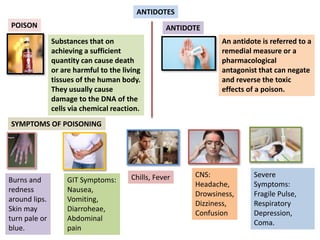
POISON
Substances that on
achieving a sufficient
quantity can cause death
or are harmful to the living
tissues of the human body.
They usually cause
damage to the DNA of the
cells via chemical reaction.
ANTIDOTE
An antidote is referred to a
remedial measure or a
pharmacological
antagonist that can negate
and reverse the toxic
effects of a poison.
SYMPTOMS OF POISONING
Burns and
redness
around lips.
Skin may
turn pale or
blue.
GIT Symptoms:
Nausea,
Vomiting,
Diarroheae,
Abdominal
pain
Chills, Fever CNS:
Headache,
Drowsiness,
Dizziness,
Confusion
Severe
Symptoms:
Fragile Pulse,
Respiratory
Depression,
Coma.
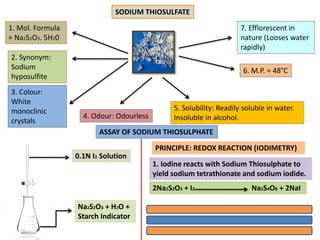
SODIUM THIOSULFATE
1. Mol. Formula
= Na2S2O3. 5H20
3. Colour:
White
monoclinic
crystals
6. M.P. = 48°C
2. Synonym:
Sodium
hyposulfite
4. Odour: Odourless
7. Efflorescent in
nature (Looses water
rapidly)
5. Solubility: Readily soluble in water.
Insoluble in alcohol.
ASSAY OF SODIUM THIOSULPHATE
0.1N I2 Solution
Na2S2O3 + H2O +
Starch Indicator
PRINCIPLE: REDOX REACTION (IODIMETRY)
1. Iodine reacts with Sodium Thiosulphate to
yield sodium tetrathionate and sodium iodide.
2Na2S2O3 + I2 Na2S4O6 + 2NaI
2. When whole of the sodium thiosulfate has
been consumed, the next drop of Iodine
solution reacts with starch indicator to form
the starch-iodine complex which is blue in
color.
3. Note the titre value
I2 + Starch [Starch-I2 complex]
(Blue colour)
4. Equivalent Weight Factor
Each ml of 0.1N I2 solution = 0.01581g of Na2S2O3
Colourless Blue Colour
Colour Change
5. % Purity =
MEDICINAL USES OF SODIUM THIOSULPHATE
1. As antidote:
As antidote to cyanide poisoning. Sodium thiosulphate donates a sulphur
atom, facilitating rhodenase catalyzed conversion of cyanide to thiocyanate.
The thiocyante formed is less toxic and is easily excreted renally.
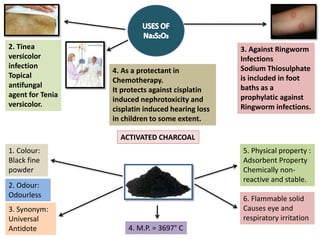
2. Tinea
versicolor
infection
Topical
antifungal
agent for Tenia
versicolor.
3. Against Ringworm
Infections
Sodium Thiosulphate
is included in foot
baths as a
prophylatic against
Ringworm infections.
4. As a protectant in
Chemotherapy.
It protects against cisplatin
induced nephrotoxicity and
cisplatin induced hearing loss
in children to some extent.
ACTIVATED CHARCOAL
2. Odour:
Odourless
1. Colour:
Black fine
powder
3. Synonym:
Universal
Antidote 4. M.P. = 3697° C
5. Physical property :
Adsorbent Property
Chemically non-
reactive and stable.
6. Flammable solid
Causes eye and
respiratory irritation
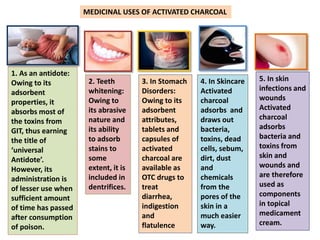
MEDICINAL USES OF ACTIVATED CHARCOAL
1. As an antidote:
Owing to its
adsorbent
properties, it
absorbs most of
the toxins from
GIT, thus earning
the title of
‘universal
Antidote’.
However, its
administration is
of lesser use when
sufficient amount
of time has passed
after consumption
of poison.
2. Teeth
whitening:
Owing to
its abrasive
nature and
its ability
to adsorb
stains to
some
extent, it is
included in
dentrifices.
3. In Stomach
Disorders:
Owing to its
adsorbent
attributes,
tablets and
capsules of
activated
charcoal are
available as
OTC drugs to
treat
diarrhea,
indigestion
and
flatulence
4. In Skincare
Activated
charcoal
adsorbs and
draws out
bacteria,
toxins, dead
cells, sebum,
dirt, dust
and
chemicals
from the
pores of the
skin in a
much easier
way.
5. In skin
infections and
wounds
Activated
charcoal
adsorbs
bacteria and
toxins from
skin and
wounds and
are therefore
used as
components
in topical
medicament
cream.
7. In Chronic Kidney Failure
Activated charcoal in the blood can bind to
creatinine, urea, uric acid and phosphorous,
reducing the amount of waste that is to be
filtered through the kidneys. Thus, it aids in
reducing the frequency of dialysis.
8. Reduction of Serum Cholesterol and
triglyceride level
Activated Charcoal has been found to adsorb
cholesterol and bile salts from the gut, thus
preventing its intake in the blood.
6. In deodrants
Activated
Charcoal adsorbs
bacteria and
toxins on their
surface. Thus, it
eliminates odour.
SODIUM NITRITE
1. Mol. Formula:
NaNO2
2. Colour: White to
slightly yellowish
crystalline powder
4. Solubility: Highly
soluble in water
3. Odour: Sweet
odour 6. Hygroscopic salt
5. M.P. = 271°C
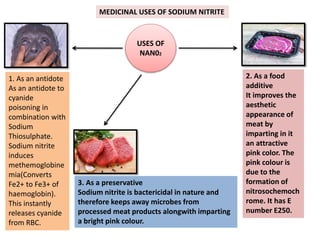
MEDICINAL USES OF SODIUM NITRITE
1. As an antidote
As an antidote to
cyanide
poisoning in
combination with
Sodium
Thiosulphate.
Sodium nitrite
induces
methemoglobine
mia(Converts
Fe2+ to Fe3+ of
haemoglobin).
This instantly
releases cyanide
from RBC.
2. As a food
additive
It improves the
aesthetic
appearance of
meat by
imparting in it
an attractive
pink color. The
pink colour is
due to the
formation of
nitrosochemoch
rome. It has E
number E250.
3. As a preservative
Sodium nitrite is bactericidal in nature and
therefore keeps away microbes from
processed meat products alongwith imparting
a bright pink colour.
USES OF
NAN02
THANK YOU.

Antidote (PCI Syllabus, B.Pharm)

  • 1.
    ANTIDOTE Authored By: Dr. AlexMartin Ph.D., M. Pharm, FAGE
  • 2.
    ANTIDOTES POISON Substances that on achievinga sufficient quantity can cause death or are harmful to the living tissues of the human body. They usually cause damage to the DNA of the cells via chemical reaction. ANTIDOTE An antidote is referred to a remedial measure or a pharmacological antagonist that can negate and reverse the toxic effects of a poison. SYMPTOMS OF POISONING Burns and redness around lips. Skin may turn pale or blue. GIT Symptoms: Nausea, Vomiting, Diarroheae, Abdominal pain Chills, Fever CNS: Headache, Drowsiness, Dizziness, Confusion Severe Symptoms: Fragile Pulse, Respiratory Depression, Coma.
  • 3.
    SODIUM THIOSULFATE 1. Mol.Formula = Na2S2O3. 5H20 3. Colour: White monoclinic crystals 6. M.P. = 48°C 2. Synonym: Sodium hyposulfite 4. Odour: Odourless 7. Efflorescent in nature (Looses water rapidly) 5. Solubility: Readily soluble in water. Insoluble in alcohol. ASSAY OF SODIUM THIOSULPHATE 0.1N I2 Solution Na2S2O3 + H2O + Starch Indicator PRINCIPLE: REDOX REACTION (IODIMETRY) 1. Iodine reacts with Sodium Thiosulphate to yield sodium tetrathionate and sodium iodide. 2Na2S2O3 + I2 Na2S4O6 + 2NaI
  • 4.
    2. When wholeof the sodium thiosulfate has been consumed, the next drop of Iodine solution reacts with starch indicator to form the starch-iodine complex which is blue in color. 3. Note the titre value I2 + Starch [Starch-I2 complex] (Blue colour) 4. Equivalent Weight Factor Each ml of 0.1N I2 solution = 0.01581g of Na2S2O3 Colourless Blue Colour Colour Change 5. % Purity = MEDICINAL USES OF SODIUM THIOSULPHATE 1. As antidote: As antidote to cyanide poisoning. Sodium thiosulphate donates a sulphur atom, facilitating rhodenase catalyzed conversion of cyanide to thiocyanate. The thiocyante formed is less toxic and is easily excreted renally.
  • 5.
    2. Tinea versicolor infection Topical antifungal agent forTenia versicolor. 3. Against Ringworm Infections Sodium Thiosulphate is included in foot baths as a prophylatic against Ringworm infections. 4. As a protectant in Chemotherapy. It protects against cisplatin induced nephrotoxicity and cisplatin induced hearing loss in children to some extent. ACTIVATED CHARCOAL 2. Odour: Odourless 1. Colour: Black fine powder 3. Synonym: Universal Antidote 4. M.P. = 3697° C 5. Physical property : Adsorbent Property Chemically non- reactive and stable. 6. Flammable solid Causes eye and respiratory irritation
  • 6.
    MEDICINAL USES OFACTIVATED CHARCOAL 1. As an antidote: Owing to its adsorbent properties, it absorbs most of the toxins from GIT, thus earning the title of ‘universal Antidote’. However, its administration is of lesser use when sufficient amount of time has passed after consumption of poison. 2. Teeth whitening: Owing to its abrasive nature and its ability to adsorb stains to some extent, it is included in dentrifices. 3. In Stomach Disorders: Owing to its adsorbent attributes, tablets and capsules of activated charcoal are available as OTC drugs to treat diarrhea, indigestion and flatulence 4. In Skincare Activated charcoal adsorbs and draws out bacteria, toxins, dead cells, sebum, dirt, dust and chemicals from the pores of the skin in a much easier way. 5. In skin infections and wounds Activated charcoal adsorbs bacteria and toxins from skin and wounds and are therefore used as components in topical medicament cream.
  • 7.
    7. In ChronicKidney Failure Activated charcoal in the blood can bind to creatinine, urea, uric acid and phosphorous, reducing the amount of waste that is to be filtered through the kidneys. Thus, it aids in reducing the frequency of dialysis. 8. Reduction of Serum Cholesterol and triglyceride level Activated Charcoal has been found to adsorb cholesterol and bile salts from the gut, thus preventing its intake in the blood. 6. In deodrants Activated Charcoal adsorbs bacteria and toxins on their surface. Thus, it eliminates odour. SODIUM NITRITE 1. Mol. Formula: NaNO2 2. Colour: White to slightly yellowish crystalline powder 4. Solubility: Highly soluble in water 3. Odour: Sweet odour 6. Hygroscopic salt 5. M.P. = 271°C
  • 8.
    MEDICINAL USES OFSODIUM NITRITE 1. As an antidote As an antidote to cyanide poisoning in combination with Sodium Thiosulphate. Sodium nitrite induces methemoglobine mia(Converts Fe2+ to Fe3+ of haemoglobin). This instantly releases cyanide from RBC. 2. As a food additive It improves the aesthetic appearance of meat by imparting in it an attractive pink color. The pink colour is due to the formation of nitrosochemoch rome. It has E number E250. 3. As a preservative Sodium nitrite is bactericidal in nature and therefore keeps away microbes from processed meat products alongwith imparting a bright pink colour. USES OF NAN02
  • 9.