1
ACIDIFIERS
Shree WaranaVibhagShikshan Mandal's
Tatyasaheb Kore College of Pharmacy,
Warananagar
Created By
Miss. A. B. Patil
M. Pharm (Pharmaceutical Chemistry)
Assistant Professor
CONTENTS
• Introduction
• Examples of Acidifiers
INTRODUCTION
• Digestion- It is mechanical and chemical
process that occurs in our body to break down the
ingested food in to smaller molecules.
INTRODUCTION
• Digestive System- The
organs used to break down
the food in to smaller
molecules which can be easily
absorbed and enters into body
cells are collectively known
as digestive System.
• It is also absorb minerals,
vitamins and water.
• It is a tubular system starts
from the buccal cavity
(mouth) to the Anus.
INTRODUCTION
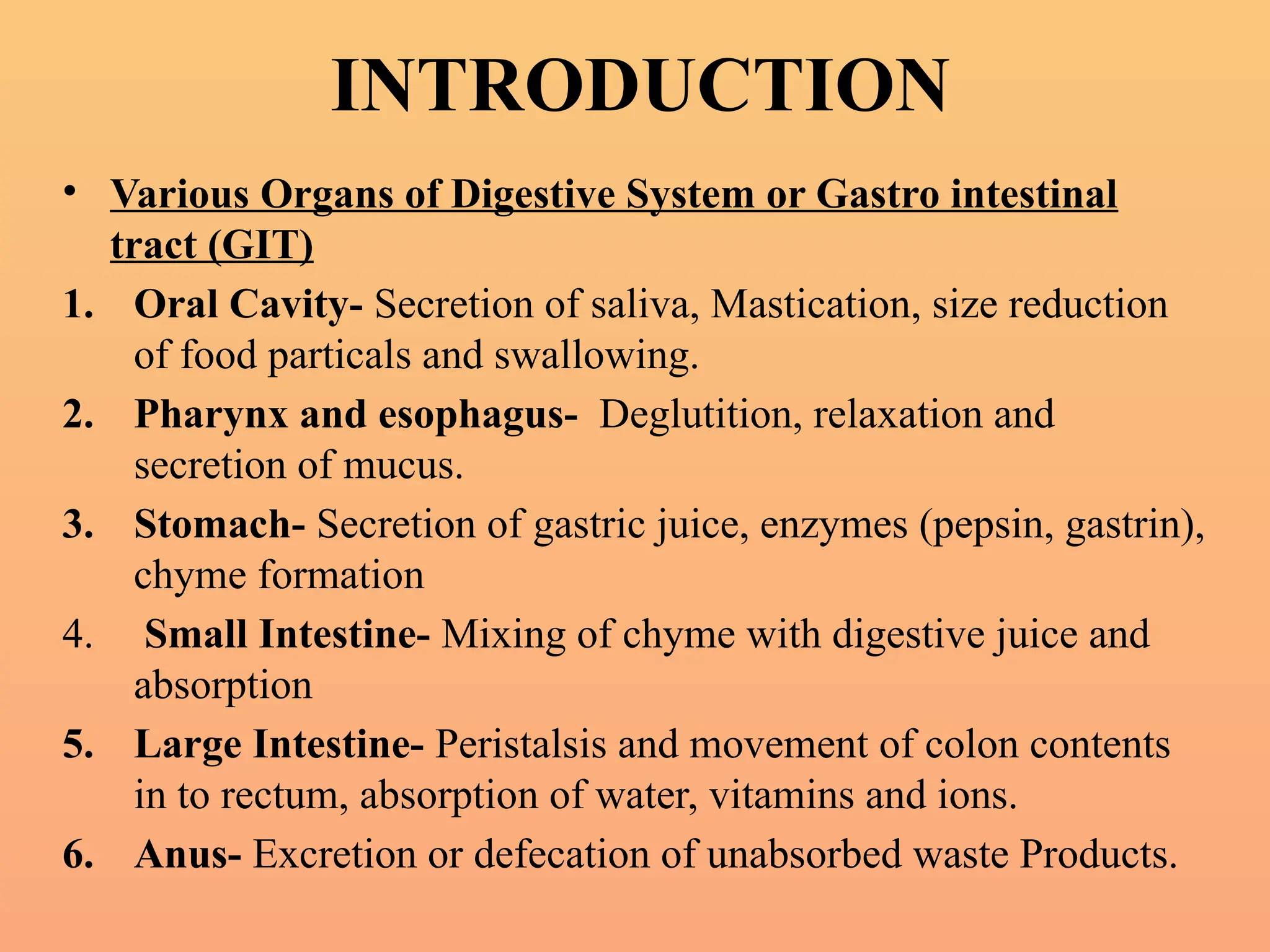
• Various Organs of Digestive System or Gastro intestinal
tract (GIT)
1. Oral Cavity- Secretion of saliva, Mastication, size reduction
of food particals and swallowing.
2. Pharynx and esophagus- Deglutition, relaxation and
secretion of mucus.
3. Stomach- Secretion of gastric juice, enzymes (pepsin, gastrin),
chyme formation
4. Small Intestine- Mixing of chyme with digestive juice and
absorption
5. Large Intestine- Peristalsis and movement of colon contents
in to rectum, absorption of water, vitamins and ions.
6. Anus- Excretion or defecation of unabsorbed waste Products.
INTRODUCTION
• Disorders /Diseases of Digestive System-
• Vomiting- Forceful expulsion of the contents of the upper GIT,
through the mouth due to strongest stimuli
• Dysphagia- Difficulty in swallowing due to inflammation.
• Nausea- Loss of appetite and vomiting sensation due to local
irritation of GIT.
• Diarrhoea- Due to indigestion, inadequate absorption of fluids and
minerals from the large intestine leads to loose, urgent bowel
movements and dehydration.
• Constipation- Lack of peristaltic movement of large intestine.
INTRODUCTION
• Gastroenteritis- inflammation of the layers of small intestine
stomach due to bacterial and viral infection.
• Heart Burn- A burning sensation in a region near to the heart
due to the esophagus irritation by gastric acid.
• Hyperacidity- Excessive gastric acid secretion in stomach lead
to imbalance of hydrochloric acid and pepsin ratio.
• Achlorhydria or hypochlorhydria- Inadequate secretion of
gastric juice in stomach lead to increase in the stomach pH. The
symptoms are mild Diarrhea and epigastric pain.
INTRODUCTION
• Acidifiers- Acidifiers are the inorganic chemicals which
produce or become acid. These are the drugs which are able
to increase the level of gastric acid in the stomach when
ingested, and hence decreasing the pH of stomach.
• Some of these drugs are used to increase metabolic acidosis
whereas some of these are used to increase the gastric
hydrochloric acid.
INTRODUCTION
• These are many types of acidifiers but the main four
main types are:
1. Gastric acidifiers:
2. Urinary acidifiers:
3. Systemic acidifiers:
4. Acids
INTRODUCTION
• Gastric acidifiers: These are the drugs which are
used to restore temporarily the acidity of the stomach
in patients suffering from achlorhydria or
hypochlorhydria.
• Urinary acidifiers: These are the drug which is used
to render acidic urine to enable treatment of some
types of urinary tract disorders.
INTRODUCTION
• Systemic acidifiers: These are the drugs which are
able to neutralize the alkaline body fluid,
particularly blood, in patients who are suffering
from systemic alkalosis.
• Acids: Acids are used as pharmaceutical aids in the
preparation, laboratory quality control
EXAMPLES OF ACIDIFIERS
1. Dilute Hydrochloric Acid
2. Ammonium Chloride
3. Dilute Phosphoric Acid
4. Dilute Ammonia Solution
5. Sodium Acid Phosphate
Dilute Hydrochloric acid
1. Synonym- spirit of salt
2. Molecular Formula: HCl (10%w/w)
3. Molecular Weight: 36.46 g/mol
4. Preparation: It is prepared by adding 274gm of
concentrated hydrochloric acid slowly in to 726gm
of purified water.
Dilute Hydrochloric acid
5. Properties:
• It is a colourless liquid , strongly acidic.
• It is miscible with water, alcohol having a specific
gravity of 1.18
• It is a strong acid and attacks metals, forming their
hydrochlorides with the evolution of hydrogen gas.
• Even in high diluted form, it is very strongly acidic to
litmus.
Dilute Hydrochloric acid
6. Assay: Simple acid base neutralization reaction.
‐
4 g of HCl is transferred into a stoppered flask
which is having 40 mL of water. Now the solution is
titrated with 1 N NaOH, using Methyl orange as an
indicator.
NaOH + HCl → NaCl + H
‐‐‐‐‐‐‐‐‐‐‐‐‐‐‐‐‐ 2O
Dilute Hydrochloric acid
7. Storage: It should be stored in well closed container of glass
or other material at a temperature not exceeding 30 °C.
8. Dose: 0.6 to 8 mL
9. Uses:
• It is mainly used as a pharmaceutical aid or as an acidifying
agent.
• Used as gastric acidifier when levels of hydrochloric acid in
gastric juice are low.
• Externally used as a solvent, catalyst in basic pharmaceutical
and as acidifier.
Ammonium chloride
1. Synonym- Sal ammoniac
2. Molecular Formula: NH4Cl
3. Molecular Weight: 53.49 g/mol
4. Preparation: Ammonium chloride is prepared
commercially by combining ammonia (NH3) with either
hydrogen chloride (gas) or hydrochloric acid (water
solution):
NH3 + HCl → NH4Cl
Ammonium chloride
5. Properties:
• Appearance: White solid, hygroscopic
• Odor: Odourless
• Taste: Cooling saline
• Density: 1.5274 g/cm3
• Melting point: 3380
C (decomposes, sublimes)
• Solubility: free soluble in water and glycerol, Sparingly
soluble in alcohol
Ammonium chloride
6. Assay:
Dissolve 1.000 g of Ammonium chloride in 20 ml of
water and add a mixture of 5 ml of formaldehyde
solution, with few drops of phenolphthalein
solution. After 1 min to 2 min, titrate slowly with
1M sodium hydroxide.
Ammonium chloride
7. Storage: Store in highly closed container.
8. Dose: 1 to 2 gm (As systemic acidifier); 0.3 to 0.5 gm
(Expectorant)
9. Uses:
• Ammonium chloride is used as an expectorant in cough medicine
• Ammonium chloride is used as a systemic acidifying agent in
treatment of severe metabolic alkalosis.
• The main application of ammonium chloride is as a nitrogen
source in fertilizers.
THANK YOU….

Acidifiers - First Year Pharm D Pharmaceutical Inorganic Chemistry

  • 1.
    1 ACIDIFIERS Shree WaranaVibhagShikshan Mandal's TatyasahebKore College of Pharmacy, Warananagar Created By Miss. A. B. Patil M. Pharm (Pharmaceutical Chemistry) Assistant Professor
  • 2.
  • 3.
    INTRODUCTION • Digestion- Itis mechanical and chemical process that occurs in our body to break down the ingested food in to smaller molecules.
  • 4.
    INTRODUCTION • Digestive System-The organs used to break down the food in to smaller molecules which can be easily absorbed and enters into body cells are collectively known as digestive System. • It is also absorb minerals, vitamins and water. • It is a tubular system starts from the buccal cavity (mouth) to the Anus.
  • 5.
    INTRODUCTION • Various Organsof Digestive System or Gastro intestinal tract (GIT) 1. Oral Cavity- Secretion of saliva, Mastication, size reduction of food particals and swallowing. 2. Pharynx and esophagus- Deglutition, relaxation and secretion of mucus. 3. Stomach- Secretion of gastric juice, enzymes (pepsin, gastrin), chyme formation 4. Small Intestine- Mixing of chyme with digestive juice and absorption 5. Large Intestine- Peristalsis and movement of colon contents in to rectum, absorption of water, vitamins and ions. 6. Anus- Excretion or defecation of unabsorbed waste Products.
  • 6.
    INTRODUCTION • Disorders /Diseasesof Digestive System- • Vomiting- Forceful expulsion of the contents of the upper GIT, through the mouth due to strongest stimuli • Dysphagia- Difficulty in swallowing due to inflammation. • Nausea- Loss of appetite and vomiting sensation due to local irritation of GIT. • Diarrhoea- Due to indigestion, inadequate absorption of fluids and minerals from the large intestine leads to loose, urgent bowel movements and dehydration. • Constipation- Lack of peristaltic movement of large intestine.
  • 7.
    INTRODUCTION • Gastroenteritis- inflammationof the layers of small intestine stomach due to bacterial and viral infection. • Heart Burn- A burning sensation in a region near to the heart due to the esophagus irritation by gastric acid. • Hyperacidity- Excessive gastric acid secretion in stomach lead to imbalance of hydrochloric acid and pepsin ratio. • Achlorhydria or hypochlorhydria- Inadequate secretion of gastric juice in stomach lead to increase in the stomach pH. The symptoms are mild Diarrhea and epigastric pain.
  • 8.
    INTRODUCTION • Acidifiers- Acidifiersare the inorganic chemicals which produce or become acid. These are the drugs which are able to increase the level of gastric acid in the stomach when ingested, and hence decreasing the pH of stomach. • Some of these drugs are used to increase metabolic acidosis whereas some of these are used to increase the gastric hydrochloric acid.
  • 9.
    INTRODUCTION • These aremany types of acidifiers but the main four main types are: 1. Gastric acidifiers: 2. Urinary acidifiers: 3. Systemic acidifiers: 4. Acids
  • 10.
    INTRODUCTION • Gastric acidifiers:These are the drugs which are used to restore temporarily the acidity of the stomach in patients suffering from achlorhydria or hypochlorhydria. • Urinary acidifiers: These are the drug which is used to render acidic urine to enable treatment of some types of urinary tract disorders.
  • 11.
    INTRODUCTION • Systemic acidifiers:These are the drugs which are able to neutralize the alkaline body fluid, particularly blood, in patients who are suffering from systemic alkalosis. • Acids: Acids are used as pharmaceutical aids in the preparation, laboratory quality control
  • 12.
    EXAMPLES OF ACIDIFIERS 1.Dilute Hydrochloric Acid 2. Ammonium Chloride 3. Dilute Phosphoric Acid 4. Dilute Ammonia Solution 5. Sodium Acid Phosphate
  • 13.
    Dilute Hydrochloric acid 1.Synonym- spirit of salt 2. Molecular Formula: HCl (10%w/w) 3. Molecular Weight: 36.46 g/mol 4. Preparation: It is prepared by adding 274gm of concentrated hydrochloric acid slowly in to 726gm of purified water.
  • 14.
    Dilute Hydrochloric acid 5.Properties: • It is a colourless liquid , strongly acidic. • It is miscible with water, alcohol having a specific gravity of 1.18 • It is a strong acid and attacks metals, forming their hydrochlorides with the evolution of hydrogen gas. • Even in high diluted form, it is very strongly acidic to litmus.
  • 15.
    Dilute Hydrochloric acid 6.Assay: Simple acid base neutralization reaction. ‐ 4 g of HCl is transferred into a stoppered flask which is having 40 mL of water. Now the solution is titrated with 1 N NaOH, using Methyl orange as an indicator. NaOH + HCl → NaCl + H ‐‐‐‐‐‐‐‐‐‐‐‐‐‐‐‐‐ 2O
  • 16.
    Dilute Hydrochloric acid 7.Storage: It should be stored in well closed container of glass or other material at a temperature not exceeding 30 °C. 8. Dose: 0.6 to 8 mL 9. Uses: • It is mainly used as a pharmaceutical aid or as an acidifying agent. • Used as gastric acidifier when levels of hydrochloric acid in gastric juice are low. • Externally used as a solvent, catalyst in basic pharmaceutical and as acidifier.
  • 17.
    Ammonium chloride 1. Synonym-Sal ammoniac 2. Molecular Formula: NH4Cl 3. Molecular Weight: 53.49 g/mol 4. Preparation: Ammonium chloride is prepared commercially by combining ammonia (NH3) with either hydrogen chloride (gas) or hydrochloric acid (water solution): NH3 + HCl → NH4Cl
  • 18.
    Ammonium chloride 5. Properties: •Appearance: White solid, hygroscopic • Odor: Odourless • Taste: Cooling saline • Density: 1.5274 g/cm3 • Melting point: 3380 C (decomposes, sublimes) • Solubility: free soluble in water and glycerol, Sparingly soluble in alcohol
  • 19.
    Ammonium chloride 6. Assay: Dissolve1.000 g of Ammonium chloride in 20 ml of water and add a mixture of 5 ml of formaldehyde solution, with few drops of phenolphthalein solution. After 1 min to 2 min, titrate slowly with 1M sodium hydroxide.
  • 20.
    Ammonium chloride 7. Storage:Store in highly closed container. 8. Dose: 1 to 2 gm (As systemic acidifier); 0.3 to 0.5 gm (Expectorant) 9. Uses: • Ammonium chloride is used as an expectorant in cough medicine • Ammonium chloride is used as a systemic acidifying agent in treatment of severe metabolic alkalosis. • The main application of ammonium chloride is as a nitrogen source in fertilizers.
  • 21.