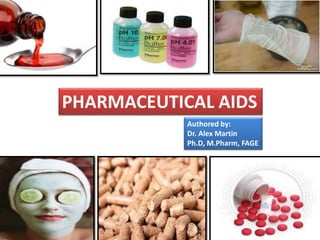
PHARMACEUTICAL AIDS
Authored by:
Dr. Alex Martin
Ph.D, M.Pharm, FAGE
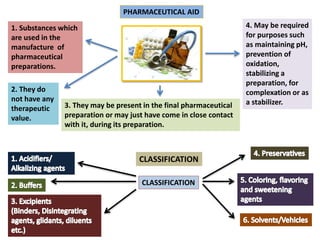
PHARMACEUTICAL AID
1. Substances which
are used in the
manufacture of
pharmaceutical
preparations.
2. They do
not have any
therapeutic
value.
3. They may be present in the final pharmaceutical
preparation or may just have come in close contact
with it, during its preparation.
4. May be required
for purposes such
as maintaining pH,
prevention of
oxidation,
stabilizing a
preparation, for
complexation or as
a stabilizer.
CLASSIFICATION
CLASSIFICATION
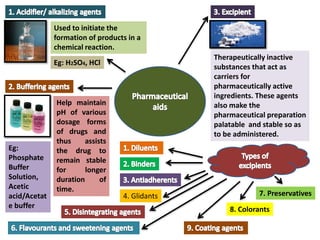
Used to initiate the
formation of products in a
chemical reaction.
Eg: H2SO4, HCl
Help maintain
pH of various
dosage forms
of drugs and
thus assists
the drug to
remain stable
for longer
duration of
time.
Eg:
Phosphate
Buffer
Solution,
Acetic
acid/Acetat
e buffer
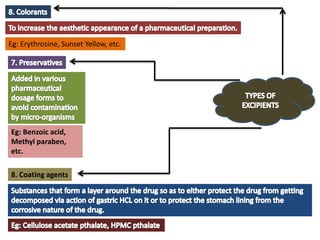
Therapeutically inactive
substances that act as
carriers for
pharmaceutically active
ingredients. These agents
also make the
pharmaceutical preparation
palatable and stable so as
to be administered.
8. Colorants
7. Preservatives
4. Glidants
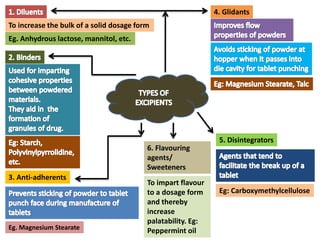
To increase the bulk of a solid dosage form
Eg. Anhydrous lactose, mannitol, etc.
3. Anti-adherents
Eg. Magnesium Stearate
4. Glidants
5. Disintegrators
Eg: Carboxymethylcellulose
6. Flavouring
agents/
Sweeteners
To impart flavour
to a dosage form
and thereby
increase
palatability. Eg:
Peppermint oil
Eg: Erythrosine, Sunset Yellow, etc.
Eg: Benzoic acid,
Methyl paraben,
etc.
8. Coating agents
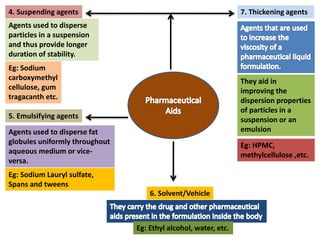
4. Suspending agents
Agents used to disperse
particles in a suspension
and thus provide longer
duration of stability.
Eg: Sodium
carboxymethyl
cellulose, gum
tragacanth etc.
5. Emulsifying agents
Agents used to disperse fat
globules uniformly throughout
aqueous medium or vice-
versa.
Eg: Sodium Lauryl sulfate,
Spans and tweens
6. Solvent/Vehicle
Eg: Ethyl alcohol, water, etc.
7. Thickening agents
They aid in
improving the
dispersion properties
of particles in a
suspension or an
emulsion
Eg: HPMC,
methylcellulose ,etc.
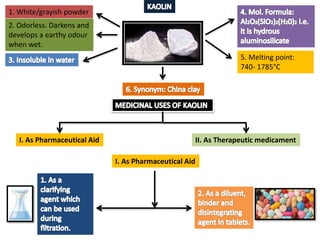
1. White/grayish powder
2. Odorless. Darkens and
develops a earthy odour
when wet.
5. Melting point:
740- 1785°C
I. As Pharmaceutical Aid II. As Therapeutic medicament
I. As Pharmaceutical Aid
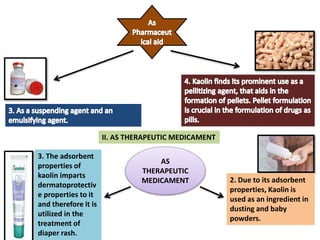
II. AS THERAPEUTIC MEDICAMENT
AS
THERAPEUTIC
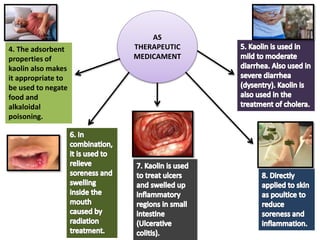
MEDICAMENT 2. Due to its adsorbent
properties, Kaolin is
used as an ingredient in
dusting and baby
powders.
3. The adsorbent
properties of
kaolin imparts
dermatoprotectiv
e properties to it
and therefore it is
utilized in the
treatment of
diaper rash.
4. The adsorbent
properties of
kaolin also makes
it appropriate to
be used to negate
food and
alkaloidal
poisoning.
AS
THERAPEUTIC
MEDICAMENT
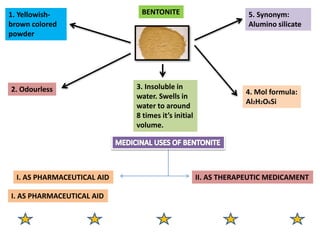
BENTONITE
1. Yellowish-
brown colored
powder
2. Odourless 3. Insoluble in
water. Swells in
water to around
8 times it’s initial
volume.
4. Mol formula:
Al2H2O6Si
5. Synonym:
Alumino silicate
I. AS PHARMACEUTICAL AID II. AS THERAPEUTIC MEDICAMENT
I. AS PHARMACEUTICAL AID
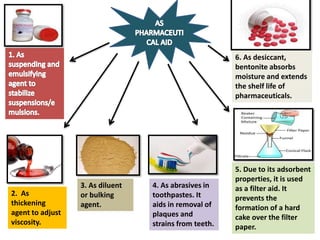
2. As
thickening
agent to adjust
viscosity.
3. As diluent
or bulking
agent.
4. As abrasives in
toothpastes. It
aids in removal of
plaques and
strains from teeth.
5. Due to its adsorbent
properties, it is used
as a filter aid. It
prevents the
formation of a hard
cake over the filter
paper.
6. As desiccant,
bentonite absorbs
moisture and extends
the shelf life of
pharmaceuticals.
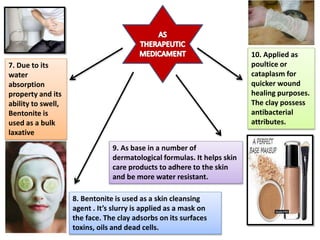
7. Due to its
water
absorption
property and its
ability to swell,
Bentonite is
used as a bulk
laxative
8. Bentonite is used as a skin cleansing
agent . It’s slurry is applied as a mask on
the face. The clay adsorbs on its surfaces
toxins, oils and dead cells.
9. As base in a number of
dermatological formulas. It helps skin
care products to adhere to the skin
and be more water resistant.
10. Applied as
poultice or
cataplasm for
quicker wound
healing purposes.
The clay possess
antibacterial
attributes.
CONFUSED WITH YOUR
RESEARCH WORK IN
PHARMACY….
CONTACT ME ON:
aalexmartin@rediffmail.com

Pharmaceutical aids (PCI Syllabus)

  • 1.
    PHARMACEUTICAL AIDS Authored by: Dr.Alex Martin Ph.D, M.Pharm, FAGE
  • 2.
    PHARMACEUTICAL AID 1. Substanceswhich are used in the manufacture of pharmaceutical preparations. 2. They do not have any therapeutic value. 3. They may be present in the final pharmaceutical preparation or may just have come in close contact with it, during its preparation. 4. May be required for purposes such as maintaining pH, prevention of oxidation, stabilizing a preparation, for complexation or as a stabilizer. CLASSIFICATION CLASSIFICATION
  • 3.
    Used to initiatethe formation of products in a chemical reaction. Eg: H2SO4, HCl Help maintain pH of various dosage forms of drugs and thus assists the drug to remain stable for longer duration of time. Eg: Phosphate Buffer Solution, Acetic acid/Acetat e buffer Therapeutically inactive substances that act as carriers for pharmaceutically active ingredients. These agents also make the pharmaceutical preparation palatable and stable so as to be administered. 8. Colorants 7. Preservatives 4. Glidants
  • 4.
    To increase thebulk of a solid dosage form Eg. Anhydrous lactose, mannitol, etc. 3. Anti-adherents Eg. Magnesium Stearate 4. Glidants 5. Disintegrators Eg: Carboxymethylcellulose 6. Flavouring agents/ Sweeteners To impart flavour to a dosage form and thereby increase palatability. Eg: Peppermint oil
  • 5.
    Eg: Erythrosine, SunsetYellow, etc. Eg: Benzoic acid, Methyl paraben, etc. 8. Coating agents
  • 6.
    4. Suspending agents Agentsused to disperse particles in a suspension and thus provide longer duration of stability. Eg: Sodium carboxymethyl cellulose, gum tragacanth etc. 5. Emulsifying agents Agents used to disperse fat globules uniformly throughout aqueous medium or vice- versa. Eg: Sodium Lauryl sulfate, Spans and tweens 6. Solvent/Vehicle Eg: Ethyl alcohol, water, etc. 7. Thickening agents They aid in improving the dispersion properties of particles in a suspension or an emulsion Eg: HPMC, methylcellulose ,etc.
  • 7.
    1. White/grayish powder 2.Odorless. Darkens and develops a earthy odour when wet. 5. Melting point: 740- 1785°C I. As Pharmaceutical Aid II. As Therapeutic medicament I. As Pharmaceutical Aid
  • 8.
    II. AS THERAPEUTICMEDICAMENT AS THERAPEUTIC MEDICAMENT 2. Due to its adsorbent properties, Kaolin is used as an ingredient in dusting and baby powders. 3. The adsorbent properties of kaolin imparts dermatoprotectiv e properties to it and therefore it is utilized in the treatment of diaper rash.
  • 9.
    4. The adsorbent propertiesof kaolin also makes it appropriate to be used to negate food and alkaloidal poisoning. AS THERAPEUTIC MEDICAMENT
  • 10.
    BENTONITE 1. Yellowish- brown colored powder 2.Odourless 3. Insoluble in water. Swells in water to around 8 times it’s initial volume. 4. Mol formula: Al2H2O6Si 5. Synonym: Alumino silicate I. AS PHARMACEUTICAL AID II. AS THERAPEUTIC MEDICAMENT I. AS PHARMACEUTICAL AID
  • 11.
    2. As thickening agent toadjust viscosity. 3. As diluent or bulking agent. 4. As abrasives in toothpastes. It aids in removal of plaques and strains from teeth. 5. Due to its adsorbent properties, it is used as a filter aid. It prevents the formation of a hard cake over the filter paper. 6. As desiccant, bentonite absorbs moisture and extends the shelf life of pharmaceuticals.
  • 12.
    7. Due toits water absorption property and its ability to swell, Bentonite is used as a bulk laxative 8. Bentonite is used as a skin cleansing agent . It’s slurry is applied as a mask on the face. The clay adsorbs on its surfaces toxins, oils and dead cells. 9. As base in a number of dermatological formulas. It helps skin care products to adhere to the skin and be more water resistant. 10. Applied as poultice or cataplasm for quicker wound healing purposes. The clay possess antibacterial attributes.
  • 13.
    CONFUSED WITH YOUR RESEARCHWORK IN PHARMACY…. CONTACT ME ON: aalexmartin@rediffmail.com