ANTIMICROBIALS
Authored By:
Dr. Alex Martin
Ph.D., M.Pharm, FAGE
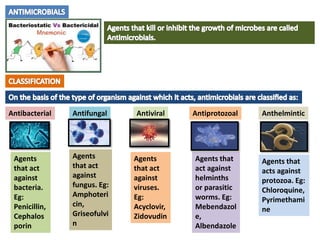
Antibacterial
Agents
that act
against
bacteria.
Eg:
Penicillin,
Cephalos
porin
Antifungal
Agents
that act
against
fungus. Eg:
Amphoteri
cin,
Griseofulvi
n
Antiviral
Agents
that act
against
viruses.
Eg:
Acyclovir,
Zidovudin
Antiprotozoal
Agents that
acts against
protozoa. Eg:
Chloroquine,
Pyrimethami
ne
Anthelmintic
Agents that
act against
helminths
or parasitic
worms. Eg:
Mebendazol
e,
Albendazole
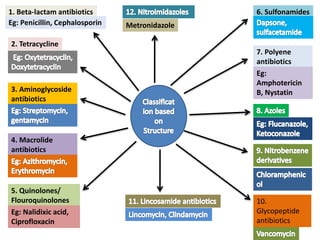
1. Beta-lactam antibiotics
Eg: Penicillin, Cephalosporin
2. Tetracycline
3. Aminoglycoside
antibiotics
4. Macrolide
antibiotics
5. Quinolones/
Flouroquinolones
Eg: Nalidixic acid,
Ciprofloxacin
6. Sulfonamides
7. Polyene
antibiotics
Eg:
Amphotericin
B, Nystatin
10.
Glycopeptide
antibiotics
Metronidazole
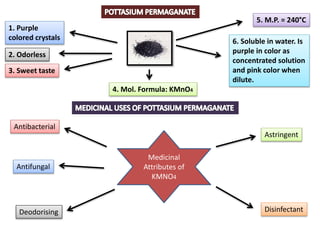
1. Purple
colored crystals
2. Odorless
3. Sweet taste
5. M.P. = 240°C
4. Mol. Formula: KMnO4
6. Soluble in water. Is
purple in color as
concentrated solution
and pink color when
dilute.
Medicinal
Attributes of
KMNO4
Antibacterial
Antifungal
Astringent
Disinfectant
Deodorising
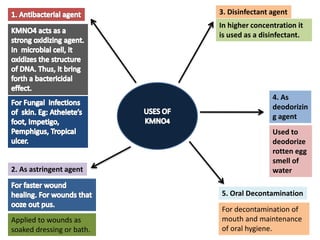
2. As astringent agent
Applied to wounds as
soaked dressing or bath.
3. Disinfectant agent
In higher concentration it
is used as a disinfectant.
4. As
deodorizin
g agent
Used to
deodorize
rotten egg
smell of
water
5. Oral Decontamination
For decontamination of
mouth and maintenance
of oral hygiene.
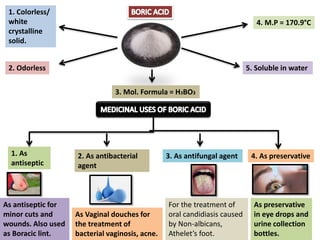
1. Colorless/
white
crystalline
solid.
5. Soluble in water
3. Mol. Formula = H3BO3
4. M.P = 170.9°C
2. Odorless
2. As antibacterial
agent
3. As antifungal agent 4. As preservative
1. As
antiseptic
As antiseptic for
minor cuts and
wounds. Also used
as Boracic lint.
As Vaginal douches for
the treatment of
bacterial vaginosis, acne.
For the treatment of
oral candidiasis caused
by Non-albicans,
Athelet’s foot.
As preservative
in eye drops and
urine collection
bottles.
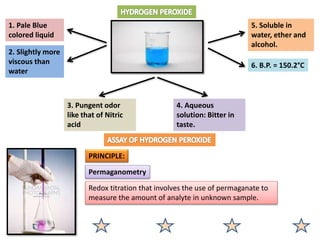
1. Pale Blue
colored liquid
2. Slightly more
viscous than
water
6. B.P. = 150.2°C
5. Soluble in
water, ether and
alcohol.
4. Aqueous
solution: Bitter in
taste.
3. Pungent odor
like that of Nitric
acid
PRINCIPLE:
Permaganometry
Redox titration that involves the use of permaganate to
measure the amount of analyte in unknown sample.
1. KMNO4 reacts with H2O2 to form colorless
solution of KHSO4 and MnSO4
5H202 + 2KMnO4 + 4H2SO4
2KHSO4 + 2MnSO4 + 5O2 + 8H2O
2. The reaction is initially slow to begin but
the presence of maganese ions acts as a
catalyst, aiding the reactants to react faster
and titration to be completed on time.
3. When whole of the H202 has reacted, a
drop in excess of KMnO4 will produce a
permanent pale pink colour that persists in
the conical flask.
4. Thus, KMnO4 acts as a self-indicator.
0.5 ml H2O2 + 10
ml H2SO4 + 100
ml H20 + small
scoop of MnSO4
KMNO4
1. Add 0.5 ml H2O2
+ 10 ml H2SO4 +
100 ml H20 + small
scoop of MnSO4
2. Fill 0.02M
KMnO4 upto
100 ml
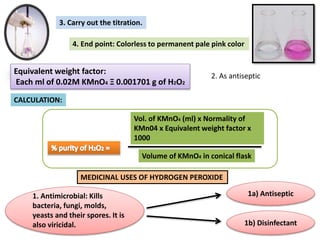
3. Carry out the titration.
4. End point: Colorless to permanent pale pink color
Equivalent weight factor:
Each ml of 0.02M KMnO4 Ξ 0.001701 g of H2O2
CALCULATION:
Vol. of KMnO4 (ml) x Normality of
KMn04 x Equivalent weight factor x
1000
Volume of KMnO4 in conical flask
MEDICINAL USES OF HYDROGEN PEROXIDE
2. As antiseptic
1. Antimicrobial: Kills
bacteria, fungi, molds,
yeasts and their spores. It is
also viricidal.
1a) Antiseptic
1b) Disinfectant
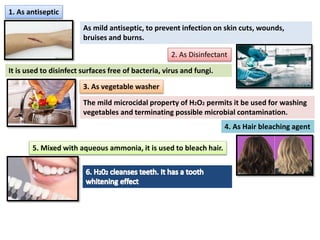
1. As antiseptic
As mild antiseptic, to prevent infection on skin cuts, wounds,
bruises and burns.
2. As Disinfectant
It is used to disinfect surfaces free of bacteria, virus and fungi.
3. As vegetable washer
The mild microcidal property of H2O2 permits it be used for washing
vegetables and terminating possible microbial contamination.
4. As Hair bleaching agent
5. Mixed with aqueous ammonia, it is used to bleach hair.
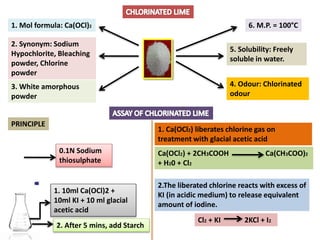
1. Mol formula: Ca(OCl)2
2. Synonym: Sodium
Hypochlorite, Bleaching
powder, Chlorine
powder
3. White amorphous
powder
4. Odour: Chlorinated
odour
6. M.P. = 100°C
5. Solubility: Freely
soluble in water.
1. 10ml Ca(OCl)2 +
10ml KI + 10 ml glacial
acetic acid
2. After 5 mins, add Starch
0.1N Sodium
thiosulphate
PRINCIPLE
1. Ca(OCl2) liberates chlorine gas on
treatment with glacial acetic acid
Ca(OCl2) + 2CH3COOH Ca(CH3COO)2
+ H20 + Cl2
2.The liberated chlorine reacts with excess of
KI (in acidic medium) to release equivalent
amount of iodine.
Cl2 + KI 2KCl + I2
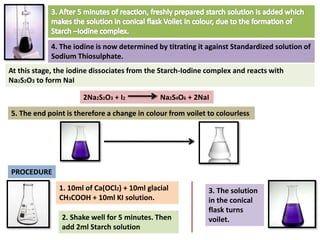
4. The iodine is now determined by titrating it against Standardized solution of
Sodium Thiosulphate.
At this stage, the iodine dissociates from the Starch-Iodine complex and reacts with
Na2S2O3 to form NaI
5. The end point is therefore a change in colour from voilet to colourless
2Na2S2O3 + I2 Na2S4O6 + 2NaI
PROCEDURE
1. 10ml of Ca(OCl2) + 10ml glacial
CH3COOH + 10ml KI solution.
2. Shake well for 5 minutes. Then
add 2ml Starch solution
3. The solution
in the conical
flask turns
voilet.
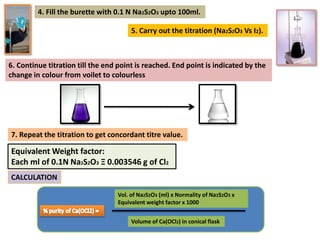
4. Fill the burette with 0.1 N Na2S2O3 upto 100ml.
5. Carry out the titration (Na2S2O3 Vs I2).
6. Continue titration till the end point is reached. End point is indicated by the
change in colour from voilet to colourless
7. Repeat the titration to get concordant titre value.
Equivalent Weight factor:
Each ml of 0.1N Na2S2O3 Ξ 0.003546 g of Cl2
CALCULATION
Vol. of Na2S2O3 (ml) x Normality of Na2S2O3 x
Equivalent weight factor x 1000
Volume of Ca(OCl2) in conical flask
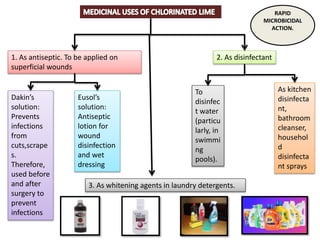
1. As antiseptic. To be applied on
superficial wounds
2. As disinfectant
Dakin’s
solution:
Prevents
infections
from
cuts,scrape
s.
Therefore,
used before
and after
surgery to
prevent
infections
Eusol’s
solution:
Antiseptic
lotion for
wound
disinfection
and wet
dressing
To
disinfec
t water
(particu
larly, in
swimmi
ng
pools).
As kitchen
disinfecta
nt,
bathroom
cleanser,
househol
d
disinfecta
nt sprays
3. As whitening agents in laundry detergents.
RAPID
MICROBICIDAL
ACTION.
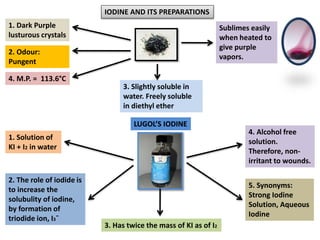
IODINE AND ITS PREPARATIONS
1. Dark Purple
lusturous crystals
2. Odour:
Pungent
3. Slightly soluble in
water. Freely soluble
in diethyl ether
4. M.P. = 113.6°C
Sublimes easily
when heated to
give purple
vapors.
LUGOL’S IODINE
1. Solution of
KI + I2 in water
2. The role of iodide is
to increase the
solubulity of iodine,
by formation of
triodide ion, I3¯
4. Alcohol free
solution.
Therefore, non-
irritant to wounds.
3. Has twice the mass of KI as of I2
5. Synonyms:
Strong Iodine
Solution, Aqueous
Iodine
MEDICINAL USES OF LUGOL’S SOLUTION
1. As an
antiseptic
to cleanse
wounds
and make
them
pathogen
free.
However,
it may
result in a
temporar
y staining
of the
skin.
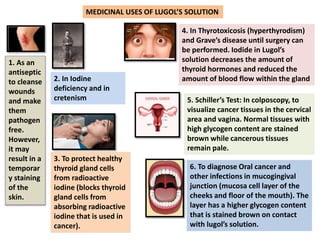
4. In Thyrotoxicosis (hyperthyrodism)
and Grave’s disease until surgery can
be performed. Iodide in Lugol’s
solution decreases the amount of
thyroid hormones and reduced the
amount of blood flow within the gland
3. To protect healthy
thyroid gland cells
from radioactive
iodine (blocks thyroid
gland cells from
absorbing radioactive
iodine that is used in
cancer).
2. In Iodine
deficiency and in
cretenism 5. Schiller’s Test: In colposcopy, to
visualize cancer tissues in the cervical
area and vagina. Normal tissues with
high glycogen content are stained
brown while cancerous tissues
remain pale.
6. To diagnose Oral cancer and
other infections in mucogingival
junction (mucosa cell layer of the
cheeks and floor of the mouth). The
layer has a higher glycogen content
that is stained brown on contact
with lugol’s solution.
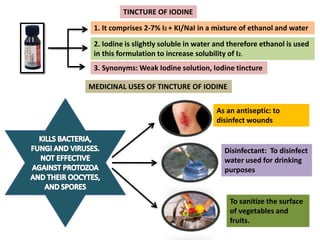
TINCTURE OF IODINE
3. Synonyms: Weak Iodine solution, Iodine tincture
1. It comprises 2-7% I2 + KI/NaI in a mixture of ethanol and water
2. Iodine is slightly soluble in water and therefore ethanol is used
in this formulation to increase solubility of I2.
MEDICINAL USES OF TINCTURE OF IODINE
As an antiseptic: to
disinfect wounds
Disinfectant: To disinfect
water used for drinking
purposes
To sanitize the surface
of vegetables and
fruits.
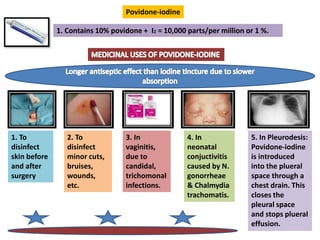
Povidone-iodine
1. Contains 10% povidone + I2 = 10,000 parts/per million or 1 %.
1. To
disinfect
skin before
and after
surgery
2. To
disinfect
minor cuts,
bruises,
wounds,
etc.
3. In
vaginitis,
due to
candidal,
trichomonal
infections.
4. In
neonatal
conjuctivitis
caused by N.
gonorrheae
& Chalmydia
trachomatis.
5. In Pleurodesis:
Povidone-iodine
is introduced
into the plueral
space through a
chest drain. This
closes the
pleural space
and stops plueral
effusion.
THANK YOU

Antimicrobials (PCI syllabus, B.Pharm)

  • 1.
    ANTIMICROBIALS Authored By: Dr. AlexMartin Ph.D., M.Pharm, FAGE
  • 2.
    Antibacterial Agents that act against bacteria. Eg: Penicillin, Cephalos porin Antifungal Agents that act against fungus.Eg: Amphoteri cin, Griseofulvi n Antiviral Agents that act against viruses. Eg: Acyclovir, Zidovudin Antiprotozoal Agents that acts against protozoa. Eg: Chloroquine, Pyrimethami ne Anthelmintic Agents that act against helminths or parasitic worms. Eg: Mebendazol e, Albendazole
  • 3.
    1. Beta-lactam antibiotics Eg:Penicillin, Cephalosporin 2. Tetracycline 3. Aminoglycoside antibiotics 4. Macrolide antibiotics 5. Quinolones/ Flouroquinolones Eg: Nalidixic acid, Ciprofloxacin 6. Sulfonamides 7. Polyene antibiotics Eg: Amphotericin B, Nystatin 10. Glycopeptide antibiotics Metronidazole
  • 4.
    1. Purple colored crystals 2.Odorless 3. Sweet taste 5. M.P. = 240°C 4. Mol. Formula: KMnO4 6. Soluble in water. Is purple in color as concentrated solution and pink color when dilute. Medicinal Attributes of KMNO4 Antibacterial Antifungal Astringent Disinfectant Deodorising
  • 5.
    2. As astringentagent Applied to wounds as soaked dressing or bath. 3. Disinfectant agent In higher concentration it is used as a disinfectant. 4. As deodorizin g agent Used to deodorize rotten egg smell of water 5. Oral Decontamination For decontamination of mouth and maintenance of oral hygiene.
  • 6.
    1. Colorless/ white crystalline solid. 5. Solublein water 3. Mol. Formula = H3BO3 4. M.P = 170.9°C 2. Odorless 2. As antibacterial agent 3. As antifungal agent 4. As preservative 1. As antiseptic As antiseptic for minor cuts and wounds. Also used as Boracic lint. As Vaginal douches for the treatment of bacterial vaginosis, acne. For the treatment of oral candidiasis caused by Non-albicans, Athelet’s foot. As preservative in eye drops and urine collection bottles.
  • 7.
    1. Pale Blue coloredliquid 2. Slightly more viscous than water 6. B.P. = 150.2°C 5. Soluble in water, ether and alcohol. 4. Aqueous solution: Bitter in taste. 3. Pungent odor like that of Nitric acid PRINCIPLE: Permaganometry Redox titration that involves the use of permaganate to measure the amount of analyte in unknown sample.
  • 8.
    1. KMNO4 reactswith H2O2 to form colorless solution of KHSO4 and MnSO4 5H202 + 2KMnO4 + 4H2SO4 2KHSO4 + 2MnSO4 + 5O2 + 8H2O 2. The reaction is initially slow to begin but the presence of maganese ions acts as a catalyst, aiding the reactants to react faster and titration to be completed on time. 3. When whole of the H202 has reacted, a drop in excess of KMnO4 will produce a permanent pale pink colour that persists in the conical flask. 4. Thus, KMnO4 acts as a self-indicator. 0.5 ml H2O2 + 10 ml H2SO4 + 100 ml H20 + small scoop of MnSO4 KMNO4 1. Add 0.5 ml H2O2 + 10 ml H2SO4 + 100 ml H20 + small scoop of MnSO4 2. Fill 0.02M KMnO4 upto 100 ml
  • 9.
    3. Carry outthe titration. 4. End point: Colorless to permanent pale pink color Equivalent weight factor: Each ml of 0.02M KMnO4 Ξ 0.001701 g of H2O2 CALCULATION: Vol. of KMnO4 (ml) x Normality of KMn04 x Equivalent weight factor x 1000 Volume of KMnO4 in conical flask MEDICINAL USES OF HYDROGEN PEROXIDE 2. As antiseptic 1. Antimicrobial: Kills bacteria, fungi, molds, yeasts and their spores. It is also viricidal. 1a) Antiseptic 1b) Disinfectant
  • 10.
    1. As antiseptic Asmild antiseptic, to prevent infection on skin cuts, wounds, bruises and burns. 2. As Disinfectant It is used to disinfect surfaces free of bacteria, virus and fungi. 3. As vegetable washer The mild microcidal property of H2O2 permits it be used for washing vegetables and terminating possible microbial contamination. 4. As Hair bleaching agent 5. Mixed with aqueous ammonia, it is used to bleach hair.
  • 11.
    1. Mol formula:Ca(OCl)2 2. Synonym: Sodium Hypochlorite, Bleaching powder, Chlorine powder 3. White amorphous powder 4. Odour: Chlorinated odour 6. M.P. = 100°C 5. Solubility: Freely soluble in water. 1. 10ml Ca(OCl)2 + 10ml KI + 10 ml glacial acetic acid 2. After 5 mins, add Starch 0.1N Sodium thiosulphate PRINCIPLE 1. Ca(OCl2) liberates chlorine gas on treatment with glacial acetic acid Ca(OCl2) + 2CH3COOH Ca(CH3COO)2 + H20 + Cl2 2.The liberated chlorine reacts with excess of KI (in acidic medium) to release equivalent amount of iodine. Cl2 + KI 2KCl + I2
  • 12.
    4. The iodineis now determined by titrating it against Standardized solution of Sodium Thiosulphate. At this stage, the iodine dissociates from the Starch-Iodine complex and reacts with Na2S2O3 to form NaI 5. The end point is therefore a change in colour from voilet to colourless 2Na2S2O3 + I2 Na2S4O6 + 2NaI PROCEDURE 1. 10ml of Ca(OCl2) + 10ml glacial CH3COOH + 10ml KI solution. 2. Shake well for 5 minutes. Then add 2ml Starch solution 3. The solution in the conical flask turns voilet.
  • 13.
    4. Fill theburette with 0.1 N Na2S2O3 upto 100ml. 5. Carry out the titration (Na2S2O3 Vs I2). 6. Continue titration till the end point is reached. End point is indicated by the change in colour from voilet to colourless 7. Repeat the titration to get concordant titre value. Equivalent Weight factor: Each ml of 0.1N Na2S2O3 Ξ 0.003546 g of Cl2 CALCULATION Vol. of Na2S2O3 (ml) x Normality of Na2S2O3 x Equivalent weight factor x 1000 Volume of Ca(OCl2) in conical flask
  • 14.
    1. As antiseptic.To be applied on superficial wounds 2. As disinfectant Dakin’s solution: Prevents infections from cuts,scrape s. Therefore, used before and after surgery to prevent infections Eusol’s solution: Antiseptic lotion for wound disinfection and wet dressing To disinfec t water (particu larly, in swimmi ng pools). As kitchen disinfecta nt, bathroom cleanser, househol d disinfecta nt sprays 3. As whitening agents in laundry detergents. RAPID MICROBICIDAL ACTION.
  • 15.
    IODINE AND ITSPREPARATIONS 1. Dark Purple lusturous crystals 2. Odour: Pungent 3. Slightly soluble in water. Freely soluble in diethyl ether 4. M.P. = 113.6°C Sublimes easily when heated to give purple vapors. LUGOL’S IODINE 1. Solution of KI + I2 in water 2. The role of iodide is to increase the solubulity of iodine, by formation of triodide ion, I3¯ 4. Alcohol free solution. Therefore, non- irritant to wounds. 3. Has twice the mass of KI as of I2 5. Synonyms: Strong Iodine Solution, Aqueous Iodine
  • 16.
    MEDICINAL USES OFLUGOL’S SOLUTION 1. As an antiseptic to cleanse wounds and make them pathogen free. However, it may result in a temporar y staining of the skin. 4. In Thyrotoxicosis (hyperthyrodism) and Grave’s disease until surgery can be performed. Iodide in Lugol’s solution decreases the amount of thyroid hormones and reduced the amount of blood flow within the gland 3. To protect healthy thyroid gland cells from radioactive iodine (blocks thyroid gland cells from absorbing radioactive iodine that is used in cancer). 2. In Iodine deficiency and in cretenism 5. Schiller’s Test: In colposcopy, to visualize cancer tissues in the cervical area and vagina. Normal tissues with high glycogen content are stained brown while cancerous tissues remain pale. 6. To diagnose Oral cancer and other infections in mucogingival junction (mucosa cell layer of the cheeks and floor of the mouth). The layer has a higher glycogen content that is stained brown on contact with lugol’s solution.
  • 17.
    TINCTURE OF IODINE 3.Synonyms: Weak Iodine solution, Iodine tincture 1. It comprises 2-7% I2 + KI/NaI in a mixture of ethanol and water 2. Iodine is slightly soluble in water and therefore ethanol is used in this formulation to increase solubility of I2. MEDICINAL USES OF TINCTURE OF IODINE As an antiseptic: to disinfect wounds Disinfectant: To disinfect water used for drinking purposes To sanitize the surface of vegetables and fruits.
  • 18.
    Povidone-iodine 1. Contains 10%povidone + I2 = 10,000 parts/per million or 1 %. 1. To disinfect skin before and after surgery 2. To disinfect minor cuts, bruises, wounds, etc. 3. In vaginitis, due to candidal, trichomonal infections. 4. In neonatal conjuctivitis caused by N. gonorrheae & Chalmydia trachomatis. 5. In Pleurodesis: Povidone-iodine is introduced into the plueral space through a chest drain. This closes the pleural space and stops plueral effusion.
  • 19.