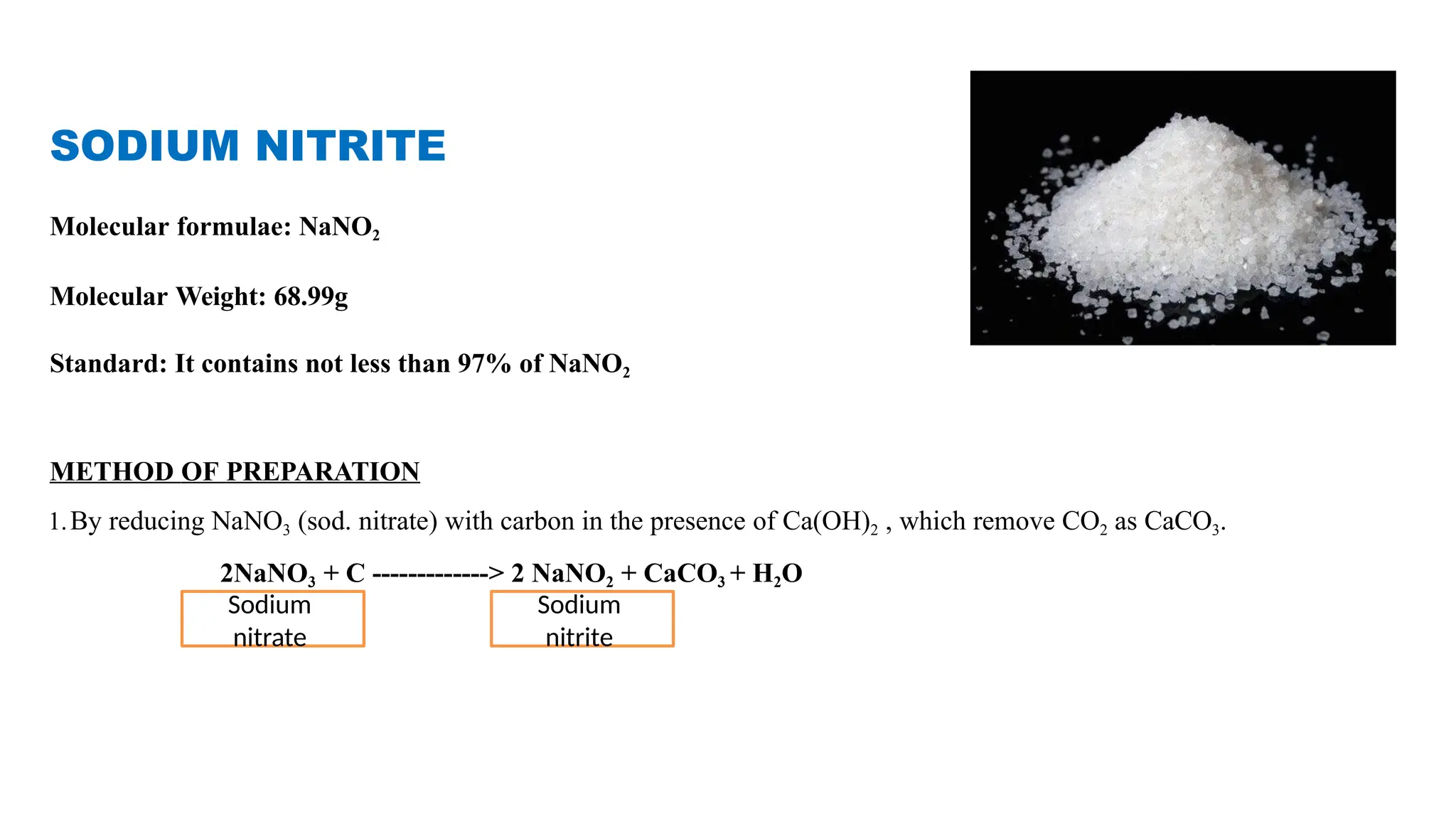
SODIUM NITRITE
Molecular formulae: NaNO2
Molecular Weight: 68.99g
Standard: It contains not less than 97% of NaNO2
METHOD OF PREPARATION
1.By reducing NaNO3 (sod. nitrate) with carbon in the presence of Ca(OH)2 , which remove CO2 as CaCO3.
2NaNO3 + C -------------> 2 NaNO2 + CaCO3 + H2O
Sodium
nitrate
Sodium
nitrite
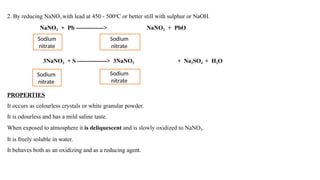
2. By reducing NaNO3 with lead at 450 - 5000C or better still with sulphur or NaOH.
NaNO3 + Pb --------------> NaNO2 + PbO
3NaNO3 + S ---------------> 3NaNO2 + Na2SO4 + H2O
PROPERTIES
It occurs as colourless crystals or white granular powder.
It is odourless and has a mild saline taste.
When exposed to atmosphere it is deliquescent and is slowly oxidized to NaNO3.
It is freely soluble in water.
It behaves both as an oxidizing and as a reducing agent.
Sodium
nitrate
Sodium
nitrate
Sodium
nitrate
Sodium
nitrate
USE
• Treatment for cyanide poisoning/ antidote for cyanide poisoning
• Antioxidant
• Manufacture of azo dye
• Used in diazotisation reactions
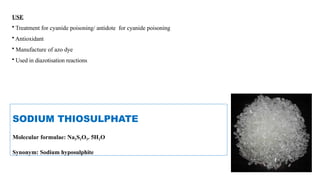
SODIUM THIOSULPHATE
Molecular formulae: Na2S2O3. 5H2O
Synonym: Sodium hyposulphite
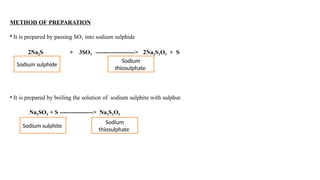
METHOD OF PREPARATION
• It is prepared by passing SO2 into sodium sulphide
2Na2S + 3SO2 --------------------> 2Na2S2O3 + S
• It is prepared by boiling the solution of sodium sulphite with sulphur.
Na2SO3 + S -----------------> Na2S2O3
Sodium sulphide
Sodium
thiosulphate
Sodium
thiosulphate
Sodium sulphite
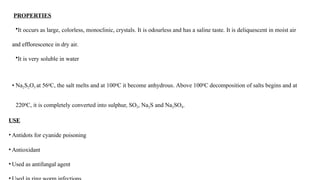
PROPERTIES
•It occurs as large, colorless, monoclinic, crystals. It is odourless and has a saline taste. It is deliquescent in moist air
and efflorescence in dry air.
•It is very soluble in water
• Na2S2O3 at 560C, the salt melts and at 1000C it become anhydrous. Above 1000C decomposition of salts begins and at
2200C, it is completely converted into sulphur, SO2, Na2S and Na2SO4.
USE
• Antidots for cyanide poisoning
• Antioxidant
• Used as antifungal agent
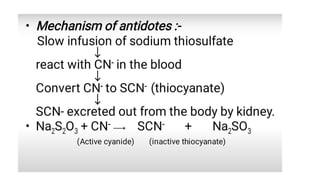
MECHANISM
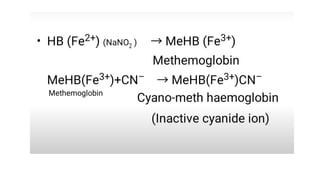
Sodium nitrite combines with hemoglobin of the blood to form methaemoglobin with which the
cyanide forms cyan-methaemoglobin. In this form the cyanide is not toxic to the body. After the
administration of nitrite, sodium thiosulphate is injected to convert the cyanide further to
thiyocyanate which is also not toxic.
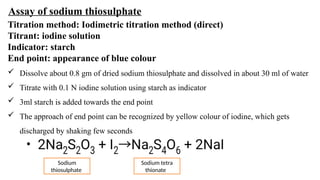
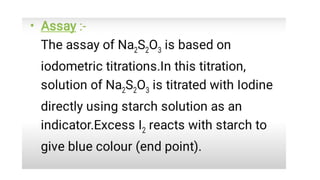
Assay of sodium thiosulphate
Titration method: Iodimetric titration method (direct)
Titrant: iodine solution
Indicator: starch
End point: appearance of blue colour
 Dissolve about 0.8 gm of dried sodium thiosulphate and dissolved in about 30 ml of water
 Titrate with 0.1 N iodine solution using starch as indicator
 3ml starch is added towards the end point
 The approach of end point can be recognized by yellow colour of iodine, which gets
discharged by shaking few seconds
Sodium
thiosulphate
Sodium tetra
thionate
ACTIVATED CHARCOAL

antidotes part 2.pptx pharmaceutical inorganic

  • 1.
    SODIUM NITRITE Molecular formulae:NaNO2 Molecular Weight: 68.99g Standard: It contains not less than 97% of NaNO2 METHOD OF PREPARATION 1.By reducing NaNO3 (sod. nitrate) with carbon in the presence of Ca(OH)2 , which remove CO2 as CaCO3. 2NaNO3 + C -------------> 2 NaNO2 + CaCO3 + H2O Sodium nitrate Sodium nitrite
  • 2.
    2. By reducingNaNO3 with lead at 450 - 5000C or better still with sulphur or NaOH. NaNO3 + Pb --------------> NaNO2 + PbO 3NaNO3 + S ---------------> 3NaNO2 + Na2SO4 + H2O PROPERTIES It occurs as colourless crystals or white granular powder. It is odourless and has a mild saline taste. When exposed to atmosphere it is deliquescent and is slowly oxidized to NaNO3. It is freely soluble in water. It behaves both as an oxidizing and as a reducing agent. Sodium nitrate Sodium nitrate Sodium nitrate Sodium nitrate
  • 5.
    USE • Treatment forcyanide poisoning/ antidote for cyanide poisoning • Antioxidant • Manufacture of azo dye • Used in diazotisation reactions SODIUM THIOSULPHATE Molecular formulae: Na2S2O3. 5H2O Synonym: Sodium hyposulphite
  • 6.
    METHOD OF PREPARATION •It is prepared by passing SO2 into sodium sulphide 2Na2S + 3SO2 --------------------> 2Na2S2O3 + S • It is prepared by boiling the solution of sodium sulphite with sulphur. Na2SO3 + S -----------------> Na2S2O3 Sodium sulphide Sodium thiosulphate Sodium thiosulphate Sodium sulphite
  • 7.
    PROPERTIES •It occurs aslarge, colorless, monoclinic, crystals. It is odourless and has a saline taste. It is deliquescent in moist air and efflorescence in dry air. •It is very soluble in water • Na2S2O3 at 560C, the salt melts and at 1000C it become anhydrous. Above 1000C decomposition of salts begins and at 2200C, it is completely converted into sulphur, SO2, Na2S and Na2SO4. USE • Antidots for cyanide poisoning • Antioxidant • Used as antifungal agent
  • 9.
    MECHANISM Sodium nitrite combineswith hemoglobin of the blood to form methaemoglobin with which the cyanide forms cyan-methaemoglobin. In this form the cyanide is not toxic to the body. After the administration of nitrite, sodium thiosulphate is injected to convert the cyanide further to thiyocyanate which is also not toxic.
  • 10.
    Assay of sodiumthiosulphate Titration method: Iodimetric titration method (direct) Titrant: iodine solution Indicator: starch End point: appearance of blue colour  Dissolve about 0.8 gm of dried sodium thiosulphate and dissolved in about 30 ml of water  Titrate with 0.1 N iodine solution using starch as indicator  3ml starch is added towards the end point  The approach of end point can be recognized by yellow colour of iodine, which gets discharged by shaking few seconds Sodium thiosulphate Sodium tetra thionate
  • 12.