Submitted By:
Shandhya Deb Nath
Pharmaceutical Science.
Antidote
 An antidote is a substance that can counteract a
form of poisoning. The term antidote is a Greek
word “Antididonai” meaning “given against”.
 In Cambridge dictionary,
“Antidote is a chemical especially a drug that limits
the effects of a poison”.
OR
“A way of preventing or acting against something
bad”.
Poison Antidote
Destroy
Poisoning
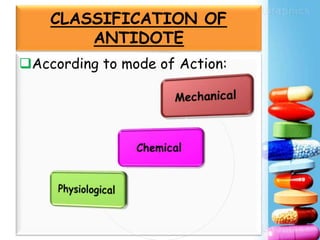
CLASSIFICATION OF
ANTIDOTE
According to mode of Action:
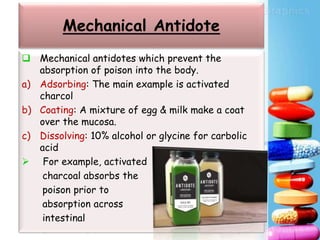
Mechanical Antidote
 Mechanical antidotes which prevent the
absorption of poison into the body.
a) Adsorbing: The main example is activated
charcol
b) Coating: A mixture of egg & milk make a coat
over the mucosa.
c) Dissolving: 10% alcohol or glycine for carbolic
acid
 For example, activated
charcoal absorbs the
poison prior to
absorption across
intestinal wall.
Chemical Antidote
Chemical antidotes are the agents
which change the chemical nature of
poison.
 For example, Na-thiosulphate
which changes toxic cyanide
to the non-toxic thiocyanate;
Sodium calcium edetate
chelates agents used for
heavy metal poison.
Mainly acts by two mechanism:
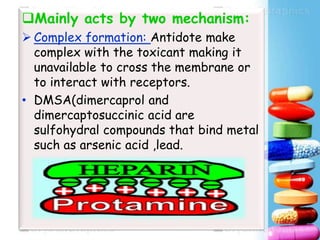
 Complex formation: Antidote make
complex with the toxicant making it
unavailable to cross the membrane or
to interact with receptors.
• DMSA(dimercaprol and
dimercaptosuccinic acid are
sulfohydral compounds that bind metal
such as arsenic acid ,lead.
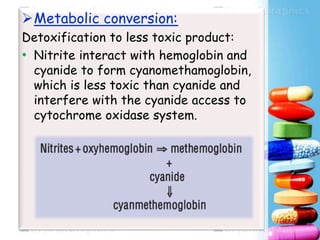
Metabolic conversion:
Detoxification to less toxic product:
• Nitrite interact with hemoglobin and
cyanide to form cyanomethamoglobin,
which is less toxic than cyanide and
interfere with the cyanide access to
cytochrome oxidase system.
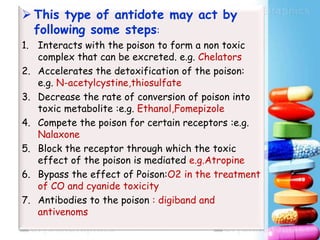
 This type of antidote may act by
following some steps:
1. Interacts with the poison to form a non toxic
complex that can be excreted. e.g. Chelators
2. Accelerates the detoxification of the poison:
e.g. N-acetylcystine,thiosulfate
3. Decrease the rate of conversion of poison into
toxic metabolite :e.g. Ethanol,Fomepizole
4. Compete the poison for certain receptors :e.g.
Nalaxone
5. Block the receptor through which the toxic
effect of the poison is mediated e.g.Atropine
6. Bypass the effect of Poison:O2 in the treatment
of CO and cyanide toxicity
7. Antibodies to the poison : digiband and
antivenoms
Mechanism of Action of
Antidotes
 Antidotes act by different mechanism. The
mechanisms of action of antidotes are given
below:
1) Complex formation.
2) Metabolic conversion.
3) Prevention of toxic metabolite formation.
4) By changing the physio-chemical nature of
toxicant.
5) Antidote returns to normal function by
repairing a defect.
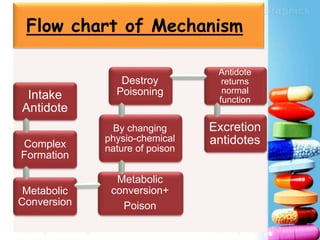
Flow chart of Mechanism
Intake
Antidote
Complex
Formation
Metabolic
Conversion
Metabolic
conversion+
Poison
By changing
physio-chemical
nature of poison
Destroy
Poisoning
Antidote
returns
normal
function
Excretion
antidotes
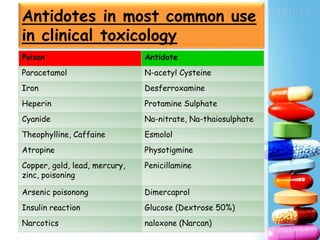
Antidotes in most common use
in clinical toxicology
Poison Antidote
Paracetamol N-acetyl Cysteine
Iron Desferroxamine
Heperin Protamine Sulphate
Cyanide Na-nitrate, Na-thaiosulphate
Theophylline, Caffaine Esmolol
Atropine Physotigmine
Copper, gold, lead, mercury,
zinc, poisoning
Penicillamine
Arsenic poisonong Dimercaprol
Insulin reaction Glucose (Dextrose 50%)
Narcotics naloxone (Narcan)
Charcoal (Universal Antidote)
What is activated
charcoal?
Activated charcoal is
simply burnt wood that
has had all the oxygen
removed through
controlled oxidation
and or processing by
steam.
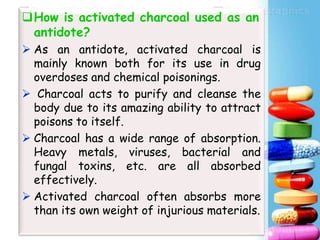
How is activated charcoal used as an
antidote?
 As an antidote, activated charcoal is
mainly known both for its use in drug
overdoses and chemical poisonings.
 Charcoal acts to purify and cleanse the
body due to its amazing ability to attract
poisons to itself.
 Charcoal has a wide range of absorption.
Heavy metals, viruses, bacterial and
fungal toxins, etc. are all absorbed
effectively.
 Activated charcoal often absorbs more
than its own weight of injurious materials.
How does charcoal work?
 Internally as an antidote and remedy,
charcoal works by binding drugs and
poisons within the gastrointestinal
tract.
 This allows their transfer out of the
body in a harmless form. Charcoal
absorbs like a sponge, and renders
poisons harmless.
 It can do varied tasks because of it’s
amazing ability to attract other
substances to its surface and hold on
to them until they exit the body.
How does charcoal work with
drug or aspirin poisoning?
 The most common drug poisoning is from
aspirin. Charcoal should be given within
the first 30 minutes of an overdose.
 Powdered charcoal reaches its maximum
rate of absorption rapidly, within one
minute. The sooner it is given the better
the chances of successful treatment.
 Charcoal given after one hour of fast
absorbing drugs, like aspirin, are usually
only about 10 percent effective.
Side Effect Of Antidotes
Charcoal Effect:
Common side effects of Charcoal
Antidote:
 Black Stools (severe)
 Diarrhea (Less severe)
 Throwing Up (Less severe)
Rare side effects of Charcoal
Antidote:
 Stomach Cramps (severe)
 Swelling of the Abdomen (less severe)
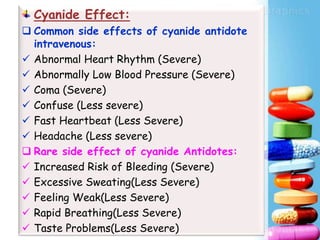
Cyanide Effect:
 Common side effects of cyanide antidote
intravenous:
 Abnormal Heart Rhythm (Severe)
 Abnormally Low Blood Pressure (Severe)
 Coma (Severe)
 Confuse (Less severe)
 Fast Heartbeat (Less Severe)
 Headache (Less severe)
 Rare side effect of cyanide Antidotes:
 Increased Risk of Bleeding (Severe)
 Excessive Sweating(Less Severe)
 Feeling Weak(Less Severe)
 Rapid Breathing(Less Severe)
 Taste Problems(Less Severe)
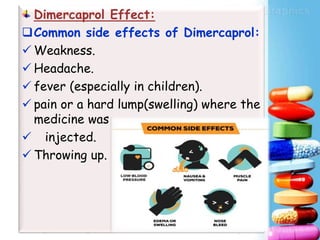
Dimercaprol Effect:
Common side effects of Dimercaprol:
 Weakness.
 Headache.
 fever (especially in children).
 pain or a hard lump(swelling) where the
medicine was
 injected.
 Throwing up.
Future Directions and
Concerns
 The evolution of antidotal therapy has
been characterized by the
development of new antidotes (such as
monoclonal antibodies), by new
applications of existing
pharmaceuticals (e.g. calcium salts), by
a more scientific approach to the
evaluation of effectiveness and of
complications that may arise from
their use, and by increased
cooperation at the international level.
Future Directions and
Concerns
 The work of the IPCS(international
programme on chemical safty )
addresses international collaboration
in the evaluation of new antidotes and
their applications. Some concern
exists regarding the possible adverse
effects of antidotes used for long
periods of time. For example, chronic
lead exposure affecting children or
pregnant mothers may necessitate
repeated chelation treatments
Life saving Antidote(funny)
Antidote

Antidote

  • 1.
    Submitted By: Shandhya DebNath Pharmaceutical Science.
  • 2.
    Antidote  An antidoteis a substance that can counteract a form of poisoning. The term antidote is a Greek word “Antididonai” meaning “given against”.  In Cambridge dictionary, “Antidote is a chemical especially a drug that limits the effects of a poison”. OR “A way of preventing or acting against something bad”. Poison Antidote Destroy Poisoning
  • 3.
  • 4.
    Mechanical Antidote  Mechanicalantidotes which prevent the absorption of poison into the body. a) Adsorbing: The main example is activated charcol b) Coating: A mixture of egg & milk make a coat over the mucosa. c) Dissolving: 10% alcohol or glycine for carbolic acid  For example, activated charcoal absorbs the poison prior to absorption across intestinal wall.
  • 5.
    Chemical Antidote Chemical antidotesare the agents which change the chemical nature of poison.  For example, Na-thiosulphate which changes toxic cyanide to the non-toxic thiocyanate; Sodium calcium edetate chelates agents used for heavy metal poison.
  • 6.
    Mainly acts bytwo mechanism:  Complex formation: Antidote make complex with the toxicant making it unavailable to cross the membrane or to interact with receptors. • DMSA(dimercaprol and dimercaptosuccinic acid are sulfohydral compounds that bind metal such as arsenic acid ,lead.
  • 7.
    Metabolic conversion: Detoxification toless toxic product: • Nitrite interact with hemoglobin and cyanide to form cyanomethamoglobin, which is less toxic than cyanide and interfere with the cyanide access to cytochrome oxidase system.
  • 8.
     This typeof antidote may act by following some steps: 1. Interacts with the poison to form a non toxic complex that can be excreted. e.g. Chelators 2. Accelerates the detoxification of the poison: e.g. N-acetylcystine,thiosulfate 3. Decrease the rate of conversion of poison into toxic metabolite :e.g. Ethanol,Fomepizole 4. Compete the poison for certain receptors :e.g. Nalaxone 5. Block the receptor through which the toxic effect of the poison is mediated e.g.Atropine 6. Bypass the effect of Poison:O2 in the treatment of CO and cyanide toxicity 7. Antibodies to the poison : digiband and antivenoms
  • 9.
    Mechanism of Actionof Antidotes  Antidotes act by different mechanism. The mechanisms of action of antidotes are given below: 1) Complex formation. 2) Metabolic conversion. 3) Prevention of toxic metabolite formation. 4) By changing the physio-chemical nature of toxicant. 5) Antidote returns to normal function by repairing a defect.
  • 10.
    Flow chart ofMechanism Intake Antidote Complex Formation Metabolic Conversion Metabolic conversion+ Poison By changing physio-chemical nature of poison Destroy Poisoning Antidote returns normal function Excretion antidotes
  • 11.
    Antidotes in mostcommon use in clinical toxicology Poison Antidote Paracetamol N-acetyl Cysteine Iron Desferroxamine Heperin Protamine Sulphate Cyanide Na-nitrate, Na-thaiosulphate Theophylline, Caffaine Esmolol Atropine Physotigmine Copper, gold, lead, mercury, zinc, poisoning Penicillamine Arsenic poisonong Dimercaprol Insulin reaction Glucose (Dextrose 50%) Narcotics naloxone (Narcan)
  • 12.
    Charcoal (Universal Antidote) Whatis activated charcoal? Activated charcoal is simply burnt wood that has had all the oxygen removed through controlled oxidation and or processing by steam.
  • 13.
    How is activatedcharcoal used as an antidote?  As an antidote, activated charcoal is mainly known both for its use in drug overdoses and chemical poisonings.  Charcoal acts to purify and cleanse the body due to its amazing ability to attract poisons to itself.  Charcoal has a wide range of absorption. Heavy metals, viruses, bacterial and fungal toxins, etc. are all absorbed effectively.  Activated charcoal often absorbs more than its own weight of injurious materials.
  • 14.
    How does charcoalwork?  Internally as an antidote and remedy, charcoal works by binding drugs and poisons within the gastrointestinal tract.  This allows their transfer out of the body in a harmless form. Charcoal absorbs like a sponge, and renders poisons harmless.  It can do varied tasks because of it’s amazing ability to attract other substances to its surface and hold on to them until they exit the body.
  • 15.
    How does charcoalwork with drug or aspirin poisoning?  The most common drug poisoning is from aspirin. Charcoal should be given within the first 30 minutes of an overdose.  Powdered charcoal reaches its maximum rate of absorption rapidly, within one minute. The sooner it is given the better the chances of successful treatment.  Charcoal given after one hour of fast absorbing drugs, like aspirin, are usually only about 10 percent effective.
  • 16.
    Side Effect OfAntidotes
  • 17.
    Charcoal Effect: Common sideeffects of Charcoal Antidote:  Black Stools (severe)  Diarrhea (Less severe)  Throwing Up (Less severe) Rare side effects of Charcoal Antidote:  Stomach Cramps (severe)  Swelling of the Abdomen (less severe)
  • 18.
    Cyanide Effect:  Commonside effects of cyanide antidote intravenous:  Abnormal Heart Rhythm (Severe)  Abnormally Low Blood Pressure (Severe)  Coma (Severe)  Confuse (Less severe)  Fast Heartbeat (Less Severe)  Headache (Less severe)  Rare side effect of cyanide Antidotes:  Increased Risk of Bleeding (Severe)  Excessive Sweating(Less Severe)  Feeling Weak(Less Severe)  Rapid Breathing(Less Severe)  Taste Problems(Less Severe)
  • 19.
    Dimercaprol Effect: Common sideeffects of Dimercaprol:  Weakness.  Headache.  fever (especially in children).  pain or a hard lump(swelling) where the medicine was  injected.  Throwing up.
  • 20.
    Future Directions and Concerns The evolution of antidotal therapy has been characterized by the development of new antidotes (such as monoclonal antibodies), by new applications of existing pharmaceuticals (e.g. calcium salts), by a more scientific approach to the evaluation of effectiveness and of complications that may arise from their use, and by increased cooperation at the international level.
  • 21.
    Future Directions and Concerns The work of the IPCS(international programme on chemical safty ) addresses international collaboration in the evaluation of new antidotes and their applications. Some concern exists regarding the possible adverse effects of antidotes used for long periods of time. For example, chronic lead exposure affecting children or pregnant mothers may necessitate repeated chelation treatments
  • 22.

Editor's Notes

  • #6  Methemoglobinemia occurs when iron atoms in hemoglobin become oxidized. During oxidation, the iron atom loses an electron to an oxidant and is converted from the ferrous state (Fe2+) to the ferric state (Fe3+).