ANCIENT CHINA
1750 BCE – 170 CE
GEOGRAPHY

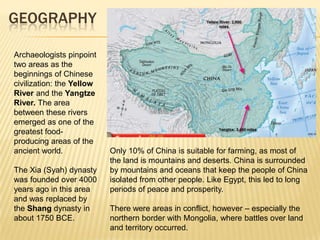
Archaeologists pinpoint
two areas as the
beginnings of Chinese
civilization: the Yellow
River and the Yangtze
River. The area
between these rivers
emerged as one of the
greatest food-
producing areas of the
ancient world.             Only 10% of China is suitable for farming, as most of
                           the land is mountains and deserts. China is surrounded
The Xia (Syah) dynasty     by mountains and oceans that keep the people of China
was founded over 4000      isolated from other people. Like Egypt, this led to long
years ago in this area     periods of peace and prosperity.
and was replaced by
the Shang dynasty in       There were areas in conflict, however – especially the
about 1750 BCE.            northern border with Mongolia, where battles over land
                           and territory occurred.
SHANG DYNASTY
     The Shang Dynasty ruled from approximately 1750 BCE
     until 1122 BCE.

     During the Shang Dynasty, farmers were ruled by the
     aristocracy (upper class) whose main concern was war.
     Power and wealth was passed down through families from
     one generation to another.

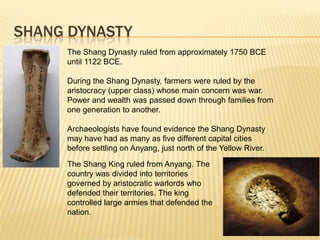
     Archaeologists have found evidence the Shang Dynasty
     may have had as many as five different capital cities
     before settling on Anyang, just north of the Yellow River.

     The Shang King ruled from Anyang. The
     country was divided into territories
     governed by aristocratic warlords who
     defended their territories. The king
     controlled large armies that defended the
     nation.
SHANG DYNASTY – RELIGION & CULTURE
 The early Chinese had a strong belief in life
  after death. They conducted human sacrifices in
  an effort to win the favor of the gods. Eventually
  this belief in the afterlife would develop into the
  veneration (worship) of ancestors.
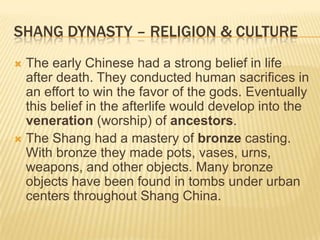
 The Shang had a mastery of bronze casting.
  With bronze they made pots, vases, urns,
  weapons, and other objects. Many bronze
  objects have been found in tombs under urban
  centers throughout Shang China.
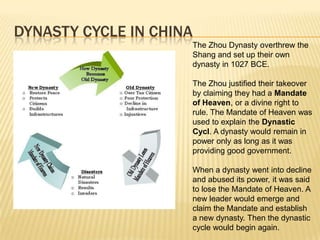
DYNASTY CYCLE IN CHINA
                     The Zhou Dynasty overthrew the
                     Shang and set up their own
                     dynasty in 1027 BCE.

                     The Zhou justified their takeover
                     by claiming they had a Mandate
                     of Heaven, or a divine right to
                     rule. The Mandate of Heaven was
                     used to explain the Dynastic
                     Cycl. A dynasty would remain in
                     power only as long as it was
                     providing good government.

                     When a dynasty went into decline
                     and abused its power, it was said
                     to lose the Mandate of Heaven. A
                     new leader would emerge and
                     claim the Mandate and establish
                     a new dynasty. Then the dynastic
                     cycle would begin again.
ZHOU DYNASTY
1122 BCE – 256 BCE

 The Zhou dynasty was the longest-lasting in Chinese history. The Zhou rulers
 continued the political system of the Shang dynasty, with a king at the top and a
 government bureaucracy to help the king rule.

 Kings who got their power through the Mandate of Heaven were expected to
 rule according to the proper “way”, called the Dao. It was the king‟s duty to keep
 the gods pleased in order to protect the people.

 The idea of the Dao in ruling meant that the Chinese had the right to revolt any
 king
                       who was corrupt or abused his power.

                       The Zhou Dynasty declined when the city-states became
                       stronger and challenged the ruler with civil war. The rulers
                       had declined morally and intellectually, and in 403 BCE
                       civil war broke out, beginning a period known as “The
                       Period of the Warring States”. In 221 BCE, the Qin (Chin)
                       took control of China and create a new dynasty.
LIFE IN THE ZHOU DYNASTY
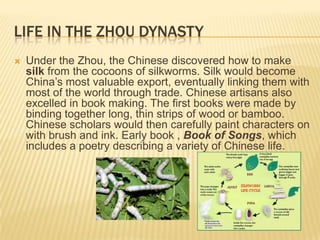
   Under the Zhou, the Chinese discovered how to make
    silk from the cocoons of silkworms. Silk would become
    China‟s most valuable export, eventually linking them with
    most of the world through trade. Chinese artisans also
    excelled in book making. The first books were made by
    binding together long, thin strips of wood or bamboo.
    Chinese scholars would then carefully paint characters on
    with brush and ink. Early book , Book of Songs, which
    includes a poetry describing a variety of Chinese life.
LIFE IN THE ZHOU DYNASTY
• Economic & Technological               • Life during the Zhou Dynasty
  Growth                                    – The Aristocracy owned the land
   – 6th-3rd centuries BCE were a time        and the peasants worked land
     of growth. Irrigation controlled         owned by the lord. Towns had
     water, iron plowshares increased         merchants who were „owned‟
     food, Silk was traded.                   by the lord like slaves. The
                                              Chinese traded along the Silk
                                              Road.
• The Chinese Written Language
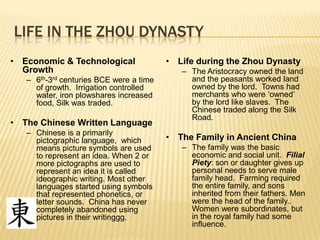
   – Chinese is a primarily
     pictographic language, which        • The Family in Ancient China
     means picture symbols are used         – The family was the basic
     to represent an idea. When 2 or          economic and social unit. Filial
     more pictographs are used to             Piety: son or daughter gives up
     represent an idea it is called           personal needs to serve male
     ideographic writing. Most other          family head. Farming required
     languages started using symbols          the entire family, and sons
     that represented phonetics, or           inherited from their fathers. Men
     letter sounds. China has never           were the head of the family..
     completely abandoned using               Women were subordinates, but
     pictures in their writinggg.             in the royal family had some
                                              influence.
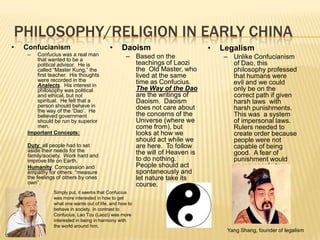
PHILOSOPHY/RELIGION IN EARLY CHINA
•   Confucianism                           •     Daoism                      •   Legalism
     –  Confucius was a real man                   – Based on the                – Unlike Confucianism
        that wanted to be a
        political advisor. He is                     teachings of Laozi            of Dao, this
        called “Master Kung,” the                    the Old Master, who           philosophy professed
        first teacher. His thoughts                  lived at the same             that humans were
        were recorded in the                         time as Confucius.            evil and we could
        Analects. His interest in
        philosophy was political                     The Way of the Dao            only be on the
        and ethical, but not                         are the writings of           correct path if given
        spiritual. He felt that a                    Daoism. Daoism                harsh laws with
        person should behave in                      does not care about           harsh punishments.
        the way of the „Dao‟. He
        believed government                          the concerns of the           This was a system
        should be run by superior                    Universe (where we            of impersonal laws.
        men.                                         come from), but               Rulers needed to
     Important Concepts:                             looks at how we               create order because
                                                     should act while we           people were not
     Duty: all people had to set                     are here. To follow           capable of being
     aside their needs for the                       the will of Heaven is         good. A fear of
     family/society. Work hard and
     improve life on Earth.                          to do nothing.                punishment would
     Humanity: Compassion and                        People should act             cause people to
     empathy for others: “measure                    spontaneously and             serve the ruler.
     the feelings of others by ones                  let nature take its
     own”.                                           course.
                Simply put, it seems that Confucius
                was more interested in how to get
                what one wants out of life, and how to
                behave in society. In contrast to
                Confucius, Lao Tzu (Laozi) was more
                interested in being in harmony with
                the world around him.
                                                                                  Yang Shang, founder of legalism
CHINESE EMPIRES: QIN DYNASTY
    221 BCE – 170 CE
   Qin Dynasty: 221-206 BCE
        Legalism was adopted by the Qin leaders.
        The government was centralized with three key parts:
             Civil Bureaucracy
             Military
             Censorate (Inspectors who kept tabs on the civil workers)
       China was divided into provinces and counties. Members of the Civil
        Bureaucracy were appointed, with censors watching the civil servants.
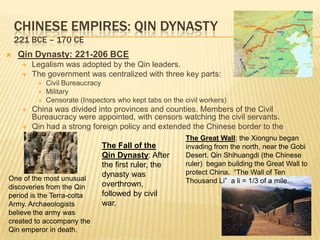
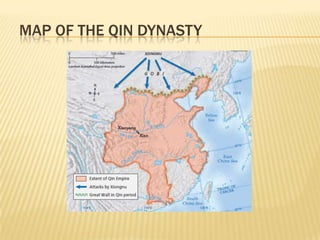
     Qin had a strong foreign policy and extended the Chinese border to the
        South                                     The Great Wall: the Xiongnu began
                           The Fall of the        invading from the north, near the Gobi
                           Qin Dynasty: After     Desert. Qin Shihuangdi (the Chinese
                           the first ruler, the   ruler) began building the Great Wall to
                           dynasty was            protect China. “The Wall of Ten
One of the most unusual                           Thousand Li” a li = 1/3 of a mile.
discoveries from the Qin   overthrown,
period is the Terra-cotta  followed by civil
Army. Archaeologists       war.
believe the army was
created to accompany the
Qin emperor in death.
MAP OF THE QIN DYNASTY
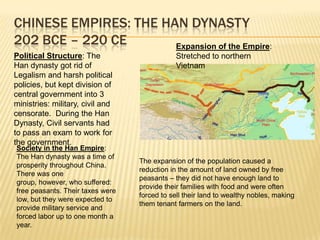
CHINESE EMPIRES: THE HAN DYNASTY
202 BCE – 220 CE       Expansion of the Empire:
Political Structure: The                      Stretched to northern
Han dynasty got rid of                        Vietnam
Legalism and harsh political
policies, but kept division of
central government into 3
ministries: military, civil and
censorate. During the Han
Dynasty, Civil servants had
to pass an exam to work for
the government.
Society in the Han Empire:
The Han dynasty was a time of
                                  The expansion of the population caused a
prosperity throughout China.
                                  reduction in the amount of land owned by free
There was one
                                  peasants – they did not have enough land to
group, however, who suffered:
                                  provide their families with food and were often
free peasants. Their taxes were
                                  forced to sell their land to wealthy nobles, making
low, but they were expected to
                                  them tenant farmers on the land.
provide military service and
forced labor up to one month a
year.
HAN DYNASTY
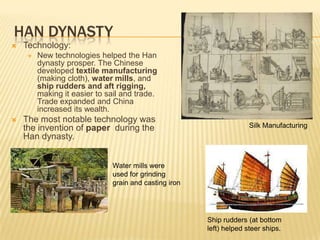
   Technology:
       New technologies helped the Han
        dynasty prosper. The Chinese
        developed textile manufacturing
        (making cloth), water mills, and
        ship rudders and aft rigging,
        making it easier to sail and trade.
        Trade expanded and China
        increased its wealth.
   The most notable technology was
    the invention of paper during the                               Silk Manufacturing
    Han dynasty.


                             Water mills were
                             used for grinding
                             grain and casting iron


                                                      Ship rudders (at bottom
                                                      left) helped steer ships.
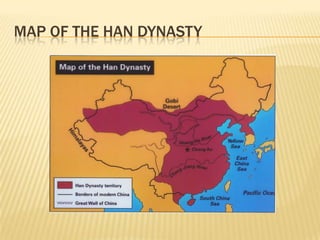
MAP OF THE HAN DYNASTY
FALL OF THE HAN DYNASTY – 220 CE
   The Han empire declined over a long period of
    time. Their rulers became corrupt and worried
    more about their royal court than the Chinese
    people. The landed aristocracy – noble families
    – began to replace the central government as
    the force of power in China. By 170 CE, wars
    and uprisings brought about the collapse of the
    Han dynasty. In 190, rebels sacked the Han
    capital. China was again plunged into civil war
    and the next great dynasty would not arise for
    400 years.

Ancient china

  • 1.
  • 2.
    GEOGRAPHY Archaeologists pinpoint two areasas the beginnings of Chinese civilization: the Yellow River and the Yangtze River. The area between these rivers emerged as one of the greatest food- producing areas of the ancient world. Only 10% of China is suitable for farming, as most of the land is mountains and deserts. China is surrounded The Xia (Syah) dynasty by mountains and oceans that keep the people of China was founded over 4000 isolated from other people. Like Egypt, this led to long years ago in this area periods of peace and prosperity. and was replaced by the Shang dynasty in There were areas in conflict, however – especially the about 1750 BCE. northern border with Mongolia, where battles over land and territory occurred.
  • 3.
    SHANG DYNASTY The Shang Dynasty ruled from approximately 1750 BCE until 1122 BCE. During the Shang Dynasty, farmers were ruled by the aristocracy (upper class) whose main concern was war. Power and wealth was passed down through families from one generation to another. Archaeologists have found evidence the Shang Dynasty may have had as many as five different capital cities before settling on Anyang, just north of the Yellow River. The Shang King ruled from Anyang. The country was divided into territories governed by aristocratic warlords who defended their territories. The king controlled large armies that defended the nation.
  • 4.
    SHANG DYNASTY –RELIGION & CULTURE  The early Chinese had a strong belief in life after death. They conducted human sacrifices in an effort to win the favor of the gods. Eventually this belief in the afterlife would develop into the veneration (worship) of ancestors.  The Shang had a mastery of bronze casting. With bronze they made pots, vases, urns, weapons, and other objects. Many bronze objects have been found in tombs under urban centers throughout Shang China.
  • 5.
    DYNASTY CYCLE INCHINA The Zhou Dynasty overthrew the Shang and set up their own dynasty in 1027 BCE. The Zhou justified their takeover by claiming they had a Mandate of Heaven, or a divine right to rule. The Mandate of Heaven was used to explain the Dynastic Cycl. A dynasty would remain in power only as long as it was providing good government. When a dynasty went into decline and abused its power, it was said to lose the Mandate of Heaven. A new leader would emerge and claim the Mandate and establish a new dynasty. Then the dynastic cycle would begin again.
  • 6.
    ZHOU DYNASTY 1122 BCE– 256 BCE The Zhou dynasty was the longest-lasting in Chinese history. The Zhou rulers continued the political system of the Shang dynasty, with a king at the top and a government bureaucracy to help the king rule. Kings who got their power through the Mandate of Heaven were expected to rule according to the proper “way”, called the Dao. It was the king‟s duty to keep the gods pleased in order to protect the people. The idea of the Dao in ruling meant that the Chinese had the right to revolt any king who was corrupt or abused his power. The Zhou Dynasty declined when the city-states became stronger and challenged the ruler with civil war. The rulers had declined morally and intellectually, and in 403 BCE civil war broke out, beginning a period known as “The Period of the Warring States”. In 221 BCE, the Qin (Chin) took control of China and create a new dynasty.
  • 7.
    LIFE IN THEZHOU DYNASTY  Under the Zhou, the Chinese discovered how to make silk from the cocoons of silkworms. Silk would become China‟s most valuable export, eventually linking them with most of the world through trade. Chinese artisans also excelled in book making. The first books were made by binding together long, thin strips of wood or bamboo. Chinese scholars would then carefully paint characters on with brush and ink. Early book , Book of Songs, which includes a poetry describing a variety of Chinese life.
  • 8.
    LIFE IN THEZHOU DYNASTY • Economic & Technological • Life during the Zhou Dynasty Growth – The Aristocracy owned the land – 6th-3rd centuries BCE were a time and the peasants worked land of growth. Irrigation controlled owned by the lord. Towns had water, iron plowshares increased merchants who were „owned‟ food, Silk was traded. by the lord like slaves. The Chinese traded along the Silk Road. • The Chinese Written Language – Chinese is a primarily pictographic language, which • The Family in Ancient China means picture symbols are used – The family was the basic to represent an idea. When 2 or economic and social unit. Filial more pictographs are used to Piety: son or daughter gives up represent an idea it is called personal needs to serve male ideographic writing. Most other family head. Farming required languages started using symbols the entire family, and sons that represented phonetics, or inherited from their fathers. Men letter sounds. China has never were the head of the family.. completely abandoned using Women were subordinates, but pictures in their writinggg. in the royal family had some influence.
  • 9.
    PHILOSOPHY/RELIGION IN EARLYCHINA • Confucianism • Daoism • Legalism – Confucius was a real man – Based on the – Unlike Confucianism that wanted to be a political advisor. He is teachings of Laozi of Dao, this called “Master Kung,” the the Old Master, who philosophy professed first teacher. His thoughts lived at the same that humans were were recorded in the time as Confucius. evil and we could Analects. His interest in philosophy was political The Way of the Dao only be on the and ethical, but not are the writings of correct path if given spiritual. He felt that a Daoism. Daoism harsh laws with person should behave in does not care about harsh punishments. the way of the „Dao‟. He believed government the concerns of the This was a system should be run by superior Universe (where we of impersonal laws. men. come from), but Rulers needed to Important Concepts: looks at how we create order because should act while we people were not Duty: all people had to set are here. To follow capable of being aside their needs for the the will of Heaven is good. A fear of family/society. Work hard and improve life on Earth. to do nothing. punishment would Humanity: Compassion and People should act cause people to empathy for others: “measure spontaneously and serve the ruler. the feelings of others by ones let nature take its own”. course. Simply put, it seems that Confucius was more interested in how to get what one wants out of life, and how to behave in society. In contrast to Confucius, Lao Tzu (Laozi) was more interested in being in harmony with the world around him. Yang Shang, founder of legalism
  • 10.
    CHINESE EMPIRES: QINDYNASTY 221 BCE – 170 CE  Qin Dynasty: 221-206 BCE  Legalism was adopted by the Qin leaders.  The government was centralized with three key parts:  Civil Bureaucracy  Military  Censorate (Inspectors who kept tabs on the civil workers)  China was divided into provinces and counties. Members of the Civil Bureaucracy were appointed, with censors watching the civil servants.  Qin had a strong foreign policy and extended the Chinese border to the South The Great Wall: the Xiongnu began The Fall of the invading from the north, near the Gobi Qin Dynasty: After Desert. Qin Shihuangdi (the Chinese the first ruler, the ruler) began building the Great Wall to dynasty was protect China. “The Wall of Ten One of the most unusual Thousand Li” a li = 1/3 of a mile. discoveries from the Qin overthrown, period is the Terra-cotta followed by civil Army. Archaeologists war. believe the army was created to accompany the Qin emperor in death.
  • 11.
    MAP OF THEQIN DYNASTY
  • 12.
    CHINESE EMPIRES: THEHAN DYNASTY 202 BCE – 220 CE Expansion of the Empire: Political Structure: The Stretched to northern Han dynasty got rid of Vietnam Legalism and harsh political policies, but kept division of central government into 3 ministries: military, civil and censorate. During the Han Dynasty, Civil servants had to pass an exam to work for the government. Society in the Han Empire: The Han dynasty was a time of The expansion of the population caused a prosperity throughout China. reduction in the amount of land owned by free There was one peasants – they did not have enough land to group, however, who suffered: provide their families with food and were often free peasants. Their taxes were forced to sell their land to wealthy nobles, making low, but they were expected to them tenant farmers on the land. provide military service and forced labor up to one month a year.
  • 13.
    HAN DYNASTY  Technology:  New technologies helped the Han dynasty prosper. The Chinese developed textile manufacturing (making cloth), water mills, and ship rudders and aft rigging, making it easier to sail and trade. Trade expanded and China increased its wealth.  The most notable technology was the invention of paper during the Silk Manufacturing Han dynasty. Water mills were used for grinding grain and casting iron Ship rudders (at bottom left) helped steer ships.
  • 14.
    MAP OF THEHAN DYNASTY
  • 15.
    FALL OF THEHAN DYNASTY – 220 CE  The Han empire declined over a long period of time. Their rulers became corrupt and worried more about their royal court than the Chinese people. The landed aristocracy – noble families – began to replace the central government as the force of power in China. By 170 CE, wars and uprisings brought about the collapse of the Han dynasty. In 190, rebels sacked the Han capital. China was again plunged into civil war and the next great dynasty would not arise for 400 years.