Ancient China The Middle Kingdom
Geography Civilization developed in the Huang He (Yellow River) and Yangtzi River valleys China was mostly isolated from other civilizations because of geographic barriers The Himalaya Mts. and Tibetan Plateau, Gobi Desert, and Pacific Ocean Population is clustered along the river valleys of eastern China and the coastal areas
Geographic Barriers of China
Population Density of China
Effects of Geography on Development Middle Kingdom – Because of isolation, the Chinese believed they were the center of the earth Ethnocentrism – The Chinese were not exposed to any other cultures, therefore they believed that their culture could not be matched by any others that possibly existed
Shang Dynasty A dynasty is a ruling family The Shang set up the first dynasty in China Social Structure: Nobility, Warriors, Merchants / Artisans, Peasants Religion – Prayed to many gods and spirits, believed in the two forces of nature – Yin and Yang First Chinese written communication develops in the form of pictographs and ideographs
Zhou Dynasty Around 1100 BC, the Zhou overthrew the Shang Their dynasty lasted nearly 800 years Mandate of Heaven – divine right to rule Feudal Government – local lords controlled their own regions but pledged military allegiance to the ruling family Began using iron to make tools Roads, canals, irrigation systems are built Contributions: First books are written, Calendar is developed, Learned how to make silk, Confucianism develops
Qin Dynasty Established around 220 BC Shi Huangdi – First Emperor of China, creates a centralized government ending the feudal system China is divided into military districts run by appointed officials System of standardized weights and measures is created, roads and canals are improved The Wall of China is built, greatest achievement of the Qin.  The wall was built to keep out invaders Terracotta Army is also constructed to be buried in the tomb with Shi Huangdi – the First Emperor
Great Wall and Terracotta Army Great Wall – Stretches across northern China, reaches heights of 35 feet, symbolizes power of the Han Dynasty Terracotta Army – Over 8,000 life size warriors buried in the tomb of Qin Emperor Shi Huangdi, Emperor believed he would still have troops at his command
Great Wall of China
Danny Way Jumps Over the Great Wall of China Skateboarding over the Great Wall
Han Dynasty Developed after the collapse of the Qin Dynasty Liu Bang, a peasant, took control of the empire He reduced taxes, expanded the Great Wall, established a complex system of roads Civil Service Exams – based on the teachings of Confucius, determined who would get government jobs based on expertise and skill Contributions – Made paper out of pulp, invented the wheelbarrow, the fishing reel, and the rudder
Tang and Song Dynasties Tang Dynasty ruled China from 619-907 Song Dynasty ruled from 960 – 1280 Tang and Song Dynasties represent a golden age in Chinese history Social Structure: Gentry (wealthy landowners and government officials), peasants, and merchants Revised the civil service exam Rulers set up schools to create a highly educated ruling class
Achievements of the Tang and Song Land Reform – land distributed to peasants Trade – merchants trade with India, Persia, and the Middle East Shipbuilding – China emerges as a naval power Money – issued the worlds first paper money Canals – built to improve trade and transportation (Grand Canal) Literature and Art – writers wrote short and poems, calligraphy, porcelain
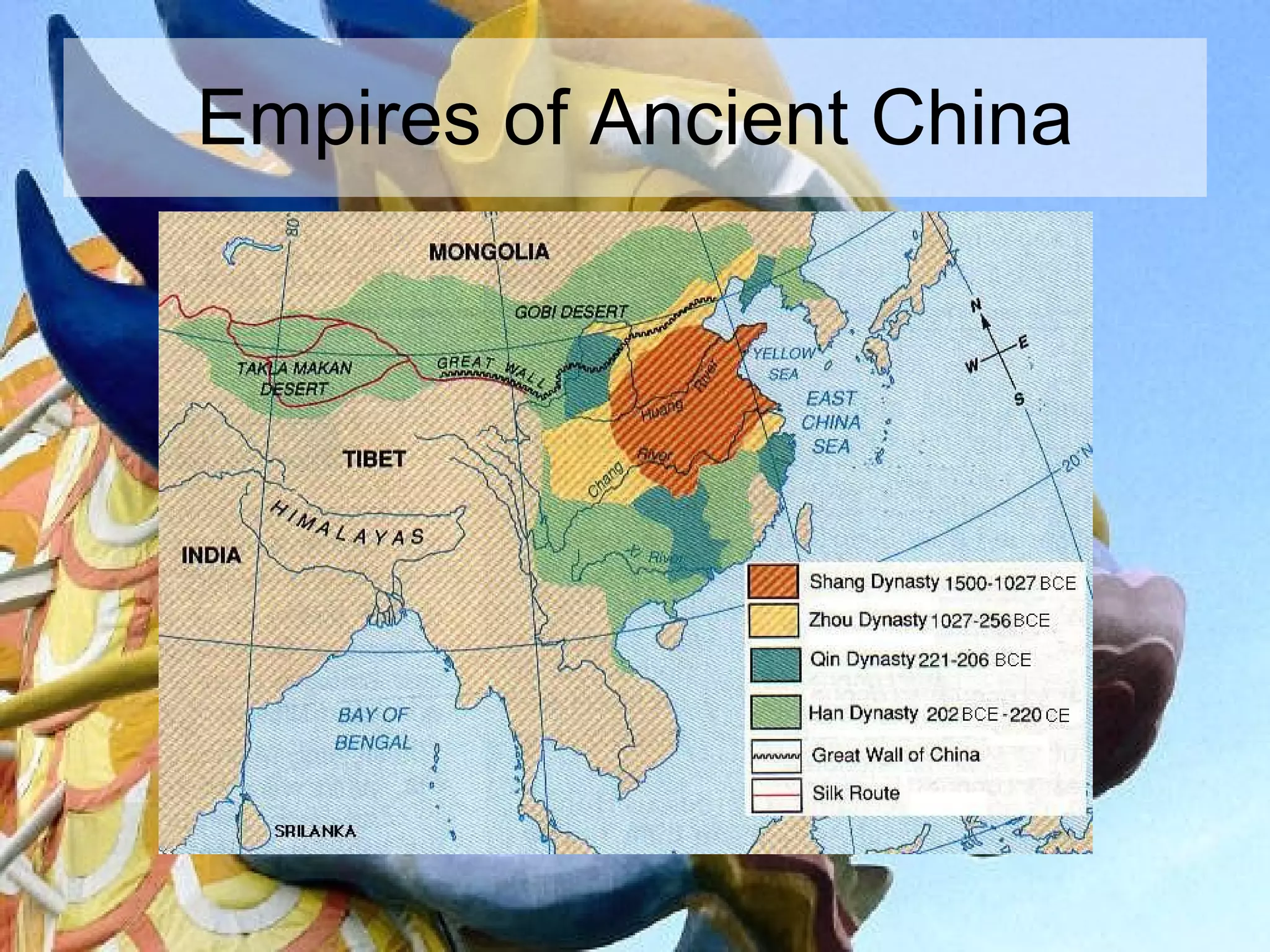
Empires of Ancient China
The Silk Road  – strategic trade and cultural transmission route that linked China to the rest of Asia, Africa and Europe
Mongol Invasion Song Dynasty will come to an end with the Mongol invasion of China beginning in 1279 Kublai Khan will conquer China and establish his own dynasty, the Yuan Dynasty
Mongol Empire

Ancient China

  • 1.
    Ancient China TheMiddle Kingdom
  • 2.
    Geography Civilization developedin the Huang He (Yellow River) and Yangtzi River valleys China was mostly isolated from other civilizations because of geographic barriers The Himalaya Mts. and Tibetan Plateau, Gobi Desert, and Pacific Ocean Population is clustered along the river valleys of eastern China and the coastal areas
  • 3.
  • 4.
  • 5.
    Effects of Geographyon Development Middle Kingdom – Because of isolation, the Chinese believed they were the center of the earth Ethnocentrism – The Chinese were not exposed to any other cultures, therefore they believed that their culture could not be matched by any others that possibly existed
  • 6.
    Shang Dynasty Adynasty is a ruling family The Shang set up the first dynasty in China Social Structure: Nobility, Warriors, Merchants / Artisans, Peasants Religion – Prayed to many gods and spirits, believed in the two forces of nature – Yin and Yang First Chinese written communication develops in the form of pictographs and ideographs
  • 7.
    Zhou Dynasty Around1100 BC, the Zhou overthrew the Shang Their dynasty lasted nearly 800 years Mandate of Heaven – divine right to rule Feudal Government – local lords controlled their own regions but pledged military allegiance to the ruling family Began using iron to make tools Roads, canals, irrigation systems are built Contributions: First books are written, Calendar is developed, Learned how to make silk, Confucianism develops
  • 8.
    Qin Dynasty Establishedaround 220 BC Shi Huangdi – First Emperor of China, creates a centralized government ending the feudal system China is divided into military districts run by appointed officials System of standardized weights and measures is created, roads and canals are improved The Wall of China is built, greatest achievement of the Qin. The wall was built to keep out invaders Terracotta Army is also constructed to be buried in the tomb with Shi Huangdi – the First Emperor
  • 9.
    Great Wall andTerracotta Army Great Wall – Stretches across northern China, reaches heights of 35 feet, symbolizes power of the Han Dynasty Terracotta Army – Over 8,000 life size warriors buried in the tomb of Qin Emperor Shi Huangdi, Emperor believed he would still have troops at his command
  • 10.
  • 11.
    Danny Way JumpsOver the Great Wall of China Skateboarding over the Great Wall
  • 12.
    Han Dynasty Developedafter the collapse of the Qin Dynasty Liu Bang, a peasant, took control of the empire He reduced taxes, expanded the Great Wall, established a complex system of roads Civil Service Exams – based on the teachings of Confucius, determined who would get government jobs based on expertise and skill Contributions – Made paper out of pulp, invented the wheelbarrow, the fishing reel, and the rudder
  • 13.
    Tang and SongDynasties Tang Dynasty ruled China from 619-907 Song Dynasty ruled from 960 – 1280 Tang and Song Dynasties represent a golden age in Chinese history Social Structure: Gentry (wealthy landowners and government officials), peasants, and merchants Revised the civil service exam Rulers set up schools to create a highly educated ruling class
  • 14.
    Achievements of theTang and Song Land Reform – land distributed to peasants Trade – merchants trade with India, Persia, and the Middle East Shipbuilding – China emerges as a naval power Money – issued the worlds first paper money Canals – built to improve trade and transportation (Grand Canal) Literature and Art – writers wrote short and poems, calligraphy, porcelain
  • 15.
  • 16.
    The Silk Road – strategic trade and cultural transmission route that linked China to the rest of Asia, Africa and Europe
  • 17.
    Mongol Invasion SongDynasty will come to an end with the Mongol invasion of China beginning in 1279 Kublai Khan will conquer China and establish his own dynasty, the Yuan Dynasty
  • 18.