Ancient China 
“The people of our race were created by Heaven, having from 
the beginning distinctions and rules, our people cling to 
customs and what they admire is seemly behavior.” 
- The Book of Songs
Introduction 
• The most stable and in many ways the most successful civilization that history has known 
began in China in the second millennium B.C. 
• It continued in its essentials through many changes in political leadership, meanwhile subjecting 
an enormous area and many different peoples to “the Chinese way.” 
• The Chinese educated classes, who considered themselves the hub of the universe, formed 
the most cohesive ruling group the world has ever seen. 
• They combined scholarship and artistic sensitivity with great administrative abilities. 
• Much of China’s permanent culture was already firmly established by about 500 B.C., and it 
would change only very slowly.
Earliest China: The Shang Era 
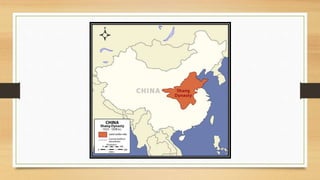
• About the time the Aryan invaders arrived in the Indus valley, the Neolithic farming villages 
along the central course of the Yellow River were drawn into an organized state for the 
first time. 
• This state was the product of military conquest by a people closely related to the villagers, the 
Shang. 
• The Shang replaced the villagers’ earlier political overseers and introduced the Shang 
Dynasty. 
• Like other Chinese, the Shang and the people they conquered were members of the Sino-Tibetan 
language group and the Mongoloid or “yellow-skinned” race. 
• Other members of this group include the North American Indian and the Turks.
Earliest China: The Shang Era 
• The society the Shang took over was already well on the way to a civilized life, introducing 
little if any cultural change: 
• The villagers were making advanced stone tools and bronze weaponry. 
• Farming had long ago replaced hunting and gathering as the mainstay of the economy. 
• The villagers had several types of domesticated animals and were growing wheat on the fertile 
soil of Mongolia. 
• Although the vast plain on both sides of the river would be China’s breadbasket, life was not 
easy for the inhabitants of the Yellow River valley. 
• Unlike the floods of the Nile, the floods of the Yellow River were tremendously damaging and 
had to be controlled by extensive levees.
Earliest China: The Shang Era 
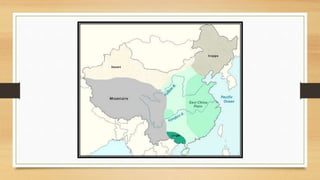
• The central valley of the Yellow River was the cradle of Chinese civilization, but another 
river would play almost as important role in China’s later history – the Yangtze River. 
• This great stream is much tamer than the Yellow River and runs far to the south through a 
warmer and wetter landscape. 
• By about the fifth century A.D., it was the center of China’s rice culture. 
• Eventually, the rice of the Yangtze became even more important than the wheat of the Yellow 
River drainage. 
• The plains along the two rivers and the coastal area between their deltas were the most 
densely populated and most important regions of ancient China.
Earliest China: The Shang Era 
• Of all the ancient civilizations, China was the most isolated from outside influences, being 
even more isolated than Egypt. 
• Both agriculture and metalworking apparently originated independently in China. 
• No connections with either Indian or Mesopotamian arts and sciences are known until much 
later, after the civilization along the Yellow and Yangtze Rivers had developed its own 
characteristics and technology. 
• Most of what we know comes from archaeology rather than history, as Shang writings were 
not numerous. 
• Several rich grave sites have been excavated starting in the 1920s.
Earliest China: The Shang Era 
• Shang society was strictly hierarchical: 
• At the top was a powerful king with his warrior court. 
• War was commonplace and warriors were favored in every way. 
• On a level below the warriors were many skilled artisans and a growing class of small traders in 
the towns. 
• In the countryside lived the great majority, the peasants in their villages. 
• Scholars are not sure whether the early Chinese had a formal religion in which all 
participated: 
• Many experts think that the upper class believed in one set of gods, whereas the majority 
worshipped another.
Earliest China: The Shang Era 
• Several fundamental aspects of Chinese life were already visible in the Shang epoch: 
• The supreme importance of the family – the Chinese rely on the family to serve as a model for public 
life and the source of all private virtue.. 
• The reverence shown to ancestors and the aged by the young – the Chinese believed that experience was far 
more important than theory and that the young must learn from the aged if harmony is to be 
preserved and progress achieved.. 
• The emphasis on this world – No other civilization of early times was so secular in orientation as the 
Chinese, who never had a priestly caste. 
• The importance of education, particularly literacy – No other culture has made the ability to read and 
write so critical for success.
Earliest China: The Shang Era 
• In the twelfth century B.C., the Shang rulers seem to have faced internal conflicts that 
weakened the dynasty. 
• Somewhat later they fell to the Zhou, a related but barbaric group from farther west. 
• The Zhou would be the longest-lived and most influential of all the Chinese ruling dynasties.
Writing 
• The written language was critically important in China. 
• How did it differ from other written languages? 
• How did it develop without input from non-Chinese sources? 
• Like most languages, Chinese was originally pictographic but soon developed a large 
vocabulary of signs that had no picture equivalents. 
• The characters are called ideographs or ideas-in-signs. 
• An ideograph with several parts can take the place of as many as seven or eight words in most 
languages, conveying whole descriptions or actions in one sign. 
• Some ideographs were derived from certain common roots, but others were not connected in any 
way, which made learning them difficult.
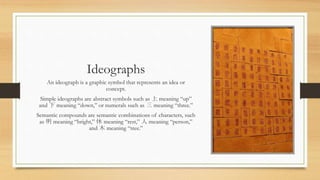
Ideographs 
An ideograph is a graphic symbol that represents an idea or 
concept. 
Simple ideographs are abstract symbols such as 上meaning “up” 
and 下meaning “down,” or numerals such as 三meaning “three.” 
Semantic compounds are semantic combinations of characters, such 
as 明meaning “bright,” 休meaning “rest,” 人meaning “person,” 
and 木meaning “tree.”
Writing 
• All in all, students had to memorize about 5,000 ideographs to be considered literate. 
• Understandably, literacy was rare and those who knew how to read and write entered a kind of 
elite club that carried tremendous prestige. 
• Although writing emerged considerably later in China than in Mesopotamia and Egypt, it 
developed quickly, had a much richer vocabulary, and was more refined than any other 
written language before the first century A.D. 
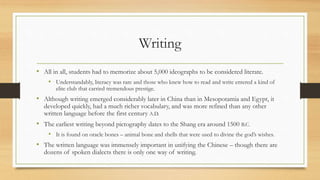
• The earliest writing beyond pictography dates to the Shang era around 1500 B.C. 
• It is found on oracle bones – animal bone and shells that were used to divine the god’s wishes. 
• The written language was immensely important in unifying the Chinese – though there are 
dozens of spoken dialects there is only one way of writing.
Oracle Bones 
Oracle bones are pieces of shell or bone, typically from ox scapulae 
or turtle plastrons, which were used for pyromancy – a form the art 
of divination by means of fire – in ancient China. 
Diviners would submit questions to the deities by carving oracle 
bone script into the piece. It would then be subjected to intense heat 
until the piece cracked [thermal expansion]. The diviner would then 
interpret the pattern of cracks and write the supposed prophecy 
upon the piece.
Art and Architecture 
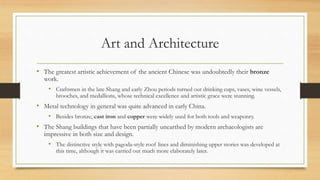
• The greatest artistic achievement of the ancient Chinese was undoubtedly their bronze 
work. 
• Craftsmen in the late Shang and early Zhou periods turned out drinking cups, vases, wine vessels, 
brooches, and medallions, whose technical excellence and artistic grace were stunning. 
• Metal technology in general was quite advanced in early China. 
• Besides bronze, cast iron and copper were widely used for both tools and weaponry. 
• The Shang buildings that have been partially unearthed by modern archaeologists are 
impressive in both size and design. 
• The distinctive style with pagoda-style roof lines and diminishing upper stories was developed at 
this time, although it was carried out much more elaborately later.
The Zhou Dynasty 
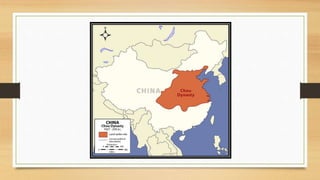
• During the 700 years that they ruled, the Zhou (Chou) greatly extended China’s borders. 
• Where the Shang had been constant to rule a relatively restricted segment of north-central China 
on either side of the Yellow River, the Zhou reached out almost to the sea in the east and well 
into Inner Mongolia in the west. 
• We know much more about the Zhou era than the Shang because of extensive literature that 
survives. 
• Much history was written and records of all types from tax rolls to lists of imports and exports 
were found.
The Zhou Dynasty 
• The dynasty falls into two distinct phases: the Unified Empire (1100-750 B.C.) and the 
Later Zhou (750-400 B.C.). 
• The earlier period was the most important in ancient Chinese history. 
• The Later Zhou dynasty experienced a series of constant provincial revolts until, finally, the 
central government broke down altogether. 
• One of the novelties of the Zhou period was the idea of the mandate from heaven. 
• To justify their forcible overthrow of the Shang, the first Zhou rulers developed the idea 
that “heaven” gave the chosen earthly ruler a mandate, or vote of confidence. 
• Heaven housed the supernatural deities who oversaw all life.
The Zhou Dynasty 
• So long as he ruled well and justly, he retained the mandate but it would be taken from him 
if he betrayed the deities’ trust. 
• A ruler who failed to protect his people from invaders or failed to contain internal revolt 
had betrayed this trust. 
• Thus, if a Chinese ruler fell to superior force or a successful conspiracy, it was a sign that he had 
“lost the mandate” and should be replaced. 
• This marvelously self-serving theory, which was used to justify numerous conspiracies and 
rebellions, was to be highly influential in Chinese history.
The Zhou Dynasty 
• The first Zhou kings were powerful rulers, who depended mainly on their swords. 
• The royal court employed hundreds of skilled administrators – this is recognized as the formal 
beginning of a professional bureaucracy. 
• As the centuries passed, however, power slipped from the monarch’s hand and a feudal 
society developed, as the kings delegated more and more of their military and administrative 
duties to local aristocrats. 
• These men stood to gain from the acquisition of new territory and they did so at every chance. 
• As a result, China expanded, but at the same time the control of the royal government 
weakened.
Culture and Daily Life under the Zhou 
• Although the Zhou rulers eventually failed to keep the nation together, their era saw great 
advances in every area of arts and crafts. 
• Wars between the contending aristocrats and against the nomads on China’s borders led to 
the use of the war chariot, which led to a technological breakthrough of great magnitude. 
• A horse harness allowed the horse to pull with the full strength of its shoulders and body 
without choking. 
• This type of harness transformed the value of horses, no only in warfare but as beasts of burden. 
• Agriculture was advanced by the invention of the iron-tipped plow, which allowed much 
more land to be tilled than could be managed with the previous wooden plow.
Culture and Daily Life under the Zhou 
• Iron blades of various sorts, sickles, and knives also increased agricultural production and 
allowed for the growth of large cities. 
• The evidence we have suggests that Chinese peasants were moderately prosperous and rarely 
enslaved at this time. 
• Although their life was undoubtedly hard, it was not miserable – Zhou peasants were in more or 
less the same economic situation as Egyptian peasants. 
• In the literary arts, most of the classics that are still being taught to Chinese children 
originated in the Zhou era. 
• The earliest surviving books stem from the 800s B.C., much earlier than any that survive from 
other civilized centers.
Culture and Daily Life under the Zhou 
• Poetry made its first appearance in Chinese letters during the early Zhou, beginning a 
tradition of sensitive, perceptive nature poetry that continues to the present day. 
• Calligraphy also began at this time and officials were expected to master this art form as a 
qualification for office. 
• Kallos meaning “beauty” and graphein meaning “to write.” 
• Silk was already a major item of luxury trade in the Zhou era. 
• Traces of Chinese silk have been unearthed from as far away as the Greek city-states of the 
classical age.
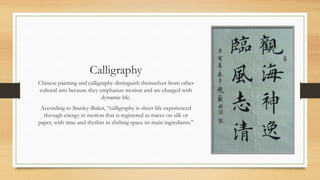
Calligraphy 
Chinese painting and calligraphy distinguish themselves from other 
cultural arts because they emphasize motion and are charged with 
dynamic life. 
According to Stanley-Baker, “calligraphy is sheer life experienced 
through energy in motion that is registered as traces on silk or 
paper, with time and rhythm in shifting space its main ingredients.”
Confucius and the Confucian Philosophy 
• China’s greatest single cultural force, the historical figure Kung Fu-tsu (551-479) or Confucius, 
appeared toward the end of the Zhou era. 
• For twenty centuries, Confucius was the most respected name in China, the molder of Chinese 
education and the authority on what a true Chinese should and should not do. 
• Confucius’s interests were centered on the hierarchy of ethical and political relations between 
individuals, in particular between the citizenry and the governor. 
• The great model for Confucius’s politics was the Chinese family. 
• In his view, the state should be like a harmonious family: the father was the undisputed head, each 
person had his/her special rights and duties, and the wisdom of the aged guided the young. 
• The oldest male was responsible for protecting and guiding the others, who owed him absolute 
obedience even when he appeared to be wrong.
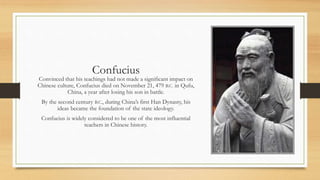
Confucius 
Convinced that his teachings had not made a significant impact on 
Chinese culture, Confucius died on November 21, 479 B.C. in Qufu, 
China, a year after losing his son in battle. 
By the second century B.C., during China’s first Han Dynasty, his 
ideas became the foundation of the state ideology. 
Confucius is widely considered to be one of the most influential 
teachers in Chinese history.
Confucius and the Confucian Philosophy 
• Confucius insisted in gentility – that is, courtesy, justice, and moderation – as the chief virtue of 
the public man. 
• He taught that the rich and the strong should feel a sense of obligation toward the poor and the 
weak. 
• A gentleman was made, not born. 
• An aristocrat might not be a gentleman, whereas a low-born person could learn to be one. 
• The proper calling of a gentleman was government. 
• He should advise the ruler and see to it that government policies were fair and promoted the 
general welfare. 
• A ruler who followed the advice of his gentlemanly councilors would surely retain the mandate 
of heaven.
Confucius and the Confucian Philosophy 
• This philosophy of public service by scholarly, virtuous officials was to have enormous 
influence on China. 
• Rulers came to be judged according to whether they made use of the Confucian prescriptions for 
good government. 
• A corps of officials educated on Confucian principles and believing him to be the Great 
Teacher came into existence. 
• These mandarins, as the West later called them, were the actual governing class of China for 
2,000 years. 
• Ultimately, Confucian principles led to a contempt for the new and a fear of change, 
however necessary.
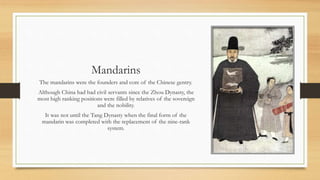
Mandarins 
The mandarins were the founders and core of the Chinese gentry. 
Although China had had civil servants since the Zhou Dynasty, the 
most high ranking positions were filled by relatives of the sovereign 
and the nobility. 
It was not until the Tang Dynasty when the final form of the 
mandarin was completed with the replacement of the nine-rank 
system.
Rivals to Confucius 
• In the later Zhou period, two rival philosophies arose to challenge the Confucian view: 
• Daoism 
• Legalism 
• Neither was as successful in capturing the permanent allegiance of the educated classes, but 
both were sometimes seized on as an alternative or a necessary addition to the Great 
Teacher.
Daoism 
• Daoism (Taoism) is a philosophy centered on nature and following the Way (Dao) it shows 
us. 
• It was supposedly the product of a teacher-sage called Lao Zi (Lao-tzu), who purportedly was a 
near contemporary of Confucius but may be entirely legendary. 
• The book attributed to him, the famous Book of Changes (Dao de Jing), was probably written 
by his followers much later. 
• Daoism has taken so many forms through the centuries that it is almost impossible to 
provide a single description of it. 
• Originally, it was a philosophy of the educated classes, but it eventually degenerated into a 
superstition of the peasants.
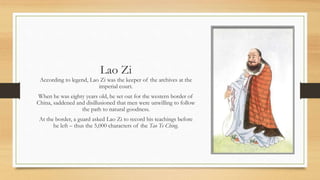
Lao Zi 
According to legend, Lao Zi was the keeper of the archives at the 
imperial court. 
When he was eighty years old, he set out for the western border of 
China, saddened and disillusioned that men were unwilling to follow 
the path to natural goodness. 
At the border, a guard asked Lao Zi to record his teachings before 
he left – thus the 5,000 characters of the Tao Te Ching.
Daoism 
• Unlike Confucius, Daoism sees the best government as the least government, and the 
people as being inherently unable and unwilling to govern themselves. 
• The responsibility of the ruling class is to give the people the justice and good 
administration that they are unable to devise for themselves. 
• In doing so, the rulers should follow the Way of Nature, as it is perceived through meditation and 
observation. 
• The truly good ruler does little except be; excessive action is as bad as no corrective action. 
• The intelligent man seeks a lifestyle that is in tune with the natural world, a harmony of 
parts into a serene whole. 
• All extremes should be avoided, even those meant to be benevolent [compassionate/generous].
Daoism 
• For many centuries, Daoism was a serious rival of Confucius’s ideas and was often adopted 
by the Chinese who sought harmony with the natural world and escape from earthly 
conflicts. 
• This dichotomy [difference of opinion] was summed up in the saying that the educated classes 
were “Confucian by day, Daoist by night.” 
• In their rational, public lives they abided by Confucian principles, but in the quiet of their beds, 
they sought immersion in mysterious, supra-rational nature.
Legalism 
• Legalism is more a philosophy of government than a philosophy of private life. 
• It was popularized in the Era of Warring States (400-225 B.C.) between the collapse of central 
Zhou dynastic authority around 400 and the rise of the Qin emperor in the 220s. 
• The Legalists were convinced that a government that allowed freedom to its subjects was 
asking for trouble. 
• Legalism was a rationalized form of governmental manipulation – its essentially a justification for 
applying force when persuasion had failed. 
• The basis for Legalism was the conviction that most people are inclined to evil selfishness, 
and it is the task of the government to restrain them and simultaneously to guide them into 
doing good – that is, what the government wants.
Legalism 
• This task is to be accomplished by controlling people even before their evil nature has 
manifested itself into actions. 
• In other words, the Legalists advocated: 
• strict censorship 
• prescribed education (differing by class) 
• immediate crushing of any signs of independent thought or action
Conclusion 
• The Chinese culture, as distinct from the state, was already shaped by 500 B.C. and would not 
change much until the modern era. 
• These deeply rooted characteristics in Chinese society were established long before the 
Romans had established their empire: 
• the emphasis on the family 
• the respect due to elders 
• the subordination of women to men 
• the focus on this life on Earth rather than on a life to come 
• the lofty position of the educated

Ancient China

  • 1.
    Ancient China “Thepeople of our race were created by Heaven, having from the beginning distinctions and rules, our people cling to customs and what they admire is seemly behavior.” - The Book of Songs
  • 2.
    Introduction • Themost stable and in many ways the most successful civilization that history has known began in China in the second millennium B.C. • It continued in its essentials through many changes in political leadership, meanwhile subjecting an enormous area and many different peoples to “the Chinese way.” • The Chinese educated classes, who considered themselves the hub of the universe, formed the most cohesive ruling group the world has ever seen. • They combined scholarship and artistic sensitivity with great administrative abilities. • Much of China’s permanent culture was already firmly established by about 500 B.C., and it would change only very slowly.
  • 3.
    Earliest China: TheShang Era • About the time the Aryan invaders arrived in the Indus valley, the Neolithic farming villages along the central course of the Yellow River were drawn into an organized state for the first time. • This state was the product of military conquest by a people closely related to the villagers, the Shang. • The Shang replaced the villagers’ earlier political overseers and introduced the Shang Dynasty. • Like other Chinese, the Shang and the people they conquered were members of the Sino-Tibetan language group and the Mongoloid or “yellow-skinned” race. • Other members of this group include the North American Indian and the Turks.
  • 5.
    Earliest China: TheShang Era • The society the Shang took over was already well on the way to a civilized life, introducing little if any cultural change: • The villagers were making advanced stone tools and bronze weaponry. • Farming had long ago replaced hunting and gathering as the mainstay of the economy. • The villagers had several types of domesticated animals and were growing wheat on the fertile soil of Mongolia. • Although the vast plain on both sides of the river would be China’s breadbasket, life was not easy for the inhabitants of the Yellow River valley. • Unlike the floods of the Nile, the floods of the Yellow River were tremendously damaging and had to be controlled by extensive levees.
  • 6.
    Earliest China: TheShang Era • The central valley of the Yellow River was the cradle of Chinese civilization, but another river would play almost as important role in China’s later history – the Yangtze River. • This great stream is much tamer than the Yellow River and runs far to the south through a warmer and wetter landscape. • By about the fifth century A.D., it was the center of China’s rice culture. • Eventually, the rice of the Yangtze became even more important than the wheat of the Yellow River drainage. • The plains along the two rivers and the coastal area between their deltas were the most densely populated and most important regions of ancient China.
  • 8.
    Earliest China: TheShang Era • Of all the ancient civilizations, China was the most isolated from outside influences, being even more isolated than Egypt. • Both agriculture and metalworking apparently originated independently in China. • No connections with either Indian or Mesopotamian arts and sciences are known until much later, after the civilization along the Yellow and Yangtze Rivers had developed its own characteristics and technology. • Most of what we know comes from archaeology rather than history, as Shang writings were not numerous. • Several rich grave sites have been excavated starting in the 1920s.
  • 9.
    Earliest China: TheShang Era • Shang society was strictly hierarchical: • At the top was a powerful king with his warrior court. • War was commonplace and warriors were favored in every way. • On a level below the warriors were many skilled artisans and a growing class of small traders in the towns. • In the countryside lived the great majority, the peasants in their villages. • Scholars are not sure whether the early Chinese had a formal religion in which all participated: • Many experts think that the upper class believed in one set of gods, whereas the majority worshipped another.
  • 10.
    Earliest China: TheShang Era • Several fundamental aspects of Chinese life were already visible in the Shang epoch: • The supreme importance of the family – the Chinese rely on the family to serve as a model for public life and the source of all private virtue.. • The reverence shown to ancestors and the aged by the young – the Chinese believed that experience was far more important than theory and that the young must learn from the aged if harmony is to be preserved and progress achieved.. • The emphasis on this world – No other civilization of early times was so secular in orientation as the Chinese, who never had a priestly caste. • The importance of education, particularly literacy – No other culture has made the ability to read and write so critical for success.
  • 11.
    Earliest China: TheShang Era • In the twelfth century B.C., the Shang rulers seem to have faced internal conflicts that weakened the dynasty. • Somewhat later they fell to the Zhou, a related but barbaric group from farther west. • The Zhou would be the longest-lived and most influential of all the Chinese ruling dynasties.
  • 12.
    Writing • Thewritten language was critically important in China. • How did it differ from other written languages? • How did it develop without input from non-Chinese sources? • Like most languages, Chinese was originally pictographic but soon developed a large vocabulary of signs that had no picture equivalents. • The characters are called ideographs or ideas-in-signs. • An ideograph with several parts can take the place of as many as seven or eight words in most languages, conveying whole descriptions or actions in one sign. • Some ideographs were derived from certain common roots, but others were not connected in any way, which made learning them difficult.
  • 13.
    Ideographs An ideographis a graphic symbol that represents an idea or concept. Simple ideographs are abstract symbols such as 上meaning “up” and 下meaning “down,” or numerals such as 三meaning “three.” Semantic compounds are semantic combinations of characters, such as 明meaning “bright,” 休meaning “rest,” 人meaning “person,” and 木meaning “tree.”
  • 14.
    Writing • Allin all, students had to memorize about 5,000 ideographs to be considered literate. • Understandably, literacy was rare and those who knew how to read and write entered a kind of elite club that carried tremendous prestige. • Although writing emerged considerably later in China than in Mesopotamia and Egypt, it developed quickly, had a much richer vocabulary, and was more refined than any other written language before the first century A.D. • The earliest writing beyond pictography dates to the Shang era around 1500 B.C. • It is found on oracle bones – animal bone and shells that were used to divine the god’s wishes. • The written language was immensely important in unifying the Chinese – though there are dozens of spoken dialects there is only one way of writing.
  • 15.
    Oracle Bones Oraclebones are pieces of shell or bone, typically from ox scapulae or turtle plastrons, which were used for pyromancy – a form the art of divination by means of fire – in ancient China. Diviners would submit questions to the deities by carving oracle bone script into the piece. It would then be subjected to intense heat until the piece cracked [thermal expansion]. The diviner would then interpret the pattern of cracks and write the supposed prophecy upon the piece.
  • 16.
    Art and Architecture • The greatest artistic achievement of the ancient Chinese was undoubtedly their bronze work. • Craftsmen in the late Shang and early Zhou periods turned out drinking cups, vases, wine vessels, brooches, and medallions, whose technical excellence and artistic grace were stunning. • Metal technology in general was quite advanced in early China. • Besides bronze, cast iron and copper were widely used for both tools and weaponry. • The Shang buildings that have been partially unearthed by modern archaeologists are impressive in both size and design. • The distinctive style with pagoda-style roof lines and diminishing upper stories was developed at this time, although it was carried out much more elaborately later.
  • 17.
    The Zhou Dynasty • During the 700 years that they ruled, the Zhou (Chou) greatly extended China’s borders. • Where the Shang had been constant to rule a relatively restricted segment of north-central China on either side of the Yellow River, the Zhou reached out almost to the sea in the east and well into Inner Mongolia in the west. • We know much more about the Zhou era than the Shang because of extensive literature that survives. • Much history was written and records of all types from tax rolls to lists of imports and exports were found.
  • 19.
    The Zhou Dynasty • The dynasty falls into two distinct phases: the Unified Empire (1100-750 B.C.) and the Later Zhou (750-400 B.C.). • The earlier period was the most important in ancient Chinese history. • The Later Zhou dynasty experienced a series of constant provincial revolts until, finally, the central government broke down altogether. • One of the novelties of the Zhou period was the idea of the mandate from heaven. • To justify their forcible overthrow of the Shang, the first Zhou rulers developed the idea that “heaven” gave the chosen earthly ruler a mandate, or vote of confidence. • Heaven housed the supernatural deities who oversaw all life.
  • 20.
    The Zhou Dynasty • So long as he ruled well and justly, he retained the mandate but it would be taken from him if he betrayed the deities’ trust. • A ruler who failed to protect his people from invaders or failed to contain internal revolt had betrayed this trust. • Thus, if a Chinese ruler fell to superior force or a successful conspiracy, it was a sign that he had “lost the mandate” and should be replaced. • This marvelously self-serving theory, which was used to justify numerous conspiracies and rebellions, was to be highly influential in Chinese history.
  • 21.
    The Zhou Dynasty • The first Zhou kings were powerful rulers, who depended mainly on their swords. • The royal court employed hundreds of skilled administrators – this is recognized as the formal beginning of a professional bureaucracy. • As the centuries passed, however, power slipped from the monarch’s hand and a feudal society developed, as the kings delegated more and more of their military and administrative duties to local aristocrats. • These men stood to gain from the acquisition of new territory and they did so at every chance. • As a result, China expanded, but at the same time the control of the royal government weakened.
  • 22.
    Culture and DailyLife under the Zhou • Although the Zhou rulers eventually failed to keep the nation together, their era saw great advances in every area of arts and crafts. • Wars between the contending aristocrats and against the nomads on China’s borders led to the use of the war chariot, which led to a technological breakthrough of great magnitude. • A horse harness allowed the horse to pull with the full strength of its shoulders and body without choking. • This type of harness transformed the value of horses, no only in warfare but as beasts of burden. • Agriculture was advanced by the invention of the iron-tipped plow, which allowed much more land to be tilled than could be managed with the previous wooden plow.
  • 23.
    Culture and DailyLife under the Zhou • Iron blades of various sorts, sickles, and knives also increased agricultural production and allowed for the growth of large cities. • The evidence we have suggests that Chinese peasants were moderately prosperous and rarely enslaved at this time. • Although their life was undoubtedly hard, it was not miserable – Zhou peasants were in more or less the same economic situation as Egyptian peasants. • In the literary arts, most of the classics that are still being taught to Chinese children originated in the Zhou era. • The earliest surviving books stem from the 800s B.C., much earlier than any that survive from other civilized centers.
  • 24.
    Culture and DailyLife under the Zhou • Poetry made its first appearance in Chinese letters during the early Zhou, beginning a tradition of sensitive, perceptive nature poetry that continues to the present day. • Calligraphy also began at this time and officials were expected to master this art form as a qualification for office. • Kallos meaning “beauty” and graphein meaning “to write.” • Silk was already a major item of luxury trade in the Zhou era. • Traces of Chinese silk have been unearthed from as far away as the Greek city-states of the classical age.
  • 25.
    Calligraphy Chinese paintingand calligraphy distinguish themselves from other cultural arts because they emphasize motion and are charged with dynamic life. According to Stanley-Baker, “calligraphy is sheer life experienced through energy in motion that is registered as traces on silk or paper, with time and rhythm in shifting space its main ingredients.”
  • 26.
    Confucius and theConfucian Philosophy • China’s greatest single cultural force, the historical figure Kung Fu-tsu (551-479) or Confucius, appeared toward the end of the Zhou era. • For twenty centuries, Confucius was the most respected name in China, the molder of Chinese education and the authority on what a true Chinese should and should not do. • Confucius’s interests were centered on the hierarchy of ethical and political relations between individuals, in particular between the citizenry and the governor. • The great model for Confucius’s politics was the Chinese family. • In his view, the state should be like a harmonious family: the father was the undisputed head, each person had his/her special rights and duties, and the wisdom of the aged guided the young. • The oldest male was responsible for protecting and guiding the others, who owed him absolute obedience even when he appeared to be wrong.
  • 27.
    Confucius Convinced thathis teachings had not made a significant impact on Chinese culture, Confucius died on November 21, 479 B.C. in Qufu, China, a year after losing his son in battle. By the second century B.C., during China’s first Han Dynasty, his ideas became the foundation of the state ideology. Confucius is widely considered to be one of the most influential teachers in Chinese history.
  • 28.
    Confucius and theConfucian Philosophy • Confucius insisted in gentility – that is, courtesy, justice, and moderation – as the chief virtue of the public man. • He taught that the rich and the strong should feel a sense of obligation toward the poor and the weak. • A gentleman was made, not born. • An aristocrat might not be a gentleman, whereas a low-born person could learn to be one. • The proper calling of a gentleman was government. • He should advise the ruler and see to it that government policies were fair and promoted the general welfare. • A ruler who followed the advice of his gentlemanly councilors would surely retain the mandate of heaven.
  • 29.
    Confucius and theConfucian Philosophy • This philosophy of public service by scholarly, virtuous officials was to have enormous influence on China. • Rulers came to be judged according to whether they made use of the Confucian prescriptions for good government. • A corps of officials educated on Confucian principles and believing him to be the Great Teacher came into existence. • These mandarins, as the West later called them, were the actual governing class of China for 2,000 years. • Ultimately, Confucian principles led to a contempt for the new and a fear of change, however necessary.
  • 30.
    Mandarins The mandarinswere the founders and core of the Chinese gentry. Although China had had civil servants since the Zhou Dynasty, the most high ranking positions were filled by relatives of the sovereign and the nobility. It was not until the Tang Dynasty when the final form of the mandarin was completed with the replacement of the nine-rank system.
  • 31.
    Rivals to Confucius • In the later Zhou period, two rival philosophies arose to challenge the Confucian view: • Daoism • Legalism • Neither was as successful in capturing the permanent allegiance of the educated classes, but both were sometimes seized on as an alternative or a necessary addition to the Great Teacher.
  • 32.
    Daoism • Daoism(Taoism) is a philosophy centered on nature and following the Way (Dao) it shows us. • It was supposedly the product of a teacher-sage called Lao Zi (Lao-tzu), who purportedly was a near contemporary of Confucius but may be entirely legendary. • The book attributed to him, the famous Book of Changes (Dao de Jing), was probably written by his followers much later. • Daoism has taken so many forms through the centuries that it is almost impossible to provide a single description of it. • Originally, it was a philosophy of the educated classes, but it eventually degenerated into a superstition of the peasants.
  • 33.
    Lao Zi Accordingto legend, Lao Zi was the keeper of the archives at the imperial court. When he was eighty years old, he set out for the western border of China, saddened and disillusioned that men were unwilling to follow the path to natural goodness. At the border, a guard asked Lao Zi to record his teachings before he left – thus the 5,000 characters of the Tao Te Ching.
  • 34.
    Daoism • UnlikeConfucius, Daoism sees the best government as the least government, and the people as being inherently unable and unwilling to govern themselves. • The responsibility of the ruling class is to give the people the justice and good administration that they are unable to devise for themselves. • In doing so, the rulers should follow the Way of Nature, as it is perceived through meditation and observation. • The truly good ruler does little except be; excessive action is as bad as no corrective action. • The intelligent man seeks a lifestyle that is in tune with the natural world, a harmony of parts into a serene whole. • All extremes should be avoided, even those meant to be benevolent [compassionate/generous].
  • 35.
    Daoism • Formany centuries, Daoism was a serious rival of Confucius’s ideas and was often adopted by the Chinese who sought harmony with the natural world and escape from earthly conflicts. • This dichotomy [difference of opinion] was summed up in the saying that the educated classes were “Confucian by day, Daoist by night.” • In their rational, public lives they abided by Confucian principles, but in the quiet of their beds, they sought immersion in mysterious, supra-rational nature.
  • 36.
    Legalism • Legalismis more a philosophy of government than a philosophy of private life. • It was popularized in the Era of Warring States (400-225 B.C.) between the collapse of central Zhou dynastic authority around 400 and the rise of the Qin emperor in the 220s. • The Legalists were convinced that a government that allowed freedom to its subjects was asking for trouble. • Legalism was a rationalized form of governmental manipulation – its essentially a justification for applying force when persuasion had failed. • The basis for Legalism was the conviction that most people are inclined to evil selfishness, and it is the task of the government to restrain them and simultaneously to guide them into doing good – that is, what the government wants.
  • 37.
    Legalism • Thistask is to be accomplished by controlling people even before their evil nature has manifested itself into actions. • In other words, the Legalists advocated: • strict censorship • prescribed education (differing by class) • immediate crushing of any signs of independent thought or action
  • 38.
    Conclusion • TheChinese culture, as distinct from the state, was already shaped by 500 B.C. and would not change much until the modern era. • These deeply rooted characteristics in Chinese society were established long before the Romans had established their empire: • the emphasis on the family • the respect due to elders • the subordination of women to men • the focus on this life on Earth rather than on a life to come • the lofty position of the educated