NAME : DEEPA V
ROLL NO : 04
B.ED SOCIAL SCIENCE
GCTE, THYCAUD, TVM
WELCOME
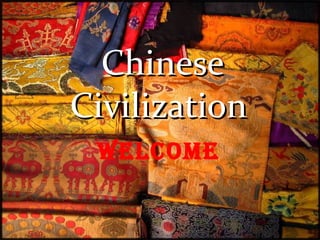
ChineseChinese
CivilizationCivilization
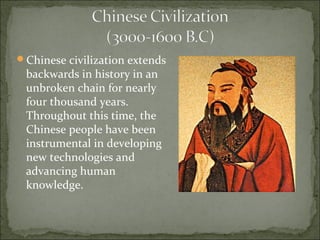
Chinese civilization extends
backwards in history in an
unbroken chain for nearly
four thousand years.
Throughout this time, the
Chinese people have been
instrumental in developing
new technologies and
advancing human
knowledge.
The Chinese have been
ruled by a succession of
dynasties (families that
pass the right to rule the
nation from one
generation to the next).
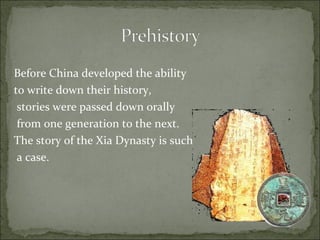
Before China developed the ability
to write down their history,
stories were passed down orally
from one generation to the next.
The story of the Xia Dynasty is such
a case.
Hwang-Ho Valley
Art of writing
OCCUPATION
(Agriculture,
Silk industry)
calendar
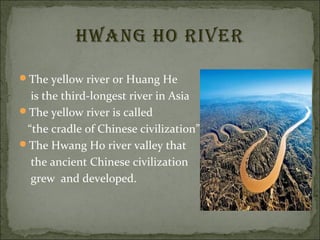
The yellow river or Huang He
is the third-longest river in Asia
The yellow river is called
“the cradle of Chinese civilization”.
The Hwang Ho river valley that
the ancient Chinese civilization
grew and developed.
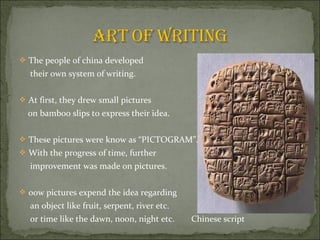
 The people of china developed
their own system of writing.
 At first, they drew small pictures
on bamboo slips to express their idea.
 These pictures were know as “PICTOGRAM”.
 With the progress of time, further
improvement was made on pictures.
 0ow pictures expend the idea regarding
an object like fruit, serpent, river etc.
or time like the dawn, noon, night etc. Chinese script
One of the most
important contributions
made during the period
that the Shang Dynasty
ruled China was the
invention of writing.
The earliest written
records found in China
come from this time
period.
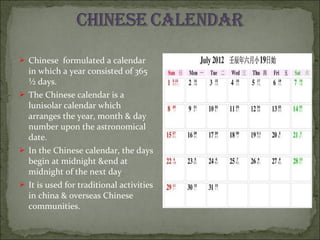
 Chinese formulated a calendar
in which a year consisted of 365
½ days.
 The Chinese calendar is a
lunisolar calendar which
arranges the year, month & day
number upon the astronomical
date.
 In the Chinese calendar, the days
begin at midnight &end at
midnight of the next day
 It is used for traditional activities
in china & overseas Chinese
communities.
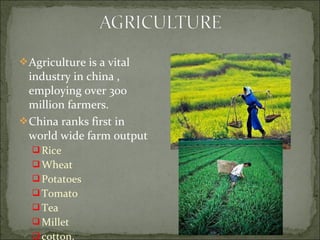
Agriculture is a vital
industry in china ,
employing over 300
million farmers.
China ranks first in
world wide farm output
 Rice
 Wheat
 Potatoes
 Tomato
 Tea
 Millet
 cotton.
 Production of silk
originates in china in the
Neolithic.
 Silk remained confined
to china until the silk
road opened at some
point during the later
half of the first
millennium BCE.
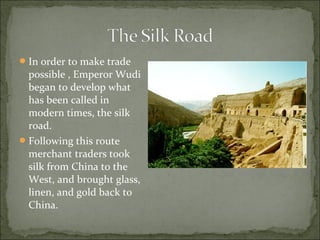
In order to make trade
possible , Emperor Wudi
began to develop what
has been called in
modern times, the silk
road.
Following this route
merchant traders took
silk from China to the
West, and brought glass,
linen, and gold back to
China.
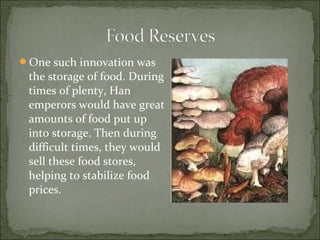
One such innovation was
the storage of food. During
times of plenty, Han
emperors would have great
amounts of food put up
into storage. Then during
difficult times, they would
sell these food stores,
helping to stabilize food
prices.
The religious history of China
is complex, and has evolved
over the centuries.
Deeply interwoven into their
beliefs is the worship of their
ancestors.
The Chinese believed that
the spirits of their ancestors
were watching over them,
and that they could be called
upon during difficult times.
1) what is the Era of chines civilization?
2) Which is the major river in china?
3) Which are the main occupation of the people in
china?
4) What is the specialty of Chinese pictorial script?
5) The ancient Chinese civilization developed mainly
depending on which activity?
6) What is the specialty of Chinese calendar?
Ancient chinese-civilization

Ancient chinese-civilization

  • 1.
    NAME : DEEPAV ROLL NO : 04 B.ED SOCIAL SCIENCE GCTE, THYCAUD, TVM
  • 2.
  • 3.
    Chinese civilization extends backwardsin history in an unbroken chain for nearly four thousand years. Throughout this time, the Chinese people have been instrumental in developing new technologies and advancing human knowledge.
  • 4.
    The Chinese havebeen ruled by a succession of dynasties (families that pass the right to rule the nation from one generation to the next).
  • 5.
    Before China developedthe ability to write down their history, stories were passed down orally from one generation to the next. The story of the Xia Dynasty is such a case.
  • 6.
    Hwang-Ho Valley Art ofwriting OCCUPATION (Agriculture, Silk industry) calendar
  • 7.
    The yellow riveror Huang He is the third-longest river in Asia The yellow river is called “the cradle of Chinese civilization”. The Hwang Ho river valley that the ancient Chinese civilization grew and developed.
  • 8.
     The peopleof china developed their own system of writing.  At first, they drew small pictures on bamboo slips to express their idea.  These pictures were know as “PICTOGRAM”.  With the progress of time, further improvement was made on pictures.  0ow pictures expend the idea regarding an object like fruit, serpent, river etc. or time like the dawn, noon, night etc. Chinese script
  • 9.
    One of themost important contributions made during the period that the Shang Dynasty ruled China was the invention of writing. The earliest written records found in China come from this time period.
  • 10.
     Chinese formulateda calendar in which a year consisted of 365 ½ days.  The Chinese calendar is a lunisolar calendar which arranges the year, month & day number upon the astronomical date.  In the Chinese calendar, the days begin at midnight &end at midnight of the next day  It is used for traditional activities in china & overseas Chinese communities.
  • 11.
    Agriculture is avital industry in china , employing over 300 million farmers. China ranks first in world wide farm output  Rice  Wheat  Potatoes  Tomato  Tea  Millet  cotton.
  • 12.
     Production ofsilk originates in china in the Neolithic.  Silk remained confined to china until the silk road opened at some point during the later half of the first millennium BCE.
  • 13.
    In order tomake trade possible , Emperor Wudi began to develop what has been called in modern times, the silk road. Following this route merchant traders took silk from China to the West, and brought glass, linen, and gold back to China.
  • 14.
    One such innovationwas the storage of food. During times of plenty, Han emperors would have great amounts of food put up into storage. Then during difficult times, they would sell these food stores, helping to stabilize food prices.
  • 15.
    The religious historyof China is complex, and has evolved over the centuries. Deeply interwoven into their beliefs is the worship of their ancestors. The Chinese believed that the spirits of their ancestors were watching over them, and that they could be called upon during difficult times.
  • 16.
    1) what isthe Era of chines civilization? 2) Which is the major river in china? 3) Which are the main occupation of the people in china? 4) What is the specialty of Chinese pictorial script? 5) The ancient Chinese civilization developed mainly depending on which activity? 6) What is the specialty of Chinese calendar?