Chinese Civilization
Boutkhil Guemide
University Mohammed Boudiaf, M’sila
Algeria
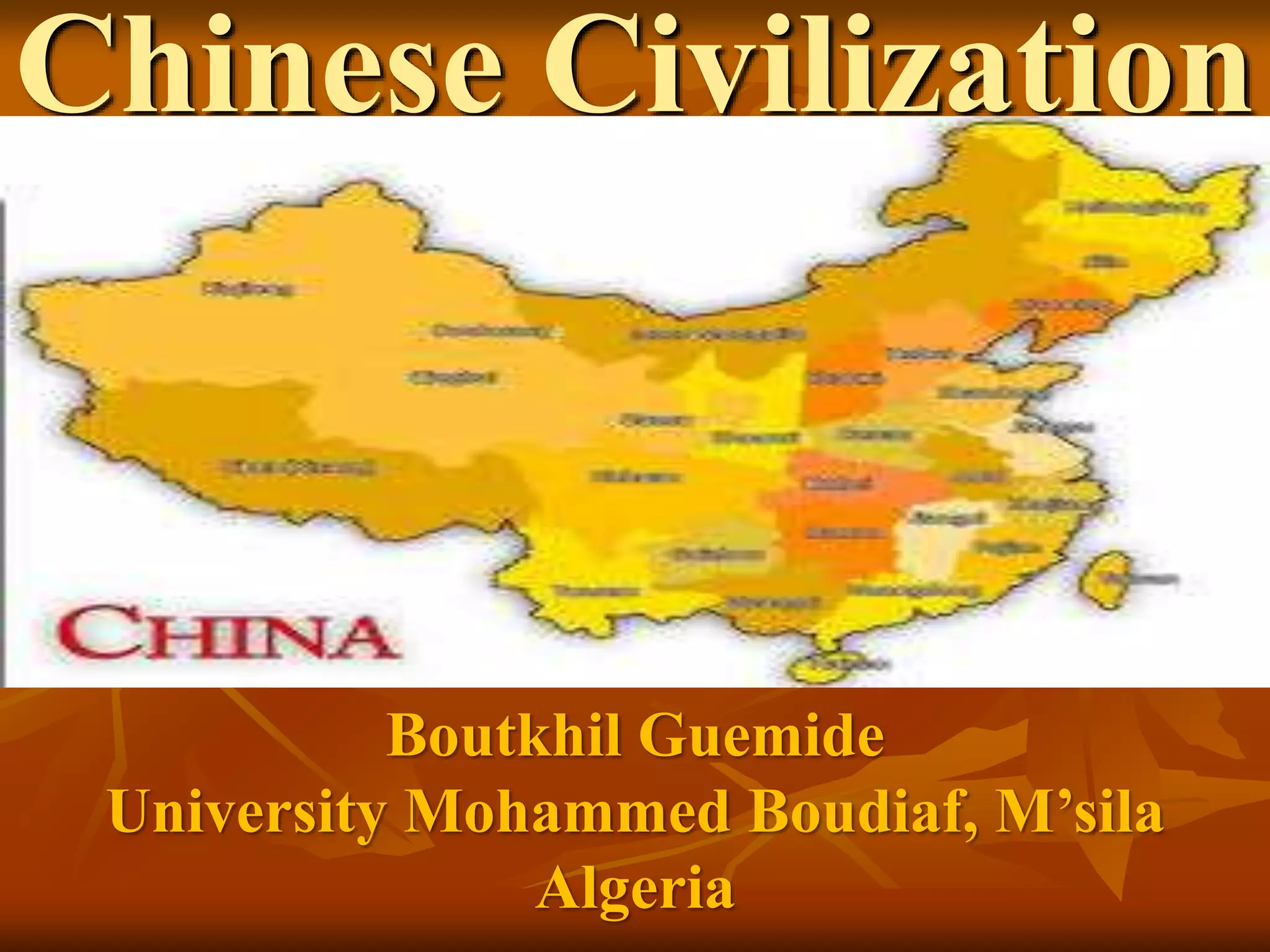
China: Geography
 China's Geography and landscape is
extremely varied, with a wide range of
weather and climate.
 Along the coast concentrate the main
cities and ports.
 In the North and West are mountains and
deserts.
 The South is crowded with jungles and
tropical lowlands whereas the South-West
is home to the harsher Tibetan Plateau.
Himalaya Mountain Range and Mt. Everest
 The Tibetan Plateau is the world's largest and highest
plateau.
 It leads to the Himalaya mountains, which are at the
China-Nepal border,
 The highest peaks in the world, including Mt.
Everest, 8,850 meters, or 29,029 ft above sea level.
 The Tibetan Plateau: The "Roof of the World" and is
home to the Autonomous Region of Tibet.
 Because of the high altitudes and harsh cold
temperatures in the winter that can drop to -40 F,
these areas are some of the least populous in the
world.
 Southern China is also home to some extraordinary
mountain scenery.
 The unusual formations and landscapes have inspired
Chinese painters and artists since ancient times and
these mountains are some of China's major tourist
attractions.
 Karst Mountains in Guilin/Yangshuo, Huang Shan or
Yellow Mountain, Zhang Jia Jie (The Avatar
Mountains)
China Rivers
 Flowing out of the Tibetan Plateau are two of China's longest
rivers, the Yangtze and the Yellow River.
 They cut across China as they continue towards the coast
through the more densely populated areas.
 The Yangtze River: The longest in China and third in the
world after the Nile and the Amazon.
 China's most important waterway and is the site of the Three
Gorges Dam, the top producer of hydroelectricity in the world.
 The Yangtze River: A major source of tourism for the area.
 The Yellow River: China's second longest, and it flows
through the North China Plain,
 The Cradle of ancient China: The most prosperous at the
time and the Chinese civilization originated in the Yellow
River Basin.
 The Pearl River: The third longest,
 A system of several rivers and tributaries that share a common
delta, the Pearl River Delta.
 Famous for the special economic zones that have been set up
along the estuary and are responsible for the rapid development
of China's economy.
China Deserts
 About 20% of China's land is
desert land.
 The largest deserts in China:
The Gobi Desert and
the Taklamakan Desert, in the
north-west of the country where
sand dunes and rocky landscape
extends in all directions.
 These areas are sparsely
populated due to their arid
environment and harsh winter
climate.
Geography of China
 Only 10% of China is suitable for
farming
 Mostly mountains and deserts on
the northern and western frontiers
 Geographical barriers isolated the
Chinese people
 Contact with others marked with
conflict
 North– Chinese protecting precious
farmland
 Ancient Chinese civilization
flourished from 1500 BC to AD
589
 Four major dynasties existed
during this time:
Shang
Zhou
Qin
Han
The Early Dynasties
 By the time of the Shang, people had
founded cities in north China.
 These cities served as centers of
administration and ritual.
 An urban network ruled the entire dynastic
state.
 Capitals were often shifted, suggesting that
new rulers often moved the locations.
 Shang troops had frequent wars with the
nomadic herdsman from the Asian steppes.
Who were these nomads from the steppes?
 Indo-Europeans who domesticated horses and pushed
deeper into the steppe.
 They herded cattle, sheep, goats, and horses.
 They mastered metallurgy about 2900 B.C.E.
 They built heavy wagons which extended their range
into the Eurasian steppe.
 By 1000 B.C.E. these nomadic people served as the link
between farming cultures in the west and in the east.
 They were dependent upon the agricultural
communities to supply them with grains, metals, and
textiles.
 In turn, they supplied the farmers with horses while
serving as a trading conduit for products and ideas.
Shang Dynasty 1750- 1050 BC
 First dynasty, Xia (SYAH) approx. 4,000 B.C.
 Little is known, however…
 Second dynasty, Shang
 1750 to 1050 B.C.
 Shang rule began about 1700 BC in the Yellow River
Valley.
 A confederation of clans, each headed by a nobleman,
acknowledged the Shang dynasty's king.
 Farming society ruled by warrior aristocracy
 (aristocracy: upper class whose wealth is based on
land and power is passed from one generation to the
next)
 Impressive cities with huge city walls, royal palaces and
large royal tombs
Political Structure
 Realm divided into territories
 Administered by aristocratic warlords
 King appointed and removed
 King’s spiritual beliefs
 Buried with corpses of servants
 Supernatural forces gave advice
 Oracle Bones: Priests carved questions in
bones, heated metal rods were stuck into the
bone causing cracks, priests interpreted the
cracks as answers from the gods
 Wrote the answers, stored the bones are a
valuable asset in understanding the Shang
period
Social Structure
 King and his family
 Aided by aristocratic families
 Aristocrats waged war and served as officials
 Were the chief landowners
 Majority of people
 Peasants who farmed the land owned by the
aristocracy
 Small number of merchants, artisans, and
slaves
Religion and Culture
 Veneration of ancestors (ancestor
worship)
 Belief in afterlife
 To this day – may people burn exactly
replicas of physical objects to
accompany dead on journey to next
world
 Believed that the spirits of family
ancestors could bring good or evil to
living members of the family
 Shang– mastery of art of bronze casting
Zhou Dynasty 1050- 221 BC
 Last Shang ruler was a “wicked tyrant”
 Aggressive ruler of the state of Zhou
(JOH) revolted and created a new
dynasty
 Zhou Dynasty lasted almost 800 years,
longest of all Chinese dynasties
 Zhou political structure
 Same as the Shang – king served by
large, complex bureaucracy,
territories/officials
Mandate of Heaven
 New Theory of Government
 Zhou claimed to rule China because it
possessed the Mandate of Heaven
 Believed that “Heaven” – an impersonal law of
nature – kept order in the universe through the
Zhou king
 Zhou king ruled over all humanity by mandate,
or authority to command, from Heaven
 Chosen because of talent and virtue
 Responsible to rule with goodness and efficiency
Mandate of Heaven
 Double-edged
 King supposed to rule according to the proper “Way”
called the Dao (DOW)
 His duty to keep the gods pleased
 Protects people from natural disaster, bad harvest
 “Right of Revolution” - if King was ineffective, he
could be overthrown by a new ruler
 Representative of Heaven, but not divine
 Dynastic Cycle
 established, ruled successfully, then began to decline
(rebellions, invasions) collapsed, new dynasty
Fall of Zhou Dynasty
 Divided into smaller territories
 Evolved into powerful states
 Zhou rulers declined, intellectually & morally
 403 B.C. civil war broke out, beginning the
“Period of the Warring States”
 Nature of warfare had changed
 Iron weapons replaced bronze weapons
 Foot soldiers (infantry) and soldiers on horseback
(cavalry)
 Calvary had powerful crossbows, Chinese invention
of 7th B.C.
 Eventually one warring state – Qin (CHIN) took
control, established dynasty in 221 B.C.
Life During Zhou Dynasty
 Economic Features
 Peasants worked land owned by a lord but
often had a small area for own use
 Artisans and merchants lived in walled towns
under direct control of local lord
 Merchants did not operate freely but were
considered property of local lord
 Slaves present as well
 Local trade (later distant trade) for items
like salt, iron, cloth and luxuries
Economic and Technical Growth
 Significant growth – 6th to 3rd century B.C.
 Irrigation early 6th century
 Mid 6th century iron plowshares = more land
to farm
 Population up to 50 million people at the end
of Zhou
 Trade and manufacturing
 SILK! All the way to
Athens, Greece…
Family in Ancient China
 Almost sacred quality of entire social order
 Filial piety: duty of family members to subordinate
their needs and desires to those of the male head of
the family
 system in which every family member has a place
 Central to Confucianism
 Male supremacy
 Traditional role – provide food, work in fields,
warriors, scholars, government ministers
 Women raised kids and worked in home
Qin Dynasty 221- 202 BC
 Came to power through military force,
around 221 BC
 Lasted only 15 years
 Name “China” comes from Qin
 Established autocracy – emperor held total
power
 Forced people to build Great Wall of China
 Discontent caused a rebel army to
overthrow the empire– founded Han
dynasty
HAN DYNASTY (202 BC-220 AD)
 A new dynasty, the Hans, took up the task of unification and became
one of the most admired houses in Chinese history.
 This Classical Era dynasty saw a revival of Confucian teachings.
 Han Emperors used the concept of the Mandate of Heaven to build a
powerful, centralized monarchy.
 The scholar-civil servant system with exams on Confucian principles
allowed successful candidates to enter into this elite group.
 The system favored candidates from wealthy families who could
afford tutors for their children
 They established trade routes out from Canton and exported silk to
as far away as the Roman Empire.
 Paper was invented by Ts’ai Lun in 105 AD.
 Internal struggles caused a popular rebellion by the Yellow
Turbans and the last Han emperor was forced to resign in 220 AD.
Chinese Written Language
 Pictographic and
Ideographic
 Form a picture of the
object to be represented
 Characters given a sound
when pronounced
 Later phonetic meanings
given to some symbols
 Evolved over 400 years,
never abandoned original
format
Chinese Philosophies
 Between 500 and 200 B.C.
 3 major schools of thought about the nature of
human beings and the universe emerged
 Confucianism, Daoism, and Legalism
 Focused on immediate world and how to
create a stable order
Confucianism
 Confucius/Kongfuzi (KOONG FOO DZUH)
 Born 551 B.C. in China
 Upset by violence and moral decay
 Traveled China to persuade political leaders to
follow his ideas
 Followers documented his sayings in the Analects
 Until 20th century almost every Chinese student studied
these sayings
 Provided a basic set of ideas to keep order
 Political and ethical philosophy, not
spiritual
 Useless to speculate on spiritual questions
 Focus on ordering the affairs of the world - if
act in harmony with the world, will prosper
 Human behavior is key
 Behave in accordance with the Dao (Way)
 Two elements to Dao
 Duty and Humanity
Confucianism
 Duty (according to the Dao, the Way)
 All should subordinate their own interests to the
needs of family and the community
 Governed by the Five Constant Relationships: parent
and child, husband and wife, older sibling and
younger sibling, older friend and younger friend, and
ruler and subject
 Each person in a relationship has a duty to the other
 Parents loving towards children, children revere parents
 Husband fulfill duties, wives should be obedient
 Older siblings kind, younger siblings respectful…
 Obvious family importance!
 Everyone does their duty – whole world prospers!
Confucianism
Confucianism
 “If there is righteousness in the heart,
there will be beauty in the character. If
there is beauty in the character, there will
be harmony in the home. If there be
harmony in the home, there will be order in
the nation. If there be order in the nation,
there will be peace in the world.”
~ Confucius
Confucianism
 Humanity (according to the Dao, the Way)
 Sense of compassion and empathy for others
 Like the Christian idea “Do unto others as you would
have others do unto you.” – instead it is “Do not do
unto others what you would not want done to
yourself.” ~ Confucius
 Tolerate others…
 Values of the “Golden Age” of the Zhou
 Revolutionary idea – government officials should
be ruled by merit, not noble birth
 Later – civil service examinations
Daoism
 System of ideas based on teachings of
Laozi (LOW DZUH)
 Contemporary of Confucius
 Ideas outlined in Tao Te Ching (The Way of the Dao)
 Also does not concern itself with underlying meaning of the
universe but focuses on proper behavior
 Differs from Confucianism
 True way to follow the will of Heaven is not action but
inaction (unlike emphasis on duty of humans to work hard
and improve life here on Earth)
 Act in harmony with universal order by acting spontaneously
and letting nature take its course by not interfering
Daoism
 “Without going outside, you may
know the whole world.
Without looking through the window,
you may see the ways of heaven.
The farther you go, the less you know.
Thus the sage [wise man] knows
without traveling;
He sees without looking;
He works without doing.”
Daoism
 “The universe is sacred.
You cannot improve it.
If you try to change it, you will ruin it.
If you try to hold it, you will lose it.”
Legalism
 Proposed that humans are evil by nature
 Will only follow the correct path if forced to by harsh
laws and punishments
 Argued for a system of impersonal laws
 Strong ruler was required to create an orderly society
 Disagreed with Confucius “Lead the people by virtue
and restrain them by the rules of good taste, and the
people will have a sense of shame, and moreover will
be become good.”
 People are not capable of being good
 Only the fear of harsh punishment would keep order
 Ruler did not have to show compassion for the needs
of the people

Early chinese civilizations

  • 1.
    Chinese Civilization Boutkhil Guemide UniversityMohammed Boudiaf, M’sila Algeria
  • 2.
    China: Geography  China'sGeography and landscape is extremely varied, with a wide range of weather and climate.  Along the coast concentrate the main cities and ports.  In the North and West are mountains and deserts.  The South is crowded with jungles and tropical lowlands whereas the South-West is home to the harsher Tibetan Plateau.
  • 4.
    Himalaya Mountain Rangeand Mt. Everest  The Tibetan Plateau is the world's largest and highest plateau.  It leads to the Himalaya mountains, which are at the China-Nepal border,  The highest peaks in the world, including Mt. Everest, 8,850 meters, or 29,029 ft above sea level.  The Tibetan Plateau: The "Roof of the World" and is home to the Autonomous Region of Tibet.  Because of the high altitudes and harsh cold temperatures in the winter that can drop to -40 F, these areas are some of the least populous in the world.  Southern China is also home to some extraordinary mountain scenery.  The unusual formations and landscapes have inspired Chinese painters and artists since ancient times and these mountains are some of China's major tourist attractions.  Karst Mountains in Guilin/Yangshuo, Huang Shan or Yellow Mountain, Zhang Jia Jie (The Avatar Mountains)
  • 5.
    China Rivers  Flowingout of the Tibetan Plateau are two of China's longest rivers, the Yangtze and the Yellow River.  They cut across China as they continue towards the coast through the more densely populated areas.  The Yangtze River: The longest in China and third in the world after the Nile and the Amazon.  China's most important waterway and is the site of the Three Gorges Dam, the top producer of hydroelectricity in the world.  The Yangtze River: A major source of tourism for the area.  The Yellow River: China's second longest, and it flows through the North China Plain,  The Cradle of ancient China: The most prosperous at the time and the Chinese civilization originated in the Yellow River Basin.  The Pearl River: The third longest,  A system of several rivers and tributaries that share a common delta, the Pearl River Delta.  Famous for the special economic zones that have been set up along the estuary and are responsible for the rapid development of China's economy.
  • 6.
    China Deserts  About20% of China's land is desert land.  The largest deserts in China: The Gobi Desert and the Taklamakan Desert, in the north-west of the country where sand dunes and rocky landscape extends in all directions.  These areas are sparsely populated due to their arid environment and harsh winter climate.
  • 7.
    Geography of China Only 10% of China is suitable for farming  Mostly mountains and deserts on the northern and western frontiers  Geographical barriers isolated the Chinese people  Contact with others marked with conflict  North– Chinese protecting precious farmland
  • 8.
     Ancient Chinesecivilization flourished from 1500 BC to AD 589  Four major dynasties existed during this time: Shang Zhou Qin Han
  • 10.
    The Early Dynasties By the time of the Shang, people had founded cities in north China.  These cities served as centers of administration and ritual.  An urban network ruled the entire dynastic state.  Capitals were often shifted, suggesting that new rulers often moved the locations.  Shang troops had frequent wars with the nomadic herdsman from the Asian steppes.
  • 11.
    Who were thesenomads from the steppes?  Indo-Europeans who domesticated horses and pushed deeper into the steppe.  They herded cattle, sheep, goats, and horses.  They mastered metallurgy about 2900 B.C.E.  They built heavy wagons which extended their range into the Eurasian steppe.  By 1000 B.C.E. these nomadic people served as the link between farming cultures in the west and in the east.  They were dependent upon the agricultural communities to supply them with grains, metals, and textiles.  In turn, they supplied the farmers with horses while serving as a trading conduit for products and ideas.
  • 12.
    Shang Dynasty 1750-1050 BC  First dynasty, Xia (SYAH) approx. 4,000 B.C.  Little is known, however…  Second dynasty, Shang  1750 to 1050 B.C.  Shang rule began about 1700 BC in the Yellow River Valley.  A confederation of clans, each headed by a nobleman, acknowledged the Shang dynasty's king.  Farming society ruled by warrior aristocracy  (aristocracy: upper class whose wealth is based on land and power is passed from one generation to the next)  Impressive cities with huge city walls, royal palaces and large royal tombs
  • 13.
    Political Structure  Realmdivided into territories  Administered by aristocratic warlords  King appointed and removed  King’s spiritual beliefs  Buried with corpses of servants  Supernatural forces gave advice  Oracle Bones: Priests carved questions in bones, heated metal rods were stuck into the bone causing cracks, priests interpreted the cracks as answers from the gods  Wrote the answers, stored the bones are a valuable asset in understanding the Shang period
  • 14.
    Social Structure  Kingand his family  Aided by aristocratic families  Aristocrats waged war and served as officials  Were the chief landowners  Majority of people  Peasants who farmed the land owned by the aristocracy  Small number of merchants, artisans, and slaves
  • 15.
    Religion and Culture Veneration of ancestors (ancestor worship)  Belief in afterlife  To this day – may people burn exactly replicas of physical objects to accompany dead on journey to next world  Believed that the spirits of family ancestors could bring good or evil to living members of the family  Shang– mastery of art of bronze casting
  • 16.
    Zhou Dynasty 1050-221 BC  Last Shang ruler was a “wicked tyrant”  Aggressive ruler of the state of Zhou (JOH) revolted and created a new dynasty  Zhou Dynasty lasted almost 800 years, longest of all Chinese dynasties  Zhou political structure  Same as the Shang – king served by large, complex bureaucracy, territories/officials
  • 17.
    Mandate of Heaven New Theory of Government  Zhou claimed to rule China because it possessed the Mandate of Heaven  Believed that “Heaven” – an impersonal law of nature – kept order in the universe through the Zhou king  Zhou king ruled over all humanity by mandate, or authority to command, from Heaven  Chosen because of talent and virtue  Responsible to rule with goodness and efficiency
  • 18.
    Mandate of Heaven Double-edged  King supposed to rule according to the proper “Way” called the Dao (DOW)  His duty to keep the gods pleased  Protects people from natural disaster, bad harvest  “Right of Revolution” - if King was ineffective, he could be overthrown by a new ruler  Representative of Heaven, but not divine  Dynastic Cycle  established, ruled successfully, then began to decline (rebellions, invasions) collapsed, new dynasty
  • 19.
    Fall of ZhouDynasty  Divided into smaller territories  Evolved into powerful states  Zhou rulers declined, intellectually & morally  403 B.C. civil war broke out, beginning the “Period of the Warring States”  Nature of warfare had changed  Iron weapons replaced bronze weapons  Foot soldiers (infantry) and soldiers on horseback (cavalry)  Calvary had powerful crossbows, Chinese invention of 7th B.C.  Eventually one warring state – Qin (CHIN) took control, established dynasty in 221 B.C.
  • 20.
    Life During ZhouDynasty  Economic Features  Peasants worked land owned by a lord but often had a small area for own use  Artisans and merchants lived in walled towns under direct control of local lord  Merchants did not operate freely but were considered property of local lord  Slaves present as well  Local trade (later distant trade) for items like salt, iron, cloth and luxuries
  • 21.
    Economic and TechnicalGrowth  Significant growth – 6th to 3rd century B.C.  Irrigation early 6th century  Mid 6th century iron plowshares = more land to farm  Population up to 50 million people at the end of Zhou  Trade and manufacturing  SILK! All the way to Athens, Greece…
  • 22.
    Family in AncientChina  Almost sacred quality of entire social order  Filial piety: duty of family members to subordinate their needs and desires to those of the male head of the family  system in which every family member has a place  Central to Confucianism  Male supremacy  Traditional role – provide food, work in fields, warriors, scholars, government ministers  Women raised kids and worked in home
  • 23.
    Qin Dynasty 221-202 BC  Came to power through military force, around 221 BC  Lasted only 15 years  Name “China” comes from Qin  Established autocracy – emperor held total power  Forced people to build Great Wall of China  Discontent caused a rebel army to overthrow the empire– founded Han dynasty
  • 24.
    HAN DYNASTY (202BC-220 AD)  A new dynasty, the Hans, took up the task of unification and became one of the most admired houses in Chinese history.  This Classical Era dynasty saw a revival of Confucian teachings.  Han Emperors used the concept of the Mandate of Heaven to build a powerful, centralized monarchy.  The scholar-civil servant system with exams on Confucian principles allowed successful candidates to enter into this elite group.  The system favored candidates from wealthy families who could afford tutors for their children  They established trade routes out from Canton and exported silk to as far away as the Roman Empire.  Paper was invented by Ts’ai Lun in 105 AD.  Internal struggles caused a popular rebellion by the Yellow Turbans and the last Han emperor was forced to resign in 220 AD.
  • 25.
    Chinese Written Language Pictographic and Ideographic  Form a picture of the object to be represented  Characters given a sound when pronounced  Later phonetic meanings given to some symbols  Evolved over 400 years, never abandoned original format
  • 26.
    Chinese Philosophies  Between500 and 200 B.C.  3 major schools of thought about the nature of human beings and the universe emerged  Confucianism, Daoism, and Legalism  Focused on immediate world and how to create a stable order
  • 27.
    Confucianism  Confucius/Kongfuzi (KOONGFOO DZUH)  Born 551 B.C. in China  Upset by violence and moral decay  Traveled China to persuade political leaders to follow his ideas  Followers documented his sayings in the Analects  Until 20th century almost every Chinese student studied these sayings  Provided a basic set of ideas to keep order
  • 28.
     Political andethical philosophy, not spiritual  Useless to speculate on spiritual questions  Focus on ordering the affairs of the world - if act in harmony with the world, will prosper  Human behavior is key  Behave in accordance with the Dao (Way)  Two elements to Dao  Duty and Humanity Confucianism
  • 29.
     Duty (accordingto the Dao, the Way)  All should subordinate their own interests to the needs of family and the community  Governed by the Five Constant Relationships: parent and child, husband and wife, older sibling and younger sibling, older friend and younger friend, and ruler and subject  Each person in a relationship has a duty to the other  Parents loving towards children, children revere parents  Husband fulfill duties, wives should be obedient  Older siblings kind, younger siblings respectful…  Obvious family importance!  Everyone does their duty – whole world prospers! Confucianism
  • 30.
    Confucianism  “If thereis righteousness in the heart, there will be beauty in the character. If there is beauty in the character, there will be harmony in the home. If there be harmony in the home, there will be order in the nation. If there be order in the nation, there will be peace in the world.” ~ Confucius
  • 31.
    Confucianism  Humanity (accordingto the Dao, the Way)  Sense of compassion and empathy for others  Like the Christian idea “Do unto others as you would have others do unto you.” – instead it is “Do not do unto others what you would not want done to yourself.” ~ Confucius  Tolerate others…  Values of the “Golden Age” of the Zhou  Revolutionary idea – government officials should be ruled by merit, not noble birth  Later – civil service examinations
  • 32.
    Daoism  System ofideas based on teachings of Laozi (LOW DZUH)  Contemporary of Confucius  Ideas outlined in Tao Te Ching (The Way of the Dao)  Also does not concern itself with underlying meaning of the universe but focuses on proper behavior  Differs from Confucianism  True way to follow the will of Heaven is not action but inaction (unlike emphasis on duty of humans to work hard and improve life here on Earth)  Act in harmony with universal order by acting spontaneously and letting nature take its course by not interfering
  • 33.
    Daoism  “Without goingoutside, you may know the whole world. Without looking through the window, you may see the ways of heaven. The farther you go, the less you know. Thus the sage [wise man] knows without traveling; He sees without looking; He works without doing.”
  • 34.
    Daoism  “The universeis sacred. You cannot improve it. If you try to change it, you will ruin it. If you try to hold it, you will lose it.”
  • 35.
    Legalism  Proposed thathumans are evil by nature  Will only follow the correct path if forced to by harsh laws and punishments  Argued for a system of impersonal laws  Strong ruler was required to create an orderly society  Disagreed with Confucius “Lead the people by virtue and restrain them by the rules of good taste, and the people will have a sense of shame, and moreover will be become good.”  People are not capable of being good  Only the fear of harsh punishment would keep order  Ruler did not have to show compassion for the needs of the people