China’s Geography and Climate

CLIMATE
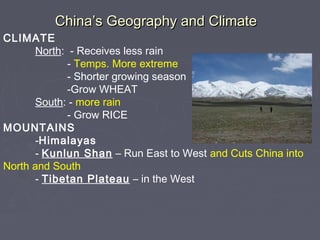
North: - Receives less rain
- Temps. More extreme
- Shorter growing season
-Grow WHEAT
South: - more rain
- Grow RICE
MOUNTAINS
-Himalayas
- Kunlun Shan – Run East to West and Cuts China into
North and South
- Tibetan Plateau – in the West
RIVERS
China Proper – East Coast and Inland has 3 wide soil
carrying rivers, Fertile Soil, and irrigation
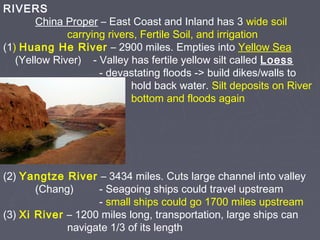
(1) Huang He River – 2900 miles. Empties into Yellow Sea
(Yellow River) - Valley has fertile yellow silt called Loess
- devastating floods -> build dikes/walls to
hold back water. Silt deposits on River
bottom and floods again

(2) Yangtze River – 3434 miles. Cuts large channel into valley
(Chang)
- Seagoing ships could travel upstream
- small ships could go 1700 miles upstream
(3) Xi River – 1200 miles long, transportation, large ships can
navigate 1/3 of its length
CHINA’S ISOLATION
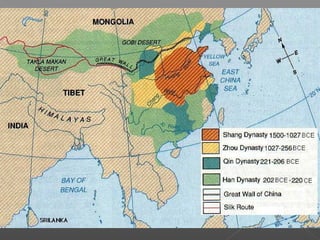
-Great distances, Mountains, and the Gobi Desert isolate
China from India and the West.
-This allows China to develop a distinctive culture.
-Some, but little outside influence/ cultural diffusion
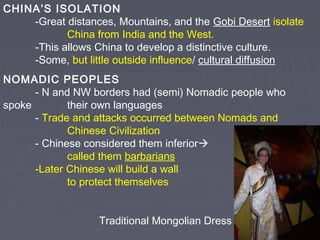
NOMADIC PEOPLES
- N and NW borders had (semi) Nomadic people who
spoke
their own languages
- Trade and attacks occurred between Nomads and
Chinese Civilization
- Chinese considered them inferior
called them barbarians
-Later Chinese will build a wall
to protect themselves
Traditional Mongolian Dress
SUPERIORITY
- isolation caused strong identity and superiority complex
- Chinese believed China was at the center of the world so
they called it the “middle kingdom”
- Believed others must learn Chinese language and adopt
customs in order become “civilized”
- Invaders  eventually loose identity and are absorbed
into China’s population
Chinese Dynasties
XIA (Shi-ah)– line of kings who ruled during the late Neolithic Era
- Huang He Valley in ~2200 BCE
- YU The Great – 1st Xia Ruler, engineer and mathematician
- developed and improved agriculture with irrigation and helped
control floods
- Began writing in symbols
SHANG – 1750-1500BCE
- simple irrigation and flood control
-establish 1st historic dynasty
-Shang leader asks the Xia people to reject their leader and
follow him
Government  capital near Anyang: City w/large walls
surrounding it for protection against waging wars.
Bureaucracy – government organized into different level and tasks
-chariots and bronze weapons to defend and increase the empire.
Economy
- agriculture (rice and millet)
-Domestic animals (pigs, chicken, horse)
-Silk Worms spun silk thread from cocoons
-Artisans  bone, ivory, jade, Kaolin (white clay, glaze it,
more durable)
Calendar – lunar and solar
- priests and astronomers – very important as they
added day to the calendar.
- Rulers success based on harvest.
Religion – Ancestor worship and Animism – the belief that
spirits inhabit everything. (ROCK + CAT)
Dragon – all powerful, lives in sea, goes to the sky,
symbol of Chinese Rulers
-Gods – wind, sun, clouds, moon (festivals and
sacrifices)
Shangdi – god who controlled human destiny
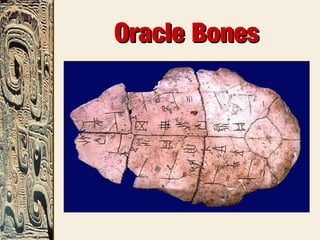
- Oracle Bones – priests carved questions in bones
and
heated up them up, priests would read the
cracks for answers
Oracle Bones
Language and Writing many dialects
- 1st in China to have a written language
- Pictographs  ideographs (idea sign + phonetic sign)
- eventually called calligraphy
- only specialists learned to read/write
-1500 characters = barely literate, 10,000=true scholar
ZHOU (Joe)– conquest in ~1050 BCE alliance w/ warlike

tribes to N.
- longest lasting dynasty – end in 256BCE
- Zhou rulers gave territory to members of royal family/allies
-each new generation had to pledge loyalty to Zhou king
-Believed God in Heaven determined who should rule China
Royal Authority came from Heaven= “Mandate of Heaven”
-~700BCE local leaders are fighting each other=internal strife
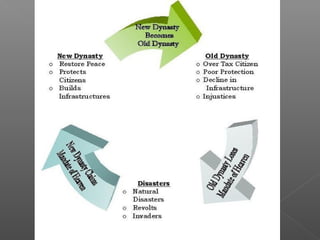
- Dynastic Cycles – strong dynasty emerges, dynasty
declines, natural disasters + rebellions, loss of mandate of
heaven, dynasty overthrown, new dynasty emerges
-Confucius – most influential scholar during time of crisis and
violence
-Feudalism - political system in which nobles or lords are
granted use of land that legally belong to the King (Japan+Eur.)
Technology and Trade : -Roads, canals, coined money, blast
furnaces for iron sickles, knives and spades.
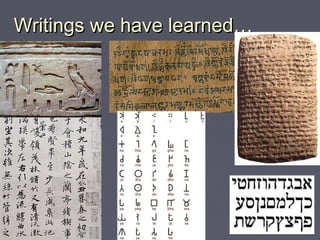
Writings we have learned…
QIN (Chin = “CHINA”)– ~20 years
- 221 BCE take over by military might
- Cheng – est. new dynasty and calls himself
Shi Huangdi  “The 1st Emperor”
- The name China comes from Qin Dynasty
- Autocracy- Emperor has full power.
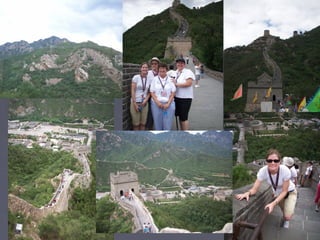
-Qin Shi Huangdi – The Great Wall of China, starts building
wall for defense. People are made to work on walls. 
During Qin dynasty it reaches 1500 miles long.
Legalism- strict rule of people through harsh rules and
punishments. Burned books disagreeing with legalist ideas.
- People become more angry as separation between Emperor and
mass of people becomes larger. (money)
-206 BCE rebel army revolts.
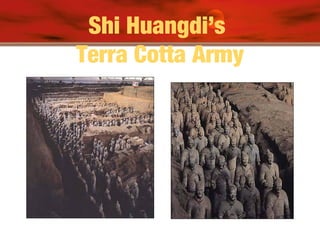
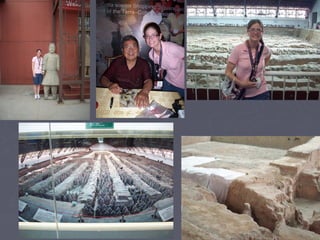
Shi Huangdi’s
Terra Cotta Army
HAN – Liu Bang is a commoner who became a General and
overthrows Qin and creates new dynasty “King of Han”
- Han rule for 400yrs.
-Capital at Xi’an (Chang-an)
-Empire extends very large. Uses centralized government=
central authority control the running of the state.
Civil Service System – people recommended to help run gov’t.
Eventually people must take tests to hold office.
Leveling – price controls on agriculture to balance economic
effects (surplus/shortage). Lowered taxes and
softened harsh punishments of the Qin.
Trade – Silk Road – Stretches from China to the Mediterranean
Sea. Camel caravans carried jade, silk, valuable goods.
Returned with gold silver, wool. (Dangerous and long)
Inventions traded on silk Road – Paper, silk, civil service system,
porcelain, gun powder, kites, compass, block printing, embroidery
-Liu Bang dies in 195bc, his son takes over, but really Liu
Bang’s wife Empress Lii ruled.
-In 180BC when Lii dies, Liu Bang’s family kills off Lii’s family.
-Liu Bang’s great-grandson Emperor Wudi took over in
141bc.
-He expands the empire with warfare.
-Nomads called the Xiongnu, known for archery skills
on horseback attack Han. Han tried to buy off Xiongnu for
peace, but eventually they took bribes and
continued
raiding.
-Emperor Wudi sought out allies in order to defeat them.
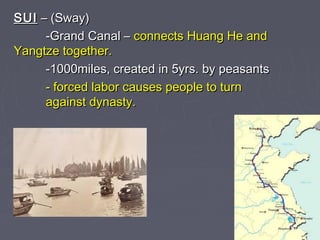
SUI – (Sway)
-Grand Canal – connects Huang He and
Yangtze together.
-1000miles, created in 5yrs. by peasants
- forced labor causes people to turn
against dynasty.
TANG – 300 years, Empire expanded by reconquering lost
lands.
-Empress Wu Zhao/ Wu Zentian  only woman to hold
complete power and title of Emperor.
-Takes control of Korea
-Strengthens central government
-Promotes foreign trade and improves
agriculture
- Guarded Silk Road with armies to keep trade safe
Mid700s – start heavily taxing people and vast empire begins to
fall apart (Do we see a trend? Dynastic Cycle)
-Muslim armies win battles and land
-907 Chinese rebels attack and burn
the Tang Capital
SONG – lasted about 300 years
-Attempted to buy peace with nomads -Failed
-Population in China doubles during dynasty
Inventions during TANG and SONG:
Movable Type – block printing
Explosive/Gun powder
Porcelain
Clock
Paper money
Compass
Golden age for poetry and art
Acupuncture – inserting slender needles in specific points of
body, depending on the nature of the problem.
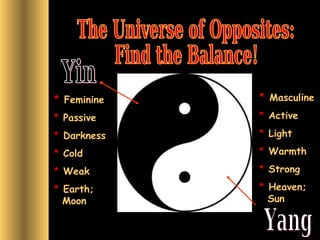
Chinese Philosophies – look to restore harmony of nature,
which has two sides-Opposite forces in balance -Yin and Yang.
Yin – female, dark, and passive
Yang – in male, bright, and active.
Confucianism – (Zhou) Confucius 551-479 BCE wrote the
Analects – collection of his teachings
Most influential of Chinese Philosophies
3 main ideas: importance of family (filial piety), respect for elders,
and respect for ancestors
Confucius wanted to solve problems or ethical/moral leadership
leaders must accept role/duty in society, have high virtue,
be moral and educated  then people will follow them.
Mencius 372-389 BCE adopted his teachings. He taught that
people contained “much goodness”.
Believed people had a right to rebel against harsh rules.
-became part of classical Chinese traditions
* Feminine

* Masculine

* Passive

* Active

* Darkness

* Light

* Cold

* Warmth

* Weak

* Strong

* Earth;
Moon

* Heaven;
Sun
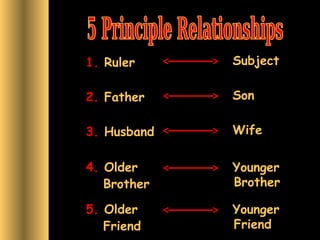
1. Ruler

Subject

2. Father

Son

3. Husband

Wife

4. Older
Brother

Younger
Brother

5. Older
Friend

Younger
Friend
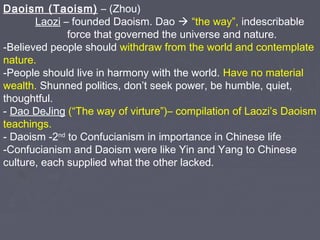
Daoism (Taoism) – (Zhou)
Laozi – founded Daoism. Dao  “the way”, indescribable
force that governed the universe and nature.
-Believed people should withdraw from the world and contemplate
nature.
-People should live in harmony with the world. Have no material
wealth. Shunned politics, don’t seek power, be humble, quiet,
thoughtful.
- Dao DeJing (“The way of virture”)– compilation of Laozi’s Daoism
teachings.
- Daoism -2nd to Confucianism in importance in Chinese life
-Confucianism and Daoism were like Yin and Yang to Chinese
culture, each supplied what the other lacked.
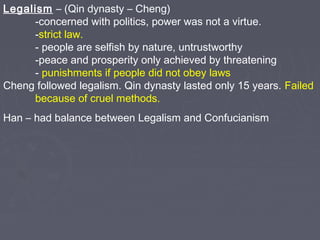
Legalism – (Qin dynasty – Cheng)
-concerned with politics, power was not a virtue.
-strict law.
- people are selfish by nature, untrustworthy
-peace and prosperity only achieved by threatening
- punishments if people did not obey laws
Cheng followed legalism. Qin dynasty lasted only 15 years. Failed
because of cruel methods.
Han – had balance between Legalism and Confucianism
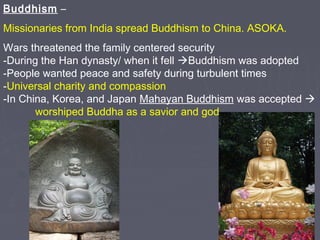
Buddhism –
Missionaries from India spread Buddhism to China. ASOKA.
Wars threatened the family centered security
-During the Han dynasty/ when it fell Buddhism was adopted
-People wanted peace and safety during turbulent times
-Universal charity and compassion
-In China, Korea, and Japan Mahayan Buddhism was accepted 
worshiped Buddha as a savior and god

Ancient China Notes

  • 3.
    China’s Geography andClimate CLIMATE North: - Receives less rain - Temps. More extreme - Shorter growing season -Grow WHEAT South: - more rain - Grow RICE MOUNTAINS -Himalayas - Kunlun Shan – Run East to West and Cuts China into North and South - Tibetan Plateau – in the West
  • 4.
    RIVERS China Proper –East Coast and Inland has 3 wide soil carrying rivers, Fertile Soil, and irrigation (1) Huang He River – 2900 miles. Empties into Yellow Sea (Yellow River) - Valley has fertile yellow silt called Loess - devastating floods -> build dikes/walls to hold back water. Silt deposits on River bottom and floods again (2) Yangtze River – 3434 miles. Cuts large channel into valley (Chang) - Seagoing ships could travel upstream - small ships could go 1700 miles upstream (3) Xi River – 1200 miles long, transportation, large ships can navigate 1/3 of its length
  • 5.
    CHINA’S ISOLATION -Great distances,Mountains, and the Gobi Desert isolate China from India and the West. -This allows China to develop a distinctive culture. -Some, but little outside influence/ cultural diffusion NOMADIC PEOPLES - N and NW borders had (semi) Nomadic people who spoke their own languages - Trade and attacks occurred between Nomads and Chinese Civilization - Chinese considered them inferior called them barbarians -Later Chinese will build a wall to protect themselves Traditional Mongolian Dress
  • 6.
    SUPERIORITY - isolation causedstrong identity and superiority complex - Chinese believed China was at the center of the world so they called it the “middle kingdom” - Believed others must learn Chinese language and adopt customs in order become “civilized” - Invaders  eventually loose identity and are absorbed into China’s population
  • 7.
    Chinese Dynasties XIA (Shi-ah)–line of kings who ruled during the late Neolithic Era - Huang He Valley in ~2200 BCE - YU The Great – 1st Xia Ruler, engineer and mathematician - developed and improved agriculture with irrigation and helped control floods - Began writing in symbols
  • 8.
    SHANG – 1750-1500BCE -simple irrigation and flood control -establish 1st historic dynasty -Shang leader asks the Xia people to reject their leader and follow him Government  capital near Anyang: City w/large walls surrounding it for protection against waging wars. Bureaucracy – government organized into different level and tasks -chariots and bronze weapons to defend and increase the empire. Economy - agriculture (rice and millet) -Domestic animals (pigs, chicken, horse) -Silk Worms spun silk thread from cocoons -Artisans  bone, ivory, jade, Kaolin (white clay, glaze it, more durable)
  • 9.
    Calendar – lunarand solar - priests and astronomers – very important as they added day to the calendar. - Rulers success based on harvest. Religion – Ancestor worship and Animism – the belief that spirits inhabit everything. (ROCK + CAT) Dragon – all powerful, lives in sea, goes to the sky, symbol of Chinese Rulers -Gods – wind, sun, clouds, moon (festivals and sacrifices) Shangdi – god who controlled human destiny - Oracle Bones – priests carved questions in bones and heated up them up, priests would read the cracks for answers
  • 10.
  • 11.
    Language and Writingmany dialects - 1st in China to have a written language - Pictographs  ideographs (idea sign + phonetic sign) - eventually called calligraphy - only specialists learned to read/write -1500 characters = barely literate, 10,000=true scholar
  • 12.
    ZHOU (Joe)– conquestin ~1050 BCE alliance w/ warlike tribes to N. - longest lasting dynasty – end in 256BCE - Zhou rulers gave territory to members of royal family/allies -each new generation had to pledge loyalty to Zhou king -Believed God in Heaven determined who should rule China Royal Authority came from Heaven= “Mandate of Heaven” -~700BCE local leaders are fighting each other=internal strife - Dynastic Cycles – strong dynasty emerges, dynasty declines, natural disasters + rebellions, loss of mandate of heaven, dynasty overthrown, new dynasty emerges -Confucius – most influential scholar during time of crisis and violence -Feudalism - political system in which nobles or lords are granted use of land that legally belong to the King (Japan+Eur.) Technology and Trade : -Roads, canals, coined money, blast furnaces for iron sickles, knives and spades.
  • 14.
    Writings we havelearned…
  • 15.
    QIN (Chin =“CHINA”)– ~20 years - 221 BCE take over by military might - Cheng – est. new dynasty and calls himself Shi Huangdi  “The 1st Emperor” - The name China comes from Qin Dynasty - Autocracy- Emperor has full power. -Qin Shi Huangdi – The Great Wall of China, starts building wall for defense. People are made to work on walls.  During Qin dynasty it reaches 1500 miles long. Legalism- strict rule of people through harsh rules and punishments. Burned books disagreeing with legalist ideas. - People become more angry as separation between Emperor and mass of people becomes larger. (money) -206 BCE rebel army revolts.
  • 16.
  • 19.
    HAN – LiuBang is a commoner who became a General and overthrows Qin and creates new dynasty “King of Han” - Han rule for 400yrs. -Capital at Xi’an (Chang-an) -Empire extends very large. Uses centralized government= central authority control the running of the state. Civil Service System – people recommended to help run gov’t. Eventually people must take tests to hold office. Leveling – price controls on agriculture to balance economic effects (surplus/shortage). Lowered taxes and softened harsh punishments of the Qin. Trade – Silk Road – Stretches from China to the Mediterranean Sea. Camel caravans carried jade, silk, valuable goods. Returned with gold silver, wool. (Dangerous and long) Inventions traded on silk Road – Paper, silk, civil service system, porcelain, gun powder, kites, compass, block printing, embroidery
  • 20.
    -Liu Bang diesin 195bc, his son takes over, but really Liu Bang’s wife Empress Lii ruled. -In 180BC when Lii dies, Liu Bang’s family kills off Lii’s family. -Liu Bang’s great-grandson Emperor Wudi took over in 141bc. -He expands the empire with warfare. -Nomads called the Xiongnu, known for archery skills on horseback attack Han. Han tried to buy off Xiongnu for peace, but eventually they took bribes and continued raiding. -Emperor Wudi sought out allies in order to defeat them.
  • 21.
    SUI – (Sway) -GrandCanal – connects Huang He and Yangtze together. -1000miles, created in 5yrs. by peasants - forced labor causes people to turn against dynasty.
  • 22.
    TANG – 300years, Empire expanded by reconquering lost lands. -Empress Wu Zhao/ Wu Zentian  only woman to hold complete power and title of Emperor. -Takes control of Korea -Strengthens central government -Promotes foreign trade and improves agriculture - Guarded Silk Road with armies to keep trade safe Mid700s – start heavily taxing people and vast empire begins to fall apart (Do we see a trend? Dynastic Cycle) -Muslim armies win battles and land -907 Chinese rebels attack and burn the Tang Capital
  • 23.
    SONG – lastedabout 300 years -Attempted to buy peace with nomads -Failed -Population in China doubles during dynasty Inventions during TANG and SONG: Movable Type – block printing Explosive/Gun powder Porcelain Clock Paper money Compass Golden age for poetry and art Acupuncture – inserting slender needles in specific points of body, depending on the nature of the problem.
  • 24.
    Chinese Philosophies –look to restore harmony of nature, which has two sides-Opposite forces in balance -Yin and Yang. Yin – female, dark, and passive Yang – in male, bright, and active. Confucianism – (Zhou) Confucius 551-479 BCE wrote the Analects – collection of his teachings Most influential of Chinese Philosophies 3 main ideas: importance of family (filial piety), respect for elders, and respect for ancestors Confucius wanted to solve problems or ethical/moral leadership leaders must accept role/duty in society, have high virtue, be moral and educated  then people will follow them. Mencius 372-389 BCE adopted his teachings. He taught that people contained “much goodness”. Believed people had a right to rebel against harsh rules. -became part of classical Chinese traditions
  • 25.
    * Feminine * Masculine *Passive * Active * Darkness * Light * Cold * Warmth * Weak * Strong * Earth; Moon * Heaven; Sun
  • 26.
    1. Ruler Subject 2. Father Son 3.Husband Wife 4. Older Brother Younger Brother 5. Older Friend Younger Friend
  • 27.
    Daoism (Taoism) –(Zhou) Laozi – founded Daoism. Dao  “the way”, indescribable force that governed the universe and nature. -Believed people should withdraw from the world and contemplate nature. -People should live in harmony with the world. Have no material wealth. Shunned politics, don’t seek power, be humble, quiet, thoughtful. - Dao DeJing (“The way of virture”)– compilation of Laozi’s Daoism teachings. - Daoism -2nd to Confucianism in importance in Chinese life -Confucianism and Daoism were like Yin and Yang to Chinese culture, each supplied what the other lacked.
  • 28.
    Legalism – (Qindynasty – Cheng) -concerned with politics, power was not a virtue. -strict law. - people are selfish by nature, untrustworthy -peace and prosperity only achieved by threatening - punishments if people did not obey laws Cheng followed legalism. Qin dynasty lasted only 15 years. Failed because of cruel methods. Han – had balance between Legalism and Confucianism
  • 29.
    Buddhism – Missionaries fromIndia spread Buddhism to China. ASOKA. Wars threatened the family centered security -During the Han dynasty/ when it fell Buddhism was adopted -People wanted peace and safety during turbulent times -Universal charity and compassion -In China, Korea, and Japan Mahayan Buddhism was accepted  worshiped Buddha as a savior and god

Editor's Notes

  • #2 {"16":"Note the western terminus at Jiayu Pass and the eastern terminus at Shanhai Pass.\n"}