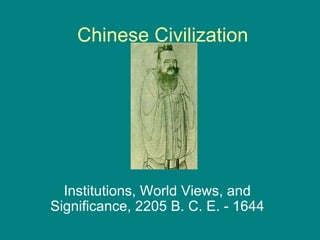
Chinese Civilization


  Institutions, World Views, and
Significance, 2205 B. C. E. - 1644
Generalizations About Chinese
           Civilization
• Powerful Central Authority—emperor
• Veneration of Ancestors
• Beginning w/ Han Dynast, Confucianism is
  official governing philosophy
• Chinese citizens mix Confucian beliefs
  with Taoism
• Perennial problems—food production,
  invasion, and internal strife
Cradle of Chinese Civilization
• Huang Ho (Yellow River) is cradle of civilization
  —also termed River of Sorrows—its floods
  destroy even as they give livelihood.
• Millet cultivation; stone tools; emergent
  urbanization.
• Three cultural heroes: Fu Hsi—invented writing;
  Shen Nung—farming and commerce; Yellow
  Emperor—government and Taoism
Huang Ho River
Sage Kings 2350-2200
• May not have been historical but were
  seen as especially virtuous
• Perceived pattern in Chinese history—
  wise rule and order followed by period of
  moral laxity, decline, decadence, and
  disorder
• Chinese history would emphasize public
  virtue—obedience to a wise emperor
Shang Dynasty—1766-1050
•   First “historical” dynasty.
•   Development of Writing
•   Bronze age civilization along Huang Ho
•   Reading of oracle bones
•   Emergence of “T’ien” concept—heaven—
    where God and ancestors dwelled.
Shang Oracle Bones
Chou Dynasty—1050-221 B. C. E.
• Development of “T’ien Ming” or Mandate of
  Heaven
• Myth of Legitimacy—how to justify overthrowing
  of Shang
• Central authority weakened in “Spring and
  Autumn” periods—771-401 b. c. e.—and
  collapse of order in Period of Warring States—
  401-256 B. C. E.
• Ironic contribution of Chou dynasty was
  providing incentive to develop classical
  philosophy in China.
Classical Chinese Philosphy

• Confucianism
• Taoism
• Legalism
Confucianism
• K’ung Fu-tzu (Confucius) 551 B. C. E.-479
  B. C. E.
• Public order comes from “jen” or humane
  behavior between people.
• Superiors should govern well
• Inferiors should obey
• Shu—reciprocity and chung—doing one’s
  best
Sayings from the Analects: 1
• Fan-ch'ih asked about jen. The Master said, "It is to
  love all men." He asked about knowledge. "It is to
  know all men." Fan ch'ih did not immediately
  understand these answers. The Master said,
  "Employ the upright and put aside all the crooked; in
  this way, the crooked can be made to be upright."
• Tzu-kung asked, saying, "Is there one world which
  may serve as a rule of practice for all one's life?"
  The Master said, "Is not reciprocity such a word?
  What you do not want done to yourself, do not do to
  others."
Sayings from the Analects: 2
•   The Master said, "With coarse rice to eat, with water to drink, and my
    bended arm for a pillow; I still have joy in the midst of these things.
    Riches and honors acquired by inhumanity are to me as a floating
    cloud."
•   The Master said, "The determined scholar and the man of virtue will
    not seek to live at the expense of humanity. They will even sacrifice their
    lives to preserve their humanity."
•   The Master said, "The superior man in everything considers
    righteousness to be essential. He performs it according to the rules of
    propriety (li ). He brings it forth in humility. He completes it with
    sincerity. This is indeed a superior man."
•   The Master said, "The object of the superior man is truth, not food. . . .
    The superior man is anxious lest he should not get truth; he is not
    anxious lest poverty should come upon him."
Social Order and Confucius
• Rule of reciprocity promoted both order
  and disorder—presumably an evil ruler or
  an ineffective husband could be
  disobeyed.
• See Ban Zhao, Lessons for a Woman
• She accepts some subservience and
  humility but also believes in the balance of
  Yin/Yang—not the dominance of Yang
Taoism
• Based on ideas of Lao Tzu
• Tao—the way of heaven—unity
• Balance of yang (maleness—cold,
  heaven) and yin (femaleness, warm,
  earth)
• Government should guide people, not rule
  them.
Legalism
• Founded by Hsun Tzu (298-238 B. C. E.)
• People are evil and must be controlled through
  harsh laws.
• Reward good deeds, punish bad deeds
  severely.
• Utilitarianism—meant that government would
  encourage agriculture over other pursuits
• Rule of Law—law is supreme—and law is
  standard in entire real (two ideas that persist in
  Chinese state)
Chi’n Dynasty (221-206 B. C. E.)

• Officially legalist
• Standardized form of govt.
• Ended period of warring states
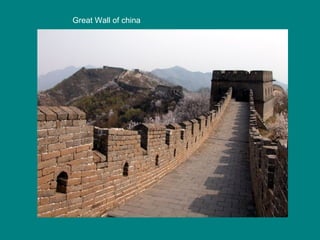
• Began Great Wall of China
• Extended China’s boundaries
  to the south
Great Wall of china
Han Dynasty ( 202 B. C. E. -220 C. E.
• Officially Confucian
• Scholar bureaucrats educated in Confucian
  classics govern china on a day to day basis.
• Han Wu Ti (r. 141-86) extended China from
  Korea to Vietnam
• Wang Mang (9-23) overthrew corrupt Han but
  was soon ousted by peasants who were then
  ousted by the nobles.
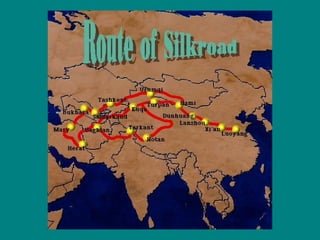
• Conquests of later Han opened up the Silk
  Roads to Mediterranean
T’ang Dynasty (618-907)
• Followed Three Kingdoms Period (220-589) and Sui
  Dynasty (589-618)
• Chinese government recentralized under emperor
  and three key ministers (but local landlords retained
  a great deal of power).
• Empress Wu (684-705) relied on Confucian
  bureaucrats and used military to extend boundaries
  of China.
• Her own Buddhist beliefs added Buddhist tradition
  to China.
• Great cosmopolitan cultural flowering facilitated with
  contracts from Asia and even Europe
Sung (960-1279)
• Emperor’s power restored
• Confucian bureaucrats pre-eminent
• Wang An-shih (1068-85)—new laws—
  maximum prices on grain; tax equity; non-
  nobles could take Confucian exams.
  (Greatest example of Confucian Scholar
  Bureaucrat)
• Neo-Confucianism
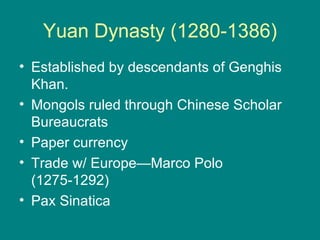
Yuan Dynasty (1280-1386)
• Established by descendants of Genghis
  Khan.
• Mongols ruled through Chinese Scholar
  Bureaucrats
• Paper currency
• Trade w/ Europe—Marco Polo
  (1275-1292)
• Pax Sinatica
Kublai Khan (1215-1294)
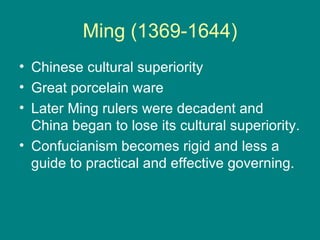
Ming (1369-1644)
• Chinese cultural superiority
• Great porcelain ware
• Later Ming rulers were decadent and
  China began to lose its cultural superiority.
• Confucianism becomes rigid and less a
  guide to practical and effective governing.
Ming Vase

China

  • 1.
    Chinese Civilization Institutions, World Views, and Significance, 2205 B. C. E. - 1644
  • 2.
    Generalizations About Chinese Civilization • Powerful Central Authority—emperor • Veneration of Ancestors • Beginning w/ Han Dynast, Confucianism is official governing philosophy • Chinese citizens mix Confucian beliefs with Taoism • Perennial problems—food production, invasion, and internal strife
  • 3.
    Cradle of ChineseCivilization • Huang Ho (Yellow River) is cradle of civilization —also termed River of Sorrows—its floods destroy even as they give livelihood. • Millet cultivation; stone tools; emergent urbanization. • Three cultural heroes: Fu Hsi—invented writing; Shen Nung—farming and commerce; Yellow Emperor—government and Taoism
  • 5.
  • 6.
    Sage Kings 2350-2200 •May not have been historical but were seen as especially virtuous • Perceived pattern in Chinese history— wise rule and order followed by period of moral laxity, decline, decadence, and disorder • Chinese history would emphasize public virtue—obedience to a wise emperor
  • 7.
    Shang Dynasty—1766-1050 • First “historical” dynasty. • Development of Writing • Bronze age civilization along Huang Ho • Reading of oracle bones • Emergence of “T’ien” concept—heaven— where God and ancestors dwelled.
  • 8.
  • 9.
    Chou Dynasty—1050-221 B.C. E. • Development of “T’ien Ming” or Mandate of Heaven • Myth of Legitimacy—how to justify overthrowing of Shang • Central authority weakened in “Spring and Autumn” periods—771-401 b. c. e.—and collapse of order in Period of Warring States— 401-256 B. C. E. • Ironic contribution of Chou dynasty was providing incentive to develop classical philosophy in China.
  • 10.
    Classical Chinese Philosphy •Confucianism • Taoism • Legalism
  • 11.
    Confucianism • K’ung Fu-tzu(Confucius) 551 B. C. E.-479 B. C. E. • Public order comes from “jen” or humane behavior between people. • Superiors should govern well • Inferiors should obey • Shu—reciprocity and chung—doing one’s best
  • 12.
    Sayings from theAnalects: 1 • Fan-ch'ih asked about jen. The Master said, "It is to love all men." He asked about knowledge. "It is to know all men." Fan ch'ih did not immediately understand these answers. The Master said, "Employ the upright and put aside all the crooked; in this way, the crooked can be made to be upright." • Tzu-kung asked, saying, "Is there one world which may serve as a rule of practice for all one's life?" The Master said, "Is not reciprocity such a word? What you do not want done to yourself, do not do to others."
  • 13.
    Sayings from theAnalects: 2 • The Master said, "With coarse rice to eat, with water to drink, and my bended arm for a pillow; I still have joy in the midst of these things. Riches and honors acquired by inhumanity are to me as a floating cloud." • The Master said, "The determined scholar and the man of virtue will not seek to live at the expense of humanity. They will even sacrifice their lives to preserve their humanity." • The Master said, "The superior man in everything considers righteousness to be essential. He performs it according to the rules of propriety (li ). He brings it forth in humility. He completes it with sincerity. This is indeed a superior man." • The Master said, "The object of the superior man is truth, not food. . . . The superior man is anxious lest he should not get truth; he is not anxious lest poverty should come upon him."
  • 14.
    Social Order andConfucius • Rule of reciprocity promoted both order and disorder—presumably an evil ruler or an ineffective husband could be disobeyed. • See Ban Zhao, Lessons for a Woman • She accepts some subservience and humility but also believes in the balance of Yin/Yang—not the dominance of Yang
  • 15.
    Taoism • Based onideas of Lao Tzu • Tao—the way of heaven—unity • Balance of yang (maleness—cold, heaven) and yin (femaleness, warm, earth) • Government should guide people, not rule them.
  • 16.
    Legalism • Founded byHsun Tzu (298-238 B. C. E.) • People are evil and must be controlled through harsh laws. • Reward good deeds, punish bad deeds severely. • Utilitarianism—meant that government would encourage agriculture over other pursuits • Rule of Law—law is supreme—and law is standard in entire real (two ideas that persist in Chinese state)
  • 17.
    Chi’n Dynasty (221-206B. C. E.) • Officially legalist • Standardized form of govt. • Ended period of warring states • Began Great Wall of China • Extended China’s boundaries to the south
  • 18.
  • 19.
    Han Dynasty (202 B. C. E. -220 C. E. • Officially Confucian • Scholar bureaucrats educated in Confucian classics govern china on a day to day basis. • Han Wu Ti (r. 141-86) extended China from Korea to Vietnam • Wang Mang (9-23) overthrew corrupt Han but was soon ousted by peasants who were then ousted by the nobles. • Conquests of later Han opened up the Silk Roads to Mediterranean
  • 21.
    T’ang Dynasty (618-907) •Followed Three Kingdoms Period (220-589) and Sui Dynasty (589-618) • Chinese government recentralized under emperor and three key ministers (but local landlords retained a great deal of power). • Empress Wu (684-705) relied on Confucian bureaucrats and used military to extend boundaries of China. • Her own Buddhist beliefs added Buddhist tradition to China. • Great cosmopolitan cultural flowering facilitated with contracts from Asia and even Europe
  • 22.
    Sung (960-1279) • Emperor’spower restored • Confucian bureaucrats pre-eminent • Wang An-shih (1068-85)—new laws— maximum prices on grain; tax equity; non- nobles could take Confucian exams. (Greatest example of Confucian Scholar Bureaucrat) • Neo-Confucianism
  • 23.
    Yuan Dynasty (1280-1386) •Established by descendants of Genghis Khan. • Mongols ruled through Chinese Scholar Bureaucrats • Paper currency • Trade w/ Europe—Marco Polo (1275-1292) • Pax Sinatica
  • 24.
  • 25.
    Ming (1369-1644) • Chinesecultural superiority • Great porcelain ware • Later Ming rulers were decadent and China began to lose its cultural superiority. • Confucianism becomes rigid and less a guide to practical and effective governing.
  • 26.