Social Studies for 8th E.G.B. |Section 4
Egyptian Achievements – pages: 102-106|
         Teacher: Mauricio Torres
Achievements
     
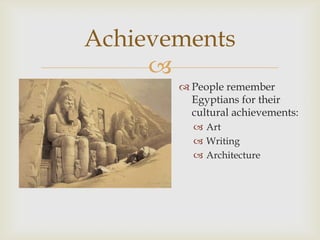
        People remember
         Egyptians for their
         cultural achievements:
          Art
          Writing
          Architecture
Writing
                          
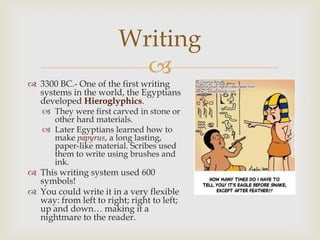
 3300 BC.- One of the first writing
  systems in the world, the Egyptians
  developed Hieroglyphics.
    They were first carved in stone or
     other hard materials.
    Later Egyptians learned how to
     make papyrus, a long lasting,
     paper-like material. Scribes used
     them to write using brushes and
     ink.
 This writing system used 600
  symbols!
 You could write it in a very flexible
  way: from left to right; right to left;
  up and down… making it a
  nightmare to the reader.
Egyptian Texts
      
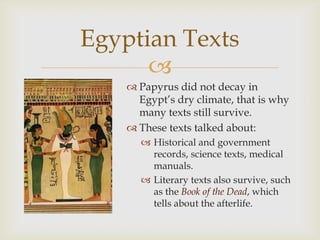
     Papyrus did not decay in
      Egypt’s dry climate, that is why
      many texts still survive.
     These texts talked about:
        Historical and government
         records, science texts, medical
         manuals.
        Literary texts also survive, such
         as the Book of the Dead, which
         tells about the afterlife.
Temples, Tombs & Art
           
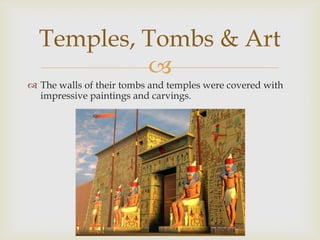
 The walls of their tombs and temples were covered with
  impressive paintings and carvings.
Great Temples
      
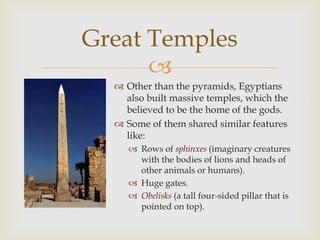
   Other than the pyramids, Egyptians
    also built massive temples, which the
    believed to be the home of the gods.
   Some of them shared similar features
    like:
      Rows of sphinxes (imaginary creatures
       with the bodies of lions and heads of
       other animals or humans).
      Huge gates.
      Obelisks (a tall four-sided pillar that is
       pointed on top).
Temples: Inside
                 


 Huge columns rose to support the roofs on the temples, and walls
  were beautifully decorated.
 Statues of gods and pharaohs often stood along the walls as well.
Art
                           
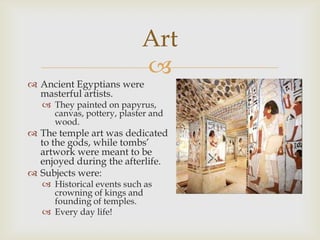
 Ancient Egyptians were
  masterful artists.
    They painted on papyrus,
     canvas, pottery, plaster and
     wood.
 The temple art was dedicated
  to the gods, while tombs’
  artwork were meant to be
  enjoyed during the afterlife.
 Subjects were:
    Historical events such as
     crowning of kings and
     founding of temples.
    Every day life!
Art
  
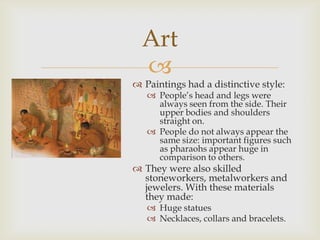
 Paintings had a distinctive style:
    People’s head and legs were
     always seen from the side. Their
     upper bodies and shoulders
     straight on.
    People do not always appear the
     same size: important figures such
     as pharaohs appear huge in
     comparison to others.
 They were also skilled
  stoneworkers, metalworkers and
  jewelers. With these materials
  they made:
    Huge statues
    Necklaces, collars and bracelets.
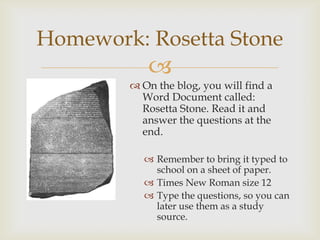
Homework: Rosetta Stone
           
         On the blog, you will find a
          Word Document called:
          Rosetta Stone. Read it and
          answer the questions at the
          end.

            Remember to bring it typed to
             school on a sheet of paper.
            Times New Roman size 12
            Type the questions, so you can
             later use them as a study
             source.
Ask Yourselves
                    
 Analyze:
    What were some advantages of using papyrus?
    What would It be like to use a language that could be written
     either up or down, right or left; or left to right?
    Why do you think builders would place obelisks at the
     entrance of the temples?
    Why do you think many Egyptian temples had rows of
     sphinxes leading to the entrance?
 Identify:
    What is a sphinx?
 Recall:
    What are the two types of large structures created by the
     Egyptian architects?
    Give two examples of common subjects of Egyptian paintings.
Bibliography
                   
 Burstein, S. M., & Shek, R. (2012). World History
  (Teacher´s Edition) (1st Edition ed.). (H. McDougal,
  Ed.) Orlando, Florida, US.: Houghton Mifflin
  Harcourt Publishing Company.
 Images taken from Google.com

Egyptian Achievements

  • 1.
    Social Studies for8th E.G.B. |Section 4 Egyptian Achievements – pages: 102-106| Teacher: Mauricio Torres
  • 2.
    Achievements   People remember Egyptians for their cultural achievements:  Art  Writing  Architecture
  • 3.
    Writing   3300 BC.- One of the first writing systems in the world, the Egyptians developed Hieroglyphics.  They were first carved in stone or other hard materials.  Later Egyptians learned how to make papyrus, a long lasting, paper-like material. Scribes used them to write using brushes and ink.  This writing system used 600 symbols!  You could write it in a very flexible way: from left to right; right to left; up and down… making it a nightmare to the reader.
  • 4.
    Egyptian Texts   Papyrus did not decay in Egypt’s dry climate, that is why many texts still survive.  These texts talked about:  Historical and government records, science texts, medical manuals.  Literary texts also survive, such as the Book of the Dead, which tells about the afterlife.
  • 5.
    Temples, Tombs &Art   The walls of their tombs and temples were covered with impressive paintings and carvings.
  • 6.
    Great Temples   Other than the pyramids, Egyptians also built massive temples, which the believed to be the home of the gods.  Some of them shared similar features like:  Rows of sphinxes (imaginary creatures with the bodies of lions and heads of other animals or humans).  Huge gates.  Obelisks (a tall four-sided pillar that is pointed on top).
  • 7.
    Temples: Inside   Huge columns rose to support the roofs on the temples, and walls were beautifully decorated.  Statues of gods and pharaohs often stood along the walls as well.
  • 8.
    Art   Ancient Egyptians were masterful artists.  They painted on papyrus, canvas, pottery, plaster and wood.  The temple art was dedicated to the gods, while tombs’ artwork were meant to be enjoyed during the afterlife.  Subjects were:  Historical events such as crowning of kings and founding of temples.  Every day life!
  • 9.
    Art  Paintings had a distinctive style:  People’s head and legs were always seen from the side. Their upper bodies and shoulders straight on.  People do not always appear the same size: important figures such as pharaohs appear huge in comparison to others.  They were also skilled stoneworkers, metalworkers and jewelers. With these materials they made:  Huge statues  Necklaces, collars and bracelets.
  • 10.
    Homework: Rosetta Stone   On the blog, you will find a Word Document called: Rosetta Stone. Read it and answer the questions at the end.  Remember to bring it typed to school on a sheet of paper.  Times New Roman size 12  Type the questions, so you can later use them as a study source.
  • 11.
    Ask Yourselves   Analyze:  What were some advantages of using papyrus?  What would It be like to use a language that could be written either up or down, right or left; or left to right?  Why do you think builders would place obelisks at the entrance of the temples?  Why do you think many Egyptian temples had rows of sphinxes leading to the entrance?  Identify:  What is a sphinx?  Recall:  What are the two types of large structures created by the Egyptian architects?  Give two examples of common subjects of Egyptian paintings.
  • 12.
    Bibliography   Burstein, S. M., & Shek, R. (2012). World History (Teacher´s Edition) (1st Edition ed.). (H. McDougal, Ed.) Orlando, Florida, US.: Houghton Mifflin Harcourt Publishing Company.  Images taken from Google.com