Skeletal system
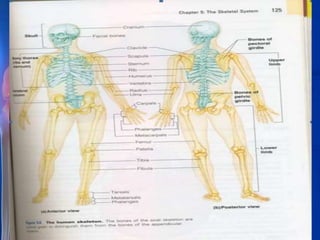
Axial skeleton: The bones that form the
longitudinal axis of the body.
Appendicular skeleton: Is the bones of
limbs, and girdles.
Skeletal system includes cartilages,
ligaments, and bones.
Functions of the bones
Support Protection
Movement Storage
Blood cell formation
Classification of bones
Compact bones Sponge bones
Long bones Short bones
Flat bones Irregular bones
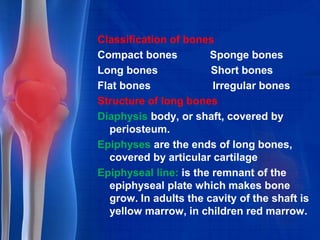
Structure of long bones
Diaphysis body, or shaft, covered by
periosteum.
Epiphyses are the ends of long bones,
covered by articular cartilage
Epiphyseal line: is the remnant of the
epiphyseal plate which makes bone
grow. In adults the cavity of the shaft is
yellow marrow, in children red marrow.
Axial skeleton
• It forms the longitudinal axis of the body.
• Skull,verteberal column, and bony thorax.
• Skull: Is formed of two sets of bones.
• Cranium, and mandible.
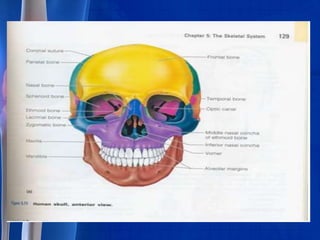
Cranium:
Is composed of eight ,large, flat bones.
• Frontal bone: Forms the fore head,
bony projections under eye brow,
superior part of each orbit.
• Parietal bones: forms the superior,
and lateral wall of the skull.
• The meet in the midline at sagittal
suture, and forms the coronal suture,
where they meet frontal bone.
• Temporal bone: Lie inferior to the
parietal bone, join them at squamous
suture
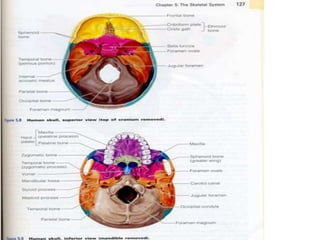
Bone marking of temporal bones
1. External auditor meatus.
2. Styloid process
3. Zygomatic process
4. Mastoid process
5. Jugular foramen
6. Carotid canal
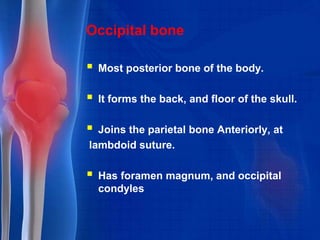
Occipital bone
 Most posterior bone of the body.
 It forms the back, and floor of the skull.
 Joins the parietal bone Anteriorly, at
lambdoid suture.
 Has foramen magnum, and occipital
condyles
Sphenoid bone
 Butterfly shaped bone
 In middle depression called sella
turcica, for pituitary gland.
 Foramen ovale, for branches of 5th
cranial nerve.
 Has sphenoid sinus.
Ethmoid bone
• Irregular shape, anterior to sphenoid.
• Roof the nose.
• Has projection called crista galli.
• Lateral has cribriform plates, for nerve
fibers of olfactory nerve.
Facial bones
14 bone form the face,12 paired.
2 Single ,mandible, and vomer.
Maxillary bones
• Two fuse ,to form upper jaw.
• All bones join it.
• Pallatine process, form the hard palate.
• Contain maxillary sinuses.
Palatine bones: form part of hard palate
Zygomatic bones: check bones
Lacrimal bones: Fingernail size bone
Nasal bones
Vomer bone
Inferior conchae.
Mandible or lower jaw
Strongest bone of the face.
Join the temporal bone at tempero mandibular joint.
Horizontal part form the chin.
Lower teeth lie in it
Hyoid bone
Does not articulate with other bones.
Lies two cm above larynx.
Horseshoe shape, has body and two horns.
Rise larynx during speak, and swallow.
Fetal skull
One forth of fetal size.
Two fontanelles, large diamond shape anterior one.
small triangular posterior one.
They connect skulls bones.
Anterior one close at 18-24 month.
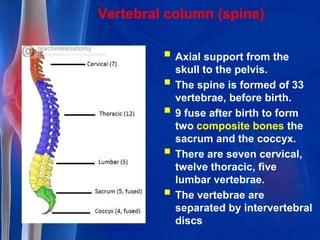
Vertebral column (spine)
 Axial support from the
skull to the pelvis.
 The spine is formed of 33
vertebrae, before birth.
 9 fuse after birth to form
two composite bones the
sacrum and the coccyx.
 There are seven cervical,
twelve thoracic, five
lumbar vertebrae.
 The vertebrae are
separated by intervertebral
discs
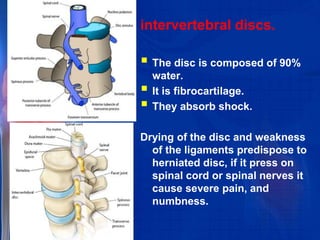
intervertebral discs.
 The disc is composed of 90%
water.
 It is fibrocartilage.
 They absorb shock.
Drying of the disc and weakness
of the ligaments predispose to
herniated disc, if it press on
spinal cord or spinal nerves it
cause severe pain, and
numbness.
The vertebral column is S shape.
The spinal curvatures in the thoracic and sacral
region are called primary curvatures.
Since they are present since birth.
Secondary curvatures, in cervical and
lumbar vertebrae.
Cervical convexity forward at 3rd month, lumbar
convexity forward at 12th month.
Length of vertebral column 3/4from bone 1/4
from disc.
Typical vertebra is
composed of
Body: is the anterior weight
bearing part of vertebra.
Vertebral arch: is formed by the
joining of all posterior
extensions,lamina,pedicle.
Vertebral foramen: canal
through which spinal cord
pass.
Transverse process: two lateral
projections.
Spinous process: single
projection from posterior part
of the arch
Superior and inferior articular
processes: paired projections
lateral to vertebral canal to
form joints with adjacent
vertebrae.
Cervical vertebrae
Seven cervical vertebrae
First is the Atlas, second is the axis.
Atlas has no body, no spinous process, look
like a ring, superior surface has articular
surface for the occipital condyles .
AXIS,2ND CERVICAL VERTEBRAE
Act as pivot for rotation of atlas and skull.
It has odontoid process, which is upright
process.
Rotation occur at atlanto-axial joint.
.
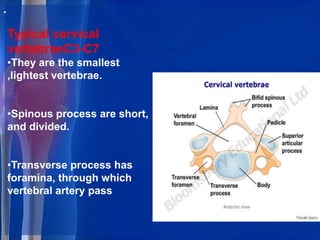
Typical cervical
vertebraeC3-C7
•They are the smallest
,lightest vertebrae.
•Spinous process are short,
and divided.
•Transverse process has
foramina, through which
vertebral artery pass
• Thoracic vertebrae
12 thoracic vertebrae.
All are typical, larger than cervical
vertebrae.
Body are heart shaped.
Has articular facet for head of ribs.
Spinous process are long.
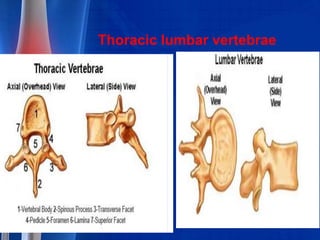
Thoracic lumbar vertebrae
Lumbar vertebrae
Strongest vertebrae
Most common site
for disc is
L4-5 L5-S1
Sacrum
 Formed by union of five vertebrae.
 Superiorly articulate with L5.
 Inferiorly with coccyx.
 Wing like ala articulate with pelvis in
sacroiliac joint.
 It forms the posterior part of the pelvis.
 Has dorsal sacral crest, and dorsal sacral
foramina.
 Vertebral canal continue as sacral canal.
COCCYX
• Formed by fusion of 3-5 small vertebrae.
Sacrum
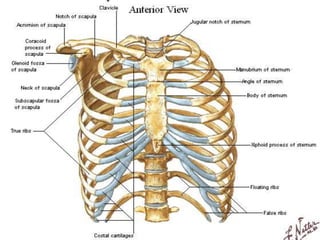
Bony Thorax [thoracic cage]
Sternum, ribs and thoracic vertebrae form the
bony thorax.
Sternum
Formed by fusion of three
bones,(Manubrium,Body,and Xiphoid
process).
Attached to first seven pair of ribs.
Sternum has three important bony
land marks.
Jugular notch: at level 3rd thoracic
vertebra.
Concave upper border of manubrium.
Sternal angle:
manubrium and body meet.
Slight transverse elevation.
Level of 2nd rib.
Xiphisternal joint: body and Xiphoid meet
at level of 9th thoracic vertebra
Ribs
 Twelve pairs of ribs form the walls of
thoracic cage.
 All ribs articulate with thoracic
vertebrae.
 True ribs articulate with sternum, by
costal cartilage.
 False ribs, are attached indirectly to
sternum, or not attached at all, last two
are called floating ribs.
The intercostals space is below rib filled by
intercostals muscles, help in respiration.
Fracture rib at weakest area, which is the
angle of the rib.
The first two and last two ribs are difficult
to be fractured.
Pain during inspiration, unable to cough, is
symptoms of rib fracture.
Upper limb
Is divided into
Shoulder region
Arm
Elbow
Forearm
Wrist
Hand
Bones of shoulder region
Clavicle and scapula
Clavicle is attached
medially to sternum, and
laterally to scapula at
acromioclavicular joint.
It is the commonest
bone to be fractured, by
fall on out stretched
hand, or direct hit,
weakest point is
junction of medial two
thirds and lateral third.
Scapula
Triangular in shape, has two important
processes,acromiom,and coracoid.
Scapula has three borders superior,lateral,medial,and
three angles,superior,inferior,and lateral. The glenoid
cavity receive head of humerous to form shoulder joint.
 The glenoid cavity is shallow.
 The shoulder girdle is light.
 The shoulder girdle is attached to axial skeleton at one
point.
 It has very wide range of movement, so it is easily
dislocated.
Arm is formed by single bone the
humerus,it is a typical long bone, has
upper end ,shaft, lower end.
Upper end has head, two
tuberosities,greater,and lesser
tuberosity, and neck.
In the middle of the shaft(body),
deltoid tuberosity, and radial groove.
The lower end,
medial trochlea,
and lateral
capitulum,above
trochlea a
depression
coronoid fossa
anteriorly, and
posteriorly,
olecranon fossa,
and medial and
lateral
epicondyles.
Forearm bones
Radius and ulna
• Radius is the lateral
bone, on the thumb side.
• Both radius and ulna
articulate by superior and
inferior radio-ulnar joint.
Both are connected by
interosseous membrane.
• Head of
radius,trochlear notch of
ulna forms the elbow
joint.
• Radial tuberosity is for
insertion of biceps
muscle.
Hand
The skeleton of the hand
Carpals,metacarpals and phalanges.
There is eight carpal bones arranged in two
rows.Carpus form the wrist, metacarpus forms the
palm,phalynges form the fingers.
Carpus bones arranged in two rows
Proximal row scaphoid,lunate,triquetral,and pisiform.
Distal row
Trapezium trapezoid,capitate,and hamate.
Five metacarpals each has base, body and head.
Phalynges have,proximal,middle,and distal phalynx
,except thumb.
Bones of the pelvic girdle
Right, and left hip bones, and sacrum.
Large, and heavy bones.
Functions of the pelvis
 Bearing weight.
 Protect Large intestine, reproductive
organs, and urinary bladder, which lie
in pelvis.
 Provide attachments for muscles.
 Rotatory movement during walking.
Each hip bone is formed by fusion of
three bones.
Ilium ,ischium ,pubis.
Ilium
 connect posteriorly with sacrum at
sacroiliac joint.
 Iliac crest is the curved highest part of
iliac bone.
 Iliac crest ends Anteriorly by anterior
superior iliac spine, and posteriorly by
posterior superior iliac spine.
Ischium
is the sitting bone;ischial
tuberosity is part which
receive body weight.
Ischial spine, narrows the
outlet of pelvis through
which baby must pass.
Greater sciatic notch, allow
blood vessels, and sciatic
nerve to pass to thigh.
Pubis
is the most anterior part of hip
bone.
Pubic bones fuse anteriorly to
form, a cartilaginous joint called
symphysis pubis.
The three bones,
ilium,ischium,pubis,fuse at
Acetabulum, which receive
head of femur bone, in hip joint.
True pelvis and lie inferior to the
ilia,is the part which allow
baby's head to pass.
False pelvis is above true pelvis.
Pelvic outlet is the inferior
opening of the pelvis.
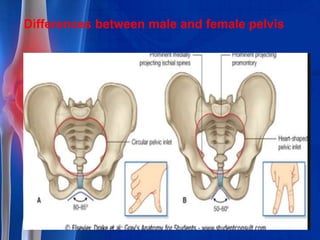
Differences between male
and female pelvis
 The FM inlet is larger and
more circular.
 The FM pelvis is shallower
and bones are lighter.
 The FM ilia flare more
laterally.
 FM sacrum is shorter, and
less curved.
 FM ischial spines are shorter,
and further apart.
 FM pubic arch is more
rounded,
Differences between male and female pelvis
Bones of the lower limbs
FEMUR
Is the longest bone of the body.
It is 45 cm long, and forms 1/4 of stature.
It has upper, shaft, and lower end.
Upper end has head,neck,greater trochanter,lesser
trochanter.
Anteriorly Intertrochanteric line
Posteriorly Intertrochanteric crest are sites for
muscle attachments
Head articulate with Acetabulum in hip joint.
Angle between neck, and shaft is smaller in females
than in males, because they have wide pelvis.
Blood supply of head of femur
Blood ascending from shaft.
Blood from capsule of hip joint.
Blood from ligamentum teres.
Types of fracture neck femur
Sub capital Transcervical
Basal Intertrochanteric
Femur
Distal end
Medial and lateral condyles
Intercondylar notch.
Smooth patellar surface for patella
at knee joint
Tibia and fibula
Are the two bones of the leg, connected by
interosseus membrane.
Tibia is the shin bone, medial bone.
Has upper end,shaft,and lower end.
Upper end has medial, lateral
Condyles ,inter condylar eminence,
to form with distal femur the knee joint.
Patellar ligament
Attached to tibial tuberosity
,a rough area on anterior Tibial surface.
Medial malleolus is the inner bulge
of the ankle.
Anterior crest is felt under the skin
Fibula
 Very thin and long bone
 Has upper
end,neck,shaft,and
lower end.
 Forms with tibia, joints
,proximal and distal.
 Lower end is lateral
malleolus, form outer
part of the ankle.
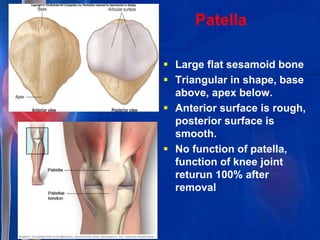
Patella
 Large flat sesamoid bone
 Triangular in shape, base
above, apex below.
 Anterior surface is rough,
posterior surface is
smooth.
 No function of patella,
function of knee joint
returun 100% after
removal
Tarsal,metatarsal,and
phalynges
Function of the foot
Support our body weight
Serve as levers that propel our
body, during walking, and
running.
The tarsus form the posterior
half of the foot.
Tarsus is formed of seven
bones.
Calcaneus or Heel bone
Talus Between, tibia and calcaneus
Navicular,cuboid, three cuneiform bones.
Five metatarsal bones
14 phalynges, five to each toe ,except two for big toe.
The bones in the foot, form three arches.
Two longitudinal arches,
one medial, one lateral, one
transverse.
Tendons and ligaments bind bones
together.
Fallen arches are called flat feet.(Pes
planus)
The arches are the bones which do
not touch the ground
Medial arch responsible for
walking
Lateral arch support body weight.
Arches of the foot:-
Para nasal sinuses
There are eight Para nasal sinuses
Frontal, maxillary, sphenoid, and ethmoid sinuses
all are paired sinuses
Maxillary sinus is the most important sinus
Functions of para nasal sinuses
Resonance of voice
Make bones of skull lighter
Humidification of air
Warming of air
Barrier to infection
Inflammation in them is called sinusitis
Para nasal sinuses
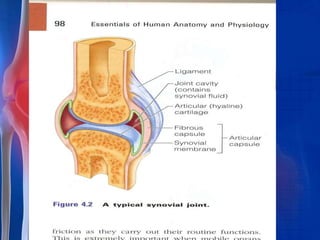
Joints
Types of joints
Fibrous
Cartilaginous
Synovial
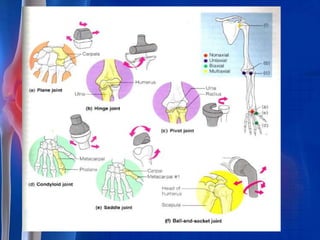
• Types of synovial joints
Nonaxial : plane joints
Uniaxial: hinge, pivot joints
Biaxial: condyloid,saddle joints
Multiaxial: ball and socket joints
Features of synovial joints
Articular cartilage
Fibrous articular capsule
Joint cavity
Reinforcing ligaments
Bursae and tendon sheath
BONE
• Cells
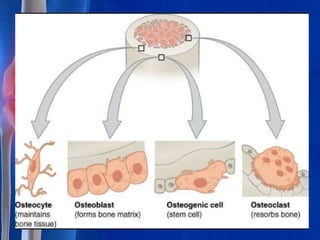
• Osteocytes Osteoblasts Osteoclasts
• Bone matrix
• Organic
• Collagen type 1
• Ground substance
• Proteoglycans
• Glycoprotein
• Inorganic
• Hydroxyapatite
• Ca ,Po4, magnesium, bicarbonate, citrate, sodium &
potassium
Osteoblasts
Form new bone, lie on surface of bone
Secrete organic part of bone matrix
Control mineralization of bone
• Osteocytes
• Mature bone cells, they are trapped osteoblast
• Sit in lacunae, inside bone
• Maintain bone matrix
• Osteoclasts
• Degrade and reabsorb bone
• On surface of bone
• Periosteum
• External layer of CT that surrounds bone
• Outer: Dense irregular CT
• Inner: Osteoblasts, osteoclasts
Endosteum Internal layer of CT that lines cavities and covers
trabeculae
• Contains Osteoblasts and osteoclasts
Compact Bone
External layer
Osteon (Haversian system)
Mature bone cells are present inside tiny cavities in bone
matrix called lacunae
Lacunae are present in concentric circles called lamellae
around central Haversian canal
Osteon (HS) is central canal and matrix rings around it
Central Haversian canal run longitudinally inside bony
matrix carrying blood vessels and nerves
Tiny canaliculi radiate outward from central canal to all
lacunae which supply nutrients
Perforating Volkmann's canals run at right angle to shaft
Adjacent lamella fibers run in opposite directions
Bone Anatomy: Spongy bone
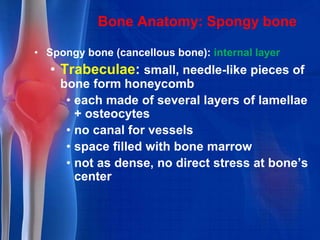
• Spongy bone (cancellous bone): internal layer
• Trabeculae: small, needle-like pieces of
bone form honeycomb
• each made of several layers of lamellae
+ osteocytes
• no canal for vessels
• space filled with bone marrow
• not as dense, no direct stress at bone’s
center
TYPES OF BONE
(GROSS OBSERVATION)
JOINTS
• All bones form joints with at least one other
bone, except hyoid bone.
• Functions of joints
• They hold bone together securely.
• They give rigid bones mobility.
• Functional classification
• Based on amount of movement
• Imobile,slightly mobile,and freely mobile.
Between cranial bones;
between facial bones
Suture—fibrous
connective tissue
between bone surfaces
Synarthrosis
(immovable)
• Between vertebrae;
between pubic bones
Symphysis—disc of
fibrous cartilage
between bones
Amphiarthrosis (slightly
movable)
Scapula and humerus;
pelvic bone and femur
Hyaline joint
Ball and socket—
movement in all planes
Diarthrosis (freely
movable)
Humerus and ulna; femur
and tibia; between
phalanges
Hinge—movement in one
plane
Temporal bone and
mandible
Condyloid—movement in
one plane with some
lateral movement two
planes
Atlas and axis; radius
&ulna. Between carpals
Carpometacarpal of
Pivot—rotation Gliding—
side-to-side movement
Saddle—movement in
Skeletal system pharma

Skeletal system pharma

  • 1.
    Skeletal system Axial skeleton:The bones that form the longitudinal axis of the body. Appendicular skeleton: Is the bones of limbs, and girdles. Skeletal system includes cartilages, ligaments, and bones. Functions of the bones Support Protection Movement Storage Blood cell formation
  • 3.
    Classification of bones Compactbones Sponge bones Long bones Short bones Flat bones Irregular bones Structure of long bones Diaphysis body, or shaft, covered by periosteum. Epiphyses are the ends of long bones, covered by articular cartilage Epiphyseal line: is the remnant of the epiphyseal plate which makes bone grow. In adults the cavity of the shaft is yellow marrow, in children red marrow.
  • 5.
    Axial skeleton • Itforms the longitudinal axis of the body. • Skull,verteberal column, and bony thorax. • Skull: Is formed of two sets of bones. • Cranium, and mandible.
  • 6.
    Cranium: Is composed ofeight ,large, flat bones. • Frontal bone: Forms the fore head, bony projections under eye brow, superior part of each orbit. • Parietal bones: forms the superior, and lateral wall of the skull. • The meet in the midline at sagittal suture, and forms the coronal suture, where they meet frontal bone. • Temporal bone: Lie inferior to the parietal bone, join them at squamous suture
  • 10.
    Bone marking oftemporal bones 1. External auditor meatus. 2. Styloid process 3. Zygomatic process 4. Mastoid process 5. Jugular foramen 6. Carotid canal
  • 11.
    Occipital bone  Mostposterior bone of the body.  It forms the back, and floor of the skull.  Joins the parietal bone Anteriorly, at lambdoid suture.  Has foramen magnum, and occipital condyles
  • 12.
    Sphenoid bone  Butterflyshaped bone  In middle depression called sella turcica, for pituitary gland.  Foramen ovale, for branches of 5th cranial nerve.  Has sphenoid sinus.
  • 13.
    Ethmoid bone • Irregularshape, anterior to sphenoid. • Roof the nose. • Has projection called crista galli. • Lateral has cribriform plates, for nerve fibers of olfactory nerve.
  • 14.
    Facial bones 14 boneform the face,12 paired. 2 Single ,mandible, and vomer. Maxillary bones • Two fuse ,to form upper jaw. • All bones join it. • Pallatine process, form the hard palate. • Contain maxillary sinuses. Palatine bones: form part of hard palate Zygomatic bones: check bones Lacrimal bones: Fingernail size bone Nasal bones Vomer bone Inferior conchae.
  • 16.
    Mandible or lowerjaw Strongest bone of the face. Join the temporal bone at tempero mandibular joint. Horizontal part form the chin. Lower teeth lie in it Hyoid bone Does not articulate with other bones. Lies two cm above larynx. Horseshoe shape, has body and two horns. Rise larynx during speak, and swallow.
  • 17.
    Fetal skull One forthof fetal size. Two fontanelles, large diamond shape anterior one. small triangular posterior one. They connect skulls bones. Anterior one close at 18-24 month.
  • 19.
    Vertebral column (spine) Axial support from the skull to the pelvis.  The spine is formed of 33 vertebrae, before birth.  9 fuse after birth to form two composite bones the sacrum and the coccyx.  There are seven cervical, twelve thoracic, five lumbar vertebrae.  The vertebrae are separated by intervertebral discs
  • 22.
    intervertebral discs.  Thedisc is composed of 90% water.  It is fibrocartilage.  They absorb shock. Drying of the disc and weakness of the ligaments predispose to herniated disc, if it press on spinal cord or spinal nerves it cause severe pain, and numbness.
  • 24.
    The vertebral columnis S shape. The spinal curvatures in the thoracic and sacral region are called primary curvatures. Since they are present since birth. Secondary curvatures, in cervical and lumbar vertebrae. Cervical convexity forward at 3rd month, lumbar convexity forward at 12th month. Length of vertebral column 3/4from bone 1/4 from disc.
  • 26.
    Typical vertebra is composedof Body: is the anterior weight bearing part of vertebra. Vertebral arch: is formed by the joining of all posterior extensions,lamina,pedicle. Vertebral foramen: canal through which spinal cord pass. Transverse process: two lateral projections. Spinous process: single projection from posterior part of the arch Superior and inferior articular processes: paired projections lateral to vertebral canal to form joints with adjacent vertebrae.
  • 27.
    Cervical vertebrae Seven cervicalvertebrae First is the Atlas, second is the axis. Atlas has no body, no spinous process, look like a ring, superior surface has articular surface for the occipital condyles .
  • 28.
    AXIS,2ND CERVICAL VERTEBRAE Actas pivot for rotation of atlas and skull. It has odontoid process, which is upright process. Rotation occur at atlanto-axial joint.
  • 29.
    . Typical cervical vertebraeC3-C7 •They arethe smallest ,lightest vertebrae. •Spinous process are short, and divided. •Transverse process has foramina, through which vertebral artery pass
  • 30.
    • Thoracic vertebrae 12thoracic vertebrae. All are typical, larger than cervical vertebrae. Body are heart shaped. Has articular facet for head of ribs. Spinous process are long.
  • 31.
  • 32.
    Lumbar vertebrae Strongest vertebrae Mostcommon site for disc is L4-5 L5-S1
  • 34.
    Sacrum  Formed byunion of five vertebrae.  Superiorly articulate with L5.  Inferiorly with coccyx.  Wing like ala articulate with pelvis in sacroiliac joint.  It forms the posterior part of the pelvis.  Has dorsal sacral crest, and dorsal sacral foramina.  Vertebral canal continue as sacral canal. COCCYX • Formed by fusion of 3-5 small vertebrae.
  • 35.
  • 36.
    Bony Thorax [thoraciccage] Sternum, ribs and thoracic vertebrae form the bony thorax. Sternum Formed by fusion of three bones,(Manubrium,Body,and Xiphoid process). Attached to first seven pair of ribs.
  • 37.
    Sternum has threeimportant bony land marks. Jugular notch: at level 3rd thoracic vertebra. Concave upper border of manubrium. Sternal angle: manubrium and body meet. Slight transverse elevation. Level of 2nd rib. Xiphisternal joint: body and Xiphoid meet at level of 9th thoracic vertebra
  • 40.
    Ribs  Twelve pairsof ribs form the walls of thoracic cage.  All ribs articulate with thoracic vertebrae.  True ribs articulate with sternum, by costal cartilage.  False ribs, are attached indirectly to sternum, or not attached at all, last two are called floating ribs.
  • 41.
    The intercostals spaceis below rib filled by intercostals muscles, help in respiration. Fracture rib at weakest area, which is the angle of the rib. The first two and last two ribs are difficult to be fractured. Pain during inspiration, unable to cough, is symptoms of rib fracture.
  • 42.
    Upper limb Is dividedinto Shoulder region Arm Elbow Forearm Wrist Hand
  • 43.
    Bones of shoulderregion Clavicle and scapula Clavicle is attached medially to sternum, and laterally to scapula at acromioclavicular joint. It is the commonest bone to be fractured, by fall on out stretched hand, or direct hit, weakest point is junction of medial two thirds and lateral third.
  • 45.
    Scapula Triangular in shape,has two important processes,acromiom,and coracoid. Scapula has three borders superior,lateral,medial,and three angles,superior,inferior,and lateral. The glenoid cavity receive head of humerous to form shoulder joint.  The glenoid cavity is shallow.  The shoulder girdle is light.  The shoulder girdle is attached to axial skeleton at one point.  It has very wide range of movement, so it is easily dislocated.
  • 46.
    Arm is formedby single bone the humerus,it is a typical long bone, has upper end ,shaft, lower end. Upper end has head, two tuberosities,greater,and lesser tuberosity, and neck. In the middle of the shaft(body), deltoid tuberosity, and radial groove.
  • 47.
    The lower end, medialtrochlea, and lateral capitulum,above trochlea a depression coronoid fossa anteriorly, and posteriorly, olecranon fossa, and medial and lateral epicondyles.
  • 49.
    Forearm bones Radius andulna • Radius is the lateral bone, on the thumb side. • Both radius and ulna articulate by superior and inferior radio-ulnar joint. Both are connected by interosseous membrane. • Head of radius,trochlear notch of ulna forms the elbow joint. • Radial tuberosity is for insertion of biceps muscle.
  • 50.
    Hand The skeleton ofthe hand Carpals,metacarpals and phalanges. There is eight carpal bones arranged in two rows.Carpus form the wrist, metacarpus forms the palm,phalynges form the fingers. Carpus bones arranged in two rows Proximal row scaphoid,lunate,triquetral,and pisiform. Distal row Trapezium trapezoid,capitate,and hamate. Five metacarpals each has base, body and head. Phalynges have,proximal,middle,and distal phalynx ,except thumb.
  • 52.
    Bones of thepelvic girdle Right, and left hip bones, and sacrum. Large, and heavy bones. Functions of the pelvis  Bearing weight.  Protect Large intestine, reproductive organs, and urinary bladder, which lie in pelvis.  Provide attachments for muscles.  Rotatory movement during walking.
  • 54.
    Each hip boneis formed by fusion of three bones. Ilium ,ischium ,pubis. Ilium  connect posteriorly with sacrum at sacroiliac joint.  Iliac crest is the curved highest part of iliac bone.  Iliac crest ends Anteriorly by anterior superior iliac spine, and posteriorly by posterior superior iliac spine.
  • 55.
    Ischium is the sittingbone;ischial tuberosity is part which receive body weight. Ischial spine, narrows the outlet of pelvis through which baby must pass. Greater sciatic notch, allow blood vessels, and sciatic nerve to pass to thigh.
  • 56.
    Pubis is the mostanterior part of hip bone. Pubic bones fuse anteriorly to form, a cartilaginous joint called symphysis pubis. The three bones, ilium,ischium,pubis,fuse at Acetabulum, which receive head of femur bone, in hip joint. True pelvis and lie inferior to the ilia,is the part which allow baby's head to pass. False pelvis is above true pelvis. Pelvic outlet is the inferior opening of the pelvis.
  • 57.
    Differences between male andfemale pelvis  The FM inlet is larger and more circular.  The FM pelvis is shallower and bones are lighter.  The FM ilia flare more laterally.  FM sacrum is shorter, and less curved.  FM ischial spines are shorter, and further apart.  FM pubic arch is more rounded,
  • 58.
    Differences between maleand female pelvis
  • 59.
    Bones of thelower limbs FEMUR Is the longest bone of the body. It is 45 cm long, and forms 1/4 of stature. It has upper, shaft, and lower end. Upper end has head,neck,greater trochanter,lesser trochanter. Anteriorly Intertrochanteric line Posteriorly Intertrochanteric crest are sites for muscle attachments Head articulate with Acetabulum in hip joint. Angle between neck, and shaft is smaller in females than in males, because they have wide pelvis.
  • 61.
    Blood supply ofhead of femur Blood ascending from shaft. Blood from capsule of hip joint. Blood from ligamentum teres. Types of fracture neck femur Sub capital Transcervical Basal Intertrochanteric
  • 62.
    Femur Distal end Medial andlateral condyles Intercondylar notch. Smooth patellar surface for patella at knee joint
  • 63.
    Tibia and fibula Arethe two bones of the leg, connected by interosseus membrane. Tibia is the shin bone, medial bone. Has upper end,shaft,and lower end. Upper end has medial, lateral Condyles ,inter condylar eminence, to form with distal femur the knee joint. Patellar ligament Attached to tibial tuberosity ,a rough area on anterior Tibial surface. Medial malleolus is the inner bulge of the ankle. Anterior crest is felt under the skin
  • 64.
    Fibula  Very thinand long bone  Has upper end,neck,shaft,and lower end.  Forms with tibia, joints ,proximal and distal.  Lower end is lateral malleolus, form outer part of the ankle.
  • 65.
    Patella  Large flatsesamoid bone  Triangular in shape, base above, apex below.  Anterior surface is rough, posterior surface is smooth.  No function of patella, function of knee joint returun 100% after removal
  • 66.
    Tarsal,metatarsal,and phalynges Function of thefoot Support our body weight Serve as levers that propel our body, during walking, and running. The tarsus form the posterior half of the foot. Tarsus is formed of seven bones.
  • 68.
    Calcaneus or Heelbone Talus Between, tibia and calcaneus Navicular,cuboid, three cuneiform bones. Five metatarsal bones 14 phalynges, five to each toe ,except two for big toe. The bones in the foot, form three arches.
  • 69.
    Two longitudinal arches, onemedial, one lateral, one transverse. Tendons and ligaments bind bones together. Fallen arches are called flat feet.(Pes planus) The arches are the bones which do not touch the ground Medial arch responsible for walking Lateral arch support body weight.
  • 70.
  • 71.
    Para nasal sinuses Thereare eight Para nasal sinuses Frontal, maxillary, sphenoid, and ethmoid sinuses all are paired sinuses Maxillary sinus is the most important sinus Functions of para nasal sinuses Resonance of voice Make bones of skull lighter Humidification of air Warming of air Barrier to infection Inflammation in them is called sinusitis
  • 72.
  • 73.
    Joints Types of joints Fibrous Cartilaginous Synovial •Types of synovial joints Nonaxial : plane joints Uniaxial: hinge, pivot joints Biaxial: condyloid,saddle joints Multiaxial: ball and socket joints
  • 76.
    Features of synovialjoints Articular cartilage Fibrous articular capsule Joint cavity Reinforcing ligaments Bursae and tendon sheath
  • 79.
    BONE • Cells • OsteocytesOsteoblasts Osteoclasts • Bone matrix • Organic • Collagen type 1 • Ground substance • Proteoglycans • Glycoprotein • Inorganic • Hydroxyapatite • Ca ,Po4, magnesium, bicarbonate, citrate, sodium & potassium
  • 80.
    Osteoblasts Form new bone,lie on surface of bone Secrete organic part of bone matrix Control mineralization of bone • Osteocytes • Mature bone cells, they are trapped osteoblast • Sit in lacunae, inside bone • Maintain bone matrix • Osteoclasts • Degrade and reabsorb bone • On surface of bone • Periosteum • External layer of CT that surrounds bone • Outer: Dense irregular CT • Inner: Osteoblasts, osteoclasts Endosteum Internal layer of CT that lines cavities and covers trabeculae • Contains Osteoblasts and osteoclasts
  • 82.
    Compact Bone External layer Osteon(Haversian system) Mature bone cells are present inside tiny cavities in bone matrix called lacunae Lacunae are present in concentric circles called lamellae around central Haversian canal Osteon (HS) is central canal and matrix rings around it Central Haversian canal run longitudinally inside bony matrix carrying blood vessels and nerves Tiny canaliculi radiate outward from central canal to all lacunae which supply nutrients Perforating Volkmann's canals run at right angle to shaft Adjacent lamella fibers run in opposite directions
  • 85.
    Bone Anatomy: Spongybone • Spongy bone (cancellous bone): internal layer • Trabeculae: small, needle-like pieces of bone form honeycomb • each made of several layers of lamellae + osteocytes • no canal for vessels • space filled with bone marrow • not as dense, no direct stress at bone’s center
  • 86.
  • 88.
    JOINTS • All bonesform joints with at least one other bone, except hyoid bone. • Functions of joints • They hold bone together securely. • They give rigid bones mobility. • Functional classification • Based on amount of movement • Imobile,slightly mobile,and freely mobile.
  • 89.
    Between cranial bones; betweenfacial bones Suture—fibrous connective tissue between bone surfaces Synarthrosis (immovable) • Between vertebrae; between pubic bones Symphysis—disc of fibrous cartilage between bones Amphiarthrosis (slightly movable) Scapula and humerus; pelvic bone and femur Hyaline joint Ball and socket— movement in all planes Diarthrosis (freely movable) Humerus and ulna; femur and tibia; between phalanges Hinge—movement in one plane Temporal bone and mandible Condyloid—movement in one plane with some lateral movement two planes Atlas and axis; radius &ulna. Between carpals Carpometacarpal of Pivot—rotation Gliding— side-to-side movement Saddle—movement in