BIOLOGICAL
BASIS OF
HUMAN
BEHAVIOR
Dr. Jayesh Patidar
www.drjayeshpatidar.blogspot.com
INTRODUCTION
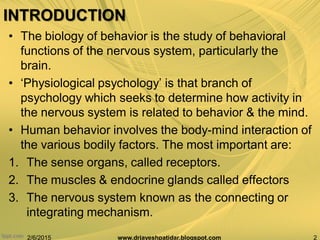
• The biology of behavior is the study of behavioral
functions of the nervous system, particularly the
brain.
• „Physiological psychology‟ is that branch of
psychology which seeks to determine how activity in
the nervous system is related to behavior & the mind.
• Human behavior involves the body-mind interaction of
the various bodily factors. The most important are:
1. The sense organs, called receptors.
2. The muscles & endocrine glands called effectors
3. The nervous system known as the connecting or
integrating mechanism.
2/6/2015 2www.drjayeshpatidar.blogspot.com
RECEPTORS
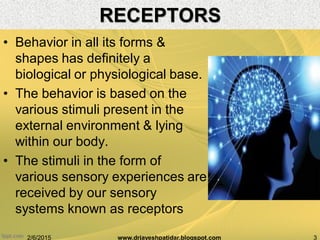
• Behavior in all its forms &
shapes has definitely a
biological or physiological base.
• The behavior is based on the
various stimuli present in the
external environment & lying
within our body.
• The stimuli in the form of
various sensory experiences are
received by our sensory
systems known as receptors
2/6/2015 3www.drjayeshpatidar.blogspot.com
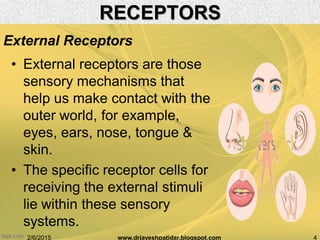
• External receptors are those
sensory mechanisms that
help us make contact with the
outer world, for example,
eyes, ears, nose, tongue &
skin.
• The specific receptor cells for
receiving the external stimuli
lie within these sensory
systems.
2/6/2015 4www.drjayeshpatidar.blogspot.com
External Receptors
RECEPTORS
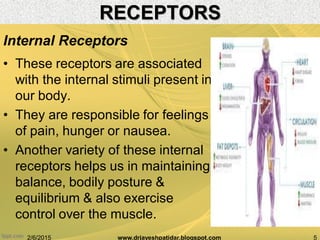
• These receptors are associated
with the internal stimuli present in
our body.
• They are responsible for feelings
of pain, hunger or nausea.
• Another variety of these internal
receptors helps us in maintaining
balance, bodily posture &
equilibrium & also exercise
control over the muscle.
2/6/2015 5www.drjayeshpatidar.blogspot.com
Internal Receptors
RECEPTORS
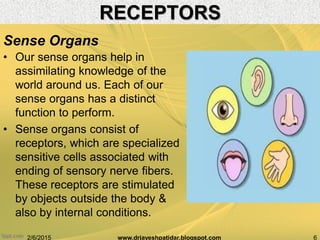
• Our sense organs help in
assimilating knowledge of the
world around us. Each of our
sense organs has a distinct
function to perform.
• Sense organs consist of
receptors, which are specialized
sensitive cells associated with
ending of sensory nerve fibers.
These receptors are stimulated
by objects outside the body &
also by internal conditions.
2/6/2015 6www.drjayeshpatidar.blogspot.com
Sense Organs
RECEPTORS
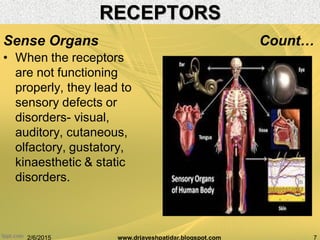
• When the receptors
are not functioning
properly, they lead to
sensory defects or
disorders- visual,
auditory, cutaneous,
olfactory, gustatory,
kinaesthetic & static
disorders.
2/6/2015 7www.drjayeshpatidar.blogspot.com
Sense Organs Count…
RECEPTORS
EFFECTORS
• Effectors are termed as the organs of responses.
• What is received through the sensory organs in
the form of sensory input is responded through
bodily reactions & motor activities carried out
through muscles & glands, particularly the
hormones secreted by the ductless gland which
are responsible for most of our behavior patterns.
• The under-activity or over-activity of these
glands, causes deficiency or excess of hormonal
secretion.
• This affects the entire personality make-up of the
individual.
2/6/2015 8www.drjayeshpatidar.blogspot.com
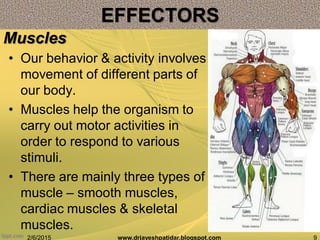
• Our behavior & activity involves
movement of different parts of
our body.
• Muscles help the organism to
carry out motor activities in
order to respond to various
stimuli.
• There are mainly three types of
muscle – smooth muscles,
cardiac muscles & skeletal
muscles.
2/6/2015 9www.drjayeshpatidar.blogspot.com
Muscles
EFFECTORS
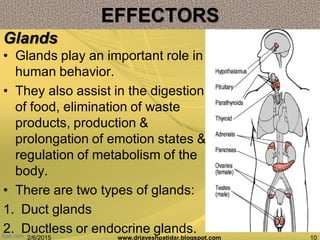
• Glands play an important role in
human behavior.
• They also assist in the digestion
of food, elimination of waste
products, production &
prolongation of emotion states &
regulation of metabolism of the
body.
• There are two types of glands:
1. Duct glands
2. Ductless or endocrine glands.
2/6/2015 10www.drjayeshpatidar.blogspot.com
Glands
EFFECTORS
• The duct glands release their chemical
secretion through little ducts or tubes into the
body cavities or on the surface of the body.
Some of the duct glands are
Salivary glands
Gastric glands
Sweat glands
Lacrimal glands
Kidney
Sex glands
2/6/2015 11www.drjayeshpatidar.blogspot.com
Glands Count…
EFFECTORS
• The ductless or endocrine glands secrete chemical
substances called hormones.
• The hormones are released into blood stream & are
carried to all parts of the body.
• They play a vital role in the determination of human
personality.
• They affect the development of the body, general
metabolism, mental development, development of
secondary sex characteristics & emotional behavior.
• The endocrine glands are:
2/6/2015 12www.drjayeshpatidar.blogspot.com
Glands Count…
EFFECTORS
The pituitary
Thyroid
Parathyroid
Adrenals
Male sex glands or gonads
Pancreas
CONNECTORS
• Connectors or adjustors help in regulating,
controlling or coordinating the activities of
receptors & effectors
• The ability to play a piano drive a car or hit a
tennis ball depends on muscle co-
ordination.
• It is necessary for the body to provide
messages to the muscles to coordinate.
• These messages are passed through
specialized cells called neurons.
2/6/2015 13www.drjayeshpatidar.blogspot.com
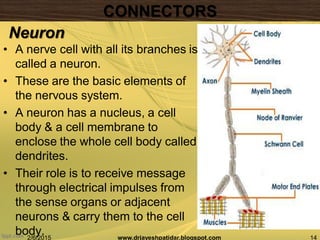
• A nerve cell with all its branches is
called a neuron.
• These are the basic elements of
the nervous system.
• A neuron has a nucleus, a cell
body & a cell membrane to
enclose the whole cell body called
dendrites.
• Their role is to receive message
through electrical impulses from
the sense organs or adjacent
neurons & carry them to the cell
body.2/6/2015 14www.drjayeshpatidar.blogspot.com
Neuron
CONNECTORS
• The messages from the cell body further travel
the length of a nerve fiber known as the axon.
• There are three types of neurons.
The sensory neurons – they help in the process
of sensation & perception.
The motor neurons – they are responsible for
physical movements & activation of glands.
The inter-neurons or association neurons – they
carry signals in the form of memories & thoughts
& add reflex or automatic activities.
2/6/2015 15www.drjayeshpatidar.blogspot.com
Neuron Count…
CONNECTORS
• Neurons are the receivers & transmitters of
messages.
• These messages are always in the form of
electrochemical impulses.
• There is a fluid-filled space called the synapse
between the axon of the neuron & the receiving
dendrite of the next neurons.
• Enlargements of the axon endings of the
transmitting neurons called boutons, contain
neuro-transmitter chemicals which are stored in
small vesicles.
2/6/2015 16www.drjayeshpatidar.blogspot.com
Neural Impulse
CONNECTORS
• Neurotransmitters are a particularly important link
between the nervous system & behavior.
• Deficiency or an excess of a neurotransmitter can
produce severe behavior disorders.
• Some major neurotransmitters are:
 Acetylcholine
 Glutamate
 Gama-amino butyric acid (GABA)
 Dopamine
 Serotonin
 endorphins
2/6/2015 17www.drjayeshpatidar.blogspot.com
Neurotransmitters
CONNECTORS
NERVOUS SYSTEM
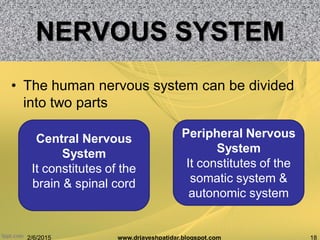
• The human nervous system can be divided
into two parts
2/6/2015 18www.drjayeshpatidar.blogspot.com
Central Nervous
System
It constitutes of the
brain & spinal cord
Peripheral Nervous
System
It constitutes of the
somatic system &
autonomic system
NERVOUS SYSTEM
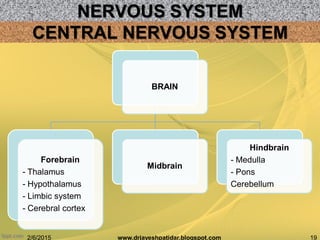
BRAIN
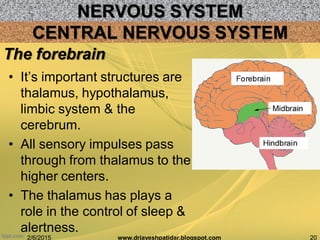
Forebrain
- Thalamus
- Hypothalamus
- Limbic system
- Cerebral cortex
Midbrain
Hindbrain
- Medulla
- Pons
Cerebellum
2/6/2015 19www.drjayeshpatidar.blogspot.com
CENTRAL NERVOUS SYSTEM
NERVOUS SYSTEM
2/6/2015 20www.drjayeshpatidar.blogspot.com
CENTRAL NERVOUS SYSTEM
• It‟s important structures are
thalamus, hypothalamus,
limbic system & the
cerebrum.
• All sensory impulses pass
through from thalamus to the
higher centers.
• The thalamus has plays a
role in the control of sleep &
alertness.
The forebrain
NERVOUS SYSTEM
2/6/2015 21www.drjayeshpatidar.blogspot.com
CENTRAL NERVOUS SYSTEM
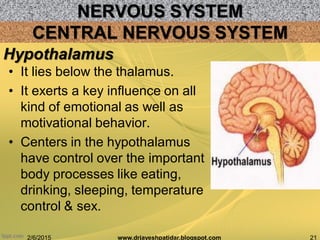
• It lies below the thalamus.
• It exerts a key influence on all
kind of emotional as well as
motivational behavior.
• Centers in the hypothalamus
have control over the important
body processes like eating,
drinking, sleeping, temperature
control & sex.
Hypothalamus
NERVOUS SYSTEM
2/6/2015 22www.drjayeshpatidar.blogspot.com
CENTRAL NERVOUS SYSTEM
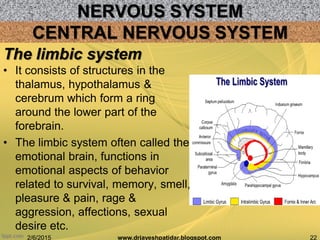
• It consists of structures in the
thalamus, hypothalamus &
cerebrum which form a ring
around the lower part of the
forebrain.
• The limbic system often called the
emotional brain, functions in
emotional aspects of behavior
related to survival, memory, smell,
pleasure & pain, rage &
aggression, affections, sexual
desire etc.
The limbic system
NERVOUS SYSTEM
2/6/2015 23www.drjayeshpatidar.blogspot.com
CENTRAL NERVOUS SYSTEM
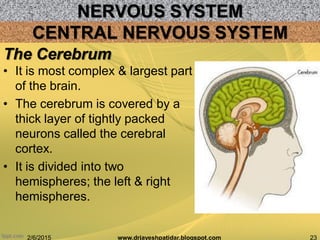
• It is most complex & largest part
of the brain.
• The cerebrum is covered by a
thick layer of tightly packed
neurons called the cerebral
cortex.
• It is divided into two
hemispheres; the left & right
hemispheres.
The Cerebrum
NERVOUS SYSTEM
2/6/2015 24www.drjayeshpatidar.blogspot.com
CENTRAL NERVOUS SYSTEM
• It is concerned with the relaying of
messages particularly those related to
hearing & sight to higher brain centers.
• One of its important structures is known as
Reticular Activating System (RAS).
• With the help of this structure an individual
is able to decide which impulses should be
registered consciously & which should be
rejected.
The midbrain
NERVOUS SYSTEM
2/6/2015 25www.drjayeshpatidar.blogspot.com
CENTRAL NERVOUS SYSTEM
• It is composed of three structures, the medulla, the
pons & the cerebellum.
• Medulla controls breathing & many important
reflexes & it also regulates the digestion, respiration
& circulation.
• The pons assists in breathing, transmitting impulses
from the cerebellum to the higher brain regions.
• Cerebellum is responsible for body balance & the
coordination of body movements like dancing,
typing, playing, etc.
The midbrain
NERVOUS SYSTEM
2/6/2015 26www.drjayeshpatidar.blogspot.com
CENTRAL NERVOUS SYSTEM
• It works as a channel of communication from
& to the brain.
• It is a rope like structure made up of long
round nerve fibers.
• It also works as an organ for effective reflex
actions like withdrawal of the hand when
something is hot.
• These reflex actions are almost automatic in
nature.
Spinal Cord
NERVOUS SYSTEM
2/6/2015 27www.drjayeshpatidar.blogspot.com
CENTRAL NERVOUS SYSTEM
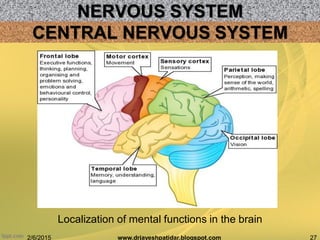
Localization of mental functions in the brain
NERVOUS SYSTEM
2/6/2015 28www.drjayeshpatidar.blogspot.com
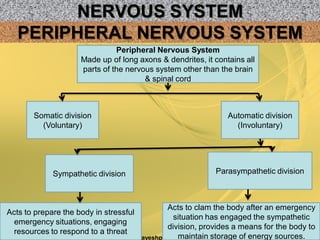
PERIPHERAL NERVOUS SYSTEM
Peripheral Nervous System
Made up of long axons & dendrites, it contains all
parts of the nervous system other than the brain
& spinal cord
Somatic division
(Voluntary)
Parasympathetic division
Acts to clam the body after an emergency
situation has engaged the sympathetic
division, provides a means for the body to
maintain storage of energy sources.
Automatic division
(Involuntary)
Acts to prepare the body in stressful
emergency situations, engaging
resources to respond to a threat
Sympathetic division
BRAIN AND BEHAVIOR
2/6/2015 29www.drjayeshpatidar.blogspot.com
• The entire behavior is effectively managed &
controlled by the co-ordination & functioning
of the nervous system.
• How we will behave in a particular situation
depends upon the judgment of our brain.
• The sense impressions, which are received
through the sense organs, do not bear any
significance unless they are given a meaning
by the nervous system.
2/6/2015 30www.drjayeshpatidar.blogspot.com
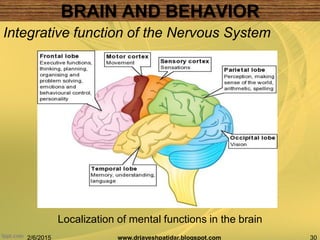
Integrative function of the Nervous System
Localization of mental functions in the brain
BRAIN AND BEHAVIOR
2/6/2015 31www.drjayeshpatidar.blogspot.com
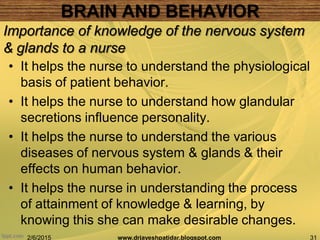
Importance of knowledge of the nervous system
& glands to a nurse
BRAIN AND BEHAVIOR
• It helps the nurse to understand the physiological
basis of patient behavior.
• It helps the nurse to understand how glandular
secretions influence personality.
• It helps the nurse to understand the various
diseases of nervous system & glands & their
effects on human behavior.
• It helps the nurse in understanding the process
of attainment of knowledge & learning, by
knowing this she can make desirable changes.
2/6/2015 32www.drjayeshpatidar.blogspot.com
LEVELS OF FUNCTIONING
• The individual functions at three levels:
1. Conscious level
2. Preconscious level
3. Unconscious level
2/6/2015 33www.drjayeshpatidar.blogspot.com
1. Conscious Level
BRAIN AND BEHAVIOR
• It constitutes all those experiences of which an
individual is immediately aware of at any
particular time.
• It consists of his current thoughts & experiences.
• For example; attending to something, observing,
thinking, reasoning, judging, imagining.
• Every conscious experience has three aspects
cognitive, affective & conative or knowing
LEVELS OF FUNCTIONING
2/6/2015 34www.drjayeshpatidar.blogspot.com
2. Pre-conscious Level
BRAIN AND BEHAVIOR
• Pre-conscious thoughts are memories of which
an individual may not be aware of, but can recall
to mind when he wishes.
• Pre-conscious mental process are also called
subconscious mental process.
• Foe example; sometimes we forget a name in
the course of a conversation. We do not become
conscious of it, we make an effort & try to
recollect, after sometime, the name which we
were in search of, springs all at once into
consciousness.
LEVELS OF FUNCTIONING
2/6/2015 35www.drjayeshpatidar.blogspot.com
3. Unconscious Level
BRAIN AND BEHAVIOR
• Experiences those which are not easily reached
by our conscious thoughts as the pre-conscious
experiences.
• We are not aware of our unconscious functions &
cannot understand them at any one time.
• Unconscious experiences cannot become
conscious but must be inferred from our
behavior.
• For example; certain things make you very angry
but you cannot understand why you become so
angry
LEVELS OF FUNCTIONING
2/6/2015 36www.drjayeshpatidar.blogspot.com
BODY-MIND RELATIONSHIP
• Psychology studies human behavior which
involves both body & the mind.
• They are interrelated & interact upon each other.
• Mental functions & physical states affect each
other.
• Body & the mind are two aspects of the living,
dynamic & adjusting personality.
• Mind is regarded as a function of the body; it does
not exist apart from the body.
• It is some total of various mental process such as
observing, knowing, thinking, reasoning, feeling,
imagining, remembering, judging & others.
2/6/2015 37www.drjayeshpatidar.blogspot.com
Modulation Process in Health and Illness
Effects of bodily conditions on mental functioning
• Increased blood pressure causes mental
excitement.
• Severe pain reduces the concentration level
• Chronic illness causes depression
• Malfunctioning of the endocrine glands for
example, may exert a full influence on one‟s
personality, resulting in lethargy, nervous
tension, etc.
BODY-MIND RELATIONSHIP
2/6/2015 38www.drjayeshpatidar.blogspot.com
Modulation Process in Health and Illness
Effects of mental conditions on bodily functioning
• Unpleasant emotions like fear, anger & worry
cause irritability, insomnia, headache etc. mental
processes are intimately connected to brain or
cortical processes.
• Emotional conflicts are responsible for peptic
ulcer, ulcerative colitis etc.
• Deep thinking & concentration can cause
physical strain.
BODY-MIND RELATIONSHIP
2/6/2015 39www.drjayeshpatidar.blogspot.com
Heredity
• Heredity is considered as “the sum total of inborn
individual traits”.
• Biologically, it has been defined as “the sum total
of traits potentially present in the fertilized ovum”.
• According to Douglas & Holland “one‟s heredity
consists of all the structures, physical
characteristics, functions or capacities derived
from parents, other ancestry or species”.
HEREDITY AND ENVIORNMENT
2/6/2015 40www.drjayeshpatidar.blogspot.com
Heredity
• Heredity is the basis for the development of
human personality.
• Many aspects of human behavior & development
ranging from physical characteristics such as
height, weight, eye & skin color, the complex
patterns of social & intellectual behavior are
influenced by person‟s genetic endowment.
HEREDITY AND ENVIORNMENT
Genetics and Behavior
2/6/2015 41www.drjayeshpatidar.blogspot.com
Environment
• The child inherits the traits & characteristics of
his parents & forefathers through genes at the
time of conception.
• After conception, how he develops is the
outcome of the interaction between his heredity
& environment.
• Environment covers the social, moral,
economical, political, physical & intellectual
factors which influence the development of the
individual from time to tiem.
HEREDITY AND ENVIORNMENT
2/6/2015 42www.drjayeshpatidar.blogspot.com
Environment
• The environment is every thing that affects the
individual except his genes.
- (Boring, Langfield and Weld)
• Environment covers all the outside factors that
have acted on the individual since he began life.
- (Woodworth)
HEREDITY AND ENVIORNMENT
Definition
2/6/2015 43www.drjayeshpatidar.blogspot.com
Environment
1. Intercellular environment: It relates to embryonic
development.
2. Intrauterine environment: It shelters the baby
during prenatal life.
3. External environment: It divided into three kinds:
a) Physical environment
b) Biological environment
c) Psychosocial environment
HEREDITY AND ENVIORNMENT
Types of Environment
2/6/2015 44www.drjayeshpatidar.blogspot.com
Thank You

Biological basis of human behavior

  • 1.
    BIOLOGICAL BASIS OF HUMAN BEHAVIOR Dr. JayeshPatidar www.drjayeshpatidar.blogspot.com
  • 2.
    INTRODUCTION • The biologyof behavior is the study of behavioral functions of the nervous system, particularly the brain. • „Physiological psychology‟ is that branch of psychology which seeks to determine how activity in the nervous system is related to behavior & the mind. • Human behavior involves the body-mind interaction of the various bodily factors. The most important are: 1. The sense organs, called receptors. 2. The muscles & endocrine glands called effectors 3. The nervous system known as the connecting or integrating mechanism. 2/6/2015 2www.drjayeshpatidar.blogspot.com
  • 3.
    RECEPTORS • Behavior inall its forms & shapes has definitely a biological or physiological base. • The behavior is based on the various stimuli present in the external environment & lying within our body. • The stimuli in the form of various sensory experiences are received by our sensory systems known as receptors 2/6/2015 3www.drjayeshpatidar.blogspot.com
  • 4.
    • External receptorsare those sensory mechanisms that help us make contact with the outer world, for example, eyes, ears, nose, tongue & skin. • The specific receptor cells for receiving the external stimuli lie within these sensory systems. 2/6/2015 4www.drjayeshpatidar.blogspot.com External Receptors RECEPTORS
  • 5.
    • These receptorsare associated with the internal stimuli present in our body. • They are responsible for feelings of pain, hunger or nausea. • Another variety of these internal receptors helps us in maintaining balance, bodily posture & equilibrium & also exercise control over the muscle. 2/6/2015 5www.drjayeshpatidar.blogspot.com Internal Receptors RECEPTORS
  • 6.
    • Our senseorgans help in assimilating knowledge of the world around us. Each of our sense organs has a distinct function to perform. • Sense organs consist of receptors, which are specialized sensitive cells associated with ending of sensory nerve fibers. These receptors are stimulated by objects outside the body & also by internal conditions. 2/6/2015 6www.drjayeshpatidar.blogspot.com Sense Organs RECEPTORS
  • 7.
    • When thereceptors are not functioning properly, they lead to sensory defects or disorders- visual, auditory, cutaneous, olfactory, gustatory, kinaesthetic & static disorders. 2/6/2015 7www.drjayeshpatidar.blogspot.com Sense Organs Count… RECEPTORS
  • 8.
    EFFECTORS • Effectors aretermed as the organs of responses. • What is received through the sensory organs in the form of sensory input is responded through bodily reactions & motor activities carried out through muscles & glands, particularly the hormones secreted by the ductless gland which are responsible for most of our behavior patterns. • The under-activity or over-activity of these glands, causes deficiency or excess of hormonal secretion. • This affects the entire personality make-up of the individual. 2/6/2015 8www.drjayeshpatidar.blogspot.com
  • 9.
    • Our behavior& activity involves movement of different parts of our body. • Muscles help the organism to carry out motor activities in order to respond to various stimuli. • There are mainly three types of muscle – smooth muscles, cardiac muscles & skeletal muscles. 2/6/2015 9www.drjayeshpatidar.blogspot.com Muscles EFFECTORS
  • 10.
    • Glands playan important role in human behavior. • They also assist in the digestion of food, elimination of waste products, production & prolongation of emotion states & regulation of metabolism of the body. • There are two types of glands: 1. Duct glands 2. Ductless or endocrine glands. 2/6/2015 10www.drjayeshpatidar.blogspot.com Glands EFFECTORS
  • 11.
    • The ductglands release their chemical secretion through little ducts or tubes into the body cavities or on the surface of the body. Some of the duct glands are Salivary glands Gastric glands Sweat glands Lacrimal glands Kidney Sex glands 2/6/2015 11www.drjayeshpatidar.blogspot.com Glands Count… EFFECTORS
  • 12.
    • The ductlessor endocrine glands secrete chemical substances called hormones. • The hormones are released into blood stream & are carried to all parts of the body. • They play a vital role in the determination of human personality. • They affect the development of the body, general metabolism, mental development, development of secondary sex characteristics & emotional behavior. • The endocrine glands are: 2/6/2015 12www.drjayeshpatidar.blogspot.com Glands Count… EFFECTORS The pituitary Thyroid Parathyroid Adrenals Male sex glands or gonads Pancreas
  • 13.
    CONNECTORS • Connectors oradjustors help in regulating, controlling or coordinating the activities of receptors & effectors • The ability to play a piano drive a car or hit a tennis ball depends on muscle co- ordination. • It is necessary for the body to provide messages to the muscles to coordinate. • These messages are passed through specialized cells called neurons. 2/6/2015 13www.drjayeshpatidar.blogspot.com
  • 14.
    • A nervecell with all its branches is called a neuron. • These are the basic elements of the nervous system. • A neuron has a nucleus, a cell body & a cell membrane to enclose the whole cell body called dendrites. • Their role is to receive message through electrical impulses from the sense organs or adjacent neurons & carry them to the cell body.2/6/2015 14www.drjayeshpatidar.blogspot.com Neuron CONNECTORS
  • 15.
    • The messagesfrom the cell body further travel the length of a nerve fiber known as the axon. • There are three types of neurons. The sensory neurons – they help in the process of sensation & perception. The motor neurons – they are responsible for physical movements & activation of glands. The inter-neurons or association neurons – they carry signals in the form of memories & thoughts & add reflex or automatic activities. 2/6/2015 15www.drjayeshpatidar.blogspot.com Neuron Count… CONNECTORS
  • 16.
    • Neurons arethe receivers & transmitters of messages. • These messages are always in the form of electrochemical impulses. • There is a fluid-filled space called the synapse between the axon of the neuron & the receiving dendrite of the next neurons. • Enlargements of the axon endings of the transmitting neurons called boutons, contain neuro-transmitter chemicals which are stored in small vesicles. 2/6/2015 16www.drjayeshpatidar.blogspot.com Neural Impulse CONNECTORS
  • 17.
    • Neurotransmitters area particularly important link between the nervous system & behavior. • Deficiency or an excess of a neurotransmitter can produce severe behavior disorders. • Some major neurotransmitters are:  Acetylcholine  Glutamate  Gama-amino butyric acid (GABA)  Dopamine  Serotonin  endorphins 2/6/2015 17www.drjayeshpatidar.blogspot.com Neurotransmitters CONNECTORS
  • 18.
    NERVOUS SYSTEM • Thehuman nervous system can be divided into two parts 2/6/2015 18www.drjayeshpatidar.blogspot.com Central Nervous System It constitutes of the brain & spinal cord Peripheral Nervous System It constitutes of the somatic system & autonomic system
  • 19.
    NERVOUS SYSTEM BRAIN Forebrain - Thalamus -Hypothalamus - Limbic system - Cerebral cortex Midbrain Hindbrain - Medulla - Pons Cerebellum 2/6/2015 19www.drjayeshpatidar.blogspot.com CENTRAL NERVOUS SYSTEM
  • 20.
    NERVOUS SYSTEM 2/6/2015 20www.drjayeshpatidar.blogspot.com CENTRALNERVOUS SYSTEM • It‟s important structures are thalamus, hypothalamus, limbic system & the cerebrum. • All sensory impulses pass through from thalamus to the higher centers. • The thalamus has plays a role in the control of sleep & alertness. The forebrain
  • 21.
    NERVOUS SYSTEM 2/6/2015 21www.drjayeshpatidar.blogspot.com CENTRALNERVOUS SYSTEM • It lies below the thalamus. • It exerts a key influence on all kind of emotional as well as motivational behavior. • Centers in the hypothalamus have control over the important body processes like eating, drinking, sleeping, temperature control & sex. Hypothalamus
  • 22.
    NERVOUS SYSTEM 2/6/2015 22www.drjayeshpatidar.blogspot.com CENTRALNERVOUS SYSTEM • It consists of structures in the thalamus, hypothalamus & cerebrum which form a ring around the lower part of the forebrain. • The limbic system often called the emotional brain, functions in emotional aspects of behavior related to survival, memory, smell, pleasure & pain, rage & aggression, affections, sexual desire etc. The limbic system
  • 23.
    NERVOUS SYSTEM 2/6/2015 23www.drjayeshpatidar.blogspot.com CENTRALNERVOUS SYSTEM • It is most complex & largest part of the brain. • The cerebrum is covered by a thick layer of tightly packed neurons called the cerebral cortex. • It is divided into two hemispheres; the left & right hemispheres. The Cerebrum
  • 24.
    NERVOUS SYSTEM 2/6/2015 24www.drjayeshpatidar.blogspot.com CENTRALNERVOUS SYSTEM • It is concerned with the relaying of messages particularly those related to hearing & sight to higher brain centers. • One of its important structures is known as Reticular Activating System (RAS). • With the help of this structure an individual is able to decide which impulses should be registered consciously & which should be rejected. The midbrain
  • 25.
    NERVOUS SYSTEM 2/6/2015 25www.drjayeshpatidar.blogspot.com CENTRALNERVOUS SYSTEM • It is composed of three structures, the medulla, the pons & the cerebellum. • Medulla controls breathing & many important reflexes & it also regulates the digestion, respiration & circulation. • The pons assists in breathing, transmitting impulses from the cerebellum to the higher brain regions. • Cerebellum is responsible for body balance & the coordination of body movements like dancing, typing, playing, etc. The midbrain
  • 26.
    NERVOUS SYSTEM 2/6/2015 26www.drjayeshpatidar.blogspot.com CENTRALNERVOUS SYSTEM • It works as a channel of communication from & to the brain. • It is a rope like structure made up of long round nerve fibers. • It also works as an organ for effective reflex actions like withdrawal of the hand when something is hot. • These reflex actions are almost automatic in nature. Spinal Cord
  • 27.
    NERVOUS SYSTEM 2/6/2015 27www.drjayeshpatidar.blogspot.com CENTRALNERVOUS SYSTEM Localization of mental functions in the brain
  • 28.
    NERVOUS SYSTEM 2/6/2015 28www.drjayeshpatidar.blogspot.com PERIPHERALNERVOUS SYSTEM Peripheral Nervous System Made up of long axons & dendrites, it contains all parts of the nervous system other than the brain & spinal cord Somatic division (Voluntary) Parasympathetic division Acts to clam the body after an emergency situation has engaged the sympathetic division, provides a means for the body to maintain storage of energy sources. Automatic division (Involuntary) Acts to prepare the body in stressful emergency situations, engaging resources to respond to a threat Sympathetic division
  • 29.
    BRAIN AND BEHAVIOR 2/6/201529www.drjayeshpatidar.blogspot.com • The entire behavior is effectively managed & controlled by the co-ordination & functioning of the nervous system. • How we will behave in a particular situation depends upon the judgment of our brain. • The sense impressions, which are received through the sense organs, do not bear any significance unless they are given a meaning by the nervous system.
  • 30.
    2/6/2015 30www.drjayeshpatidar.blogspot.com Integrative functionof the Nervous System Localization of mental functions in the brain BRAIN AND BEHAVIOR
  • 31.
    2/6/2015 31www.drjayeshpatidar.blogspot.com Importance ofknowledge of the nervous system & glands to a nurse BRAIN AND BEHAVIOR • It helps the nurse to understand the physiological basis of patient behavior. • It helps the nurse to understand how glandular secretions influence personality. • It helps the nurse to understand the various diseases of nervous system & glands & their effects on human behavior. • It helps the nurse in understanding the process of attainment of knowledge & learning, by knowing this she can make desirable changes.
  • 32.
    2/6/2015 32www.drjayeshpatidar.blogspot.com LEVELS OFFUNCTIONING • The individual functions at three levels: 1. Conscious level 2. Preconscious level 3. Unconscious level
  • 33.
    2/6/2015 33www.drjayeshpatidar.blogspot.com 1. ConsciousLevel BRAIN AND BEHAVIOR • It constitutes all those experiences of which an individual is immediately aware of at any particular time. • It consists of his current thoughts & experiences. • For example; attending to something, observing, thinking, reasoning, judging, imagining. • Every conscious experience has three aspects cognitive, affective & conative or knowing LEVELS OF FUNCTIONING
  • 34.
    2/6/2015 34www.drjayeshpatidar.blogspot.com 2. Pre-consciousLevel BRAIN AND BEHAVIOR • Pre-conscious thoughts are memories of which an individual may not be aware of, but can recall to mind when he wishes. • Pre-conscious mental process are also called subconscious mental process. • Foe example; sometimes we forget a name in the course of a conversation. We do not become conscious of it, we make an effort & try to recollect, after sometime, the name which we were in search of, springs all at once into consciousness. LEVELS OF FUNCTIONING
  • 35.
    2/6/2015 35www.drjayeshpatidar.blogspot.com 3. UnconsciousLevel BRAIN AND BEHAVIOR • Experiences those which are not easily reached by our conscious thoughts as the pre-conscious experiences. • We are not aware of our unconscious functions & cannot understand them at any one time. • Unconscious experiences cannot become conscious but must be inferred from our behavior. • For example; certain things make you very angry but you cannot understand why you become so angry LEVELS OF FUNCTIONING
  • 36.
    2/6/2015 36www.drjayeshpatidar.blogspot.com BODY-MIND RELATIONSHIP •Psychology studies human behavior which involves both body & the mind. • They are interrelated & interact upon each other. • Mental functions & physical states affect each other. • Body & the mind are two aspects of the living, dynamic & adjusting personality. • Mind is regarded as a function of the body; it does not exist apart from the body. • It is some total of various mental process such as observing, knowing, thinking, reasoning, feeling, imagining, remembering, judging & others.
  • 37.
    2/6/2015 37www.drjayeshpatidar.blogspot.com Modulation Processin Health and Illness Effects of bodily conditions on mental functioning • Increased blood pressure causes mental excitement. • Severe pain reduces the concentration level • Chronic illness causes depression • Malfunctioning of the endocrine glands for example, may exert a full influence on one‟s personality, resulting in lethargy, nervous tension, etc. BODY-MIND RELATIONSHIP
  • 38.
    2/6/2015 38www.drjayeshpatidar.blogspot.com Modulation Processin Health and Illness Effects of mental conditions on bodily functioning • Unpleasant emotions like fear, anger & worry cause irritability, insomnia, headache etc. mental processes are intimately connected to brain or cortical processes. • Emotional conflicts are responsible for peptic ulcer, ulcerative colitis etc. • Deep thinking & concentration can cause physical strain. BODY-MIND RELATIONSHIP
  • 39.
    2/6/2015 39www.drjayeshpatidar.blogspot.com Heredity • Heredityis considered as “the sum total of inborn individual traits”. • Biologically, it has been defined as “the sum total of traits potentially present in the fertilized ovum”. • According to Douglas & Holland “one‟s heredity consists of all the structures, physical characteristics, functions or capacities derived from parents, other ancestry or species”. HEREDITY AND ENVIORNMENT
  • 40.
    2/6/2015 40www.drjayeshpatidar.blogspot.com Heredity • Heredityis the basis for the development of human personality. • Many aspects of human behavior & development ranging from physical characteristics such as height, weight, eye & skin color, the complex patterns of social & intellectual behavior are influenced by person‟s genetic endowment. HEREDITY AND ENVIORNMENT Genetics and Behavior
  • 41.
    2/6/2015 41www.drjayeshpatidar.blogspot.com Environment • Thechild inherits the traits & characteristics of his parents & forefathers through genes at the time of conception. • After conception, how he develops is the outcome of the interaction between his heredity & environment. • Environment covers the social, moral, economical, political, physical & intellectual factors which influence the development of the individual from time to tiem. HEREDITY AND ENVIORNMENT
  • 42.
    2/6/2015 42www.drjayeshpatidar.blogspot.com Environment • Theenvironment is every thing that affects the individual except his genes. - (Boring, Langfield and Weld) • Environment covers all the outside factors that have acted on the individual since he began life. - (Woodworth) HEREDITY AND ENVIORNMENT Definition
  • 43.
    2/6/2015 43www.drjayeshpatidar.blogspot.com Environment 1. Intercellularenvironment: It relates to embryonic development. 2. Intrauterine environment: It shelters the baby during prenatal life. 3. External environment: It divided into three kinds: a) Physical environment b) Biological environment c) Psychosocial environment HEREDITY AND ENVIORNMENT Types of Environment
  • 44.