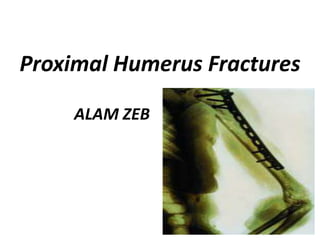
Proximal Humerus Fractures
ALAM ZEB
Learning Objectives
•Bony and Muscular anatomy of the proximal
humerus
•Epidemiological factors and common mechanism
of injury for proximal humeral fractures
•Diagnostic tools
•Objective Examination
•Management
•Rehabilitation program
•Common complications
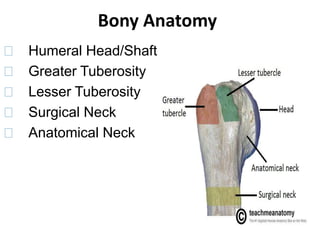
Bony Anatomy
􀁺 Humeral Head/Shaft
􀁺 Greater Tuberosity
􀁺 Lesser Tuberosity
􀁺 Surgical Neck
􀁺 Anatomical Neck
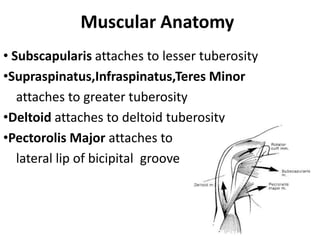
Muscular Anatomy
• Subscapularis attaches to lesser tuberosity
•Supraspinatus,Infraspinatus,Teres Minor
attaches to greater tuberosity
•Deltoid attaches to deltoid tuberosity
•Pectorolis Major attaches to
lateral lip of bicipital groove
Epidemiology
• 4-5% of all fractures
• 75% of humeral fractures in patients over 40
• Women incidence > Men
– osteoporotic factor
Mechanism of Injury
Over 50
– Minimal to moderate trauma
– More typically indirect mechanism such
as fall on an outstretched hand
 Under 50
– High-energy trauma
– More typically direct impact or fall on
the shoulder
– May be concurrent with dislocation due to higher
forces
Diagnostic Studies
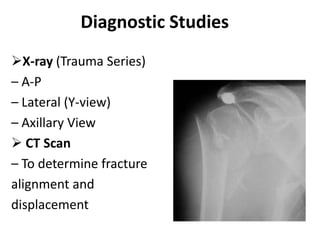
X-ray (Trauma Series)
– A-P
– Lateral (Y-view)
– Axillary View
 CT Scan
– To determine fracture
alignment and
displacement
Objective Examination
• Varies related to type of fracture and amount
of displacement
• Painful motion
• Swelling and delayed ecchymosis
• Tenderness to palpation
• Crepitus indicative of fracture instability
• IR/ER to assess proximal and distal humerus
move simultaneously as a unit
General Treatment Options
Non-Operative
•80% of PHF are NONDISPLACED and can be successfully
treated NONOPERATIVELY
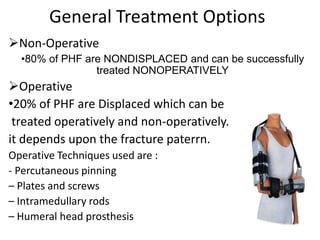
Operative
•20% of PHF are Displaced which can be
treated operatively and non-operatively.
it depends upon the fracture paterrn.
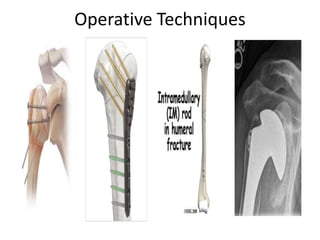
Operative Techniques used are :
- Percutaneous pinning
– Plates and screws
– Intramedullary rods
– Humeral head prosthesis
Operative Techniques
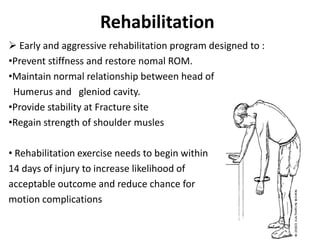
Rehabilitation
 Early and aggressive rehabilitation program designed to :
•Prevent stiffness and restore nomal ROM.
•Maintain normal relationship between head of
Humerus and gleniod cavity.
•Provide stability at Fracture site
•Regain strength of shoulder musles
• Rehabilitation exercise needs to begin within
14 days of injury to increase likelihood of
acceptable outcome and reduce chance for
motion complications
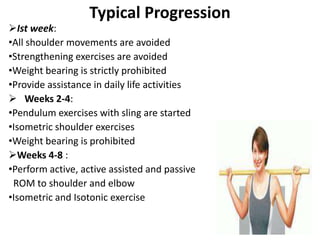
Typical Progression
Ist week:
•All shoulder movements are avoided
•Strengthening exercises are avoided
•Weight bearing is strictly prohibited
•Provide assistance in daily life activities
 Weeks 2-4:
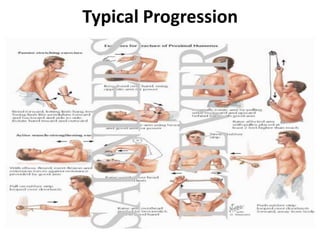
•Pendulum exercises with sling are started
•Isometric shoulder exercises
•Weight bearing is prohibited
Weeks 4-8 :
•Perform active, active assisted and passive
ROM to shoulder and elbow
•Isometric and Isotonic exercise
Typical Progression
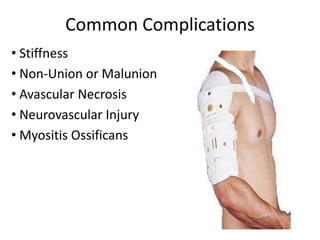
Common Complications
• Stiffness
• Non-Union or Malunion
• Avascular Necrosis
• Neurovascular Injury
• Myositis Ossificans
Proximal humerus fractures by amir

Proximal humerus fractures by amir

  • 1.
  • 2.
    Learning Objectives •Bony andMuscular anatomy of the proximal humerus •Epidemiological factors and common mechanism of injury for proximal humeral fractures •Diagnostic tools •Objective Examination •Management •Rehabilitation program •Common complications
  • 3.
    Bony Anatomy 􀁺 HumeralHead/Shaft 􀁺 Greater Tuberosity 􀁺 Lesser Tuberosity 􀁺 Surgical Neck 􀁺 Anatomical Neck
  • 4.
    Muscular Anatomy • Subscapularisattaches to lesser tuberosity •Supraspinatus,Infraspinatus,Teres Minor attaches to greater tuberosity •Deltoid attaches to deltoid tuberosity •Pectorolis Major attaches to lateral lip of bicipital groove
  • 5.
    Epidemiology • 4-5% ofall fractures • 75% of humeral fractures in patients over 40 • Women incidence > Men – osteoporotic factor Mechanism of Injury Over 50 – Minimal to moderate trauma – More typically indirect mechanism such as fall on an outstretched hand  Under 50 – High-energy trauma – More typically direct impact or fall on the shoulder – May be concurrent with dislocation due to higher forces
  • 6.
    Diagnostic Studies X-ray (TraumaSeries) – A-P – Lateral (Y-view) – Axillary View  CT Scan – To determine fracture alignment and displacement
  • 7.
    Objective Examination • Variesrelated to type of fracture and amount of displacement • Painful motion • Swelling and delayed ecchymosis • Tenderness to palpation • Crepitus indicative of fracture instability • IR/ER to assess proximal and distal humerus move simultaneously as a unit
  • 8.
    General Treatment Options Non-Operative •80%of PHF are NONDISPLACED and can be successfully treated NONOPERATIVELY Operative •20% of PHF are Displaced which can be treated operatively and non-operatively. it depends upon the fracture paterrn. Operative Techniques used are : - Percutaneous pinning – Plates and screws – Intramedullary rods – Humeral head prosthesis
  • 9.
  • 10.
    Rehabilitation  Early andaggressive rehabilitation program designed to : •Prevent stiffness and restore nomal ROM. •Maintain normal relationship between head of Humerus and gleniod cavity. •Provide stability at Fracture site •Regain strength of shoulder musles • Rehabilitation exercise needs to begin within 14 days of injury to increase likelihood of acceptable outcome and reduce chance for motion complications
  • 11.
    Typical Progression Ist week: •Allshoulder movements are avoided •Strengthening exercises are avoided •Weight bearing is strictly prohibited •Provide assistance in daily life activities  Weeks 2-4: •Pendulum exercises with sling are started •Isometric shoulder exercises •Weight bearing is prohibited Weeks 4-8 : •Perform active, active assisted and passive ROM to shoulder and elbow •Isometric and Isotonic exercise
  • 12.
  • 13.
    Common Complications • Stiffness •Non-Union or Malunion • Avascular Necrosis • Neurovascular Injury • Myositis Ossificans

Editor's Notes

  • #4 Greater Tuberosity is laterally oriented and 5-10 mm distal to the topof the humerusLesser Tuberosity more anteriorly and the insertion site for thesubscapularisSurgical Neck is at the base of humeral headAnatomical Neck at the base of the humeral head’s articular surfaceRetroversion of humeral head is about 25-30° external as comparedto the condylar axis of the elbowNormal Humeral Neck to Shaft angle is about 135°. Range is 125-150º
  • #5 Subscapularis attaches to the lesser tuberosityAnterior and medial displacement if unopposed pullfollowing fractureSupraspinatus-Infraspinatus-Teres Minor attaches to the greatertuberosityPosterior and superior displacement if unopposed pullfollowing fractureDeltoid attaches to the deltoid tuberosityFragment shearing is created by muscular contractionfollowing fracturePecoralisMajor attaches to the lateral lip of the bicipital grooveMedial displacement of proximal humeral shaft if unopposedpull following fracture
  • #6 “Fall” Factors related to Humeral Fractures1. Difficulty walking in dim light2. Seizure medication use3. Always use a hearing aid4. Left handedness
  • #7 AP radiograph of the right shoulder. This depicts fractures of bothtuberosities and a surgical neck fracture (Neer four-part).
  • #8 Ecchymosis 2-3 days following the trauma can be extensive anddiscoloration may extend to the elbow , along the chest wall andupper back.Inconsequential or low energy mechanisms require you to rule outmetastatic disease which are most commonly manifested at thesurgical neck
  • #11 Important to minimize muscular contractions of the shoulder untilshoulder fracture fragments are healed or stabilized. This will varyaccording to the location of the fracture and the method of fixation.However, humeral fractures cause extensive bleeding in the joint.Blood can act like glue and if the patient doesn’t move the jointcontractures will quickly develop.It is a constant battle to maintain motion without interrupting thehealing process. Neither a stiff shoulder with a well-healed fracture orgood motion in non-union fracture would be a desirable outcome.The following statement was taken from the Cochrane Review entitled“Interventions for treating proximal humeral fractures in adults“There is some evidence that 'immediate' physiotherapy, withoutroutine immobilization, compared with that delayed until after threeweeks immobilization results in less pain and both faster andpotentially better recovery in patients with undisplaced two-partfractures. Similarly, there was evidence that mobilization at one weekinstead of three weeks alleviated pain in the short term withoutcompromising long term outcome.”
  • #12 1. Patient Education and physical agents or electrotherapeuticmodalities for symptom relief2. PROM emphasizes forward elevation and external rotation3. Joint mobilizations (Grade I-II) for pain relief throughneuromodulation4. No distraction along humeral long axis or inferior glidessupine flexion and external rotation ROM exercisescan usually begin towards the end of this phaseMotion intervention will vary according to fracture stability andpatient’s healing responseWeeks 3-6 AROM and pulley exercisesWeeks 6-12: PREs and stretching exercises when clinical union ispresent