Q Axilla
The following structures make up the anterior wall of the axilla
1 Pectoralis major
2 Subclavius
3 Subscapularis
4 Pectoralis minor
5 Coracobrachialis
The following structures make up the anterior wall of the axilla
1 Pectoralis major T
2 Subclavius F
3 Subscapularis F
4 Pectoralis minor T
5 Coracobrachialis F
The following structures make up the medial wall of the axilla
1 Pectoralis major
2 Ribs
3 Subscapularis
4 Serratus anterior
5 Coracobrachialis
The following structures make up the medial wall of the axilla
1 Pectoralis major F
2 Ribs T
3 Subscapularis F
4 Serratus anterior T
5 Coracobrachialis F
The following structures make up the posterior wall of the axilla
1 Latissimus Dorsi
2 Teres major
3 Subscapularis
4 Serratus anterior
5 Teres minor
The following structures make up the posterior wall of the axilla
1 Latissimus Dorsi T
2 Teres major T
3 Subscapularis T
4 Serratus anterior F
5 Teres minor F
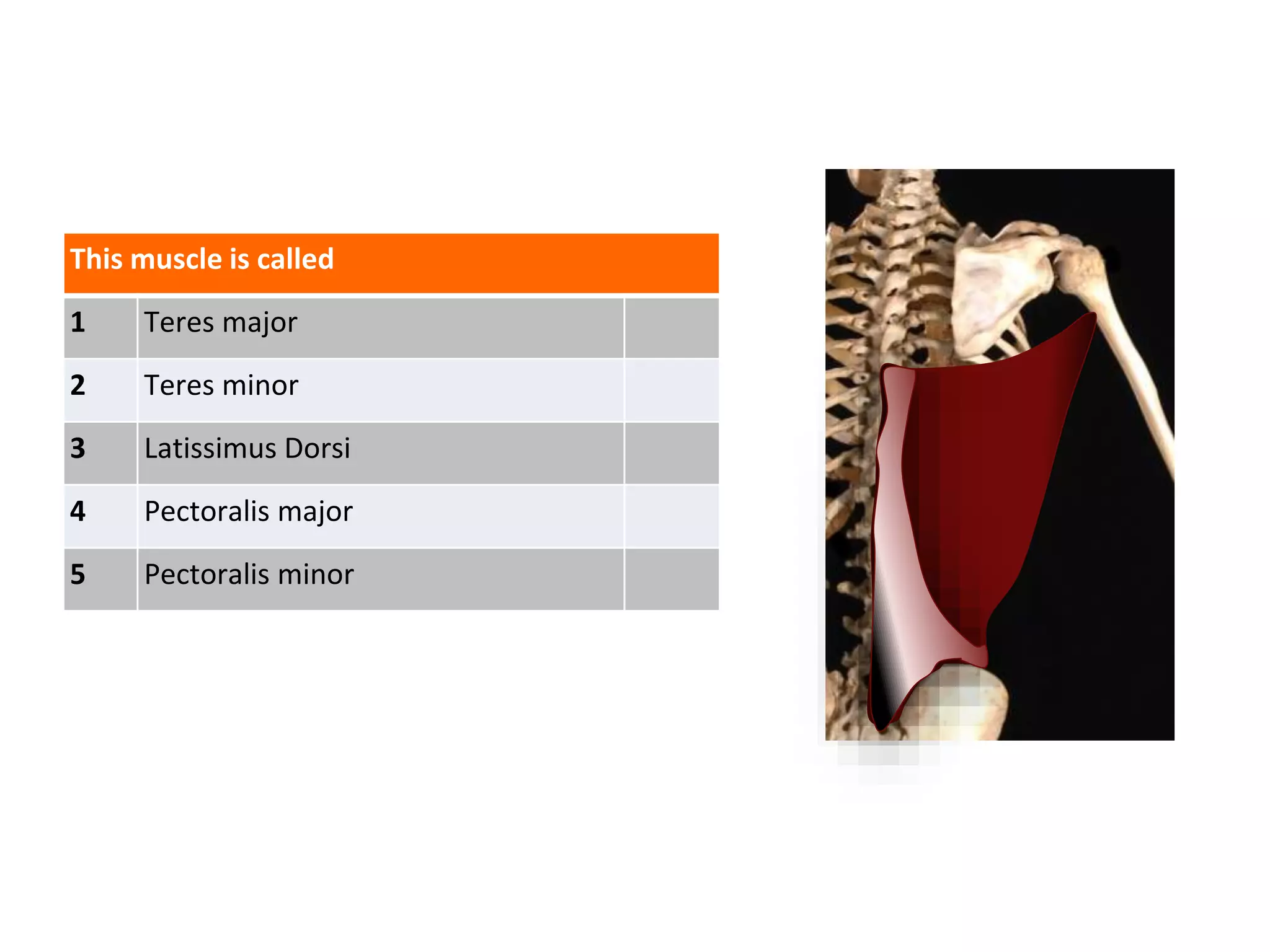
This muscle is called
1 Teres major
2 Teres minor
3 Latissimus Dorsi
4 Pectoralis major
5 Pectoralis minor
This muscle is called
1 Teres major F
2 Teres minor F
3 Latissimus Dorsi T
4 Pectoralis major F
5 Pectoralis minor F
This muscle is innervated by
1 Axillary nerve
2 Subscapular nerve
3 Dorsal scapular nerve
4 Lower subscapular nerve
5 Thoracodorsal nerve
This muscle is innervated by
1 Axillary nerve F
2 Subscapular nerve F
3 Dorsal scapular nerve F
4 Lower subscapular nerve F
5 Thoracodorsal nerve T
This is the latissimus dorsi muscle.
It is innervated by the thoracodorsal nerve
The muscle forms part of the
1 Anterior wall
2 Superior wall
3 Medial wall
4 Posterior wall
5 Lateral wall
The muscle forms part of the
1 Anterior wall F
2 Superior wall F
3 Medial wall F
4 Posterior wall T
5 Lateral wall F
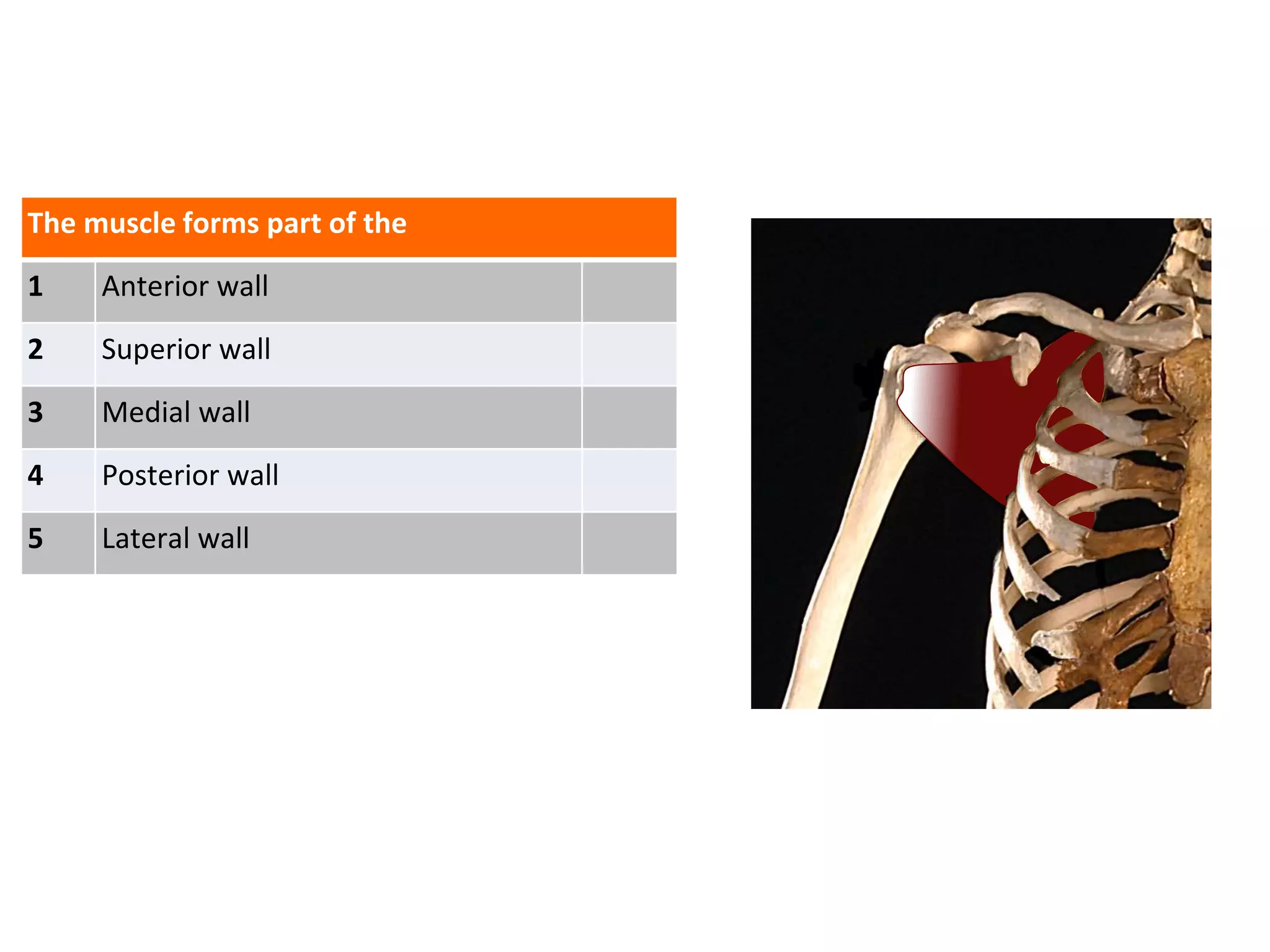
This is muscle is subscapularis. It forms part of the
posterior wall of the axilla.
The muscle forms part of the
1 Anterior wall
2 Superior wall
3 Medial wall
4 Posterior wall
5 Lateral wall
The muscle forms part of the
1 Anterior wall T
2 Superior wall F
3 Medial wall F
4 Posterior wall F
5 Lateral wall F
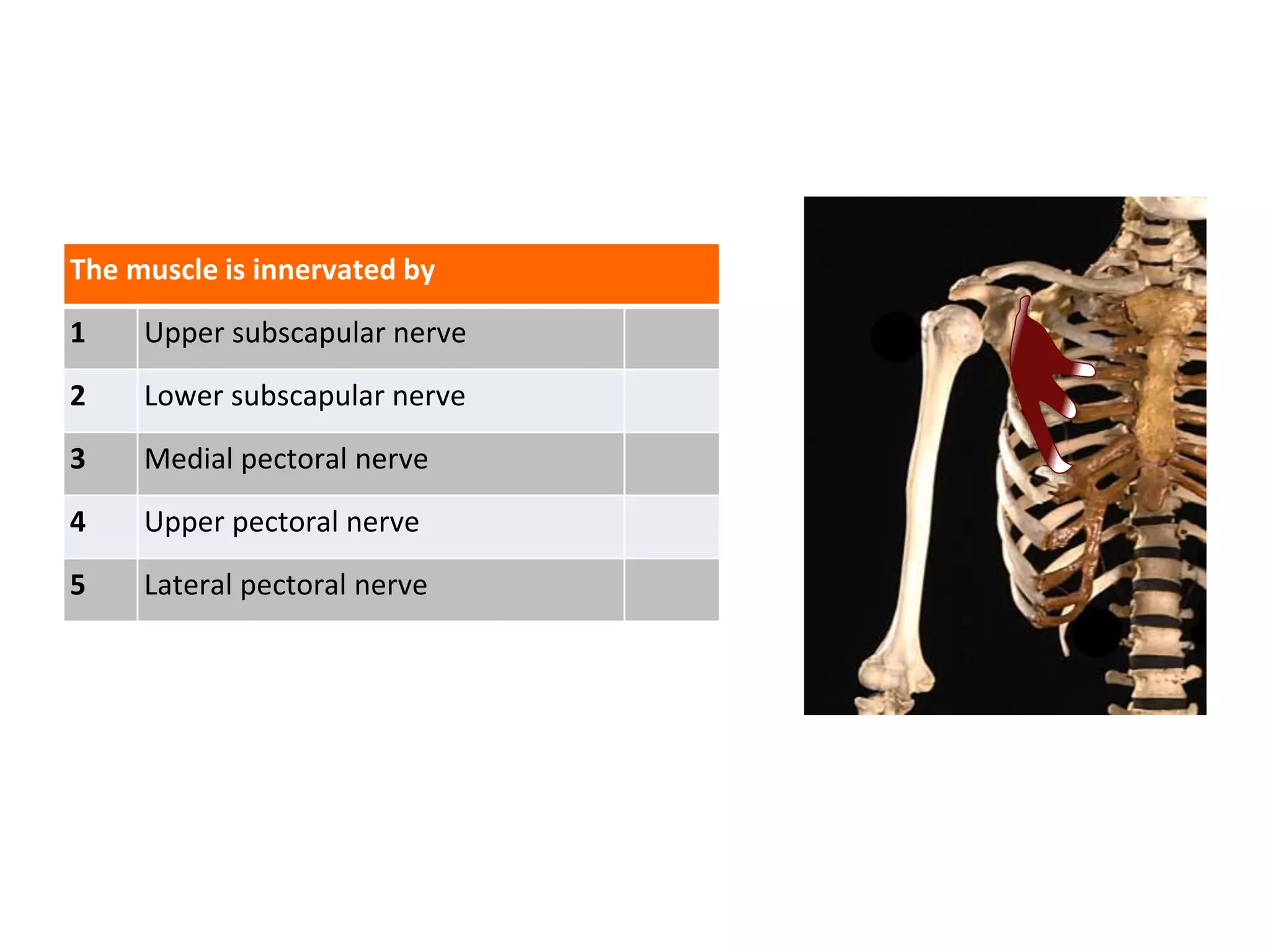
This is muscle is pectoralis minor. It forms part of the
anterior wall of the axilla.
The muscle is innervated by
1 Upper subscapular nerve
2 Lower subscapular nerve
3 Medial pectoral nerve
4 Upper pectoral nerve
5 Lateral pectoral nerve
The muscle is innervated by
1 Upper subscapular nerve F
2 Lower subscapular nerve F
3 Medial pectoral nerve T
4 Upper pectoral nerve F
5 Lateral pectoral nerve T
This muscle is pectoralis minor. It is innervated by the medial and lateral pectoral
nerves.
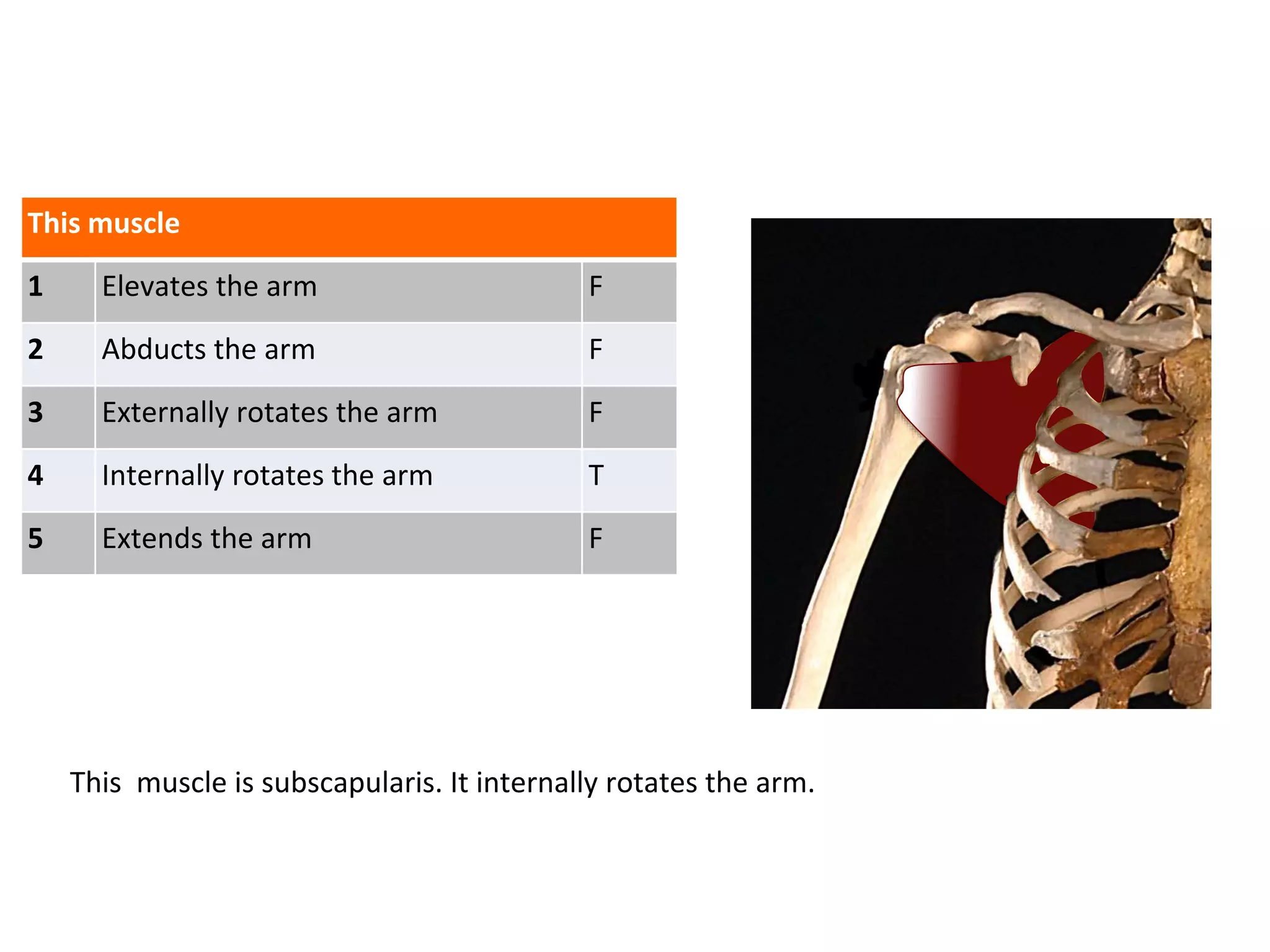
This muscle
1 Elevates the arm
2 Abducts the arm
3 Externally rotates the arm
4 Internally rotates the arm
5 Extends the arm
This muscle
1 Elevates the arm F
2 Abducts the arm F
3 Externally rotates the arm F
4 Internally rotates the arm T
5 Extends the arm F
This muscle is subscapularis. It internally rotates the arm.
This muscle
1 Adducts the arm
2 Abducts the arm
3 Externally rotates the arm
4 Internally rotates the arm
5 Extends the arm
This muscle
1 Adducts the arm T
2 Abducts the arm F
3 Externally rotates the arm F
4 Internally rotates the arm T
5 Extends the arm F
This muscle is pectoralis major. It adducts and internally rotates the arm.
The muscle forms part of the
1 Anterior wall
2 Superior wall
3 Medial wall
4 Posterior wall
5 Lateral wall
This is muscle is pectoralis major. It forms part of the anterior wall of the
axilla with pectoralis minor.
The muscle forms part of the
1 Anterior wall T
2 Superior wall F
3 Medial wall F
4 Posterior wall F
5 Lateral wall F
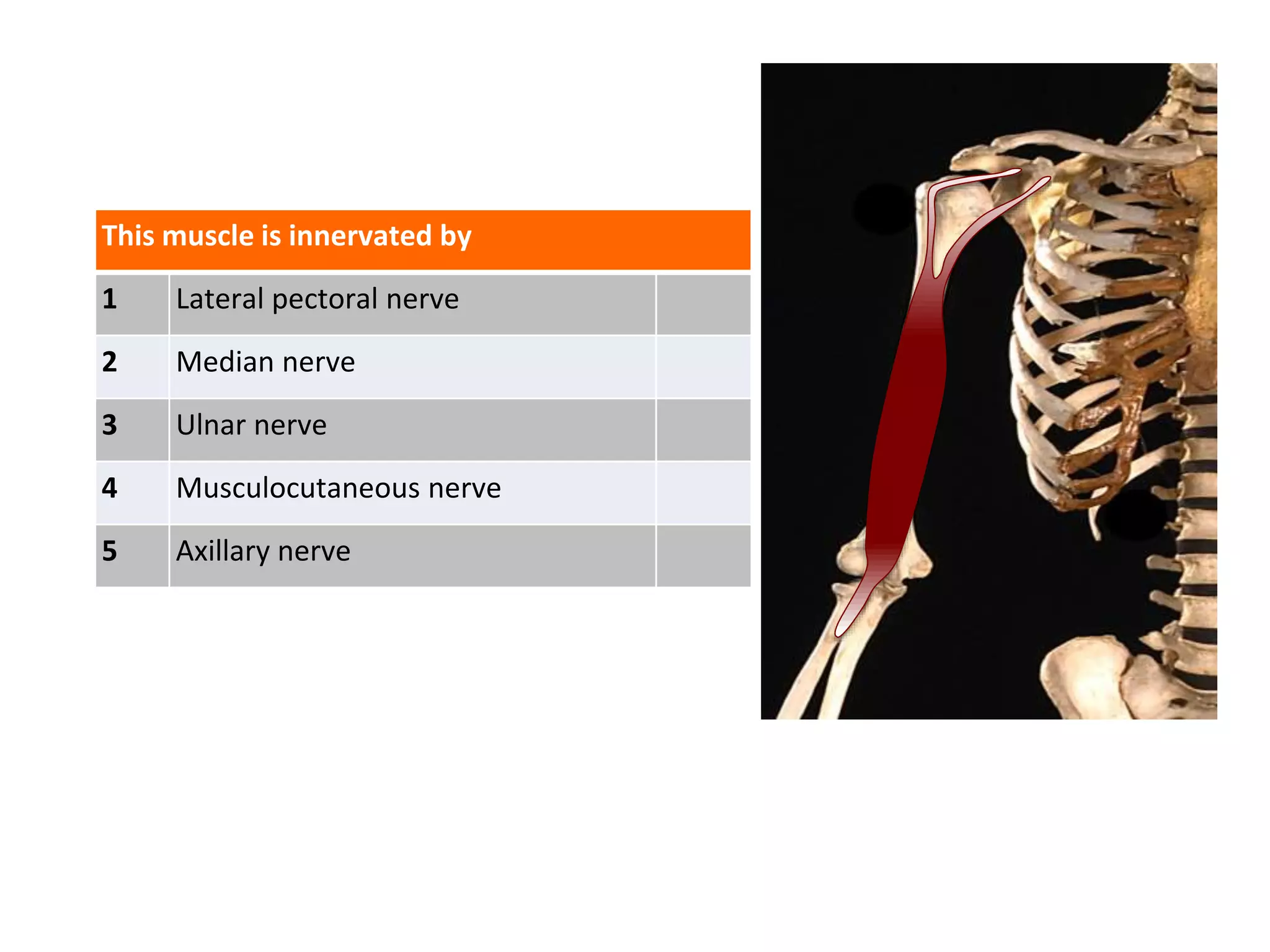
This muscle is innervated by
1 Lateral pectoral nerve
2 Median nerve
3 Ulnar nerve
4 Musculocutaneous nerve
5 Axillary nerve
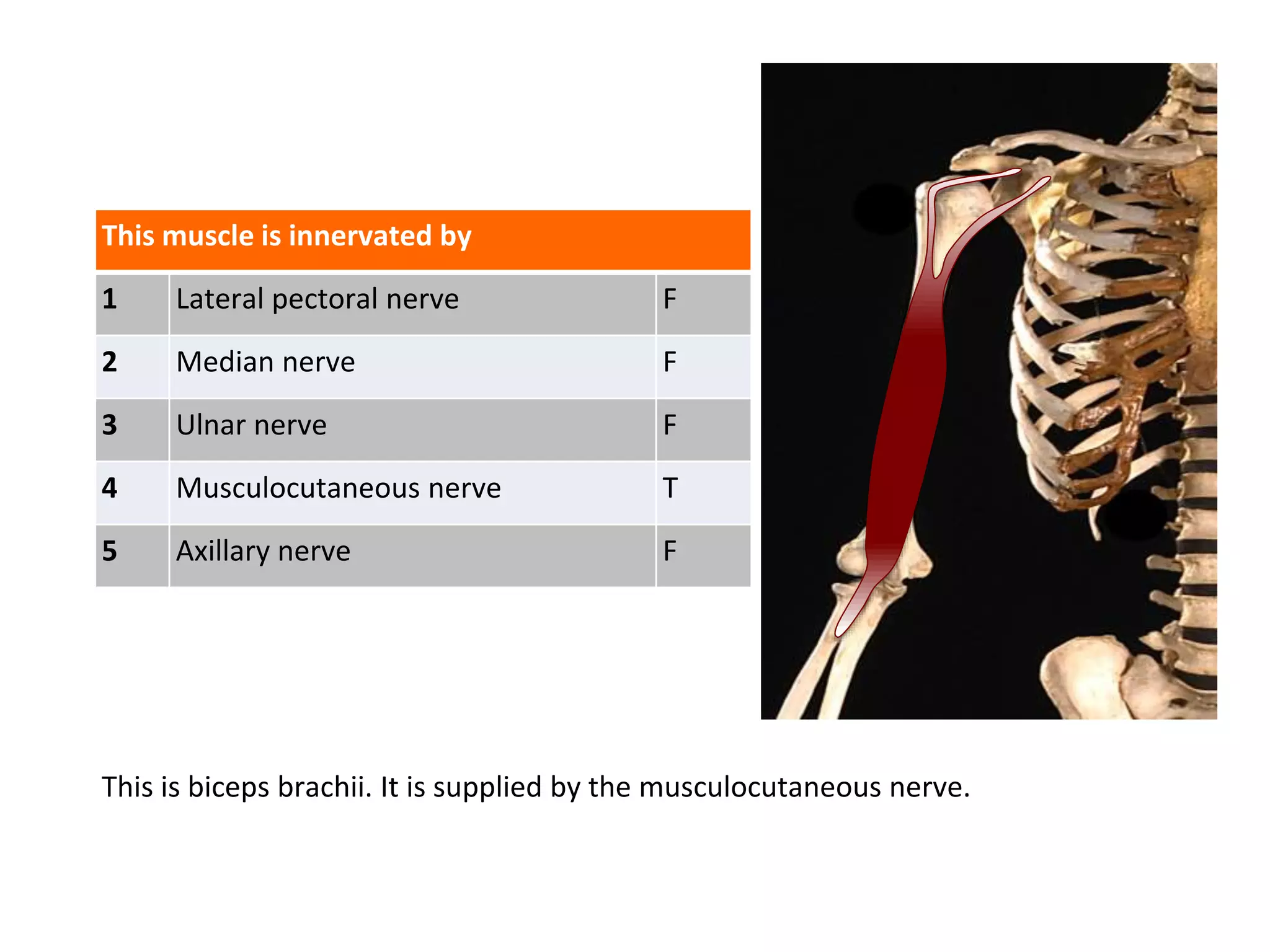
This muscle is innervated by
1 Lateral pectoral nerve F
2 Median nerve F
3 Ulnar nerve F
4 Musculocutaneous nerve T
5 Axillary nerve F
This is biceps brachii. It is supplied by the musculocutaneous nerve.
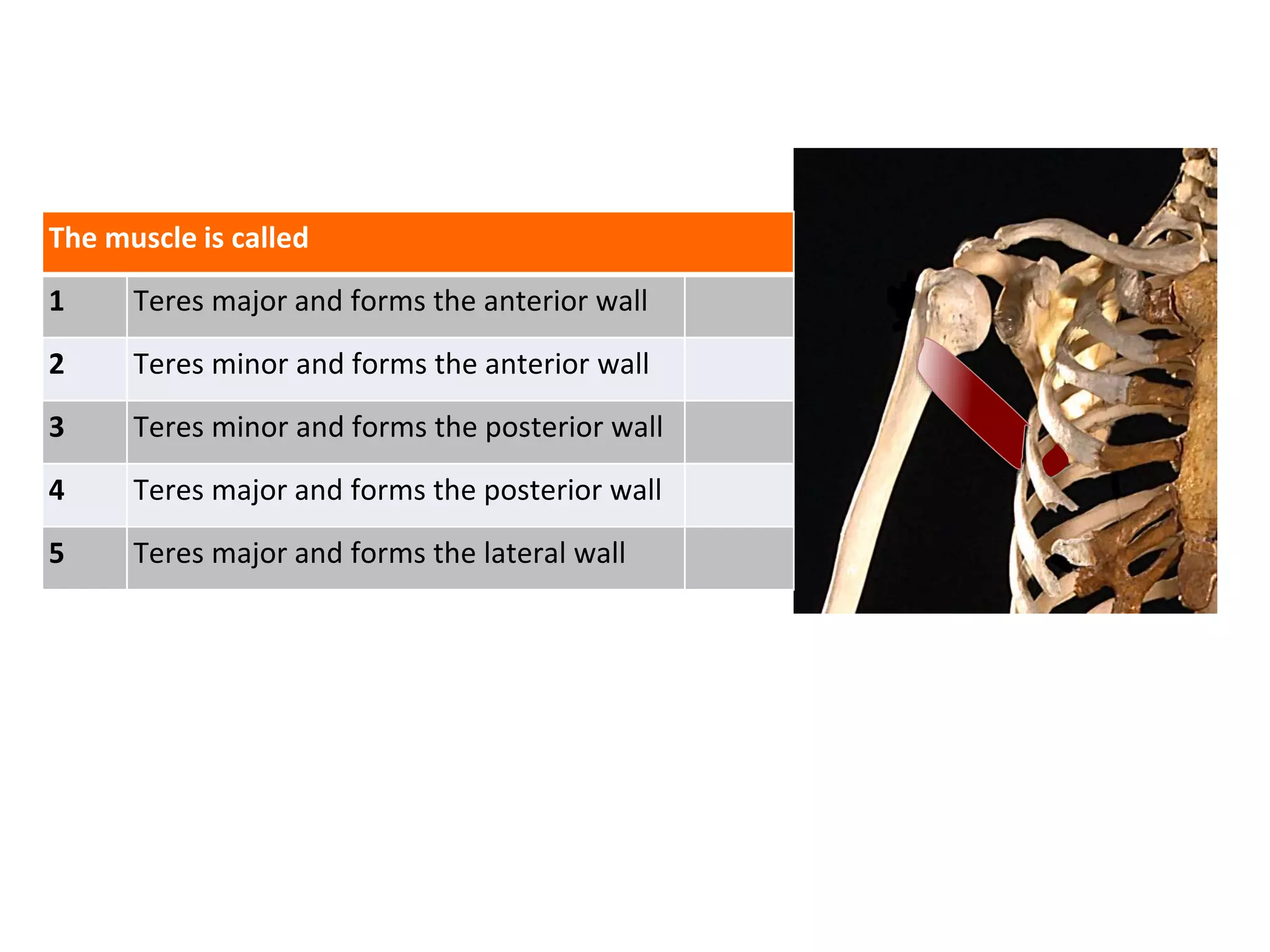
The muscle is called
1 Teres major and forms the anterior wall
2 Teres minor and forms the anterior wall
3 Teres minor and forms the posterior wall
4 Teres major and forms the posterior wall
5 Teres major and forms the lateral wall
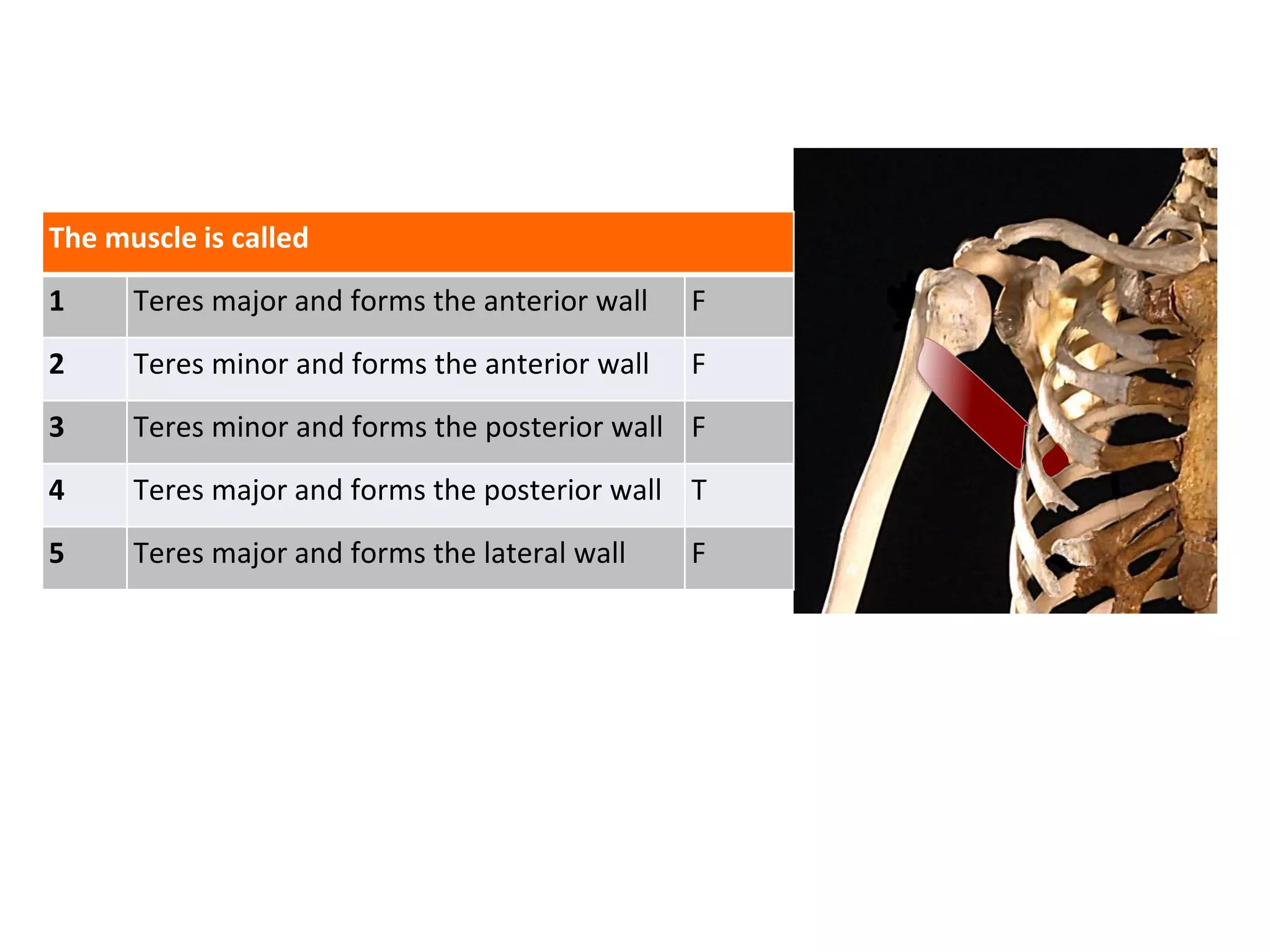
The muscle is called
1 Teres major and forms the anterior wall F
2 Teres minor and forms the anterior wall F
3 Teres minor and forms the posterior wall F
4 Teres major and forms the posterior wall T
5 Teres major and forms the lateral wall F
The muscle is innervated by
1 Lower subscapular nerve
2 Suprascapular nerve
3 Dorsal scapular nerve
4 Axillary nerve
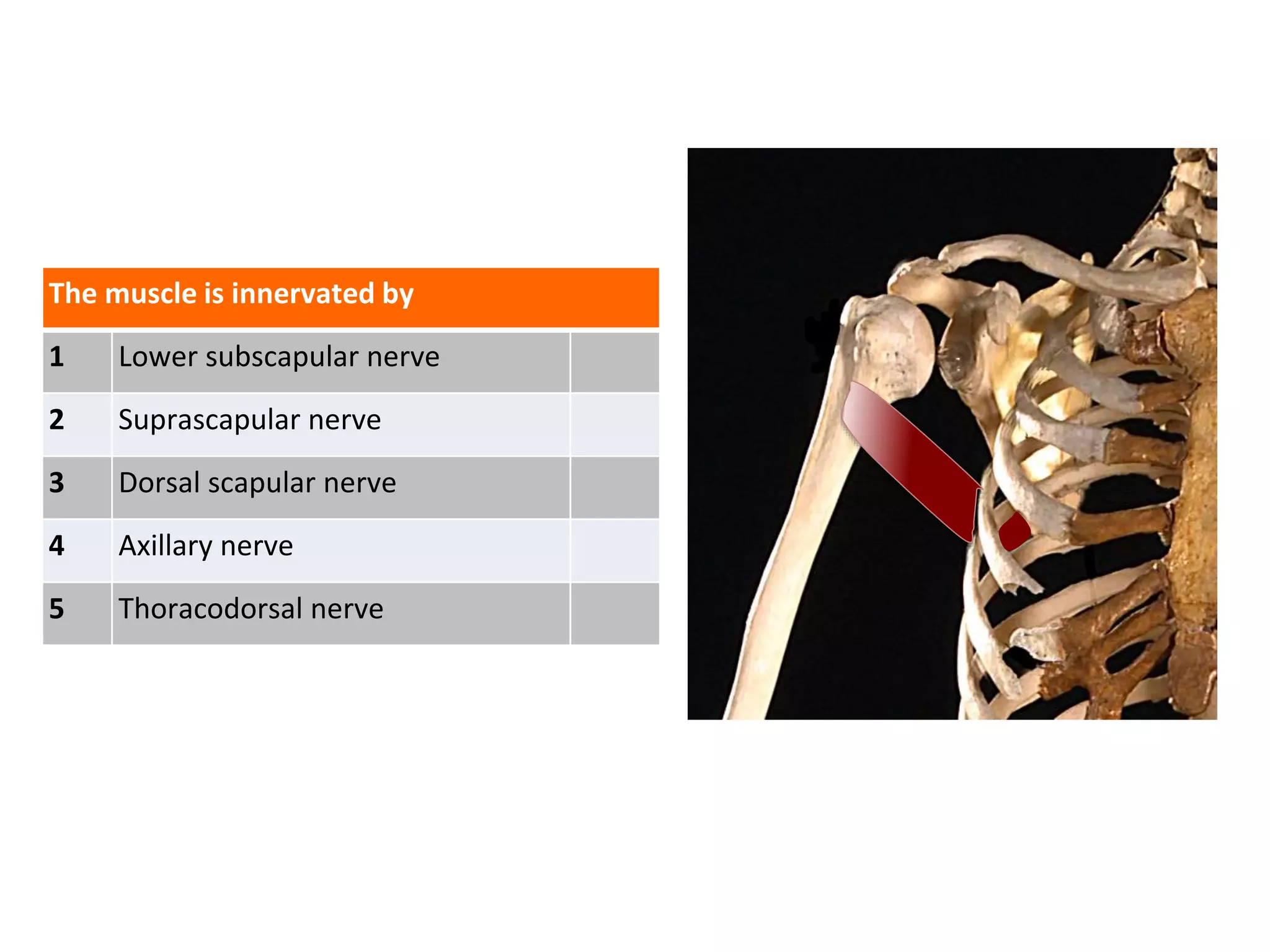
5 Thoracodorsal nerve
The muscle is innervated by
1 Lower subscapular nerve T
2 Suprascapular nerve F
3 Dorsal scapular nerve F
4 Axillary nerve F
5 Thoracodorsal nerve F
This muscle is teres major and is supplied by the lower subscapular nerve
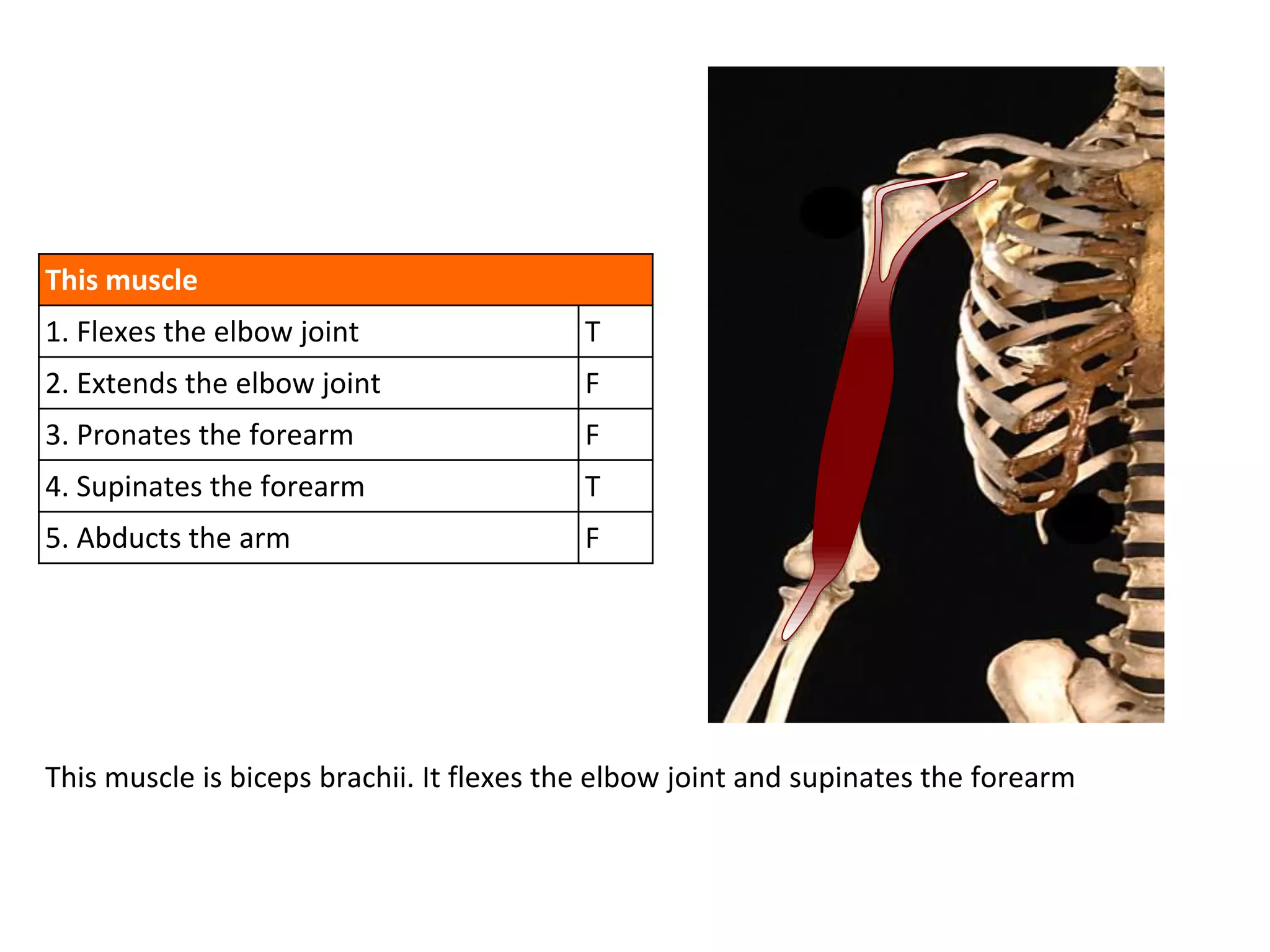
This muscle
1. Flexes the elbow joint
2. Extends the elbow joint
3. Pronates the forearm
4. Supinates the forearm
5. Abducts the arm
This muscle
1. Flexes the elbow joint T
2. Extends the elbow joint F
3. Pronates the forearm F
4. Supinates the forearm T
5. Abducts the arm F
This muscle is biceps brachii. It flexes the elbow joint and supinates the forearm
The axilla contains
1 Brachial artery
2 Subclavian artery
3 Axillary artery
4 Ulnar artery
5 Radial artery
The axilla contains
1 Brachial artery F
2 Subclavian artery F
3 Axillary artery T
4 Ulnar artery F
5 Radial artery F
The axilla contains the axillary artery which is a direct continuation of the subclavian
artery. It starts at the lateral border of the 1st rib and ends at the inferior border of teres
major and continues down the arm as the brachial artery. The ulnar and radial arteries
are further divisions of the brachial artery in the forearm.
The axilla contains
1 Cords of the brachial plexus
2 Roots of the brachial plexus
3 Branches of the brachial plexus
4 Divisions of the brachial plexus
5 Trunks of the brachial plexus
The axilla contains
1 Cords of the brachial plexus T
2 Roots of the brachial plexus F
3 Branches of the brachial plexus T
4 Divisions of the brachial plexus F
5 Trunks of the brachial plexus F
The brachial plexus consists of the 5 roots from C5, C6, C7, C8 and T1 that lie
anterior to scalenus medius and posterior to scalenus anterior. Then the trunks lie
on the base of the posterior triangle of the neck. The divisions are behind the
clavicle, and the cords and branches or nerves lie in the axilla.
Concerning the axilla:
1 Pectoralis minor helps form the anterior wall
2 The axillary artery lies medial to the axillary vein
3 The axilla is crossed by the intercosto-brachial nerve
4 Serratus anterior lies on the medial wall of the axilla
5 The apex of the axilla lies at the level of the clavicle
The anterior wall of the axilla is two layers thick; a superficial layer being made of
pectoralis major and a deep layer being made up collectively, of pectoralis minor,
clavipectoral fascia, and subclavius
The axillary vein lies antero-medial to the artery
The intercosto-brachial nerve is the lateral cutaneous branch of the second
(sometimes third) intercostal nerve. It crosses the axillary space and innervates a
small area of skin on the upper medial aspect of the arm)
The medial wall of the axilla is defined as the lateral aspect of the upper four
intercostal spaces. These are overlapped by the upper four or five digitations of
serratus anterior.
The upper limit of the axilla called the apex lies behind the middle third of the
clavicle)
Concerning the axilla:
1 Pectoralis minor helps form the anterior wall T
2 The axillary artery lies medial to the axillary vein F
3 The axilla is crossed by the intercosto-brachial nerve T
4 Serratus anterior lies on the medial wall of the axilla T
5 The apex of the axilla lies at the level of the clavicle T
The Pectoralis major muscle:
1 arises in part from the upper six or so costal cartilages
2 is innervated by the medial and lateral pectoral nerves.
3 is attached to the lesser tuberosity of the humerus
4 lies deep to the clavipectoral fascia.
5 is pierced by the anterior intercostal arteries
The medial and lateral pectoral nerves are respectively from the medial and
lateral cords of the brachial plexus, and together they innervate all of
pectoralis major)
The humeral attachment of pectoralis major is to the lateral lip of the
intertubercular groove, not to the lesser tuberosity)
The anterior intercostals arteries are branches of the internal thoracic
(mammary) artery. They pierce the anterior ends of the intercostal spaces
before piercing pectoralis major to reach the overlying skin).
The Pectoralis major muscle:
1 arises in part from the upper six or so costal cartilages T
2 is innervated by the medial and lateral pectoral nerves. T
3 is attached to the lesser tuberosity of the humerus F
4 lies deep to the clavipectoral fascia. F
5 is pierced by the anterior intercostal arteries T
Complete transection of the upper trunk of brachial plexus will result in
1 failure of voluntary shoulder abduction
2 weakness of voluntary elbow flexion
3 loss of cutaneous sensarion on the inner (medial)
aspect of the arm
4 paralysis of lumbricals
5 significant impairment of lateral rotation of the
shoulder joint
The medial aspect of the arm corresponds to the territories of T1 & T2 spinal nerves,
not C5 & 6).
The lumbricals are innervated by fibres fromT1 (the first thoracic spinal nerve)
Infraspinatus, the powerful lateral rotator of the shoulder joint is innervated by C5 & 6
fibres
The upper trunk of the brachial plexus is formed by the union of the ventral rami of the
5th and 6th cervical nerves. Shoulder abduction requires an intact C5 contribution, while
lateral rotation of shoulder joint and elbow flexion both require intact C5 and 6 fibres.
Complete transection of the upper trunk of brachial plexus will result in
1 failure of voluntary shoulder abduction T
2 weakness of voluntary elbow flexion T
3 loss of cutaneous sensarion on the inner (medial)
aspect of the arm
F
4 paralysis of lumbricals F
5 significant impairment of lateral rotation of the
shoulder joint
T
Posterior cord of the brachial plexus
1 Lies posterior to the axillary artery
2 innervates extensor muscles of the arm and forearm
3 innervates erector spinae
4 carries cutaneous sensation from the lateral aspect of
the arm
5 gives a branch which supplies latissimus dorsi
Erector spinae is innervated by dorsal rami of spinal nerves, not by the
brachial plexus
Cutaneous sensation from the lateral aspect of the arm is via the axillary and
radial nerves.
Thoracodorsal nerve supplies latissimus dorsi
Posterior cord of the brachial plexus
1 Lies posterior to the axillary artery T
2 innervates extensor muscles of the arm and forearm T
3 innervates erector spinae F
4 carries cutaneous sensation from the lateral aspect of
the arm
T
5 gives a branch which supplies latissimus dorsi T
The clavipectoral fascia
1 is part of the anterior wall of the axilla
2 is pierced by the cephalic vein
3 encloses the subclavius muscle
4 is anterior to the first part of the axillary artery
5 is pierced by the acromio-thoracic artery
The clavipectoral fascia
1 is part of the anterior wall of the axilla T
2 is pierced by the cephalic vein T
3 encloses the subclavius muscle T
4 is anterior to the first part of the axillary artery T
5 is pierced by the acromio-thoracic artery T
The axillary artery
1 runs superficial to the first intercostal space as it
enters the axilla
2 is the direct continuation of the suprascapular artery
3 runs behind ( ie, deep to) the pectoralis minor muscle
4 gives rise to the subscapular artery usually from its
first part
5 is covered in a fascial sheath derived from the
prevertebral fascia
The axillary artery
1 runs superficial to the first intercostal space as it
enters the axilla
T
2 is the direct continuation of the suprascapular artery F
3 runs behind ( ie, deep to) the pectoralis minor muscle T
4 gives rise to the subscapular artery usually from its
first part
F
5 is covered in a fascial sheath derived from the
prevertebral fascia
T
The axillary artery is initially medial to pectoralis minor, then deep to the muscle
and finally lateral to the muscle. These relationships correspond to the first,
second and third parts of the artery, respectively
The axillary sheath, which encloses the axillary artery and brachial plexus, is
derived from the prevertebral fascia).
Which of the following statements in relation to the anatomy of the axilla
are true?
1 Latissimus dorsi is part of the posterior wall of the axilla
2 The second part of the axillary artery corresponds to the
segment of the artery that lies medial to the pectoralis
minor muscle
3 The median nerve is derived exclusively from the lateral
cord of the brachial plexus
4 The ulnar nerve is derived from the medial cord of the
brachial plexus
5 The radial nerve is a branch of the posterior cord of the
brachial plexus
Which of the following statements in relation to the anatomy of the axilla
are true?
1 Latissimus dorsi is part of the posterior wall of the axilla T
2 The second part of the axillary artery corresponds to the
segment of the artery that lies medial to the pectoralis
minor muscle
F
3 The median nerve is derived exclusively from the lateral
cord of the brachial plexus
F
4 The ulnar nerve is derived from the medial cord of the
brachial plexus
T
5 The radial nerve is a branch of the posterior cord of the
brachial plexus
T
Latissimus Dorsi is part of the posterior wall of the Axilla along with subscapularis and
teres major
The ulnar nerve is derived from the medial cord of the brachial plexus
The radial nerve is a branch of the posterior cord of the brachial plexus

Exam Questions Axilla

  • 1.
  • 2.
    The following structuresmake up the anterior wall of the axilla 1 Pectoralis major 2 Subclavius 3 Subscapularis 4 Pectoralis minor 5 Coracobrachialis
  • 3.
    The following structuresmake up the anterior wall of the axilla 1 Pectoralis major T 2 Subclavius F 3 Subscapularis F 4 Pectoralis minor T 5 Coracobrachialis F
  • 4.
    The following structuresmake up the medial wall of the axilla 1 Pectoralis major 2 Ribs 3 Subscapularis 4 Serratus anterior 5 Coracobrachialis
  • 5.
    The following structuresmake up the medial wall of the axilla 1 Pectoralis major F 2 Ribs T 3 Subscapularis F 4 Serratus anterior T 5 Coracobrachialis F
  • 6.
    The following structuresmake up the posterior wall of the axilla 1 Latissimus Dorsi 2 Teres major 3 Subscapularis 4 Serratus anterior 5 Teres minor
  • 7.
    The following structuresmake up the posterior wall of the axilla 1 Latissimus Dorsi T 2 Teres major T 3 Subscapularis T 4 Serratus anterior F 5 Teres minor F
  • 8.
    This muscle iscalled 1 Teres major 2 Teres minor 3 Latissimus Dorsi 4 Pectoralis major 5 Pectoralis minor
  • 9.
    This muscle iscalled 1 Teres major F 2 Teres minor F 3 Latissimus Dorsi T 4 Pectoralis major F 5 Pectoralis minor F
  • 10.
    This muscle isinnervated by 1 Axillary nerve 2 Subscapular nerve 3 Dorsal scapular nerve 4 Lower subscapular nerve 5 Thoracodorsal nerve
  • 11.
    This muscle isinnervated by 1 Axillary nerve F 2 Subscapular nerve F 3 Dorsal scapular nerve F 4 Lower subscapular nerve F 5 Thoracodorsal nerve T This is the latissimus dorsi muscle. It is innervated by the thoracodorsal nerve
  • 12.
    The muscle formspart of the 1 Anterior wall 2 Superior wall 3 Medial wall 4 Posterior wall 5 Lateral wall
  • 13.
    The muscle formspart of the 1 Anterior wall F 2 Superior wall F 3 Medial wall F 4 Posterior wall T 5 Lateral wall F This is muscle is subscapularis. It forms part of the posterior wall of the axilla.
  • 14.
    The muscle formspart of the 1 Anterior wall 2 Superior wall 3 Medial wall 4 Posterior wall 5 Lateral wall
  • 15.
    The muscle formspart of the 1 Anterior wall T 2 Superior wall F 3 Medial wall F 4 Posterior wall F 5 Lateral wall F This is muscle is pectoralis minor. It forms part of the anterior wall of the axilla.
  • 16.
    The muscle isinnervated by 1 Upper subscapular nerve 2 Lower subscapular nerve 3 Medial pectoral nerve 4 Upper pectoral nerve 5 Lateral pectoral nerve
  • 17.
    The muscle isinnervated by 1 Upper subscapular nerve F 2 Lower subscapular nerve F 3 Medial pectoral nerve T 4 Upper pectoral nerve F 5 Lateral pectoral nerve T This muscle is pectoralis minor. It is innervated by the medial and lateral pectoral nerves.
  • 18.
    This muscle 1 Elevatesthe arm 2 Abducts the arm 3 Externally rotates the arm 4 Internally rotates the arm 5 Extends the arm
  • 19.
    This muscle 1 Elevatesthe arm F 2 Abducts the arm F 3 Externally rotates the arm F 4 Internally rotates the arm T 5 Extends the arm F This muscle is subscapularis. It internally rotates the arm.
  • 20.
    This muscle 1 Adductsthe arm 2 Abducts the arm 3 Externally rotates the arm 4 Internally rotates the arm 5 Extends the arm
  • 21.
    This muscle 1 Adductsthe arm T 2 Abducts the arm F 3 Externally rotates the arm F 4 Internally rotates the arm T 5 Extends the arm F This muscle is pectoralis major. It adducts and internally rotates the arm.
  • 22.
    The muscle formspart of the 1 Anterior wall 2 Superior wall 3 Medial wall 4 Posterior wall 5 Lateral wall
  • 23.
    This is muscleis pectoralis major. It forms part of the anterior wall of the axilla with pectoralis minor. The muscle forms part of the 1 Anterior wall T 2 Superior wall F 3 Medial wall F 4 Posterior wall F 5 Lateral wall F
  • 24.
    This muscle isinnervated by 1 Lateral pectoral nerve 2 Median nerve 3 Ulnar nerve 4 Musculocutaneous nerve 5 Axillary nerve
  • 25.
    This muscle isinnervated by 1 Lateral pectoral nerve F 2 Median nerve F 3 Ulnar nerve F 4 Musculocutaneous nerve T 5 Axillary nerve F This is biceps brachii. It is supplied by the musculocutaneous nerve.
  • 26.
    The muscle iscalled 1 Teres major and forms the anterior wall 2 Teres minor and forms the anterior wall 3 Teres minor and forms the posterior wall 4 Teres major and forms the posterior wall 5 Teres major and forms the lateral wall
  • 27.
    The muscle iscalled 1 Teres major and forms the anterior wall F 2 Teres minor and forms the anterior wall F 3 Teres minor and forms the posterior wall F 4 Teres major and forms the posterior wall T 5 Teres major and forms the lateral wall F
  • 28.
    The muscle isinnervated by 1 Lower subscapular nerve 2 Suprascapular nerve 3 Dorsal scapular nerve 4 Axillary nerve 5 Thoracodorsal nerve
  • 29.
    The muscle isinnervated by 1 Lower subscapular nerve T 2 Suprascapular nerve F 3 Dorsal scapular nerve F 4 Axillary nerve F 5 Thoracodorsal nerve F This muscle is teres major and is supplied by the lower subscapular nerve
  • 30.
    This muscle 1. Flexesthe elbow joint 2. Extends the elbow joint 3. Pronates the forearm 4. Supinates the forearm 5. Abducts the arm
  • 31.
    This muscle 1. Flexesthe elbow joint T 2. Extends the elbow joint F 3. Pronates the forearm F 4. Supinates the forearm T 5. Abducts the arm F This muscle is biceps brachii. It flexes the elbow joint and supinates the forearm
  • 32.
    The axilla contains 1Brachial artery 2 Subclavian artery 3 Axillary artery 4 Ulnar artery 5 Radial artery
  • 33.
    The axilla contains 1Brachial artery F 2 Subclavian artery F 3 Axillary artery T 4 Ulnar artery F 5 Radial artery F The axilla contains the axillary artery which is a direct continuation of the subclavian artery. It starts at the lateral border of the 1st rib and ends at the inferior border of teres major and continues down the arm as the brachial artery. The ulnar and radial arteries are further divisions of the brachial artery in the forearm.
  • 34.
    The axilla contains 1Cords of the brachial plexus 2 Roots of the brachial plexus 3 Branches of the brachial plexus 4 Divisions of the brachial plexus 5 Trunks of the brachial plexus
  • 35.
    The axilla contains 1Cords of the brachial plexus T 2 Roots of the brachial plexus F 3 Branches of the brachial plexus T 4 Divisions of the brachial plexus F 5 Trunks of the brachial plexus F The brachial plexus consists of the 5 roots from C5, C6, C7, C8 and T1 that lie anterior to scalenus medius and posterior to scalenus anterior. Then the trunks lie on the base of the posterior triangle of the neck. The divisions are behind the clavicle, and the cords and branches or nerves lie in the axilla.
  • 36.
    Concerning the axilla: 1Pectoralis minor helps form the anterior wall 2 The axillary artery lies medial to the axillary vein 3 The axilla is crossed by the intercosto-brachial nerve 4 Serratus anterior lies on the medial wall of the axilla 5 The apex of the axilla lies at the level of the clavicle
  • 37.
    The anterior wallof the axilla is two layers thick; a superficial layer being made of pectoralis major and a deep layer being made up collectively, of pectoralis minor, clavipectoral fascia, and subclavius The axillary vein lies antero-medial to the artery The intercosto-brachial nerve is the lateral cutaneous branch of the second (sometimes third) intercostal nerve. It crosses the axillary space and innervates a small area of skin on the upper medial aspect of the arm) The medial wall of the axilla is defined as the lateral aspect of the upper four intercostal spaces. These are overlapped by the upper four or five digitations of serratus anterior. The upper limit of the axilla called the apex lies behind the middle third of the clavicle) Concerning the axilla: 1 Pectoralis minor helps form the anterior wall T 2 The axillary artery lies medial to the axillary vein F 3 The axilla is crossed by the intercosto-brachial nerve T 4 Serratus anterior lies on the medial wall of the axilla T 5 The apex of the axilla lies at the level of the clavicle T
  • 38.
    The Pectoralis majormuscle: 1 arises in part from the upper six or so costal cartilages 2 is innervated by the medial and lateral pectoral nerves. 3 is attached to the lesser tuberosity of the humerus 4 lies deep to the clavipectoral fascia. 5 is pierced by the anterior intercostal arteries
  • 39.
    The medial andlateral pectoral nerves are respectively from the medial and lateral cords of the brachial plexus, and together they innervate all of pectoralis major) The humeral attachment of pectoralis major is to the lateral lip of the intertubercular groove, not to the lesser tuberosity) The anterior intercostals arteries are branches of the internal thoracic (mammary) artery. They pierce the anterior ends of the intercostal spaces before piercing pectoralis major to reach the overlying skin). The Pectoralis major muscle: 1 arises in part from the upper six or so costal cartilages T 2 is innervated by the medial and lateral pectoral nerves. T 3 is attached to the lesser tuberosity of the humerus F 4 lies deep to the clavipectoral fascia. F 5 is pierced by the anterior intercostal arteries T
  • 40.
    Complete transection ofthe upper trunk of brachial plexus will result in 1 failure of voluntary shoulder abduction 2 weakness of voluntary elbow flexion 3 loss of cutaneous sensarion on the inner (medial) aspect of the arm 4 paralysis of lumbricals 5 significant impairment of lateral rotation of the shoulder joint
  • 41.
    The medial aspectof the arm corresponds to the territories of T1 & T2 spinal nerves, not C5 & 6). The lumbricals are innervated by fibres fromT1 (the first thoracic spinal nerve) Infraspinatus, the powerful lateral rotator of the shoulder joint is innervated by C5 & 6 fibres The upper trunk of the brachial plexus is formed by the union of the ventral rami of the 5th and 6th cervical nerves. Shoulder abduction requires an intact C5 contribution, while lateral rotation of shoulder joint and elbow flexion both require intact C5 and 6 fibres. Complete transection of the upper trunk of brachial plexus will result in 1 failure of voluntary shoulder abduction T 2 weakness of voluntary elbow flexion T 3 loss of cutaneous sensarion on the inner (medial) aspect of the arm F 4 paralysis of lumbricals F 5 significant impairment of lateral rotation of the shoulder joint T
  • 42.
    Posterior cord ofthe brachial plexus 1 Lies posterior to the axillary artery 2 innervates extensor muscles of the arm and forearm 3 innervates erector spinae 4 carries cutaneous sensation from the lateral aspect of the arm 5 gives a branch which supplies latissimus dorsi
  • 43.
    Erector spinae isinnervated by dorsal rami of spinal nerves, not by the brachial plexus Cutaneous sensation from the lateral aspect of the arm is via the axillary and radial nerves. Thoracodorsal nerve supplies latissimus dorsi Posterior cord of the brachial plexus 1 Lies posterior to the axillary artery T 2 innervates extensor muscles of the arm and forearm T 3 innervates erector spinae F 4 carries cutaneous sensation from the lateral aspect of the arm T 5 gives a branch which supplies latissimus dorsi T
  • 44.
    The clavipectoral fascia 1is part of the anterior wall of the axilla 2 is pierced by the cephalic vein 3 encloses the subclavius muscle 4 is anterior to the first part of the axillary artery 5 is pierced by the acromio-thoracic artery
  • 45.
    The clavipectoral fascia 1is part of the anterior wall of the axilla T 2 is pierced by the cephalic vein T 3 encloses the subclavius muscle T 4 is anterior to the first part of the axillary artery T 5 is pierced by the acromio-thoracic artery T
  • 46.
    The axillary artery 1runs superficial to the first intercostal space as it enters the axilla 2 is the direct continuation of the suprascapular artery 3 runs behind ( ie, deep to) the pectoralis minor muscle 4 gives rise to the subscapular artery usually from its first part 5 is covered in a fascial sheath derived from the prevertebral fascia
  • 47.
    The axillary artery 1runs superficial to the first intercostal space as it enters the axilla T 2 is the direct continuation of the suprascapular artery F 3 runs behind ( ie, deep to) the pectoralis minor muscle T 4 gives rise to the subscapular artery usually from its first part F 5 is covered in a fascial sheath derived from the prevertebral fascia T The axillary artery is initially medial to pectoralis minor, then deep to the muscle and finally lateral to the muscle. These relationships correspond to the first, second and third parts of the artery, respectively The axillary sheath, which encloses the axillary artery and brachial plexus, is derived from the prevertebral fascia).
  • 48.
    Which of thefollowing statements in relation to the anatomy of the axilla are true? 1 Latissimus dorsi is part of the posterior wall of the axilla 2 The second part of the axillary artery corresponds to the segment of the artery that lies medial to the pectoralis minor muscle 3 The median nerve is derived exclusively from the lateral cord of the brachial plexus 4 The ulnar nerve is derived from the medial cord of the brachial plexus 5 The radial nerve is a branch of the posterior cord of the brachial plexus
  • 49.
    Which of thefollowing statements in relation to the anatomy of the axilla are true? 1 Latissimus dorsi is part of the posterior wall of the axilla T 2 The second part of the axillary artery corresponds to the segment of the artery that lies medial to the pectoralis minor muscle F 3 The median nerve is derived exclusively from the lateral cord of the brachial plexus F 4 The ulnar nerve is derived from the medial cord of the brachial plexus T 5 The radial nerve is a branch of the posterior cord of the brachial plexus T Latissimus Dorsi is part of the posterior wall of the Axilla along with subscapularis and teres major The ulnar nerve is derived from the medial cord of the brachial plexus The radial nerve is a branch of the posterior cord of the brachial plexus