UNIT 5
CALIBRATION , QUALIFICATION
& VALIDATION
`
Validation
• Validation is a systematic approach to collecting
and analysing sufficient data to give reasonable
assurance and documented evidence that a
process or an analytical method will, when
operated within specified parameters, consistently
produce results within predetermined
specifications.
Qualification
• When this approach is related to a machine or
equipment, rather than Validation, this is
referred to as Qualification.
• Qualification is described as the action of
proving that any premises, systems and items
of equipment work correctly and actually lead
to the expected results. It is the process used
to establish confidence that the equipment is
capable of consistently operating within
established limits and tolerances
Calibration
• Calibration is a necessary component to ensure of
the authenticity of Qualification and Validation.
• Calibration is a process that demonstrates a
particular instrument or device produces results
within specified limits, as compared to those
produced by a definite standard over an
appropriate range of measurements.
• Calibration activities must be performed with
qualified instruments by an accredited laboratory.
Definitions
"The measuring devices require calibration"
Calibration in measurement technology and metrology is
the comparison of measurement values delivered by a device
under test with those of a calibration standard of known
accuracy.
Calibration is the process of adjusting an instrument or
equipment to meet the manufacturer’s specification.
Calibration is a process by which ensure that an
instrument readings are accurate with reference to
established standards.
Calibration is performed using primary reference standard.
Instruments need to be calibrated before using. For
example weighing balance, ph meter etc
Calibration of an instrument is the process of determining
Scope/ Purpose/ Need of calibration
• To determine the accuracy, precision, and
deviation of the measurements produced
by all the instruments
• To establish the reliability of the
instrument being used and whether it
can be trusted to deliver repeatable
results each time.
• To make sure that the readings of
equipment/instrument are consistent
and correct every single time
CALIBRATION OF PH METER
pH
pH is defined as an estimate of hydrogen ion activity in a
substance, or simply how acidic ( a majority of hydrogen ions) or
basic ( a majority of hydroxyl ions) it is. This characteristic is
measured on a scale of 0-14, with 0 the most acidic and 14 the most
basic. A pH of 7 is neutral, i.e. neither acidic nor basic.
pH meter
A pH meter is an electronic instrument used for measuring the pH
(acidity or alkalinity) of a liquid. A typical pH meter consists of
special measuring probes (a glass electrode and a reference
electrode) connected to an electronic meter that measure and
displays the pH reading.
Calibration should be performed with at least two standard buffer
solutions that extent the range of ph values to be measured.
For general purposes buffers at ph 4 and ph 10 are acceptable.
Calibration of the Meters with pH 7 and pH 2
Buffers
1. Turn on your pH meter.
• Before you begin to calibrate and use your pH
meter you will first need to turn it on and allow
adequate time for the meter to warm up. This
should generally take around 30 minutes, but check
your pH meter’s operating manual for exact times.
• 2. Select the pH Mode and set the temperature
control knob to 25°C. Adjust the cal knob to read
100%.
• 3 Rinse the electrode with deionized water and
dry using a piece of tissue
• 4. Place the electrode in the solution of pH 7 buffer,
allow the display to stabilize and, then, set the display
to read 7 by adjusting cal knob. Remove the electrode
from the buffer.
• 5. Rinse the electrode with deionized water and dry
using a piece of tissue
• 6. Place the electrode in the solution of pH 2 buffer,
allow the display to stabilize and, then, set the display
to read by adjusting cal knob. Remove the electrode
from the buffer.
• 7. Rinse the electrode with deionized water and dry
using a piece of tissue
Validation
• significance and scope of validation
• Types of validation
• Validation master plan.
• General principles of Analytical method
Validation.
significance and scope of validation
• Validation is the action of making or declaring something
legally or officially acceptable
• The concept of validation was first proposed by two Food and
Drug Administration (FDA) officials, Ted Byers and Bud Loftus,
in the mid 1979s in (USA ) order to improve the quality of
pharmaceuticals
• Significance & Scope
• To Determine the process parameters and necessary controls.
• To confirm the process design as capable of reproducible
commercial manufacturing.
• Risk assessment.
• To provide ongoing assurance that the process remains in a
state of control during routine production
• Quantitatively determine the inconsistency of a process
• The variability within and between batches can
be evaluated to determine the inner and intra-
batch variability.
• Greater analysis of the process performance for
development and operation of process controls.
• To optimize and validate pharmaceutical
productions and supporting processes and cost
reduction.
• Investigate deviations if any from established
parameters
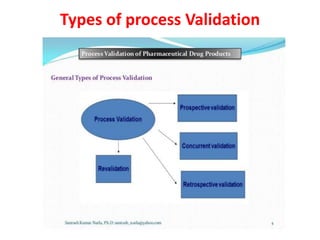
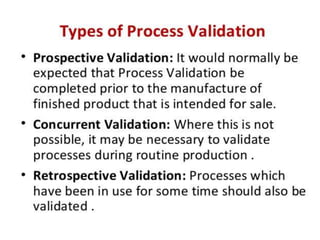
Types of validation
• Process validation is a critical part of quality
assurance procedures, for any sector or industry
today. You can perform process validation at
various stages of the production lifecycle to
confirm whether your process is effectively
controlling the quality of your finished product.
• There are 4 main types of validation:
• Prospective Validation
• Concurrent Validation
• Retrospective Validation
• Revalidation (Periodic and After Change)
Types of process Validation
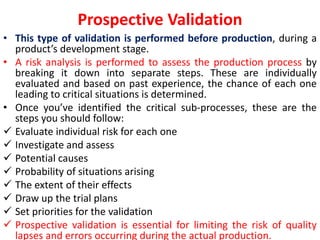
Prospective Validation
• This type of validation is performed before production, during a
product’s development stage.
• A risk analysis is performed to assess the production process by
breaking it down into separate steps. These are individually
evaluated and based on past experience, the chance of each one
leading to critical situations is determined.
• Once you’ve identified the critical sub-processes, these are the
steps you should follow:
 Evaluate individual risk for each one
 Investigate and assess
 Potential causes
 Probability of situations arising
 The extent of their effects
 Draw up the trial plans
 Set priorities for the validation
 Prospective validation is essential for limiting the risk of quality
lapses and errors occurring during the actual production.
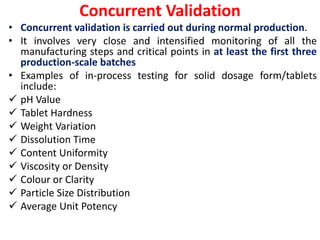
Concurrent Validation
• Concurrent validation is carried out during normal production.
• It involves very close and intensified monitoring of all the
manufacturing steps and critical points in at least the first three
production-scale batches
• Examples of in-process testing for solid dosage form/tablets
include:
 pH Value
 Tablet Hardness
 Weight Variation
 Dissolution Time
 Content Uniformity
 Viscosity or Density
 Colour or Clarity
 Particle Size Distribution
 Average Unit Potency
Retrospective Validation
• It involves analysis of the past experiences of the
process and evaluating the final control tests. This
evaluation is done while assuming that the
procedures, composition and equipment remains
unchanged.
• Retrospective validation is the analysis of results
from past production batches manufactured
under identical conditions to assess the
consistency of a process.
• This type of validation is applied to established
products who are considered stable
Revalidation
(Periodic and After Change)
• Revalidation is needed to ensure that changes
in the process and/or in the process
environment, whether intentional or
unintentional, do not adversely affect process
characteristics and product quality.
• Revalidation may be divided into two broad
categories:
• Revalidation after any change having a
bearing on product quality.
• Periodic revalidation carried out at
scheduled intervals.
Revalidation after Changes
• Whenever you’ve introduced any new elements in
the manufacturing process, revalidation needs to be
performed to determine their effects. There can be a
number of changes in the manufacturing or standard
operating procedures that impact product quality.
• These can be:
– Changes in Starting Materials – Changes in physical
attributes can alter the mechanical properties of
compounds and materials, which can consequently have
adverse effects on the product or the process.
– Changes in Packaging Material – If you switch packaging
materials, you may also be forced to make changes to the
procedures followed during packaging, which can impact
product stability.
– Changes in Process – Any time you alter the
manufacturing process, the subsequent steps can be
affected and thereby, the product quality too.
– Changes in Equipment – Repairs, maintenance and
replacement of key components is unavoidable, but be
sure to assess whether quality is affected and how much.
– Changes in Support System or Production Area –
Rearrangement of support systems or production areas
can also affect product quality, especially critical systems
like ventilation.
Periodic Revalidation
• Similar to regular maintenance, calibration and other
core requirements, revalidation at scheduled
intervals helps you ensure that your systems and
checks are performing within the required standards.
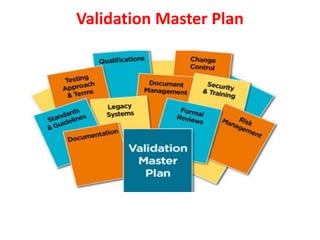
Validation Master Plan
• Validation Master Plans discuss validation
activities across within an organization.
• The Validation Master Plan is a summary of
validation strategy.
• The purpose of the Validation Master Plan is to
document the compliance requirements for the
site and to ensure that sufficient resources are
available for validation projects.
• Master plans are written to assist an organization
with validation strategy or to provide control over
a specific process.
• The Validation Master Plan is
different from a validation
procedure (SOP), which describes
the specific process for
performing validation activities.
• Validation Master Plan Examples
• The Validation Master Plan includes:
• Systems, equipment, methods, facilities,
etc.
• Current validation status for the systems
within the project scope
• Compliance requirements for validation,
including how the validated state will be
maintained
• Schedule of validation activities
• Validation Master Plans can also include:
• Required validation deliverables
• Validation documentation format
• Current validation procedures and policies
• General validation risk mitigation strategy
• Validation Master Plans should be approved by
the head of Site Quality, plus other senior
department heads as appropriate. Senior
management approval is necessary for Validation
Master Plans because their support is essential
for the success of the plan.

Calibration

  • 1.
    UNIT 5 CALIBRATION ,QUALIFICATION & VALIDATION
  • 2.
    ` Validation • Validation isa systematic approach to collecting and analysing sufficient data to give reasonable assurance and documented evidence that a process or an analytical method will, when operated within specified parameters, consistently produce results within predetermined specifications.
  • 3.
    Qualification • When thisapproach is related to a machine or equipment, rather than Validation, this is referred to as Qualification. • Qualification is described as the action of proving that any premises, systems and items of equipment work correctly and actually lead to the expected results. It is the process used to establish confidence that the equipment is capable of consistently operating within established limits and tolerances
  • 4.
    Calibration • Calibration isa necessary component to ensure of the authenticity of Qualification and Validation. • Calibration is a process that demonstrates a particular instrument or device produces results within specified limits, as compared to those produced by a definite standard over an appropriate range of measurements. • Calibration activities must be performed with qualified instruments by an accredited laboratory.
  • 5.
    Definitions "The measuring devicesrequire calibration" Calibration in measurement technology and metrology is the comparison of measurement values delivered by a device under test with those of a calibration standard of known accuracy. Calibration is the process of adjusting an instrument or equipment to meet the manufacturer’s specification. Calibration is a process by which ensure that an instrument readings are accurate with reference to established standards. Calibration is performed using primary reference standard. Instruments need to be calibrated before using. For example weighing balance, ph meter etc Calibration of an instrument is the process of determining
  • 6.
    Scope/ Purpose/ Needof calibration • To determine the accuracy, precision, and deviation of the measurements produced by all the instruments • To establish the reliability of the instrument being used and whether it can be trusted to deliver repeatable results each time. • To make sure that the readings of equipment/instrument are consistent and correct every single time
  • 7.
    CALIBRATION OF PHMETER pH pH is defined as an estimate of hydrogen ion activity in a substance, or simply how acidic ( a majority of hydrogen ions) or basic ( a majority of hydroxyl ions) it is. This characteristic is measured on a scale of 0-14, with 0 the most acidic and 14 the most basic. A pH of 7 is neutral, i.e. neither acidic nor basic. pH meter A pH meter is an electronic instrument used for measuring the pH (acidity or alkalinity) of a liquid. A typical pH meter consists of special measuring probes (a glass electrode and a reference electrode) connected to an electronic meter that measure and displays the pH reading. Calibration should be performed with at least two standard buffer solutions that extent the range of ph values to be measured. For general purposes buffers at ph 4 and ph 10 are acceptable.
  • 8.
    Calibration of theMeters with pH 7 and pH 2 Buffers 1. Turn on your pH meter. • Before you begin to calibrate and use your pH meter you will first need to turn it on and allow adequate time for the meter to warm up. This should generally take around 30 minutes, but check your pH meter’s operating manual for exact times. • 2. Select the pH Mode and set the temperature control knob to 25°C. Adjust the cal knob to read 100%. • 3 Rinse the electrode with deionized water and dry using a piece of tissue
  • 9.
    • 4. Placethe electrode in the solution of pH 7 buffer, allow the display to stabilize and, then, set the display to read 7 by adjusting cal knob. Remove the electrode from the buffer. • 5. Rinse the electrode with deionized water and dry using a piece of tissue • 6. Place the electrode in the solution of pH 2 buffer, allow the display to stabilize and, then, set the display to read by adjusting cal knob. Remove the electrode from the buffer. • 7. Rinse the electrode with deionized water and dry using a piece of tissue
  • 10.
    Validation • significance andscope of validation • Types of validation • Validation master plan. • General principles of Analytical method Validation.
  • 11.
    significance and scopeof validation • Validation is the action of making or declaring something legally or officially acceptable • The concept of validation was first proposed by two Food and Drug Administration (FDA) officials, Ted Byers and Bud Loftus, in the mid 1979s in (USA ) order to improve the quality of pharmaceuticals • Significance & Scope • To Determine the process parameters and necessary controls. • To confirm the process design as capable of reproducible commercial manufacturing. • Risk assessment. • To provide ongoing assurance that the process remains in a state of control during routine production • Quantitatively determine the inconsistency of a process
  • 12.
    • The variabilitywithin and between batches can be evaluated to determine the inner and intra- batch variability. • Greater analysis of the process performance for development and operation of process controls. • To optimize and validate pharmaceutical productions and supporting processes and cost reduction. • Investigate deviations if any from established parameters
  • 13.
    Types of validation •Process validation is a critical part of quality assurance procedures, for any sector or industry today. You can perform process validation at various stages of the production lifecycle to confirm whether your process is effectively controlling the quality of your finished product. • There are 4 main types of validation: • Prospective Validation • Concurrent Validation • Retrospective Validation • Revalidation (Periodic and After Change)
  • 14.
    Types of processValidation
  • 16.
    Prospective Validation • Thistype of validation is performed before production, during a product’s development stage. • A risk analysis is performed to assess the production process by breaking it down into separate steps. These are individually evaluated and based on past experience, the chance of each one leading to critical situations is determined. • Once you’ve identified the critical sub-processes, these are the steps you should follow:  Evaluate individual risk for each one  Investigate and assess  Potential causes  Probability of situations arising  The extent of their effects  Draw up the trial plans  Set priorities for the validation  Prospective validation is essential for limiting the risk of quality lapses and errors occurring during the actual production.
  • 17.
    Concurrent Validation • Concurrentvalidation is carried out during normal production. • It involves very close and intensified monitoring of all the manufacturing steps and critical points in at least the first three production-scale batches • Examples of in-process testing for solid dosage form/tablets include:  pH Value  Tablet Hardness  Weight Variation  Dissolution Time  Content Uniformity  Viscosity or Density  Colour or Clarity  Particle Size Distribution  Average Unit Potency
  • 18.
    Retrospective Validation • Itinvolves analysis of the past experiences of the process and evaluating the final control tests. This evaluation is done while assuming that the procedures, composition and equipment remains unchanged. • Retrospective validation is the analysis of results from past production batches manufactured under identical conditions to assess the consistency of a process. • This type of validation is applied to established products who are considered stable
  • 19.
    Revalidation (Periodic and AfterChange) • Revalidation is needed to ensure that changes in the process and/or in the process environment, whether intentional or unintentional, do not adversely affect process characteristics and product quality. • Revalidation may be divided into two broad categories: • Revalidation after any change having a bearing on product quality. • Periodic revalidation carried out at scheduled intervals.
  • 20.
    Revalidation after Changes •Whenever you’ve introduced any new elements in the manufacturing process, revalidation needs to be performed to determine their effects. There can be a number of changes in the manufacturing or standard operating procedures that impact product quality. • These can be: – Changes in Starting Materials – Changes in physical attributes can alter the mechanical properties of compounds and materials, which can consequently have adverse effects on the product or the process. – Changes in Packaging Material – If you switch packaging materials, you may also be forced to make changes to the procedures followed during packaging, which can impact product stability.
  • 21.
    – Changes inProcess – Any time you alter the manufacturing process, the subsequent steps can be affected and thereby, the product quality too. – Changes in Equipment – Repairs, maintenance and replacement of key components is unavoidable, but be sure to assess whether quality is affected and how much. – Changes in Support System or Production Area – Rearrangement of support systems or production areas can also affect product quality, especially critical systems like ventilation. Periodic Revalidation • Similar to regular maintenance, calibration and other core requirements, revalidation at scheduled intervals helps you ensure that your systems and checks are performing within the required standards.
  • 22.
  • 25.
    • Validation MasterPlans discuss validation activities across within an organization. • The Validation Master Plan is a summary of validation strategy. • The purpose of the Validation Master Plan is to document the compliance requirements for the site and to ensure that sufficient resources are available for validation projects. • Master plans are written to assist an organization with validation strategy or to provide control over a specific process.
  • 26.
    • The ValidationMaster Plan is different from a validation procedure (SOP), which describes the specific process for performing validation activities.
  • 27.
    • Validation MasterPlan Examples • The Validation Master Plan includes: • Systems, equipment, methods, facilities, etc. • Current validation status for the systems within the project scope • Compliance requirements for validation, including how the validated state will be maintained • Schedule of validation activities
  • 28.
    • Validation MasterPlans can also include: • Required validation deliverables • Validation documentation format • Current validation procedures and policies • General validation risk mitigation strategy • Validation Master Plans should be approved by the head of Site Quality, plus other senior department heads as appropriate. Senior management approval is necessary for Validation Master Plans because their support is essential for the success of the plan.