Guided By: Mr.Rohan Dongre Sir
(Pharmaceutical Organic Chemistry)
Presented By - Tausif.M
(B.Pharm 2nd Year)
CONTENTS
 Introduction To Validation
 Importance of Validation
 Implementation
 Types of Validation
 Analytical Method Validation
 Importance
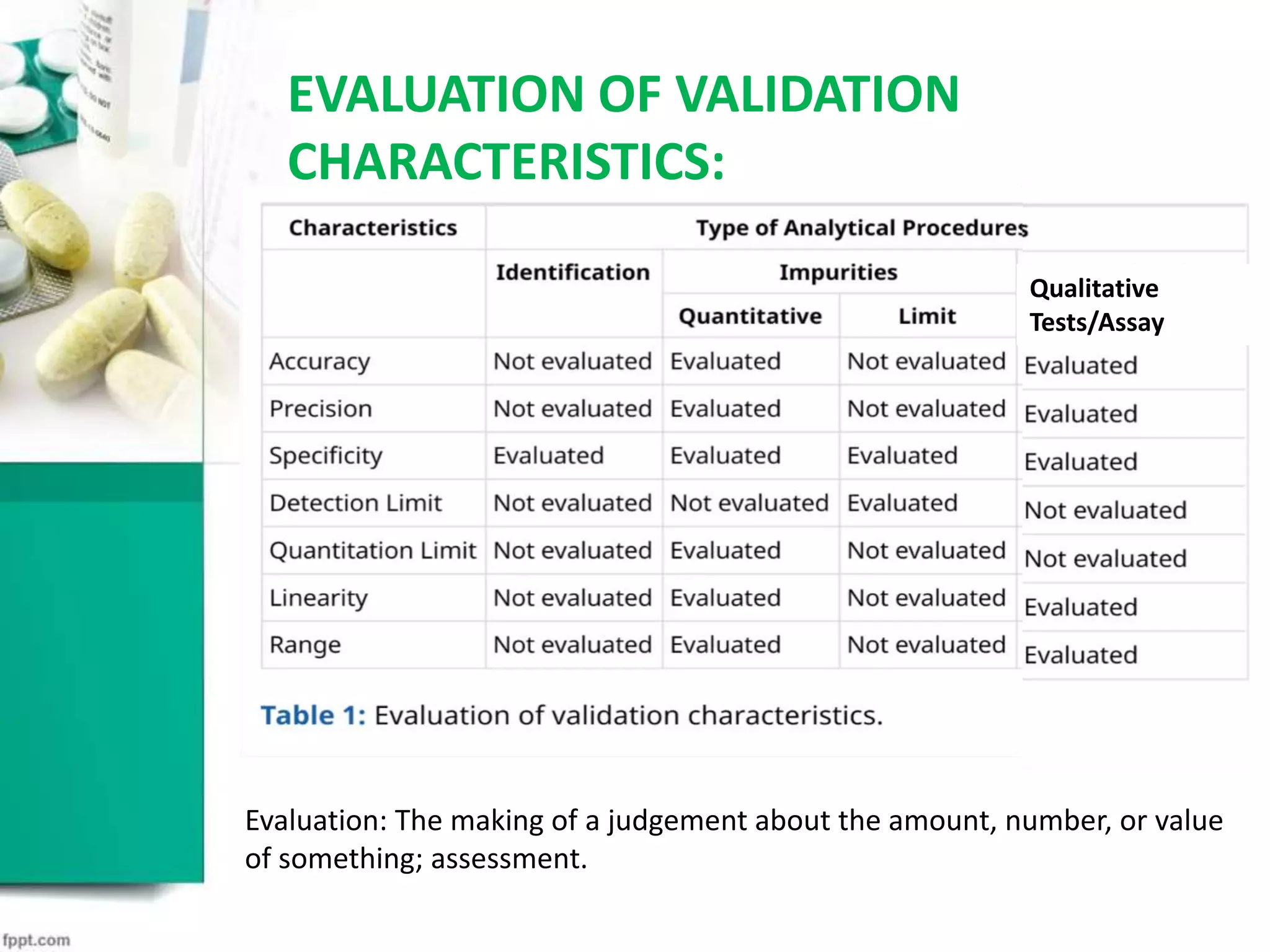
 Characterisitics
 Parameters
 Evaluation
 Validation Protocol
INTRODUCTION
VALIDATION:
Validation is the process of establishing
documentary evidence demonstrating that a
procedure, process, or activity carried out in
testing and then production maintains the
desired level of compliance at all stages.
WHY VALIDATION IS NECESSARY?
 In the pharmaceutical industry, it is very
important that in addition to final testing
and compliance of products, it is also
assured that the process will consistently
produce the expected results.
 It is an important element of quality control.
 In some fields,validation of methods is an
Regulatory Requirement.
Continue…
 FDA, or any other food and drugs regulatory
agency around the globe not only ask for a product
that meets its specification but also require a
process, procedures, intermediate stages of
inspections, and testing adopted during
manufacturing are designed such that when they
are adopted they produce consistently similar,
reproducible, desired results which meet the quality
standard of product being manufactured and
Complies the Regulatory and Security Aspects.
 Such procedures are developed through the process
of validation.
 This is to maintain and assure a higher degree of
quality of food and drug products.
WHEN & WHO PROPOSED VALIDATON?
 The concept of validation was first proposed by
two Food and Drug Administration (FDA)
officials, Ted Byers and Bud Loftus, in 1979 in
USA, to improve the quality of pharmaceuticals.
 It was proposed in direct response to several
problems in the sterility of large volume
parenteral market.
 The first validation activities were focused on
the processes involved in making these
products, but quickly spread to associated
processes including environmental control,
media fill, equipment sanitization and purified
water production.
TYPES OF VALIDATON
Since a wide variety of procedures, processes, and activities
need to be validated, the field of validation is divided into a
number of subsections including the following:
• Equipment Validation
• Facilities Validation
• HVAC System Validation
• Cleaning Validation
• Process Validation
• Analytical Method Validation
• Computer System Validation
• Packaging Validation
• Cold Chain Validation
CONTINUE…
1) Equipment Validation: Equipment Qualification is a subset of Validation.
Qualification starts with user specifying the design and functions of the
equipment, that is, how it must perform.
2) Facilities Validation: Primarily, it's the preparation of all documentation
that proves a facility has all the right equipment and is following standard
operating procedures (SOPs) to achieve the required product quality.
3) HVAC System Validation: (Heating,ventilation and air conditioning System)
This system is needed for maintenance of a suitable temperature, for
continuous flow of air, which ultimately prevents cross-contamination and
accumulation of air and to ensure the cooling of air in the premises.
4) Cleaning Validation: Cleaning validation is the methodology used to assure
that a cleaning process removes residues of the active pharmaceutical
ingredients of the product manufactured in a piece of equipment, the
cleaning aids utilized in the cleaning process and the microbial attributes.
CONTINUE…
5)Process Validation: Process Validation is the analysis of data gathered
throughout the design and manufacturing of a product in order to
confirm that the process can reliably output products of a determined
standard.
6)CS Validation: Proper functioning and performance of software and
computer systems play a major role in obtaining consistency, reliability
and accuracy of data. Therefore, computer system validation (CSV)
should be part of any good development and manufacturing practice.
7)Packaging validation: Medical packaging can lose its integrity as a
result of dynamic events that occur during processing and/or
distribution. Because of this, QTS employs physical test methods that
validate the package integrity has been maintained throughout all the
phases of processing, handling and expected shelf life.
8)Cold Chain Validation: A cold chain is a temperature-controlled supply
chain. An unbroken cold chain is an uninterrupted series of storage and
distribution activities which maintain a given temperature range.
ANALYTICAL METHOD VALIDATION
Definition:
Analytical method validation is the process
used to confirm that the analytical procedure
employed for a specific test is suitable for its
intended use. Results from Analytical method
validation can be used to judge the quality,
reliability and consistency of analytical results;
it is an integral part of any good analytical
practice.
CONTINUE…
 After the development of
an analytical procedure, it is must important to
assure that the procedure will consistently
produce the intended a precise result with
high degree of accuracy.
 The method should give a specific result that
may not be affected by external matters.
 This creates a requirement to validate the
analytical procedures.
 Validation is a scientific study which provides
high degree of assurance that a specific process
will consistently produce the product or service
or result.
Method Validation Is Performed For:
 New analytical methods before using in
routine analysis
 For transfer of analytical method
 For current methods when any changes are
made to the procedure, composition of the
drug product and synthesis of the drugs
substances.
After validation, the method is transferred to
the laboratory for use in routine analysis.
Method Validation Characteristics
The major analyses in drugs are:
Identification, Impurity and Assay.
The validation program can be performed for
these analytical methods:
 Identification tests
 Quantitative tests for impurities content
 Limit tests for the control of impurities
 Quantitative tests of the active components in
samples of drug substance or drug product or
other selected components in the drug product
Method Validation Parameters
Some of the common typical validation parameters which may be
considered are listed below:
• Accuracy
• Precision
• Specificity
• Detection Limit
• Quantitation Limit
• Linearity
• Range
• Robustness
The requirement of validation parameters depends on the type of
analytical method. The validation characteristics are to be
evaluated on the basis of the type of analytical procedures.
See Table 1.
CONTINUE…
 Accuracy: Accuracy refers to the closeness of a
measured value to a standard or known value.
 Precision: Precision refers to the closeness of
two or more measurements to each other.
 Specificity: Specificity is the ability to assess
unequivocally the analyte in the presence of
components which may be expected to be
present.
 Detection Limit & Quantitation Limit: LOD and
LOQ are terms used to describe the smallest
concentration of an analyte that can be reliably
measured by an analytical procedure.
CONTINUE…
 Linearity: The linearity of an analytical
method is its ability to elicit test results that are
directly, or by a well-defined mathematical
transformation, proportional to the
concentration of analyte in samples within a
given range.
 Range: The area of variation between upper
and lower limits on a particular scale.
 Robustness: The Robustness of an analytical
procedure is a measure of its capacity to remain
unaffected by small,but deliberate variations in
method parameters and provides an indication
of its reliability during normal usage.
EVALUATION OF VALIDATION
CHARACTERISTICS:
Evaluation: The making of a judgement about the amount, number, or value
of something; assessment.
Qualitative
Tests/Assay
VALIDATION PROTOCOL
 Protocol is an approved written document of the
method validation process.
 It is a step by step guide for preparing resources and
performing method validation.
 It includes the methodology and the details of the
resources required in the validation process. It
includes the step by step process of the validation
process and the acceptance criteria.
 Each validation process in the protocol is followed
by blank worksheet for the entry of the observation
and calculation/results obtained during the
validation process.
 Any changes made during validation are also
included in the protocol.
VALIDATION PROTOCOL
A method validation protocol should contain
following sections:
• Purpose of study
• Details of the study
• Method of Analysis
• Resources and their information
• Validation Steps with worksheet and
Acceptance Criteria
• Remarks
• Conclusions
REFERENCE
 https://labwrite.ncsu.edu/Experimental%20Design/accuracyprecision.htm
 http://www.chromatographyonline.com/limit-detection
 https://www.slideshare.net/mallikarjunvasm/analytical-method-validation
 https://en.wikipedia.org/wiki/Validation_(drug_manufacture)
 https://www.omicsonline.org/open-access/a-view-on-analytical-method-
validation-of-drugs-2157-7013-1000235.php?aid=67979
Analytical method validation

Analytical method validation

  • 1.
    Guided By: Mr.RohanDongre Sir (Pharmaceutical Organic Chemistry) Presented By - Tausif.M (B.Pharm 2nd Year)
  • 2.
    CONTENTS  Introduction ToValidation  Importance of Validation  Implementation  Types of Validation  Analytical Method Validation  Importance  Characterisitics  Parameters  Evaluation  Validation Protocol
  • 3.
    INTRODUCTION VALIDATION: Validation is theprocess of establishing documentary evidence demonstrating that a procedure, process, or activity carried out in testing and then production maintains the desired level of compliance at all stages.
  • 4.
    WHY VALIDATION ISNECESSARY?  In the pharmaceutical industry, it is very important that in addition to final testing and compliance of products, it is also assured that the process will consistently produce the expected results.  It is an important element of quality control.  In some fields,validation of methods is an Regulatory Requirement.
  • 5.
    Continue…  FDA, orany other food and drugs regulatory agency around the globe not only ask for a product that meets its specification but also require a process, procedures, intermediate stages of inspections, and testing adopted during manufacturing are designed such that when they are adopted they produce consistently similar, reproducible, desired results which meet the quality standard of product being manufactured and Complies the Regulatory and Security Aspects.  Such procedures are developed through the process of validation.  This is to maintain and assure a higher degree of quality of food and drug products.
  • 6.
    WHEN & WHOPROPOSED VALIDATON?  The concept of validation was first proposed by two Food and Drug Administration (FDA) officials, Ted Byers and Bud Loftus, in 1979 in USA, to improve the quality of pharmaceuticals.  It was proposed in direct response to several problems in the sterility of large volume parenteral market.  The first validation activities were focused on the processes involved in making these products, but quickly spread to associated processes including environmental control, media fill, equipment sanitization and purified water production.
  • 7.
    TYPES OF VALIDATON Sincea wide variety of procedures, processes, and activities need to be validated, the field of validation is divided into a number of subsections including the following: • Equipment Validation • Facilities Validation • HVAC System Validation • Cleaning Validation • Process Validation • Analytical Method Validation • Computer System Validation • Packaging Validation • Cold Chain Validation
  • 8.
    CONTINUE… 1) Equipment Validation:Equipment Qualification is a subset of Validation. Qualification starts with user specifying the design and functions of the equipment, that is, how it must perform. 2) Facilities Validation: Primarily, it's the preparation of all documentation that proves a facility has all the right equipment and is following standard operating procedures (SOPs) to achieve the required product quality. 3) HVAC System Validation: (Heating,ventilation and air conditioning System) This system is needed for maintenance of a suitable temperature, for continuous flow of air, which ultimately prevents cross-contamination and accumulation of air and to ensure the cooling of air in the premises. 4) Cleaning Validation: Cleaning validation is the methodology used to assure that a cleaning process removes residues of the active pharmaceutical ingredients of the product manufactured in a piece of equipment, the cleaning aids utilized in the cleaning process and the microbial attributes.
  • 9.
    CONTINUE… 5)Process Validation: ProcessValidation is the analysis of data gathered throughout the design and manufacturing of a product in order to confirm that the process can reliably output products of a determined standard. 6)CS Validation: Proper functioning and performance of software and computer systems play a major role in obtaining consistency, reliability and accuracy of data. Therefore, computer system validation (CSV) should be part of any good development and manufacturing practice. 7)Packaging validation: Medical packaging can lose its integrity as a result of dynamic events that occur during processing and/or distribution. Because of this, QTS employs physical test methods that validate the package integrity has been maintained throughout all the phases of processing, handling and expected shelf life. 8)Cold Chain Validation: A cold chain is a temperature-controlled supply chain. An unbroken cold chain is an uninterrupted series of storage and distribution activities which maintain a given temperature range.
  • 10.
    ANALYTICAL METHOD VALIDATION Definition: Analyticalmethod validation is the process used to confirm that the analytical procedure employed for a specific test is suitable for its intended use. Results from Analytical method validation can be used to judge the quality, reliability and consistency of analytical results; it is an integral part of any good analytical practice.
  • 11.
    CONTINUE…  After thedevelopment of an analytical procedure, it is must important to assure that the procedure will consistently produce the intended a precise result with high degree of accuracy.  The method should give a specific result that may not be affected by external matters.  This creates a requirement to validate the analytical procedures.  Validation is a scientific study which provides high degree of assurance that a specific process will consistently produce the product or service or result.
  • 12.
    Method Validation IsPerformed For:  New analytical methods before using in routine analysis  For transfer of analytical method  For current methods when any changes are made to the procedure, composition of the drug product and synthesis of the drugs substances. After validation, the method is transferred to the laboratory for use in routine analysis.
  • 13.
    Method Validation Characteristics Themajor analyses in drugs are: Identification, Impurity and Assay. The validation program can be performed for these analytical methods:  Identification tests  Quantitative tests for impurities content  Limit tests for the control of impurities  Quantitative tests of the active components in samples of drug substance or drug product or other selected components in the drug product
  • 14.
    Method Validation Parameters Someof the common typical validation parameters which may be considered are listed below: • Accuracy • Precision • Specificity • Detection Limit • Quantitation Limit • Linearity • Range • Robustness The requirement of validation parameters depends on the type of analytical method. The validation characteristics are to be evaluated on the basis of the type of analytical procedures. See Table 1.
  • 15.
    CONTINUE…  Accuracy: Accuracyrefers to the closeness of a measured value to a standard or known value.  Precision: Precision refers to the closeness of two or more measurements to each other.  Specificity: Specificity is the ability to assess unequivocally the analyte in the presence of components which may be expected to be present.  Detection Limit & Quantitation Limit: LOD and LOQ are terms used to describe the smallest concentration of an analyte that can be reliably measured by an analytical procedure.
  • 16.
    CONTINUE…  Linearity: Thelinearity of an analytical method is its ability to elicit test results that are directly, or by a well-defined mathematical transformation, proportional to the concentration of analyte in samples within a given range.  Range: The area of variation between upper and lower limits on a particular scale.  Robustness: The Robustness of an analytical procedure is a measure of its capacity to remain unaffected by small,but deliberate variations in method parameters and provides an indication of its reliability during normal usage.
  • 17.
    EVALUATION OF VALIDATION CHARACTERISTICS: Evaluation:The making of a judgement about the amount, number, or value of something; assessment. Qualitative Tests/Assay
  • 18.
    VALIDATION PROTOCOL  Protocolis an approved written document of the method validation process.  It is a step by step guide for preparing resources and performing method validation.  It includes the methodology and the details of the resources required in the validation process. It includes the step by step process of the validation process and the acceptance criteria.  Each validation process in the protocol is followed by blank worksheet for the entry of the observation and calculation/results obtained during the validation process.  Any changes made during validation are also included in the protocol.
  • 19.
    VALIDATION PROTOCOL A methodvalidation protocol should contain following sections: • Purpose of study • Details of the study • Method of Analysis • Resources and their information • Validation Steps with worksheet and Acceptance Criteria • Remarks • Conclusions
  • 20.
    REFERENCE  https://labwrite.ncsu.edu/Experimental%20Design/accuracyprecision.htm  http://www.chromatographyonline.com/limit-detection https://www.slideshare.net/mallikarjunvasm/analytical-method-validation  https://en.wikipedia.org/wiki/Validation_(drug_manufacture)  https://www.omicsonline.org/open-access/a-view-on-analytical-method- validation-of-drugs-2157-7013-1000235.php?aid=67979