VALIDATION OF ANALYTICAL
PROCEDURE (USFDA)
By Achana Chavhan
M.Pharm (QA)
RSCP, Buldana
• Validation of an analytical procedure is the
process by which it is established, by laboratory
studies, that the performance characteristics of
the procedure meet the requirements for the
intended analytical applications
• Typical analytical performance characteristics
that should be considered in the validation of the
types of procedures described in this document
are listed in Table 1.
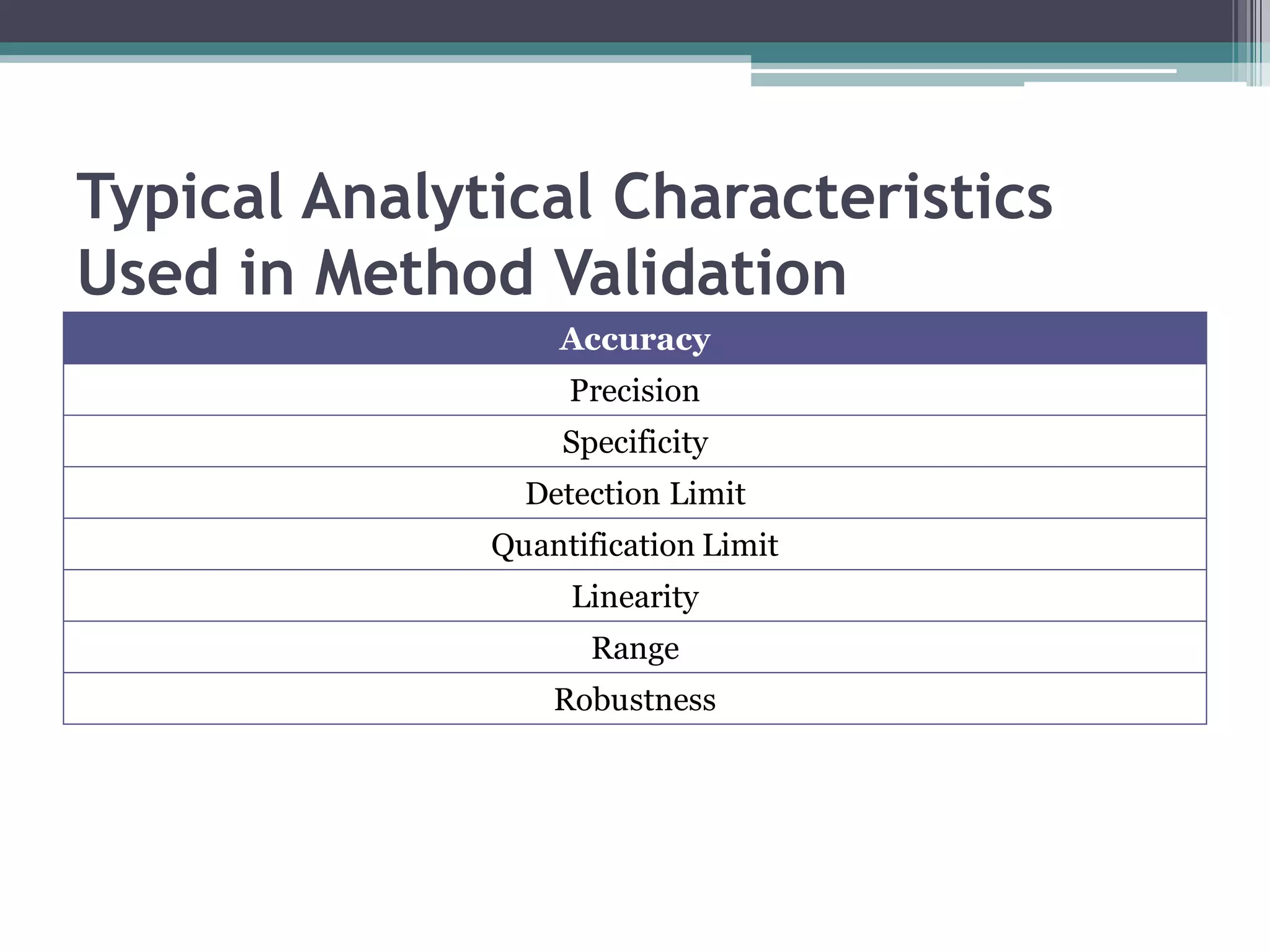
Typical Analytical Characteristics
Used in Method Validation
Accuracy
Precision
Specificity
Detection Limit
Quantification Limit
Linearity
Range
Robustness
Accuracy
• The accuracy of an analytical procedure is the
closeness of test results obtained by that
procedure to the true value.
• The accuracy of an analytical procedure should
be established across its range.
• Determination:
• In the case of the assay of a drug substance,
accuracy may be determined by application of the
analytical procedure to an analyte of known purity
(e.g., a Reference Standard) or by comparison of the
results of the procedure with those of a second, well-
characterized procedure, the accuracy of which has
been stated or defined.
• The ICH documents recommend that accuracy
should be assessed using a minimum of nine
determinations over a minimum of three
concentration levels, covering the specified range
Precision
• The precision of an analytical procedure is the
degree of agreement among individual test
results when the procedure is applied repeatedly
to multiple samplings of a homogeneous sample.
• The precision of an analytical procedure is
usually expressed as the standard deviation or
relative standard deviation (coefficient of
variation) of a series of measurements.
• Determination:
• The precision of an analytical procedure is
determined by assaying a sufficient number of
aliquots of a homogeneous sample to be able to
calculate statistically valid estimates of standard
deviation or relative standard deviation(coefficient
of variation).
• The ICH documents recommend that repeatability
should be assessed using a minimum of nine
determinations covering the specified range for the
procedure (i.e., three concentrations and three
replicates of each concentration) or using a
minimum of six determinations at 100% of the test
concentration.
Specificity
• The ICH documents define specificity as the
ability to assess unequivocally the analyte in the
presence of components that may be expected to
be present, such as impurities, degradation
products, and matrix components.
• Determination:
• In the case of qualitative analyses (identification
tests), the ability to select between compounds of
closely related structure that are likely to be present
should be demonstrated.
• This should be confirmed by obtaining positive
results (perhaps by comparison to a known reference
material) from samples containing the analyte.
• For validation of specificity for qualitative and
quantitative determinations by spectroscopic
methods, chapters related to topics such as near-
infrared spectrophotometry, Raman spectroscopy,
and X-ray powder diffraction should be consulted.
Detection Limit
• The detection limit is a characteristic of limit
tests. It is the lowest amount of analyte in a
sample that can be detected, but not necessarily
quantitated, under the stated experimental
conditions.
• The detection limit is usually expressed as the
concentration of analyte (e.g., percentage or
parts per billion) in the sample.
• Determination:
• For noninstrumental procedures, the detection limit
is generally determined by the analysis of samples
with known concentrations of analyte and by
establishing the minimum level at which the analyte
can be reliably detected.
• In the case of instrumental analytical procedures that
exhibit background noise, the ICH documents
describe a common approach, which is to compare
measured signals from samples with known low
concentrations of analyte with those of blank
samples. The minimum concentration at which the
analyte can reliably be detected is established
Quantitation Limit
• The quantitation limit is a characteristic of
quantitative assays for low levels of compounds
in sample matrices, such as impurities in bulk
drug substances and degradation products in
finished pharmaceuticals.
• The quantitation limit is expressed as the
concentration of analyte (e.g., percentage or
parts per billion) in the sample.
• Determination:
• For noninstrumental procedures, the quantitation
limit is generally determined by the analysis of
samples with known concentrations of analyte and
by establishing the minimum level at which the
analyte can be determined with acceptable
Accuracy and Precision.
• For instrumental procedures, the same approach
may be used as for noninstrumental procedures. In
the case of procedures submitted for consideration
as official compendial procedures, it is almost never
necessary to determine the actual quantitation
limit.
Linearity & Range
• The linearity of an analytical procedure is its ability to
elicit test results that are directly, or by a well-defined
mathematical transformation, proportional to the
concentration of analyte in samples within a given range.
• The range of an analytical procedure is the interval
between the upper and lower levels of analyte (including
these levels) that have been demonstrated to be
determined with a suitable level of precision, accuracy,
and linearity using the procedure as written. The range is
normally expressed in the same units as test results (e.g.,
percent or parts per million) obtained by the analytical
procedure.
• Determination:
• Linearity should be established across the range
of the analytical procedure. It should be
established initially by visual examination of a
plot of signals as a function of analyte
concentration of content.
• The range of the procedure is validated by
verifying that the analytical procedure provides
acceptable precision, accuracy, and linearity
when applied to samples containing analyte at
the extremes of the range as well as within the
range.
• It is also recommended that the following
minimum specified ranges should be considered:
• Assay of a drug substance (or a finished
product): From 80% to 120% of the test
concentration
• Determination of an impurity: From 50% to
120% of the acceptance criterion
• For content uniformity: A minimum of 70%–
130% of the test concentration,
• For dissolution testing: ±20% over the specified
range
Robustness
• The robustness of an analytical procedure is a
measure of its capacity to remain unaffected by
small but deliberate variations in procedural
parameters
• Robustness may be determined during
development of the analytical procedure.
validation of analytical procedure USFDA Guidline

validation of analytical procedure USFDA Guidline

  • 1.
    VALIDATION OF ANALYTICAL PROCEDURE(USFDA) By Achana Chavhan M.Pharm (QA) RSCP, Buldana
  • 2.
    • Validation ofan analytical procedure is the process by which it is established, by laboratory studies, that the performance characteristics of the procedure meet the requirements for the intended analytical applications • Typical analytical performance characteristics that should be considered in the validation of the types of procedures described in this document are listed in Table 1.
  • 3.
    Typical Analytical Characteristics Usedin Method Validation Accuracy Precision Specificity Detection Limit Quantification Limit Linearity Range Robustness
  • 4.
    Accuracy • The accuracyof an analytical procedure is the closeness of test results obtained by that procedure to the true value. • The accuracy of an analytical procedure should be established across its range.
  • 5.
    • Determination: • Inthe case of the assay of a drug substance, accuracy may be determined by application of the analytical procedure to an analyte of known purity (e.g., a Reference Standard) or by comparison of the results of the procedure with those of a second, well- characterized procedure, the accuracy of which has been stated or defined. • The ICH documents recommend that accuracy should be assessed using a minimum of nine determinations over a minimum of three concentration levels, covering the specified range
  • 6.
    Precision • The precisionof an analytical procedure is the degree of agreement among individual test results when the procedure is applied repeatedly to multiple samplings of a homogeneous sample. • The precision of an analytical procedure is usually expressed as the standard deviation or relative standard deviation (coefficient of variation) of a series of measurements.
  • 7.
    • Determination: • Theprecision of an analytical procedure is determined by assaying a sufficient number of aliquots of a homogeneous sample to be able to calculate statistically valid estimates of standard deviation or relative standard deviation(coefficient of variation). • The ICH documents recommend that repeatability should be assessed using a minimum of nine determinations covering the specified range for the procedure (i.e., three concentrations and three replicates of each concentration) or using a minimum of six determinations at 100% of the test concentration.
  • 8.
    Specificity • The ICHdocuments define specificity as the ability to assess unequivocally the analyte in the presence of components that may be expected to be present, such as impurities, degradation products, and matrix components.
  • 9.
    • Determination: • Inthe case of qualitative analyses (identification tests), the ability to select between compounds of closely related structure that are likely to be present should be demonstrated. • This should be confirmed by obtaining positive results (perhaps by comparison to a known reference material) from samples containing the analyte. • For validation of specificity for qualitative and quantitative determinations by spectroscopic methods, chapters related to topics such as near- infrared spectrophotometry, Raman spectroscopy, and X-ray powder diffraction should be consulted.
  • 10.
    Detection Limit • Thedetection limit is a characteristic of limit tests. It is the lowest amount of analyte in a sample that can be detected, but not necessarily quantitated, under the stated experimental conditions. • The detection limit is usually expressed as the concentration of analyte (e.g., percentage or parts per billion) in the sample.
  • 11.
    • Determination: • Fornoninstrumental procedures, the detection limit is generally determined by the analysis of samples with known concentrations of analyte and by establishing the minimum level at which the analyte can be reliably detected. • In the case of instrumental analytical procedures that exhibit background noise, the ICH documents describe a common approach, which is to compare measured signals from samples with known low concentrations of analyte with those of blank samples. The minimum concentration at which the analyte can reliably be detected is established
  • 12.
    Quantitation Limit • Thequantitation limit is a characteristic of quantitative assays for low levels of compounds in sample matrices, such as impurities in bulk drug substances and degradation products in finished pharmaceuticals. • The quantitation limit is expressed as the concentration of analyte (e.g., percentage or parts per billion) in the sample.
  • 13.
    • Determination: • Fornoninstrumental procedures, the quantitation limit is generally determined by the analysis of samples with known concentrations of analyte and by establishing the minimum level at which the analyte can be determined with acceptable Accuracy and Precision. • For instrumental procedures, the same approach may be used as for noninstrumental procedures. In the case of procedures submitted for consideration as official compendial procedures, it is almost never necessary to determine the actual quantitation limit.
  • 14.
    Linearity & Range •The linearity of an analytical procedure is its ability to elicit test results that are directly, or by a well-defined mathematical transformation, proportional to the concentration of analyte in samples within a given range. • The range of an analytical procedure is the interval between the upper and lower levels of analyte (including these levels) that have been demonstrated to be determined with a suitable level of precision, accuracy, and linearity using the procedure as written. The range is normally expressed in the same units as test results (e.g., percent or parts per million) obtained by the analytical procedure.
  • 15.
    • Determination: • Linearityshould be established across the range of the analytical procedure. It should be established initially by visual examination of a plot of signals as a function of analyte concentration of content. • The range of the procedure is validated by verifying that the analytical procedure provides acceptable precision, accuracy, and linearity when applied to samples containing analyte at the extremes of the range as well as within the range.
  • 16.
    • It isalso recommended that the following minimum specified ranges should be considered: • Assay of a drug substance (or a finished product): From 80% to 120% of the test concentration • Determination of an impurity: From 50% to 120% of the acceptance criterion • For content uniformity: A minimum of 70%– 130% of the test concentration, • For dissolution testing: ±20% over the specified range
  • 17.
    Robustness • The robustnessof an analytical procedure is a measure of its capacity to remain unaffected by small but deliberate variations in procedural parameters • Robustness may be determined during development of the analytical procedure.