Analytical Method development and validation of azelnidipine by
UV-Visible Spectroscopy
6/16/2021 DOPs, SIHAS, SHUATS, Prayagraj, U.P, India
Presented to:
Prof. (Dr). P.Malairajan
(Hod, Department of Pharmaceutical
Sciences, SIHAS, SHUATS, Prayagraj,
U.P, India)
Presented By:
Name: Imdad H. Mukeri
Id No: 17BPH084
Subject: Advance Instrumentation
Technique
Course code: BP814PW
Date of Submission: 14/06/2021
1
Introduction
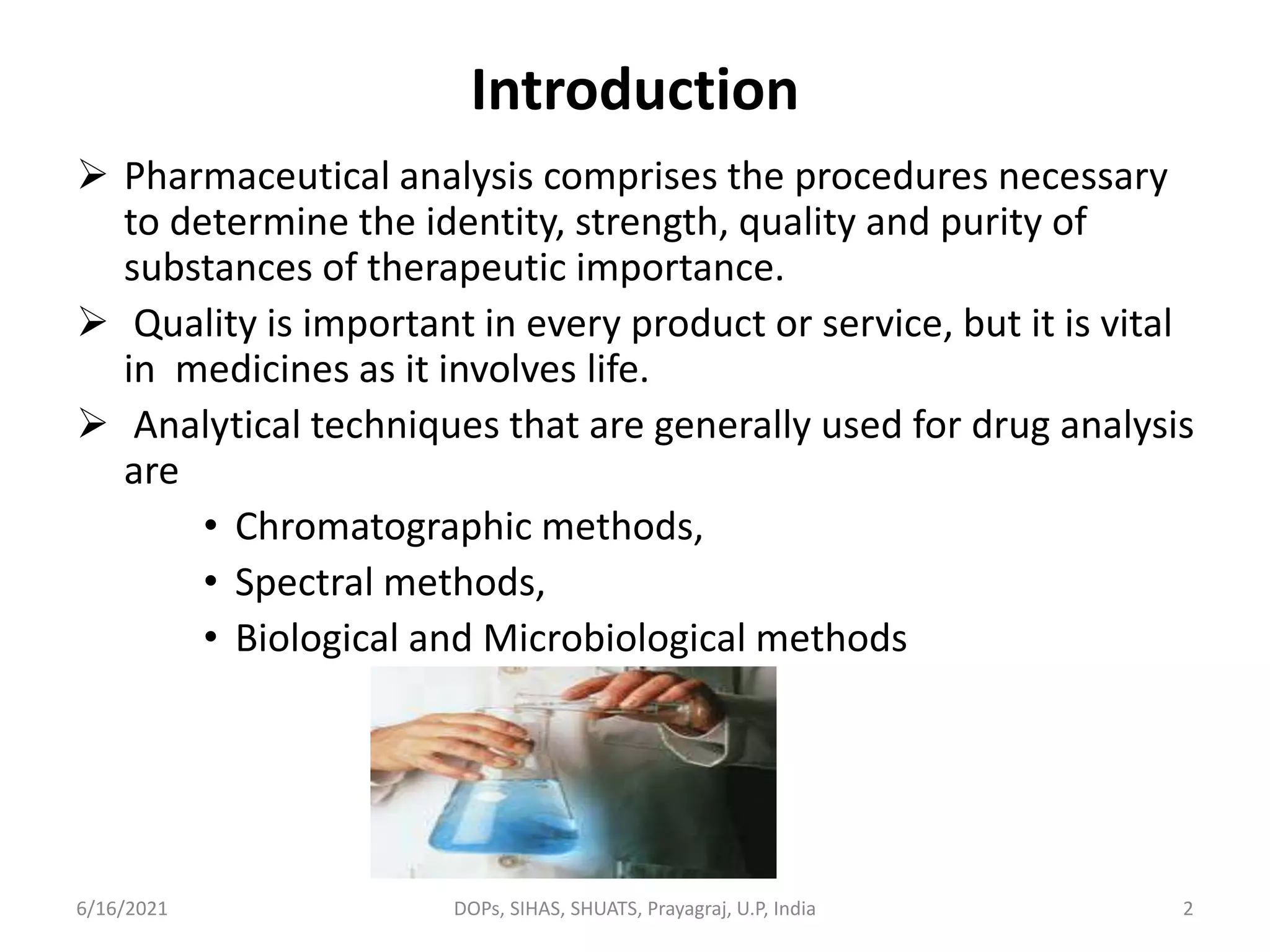
 Pharmaceutical analysis comprises the procedures necessary
to determine the identity, strength, quality and purity of
substances of therapeutic importance.
 Quality is important in every product or service, but it is vital
in medicines as it involves life.
 Analytical techniques that are generally used for drug analysis
are
• Chromatographic methods,
• Spectral methods,
• Biological and Microbiological methods
6/16/2021 DOPs, SIHAS, SHUATS, Prayagraj, U.P, India 2
Introduction to UV-Visible spectroscopy
• UV-Visible spectroscopy is type of absorption spectroscopy in which light
of ultra-violet and visible region (200-400nm and 400-800nm) is absorbed
by the molecule which results in the excitation of the electrons from the
ground state to higher energy state.
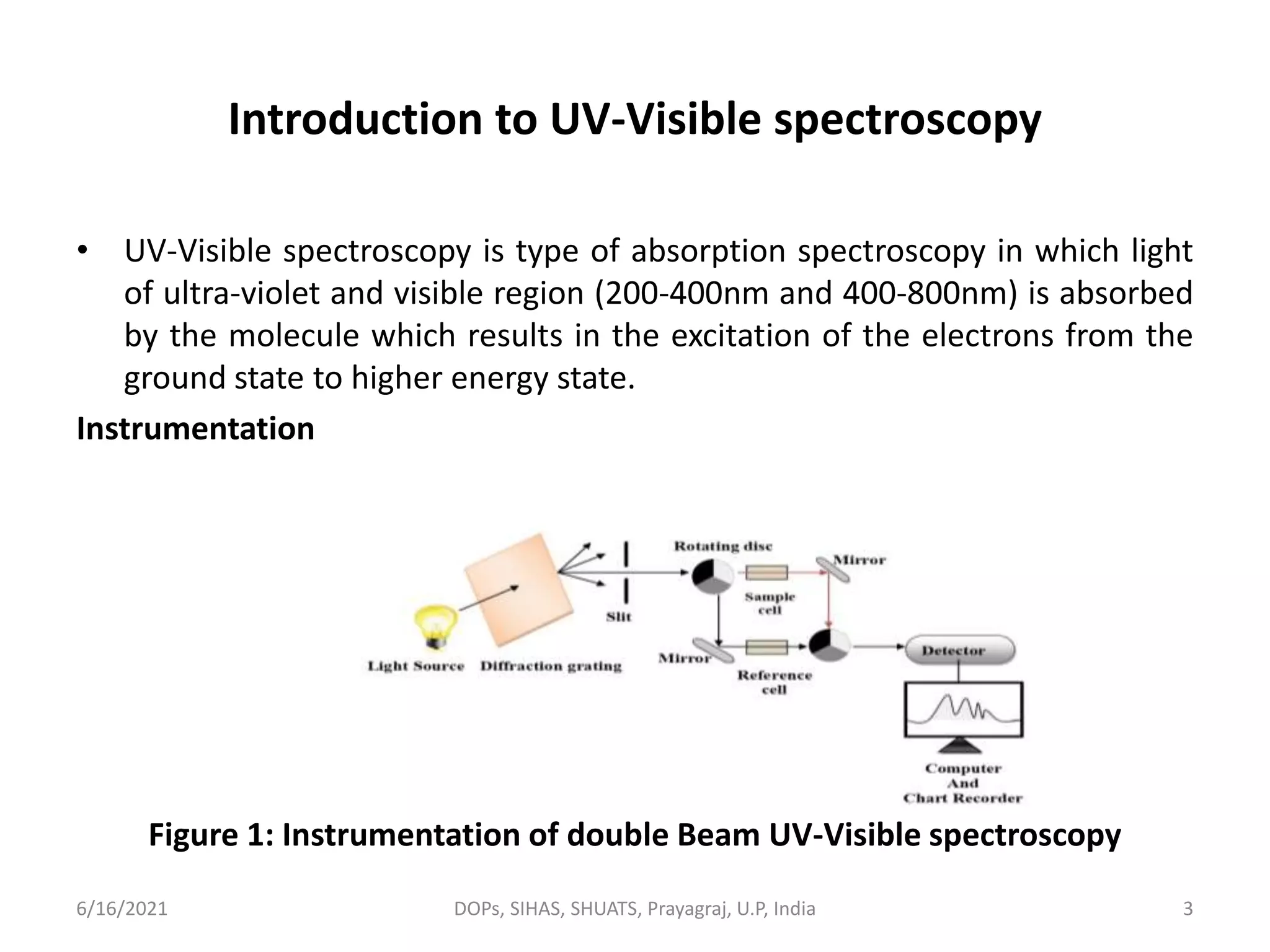
Instrumentation
Figure 1: Instrumentation of double Beam UV-Visible spectroscopy
6/16/2021 DOPs, SIHAS, SHUATS, Prayagraj, U.P, India 3
The fundamental law that governs the quantitative
spectrophotometric analysis
Beer -Lambert law.
• It states that the intensity of a beam of parallel monochromatic radiation
decreases exponentially with the number of absorbing molecules i.e
absorbance is proportional to the concentration and passes through a
medium of homogeneous thickness. A combination of these two laws
yields the Beer-Lambert law.
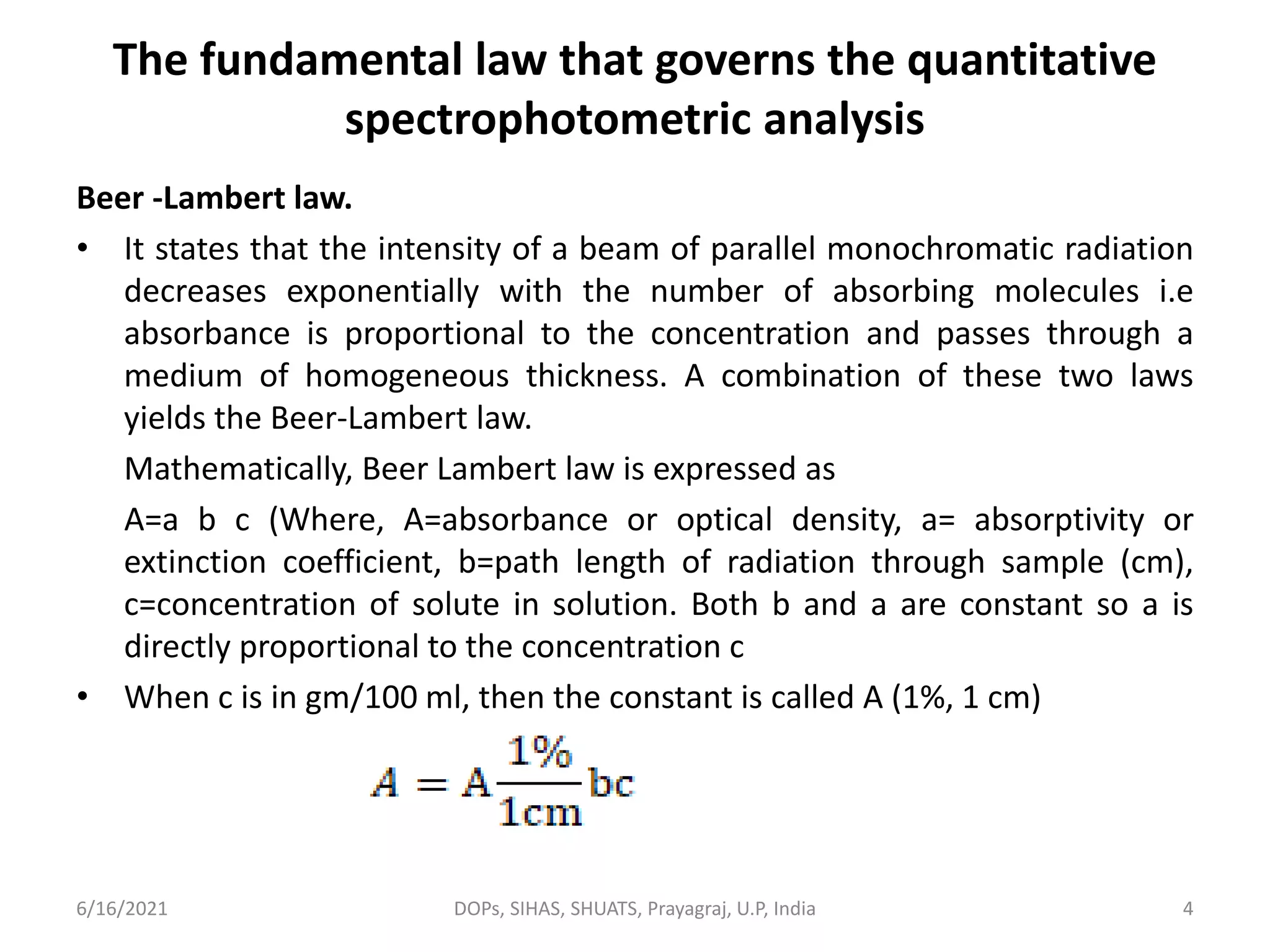
Mathematically, Beer Lambert law is expressed as
A=a b c (Where, A=absorbance or optical density, a= absorptivity or
extinction coefficient, b=path length of radiation through sample (cm),
c=concentration of solute in solution. Both b and a are constant so a is
directly proportional to the concentration c
• When c is in gm/100 ml, then the constant is called A (1%, 1 cm)
6/16/2021 DOPs, SIHAS, SHUATS, Prayagraj, U.P, India 4
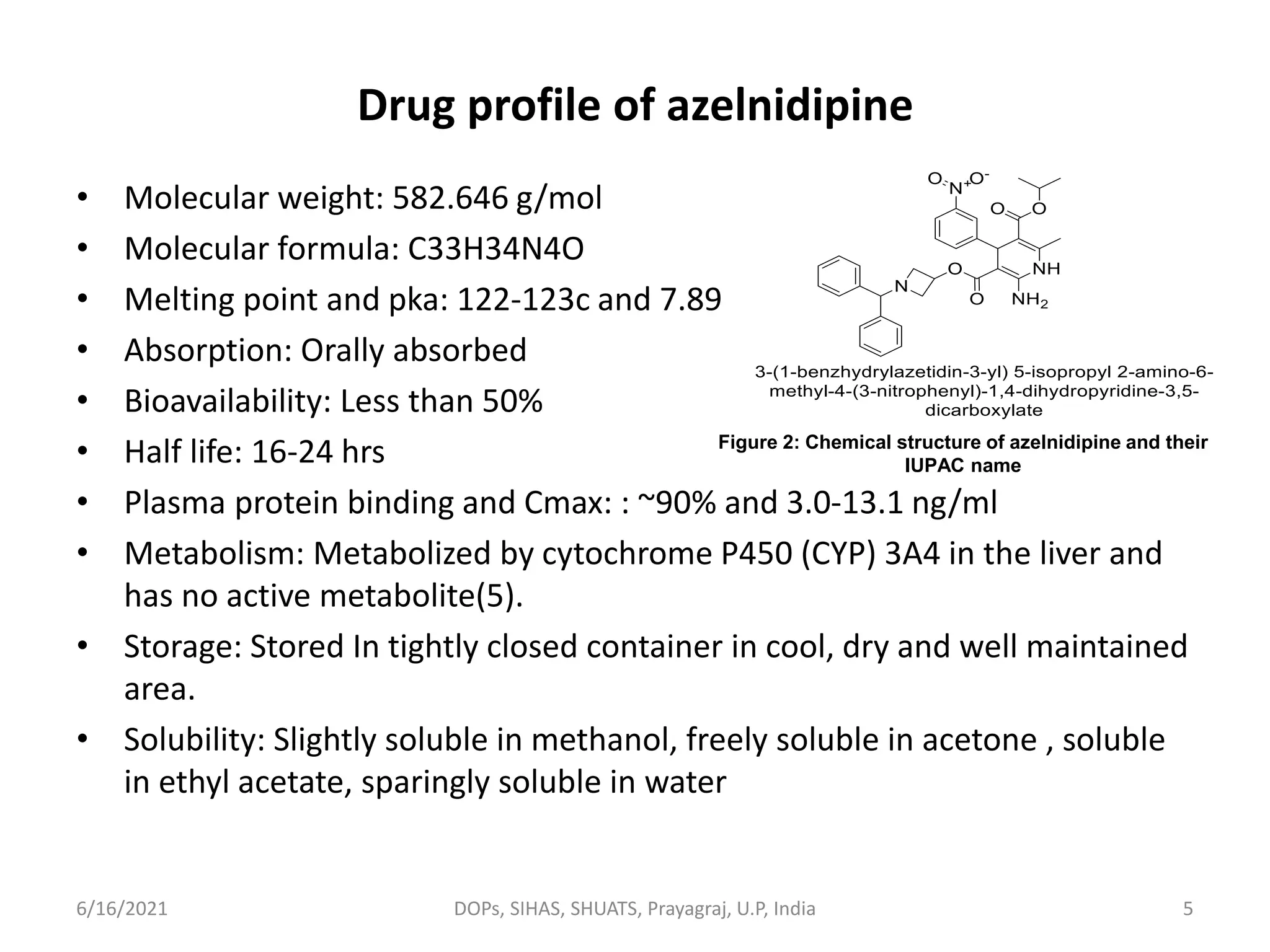
Drug profile of azelnidipine
• Molecular weight: 582.646 g/mol
• Molecular formula: C33H34N4O
• Melting point and pka: 122-123c and 7.89
• Absorption: Orally absorbed
• Bioavailability: Less than 50%
• Half life: 16-24 hrs
• Plasma protein binding and Cmax: : ~90% and 3.0-13.1 ng/ml
• Metabolism: Metabolized by cytochrome P450 (CYP) 3A4 in the liver and
has no active metabolite(5).
• Storage: Stored In tightly closed container in cool, dry and well maintained
area.
• Solubility: Slightly soluble in methanol, freely soluble in acetone , soluble
in ethyl acetate, sparingly soluble in water
6/16/2021 DOPs, SIHAS, SHUATS, Prayagraj, U.P, India
Figure 2: Chemical structure of azelnidipine and their
IUPAC name
5
Objective
The Objective of this dissertation work is as follows
 Aim of the present work is to Develop some new analytical
methods for the estimation of azelnidipine and drug
formulations
 To Develop rapid, sensitive and selective method
 Economic and accurate method
 Method validation according to ICH guidelines.
6/16/2021 DOPs, SIHAS, SHUATS, Prayagraj, U.P, India 6
Methodology: UV-Visible spectroscopy
 Selection of analytical wavelength
 Preparation of stock solutions
 Calibration curve for the Azelnidipine
 Sample preparation for determination of azelnidipine from
dosage form
 Validation of Spectrophotometric methods
6/16/2021 DOPs, SIHAS, SHUATS, Prayagraj, U.P, India 7
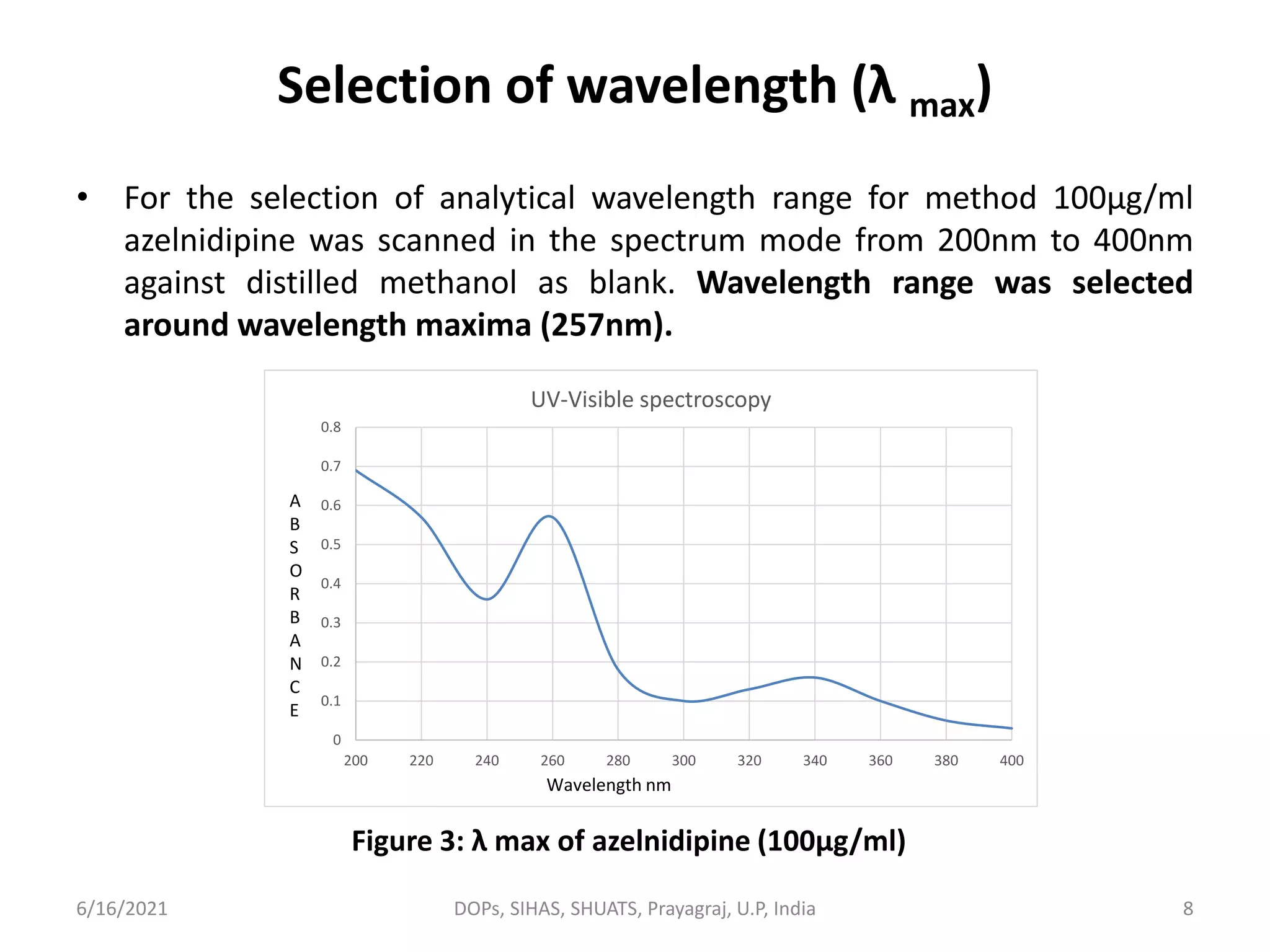
Selection of wavelength (λ max)
• For the selection of analytical wavelength range for method 100µg/ml
azelnidipine was scanned in the spectrum mode from 200nm to 400nm
against distilled methanol as blank. Wavelength range was selected
around wavelength maxima (257nm).
6/16/2021 DOPs, SIHAS, SHUATS, Prayagraj, U.P, India
0
0.1
0.2
0.3
0.4
0.5
0.6
0.7
0.8
200 220 240 260 280 300 320 340 360 380 400
UV-Visible spectroscopy
Wavelength nm
A
B
S
O
R
B
A
N
C
E
Figure 3: λ max of azelnidipine (100μg/ml)
8
Method development by UV-Visible
spectroscopy
• It is the process of formulating the material, condition, and
protocol for measuring the analyte
• To develop a suitable UV-Visible method for determination of
azelnidipine with the compositions of methanol was used as
diluents
• Finally good % RSD was found with diluents methanol.
• On scanning the standard solution against diluents in entire
UV-Visible range of 200-800nm, good response was found at
257nm for 100µg/ml solution.
• There is no interference from diluents methanol through the
entire UV-Visible range 200-800nm.
6/16/2021 DOPs, SIHAS, SHUATS, Prayagraj, U.P, India 9
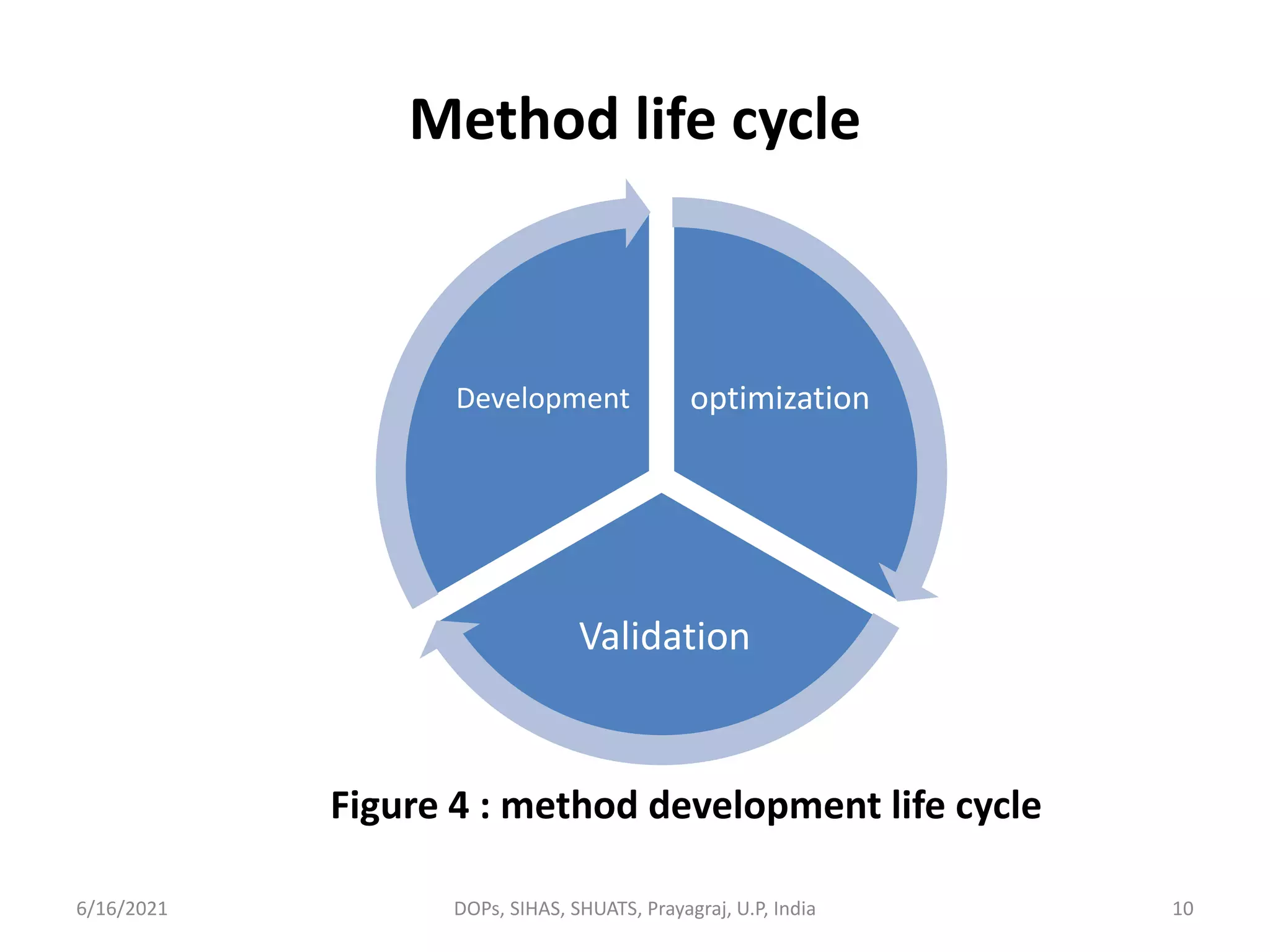
Method life cycle
optimization
Validation
Development
6/16/2021 DOPs, SIHAS, SHUATS, Prayagraj, U.P, India
Figure 4 : method development life cycle
10
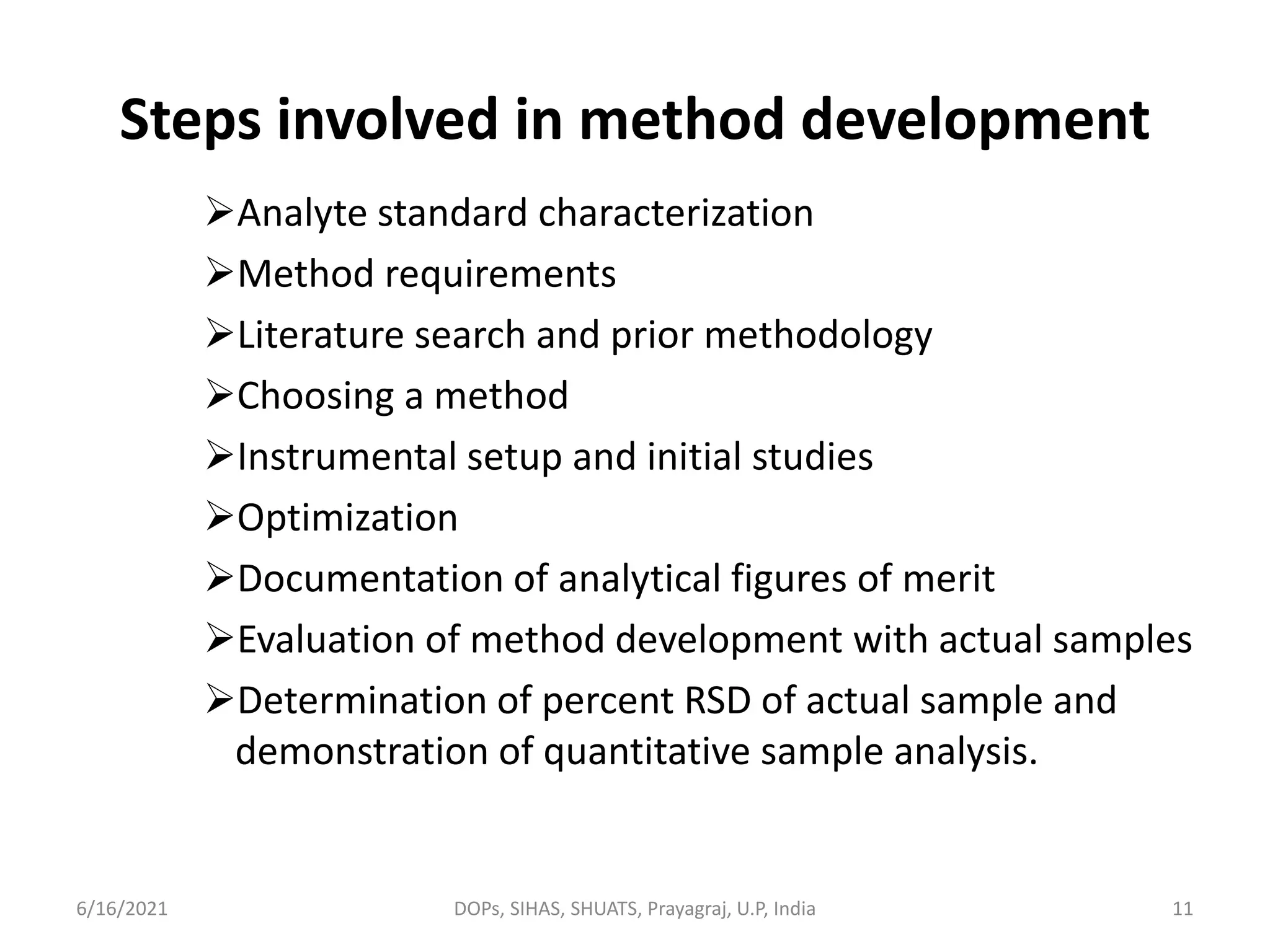
Steps involved in method development
Analyte standard characterization
Method requirements
Literature search and prior methodology
Choosing a method
Instrumental setup and initial studies
Optimization
Documentation of analytical figures of merit
Evaluation of method development with actual samples
Determination of percent RSD of actual sample and
demonstration of quantitative sample analysis.
6/16/2021 DOPs, SIHAS, SHUATS, Prayagraj, U.P, India 11
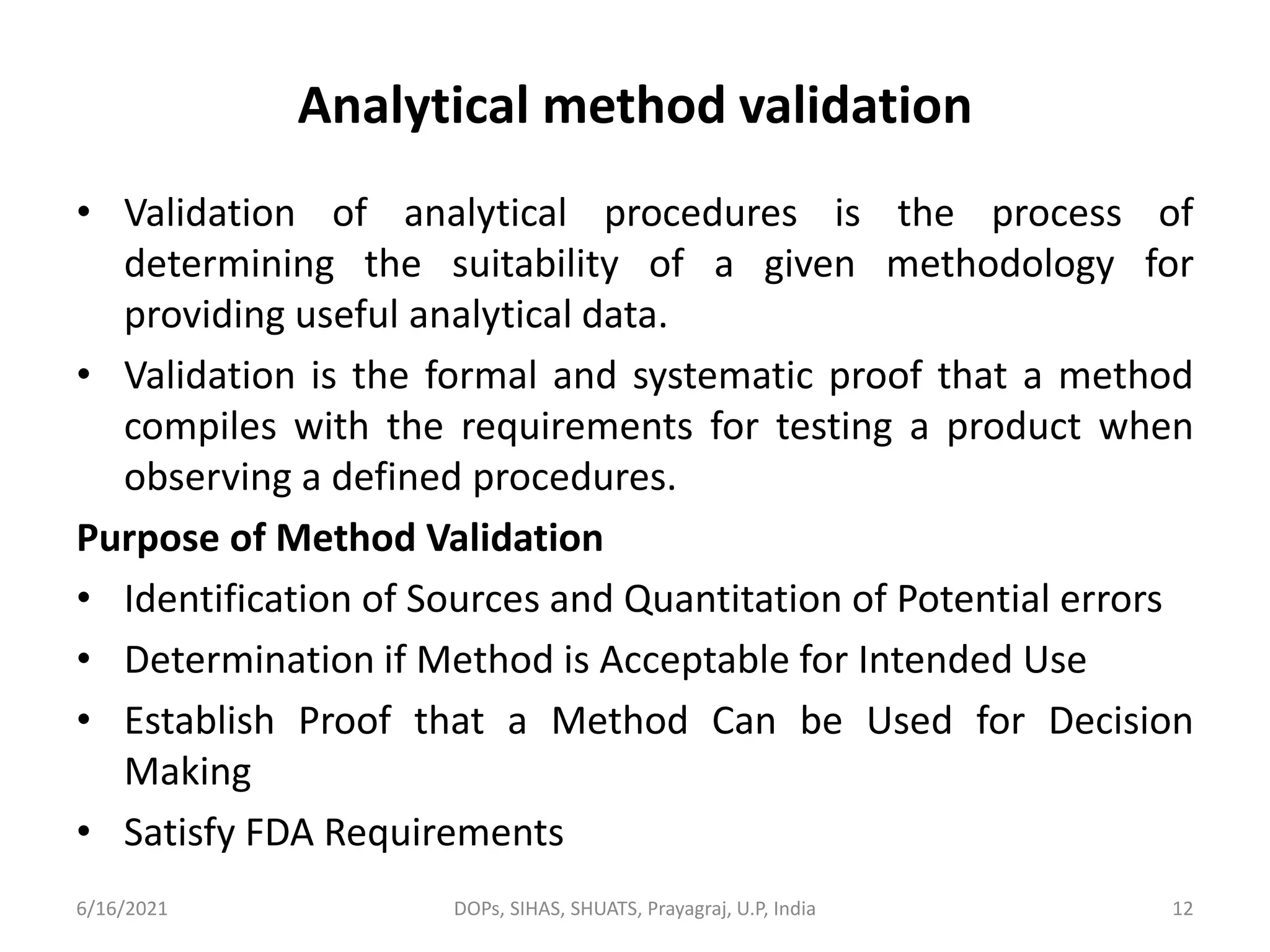
Analytical method validation
• Validation of analytical procedures is the process of
determining the suitability of a given methodology for
providing useful analytical data.
• Validation is the formal and systematic proof that a method
compiles with the requirements for testing a product when
observing a defined procedures.
Purpose of Method Validation
• Identification of Sources and Quantitation of Potential errors
• Determination if Method is Acceptable for Intended Use
• Establish Proof that a Method Can be Used for Decision
Making
• Satisfy FDA Requirements
6/16/2021 DOPs, SIHAS, SHUATS, Prayagraj, U.P, India 12
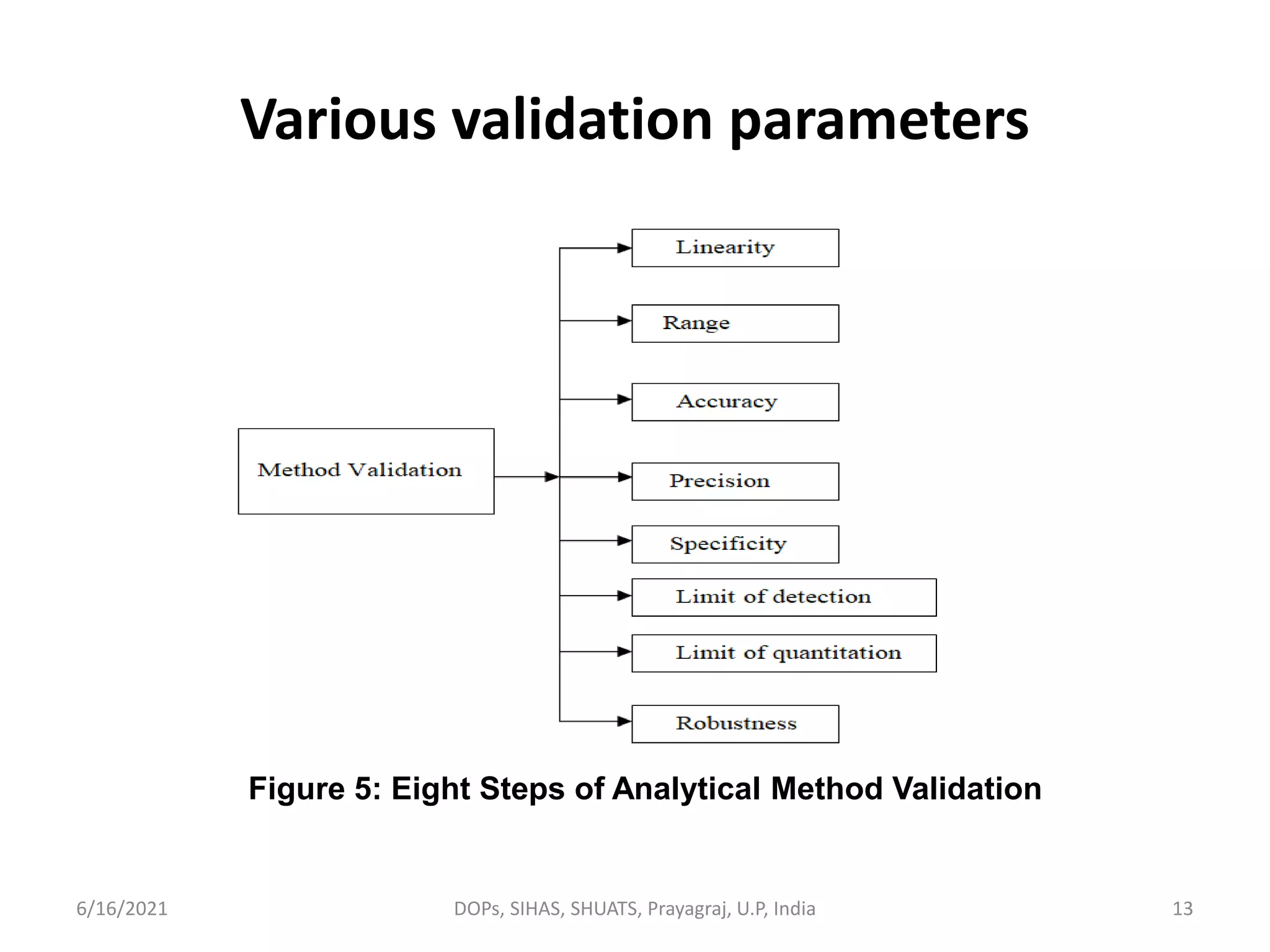
Various validation parameters
Figure 5: Eight Steps of Analytical Method Validation
6/16/2021 DOPs, SIHAS, SHUATS, Prayagraj, U.P, India 13
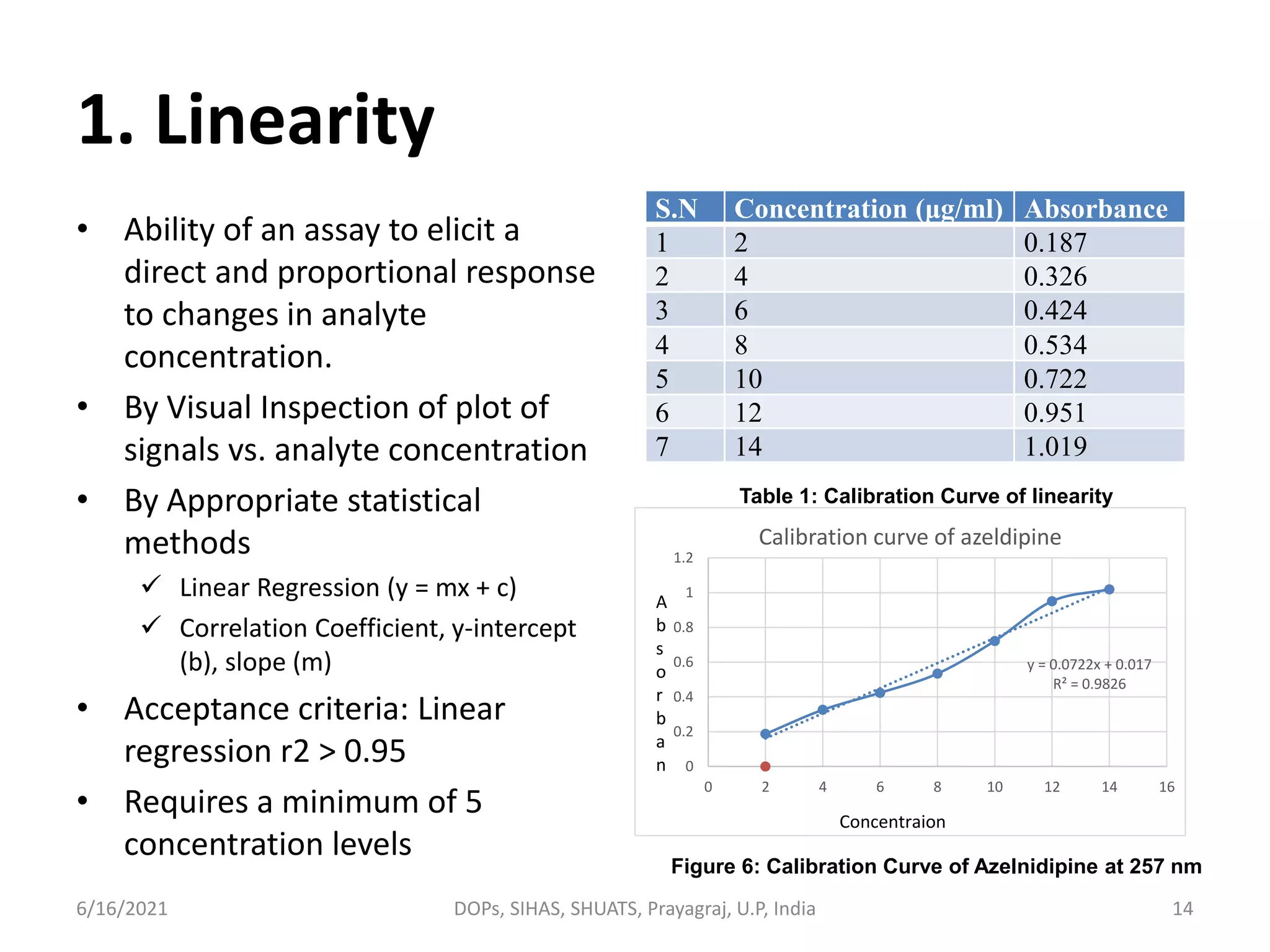
1. Linearity
• Ability of an assay to elicit a
direct and proportional response
to changes in analyte
concentration.
• By Visual Inspection of plot of
signals vs. analyte concentration
• By Appropriate statistical
methods
 Linear Regression (y = mx + c)
 Correlation Coefficient, y-intercept
(b), slope (m)
• Acceptance criteria: Linear
regression r2 > 0.95
• Requires a minimum of 5
concentration levels
S.N Concentration (μg/ml) Absorbance
1 2 0.187
2 4 0.326
3 6 0.424
4 8 0.534
5 10 0.722
6 12 0.951
7 14 1.019
6/16/2021 DOPs, SIHAS, SHUATS, Prayagraj, U.P, India
y = 0.0722x + 0.017
R² = 0.9826
0
0.2
0.4
0.6
0.8
1
1.2
0 2 4 6 8 10 12 14 16
Calibration curve of azeldipine
Concentraion
A
b
s
o
r
b
a
n
Figure 6: Calibration Curve of Azelnidipine at 257 nm
14
Table 1: Calibration Curve of linearity
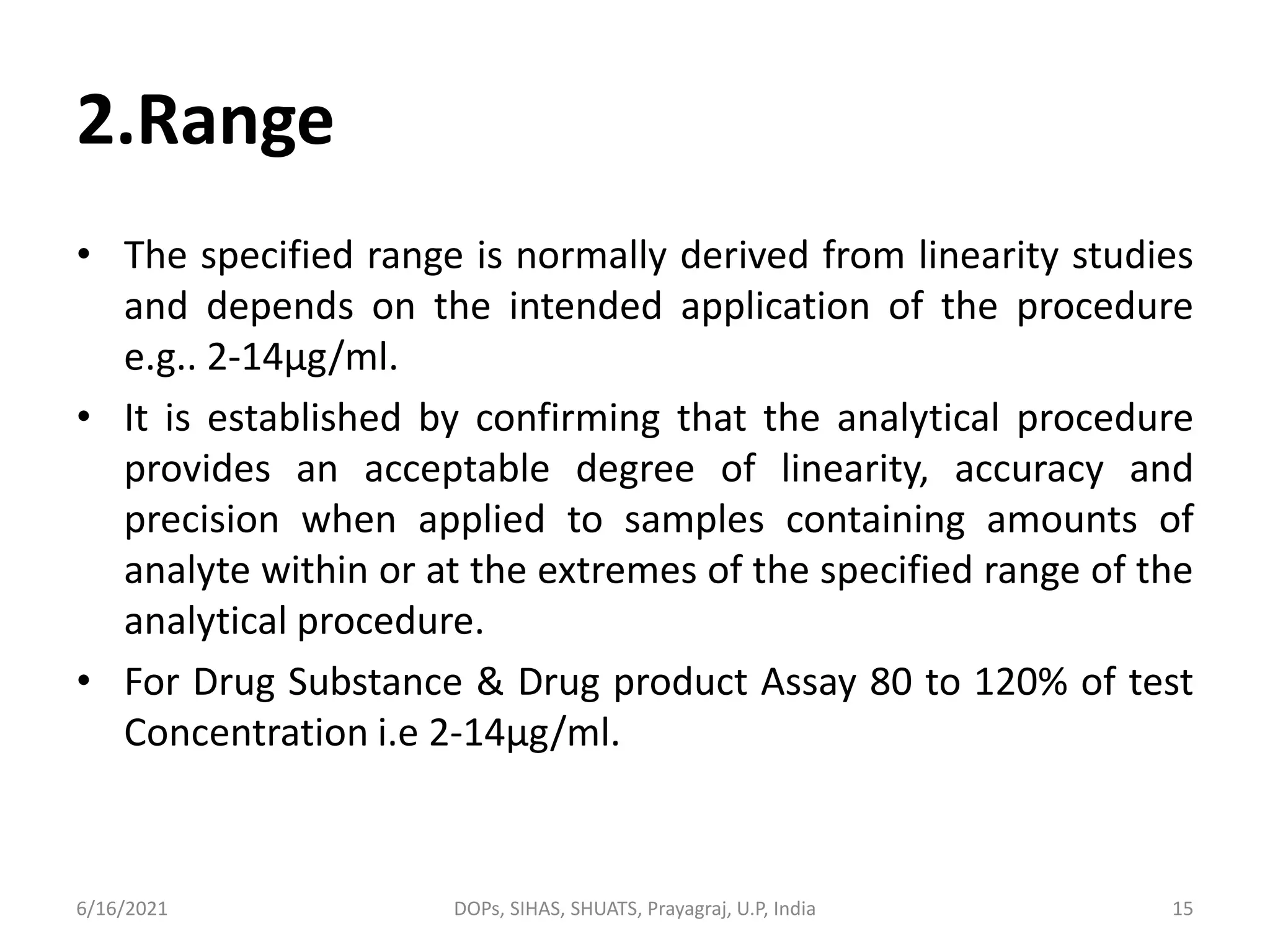
2.Range
• The specified range is normally derived from linearity studies
and depends on the intended application of the procedure
e.g.. 2-14µg/ml.
• It is established by confirming that the analytical procedure
provides an acceptable degree of linearity, accuracy and
precision when applied to samples containing amounts of
analyte within or at the extremes of the specified range of the
analytical procedure.
• For Drug Substance & Drug product Assay 80 to 120% of test
Concentration i.e 2-14µg/ml.
6/16/2021 DOPs, SIHAS, SHUATS, Prayagraj, U.P, India 15
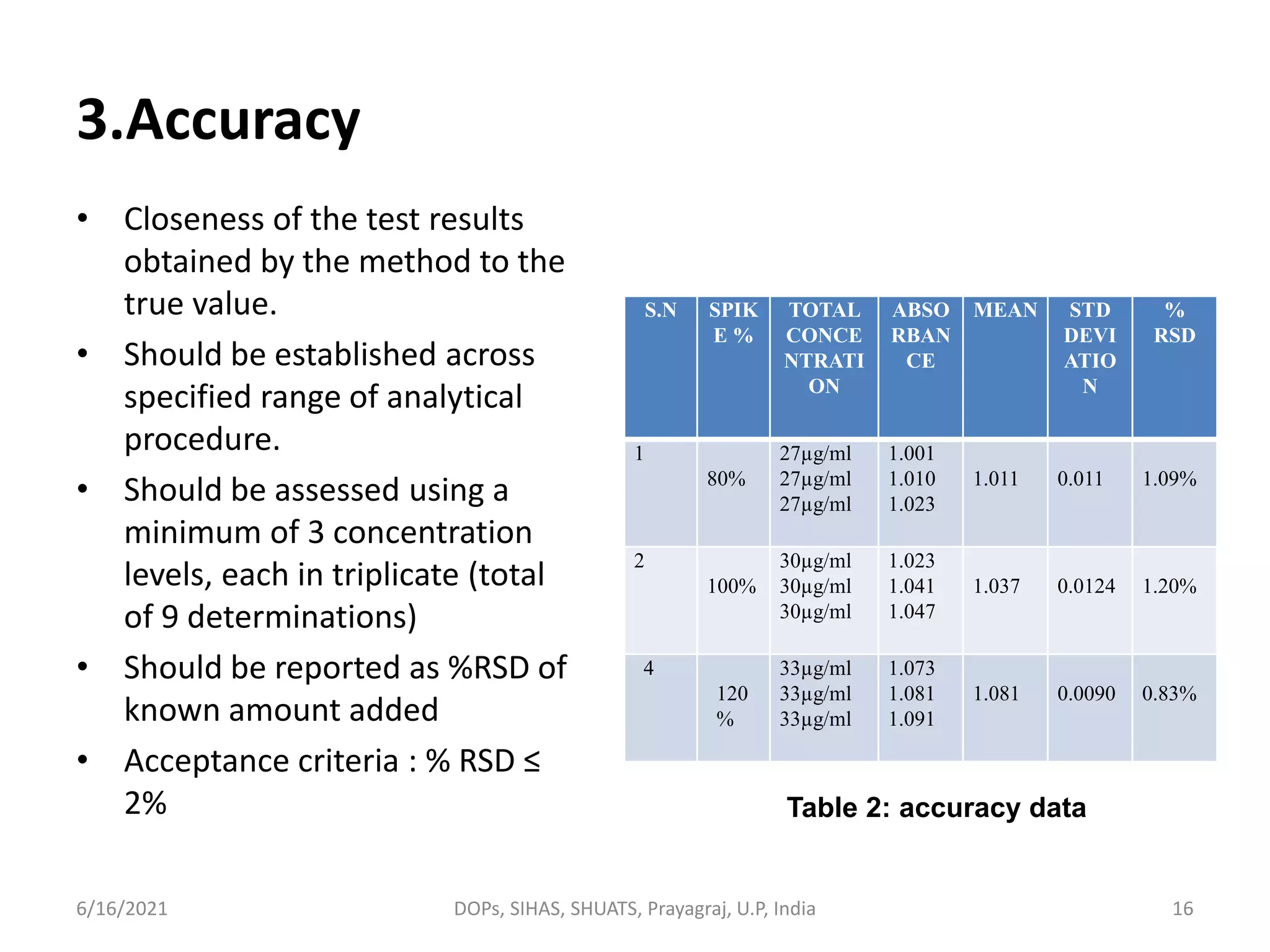
3.Accuracy
• Closeness of the test results
obtained by the method to the
true value.
• Should be established across
specified range of analytical
procedure.
• Should be assessed using a
minimum of 3 concentration
levels, each in triplicate (total
of 9 determinations)
• Should be reported as %RSD of
known amount added
• Acceptance criteria : % RSD ≤
2%
S.N SPIK
E %
TOTAL
CONCE
NTRATI
ON
ABSO
RBAN
CE
MEAN STD
DEVI
ATIO
N
%
RSD
1
80%
27µg/ml
27µg/ml
27µg/ml
1.001
1.010
1.023
1.011 0.011 1.09%
2
100%
30µg/ml
30µg/ml
30µg/ml
1.023
1.041
1.047
1.037 0.0124 1.20%
4
120
%
33µg/ml
33µg/ml
33µg/ml
1.073
1.081
1.091
1.081 0.0090 0.83%
6/16/2021 DOPs, SIHAS, SHUATS, Prayagraj, U.P, India 16
Table 2: accuracy data
4.Precision
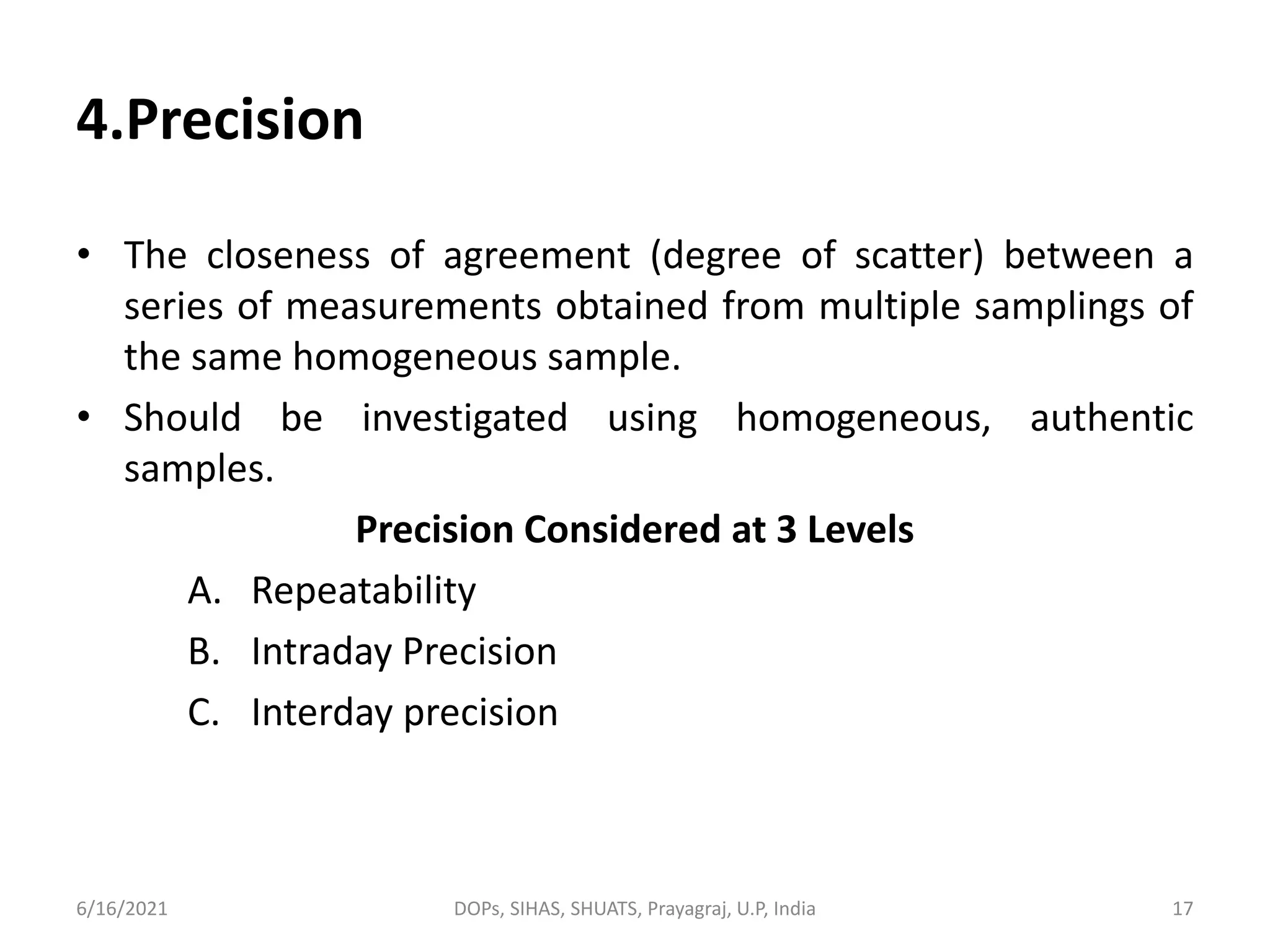
• The closeness of agreement (degree of scatter) between a
series of measurements obtained from multiple samplings of
the same homogeneous sample.
• Should be investigated using homogeneous, authentic
samples.
Precision Considered at 3 Levels
A. Repeatability
B. Intraday Precision
C. Interday precision
6/16/2021 DOPs, SIHAS, SHUATS, Prayagraj, U.P, India 17
A. Repeatability
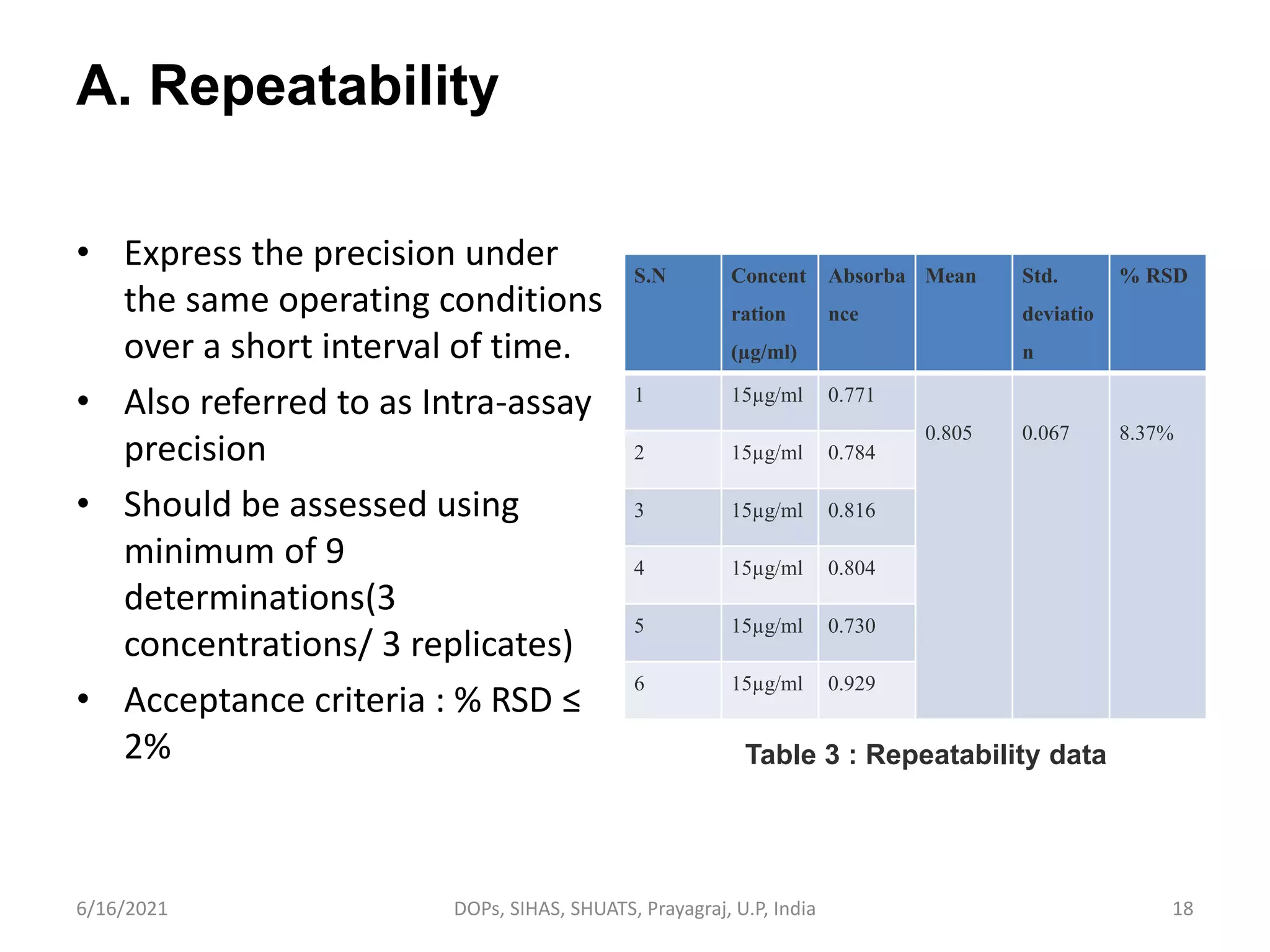
• Express the precision under
the same operating conditions
over a short interval of time.
• Also referred to as Intra-assay
precision
• Should be assessed using
minimum of 9
determinations(3
concentrations/ 3 replicates)
• Acceptance criteria : % RSD ≤
2%
S.N Concent
ration
(µg/ml)
Absorba
nce
Mean Std.
deviatio
n
% RSD
1 15µg/ml 0.771
0.805 0.067 8.37%
2 15µg/ml 0.784
3 15µg/ml 0.816
4 15µg/ml 0.804
5 15µg/ml 0.730
6 15µg/ml 0.929
6/16/2021 DOPs, SIHAS, SHUATS, Prayagraj, U.P, India
Table 3 : Repeatability data
18
B. Intraday precision
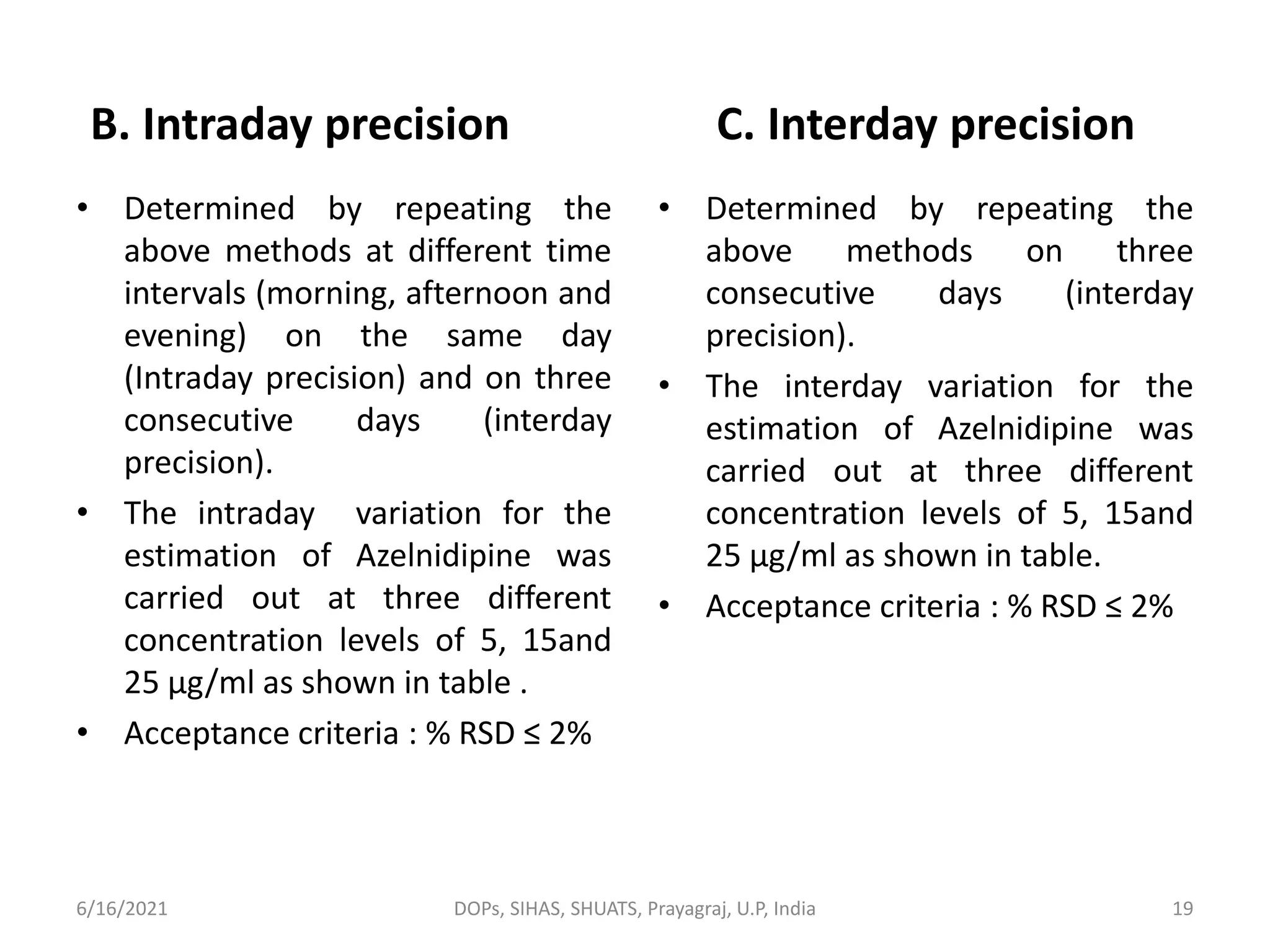
• Determined by repeating the
above methods at different time
intervals (morning, afternoon and
evening) on the same day
(Intraday precision) and on three
consecutive days (interday
precision).
• The intraday variation for the
estimation of Azelnidipine was
carried out at three different
concentration levels of 5, 15and
25 µg/ml as shown in table .
• Acceptance criteria : % RSD ≤ 2%
C. Interday precision
• Determined by repeating the
above methods on three
consecutive days (interday
precision).
• The interday variation for the
estimation of Azelnidipine was
carried out at three different
concentration levels of 5, 15and
25 µg/ml as shown in table.
• Acceptance criteria : % RSD ≤ 2%
6/16/2021 DOPs, SIHAS, SHUATS, Prayagraj, U.P, India 19
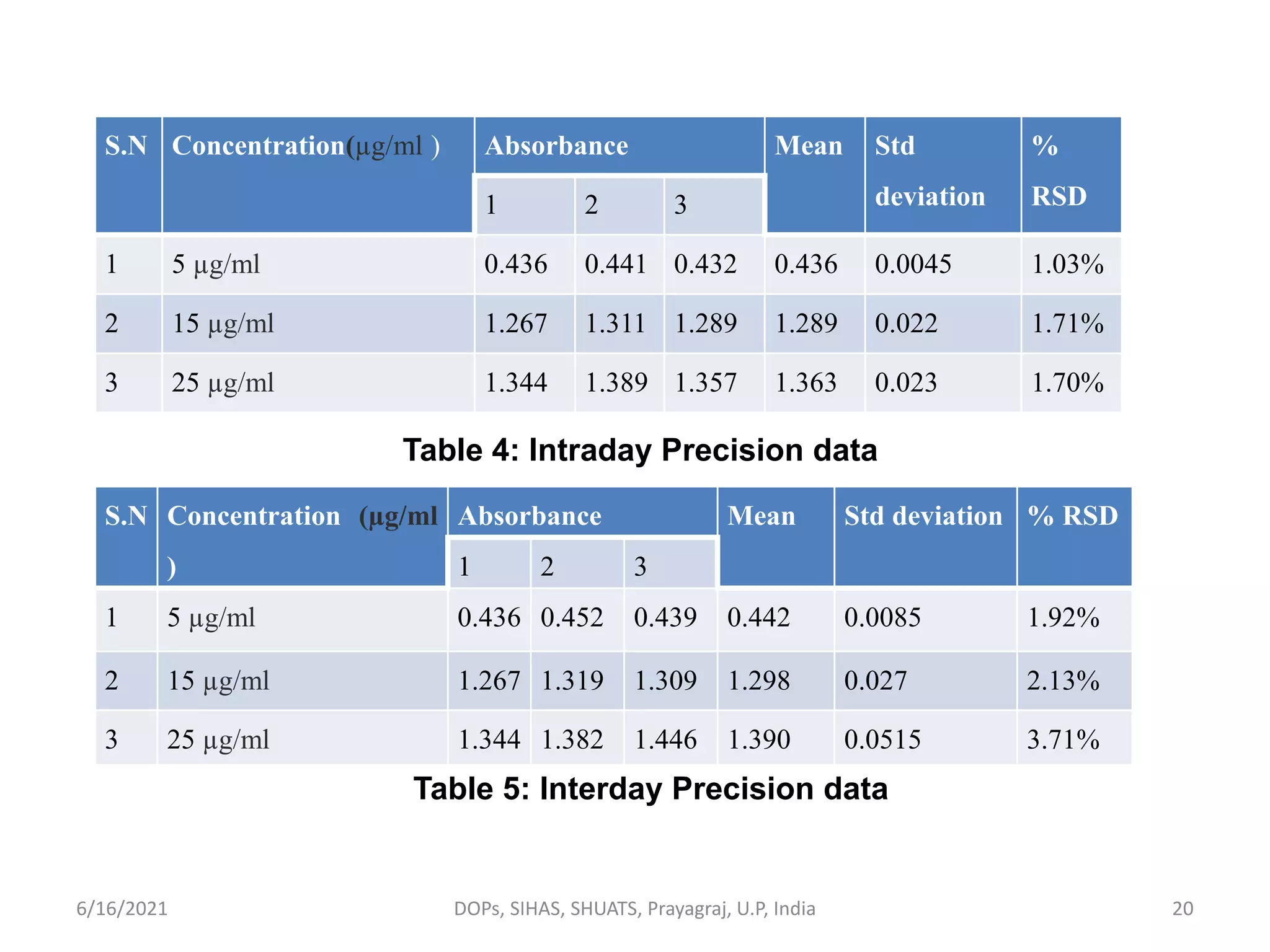
S.N Concentration(µg/ml ) Absorbance Mean Std
deviation
%
RSD
1 2 3
1 5 µg/ml 0.436 0.441 0.432 0.436 0.0045 1.03%
2 15 µg/ml 1.267 1.311 1.289 1.289 0.022 1.71%
3 25 µg/ml 1.344 1.389 1.357 1.363 0.023 1.70%
6/16/2021 DOPs, SIHAS, SHUATS, Prayagraj, U.P, India
S.N Concentration (µg/ml
)
Absorbance Mean Std deviation % RSD
1 2 3
1 5 µg/ml 0.436 0.452 0.439 0.442 0.0085 1.92%
2 15 µg/ml 1.267 1.319 1.309 1.298 0.027 2.13%
3 25 µg/ml 1.344 1.382 1.446 1.390 0.0515 3.71%
Table 5: Interday Precision data
Table 4: Intraday Precision data
20
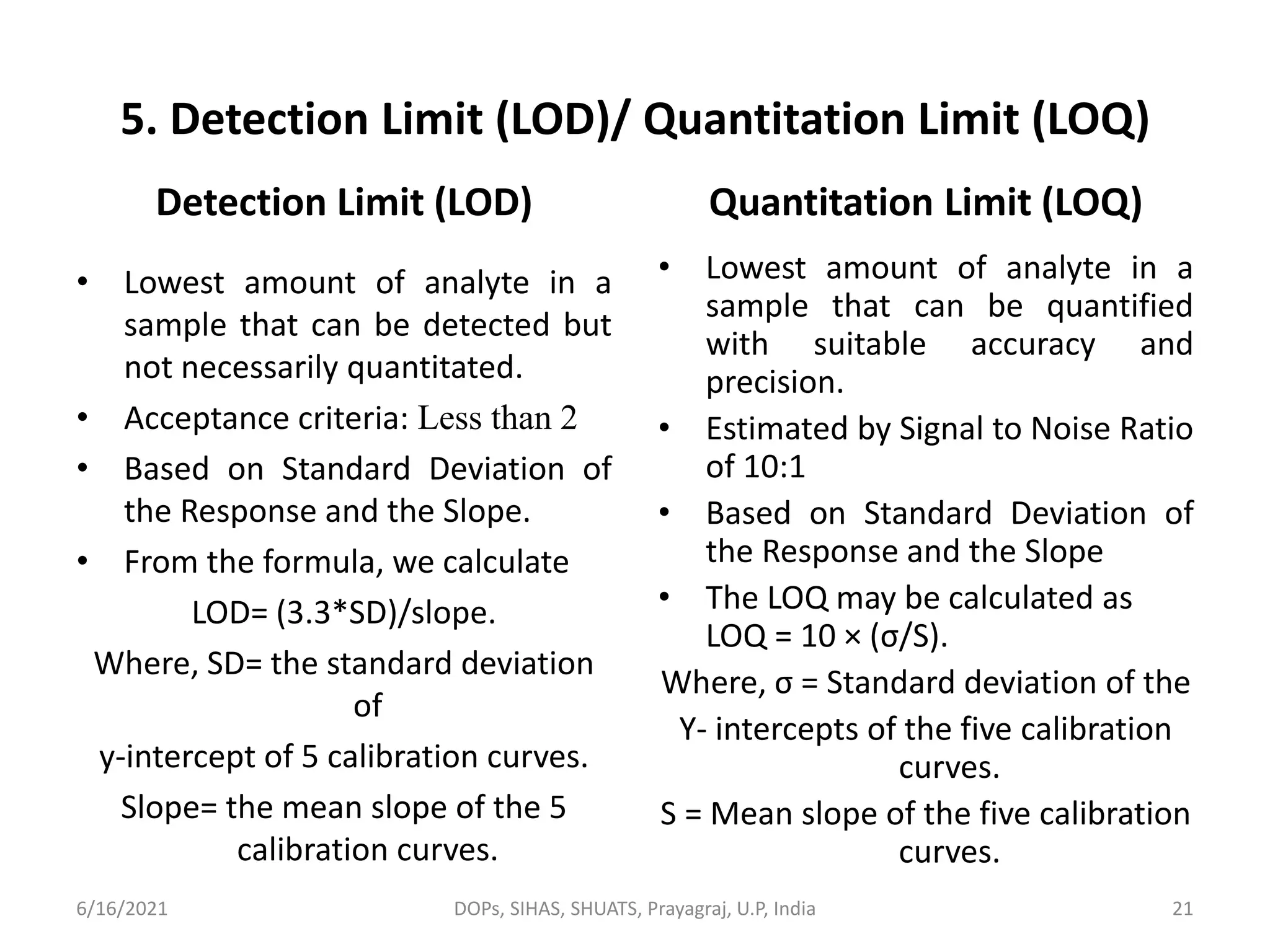
5. Detection Limit (LOD)/ Quantitation Limit (LOQ)
Detection Limit (LOD)
• Lowest amount of analyte in a
sample that can be detected but
not necessarily quantitated.
• Acceptance criteria: Less than 2
• Based on Standard Deviation of
the Response and the Slope.
• From the formula, we calculate
LOD= (3.3*SD)/slope.
Where, SD= the standard deviation
of
y-intercept of 5 calibration curves.
Slope= the mean slope of the 5
calibration curves.
Quantitation Limit (LOQ)
• Lowest amount of analyte in a
sample that can be quantified
with suitable accuracy and
precision.
• Estimated by Signal to Noise Ratio
of 10:1
• Based on Standard Deviation of
the Response and the Slope
• The LOQ may be calculated as
LOQ = 10 × (σ/S).
Where, σ = Standard deviation of the
Y- intercepts of the five calibration
curves.
S = Mean slope of the five calibration
curves.
6/16/2021 DOPs, SIHAS, SHUATS, Prayagraj, U.P, India 21
6.Robustness
• It is a measure of its capacity to remain unaffected by small,
but deliberate variations in method parameters and provides
an indication of its reliability during normal usage.
• It is carryout by doing deliberate variation in method
parameter is done (i.e. change in wavelength, analysis by
person to person and changing room temperature).
Absorbance of any one concentration 15 µg/ml is measured at
three different wavelengths i.e. 256,257,258 nm and calculate
% RSD.
• Acceptance criteria : % RSD ≤ 2%
6/16/2021 DOPs, SIHAS, SHUATS, Prayagraj, U.P, India 22
S.
N
Parameter Absorbance Mean Std.
Deviation
% RSD
1
Wavelength
(256,257,258 nm)
256
257
258
0.494
0.4963 0.0068 1.37%
0.491
0.504
2
Analysis by person
to person
1st
2nd
3rd
0.476
0.484 0.0065 1.34%
0.481
0.491
3
By changing
Temperature
38c
43c
40c
0.436
0.442 0.0052 1.92%
0.452
0.439
6/16/2021 DOPs, SIHAS, SHUATS, Prayagraj, U.P, India
Table 6: Measure Robustness (15µg/ml) of the method
23
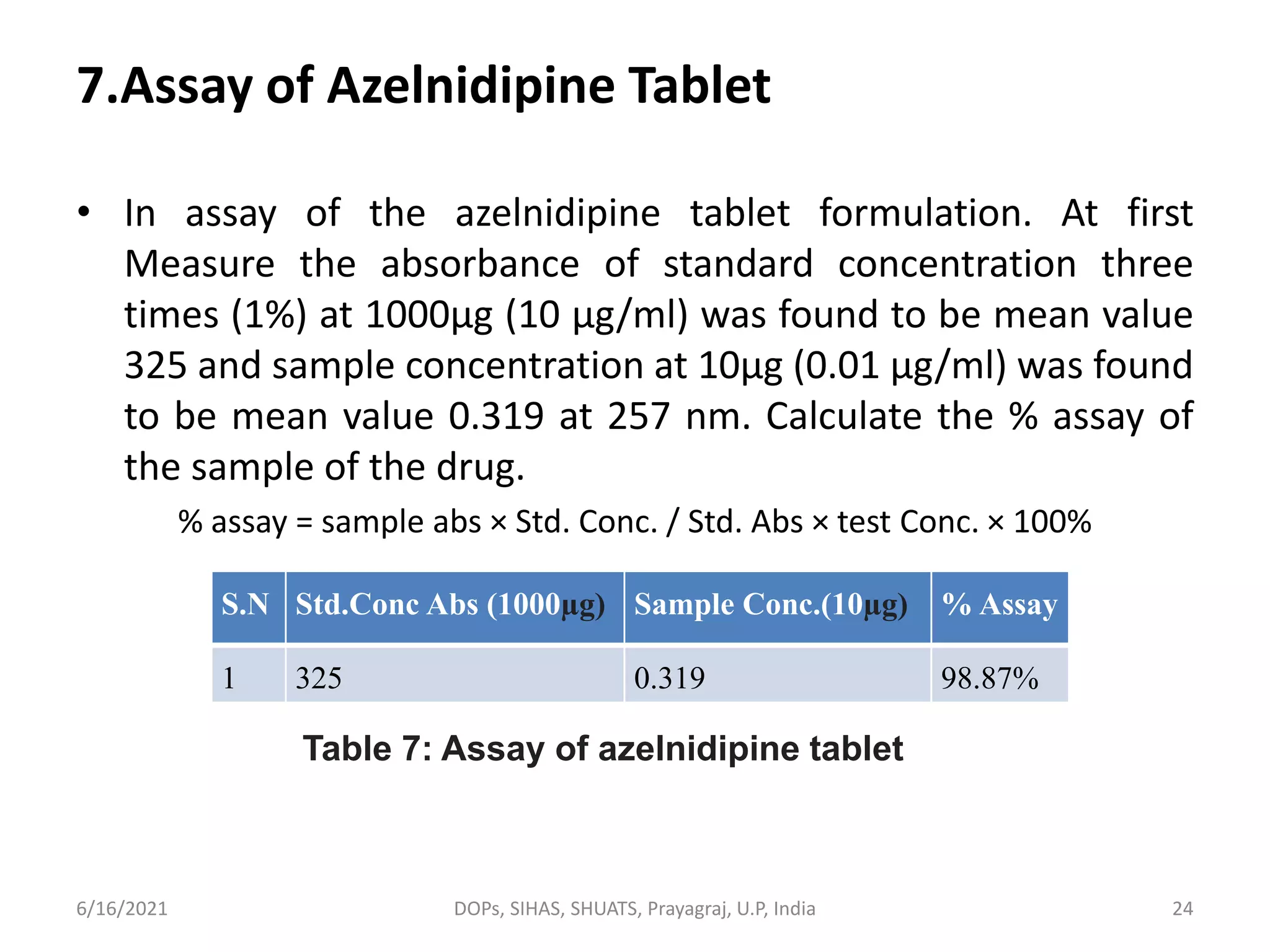
7.Assay of Azelnidipine Tablet
• In assay of the azelnidipine tablet formulation. At first
Measure the absorbance of standard concentration three
times (1%) at 1000µg (10 µg/ml) was found to be mean value
325 and sample concentration at 10µg (0.01 µg/ml) was found
to be mean value 0.319 at 257 nm. Calculate the % assay of
the sample of the drug.
% assay = sample abs × Std. Conc. / Std. Abs × test Conc. × 100%
6/16/2021 DOPs, SIHAS, SHUATS, Prayagraj, U.P, India
S.N Std.Conc Abs (1000µg) Sample Conc.(10µg) % Assay
1 325 0.319 98.87%
Table 7: Assay of azelnidipine tablet
24
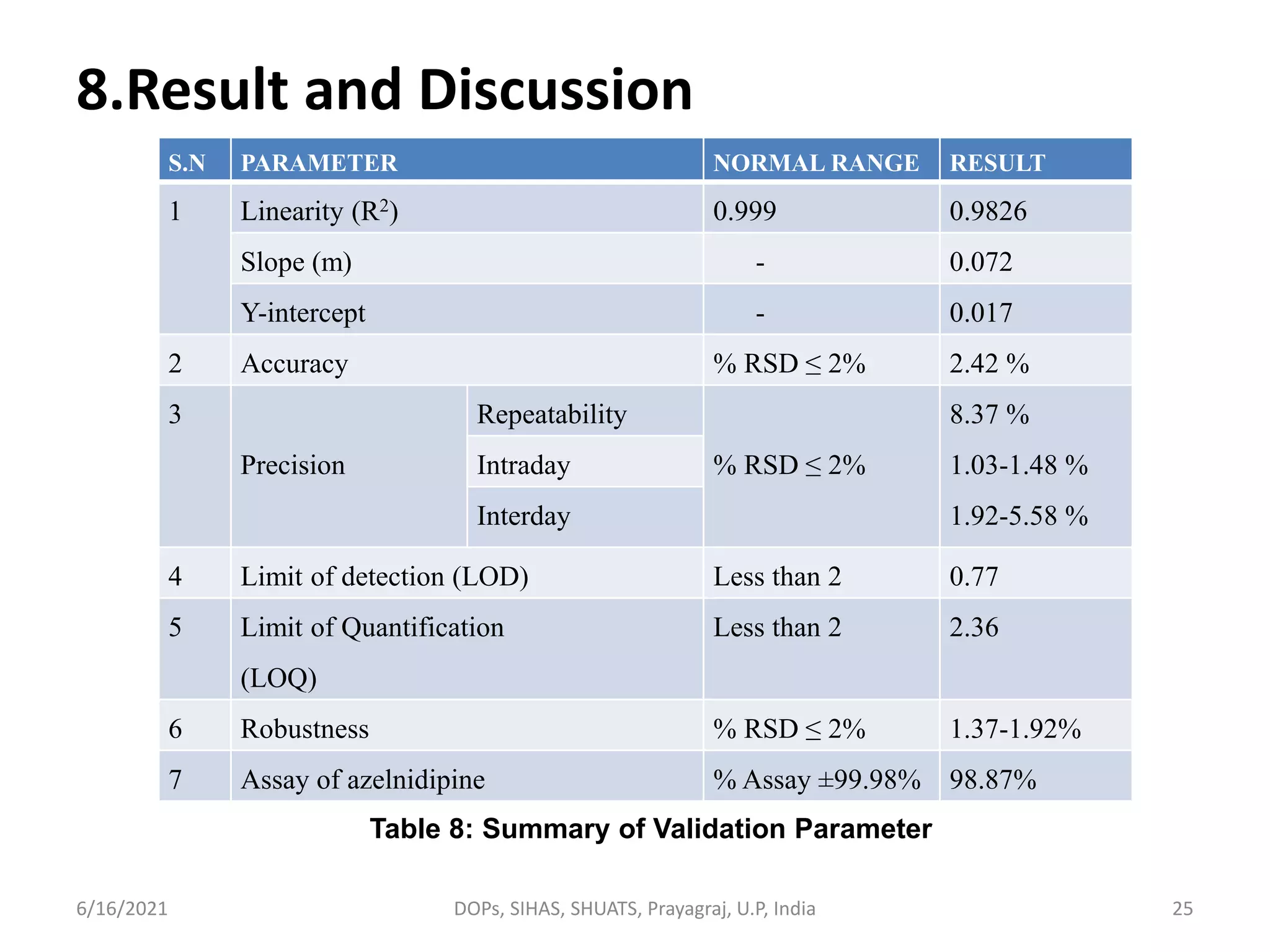
8.Result and Discussion
S.N PARAMETER NORMAL RANGE RESULT
1 Linearity (R2) 0.999 0.9826
Slope (m) - 0.072
Y-intercept - 0.017
2 Accuracy % RSD ≤ 2% 2.42 %
3
Precision
Repeatability
% RSD ≤ 2%
8.37 %
1.03-1.48 %
1.92-5.58 %
Intraday
Interday
4 Limit of detection (LOD) Less than 2 0.77
5 Limit of Quantification
(LOQ)
Less than 2 2.36
6 Robustness % RSD ≤ 2% 1.37-1.92%
7 Assay of azelnidipine % Assay ±99.98% 98.87%
6/16/2021 DOPs, SIHAS, SHUATS, Prayagraj, U.P, India
Table 8: Summary of Validation Parameter
25
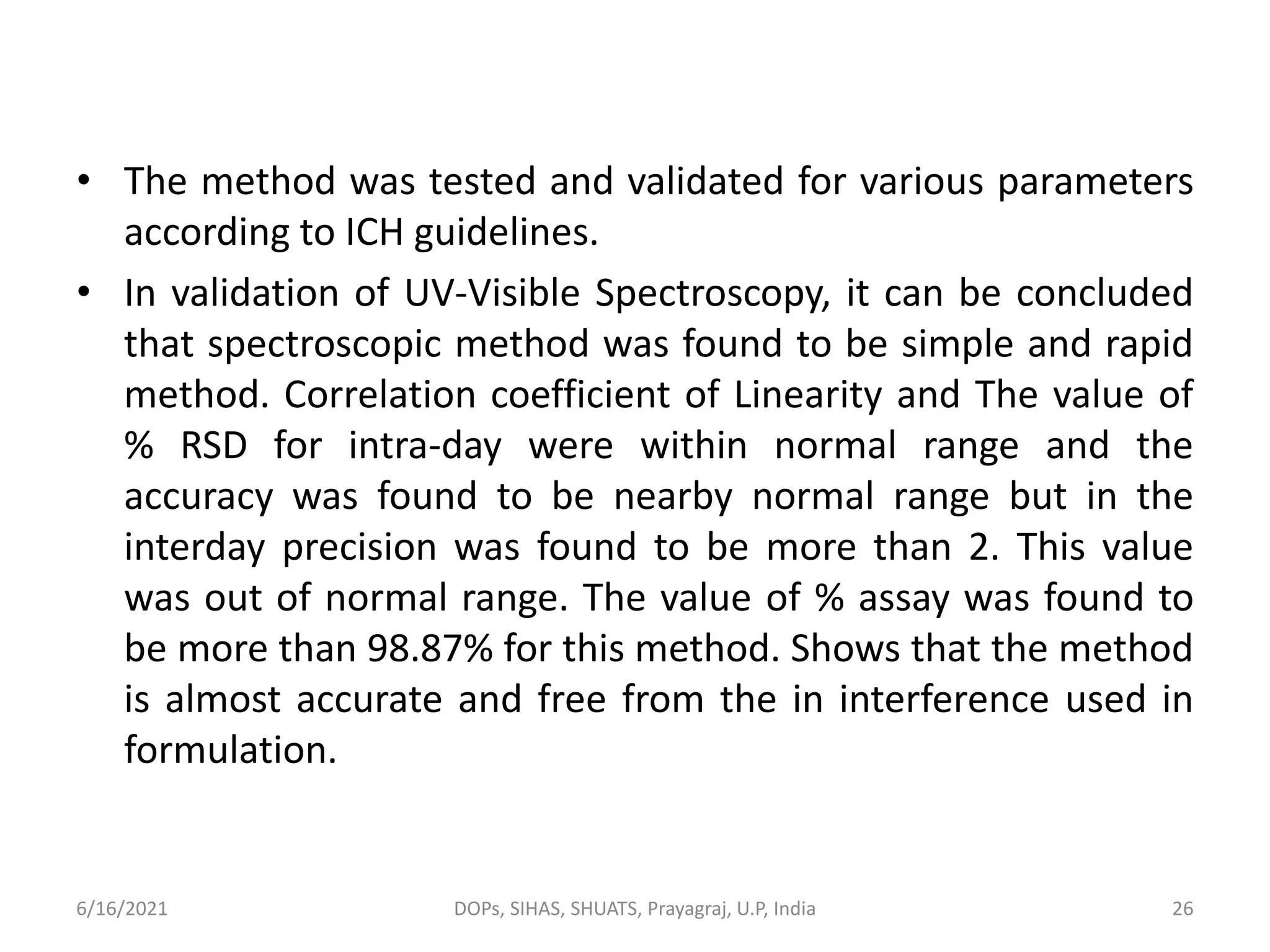
• The method was tested and validated for various parameters
according to ICH guidelines.
• In validation of UV-Visible Spectroscopy, it can be concluded
that spectroscopic method was found to be simple and rapid
method. Correlation coefficient of Linearity and The value of
% RSD for intra-day were within normal range and the
accuracy was found to be nearby normal range but in the
interday precision was found to be more than 2. This value
was out of normal range. The value of % assay was found to
be more than 98.87% for this method. Shows that the method
is almost accurate and free from the in interference used in
formulation.
6/16/2021 DOPs, SIHAS, SHUATS, Prayagraj, U.P, India 26
• The limit of detection and limit of quantification of APL were
found to be 0.77 and 2.36.
• The excipients in the commercial tablet preparation did not
interfere with the % assay .
• The developed UV-Visible Spectrophotometric method was
found to be least accurate, sensitive, precise, so this method
was almost accurate to apply in pharmaceutical tablet
formulation for quantitative estimation of Azelnidipine.
• The developed UV method was subjected to stability
indicating studies for Azelnidipine. It was found that the
interfering peak from solvent did not interfere with estimation
of drug and the developed method was found to be specific
for estimation of Azelnidipine.
6/16/2021 DOPs, SIHAS, SHUATS, Prayagraj, U.P, India 27
9. Conclusion
• The proposed method development of UV-Visible
SPECTROSCOPY was found to be least rapid, precise, accurate
and sensitive in comparison to other.
• Many samples cannot be suitably analyzed by this method.
Hence developed method cannot be used for routine analysis
of AZP in various formulations.
• It was concluded that developed method is simple, almost
accurate, precise and reliable.
6/16/2021 DOPs, SIHAS, SHUATS, Prayagraj, U.P, India 28
10.References
1. Guy RC. International Conference on Harmonisation. Encycl Toxicol Third
Ed. 2014;2:1070–1072.
2. Thakare L, Ahmad S, Shastry VM. Development and Validation of Uv-
Visible Spectrophotometric Method for Estimation of Cilnidipine and
Telmisartan in Bulk and Dosage Form. Indo Am J Pharm Res.
2017;7(04):8552–8559.
3. Jenisha Modi, Shivangi K. Patel, Namrata Parikh, Shreya R. Shah* PKP and
UMU. World Journal of Pharmaceutical Research. Infection. 2014;5(2):831-
847.
4. Rane AS, Mahajan SK. Validation and Forced Stability-Indicating Hptlc
Method for Determination of Azelnidipine. Rane al World J Pharm Res
World J Pharm Res SJIF Impact Factor 6 [Internet]. 2016;5(9):1053–1062.
Available from: www.wjpr.net
6/16/2021 DOPs, SIHAS, SHUATS, Prayagraj, U.P, India 29
Thank you!
Any question?
6/16/2021 DOPs, SIHAS, SHUATS, Prayagraj, U.P, India 30

Analytical Method Development and validation of UV-Visible spectroscopy

  • 1.
    Analytical Method developmentand validation of azelnidipine by UV-Visible Spectroscopy 6/16/2021 DOPs, SIHAS, SHUATS, Prayagraj, U.P, India Presented to: Prof. (Dr). P.Malairajan (Hod, Department of Pharmaceutical Sciences, SIHAS, SHUATS, Prayagraj, U.P, India) Presented By: Name: Imdad H. Mukeri Id No: 17BPH084 Subject: Advance Instrumentation Technique Course code: BP814PW Date of Submission: 14/06/2021 1
  • 2.
    Introduction  Pharmaceutical analysiscomprises the procedures necessary to determine the identity, strength, quality and purity of substances of therapeutic importance.  Quality is important in every product or service, but it is vital in medicines as it involves life.  Analytical techniques that are generally used for drug analysis are • Chromatographic methods, • Spectral methods, • Biological and Microbiological methods 6/16/2021 DOPs, SIHAS, SHUATS, Prayagraj, U.P, India 2
  • 3.
    Introduction to UV-Visiblespectroscopy • UV-Visible spectroscopy is type of absorption spectroscopy in which light of ultra-violet and visible region (200-400nm and 400-800nm) is absorbed by the molecule which results in the excitation of the electrons from the ground state to higher energy state. Instrumentation Figure 1: Instrumentation of double Beam UV-Visible spectroscopy 6/16/2021 DOPs, SIHAS, SHUATS, Prayagraj, U.P, India 3
  • 4.
    The fundamental lawthat governs the quantitative spectrophotometric analysis Beer -Lambert law. • It states that the intensity of a beam of parallel monochromatic radiation decreases exponentially with the number of absorbing molecules i.e absorbance is proportional to the concentration and passes through a medium of homogeneous thickness. A combination of these two laws yields the Beer-Lambert law. Mathematically, Beer Lambert law is expressed as A=a b c (Where, A=absorbance or optical density, a= absorptivity or extinction coefficient, b=path length of radiation through sample (cm), c=concentration of solute in solution. Both b and a are constant so a is directly proportional to the concentration c • When c is in gm/100 ml, then the constant is called A (1%, 1 cm) 6/16/2021 DOPs, SIHAS, SHUATS, Prayagraj, U.P, India 4
  • 5.
    Drug profile ofazelnidipine • Molecular weight: 582.646 g/mol • Molecular formula: C33H34N4O • Melting point and pka: 122-123c and 7.89 • Absorption: Orally absorbed • Bioavailability: Less than 50% • Half life: 16-24 hrs • Plasma protein binding and Cmax: : ~90% and 3.0-13.1 ng/ml • Metabolism: Metabolized by cytochrome P450 (CYP) 3A4 in the liver and has no active metabolite(5). • Storage: Stored In tightly closed container in cool, dry and well maintained area. • Solubility: Slightly soluble in methanol, freely soluble in acetone , soluble in ethyl acetate, sparingly soluble in water 6/16/2021 DOPs, SIHAS, SHUATS, Prayagraj, U.P, India Figure 2: Chemical structure of azelnidipine and their IUPAC name 5
  • 6.
    Objective The Objective ofthis dissertation work is as follows  Aim of the present work is to Develop some new analytical methods for the estimation of azelnidipine and drug formulations  To Develop rapid, sensitive and selective method  Economic and accurate method  Method validation according to ICH guidelines. 6/16/2021 DOPs, SIHAS, SHUATS, Prayagraj, U.P, India 6
  • 7.
    Methodology: UV-Visible spectroscopy Selection of analytical wavelength  Preparation of stock solutions  Calibration curve for the Azelnidipine  Sample preparation for determination of azelnidipine from dosage form  Validation of Spectrophotometric methods 6/16/2021 DOPs, SIHAS, SHUATS, Prayagraj, U.P, India 7
  • 8.
    Selection of wavelength(λ max) • For the selection of analytical wavelength range for method 100µg/ml azelnidipine was scanned in the spectrum mode from 200nm to 400nm against distilled methanol as blank. Wavelength range was selected around wavelength maxima (257nm). 6/16/2021 DOPs, SIHAS, SHUATS, Prayagraj, U.P, India 0 0.1 0.2 0.3 0.4 0.5 0.6 0.7 0.8 200 220 240 260 280 300 320 340 360 380 400 UV-Visible spectroscopy Wavelength nm A B S O R B A N C E Figure 3: λ max of azelnidipine (100μg/ml) 8
  • 9.
    Method development byUV-Visible spectroscopy • It is the process of formulating the material, condition, and protocol for measuring the analyte • To develop a suitable UV-Visible method for determination of azelnidipine with the compositions of methanol was used as diluents • Finally good % RSD was found with diluents methanol. • On scanning the standard solution against diluents in entire UV-Visible range of 200-800nm, good response was found at 257nm for 100µg/ml solution. • There is no interference from diluents methanol through the entire UV-Visible range 200-800nm. 6/16/2021 DOPs, SIHAS, SHUATS, Prayagraj, U.P, India 9
  • 10.
    Method life cycle optimization Validation Development 6/16/2021DOPs, SIHAS, SHUATS, Prayagraj, U.P, India Figure 4 : method development life cycle 10
  • 11.
    Steps involved inmethod development Analyte standard characterization Method requirements Literature search and prior methodology Choosing a method Instrumental setup and initial studies Optimization Documentation of analytical figures of merit Evaluation of method development with actual samples Determination of percent RSD of actual sample and demonstration of quantitative sample analysis. 6/16/2021 DOPs, SIHAS, SHUATS, Prayagraj, U.P, India 11
  • 12.
    Analytical method validation •Validation of analytical procedures is the process of determining the suitability of a given methodology for providing useful analytical data. • Validation is the formal and systematic proof that a method compiles with the requirements for testing a product when observing a defined procedures. Purpose of Method Validation • Identification of Sources and Quantitation of Potential errors • Determination if Method is Acceptable for Intended Use • Establish Proof that a Method Can be Used for Decision Making • Satisfy FDA Requirements 6/16/2021 DOPs, SIHAS, SHUATS, Prayagraj, U.P, India 12
  • 13.
    Various validation parameters Figure5: Eight Steps of Analytical Method Validation 6/16/2021 DOPs, SIHAS, SHUATS, Prayagraj, U.P, India 13
  • 14.
    1. Linearity • Abilityof an assay to elicit a direct and proportional response to changes in analyte concentration. • By Visual Inspection of plot of signals vs. analyte concentration • By Appropriate statistical methods  Linear Regression (y = mx + c)  Correlation Coefficient, y-intercept (b), slope (m) • Acceptance criteria: Linear regression r2 > 0.95 • Requires a minimum of 5 concentration levels S.N Concentration (μg/ml) Absorbance 1 2 0.187 2 4 0.326 3 6 0.424 4 8 0.534 5 10 0.722 6 12 0.951 7 14 1.019 6/16/2021 DOPs, SIHAS, SHUATS, Prayagraj, U.P, India y = 0.0722x + 0.017 R² = 0.9826 0 0.2 0.4 0.6 0.8 1 1.2 0 2 4 6 8 10 12 14 16 Calibration curve of azeldipine Concentraion A b s o r b a n Figure 6: Calibration Curve of Azelnidipine at 257 nm 14 Table 1: Calibration Curve of linearity
  • 15.
    2.Range • The specifiedrange is normally derived from linearity studies and depends on the intended application of the procedure e.g.. 2-14µg/ml. • It is established by confirming that the analytical procedure provides an acceptable degree of linearity, accuracy and precision when applied to samples containing amounts of analyte within or at the extremes of the specified range of the analytical procedure. • For Drug Substance & Drug product Assay 80 to 120% of test Concentration i.e 2-14µg/ml. 6/16/2021 DOPs, SIHAS, SHUATS, Prayagraj, U.P, India 15
  • 16.
    3.Accuracy • Closeness ofthe test results obtained by the method to the true value. • Should be established across specified range of analytical procedure. • Should be assessed using a minimum of 3 concentration levels, each in triplicate (total of 9 determinations) • Should be reported as %RSD of known amount added • Acceptance criteria : % RSD ≤ 2% S.N SPIK E % TOTAL CONCE NTRATI ON ABSO RBAN CE MEAN STD DEVI ATIO N % RSD 1 80% 27µg/ml 27µg/ml 27µg/ml 1.001 1.010 1.023 1.011 0.011 1.09% 2 100% 30µg/ml 30µg/ml 30µg/ml 1.023 1.041 1.047 1.037 0.0124 1.20% 4 120 % 33µg/ml 33µg/ml 33µg/ml 1.073 1.081 1.091 1.081 0.0090 0.83% 6/16/2021 DOPs, SIHAS, SHUATS, Prayagraj, U.P, India 16 Table 2: accuracy data
  • 17.
    4.Precision • The closenessof agreement (degree of scatter) between a series of measurements obtained from multiple samplings of the same homogeneous sample. • Should be investigated using homogeneous, authentic samples. Precision Considered at 3 Levels A. Repeatability B. Intraday Precision C. Interday precision 6/16/2021 DOPs, SIHAS, SHUATS, Prayagraj, U.P, India 17
  • 18.
    A. Repeatability • Expressthe precision under the same operating conditions over a short interval of time. • Also referred to as Intra-assay precision • Should be assessed using minimum of 9 determinations(3 concentrations/ 3 replicates) • Acceptance criteria : % RSD ≤ 2% S.N Concent ration (µg/ml) Absorba nce Mean Std. deviatio n % RSD 1 15µg/ml 0.771 0.805 0.067 8.37% 2 15µg/ml 0.784 3 15µg/ml 0.816 4 15µg/ml 0.804 5 15µg/ml 0.730 6 15µg/ml 0.929 6/16/2021 DOPs, SIHAS, SHUATS, Prayagraj, U.P, India Table 3 : Repeatability data 18
  • 19.
    B. Intraday precision •Determined by repeating the above methods at different time intervals (morning, afternoon and evening) on the same day (Intraday precision) and on three consecutive days (interday precision). • The intraday variation for the estimation of Azelnidipine was carried out at three different concentration levels of 5, 15and 25 µg/ml as shown in table . • Acceptance criteria : % RSD ≤ 2% C. Interday precision • Determined by repeating the above methods on three consecutive days (interday precision). • The interday variation for the estimation of Azelnidipine was carried out at three different concentration levels of 5, 15and 25 µg/ml as shown in table. • Acceptance criteria : % RSD ≤ 2% 6/16/2021 DOPs, SIHAS, SHUATS, Prayagraj, U.P, India 19
  • 20.
    S.N Concentration(µg/ml )Absorbance Mean Std deviation % RSD 1 2 3 1 5 µg/ml 0.436 0.441 0.432 0.436 0.0045 1.03% 2 15 µg/ml 1.267 1.311 1.289 1.289 0.022 1.71% 3 25 µg/ml 1.344 1.389 1.357 1.363 0.023 1.70% 6/16/2021 DOPs, SIHAS, SHUATS, Prayagraj, U.P, India S.N Concentration (µg/ml ) Absorbance Mean Std deviation % RSD 1 2 3 1 5 µg/ml 0.436 0.452 0.439 0.442 0.0085 1.92% 2 15 µg/ml 1.267 1.319 1.309 1.298 0.027 2.13% 3 25 µg/ml 1.344 1.382 1.446 1.390 0.0515 3.71% Table 5: Interday Precision data Table 4: Intraday Precision data 20
  • 21.
    5. Detection Limit(LOD)/ Quantitation Limit (LOQ) Detection Limit (LOD) • Lowest amount of analyte in a sample that can be detected but not necessarily quantitated. • Acceptance criteria: Less than 2 • Based on Standard Deviation of the Response and the Slope. • From the formula, we calculate LOD= (3.3*SD)/slope. Where, SD= the standard deviation of y-intercept of 5 calibration curves. Slope= the mean slope of the 5 calibration curves. Quantitation Limit (LOQ) • Lowest amount of analyte in a sample that can be quantified with suitable accuracy and precision. • Estimated by Signal to Noise Ratio of 10:1 • Based on Standard Deviation of the Response and the Slope • The LOQ may be calculated as LOQ = 10 × (σ/S). Where, σ = Standard deviation of the Y- intercepts of the five calibration curves. S = Mean slope of the five calibration curves. 6/16/2021 DOPs, SIHAS, SHUATS, Prayagraj, U.P, India 21
  • 22.
    6.Robustness • It isa measure of its capacity to remain unaffected by small, but deliberate variations in method parameters and provides an indication of its reliability during normal usage. • It is carryout by doing deliberate variation in method parameter is done (i.e. change in wavelength, analysis by person to person and changing room temperature). Absorbance of any one concentration 15 µg/ml is measured at three different wavelengths i.e. 256,257,258 nm and calculate % RSD. • Acceptance criteria : % RSD ≤ 2% 6/16/2021 DOPs, SIHAS, SHUATS, Prayagraj, U.P, India 22
  • 23.
    S. N Parameter Absorbance MeanStd. Deviation % RSD 1 Wavelength (256,257,258 nm) 256 257 258 0.494 0.4963 0.0068 1.37% 0.491 0.504 2 Analysis by person to person 1st 2nd 3rd 0.476 0.484 0.0065 1.34% 0.481 0.491 3 By changing Temperature 38c 43c 40c 0.436 0.442 0.0052 1.92% 0.452 0.439 6/16/2021 DOPs, SIHAS, SHUATS, Prayagraj, U.P, India Table 6: Measure Robustness (15µg/ml) of the method 23
  • 24.
    7.Assay of AzelnidipineTablet • In assay of the azelnidipine tablet formulation. At first Measure the absorbance of standard concentration three times (1%) at 1000µg (10 µg/ml) was found to be mean value 325 and sample concentration at 10µg (0.01 µg/ml) was found to be mean value 0.319 at 257 nm. Calculate the % assay of the sample of the drug. % assay = sample abs × Std. Conc. / Std. Abs × test Conc. × 100% 6/16/2021 DOPs, SIHAS, SHUATS, Prayagraj, U.P, India S.N Std.Conc Abs (1000µg) Sample Conc.(10µg) % Assay 1 325 0.319 98.87% Table 7: Assay of azelnidipine tablet 24
  • 25.
    8.Result and Discussion S.NPARAMETER NORMAL RANGE RESULT 1 Linearity (R2) 0.999 0.9826 Slope (m) - 0.072 Y-intercept - 0.017 2 Accuracy % RSD ≤ 2% 2.42 % 3 Precision Repeatability % RSD ≤ 2% 8.37 % 1.03-1.48 % 1.92-5.58 % Intraday Interday 4 Limit of detection (LOD) Less than 2 0.77 5 Limit of Quantification (LOQ) Less than 2 2.36 6 Robustness % RSD ≤ 2% 1.37-1.92% 7 Assay of azelnidipine % Assay ±99.98% 98.87% 6/16/2021 DOPs, SIHAS, SHUATS, Prayagraj, U.P, India Table 8: Summary of Validation Parameter 25
  • 26.
    • The methodwas tested and validated for various parameters according to ICH guidelines. • In validation of UV-Visible Spectroscopy, it can be concluded that spectroscopic method was found to be simple and rapid method. Correlation coefficient of Linearity and The value of % RSD for intra-day were within normal range and the accuracy was found to be nearby normal range but in the interday precision was found to be more than 2. This value was out of normal range. The value of % assay was found to be more than 98.87% for this method. Shows that the method is almost accurate and free from the in interference used in formulation. 6/16/2021 DOPs, SIHAS, SHUATS, Prayagraj, U.P, India 26
  • 27.
    • The limitof detection and limit of quantification of APL were found to be 0.77 and 2.36. • The excipients in the commercial tablet preparation did not interfere with the % assay . • The developed UV-Visible Spectrophotometric method was found to be least accurate, sensitive, precise, so this method was almost accurate to apply in pharmaceutical tablet formulation for quantitative estimation of Azelnidipine. • The developed UV method was subjected to stability indicating studies for Azelnidipine. It was found that the interfering peak from solvent did not interfere with estimation of drug and the developed method was found to be specific for estimation of Azelnidipine. 6/16/2021 DOPs, SIHAS, SHUATS, Prayagraj, U.P, India 27
  • 28.
    9. Conclusion • Theproposed method development of UV-Visible SPECTROSCOPY was found to be least rapid, precise, accurate and sensitive in comparison to other. • Many samples cannot be suitably analyzed by this method. Hence developed method cannot be used for routine analysis of AZP in various formulations. • It was concluded that developed method is simple, almost accurate, precise and reliable. 6/16/2021 DOPs, SIHAS, SHUATS, Prayagraj, U.P, India 28
  • 29.
    10.References 1. Guy RC.International Conference on Harmonisation. Encycl Toxicol Third Ed. 2014;2:1070–1072. 2. Thakare L, Ahmad S, Shastry VM. Development and Validation of Uv- Visible Spectrophotometric Method for Estimation of Cilnidipine and Telmisartan in Bulk and Dosage Form. Indo Am J Pharm Res. 2017;7(04):8552–8559. 3. Jenisha Modi, Shivangi K. Patel, Namrata Parikh, Shreya R. Shah* PKP and UMU. World Journal of Pharmaceutical Research. Infection. 2014;5(2):831- 847. 4. Rane AS, Mahajan SK. Validation and Forced Stability-Indicating Hptlc Method for Determination of Azelnidipine. Rane al World J Pharm Res World J Pharm Res SJIF Impact Factor 6 [Internet]. 2016;5(9):1053–1062. Available from: www.wjpr.net 6/16/2021 DOPs, SIHAS, SHUATS, Prayagraj, U.P, India 29
  • 30.
    Thank you! Any question? 6/16/2021DOPs, SIHAS, SHUATS, Prayagraj, U.P, India 30