Seminar on
Biopharmaceutical Classification system (BCS)
Guideline for Solubility and Dissolution
Center of Pharmaceutical Sciences, IST,
JNTUH, Hyderabad-500085
9/2/2022
Center of Pharmaceutical sciences, IST,
JNTUH
1
Presented by:
Imdad H. Mukeri
M. Pharm( Pharmaceutics)
Table of Contents
• Introduction to BCS Guidline for Solubility and Dissolution
• Goal of BCS
• Determination of High solubility, High permeability and Rapid
dissolution
• Factor Affecting BCS (Solubility, Permiability and Dissolution
• Biopharmaceutical Classification system (BCS)
• Dissolution Testing Apparatus as per USP
• Conclusion
• References
9/2/2022
Center of Pharmaceutical sciences, IST,
JNTUH
2
Introduction to BCS
• Biopharmaceutics Classification System (BCS) proposed in
1995 by Amidon et al and his collegues that classified
compounds based on their solubility and permeability.
• The BCS is a scientific approach based on the aqueous
solubility and intestinal permeability characteristics of the
drug substance.
• BCS has been incorporated in Guidelines for biowaiver
granting. Based on aqueous solubility and intestinal
permeability the four classes of the BCS represent four
distinct expectations of in vitro invivo correlations (IVIVC).
9/2/2022
Center of Pharmaceutical sciences, IST,
JNTUH
3
9/2/2022
Center of Pharmaceutical sciences, IST,
JNTUH
4
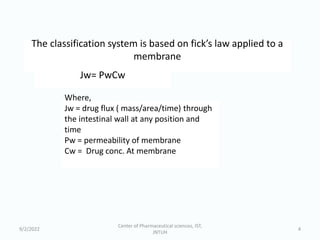
The classification system is based on fick’s law applied to a
membrane
Jw= PwCw
Where,
Jw = drug flux ( mass/area/time) through
the intestinal wall at any position and
time
Pw = permeability of membrane
Cw = Drug conc. At membrane
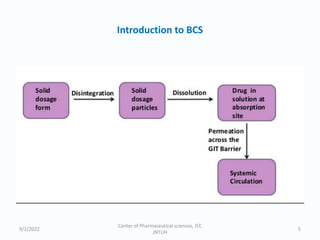
Introduction to BCS
9/2/2022
Center of Pharmaceutical sciences, IST,
JNTUH
5
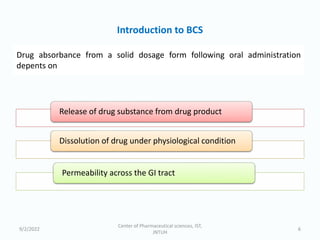
Introduction to BCS
Release of drug substance from drug product
Dissolution of drug under physiological condition
Permeability across the GI tract
9/2/2022
Center of Pharmaceutical sciences, IST,
JNTUH
6
Drug absorbance from a solid dosage form following oral administration
depents on
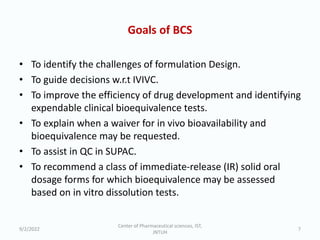
Goals of BCS
• To identify the challenges of formulation Design.
• To guide decisions w.r.t IVIVC.
• To improve the efficiency of drug development and identifying
expendable clinical bioequivalence tests.
• To explain when a waiver for in vivo bioavailability and
bioequivalence may be requested.
• To assist in QC in SUPAC.
• To recommend a class of immediate-release (IR) solid oral
dosage forms for which bioequivalence may be assessed
based on in vitro dissolution tests.
9/2/2022
Center of Pharmaceutical sciences, IST,
JNTUH
7
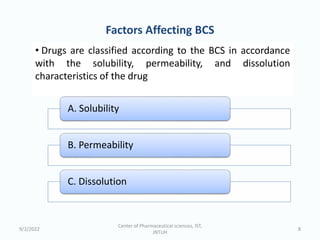
Factors Affecting BCS
A. Solubility
B. Permeability
C. Dissolution
9/2/2022
Center of Pharmaceutical sciences, IST,
JNTUH
8
• Drugs are classified according to the BCS in accordance
with the solubility, permeability, and dissolution
characteristics of the drug
Solubility
• To determine the solubility of a drug under approximate physiologic
conditions.
• Determine of pH–solubility profiles over a pH range of 1–8
• The solubility class is determined by calculating what volume of an
aqueous medium is sufficient to dissolve the highest anticipated
dose strength.
• A drug substance is considered highly soluble when the highest
dose strength is soluble in 250 mL or less of aqueous medium over
the Ph range 1–8.
• The drug substance is not stable with >10% degradation over the
extent of the solubility assessment, solubility cannot be adequately
determined and thus the drug substance cannot be classified.
9/2/2022
Center of Pharmaceutical sciences, IST,
JNTUH
9
Determination of High solubility, High permeability
and Rapid dissolution
Hight soluble
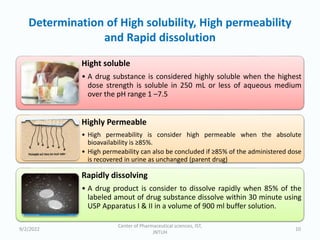
• A drug substance is considered highly soluble when the highest
dose strength is soluble in 250 mL or less of aqueous medium
over the pH range 1 –7.5
Highly Permeable
• High permeability is consider high permeable when the absolute
bioavailability is ≥85%.
• High permeability can also be concluded if ≥85% of the administered dose
is recovered in urine as unchanged (parent drug)
Rapidly dissolving
• A drug product is consider to dissolve rapidly when 85% of the
labeled amout of drug substance dissolve within 30 minute using
USP Apparatus I & II in a volume of 900 ml buffer solution.
9/2/2022
Center of Pharmaceutical sciences, IST,
JNTUH
10
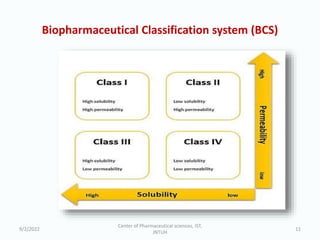
Biopharmaceutical Classification system (BCS)
9/2/2022
Center of Pharmaceutical sciences, IST,
JNTUH
11
Class I drugs (high solubility/high permeability
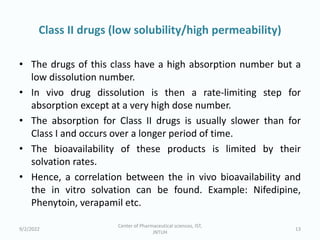
• The drugs of this class exhibit high absorption number and
high dissolution number.
• For those class 1 drugs formulated as IR products, dissolution
rate generally exceeds gastric emptying.
• Behave like an oral solution in-vivo. The rate-limiting step is
gastric emptying.
• These compounds are well absorbed. Absorption rate is
usually higher than the excretion rate. Example Example
Diltiazem, Metoprolol , Propanolol etc.
9/2/2022
Center of Pharmaceutical sciences, IST,
JNTUH
12
Class II drugs (low solubility/high permeability)
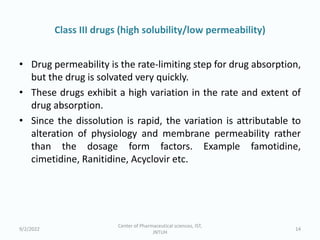
• The drugs of this class have a high absorption number but a
low dissolution number.
• In vivo drug dissolution is then a rate-limiting step for
absorption except at a very high dose number.
• The absorption for Class II drugs is usually slower than for
Class I and occurs over a longer period of time.
• The bioavailability of these products is limited by their
solvation rates.
• Hence, a correlation between the in vivo bioavailability and
the in vitro solvation can be found. Example: Nifedipine,
Phenytoin, verapamil etc.
9/2/2022
Center of Pharmaceutical sciences, IST,
JNTUH
13
Class III drugs (high solubility/low permeability)
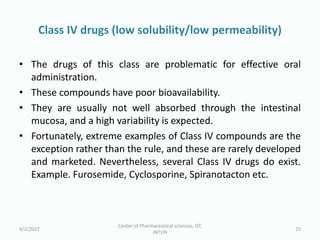
• Drug permeability is the rate-limiting step for drug absorption,
but the drug is solvated very quickly.
• These drugs exhibit a high variation in the rate and extent of
drug absorption.
• Since the dissolution is rapid, the variation is attributable to
alteration of physiology and membrane permeability rather
than the dosage form factors. Example famotidine,
cimetidine, Ranitidine, Acyclovir etc.
9/2/2022
Center of Pharmaceutical sciences, IST,
JNTUH
14
Class IV drugs (low solubility/low permeability)
• The drugs of this class are problematic for effective oral
administration.
• These compounds have poor bioavailability.
• They are usually not well absorbed through the intestinal
mucosa, and a high variability is expected.
• Fortunately, extreme examples of Class IV compounds are the
exception rather than the rule, and these are rarely developed
and marketed. Nevertheless, several Class IV drugs do exist.
Example. Furosemide, Cyclosporine, Spiranotacton etc.
9/2/2022
Center of Pharmaceutical sciences, IST,
JNTUH
15
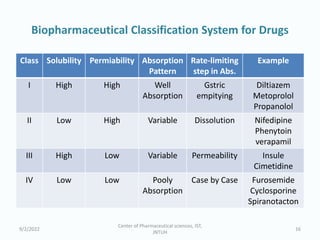
Biopharmaceutical Classification System for Drugs
Class Solubility Permiability Absorption
Pattern
Rate-limiting
step in Abs.
Example
I High High Well
Absorption
Gstric
empitying
Diltiazem
Metoprolol
Propanolol
II Low High Variable Dissolution Nifedipine
Phenytoin
verapamil
III High Low Variable Permeability Insule
Cimetidine
IV Low Low Pooly
Absorption
Case by Case Furosemide
Cyclosporine
Spiranotacton
9/2/2022
Center of Pharmaceutical sciences, IST,
JNTUH
16
Dissolution Testing Apparatus as per USP
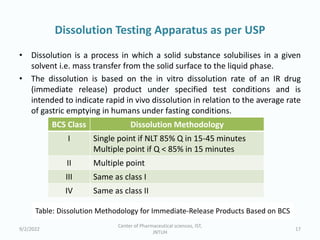
• Dissolution is a process in which a solid substance solubilises in a given
solvent i.e. mass transfer from the solid surface to the liquid phase.
• The dissolution is based on the in vitro dissolution rate of an IR drug
(immediate release) product under specified test conditions and is
intended to indicate rapid in vivo dissolution in relation to the average rate
of gastric emptying in humans under fasting conditions.
9/2/2022
Center of Pharmaceutical sciences, IST,
JNTUH
17
BCS Class Dissolution Methodology
I Single point if NLT 85% Q in 15-45 minutes
Multiple point if Q < 85% in 15 minutes
II Multiple point
III Same as class I
IV Same as class II
Table: Dissolution Methodology for Immediate-Release Products Based on BCS
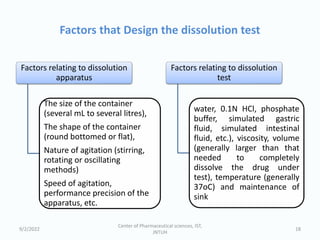
Factors that Design the dissolution test
Factors relating to dissolution
apparatus
The size of the container
(several mL to several litres),
The shape of the container
(round bottomed or flat),
Nature of agitation (stirring,
rotating or oscillating
methods)
Speed of agitation,
performance precision of the
apparatus, etc.
Factors relating to dissolution
test
water, 0.1N HCl, phosphate
buffer, simulated gastric
fluid, simulated intestinal
fluid, etc.), viscosity, volume
(generally larger than that
needed to completely
dissolve the drug under
test), temperature (generally
37oC) and maintenance of
sink
9/2/2022
Center of Pharmaceutical sciences, IST,
JNTUH
18
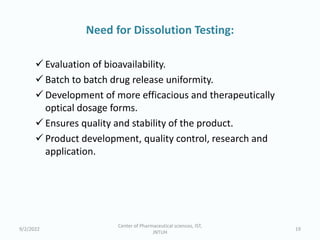
Need for Dissolution Testing:
 Evaluation of bioavailability.
 Batch to batch drug release uniformity.
 Development of more efficacious and therapeutically
optical dosage forms.
 Ensures quality and stability of the product.
 Product development, quality control, research and
application.
9/2/2022
Center of Pharmaceutical sciences, IST,
JNTUH
19
9/2/2022
Center of Pharmaceutical sciences, IST,
JNTUH
20
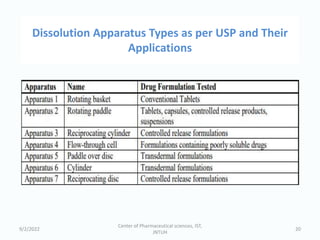
Dissolution Apparatus Types as per USP and Their
Applications
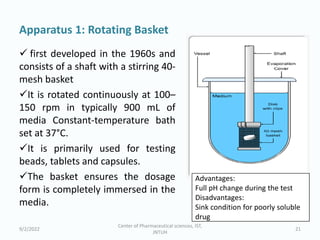
Apparatus 1: Rotating Basket
 first developed in the 1960s and
consists of a shaft with a stirring 40-
mesh basket
It is rotated continuously at 100–
150 rpm in typically 900 mL of
media Constant-temperature bath
set at 37°C.
It is primarily used for testing
beads, tablets and capsules.
The basket ensures the dosage
form is completely immersed in the
media.
9/2/2022
Center of Pharmaceutical sciences, IST,
JNTUH
21
Advantages:
Full pH change during the test
Disadvantages:
Sink condition for poorly soluble
drug
Apparatus 2: Paddle Method
Consists of a stainless steel or teflon
coated shaft with a paddle that is
continuously rotated typically 900 mL
of media at at 37°C
The most common operating speeds
for Apparatus 2 are 50 or 75 rpm for
solid oral dosage forms and 25 rpm for
oral suspensions.
This apparatus has been found to be
useful for immediate and modified
release forms.
9/2/2022
Center of Pharmaceutical sciences, IST,
JNTUH
22
Advatages: esay to use robust
Disadvantages: pH/media change is difficult and sink condition
for pooly soluble drugs.
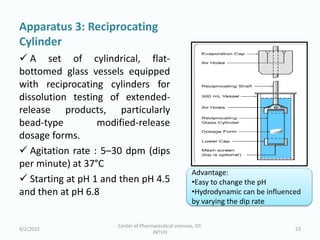
Apparatus 3: Reciprocating
Cylinder
 A set of cylindrical, flat-
bottomed glass vessels equipped
with reciprocating cylinders for
dissolution testing of extended-
release products, particularly
bead-type modified-release
dosage forms.
 Agitation rate : 5–30 dpm (dips
per minute) at 37°C
 Starting at pH 1 and then pH 4.5
and then at pH 6.8
9/2/2022
Center of Pharmaceutical sciences, IST,
JNTUH
23
Advantage:
•Easy to change the pH
•Hydrodynamic can be influenced
by varying the dip rate
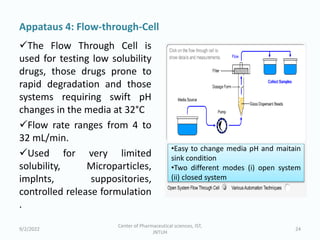
Appataus 4: Flow-through-Cell
The Flow Through Cell is
used for testing low solubility
drugs, those drugs prone to
rapid degradation and those
systems requiring swift pH
changes in the media at 32°C
Flow rate ranges from 4 to
32 mL/min.
Used for very limited
solubility, Microparticles,
implnts, suppositories,
controlled release formulation
.
9/2/2022
Center of Pharmaceutical sciences, IST,
JNTUH
24
•Easy to change media pH and maitain
sink condition
•Two different modes (i) open system
(ii) closed system
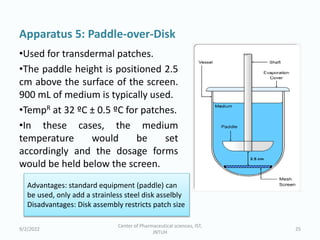
Apparatus 5: Paddle-over-Disk
•Used for transdermal patches.
•The paddle height is positioned 2.5
cm above the surface of the screen.
900 mL of medium is typically used.
•TempR at 32 ºC ± 0.5 ºC for patches.
•In these cases, the medium
temperature would be set
accordingly and the dosage forms
would be held below the screen.
9/2/2022
Center of Pharmaceutical sciences, IST,
JNTUH
25
Advantages: standard equipment (paddle) can
be used, only add a strainless steel disk asselbly
Disadvantages: Disk assembly restricts patch size
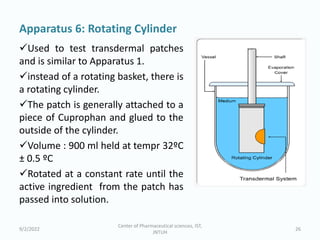
Apparatus 6: Rotating Cylinder
Used to test transdermal patches
and is similar to Apparatus 1.
instead of a rotating basket, there is
a rotating cylinder.
The patch is generally attached to a
piece of Cuprophan and glued to the
outside of the cylinder.
Volume : 900 ml held at tempr 32ºC
± 0.5 ºC
Rotated at a constant rate until the
active ingredient from the patch has
passed into solution.
9/2/2022
Center of Pharmaceutical sciences, IST,
JNTUH
26
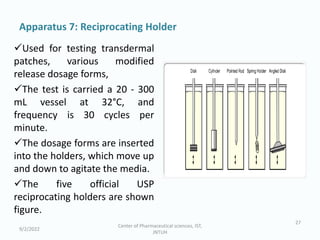
Apparatus 7: Reciprocating Holder
Used for testing transdermal
patches, various modified
release dosage forms,
The test is carried a 20 - 300
mL vessel at 32°C, and
frequency is 30 cycles per
minute.
The dosage forms are inserted
into the holders, which move up
and down to agitate the media.
The five official USP
reciprocating holders are shown
figure.
9/2/2022
Center of Pharmaceutical sciences, IST,
JNTUH
27
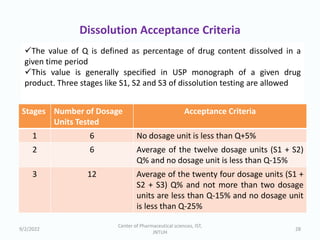
Dissolution Acceptance Criteria
Stages Number of Dosage
Units Tested
Acceptance Criteria
1 6 No dosage unit is less than Q+5%
2 6 Average of the twelve dosage units (S1 + S2)
Q% and no dosage unit is less than Q-15%
3 12 Average of the twenty four dosage units (S1 +
S2 + S3) Q% and not more than two dosage
units are less than Q-15% and no dosage unit
is less than Q-25%
9/2/2022
Center of Pharmaceutical sciences, IST,
JNTUH
28
The value of Q is defined as percentage of drug content dissolved in a
given time period
This value is generally specified in USP monograph of a given drug
product. Three stages like S1, S2 and S3 of dissolution testing are allowed
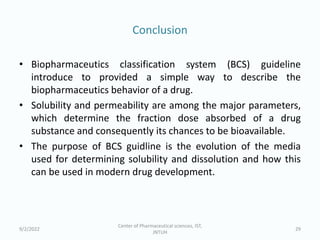
Conclusion
• Biopharmaceutics classification system (BCS) guideline
introduce to provided a simple way to describe the
biopharmaceutics behavior of a drug.
• Solubility and permeability are among the major parameters,
which determine the fraction dose absorbed of a drug
substance and consequently its chances to be bioavailable.
• The purpose of BCS guidline is the evolution of the media
used for determining solubility and dissolution and how this
can be used in modern drug development.
9/2/2022
Center of Pharmaceutical sciences, IST,
JNTUH
29
References
• Siewert M, Dressman J, Brown CK, Shah VP, Aiache JM, Aoyagi N, Bashaw
D, Brown C, Brown W, Burgess D, Crison J. FIP/AAPS guidelines to
dissolution/in vitro release testing of novel/special dosage forms. Aaps
Pharmscitech. 2003 Mar;4(1):43-52.
• Guideline IH. Biopharmaceutics classification system-based biowaivers
M9. Int Counc Harmon Tech Requir Pharm Hum Use. 2018 Jun 7:19.
• Bou-Chacra N, Melo KJ, Morales IA, Stippler ES, Kesisoglou F, Yazdanian M,
Löbenberg R. Evolution of choice of solubility and dissolution media after
two decades of biopharmaceutical classification system. The AAPS journal.
2017 Jul;19(4):989-1001.
• Papich MG, Martinez MN. Applying biopharmaceutical classification
system (BCS) criteria to predict oral absorption of drugs in dogs:
challenges and pitfalls. The AAPS journal. 2015 Jul;17(4):948-64.
9/2/2022
Center of Pharmaceutical sciences, IST,
JNTUH
30
• Tsume Y, Mudie DM, Langguth P, Amidon GE, Amidon GL. The
Biopharmaceutics Classification System: subclasses for in vivo predictive
dissolution (IPD) methodology and IVIVC. European Journal of
Pharmaceutical Sciences. 2014 Jun 16;57:152-63.
• Blume HH, Schug BS. The biopharmaceutics classification system (BCS):
class III drugs—better candidates for BA/BE waiver?. European Journal of
Pharmaceutical Sciences. 1999 Dec 1;9(2):117-21.
• Chavda H, Patel C, Anand I. Biopharmaceutics classification system.
Systematic reviews in pharmacy. 2010;1(1):62.
• Reddy BB, Karunakar A. Biopharmaceutics classification system: A
regulatory approach. Dissolution Technologies. 2011 Feb 1;18(1):31-7.
9/2/2022
Center of Pharmaceutical sciences, IST,
JNTUH
31
Thank you
for your attention
Any question?
9/2/2022
Center of Pharmaceutical sciences, IST,
JNTUH
32

BCS Guideline for solubility and Dissolution.pptx

  • 1.
    Seminar on Biopharmaceutical Classificationsystem (BCS) Guideline for Solubility and Dissolution Center of Pharmaceutical Sciences, IST, JNTUH, Hyderabad-500085 9/2/2022 Center of Pharmaceutical sciences, IST, JNTUH 1 Presented by: Imdad H. Mukeri M. Pharm( Pharmaceutics)
  • 2.
    Table of Contents •Introduction to BCS Guidline for Solubility and Dissolution • Goal of BCS • Determination of High solubility, High permeability and Rapid dissolution • Factor Affecting BCS (Solubility, Permiability and Dissolution • Biopharmaceutical Classification system (BCS) • Dissolution Testing Apparatus as per USP • Conclusion • References 9/2/2022 Center of Pharmaceutical sciences, IST, JNTUH 2
  • 3.
    Introduction to BCS •Biopharmaceutics Classification System (BCS) proposed in 1995 by Amidon et al and his collegues that classified compounds based on their solubility and permeability. • The BCS is a scientific approach based on the aqueous solubility and intestinal permeability characteristics of the drug substance. • BCS has been incorporated in Guidelines for biowaiver granting. Based on aqueous solubility and intestinal permeability the four classes of the BCS represent four distinct expectations of in vitro invivo correlations (IVIVC). 9/2/2022 Center of Pharmaceutical sciences, IST, JNTUH 3
  • 4.
    9/2/2022 Center of Pharmaceuticalsciences, IST, JNTUH 4 The classification system is based on fick’s law applied to a membrane Jw= PwCw Where, Jw = drug flux ( mass/area/time) through the intestinal wall at any position and time Pw = permeability of membrane Cw = Drug conc. At membrane
  • 5.
    Introduction to BCS 9/2/2022 Centerof Pharmaceutical sciences, IST, JNTUH 5
  • 6.
    Introduction to BCS Releaseof drug substance from drug product Dissolution of drug under physiological condition Permeability across the GI tract 9/2/2022 Center of Pharmaceutical sciences, IST, JNTUH 6 Drug absorbance from a solid dosage form following oral administration depents on
  • 7.
    Goals of BCS •To identify the challenges of formulation Design. • To guide decisions w.r.t IVIVC. • To improve the efficiency of drug development and identifying expendable clinical bioequivalence tests. • To explain when a waiver for in vivo bioavailability and bioequivalence may be requested. • To assist in QC in SUPAC. • To recommend a class of immediate-release (IR) solid oral dosage forms for which bioequivalence may be assessed based on in vitro dissolution tests. 9/2/2022 Center of Pharmaceutical sciences, IST, JNTUH 7
  • 8.
    Factors Affecting BCS A.Solubility B. Permeability C. Dissolution 9/2/2022 Center of Pharmaceutical sciences, IST, JNTUH 8 • Drugs are classified according to the BCS in accordance with the solubility, permeability, and dissolution characteristics of the drug
  • 9.
    Solubility • To determinethe solubility of a drug under approximate physiologic conditions. • Determine of pH–solubility profiles over a pH range of 1–8 • The solubility class is determined by calculating what volume of an aqueous medium is sufficient to dissolve the highest anticipated dose strength. • A drug substance is considered highly soluble when the highest dose strength is soluble in 250 mL or less of aqueous medium over the Ph range 1–8. • The drug substance is not stable with >10% degradation over the extent of the solubility assessment, solubility cannot be adequately determined and thus the drug substance cannot be classified. 9/2/2022 Center of Pharmaceutical sciences, IST, JNTUH 9
  • 10.
    Determination of Highsolubility, High permeability and Rapid dissolution Hight soluble • A drug substance is considered highly soluble when the highest dose strength is soluble in 250 mL or less of aqueous medium over the pH range 1 –7.5 Highly Permeable • High permeability is consider high permeable when the absolute bioavailability is ≥85%. • High permeability can also be concluded if ≥85% of the administered dose is recovered in urine as unchanged (parent drug) Rapidly dissolving • A drug product is consider to dissolve rapidly when 85% of the labeled amout of drug substance dissolve within 30 minute using USP Apparatus I & II in a volume of 900 ml buffer solution. 9/2/2022 Center of Pharmaceutical sciences, IST, JNTUH 10
  • 11.
    Biopharmaceutical Classification system(BCS) 9/2/2022 Center of Pharmaceutical sciences, IST, JNTUH 11
  • 12.
    Class I drugs(high solubility/high permeability • The drugs of this class exhibit high absorption number and high dissolution number. • For those class 1 drugs formulated as IR products, dissolution rate generally exceeds gastric emptying. • Behave like an oral solution in-vivo. The rate-limiting step is gastric emptying. • These compounds are well absorbed. Absorption rate is usually higher than the excretion rate. Example Example Diltiazem, Metoprolol , Propanolol etc. 9/2/2022 Center of Pharmaceutical sciences, IST, JNTUH 12
  • 13.
    Class II drugs(low solubility/high permeability) • The drugs of this class have a high absorption number but a low dissolution number. • In vivo drug dissolution is then a rate-limiting step for absorption except at a very high dose number. • The absorption for Class II drugs is usually slower than for Class I and occurs over a longer period of time. • The bioavailability of these products is limited by their solvation rates. • Hence, a correlation between the in vivo bioavailability and the in vitro solvation can be found. Example: Nifedipine, Phenytoin, verapamil etc. 9/2/2022 Center of Pharmaceutical sciences, IST, JNTUH 13
  • 14.
    Class III drugs(high solubility/low permeability) • Drug permeability is the rate-limiting step for drug absorption, but the drug is solvated very quickly. • These drugs exhibit a high variation in the rate and extent of drug absorption. • Since the dissolution is rapid, the variation is attributable to alteration of physiology and membrane permeability rather than the dosage form factors. Example famotidine, cimetidine, Ranitidine, Acyclovir etc. 9/2/2022 Center of Pharmaceutical sciences, IST, JNTUH 14
  • 15.
    Class IV drugs(low solubility/low permeability) • The drugs of this class are problematic for effective oral administration. • These compounds have poor bioavailability. • They are usually not well absorbed through the intestinal mucosa, and a high variability is expected. • Fortunately, extreme examples of Class IV compounds are the exception rather than the rule, and these are rarely developed and marketed. Nevertheless, several Class IV drugs do exist. Example. Furosemide, Cyclosporine, Spiranotacton etc. 9/2/2022 Center of Pharmaceutical sciences, IST, JNTUH 15
  • 16.
    Biopharmaceutical Classification Systemfor Drugs Class Solubility Permiability Absorption Pattern Rate-limiting step in Abs. Example I High High Well Absorption Gstric empitying Diltiazem Metoprolol Propanolol II Low High Variable Dissolution Nifedipine Phenytoin verapamil III High Low Variable Permeability Insule Cimetidine IV Low Low Pooly Absorption Case by Case Furosemide Cyclosporine Spiranotacton 9/2/2022 Center of Pharmaceutical sciences, IST, JNTUH 16
  • 17.
    Dissolution Testing Apparatusas per USP • Dissolution is a process in which a solid substance solubilises in a given solvent i.e. mass transfer from the solid surface to the liquid phase. • The dissolution is based on the in vitro dissolution rate of an IR drug (immediate release) product under specified test conditions and is intended to indicate rapid in vivo dissolution in relation to the average rate of gastric emptying in humans under fasting conditions. 9/2/2022 Center of Pharmaceutical sciences, IST, JNTUH 17 BCS Class Dissolution Methodology I Single point if NLT 85% Q in 15-45 minutes Multiple point if Q < 85% in 15 minutes II Multiple point III Same as class I IV Same as class II Table: Dissolution Methodology for Immediate-Release Products Based on BCS
  • 18.
    Factors that Designthe dissolution test Factors relating to dissolution apparatus The size of the container (several mL to several litres), The shape of the container (round bottomed or flat), Nature of agitation (stirring, rotating or oscillating methods) Speed of agitation, performance precision of the apparatus, etc. Factors relating to dissolution test water, 0.1N HCl, phosphate buffer, simulated gastric fluid, simulated intestinal fluid, etc.), viscosity, volume (generally larger than that needed to completely dissolve the drug under test), temperature (generally 37oC) and maintenance of sink 9/2/2022 Center of Pharmaceutical sciences, IST, JNTUH 18
  • 19.
    Need for DissolutionTesting:  Evaluation of bioavailability.  Batch to batch drug release uniformity.  Development of more efficacious and therapeutically optical dosage forms.  Ensures quality and stability of the product.  Product development, quality control, research and application. 9/2/2022 Center of Pharmaceutical sciences, IST, JNTUH 19
  • 20.
    9/2/2022 Center of Pharmaceuticalsciences, IST, JNTUH 20 Dissolution Apparatus Types as per USP and Their Applications
  • 21.
    Apparatus 1: RotatingBasket  first developed in the 1960s and consists of a shaft with a stirring 40- mesh basket It is rotated continuously at 100– 150 rpm in typically 900 mL of media Constant-temperature bath set at 37°C. It is primarily used for testing beads, tablets and capsules. The basket ensures the dosage form is completely immersed in the media. 9/2/2022 Center of Pharmaceutical sciences, IST, JNTUH 21 Advantages: Full pH change during the test Disadvantages: Sink condition for poorly soluble drug
  • 22.
    Apparatus 2: PaddleMethod Consists of a stainless steel or teflon coated shaft with a paddle that is continuously rotated typically 900 mL of media at at 37°C The most common operating speeds for Apparatus 2 are 50 or 75 rpm for solid oral dosage forms and 25 rpm for oral suspensions. This apparatus has been found to be useful for immediate and modified release forms. 9/2/2022 Center of Pharmaceutical sciences, IST, JNTUH 22 Advatages: esay to use robust Disadvantages: pH/media change is difficult and sink condition for pooly soluble drugs.
  • 23.
    Apparatus 3: Reciprocating Cylinder A set of cylindrical, flat- bottomed glass vessels equipped with reciprocating cylinders for dissolution testing of extended- release products, particularly bead-type modified-release dosage forms.  Agitation rate : 5–30 dpm (dips per minute) at 37°C  Starting at pH 1 and then pH 4.5 and then at pH 6.8 9/2/2022 Center of Pharmaceutical sciences, IST, JNTUH 23 Advantage: •Easy to change the pH •Hydrodynamic can be influenced by varying the dip rate
  • 24.
    Appataus 4: Flow-through-Cell TheFlow Through Cell is used for testing low solubility drugs, those drugs prone to rapid degradation and those systems requiring swift pH changes in the media at 32°C Flow rate ranges from 4 to 32 mL/min. Used for very limited solubility, Microparticles, implnts, suppositories, controlled release formulation . 9/2/2022 Center of Pharmaceutical sciences, IST, JNTUH 24 •Easy to change media pH and maitain sink condition •Two different modes (i) open system (ii) closed system
  • 25.
    Apparatus 5: Paddle-over-Disk •Usedfor transdermal patches. •The paddle height is positioned 2.5 cm above the surface of the screen. 900 mL of medium is typically used. •TempR at 32 ºC ± 0.5 ºC for patches. •In these cases, the medium temperature would be set accordingly and the dosage forms would be held below the screen. 9/2/2022 Center of Pharmaceutical sciences, IST, JNTUH 25 Advantages: standard equipment (paddle) can be used, only add a strainless steel disk asselbly Disadvantages: Disk assembly restricts patch size
  • 26.
    Apparatus 6: RotatingCylinder Used to test transdermal patches and is similar to Apparatus 1. instead of a rotating basket, there is a rotating cylinder. The patch is generally attached to a piece of Cuprophan and glued to the outside of the cylinder. Volume : 900 ml held at tempr 32ºC ± 0.5 ºC Rotated at a constant rate until the active ingredient from the patch has passed into solution. 9/2/2022 Center of Pharmaceutical sciences, IST, JNTUH 26
  • 27.
    Apparatus 7: ReciprocatingHolder Used for testing transdermal patches, various modified release dosage forms, The test is carried a 20 - 300 mL vessel at 32°C, and frequency is 30 cycles per minute. The dosage forms are inserted into the holders, which move up and down to agitate the media. The five official USP reciprocating holders are shown figure. 9/2/2022 Center of Pharmaceutical sciences, IST, JNTUH 27
  • 28.
    Dissolution Acceptance Criteria StagesNumber of Dosage Units Tested Acceptance Criteria 1 6 No dosage unit is less than Q+5% 2 6 Average of the twelve dosage units (S1 + S2) Q% and no dosage unit is less than Q-15% 3 12 Average of the twenty four dosage units (S1 + S2 + S3) Q% and not more than two dosage units are less than Q-15% and no dosage unit is less than Q-25% 9/2/2022 Center of Pharmaceutical sciences, IST, JNTUH 28 The value of Q is defined as percentage of drug content dissolved in a given time period This value is generally specified in USP monograph of a given drug product. Three stages like S1, S2 and S3 of dissolution testing are allowed
  • 29.
    Conclusion • Biopharmaceutics classificationsystem (BCS) guideline introduce to provided a simple way to describe the biopharmaceutics behavior of a drug. • Solubility and permeability are among the major parameters, which determine the fraction dose absorbed of a drug substance and consequently its chances to be bioavailable. • The purpose of BCS guidline is the evolution of the media used for determining solubility and dissolution and how this can be used in modern drug development. 9/2/2022 Center of Pharmaceutical sciences, IST, JNTUH 29
  • 30.
    References • Siewert M,Dressman J, Brown CK, Shah VP, Aiache JM, Aoyagi N, Bashaw D, Brown C, Brown W, Burgess D, Crison J. FIP/AAPS guidelines to dissolution/in vitro release testing of novel/special dosage forms. Aaps Pharmscitech. 2003 Mar;4(1):43-52. • Guideline IH. Biopharmaceutics classification system-based biowaivers M9. Int Counc Harmon Tech Requir Pharm Hum Use. 2018 Jun 7:19. • Bou-Chacra N, Melo KJ, Morales IA, Stippler ES, Kesisoglou F, Yazdanian M, Löbenberg R. Evolution of choice of solubility and dissolution media after two decades of biopharmaceutical classification system. The AAPS journal. 2017 Jul;19(4):989-1001. • Papich MG, Martinez MN. Applying biopharmaceutical classification system (BCS) criteria to predict oral absorption of drugs in dogs: challenges and pitfalls. The AAPS journal. 2015 Jul;17(4):948-64. 9/2/2022 Center of Pharmaceutical sciences, IST, JNTUH 30
  • 31.
    • Tsume Y,Mudie DM, Langguth P, Amidon GE, Amidon GL. The Biopharmaceutics Classification System: subclasses for in vivo predictive dissolution (IPD) methodology and IVIVC. European Journal of Pharmaceutical Sciences. 2014 Jun 16;57:152-63. • Blume HH, Schug BS. The biopharmaceutics classification system (BCS): class III drugs—better candidates for BA/BE waiver?. European Journal of Pharmaceutical Sciences. 1999 Dec 1;9(2):117-21. • Chavda H, Patel C, Anand I. Biopharmaceutics classification system. Systematic reviews in pharmacy. 2010;1(1):62. • Reddy BB, Karunakar A. Biopharmaceutics classification system: A regulatory approach. Dissolution Technologies. 2011 Feb 1;18(1):31-7. 9/2/2022 Center of Pharmaceutical sciences, IST, JNTUH 31
  • 32.
    Thank you for yourattention Any question? 9/2/2022 Center of Pharmaceutical sciences, IST, JNTUH 32