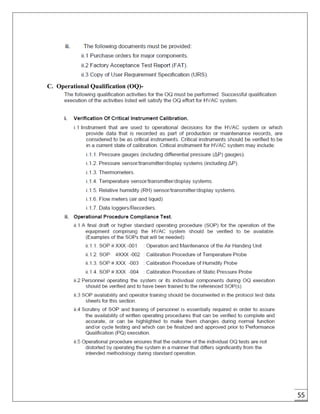
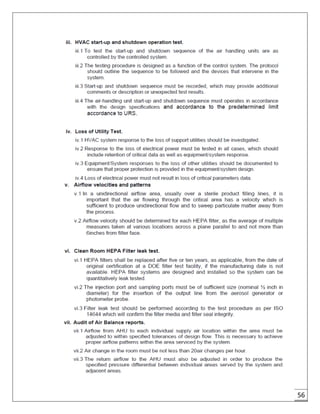
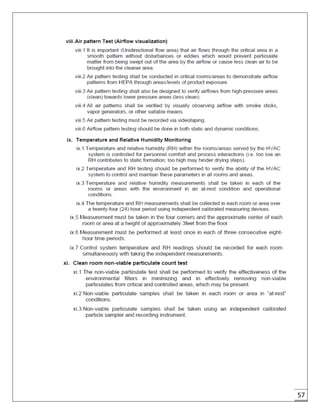
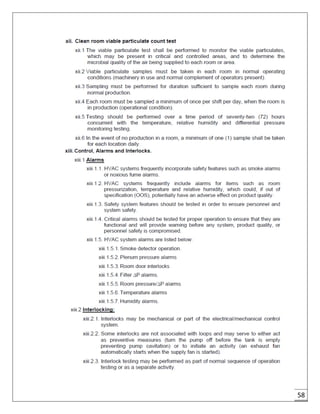
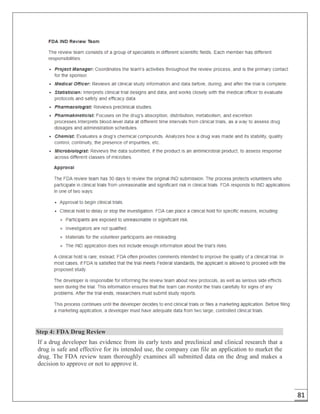
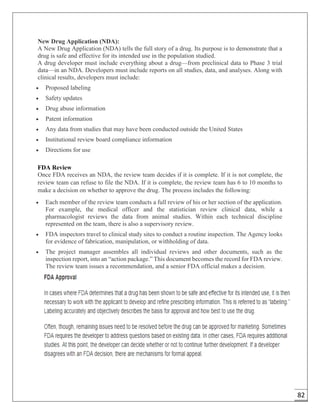
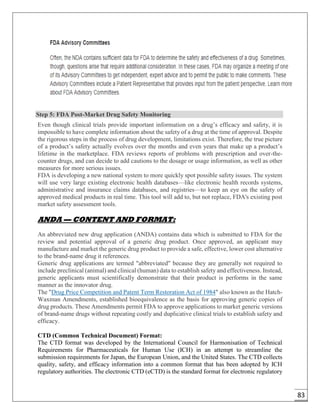
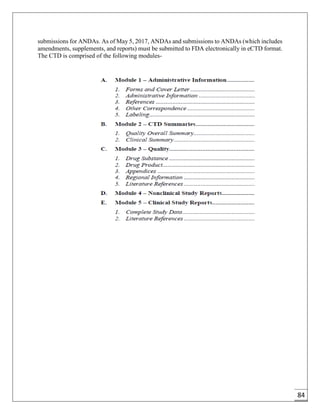
PHARMACEUTICAL VALIDATION
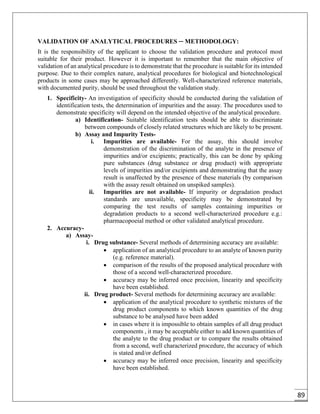
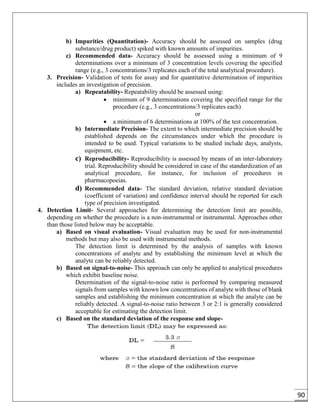
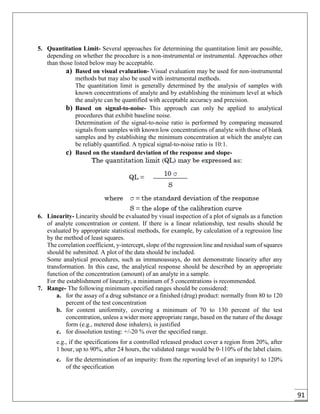
M. Pharm 1st Semester
L. SANATHOIBA SINGHA
1
1. INTRODUCTION
DEFINATION OF QUALIFICATION AND VALIDATION:
Validation- The term validation has been defined by many different authors. Although the
wording may be different, the sense is always the same. One of todayโ€™s commonly accepted
definitions of validation was given by the FDA and it defines validation as 'Establishing
documented evidence which provides a high degree of assurance that a specific process will
consistently produce a product meeting its predetermined specifications and quality attributes.'
Qualification- Qualification is defined as the โ€œaction of proving that any equipment works
correctly and leads to the expected results.โ€ Qualification is also part of validation and is product-
specific.
Qualification is often a part (the initial stage) of validation, but the individual qualification steps
alone do not constitute process validation.
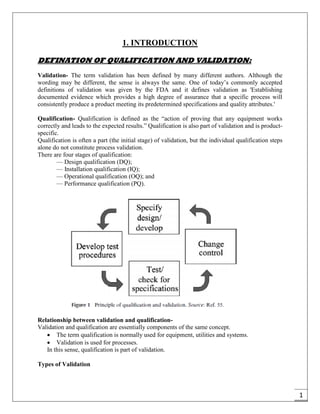
There are four stages of qualification:
โ€” Design qualification (DQ);
โ€” Installation qualification (IQ);
โ€” Operational qualification (OQ); and
โ€” Performance qualification (PQ).
Relationship between validation and qualification-
Validation and qualification are essentially components of the same concept.
๏‚ท The term qualification is normally used for equipment, utilities and systems.
๏‚ท Validation is used for processes.
In this sense, qualification is part of validation.
Types of Validation
2
Process validation or simply called validation may be conducted at different points during the
life cycle of a product. The types of process validation are defined in terms of when they occur
in relation to product design, transfer to production and release of the product for distribution.
i. Prospective Validation
ii. Concurrent Validation
iii. Retrospective Validation
iv. Revalidation
i. Prospective Validation
Prospective validation is conducted before a new product is released for distribution or, where
the revisions may affect the product's characteristics, before a product made under a revised
manufacturing process is released for distribution.
Criteria for performing the prospective validation:
Facilities and equipments should meet GMPs requirements
Personnel has to be trained properly
Critical processing steps and processing variables should be identified and provisional
operational control limits for each critical test parameter should be provided using pilot
laboratory batches (10 x)
Points to be considered:
๏ƒผ Different lots of raw materials should be used.
๏ƒผ Batches should be run in succession on different days
๏ƒผ Batches should be manufactured in equipment and other facilities meant for commercial
production.
๏ƒผ Critical process variables should be set with in their upper and lower limits during process
operation.
๏ƒผ If failure occurs it should be subjected to process requalification and subsequent
revalidation.
ii. Concurrent Validation
Concurrent validation is used for establishing documented evidence that a facility and processes
do what they purport to do, based on information generated during actual imputation of the process.
Concurrent validation is a subset of prospective validation and is conducted with the intention of
ultimately distributing product manufactured during the validation study.
In-process tests that can be monitored in solid and liquid dosage forms are:
๏‚พ Powder-blend uniformity
3
๏‚พ Moisture content
๏‚พ Particle/granule size distribution
๏‚พ Weight variation
๏‚พ Content uniformity
๏‚พ Disintegration time / dissolution time
๏‚พ Tablet hardness
๏‚พ pH value
๏‚พ Colour/clarity
๏‚พ Viscosity/density
๏‚พ Average unit potency
Selection of the in-process test process parameters should be on the basis of the critical
processing variables to be evaluated.
iii. Retrospective Validation
Retrospective validation is the validation of a process based on accumulated historical production,
testing, control, and other information for a product already in production and distribution.
This type of validation makes use of historical data and information which may be found in batch
records, production log books, lot records, control charts, test and inspection results, customer
complaints or lack of complaints, field failure reports, service reports, and audit reports.
Historical data must contain enough information to provide an in-depth picture of how the process
has been operating and whether the product has consistently met its specifications.
Retrospective validation-method:
๏ƒผ Collect commercial values of in-process data and end product testing results.
๏ƒผ Organize these data in chronological order.
๏ƒผ Include data from at least 20-30 batches for analysis.
๏ƒผ Isolate critical processing steps data.
๏ƒผ Subject the data to statistical analysis and evaluation.
๏ƒผ Draw the conclusions on the state of control of the manufacturing process
๏ƒผ Issue a report of findings.
iv. Revalidation
Repeated validation of an approved process (or a part thereof) to ensure continued compliance
with established requirements.
Revalidation should be performed following a change that could have an effect on the process,
procedure, quality of the product and/or the product characteristics.
Revalidation should be performed following a change that could have an effect on the process,
procedure, quality of the product and/or the product characteristics.
4
ADVANTAGES OF VALIDATION:
i. Process parameters and controls are determined during the validation of any process or
system.
ii. It helps to determine the worst case and risks that may arise during the manufacturing of
the quality products.
iii. Validation helps to investigate the deviations caused during the process.
iv. Deep study and understanding of the system and equipment are made possible due to the
validation.
v. The risk of the regulatory non-compliance is minimized after the validation.
vi. A validated process required less process control and the finished product testing.
vii. Batch to batch variation is minimized due to the validation of processes, systems and
equipment.
viii. Reduces the production cost of the product.
ix. Increases the production of manufacturing facility due to the minimized rework and
rejection.
x. Decreases the chances of the failure of the batches.
STREAMLINING OF QUALIFICATION AND VALIDATION
PROCESS:
APPROACH TO PROCESS VALIDATION- In all stages of the product lifecycle, good project
management and good archiving that capture scientific knowledge will make the process
validation program more effective and efficient. Process validation involves a series of activities
taking place over the lifecycle of the product and process.
Stage 1 โ€“ Process Design
Stage 2 โ€“ Process Qualification
Stage 3 โ€“ Continued Process Verification
๏ถ Stage 1 โ€“ Process Design:
Process design is the activity of defining the commercial manufacturing process that will be
reflected in planned master production and control records. The goal of this stage is to design a
process suitable for routine commercial manufacturing that can consistently deliver a product that
meets its quality attributes.
๏ถ Stage 2 โ€“ Process Qualification:
During the process qualification (PQ) stage of process validation, the process design is evaluated
to determine if it is capable of reproducible commercial manufacture. This stage has two
elements:
๏‚ท Design of the facility and qualification of the equipment and utilities and
๏‚ท Process performance qualification (PPQ).
During Stage 2, CGMP-compliant procedures must be followed. Successful completion of Stage
2 is necessary before commercial distribution. Products manufactured during this stage, if
acceptable, can be released for distribution.
5
๏ถ Stage 3 โ€“ Continued Process Verification:
The goal of the third validation stage is continual assurance that the process remains in a state of
control (the validated state) during commercial manufacture.
An ongoing program to collect and analyze product and process data that relate to product quality
must be established. The data collected should include relevant process trends and quality of
incoming materials or components, in-process material, and finished products. The data should be
statistically trended and reviewed by trained personnel. The information collected should verify
that the quality attributes are being appropriately controlled throughout the process.
QUALIFICATION AND VALIDATION PROTOCOLS-
As a minimum the protocols should include the following significant background information:
โ€” the objectives of the study
โ€” the site of the study
โ€” the responsible personnel
โ€” description of SOPs to be followed
โ€” equipment to be used; standards and criteria for the relevant products and processes
โ€” the type of validation
โ€” the processes and/or parameters
โ€” sampling, testing and monitoring requirements
โ€” predetermined acceptance criteria for drawing conclusions.
๏‚ท There should be a description of the way in which the results will be analysed.
๏‚ท The protocol should be approved prior to use. Any changes to a protocol should be
approved prior to implementation of the change.
STEPS IN VALIDATING A PROCESS-
1. Develop validation protocol
2. Conduct installation qualification
3. Conduct operational qualification
4. Conduct performance qualification
5. Analyze results and reach conclusions
6. Monitor and control process
7. Purpose: to ensure process remains within established parameters under anticipated
conditions
8. Investigate deviations from established parameters
9. Take corrective action
10. Consider whether revalidation is necessary.
11. Changes in process or product.
6
QUALIFICATION AND VALIDATION REPORTS-
๏‚ท Reports should reflect the protocols followed and include at least:
๏ƒผ the title and objective of the study
๏ƒผ reference to the protocol
๏ƒผ details of material, equipment, programmes and cycles used
๏ƒผ procedures and test methods.
๏‚ท The results should be evaluated, analysed and compared against the pre-determined
acceptance criteria. The results should meet the acceptance criteria; deviations and out-of-
limit results should be investigated. If these deviations are accepted, this should be
justified. Where necessary further studies should be performed.
๏‚ท The departments responsible for the qualification and validation work should approve the
completed report.
๏‚ท The conclusion of the report should state whether or not the outcome of the qualification
and/or validation was considered successful.
๏‚ท The quality assurance department should approve the report after the final review. The
criteria for approval should be in accordance with the companyโ€™s quality assurance system.
๏‚ท Any deviations found during the validation process should be acted upon and documented
as such. Corrective actions may be required.
VALIDATION MASTER PLAN:
The VMP (Validation Master Plan) serves as the validation roadmap, setting the course, justifying
the strategy, outlining the preliminary test and acceptance criteria and documenting the necessary
programs that ensure a continuing state of validation.
The VMP should be authored for its audience, including the organizationโ€™s quality, engineering,
and regulatory departments, the FDA, and potential outside contractors. Each group looks for
different elements. Outside contractors want a Deliverables List on which to base quotes and define
the scope of work; the FDA looks for the pre-approved intention to comply with Federal
regulations; while in-house quality, engineering, and regulatory departments look for an accurate
representation of systems and corporate policies. The VMP should address all of these concerns.
7
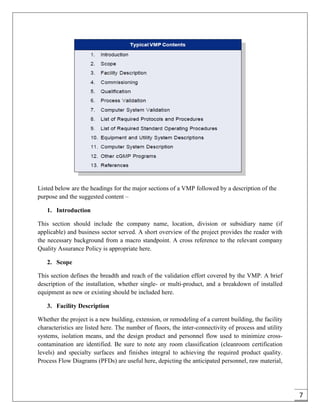
Listed below are the headings for the major sections of a VMP followed by a description of the
purpose and the suggested content โ€“
1. Introduction
This section should include the company name, location, division or subsidiary name (if
applicable) and business sector served. A short overview of the project provides the reader with
the necessary background from a macro standpoint. A cross reference to the relevant company
Quality Assurance Policy is appropriate here.
2. Scope
This section defines the breadth and reach of the validation effort covered by the VMP. A brief
description of the installation, whether single- or multi-product, and a breakdown of installed
equipment as new or existing should be included here.
3. Facility Description
Whether the project is a new building, extension, or remodeling of a current building, the facility
characteristics are listed here. The number of floors, the inter-connectivity of process and utility
systems, isolation means, and the design product and personnel flow used to minimize cross-
contamination are identified. Be sure to note any room classification (cleanroom certification
levels) and specialty surfaces and finishes integral to achieving the required product quality.
Process Flow Diagrams (PFDs) are useful here, depicting the anticipated personnel, raw material,
8
process, and waste material flow. The emphasis here is on design considerations to eliminate cross
contamination of material.
4. Commissioning
Documented here is the selection criteria governing what equipment and utility systems will
undergo Commissioning. As Commissioning is not part of the Validation Program and is not
regulated by the FDA, people often wonder why they should include this section at all. The reason
is the FDA is just as interested in the rationale behind why one system is not validated while
another is. The VMP needs to answer that question, identifying support utilities that do not need
to be validated because they do not directly affect product quality. It also demonstrates thorough-
ness, showing the FDA that all systems have been examined for product quality impact. To
maximize the usefulness of commissioning, the system should be tested within the anticipated
operating range of the respective OQ.
5. Qualification
The selection criteria governing what equipment and utility systems will undergo Qualification is
discussed here. Individual definitions of IQ, OQ, and PQ, may be included. Company policies,
regulatory references, and published guidelines used in this selection process should be addressed.
This discussion may include considerations such as product contacting surfaces, critical/non-
critical instrumentation, direct and indirect systems, and downstream processing, among others. A
discussion of protocol and final report formats may be included here, with either a reference to
existing protocol development procedures, or a description of the format to be utilized. Final
Reports may be generated as attachments to the protocols themselves, or as separate documents.
6. Process Validation
This section addresses the selection criteria governing what equipment and utility systems need to
undergo Process Validation. Company policies, regulatory references, and published guidelines
utilized in the selection process should be addressed. One such criteria is if the โ€œresults of a process
cannot be fully verified by subsequent inspection and test, the process shall be validatedโ€ฆ.โ€. Also
included is a discussion on the appropriate Cleaning Validations (CV) required to verify inter- and
intra-campaign cleaning methods. If this is to be a finished product, Packaging and Sterility
validation needs to be addressed.
7. Computer System Validation
A separate section should be devoted to the discussion of Computer Validation, whether that is in
the form of a Programmable Logic Controller (PLC) or a Distributed Control System (DCS).
Computer Validation criteria also should be discussed, and whether the installed control system is
to be 21 CFR 11 compliant, i.e., secure audit trails, authority checks, etc.
9
8. List of Required Protocols and Procedures
Include here a tabular representation of the equipment and utility systems, and the required
protocols and procedures associated with each. This is the essence of the VMP because it defines
the validation requirements for the project, and can be used to determine resource loading. This
table can subsequently be used as a โ€œDeliverables Listโ€ if the validation effort is contracted outside
of the organization.
9. List of Required Standard Operating Procedures (SOPs)
This should take the form of a tabular representation of the installed equipment and utility systems
and the required SOP associated with each, similar to the List of Required Protocols and
Procedures. This will help identify the level of SOP generation necessary to complete validation
activities. These will generally take the form of Operation, Maintenance, and Cleaning SOPs.
10. Equipment and Utility System Descriptions
An overview of the particular system should be given, aligned with the Basis of Design
documentation. A listing of proposed Qualification tests (IQ/OQ/PQ) should be identified with a
brief description of the procedure and how the associated Acceptance Criteria will be determined.
As the VMP should be developed early in the planning stage, many system specifics will be in the
draft phase and subject to change. To avoid duplication of effort and unnecessary revisions, do not
assign numeric-specific Acceptance Criteria in the VMP. Those details will be fully delineated in
the respective Qualification and Validation protocols that will follow. Keep in mind the intent of
the VMP as a scope and guidance document. System specific acceptance criteria fall under the
auspices of the individual protocols.
11. Additional cGMP Programs
The VMP is meant to be a Validation Life Cycle document. It should cover the activities and
requirements from project inception to testing completion and on through a program of continuous
monitoring and evaluation. Associated with this effort are Quality Assurance/Quality Control
procedures meant to support and update the validation effort. These programs include, but are not
limited to:
๏‚ท Document/Change Control
๏‚ท Standard Operating Procedures
๏‚ท Calibration
๏‚ท Revalidation
๏‚ท Operator Training
12. References
All company policies and procedures, as well as any applicable local, state and federal regulations,
and industry standards referenced should be listed.
10
QUALIFICATION
USER REQUIREMENT SPECIFICATION:
User Requirement Specification (URS) is a list of all requirements of buyer regarding the
equipment to be purchased. URS is prepared by the equipment user department. It is sent to
equipment manufacturer to make it as desired criteria.
Following points should be included in a pharmaceutical user requirement specification:
1. Introduction
A brief introduction of the equipment should be written.
2. Overview
i. Intended Use: Write the use of the equipment in the manufacturing.
ii. Capacity: Write the required capacity if the equipment in the liter or kgs.
iii. Space Availability: Write the available space for installation of the equipment
including height, width and height in mm.
iv. Accuracy of Instrument: Write the desired accuracy of the instrument in decimal
places if applicable.
v. Cleaning Requirements: Instrument should be easy to clean. Write, if there is any
specific cleaning requirement.
vi. Equipment Specific Requirements: for example, required quality of Stainless
Steel (SS) as SS-308, SS-316 or SS-316L if applicable.
3. Operational Requirements
i. Functional Requirements: Specify all technical requirements for the equipment.
ii. Operation: Write the operational requirements.
iii. Control System: Specify ON, OFF or other specific equipment control
requirements.
iv. Power: Write the requirements on power failure as autostart or manual.
v. Safety: Write the requirements of safety guard and MCB trips on short circuit or
overload
vi. Environment: Temperature and humidity of the area where the equipment will be
installed.
vii. Other Requirements: Write the other requirements as the metal of construction
(MOC) of non-contact parts and specific requirements of seals and tubing.
4. Compatibility and Support
i. Utilities: Available power supply on which instrument shall be operated. The
requirement of the uninterrupted power supply (UPS) and other specific utility
requirements.
ii. Availability: Continuous operating time of the equipment in hours or working
shifts.
11
iii. Supporting Documents: Requirements of operating manual, circuit diagrams,
warranty letter, change part list, spare part list etc.
5. Abbreviations
List all abbreviations used in this user requirement specification document.
6. References
7. Approval
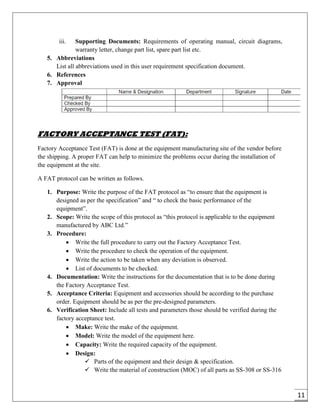
FACTORY ACCEPTANCE TEST (FAT):
Factory Acceptance Test (FAT) is done at the equipment manufacturing site of the vendor before
the shipping. A proper FAT can help to minimize the problems occur during the installation of
the equipment at the site.
A FAT protocol can be written as follows.
1. Purpose: Write the purpose of the FAT protocol as โ€œto ensure that the equipment is
designed as per the specificationโ€ and โ€œ to check the basic performance of the
equipmentโ€.
2. Scope: Write the scope of this protocol as โ€œthis protocol is applicable to the equipment
manufactured by ABC Ltd.โ€
3. Procedure:
๏‚ท Write the full procedure to carry out the Factory Acceptance Test.
๏‚ท Write the procedure to check the operation of the equipment.
๏‚ท Write the action to be taken when any deviation is observed.
๏‚ท List of documents to be checked.
4. Documentation: Write the instructions for the documentation that is to be done during
the Factory Acceptance Test.
5. Acceptance Criteria: Equipment and accessories should be according to the purchase
order. Equipment should be as per the pre-designed parameters.
6. Verification Sheet: Include all tests and parameters those should be verified during the
factory acceptance test.
๏‚ท Make: Write the make of the equipment.
๏‚ท Model: Write the model of the equipment here.
๏‚ท Capacity: Write the required capacity of the equipment.
๏‚ท Design:
๏ƒผ Parts of the equipment and their design & specification.
๏ƒผ Write the material of construction (MOC) of all parts as SS-308 or SS-316
12
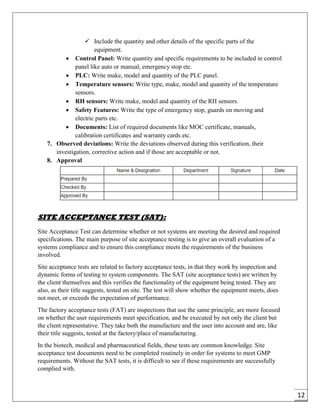
๏ƒผ Include the quantity and other details of the specific parts of the
equipment.
๏‚ท Control Panel: Write quantity and specific requirements to be included in control
panel like auto or manual, emergency stop etc.
๏‚ท PLC: Write make, model and quantity of the PLC panel.
๏‚ท Temperature sensors: Write type, make, model and quantity of the temperature
sensors.
๏‚ท RH sensors: Write make, model and quantity of the RH sensors.
๏‚ท Safety Features: Write the type of emergency stop, guards on moving and
electric parts etc.
๏‚ท Documents: List of required documents like MOC certificate, manuals,
calibration certificates and warranty cards etc.
7. Observed deviations: Write the deviations observed during this verification, their
investigation, corrective action and if those are acceptable or not.
8. Approval
SITE ACCEPTANCE TEST (SAT):
Site Acceptance Test can determine whether or not systems are meeting the desired and required
specifications. The main purpose of site acceptance testing is to give an overall evaluation of a
systems compliance and to ensure this compliance meets the requirements of the business
involved.
Site acceptance tests are related to factory acceptance tests, in that they work by inspection and
dynamic forms of testing to system components. The SAT (site acceptance tests) are written by
the client themselves and this verifies the functionality of the equipment being tested. They are
also, as their title suggests, tested on site. The test will show whether the equipment meets, does
not meet, or exceeds the expectation of performance.
The factory acceptance tests (FAT) are inspections that use the same principle, are more focused
on whether the user requirements meet specification, and be executed by not only the client but
the client representative. They take both the manufacture and the user into account and are, like
their title suggests, tested at the factory/place of manufacturing.
In the biotech, medical and pharmaceutical fields, these tests are common knowledge. Site
acceptance test documents need to be completed routinely in order for systems to meet GMP
requirements. Without the SAT tests, it is difficult to see if these requirements are successfully
complied with.
13
The SAT is a test of not only efficiency but quality. It is up to senior management and committed
staff to keep a track of system software levels across different departments. By conducting an
SAT, quality assurance is met, along with good manufacturing practice, safe quality risk
management and efficient quality control checks.
There are various elements of a Site Acceptance Test that will be included in the test to ensure its
success. These include: Finishing visual checks, main components visual checks, internal box
pressure and ventilation setting checks, the functionality of utilities to be checked, the interlocks
to be checked in relation to functionality, a hot test for dispensing systems, calibrator
verifications, safety devices checks and tests of the operatorโ€™s training and ability.
Issues can be rectified before they have the potential to cause damage or harm, which also allows
for projects to be kept on track and, if applicable, on budget. Site acceptance tests arenโ€™t just used
in the pharmaceutical fields. They stem across all borders of engineering, even into traffic signal
equipment! By conducting an SAT all users are able to acknowledge a system is doing its job
right.
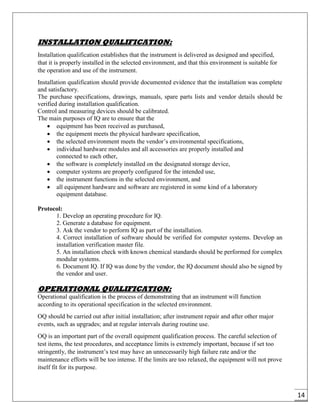
DESIGN QUALIFICATION:
Documented evidence that the premises, supporting systems, utilities, equipment and processes
have been designed in accordance with the requirements of GMP
Design qualification should provide documented evidence that the design specifications were met.
DQ should ensure that instruments have all the necessary functions and performance that will
enable them to be successfully implemented for the intended application and to meet business
requirements.
While IQ, OQ, and PQ are being performed in most regulated laboratories, DQ is not so well
known to many laboratories. It is rarely performed officially in those cases where the equipment
is planned for use in multiple applications, not in a specific one.
DQ is performed in most laboratories but are not called DQ. DQ is officially required by Annex
15 of the EU Guide for Good Manufacturing Practices. Therefore inspectors from Europe and from
other PIC/S member countries are quite familiar with the term and may ask for DQ documents.
An FDA inspector may ask for documented user requirements.
14
INSTALLATION QUALIFICATION:
Installation qualification establishes that the instrument is delivered as designed and specified,
that it is properly installed in the selected environment, and that this environment is suitable for
the operation and use of the instrument.
Installation qualification should provide documented evidence that the installation was complete
and satisfactory.
The purchase specifications, drawings, manuals, spare parts lists and vendor details should be
verified during installation qualification.
Control and measuring devices should be calibrated.
The main purposes of IQ are to ensure that the
๏‚ท equipment has been received as purchased,
๏‚ท the equipment meets the physical hardware specification,
๏‚ท the selected environment meets the vendorโ€™s environmental specifications,
๏‚ท individual hardware modules and all accessories are properly installed and
connected to each other,
๏‚ท the software is completely installed on the designated storage device,
๏‚ท computer systems are properly configured for the intended use,
๏‚ท the instrument functions in the selected environment, and
๏‚ท all equipment hardware and software are registered in some kind of a laboratory
equipment database.
Protocol:
1. Develop an operating procedure for IQ.
2. Generate a database for equipment.
3. Ask the vendor to perform IQ as part of the installation.
4. Correct installation of software should be verified for computer systems. Develop an
installation verification master file.
5. An installation check with known chemical standards should be performed for complex
modular systems.
6. Document IQ. If IQ was done by the vendor, the IQ document should also be signed by
the vendor and user.
OPERATIONAL QUALIFICATION:
Operational qualification is the process of demonstrating that an instrument will function
according to its operational specification in the selected environment.
OQ should be carried out after initial installation; after instrument repair and after other major
events, such as upgrades; and at regular intervals during routine use.
OQ is an important part of the overall equipment qualification process. The careful selection of
test items, the test procedures, and acceptance limits is extremely important, because if set too
stringently, the instrumentโ€™s test may have an unnecessarily high failure rate and/or the
maintenance efforts will be too intense. If the limits are too relaxed, the equipment will not prove
itself fit for its purpose.
15
The general procedure to qualify an instrument for operation is as follows:
1. Define the intended use and the functional and operational specifications (use criteria
as defined during DQ).
2. Develop test procedures and protocols.
3. Define acceptance criteria.
4. Perform the tests.
5. Check if test results meet acceptance criteria
6. Document the results.
7. Develop criteria and steps for requalification, e.g., after repair.
8. Develop procedures in case the equipment does not perform to specifications.
PERFORMANCE QUALIFICATION:
Performance qualification (PQ) is the process of demonstrating that an instrument consistently
performs according to a specification appropriate for its routine use.
Ongoing activities may include the following:
1. Preventive instrument maintenance
2. Regular calibration
3. Full or partial OQ checks
4. Daily check of critical performance characteristics, for example, baseline noise of a
UV detector if limit of detection is critical
5. Daily system suitability testing
6. Analysis of blanks
7. Duplicate analysis
8. Analysis of QC samples
9. Procedures to detect, record, and handle errors and other unforeseen events
10. Regular security checks
11. Changes to the system in a controlled manner and controlled requalification after the
change, if necessary
12. Internal audits
13. Participation in proficiency testing schemes
14. Ongoing training programs for employees.
16
General procedures:
1. Develop an equipment logbook.
2. Develop maintenance procedures (with the help of the vendor).
3. Develop procedures and acceptance limits for performance testing (criteria:
regulations, instrument type, application, performance requirements).
RE-QUALIFICATION:
Requalification means ensuring that the equipment is still in the qualified state after a change and
periodical assessment of the equipment within defined time intervals.
Strictly speaking, requalification is not mentioned in Annexure 15 of the EU guidelines to GMP,
which is the guidance document for qualification in Europe. But revalidation is described and since
qualification is considered to be a subset of validation, a requalification also is required. There is
no setting of time standards. But it should be stipulated when a periodically recurring
requalification has to be carried out. These requirements should not be taken and met on a general
basis but system-related and risk-based. In many cases this is every 3 to 5 years. But in the case of
a fully automated system for the visual inspection of parenterals for example, it could be scheduled
already every 1 to 2 years. It is very important that this requalification is not understood as a
repetition of qualification.
Usually, no new tests or measurements are necessary insofar as the equipment concerned was not
changed. Here, requalification is rather a review of data from routine operation. Hence, the quality-
related equipment or specification parameters are to be considered and analysed as well as the
changes in the equipment and the deviations that took place in the period considered.
An analysis of the logbook should also be part of this evaluation. The document should end with
a conclusion that informs about the equipment's state: equipment still is considered to be qualified:
Yes / No.
MAINTAINING STATUS FOR CALIBRATION:
The quality of the products manufactured by any enterprise can directly be associated with the
accuracy of the instruments producing them. If the instruments are not calibrated properly, or if
they are damaged and need repair work, they will surely affect the end products. ISO calibration
lists out the general requirements for the competence of testing and calibration laboratories. All
the labs must adhere to service specifications developed by the International Organization for
Standardization.
It is important to remember that instruments and equipment will not always stay calibrated. At
some point, the level of calibration will go down and it will affect the final measurements and
quality of the products. The instruments and equipment must be kept in excellent condition at all
17
times. Preventive maintenance and repair, and recalibration of the instruments are performed
regularly.
Variables determining how frequently instruments should be calibrated or re-calibrated:
i. Manufacturersโ€™ Recommendations:
Every manufacturer mentions the ideal time frame of when you should recalibrate an
instrument. Follow these instructions and specifications to the letter and you will face
minimum maintenance issues. It is extremely important to remember that critical
measurements may call for greater frequency.
ii. Annually or Biannually:
Some instruments need to be re-calibrated once or twice every year. It depends on how
often the critical measurements are taken. Additionally, the amount of damage sustained
by the instruments during use also plays a role.
iii. After a Damaging Incident:
If any instrument was damaged in an accident, if it was dropped hard or if it sustained any
kind of injury, you must calibrate it immediately. Events where the instruments sustain
damage usually experience a sharp impact that directly affects their readings. Check if the
calibration was altered and carry out the necessary calibration procedures.
iv. As Demanded by Projects:
When you carry out certain assignments, you have to use certified and calibrated test
equipment, irrespective of how big or small the project is. When assignments call for such
calibration based on project requirements, you must follow it.
v. Before or After a Major Project:
Some major projects require extremely accurate measurements. This means that the
instruments must be calibrated before the project starts. However, it doesnโ€™t end there.
You must calibrate all the instruments that were used after the project comes to an end.
Post-project calibration will show you if the testing that you conducted is indeed reliable
or not, if the correct and consistent measurements were observed throughout the project.
vi. Semiannually, Quarterly or Monthly:
Some instruments, based on their use and functions, need to be calibrated frequently. If
you deal with critical measurements quite frequently, it would be ideal that you conduct
frequent and consistent calibration check-ups, like every month or every three to six
months.
18
PREVENTIVE MAINTENANCE:
Preventive maintenance (PM) or preventative maintenance is maintenance that is regularly
performed on a piece of equipment to lessen the likelihood of it failing. It is performed while the
equipment is still working so that it does not break down unexpectedly.
Maintenance and service-related items are often the second-largest budget element in a laboratory
after salaries and benefits. Within maintenance, preventive maintenance (PM) is a substantial
portion of the budget. Traditionally, PM was an equipment maintenance philosophy based on
replacing, overhauling or remanufacturing a piece of equipment at fixed intervals, regardless of its
condition at the time. In essence, it involved fixing something that wasn't necessarily broken and
this approach is still widely used in the pharmaceutical industry.
The typical rationale for performing PM includes:
โ€ข Original equipment manufacturer (OEM) recommendations.
โ€ข Maintaining the performance specifications of an instrument.
โ€ข Meeting regulatory requirements.
โ€ข Maximizing uptime and minimizing corrective maintenance.
โ€ข Increasing the life of the instrument.
โ€ข Assuring end-user productivity and efficiency.
Risk assessment-
There are two major risks to consider when establishing a PM programme:
๏‚ท complying with regulatory issues and
๏‚ท finding the right balance between over- and under-maintaining instruments and
equipment.
There are two factors that must be taken into account to ensure the PM programme achieves a
satisfactory level of maintenance:
๏‚ท The first factor is equipment failure. If the performance degrades slowly as the parts
wear, it is critical that PM is performed to keep the equipment operating within
specification.
๏‚ท The second consideration is to ensure that mechanical parts subject to wear are included
in programmes for replacement, cleaning and lubrication. These parts are vulnerable to
the forces of friction and need to be replaced.
The main issue with equipment regarding mechanical parts is the frequency of PM because the
degree of wear is directly related to the usage rate. Schedules are generally based upon the
maximum usage rate so parts for equipment that are not 100% utilized may be replaced long
before they experience significant wear.
19
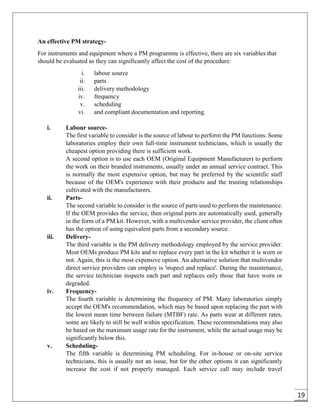
An effective PM strategy-
For instruments and equipment where a PM programme is effective, there are six variables that
should be evaluated as they can significantly affect the cost of the procedure:
i. labour source
ii. parts
iii. delivery methodology
iv. frequency
v. scheduling
vi. and compliant documentation and reporting.
i. Labour source-
The first variable to consider is the source of labour to perform the PM functions. Some
laboratories employ their own full-time instrument technicians, which is usually the
cheapest option providing there is sufficient work.
A second option is to use each OEM (Original Equipment Manufacturer) to perform
the work on their branded instruments, usually under an annual service contract. This
is normally the most expensive option, but may be preferred by the scientific staff
because of the OEM's experience with their products and the trusting relationships
cultivated with the manufacturers.
ii. Parts-
The second variable to consider is the source of parts used to perform the maintenance.
If the OEM provides the service, then original parts are automatically used, generally
in the form of a PM kit. However, with a multivendor service provider, the client often
has the option of using equivalent parts from a secondary source.
iii. Delivery-
The third variable is the PM delivery methodology employed by the service provider.
Most OEMs produce PM kits and to replace every part in the kit whether it is worn or
not. Again, this is the most expensive option. An alternative solution that multivendor
direct service providers can employ is 'inspect and replace'. During the maintenance,
the service technician inspects each part and replaces only those that have worn or
degraded.
iv. Frequency-
The fourth variable is determining the frequency of PM. Many laboratories simply
accept the OEM's recommendation, which may be based upon replacing the part with
the lowest mean time between failure (MTBF) rate. As parts wear at different rates,
some are likely to still be well within specification. These recommendations may also
be based on the maximum usage rate for the instrument, while the actual usage may be
significantly below this.
v. Scheduling-
The fifth variable is determining PM scheduling. For in-house or on-site service
technicians, this is usually not an issue, but for the other options it can significantly
increase the cost if not properly managed. Each service call may include travel
20
expenses and minimum charges so it is beneficial to minimize the number and
frequency of appointments. It is common practice to group equipment for a particular
vendor so that multiple PMs can be completed in one visit.
vi. Reporting-
The sixth variable is compliant documentation and reporting.The client expectation is
that the service provider will always generate the correct documents in the proper form
to meet the requirements of the standard. However, this confidence is not always
warranted because the quality of these documents can vary greatly depending on the
expertise of the provider and, thus, random internal audits of the records are always
recommended.
CHANGE MANAGEMENT:
Change management is a systematic approach to dealing with the transition or transformation of
an organization's goals, processes or technologies. The purpose of change management is to
implement strategies for effecting change, controlling change and helping people to adapt to
change.
In the pharmaceutical industry, a change and deviation management system (CMS) is a central
part of the overall quality management system for drug product manufacture. According to the
FDA and International Conference on Harmonisation (ICH), a formal CMS should be established
to evaluate all changes that could affect the production and control of the drug product,
intermediate or API in a pharmaceutical manufacturing company.
FDA requirements and typical failures-
The FDA considers change control a very critical GMP compliance issue; therefore it has been
one of the main criteria used by the agency in determining their drug inspection depth and
coverage, and their decision for follow-up regulatory actions (e.g., Warning Letter issuance). The
FDA's strategy for drug inspection and follow-up is evidenced in their systems inspection
programme introduced in 2002 for drug product inspection, and in 2006 for API inspection.
Typical major GMP deficiencies related to CMS include:
๏‚ท The failure to evaluate FDA filing requirements; i.e., whether to file for a prior
approval or changes being effected, or to report the change in the next annual report.
๏‚ท The failure to file changes with the FDA.
๏‚ท The failure to evaluate and/or justify whether equipment/system requalification is
needed to support an equipment/system change, and whether process revalidation,
stability studies or equivalency studies are required to support a process and/or
processing parameter change.
๏‚ท The inadequate review and approval of the change by the quality control unit.
๏‚ท The FDA expects the intimate involvement of the quality control unit in the change
control review and approval process, and usually holds the quality control unit
responsible for deficiencies regarding change control, which again can be
evidenced in several Warning Letters issued in the past years.
21
One example of this FDA expectation was documented in a Warning Letter issued
by the FDA in 2003. A company performed a routine replacement of the filling
pump pistons, without filing a change request because it was a "like to like"
replacement (which has been a typical industry practice). Although the replacement
pistons had the same part number as the original pistons, they were slightly longer.
This longer dimension caused the pistons to come into contact with the bottom of
the filling blocks, resulting in the generation of metal particles, which contaminated
the product batches. This metal contamination resulted in the recall of several
product batches and the FDA's issuance of a Warning Letter.
Implementing an effective CMS (Change Management System)-
๏‚ท Quality risk management should be used to evaluate proposed changes.
๏‚ท Proposed changes should be evaluated by expert teams contributing the appropriate
expertise and knowledge from relevant areas (e.g., pharmaceutical development,
manufacturing, quality, regulatory affairs and medical) to ensure the change is technically
justified.
๏‚ท After implementation, an evaluation of the change should be undertaken to confirm the
change objectives were achieved and that there was no deleterious impact on product
quality.
๏‚ท Develop a change management tracking system to facilitate effective change control.
A new paradigm for managing change in an ideal environment is electronic-based CMS; a
solution that smoothly complies with the above mentioned requirements and provides a means of
bypassing potential barriers and obstacles.
22
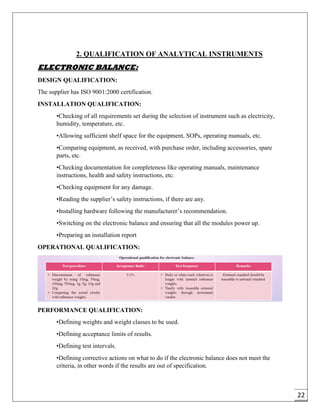
2. QUALIFICATION OF ANALYTICAL INSTRUMENTS
ELECTRONIC BALANCE:
DESIGN QUALIFICATION:
The supplier has ISO 9001:2000 certification.
INSTALLATION QUALIFICATION:
โ€ขChecking of all requirements set during the selection of instrument such as electricity,
humidity, temperature, etc.
โ€ขAllowing sufficient shelf space for the equipment, SOPs, operating manuals, etc.
โ€ขComparing equipment, as received, with purchase order, including accessories, spare
parts, etc.
โ€ขChecking documentation for completeness like operating manuals, maintenance
instructions, health and safety instructions, etc.
โ€ขChecking equipment for any damage.
โ€ขReading the supplierโ€™s safety instructions, if there are any.
โ€ขInstalling hardware following the manufacturerโ€™s recommendation.
โ€ขSwitching on the electronic balance and ensuring that all the modules power up.
โ€ขPreparing an installation report
OPERATIONAL QUALIFICATION:
PERFORMANCE QUALIFICATION:
โ€ขDefining weights and weight classes to be used.
โ€ขDefining acceptance limits of results.
โ€ขDefining test intervals.
โ€ขDefining corrective actions on what to do if the electronic balance does not meet the
criteria, in other words if the results are out of specification.
23
24
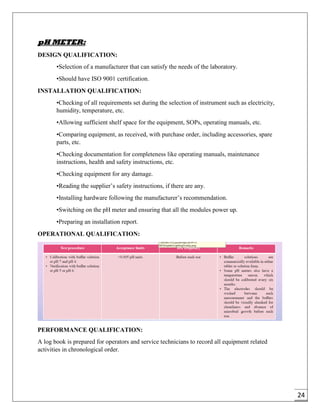
pH METER:
DESIGN QUALIFICATION:
โ€ขSelection of a manufacturer that can satisfy the needs of the laboratory.
โ€ขShould have ISO 9001 certification.
INSTALLATION QUALIFICATION:
โ€ขChecking of all requirements set during the selection of instrument such as electricity,
humidity, temperature, etc.
โ€ขAllowing sufficient shelf space for the equipment, SOPs, operating manuals, etc.
โ€ขComparing equipment, as received, with purchase order, including accessories, spare
parts, etc.
โ€ขChecking documentation for completeness like operating manuals, maintenance
instructions, health and safety instructions, etc.
โ€ขChecking equipment for any damage.
โ€ขReading the supplierโ€™s safety instructions, if there are any.
โ€ขInstalling hardware following the manufacturerโ€™s recommendation.
โ€ขSwitching on the pH meter and ensuring that all the modules power up.
โ€ขPreparing an installation report.
OPERATIONAL QUALIFICATION:
PERFORMANCE QUALIFICATION:
A log book is prepared for operators and service technicians to record all equipment related
activities in chronological order.
25
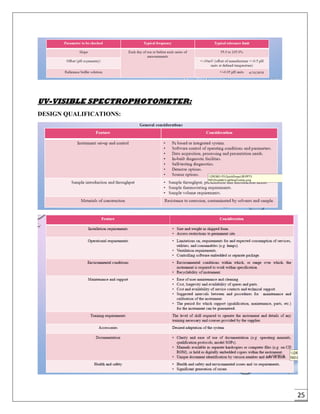
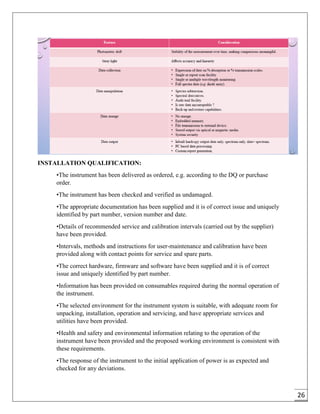
UV-VISIBLE SPECTROPHOTOMETER:
DESIGN QUALIFICATIONS:
26
INSTALLATION QUALIFICATION:
โ€ขThe instrument has been delivered as ordered, e.g. according to the DQ or purchase
order.
โ€ขThe instrument has been checked and verified as undamaged.
โ€ขThe appropriate documentation has been supplied and it is of correct issue and uniquely
identified by part number, version number and date.
โ€ขDetails of recommended service and calibration intervals (carried out by the supplier)
have been provided.
โ€ขIntervals, methods and instructions for user-maintenance and calibration have been
provided along with contact points for service and spare parts.
โ€ขThe correct hardware, firmware and software have been supplied and it is of correct
issue and uniquely identified by part number.
โ€ขInformation has been provided on consumables required during the normal operation of
the instrument.
โ€ขThe selected environment for the instrument system is suitable, with adequate room for
unpacking, installation, operation and servicing, and have appropriate services and
utilities have been provided.
โ€ขHealth and safety and environmental information relating to the operation of the
instrument have been provided and the proposed working environment is consistent with
these requirements.
โ€ขThe response of the instrument to the initial application of power is as expected and
checked for any deviations.
27
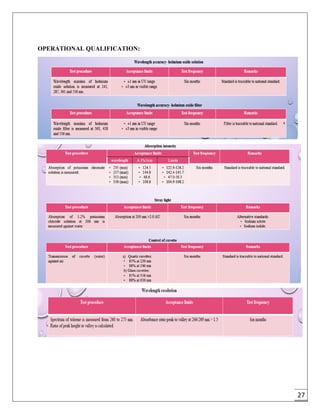
OPERATIONAL QUALIFICATION:
28
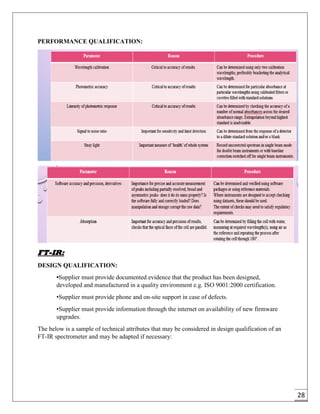
PERFORMANCE QUALIFICATION:
FT-IR:
DESIGN QUALIFICATION:
โ€ขSupplier must provide documented evidence that the product has been designed,
developed and manufactured in a quality environment e.g. ISO 9001:2000 certification.
โ€ขSupplier must provide phone and on-site support in case of defects.
โ€ขSupplier must provide information through the internet on availability of new firmware
upgrades.
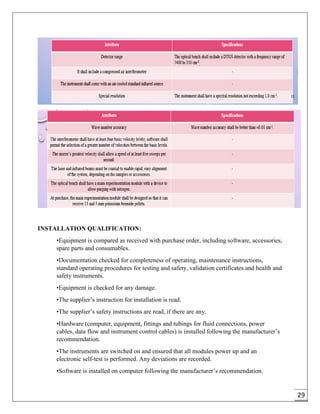
The below is a sample of technical attributes that may be considered in design qualification of an
FT-IR spectrometer and may be adapted if necessary:
29
INSTALLATION QUALIFICATION:
โ€ขEquipment is compared as received with purchase order, including software, accessories,
spare parts and consumables.
โ€ขDocumentation checked for completeness of operating, maintenance instructions,
standard operating procedures for testing and safety, validation certificates and health and
safety instruments.
โ€ขEquipment is checked for any damage.
โ€ขThe supplierโ€™s instruction for installation is read.
โ€ขThe supplierโ€™s safety instructions are read, if there are any.
โ€ขHardware (computer, equipment, fittings and tubings for fluid connections, power
cables, data flow and instrument control cables) is installed following the manufacturerโ€™s
recommendation.
โ€ขThe instruments are switched on and ensured that all modules power up and an
electronic self-test is performed. Any deviations are recorded.
โ€ขSoftware is installed on computer following the manufacturerโ€™s recommendation.
30
โ€ขCorrect software installation is verified.
โ€ขA backup copy of software is made.
โ€ขPeripherals e.g. printers and equipment modules are configured.
โ€ขA list with a description of all hardware are identified and made, including drawings
where appropriate.
โ€ขA list with a description of all software installed on the computer is made.
โ€ขEquipment manuals and SOPs are listed.
โ€ขAn installation report is prepared.
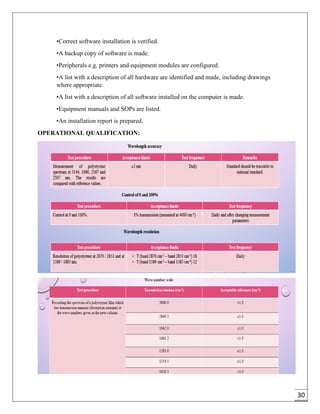
OPERATIONAL QUALIFICATION:
31
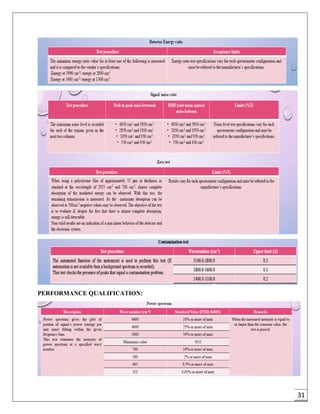
PERFORMANCE QUALIFICATION:
32
Wave number accuracy
The wave number scale is usually calibrated by the use of several characteristics wave numbers
of a polystyrene film:
โ€ข3060.0 (ยฑ/-1.5) cm-1
โ€ข2849.5 (ยฑ/-1.5) cm-1
โ€ข1942.9 (ยฑ/-1.5) cm-1
โ€ข1601.2 (ยฑ/-1.0) cm-1
โ€ข1583.0 (ยฑ/-1.0) cm-1
โ€ข1154.5 (ยฑ/-1.0) cm-1
โ€ข1028.3 (ยฑ/-1.0) cm-1
The software then judges whether the values are within the allowable range and the program
labels the results โ€˜PASSโ€™ if all the peak numbers are within the range.
Wave number reproducibility:
โ€ขThis program specifies three points to measure the peak wave numbers.
โ€ขThen it obtains the actual peak wave numbers at each point by measuring the
polystyrene film twice.
โ€ขIt should satisfy 5 cm-1around 3000 cm-1of polystyrene absorption wave number, 1 cm-
1around 1000 cm-1.
โ€ขThe software determines whether the differences between each of two measurements are
within the allowable range and it labels the result โ€˜PASSโ€™ if they are within the range.
Transmittance reproducibility:
โ€ขThis program specifies peak wave number at three points and the transmittance at each
point is measured twice.
โ€ขThe transmittance reproducibility should satisfy 0.5% T when the several points of
polystyrene absorption from 3000 cm-1to 1000 cm-1 are measured twice.
โ€ขThen it is determined whether the differences between the two data are within the range.
โ€ขThe FTIR abnormalities or large changes over short term and long term is assessed by
these tests.
The two parameters checked by this program are:
a) Energy spectrum test-Power spectra obtained in the inspection are compared
with reference data and the spectra are checked for changes over long periods.
100% T line spectra are calculated for power spectra and are measured
continuously in inspection and the spectra are checked for changes over short
periods.
b) Polystyrene test-Evaluation is performed using differences between spectra
obtained for polystyrene film in inspection and the stored reference data. When
the differences are within the standard, it passes the test.
33
GAS CHROMATROGRAPHY:
DESIGN QUALIFICATION:
โ€ขSupplier must provide documented evidence that the product has been designed,
developed and manufactured in a quality environment e.g. ISO 9001:2000 certification.
โ€ขSupplier must provide phone and on-site support in case of defects.
โ€ขSupplier must provide information through the internet on availability of new firmware
upgrades.
INSTALLATION QUALIFICATION:
โ€ขEquipment is compared as received with purchase order, including software, accessories,
spare parts and consumables.
โ€ขDocumentation checked for completeness of operating, maintenance instructions,
standard operating procedures for testing and safety, validation certificates and health and
safety instruments.
โ€ขEquipment is checked for any damage.
โ€ขThe supplierโ€™s instruction for installation is read.
โ€ขThe supplierโ€™s safety instructions are read, if there are any.
โ€ขHardware (computer, equipment, fittings and tubings for fluid connections, power
cables, data flow and instrument control cables) is installed following the manufacturerโ€™s
recommendation.
โ€ขThe instruments are switched on and ensured that all modules power up and an
electronic self-test is performed. Any deviations are recorded.
โ€ขSoftware is installed on computer following the manufacturerโ€™s recommendation.
โ€ขCorrect software installation is verified.
โ€ขA backup copy of software is made.
โ€ขPeripherals e.g. printers and equipment modules are configured.
OPERATIONAL QUALIFICATION:
34
PERFORMANCE QUALIFICATION:
Flow rate accuracy:
โ€ขThe digital flow meter is connected to the detector outlet port.
โ€ขThe carrier gas flow is set and wait till it reaches the set flow.
โ€ขThe observed flow in replicate is noted.
โ€ขThe procedure is repeated for other carrier gases such as hydrogen and air.
โ€ขThe flow rate of carrier gas should be ยฑ10% of set flow
35
System precision:
โ€ข20ml of methanol, ethanol and acetone is transferred into 100ml volumetric flask and
made up with ethyl acetate.
โ€ขBlank is injected followed by standard preparation in six replicates.
โ€ขThe areas and retention times are noted down.
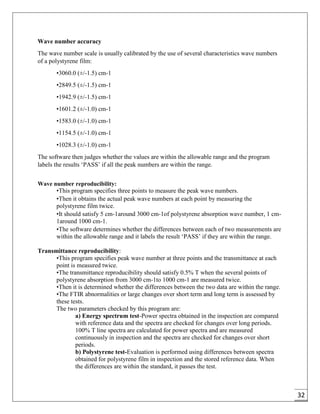
โ€ขThe %RSD (Relative standard deviation) of retention time should not be more than 1.0%
and peak area NMT (not more than) 5.0%
Detector noise and Drift test:
โ€ขAfter GC is ready, the system is run up to 15 minutes through single run.
โ€ขWhen the run is completed noise and drift is calculated through software.
โ€ขThe acceptance values are:
a) Noise not more than 100ฮผV.
b) Drift not more than 2500ฮผV/hr.
HPLC:
DESIGN QUALIFICATIONS:
The following table lists the elements with examples that may be included in the design
qualification for HPLC.
36
INSTALLATION QUALIFICATION:
๏‚ท Equipment is compared as received with purchase order, including software, accessories,
spare parts and consumables.
๏‚ท Documentation checked for completeness of operating, maintenance instructions,
standard operating procedures for testing and safety, validation certificates and health and
safety instruments.
๏‚ท Equipment is checked for any damage.
๏‚ท The supplierโ€™s instruction for installation is read.
๏‚ท The supplierโ€™s safety instructions are read, if there are any.
๏‚ท Hardware (computer, equipment, fittings and tubings for fluid connections, power cables,
data flow and instrument control cables) is installed following the manufacturerโ€™s
recommendation.
๏‚ท The instruments are switched on and ensured that all modules power up and an electronic
self-test is performed. Any deviations are recorded.
๏‚ท Software is installed on computer following the manufacturerโ€™s recommendation.
๏‚ท Correct software installation is verified.
๏‚ท A backup copy of software is made.
๏‚ท Peripherals e.g. printers and equipment modules are configured.
OPERATIONAL QUALIFICATION:
37
38
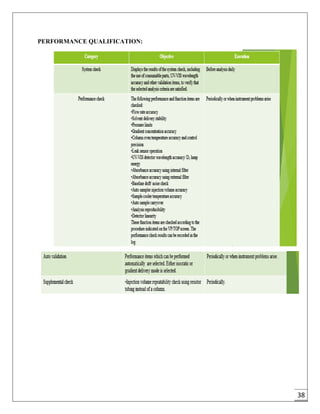
PERFORMANCE QUALIFICATION:
39
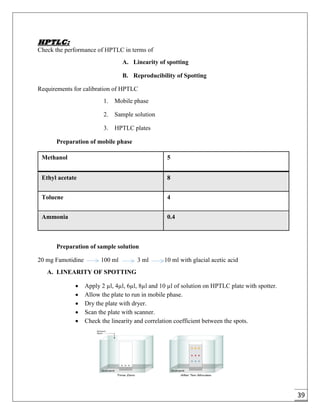
HPTLC:
Check the performance of HPTLC in terms of
A. Linearity of spotting
B. Reproducibility of Spotting
Requirements for calibration of HPTLC
1. Mobile phase
2. Sample solution
3. HPTLC plates
Preparation of mobile phase
Methanol 5
Ethyl acetate 8
Toluene 4
Ammonia 0.4
Preparation of sample solution
20 mg Famotidine 100 ml 3 ml 10 ml with glacial acetic acid
A. LINEARITY OF SPOTTING
๏‚ท Apply 2 ยตl, 4ยตl, 6ยตl, 8ยตl and 10 ยตl of solution on HPTLC plate with spotter.
๏‚ท Allow the plate to run in mobile phase.
๏‚ท Dry the plate with dryer.
๏‚ท Scan the plate with scanner.
๏‚ท Check the linearity and correlation coefficient between the spots.
40
Calculation of correlation coefficient:
It is a number that gives you a good idea about how closely one variable (spot) is related
to another variable.
Acceptance limit
Correlation coefficient is not less than 0.9900
B. REPRODUCIBILITY OF SPOTTING
๏‚ทApply 10ยตl solution on HPTLC plate for six times in sequence
๏‚ท Allow the plate to run in mobile phase.
๏‚ท Dry the plate with drier.
๏‚ท Scan the plate with scanner.
๏‚ท Calculate the Relative Standard Deviation (RSD) for six tracks.
RSD Limit: not more than 3.0%
41
DISINTEGRATION APPARATUS:
DESIGN QUALIFICATION:
INSTALLATION QUALIFICATION:
Few critical parameters during installation
๏‚ท Room Temperature - 15-30หšC
๏‚ท RH - 20-70%
๏‚ท Table Strength - Should have sufficient strength to place the equipment
๏‚ท Base / surface - Smooth and leveled steady base
๏‚ท Voltage - 220V ยฑ 10 %
๏‚ท Earthing - Less than 3 V b/w neutral & earth
OPERATIONAL QUALIFICATION:
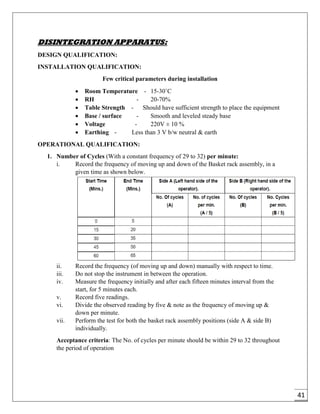
1. Number of Cycles (With a constant frequency of 29 to 32) per minute:
i. Record the frequency of moving up and down of the Basket rack assembly, in a
given time as shown below.
ii. Record the frequency (of moving up and down) manually with respect to time.
iii. Do not stop the instrument in between the operation.
iv. Measure the frequency initially and after each fifteen minutes interval from the
start, for 5 minutes each.
v. Record five readings.
vi. Divide the observed reading by five & note as the frequency of moving up &
down per minute.
vii. Perform the test for both the basket rack assembly positions (side A & side B)
individually.
Acceptance criteria: The No. of cycles per minute should be within 29 to 32 throughout
the period of operation
42
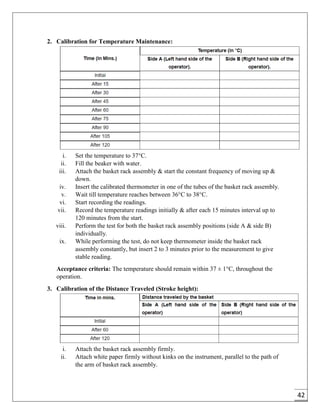
2. Calibration for Temperature Maintenance:
i. Set the temperature to 37ยฐC.
ii. Fill the beaker with water.
iii. Attach the basket rack assembly & start the constant frequency of moving up &
down.
iv. Insert the calibrated thermometer in one of the tubes of the basket rack assembly.
v. Wait till temperature reaches between 36ยฐC to 38ยฐC.
vi. Start recording the readings.
vii. Record the temperature readings initially & after each 15 minutes interval up to
120 minutes from the start.
viii. Perform the test for both the basket rack assembly positions (side A & side B)
individually.
ix. While performing the test, do not keep thermometer inside the basket rack
assembly constantly, but insert 2 to 3 minutes prior to the measurement to give
stable reading.
Acceptance criteria: The temperature should remain within 37 ยฑ 1ยฐC, throughout the
operation.
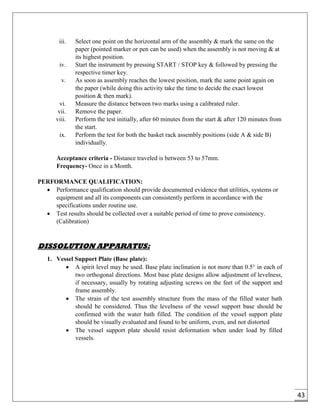
3. Calibration of the Distance Traveled (Stroke height):
i. Attach the basket rack assembly firmly.
ii. Attach white paper firmly without kinks on the instrument, parallel to the path of
the arm of basket rack assembly.
43
iii. Select one point on the horizontal arm of the assembly & mark the same on the
paper (pointed marker or pen can be used) when the assembly is not moving & at
its highest position.
iv. Start the instrument by pressing START / STOP key & followed by pressing the
respective timer key.
v. As soon as assembly reaches the lowest position, mark the same point again on
the paper (while doing this activity take the time to decide the exact lowest
position & then mark).
vi. Measure the distance between two marks using a calibrated ruler.
vii. Remove the paper.
viii. Perform the test initially, after 60 minutes from the start & after 120 minutes from
the start.
ix. Perform the test for both the basket rack assembly positions (side A & side B)
individually.
Acceptance criteria - Distance traveled is between 53 to 57mm.
Frequency- Once in a Month.
PERFORMANCE QUALIFICATION:
๏‚ท Performance qualification should provide documented evidence that utilities, systems or
equipment and all its components can consistently perform in accordance with the
specifications under routine use.
๏‚ท Test results should be collected over a suitable period of time to prove consistency.
(Calibration)
DISSOLUTION APPARATUS:
1. Vessel Support Plate (Base plate):
๏‚ท A spirit level may be used. Base plate inclination is not more than 0.5ยฐ in each of
two orthogonal directions. Most base plate designs allow adjustment of levelness,
if necessary, usually by rotating adjusting screws on the feet of the support and
frame assembly.
๏‚ท The strain of the test assembly structure from the mass of the filled water bath
should be considered. Thus the levelness of the vessel support base should be
confirmed with the water bath filled. The condition of the vessel support plate
should be visually evaluated and found to be uniform, even, and not distorted
๏‚ท The vessel support plate should resist deformation when under load by filled
vessels.
44
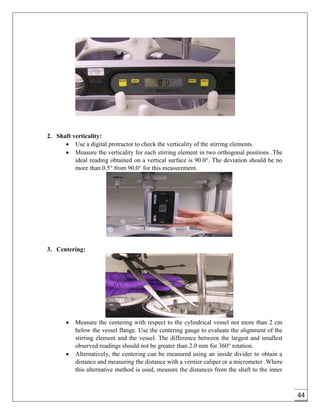
2. Shaft verticality:
๏‚ท Use a digital protractor to check the verticality of the stirring elements.
๏‚ท Measure the verticality for each stirring element in two orthogonal positions .The
ideal reading obtained on a vertical surface is 90.0ยฐ. The deviation should be no
more than 0.5ยฐ from 90.0ยฐ for this measurement.
3. Centering:
๏‚ท Measure the centering with respect to the cylindrical vessel not more than 2 cm
below the vessel flange. Use the centering gauge to evaluate the alignment of the
stirring element and the vessel. The difference between the largest and smallest
observed readings should not be greater than 2.0 mm for 360ยฐ rotation.
๏‚ท Alternatively, the centering can be measured using an inside divider to obtain a
distance and measuring the distance with a vernier caliper or a micrometer .Where
this alternative method is used, measure the distances from the shaft to the inner
45
vessel wall at four locations equally spaced around the vessel and no more than 2
cm below the vessel flange .The difference between the largest and smallest
readings is not greater than 2.0 mm.
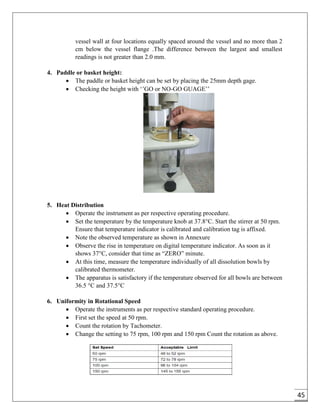
4. Paddle or basket height:
๏‚ท The paddle or basket height can be set by placing the 25mm depth gage.
๏‚ท Checking the height with โ€˜โ€™GO or NO-GO GUAGEโ€™โ€™
5. Heat Distribution
๏‚ท Operate the instrument as per respective operating procedure.
๏‚ท Set the temperature by the temperature knob at 37.8ยฐC. Start the stirrer at 50 rpm.
Ensure that temperature indicator is calibrated and calibration tag is affixed.
๏‚ท Note the observed temperature as shown in Annexure
๏‚ท Observe the rise in temperature on digital temperature indicator. As soon as it
shows 37ยฐC, consider that time as โ€œZEROโ€ minute.
๏‚ท At this time, measure the temperature individually of all dissolution bowls by
calibrated thermometer.
๏‚ท The apparatus is satisfactory if the temperature observed for all bowls are between
36.5 ยฐC and 37.5ยฐC
6. Uniformity in Rotational Speed
๏‚ท Operate the instruments as per respective standard operating procedure.
๏‚ท First set the speed at 50 rpm.
๏‚ท Count the rotation by Tachometer.
๏‚ท Change the setting to 75 rpm, 100 rpm and 150 rpm Count the rotation as above.
46
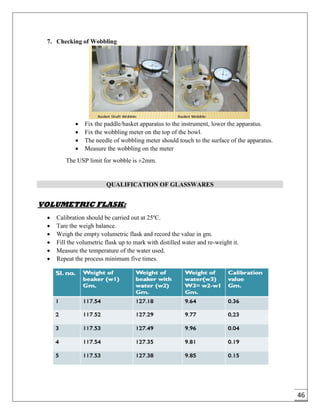
7. Checking of Wobbling
๏‚ท Fix the paddle/basket apparatus to the instrument, lower the apparatus.
๏‚ท Fix the wobbling meter on the top of the bowl.
๏‚ท The needle of wobbling meter should touch to the surface of the apparatus.
๏‚ท Measure the wobbling on the meter
The USP limit for wobble is ยฑ2mm.
QUALIFICATION OF GLASSWARES
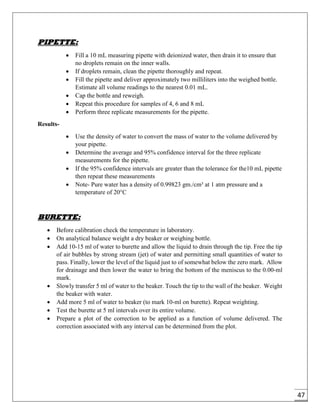
VOLUMETRIC FLASK:
๏‚ท Calibration should be carried out at 25ยบC.
๏‚ท Tare the weigh balance.
๏‚ท Weigh the empty volumetric flask and record the value in gm.
๏‚ท Fill the volumetric flask up to mark with distilled water and re-weight it.
๏‚ท Measure the temperature of the water used.
๏‚ท Repeat the process minimum five times.
47
PIPETTE:
๏‚ท Fill a 10 mL measuring pipette with deionized water, then drain it to ensure that
no droplets remain on the inner walls.
๏‚ท If droplets remain, clean the pipette thoroughly and repeat.
๏‚ท Fill the pipette and deliver approximately two milliliters into the weighed bottle.
Estimate all volume readings to the nearest 0.01 mL.
๏‚ท Cap the bottle and reweigh.
๏‚ท Repeat this procedure for samples of 4, 6 and 8 mL
๏‚ท Perform three replicate measurements for the pipette.
Results-
๏‚ท Use the density of water to convert the mass of water to the volume delivered by
your pipette.
๏‚ท Determine the average and 95% confidence interval for the three replicate
measurements for the pipette.
๏‚ท If the 95% confidence intervals are greater than the tolerance for the10 mL pipette
then repeat these measurements
๏‚ท Note- Pure water has a density of 0.99823 gm./cmยณ at 1 atm pressure and a
temperature of 20ยฐC
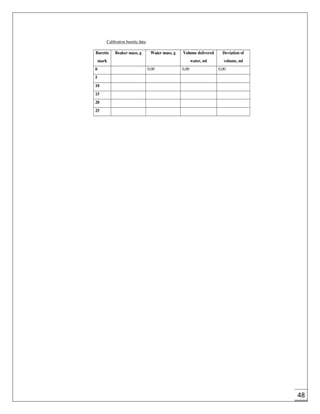
BURETTE:
๏‚ท Before calibration check the temperature in laboratory.
๏‚ท On analytical balance weight a dry beaker or weighing bottle.
๏‚ท Add 10-15 ml of water to burette and allow the liquid to drain through the tip. Free the tip
of air bubbles by strong stream (jet) of water and permitting small quantities of water to
pass. Finally, lower the level of the liquid just to of somewhat below the zero mark. Allow
for drainage and then lower the water to bring the bottom of the meniscus to the 0.00-ml
mark.
๏‚ท Slowly transfer 5 ml of water to the beaker. Touch the tip to the wall of the beaker. Weight
the beaker with water.
๏‚ท Add more 5 ml of water to beaker (to mark 10-ml on burette). Repeat weighting.
๏‚ท Test the burette at 5 ml intervals over its entire volume.
๏‚ท Prepare a plot of the correction to be applied as a function of volume delivered. The
correction associated with any interval can be determined from the plot.
48
49
50
3. VALIDATION OF UTILITY SYSTEMS
VALIDATION OF PHARMACEUTICAL WATER SYSTEM:
Water is a component of every pharmaceutical product, so water system must be validated to
ensure the consistent production of high quality water. The pharmaceutical industry places a high
priority on the quality of water used in production of finished product, intermediate reagent
preparation & analytical processes & especially in case of parenteral products where quality of
water must be as per Pharmacopoeia. In present scenario the quality of pharmaceutical water is
maintained by setting a good pharmaceutical water system and this system encompasses system
design qualification, attention of the regulatory requirements which are updated time to time.
Grades of water specified in the USP are classified as:
i. Potable water
ii. Purified water
iii. Water for injection
iv. Sterile water for injection
v. Sterile water for inhalation
vi. Sterile water for irrigation
vii. Sterile bacteriostatic water for injection
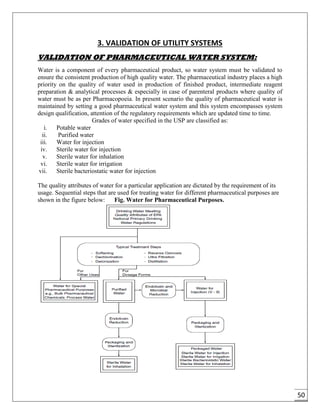
The quality attributes of water for a particular application are dictated by the requirement of its
usage. Sequential steps that are used for treating water for different pharmaceutical purposes are
shown in the figure below: Fig. Water for Pharmaceutical Purposes.
51
VALIDATION SEQUENCE:
A. Design Qualification (DQ)- The basic design package should include the following:
i. Flow schematics for the proposed water system showing all of the instrumentation,
controls and valves and component should be numbered for reference.
ii. A complete description of features and functions of the system. This is of critical
importance to enable production and quality assurance personnel, who may be
unfamiliar with engineering terminology, to fully understand the manner in which
the system is to be designed, built, operated, monitored and sterilized.
iii. Detailed specification for the equipment to be used for water treatment and
pretreatment.
iv. Detailed specification for all other system components such as storage tanks, heat
exchangers, pumps, valves and piping components.
v. Detailed specifications for sanitary system controls and description of their
operation.
vi. Specification for construction techniques to be employed where quality is of critical
importance.
vii. Procedure for cleaning the system, both after construction and on a routine basis.
viii. Preliminary standard operating procedures (SOPโ€™s) for operating, sampling and
sterilization. These procedures will be cross referenced to the valve and component
numbers on the system schematics.
ix. Preliminary SOPโ€™s for filter replacement, integrity testing and maintenance.
x. Preliminary sampling procedures to monitor both water quality and operation of the
equipment.
xi. Preliminary system certification procedures.
xii. Preliminary preventive maintenance procedures.
B. Installation qualification (IQ)- It ascertains that all the unit components are installed as
per the specifications and according to the design drawing. IQ provides construction
verification in that established specifications have been complied. This also involves
instrument connections, review the instrumentation drawings, review and verify the
manual, examination and documentation of wields, inspection for dead legs and pipe
slopes, verification of stainless steel passivation and any other information. IQ conforms
the โ€œAs-Builtโ€ drawing and ensures the suitability of the completed system. Absence of
leaks shall also be checked. IQ should cover why and how is the water purification system
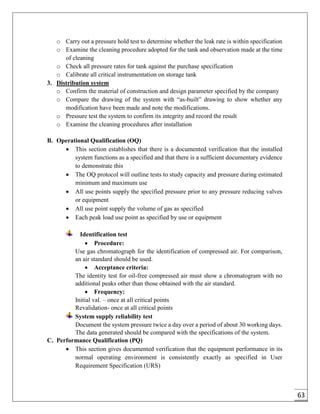
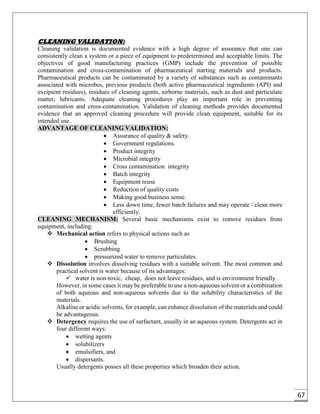
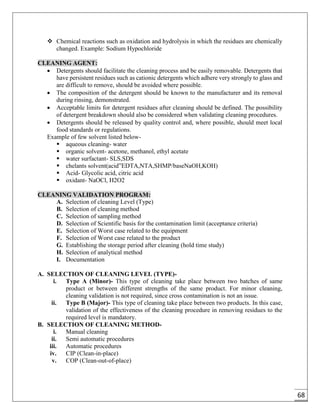
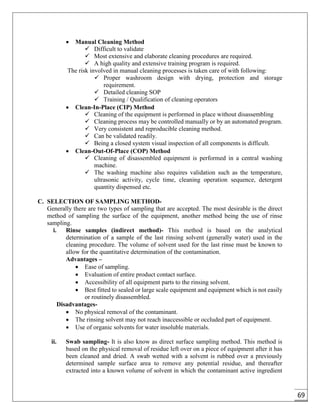
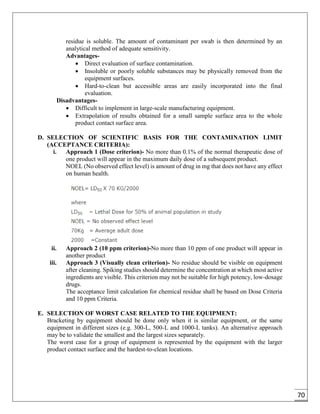
with complete description of system and purification system. Feed water shall be identified
in this stage. List out the major components of the system like pump, filters, UV lights,
controls, valves, drains, control system etc. and verify adequate to the design specification.
Make the list of instruments and controls, calibration of these instruments shall be traceable
to the national and international standards. Calibrations of instruments can be performed
at the end of IQ process and recorded as a part of IQ or at the beginning of the operational
qualification. Once the IQ is complete, system is recommended for operational
qualification (OQ).
C. Operational Qualification (OQ)- Considerations of feed water quality, of system
capacity, temperature controls, and flow rates are involved in the OQ protocol of the
52
water purification process. It involves an examination of the equipment design to identify
features critical to the process and product. The goal of OQ is to evaluate the limits of
control within which the validated system is expected to perform.
i. Components- Selection should be made with assurance that it does not create a
source for contamination intrusion.
ii. Piping and Installation- Stainless steel welds should provide reliable joints that are
internally smooth and corrosion-free. Piping systems should be installed and sloped in
such a way that they are completely self-draining. Complete drainage is important, as
it prevents the formation of standing โ€œpoolsโ€ of liquid that can support the growth of
microbes.
iii. Dead legs- Dead legs pose two problems for CIP (clean-in-place). First, cleaning fluids
must be able to flush out trapped gas pockets in order to wet all the piping surfaces in
the dead legs. Second, fresh cleaning fluid must flush the dead leg to maintain rapid
cleaning rates. Dead legs should not be greater in length than six diameters (6D) of the
unused portion measured from the axis of the pipe in use.
iv. Valves- The most commonly used valves in process piping systems for PW (Purified
water) and WFI (Water for injection) used for pharmaceutical manufacturing are
diaphragm valves. This is because they are easily CIP-cleanable and provide complete
containment of in-process materials. Ball and butterfly valves are also commonly used
in water treatment systems.
v. Pumps- Pumps should be of sanitary design with seals that prevent contamination of
the water. Several types of CIP-cleanable pumps are commonly used in water systems
or pharmaceutical manufacturing processes. These include centrifugal, rotary lobe,
peristaltic, and diaphragm pumps, of which all but the centrifugal pump provide
positive displacement.
vi. In-line instrumentation- In-line instruments or sensors are necessary components for
automated processes. For ease of cleaning, sensors should be chosen that directly
mount onto vessel nozzles or piping tees with minimum dead leg distances.
vii. Pressure gauges- Sanitary diaphragm-style pressure gauges should be used when
possible, as they are very cleanable.
viii. Distillation- Distillation equipment is used to produce USP WFI-quality water. The
distillation process removes dissolved solids not otherwise removed by deionizers or
RO units. The condenser must be of a double-tube design to prevent condenser coolant
from coming into direct contact with the distillate, thereby causing recontamination.
ix. Filters- Water storage tank vent filters must be equipped with a sterilizing air filter in
order to prevent the air, which displaces water drawn from the tank, from
microbiologically contaminating the water. Filters are commonly used downstream
from carbon beds and resin beds and on the incoming water supply line. Membrane
filters of 0.2 ฮผm are used to remove bacteria.
x. Deionizers- Dionizers use ion exchange resins to remove charged particles. Mixed bed
deionizers (containing both cation and anion exchange resins) are commonly used to
give the water a final โ€œpolishingโ€ treatment.
xi. Ultraviolet light- The use of UV light also facilitates the degradation of hydrogen
peroxide and ozone. The most effective biocidal wavelength is 253.7 nm. The amount
53
of light at 255 nm emitted by a UV light decreases with time, so lamps have to be
monitored and replaced when necessary.
xii. Waste water- Waste liquids shall be introduced to sewers through trapped drains.
Drains from equipment shall be designed with an atmospheric break to prevent back
siphonage.
D. Performance Qualification (PQ)- The purpose of PQ is to provide rigorous testing of
demonstrate the effectiveness and reproducibility of the total integrated process. Three phases
approaches shall be used to satisfy the objective of the providing the reliability and robustness
of the system in service over an extended period. The three phase validation is regulatory
expectation.
i. Phase I: Test period shall be 2- 4 weeks (14 days minimum) for monitoring the
system intensively. During this period the system should operate continuously
without failure or performance deviation.
ii. Phase II: A further test period of 2-4 weeks (30 days) should be spent carrying
out further intensive monitoring, while developing all the refined SOPโ€™s after
the satisfactory completion of phase I. The sampling scheme should be
generally the same as in phase 1. Water can be used for manufacturing purpose
during this phase.
iii. Phase III: Phase 3 typically runs for one year after the satisfactory completion
of phase II. Water can be used for manufacturing purpose during this phase.
After completion of phase III of the qualification program of water system, a
routine plan should be established based on the results on phase III.
VALIDATION OF PURE STEAM:
The pure steam is produced by the steam generator of the purified water. The steam generator shall
be located at a suitable place per approved layout. From this, start the tubing to the different points
of use. A system to collect the condensate must be provided for the most important point of use.
The collected condensate could be used to feed the industrial steam generator.
The pure steam should be qualified. The WHO guide to GMP requirements clearly says to perform
the performance qualification (PQ) of pure steam.
At the time of performance qualification of pure steam generation system, the sample shall be
taken from each steam user point and analyzed for three consecutive days. The purified water
system must be qualified before starting the qualification of pure steam.
Documents required: Presently, pure steam generators are available where pure water is used as
feed water. The validation of the equipment requires the following documents:
๏‚ท Specifications, test methods and reports for purified water and water for injection.
๏‚ท Validation reports for purified water system, water for injection system and pure steam
generators.
The sampling of Pure Steam: Sampling for Bacterial Endotoxin Test and chemical tests should
be done separately. Depyrogenated tubes or bottles should be used for taking the sample for
bacterial endotoxin test. Allow the steam to drain for minimum one minute.
Open the cap of the bottle and fill the bottle with steam condensate by holding the bottle in the
holder. Gloves should wear into the hands while sampling the pure steam. Tighten the cap of the
54
bottle and mark with the sampling information. If the sample is not analyzed within 2 hours of
sampling, store the sample at 2-8 ยฐC.
Analysis of Pure Steam: Pure steam should be analyzed for following tests:
1. Non-condensable Gases: Non-condensable gases are air and carbon dioxide those do
not condense with the steam. These are generated due to their presence in the purified water
that continuously circulates in the water distribution system. Non-condensable gases
should not be more than 3.5%.
2. Steam Dryness Value: Dry steam has more energy than the wet steam. Wet steam has
water with it and does not have heat energy as dry steam. Dryness of steam is determined
by the latent heat. Dryness of the pure steam should not be less than 90%. High moisture
content can cause the loss in energy of steam and that may cause the longer sterilization
time.
3. pH: Steam condensate is analyzed for pH value at 25 ยฐ C. It should be between 5-7.
4. Conductivity: Conductivity should be tested with calibrated conductivity meter at 20
ยฐC. Conductivity should not be more than 1.3 ยตS/cm.
5. Microorganisms: Steam condensate is tested for microbial contamination using pour
plate method. There should not any microbial contamination in the steam condensate.
6. Endotoxin Test: Determine the endotoxin in the pure steam condensate and it should
not be more than 0.25 EU/ml as in water for injection.
VALIDATION OF HVAC SYSTEM:
The HVAC (Heating, ventilation and air-conditioning) system plays an important role in product,
personnel, environment, instrument and machine protection. It also ensures the manufacture of
quality pharmaceutical products. HVAC utility is designed to control the level of viable and non-
viable particulate exposure that a drug or medicinal device might receive in addition to
regulating temperature and relative humidity conditions.
A. Design Qualification (DQ)-
B. Installation Qualification (IQ)- The objective for installation qualification (IQ) is to
demonstrate that the HVAC system in sterile area is in conformance to the URS and
manufacture literature. The information must be documented that the equipment meets
specification.
55
C. Operational Qualification (OQ)-
56
57
58
59
D. Performance Qualification (PQ)-
60
61
62
VALIDATION OF COMPRESSED AIR:
Definition of compressed air:
๏‚ท Commonly called Industry's Fourth Utility
๏‚ท Air that is condensed and contained at a pressure that is greater than the atmosphere
๏‚ท The process takes a given mass of air, which occupies a given volume of space, and
reduces it into a smaller space. In that space, greater air mass produces greater pressure.
The pressure comes from this air trying to return to its original volume
๏‚ท It is used in many different manufacturing operations. A typical compressed air system
operating at 100 psig (7 bar) will compress the air down to 1/8 of its original volume.
๏‚ท Compressed air is an important component of pharmaceutical manufacturing facilities
๏‚ท It provides many of the air types necessary for a manufacturing facility to function,
including: breathing air , motive air for machines , process air , analytical air and
Product Direct Impact , or "cGMP" air
The application for which the compressed air will be used will dictate the level of air quality
that is appropriate for use
Types of compressed air system:
I. Conventional oil lubricated compressors- For operating instruments and
machinery where no contact with product being manufactured is involved.
II. Oil free compressed air system- Used in clean room areas.
VALIDATION PROTOCOL:
A. Installation Qualification (IQ)
๏‚ท This section establishes documented verification that key aspects of equipment
adhere to approve design intentions and recommendation of manufacturer have
been suitably consider
๏‚ท In addition to the common requirements outlined in the "General" section, the
following are required for Distribution systems
The piping should be supported, labeled, and sloped to drain completely
1. Oil free compressor
o Check specification on purchase order and actual delivery specification
o Verify that no oil or other lubricant is used in the compressor
o Check that all required utility requirements have been met and connected properly
o Check whether pre-start up procedures were performed
o Check whether all critical instruments have been calibrated
o Document above all
2. Compressed air storage tank
o Confirm that the material of construction is as per specification
o Check the capacity of the tank against purchase specification
63
o Carry out a pressure hold test to determine whether the leak rate is within specification
o Examine the cleaning procedure adopted for the tank and observation made at the time
of cleaning
o Check all pressure rates for tank against the purchase specification
o Calibrate all critical instrumentation on storage tank
3. Distribution system
o Confirm the material of construction and design parameter specified by the company
o Compare the drawing of the system with โ€œas-builtโ€ drawing to show whether any
modification have been made and note the modifications.
o Pressure test the system to confirm its integrity and record the result
o Examine the cleaning procedures after installation
B. Operational Qualification (OQ)
๏‚ท This section establishes that there is a documented verification that the installed
system functions as a specified and that there is a sufficient documentary evidence
to demonstrate this
๏‚ท The OQ protocol will outline tests to study capacity and pressure during estimated
minimum and maximum use
๏‚ท All use points supply the specified pressure prior to any pressure reducing valves
or equipment
๏‚ท All use point supply the volume of gas as specified
๏‚ท Each peak load use point as specified by use or equipment
Identification test
๏‚ท Procedure:
Use gas chromatograph for the identification of compressed air. For comparison,
an air standard should be used.
๏‚ท Acceptance criteria:
The identity test for oil-free compressed air must show a chromatogram with no
additional peaks other than those obtained with the air standard.
๏‚ท Frequency:
Initial val. โ€“ once at all critical points
Revalidation- once at all critical points
System supply reliability test
Document the system pressure twice a day over a period of about 30 working days.
The data generated should be compared with the specifications of the system.
C. Performance Qualification (PQ)
๏‚ท This section gives documented verification that the equipment performance in its
normal operating environment is consistently exactly as specified in User
Requirement Specification (URS)
64
๏‚ท Each point of use will be tested at least three times over 10 working days. Every
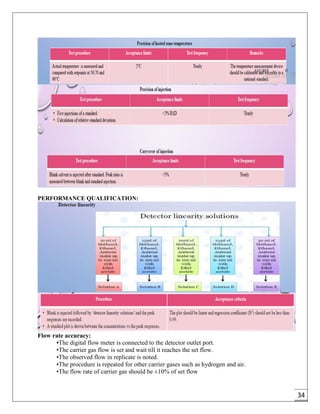
use point of the system must be tested several times over the course of the study.
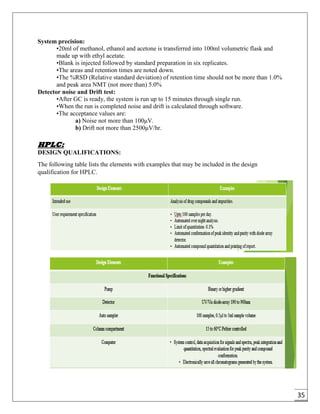
๏ƒ˜ PQ includes the following tests:
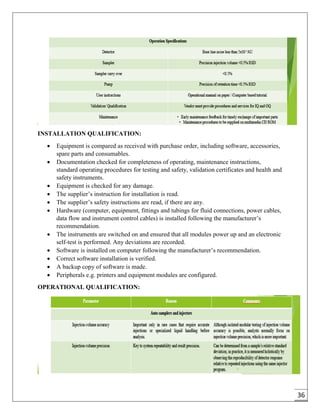
o NON VIABLE PARTICLE COUNT
o VIABLE PARTICLE COUNT
o MOISTURE CONTENT
o OIL CONTENT
o HYDROCARBON MONITORING
o PURITY ANALYSIS FOR NITROGEN
o PURITY ANALYSIS FOR OXYGEN
Moisture content
๏‚ท Procedure:
use dew point meter to determine moisture content from critical supply unit
๏‚ท Acceptance criteria:
The dew point of compressed air less than or equal to -10ยฐC, or less than
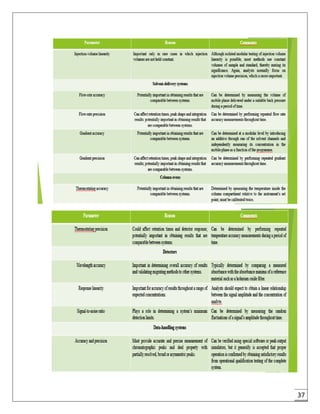
the lowest temperature to which the system is exposed
๏‚ท Frequency
Initial val. โ€“ 1test/day for first 30days at all critical supply points each day.
Revalidation- 1test/month at each critical supply point.
Oil content
๏‚ท Procedure:
Using the oil indicators
๏‚ท Acceptance criteria:
Oil content of oil free compressed air should be NMT 0.01ppm
๏‚ท Frequency:
Initial val. โ€“ 1test/day for first 30days at all critical supply points each day.
Revalidation- 1test/month at each critical supply point.
Non viable particle count
๏‚ท Procedure:
The outlet of the supply point is opened for 5min. Adjust to a volume flow
of about 30l/min. The particulate counter is connected to the outlet, at the
maintained flow a min. volume of 90lits. Is monitored. Each supply point
should be investigated in the same way.
๏‚ท Acceptance criteria:
Nonviable particulate counts must be โ‰ค 100/ft3
of 0.5ฮผ or larger at all
critical use points
๏‚ท Frequency:
Initial val. โ€“ once for each supply point
65
Revalidation- every 3 months
Viable Monitoring
acceptance criteria:
(not needed of integrity tested final filter is in place) less than 0.03 CFU/ft3
or less than 1 CFU/m3
Hydrocarbon Monitoring
acceptance criteria:
should show less than 0.2 mg/m3 (25 mg/125 liters) detected. (the lower
limit of a Dragger tube)
Identity and Purity (Nitrogen)
acceptance criteria:
Not less than 99.0% nitrogen by volume. Not more than 0.001% Carbon
Monoxide. No appreciable odor
Identity and Purity (Oxygen)
acceptance criteria:
Not less than 99.0% Oxygen by volume. No appreciable odor
Final report:
Depending on IQ, OQ and PQ data final report is made and that will indicate whether your
system is validated or not.
VALIDATION OF NITROGEN GAS:
Nitrogen Gas is a critical component in the production of pharmaceutical industry and effects on
the quality of the end product. The most common gases used in Pharmaceutical Industries are
compressed air used for instruments or product contact, and Nitrogen used for providing an inert
gas in the vial, ampoule or WFI (Water for injection) tanks and used for creating an inert pressure
pad in processes where solvents are present.
66
67
CLEANING VALIDATION:
Cleaning validation is documented evidence with a high degree of assurance that one can
consistently clean a system or a piece of equipment to predetermined and acceptable limits. The
objectives of good manufacturing practices (GMP) include the prevention of possible
contamination and cross-contamination of pharmaceutical starting materials and products.
Pharmaceutical products can be contaminated by a variety of substances such as contaminants
associated with microbes, previous products (both active pharmaceutical ingredients (API) and
excipient residues), residues of cleaning agents, airborne materials, such as dust and particulate
matter, lubricants. Adequate cleaning procedures play an important role in preventing
contamination and cross-contamination. Validation of cleaning methods provides documented
evidence that an approved cleaning procedure will provide clean equipment, suitable for its
intended use.
ADVANTAGE OF CLEANING VALIDATION:
๏‚ท Assurance of quality & safety.
๏‚ท Government regulations.
๏‚ท Product integrity
๏‚ท Microbial integrity
๏‚ท Cross contamination integrity
๏‚ท Batch integrity
๏‚ท Equipment reuse
๏‚ท Reduction of quality costs
๏‚ท Making good business sense.
๏‚ท Less down time, fewer batch failures and may operate / clean more
efficiently.
CLEANING MECHANISM: Several basic mechanisms exist to remove residues from
equipment, including:
๏ถ Mechanical action refers to physical actions such as
๏‚ท Brushing
๏‚ท Scrubbing
๏‚ท pressurized water to remove particulates.
๏ถ Dissolution involves dissolving residues with a suitable solvent. The most common and
practical solvent is water because of its advantages:
๏ƒผ water is non-toxic, cheap, does not leave residues, and is environment friendly.
However, in some cases it may be preferable to use a non-aqueous solvent or a combination
of both aqueous and non-aqueous solvents due to the solubility characteristics of the
materials.
Alkaline or acidic solvents, for example, can enhance dissolution of the materials and could
be advantageous.
๏ถ Detergency requires the use of surfactant, usually in an aqueous system. Detergents act in
four different ways:
๏‚ท wetting agents
๏‚ท solubilizers
๏‚ท emulsifiers, and
๏‚ท dispersants.
Usually detergents posses all these properties which broaden their action.
68
๏ถ Chemical reactions such as oxidation and hydrolysis in which the residues are chemically
changed. Example: Sodium Hypochloride
CLEANING AGENT:
๏‚ท Detergents should facilitate the cleaning process and be easily removable. Detergents that
have persistent residues such as cationic detergents which adhere very strongly to glass and
are difficult to remove, should be avoided where possible.
๏‚ท The composition of the detergent should be known to the manufacturer and its removal
during rinsing, demonstrated.
๏‚ท Acceptable limits for detergent residues after cleaning should be defined. The possibility
of detergent breakdown should also be considered when validating cleaning procedures.
๏‚ท Detergents should be released by quality control and, where possible, should meet local
food standards or regulations.
Example of few solvent listed below-
๏‚ง aqueous cleaning- water
๏‚ง organic solvent- acetone, methanol, ethyl acetate
๏‚ง water surfactant- SLS,SDS
๏‚ง chelants solvent(acidโ€EDTA,NTA,SHMP/baseNaOH,KOH)
๏‚ง Acid- Glycolic acid, citric acid
๏‚ง oxidant- NaOCl, H2O2
CLEANING VALIDATION PROGRAM:
A. Selection of cleaning Level (Type)
B. Selection of cleaning method
C. Selection of sampling method
D. Selection of Scientific basis for the contamination limit (acceptance criteria)
E. Selection of Worst case related to the equipment
F. Selection of Worst case related to the product
G. Establishing the storage period after cleaning (hold time study)
H. Selection of analytical method
I. Documentation
A. SELECTION OF CLEANING LEVEL (TYPE)-
i. Type A (Minor)- This type of cleaning take place between two batches of same
product or between different strengths of the same product. For minor cleaning,
cleaning validation is not required, since cross contamination is not an issue.
ii. Type B (Major)- This type of cleaning take place between two products. In this case,
validation of the effectiveness of the cleaning procedure in removing residues to the
required level is mandatory.
B. SELECTION OF CLEANING METHOD-
i. Manual cleaning
ii. Semi automatic procedures
iii. Automatic procedures
iv. CIP (Clean-in-place)
v. COP (Clean-out-of-place)
69
๏‚ท Manual Cleaning Method
๏ƒผ Difficult to validate
๏ƒผ Most extensive and elaborate cleaning procedures are required.
๏ƒผ A high quality and extensive training program is required.
The risk involved in manual cleaning processes is taken care of with following:
๏ƒผ Proper washroom design with drying, protection and storage
requirement.
๏ƒผ Detailed cleaning SOP
๏ƒผ Training / Qualification of cleaning operators
๏‚ท Clean-In-Place (CIP) Method
๏ƒผ Cleaning of the equipment is performed in place without disassembling
๏ƒผ Cleaning process may be controlled manually or by an automated program.
๏ƒผ Very consistent and reproducible cleaning method.
๏ƒผ Can be validated readily.
๏ƒผ Being a closed system visual inspection of all components is difficult.
๏‚ท Clean-Out-Of-Place (COP) Method
๏ƒผ Cleaning of disassembled equipment is performed in a central washing
machine.
๏ƒผ The washing machine also requires validation such as the temperature,
ultrasonic activity, cycle time, cleaning operation sequence, detergent
quantity dispensed etc.
C. SELECTION OF SAMPLING METHOD-
Generally there are two types of sampling that are accepted. The most desirable is the direct
method of sampling the surface of the equipment, another method being the use of rinse
sampling.
i. Rinse samples (indirect method)- This method is based on the analytical
determination of a sample of the last rinsing solvent (generally water) used in the
cleaning procedure. The volume of solvent used for the last rinse must be known to
allow for the quantitative determination of the contamination.
Advantages โ€“
๏‚ท Ease of sampling.
๏‚ท Evaluation of entire product contact surface.
๏‚ท Accessibility of all equipment parts to the rinsing solvent.
๏‚ท Best fitted to sealed or large scale equipment and equipment which is not easily
or routinely disassembled.
Disadvantages-
๏‚ท No physical removal of the contaminant.
๏‚ท The rinsing solvent may not reach inaccessible or occluded part of equipment.
๏‚ท Use of organic solvents for water insoluble materials.
ii. Swab sampling- It is also know as direct surface sampling method. This method is
based on the physical removal of residue left over on a piece of equipment after it has
been cleaned and dried. A swab wetted with a solvent is rubbed over a previously
determined sample surface area to remove any potential residue, and thereafter
extracted into a known volume of solvent in which the contaminant active ingredient
70
residue is soluble. The amount of contaminant per swab is then determined by an
analytical method of adequate sensitivity.
Advantages-
๏‚ท Direct evaluation of surface contamination.
๏‚ท Insoluble or poorly soluble substances may be physically removed from the
equipment surfaces.
๏‚ท Hard-to-clean but accessible areas are easily incorporated into the final
evaluation.
Disadvantages-
๏‚ท Difficult to implement in large-scale manufacturing equipment.
๏‚ท Extrapolation of results obtained for a small sample surface area to the whole
product contact surface area.
D. SELECTION OF SCIENTIFIC BASIS FOR THE CONTAMINATION LIMIT
(ACCEPTANCE CRITERIA):
i. Approach 1 (Dose criterion)- No more than 0.1% of the normal therapeutic dose of
one product will appear in the maximum daily dose of a subsequent product.
NOEL (No observed effect level) is amount of drug in mg that does not have any effect
on human health.
ii. Approach 2 (10 ppm criterion)-No more than 10 ppm of one product will appear in
another product
iii. Approach 3 (Visually clean criterion)- No residue should be visible on equipment
after cleaning. Spiking studies should determine the concentration at which most active
ingredients are visible. This criterion may not be suitable for high potency, low-dosage
drugs.
The acceptance limit calculation for chemical residue shall be based on Dose Criteria
and 10 ppm Criteria.
E. SELECTION OF WORST CASE RELATED TO THE EQUIPMENT:
Bracketing by equipment should be done only when it is similar equipment, or the same
equipment in different sizes (e.g. 300-L, 500-L and 1000-L tanks). An alternative approach
may be to validate the smallest and the largest sizes separately.
The worst case for a group of equipment is represented by the equipment with the larger
product contact surface and the hardest-to-clean locations.
71
F. SELECTION OF WORST CASE RELATED TO THE PRODUCT:
Only one product out of a group of product processed in a piece of equipment is selected for
the cleaning validation study, based on the lowest solubility of the active ingredient and its
therapeutic dose.
G. ESTABLISHING THE STORAGE PERIOD AFTER CLEANING (HOLD TIME
STUDY):
The objective for establishing time limit between equipment cleaning and reuse is to ensure
that the equipment remains clean till the next use. This needs demonstration that there is no
microbial proliferation in cleaned equipments during storage.
For establishing the time limit, the equipment should be dried. Initial swab samples for surface
should be taken. Thereafter, the equipment should be protected as prescribed in the SOP and
stored in its designated area. Periodic samples of product contact surface for microbiological
contamination should be taken. (1st day, 2nd day, 3rd day etc.)
Based on the data generated establish the acceptable time limit.
H. SELECTION OF ANALYTICAL METHOD:
The Basic Requirements for the Analytical Method.
a. The sensitivity of the method shall be appropriate to the calculated contamination limit.
b. The method shall be practical and rapid, and, as much as possible use instrumentation
existing in the company.
c. The method shall be validated in accordance with ICH, USP and EP requirements.
d. The analytical development shall include a recovery study to challenge the sampling
and testing methods.
i. Specific Methods-
๏‚ท Chromatographic methods such as GC, HPLC etc.
๏‚ท Thin layer chromatography
๏‚ท Specific ion meter
Of the above methods, chromatography methods are the methods of choice, as they
separate analytes, are highly specific, highly sensitive, and quantitative. But the
methods are costly and time consuming.
ii. Non-specific Methods-
๏‚ท Spectrophotometric methods in the visible, infrared, or UV ranges
๏‚ท Total organic carbon (TOC)
๏‚ท Other Methods
For monitoring cleaning procedure TOC method is used. It offers at a moderate
cost and in addition to its rapidity, a detection capability down to the ppb range.
I. DOCUMENTATION:
๏‚ท Detailed cleaning procedure(s) are to be documented in SOPs.
๏‚ท A Cleaning Validation Protocol is required to define how the cleaning process will be
validated.
๏‚ท Depending upon the complexity of the system and cleaning processes, the amount of
documentation necessary for executing various cleaning steps or procedures may vary.
๏‚ท When more complex cleaning procedures are required, it is important to document the
critical cleaning steps. In this regard, specific documentation on the equipment itself
which includes information about who cleaned it, when the cleaning was carried out,
the product which was previously processed on the equipment being cleaned should be
72
available. However, for relatively simple cleaning operations, the mere documentation
that the overall cleaning process was performed might be sufficient.
๏‚ท Other factors such as history of cleaning, residue levels found after cleaning, and
variability of test results may also dictate the amount of documentation required. For
example, when variable residue levels are detected following cleaning, particularly for
a process that is believed to be acceptable, one must establish the effectiveness of the
process and of the operator performance. Appropriate evaluations must be made, and
when operator performance is deemed a problem, more extensive documentation
(guidance) and training may be required.
๏‚ท A Final Validation Report should be prepared. The conclusions of this report should
state if the cleaning process has been validated successfully.
CLEANING IN PLACE (CIP):
Clean-in-place (CIP) is a method of cleaning the interior surfaces of pipes, vessels, process
equipment, filters and associated fittings, without disassembly.
Up to the 1950s, closed systems were disassembled and cleaned manually. The advent of CIP was
a boon to industries that needed frequent internal cleaning of their processes. Industries that rely
heavily on CIP are those requiring high levels of hygiene, and include: dairy, beverage, brewing,
processed foods, pharmaceutical, and cosmetics.
The U.S. Food and Drug Administration published a CIP regulation in 1978 applicable to
pharmaceutical manufacturing.
The benefit to industries that use CIP is that the cleaning is faster, less labor-intensive and more
repeatable, and poses less of a chemical exposure risk. CIP started as a manual practice involving
a balance tank, centrifugal pump, and connection to the system being cleaned. Since the 1950s,
CIP has evolved to include fully automated systems with programmable logic controllers, multiple
balance tanks, sensors, valves, heat exchangers, data acquisition and specially designed spray
nozzle systems. Simple, manually operated CIP systems can still be found in use today.
Depending on soil load and process geometry, the CIP design principle is one of the following:
๏‚ท deliver highly turbulent, high flow-rate solution to effect good cleaning (applies to pipe
circuits and some filled equipment).
๏‚ท deliver solution as a low-energy spray to fully wet the surface (applies to lightly soiled
vessels where a static sprayball may be used).
๏‚ท deliver a high energy impinging spray (applies to highly soiled or large diameter vessels
where a dynamic spray device may be used).
Elevated temperature and chemical detergents are often employed to enhance cleaning
effectiveness.
Factors affecting the effectiveness of the cleaning agents-
73
i. Temperature of the cleaning solution- Elevating the temperature of a cleaning solution
increases its dirt removal efficiency. Molecules with high kinetic energy dislodge dirt
faster than slow moving molecules of a cold solution.
ii. Concentration of the cleaning agent- A concentrated cleaning solution will clean a dirty
surface much better than a dilute one due to the increased surface binding capacity.
iii. Contact time of the cleaning solution- The longer the detergent contact period, the
higher the cleaning efficiency. After some time, the detergent eventually dissolves the
hard stains/soil from the dirty surface.
iv. Pressure exerted by the cleaning solution (or turbulence)- The turbulence creates an
abrasive force that dislodges stubborn soil from the dirty surface.
CIP cycle-
A typical CIP cycle consists of many steps which often include (in order):
i. Pre-rinse with WFI (water for injection) or PW (purified water) which is performed to
wet the interior surface of the tank and remove residue. It also provides a non-chemical
pressure test of the CIP flow path.
ii. Caustic solution single pass flush through the vessel to drain. Caustic is the main
cleaning solution.
iii. Caustic solution re-circulation through the vessel.
iv. Intermediate WFI or PW rinse
v. Acid solution wash โ€“ used to remove mineral precipitates and protein residues.
vi. Final rinse with WFI or PW โ€“ rinses to flush out residual cleaning agents.
vii. Final air blow โ€“ used to remove moisture remaining after CIP cycle.
Bioreactors, fermentors, and mix vessels-
CIP is commonly used for cleaning bioreactors, fermenters, mix vessels, and other equipment
used in biotech manufacturing, pharmaceutical manufacturing and food and beverage
manufacturing. CIP is performed to remove or obliterate previous cell culture batch components.
It is used to remove in-process residues, control bioburden, and reduce endotoxin levels within
processing equipment and systems.
74
75
4. HISTORY OF VARIOUS PHASES OF DRUG DEVELOPMENT AND DRUG
APPROVAL
Drug discovery and development has a long history and dates back to the early days of human
civilization. In those ancient times, drugs were not just used for physical remedies but were also
associated with religious and spiritual healing. Sages or religious leaders were often the
administrators of drugs. The early drugs or folk medicines were derived mainly from plant
products and supplemented by animal materials and minerals. These drugs were most probably
discovered through a combination of trial and error experimentation and observation of human and
animal reactions as a result of ingesting such products.
The following are some snapshot examples of how drugs were discovered from the early human
civilizations.
๏‚ท Chinese Medicine- Traditional Chinese medicine (TCM) is believed to have originated in
the times of the legendary emperor Sheng Nong in 3500 BC . The dynasty system and
meticulous recording have helped to preserve the TCM scripts of old China. Some
important medical writings are The Internal Book of Emperor Huang and The
Pharmacopoeia of Sheng Nong โ€” a legendary emperor.
๏‚ท Egyptian Medicine- Ancient papyrus provided written records of early Egyptian medical
knowledge. The Ebers papyrus (from around 3000 bc ) provided 877 prescriptions and
recipes for internal medicine, eye and skin problems, and gynecology. Another record,
from the Kahun papyrus of around 1800 BC , detailed treatments for gynecological
problems.
๏‚ท Indian Medicine- The Indian folk medicine, called Ayurvedic medicine, can be traced
back 3000 โ€“ 5000 years and was practiced by the Brahmin sages of ancient times. The
treatments were set out in sacred writings called Vedas.
๏‚ท Greek Medicine- Some of the Greek medical ideas were derived from the Egyptians,
Babylonians, and even the Chinese and Indians. The greatest Greek contribution to the
medical field is perhaps to dispel the notion that diseases are due to supernatural causes or
spells. The Greeks established that diseases result from natural causes. Hippocrates, the
father of medicine, at about 400 BC is credited with laying down the ethics for physicians.
๏‚ท Roman Medicine- As great administrators, the Romans instituted hospitals, although these
were used mainly to cater to the needs of the military. Through this work, organized
medical care was made available. The Romans also extended the pharmacy practice of the
Greeks.
Drug Discovery in the Middle Ages:
The Middle Ages, from around ad 400 to 1500, witnessed the decline of the Roman influence. This
was also the time when plagues scourged many parts of Europe. Diseases such as bubonic plague,
leprosy, smallpox, tuberculosis, and scabies were rampant.
76
๏‚ท The early church- There are some references to herbs in the Bible. However, the Churchโ€™s
main contribution to medicines is the preservation and transcription of Greek medical
manuscripts and treatises.
๏‚ท Arabian Medicine- Through trade with many regions, the Arabians learned and extended
medical knowledge. Their major contribution is perhaps the knowledge of medical
preparations and distillation methods, although the techniques were probably derived from
the practices of alchemists.
Foundation of Current Drug Discovery and Development:
The Renaissance period laid the foundation for scientific thoughts in medicinal preparations and
medical treatments.
Beginnings of the Modern Pharmaceutical Industry:
Despite the advances made in the 1800s, there were only a few drugs available for treating diseases
at the beginning of the 1900s:
77
๏‚ท Penicillin- In 1928, Alexander Fleming discovered that Penicillium mold was active
against staphylococcus bacteria. Ernst Chain rediscovered this fact some 10 years later,
when he collaborated with Howard Florey. By 1944, large โ€“ scale production of penicillin
was available through the work of Howard Florey and Ernst Chain.
Evolution of Drug Products:
VARIOUS PHASES OF DRUG DEVELOPMENT AND DRUG
APPROVAL:
Step 1: Discovery and Development-
Discovery:
Typically, researchers discover new drugs through:
๏‚ท New insights into a disease process that allow researchers to design a product to stop or
reverse the effects of the disease.
๏‚ท Many tests of molecular compounds to find possible beneficial effects against any of a
large number of diseases.
๏‚ท Existing treatments that have unanticipated effects.
๏‚ท New technologies, such as those that provide new ways to target medical products to
specific sites within the body or to manipulate genetic material. New technologies, such as
those that provide new ways to target medical products to specific sites within the body or
to manipulate genetic material.
78
At this stage in the process, thousands of compounds may be potential candidates for development
as a medical treatment. After early testing, however, only a small number of compounds look
promising and call for further study.
Development:
Once researchers identify a promising compound for development, they conduct experiments to
gather information on:
๏‚ท How it is absorbed, distributed, metabolized, and excreted.
๏‚ท Its potential benefits and mechanisms of action.
๏‚ท The best dosage.
๏‚ท The best way to give the drug (such as by mouth or injection).
๏‚ท Side effects or adverse events that can often be referred to as toxicity.
๏‚ท How it affects different groups of people (such as by gender, race, or ethnicity) differently.
๏‚ท How it interacts with other drugs and treatments.
๏‚ท Its effectiveness as compared with similar drugs.
Step 2: Preclinical Research-
Before testing a drug in people, researchers must find out whether it has the potential to cause
serious harm, also called toxicity. The two types of preclinical research are:
๏‚ท in vitro
๏‚ท in vivo
FDA requires researchers to use good laboratory practices (GLP), defined in medical product
development regulations, for preclinical laboratory studies. These regulations set the minimum
basic requirements for:
๏‚ท study conduct
๏‚ท personnel
๏‚ท facilities
๏‚ท equipment
๏‚ท written protocols
๏‚ท operating procedures
๏‚ท study reports
๏‚ท and a system of quality assurance oversight for each study to help assure the safety of FDA-
regulated product
Usually, preclinical studies are not very large. However, these studies must provide detailed
information on dosing and toxicity levels. After preclinical testing, researchers review their
findings and decide whether the drug should be tested in people.
79
Step 3: Clinical Research-
While preclinical research answers basic questions about a drugโ€™s safety, it is not a substitute for
studies of ways the drug will interact with the human body. โ€œClinical researchโ€ refers to studies,
or trials, that are done in people. As the developers design the clinical study, they will consider
what they want to accomplish for each of the different Clinical Research Phases and begin the
Investigational New Drug Process (IND), a process they must go through before clinical research
begins.
Designing clinical trials:
Researchers design clinical trials to answer specific research questions related to a medical
product. These trials follow a specific study plan, called a protocol, that is developed by the
researcher or manufacturer. Before a clinical trial begins, researchers review prior information
about the drug to develop research questions and objectives. Then, they decide questions like:
๏‚ท Who qualifies to participate (selection criteria)?
๏‚ท How many people will be part of the study?
๏‚ท How long the study will last?
๏‚ท How the drug will be given to patients and at what dosage? , etcโ€ฆ
Clinical Research Phase Studies:
Phase 1
Phase 2
80
Phase 3
Phase 4
The Investigational New Drug (IND) Process:
Drug developers, or sponsors, must submit an Investigational New Drug (IND) application to FDA
before beginning clinical research.
In the IND application, developers must include:
๏‚ท Animal study data and toxicity (side effects that cause great harm) data
๏‚ท Manufacturing information
๏‚ท Clinical protocols (study plans) for studies to be conducted
๏‚ท Data from any prior human research
๏‚ท Information about the investigator
81
Step 4: FDA Drug Review
If a drug developer has evidence from its early tests and preclinical and clinical research that a
drug is safe and effective for its intended use, the company can file an application to market the
drug. The FDA review team thoroughly examines all submitted data on the drug and makes a
decision to approve or not to approve it.
82
New Drug Application (NDA):
A New Drug Application (NDA) tells the full story of a drug. Its purpose is to demonstrate that a
drug is safe and effective for its intended use in the population studied.
A drug developer must include everything about a drugโ€”from preclinical data to Phase 3 trial
dataโ€”in an NDA. Developers must include reports on all studies, data, and analyses. Along with
clinical results, developers must include:
๏‚ท Proposed labeling
๏‚ท Safety updates
๏‚ท Drug abuse information
๏‚ท Patent information
๏‚ท Any data from studies that may have been conducted outside the United States
๏‚ท Institutional review board compliance information
๏‚ท Directions for use
FDA Review
Once FDA receives an NDA, the review team decides if it is complete. If it is not complete, the
review team can refuse to file the NDA. If it is complete, the review team has 6 to 10 months to
make a decision on whether to approve the drug. The process includes the following:
๏‚ท Each member of the review team conducts a full review of his or her section of the application.
For example, the medical officer and the statistician review clinical data, while a
pharmacologist reviews the data from animal studies. Within each technical discipline
represented on the team, there is also a supervisory review.
๏‚ท FDA inspectors travel to clinical study sites to conduct a routine inspection. The Agency looks
for evidence of fabrication, manipulation, or withholding of data.
๏‚ท The project manager assembles all individual reviews and other documents, such as the
inspection report, into an โ€œaction package.โ€ This document becomes the record for FDA review.
The review team issues a recommendation, and a senior FDA official makes a decision.
83
Step 5: FDA Post-Market Drug Safety Monitoring
Even though clinical trials provide important information on a drugโ€™s efficacy and safety, it is
impossible to have complete information about the safety of a drug at the time of approval. Despite
the rigorous steps in the process of drug development, limitations exist. Therefore, the true picture
of a productโ€™s safety actually evolves over the months and even years that make up a productโ€™s
lifetime in the marketplace. FDA reviews reports of problems with prescription and over-the-
counter drugs, and can decide to add cautions to the dosage or usage information, as well as other
measures for more serious issues.
FDA is developing a new national system to more quickly spot possible safety issues. The system
will use very large existing electronic health databasesโ€”like electronic health records systems,
administrative and insurance claims databases, and registriesโ€”to keep an eye on the safety of
approved medical products in real time. This tool will add to, but not replace, FDA's existing post
market safety assessment tools.
ANDA โ€” CONTENT AND FORMAT:
An abbreviated new drug application (ANDA) contains data which is submitted to FDA for the
review and potential approval of a generic drug product. Once approved, an applicant may
manufacture and market the generic drug product to provide a safe, effective, lower cost alternative
to the brand-name drug it references.
Generic drug applications are termed "abbreviated" because they are generally not required to
include preclinical (animal) and clinical (human) data to establish safety and effectiveness. Instead,
generic applicants must scientifically demonstrate that their product is performs in the same
manner as the innovator drug.
The "Drug Price Competition and Patent Term Restoration Act of 1984" also known as the Hatch-
Waxman Amendments, established bioequivalence as the basis for approving generic copies of
drug products. These Amendments permit FDA to approve applications to market generic versions
of brand-name drugs without repeating costly and duplicative clinical trials to establish safety and
efficacy.
CTD (Common Technical Document) Format:
The CTD format was developed by the International Council for Harmonisation of Technical
Requirements for Pharmaceuticals for Human Use (ICH) in an attempt to streamline the
submission requirements for Japan, the European Union, and the United States. The CTD collects
quality, safety, and efficacy information into a common format that has been adopted by ICH
regulatory authorities. The electronic CTD (eCTD) is the standard format for electronic regulatory
84
submissions for ANDAs. As of May 5, 2017, ANDAs and submissions to ANDAs (which includes
amendments, supplements, and reports) must be submitted to FDA electronically in eCTD format.
The CTD is comprised of the following modules-
85
SUGGESTED COVER TEMPLATE
86
87
88
ANALYTICAL METHOD VALIDATION as per ICH guidelines:
GENERAL PRINCIPLES-
The objective of validation of an analytical procedure is to demonstrate that it is suitable for its
intended purpose.
The discussion of the validation of analytical procedures is directed to the four most common
types of analytical procedures:
๏‚ท Identification tests
๏‚ท Quantitative tests for impurities content
๏‚ท Limit tests for the control of impurities
๏‚ท Quantitative tests of the active moiety in samples of drug substance or drug product or other
selected component(s) in the drug product.
The analytical procedure refers to the way of performing the analysis. It should describe in detail
the steps necessary to perform each analytical test. The objective of the analytical procedure should
be clearly understood since this will govern the validation characteristics which need to be
evaluated. Typical validation characteristics which should be considered are listed below:
1. Specificity- Specificity is the ability to assess without any doubt the analyte in the presence
of components which may be expected to be present.
2. Accuracy- The accuracy of an analytical procedure expresses the closeness of agreement
between the value which is accepted either as a conventional true value or an accepted
reference value and the value found.
3. Precision- The precision of an analytical procedure expresses the closeness of agreement
(degree of scatter) between a series of measurements obtained from multiple sampling of
the same homogeneous sample under the prescribed conditions. Precision may be
considered at three levels: repeatability, intermediate precision and reproducibility.
4. Detection Limit- The detection limit of an individual analytical procedure is the lowest
amount of analyte in a sample which can be detected but not necessarily quantitated as an
exact value.
5. Quantitation Limit- The quantitation limit of an individual analytical procedure is the
lowest amount of analyte in a sample which can be quantitatively determined with suitable
precision and accuracy. The quantitation limit is a parameter of quantitative assays for low
levels of compounds in sample matrices, and is used particularly for the determination of
impurities and/or degradation products.
6. Linearity- The linearity of an analytical procedure is its ability (within a given range) to
obtain test results which are directly proportional to the concentration (amount) of analyte
in the sample.
7. Range- The range of an analytical procedure is the interval between the upper and lower
concentration (amounts) of analyte in the sample (including these concentrations) for
which it has been demonstrated that the analytical procedure has a suitable level of
precision, accuracy and linearity.
8. Robustness- The robustness of an analytical procedure is a measure of its capacity to
remain unaffected by small, but deliberate variations in method parameters and provides
an indication of its reliability during normal usage.
89
VALIDATION OF ANALYTICAL PROCEDURES โ”€ METHODOLOGY:
It is the responsibility of the applicant to choose the validation procedure and protocol most
suitable for their product. However it is important to remember that the main objective of
validation of an analytical procedure is to demonstrate that the procedure is suitable for its intended
purpose. Due to their complex nature, analytical procedures for biological and biotechnological
products in some cases may be approached differently. Well-characterized reference materials,
with documented purity, should be used throughout the validation study.
1. Specificity- An investigation of specificity should be conducted during the validation of
identification tests, the determination of impurities and the assay. The procedures used to
demonstrate specificity will depend on the intended objective of the analytical procedure.
a) Identification- Suitable identification tests should be able to discriminate
between compounds of closely related structures which are likely to be present.
b) Assay and Impurity Tests-
i. Impurities are available- For the assay, this should involve
demonstration of the discrimination of the analyte in the presence of
impurities and/or excipients; practically, this can be done by spiking
pure substances (drug substance or drug product) with appropriate
levels of impurities and/or excipients and demonstrating that the assay
result is unaffected by the presence of these materials (by comparison
with the assay result obtained on unspiked samples).
ii. Impurities are not available- If impurity or degradation product
standards are unavailable, specificity may be demonstrated by
comparing the test results of samples containing impurities or
degradation products to a second well-characterized procedure e.g.:
pharmacopoeial method or other validated analytical procedure.
2. Accuracy-
a) Assay-
i. Drug substance- Several methods of determining accuracy are available:
๏‚ท application of an analytical procedure to an analyte of known purity
(e.g. reference material).
๏‚ท comparison of the results of the proposed analytical procedure with
those of a second well-characterized procedure.
๏‚ท accuracy may be inferred once precision, linearity and specificity
have been established.
ii. Drug product- Several methods for determining accuracy are available:
๏‚ท application of the analytical procedure to synthetic mixtures of the
drug product components to which known quantities of the drug
substance to be analysed have been added
๏‚ท in cases where it is impossible to obtain samples of all drug product
components , it may be acceptable either to add known quantities of
the analyte to the drug product or to compare the results obtained
from a second, well characterized procedure, the accuracy of which
is stated and/or defined
๏‚ท accuracy may be inferred once precision, linearity and specificity
have been established.
90
b) Impurities (Quantitation)- Accuracy should be assessed on samples (drug
substance/drug product) spiked with known amounts of impurities.
c) Recommended data- Accuracy should be assessed using a minimum of 9
determinations over a minimum of 3 concentration levels covering the specified
range (e.g., 3 concentrations/3 replicates each of the total analytical procedure).
3. Precision- Validation of tests for assay and for quantitative determination of impurities
includes an investigation of precision.
a) Repeatability- Repeatability should be assessed using:
๏‚ท minimum of 9 determinations covering the specified range for the
procedure (e.g., 3 concentrations/3 replicates each)
or
๏‚ท a minimum of 6 determinations at 100% of the test concentration.
b) Intermediate Precision- The extent to which intermediate precision should be
established depends on the circumstances under which the procedure is
intended to be used. Typical variations to be studied include days, analysts,
equipment, etc.
c) Reproducibility- Reproducibility is assessed by means of an inter-laboratory
trial. Reproducibility should be considered in case of the standardization of an
analytical procedure, for instance, for inclusion of procedures in
pharmacopoeias.
d) Recommended data- The standard deviation, relative standard deviation
(coefficient of variation) and confidence interval should be reported for each
type of precision investigated.
4. Detection Limit- Several approaches for determining the detection limit are possible,
depending on whether the procedure is a non-instrumental or instrumental. Approaches other
than those listed below may be acceptable.
a) Based on visual evaluation- Visual evaluation may be used for non-instrumental
methods but may also be used with instrumental methods.
The detection limit is determined by the analysis of samples with known
concentrations of analyte and by establishing the minimum level at which the
analyte can be reliably detected.
b) Based on signal-to-noise- This approach can only be applied to analytical procedures
which exhibit baseline noise.
Determination of the signal-to-noise ratio is performed by comparing measured
signals from samples with known low concentrations of analyte with those of blank
samples and establishing the minimum concentration at which the analyte can be
reliably detected. A signal-to-noise ratio between 3 or 2:1 is generally considered
acceptable for estimating the detection limit.
c) Based on the standard deviation of the response and slope-
91
5. Quantitation Limit- Several approaches for determining the quantitation limit are possible,
depending on whether the procedure is a non-instrumental or instrumental. Approaches other
than those listed below may be acceptable.
a) Based on visual evaluation- Visual evaluation may be used for non-instrumental
methods but may also be used with instrumental methods.
The quantitation limit is generally determined by the analysis of samples with
known concentrations of analyte and by establishing the minimum level at which
the analyte can be quantified with acceptable accuracy and precision.
b) Based on signal-to-noise- This approach can only be applied to analytical
procedures that exhibit baseline noise.
Determination of the signal-to-noise ratio is performed by comparing measured
signals from samples with known low concentrations of analyte with those of blank
samples and by establishing the minimum concentration at which the analyte can
be reliably quantified. A typical signal-to-noise ratio is 10:1.
c) Based on the standard deviation of the response and slope-
6. Linearity- Linearity should be evaluated by visual inspection of a plot of signals as a function
of analyte concentration or content. If there is a linear relationship, test results should be
evaluated by appropriate statistical methods, for example, by calculation of a regression line
by the method of least squares.
The correlation coefficient, y-intercept, slope of the regression line and residual sum of squares
should be submitted. A plot of the data should be included.
Some analytical procedures, such as immunoassays, do not demonstrate linearity after any
transformation. In this case, the analytical response should be described by an appropriate
function of the concentration (amount) of an analyte in a sample.
For the establishment of linearity, a minimum of 5 concentrations is recommended.
7. Range- The following minimum specified ranges should be considered:
a. for the assay of a drug substance or a finished (drug) product: normally from 80 to 120
percent of the test concentration
b. for content uniformity, covering a minimum of 70 to 130 percent of the test
concentration, unless a wider more appropriate range, based on the nature of the dosage
form (e.g., metered dose inhalers), is justified
c. for dissolution testing: +/-20 % over the specified range.
e.g., if the specifications for a controlled released product cover a region from 20%, after
1 hour, up to 90%, after 24 hours, the validated range would be 0-110% of the label claim.
c. for the determination of an impurity: from the reporting level of an impurity1 to 120%
of the specification
92
8. Robustness- One consequence of the evaluation of robustness should be that a series of
system suitability parameters (e.g., resolution test) is established to ensure that the validity
of the analytical procedure is maintained whenever used.
Examples of typical variations are:
๏‚ท stability of analytical solutions
๏‚ท extraction time
In the case of liquid chromatography, examples of typical variations are:
๏‚ท influence of variations of pH in a mobile phase
๏‚ท influence of variations in mobile phase composition
๏‚ท different columns (different lots and/or suppliers)
๏‚ท temperature
๏‚ท flow rate.
In the case of gas-chromatography, examples of typical variations are:
๏‚ท different columns (different lots and/or suppliers)
๏‚ท temperature
๏‚ท flow rate.
9. System suitability testing- System suitability testing is an integral part of many analytical
procedures. The tests are based on the concept that the equipment, electronics, analytical
operations and samples to be analyzed constitute an integral system that can be evaluated
as such. System suitability test parameters to be established for a particular procedure
depend on the type of procedure being validated.
93
5. REGULATORY SCENARIO IN INDIA
REGULATORY ASPECTS IN PHARMACEUTICALS:
94
95
96
97
REGULATORY ASPECTS OF BULK DRUG MANUFACTURE:
98
99
100
101
REGULATORY DRUG ANALYSIS:
102
103
104
LOAN LICENSE AND AUDITING:
105
106
107
108
RECENT AMENDMENTS TO DRUGS AND COSMETICS ACT:
DRUGS AND COSMETICS ACT, 1940
which was passed as the Drug and Cosmetics Act in 1940.
This Act extends to whole of India and covers drugs under Allopathic, Ayurvedic, Homeopathic
and Unani systems as well as drugs for Veterinary use.
109
13. The Drugs and Cosmetics (Amendment) Bill, 2013.
14. The Drugs and Cosmetics (Fifth Amendment) Rules, 2018.
The Drugs and Cosmetics (Amendment) Bill, 2013:
๏‚ท The Drugs and Cosmetics (Amendment) Bill, 2013 was introduced in the Rajya
Sabha on August 29, 2013.
๏‚ท The Bill amends the Drugs and Cosmetics Act, 1940 and changes the name of
the Act to the Drugs, Cosmetics and Medical Devices Act, 1940.
๏‚ท Under the Act, medical devices were covered under the definition of drugs.
The Drugs and Cosmetics (Fifth Amendment) Rules, 2018:
๏‚ท This amendment causes changes in the manner of labeling of the innermost
container and every other covering in which the container is packed, as
specified in Rule 96 & 97 of the Act.
110
๏‚ท Rule no. 96- This rule illustrates that the Brand and Generic Name of the drugs
having single drug or two ingredients (fixed dose combination) will have the
same font style but the Generic Name of the drugs will remain two font larger
than the Brand Name.
๏‚ท Rule no. 97-
a. The drugs which are covered under Schedule G drugs will simply be
labeled with black color font size in completely red rectangular box.
b. The drugs which are covered under Schedule H shall be labeled with
symbol Rx and shall be displayed with black color font size in
completely red rectangular box.
c. The drugs which are covered both under Schedule H and also under the
preview of the Narcotic Drugs and Psychotropic Substances Act, 1985,
shall be labeled with the symbol NRx which shall be in red color and
warning information shall be written with black color font size in
completely red rectangular box.
d. The drugs which are covered both under Schedule X and also under the
preview of the Narcotic Drugs and Psychotropic Substances Act, 1985
shall be labeled with the symbol XRx which shall be in red color and
warning information shall be written with black color font size in
completely red rectangular box.
e. The drugs which are covered under Schedule H1 shall be labeled with
symbol Rx which shall be in red color and warning information shall be
written with black color font size in completely red rectangular box.
111
PROVISIONS OF CONSUMER PROTECTION ACT:
112
113
114
ENVIRONMENT PROTECTION ACT:
115
116

Notes for the subject 'Pharmaceutical Validation'

  • 1.
    PHARMACEUTICAL VALIDATION M. Pharm1st Semester L. SANATHOIBA SINGHA
  • 2.
    1 1. INTRODUCTION DEFINATION OFQUALIFICATION AND VALIDATION: Validation- The term validation has been defined by many different authors. Although the wording may be different, the sense is always the same. One of todayโ€™s commonly accepted definitions of validation was given by the FDA and it defines validation as 'Establishing documented evidence which provides a high degree of assurance that a specific process will consistently produce a product meeting its predetermined specifications and quality attributes.' Qualification- Qualification is defined as the โ€œaction of proving that any equipment works correctly and leads to the expected results.โ€ Qualification is also part of validation and is product- specific. Qualification is often a part (the initial stage) of validation, but the individual qualification steps alone do not constitute process validation. There are four stages of qualification: โ€” Design qualification (DQ); โ€” Installation qualification (IQ); โ€” Operational qualification (OQ); and โ€” Performance qualification (PQ). Relationship between validation and qualification- Validation and qualification are essentially components of the same concept. ๏‚ท The term qualification is normally used for equipment, utilities and systems. ๏‚ท Validation is used for processes. In this sense, qualification is part of validation. Types of Validation
  • 3.
    2 Process validation orsimply called validation may be conducted at different points during the life cycle of a product. The types of process validation are defined in terms of when they occur in relation to product design, transfer to production and release of the product for distribution. i. Prospective Validation ii. Concurrent Validation iii. Retrospective Validation iv. Revalidation i. Prospective Validation Prospective validation is conducted before a new product is released for distribution or, where the revisions may affect the product's characteristics, before a product made under a revised manufacturing process is released for distribution. Criteria for performing the prospective validation: Facilities and equipments should meet GMPs requirements Personnel has to be trained properly Critical processing steps and processing variables should be identified and provisional operational control limits for each critical test parameter should be provided using pilot laboratory batches (10 x) Points to be considered: ๏ƒผ Different lots of raw materials should be used. ๏ƒผ Batches should be run in succession on different days ๏ƒผ Batches should be manufactured in equipment and other facilities meant for commercial production. ๏ƒผ Critical process variables should be set with in their upper and lower limits during process operation. ๏ƒผ If failure occurs it should be subjected to process requalification and subsequent revalidation. ii. Concurrent Validation Concurrent validation is used for establishing documented evidence that a facility and processes do what they purport to do, based on information generated during actual imputation of the process. Concurrent validation is a subset of prospective validation and is conducted with the intention of ultimately distributing product manufactured during the validation study. In-process tests that can be monitored in solid and liquid dosage forms are: ๏‚พ Powder-blend uniformity
  • 4.
    3 ๏‚พ Moisture content ๏‚พParticle/granule size distribution ๏‚พ Weight variation ๏‚พ Content uniformity ๏‚พ Disintegration time / dissolution time ๏‚พ Tablet hardness ๏‚พ pH value ๏‚พ Colour/clarity ๏‚พ Viscosity/density ๏‚พ Average unit potency Selection of the in-process test process parameters should be on the basis of the critical processing variables to be evaluated. iii. Retrospective Validation Retrospective validation is the validation of a process based on accumulated historical production, testing, control, and other information for a product already in production and distribution. This type of validation makes use of historical data and information which may be found in batch records, production log books, lot records, control charts, test and inspection results, customer complaints or lack of complaints, field failure reports, service reports, and audit reports. Historical data must contain enough information to provide an in-depth picture of how the process has been operating and whether the product has consistently met its specifications. Retrospective validation-method: ๏ƒผ Collect commercial values of in-process data and end product testing results. ๏ƒผ Organize these data in chronological order. ๏ƒผ Include data from at least 20-30 batches for analysis. ๏ƒผ Isolate critical processing steps data. ๏ƒผ Subject the data to statistical analysis and evaluation. ๏ƒผ Draw the conclusions on the state of control of the manufacturing process ๏ƒผ Issue a report of findings. iv. Revalidation Repeated validation of an approved process (or a part thereof) to ensure continued compliance with established requirements. Revalidation should be performed following a change that could have an effect on the process, procedure, quality of the product and/or the product characteristics. Revalidation should be performed following a change that could have an effect on the process, procedure, quality of the product and/or the product characteristics.
  • 5.
    4 ADVANTAGES OF VALIDATION: i.Process parameters and controls are determined during the validation of any process or system. ii. It helps to determine the worst case and risks that may arise during the manufacturing of the quality products. iii. Validation helps to investigate the deviations caused during the process. iv. Deep study and understanding of the system and equipment are made possible due to the validation. v. The risk of the regulatory non-compliance is minimized after the validation. vi. A validated process required less process control and the finished product testing. vii. Batch to batch variation is minimized due to the validation of processes, systems and equipment. viii. Reduces the production cost of the product. ix. Increases the production of manufacturing facility due to the minimized rework and rejection. x. Decreases the chances of the failure of the batches. STREAMLINING OF QUALIFICATION AND VALIDATION PROCESS: APPROACH TO PROCESS VALIDATION- In all stages of the product lifecycle, good project management and good archiving that capture scientific knowledge will make the process validation program more effective and efficient. Process validation involves a series of activities taking place over the lifecycle of the product and process. Stage 1 โ€“ Process Design Stage 2 โ€“ Process Qualification Stage 3 โ€“ Continued Process Verification ๏ถ Stage 1 โ€“ Process Design: Process design is the activity of defining the commercial manufacturing process that will be reflected in planned master production and control records. The goal of this stage is to design a process suitable for routine commercial manufacturing that can consistently deliver a product that meets its quality attributes. ๏ถ Stage 2 โ€“ Process Qualification: During the process qualification (PQ) stage of process validation, the process design is evaluated to determine if it is capable of reproducible commercial manufacture. This stage has two elements: ๏‚ท Design of the facility and qualification of the equipment and utilities and ๏‚ท Process performance qualification (PPQ). During Stage 2, CGMP-compliant procedures must be followed. Successful completion of Stage 2 is necessary before commercial distribution. Products manufactured during this stage, if acceptable, can be released for distribution.
  • 6.
    5 ๏ถ Stage 3โ€“ Continued Process Verification: The goal of the third validation stage is continual assurance that the process remains in a state of control (the validated state) during commercial manufacture. An ongoing program to collect and analyze product and process data that relate to product quality must be established. The data collected should include relevant process trends and quality of incoming materials or components, in-process material, and finished products. The data should be statistically trended and reviewed by trained personnel. The information collected should verify that the quality attributes are being appropriately controlled throughout the process. QUALIFICATION AND VALIDATION PROTOCOLS- As a minimum the protocols should include the following significant background information: โ€” the objectives of the study โ€” the site of the study โ€” the responsible personnel โ€” description of SOPs to be followed โ€” equipment to be used; standards and criteria for the relevant products and processes โ€” the type of validation โ€” the processes and/or parameters โ€” sampling, testing and monitoring requirements โ€” predetermined acceptance criteria for drawing conclusions. ๏‚ท There should be a description of the way in which the results will be analysed. ๏‚ท The protocol should be approved prior to use. Any changes to a protocol should be approved prior to implementation of the change. STEPS IN VALIDATING A PROCESS- 1. Develop validation protocol 2. Conduct installation qualification 3. Conduct operational qualification 4. Conduct performance qualification 5. Analyze results and reach conclusions 6. Monitor and control process 7. Purpose: to ensure process remains within established parameters under anticipated conditions 8. Investigate deviations from established parameters 9. Take corrective action 10. Consider whether revalidation is necessary. 11. Changes in process or product.
  • 7.
    6 QUALIFICATION AND VALIDATIONREPORTS- ๏‚ท Reports should reflect the protocols followed and include at least: ๏ƒผ the title and objective of the study ๏ƒผ reference to the protocol ๏ƒผ details of material, equipment, programmes and cycles used ๏ƒผ procedures and test methods. ๏‚ท The results should be evaluated, analysed and compared against the pre-determined acceptance criteria. The results should meet the acceptance criteria; deviations and out-of- limit results should be investigated. If these deviations are accepted, this should be justified. Where necessary further studies should be performed. ๏‚ท The departments responsible for the qualification and validation work should approve the completed report. ๏‚ท The conclusion of the report should state whether or not the outcome of the qualification and/or validation was considered successful. ๏‚ท The quality assurance department should approve the report after the final review. The criteria for approval should be in accordance with the companyโ€™s quality assurance system. ๏‚ท Any deviations found during the validation process should be acted upon and documented as such. Corrective actions may be required. VALIDATION MASTER PLAN: The VMP (Validation Master Plan) serves as the validation roadmap, setting the course, justifying the strategy, outlining the preliminary test and acceptance criteria and documenting the necessary programs that ensure a continuing state of validation. The VMP should be authored for its audience, including the organizationโ€™s quality, engineering, and regulatory departments, the FDA, and potential outside contractors. Each group looks for different elements. Outside contractors want a Deliverables List on which to base quotes and define the scope of work; the FDA looks for the pre-approved intention to comply with Federal regulations; while in-house quality, engineering, and regulatory departments look for an accurate representation of systems and corporate policies. The VMP should address all of these concerns.
  • 8.
    7 Listed below arethe headings for the major sections of a VMP followed by a description of the purpose and the suggested content โ€“ 1. Introduction This section should include the company name, location, division or subsidiary name (if applicable) and business sector served. A short overview of the project provides the reader with the necessary background from a macro standpoint. A cross reference to the relevant company Quality Assurance Policy is appropriate here. 2. Scope This section defines the breadth and reach of the validation effort covered by the VMP. A brief description of the installation, whether single- or multi-product, and a breakdown of installed equipment as new or existing should be included here. 3. Facility Description Whether the project is a new building, extension, or remodeling of a current building, the facility characteristics are listed here. The number of floors, the inter-connectivity of process and utility systems, isolation means, and the design product and personnel flow used to minimize cross- contamination are identified. Be sure to note any room classification (cleanroom certification levels) and specialty surfaces and finishes integral to achieving the required product quality. Process Flow Diagrams (PFDs) are useful here, depicting the anticipated personnel, raw material,
  • 9.
    8 process, and wastematerial flow. The emphasis here is on design considerations to eliminate cross contamination of material. 4. Commissioning Documented here is the selection criteria governing what equipment and utility systems will undergo Commissioning. As Commissioning is not part of the Validation Program and is not regulated by the FDA, people often wonder why they should include this section at all. The reason is the FDA is just as interested in the rationale behind why one system is not validated while another is. The VMP needs to answer that question, identifying support utilities that do not need to be validated because they do not directly affect product quality. It also demonstrates thorough- ness, showing the FDA that all systems have been examined for product quality impact. To maximize the usefulness of commissioning, the system should be tested within the anticipated operating range of the respective OQ. 5. Qualification The selection criteria governing what equipment and utility systems will undergo Qualification is discussed here. Individual definitions of IQ, OQ, and PQ, may be included. Company policies, regulatory references, and published guidelines used in this selection process should be addressed. This discussion may include considerations such as product contacting surfaces, critical/non- critical instrumentation, direct and indirect systems, and downstream processing, among others. A discussion of protocol and final report formats may be included here, with either a reference to existing protocol development procedures, or a description of the format to be utilized. Final Reports may be generated as attachments to the protocols themselves, or as separate documents. 6. Process Validation This section addresses the selection criteria governing what equipment and utility systems need to undergo Process Validation. Company policies, regulatory references, and published guidelines utilized in the selection process should be addressed. One such criteria is if the โ€œresults of a process cannot be fully verified by subsequent inspection and test, the process shall be validatedโ€ฆ.โ€. Also included is a discussion on the appropriate Cleaning Validations (CV) required to verify inter- and intra-campaign cleaning methods. If this is to be a finished product, Packaging and Sterility validation needs to be addressed. 7. Computer System Validation A separate section should be devoted to the discussion of Computer Validation, whether that is in the form of a Programmable Logic Controller (PLC) or a Distributed Control System (DCS). Computer Validation criteria also should be discussed, and whether the installed control system is to be 21 CFR 11 compliant, i.e., secure audit trails, authority checks, etc.
  • 10.
    9 8. List ofRequired Protocols and Procedures Include here a tabular representation of the equipment and utility systems, and the required protocols and procedures associated with each. This is the essence of the VMP because it defines the validation requirements for the project, and can be used to determine resource loading. This table can subsequently be used as a โ€œDeliverables Listโ€ if the validation effort is contracted outside of the organization. 9. List of Required Standard Operating Procedures (SOPs) This should take the form of a tabular representation of the installed equipment and utility systems and the required SOP associated with each, similar to the List of Required Protocols and Procedures. This will help identify the level of SOP generation necessary to complete validation activities. These will generally take the form of Operation, Maintenance, and Cleaning SOPs. 10. Equipment and Utility System Descriptions An overview of the particular system should be given, aligned with the Basis of Design documentation. A listing of proposed Qualification tests (IQ/OQ/PQ) should be identified with a brief description of the procedure and how the associated Acceptance Criteria will be determined. As the VMP should be developed early in the planning stage, many system specifics will be in the draft phase and subject to change. To avoid duplication of effort and unnecessary revisions, do not assign numeric-specific Acceptance Criteria in the VMP. Those details will be fully delineated in the respective Qualification and Validation protocols that will follow. Keep in mind the intent of the VMP as a scope and guidance document. System specific acceptance criteria fall under the auspices of the individual protocols. 11. Additional cGMP Programs The VMP is meant to be a Validation Life Cycle document. It should cover the activities and requirements from project inception to testing completion and on through a program of continuous monitoring and evaluation. Associated with this effort are Quality Assurance/Quality Control procedures meant to support and update the validation effort. These programs include, but are not limited to: ๏‚ท Document/Change Control ๏‚ท Standard Operating Procedures ๏‚ท Calibration ๏‚ท Revalidation ๏‚ท Operator Training 12. References All company policies and procedures, as well as any applicable local, state and federal regulations, and industry standards referenced should be listed.
  • 11.
    10 QUALIFICATION USER REQUIREMENT SPECIFICATION: UserRequirement Specification (URS) is a list of all requirements of buyer regarding the equipment to be purchased. URS is prepared by the equipment user department. It is sent to equipment manufacturer to make it as desired criteria. Following points should be included in a pharmaceutical user requirement specification: 1. Introduction A brief introduction of the equipment should be written. 2. Overview i. Intended Use: Write the use of the equipment in the manufacturing. ii. Capacity: Write the required capacity if the equipment in the liter or kgs. iii. Space Availability: Write the available space for installation of the equipment including height, width and height in mm. iv. Accuracy of Instrument: Write the desired accuracy of the instrument in decimal places if applicable. v. Cleaning Requirements: Instrument should be easy to clean. Write, if there is any specific cleaning requirement. vi. Equipment Specific Requirements: for example, required quality of Stainless Steel (SS) as SS-308, SS-316 or SS-316L if applicable. 3. Operational Requirements i. Functional Requirements: Specify all technical requirements for the equipment. ii. Operation: Write the operational requirements. iii. Control System: Specify ON, OFF or other specific equipment control requirements. iv. Power: Write the requirements on power failure as autostart or manual. v. Safety: Write the requirements of safety guard and MCB trips on short circuit or overload vi. Environment: Temperature and humidity of the area where the equipment will be installed. vii. Other Requirements: Write the other requirements as the metal of construction (MOC) of non-contact parts and specific requirements of seals and tubing. 4. Compatibility and Support i. Utilities: Available power supply on which instrument shall be operated. The requirement of the uninterrupted power supply (UPS) and other specific utility requirements. ii. Availability: Continuous operating time of the equipment in hours or working shifts.
  • 12.
    11 iii. Supporting Documents:Requirements of operating manual, circuit diagrams, warranty letter, change part list, spare part list etc. 5. Abbreviations List all abbreviations used in this user requirement specification document. 6. References 7. Approval FACTORY ACCEPTANCE TEST (FAT): Factory Acceptance Test (FAT) is done at the equipment manufacturing site of the vendor before the shipping. A proper FAT can help to minimize the problems occur during the installation of the equipment at the site. A FAT protocol can be written as follows. 1. Purpose: Write the purpose of the FAT protocol as โ€œto ensure that the equipment is designed as per the specificationโ€ and โ€œ to check the basic performance of the equipmentโ€. 2. Scope: Write the scope of this protocol as โ€œthis protocol is applicable to the equipment manufactured by ABC Ltd.โ€ 3. Procedure: ๏‚ท Write the full procedure to carry out the Factory Acceptance Test. ๏‚ท Write the procedure to check the operation of the equipment. ๏‚ท Write the action to be taken when any deviation is observed. ๏‚ท List of documents to be checked. 4. Documentation: Write the instructions for the documentation that is to be done during the Factory Acceptance Test. 5. Acceptance Criteria: Equipment and accessories should be according to the purchase order. Equipment should be as per the pre-designed parameters. 6. Verification Sheet: Include all tests and parameters those should be verified during the factory acceptance test. ๏‚ท Make: Write the make of the equipment. ๏‚ท Model: Write the model of the equipment here. ๏‚ท Capacity: Write the required capacity of the equipment. ๏‚ท Design: ๏ƒผ Parts of the equipment and their design & specification. ๏ƒผ Write the material of construction (MOC) of all parts as SS-308 or SS-316
  • 13.
    12 ๏ƒผ Include thequantity and other details of the specific parts of the equipment. ๏‚ท Control Panel: Write quantity and specific requirements to be included in control panel like auto or manual, emergency stop etc. ๏‚ท PLC: Write make, model and quantity of the PLC panel. ๏‚ท Temperature sensors: Write type, make, model and quantity of the temperature sensors. ๏‚ท RH sensors: Write make, model and quantity of the RH sensors. ๏‚ท Safety Features: Write the type of emergency stop, guards on moving and electric parts etc. ๏‚ท Documents: List of required documents like MOC certificate, manuals, calibration certificates and warranty cards etc. 7. Observed deviations: Write the deviations observed during this verification, their investigation, corrective action and if those are acceptable or not. 8. Approval SITE ACCEPTANCE TEST (SAT): Site Acceptance Test can determine whether or not systems are meeting the desired and required specifications. The main purpose of site acceptance testing is to give an overall evaluation of a systems compliance and to ensure this compliance meets the requirements of the business involved. Site acceptance tests are related to factory acceptance tests, in that they work by inspection and dynamic forms of testing to system components. The SAT (site acceptance tests) are written by the client themselves and this verifies the functionality of the equipment being tested. They are also, as their title suggests, tested on site. The test will show whether the equipment meets, does not meet, or exceeds the expectation of performance. The factory acceptance tests (FAT) are inspections that use the same principle, are more focused on whether the user requirements meet specification, and be executed by not only the client but the client representative. They take both the manufacture and the user into account and are, like their title suggests, tested at the factory/place of manufacturing. In the biotech, medical and pharmaceutical fields, these tests are common knowledge. Site acceptance test documents need to be completed routinely in order for systems to meet GMP requirements. Without the SAT tests, it is difficult to see if these requirements are successfully complied with.
  • 14.
    13 The SAT isa test of not only efficiency but quality. It is up to senior management and committed staff to keep a track of system software levels across different departments. By conducting an SAT, quality assurance is met, along with good manufacturing practice, safe quality risk management and efficient quality control checks. There are various elements of a Site Acceptance Test that will be included in the test to ensure its success. These include: Finishing visual checks, main components visual checks, internal box pressure and ventilation setting checks, the functionality of utilities to be checked, the interlocks to be checked in relation to functionality, a hot test for dispensing systems, calibrator verifications, safety devices checks and tests of the operatorโ€™s training and ability. Issues can be rectified before they have the potential to cause damage or harm, which also allows for projects to be kept on track and, if applicable, on budget. Site acceptance tests arenโ€™t just used in the pharmaceutical fields. They stem across all borders of engineering, even into traffic signal equipment! By conducting an SAT all users are able to acknowledge a system is doing its job right. DESIGN QUALIFICATION: Documented evidence that the premises, supporting systems, utilities, equipment and processes have been designed in accordance with the requirements of GMP Design qualification should provide documented evidence that the design specifications were met. DQ should ensure that instruments have all the necessary functions and performance that will enable them to be successfully implemented for the intended application and to meet business requirements. While IQ, OQ, and PQ are being performed in most regulated laboratories, DQ is not so well known to many laboratories. It is rarely performed officially in those cases where the equipment is planned for use in multiple applications, not in a specific one. DQ is performed in most laboratories but are not called DQ. DQ is officially required by Annex 15 of the EU Guide for Good Manufacturing Practices. Therefore inspectors from Europe and from other PIC/S member countries are quite familiar with the term and may ask for DQ documents. An FDA inspector may ask for documented user requirements.
  • 15.
    14 INSTALLATION QUALIFICATION: Installation qualificationestablishes that the instrument is delivered as designed and specified, that it is properly installed in the selected environment, and that this environment is suitable for the operation and use of the instrument. Installation qualification should provide documented evidence that the installation was complete and satisfactory. The purchase specifications, drawings, manuals, spare parts lists and vendor details should be verified during installation qualification. Control and measuring devices should be calibrated. The main purposes of IQ are to ensure that the ๏‚ท equipment has been received as purchased, ๏‚ท the equipment meets the physical hardware specification, ๏‚ท the selected environment meets the vendorโ€™s environmental specifications, ๏‚ท individual hardware modules and all accessories are properly installed and connected to each other, ๏‚ท the software is completely installed on the designated storage device, ๏‚ท computer systems are properly configured for the intended use, ๏‚ท the instrument functions in the selected environment, and ๏‚ท all equipment hardware and software are registered in some kind of a laboratory equipment database. Protocol: 1. Develop an operating procedure for IQ. 2. Generate a database for equipment. 3. Ask the vendor to perform IQ as part of the installation. 4. Correct installation of software should be verified for computer systems. Develop an installation verification master file. 5. An installation check with known chemical standards should be performed for complex modular systems. 6. Document IQ. If IQ was done by the vendor, the IQ document should also be signed by the vendor and user. OPERATIONAL QUALIFICATION: Operational qualification is the process of demonstrating that an instrument will function according to its operational specification in the selected environment. OQ should be carried out after initial installation; after instrument repair and after other major events, such as upgrades; and at regular intervals during routine use. OQ is an important part of the overall equipment qualification process. The careful selection of test items, the test procedures, and acceptance limits is extremely important, because if set too stringently, the instrumentโ€™s test may have an unnecessarily high failure rate and/or the maintenance efforts will be too intense. If the limits are too relaxed, the equipment will not prove itself fit for its purpose.
  • 16.
    15 The general procedureto qualify an instrument for operation is as follows: 1. Define the intended use and the functional and operational specifications (use criteria as defined during DQ). 2. Develop test procedures and protocols. 3. Define acceptance criteria. 4. Perform the tests. 5. Check if test results meet acceptance criteria 6. Document the results. 7. Develop criteria and steps for requalification, e.g., after repair. 8. Develop procedures in case the equipment does not perform to specifications. PERFORMANCE QUALIFICATION: Performance qualification (PQ) is the process of demonstrating that an instrument consistently performs according to a specification appropriate for its routine use. Ongoing activities may include the following: 1. Preventive instrument maintenance 2. Regular calibration 3. Full or partial OQ checks 4. Daily check of critical performance characteristics, for example, baseline noise of a UV detector if limit of detection is critical 5. Daily system suitability testing 6. Analysis of blanks 7. Duplicate analysis 8. Analysis of QC samples 9. Procedures to detect, record, and handle errors and other unforeseen events 10. Regular security checks 11. Changes to the system in a controlled manner and controlled requalification after the change, if necessary 12. Internal audits 13. Participation in proficiency testing schemes 14. Ongoing training programs for employees.
  • 17.
    16 General procedures: 1. Developan equipment logbook. 2. Develop maintenance procedures (with the help of the vendor). 3. Develop procedures and acceptance limits for performance testing (criteria: regulations, instrument type, application, performance requirements). RE-QUALIFICATION: Requalification means ensuring that the equipment is still in the qualified state after a change and periodical assessment of the equipment within defined time intervals. Strictly speaking, requalification is not mentioned in Annexure 15 of the EU guidelines to GMP, which is the guidance document for qualification in Europe. But revalidation is described and since qualification is considered to be a subset of validation, a requalification also is required. There is no setting of time standards. But it should be stipulated when a periodically recurring requalification has to be carried out. These requirements should not be taken and met on a general basis but system-related and risk-based. In many cases this is every 3 to 5 years. But in the case of a fully automated system for the visual inspection of parenterals for example, it could be scheduled already every 1 to 2 years. It is very important that this requalification is not understood as a repetition of qualification. Usually, no new tests or measurements are necessary insofar as the equipment concerned was not changed. Here, requalification is rather a review of data from routine operation. Hence, the quality- related equipment or specification parameters are to be considered and analysed as well as the changes in the equipment and the deviations that took place in the period considered. An analysis of the logbook should also be part of this evaluation. The document should end with a conclusion that informs about the equipment's state: equipment still is considered to be qualified: Yes / No. MAINTAINING STATUS FOR CALIBRATION: The quality of the products manufactured by any enterprise can directly be associated with the accuracy of the instruments producing them. If the instruments are not calibrated properly, or if they are damaged and need repair work, they will surely affect the end products. ISO calibration lists out the general requirements for the competence of testing and calibration laboratories. All the labs must adhere to service specifications developed by the International Organization for Standardization. It is important to remember that instruments and equipment will not always stay calibrated. At some point, the level of calibration will go down and it will affect the final measurements and quality of the products. The instruments and equipment must be kept in excellent condition at all
  • 18.
    17 times. Preventive maintenanceand repair, and recalibration of the instruments are performed regularly. Variables determining how frequently instruments should be calibrated or re-calibrated: i. Manufacturersโ€™ Recommendations: Every manufacturer mentions the ideal time frame of when you should recalibrate an instrument. Follow these instructions and specifications to the letter and you will face minimum maintenance issues. It is extremely important to remember that critical measurements may call for greater frequency. ii. Annually or Biannually: Some instruments need to be re-calibrated once or twice every year. It depends on how often the critical measurements are taken. Additionally, the amount of damage sustained by the instruments during use also plays a role. iii. After a Damaging Incident: If any instrument was damaged in an accident, if it was dropped hard or if it sustained any kind of injury, you must calibrate it immediately. Events where the instruments sustain damage usually experience a sharp impact that directly affects their readings. Check if the calibration was altered and carry out the necessary calibration procedures. iv. As Demanded by Projects: When you carry out certain assignments, you have to use certified and calibrated test equipment, irrespective of how big or small the project is. When assignments call for such calibration based on project requirements, you must follow it. v. Before or After a Major Project: Some major projects require extremely accurate measurements. This means that the instruments must be calibrated before the project starts. However, it doesnโ€™t end there. You must calibrate all the instruments that were used after the project comes to an end. Post-project calibration will show you if the testing that you conducted is indeed reliable or not, if the correct and consistent measurements were observed throughout the project. vi. Semiannually, Quarterly or Monthly: Some instruments, based on their use and functions, need to be calibrated frequently. If you deal with critical measurements quite frequently, it would be ideal that you conduct frequent and consistent calibration check-ups, like every month or every three to six months.
  • 19.
    18 PREVENTIVE MAINTENANCE: Preventive maintenance(PM) or preventative maintenance is maintenance that is regularly performed on a piece of equipment to lessen the likelihood of it failing. It is performed while the equipment is still working so that it does not break down unexpectedly. Maintenance and service-related items are often the second-largest budget element in a laboratory after salaries and benefits. Within maintenance, preventive maintenance (PM) is a substantial portion of the budget. Traditionally, PM was an equipment maintenance philosophy based on replacing, overhauling or remanufacturing a piece of equipment at fixed intervals, regardless of its condition at the time. In essence, it involved fixing something that wasn't necessarily broken and this approach is still widely used in the pharmaceutical industry. The typical rationale for performing PM includes: โ€ข Original equipment manufacturer (OEM) recommendations. โ€ข Maintaining the performance specifications of an instrument. โ€ข Meeting regulatory requirements. โ€ข Maximizing uptime and minimizing corrective maintenance. โ€ข Increasing the life of the instrument. โ€ข Assuring end-user productivity and efficiency. Risk assessment- There are two major risks to consider when establishing a PM programme: ๏‚ท complying with regulatory issues and ๏‚ท finding the right balance between over- and under-maintaining instruments and equipment. There are two factors that must be taken into account to ensure the PM programme achieves a satisfactory level of maintenance: ๏‚ท The first factor is equipment failure. If the performance degrades slowly as the parts wear, it is critical that PM is performed to keep the equipment operating within specification. ๏‚ท The second consideration is to ensure that mechanical parts subject to wear are included in programmes for replacement, cleaning and lubrication. These parts are vulnerable to the forces of friction and need to be replaced. The main issue with equipment regarding mechanical parts is the frequency of PM because the degree of wear is directly related to the usage rate. Schedules are generally based upon the maximum usage rate so parts for equipment that are not 100% utilized may be replaced long before they experience significant wear.
  • 20.
    19 An effective PMstrategy- For instruments and equipment where a PM programme is effective, there are six variables that should be evaluated as they can significantly affect the cost of the procedure: i. labour source ii. parts iii. delivery methodology iv. frequency v. scheduling vi. and compliant documentation and reporting. i. Labour source- The first variable to consider is the source of labour to perform the PM functions. Some laboratories employ their own full-time instrument technicians, which is usually the cheapest option providing there is sufficient work. A second option is to use each OEM (Original Equipment Manufacturer) to perform the work on their branded instruments, usually under an annual service contract. This is normally the most expensive option, but may be preferred by the scientific staff because of the OEM's experience with their products and the trusting relationships cultivated with the manufacturers. ii. Parts- The second variable to consider is the source of parts used to perform the maintenance. If the OEM provides the service, then original parts are automatically used, generally in the form of a PM kit. However, with a multivendor service provider, the client often has the option of using equivalent parts from a secondary source. iii. Delivery- The third variable is the PM delivery methodology employed by the service provider. Most OEMs produce PM kits and to replace every part in the kit whether it is worn or not. Again, this is the most expensive option. An alternative solution that multivendor direct service providers can employ is 'inspect and replace'. During the maintenance, the service technician inspects each part and replaces only those that have worn or degraded. iv. Frequency- The fourth variable is determining the frequency of PM. Many laboratories simply accept the OEM's recommendation, which may be based upon replacing the part with the lowest mean time between failure (MTBF) rate. As parts wear at different rates, some are likely to still be well within specification. These recommendations may also be based on the maximum usage rate for the instrument, while the actual usage may be significantly below this. v. Scheduling- The fifth variable is determining PM scheduling. For in-house or on-site service technicians, this is usually not an issue, but for the other options it can significantly increase the cost if not properly managed. Each service call may include travel
  • 21.
    20 expenses and minimumcharges so it is beneficial to minimize the number and frequency of appointments. It is common practice to group equipment for a particular vendor so that multiple PMs can be completed in one visit. vi. Reporting- The sixth variable is compliant documentation and reporting.The client expectation is that the service provider will always generate the correct documents in the proper form to meet the requirements of the standard. However, this confidence is not always warranted because the quality of these documents can vary greatly depending on the expertise of the provider and, thus, random internal audits of the records are always recommended. CHANGE MANAGEMENT: Change management is a systematic approach to dealing with the transition or transformation of an organization's goals, processes or technologies. The purpose of change management is to implement strategies for effecting change, controlling change and helping people to adapt to change. In the pharmaceutical industry, a change and deviation management system (CMS) is a central part of the overall quality management system for drug product manufacture. According to the FDA and International Conference on Harmonisation (ICH), a formal CMS should be established to evaluate all changes that could affect the production and control of the drug product, intermediate or API in a pharmaceutical manufacturing company. FDA requirements and typical failures- The FDA considers change control a very critical GMP compliance issue; therefore it has been one of the main criteria used by the agency in determining their drug inspection depth and coverage, and their decision for follow-up regulatory actions (e.g., Warning Letter issuance). The FDA's strategy for drug inspection and follow-up is evidenced in their systems inspection programme introduced in 2002 for drug product inspection, and in 2006 for API inspection. Typical major GMP deficiencies related to CMS include: ๏‚ท The failure to evaluate FDA filing requirements; i.e., whether to file for a prior approval or changes being effected, or to report the change in the next annual report. ๏‚ท The failure to file changes with the FDA. ๏‚ท The failure to evaluate and/or justify whether equipment/system requalification is needed to support an equipment/system change, and whether process revalidation, stability studies or equivalency studies are required to support a process and/or processing parameter change. ๏‚ท The inadequate review and approval of the change by the quality control unit. ๏‚ท The FDA expects the intimate involvement of the quality control unit in the change control review and approval process, and usually holds the quality control unit responsible for deficiencies regarding change control, which again can be evidenced in several Warning Letters issued in the past years.
  • 22.
    21 One example ofthis FDA expectation was documented in a Warning Letter issued by the FDA in 2003. A company performed a routine replacement of the filling pump pistons, without filing a change request because it was a "like to like" replacement (which has been a typical industry practice). Although the replacement pistons had the same part number as the original pistons, they were slightly longer. This longer dimension caused the pistons to come into contact with the bottom of the filling blocks, resulting in the generation of metal particles, which contaminated the product batches. This metal contamination resulted in the recall of several product batches and the FDA's issuance of a Warning Letter. Implementing an effective CMS (Change Management System)- ๏‚ท Quality risk management should be used to evaluate proposed changes. ๏‚ท Proposed changes should be evaluated by expert teams contributing the appropriate expertise and knowledge from relevant areas (e.g., pharmaceutical development, manufacturing, quality, regulatory affairs and medical) to ensure the change is technically justified. ๏‚ท After implementation, an evaluation of the change should be undertaken to confirm the change objectives were achieved and that there was no deleterious impact on product quality. ๏‚ท Develop a change management tracking system to facilitate effective change control. A new paradigm for managing change in an ideal environment is electronic-based CMS; a solution that smoothly complies with the above mentioned requirements and provides a means of bypassing potential barriers and obstacles.
  • 23.
    22 2. QUALIFICATION OFANALYTICAL INSTRUMENTS ELECTRONIC BALANCE: DESIGN QUALIFICATION: The supplier has ISO 9001:2000 certification. INSTALLATION QUALIFICATION: โ€ขChecking of all requirements set during the selection of instrument such as electricity, humidity, temperature, etc. โ€ขAllowing sufficient shelf space for the equipment, SOPs, operating manuals, etc. โ€ขComparing equipment, as received, with purchase order, including accessories, spare parts, etc. โ€ขChecking documentation for completeness like operating manuals, maintenance instructions, health and safety instructions, etc. โ€ขChecking equipment for any damage. โ€ขReading the supplierโ€™s safety instructions, if there are any. โ€ขInstalling hardware following the manufacturerโ€™s recommendation. โ€ขSwitching on the electronic balance and ensuring that all the modules power up. โ€ขPreparing an installation report OPERATIONAL QUALIFICATION: PERFORMANCE QUALIFICATION: โ€ขDefining weights and weight classes to be used. โ€ขDefining acceptance limits of results. โ€ขDefining test intervals. โ€ขDefining corrective actions on what to do if the electronic balance does not meet the criteria, in other words if the results are out of specification.
  • 24.
  • 25.
    24 pH METER: DESIGN QUALIFICATION: โ€ขSelectionof a manufacturer that can satisfy the needs of the laboratory. โ€ขShould have ISO 9001 certification. INSTALLATION QUALIFICATION: โ€ขChecking of all requirements set during the selection of instrument such as electricity, humidity, temperature, etc. โ€ขAllowing sufficient shelf space for the equipment, SOPs, operating manuals, etc. โ€ขComparing equipment, as received, with purchase order, including accessories, spare parts, etc. โ€ขChecking documentation for completeness like operating manuals, maintenance instructions, health and safety instructions, etc. โ€ขChecking equipment for any damage. โ€ขReading the supplierโ€™s safety instructions, if there are any. โ€ขInstalling hardware following the manufacturerโ€™s recommendation. โ€ขSwitching on the pH meter and ensuring that all the modules power up. โ€ขPreparing an installation report. OPERATIONAL QUALIFICATION: PERFORMANCE QUALIFICATION: A log book is prepared for operators and service technicians to record all equipment related activities in chronological order.
  • 26.
  • 27.
    26 INSTALLATION QUALIFICATION: โ€ขThe instrumenthas been delivered as ordered, e.g. according to the DQ or purchase order. โ€ขThe instrument has been checked and verified as undamaged. โ€ขThe appropriate documentation has been supplied and it is of correct issue and uniquely identified by part number, version number and date. โ€ขDetails of recommended service and calibration intervals (carried out by the supplier) have been provided. โ€ขIntervals, methods and instructions for user-maintenance and calibration have been provided along with contact points for service and spare parts. โ€ขThe correct hardware, firmware and software have been supplied and it is of correct issue and uniquely identified by part number. โ€ขInformation has been provided on consumables required during the normal operation of the instrument. โ€ขThe selected environment for the instrument system is suitable, with adequate room for unpacking, installation, operation and servicing, and have appropriate services and utilities have been provided. โ€ขHealth and safety and environmental information relating to the operation of the instrument have been provided and the proposed working environment is consistent with these requirements. โ€ขThe response of the instrument to the initial application of power is as expected and checked for any deviations.
  • 28.
  • 29.
    28 PERFORMANCE QUALIFICATION: FT-IR: DESIGN QUALIFICATION: โ€ขSuppliermust provide documented evidence that the product has been designed, developed and manufactured in a quality environment e.g. ISO 9001:2000 certification. โ€ขSupplier must provide phone and on-site support in case of defects. โ€ขSupplier must provide information through the internet on availability of new firmware upgrades. The below is a sample of technical attributes that may be considered in design qualification of an FT-IR spectrometer and may be adapted if necessary:
  • 30.
    29 INSTALLATION QUALIFICATION: โ€ขEquipment iscompared as received with purchase order, including software, accessories, spare parts and consumables. โ€ขDocumentation checked for completeness of operating, maintenance instructions, standard operating procedures for testing and safety, validation certificates and health and safety instruments. โ€ขEquipment is checked for any damage. โ€ขThe supplierโ€™s instruction for installation is read. โ€ขThe supplierโ€™s safety instructions are read, if there are any. โ€ขHardware (computer, equipment, fittings and tubings for fluid connections, power cables, data flow and instrument control cables) is installed following the manufacturerโ€™s recommendation. โ€ขThe instruments are switched on and ensured that all modules power up and an electronic self-test is performed. Any deviations are recorded. โ€ขSoftware is installed on computer following the manufacturerโ€™s recommendation.
  • 31.
    30 โ€ขCorrect software installationis verified. โ€ขA backup copy of software is made. โ€ขPeripherals e.g. printers and equipment modules are configured. โ€ขA list with a description of all hardware are identified and made, including drawings where appropriate. โ€ขA list with a description of all software installed on the computer is made. โ€ขEquipment manuals and SOPs are listed. โ€ขAn installation report is prepared. OPERATIONAL QUALIFICATION:
  • 32.
  • 33.
    32 Wave number accuracy Thewave number scale is usually calibrated by the use of several characteristics wave numbers of a polystyrene film: โ€ข3060.0 (ยฑ/-1.5) cm-1 โ€ข2849.5 (ยฑ/-1.5) cm-1 โ€ข1942.9 (ยฑ/-1.5) cm-1 โ€ข1601.2 (ยฑ/-1.0) cm-1 โ€ข1583.0 (ยฑ/-1.0) cm-1 โ€ข1154.5 (ยฑ/-1.0) cm-1 โ€ข1028.3 (ยฑ/-1.0) cm-1 The software then judges whether the values are within the allowable range and the program labels the results โ€˜PASSโ€™ if all the peak numbers are within the range. Wave number reproducibility: โ€ขThis program specifies three points to measure the peak wave numbers. โ€ขThen it obtains the actual peak wave numbers at each point by measuring the polystyrene film twice. โ€ขIt should satisfy 5 cm-1around 3000 cm-1of polystyrene absorption wave number, 1 cm- 1around 1000 cm-1. โ€ขThe software determines whether the differences between each of two measurements are within the allowable range and it labels the result โ€˜PASSโ€™ if they are within the range. Transmittance reproducibility: โ€ขThis program specifies peak wave number at three points and the transmittance at each point is measured twice. โ€ขThe transmittance reproducibility should satisfy 0.5% T when the several points of polystyrene absorption from 3000 cm-1to 1000 cm-1 are measured twice. โ€ขThen it is determined whether the differences between the two data are within the range. โ€ขThe FTIR abnormalities or large changes over short term and long term is assessed by these tests. The two parameters checked by this program are: a) Energy spectrum test-Power spectra obtained in the inspection are compared with reference data and the spectra are checked for changes over long periods. 100% T line spectra are calculated for power spectra and are measured continuously in inspection and the spectra are checked for changes over short periods. b) Polystyrene test-Evaluation is performed using differences between spectra obtained for polystyrene film in inspection and the stored reference data. When the differences are within the standard, it passes the test.
  • 34.
    33 GAS CHROMATROGRAPHY: DESIGN QUALIFICATION: โ€ขSuppliermust provide documented evidence that the product has been designed, developed and manufactured in a quality environment e.g. ISO 9001:2000 certification. โ€ขSupplier must provide phone and on-site support in case of defects. โ€ขSupplier must provide information through the internet on availability of new firmware upgrades. INSTALLATION QUALIFICATION: โ€ขEquipment is compared as received with purchase order, including software, accessories, spare parts and consumables. โ€ขDocumentation checked for completeness of operating, maintenance instructions, standard operating procedures for testing and safety, validation certificates and health and safety instruments. โ€ขEquipment is checked for any damage. โ€ขThe supplierโ€™s instruction for installation is read. โ€ขThe supplierโ€™s safety instructions are read, if there are any. โ€ขHardware (computer, equipment, fittings and tubings for fluid connections, power cables, data flow and instrument control cables) is installed following the manufacturerโ€™s recommendation. โ€ขThe instruments are switched on and ensured that all modules power up and an electronic self-test is performed. Any deviations are recorded. โ€ขSoftware is installed on computer following the manufacturerโ€™s recommendation. โ€ขCorrect software installation is verified. โ€ขA backup copy of software is made. โ€ขPeripherals e.g. printers and equipment modules are configured. OPERATIONAL QUALIFICATION:
  • 35.
    34 PERFORMANCE QUALIFICATION: Flow rateaccuracy: โ€ขThe digital flow meter is connected to the detector outlet port. โ€ขThe carrier gas flow is set and wait till it reaches the set flow. โ€ขThe observed flow in replicate is noted. โ€ขThe procedure is repeated for other carrier gases such as hydrogen and air. โ€ขThe flow rate of carrier gas should be ยฑ10% of set flow
  • 36.
    35 System precision: โ€ข20ml ofmethanol, ethanol and acetone is transferred into 100ml volumetric flask and made up with ethyl acetate. โ€ขBlank is injected followed by standard preparation in six replicates. โ€ขThe areas and retention times are noted down. โ€ขThe %RSD (Relative standard deviation) of retention time should not be more than 1.0% and peak area NMT (not more than) 5.0% Detector noise and Drift test: โ€ขAfter GC is ready, the system is run up to 15 minutes through single run. โ€ขWhen the run is completed noise and drift is calculated through software. โ€ขThe acceptance values are: a) Noise not more than 100ฮผV. b) Drift not more than 2500ฮผV/hr. HPLC: DESIGN QUALIFICATIONS: The following table lists the elements with examples that may be included in the design qualification for HPLC.
  • 37.
    36 INSTALLATION QUALIFICATION: ๏‚ท Equipmentis compared as received with purchase order, including software, accessories, spare parts and consumables. ๏‚ท Documentation checked for completeness of operating, maintenance instructions, standard operating procedures for testing and safety, validation certificates and health and safety instruments. ๏‚ท Equipment is checked for any damage. ๏‚ท The supplierโ€™s instruction for installation is read. ๏‚ท The supplierโ€™s safety instructions are read, if there are any. ๏‚ท Hardware (computer, equipment, fittings and tubings for fluid connections, power cables, data flow and instrument control cables) is installed following the manufacturerโ€™s recommendation. ๏‚ท The instruments are switched on and ensured that all modules power up and an electronic self-test is performed. Any deviations are recorded. ๏‚ท Software is installed on computer following the manufacturerโ€™s recommendation. ๏‚ท Correct software installation is verified. ๏‚ท A backup copy of software is made. ๏‚ท Peripherals e.g. printers and equipment modules are configured. OPERATIONAL QUALIFICATION:
  • 38.
  • 39.
  • 40.
    39 HPTLC: Check the performanceof HPTLC in terms of A. Linearity of spotting B. Reproducibility of Spotting Requirements for calibration of HPTLC 1. Mobile phase 2. Sample solution 3. HPTLC plates Preparation of mobile phase Methanol 5 Ethyl acetate 8 Toluene 4 Ammonia 0.4 Preparation of sample solution 20 mg Famotidine 100 ml 3 ml 10 ml with glacial acetic acid A. LINEARITY OF SPOTTING ๏‚ท Apply 2 ยตl, 4ยตl, 6ยตl, 8ยตl and 10 ยตl of solution on HPTLC plate with spotter. ๏‚ท Allow the plate to run in mobile phase. ๏‚ท Dry the plate with dryer. ๏‚ท Scan the plate with scanner. ๏‚ท Check the linearity and correlation coefficient between the spots.
  • 41.
    40 Calculation of correlationcoefficient: It is a number that gives you a good idea about how closely one variable (spot) is related to another variable. Acceptance limit Correlation coefficient is not less than 0.9900 B. REPRODUCIBILITY OF SPOTTING ๏‚ทApply 10ยตl solution on HPTLC plate for six times in sequence ๏‚ท Allow the plate to run in mobile phase. ๏‚ท Dry the plate with drier. ๏‚ท Scan the plate with scanner. ๏‚ท Calculate the Relative Standard Deviation (RSD) for six tracks. RSD Limit: not more than 3.0%
  • 42.
    41 DISINTEGRATION APPARATUS: DESIGN QUALIFICATION: INSTALLATIONQUALIFICATION: Few critical parameters during installation ๏‚ท Room Temperature - 15-30หšC ๏‚ท RH - 20-70% ๏‚ท Table Strength - Should have sufficient strength to place the equipment ๏‚ท Base / surface - Smooth and leveled steady base ๏‚ท Voltage - 220V ยฑ 10 % ๏‚ท Earthing - Less than 3 V b/w neutral & earth OPERATIONAL QUALIFICATION: 1. Number of Cycles (With a constant frequency of 29 to 32) per minute: i. Record the frequency of moving up and down of the Basket rack assembly, in a given time as shown below. ii. Record the frequency (of moving up and down) manually with respect to time. iii. Do not stop the instrument in between the operation. iv. Measure the frequency initially and after each fifteen minutes interval from the start, for 5 minutes each. v. Record five readings. vi. Divide the observed reading by five & note as the frequency of moving up & down per minute. vii. Perform the test for both the basket rack assembly positions (side A & side B) individually. Acceptance criteria: The No. of cycles per minute should be within 29 to 32 throughout the period of operation
  • 43.
    42 2. Calibration forTemperature Maintenance: i. Set the temperature to 37ยฐC. ii. Fill the beaker with water. iii. Attach the basket rack assembly & start the constant frequency of moving up & down. iv. Insert the calibrated thermometer in one of the tubes of the basket rack assembly. v. Wait till temperature reaches between 36ยฐC to 38ยฐC. vi. Start recording the readings. vii. Record the temperature readings initially & after each 15 minutes interval up to 120 minutes from the start. viii. Perform the test for both the basket rack assembly positions (side A & side B) individually. ix. While performing the test, do not keep thermometer inside the basket rack assembly constantly, but insert 2 to 3 minutes prior to the measurement to give stable reading. Acceptance criteria: The temperature should remain within 37 ยฑ 1ยฐC, throughout the operation. 3. Calibration of the Distance Traveled (Stroke height): i. Attach the basket rack assembly firmly. ii. Attach white paper firmly without kinks on the instrument, parallel to the path of the arm of basket rack assembly.
  • 44.
    43 iii. Select onepoint on the horizontal arm of the assembly & mark the same on the paper (pointed marker or pen can be used) when the assembly is not moving & at its highest position. iv. Start the instrument by pressing START / STOP key & followed by pressing the respective timer key. v. As soon as assembly reaches the lowest position, mark the same point again on the paper (while doing this activity take the time to decide the exact lowest position & then mark). vi. Measure the distance between two marks using a calibrated ruler. vii. Remove the paper. viii. Perform the test initially, after 60 minutes from the start & after 120 minutes from the start. ix. Perform the test for both the basket rack assembly positions (side A & side B) individually. Acceptance criteria - Distance traveled is between 53 to 57mm. Frequency- Once in a Month. PERFORMANCE QUALIFICATION: ๏‚ท Performance qualification should provide documented evidence that utilities, systems or equipment and all its components can consistently perform in accordance with the specifications under routine use. ๏‚ท Test results should be collected over a suitable period of time to prove consistency. (Calibration) DISSOLUTION APPARATUS: 1. Vessel Support Plate (Base plate): ๏‚ท A spirit level may be used. Base plate inclination is not more than 0.5ยฐ in each of two orthogonal directions. Most base plate designs allow adjustment of levelness, if necessary, usually by rotating adjusting screws on the feet of the support and frame assembly. ๏‚ท The strain of the test assembly structure from the mass of the filled water bath should be considered. Thus the levelness of the vessel support base should be confirmed with the water bath filled. The condition of the vessel support plate should be visually evaluated and found to be uniform, even, and not distorted ๏‚ท The vessel support plate should resist deformation when under load by filled vessels.
  • 45.
    44 2. Shaft verticality: ๏‚ทUse a digital protractor to check the verticality of the stirring elements. ๏‚ท Measure the verticality for each stirring element in two orthogonal positions .The ideal reading obtained on a vertical surface is 90.0ยฐ. The deviation should be no more than 0.5ยฐ from 90.0ยฐ for this measurement. 3. Centering: ๏‚ท Measure the centering with respect to the cylindrical vessel not more than 2 cm below the vessel flange. Use the centering gauge to evaluate the alignment of the stirring element and the vessel. The difference between the largest and smallest observed readings should not be greater than 2.0 mm for 360ยฐ rotation. ๏‚ท Alternatively, the centering can be measured using an inside divider to obtain a distance and measuring the distance with a vernier caliper or a micrometer .Where this alternative method is used, measure the distances from the shaft to the inner
  • 46.
    45 vessel wall atfour locations equally spaced around the vessel and no more than 2 cm below the vessel flange .The difference between the largest and smallest readings is not greater than 2.0 mm. 4. Paddle or basket height: ๏‚ท The paddle or basket height can be set by placing the 25mm depth gage. ๏‚ท Checking the height with โ€˜โ€™GO or NO-GO GUAGEโ€™โ€™ 5. Heat Distribution ๏‚ท Operate the instrument as per respective operating procedure. ๏‚ท Set the temperature by the temperature knob at 37.8ยฐC. Start the stirrer at 50 rpm. Ensure that temperature indicator is calibrated and calibration tag is affixed. ๏‚ท Note the observed temperature as shown in Annexure ๏‚ท Observe the rise in temperature on digital temperature indicator. As soon as it shows 37ยฐC, consider that time as โ€œZEROโ€ minute. ๏‚ท At this time, measure the temperature individually of all dissolution bowls by calibrated thermometer. ๏‚ท The apparatus is satisfactory if the temperature observed for all bowls are between 36.5 ยฐC and 37.5ยฐC 6. Uniformity in Rotational Speed ๏‚ท Operate the instruments as per respective standard operating procedure. ๏‚ท First set the speed at 50 rpm. ๏‚ท Count the rotation by Tachometer. ๏‚ท Change the setting to 75 rpm, 100 rpm and 150 rpm Count the rotation as above.
  • 47.
    46 7. Checking ofWobbling ๏‚ท Fix the paddle/basket apparatus to the instrument, lower the apparatus. ๏‚ท Fix the wobbling meter on the top of the bowl. ๏‚ท The needle of wobbling meter should touch to the surface of the apparatus. ๏‚ท Measure the wobbling on the meter The USP limit for wobble is ยฑ2mm. QUALIFICATION OF GLASSWARES VOLUMETRIC FLASK: ๏‚ท Calibration should be carried out at 25ยบC. ๏‚ท Tare the weigh balance. ๏‚ท Weigh the empty volumetric flask and record the value in gm. ๏‚ท Fill the volumetric flask up to mark with distilled water and re-weight it. ๏‚ท Measure the temperature of the water used. ๏‚ท Repeat the process minimum five times.
  • 48.
    47 PIPETTE: ๏‚ท Fill a10 mL measuring pipette with deionized water, then drain it to ensure that no droplets remain on the inner walls. ๏‚ท If droplets remain, clean the pipette thoroughly and repeat. ๏‚ท Fill the pipette and deliver approximately two milliliters into the weighed bottle. Estimate all volume readings to the nearest 0.01 mL. ๏‚ท Cap the bottle and reweigh. ๏‚ท Repeat this procedure for samples of 4, 6 and 8 mL ๏‚ท Perform three replicate measurements for the pipette. Results- ๏‚ท Use the density of water to convert the mass of water to the volume delivered by your pipette. ๏‚ท Determine the average and 95% confidence interval for the three replicate measurements for the pipette. ๏‚ท If the 95% confidence intervals are greater than the tolerance for the10 mL pipette then repeat these measurements ๏‚ท Note- Pure water has a density of 0.99823 gm./cmยณ at 1 atm pressure and a temperature of 20ยฐC BURETTE: ๏‚ท Before calibration check the temperature in laboratory. ๏‚ท On analytical balance weight a dry beaker or weighing bottle. ๏‚ท Add 10-15 ml of water to burette and allow the liquid to drain through the tip. Free the tip of air bubbles by strong stream (jet) of water and permitting small quantities of water to pass. Finally, lower the level of the liquid just to of somewhat below the zero mark. Allow for drainage and then lower the water to bring the bottom of the meniscus to the 0.00-ml mark. ๏‚ท Slowly transfer 5 ml of water to the beaker. Touch the tip to the wall of the beaker. Weight the beaker with water. ๏‚ท Add more 5 ml of water to beaker (to mark 10-ml on burette). Repeat weighting. ๏‚ท Test the burette at 5 ml intervals over its entire volume. ๏‚ท Prepare a plot of the correction to be applied as a function of volume delivered. The correction associated with any interval can be determined from the plot.
  • 49.
  • 50.
  • 51.
    50 3. VALIDATION OFUTILITY SYSTEMS VALIDATION OF PHARMACEUTICAL WATER SYSTEM: Water is a component of every pharmaceutical product, so water system must be validated to ensure the consistent production of high quality water. The pharmaceutical industry places a high priority on the quality of water used in production of finished product, intermediate reagent preparation & analytical processes & especially in case of parenteral products where quality of water must be as per Pharmacopoeia. In present scenario the quality of pharmaceutical water is maintained by setting a good pharmaceutical water system and this system encompasses system design qualification, attention of the regulatory requirements which are updated time to time. Grades of water specified in the USP are classified as: i. Potable water ii. Purified water iii. Water for injection iv. Sterile water for injection v. Sterile water for inhalation vi. Sterile water for irrigation vii. Sterile bacteriostatic water for injection The quality attributes of water for a particular application are dictated by the requirement of its usage. Sequential steps that are used for treating water for different pharmaceutical purposes are shown in the figure below: Fig. Water for Pharmaceutical Purposes.
  • 52.
    51 VALIDATION SEQUENCE: A. DesignQualification (DQ)- The basic design package should include the following: i. Flow schematics for the proposed water system showing all of the instrumentation, controls and valves and component should be numbered for reference. ii. A complete description of features and functions of the system. This is of critical importance to enable production and quality assurance personnel, who may be unfamiliar with engineering terminology, to fully understand the manner in which the system is to be designed, built, operated, monitored and sterilized. iii. Detailed specification for the equipment to be used for water treatment and pretreatment. iv. Detailed specification for all other system components such as storage tanks, heat exchangers, pumps, valves and piping components. v. Detailed specifications for sanitary system controls and description of their operation. vi. Specification for construction techniques to be employed where quality is of critical importance. vii. Procedure for cleaning the system, both after construction and on a routine basis. viii. Preliminary standard operating procedures (SOPโ€™s) for operating, sampling and sterilization. These procedures will be cross referenced to the valve and component numbers on the system schematics. ix. Preliminary SOPโ€™s for filter replacement, integrity testing and maintenance. x. Preliminary sampling procedures to monitor both water quality and operation of the equipment. xi. Preliminary system certification procedures. xii. Preliminary preventive maintenance procedures. B. Installation qualification (IQ)- It ascertains that all the unit components are installed as per the specifications and according to the design drawing. IQ provides construction verification in that established specifications have been complied. This also involves instrument connections, review the instrumentation drawings, review and verify the manual, examination and documentation of wields, inspection for dead legs and pipe slopes, verification of stainless steel passivation and any other information. IQ conforms the โ€œAs-Builtโ€ drawing and ensures the suitability of the completed system. Absence of leaks shall also be checked. IQ should cover why and how is the water purification system with complete description of system and purification system. Feed water shall be identified in this stage. List out the major components of the system like pump, filters, UV lights, controls, valves, drains, control system etc. and verify adequate to the design specification. Make the list of instruments and controls, calibration of these instruments shall be traceable to the national and international standards. Calibrations of instruments can be performed at the end of IQ process and recorded as a part of IQ or at the beginning of the operational qualification. Once the IQ is complete, system is recommended for operational qualification (OQ). C. Operational Qualification (OQ)- Considerations of feed water quality, of system capacity, temperature controls, and flow rates are involved in the OQ protocol of the
  • 53.
    52 water purification process.It involves an examination of the equipment design to identify features critical to the process and product. The goal of OQ is to evaluate the limits of control within which the validated system is expected to perform. i. Components- Selection should be made with assurance that it does not create a source for contamination intrusion. ii. Piping and Installation- Stainless steel welds should provide reliable joints that are internally smooth and corrosion-free. Piping systems should be installed and sloped in such a way that they are completely self-draining. Complete drainage is important, as it prevents the formation of standing โ€œpoolsโ€ of liquid that can support the growth of microbes. iii. Dead legs- Dead legs pose two problems for CIP (clean-in-place). First, cleaning fluids must be able to flush out trapped gas pockets in order to wet all the piping surfaces in the dead legs. Second, fresh cleaning fluid must flush the dead leg to maintain rapid cleaning rates. Dead legs should not be greater in length than six diameters (6D) of the unused portion measured from the axis of the pipe in use. iv. Valves- The most commonly used valves in process piping systems for PW (Purified water) and WFI (Water for injection) used for pharmaceutical manufacturing are diaphragm valves. This is because they are easily CIP-cleanable and provide complete containment of in-process materials. Ball and butterfly valves are also commonly used in water treatment systems. v. Pumps- Pumps should be of sanitary design with seals that prevent contamination of the water. Several types of CIP-cleanable pumps are commonly used in water systems or pharmaceutical manufacturing processes. These include centrifugal, rotary lobe, peristaltic, and diaphragm pumps, of which all but the centrifugal pump provide positive displacement. vi. In-line instrumentation- In-line instruments or sensors are necessary components for automated processes. For ease of cleaning, sensors should be chosen that directly mount onto vessel nozzles or piping tees with minimum dead leg distances. vii. Pressure gauges- Sanitary diaphragm-style pressure gauges should be used when possible, as they are very cleanable. viii. Distillation- Distillation equipment is used to produce USP WFI-quality water. The distillation process removes dissolved solids not otherwise removed by deionizers or RO units. The condenser must be of a double-tube design to prevent condenser coolant from coming into direct contact with the distillate, thereby causing recontamination. ix. Filters- Water storage tank vent filters must be equipped with a sterilizing air filter in order to prevent the air, which displaces water drawn from the tank, from microbiologically contaminating the water. Filters are commonly used downstream from carbon beds and resin beds and on the incoming water supply line. Membrane filters of 0.2 ฮผm are used to remove bacteria. x. Deionizers- Dionizers use ion exchange resins to remove charged particles. Mixed bed deionizers (containing both cation and anion exchange resins) are commonly used to give the water a final โ€œpolishingโ€ treatment. xi. Ultraviolet light- The use of UV light also facilitates the degradation of hydrogen peroxide and ozone. The most effective biocidal wavelength is 253.7 nm. The amount
  • 54.
    53 of light at255 nm emitted by a UV light decreases with time, so lamps have to be monitored and replaced when necessary. xii. Waste water- Waste liquids shall be introduced to sewers through trapped drains. Drains from equipment shall be designed with an atmospheric break to prevent back siphonage. D. Performance Qualification (PQ)- The purpose of PQ is to provide rigorous testing of demonstrate the effectiveness and reproducibility of the total integrated process. Three phases approaches shall be used to satisfy the objective of the providing the reliability and robustness of the system in service over an extended period. The three phase validation is regulatory expectation. i. Phase I: Test period shall be 2- 4 weeks (14 days minimum) for monitoring the system intensively. During this period the system should operate continuously without failure or performance deviation. ii. Phase II: A further test period of 2-4 weeks (30 days) should be spent carrying out further intensive monitoring, while developing all the refined SOPโ€™s after the satisfactory completion of phase I. The sampling scheme should be generally the same as in phase 1. Water can be used for manufacturing purpose during this phase. iii. Phase III: Phase 3 typically runs for one year after the satisfactory completion of phase II. Water can be used for manufacturing purpose during this phase. After completion of phase III of the qualification program of water system, a routine plan should be established based on the results on phase III. VALIDATION OF PURE STEAM: The pure steam is produced by the steam generator of the purified water. The steam generator shall be located at a suitable place per approved layout. From this, start the tubing to the different points of use. A system to collect the condensate must be provided for the most important point of use. The collected condensate could be used to feed the industrial steam generator. The pure steam should be qualified. The WHO guide to GMP requirements clearly says to perform the performance qualification (PQ) of pure steam. At the time of performance qualification of pure steam generation system, the sample shall be taken from each steam user point and analyzed for three consecutive days. The purified water system must be qualified before starting the qualification of pure steam. Documents required: Presently, pure steam generators are available where pure water is used as feed water. The validation of the equipment requires the following documents: ๏‚ท Specifications, test methods and reports for purified water and water for injection. ๏‚ท Validation reports for purified water system, water for injection system and pure steam generators. The sampling of Pure Steam: Sampling for Bacterial Endotoxin Test and chemical tests should be done separately. Depyrogenated tubes or bottles should be used for taking the sample for bacterial endotoxin test. Allow the steam to drain for minimum one minute. Open the cap of the bottle and fill the bottle with steam condensate by holding the bottle in the holder. Gloves should wear into the hands while sampling the pure steam. Tighten the cap of the
  • 55.
    54 bottle and markwith the sampling information. If the sample is not analyzed within 2 hours of sampling, store the sample at 2-8 ยฐC. Analysis of Pure Steam: Pure steam should be analyzed for following tests: 1. Non-condensable Gases: Non-condensable gases are air and carbon dioxide those do not condense with the steam. These are generated due to their presence in the purified water that continuously circulates in the water distribution system. Non-condensable gases should not be more than 3.5%. 2. Steam Dryness Value: Dry steam has more energy than the wet steam. Wet steam has water with it and does not have heat energy as dry steam. Dryness of steam is determined by the latent heat. Dryness of the pure steam should not be less than 90%. High moisture content can cause the loss in energy of steam and that may cause the longer sterilization time. 3. pH: Steam condensate is analyzed for pH value at 25 ยฐ C. It should be between 5-7. 4. Conductivity: Conductivity should be tested with calibrated conductivity meter at 20 ยฐC. Conductivity should not be more than 1.3 ยตS/cm. 5. Microorganisms: Steam condensate is tested for microbial contamination using pour plate method. There should not any microbial contamination in the steam condensate. 6. Endotoxin Test: Determine the endotoxin in the pure steam condensate and it should not be more than 0.25 EU/ml as in water for injection. VALIDATION OF HVAC SYSTEM: The HVAC (Heating, ventilation and air-conditioning) system plays an important role in product, personnel, environment, instrument and machine protection. It also ensures the manufacture of quality pharmaceutical products. HVAC utility is designed to control the level of viable and non- viable particulate exposure that a drug or medicinal device might receive in addition to regulating temperature and relative humidity conditions. A. Design Qualification (DQ)- B. Installation Qualification (IQ)- The objective for installation qualification (IQ) is to demonstrate that the HVAC system in sterile area is in conformance to the URS and manufacture literature. The information must be documented that the equipment meets specification.
  • 56.
  • 57.
  • 58.
  • 59.
  • 60.
  • 61.
  • 62.
  • 63.
    62 VALIDATION OF COMPRESSEDAIR: Definition of compressed air: ๏‚ท Commonly called Industry's Fourth Utility ๏‚ท Air that is condensed and contained at a pressure that is greater than the atmosphere ๏‚ท The process takes a given mass of air, which occupies a given volume of space, and reduces it into a smaller space. In that space, greater air mass produces greater pressure. The pressure comes from this air trying to return to its original volume ๏‚ท It is used in many different manufacturing operations. A typical compressed air system operating at 100 psig (7 bar) will compress the air down to 1/8 of its original volume. ๏‚ท Compressed air is an important component of pharmaceutical manufacturing facilities ๏‚ท It provides many of the air types necessary for a manufacturing facility to function, including: breathing air , motive air for machines , process air , analytical air and Product Direct Impact , or "cGMP" air The application for which the compressed air will be used will dictate the level of air quality that is appropriate for use Types of compressed air system: I. Conventional oil lubricated compressors- For operating instruments and machinery where no contact with product being manufactured is involved. II. Oil free compressed air system- Used in clean room areas. VALIDATION PROTOCOL: A. Installation Qualification (IQ) ๏‚ท This section establishes documented verification that key aspects of equipment adhere to approve design intentions and recommendation of manufacturer have been suitably consider ๏‚ท In addition to the common requirements outlined in the "General" section, the following are required for Distribution systems The piping should be supported, labeled, and sloped to drain completely 1. Oil free compressor o Check specification on purchase order and actual delivery specification o Verify that no oil or other lubricant is used in the compressor o Check that all required utility requirements have been met and connected properly o Check whether pre-start up procedures were performed o Check whether all critical instruments have been calibrated o Document above all 2. Compressed air storage tank o Confirm that the material of construction is as per specification o Check the capacity of the tank against purchase specification
  • 64.
    63 o Carry outa pressure hold test to determine whether the leak rate is within specification o Examine the cleaning procedure adopted for the tank and observation made at the time of cleaning o Check all pressure rates for tank against the purchase specification o Calibrate all critical instrumentation on storage tank 3. Distribution system o Confirm the material of construction and design parameter specified by the company o Compare the drawing of the system with โ€œas-builtโ€ drawing to show whether any modification have been made and note the modifications. o Pressure test the system to confirm its integrity and record the result o Examine the cleaning procedures after installation B. Operational Qualification (OQ) ๏‚ท This section establishes that there is a documented verification that the installed system functions as a specified and that there is a sufficient documentary evidence to demonstrate this ๏‚ท The OQ protocol will outline tests to study capacity and pressure during estimated minimum and maximum use ๏‚ท All use points supply the specified pressure prior to any pressure reducing valves or equipment ๏‚ท All use point supply the volume of gas as specified ๏‚ท Each peak load use point as specified by use or equipment Identification test ๏‚ท Procedure: Use gas chromatograph for the identification of compressed air. For comparison, an air standard should be used. ๏‚ท Acceptance criteria: The identity test for oil-free compressed air must show a chromatogram with no additional peaks other than those obtained with the air standard. ๏‚ท Frequency: Initial val. โ€“ once at all critical points Revalidation- once at all critical points System supply reliability test Document the system pressure twice a day over a period of about 30 working days. The data generated should be compared with the specifications of the system. C. Performance Qualification (PQ) ๏‚ท This section gives documented verification that the equipment performance in its normal operating environment is consistently exactly as specified in User Requirement Specification (URS)
  • 65.
    64 ๏‚ท Each pointof use will be tested at least three times over 10 working days. Every use point of the system must be tested several times over the course of the study. ๏ƒ˜ PQ includes the following tests: o NON VIABLE PARTICLE COUNT o VIABLE PARTICLE COUNT o MOISTURE CONTENT o OIL CONTENT o HYDROCARBON MONITORING o PURITY ANALYSIS FOR NITROGEN o PURITY ANALYSIS FOR OXYGEN Moisture content ๏‚ท Procedure: use dew point meter to determine moisture content from critical supply unit ๏‚ท Acceptance criteria: The dew point of compressed air less than or equal to -10ยฐC, or less than the lowest temperature to which the system is exposed ๏‚ท Frequency Initial val. โ€“ 1test/day for first 30days at all critical supply points each day. Revalidation- 1test/month at each critical supply point. Oil content ๏‚ท Procedure: Using the oil indicators ๏‚ท Acceptance criteria: Oil content of oil free compressed air should be NMT 0.01ppm ๏‚ท Frequency: Initial val. โ€“ 1test/day for first 30days at all critical supply points each day. Revalidation- 1test/month at each critical supply point. Non viable particle count ๏‚ท Procedure: The outlet of the supply point is opened for 5min. Adjust to a volume flow of about 30l/min. The particulate counter is connected to the outlet, at the maintained flow a min. volume of 90lits. Is monitored. Each supply point should be investigated in the same way. ๏‚ท Acceptance criteria: Nonviable particulate counts must be โ‰ค 100/ft3 of 0.5ฮผ or larger at all critical use points ๏‚ท Frequency: Initial val. โ€“ once for each supply point
  • 66.
    65 Revalidation- every 3months Viable Monitoring acceptance criteria: (not needed of integrity tested final filter is in place) less than 0.03 CFU/ft3 or less than 1 CFU/m3 Hydrocarbon Monitoring acceptance criteria: should show less than 0.2 mg/m3 (25 mg/125 liters) detected. (the lower limit of a Dragger tube) Identity and Purity (Nitrogen) acceptance criteria: Not less than 99.0% nitrogen by volume. Not more than 0.001% Carbon Monoxide. No appreciable odor Identity and Purity (Oxygen) acceptance criteria: Not less than 99.0% Oxygen by volume. No appreciable odor Final report: Depending on IQ, OQ and PQ data final report is made and that will indicate whether your system is validated or not. VALIDATION OF NITROGEN GAS: Nitrogen Gas is a critical component in the production of pharmaceutical industry and effects on the quality of the end product. The most common gases used in Pharmaceutical Industries are compressed air used for instruments or product contact, and Nitrogen used for providing an inert gas in the vial, ampoule or WFI (Water for injection) tanks and used for creating an inert pressure pad in processes where solvents are present.
  • 67.
  • 68.
    67 CLEANING VALIDATION: Cleaning validationis documented evidence with a high degree of assurance that one can consistently clean a system or a piece of equipment to predetermined and acceptable limits. The objectives of good manufacturing practices (GMP) include the prevention of possible contamination and cross-contamination of pharmaceutical starting materials and products. Pharmaceutical products can be contaminated by a variety of substances such as contaminants associated with microbes, previous products (both active pharmaceutical ingredients (API) and excipient residues), residues of cleaning agents, airborne materials, such as dust and particulate matter, lubricants. Adequate cleaning procedures play an important role in preventing contamination and cross-contamination. Validation of cleaning methods provides documented evidence that an approved cleaning procedure will provide clean equipment, suitable for its intended use. ADVANTAGE OF CLEANING VALIDATION: ๏‚ท Assurance of quality & safety. ๏‚ท Government regulations. ๏‚ท Product integrity ๏‚ท Microbial integrity ๏‚ท Cross contamination integrity ๏‚ท Batch integrity ๏‚ท Equipment reuse ๏‚ท Reduction of quality costs ๏‚ท Making good business sense. ๏‚ท Less down time, fewer batch failures and may operate / clean more efficiently. CLEANING MECHANISM: Several basic mechanisms exist to remove residues from equipment, including: ๏ถ Mechanical action refers to physical actions such as ๏‚ท Brushing ๏‚ท Scrubbing ๏‚ท pressurized water to remove particulates. ๏ถ Dissolution involves dissolving residues with a suitable solvent. The most common and practical solvent is water because of its advantages: ๏ƒผ water is non-toxic, cheap, does not leave residues, and is environment friendly. However, in some cases it may be preferable to use a non-aqueous solvent or a combination of both aqueous and non-aqueous solvents due to the solubility characteristics of the materials. Alkaline or acidic solvents, for example, can enhance dissolution of the materials and could be advantageous. ๏ถ Detergency requires the use of surfactant, usually in an aqueous system. Detergents act in four different ways: ๏‚ท wetting agents ๏‚ท solubilizers ๏‚ท emulsifiers, and ๏‚ท dispersants. Usually detergents posses all these properties which broaden their action.
  • 69.
    68 ๏ถ Chemical reactionssuch as oxidation and hydrolysis in which the residues are chemically changed. Example: Sodium Hypochloride CLEANING AGENT: ๏‚ท Detergents should facilitate the cleaning process and be easily removable. Detergents that have persistent residues such as cationic detergents which adhere very strongly to glass and are difficult to remove, should be avoided where possible. ๏‚ท The composition of the detergent should be known to the manufacturer and its removal during rinsing, demonstrated. ๏‚ท Acceptable limits for detergent residues after cleaning should be defined. The possibility of detergent breakdown should also be considered when validating cleaning procedures. ๏‚ท Detergents should be released by quality control and, where possible, should meet local food standards or regulations. Example of few solvent listed below- ๏‚ง aqueous cleaning- water ๏‚ง organic solvent- acetone, methanol, ethyl acetate ๏‚ง water surfactant- SLS,SDS ๏‚ง chelants solvent(acidโ€EDTA,NTA,SHMP/baseNaOH,KOH) ๏‚ง Acid- Glycolic acid, citric acid ๏‚ง oxidant- NaOCl, H2O2 CLEANING VALIDATION PROGRAM: A. Selection of cleaning Level (Type) B. Selection of cleaning method C. Selection of sampling method D. Selection of Scientific basis for the contamination limit (acceptance criteria) E. Selection of Worst case related to the equipment F. Selection of Worst case related to the product G. Establishing the storage period after cleaning (hold time study) H. Selection of analytical method I. Documentation A. SELECTION OF CLEANING LEVEL (TYPE)- i. Type A (Minor)- This type of cleaning take place between two batches of same product or between different strengths of the same product. For minor cleaning, cleaning validation is not required, since cross contamination is not an issue. ii. Type B (Major)- This type of cleaning take place between two products. In this case, validation of the effectiveness of the cleaning procedure in removing residues to the required level is mandatory. B. SELECTION OF CLEANING METHOD- i. Manual cleaning ii. Semi automatic procedures iii. Automatic procedures iv. CIP (Clean-in-place) v. COP (Clean-out-of-place)
  • 70.
    69 ๏‚ท Manual CleaningMethod ๏ƒผ Difficult to validate ๏ƒผ Most extensive and elaborate cleaning procedures are required. ๏ƒผ A high quality and extensive training program is required. The risk involved in manual cleaning processes is taken care of with following: ๏ƒผ Proper washroom design with drying, protection and storage requirement. ๏ƒผ Detailed cleaning SOP ๏ƒผ Training / Qualification of cleaning operators ๏‚ท Clean-In-Place (CIP) Method ๏ƒผ Cleaning of the equipment is performed in place without disassembling ๏ƒผ Cleaning process may be controlled manually or by an automated program. ๏ƒผ Very consistent and reproducible cleaning method. ๏ƒผ Can be validated readily. ๏ƒผ Being a closed system visual inspection of all components is difficult. ๏‚ท Clean-Out-Of-Place (COP) Method ๏ƒผ Cleaning of disassembled equipment is performed in a central washing machine. ๏ƒผ The washing machine also requires validation such as the temperature, ultrasonic activity, cycle time, cleaning operation sequence, detergent quantity dispensed etc. C. SELECTION OF SAMPLING METHOD- Generally there are two types of sampling that are accepted. The most desirable is the direct method of sampling the surface of the equipment, another method being the use of rinse sampling. i. Rinse samples (indirect method)- This method is based on the analytical determination of a sample of the last rinsing solvent (generally water) used in the cleaning procedure. The volume of solvent used for the last rinse must be known to allow for the quantitative determination of the contamination. Advantages โ€“ ๏‚ท Ease of sampling. ๏‚ท Evaluation of entire product contact surface. ๏‚ท Accessibility of all equipment parts to the rinsing solvent. ๏‚ท Best fitted to sealed or large scale equipment and equipment which is not easily or routinely disassembled. Disadvantages- ๏‚ท No physical removal of the contaminant. ๏‚ท The rinsing solvent may not reach inaccessible or occluded part of equipment. ๏‚ท Use of organic solvents for water insoluble materials. ii. Swab sampling- It is also know as direct surface sampling method. This method is based on the physical removal of residue left over on a piece of equipment after it has been cleaned and dried. A swab wetted with a solvent is rubbed over a previously determined sample surface area to remove any potential residue, and thereafter extracted into a known volume of solvent in which the contaminant active ingredient
  • 71.
    70 residue is soluble.The amount of contaminant per swab is then determined by an analytical method of adequate sensitivity. Advantages- ๏‚ท Direct evaluation of surface contamination. ๏‚ท Insoluble or poorly soluble substances may be physically removed from the equipment surfaces. ๏‚ท Hard-to-clean but accessible areas are easily incorporated into the final evaluation. Disadvantages- ๏‚ท Difficult to implement in large-scale manufacturing equipment. ๏‚ท Extrapolation of results obtained for a small sample surface area to the whole product contact surface area. D. SELECTION OF SCIENTIFIC BASIS FOR THE CONTAMINATION LIMIT (ACCEPTANCE CRITERIA): i. Approach 1 (Dose criterion)- No more than 0.1% of the normal therapeutic dose of one product will appear in the maximum daily dose of a subsequent product. NOEL (No observed effect level) is amount of drug in mg that does not have any effect on human health. ii. Approach 2 (10 ppm criterion)-No more than 10 ppm of one product will appear in another product iii. Approach 3 (Visually clean criterion)- No residue should be visible on equipment after cleaning. Spiking studies should determine the concentration at which most active ingredients are visible. This criterion may not be suitable for high potency, low-dosage drugs. The acceptance limit calculation for chemical residue shall be based on Dose Criteria and 10 ppm Criteria. E. SELECTION OF WORST CASE RELATED TO THE EQUIPMENT: Bracketing by equipment should be done only when it is similar equipment, or the same equipment in different sizes (e.g. 300-L, 500-L and 1000-L tanks). An alternative approach may be to validate the smallest and the largest sizes separately. The worst case for a group of equipment is represented by the equipment with the larger product contact surface and the hardest-to-clean locations.
  • 72.
    71 F. SELECTION OFWORST CASE RELATED TO THE PRODUCT: Only one product out of a group of product processed in a piece of equipment is selected for the cleaning validation study, based on the lowest solubility of the active ingredient and its therapeutic dose. G. ESTABLISHING THE STORAGE PERIOD AFTER CLEANING (HOLD TIME STUDY): The objective for establishing time limit between equipment cleaning and reuse is to ensure that the equipment remains clean till the next use. This needs demonstration that there is no microbial proliferation in cleaned equipments during storage. For establishing the time limit, the equipment should be dried. Initial swab samples for surface should be taken. Thereafter, the equipment should be protected as prescribed in the SOP and stored in its designated area. Periodic samples of product contact surface for microbiological contamination should be taken. (1st day, 2nd day, 3rd day etc.) Based on the data generated establish the acceptable time limit. H. SELECTION OF ANALYTICAL METHOD: The Basic Requirements for the Analytical Method. a. The sensitivity of the method shall be appropriate to the calculated contamination limit. b. The method shall be practical and rapid, and, as much as possible use instrumentation existing in the company. c. The method shall be validated in accordance with ICH, USP and EP requirements. d. The analytical development shall include a recovery study to challenge the sampling and testing methods. i. Specific Methods- ๏‚ท Chromatographic methods such as GC, HPLC etc. ๏‚ท Thin layer chromatography ๏‚ท Specific ion meter Of the above methods, chromatography methods are the methods of choice, as they separate analytes, are highly specific, highly sensitive, and quantitative. But the methods are costly and time consuming. ii. Non-specific Methods- ๏‚ท Spectrophotometric methods in the visible, infrared, or UV ranges ๏‚ท Total organic carbon (TOC) ๏‚ท Other Methods For monitoring cleaning procedure TOC method is used. It offers at a moderate cost and in addition to its rapidity, a detection capability down to the ppb range. I. DOCUMENTATION: ๏‚ท Detailed cleaning procedure(s) are to be documented in SOPs. ๏‚ท A Cleaning Validation Protocol is required to define how the cleaning process will be validated. ๏‚ท Depending upon the complexity of the system and cleaning processes, the amount of documentation necessary for executing various cleaning steps or procedures may vary. ๏‚ท When more complex cleaning procedures are required, it is important to document the critical cleaning steps. In this regard, specific documentation on the equipment itself which includes information about who cleaned it, when the cleaning was carried out, the product which was previously processed on the equipment being cleaned should be
  • 73.
    72 available. However, forrelatively simple cleaning operations, the mere documentation that the overall cleaning process was performed might be sufficient. ๏‚ท Other factors such as history of cleaning, residue levels found after cleaning, and variability of test results may also dictate the amount of documentation required. For example, when variable residue levels are detected following cleaning, particularly for a process that is believed to be acceptable, one must establish the effectiveness of the process and of the operator performance. Appropriate evaluations must be made, and when operator performance is deemed a problem, more extensive documentation (guidance) and training may be required. ๏‚ท A Final Validation Report should be prepared. The conclusions of this report should state if the cleaning process has been validated successfully. CLEANING IN PLACE (CIP): Clean-in-place (CIP) is a method of cleaning the interior surfaces of pipes, vessels, process equipment, filters and associated fittings, without disassembly. Up to the 1950s, closed systems were disassembled and cleaned manually. The advent of CIP was a boon to industries that needed frequent internal cleaning of their processes. Industries that rely heavily on CIP are those requiring high levels of hygiene, and include: dairy, beverage, brewing, processed foods, pharmaceutical, and cosmetics. The U.S. Food and Drug Administration published a CIP regulation in 1978 applicable to pharmaceutical manufacturing. The benefit to industries that use CIP is that the cleaning is faster, less labor-intensive and more repeatable, and poses less of a chemical exposure risk. CIP started as a manual practice involving a balance tank, centrifugal pump, and connection to the system being cleaned. Since the 1950s, CIP has evolved to include fully automated systems with programmable logic controllers, multiple balance tanks, sensors, valves, heat exchangers, data acquisition and specially designed spray nozzle systems. Simple, manually operated CIP systems can still be found in use today. Depending on soil load and process geometry, the CIP design principle is one of the following: ๏‚ท deliver highly turbulent, high flow-rate solution to effect good cleaning (applies to pipe circuits and some filled equipment). ๏‚ท deliver solution as a low-energy spray to fully wet the surface (applies to lightly soiled vessels where a static sprayball may be used). ๏‚ท deliver a high energy impinging spray (applies to highly soiled or large diameter vessels where a dynamic spray device may be used). Elevated temperature and chemical detergents are often employed to enhance cleaning effectiveness. Factors affecting the effectiveness of the cleaning agents-
  • 74.
    73 i. Temperature ofthe cleaning solution- Elevating the temperature of a cleaning solution increases its dirt removal efficiency. Molecules with high kinetic energy dislodge dirt faster than slow moving molecules of a cold solution. ii. Concentration of the cleaning agent- A concentrated cleaning solution will clean a dirty surface much better than a dilute one due to the increased surface binding capacity. iii. Contact time of the cleaning solution- The longer the detergent contact period, the higher the cleaning efficiency. After some time, the detergent eventually dissolves the hard stains/soil from the dirty surface. iv. Pressure exerted by the cleaning solution (or turbulence)- The turbulence creates an abrasive force that dislodges stubborn soil from the dirty surface. CIP cycle- A typical CIP cycle consists of many steps which often include (in order): i. Pre-rinse with WFI (water for injection) or PW (purified water) which is performed to wet the interior surface of the tank and remove residue. It also provides a non-chemical pressure test of the CIP flow path. ii. Caustic solution single pass flush through the vessel to drain. Caustic is the main cleaning solution. iii. Caustic solution re-circulation through the vessel. iv. Intermediate WFI or PW rinse v. Acid solution wash โ€“ used to remove mineral precipitates and protein residues. vi. Final rinse with WFI or PW โ€“ rinses to flush out residual cleaning agents. vii. Final air blow โ€“ used to remove moisture remaining after CIP cycle. Bioreactors, fermentors, and mix vessels- CIP is commonly used for cleaning bioreactors, fermenters, mix vessels, and other equipment used in biotech manufacturing, pharmaceutical manufacturing and food and beverage manufacturing. CIP is performed to remove or obliterate previous cell culture batch components. It is used to remove in-process residues, control bioburden, and reduce endotoxin levels within processing equipment and systems.
  • 75.
  • 76.
    75 4. HISTORY OFVARIOUS PHASES OF DRUG DEVELOPMENT AND DRUG APPROVAL Drug discovery and development has a long history and dates back to the early days of human civilization. In those ancient times, drugs were not just used for physical remedies but were also associated with religious and spiritual healing. Sages or religious leaders were often the administrators of drugs. The early drugs or folk medicines were derived mainly from plant products and supplemented by animal materials and minerals. These drugs were most probably discovered through a combination of trial and error experimentation and observation of human and animal reactions as a result of ingesting such products. The following are some snapshot examples of how drugs were discovered from the early human civilizations. ๏‚ท Chinese Medicine- Traditional Chinese medicine (TCM) is believed to have originated in the times of the legendary emperor Sheng Nong in 3500 BC . The dynasty system and meticulous recording have helped to preserve the TCM scripts of old China. Some important medical writings are The Internal Book of Emperor Huang and The Pharmacopoeia of Sheng Nong โ€” a legendary emperor. ๏‚ท Egyptian Medicine- Ancient papyrus provided written records of early Egyptian medical knowledge. The Ebers papyrus (from around 3000 bc ) provided 877 prescriptions and recipes for internal medicine, eye and skin problems, and gynecology. Another record, from the Kahun papyrus of around 1800 BC , detailed treatments for gynecological problems. ๏‚ท Indian Medicine- The Indian folk medicine, called Ayurvedic medicine, can be traced back 3000 โ€“ 5000 years and was practiced by the Brahmin sages of ancient times. The treatments were set out in sacred writings called Vedas. ๏‚ท Greek Medicine- Some of the Greek medical ideas were derived from the Egyptians, Babylonians, and even the Chinese and Indians. The greatest Greek contribution to the medical field is perhaps to dispel the notion that diseases are due to supernatural causes or spells. The Greeks established that diseases result from natural causes. Hippocrates, the father of medicine, at about 400 BC is credited with laying down the ethics for physicians. ๏‚ท Roman Medicine- As great administrators, the Romans instituted hospitals, although these were used mainly to cater to the needs of the military. Through this work, organized medical care was made available. The Romans also extended the pharmacy practice of the Greeks. Drug Discovery in the Middle Ages: The Middle Ages, from around ad 400 to 1500, witnessed the decline of the Roman influence. This was also the time when plagues scourged many parts of Europe. Diseases such as bubonic plague, leprosy, smallpox, tuberculosis, and scabies were rampant.
  • 77.
    76 ๏‚ท The earlychurch- There are some references to herbs in the Bible. However, the Churchโ€™s main contribution to medicines is the preservation and transcription of Greek medical manuscripts and treatises. ๏‚ท Arabian Medicine- Through trade with many regions, the Arabians learned and extended medical knowledge. Their major contribution is perhaps the knowledge of medical preparations and distillation methods, although the techniques were probably derived from the practices of alchemists. Foundation of Current Drug Discovery and Development: The Renaissance period laid the foundation for scientific thoughts in medicinal preparations and medical treatments. Beginnings of the Modern Pharmaceutical Industry: Despite the advances made in the 1800s, there were only a few drugs available for treating diseases at the beginning of the 1900s:
  • 78.
    77 ๏‚ท Penicillin- In1928, Alexander Fleming discovered that Penicillium mold was active against staphylococcus bacteria. Ernst Chain rediscovered this fact some 10 years later, when he collaborated with Howard Florey. By 1944, large โ€“ scale production of penicillin was available through the work of Howard Florey and Ernst Chain. Evolution of Drug Products: VARIOUS PHASES OF DRUG DEVELOPMENT AND DRUG APPROVAL: Step 1: Discovery and Development- Discovery: Typically, researchers discover new drugs through: ๏‚ท New insights into a disease process that allow researchers to design a product to stop or reverse the effects of the disease. ๏‚ท Many tests of molecular compounds to find possible beneficial effects against any of a large number of diseases. ๏‚ท Existing treatments that have unanticipated effects. ๏‚ท New technologies, such as those that provide new ways to target medical products to specific sites within the body or to manipulate genetic material. New technologies, such as those that provide new ways to target medical products to specific sites within the body or to manipulate genetic material.
  • 79.
    78 At this stagein the process, thousands of compounds may be potential candidates for development as a medical treatment. After early testing, however, only a small number of compounds look promising and call for further study. Development: Once researchers identify a promising compound for development, they conduct experiments to gather information on: ๏‚ท How it is absorbed, distributed, metabolized, and excreted. ๏‚ท Its potential benefits and mechanisms of action. ๏‚ท The best dosage. ๏‚ท The best way to give the drug (such as by mouth or injection). ๏‚ท Side effects or adverse events that can often be referred to as toxicity. ๏‚ท How it affects different groups of people (such as by gender, race, or ethnicity) differently. ๏‚ท How it interacts with other drugs and treatments. ๏‚ท Its effectiveness as compared with similar drugs. Step 2: Preclinical Research- Before testing a drug in people, researchers must find out whether it has the potential to cause serious harm, also called toxicity. The two types of preclinical research are: ๏‚ท in vitro ๏‚ท in vivo FDA requires researchers to use good laboratory practices (GLP), defined in medical product development regulations, for preclinical laboratory studies. These regulations set the minimum basic requirements for: ๏‚ท study conduct ๏‚ท personnel ๏‚ท facilities ๏‚ท equipment ๏‚ท written protocols ๏‚ท operating procedures ๏‚ท study reports ๏‚ท and a system of quality assurance oversight for each study to help assure the safety of FDA- regulated product Usually, preclinical studies are not very large. However, these studies must provide detailed information on dosing and toxicity levels. After preclinical testing, researchers review their findings and decide whether the drug should be tested in people.
  • 80.
    79 Step 3: ClinicalResearch- While preclinical research answers basic questions about a drugโ€™s safety, it is not a substitute for studies of ways the drug will interact with the human body. โ€œClinical researchโ€ refers to studies, or trials, that are done in people. As the developers design the clinical study, they will consider what they want to accomplish for each of the different Clinical Research Phases and begin the Investigational New Drug Process (IND), a process they must go through before clinical research begins. Designing clinical trials: Researchers design clinical trials to answer specific research questions related to a medical product. These trials follow a specific study plan, called a protocol, that is developed by the researcher or manufacturer. Before a clinical trial begins, researchers review prior information about the drug to develop research questions and objectives. Then, they decide questions like: ๏‚ท Who qualifies to participate (selection criteria)? ๏‚ท How many people will be part of the study? ๏‚ท How long the study will last? ๏‚ท How the drug will be given to patients and at what dosage? , etcโ€ฆ Clinical Research Phase Studies: Phase 1 Phase 2
  • 81.
    80 Phase 3 Phase 4 TheInvestigational New Drug (IND) Process: Drug developers, or sponsors, must submit an Investigational New Drug (IND) application to FDA before beginning clinical research. In the IND application, developers must include: ๏‚ท Animal study data and toxicity (side effects that cause great harm) data ๏‚ท Manufacturing information ๏‚ท Clinical protocols (study plans) for studies to be conducted ๏‚ท Data from any prior human research ๏‚ท Information about the investigator
  • 82.
    81 Step 4: FDADrug Review If a drug developer has evidence from its early tests and preclinical and clinical research that a drug is safe and effective for its intended use, the company can file an application to market the drug. The FDA review team thoroughly examines all submitted data on the drug and makes a decision to approve or not to approve it.
  • 83.
    82 New Drug Application(NDA): A New Drug Application (NDA) tells the full story of a drug. Its purpose is to demonstrate that a drug is safe and effective for its intended use in the population studied. A drug developer must include everything about a drugโ€”from preclinical data to Phase 3 trial dataโ€”in an NDA. Developers must include reports on all studies, data, and analyses. Along with clinical results, developers must include: ๏‚ท Proposed labeling ๏‚ท Safety updates ๏‚ท Drug abuse information ๏‚ท Patent information ๏‚ท Any data from studies that may have been conducted outside the United States ๏‚ท Institutional review board compliance information ๏‚ท Directions for use FDA Review Once FDA receives an NDA, the review team decides if it is complete. If it is not complete, the review team can refuse to file the NDA. If it is complete, the review team has 6 to 10 months to make a decision on whether to approve the drug. The process includes the following: ๏‚ท Each member of the review team conducts a full review of his or her section of the application. For example, the medical officer and the statistician review clinical data, while a pharmacologist reviews the data from animal studies. Within each technical discipline represented on the team, there is also a supervisory review. ๏‚ท FDA inspectors travel to clinical study sites to conduct a routine inspection. The Agency looks for evidence of fabrication, manipulation, or withholding of data. ๏‚ท The project manager assembles all individual reviews and other documents, such as the inspection report, into an โ€œaction package.โ€ This document becomes the record for FDA review. The review team issues a recommendation, and a senior FDA official makes a decision.
  • 84.
    83 Step 5: FDAPost-Market Drug Safety Monitoring Even though clinical trials provide important information on a drugโ€™s efficacy and safety, it is impossible to have complete information about the safety of a drug at the time of approval. Despite the rigorous steps in the process of drug development, limitations exist. Therefore, the true picture of a productโ€™s safety actually evolves over the months and even years that make up a productโ€™s lifetime in the marketplace. FDA reviews reports of problems with prescription and over-the- counter drugs, and can decide to add cautions to the dosage or usage information, as well as other measures for more serious issues. FDA is developing a new national system to more quickly spot possible safety issues. The system will use very large existing electronic health databasesโ€”like electronic health records systems, administrative and insurance claims databases, and registriesโ€”to keep an eye on the safety of approved medical products in real time. This tool will add to, but not replace, FDA's existing post market safety assessment tools. ANDA โ€” CONTENT AND FORMAT: An abbreviated new drug application (ANDA) contains data which is submitted to FDA for the review and potential approval of a generic drug product. Once approved, an applicant may manufacture and market the generic drug product to provide a safe, effective, lower cost alternative to the brand-name drug it references. Generic drug applications are termed "abbreviated" because they are generally not required to include preclinical (animal) and clinical (human) data to establish safety and effectiveness. Instead, generic applicants must scientifically demonstrate that their product is performs in the same manner as the innovator drug. The "Drug Price Competition and Patent Term Restoration Act of 1984" also known as the Hatch- Waxman Amendments, established bioequivalence as the basis for approving generic copies of drug products. These Amendments permit FDA to approve applications to market generic versions of brand-name drugs without repeating costly and duplicative clinical trials to establish safety and efficacy. CTD (Common Technical Document) Format: The CTD format was developed by the International Council for Harmonisation of Technical Requirements for Pharmaceuticals for Human Use (ICH) in an attempt to streamline the submission requirements for Japan, the European Union, and the United States. The CTD collects quality, safety, and efficacy information into a common format that has been adopted by ICH regulatory authorities. The electronic CTD (eCTD) is the standard format for electronic regulatory
  • 85.
    84 submissions for ANDAs.As of May 5, 2017, ANDAs and submissions to ANDAs (which includes amendments, supplements, and reports) must be submitted to FDA electronically in eCTD format. The CTD is comprised of the following modules-
  • 86.
  • 87.
  • 88.
  • 89.
    88 ANALYTICAL METHOD VALIDATIONas per ICH guidelines: GENERAL PRINCIPLES- The objective of validation of an analytical procedure is to demonstrate that it is suitable for its intended purpose. The discussion of the validation of analytical procedures is directed to the four most common types of analytical procedures: ๏‚ท Identification tests ๏‚ท Quantitative tests for impurities content ๏‚ท Limit tests for the control of impurities ๏‚ท Quantitative tests of the active moiety in samples of drug substance or drug product or other selected component(s) in the drug product. The analytical procedure refers to the way of performing the analysis. It should describe in detail the steps necessary to perform each analytical test. The objective of the analytical procedure should be clearly understood since this will govern the validation characteristics which need to be evaluated. Typical validation characteristics which should be considered are listed below: 1. Specificity- Specificity is the ability to assess without any doubt the analyte in the presence of components which may be expected to be present. 2. Accuracy- The accuracy of an analytical procedure expresses the closeness of agreement between the value which is accepted either as a conventional true value or an accepted reference value and the value found. 3. Precision- The precision of an analytical procedure expresses the closeness of agreement (degree of scatter) between a series of measurements obtained from multiple sampling of the same homogeneous sample under the prescribed conditions. Precision may be considered at three levels: repeatability, intermediate precision and reproducibility. 4. Detection Limit- The detection limit of an individual analytical procedure is the lowest amount of analyte in a sample which can be detected but not necessarily quantitated as an exact value. 5. Quantitation Limit- The quantitation limit of an individual analytical procedure is the lowest amount of analyte in a sample which can be quantitatively determined with suitable precision and accuracy. The quantitation limit is a parameter of quantitative assays for low levels of compounds in sample matrices, and is used particularly for the determination of impurities and/or degradation products. 6. Linearity- The linearity of an analytical procedure is its ability (within a given range) to obtain test results which are directly proportional to the concentration (amount) of analyte in the sample. 7. Range- The range of an analytical procedure is the interval between the upper and lower concentration (amounts) of analyte in the sample (including these concentrations) for which it has been demonstrated that the analytical procedure has a suitable level of precision, accuracy and linearity. 8. Robustness- The robustness of an analytical procedure is a measure of its capacity to remain unaffected by small, but deliberate variations in method parameters and provides an indication of its reliability during normal usage.
  • 90.
    89 VALIDATION OF ANALYTICALPROCEDURES โ”€ METHODOLOGY: It is the responsibility of the applicant to choose the validation procedure and protocol most suitable for their product. However it is important to remember that the main objective of validation of an analytical procedure is to demonstrate that the procedure is suitable for its intended purpose. Due to their complex nature, analytical procedures for biological and biotechnological products in some cases may be approached differently. Well-characterized reference materials, with documented purity, should be used throughout the validation study. 1. Specificity- An investigation of specificity should be conducted during the validation of identification tests, the determination of impurities and the assay. The procedures used to demonstrate specificity will depend on the intended objective of the analytical procedure. a) Identification- Suitable identification tests should be able to discriminate between compounds of closely related structures which are likely to be present. b) Assay and Impurity Tests- i. Impurities are available- For the assay, this should involve demonstration of the discrimination of the analyte in the presence of impurities and/or excipients; practically, this can be done by spiking pure substances (drug substance or drug product) with appropriate levels of impurities and/or excipients and demonstrating that the assay result is unaffected by the presence of these materials (by comparison with the assay result obtained on unspiked samples). ii. Impurities are not available- If impurity or degradation product standards are unavailable, specificity may be demonstrated by comparing the test results of samples containing impurities or degradation products to a second well-characterized procedure e.g.: pharmacopoeial method or other validated analytical procedure. 2. Accuracy- a) Assay- i. Drug substance- Several methods of determining accuracy are available: ๏‚ท application of an analytical procedure to an analyte of known purity (e.g. reference material). ๏‚ท comparison of the results of the proposed analytical procedure with those of a second well-characterized procedure. ๏‚ท accuracy may be inferred once precision, linearity and specificity have been established. ii. Drug product- Several methods for determining accuracy are available: ๏‚ท application of the analytical procedure to synthetic mixtures of the drug product components to which known quantities of the drug substance to be analysed have been added ๏‚ท in cases where it is impossible to obtain samples of all drug product components , it may be acceptable either to add known quantities of the analyte to the drug product or to compare the results obtained from a second, well characterized procedure, the accuracy of which is stated and/or defined ๏‚ท accuracy may be inferred once precision, linearity and specificity have been established.
  • 91.
    90 b) Impurities (Quantitation)-Accuracy should be assessed on samples (drug substance/drug product) spiked with known amounts of impurities. c) Recommended data- Accuracy should be assessed using a minimum of 9 determinations over a minimum of 3 concentration levels covering the specified range (e.g., 3 concentrations/3 replicates each of the total analytical procedure). 3. Precision- Validation of tests for assay and for quantitative determination of impurities includes an investigation of precision. a) Repeatability- Repeatability should be assessed using: ๏‚ท minimum of 9 determinations covering the specified range for the procedure (e.g., 3 concentrations/3 replicates each) or ๏‚ท a minimum of 6 determinations at 100% of the test concentration. b) Intermediate Precision- The extent to which intermediate precision should be established depends on the circumstances under which the procedure is intended to be used. Typical variations to be studied include days, analysts, equipment, etc. c) Reproducibility- Reproducibility is assessed by means of an inter-laboratory trial. Reproducibility should be considered in case of the standardization of an analytical procedure, for instance, for inclusion of procedures in pharmacopoeias. d) Recommended data- The standard deviation, relative standard deviation (coefficient of variation) and confidence interval should be reported for each type of precision investigated. 4. Detection Limit- Several approaches for determining the detection limit are possible, depending on whether the procedure is a non-instrumental or instrumental. Approaches other than those listed below may be acceptable. a) Based on visual evaluation- Visual evaluation may be used for non-instrumental methods but may also be used with instrumental methods. The detection limit is determined by the analysis of samples with known concentrations of analyte and by establishing the minimum level at which the analyte can be reliably detected. b) Based on signal-to-noise- This approach can only be applied to analytical procedures which exhibit baseline noise. Determination of the signal-to-noise ratio is performed by comparing measured signals from samples with known low concentrations of analyte with those of blank samples and establishing the minimum concentration at which the analyte can be reliably detected. A signal-to-noise ratio between 3 or 2:1 is generally considered acceptable for estimating the detection limit. c) Based on the standard deviation of the response and slope-
  • 92.
    91 5. Quantitation Limit-Several approaches for determining the quantitation limit are possible, depending on whether the procedure is a non-instrumental or instrumental. Approaches other than those listed below may be acceptable. a) Based on visual evaluation- Visual evaluation may be used for non-instrumental methods but may also be used with instrumental methods. The quantitation limit is generally determined by the analysis of samples with known concentrations of analyte and by establishing the minimum level at which the analyte can be quantified with acceptable accuracy and precision. b) Based on signal-to-noise- This approach can only be applied to analytical procedures that exhibit baseline noise. Determination of the signal-to-noise ratio is performed by comparing measured signals from samples with known low concentrations of analyte with those of blank samples and by establishing the minimum concentration at which the analyte can be reliably quantified. A typical signal-to-noise ratio is 10:1. c) Based on the standard deviation of the response and slope- 6. Linearity- Linearity should be evaluated by visual inspection of a plot of signals as a function of analyte concentration or content. If there is a linear relationship, test results should be evaluated by appropriate statistical methods, for example, by calculation of a regression line by the method of least squares. The correlation coefficient, y-intercept, slope of the regression line and residual sum of squares should be submitted. A plot of the data should be included. Some analytical procedures, such as immunoassays, do not demonstrate linearity after any transformation. In this case, the analytical response should be described by an appropriate function of the concentration (amount) of an analyte in a sample. For the establishment of linearity, a minimum of 5 concentrations is recommended. 7. Range- The following minimum specified ranges should be considered: a. for the assay of a drug substance or a finished (drug) product: normally from 80 to 120 percent of the test concentration b. for content uniformity, covering a minimum of 70 to 130 percent of the test concentration, unless a wider more appropriate range, based on the nature of the dosage form (e.g., metered dose inhalers), is justified c. for dissolution testing: +/-20 % over the specified range. e.g., if the specifications for a controlled released product cover a region from 20%, after 1 hour, up to 90%, after 24 hours, the validated range would be 0-110% of the label claim. c. for the determination of an impurity: from the reporting level of an impurity1 to 120% of the specification
  • 93.
    92 8. Robustness- Oneconsequence of the evaluation of robustness should be that a series of system suitability parameters (e.g., resolution test) is established to ensure that the validity of the analytical procedure is maintained whenever used. Examples of typical variations are: ๏‚ท stability of analytical solutions ๏‚ท extraction time In the case of liquid chromatography, examples of typical variations are: ๏‚ท influence of variations of pH in a mobile phase ๏‚ท influence of variations in mobile phase composition ๏‚ท different columns (different lots and/or suppliers) ๏‚ท temperature ๏‚ท flow rate. In the case of gas-chromatography, examples of typical variations are: ๏‚ท different columns (different lots and/or suppliers) ๏‚ท temperature ๏‚ท flow rate. 9. System suitability testing- System suitability testing is an integral part of many analytical procedures. The tests are based on the concept that the equipment, electronics, analytical operations and samples to be analyzed constitute an integral system that can be evaluated as such. System suitability test parameters to be established for a particular procedure depend on the type of procedure being validated.
  • 94.
    93 5. REGULATORY SCENARIOIN INDIA REGULATORY ASPECTS IN PHARMACEUTICALS:
  • 95.
  • 96.
  • 97.
  • 98.
    97 REGULATORY ASPECTS OFBULK DRUG MANUFACTURE:
  • 99.
  • 100.
  • 101.
  • 102.
  • 103.
  • 104.
  • 105.
  • 106.
  • 107.
  • 108.
  • 109.
    108 RECENT AMENDMENTS TODRUGS AND COSMETICS ACT: DRUGS AND COSMETICS ACT, 1940 which was passed as the Drug and Cosmetics Act in 1940. This Act extends to whole of India and covers drugs under Allopathic, Ayurvedic, Homeopathic and Unani systems as well as drugs for Veterinary use.
  • 110.
    109 13. The Drugsand Cosmetics (Amendment) Bill, 2013. 14. The Drugs and Cosmetics (Fifth Amendment) Rules, 2018. The Drugs and Cosmetics (Amendment) Bill, 2013: ๏‚ท The Drugs and Cosmetics (Amendment) Bill, 2013 was introduced in the Rajya Sabha on August 29, 2013. ๏‚ท The Bill amends the Drugs and Cosmetics Act, 1940 and changes the name of the Act to the Drugs, Cosmetics and Medical Devices Act, 1940. ๏‚ท Under the Act, medical devices were covered under the definition of drugs. The Drugs and Cosmetics (Fifth Amendment) Rules, 2018: ๏‚ท This amendment causes changes in the manner of labeling of the innermost container and every other covering in which the container is packed, as specified in Rule 96 & 97 of the Act.
  • 111.
    110 ๏‚ท Rule no.96- This rule illustrates that the Brand and Generic Name of the drugs having single drug or two ingredients (fixed dose combination) will have the same font style but the Generic Name of the drugs will remain two font larger than the Brand Name. ๏‚ท Rule no. 97- a. The drugs which are covered under Schedule G drugs will simply be labeled with black color font size in completely red rectangular box. b. The drugs which are covered under Schedule H shall be labeled with symbol Rx and shall be displayed with black color font size in completely red rectangular box. c. The drugs which are covered both under Schedule H and also under the preview of the Narcotic Drugs and Psychotropic Substances Act, 1985, shall be labeled with the symbol NRx which shall be in red color and warning information shall be written with black color font size in completely red rectangular box. d. The drugs which are covered both under Schedule X and also under the preview of the Narcotic Drugs and Psychotropic Substances Act, 1985 shall be labeled with the symbol XRx which shall be in red color and warning information shall be written with black color font size in completely red rectangular box. e. The drugs which are covered under Schedule H1 shall be labeled with symbol Rx which shall be in red color and warning information shall be written with black color font size in completely red rectangular box.
  • 112.
  • 113.
  • 114.
  • 115.
  • 116.
  • 117.