PHOTOSTABILITY
TESTING
PRESENTED BY : HARSHAVARDHAN VIJAY
KONDHARE
1ST YEAR M.PHARM (DRUG REGULATORY AFFAIRS)
GUIDE : DR. R.N. PUROHIT
H.O.D DRUG REGULATORY AFFAIRS
POONA COLLEGE OF PHARMACY
29-12-2015
IMPORTANT TERMS
 Stability : time period in which the drug product retains the same properties
and characteristics that it possessed at the time of its manufacturing.
 Stress testing : is a form of deliberately intense or thorough testing used to
determine the stability of a given drug substance or product.
 Photosensitivity : amount to which a drug substance or product reacts
upon receiving photons, especially visible light.
 Photostability : stability of a drug substance or product on exposure to light.
2
IMPORTANT TERMS
 Immediate (primary) pack is that constituent of the packaging that is in
direct contact with the drug substance or drug product, and includes any
appropriate label.
 Marketing pack is the combination of immediate pack and other secondary
packaging such as a carton.
 Forced degradation testing studies are those undertaken to degrade the
sample deliberately.
3
IMPORTANT TERMS
 Confirmatory studies are those undertaken to establish photostability
characteristics under standardized conditions.
 Parent Guideline : Q1A(R2) Stability Testing of New Drug Substances and
Products.
4
INDEX
 Why to perform photostability studies ?
 When do we do photostability testing?
 Factors that influence photostability of drug products
 Some typical examples of photostability studies of drugs
 Pharmaceutical product sensitivity classification
 Photostability testing of new drug substances and products as per ICH
Q1B guideline
 Light sources
 General procedure
 Drug substance: Presentation of samples, Analysis of sample, Judgement of
results
 Drug product: Presentation of samples, Analysis of sample, Judgement of
results
 Challenges of photostability testing
 Solutions to photostability testing challenges
5
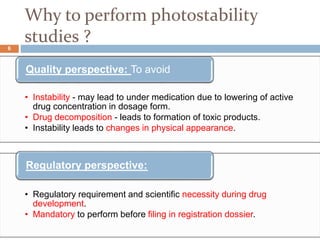
Why to perform photostability
studies ?
• Instability - may lead to under medication due to lowering of active
drug concentration in dosage form.
• Drug decomposition - leads to formation of toxic products.
• Instability leads to changes in physical appearance.
Quality perspective: To avoid
• Regulatory requirement and scientific necessity during drug
development.
• Mandatory to perform before filing in registration dossier.
Regulatory perspective:
6
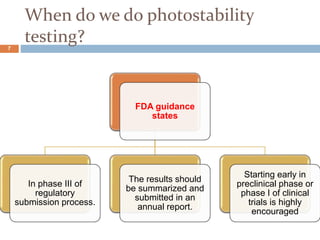
When do we do photostability
testing?
FDA guidance
states
In phase III of
regulatory
submission process.
The results should
be summarized and
submitted in an
annual report.
Starting early in
preclinical phase or
phase I of clinical
trials is highly
encouraged
7
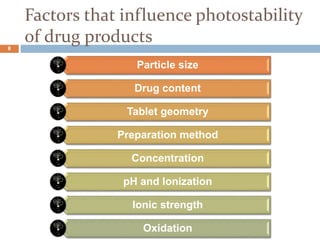
Factors that influence photostability
of drug products
Particle size
Drug content
Tablet geometry
Preparation method
Concentration
pH and Ionization
Ionic strength
Oxidation
8
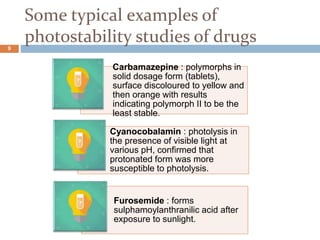
Some typical examples of
photostability studies of drugs
Carbamazepine : polymorphs in
solid dosage form (tablets),
surface discoloured to yellow and
then orange with results
indicating polymorph II to be the
least stable.
Cyanocobalamin : photolysis in
the presence of visible light at
various pH, confirmed that
protonated form was more
susceptible to photolysis.
Furosemide : forms
sulphamoylanthranilic acid after
exposure to sunlight.
9
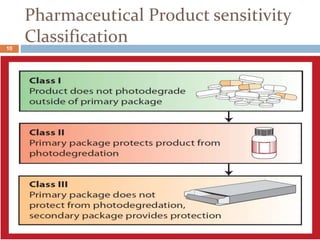
Pharmaceutical Product sensitivity
Classification10
PHOTOSTABLITY
TESTING OF NEW
DRUG SUBSTANCES
AND PRODUCTS AS
PER
ICH Q1B
GUIDELINE
11
The guideline is
for photostability
information for
Registration for
new molecular
entities.
The guideline
does not cover
the photostability
of drugs after
administration
(i.e. under
conditions of
use).
Alternative
approaches may
be used if they
are scientifically
sound and
justification is
provided.
12
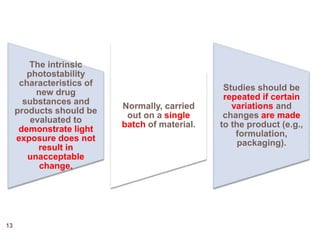
The intrinsic
photostability
characteristics of
new drug
substances and
products should be
evaluated to
demonstrate light
exposure does not
result in
unacceptable
change.
Normally, carried
out on a single
batch of material.
Studies should be
repeated if certain
variations and
changes are made
to the product (e.g.,
formulation,
packaging).
13
LIGHT SOURCES
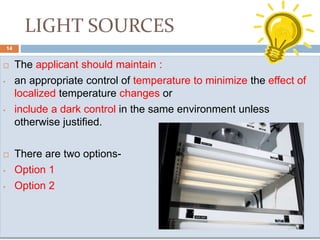
 The applicant should maintain :
• an appropriate control of temperature to minimize the effect of
localized temperature changes or
• include a dark control in the same environment unless
otherwise justified.
 There are two options-
• Option 1
• Option 2
14
LIGHT SOURCES
Option 1
Any light source that is designed to
produce an output similar to the D65/ID65*
emission standard such as
an artificial daylight
fluorescent lamp
combining visible
and ultraviolet (UV)
outputs
xenon
metal halide
lamp.
*D65 is the internationally recognized standard for outdoor daylight as
defined in ISO 10977 (1993). ID65 is the equivalent indoor indirect daylight
standard.
15
LIGHT SOURCES
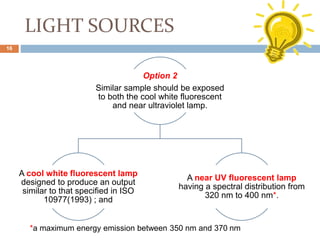
Option 2
Similar sample should be exposed
to both the cool white fluorescent
and near ultraviolet lamp.
A cool white fluorescent lamp
designed to produce an output
similar to that specified in ISO
10977(1993) ; and
A near UV fluorescent lamp
having a spectral distribution from
320 nm to 400 nm*.
*a maximum energy emission between 350 nm and 370 nm
16
LIGHT SOURCES: ISO 10977
 Describes test equipment, test procedure and analytical
methods for
• predicting the long-term dark storage stability of colour
photographic images (based on the Arrhenius method) and
• measuring the colour stability of such products when
subjected to certain illuminants at specified temperatures
and humidities.
 Does not specify limits of acceptability for the
stability.
17
GENERAL PROCEDURE
 For confirmatory studies:
Samples should be exposed to light providing
• illumination of not less than 1.2 million lux hours and
• an integrated near ultraviolet energy of not less than 200 watt
hours/square meter .
Samples may be exposed side-by-side with a validated chemical
actinometric system.
18
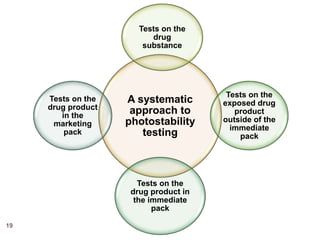
A systematic
approach to
photostability
testing
Tests on the
drug
substance
Tests on the
exposed drug
product
outside of the
immediate
pack
Tests on the
drug product in
the immediate
pack
Tests on the
drug product
in the
marketing
pack
19
DRUG SUBSTANCE
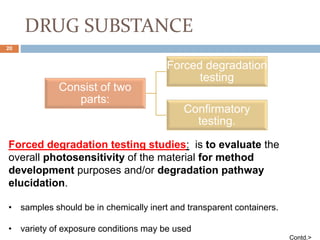
Consist of two
parts:
Forced degradation
testing
Confirmatory
testing.
Forced degradation testing studies: is to evaluate the
overall photosensitivity of the material for method
development purposes and/or degradation pathway
elucidation.
• samples should be in chemically inert and transparent containers.
• variety of exposure conditions may be used
Contd.>
20
DRUG SUBSTANCE
Under forcing conditions, decomposition products may be
observed that are unlikely to be formed under the conditions used
for confirmatory studies.
Confirmatory studies: provide the information necessary for
handling, packaging, and labeling.
• If the drug is clearly photostable or photolabile the
photostability characteristics should be confirmed on a single
batch.
• If the results of the confirmatory study are equivocal, testing of
up to two additional batches should be conducted.
21
DRUG SUBSTANCE:
PRESENTATION OF SAMPLES
 Ensure that the effects of the changes in physical states such
as sublimation, evaporation or melting are minimized.
 To provide minimal interference with the exposure of samples
under test.
 Possible interactions between the samples and any material
used for containers or for general protection of the sample,
should also be considered and eliminated.
• Solid drug substances spread across the container to give a
thickness of not more than 3 millimeters.
• Liquids should be exposed in chemically inert and transparent
containers.
22
DRUG SUBSTANCE: ANALYSIS OF
SAMPLE
the samples should be examined for;
 any changes in physical properties (e.g., appearance,
clarity, or color of solution)
 for assay and;
 degradants by a method suitably validated for products
likely to arise from photochemical degradation
processes.
Analysis of the exposed sample should be performed
concomitantly with protected samples used as dark
23
DRUG SUBSTANCE: JUDGEMENT
OF RESULTS
 Forced degradation studies:
• It is important to recognize that they form part of the stress
testing and
• are not therefore designed to establish qualitative or
quantitative limits for change.
 Confirmatory studies: should identify precautionary
measures needed
• In manufacturing or in formulation of the drug product, and
• If light resistant packaging is needed.
24
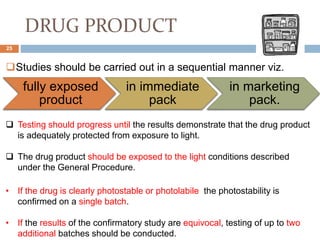
DRUG PRODUCT
fully exposed
product
in immediate
pack
in marketing
pack.
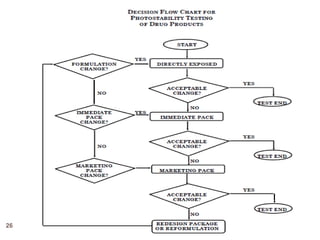
25
Studies should be carried out in a sequential manner viz.
 Testing should progress until the results demonstrate that the drug product
is adequately protected from exposure to light.
 The drug product should be exposed to the light conditions described
under the General Procedure.
• If the drug is clearly photostable or photolabile the photostability is
confirmed on a single batch.
• If the results of the confirmatory study are equivocal, testing of up to two
additional batches should be conducted.
26
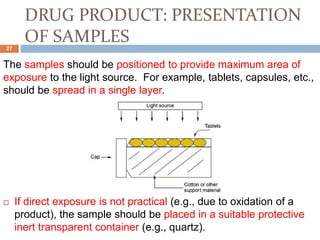
DRUG PRODUCT: PRESENTATION
OF SAMPLES
The samples should be positioned to provide maximum area of
exposure to the light source. For example, tablets, capsules, etc.,
should be spread in a single layer.
 If direct exposure is not practical (e.g., due to oxidation of a
product), the sample should be placed in a suitable protective
inert transparent container (e.g., quartz).
27
DRUG PRODUCT: ANALYSIS OF
SAMPLES
the samples should be examined for;
 any changes in physical properties (e.g., appearance, clarity, or color of
solution)
 for assay and;
 degradants by a method suitably validated for products likely to arise from
photochemical degradation processes.
 For solid oral dosage form products, testing should be
conducted on an appropriately sized composite , for example,
20 tablets or capsules.
 Homogenization or solubilization of the entire sample - creams,
ointments, suspensions, etc.
Analysis of the exposed sample should be performed concomitantly with
protected samples used as dark controls.
28
DRUG PRODUCT: JUDGEMENT
OF RESULTS
Depending on the extent of change special
labeling or packaging may be needed.
When evaluating the results of photostability
studies it is important to consider the results
obtained from other formal stability studies.
29
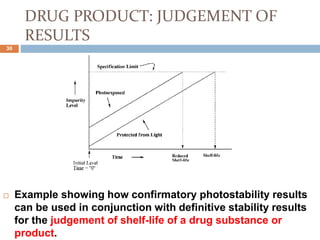
DRUG PRODUCT: JUDGEMENT OF
RESULTS
 Example showing how confirmatory photostability results
can be used in conjunction with definitive stability results
for the judgement of shelf-life of a drug substance or
product.
30
CHALLENGES OF
PHOTOSTABILITY TESTING
31
1. Troublesome Lamp Selection
Option I light sources (fluorescent D65, metal halide or xenon)
cause:
 Over exposure: it produces both UVA and visual irradiance in
fixed ration, but the exposure requirement for photopic and UVA
are different, one of the dose gets overexposed.
 Production of excessive heat
 dark controls are needed to segregate photochemical degradation from
thermal degradation.
 Large internal cooling fans are necessary to dissipate this heat and can
pose presentation problems by blowing samples around.
 Sample colour changes due to high temperatures cannot easily be
32
1. Troublesome Lamp Selection
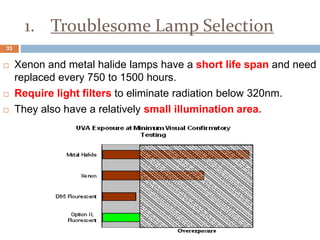
 Xenon and metal halide lamps have a short life span and need
replaced every 750 to 1500 hours.
 Require light filters to eliminate radiation below 320nm.
 They also have a relatively small illumination area.
33
2. Irradiance Measurement Difficulty
Chemical actinometers can be used to measure sample dose
 ICH describes the use of quinine hydrochloride dehydrate as an
example of a chemical actinometer.
 Quinine has a ‘dark reaction’ where the reaction continues after it is
used. Not only is quinine wavelength dependent, it is affected by
temperature and pH variations. Due to these characteristics, quinine
has been shown to be inaccurate with lamps that produce significant
amounts of heat, such as xenon lamps.
 Irradiance measurements with instrumental radiometers have
high margins of uncertainty; 10% is not uncommon.
 Radiometers need to be calibrated or certified before use.
34
3. Test Completion Control Issues
 Chemical actinometers do not provide a mechanism to
automatically turn the lamps off or alert the operator when the
desired exposure level is reached.
 Chemical actinometers cannot record irradiance levels
throughout the test.
 As lamps age, their intensity decreases → causes irradiance
levels of full-power light sources to fluctuate over time→ light
intensity would terminate prematurely compared to the desired
dose→ This is particularly troublesome for confirmatory studies.
35
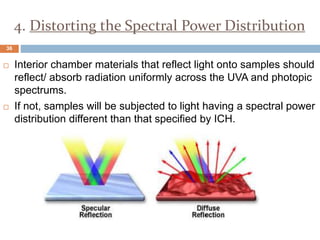
4. Distorting the Spectral Power Distribution
 Interior chamber materials that reflect light onto samples should
reflect/ absorb radiation uniformly across the UVA and photopic
spectrums.
 If not, samples will be subjected to light having a spectral power
distribution different than that specified by ICH.
36
5. Humidity Control Factor
 State of hydration affects the photostability of some samples.
 This means identical drug substances subjected to
identical irradiance and temperature conditions can have
very different results if exposed to different humidity
levels.
37
SOLUTIONS TO PHOTOSTABILITY
TESTING CHALLENGES
38
1. Prudent Lamp Selection
Option II of ICH guidelines (cool white and near- UV fluorescent lighting)
• Independent control of illuminance and UVA irradiance eliminates overexposure.
• Fluorescent lamps generate minimal heat.
• Eliminate the need for expensive light filters and dark controls.
• Small internal fans can be employed to subtly maintain proper air temperature
without disturbing sample presentation.
• Typically last over ten thousand hours, have low replacement costs, and provide a
large illumination area.
2. Accurate Light Measurements
• Achieved with a built-in radiometer.
• Detectors utilizing a Teflon hemisphere may result in an exceptionally good cosine
response.
• Detectors should be both cosine corrected and calibrated.
• It is best if radiometer displayed units for illuminance and UVA irradiance are
consistent with ICH documentation.
3. Precise Test Completion Controls
• An integrating radiometer combined with chamber controls should be used to
ensure precise dose levels at test completion.
• Advanced systems are capable of running based on exposure level or timed tests,
the radiometer should show irradiance, test time remaining and accumulated dose
levels.
39
4. Preserving the Spectral Power Distribution
• Using specular aluminium on interior reflective surfaces, it reflects light
across both UVA and photopic spectrums
• Available with a 95% total reflection.
• Outshines mirrored stainless steel and white painted surfaces for not only
illuminance reflection but also UVA irradiance.
5. Tight Humidity Control
• Use ultrasonic nebulizers, they vaporize water droplets as small as a 3 micron
mean diameter, this enhances uniform humidity distribution throughout the
chamber without injecting additional unwanted heat.
• Dehumidification is often accomplished through mechanical refrigeration.
6. Value Added Features
Chamber features are available that enhance the end-user experience:
• keep track of accumulated lamp hours
• alert the operator when to replace the lamps
Validation is simple with pre-written IQ/OQ/PQ validation protocols.
Chart recorders assist in demonstrating regulatory compliance by permanently
recording illuminance, UVA irradiance, temperature and humidity testing
conditions.
Sliding shelves, access ports and security lockouts are other features that can40
CONCLUSION
 Product should be shown to be light stable by photostability
studies.
 Showing the dosage form or dosage form in packaging is
photostable.
 By light transmission studies showing adequate protection of
the packaging.
 For blisters, which are not light protective, store blister in carton.
 If product is not light stable; label should state that protect form
light and container should be light protective; light transmission
41
CONCLUSION
 Photo stability studies are performed to generate primary
degradants of drug substance by exposure to UV or fluorescent
conditions.
 Important to help develop determine the degradation pathways
and degradation products of the active ingredients.
 The various factors affecting the photostability of dosage form
should be clearly indicated so as to prevent their interference with
the testing and the stability of dosage form.
42
43
REFERENCES
1. ICH Harmonised tripartite guideline, Stability testing: Photostability Testing of New
Drug Substances and Products Q1B Current Step 4 version dated 6 November
1996
2. Jitendra Kumar, Review: Development of forced degradation studies of drugs,
International Journal of Advances in Pharmaceutics 2 (3) 2013; 35,37-38.
3. Abhijjeet Welankiwar, Photostability Testing of Pharmaceutical Products,
International Research Journal of Pharmacy 2013; 11-15.
4. Steven W Baertschi, Commentary: A critical assessment of the ICH guideline on
photostability testing of new drug substances and products (Q1B), Journal of
Pharmaceutical Sciences, vol. 99, No. 7, July 2010; 2934-2939.
5. Robert A. Reed, Implications of Photostability on the Manufacturing, Packaging,
Storage, and Testing of Formulated Pharmaceutical Products; Pharmaceutical
technology March 2005; 70-71.
6. Bob Dotterer, Using photostability chambers to meet the requirements of drug
testing in accordance with ICH, Q1B; CARON; 1-5.
7. PowerPoint Presentation: Gabriel K. Kaddu, Stability Principles and Case Studies:
Active Pharmaceutical Ingredient (API) and Finished Pharmaceutical Product
(FPP); WHO Prequalification of Medicines Programme; Assessment training,
44
45

PHOTOSTABILITY TESTING SEM I SEMINAR

  • 1.
    PHOTOSTABILITY TESTING PRESENTED BY :HARSHAVARDHAN VIJAY KONDHARE 1ST YEAR M.PHARM (DRUG REGULATORY AFFAIRS) GUIDE : DR. R.N. PUROHIT H.O.D DRUG REGULATORY AFFAIRS POONA COLLEGE OF PHARMACY 29-12-2015
  • 2.
    IMPORTANT TERMS  Stability: time period in which the drug product retains the same properties and characteristics that it possessed at the time of its manufacturing.  Stress testing : is a form of deliberately intense or thorough testing used to determine the stability of a given drug substance or product.  Photosensitivity : amount to which a drug substance or product reacts upon receiving photons, especially visible light.  Photostability : stability of a drug substance or product on exposure to light. 2
  • 3.
    IMPORTANT TERMS  Immediate(primary) pack is that constituent of the packaging that is in direct contact with the drug substance or drug product, and includes any appropriate label.  Marketing pack is the combination of immediate pack and other secondary packaging such as a carton.  Forced degradation testing studies are those undertaken to degrade the sample deliberately. 3
  • 4.
    IMPORTANT TERMS  Confirmatorystudies are those undertaken to establish photostability characteristics under standardized conditions.  Parent Guideline : Q1A(R2) Stability Testing of New Drug Substances and Products. 4
  • 5.
    INDEX  Why toperform photostability studies ?  When do we do photostability testing?  Factors that influence photostability of drug products  Some typical examples of photostability studies of drugs  Pharmaceutical product sensitivity classification  Photostability testing of new drug substances and products as per ICH Q1B guideline  Light sources  General procedure  Drug substance: Presentation of samples, Analysis of sample, Judgement of results  Drug product: Presentation of samples, Analysis of sample, Judgement of results  Challenges of photostability testing  Solutions to photostability testing challenges 5
  • 6.
    Why to performphotostability studies ? • Instability - may lead to under medication due to lowering of active drug concentration in dosage form. • Drug decomposition - leads to formation of toxic products. • Instability leads to changes in physical appearance. Quality perspective: To avoid • Regulatory requirement and scientific necessity during drug development. • Mandatory to perform before filing in registration dossier. Regulatory perspective: 6
  • 7.
    When do wedo photostability testing? FDA guidance states In phase III of regulatory submission process. The results should be summarized and submitted in an annual report. Starting early in preclinical phase or phase I of clinical trials is highly encouraged 7
  • 8.
    Factors that influencephotostability of drug products Particle size Drug content Tablet geometry Preparation method Concentration pH and Ionization Ionic strength Oxidation 8
  • 9.
    Some typical examplesof photostability studies of drugs Carbamazepine : polymorphs in solid dosage form (tablets), surface discoloured to yellow and then orange with results indicating polymorph II to be the least stable. Cyanocobalamin : photolysis in the presence of visible light at various pH, confirmed that protonated form was more susceptible to photolysis. Furosemide : forms sulphamoylanthranilic acid after exposure to sunlight. 9
  • 10.
  • 11.
    PHOTOSTABLITY TESTING OF NEW DRUGSUBSTANCES AND PRODUCTS AS PER ICH Q1B GUIDELINE 11
  • 12.
    The guideline is forphotostability information for Registration for new molecular entities. The guideline does not cover the photostability of drugs after administration (i.e. under conditions of use). Alternative approaches may be used if they are scientifically sound and justification is provided. 12
  • 13.
    The intrinsic photostability characteristics of newdrug substances and products should be evaluated to demonstrate light exposure does not result in unacceptable change. Normally, carried out on a single batch of material. Studies should be repeated if certain variations and changes are made to the product (e.g., formulation, packaging). 13
  • 14.
    LIGHT SOURCES  Theapplicant should maintain : • an appropriate control of temperature to minimize the effect of localized temperature changes or • include a dark control in the same environment unless otherwise justified.  There are two options- • Option 1 • Option 2 14
  • 15.
    LIGHT SOURCES Option 1 Anylight source that is designed to produce an output similar to the D65/ID65* emission standard such as an artificial daylight fluorescent lamp combining visible and ultraviolet (UV) outputs xenon metal halide lamp. *D65 is the internationally recognized standard for outdoor daylight as defined in ISO 10977 (1993). ID65 is the equivalent indoor indirect daylight standard. 15
  • 16.
    LIGHT SOURCES Option 2 Similarsample should be exposed to both the cool white fluorescent and near ultraviolet lamp. A cool white fluorescent lamp designed to produce an output similar to that specified in ISO 10977(1993) ; and A near UV fluorescent lamp having a spectral distribution from 320 nm to 400 nm*. *a maximum energy emission between 350 nm and 370 nm 16
  • 17.
    LIGHT SOURCES: ISO10977  Describes test equipment, test procedure and analytical methods for • predicting the long-term dark storage stability of colour photographic images (based on the Arrhenius method) and • measuring the colour stability of such products when subjected to certain illuminants at specified temperatures and humidities.  Does not specify limits of acceptability for the stability. 17
  • 18.
    GENERAL PROCEDURE  Forconfirmatory studies: Samples should be exposed to light providing • illumination of not less than 1.2 million lux hours and • an integrated near ultraviolet energy of not less than 200 watt hours/square meter . Samples may be exposed side-by-side with a validated chemical actinometric system. 18
  • 19.
    A systematic approach to photostability testing Testson the drug substance Tests on the exposed drug product outside of the immediate pack Tests on the drug product in the immediate pack Tests on the drug product in the marketing pack 19
  • 20.
    DRUG SUBSTANCE Consist oftwo parts: Forced degradation testing Confirmatory testing. Forced degradation testing studies: is to evaluate the overall photosensitivity of the material for method development purposes and/or degradation pathway elucidation. • samples should be in chemically inert and transparent containers. • variety of exposure conditions may be used Contd.> 20
  • 21.
    DRUG SUBSTANCE Under forcingconditions, decomposition products may be observed that are unlikely to be formed under the conditions used for confirmatory studies. Confirmatory studies: provide the information necessary for handling, packaging, and labeling. • If the drug is clearly photostable or photolabile the photostability characteristics should be confirmed on a single batch. • If the results of the confirmatory study are equivocal, testing of up to two additional batches should be conducted. 21
  • 22.
    DRUG SUBSTANCE: PRESENTATION OFSAMPLES  Ensure that the effects of the changes in physical states such as sublimation, evaporation or melting are minimized.  To provide minimal interference with the exposure of samples under test.  Possible interactions between the samples and any material used for containers or for general protection of the sample, should also be considered and eliminated. • Solid drug substances spread across the container to give a thickness of not more than 3 millimeters. • Liquids should be exposed in chemically inert and transparent containers. 22
  • 23.
    DRUG SUBSTANCE: ANALYSISOF SAMPLE the samples should be examined for;  any changes in physical properties (e.g., appearance, clarity, or color of solution)  for assay and;  degradants by a method suitably validated for products likely to arise from photochemical degradation processes. Analysis of the exposed sample should be performed concomitantly with protected samples used as dark 23
  • 24.
    DRUG SUBSTANCE: JUDGEMENT OFRESULTS  Forced degradation studies: • It is important to recognize that they form part of the stress testing and • are not therefore designed to establish qualitative or quantitative limits for change.  Confirmatory studies: should identify precautionary measures needed • In manufacturing or in formulation of the drug product, and • If light resistant packaging is needed. 24
  • 25.
    DRUG PRODUCT fully exposed product inimmediate pack in marketing pack. 25 Studies should be carried out in a sequential manner viz.  Testing should progress until the results demonstrate that the drug product is adequately protected from exposure to light.  The drug product should be exposed to the light conditions described under the General Procedure. • If the drug is clearly photostable or photolabile the photostability is confirmed on a single batch. • If the results of the confirmatory study are equivocal, testing of up to two additional batches should be conducted.
  • 26.
  • 27.
    DRUG PRODUCT: PRESENTATION OFSAMPLES The samples should be positioned to provide maximum area of exposure to the light source. For example, tablets, capsules, etc., should be spread in a single layer.  If direct exposure is not practical (e.g., due to oxidation of a product), the sample should be placed in a suitable protective inert transparent container (e.g., quartz). 27
  • 28.
    DRUG PRODUCT: ANALYSISOF SAMPLES the samples should be examined for;  any changes in physical properties (e.g., appearance, clarity, or color of solution)  for assay and;  degradants by a method suitably validated for products likely to arise from photochemical degradation processes.  For solid oral dosage form products, testing should be conducted on an appropriately sized composite , for example, 20 tablets or capsules.  Homogenization or solubilization of the entire sample - creams, ointments, suspensions, etc. Analysis of the exposed sample should be performed concomitantly with protected samples used as dark controls. 28
  • 29.
    DRUG PRODUCT: JUDGEMENT OFRESULTS Depending on the extent of change special labeling or packaging may be needed. When evaluating the results of photostability studies it is important to consider the results obtained from other formal stability studies. 29
  • 30.
    DRUG PRODUCT: JUDGEMENTOF RESULTS  Example showing how confirmatory photostability results can be used in conjunction with definitive stability results for the judgement of shelf-life of a drug substance or product. 30
  • 31.
  • 32.
    1. Troublesome LampSelection Option I light sources (fluorescent D65, metal halide or xenon) cause:  Over exposure: it produces both UVA and visual irradiance in fixed ration, but the exposure requirement for photopic and UVA are different, one of the dose gets overexposed.  Production of excessive heat  dark controls are needed to segregate photochemical degradation from thermal degradation.  Large internal cooling fans are necessary to dissipate this heat and can pose presentation problems by blowing samples around.  Sample colour changes due to high temperatures cannot easily be 32
  • 33.
    1. Troublesome LampSelection  Xenon and metal halide lamps have a short life span and need replaced every 750 to 1500 hours.  Require light filters to eliminate radiation below 320nm.  They also have a relatively small illumination area. 33
  • 34.
    2. Irradiance MeasurementDifficulty Chemical actinometers can be used to measure sample dose  ICH describes the use of quinine hydrochloride dehydrate as an example of a chemical actinometer.  Quinine has a ‘dark reaction’ where the reaction continues after it is used. Not only is quinine wavelength dependent, it is affected by temperature and pH variations. Due to these characteristics, quinine has been shown to be inaccurate with lamps that produce significant amounts of heat, such as xenon lamps.  Irradiance measurements with instrumental radiometers have high margins of uncertainty; 10% is not uncommon.  Radiometers need to be calibrated or certified before use. 34
  • 35.
    3. Test CompletionControl Issues  Chemical actinometers do not provide a mechanism to automatically turn the lamps off or alert the operator when the desired exposure level is reached.  Chemical actinometers cannot record irradiance levels throughout the test.  As lamps age, their intensity decreases → causes irradiance levels of full-power light sources to fluctuate over time→ light intensity would terminate prematurely compared to the desired dose→ This is particularly troublesome for confirmatory studies. 35
  • 36.
    4. Distorting theSpectral Power Distribution  Interior chamber materials that reflect light onto samples should reflect/ absorb radiation uniformly across the UVA and photopic spectrums.  If not, samples will be subjected to light having a spectral power distribution different than that specified by ICH. 36
  • 37.
    5. Humidity ControlFactor  State of hydration affects the photostability of some samples.  This means identical drug substances subjected to identical irradiance and temperature conditions can have very different results if exposed to different humidity levels. 37
  • 38.
  • 39.
    1. Prudent LampSelection Option II of ICH guidelines (cool white and near- UV fluorescent lighting) • Independent control of illuminance and UVA irradiance eliminates overexposure. • Fluorescent lamps generate minimal heat. • Eliminate the need for expensive light filters and dark controls. • Small internal fans can be employed to subtly maintain proper air temperature without disturbing sample presentation. • Typically last over ten thousand hours, have low replacement costs, and provide a large illumination area. 2. Accurate Light Measurements • Achieved with a built-in radiometer. • Detectors utilizing a Teflon hemisphere may result in an exceptionally good cosine response. • Detectors should be both cosine corrected and calibrated. • It is best if radiometer displayed units for illuminance and UVA irradiance are consistent with ICH documentation. 3. Precise Test Completion Controls • An integrating radiometer combined with chamber controls should be used to ensure precise dose levels at test completion. • Advanced systems are capable of running based on exposure level or timed tests, the radiometer should show irradiance, test time remaining and accumulated dose levels. 39
  • 40.
    4. Preserving theSpectral Power Distribution • Using specular aluminium on interior reflective surfaces, it reflects light across both UVA and photopic spectrums • Available with a 95% total reflection. • Outshines mirrored stainless steel and white painted surfaces for not only illuminance reflection but also UVA irradiance. 5. Tight Humidity Control • Use ultrasonic nebulizers, they vaporize water droplets as small as a 3 micron mean diameter, this enhances uniform humidity distribution throughout the chamber without injecting additional unwanted heat. • Dehumidification is often accomplished through mechanical refrigeration. 6. Value Added Features Chamber features are available that enhance the end-user experience: • keep track of accumulated lamp hours • alert the operator when to replace the lamps Validation is simple with pre-written IQ/OQ/PQ validation protocols. Chart recorders assist in demonstrating regulatory compliance by permanently recording illuminance, UVA irradiance, temperature and humidity testing conditions. Sliding shelves, access ports and security lockouts are other features that can40
  • 41.
    CONCLUSION  Product shouldbe shown to be light stable by photostability studies.  Showing the dosage form or dosage form in packaging is photostable.  By light transmission studies showing adequate protection of the packaging.  For blisters, which are not light protective, store blister in carton.  If product is not light stable; label should state that protect form light and container should be light protective; light transmission 41
  • 42.
    CONCLUSION  Photo stabilitystudies are performed to generate primary degradants of drug substance by exposure to UV or fluorescent conditions.  Important to help develop determine the degradation pathways and degradation products of the active ingredients.  The various factors affecting the photostability of dosage form should be clearly indicated so as to prevent their interference with the testing and the stability of dosage form. 42
  • 43.
  • 44.
    REFERENCES 1. ICH Harmonisedtripartite guideline, Stability testing: Photostability Testing of New Drug Substances and Products Q1B Current Step 4 version dated 6 November 1996 2. Jitendra Kumar, Review: Development of forced degradation studies of drugs, International Journal of Advances in Pharmaceutics 2 (3) 2013; 35,37-38. 3. Abhijjeet Welankiwar, Photostability Testing of Pharmaceutical Products, International Research Journal of Pharmacy 2013; 11-15. 4. Steven W Baertschi, Commentary: A critical assessment of the ICH guideline on photostability testing of new drug substances and products (Q1B), Journal of Pharmaceutical Sciences, vol. 99, No. 7, July 2010; 2934-2939. 5. Robert A. Reed, Implications of Photostability on the Manufacturing, Packaging, Storage, and Testing of Formulated Pharmaceutical Products; Pharmaceutical technology March 2005; 70-71. 6. Bob Dotterer, Using photostability chambers to meet the requirements of drug testing in accordance with ICH, Q1B; CARON; 1-5. 7. PowerPoint Presentation: Gabriel K. Kaddu, Stability Principles and Case Studies: Active Pharmaceutical Ingredient (API) and Finished Pharmaceutical Product (FPP); WHO Prequalification of Medicines Programme; Assessment training, 44
  • 45.