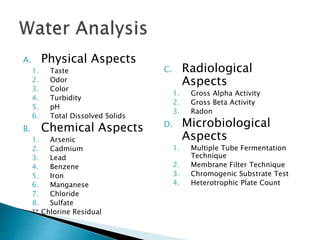
A. Physical Aspects 
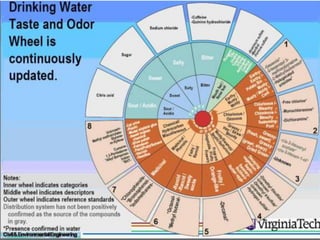
1. Taste 
2. Odor 
3. Color 
4. Turbidity 
5. pH 
6. Total Dissolved Solids 
B. Chemical Aspects 
1. Arsenic 
2. Cadmium 
3. Lead 
4. Benzene 
5. Iron 
6. Manganese 
7. Chloride 
8. Sulfate 
** Chlorine Residual 
C. Radiological 
Aspects 
1. Gross Alpha Activity 
2. Gross Beta Activity 
3. Radon 
D. Microbiological 
Aspects 
1. Multiple Tube Fermentation 
Technique 
2. Membrane Filter Technique 
3. Chromogenic Substrate Test 
4. Heterotrophic Plate Count
 This part deals primarily with the 
measurement of the physical properties of 
the sample 
 Provides first warning of potential hazards in 
the environment
 Refers to the gustatory sensations 
◦ Bitter – caffeine ( Strong coffee) 
◦ Salty – sodium chloride (Chlorinated water) 
◦ Sour – citric acid (lemon juice) 
◦ Sweet – sugar (syrup) 
 Flavor – gustatory, olfactory and trigeminal 
sensations 
 Methods: 
◦ Sensory Evaluation Technique 
 Only used on samples known to be safe for 
ingestion 
 Standard: No Objectionable Taste
 Affected by organic and inorganic chemicals 
present in water 
 Provide qualitative descriptions of odor 
intensity 
 Method: 
◦ Sensory Evaluation Technique 
 Standard: No Objectionable Odor
 Color of surface and groundwater results 
primarily from the presence of natural 
organic matter, particularly aquatic humic 
matter 
◦ Humic matter consists of humic and fulvic acids – 
yellow-brown color 
 Substances that adds color to water: 
◦ Suspended particles 
 Clays, algae, iron, manganese oxides 
 Color usually removed from potable water for 
aesthetic purposes
 True Color 
◦ Color of water from which the turbidity has been 
removed 
◦ Standard: ≦ 5 Color Units 
 Apparent Color 
◦ Color due to substances in the solution and 
suspended matter 
◦ Contributed principally by colloidal or suspended 
material 
◦ Standard: ≦ 10 Color Units 
 Methods: Visual Comparison Colorimetric
 Caused by suspended and colloidal material 
◦ Clay, silt, finely divided organic and inorganic 
matter, plankton and other microbes 
 Method: Turbidimetry 
 Standard: 5 NTU
 Acidity 
◦ Attributed to the presence of strong mineral acids and 
weak acids and hydrolizing salts such as iron and 
aluminum sulfate 
◦ Contribute to corrosiveness and influence chemical 
rates, chemical speciation and biological processes 
 Alkalinity 
◦ Refers to the acid-neutralizing capacity of water 
◦ Attributed to the carbonate, bicarbonate and hydroxide 
content and borates, phosphates and silicates or other 
bases 
 Method: Electrometric method (pH meter) 
 Standard: 6.5 to 8.5
 Waters with high dissolved solids generally 
are of inferior palatability 
 Portions of solids that passes through a filter 
of nominal pore size 
 Methods: Gravimetric, dried at 180°C 
 Standard: ≦ 500
 Various forms of chemicals are present in 
drinking water that may lead to some health 
problems 
 Inorganic constituents 
◦ Arsenic, lead, chromium and cadmium 
 Suspected carcinogens 
 Organic constituents 
◦ Due to decomposition of organic debris, domestic, 
agricultural, industrial, water treatment
 Presence of arsenic in water is due to mineral 
dissolution, industrial discharges, application of 
pesticides 
 Health Effects: severe poisoning and carcinogenic 
 Methods: Inductively Couple Plasma/Mass 
Spectrophotometry; hydride generation Atomic 
Absorption Spectrophotometry; Silver 
Diethyldithiocarbamate Method, Electrothermal 
Atomic Absorption Spectrophotometry (Graphite 
furnace AAS) 
 Standard: ≦ 0.05 mg/L
 extremely toxic and accumulate in the 
kidneys and liver 
◦ Causes dysfunction of the kidneys 
 Methods: Inductively Couple Plasma/Mass 
Spectrophotometry (ICP/MS), Flame Atomic 
Absorption Spectrophotometry (FAAS) 
 Standard: ≦ 0.003 mg/L
 Presence in water supply comes from industrial, 

mine and smelts discharges or from the 

dissolution of plumbing and plumbing fixtures 
 Toxic and cummulative poison 
 Method: Inductively Couple Plasma/Mass 
Spectrophotometry (ICP/MS), Flame Atomic 
Absorption Spectrophotometry (FAAS), 
Electrothermal Atomic Absorption 
Spectrophotometry (EAAS), Anodic Stripping 
Voltammetry; Dithizone 
 Standard: ≦ 0.01 mg/L
 Results with high contamination from human 
or animal waste 
 Methods: Cd Reduction Method, Capillary Ion 
Electrophoresis Colorimetric (Diazotization); 
Flow Injection Analysis 
 Standard: ≦ 0.01 mg/L
 Presence is due to industrial effluents, 
atmospheric pollution due to vehicular 
emissions 
 Method: Gas Chromatography/Mass 
Spectrophotometry 
 Standard: ≦ 0.01 mg/L
 Elevated iron levels can cause stains in 
plumbing, laundry, and cooking utensils 
 Imparts objectionable taste and color 
 Ferrous state -> oxidized -> ferric state 
(reddish precipitate) 
 Method: Phenanthroline, Atomic Absorption 
Spectrophotometry, Colorimetric Method 
 Standard: ≦ 0.01 mg/L
 Elevated manganese can cause stains in 
plumbing, laundry, cooking utensils 
 Mn2+ -> oxidized -> MnO2 black precipitate 
 Methods: Perfurate Method, Atomic 
Absorption Spectrophotometry, Inductively 
Color Plasma/Mass Spectrophotometry 
 Standard: ≦ 0.04 mg/L
 Major inorganic anions in water 
 Produces salty taste if the cation is sodium 
 High chloride content may harm metallic 
pipes and structures 
 Method: Argentometric Method, IC 
 Standard: ≦ 250 mg/L
 Occurs naturally in water 
 Method: Turbidimetric Method, Ion 
Chromatography, Gravimetric Method 
 Standard: ≦ 250 mg/L
 Chlorine if not within limits may produce 
adverse effects 
 Taste and color of water is intensified 
 Potential organic chloroform may be form in 
the process of chlorination 
 Methods: Iodometric, Amperometric 
Titrations, DPD Colorimetric Method 
 Standard: 0.3 to 1.5 mg/L
 Does not provide a complete water quality 
picture 
◦ If possible a series of analysis must be conducted 
over a protracted period
 Coliform group consists of several genera of 
bacteria belonging to the family of 
Enterobacteriaceae 
◦ Facultative anaerobic, gram-negative, non-sporeforming 
bacteria that ferments lactose with 
gas and acid within 48 hours @ 35°C 
 Uses MPN table to estimate coliform density
 Presumptive Phase 
◦ Lauryl Sulfate Broth (Triple Strength) 
 10mL media plus 20mL sample in 5 tubes 
 Incubate for 48hours at 35 +/- 0.5°C 
 Confirmatory Phase 
◦ Brilliant Green Bile Broth 
 1 loopful or 1 drop of positive samples in 5 tubes of 10mL 
media 
 Incubate for 48hours at 35 +/- 0.5°C 
◦ EC Broth 
 1 loopful or 1 drop of positive samples in 5 tubes of 10mL 
media 
 Incubate in water bath for 24 hours at 44.5 +/- 0.2°C 
 Completed Phase 
◦ Lauryl Sulfate Broth (Single Strength)
 Presumptive Phase 
 Preparation of Lauryl Sulfate Broth 
 Dissolve 35.6 grams in one liter distilled water. 
 Dispense 10 ml to clean culture tubes. 
 Place fermentation/durham tube in an inverted position. 
 Put the screw cap on the culture tubes. 
 Place all tubes in the autoclavable rack and wrap with brown paper. 
 Sterilize for 15 minutes at 121 psi pressure. 
 Procedure 
 Pipette 20 ml of water sample into five (5) tubes of primary lactose broth. 
 Mix by gentle shaking. 
 Incubate at 35°C for 24 hours. 
 Read at the end of 24 hours and record the presence or absence of gas. 
 Incubate for another 24 hours if no gas has developed. 
 Examine for gas formation after 48 hours.
Confirmatory Test 
 Brilliant Green Bile Broth 
 Preparation 
 Dissolve 40 grams in one liter distilled water. 
 Dispense 10 ml to clean culture tubes. 
 Place fermentation/durham tube in an inverted position. 
 Put the screw cap on the culture tubes. 
 Place all tubes in the autoclavable rack and wrap with brown paper. 
 Sterilize for 15 minutes at 121 psi pressure. 
 Procedure 
 Pipette 0.3 ml of broth from positive presumptive tubes to five (5) to ten 
(10) ml portions of BGB tubes. 
 Mix by gentle shaking. 
 Incubate the inoculated tubes for 24-48 hours, at 35°C.
Confirmatory Test 
 EC Media 
 Preparation 
 Dissolve 37 grams in one liter distilled water. 
 Dispense 10 ml broth to culture tubes. 
 Place fermentation tube in an inverted position. 
 Put the screw cap on the culture tubes. 
 Place all tubes in the autoclavable rack and wrap with brown 
paper. 
 Sterilize for 15 minutes at 121 psi pressure. 
 Procedure 
 Transfer 0.3 ml water sample from positive presumptive tubes. 
 Incubate at 44.5 ± 2 °C for 24 hours in water bath.
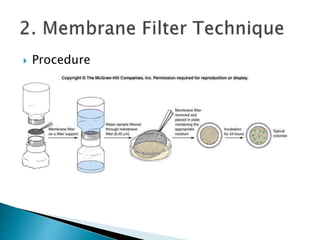
 Used to test large sample volumes 
 Released numerical results more rapidly than 
MTFT 
 Greatly affected by: 
◦ high levels of turbidity 
 Clogs the membrane filter 
◦ High heterotrophic bacteria count 
 Interferes with the growth of coliforms on the filter
 Procedure
 Also called Enzyme Substrate Coliform Test 
 Qualitative test 
 Principle: 
◦ Total Coliform Bacteria 
 Chromogenic Substrate 
1. ONPG – ortho-nitrophenyl-β-D-galactopyranoside 
2. CPRG – chlorophenol red- β-D-galactopyranoside 
3. X-GAL – 5-chromo-4-chloro-3-indoyl- β-D-galactopyranoside 
 Detects enzyme β-D-galactosidase which is produced 
by total coliform bacteria
 Principle: 
◦ Escherichia coli 
 Fluorogenic Substrate 
1. MUG – 4-methylumbellferyl-β-D-glucoronide 
o Detects enzyme β-D-glucoronidase which is 
produced by E. coli
 FLUOROCULT Modified LMX Broth 
◦ Increased sensitivity 
◦ Detection time is shorten 
 Contains IPTG: 1-Isopropyl-β-D-1-thiogalactopyranoside 
 Increase activity of β-D-galactosidase 
◦ Chromogenic Substrate: X-GAL 
◦ Fluorogenic Substrate: MUG 
◦ Contains tryptophan 
 Indole test – Kovac’s reagent added
 Useful in checking water treatments’ 
effectiveness 
◦ Indirect indicator of pathogen removal 
 High HPC – false negative coliform results 
a) Pour Plate – R2A, NWRI agar 
b) Spread Plate – R2A, NWRI agar 
c) Membrane Filter – mHPC, R2A, NWRI agar
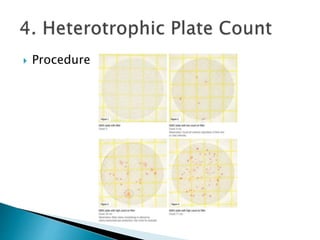
 Procedure
 Gross alpha activity 
◦ Alpha-emitting radionuclides 
 Radium 
 Uranium 
 Thorium 
 Gross beta activity 
 Radon
If it’s only an idea!
“The analytical laboratory provides qualitative and 
quantitative data for use in decision-making. To be 
valuable, the data must accurately describe the 
characteristics and concentrations of constituents in 
the samples submitted to the laboratory. In many 
cases, because they lead to faulty interpretations, 
approximate or incorrect results are worse than no 
result at all.”
 set of operating principles that, if strictly followed 
during sample collection and analysis, will produce 
data of known and defensible quality
 Everyone involved with the lab: 
◦ Person sampling 
◦ Person running the test 
◦ Person washing the glassware 
◦ Person doing maintenance on the instruments 
◦ Person interpreting the results
 Staff Organization and Responsibilities 
 Sample Control and Documentation 
 SOP for Analytical Methods & Procedures 
 Analyst Training Requirements 
 Equipment Preventative Maintenance 
 Calibration Procedures 
 Corrective Actions 
 Internal Quality Control Activities 
 Performance Audits 
 Data Assessment for Bias and Precision 
 Data Validation and Reporting
 Documentation 
 Communication 
 Training 
 Cross-Training 
 Updating
 part of quality management focused on fulfilling 
quality requirements 
 examining “control” materials of known 
substances along with patient samples to monitor 
the accuracy and precision of the complete 
examination (analytic) process 
 GOAL: to detect errors and correct them 
before results are reported
 Certification of Analyst Competence 
 Recovery of Known Additions 
 Analysis of Standards 
 Analysis of Reagent Blanks 
 Calibration with Standards 
 Analysis of Duplicates 
 Maintenance of Control Charts

Water Analysis for Drinking Water

  • 2.
    A. Physical Aspects 1. Taste 2. Odor 3. Color 4. Turbidity 5. pH 6. Total Dissolved Solids B. Chemical Aspects 1. Arsenic 2. Cadmium 3. Lead 4. Benzene 5. Iron 6. Manganese 7. Chloride 8. Sulfate ** Chlorine Residual C. Radiological Aspects 1. Gross Alpha Activity 2. Gross Beta Activity 3. Radon D. Microbiological Aspects 1. Multiple Tube Fermentation Technique 2. Membrane Filter Technique 3. Chromogenic Substrate Test 4. Heterotrophic Plate Count
  • 3.
     This partdeals primarily with the measurement of the physical properties of the sample  Provides first warning of potential hazards in the environment
  • 4.
     Refers tothe gustatory sensations ◦ Bitter – caffeine ( Strong coffee) ◦ Salty – sodium chloride (Chlorinated water) ◦ Sour – citric acid (lemon juice) ◦ Sweet – sugar (syrup)  Flavor – gustatory, olfactory and trigeminal sensations  Methods: ◦ Sensory Evaluation Technique  Only used on samples known to be safe for ingestion  Standard: No Objectionable Taste
  • 5.
     Affected byorganic and inorganic chemicals present in water  Provide qualitative descriptions of odor intensity  Method: ◦ Sensory Evaluation Technique  Standard: No Objectionable Odor
  • 7.
     Color ofsurface and groundwater results primarily from the presence of natural organic matter, particularly aquatic humic matter ◦ Humic matter consists of humic and fulvic acids – yellow-brown color  Substances that adds color to water: ◦ Suspended particles  Clays, algae, iron, manganese oxides  Color usually removed from potable water for aesthetic purposes
  • 8.
     True Color ◦ Color of water from which the turbidity has been removed ◦ Standard: ≦ 5 Color Units  Apparent Color ◦ Color due to substances in the solution and suspended matter ◦ Contributed principally by colloidal or suspended material ◦ Standard: ≦ 10 Color Units  Methods: Visual Comparison Colorimetric
  • 9.
     Caused bysuspended and colloidal material ◦ Clay, silt, finely divided organic and inorganic matter, plankton and other microbes  Method: Turbidimetry  Standard: 5 NTU
  • 10.
     Acidity ◦Attributed to the presence of strong mineral acids and weak acids and hydrolizing salts such as iron and aluminum sulfate ◦ Contribute to corrosiveness and influence chemical rates, chemical speciation and biological processes  Alkalinity ◦ Refers to the acid-neutralizing capacity of water ◦ Attributed to the carbonate, bicarbonate and hydroxide content and borates, phosphates and silicates or other bases  Method: Electrometric method (pH meter)  Standard: 6.5 to 8.5
  • 11.
     Waters withhigh dissolved solids generally are of inferior palatability  Portions of solids that passes through a filter of nominal pore size  Methods: Gravimetric, dried at 180°C  Standard: ≦ 500
  • 12.
     Various formsof chemicals are present in drinking water that may lead to some health problems  Inorganic constituents ◦ Arsenic, lead, chromium and cadmium  Suspected carcinogens  Organic constituents ◦ Due to decomposition of organic debris, domestic, agricultural, industrial, water treatment
  • 13.
     Presence ofarsenic in water is due to mineral dissolution, industrial discharges, application of pesticides  Health Effects: severe poisoning and carcinogenic  Methods: Inductively Couple Plasma/Mass Spectrophotometry; hydride generation Atomic Absorption Spectrophotometry; Silver Diethyldithiocarbamate Method, Electrothermal Atomic Absorption Spectrophotometry (Graphite furnace AAS)  Standard: ≦ 0.05 mg/L
  • 14.
     extremely toxicand accumulate in the kidneys and liver ◦ Causes dysfunction of the kidneys  Methods: Inductively Couple Plasma/Mass Spectrophotometry (ICP/MS), Flame Atomic Absorption Spectrophotometry (FAAS)  Standard: ≦ 0.003 mg/L
  • 15.
     Presence inwater supply comes from industrial, mine and smelts discharges or from the dissolution of plumbing and plumbing fixtures  Toxic and cummulative poison  Method: Inductively Couple Plasma/Mass Spectrophotometry (ICP/MS), Flame Atomic Absorption Spectrophotometry (FAAS), Electrothermal Atomic Absorption Spectrophotometry (EAAS), Anodic Stripping Voltammetry; Dithizone  Standard: ≦ 0.01 mg/L
  • 16.
     Results withhigh contamination from human or animal waste  Methods: Cd Reduction Method, Capillary Ion Electrophoresis Colorimetric (Diazotization); Flow Injection Analysis  Standard: ≦ 0.01 mg/L
  • 17.
     Presence isdue to industrial effluents, atmospheric pollution due to vehicular emissions  Method: Gas Chromatography/Mass Spectrophotometry  Standard: ≦ 0.01 mg/L
  • 18.
     Elevated ironlevels can cause stains in plumbing, laundry, and cooking utensils  Imparts objectionable taste and color  Ferrous state -> oxidized -> ferric state (reddish precipitate)  Method: Phenanthroline, Atomic Absorption Spectrophotometry, Colorimetric Method  Standard: ≦ 0.01 mg/L
  • 19.
     Elevated manganesecan cause stains in plumbing, laundry, cooking utensils  Mn2+ -> oxidized -> MnO2 black precipitate  Methods: Perfurate Method, Atomic Absorption Spectrophotometry, Inductively Color Plasma/Mass Spectrophotometry  Standard: ≦ 0.04 mg/L
  • 20.
     Major inorganicanions in water  Produces salty taste if the cation is sodium  High chloride content may harm metallic pipes and structures  Method: Argentometric Method, IC  Standard: ≦ 250 mg/L
  • 21.
     Occurs naturallyin water  Method: Turbidimetric Method, Ion Chromatography, Gravimetric Method  Standard: ≦ 250 mg/L
  • 22.
     Chlorine ifnot within limits may produce adverse effects  Taste and color of water is intensified  Potential organic chloroform may be form in the process of chlorination  Methods: Iodometric, Amperometric Titrations, DPD Colorimetric Method  Standard: 0.3 to 1.5 mg/L
  • 23.
     Does notprovide a complete water quality picture ◦ If possible a series of analysis must be conducted over a protracted period
  • 24.
     Coliform groupconsists of several genera of bacteria belonging to the family of Enterobacteriaceae ◦ Facultative anaerobic, gram-negative, non-sporeforming bacteria that ferments lactose with gas and acid within 48 hours @ 35°C  Uses MPN table to estimate coliform density
  • 25.
     Presumptive Phase ◦ Lauryl Sulfate Broth (Triple Strength)  10mL media plus 20mL sample in 5 tubes  Incubate for 48hours at 35 +/- 0.5°C  Confirmatory Phase ◦ Brilliant Green Bile Broth  1 loopful or 1 drop of positive samples in 5 tubes of 10mL media  Incubate for 48hours at 35 +/- 0.5°C ◦ EC Broth  1 loopful or 1 drop of positive samples in 5 tubes of 10mL media  Incubate in water bath for 24 hours at 44.5 +/- 0.2°C  Completed Phase ◦ Lauryl Sulfate Broth (Single Strength)
  • 26.
     Presumptive Phase  Preparation of Lauryl Sulfate Broth  Dissolve 35.6 grams in one liter distilled water.  Dispense 10 ml to clean culture tubes.  Place fermentation/durham tube in an inverted position.  Put the screw cap on the culture tubes.  Place all tubes in the autoclavable rack and wrap with brown paper.  Sterilize for 15 minutes at 121 psi pressure.  Procedure  Pipette 20 ml of water sample into five (5) tubes of primary lactose broth.  Mix by gentle shaking.  Incubate at 35°C for 24 hours.  Read at the end of 24 hours and record the presence or absence of gas.  Incubate for another 24 hours if no gas has developed.  Examine for gas formation after 48 hours.
  • 27.
    Confirmatory Test Brilliant Green Bile Broth  Preparation  Dissolve 40 grams in one liter distilled water.  Dispense 10 ml to clean culture tubes.  Place fermentation/durham tube in an inverted position.  Put the screw cap on the culture tubes.  Place all tubes in the autoclavable rack and wrap with brown paper.  Sterilize for 15 minutes at 121 psi pressure.  Procedure  Pipette 0.3 ml of broth from positive presumptive tubes to five (5) to ten (10) ml portions of BGB tubes.  Mix by gentle shaking.  Incubate the inoculated tubes for 24-48 hours, at 35°C.
  • 28.
    Confirmatory Test EC Media  Preparation  Dissolve 37 grams in one liter distilled water.  Dispense 10 ml broth to culture tubes.  Place fermentation tube in an inverted position.  Put the screw cap on the culture tubes.  Place all tubes in the autoclavable rack and wrap with brown paper.  Sterilize for 15 minutes at 121 psi pressure.  Procedure  Transfer 0.3 ml water sample from positive presumptive tubes.  Incubate at 44.5 ± 2 °C for 24 hours in water bath.
  • 29.
     Used totest large sample volumes  Released numerical results more rapidly than MTFT  Greatly affected by: ◦ high levels of turbidity  Clogs the membrane filter ◦ High heterotrophic bacteria count  Interferes with the growth of coliforms on the filter
  • 30.
  • 31.
     Also calledEnzyme Substrate Coliform Test  Qualitative test  Principle: ◦ Total Coliform Bacteria  Chromogenic Substrate 1. ONPG – ortho-nitrophenyl-β-D-galactopyranoside 2. CPRG – chlorophenol red- β-D-galactopyranoside 3. X-GAL – 5-chromo-4-chloro-3-indoyl- β-D-galactopyranoside  Detects enzyme β-D-galactosidase which is produced by total coliform bacteria
  • 32.
     Principle: ◦Escherichia coli  Fluorogenic Substrate 1. MUG – 4-methylumbellferyl-β-D-glucoronide o Detects enzyme β-D-glucoronidase which is produced by E. coli
  • 33.
     FLUOROCULT ModifiedLMX Broth ◦ Increased sensitivity ◦ Detection time is shorten  Contains IPTG: 1-Isopropyl-β-D-1-thiogalactopyranoside  Increase activity of β-D-galactosidase ◦ Chromogenic Substrate: X-GAL ◦ Fluorogenic Substrate: MUG ◦ Contains tryptophan  Indole test – Kovac’s reagent added
  • 34.
     Useful inchecking water treatments’ effectiveness ◦ Indirect indicator of pathogen removal  High HPC – false negative coliform results a) Pour Plate – R2A, NWRI agar b) Spread Plate – R2A, NWRI agar c) Membrane Filter – mHPC, R2A, NWRI agar
  • 35.
  • 36.
     Gross alphaactivity ◦ Alpha-emitting radionuclides  Radium  Uranium  Thorium  Gross beta activity  Radon
  • 38.
  • 39.
    “The analytical laboratoryprovides qualitative and quantitative data for use in decision-making. To be valuable, the data must accurately describe the characteristics and concentrations of constituents in the samples submitted to the laboratory. In many cases, because they lead to faulty interpretations, approximate or incorrect results are worse than no result at all.”
  • 40.
     set ofoperating principles that, if strictly followed during sample collection and analysis, will produce data of known and defensible quality
  • 41.
     Everyone involvedwith the lab: ◦ Person sampling ◦ Person running the test ◦ Person washing the glassware ◦ Person doing maintenance on the instruments ◦ Person interpreting the results
  • 42.
     Staff Organizationand Responsibilities  Sample Control and Documentation  SOP for Analytical Methods & Procedures  Analyst Training Requirements  Equipment Preventative Maintenance  Calibration Procedures  Corrective Actions  Internal Quality Control Activities  Performance Audits  Data Assessment for Bias and Precision  Data Validation and Reporting
  • 43.
     Documentation Communication  Training  Cross-Training  Updating
  • 44.
     part ofquality management focused on fulfilling quality requirements  examining “control” materials of known substances along with patient samples to monitor the accuracy and precision of the complete examination (analytic) process  GOAL: to detect errors and correct them before results are reported
  • 45.
     Certification ofAnalyst Competence  Recovery of Known Additions  Analysis of Standards  Analysis of Reagent Blanks  Calibration with Standards  Analysis of Duplicates  Maintenance of Control Charts

Editor's Notes

  • #41 The Accuracy of the analytical result can be stated with a high level of confidence.”