




Controlling Clinical Laboratory
Errors-
Focusing on Analytical
and
Post Analytical Process
Dr. RajeshV Bendre
Chief Pathologist, MD(path), DNB(path), DPB
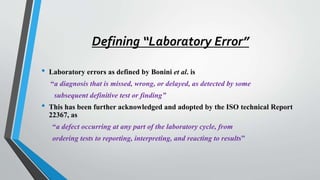
Defining “Laboratory Error”
• Laboratory errors as defined by Bonini et al. is
“a diagnosis that is missed, wrong, or delayed, as detected by some
subsequent definitive test or finding”
• This has been further acknowledged and adopted by the ISO technical Report
22367, as
“a defect occurring at any part of the laboratory cycle, from
ordering tests to reporting, interpreting, and reacting to results”
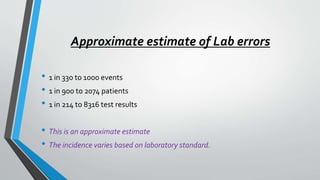
Approximate estimate of Lab errors
• 1 in 330 to 1000 events
• 1 in 900 to 2074 patients
• 1 in 214 to 8316 test results
• This is an approximate estimate
• The incidence varies based on laboratory standard.
Modes to find Lab errors
• Analyzing complaint from Patient and/or doctor
• Internal audit or supervisory observation.
• Pro-active feedback collection from patient/doctor
• Consistently failing proficiency test
• System and discipline to log events
Approach towards Complaints and errors
• To be treated as most important event needing personal addressal.
• Serious consideration as an area of improvement.
• This is an opportunity to: -
• Get involved
• Self audit
• Bring discipline/fear in staff
• Sincerity in work for staff.
• Keep staff on toes instead of getting over confident.
• This is a chance to speak/impress a customer (patient/doctor)
• Periodic review meetings on complaint and errors.
How does one react to a
complaint?
- On receipt of the complaint
- On revert after analyzing it
How to ensure that complaints are
recorded,
escalated
and closed
to customer’s satisfaction?
What should be recorded?
• Customer complaint, which may be –
• An error
• Perception
• Internal error found, with situation where –
• The report was already submitted
• The report was not submitted
• Non-compliance on various accounts –
• Non-delivery of service
• System lapses
• Record service complaints also. E.g. –
• Delayed report.
• Improper/painful blood collection.
• Rude behavior of staff
• Unpleasant communication by customer care advisor.
• Hygiene and infrastructure complaint
Classification of Lab errors
Latent errors
These are the errors occurring due to -
• Organizational failures.
• Infrastructure and design
• Faulty policies from management.
Active errors
The rest are active errors, which are of three types
• Pre-analytical errors
• Analytical errors
• Post analytical errors
Latent errors
• Chronic understaffing
• Multi-tasking and improper job distribution amongst staff
• Lack of instrument interface
• Poor formatting of results
• Overloading of analyzer and no back up
• Poor laboratory layout leading to misplacement of specimen
• Poor sample labelling policy
• Policy, design and process pertaining toTest requisition form.
• Poor communication between shifts and departments
• Excessive focus of management on costs
• Management’s approach towards incident reporting
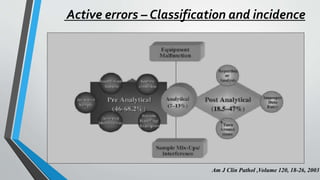
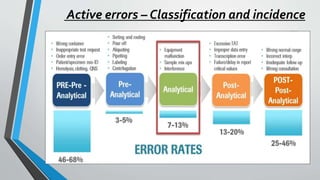
Active errors – Classification and incidence
Am J Clin Pathol ,Volume 120, 18-26, 2003
Active errors – Classification and incidence
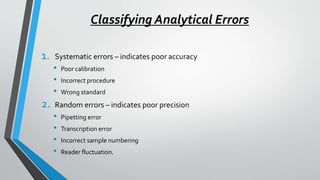
Classifying Analytical Errors
1. Systematic errors – indicates poor accuracy
• Poor calibration
• Incorrect procedure
• Wrong standard
2. Random errors – indicates poor precision
• Pipetting error
• Transcription error
• Incorrect sample numbering
• Reader fluctuation.
Preventive actions
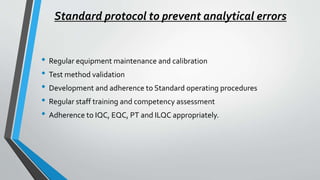
Standard protocol to prevent analytical errors
• Regular equipment maintenance and calibration
• Test method validation
• Development and adherence to Standard operating procedures
• Regular staff training and competency assessment
• Adherence to IQC, EQC, PT and ILQC appropriately.
Practical approach and
experience sharing
To prevent Analytical errors
Areas to be addressed for analytical errors
1. Sample
2. Reagent
3. Method of analysis
4. Equipment and automation
5. Validations
6. Quality system
7. Personnel
8. Reference intervals
1. Sample
• Avoid use of sample where labelling is compromised
• Unfit and poorly stored samples to be rejected.
• Inadequate sample to be handled cautiously
• Over diluted sample needs to be reported with care.
• Compromise/error on aliquoting may have special attention.
2. Reagent
• Careful choice of reagent brand
• Avoid lot mixing
• Expired reagents should be avoided.
• Appropriately store the reagents.
• Calibrators and control material
• Usage
• Preparation
• storage .
3. Method of Analysis
• Criteria to choose a method for an analyte estimation.
• Method validation
• Lot validation
• Validation of attributes like sensitivity, specificity, cross-reactivity etc.
• Avoid frequent change of method, kit brand etc.
4. Equipment and automation
• Follow maximum automation.
• Choose automation based on test volume and test parameters
• Ensure technical comparison and customer feedbacks while choosing
automation.
• Ensure basic features like bubble detection, clot detection, carry over,
interface capability etc.
• Bi-directionally interface the machines
• Ensure power stability, appropriate environmental conditions, quality of
water etc.
• Regular maintenance.
• Choose right analytical parameters.
Warnings on automation
• Selected parameters may not work well on each autoanalyser even if they are
big brand.
• Occasionally one may have series of wrong result after successful calibration and
controls due to various internal errors like
• probe block,
• temperature error,
• voltage change etc.
• Bubble, clots and short sample may give wrong results.
• Poor quality of water may give series of wrong results.
5.Validations
• Machine validation
• Kit / reagent validation
• Lot validation
• Reference range validation
6. Quality system
• IQC –
• Human origin to avoid matrix effect,
• Third party
• to cover measuring range
• EQC
• PT
• ILQC
Analyzing the findings and appropriate corrective actions to be taken
7. Personnel
• Training, training and training.
• Periodic competency assessment.
• Rewarding for “no errors”
• Ensuring that SOPs are followed
• Induction protocol & training calendar
8. Reference interval
• Validate ranges for each analyte
• Prefer reference book ranges
• Give age wise, sex wise, phase wise, clinical condition wise ranges
• Provide interpretation guidelines
• Indicate limitations.
• Periodic review.
Tips
Formulate recheck policy
for each analyte
- Different sample
- Different analyzer
- Different technician
- Different method
For every result i.e. challenged or needs review before
submission*
* Conditions apply
Examples
Hormones
• Prolactin
• TSH
• Vitamin D (25-(OH)vitaminD)
• PTH
• Testosterone
Infectious diseases
• HIV
• HBsAg
• Anti HCV
• TORCH-IgM
• HBV-DNA detection
• HIV-RNA detection
• HCV- RNA detection
Haematology
• Platelet count
• Malarial parasite
• Blood group
• PT
• Lupus anticoagulant
Tumor markers
• CEA
• PSA
• Ca125
Pregnancy
• HCG beta- serum
• HCG beta- urine
• IVF-E2
• Maternal screen
Biochemistry
• Glucose
• Bicarbonate
• Ammonia
• Creatinine
• Electrolytes
• Urine Chemistry
Important
• Formulate reporting/validation guidelines for each analyte.
• Ensure that Age and Sex is taken for all patients.
• Do take LMP and other history for selected tests like sex hormones, pregnancy related
tests etc.
• For every out of the range result,
• Co-relate with history
• Co-relate with patient demographics
• Co-relate with other test findings
• Co-relate with previous results, if appropriate.
• Generous versus planned rechecks.
• Pick up every opportunity to speak to clinician.
• Read as and when needed while reporting
• Introduce several panels and reflex tests.
Post analytical errors
Types of errors
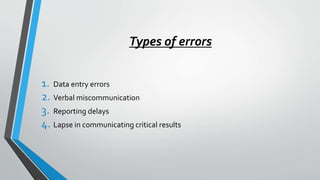
1. Data entry errors
2. Verbal miscommunication
3. Reporting delays
4. Lapse in communicating critical results
Suggested preventive
actions
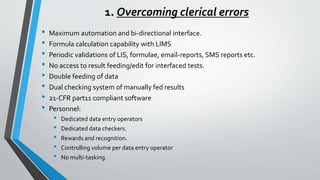
1. Overcoming clerical errors
• Maximum automation and bi-directional interface.
• Formula calculation capability with LIMS
• Periodic validations of LIS, formulae, email-reports, SMS reports etc.
• No access to result feeding/edit for interfaced tests.
• Double feeding of data
• Dual checking system of manually fed results
• 21-CFR part11 compliant software
• Personnel:
• Dedicated data entry operators
• Dedicated data checkers.
• Rewards and recognition.
• Controlling volume per data entry operator
• No multi-tasking.
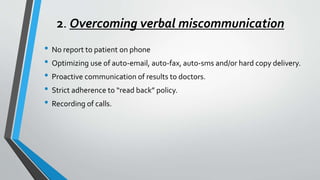
2. Overcoming verbal miscommunication
• No report to patient on phone
• Optimizing use of auto-email, auto-fax, auto-sms and/or hard copy delivery.
• Proactive communication of results to doctors.
• Strict adherence to “read back” policy.
• Recording of calls.
3. Reporting delays
• Set and communicate right customer expectation onTAT.
• AutomatedTAT calculation on receipt.
• SMS alert when report is ready.
• Intimate delays without fail
• Auto-validation and auto-authorization, rule based.
• No multi-tasking while validating results.
• Encourage customers to adopt electronic reporting mode
• Dedicated person for stat reporting and critical alerts
• Daily monitoring ofTAT, reviewing the results of delay and CAPA.
• Print results upon patient’s visit.
Take home message
• Actions to control laboratory errors is a journey.
• Never relax or overlook it.
• Enjoy analyzing and implementing CAPA.
• This is the only way for continuous quality improvement for better
patient care
Thank you

Controlling clinical laboratory errors

  • 1.
    Controlling Clinical Laboratory Errors- Focusingon Analytical and Post Analytical Process Dr. RajeshV Bendre Chief Pathologist, MD(path), DNB(path), DPB
  • 2.
    Defining “Laboratory Error” •Laboratory errors as defined by Bonini et al. is “a diagnosis that is missed, wrong, or delayed, as detected by some subsequent definitive test or finding” • This has been further acknowledged and adopted by the ISO technical Report 22367, as “a defect occurring at any part of the laboratory cycle, from ordering tests to reporting, interpreting, and reacting to results”
  • 3.
    Approximate estimate ofLab errors • 1 in 330 to 1000 events • 1 in 900 to 2074 patients • 1 in 214 to 8316 test results • This is an approximate estimate • The incidence varies based on laboratory standard.
  • 4.
    Modes to findLab errors • Analyzing complaint from Patient and/or doctor • Internal audit or supervisory observation. • Pro-active feedback collection from patient/doctor • Consistently failing proficiency test • System and discipline to log events
  • 5.
    Approach towards Complaintsand errors • To be treated as most important event needing personal addressal. • Serious consideration as an area of improvement. • This is an opportunity to: - • Get involved • Self audit • Bring discipline/fear in staff • Sincerity in work for staff. • Keep staff on toes instead of getting over confident. • This is a chance to speak/impress a customer (patient/doctor) • Periodic review meetings on complaint and errors.
  • 6.
    How does onereact to a complaint? - On receipt of the complaint - On revert after analyzing it
  • 7.
    How to ensurethat complaints are recorded, escalated and closed to customer’s satisfaction?
  • 8.
    What should berecorded? • Customer complaint, which may be – • An error • Perception • Internal error found, with situation where – • The report was already submitted • The report was not submitted • Non-compliance on various accounts – • Non-delivery of service • System lapses • Record service complaints also. E.g. – • Delayed report. • Improper/painful blood collection. • Rude behavior of staff • Unpleasant communication by customer care advisor. • Hygiene and infrastructure complaint
  • 9.
    Classification of Laberrors Latent errors These are the errors occurring due to - • Organizational failures. • Infrastructure and design • Faulty policies from management. Active errors The rest are active errors, which are of three types • Pre-analytical errors • Analytical errors • Post analytical errors
  • 10.
    Latent errors • Chronicunderstaffing • Multi-tasking and improper job distribution amongst staff • Lack of instrument interface • Poor formatting of results • Overloading of analyzer and no back up • Poor laboratory layout leading to misplacement of specimen • Poor sample labelling policy • Policy, design and process pertaining toTest requisition form. • Poor communication between shifts and departments • Excessive focus of management on costs • Management’s approach towards incident reporting
  • 11.
    Active errors –Classification and incidence Am J Clin Pathol ,Volume 120, 18-26, 2003
  • 12.
    Active errors –Classification and incidence
  • 13.
    Classifying Analytical Errors 1.Systematic errors – indicates poor accuracy • Poor calibration • Incorrect procedure • Wrong standard 2. Random errors – indicates poor precision • Pipetting error • Transcription error • Incorrect sample numbering • Reader fluctuation.
  • 14.
  • 15.
    Standard protocol toprevent analytical errors • Regular equipment maintenance and calibration • Test method validation • Development and adherence to Standard operating procedures • Regular staff training and competency assessment • Adherence to IQC, EQC, PT and ILQC appropriately.
  • 16.
    Practical approach and experiencesharing To prevent Analytical errors
  • 17.
    Areas to beaddressed for analytical errors 1. Sample 2. Reagent 3. Method of analysis 4. Equipment and automation 5. Validations 6. Quality system 7. Personnel 8. Reference intervals
  • 18.
    1. Sample • Avoiduse of sample where labelling is compromised • Unfit and poorly stored samples to be rejected. • Inadequate sample to be handled cautiously • Over diluted sample needs to be reported with care. • Compromise/error on aliquoting may have special attention.
  • 19.
    2. Reagent • Carefulchoice of reagent brand • Avoid lot mixing • Expired reagents should be avoided. • Appropriately store the reagents. • Calibrators and control material • Usage • Preparation • storage .
  • 20.
    3. Method ofAnalysis • Criteria to choose a method for an analyte estimation. • Method validation • Lot validation • Validation of attributes like sensitivity, specificity, cross-reactivity etc. • Avoid frequent change of method, kit brand etc.
  • 21.
    4. Equipment andautomation • Follow maximum automation. • Choose automation based on test volume and test parameters • Ensure technical comparison and customer feedbacks while choosing automation. • Ensure basic features like bubble detection, clot detection, carry over, interface capability etc. • Bi-directionally interface the machines • Ensure power stability, appropriate environmental conditions, quality of water etc. • Regular maintenance. • Choose right analytical parameters.
  • 22.
    Warnings on automation •Selected parameters may not work well on each autoanalyser even if they are big brand. • Occasionally one may have series of wrong result after successful calibration and controls due to various internal errors like • probe block, • temperature error, • voltage change etc. • Bubble, clots and short sample may give wrong results. • Poor quality of water may give series of wrong results.
  • 23.
    5.Validations • Machine validation •Kit / reagent validation • Lot validation • Reference range validation
  • 24.
    6. Quality system •IQC – • Human origin to avoid matrix effect, • Third party • to cover measuring range • EQC • PT • ILQC Analyzing the findings and appropriate corrective actions to be taken
  • 25.
    7. Personnel • Training,training and training. • Periodic competency assessment. • Rewarding for “no errors” • Ensuring that SOPs are followed • Induction protocol & training calendar
  • 26.
    8. Reference interval •Validate ranges for each analyte • Prefer reference book ranges • Give age wise, sex wise, phase wise, clinical condition wise ranges • Provide interpretation guidelines • Indicate limitations. • Periodic review.
  • 27.
  • 28.
  • 29.
    - Different sample -Different analyzer - Different technician - Different method For every result i.e. challenged or needs review before submission* * Conditions apply
  • 30.
  • 31.
    Hormones • Prolactin • TSH •Vitamin D (25-(OH)vitaminD) • PTH • Testosterone Infectious diseases • HIV • HBsAg • Anti HCV • TORCH-IgM • HBV-DNA detection • HIV-RNA detection • HCV- RNA detection
  • 32.
    Haematology • Platelet count •Malarial parasite • Blood group • PT • Lupus anticoagulant Tumor markers • CEA • PSA • Ca125
  • 33.
    Pregnancy • HCG beta-serum • HCG beta- urine • IVF-E2 • Maternal screen Biochemistry • Glucose • Bicarbonate • Ammonia • Creatinine • Electrolytes • Urine Chemistry
  • 34.
    Important • Formulate reporting/validationguidelines for each analyte. • Ensure that Age and Sex is taken for all patients. • Do take LMP and other history for selected tests like sex hormones, pregnancy related tests etc. • For every out of the range result, • Co-relate with history • Co-relate with patient demographics • Co-relate with other test findings • Co-relate with previous results, if appropriate. • Generous versus planned rechecks. • Pick up every opportunity to speak to clinician. • Read as and when needed while reporting • Introduce several panels and reflex tests.
  • 35.
  • 36.
    Types of errors 1.Data entry errors 2. Verbal miscommunication 3. Reporting delays 4. Lapse in communicating critical results
  • 37.
  • 38.
    1. Overcoming clericalerrors • Maximum automation and bi-directional interface. • Formula calculation capability with LIMS • Periodic validations of LIS, formulae, email-reports, SMS reports etc. • No access to result feeding/edit for interfaced tests. • Double feeding of data • Dual checking system of manually fed results • 21-CFR part11 compliant software • Personnel: • Dedicated data entry operators • Dedicated data checkers. • Rewards and recognition. • Controlling volume per data entry operator • No multi-tasking.
  • 39.
    2. Overcoming verbalmiscommunication • No report to patient on phone • Optimizing use of auto-email, auto-fax, auto-sms and/or hard copy delivery. • Proactive communication of results to doctors. • Strict adherence to “read back” policy. • Recording of calls.
  • 40.
    3. Reporting delays •Set and communicate right customer expectation onTAT. • AutomatedTAT calculation on receipt. • SMS alert when report is ready. • Intimate delays without fail • Auto-validation and auto-authorization, rule based. • No multi-tasking while validating results. • Encourage customers to adopt electronic reporting mode • Dedicated person for stat reporting and critical alerts • Daily monitoring ofTAT, reviewing the results of delay and CAPA. • Print results upon patient’s visit.
  • 41.
    Take home message •Actions to control laboratory errors is a journey. • Never relax or overlook it. • Enjoy analyzing and implementing CAPA. • This is the only way for continuous quality improvement for better patient care
  • 42.