Quality Control in Clinical Biochemistry
Laboratory
Quality Control in Clinical Biochemistry
Laboratory
• The ultimate goal of the clinical biochemistry laboratory is
to analyze the substances in body fluids qualitatively and
quantitatively for diagnosis and treatment of disease.
• The presentation of incorrect laboratory results may lead to
wrong diagnosis and treatment, leading to fatal results.
• Hence, it is very important to generate the reliable data
that depends on strict quality control management.
• Quality control is the procedures employed for the
detection and measurement of the sources of variation or
errors.
• Quality control is a representation of precision and
accuracy under varying experimental conditions.
Quality control
• Quality control in the clinical laboratory is a statistical
process used to monitor and evaluate the analytical
process that produces patient results.
• Requirements for the Statistical Process
– Regular testing of quality control products along with patient
samples
– Comparison of quality control results to specific statistical limits
(ranges).
• Reliability for most testing can be resolved by regular use
of quality control materials and statistical process control
• A quality control sample or product is a patient-like
material ideally made from human serum, urine or spinal
fluid
Quality control
• Good laboratory practice requires testing normal and
abnormal controls for each test at least daily to monitor the
analytical process
• Daily or regular testing of quality control samples creates a
QC database that the laboratory uses to validate the test
system
• Validation occurs by comparing daily QC results to a
laboratory-defined range of QC values.
• The laboratory defined range is calculated from QC data
collected from testing of normal and abnormal controls.
• To maintain the criteria for reliability in analysis,
calibration is done regularly by using the various
standards.
• A standard is the solution with known amount of analytes
and with which the sample can be compared to derive the
result
• While performing analytical measurements in laboratory,
various types of errors may be encountered.
Three major types of Laboratory Errors
• There are three major errors that may occur in
a laboratory:
– Random errors:
– Systemic errors:
– Gross errors or total analytical error
Random errors
• Random errors are the errors that arise due to statistical
fluctuations in the observations and lead to inconsistent
measurement value of a constant attribute.
• A random error is associated with the fact that when a
measurement is repeated, it will generally provide a
measured value that is different from the previous value.
• Random errors are caused by uncontrollable variables,
which cannot be defined or eliminated.
• These are errors that may arise due to bubbles in reagents
or reagent lines, instrument instability, temperature
variations, and operator variability, such as variation in
pipetting.
Systemic errors
• Systematic errors cause inaccurate results that are
consistently low or high.
• Systematic error is reproducible and predictable and can
be easily identified and corrected.
• These errors are caused by:
– insufficient control on analytical variables, e.g., impure calibration
material
– change in reagent lot
– change in calibration
– assigning the wrong calibrator values
– improperly prepared or deteriorating reagents
Systemic errors
• Majorly, systemic errors arise due to three factors:
a. Instrument errors: Instrument errors are errors associated
with instrument functioning e.g. due to power
fluctuations, defect in any parts of the instrument,
temperature variation, or when not calibrated.
– The instrumental errors can be removed by proper calibration or
maintenance of instrument.
b. Method errors: These are errors that arise due to the use
of non-ideal physical or chemical methods e.g. the speed
of reaction, problem associated with sampling, and
interference from side reactions can lead to such errors.
– The development and use of proper method can help to correct
these errors.
Systemic errors
c. Personal errors: These are caused by an observer’s
personal habits or mental judgment, wrong
judgment of dimensional values, color acuity
problems
– It may be accidental or systematic; proper training and
experience can help to eliminate the personal errors
effectively.
• Gross errors or total analytical error:
• Total analytical errors arise due to equipment failure
or observer’s carelessness.
Pre-analytical, analytical and post-analytical errors
• Pre-analytical errors arise before the analysis of sample
takes place e.g. mismatch of sample and laboratory data,
error in presentation of analyzed results, and delaying in
report generation.
• Analytical errors occur during analytical methods e.g. errors
related to use of expired or spoiled reagents, controls or
calibrators, sampling errors, and changes in analyzer’s
measuring unit.
• Post-analytical errors arise during transmission of data from
analyzers, result validation, and dispatching/communicating
results to physicians or patients as well as loss of the
results, inappropriate specimen or anticoagulant, error in
storage of sample, or mistakes in patients’ identification
Methods to Minimize the Laboratory Errors
• The quality control techniques must be used regularly to
detect for any change in precision or accuracy and to
follow corrective measures
• It is always desirable that both random and systematic
errors must be detected at the earliest possible stage and
preventive measures should be applied to minimize them
• The procedure adopted for the detection of errors consists
of specific quality control methods divided in two
categories:
– Internal Quality Control
– External Quality Control
Assignment
• Read on the methods to minimize the
laboratory errors.
• Prepare five power point slides for 10 minutes
presentation
Diagnostic Test Value
• A test used to diagnose disorders has four possible
outcomes:
– True positive (TP): a positive result for a patient who has
the condition (correct result)
– False positive (FP): a positive result for a patient who
does not have the condition (wrong result)
– True negative (TN): a negative result for a patient who
does not have the condition (correct result)
– False negative (FN): a negative result for a patient who
has the condition (wrong result)
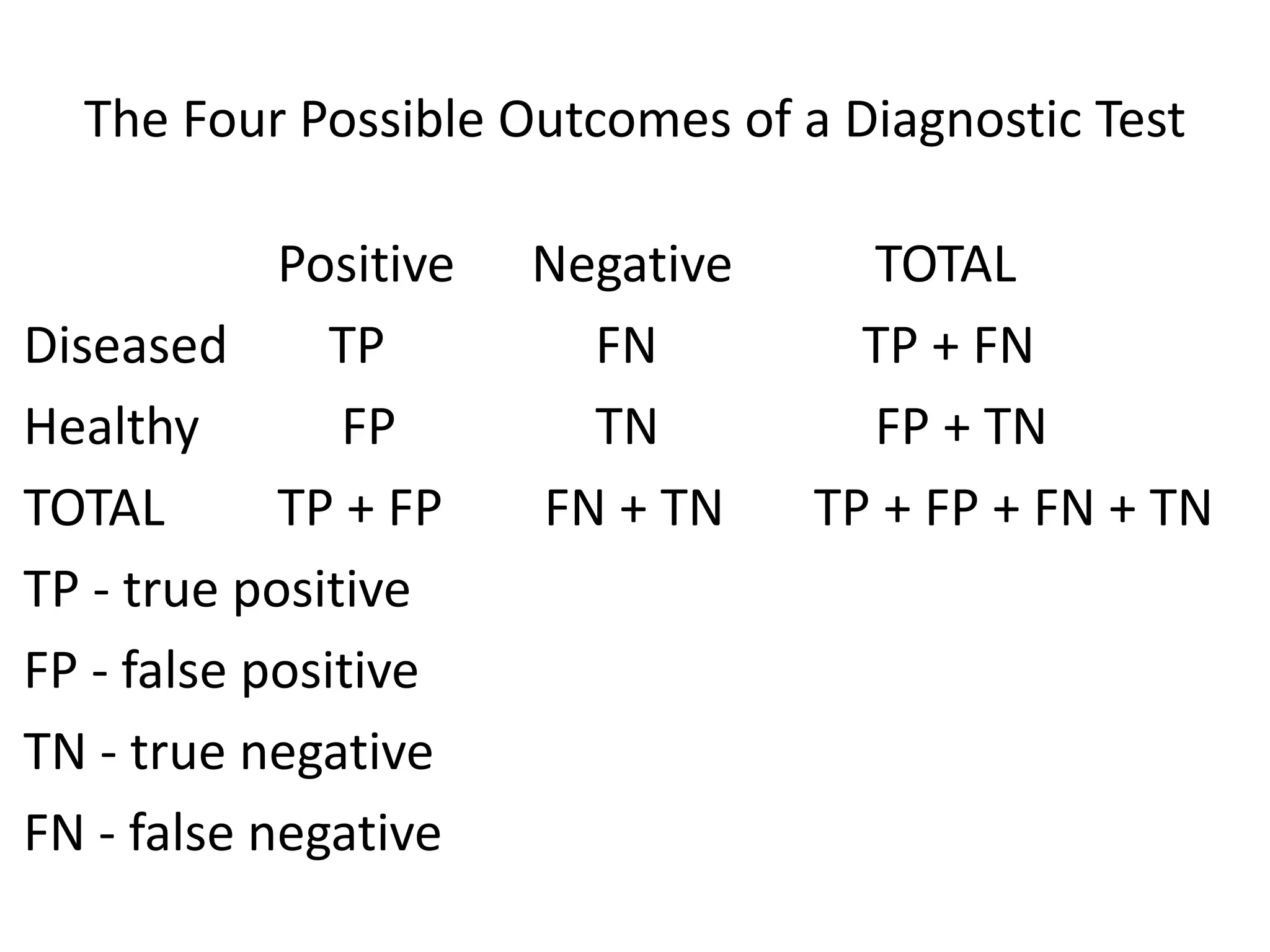
The Four Possible Outcomes of a Diagnostic Test
Positive Negative TOTAL
Diseased TP FN TP + FN
Healthy FP TN FP + TN
TOTAL TP + FP FN + TN TP + FP + FN + TN
TP - true positive
FP - false positive
TN - true negative
FN - false negative
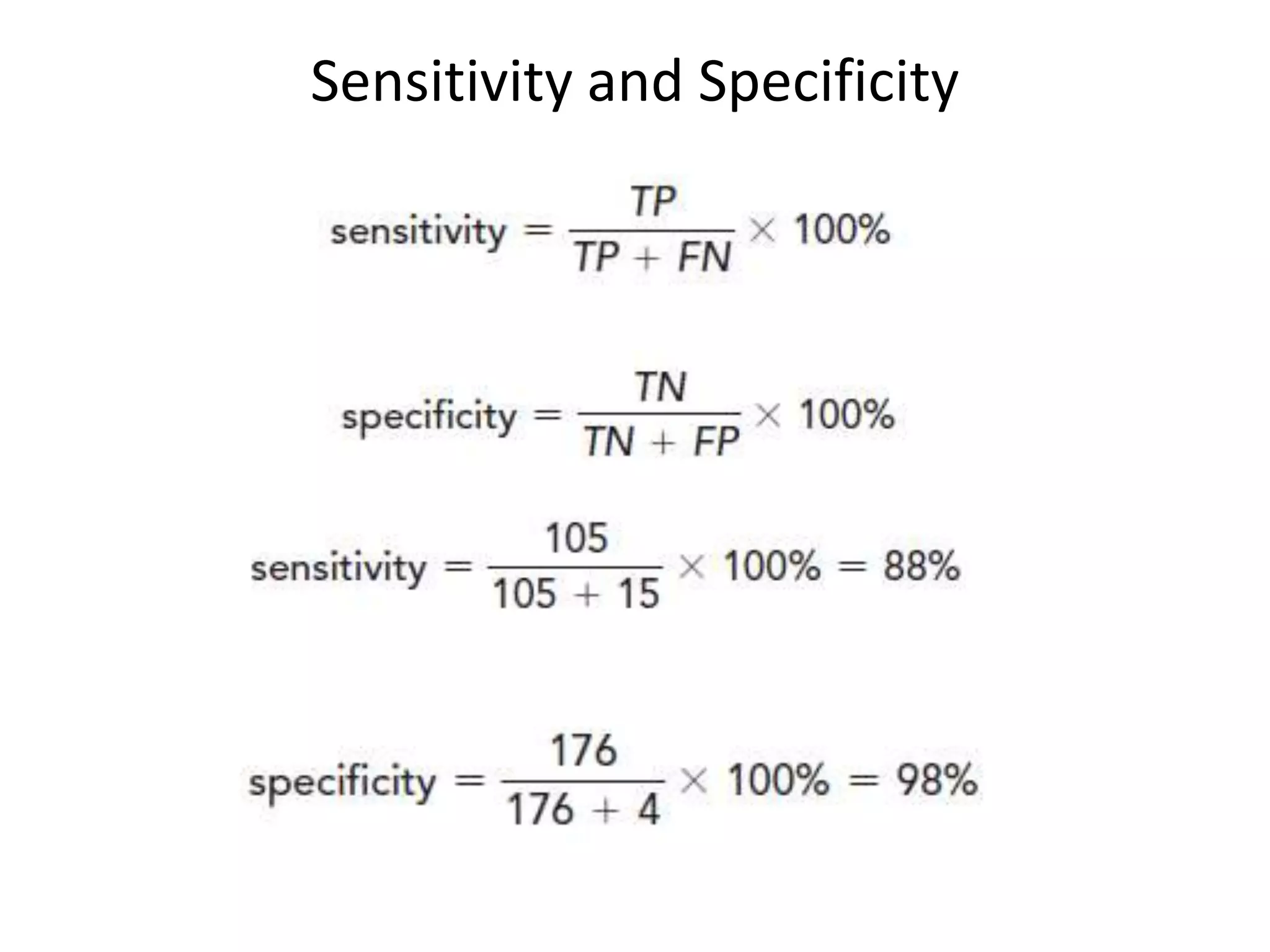
Sensitivity and Specificity
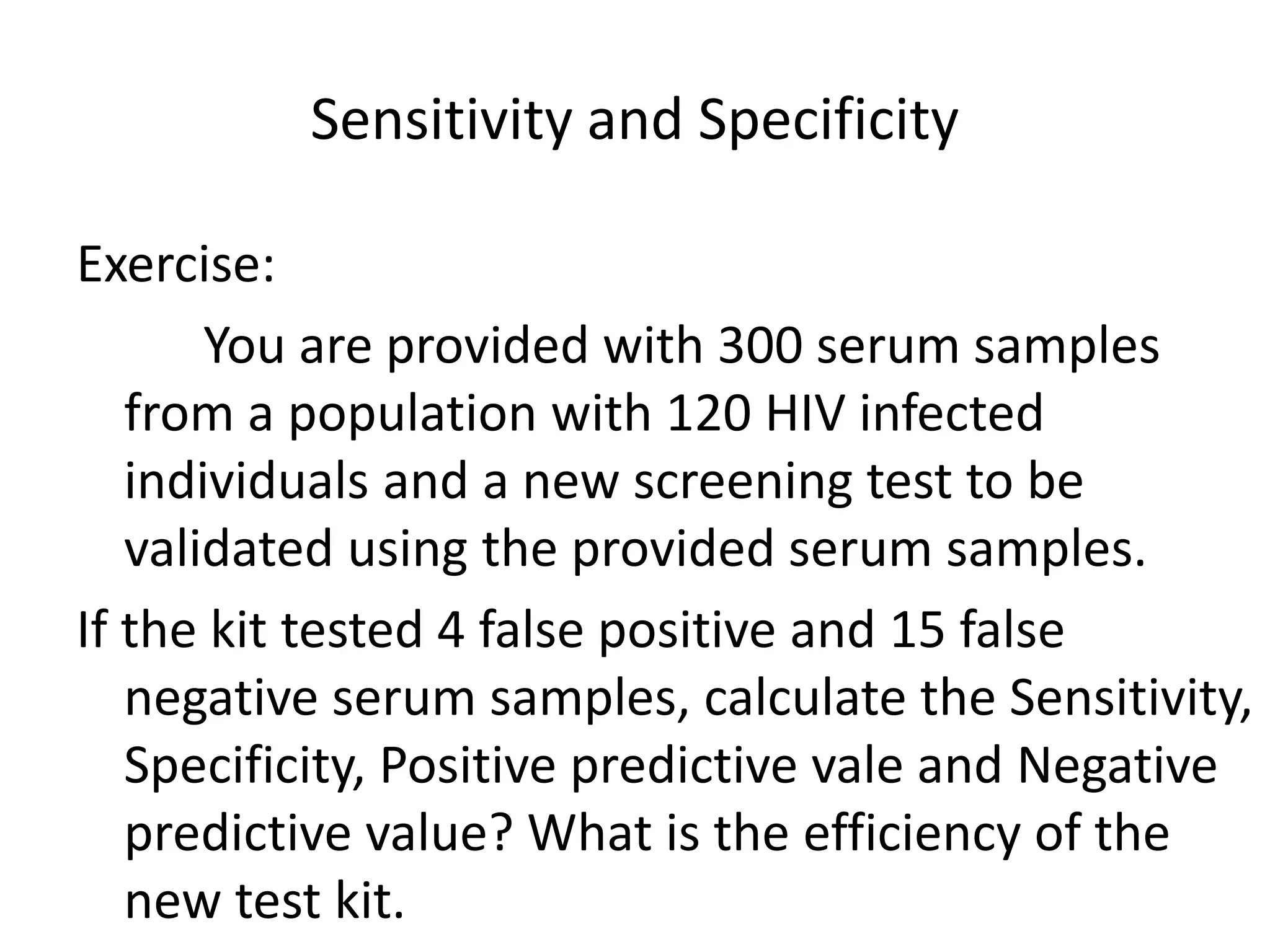
Exercise:
You are provided with 300 serum samples
from a population with 120 HIV infected
individuals and a new screening test to be
validated using the provided serum samples.
If the kit tested 4 false positive and 15 false
negative serum samples, calculate the Sensitivity,
Specificity, Positive predictive vale and Negative
predictive value? What is the efficiency of the
new test kit.
Sensitivity and Specificity
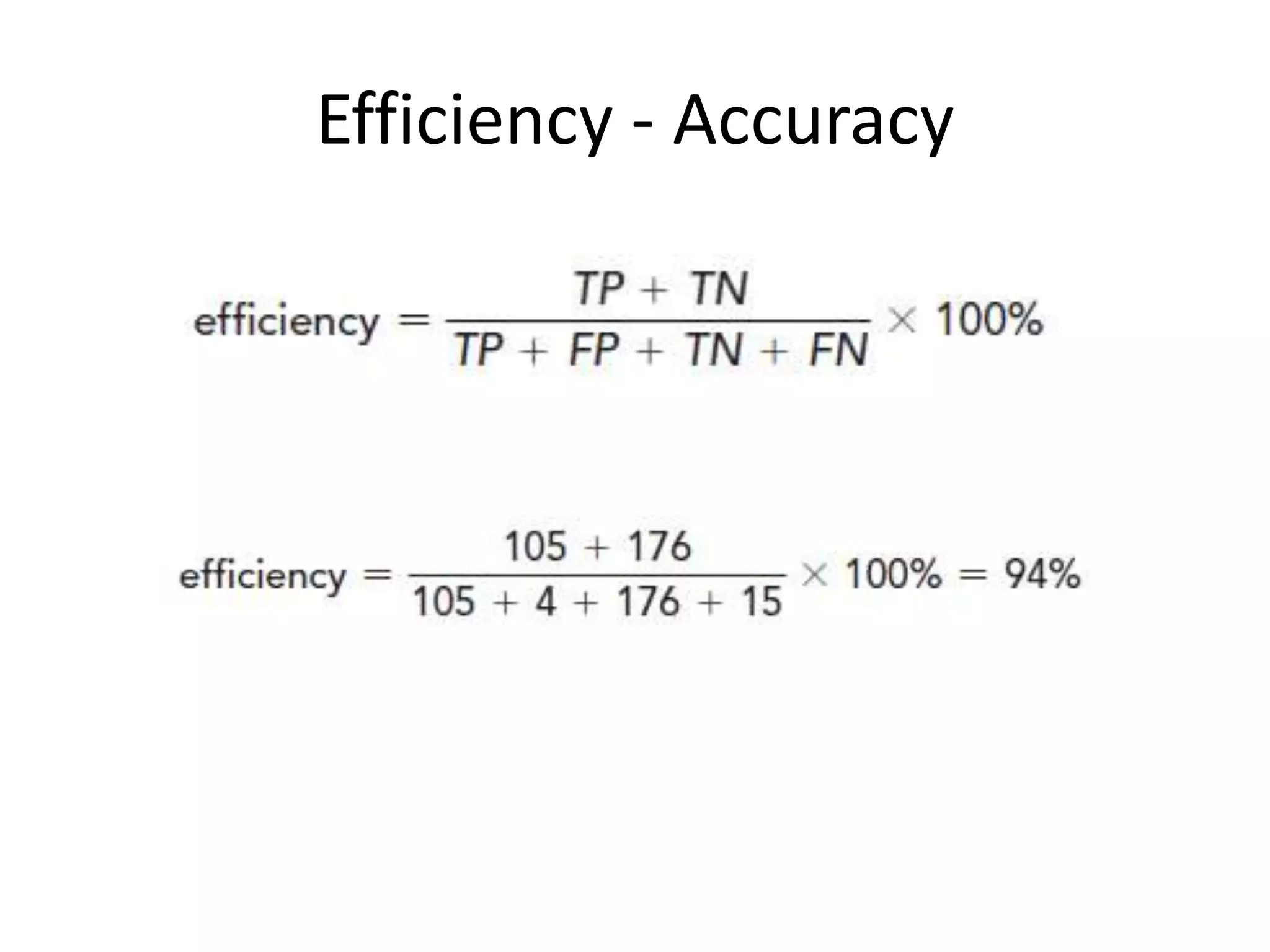
Efficiency - Accuracy
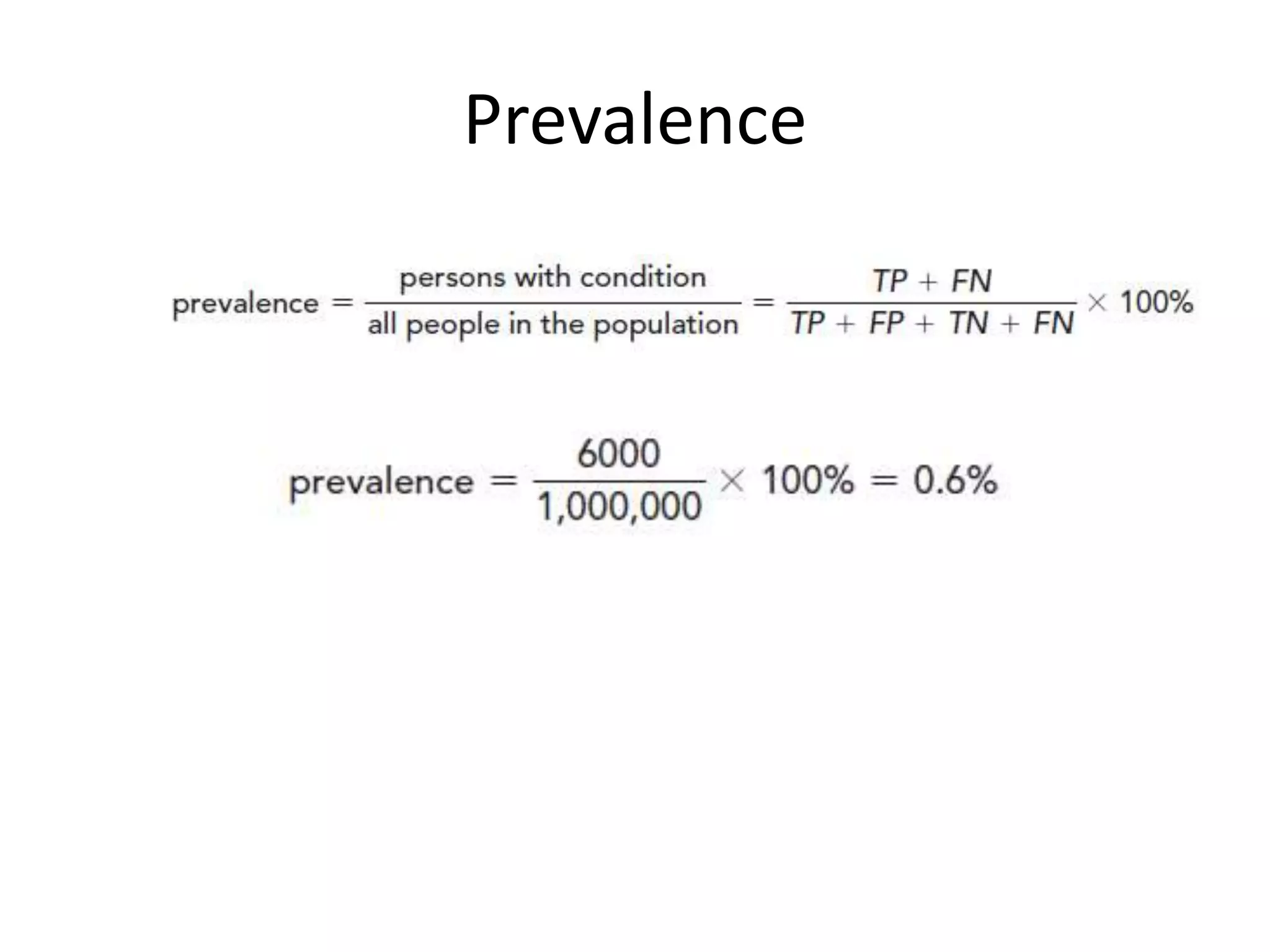
Prevalence
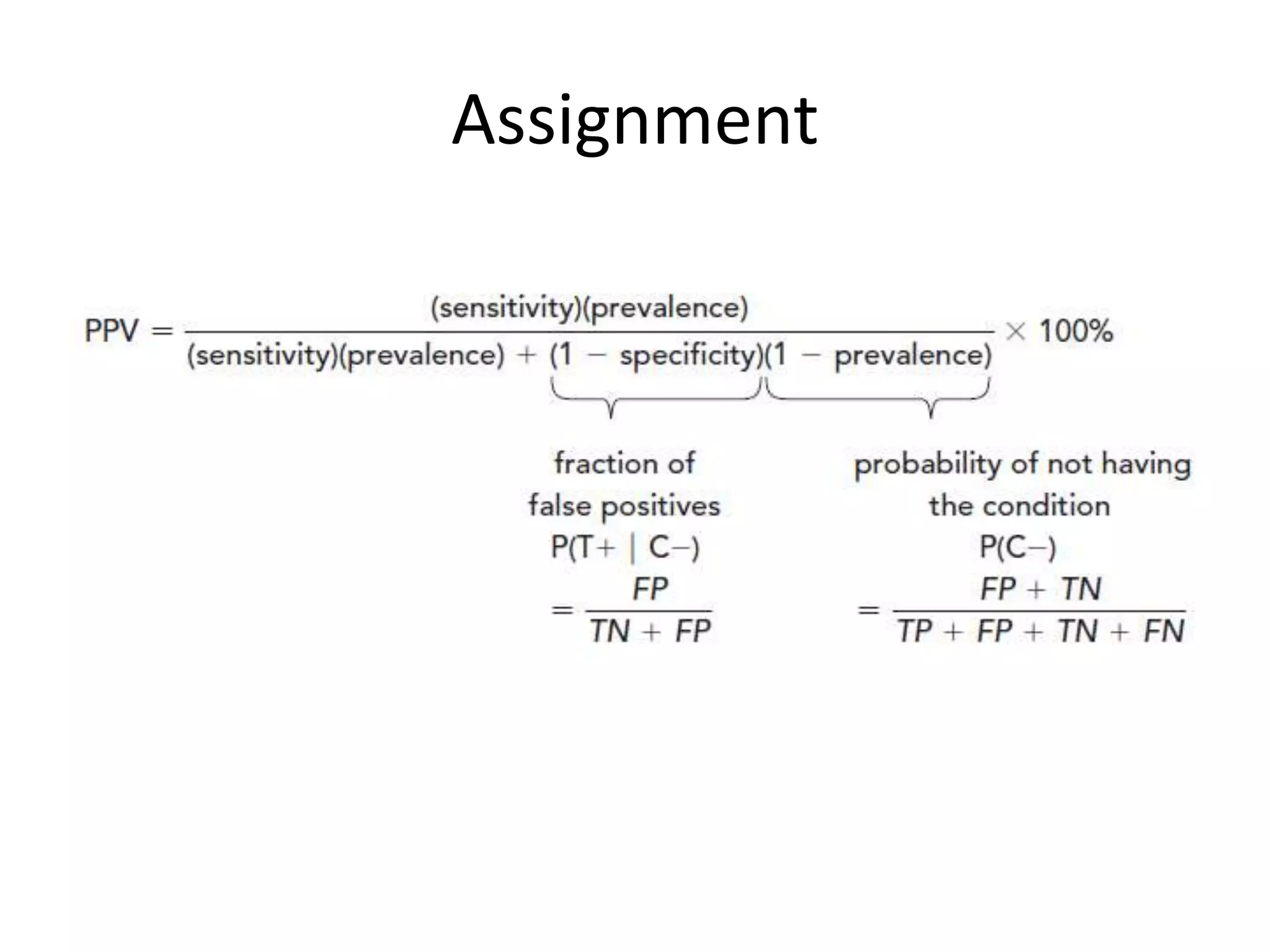
Predictive values
Assignment

Lecture , quality_control_in_clinical_biochemistry_laboratory

  • 1.
    Quality Control inClinical Biochemistry Laboratory
  • 2.
    Quality Control inClinical Biochemistry Laboratory • The ultimate goal of the clinical biochemistry laboratory is to analyze the substances in body fluids qualitatively and quantitatively for diagnosis and treatment of disease. • The presentation of incorrect laboratory results may lead to wrong diagnosis and treatment, leading to fatal results. • Hence, it is very important to generate the reliable data that depends on strict quality control management. • Quality control is the procedures employed for the detection and measurement of the sources of variation or errors. • Quality control is a representation of precision and accuracy under varying experimental conditions.
  • 3.
    Quality control • Qualitycontrol in the clinical laboratory is a statistical process used to monitor and evaluate the analytical process that produces patient results. • Requirements for the Statistical Process – Regular testing of quality control products along with patient samples – Comparison of quality control results to specific statistical limits (ranges). • Reliability for most testing can be resolved by regular use of quality control materials and statistical process control • A quality control sample or product is a patient-like material ideally made from human serum, urine or spinal fluid
  • 4.
    Quality control • Goodlaboratory practice requires testing normal and abnormal controls for each test at least daily to monitor the analytical process • Daily or regular testing of quality control samples creates a QC database that the laboratory uses to validate the test system • Validation occurs by comparing daily QC results to a laboratory-defined range of QC values. • The laboratory defined range is calculated from QC data collected from testing of normal and abnormal controls.
  • 5.
    • To maintainthe criteria for reliability in analysis, calibration is done regularly by using the various standards. • A standard is the solution with known amount of analytes and with which the sample can be compared to derive the result • While performing analytical measurements in laboratory, various types of errors may be encountered.
  • 6.
    Three major typesof Laboratory Errors • There are three major errors that may occur in a laboratory: – Random errors: – Systemic errors: – Gross errors or total analytical error
  • 7.
    Random errors • Randomerrors are the errors that arise due to statistical fluctuations in the observations and lead to inconsistent measurement value of a constant attribute. • A random error is associated with the fact that when a measurement is repeated, it will generally provide a measured value that is different from the previous value. • Random errors are caused by uncontrollable variables, which cannot be defined or eliminated. • These are errors that may arise due to bubbles in reagents or reagent lines, instrument instability, temperature variations, and operator variability, such as variation in pipetting.
  • 8.
    Systemic errors • Systematicerrors cause inaccurate results that are consistently low or high. • Systematic error is reproducible and predictable and can be easily identified and corrected. • These errors are caused by: – insufficient control on analytical variables, e.g., impure calibration material – change in reagent lot – change in calibration – assigning the wrong calibrator values – improperly prepared or deteriorating reagents
  • 9.
    Systemic errors • Majorly,systemic errors arise due to three factors: a. Instrument errors: Instrument errors are errors associated with instrument functioning e.g. due to power fluctuations, defect in any parts of the instrument, temperature variation, or when not calibrated. – The instrumental errors can be removed by proper calibration or maintenance of instrument. b. Method errors: These are errors that arise due to the use of non-ideal physical or chemical methods e.g. the speed of reaction, problem associated with sampling, and interference from side reactions can lead to such errors. – The development and use of proper method can help to correct these errors.
  • 10.
    Systemic errors c. Personalerrors: These are caused by an observer’s personal habits or mental judgment, wrong judgment of dimensional values, color acuity problems – It may be accidental or systematic; proper training and experience can help to eliminate the personal errors effectively. • Gross errors or total analytical error: • Total analytical errors arise due to equipment failure or observer’s carelessness.
  • 11.
    Pre-analytical, analytical andpost-analytical errors • Pre-analytical errors arise before the analysis of sample takes place e.g. mismatch of sample and laboratory data, error in presentation of analyzed results, and delaying in report generation. • Analytical errors occur during analytical methods e.g. errors related to use of expired or spoiled reagents, controls or calibrators, sampling errors, and changes in analyzer’s measuring unit. • Post-analytical errors arise during transmission of data from analyzers, result validation, and dispatching/communicating results to physicians or patients as well as loss of the results, inappropriate specimen or anticoagulant, error in storage of sample, or mistakes in patients’ identification
  • 12.
    Methods to Minimizethe Laboratory Errors • The quality control techniques must be used regularly to detect for any change in precision or accuracy and to follow corrective measures • It is always desirable that both random and systematic errors must be detected at the earliest possible stage and preventive measures should be applied to minimize them • The procedure adopted for the detection of errors consists of specific quality control methods divided in two categories: – Internal Quality Control – External Quality Control
  • 13.
    Assignment • Read onthe methods to minimize the laboratory errors. • Prepare five power point slides for 10 minutes presentation
  • 14.
    Diagnostic Test Value •A test used to diagnose disorders has four possible outcomes: – True positive (TP): a positive result for a patient who has the condition (correct result) – False positive (FP): a positive result for a patient who does not have the condition (wrong result) – True negative (TN): a negative result for a patient who does not have the condition (correct result) – False negative (FN): a negative result for a patient who has the condition (wrong result)
  • 15.
    The Four PossibleOutcomes of a Diagnostic Test Positive Negative TOTAL Diseased TP FN TP + FN Healthy FP TN FP + TN TOTAL TP + FP FN + TN TP + FP + FN + TN TP - true positive FP - false positive TN - true negative FN - false negative
  • 17.
    Sensitivity and Specificity Exercise: Youare provided with 300 serum samples from a population with 120 HIV infected individuals and a new screening test to be validated using the provided serum samples. If the kit tested 4 false positive and 15 false negative serum samples, calculate the Sensitivity, Specificity, Positive predictive vale and Negative predictive value? What is the efficiency of the new test kit.
  • 18.
  • 19.
  • 20.
  • 21.
  • 22.