 Error is the difference between the true result (or
accepted true result) and the measured result.
 failure of a planned action to be completed can
occurring at any part of the laboratory cycle from
ordering examinations to reporting results and
appropriately interpreting and reacting to them
 The handling of the specimens is critical to decreasing
the error in the lab results
ERROR
The frequency of laboratory errors varies greatly
depending on:-
 The study design
 The specific steps of the total testing process (TTP)
investigated
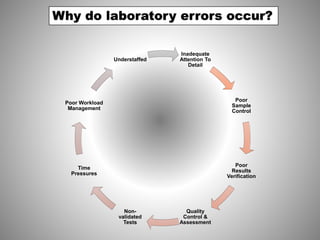
Why do laboratory errors occur?
Inadequate
Attention To
Detail
Poor
Sample
Control
Poor
Results
Verification
Quality
Control &
Assessment
Non-
validated
Tests
Time
Pressures
Poor Workload
Management
Understaffed
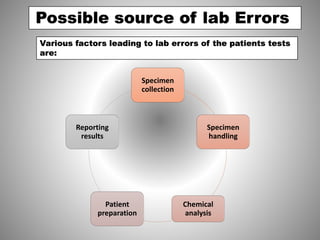
Possible source of lab Errors
Specimen
collection
Specimen
handling
Chemical
analysis
Patient
preparation
Reporting
results
Various factors leading to lab errors of the patients tests
are:
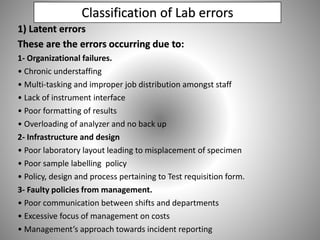
1) Latent errors
These are the errors occurring due to:
1- Organizational failures.
• Chronic understaffing
• Multi-tasking and improper job distribution amongst staff
• Lack of instrument interface
• Poor formatting of results
• Overloading of analyzer and no back up
2- Infrastructure and design
• Poor laboratory layout leading to misplacement of specimen
• Poor sample labelling policy
• Policy, design and process pertaining to Test requisition form.
3- Faulty policies from management.
• Poor communication between shifts and departments
• Excessive focus of management on costs
• Management’s approach towards incident reporting
Classification of Lab errors
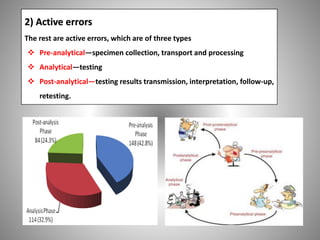
2) Active errors
The rest are active errors, which are of three types
 Pre-analytical—specimen collection, transport and processing
 Analytical—testing
 Post-analytical—testing results transmission, interpretation, follow-up,
retesting.
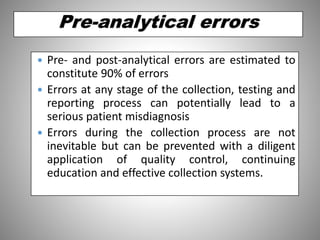
Pre-analytical errors
ļ‚— Pre- and post-analytical errors are estimated to
constitute 90% of errors
ļ‚— Errors at any stage of the collection, testing and
reporting process can potentially lead to a
serious patient misdiagnosis
ļ‚— Errors during the collection process are not
inevitable but can be prevented with a diligent
application of quality control, continuing
education and effective collection systems.
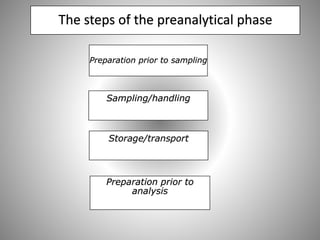
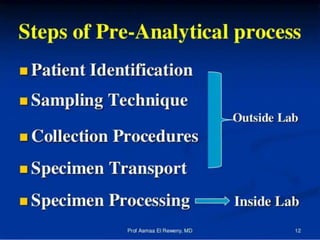
The steps of the preanalytical phase
Sampling/handling
Preparation prior to sampling
Storage/transport
Preparation prior to
analysis
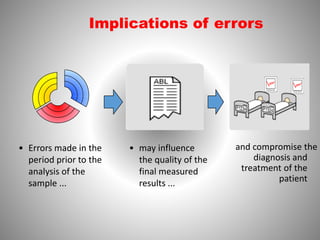
Implications of errors
and compromise the
diagnosis and
treatment of the
patient
• Errors made in the
period prior to the
analysis of the
sample ...
• may influence
the quality of the
final measured
results ...
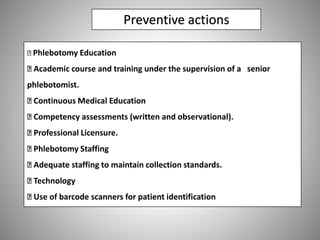
Preventive actions
Phlebotomy Education
Academic course and training under the supervision of a senior
phlebotomist.
Continuous Medical Education
Competency assessments (written and observational).
Professional Licensure.
Phlebotomy Staffing
Adequate staffing to maintain collection standards.
Technology
Use of barcode scanners for patient identification
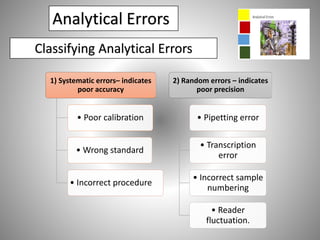
Analytical Errors
1) Systematic errors– indicates
poor accuracy
• Poor calibration
• Wrong standard
• Incorrect procedure
2) Random errors – indicates
poor precision
• Pipetting error
• Transcription
error
• Incorrect sample
numbering
• Reader
fluctuation.
Classifying Analytical Errors
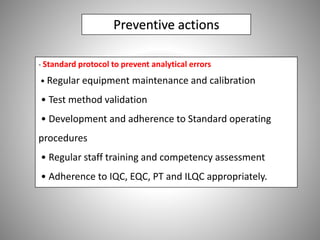
- Standard protocol to prevent analytical errors
• Regular equipment maintenance and calibration
• Test method validation
• Development and adherence to Standard operating
procedures
• Regular staff training and competency assessment
• Adherence to IQC, EQC, PT and ILQC appropriately.
Preventive actions
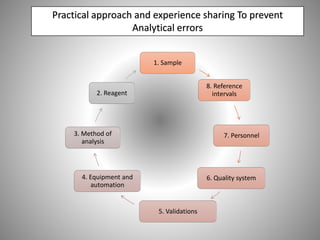
Practical approach and experience sharing To prevent
Analytical errors
1. Sample
8. Reference
intervals
7. Personnel
6. Quality system
5. Validations
4. Equipment and
automation
3. Method of
analysis
2. Reagent
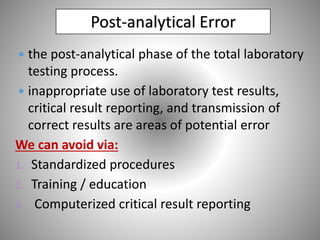
ļ‚— the post-analytical phase of the total laboratory
testing process.
ļ‚— inappropriate use of laboratory test results,
critical result reporting, and transmission of
correct results are areas of potential error
We can avoid via:
1. Standardized procedures
2. Training / education
3. Computerized critical result reporting
Post-analytical Error
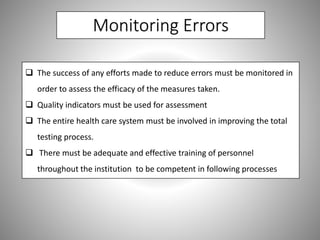
Monitoring Errors
 The success of any efforts made to reduce errors must be monitored in
order to assess the efficacy of the measures taken.
 Quality indicators must be used for assessment
 The entire health care system must be involved in improving the total
testing process.
 There must be adequate and effective training of personnel
throughout the institution to be competent in following processes
• The laboratories have long focused their attention on
quality control methods and quality assessment programs
which lead to :-
• More accurate result
• Less hazards and errors
• Patient safety
• More qualified diagnostic technique
Importance of lab errors
REFERENCES
ļ‚— Institute of Medicine (US) Committee on Quality of Health Care in America Kohn
LT, Corrigan JM, Donaldson MS, editors. To Err is Human: Building a Safer Health
System. Washington (DC): National Academies Press (US); 2000.
ļ‚— Plebani M. The CCLM contribution to improvements in quality and patient safety.
Clin Chem Lab Med 2013;51:39-46
ļ‚— Belk WP, Sunderman FW. A survey of the accuracy of chemical analyses in clinical
laboratories. Am J Clin Pathol 1947;17:853-861.]
ļ‚— Diagnostic errors and laboratory medicine – causes and strategies Mario Plebani
anuary 2015
ļ‚— Bland, J. Martin, and Douglas G. Altman (1996). ā€œStatistics Notes: Measurement
Error.ā€ BMJ 313.7059: 744.
ļ‚— Cochran, W. G. (1968). ā€œErrors of Measurement in Statisticsā€. Technometrics.
Taylor & Francis, Ltd. on behalf of American Statistical Association and American
Society for Quality. 10: 637–666. doi:10.2307/1267450
ļ‚— Dodge, Y. (2003). The Oxford Dictionary of Statistical Terms. OUP. ISBN 0-19-
920613-9.
ļ‚— Taylor, J. R. (1999). An Introduction to Error Analysis: The Study of Uncertainties in
Physical Measurements. University Science Books. ISBN 0-935702-75-X.
Thank you for your attention
causes of laboratory errors