LINEAR BLOCK
CODES
COMPUTER NETWORK
LINEAR BLOCK CODES :
 All block codes used belong to a subset called linear
block code.
 The use of non-linear block codes for error detection
and correction is not as widespread because their
structure makes theoretical analysis and
implementation difficult.
In a linear block code, the exclusive OR(XOR) of any two
valid codeword creates another valid codeword.
Minimumdistancefor LinearBlockCodes :
 It is simple to find the minimum humming distance for a
Linear Block Code.
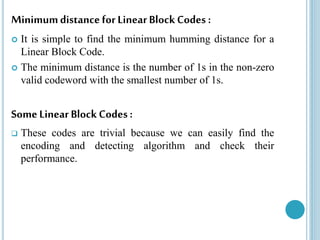
 The minimum distance is the number of 1s in the non-zero
valid codeword with the smallest number of 1s.
Some Linear BlockCodes :
 These codes are trivial because we can easily find the
encoding and detecting algorithm and check their
performance.
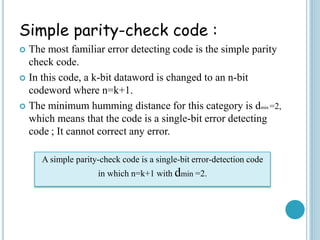
Simple parity-check code :
 The most familiar error detecting code is the simple parity
check code.
 In this code, a k-bit dataword is changed to an n-bit
codeword where n=k+1.
 The minimum humming distance for this category is dmin =2,
which means that the code is a single-bit error detecting
code ; It cannot correct any error.
A simple parity-check code is a single-bit error-detection code
in which n=k+1 with dmin =2.
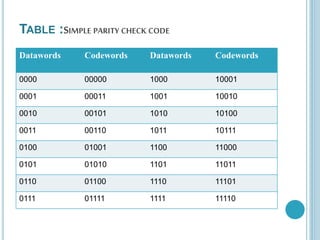
TABLE :SIMPLE PARITY CHECK CODE
Datawords Codewords Datawords Codewords
0000 00000 1000 10001
0001 00011 1001 10010
0010 00101 1010 10100
0011 00110 1011 10111
0100 01001 1100 11000
0101 01010 1101 11011
0110 01100 1110 11101
0111 01111 1111 11110
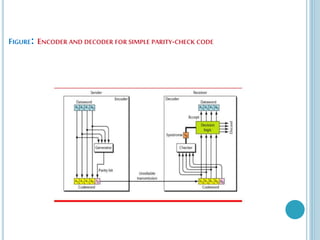
FIGURE: ENCODER AND DECODER FOR SIMPLE PARITY-CHECK CODE
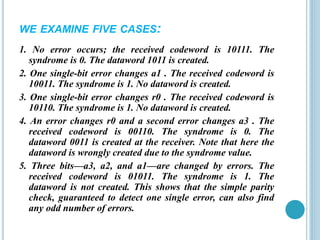
WE EXAMINE FIVE CASES:
1. No error occurs; the received codeword is 10111. The
syndrome is 0. The dataword 1011 is created.
2. One single-bit error changes a1 . The received codeword is
10011. The syndrome is 1. No dataword is created.
3. One single-bit error changes r0 . The received codeword is
10110. The syndrome is 1. No dataword is created.
4. An error changes r0 and a second error changes a3 . The
received codeword is 00110. The syndrome is 0. The
dataword 0011 is created at the receiver. Note that here the
dataword is wrongly created due to the syndrome value.
5. Three bits—a3, a2, and a1—are changed by errors. The
received codeword is 01011. The syndrome is 1. The
dataword is not created. This shows that the simple parity
check, guaranteed to detect one single error, can also find
any odd number of errors.
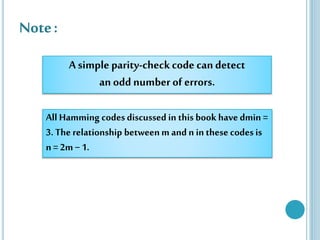
Note:
A simple parity-checkcode candetect
an odd number of errors.
All Hamming codesdiscussed in this book have dmin =
3. The relationship betweenm and n in these codes is
n = 2m − 1.
FIGURE: TWO-DIMENSIONAL PARITY-CHECK CODE
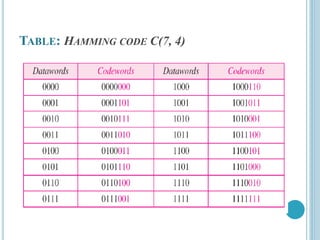
TABLE: HAMMING CODE C(7, 4)
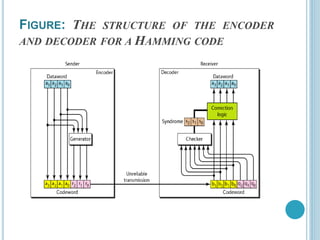
FIGURE: THE STRUCTURE OF THE ENCODER
AND DECODER FOR A HAMMING CODE
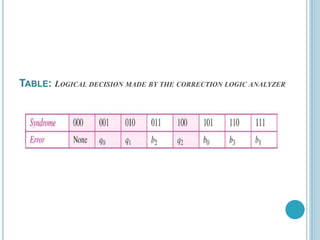
TABLE: LOGICAL DECISION MADE BY THE CORRECTION LOGIC ANALYZER
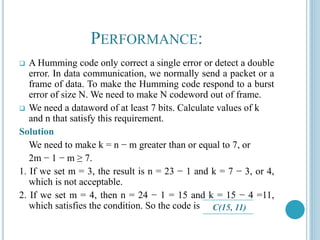
PERFORMANCE:
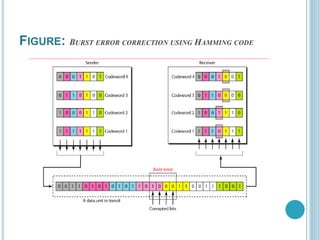
 A Humming code only correct a single error or detect a double
error. In data communication, we normally send a packet or a
frame of data. To make the Humming code respond to a burst
error of size N. We need to make N codeword out of frame.
 We need a dataword of at least 7 bits. Calculate values of k
and n that satisfy this requirement.
Solution
We need to make k = n − m greater than or equal to 7, or
2m − 1 − m ≥ 7.
1. If we set m = 3, the result is n = 23 − 1 and k = 7 − 3, or 4,
which is not acceptable.
2. If we set m = 4, then n = 24 − 1 = 15 and k = 15 − 4 =11,
which satisfies the condition. So the code is C(15, 11)
FIGURE: BURST ERROR CORRECTION USING HAMMING CODE
THANK
YOU…

Linear Block Codes

  • 1.
  • 2.
    LINEAR BLOCK CODES:  All block codes used belong to a subset called linear block code.  The use of non-linear block codes for error detection and correction is not as widespread because their structure makes theoretical analysis and implementation difficult. In a linear block code, the exclusive OR(XOR) of any two valid codeword creates another valid codeword.
  • 3.
    Minimumdistancefor LinearBlockCodes : It is simple to find the minimum humming distance for a Linear Block Code.  The minimum distance is the number of 1s in the non-zero valid codeword with the smallest number of 1s. Some Linear BlockCodes :  These codes are trivial because we can easily find the encoding and detecting algorithm and check their performance.
  • 4.
    Simple parity-check code:  The most familiar error detecting code is the simple parity check code.  In this code, a k-bit dataword is changed to an n-bit codeword where n=k+1.  The minimum humming distance for this category is dmin =2, which means that the code is a single-bit error detecting code ; It cannot correct any error. A simple parity-check code is a single-bit error-detection code in which n=k+1 with dmin =2.
  • 5.
    TABLE :SIMPLE PARITYCHECK CODE Datawords Codewords Datawords Codewords 0000 00000 1000 10001 0001 00011 1001 10010 0010 00101 1010 10100 0011 00110 1011 10111 0100 01001 1100 11000 0101 01010 1101 11011 0110 01100 1110 11101 0111 01111 1111 11110
  • 6.
    FIGURE: ENCODER ANDDECODER FOR SIMPLE PARITY-CHECK CODE
  • 7.
    WE EXAMINE FIVECASES: 1. No error occurs; the received codeword is 10111. The syndrome is 0. The dataword 1011 is created. 2. One single-bit error changes a1 . The received codeword is 10011. The syndrome is 1. No dataword is created. 3. One single-bit error changes r0 . The received codeword is 10110. The syndrome is 1. No dataword is created. 4. An error changes r0 and a second error changes a3 . The received codeword is 00110. The syndrome is 0. The dataword 0011 is created at the receiver. Note that here the dataword is wrongly created due to the syndrome value. 5. Three bits—a3, a2, and a1—are changed by errors. The received codeword is 01011. The syndrome is 1. The dataword is not created. This shows that the simple parity check, guaranteed to detect one single error, can also find any odd number of errors.
  • 8.
    Note: A simple parity-checkcodecandetect an odd number of errors. All Hamming codesdiscussed in this book have dmin = 3. The relationship betweenm and n in these codes is n = 2m − 1.
  • 9.
  • 10.
  • 11.
    FIGURE: THE STRUCTUREOF THE ENCODER AND DECODER FOR A HAMMING CODE
  • 12.
    TABLE: LOGICAL DECISIONMADE BY THE CORRECTION LOGIC ANALYZER
  • 13.
    PERFORMANCE:  A Hummingcode only correct a single error or detect a double error. In data communication, we normally send a packet or a frame of data. To make the Humming code respond to a burst error of size N. We need to make N codeword out of frame.  We need a dataword of at least 7 bits. Calculate values of k and n that satisfy this requirement. Solution We need to make k = n − m greater than or equal to 7, or 2m − 1 − m ≥ 7. 1. If we set m = 3, the result is n = 23 − 1 and k = 7 − 3, or 4, which is not acceptable. 2. If we set m = 4, then n = 24 − 1 = 15 and k = 15 − 4 =11, which satisfies the condition. So the code is C(15, 11)
  • 14.
    FIGURE: BURST ERRORCORRECTION USING HAMMING CODE
  • 15.