ANALOG TO DIGITAL
CONVERSION
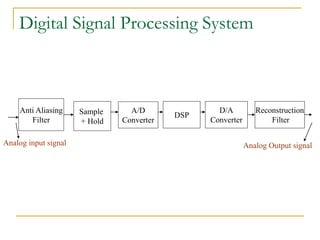
Digital Signal Processing System
Anti Aliasing
Filter
Sample
+ Hold
A/D
Converter
DSP
D/A
Converter
Reconstruction
Filter
Analog input signal Analog Output signal
Analog to Digital Converter
Continuous- time
Continuous- amplitude
input signal
SAMPLER QUANTIZER ENCODER
Discrete-time
Continuous-
amplitude signal
Discrete-time Discrete
amplitude signal
Digital
Output
signal
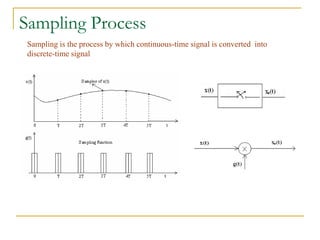
Sampling Process
Sampling is the process by which continuous-time signal is converted into
discrete-time signal
  




n
t
f
jn
n
s
e
C
t
g 
2
  dt
e
t
g
T
C
T
T
t
f
jn
n
s




2
2
2
1 
   




n
t
f
jn
n
s
s
e
C
t
x
t
x 
2
     
t
g
t
x
t
xs 
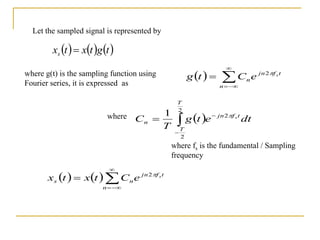
Let the sampled signal is represented by
where g(t) is the sampling function using
Fourier series, it is expressed as
where
where fs is the fundamental / Sampling
frequency
    dt
e
e
t
x
C
f
X ft
j
t
f
jn
n
n
s
s
 







 
 2
2
   






n
s
n
s nf
f
X
C
f
X
     
1
2













 




dt
e
t
x
f
X ft
j
s
s

Using Fourier transform the spectrum of xs(t) is denoted by
Substituting xs(t) in the above equation,
Thus by comparing
with eqn 1
   




n
t
f
jn
n
s
s
e
C
t
x
t
x 
2
     
 








n
t
nf
f
j
n
s dt
e
t
x
C
f
X s

2
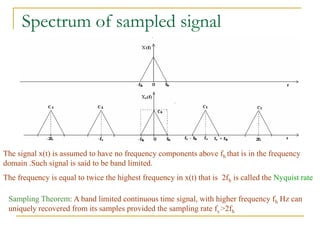
Spectrum of sampled signal
The signal x(t) is assumed to have no frequency components above fh that is in the frequency
domain .Such signal is said to be band limited.
The frequency is equal to twice the highest frequency in x(t) that is 2fh is called the Nyquist rate
Sampling Theorem: A band limited continuous time signal, with higher frequency fh Hz can
uniquely recovered from its samples provided the sampling rate fs >2fh
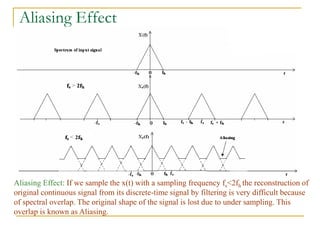
Aliasing Effect
Aliasing Effect: If we sample the x(t) with a sampling frequency fs<2fh the reconstruction of
original continuous signal from its discrete-time signal by filtering is very difficult because
of spectral overlap. The original shape of the signal is lost due to under sampling. This
overlap is known as Aliasing.
Quantization
1
2 

 b
R
The process of converting discrete time continuous signal into discrete time
discrete amplitude signal
Quantization step size
levels
quantized
of
Number
signal
of
Range


Sampled Value
x(n)
(Decimal Reprs)
Binary
Representation
Rounding Quantized
Value xq(n)
Quantization Error
e(n) = xq(n)- x(n)
0.620 0.10011110 0.101 0.625 0.005
  
 0
,
575
.
0
,
85
.
0
,
85
.
0
,
625
.
0
,
03
.
0
,
575
.
0
,
85
.
0
,
85
.
0
,
620
.
0
,
0 





n
x
Illustration of Quantization
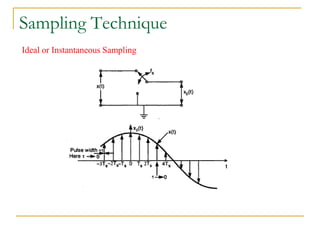
Sampling Technique
Ideal or Instantaneous Sampling
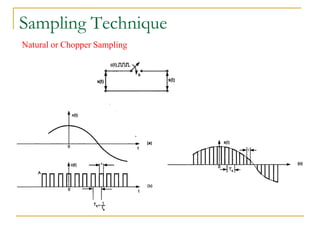
Sampling Technique
Natural or Chopper Sampling
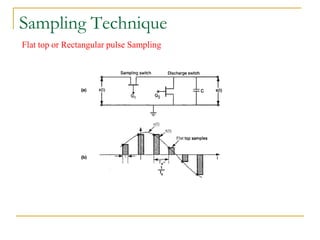
Sampling Technique
Flat top or Rectangular pulse Sampling
Elementary Signals
•Unit Step
•Unit Impulse
•Unit Ramp
•Exponential
•Complex exponential and sinusoidal signal
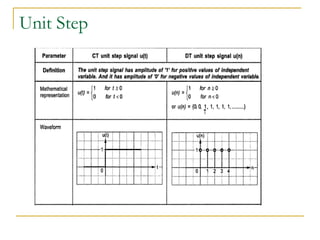
Unit Step
Unit Impulse
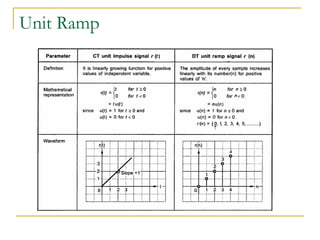
Unit Ramp
Exponential
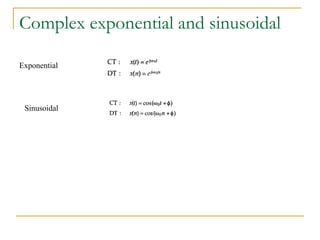
Complex exponential and sinusoidal
Exponential
Sinusoidal

Sampling process, Aliasing effect, Quantization

  • 1.
  • 2.
    Digital Signal ProcessingSystem Anti Aliasing Filter Sample + Hold A/D Converter DSP D/A Converter Reconstruction Filter Analog input signal Analog Output signal
  • 3.
    Analog to DigitalConverter Continuous- time Continuous- amplitude input signal SAMPLER QUANTIZER ENCODER Discrete-time Continuous- amplitude signal Discrete-time Discrete amplitude signal Digital Output signal
  • 4.
    Sampling Process Sampling isthe process by which continuous-time signal is converted into discrete-time signal
  • 5.
           n t f jn n s e C t g 2   dt e t g T C T T t f jn n s     2 2 2 1          n t f jn n s s e C t x t x  2       t g t x t xs  Let the sampled signal is represented by where g(t) is the sampling function using Fourier series, it is expressed as where where fs is the fundamental / Sampling frequency
  • 6.
       dt e e t x C f X ft j t f jn n n s s             2 2           n s n s nf f X C f X       1 2                    dt e t x f X ft j s s  Using Fourier transform the spectrum of xs(t) is denoted by Substituting xs(t) in the above equation, Thus by comparing with eqn 1         n t f jn n s s e C t x t x  2                 n t nf f j n s dt e t x C f X s  2
  • 7.
    Spectrum of sampledsignal The signal x(t) is assumed to have no frequency components above fh that is in the frequency domain .Such signal is said to be band limited. The frequency is equal to twice the highest frequency in x(t) that is 2fh is called the Nyquist rate Sampling Theorem: A band limited continuous time signal, with higher frequency fh Hz can uniquely recovered from its samples provided the sampling rate fs >2fh
  • 8.
    Aliasing Effect Aliasing Effect:If we sample the x(t) with a sampling frequency fs<2fh the reconstruction of original continuous signal from its discrete-time signal by filtering is very difficult because of spectral overlap. The original shape of the signal is lost due to under sampling. This overlap is known as Aliasing.
  • 9.
    Quantization 1 2    b R Theprocess of converting discrete time continuous signal into discrete time discrete amplitude signal Quantization step size levels quantized of Number signal of Range   Sampled Value x(n) (Decimal Reprs) Binary Representation Rounding Quantized Value xq(n) Quantization Error e(n) = xq(n)- x(n) 0.620 0.10011110 0.101 0.625 0.005
  • 10.
       0 , 575 . 0 , 85 . 0 , 85 . 0 , 625 . 0 , 03 . 0 , 575 . 0 , 85 . 0 , 85 . 0 , 620 . 0 , 0       n x Illustration of Quantization
  • 11.
    Sampling Technique Ideal orInstantaneous Sampling
  • 12.
  • 13.
    Sampling Technique Flat topor Rectangular pulse Sampling
  • 14.
    Elementary Signals •Unit Step •UnitImpulse •Unit Ramp •Exponential •Complex exponential and sinusoidal signal
  • 15.
  • 16.
  • 17.
  • 18.
  • 19.
    Complex exponential andsinusoidal Exponential Sinusoidal