Location Aided Routing
(LAR) and Power Aware
Routing Metrics (PAR)
T S Pradeep Kumar!
http://www.nsnam.com
LAR
❖ Utilises the location information for improving the
efficiency of routing by reducing control overhead!
❖ It uses GPS for obtaining the Geographical information
Zones in LAR
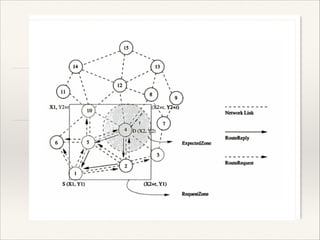
❖ Two zones in LAR namely ExpectedZone and RequestZone!
❖ ExpectedZone is the zone where the destination is expected to be
present based on the past location and its mobility. if such an
information is not available, then the entire network is said to be the
ExpectedZone!
❖ RequestZone - It is the zone in which the path finding control packets
are permitted to be propagated. !
❖ If the sender nodes or the intermediate relay nodes are not present in this
zone, then additional area will be selected for propagation.!
❖ But usually, the nodes outside the RequestZone discards the control
packets.
LAR1
❖ A RequestZone is framed that includes the Source node
and the ExpectedZone (rectangle region). When the
source node is inside the ExpectedZone, the size reduces
to be the ExpectedZone.!
❖ RREQ packet is forwarded every neighbor node and the
packet will be discarded if the node is outside the
RequestZone!
❖ RREP can be with current location, current time and in
some cases speed of the node also.
LAR2
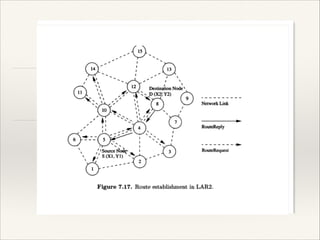
❖ This is based on the distance from the source to
Destination node in the RREQ packet. !
❖ When an intermediate node receives this packet, it
computes the distance to Destination and if it less, then
it forwards the packet, else the packet is dropped.
Pros and Cons of LAR
❖ Pros!
❖ Reduces the control overhead!
❖ Bandwidth utilisation!
❖ Cons !
❖ Since this is based on GPS, may not be suitable if no
such facility available
Power Aware Routing Metrics
❖ Minimal Energy Consumption per packet!
❖ Energy consumed by a packet is the sum of energies required at every
intermediate hops!
❖ Maximum Network Connectivity!
❖ Minimum variance in node power levels!
❖ distribution of load among all nodes to that all the nodes' power
consumption distribute uniformly!
❖ Minimum Cost per packet!
❖ Function of state of node's battery!
❖ Cost of a node is calculated based on the battery discharge
Ref: Siva Ram Murthy, B S Manoj, Adhoc Wireless
Networks, Architectures and Protocols

Location Aided Routing (LAR)

  • 1.
    Location Aided Routing (LAR)and Power Aware Routing Metrics (PAR) T S Pradeep Kumar! http://www.nsnam.com
  • 2.
    LAR ❖ Utilises thelocation information for improving the efficiency of routing by reducing control overhead! ❖ It uses GPS for obtaining the Geographical information
  • 3.
    Zones in LAR ❖Two zones in LAR namely ExpectedZone and RequestZone! ❖ ExpectedZone is the zone where the destination is expected to be present based on the past location and its mobility. if such an information is not available, then the entire network is said to be the ExpectedZone! ❖ RequestZone - It is the zone in which the path finding control packets are permitted to be propagated. ! ❖ If the sender nodes or the intermediate relay nodes are not present in this zone, then additional area will be selected for propagation.! ❖ But usually, the nodes outside the RequestZone discards the control packets.
  • 4.
    LAR1 ❖ A RequestZoneis framed that includes the Source node and the ExpectedZone (rectangle region). When the source node is inside the ExpectedZone, the size reduces to be the ExpectedZone.! ❖ RREQ packet is forwarded every neighbor node and the packet will be discarded if the node is outside the RequestZone! ❖ RREP can be with current location, current time and in some cases speed of the node also.
  • 6.
    LAR2 ❖ This isbased on the distance from the source to Destination node in the RREQ packet. ! ❖ When an intermediate node receives this packet, it computes the distance to Destination and if it less, then it forwards the packet, else the packet is dropped.
  • 8.
    Pros and Consof LAR ❖ Pros! ❖ Reduces the control overhead! ❖ Bandwidth utilisation! ❖ Cons ! ❖ Since this is based on GPS, may not be suitable if no such facility available
  • 9.
    Power Aware RoutingMetrics ❖ Minimal Energy Consumption per packet! ❖ Energy consumed by a packet is the sum of energies required at every intermediate hops! ❖ Maximum Network Connectivity! ❖ Minimum variance in node power levels! ❖ distribution of load among all nodes to that all the nodes' power consumption distribute uniformly! ❖ Minimum Cost per packet! ❖ Function of state of node's battery! ❖ Cost of a node is calculated based on the battery discharge
  • 10.
    Ref: Siva RamMurthy, B S Manoj, Adhoc Wireless Networks, Architectures and Protocols