MUSC 365
Basics of Digital Audio Module (original)
Analog = continuous


•   continuous time and amplitude
Digital = discrete


•   is discrete time and amplitude
Sampling Theory
Sampling


•   making discrete Time

•   A signal of bandwidth BW may be LOSSLESSLY sampled if the
    sampling rate Fs >= 2BW
Sampling


•   Amplitude is held (sampled) only at certain times

•   Input must be bandlimited to half the sampling rate
Nyquist Frequency


•   half the sampling frequency

•   Fs/2
Critical sampling


•   When a signal is sampled at exactly twice its highest frequency

•   Never done in audio
Sampling Rate

•   High

    •   Large guard band

    •   Allows varispeed

•   Low

    •   Reduce transmission and storage BW
Sampling

•   A band limited waveform amplitude modulates an impulse train.

•   The spectrum of an impulse train is sinewaves @ multiples of Fs

•   Modulated spectrum is waveform spectrum (bandlimited) repeated
    around multiples of Fs (with upper and lower sidebands)

•   If impulses have some width, then the total spectrum is superimposed
    with the |Sin (x)/x| curve
Aliasing
•   Input signal must be bandlimited

•   If it is not, sampling will cause the first lower sideband to fold back
    into the signal

•   Inputs frequencies above Fs/2 are folded back into audio band

•   Wagon wheel analogy in film

•   A 7 kHz wave sampled @ 10kHz looks just like a 3 kHz wave
Sample & Hold


•   Must acquire analog input amplitude at sample time and hold it long
    enough for it to be quantized

•   Sampled analog waveform has greater bandwidth than original input.
    This is inefficient, so amplitude is Quantized and Coded.
Encoding/Modulation
Pulse Code Modulation (PCM)


•   Binary Code is transmitted
Quantization

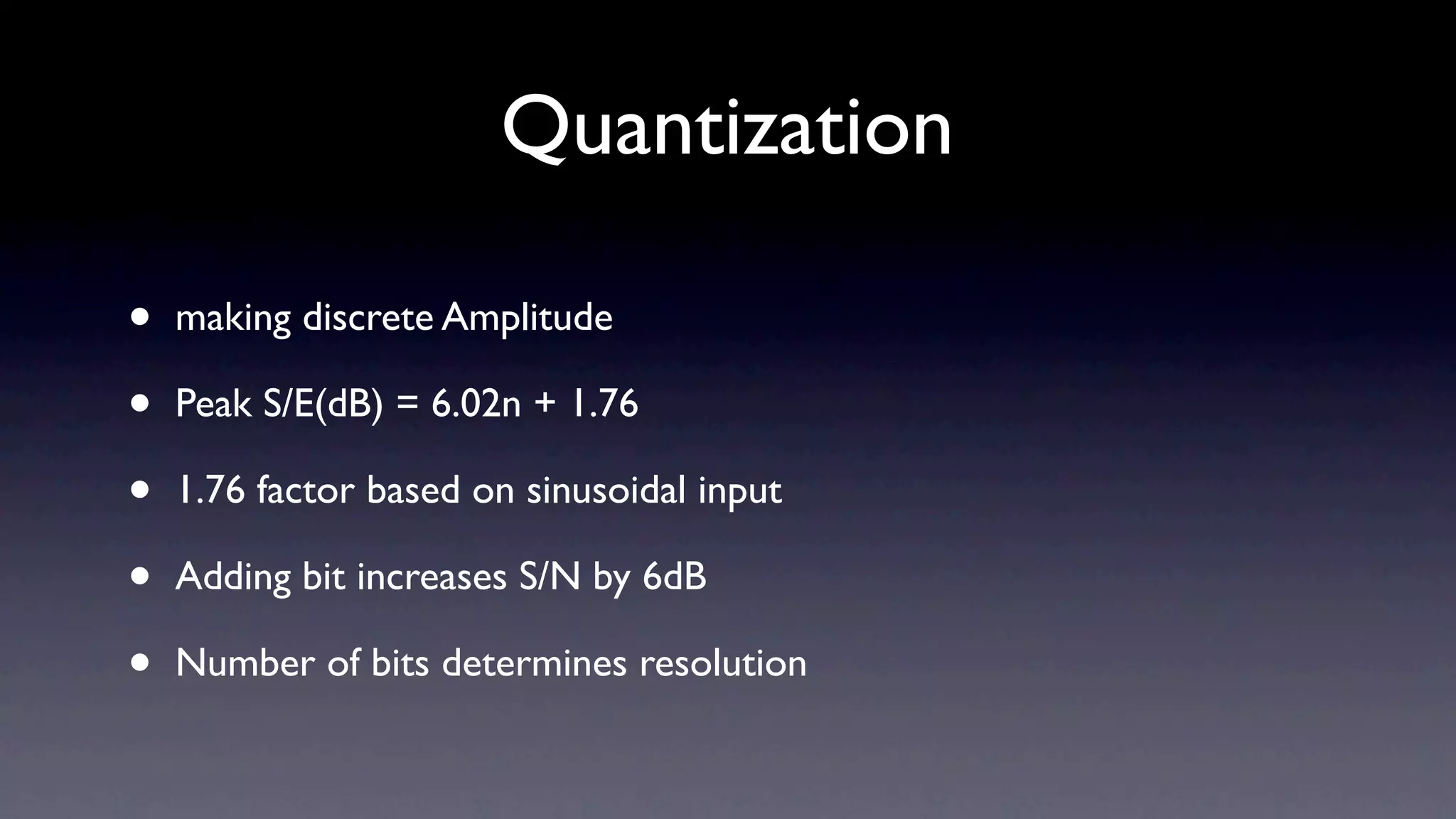
•   making discrete Amplitude

•   Peak S/E(dB) = 6.02n + 1.76

•   1.76 factor based on sinusoidal input

•   Adding bit increases S/N by 6dB

•   Number of bits determines resolution
Dynamic Range

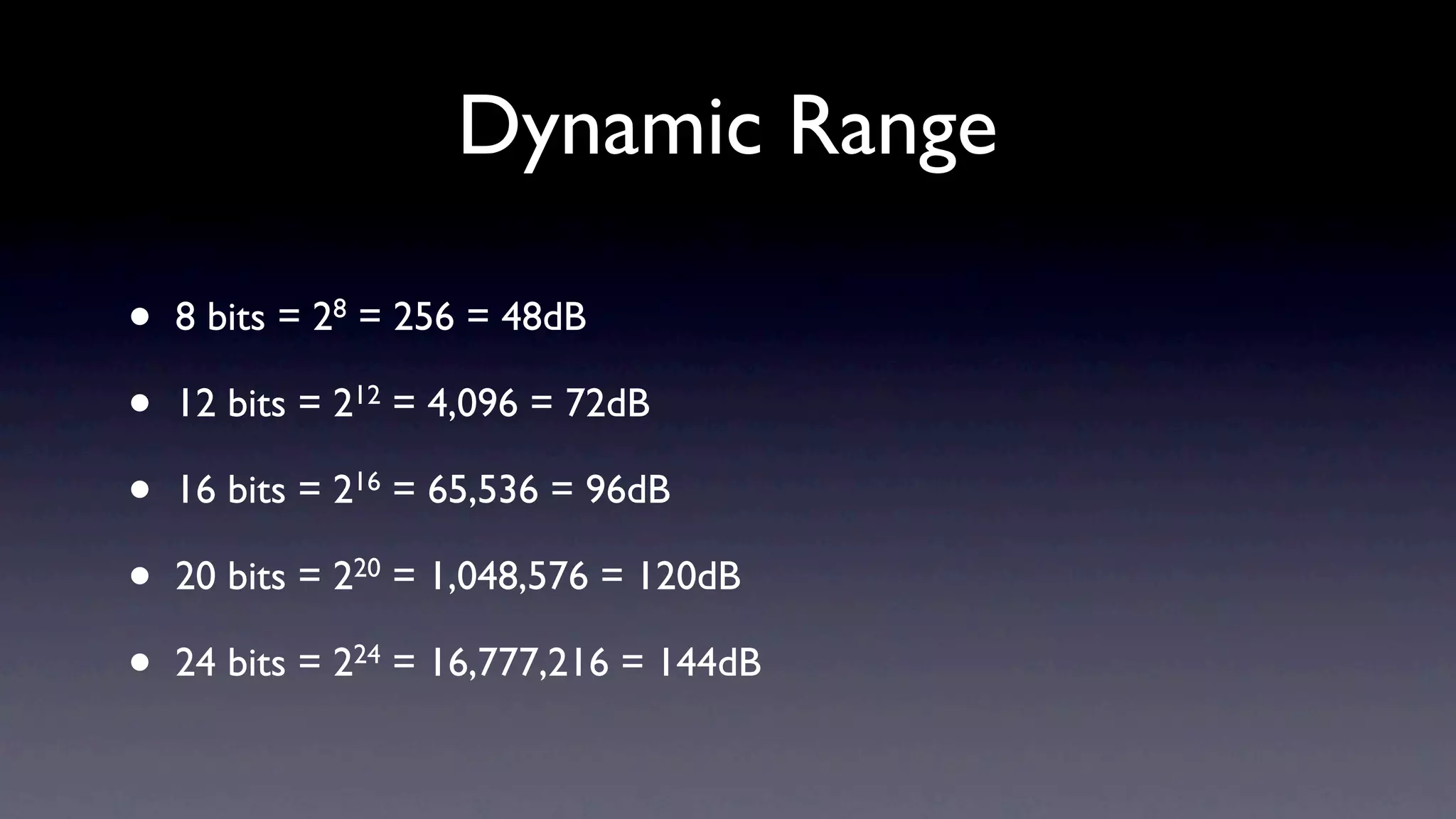
•   8 bits = 28 = 256 = 48dB

•   12 bits = 212 = 4,096 = 72dB

•   16 bits = 216 = 65,536 = 96dB

•   20 bits = 220 = 1,048,576 = 120dB

•   24 bits = 224 = 16,777,216 = 144dB
Dynamic Range


•   S/E power ratio increases exponentially with data bandwidth

•   (one additional bit is double the accuracy)

•   assumes equal distribution (large signal)
Incredible accuracy


•   Image a stack of paper 22 feet high. The thickness of a sheet of paper
    is the accuracy of a 16bit quantization interval!

•   Image a stack of paper a mile high. The thickness of a sheet of paper is
    the accuracy of a 24bit quantization interval!
Quantization Error
•   Distortion power relative to number of intervals, independent of
    amplitude of signal

•   No input, no error

•   Perceptively changes with input type and level

•   Error is +/- 1/2 Q with a rectangular PDF (equal chance)

•   High level signal has un-correlated error
Types of error

•   Overload Noise (If input > MSB)

•   Over lights on equipment

•   Random Noise (large input)

•   White noise (rectangular, not Gaussian p.d.f), masked by signal

•   Granulation distortion (Very low level input)
Quantization Error

•   Quantization noise is not random, but based on signal.

•   Distortion produces harmonics which can alias

•   Multiple input freq. can cause intermodulation distortion

•   Quantization error can create Aliasing (frequencies not present in
    source) even though it occurs after the sample process
Idle channel Noise/Hunting noise


•   Input signal below LSB, but low freq. information (rumble) moves it
    across quantizing intervals, the signal (and noise) will come and go
Distortion, not noise


•   Peak to peak = ±1/2 Quantization interval (Q)

•   An ideal quantizer is by definition non-linear and will cause
    distortion!!
Quantizing


•   Held amplitude is measured and assigned the closest number

•   2n steps, where n = number of bits

•   approximately 6dB of dynamic range per bit
Transmission


•   AES/EBU

•   S/PDIF

•   TDIF
Metering


•   0dBFS (reference is when all codes are being used – Full Scale)

•   Overload

•   Output is at full scale for many consecutive samples
Dither


•   Noise added to the signal to de-correlate the signal from the
    quantizer
Pro

•   Randomizes granulation distortion, changing it to white noise

•   encodes low-level signals via PWM

•   ear averages PWM signal to resolve signal

•   With dither, resolution is below least significant bit!
Con


•   Raises noise floor slightly
ADC Process

•   Analog-to-Digital conversion

    •   Anti-alias filter

    •   sample & hold

    •   quantizer (with Dither)
Oversampling

•   to ease the requirements

    •   of the anti-alias filter and

    •   the accuracy of the quantizer

•   we trade amplitude accuracy for time accuracy

•   sample crude, but fast
Oversampling

•   gentle analog anti-alias filter

•   High Fs

•   Digital filter (anti-alias) and downsample

•   Digital filter easier than analog
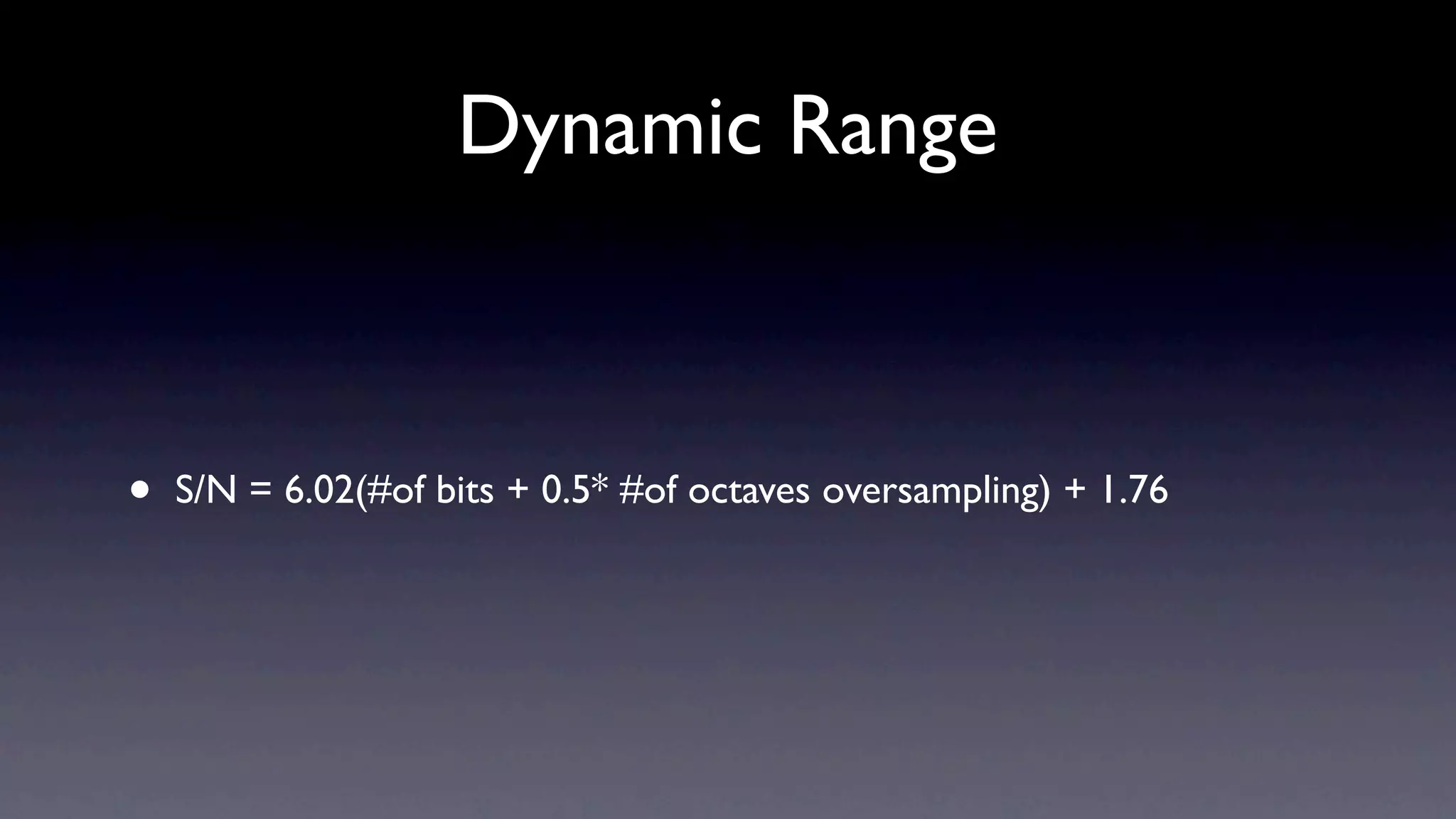
Dynamic Range


•   S/N = 6.02(#of bits + 0.5* #of octaves oversampling) + 1.76
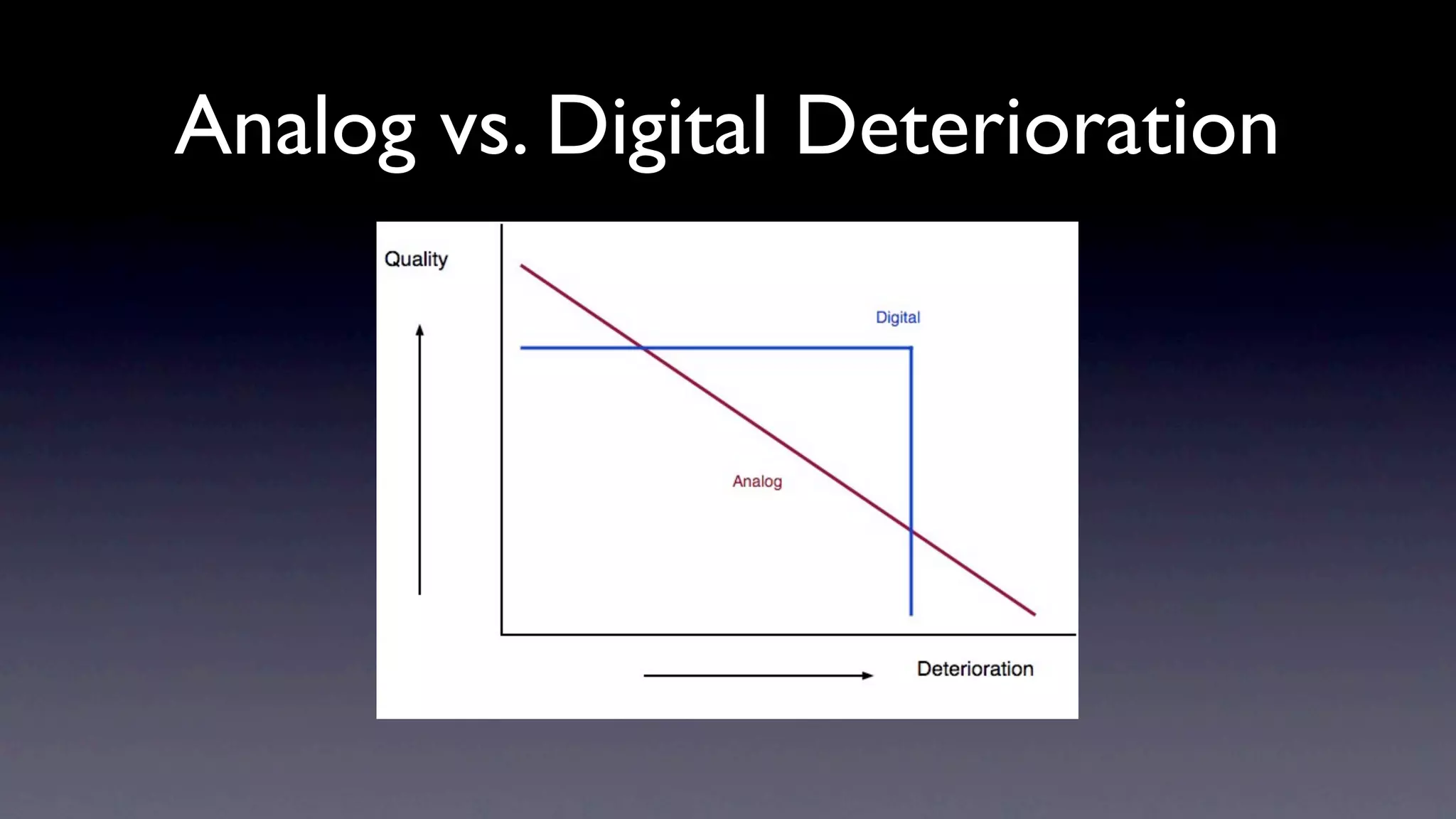
Analog vs. Digital Deterioration


•   In Analog, noise steadily deteriorates the signal-to-noise ratio

•   In Digital, we reach a point of catastrophic failure, when the data can
    no longer be received correctly
Analog vs. Digital Deterioration
365 digital basics before

365 digital basics before

  • 1.
    MUSC 365 Basics ofDigital Audio Module (original)
  • 2.
    Analog = continuous • continuous time and amplitude
  • 3.
    Digital = discrete • is discrete time and amplitude
  • 4.
  • 5.
    Sampling • making discrete Time • A signal of bandwidth BW may be LOSSLESSLY sampled if the sampling rate Fs >= 2BW
  • 6.
    Sampling • Amplitude is held (sampled) only at certain times • Input must be bandlimited to half the sampling rate
  • 7.
    Nyquist Frequency • half the sampling frequency • Fs/2
  • 8.
    Critical sampling • When a signal is sampled at exactly twice its highest frequency • Never done in audio
  • 9.
    Sampling Rate • High • Large guard band • Allows varispeed • Low • Reduce transmission and storage BW
  • 10.
    Sampling • A band limited waveform amplitude modulates an impulse train. • The spectrum of an impulse train is sinewaves @ multiples of Fs • Modulated spectrum is waveform spectrum (bandlimited) repeated around multiples of Fs (with upper and lower sidebands) • If impulses have some width, then the total spectrum is superimposed with the |Sin (x)/x| curve
  • 11.
    Aliasing • Input signal must be bandlimited • If it is not, sampling will cause the first lower sideband to fold back into the signal • Inputs frequencies above Fs/2 are folded back into audio band • Wagon wheel analogy in film • A 7 kHz wave sampled @ 10kHz looks just like a 3 kHz wave
  • 12.
    Sample & Hold • Must acquire analog input amplitude at sample time and hold it long enough for it to be quantized • Sampled analog waveform has greater bandwidth than original input. This is inefficient, so amplitude is Quantized and Coded.
  • 13.
  • 14.
    Pulse Code Modulation(PCM) • Binary Code is transmitted
  • 15.
    Quantization • making discrete Amplitude • Peak S/E(dB) = 6.02n + 1.76 • 1.76 factor based on sinusoidal input • Adding bit increases S/N by 6dB • Number of bits determines resolution
  • 16.
    Dynamic Range • 8 bits = 28 = 256 = 48dB • 12 bits = 212 = 4,096 = 72dB • 16 bits = 216 = 65,536 = 96dB • 20 bits = 220 = 1,048,576 = 120dB • 24 bits = 224 = 16,777,216 = 144dB
  • 17.
    Dynamic Range • S/E power ratio increases exponentially with data bandwidth • (one additional bit is double the accuracy) • assumes equal distribution (large signal)
  • 18.
    Incredible accuracy • Image a stack of paper 22 feet high. The thickness of a sheet of paper is the accuracy of a 16bit quantization interval! • Image a stack of paper a mile high. The thickness of a sheet of paper is the accuracy of a 24bit quantization interval!
  • 19.
    Quantization Error • Distortion power relative to number of intervals, independent of amplitude of signal • No input, no error • Perceptively changes with input type and level • Error is +/- 1/2 Q with a rectangular PDF (equal chance) • High level signal has un-correlated error
  • 20.
    Types of error • Overload Noise (If input > MSB) • Over lights on equipment • Random Noise (large input) • White noise (rectangular, not Gaussian p.d.f), masked by signal • Granulation distortion (Very low level input)
  • 21.
    Quantization Error • Quantization noise is not random, but based on signal. • Distortion produces harmonics which can alias • Multiple input freq. can cause intermodulation distortion • Quantization error can create Aliasing (frequencies not present in source) even though it occurs after the sample process
  • 22.
    Idle channel Noise/Huntingnoise • Input signal below LSB, but low freq. information (rumble) moves it across quantizing intervals, the signal (and noise) will come and go
  • 23.
    Distortion, not noise • Peak to peak = ±1/2 Quantization interval (Q) • An ideal quantizer is by definition non-linear and will cause distortion!!
  • 24.
    Quantizing • Held amplitude is measured and assigned the closest number • 2n steps, where n = number of bits • approximately 6dB of dynamic range per bit
  • 25.
    Transmission • AES/EBU • S/PDIF • TDIF
  • 26.
    Metering • 0dBFS (reference is when all codes are being used – Full Scale) • Overload • Output is at full scale for many consecutive samples
  • 27.
    Dither • Noise added to the signal to de-correlate the signal from the quantizer
  • 28.
    Pro • Randomizes granulation distortion, changing it to white noise • encodes low-level signals via PWM • ear averages PWM signal to resolve signal • With dither, resolution is below least significant bit!
  • 29.
    Con • Raises noise floor slightly
  • 30.
    ADC Process • Analog-to-Digital conversion • Anti-alias filter • sample & hold • quantizer (with Dither)
  • 31.
    Oversampling • to ease the requirements • of the anti-alias filter and • the accuracy of the quantizer • we trade amplitude accuracy for time accuracy • sample crude, but fast
  • 32.
    Oversampling • gentle analog anti-alias filter • High Fs • Digital filter (anti-alias) and downsample • Digital filter easier than analog
  • 33.
    Dynamic Range • S/N = 6.02(#of bits + 0.5* #of octaves oversampling) + 1.76
  • 34.
    Analog vs. DigitalDeterioration • In Analog, noise steadily deteriorates the signal-to-noise ratio • In Digital, we reach a point of catastrophic failure, when the data can no longer be received correctly
  • 35.
    Analog vs. DigitalDeterioration

Editor's Notes

  • #6  (Pohlmann pg. 27) Proof in Couch pg. 90-91
  • #16 Pohlmann pg. 35