 Anaemia is a condition in which the number
of red blood cells or their oxygen-carrying
capacity is insufficient to meet physiologic
needs, which vary by age, sex, altitude,
smoking, and pregnancy status. (WHO
2014)
 Anaemia is a “Silent killer”.
 WHO criteria :
› Hb less than12 g/dL in females and less than
13g/dL in males
 Globally, anaemia affects 1.62 billion
people, which corresponds to 24.8%
of the population.
 In India, anaemia affects an
estimated 50% of the population.
 20%-40% of maternal deaths in India
are due to anaemia
 One in every two Indian women (56%)
suffers from some form of anaemia.
 Anemia is rarely a disease by itself,
 It is mostly a manifestation or
consequence of an underlying (genetic
or acquired) disease.
 The finding of anemia has to start
attempts to disclose an underlying
disease .
› What is the cause of anemia ?
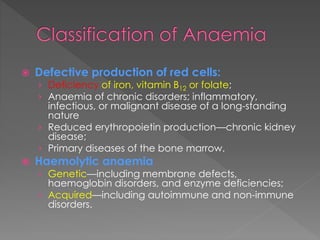
 Defective production of red cells:
› Deficiency of iron, vitamin B12 or folate;
› Anaemia of chronic disorders; inflammatory,
infectious, or malignant disease of a long-standing
nature
› Reduced erythropoietin production—chronic kidney
disease;
› Primary diseases of the bone marrow.
 Haemolytic anaemia
› Genetic—including membrane defects,
haemoglobin disorders, and enzyme deficiencies;
› Acquired—including autoimmune and non-immune
disorders.
normal
Hct
(a/b%):Normal
Dehydration
Hct:Increase
d
Acute blood
loss(early)
Hct:unchang
ed
Chronic
anemia
Hct: Low
1 2 3 4 5
Increase
d plasma
volume
Hct: Low
b
a
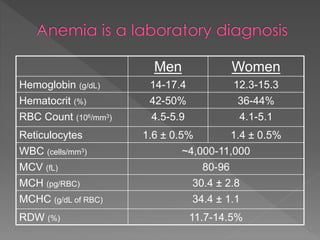
Men Women
Hemoglobin (g/dL) 14-17.4 12.3-15.3
Hematocrit (%) 42-50% 36-44%
RBC Count (106/mm3) 4.5-5.9 4.1-5.1
Reticulocytes 1.6 ± 0.5% 1.4 ± 0.5%
WBC (cells/mm3) ~4,000-11,000
MCV (fL) 80-96
MCH (pg/RBC) 30.4 ± 2.8
MCHC (g/dL of RBC) 34.4 ± 1.1
RDW (%) 11.7-14.5%
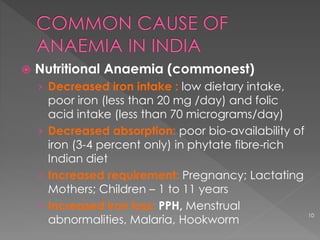
 Nutritional Anaemia (commonest)
› Decreased iron intake : low dietary intake,
poor iron (less than 20 mg /day) and folic
acid intake (less than 70 micrograms/day)
› Decreased absorption: poor bio-availability of
iron (3-4 percent only) in phytate fibre-rich
Indian diet
› Increased requirement: Pregnancy; Lactating
Mothers; Children – 1 to 11 years
› Increased iron loss: PPH, Menstrual
abnormalities, Malaria, Hookworm
10
 Sources: Liver, Fish, Dry fruits, Jaggery,
Spinach, Banana, Meat.
 PHARMACOKINETICS
› Haemoglobin, Myoglobin, Respiratory
Enzymes, Cytochrome
› Dietary Iron is in Ferric Form
› HCl in stomach reduces Ferric to Ferrous iron
› Absorption of Iron takes place in Duodenum
and upper jejunum.
 Acidic pH, Ascorbic Acid(Vit-C),
Cysteine
 Reduces Ferric[Fe3+] to Ferrous[Fe2+]
 Phosphates, Oxalates, Phytates
 Milk, Antacid, Tetracyclines (Forms
Insoluble complexes)
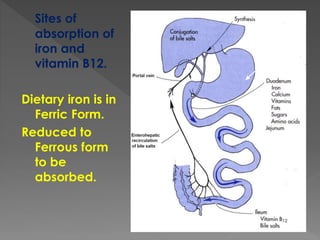
Sites of
absorption of
iron and
vitamin B12.
Dietary iron is in
Ferric Form.
Reduced to
Ferrous form
to be
absorbed.
IF secretion
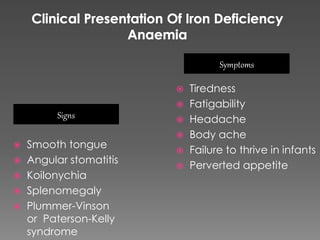
 Tiredness
 Fatigability
 Headache
 Body ache
 Failure to thrive in infants
 Perverted appetite
 Smooth tongue
 Angular stomatitis
 Koilonychia
 Splenomegaly
 Plummer-Vinson
or Paterson-Kelly
syndrome
Symptoms
Signs
 IRON
 B12
 Folic Acid
 During Pregnancy
 Due to blood loss
 Due to nutritional iron deficiency
 Due to poor absorption of iron from the
gut.
 ORAL
› Ferrous sulfate (20%)
› Ferrous
Gluconate(12%)
› Ferrous Fumerate
(33%)
› Colloidal Ferric
Hydroxide (50%)
› Carbonyl iron
› Ferrous succinate
› Ferric ammonium
citrate
 PARENTERAL
› Iron dextran
› Iron sorbitol citric acid
› Ferrous sucrose
› Ferric carboxy
maltose
 The most common iron salt used for oral
administration is ferrous sulfate,
 Ferrous fumarate and gluconate have less
gastrointestinal side effects and are readily
absorbed than ferrous sulfate.
 Ferrous succinate is more completely
absorbed, but is more expensive and has no
advantage over ferrous fumarate and ferrous
sulfate
 Ferrous calcium citrate has very low iron
content and does not supply adequate
elemental iron unless several tablets are taken
which is inconvenient for the patient.
 Colloidal ferric hydroxide has high elemental
iron(52.26%).Better absorption and less gastric
irritation
19
 Epigastric pain
 Heart burn
 Nausea
 Staining of teeth
 Bloating
 Metallic taste
 Intestinal colic
 Constipation
 Vomiting
IRON Required(mg)=
4.4 x Body weight(kg) x [Target Hb-Patient’s
Hb deficit](g/dl)
 Dose- 100mg daily or alternative day up
to 2gm.
 Deep IM into the buttock using ‘Z-track’
technique.
 To prevent staining of skin.
 Iron dextran complex- diluted in 500ml of NS
and infused over 1-2hrs after administering
a test dose.
 Sodium ferric gluconate
 Iron sucrose
 Adverse effects- painful, discolouration,
nausea, vomitting, athralgia, rashes,
anaphylactic reactions.
 MW- 34,000
 Sialoglycoprotein
 Erythropoietins are called epoetins (EPO).
 There are four different types of epoetin:
Epoetin alfa
Epoetin beta
Epoetin zeta
Epoetin theta
 Darbepoetin alfa is hyperglcosylated
modified epoetin.
 Indicated in CKD patients with anaemia.
 Vitamin B12
 Folic Acid
 Essential for DNA synthesis
 Deficiency causes megaloblastic
anaemia.
 Synthesized by colonic bacteria
 Present in meat, liver, egg, fish.
 Required for Haemopoiesis and for
maintenance of myelin.
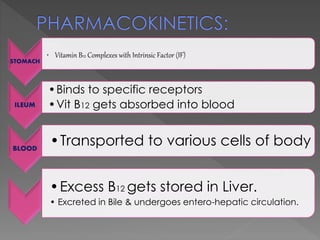
STOMACH
• Vitamin B12 Complexes with Intrinsic Factor (IF)
ILEUM
•Binds to specific receptors
•Vit B12 gets absorbed into blood
BLOOD
•Transported to various cells of body
•Excess B12 gets stored in Liver.
• Excreted in Bile & undergoes entero-hepatic circulation.
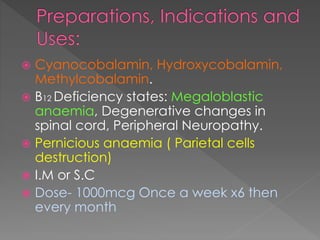
 Cyanocobalamin, Hydroxycobalamin,
Methylcobalamin.
 B12 Deficiency states: Megaloblastic
anaemia, Degenerative changes in
spinal cord, Peripheral Neuropathy.
 Pernicious anaemia ( Parietal cells
destruction)
 I.M or S.C
 Dose- 1000mcg Once a week x6 then
every month
 Abundant in Fresh green leafy
vegetables, liver, fruits.
 Requirement increases in Pregnancy and
Lactation.
 FOLATE DEFICIENCY:
› Dietary def; Decreased absorption;
Diminished hepatic storage; Increased
demand; Drug Induced(Methotrexate).
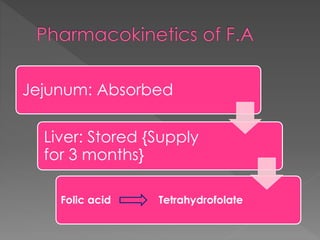
Jejunum: Absorbed
Liver: Stored {Supply
for 3 months}
Folic acid Tetrahydrofolate
Anaemia for b sc nursing

Anaemia for b sc nursing

  • 3.
     Anaemia isa condition in which the number of red blood cells or their oxygen-carrying capacity is insufficient to meet physiologic needs, which vary by age, sex, altitude, smoking, and pregnancy status. (WHO 2014)  Anaemia is a “Silent killer”.  WHO criteria : › Hb less than12 g/dL in females and less than 13g/dL in males
  • 4.
     Globally, anaemiaaffects 1.62 billion people, which corresponds to 24.8% of the population.  In India, anaemia affects an estimated 50% of the population.  20%-40% of maternal deaths in India are due to anaemia  One in every two Indian women (56%) suffers from some form of anaemia.
  • 5.
     Anemia israrely a disease by itself,  It is mostly a manifestation or consequence of an underlying (genetic or acquired) disease.  The finding of anemia has to start attempts to disclose an underlying disease . › What is the cause of anemia ?
  • 6.
     Defective productionof red cells: › Deficiency of iron, vitamin B12 or folate; › Anaemia of chronic disorders; inflammatory, infectious, or malignant disease of a long-standing nature › Reduced erythropoietin production—chronic kidney disease; › Primary diseases of the bone marrow.  Haemolytic anaemia › Genetic—including membrane defects, haemoglobin disorders, and enzyme deficiencies; › Acquired—including autoimmune and non-immune disorders.
  • 7.
  • 8.
    Men Women Hemoglobin (g/dL)14-17.4 12.3-15.3 Hematocrit (%) 42-50% 36-44% RBC Count (106/mm3) 4.5-5.9 4.1-5.1 Reticulocytes 1.6 ± 0.5% 1.4 ± 0.5% WBC (cells/mm3) ~4,000-11,000 MCV (fL) 80-96 MCH (pg/RBC) 30.4 ± 2.8 MCHC (g/dL of RBC) 34.4 ± 1.1 RDW (%) 11.7-14.5%
  • 10.
     Nutritional Anaemia(commonest) › Decreased iron intake : low dietary intake, poor iron (less than 20 mg /day) and folic acid intake (less than 70 micrograms/day) › Decreased absorption: poor bio-availability of iron (3-4 percent only) in phytate fibre-rich Indian diet › Increased requirement: Pregnancy; Lactating Mothers; Children – 1 to 11 years › Increased iron loss: PPH, Menstrual abnormalities, Malaria, Hookworm 10
  • 11.
     Sources: Liver,Fish, Dry fruits, Jaggery, Spinach, Banana, Meat.  PHARMACOKINETICS › Haemoglobin, Myoglobin, Respiratory Enzymes, Cytochrome › Dietary Iron is in Ferric Form › HCl in stomach reduces Ferric to Ferrous iron › Absorption of Iron takes place in Duodenum and upper jejunum.
  • 12.
     Acidic pH,Ascorbic Acid(Vit-C), Cysteine  Reduces Ferric[Fe3+] to Ferrous[Fe2+]  Phosphates, Oxalates, Phytates  Milk, Antacid, Tetracyclines (Forms Insoluble complexes)
  • 13.
    Sites of absorption of ironand vitamin B12. Dietary iron is in Ferric Form. Reduced to Ferrous form to be absorbed. IF secretion
  • 14.
     Tiredness  Fatigability Headache  Body ache  Failure to thrive in infants  Perverted appetite  Smooth tongue  Angular stomatitis  Koilonychia  Splenomegaly  Plummer-Vinson or Paterson-Kelly syndrome Symptoms Signs
  • 15.
  • 16.
     During Pregnancy Due to blood loss  Due to nutritional iron deficiency  Due to poor absorption of iron from the gut.
  • 17.
     ORAL › Ferroussulfate (20%) › Ferrous Gluconate(12%) › Ferrous Fumerate (33%) › Colloidal Ferric Hydroxide (50%) › Carbonyl iron › Ferrous succinate › Ferric ammonium citrate  PARENTERAL › Iron dextran › Iron sorbitol citric acid › Ferrous sucrose › Ferric carboxy maltose
  • 18.
     The mostcommon iron salt used for oral administration is ferrous sulfate,  Ferrous fumarate and gluconate have less gastrointestinal side effects and are readily absorbed than ferrous sulfate.  Ferrous succinate is more completely absorbed, but is more expensive and has no advantage over ferrous fumarate and ferrous sulfate  Ferrous calcium citrate has very low iron content and does not supply adequate elemental iron unless several tablets are taken which is inconvenient for the patient.  Colloidal ferric hydroxide has high elemental iron(52.26%).Better absorption and less gastric irritation
  • 19.
    19  Epigastric pain Heart burn  Nausea  Staining of teeth  Bloating  Metallic taste  Intestinal colic  Constipation  Vomiting
  • 20.
    IRON Required(mg)= 4.4 xBody weight(kg) x [Target Hb-Patient’s Hb deficit](g/dl)
  • 21.
     Dose- 100mgdaily or alternative day up to 2gm.  Deep IM into the buttock using ‘Z-track’ technique.  To prevent staining of skin.
  • 22.
     Iron dextrancomplex- diluted in 500ml of NS and infused over 1-2hrs after administering a test dose.  Sodium ferric gluconate  Iron sucrose  Adverse effects- painful, discolouration, nausea, vomitting, athralgia, rashes, anaphylactic reactions.
  • 23.
     MW- 34,000 Sialoglycoprotein  Erythropoietins are called epoetins (EPO).  There are four different types of epoetin: Epoetin alfa Epoetin beta Epoetin zeta Epoetin theta  Darbepoetin alfa is hyperglcosylated modified epoetin.  Indicated in CKD patients with anaemia.
  • 24.
     Vitamin B12 Folic Acid  Essential for DNA synthesis  Deficiency causes megaloblastic anaemia.
  • 25.
     Synthesized bycolonic bacteria  Present in meat, liver, egg, fish.  Required for Haemopoiesis and for maintenance of myelin.
  • 26.
    STOMACH • Vitamin B12Complexes with Intrinsic Factor (IF) ILEUM •Binds to specific receptors •Vit B12 gets absorbed into blood BLOOD •Transported to various cells of body •Excess B12 gets stored in Liver. • Excreted in Bile & undergoes entero-hepatic circulation.
  • 27.
     Cyanocobalamin, Hydroxycobalamin, Methylcobalamin. B12 Deficiency states: Megaloblastic anaemia, Degenerative changes in spinal cord, Peripheral Neuropathy.  Pernicious anaemia ( Parietal cells destruction)  I.M or S.C  Dose- 1000mcg Once a week x6 then every month
  • 28.
     Abundant inFresh green leafy vegetables, liver, fruits.  Requirement increases in Pregnancy and Lactation.  FOLATE DEFICIENCY: › Dietary def; Decreased absorption; Diminished hepatic storage; Increased demand; Drug Induced(Methotrexate).
  • 29.
    Jejunum: Absorbed Liver: Stored{Supply for 3 months} Folic acid Tetrahydrofolate