S
Steam
inhalation
BY,
MR. ABHIJIT BHOYAR
M. SC. NURSING
CHILD HEALTH
 Steam inhalation is one of the most widely
used home remedies to soothe & open the
nasal passages and get relief from the
symptoms of cold or sinus infections
Meaning
Inhalation means the inhaling of medicines
or anaesthetics in the form of a gas or
vapour.
 To relieve inflammation of the
mucous membrane in acute
cold & in sinusitis. It produces
symptomatic relief.
 To soften thick, tenacious
mucous & relief coughing
from many causes
Purposes
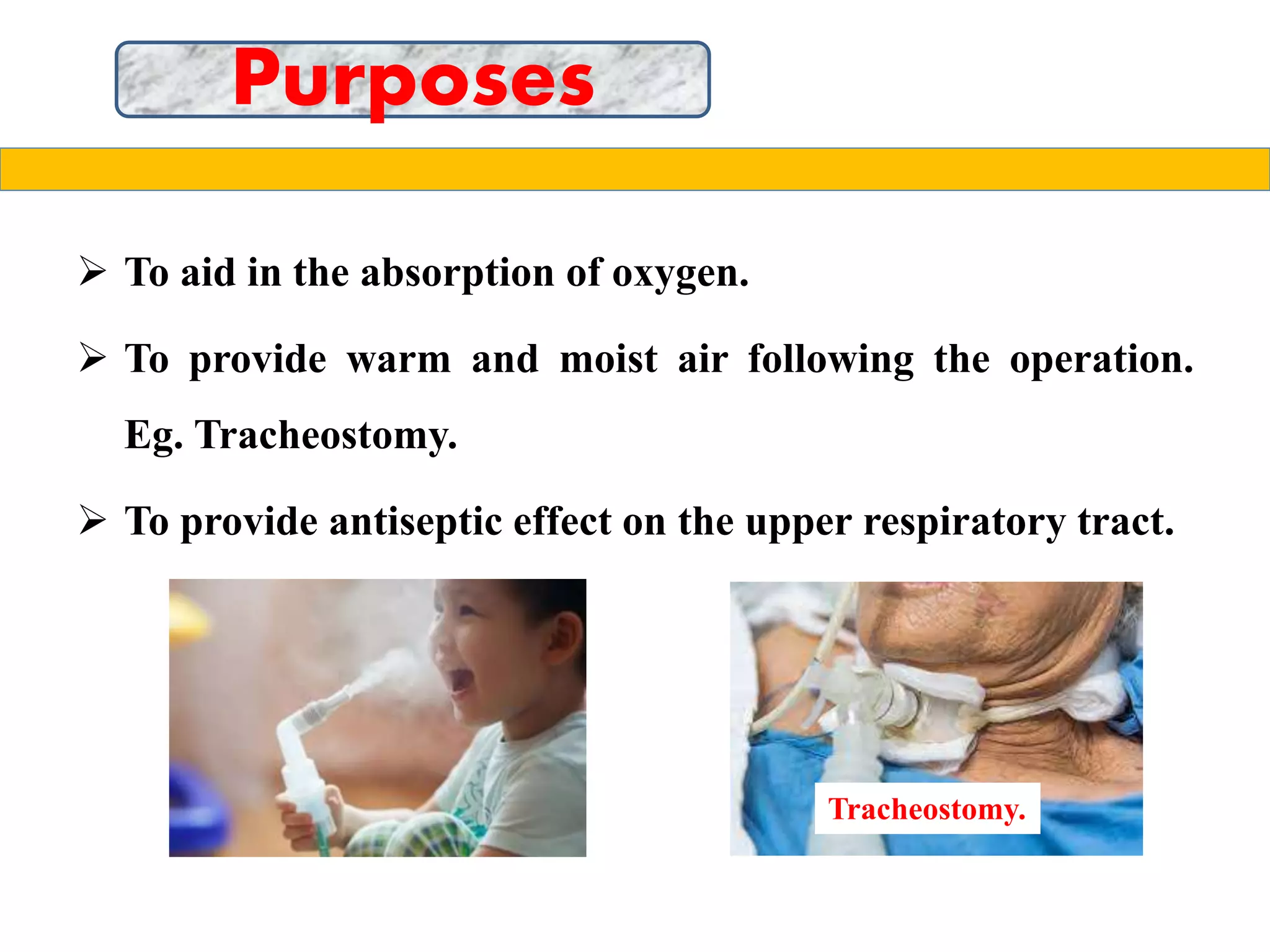
 To aid in the absorption of oxygen.
 To provide warm and moist air following the operation.
Eg. Tracheostomy.
 To provide antiseptic effect on the upper respiratory tract.
Purposes
Tracheostomy.
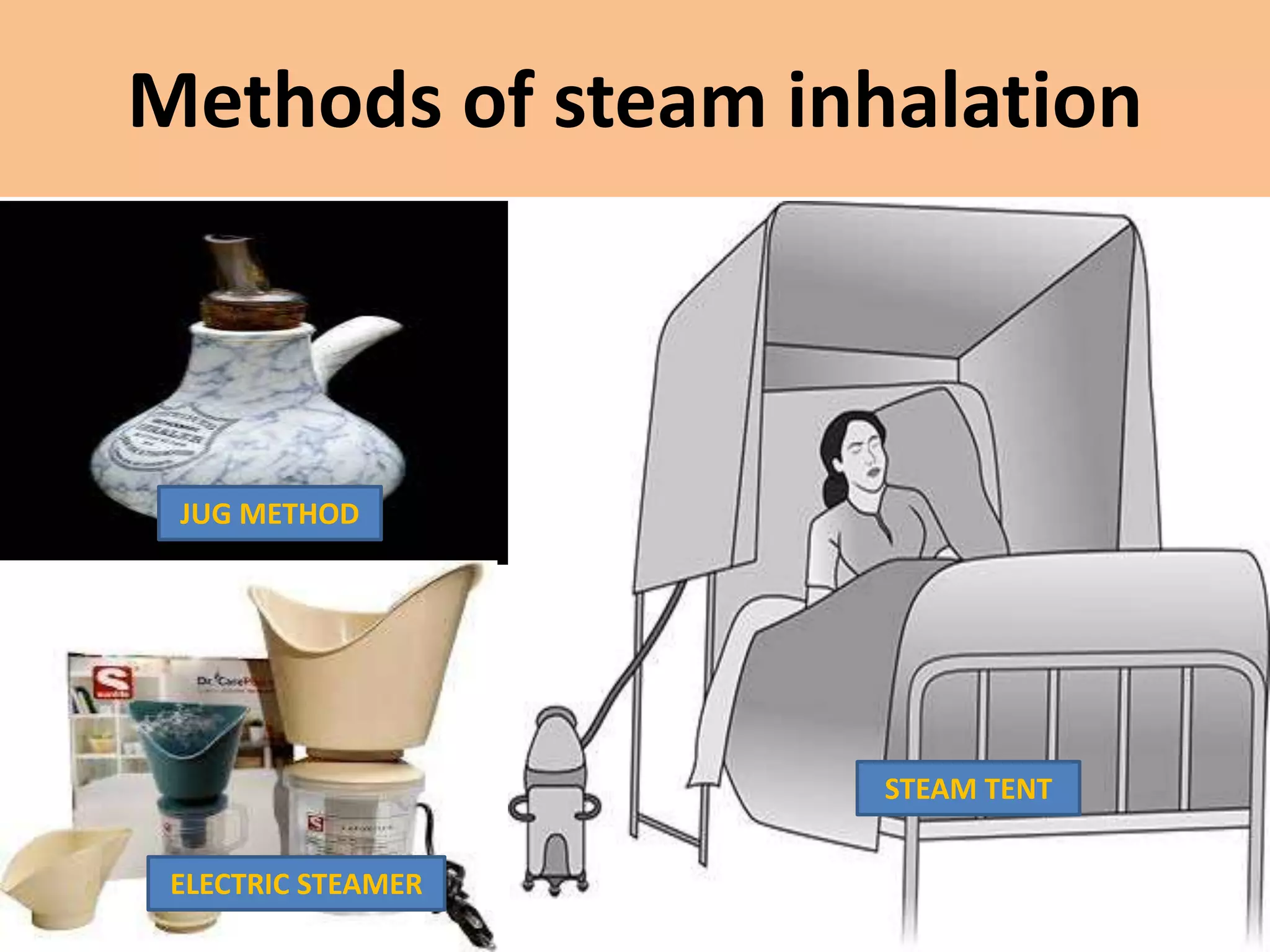
Methods of steam inhalation
JUG METHOD
STEAM TENT
ELECTRIC STEAMER
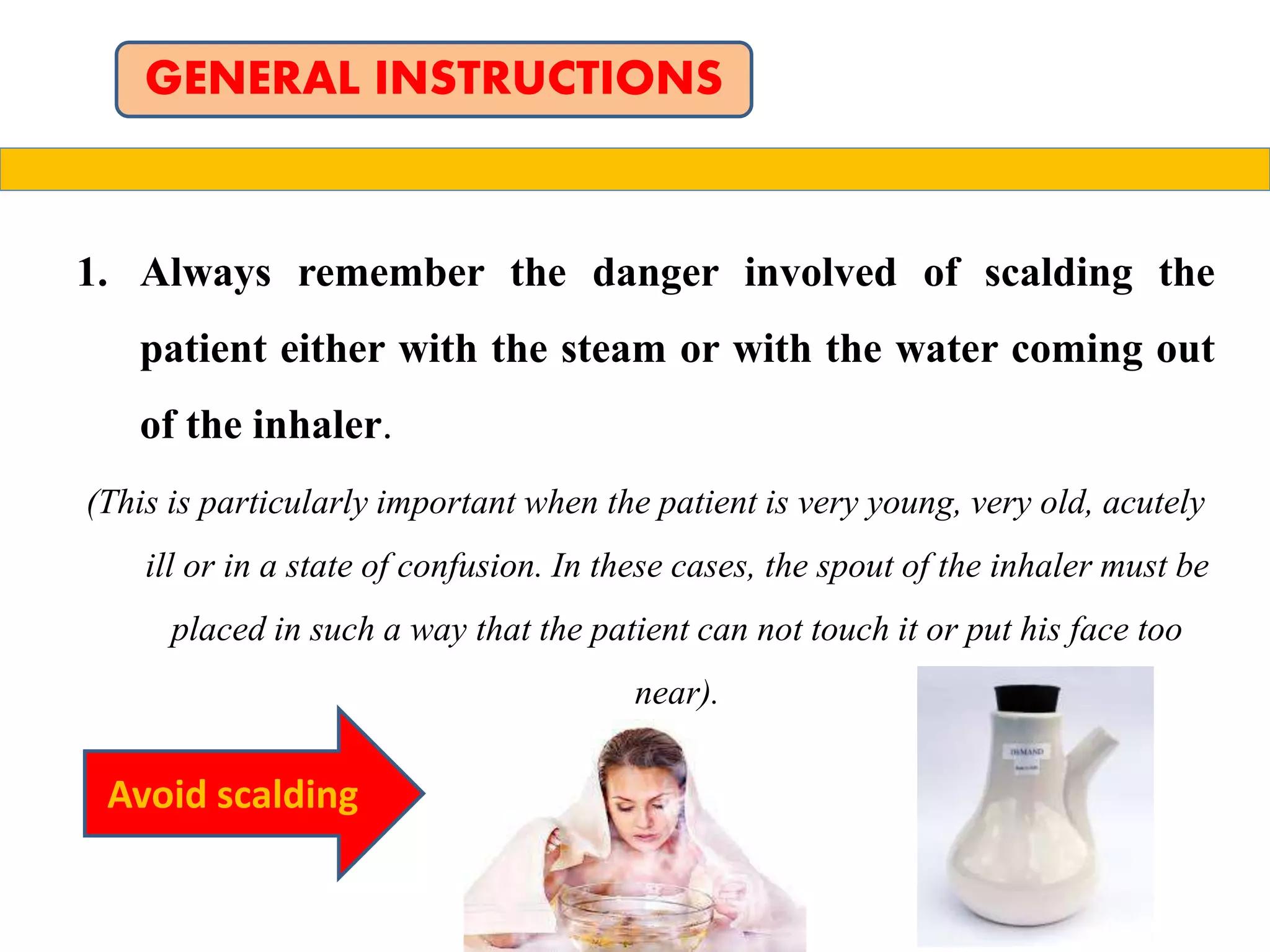
1. Always remember the danger involved of scalding the
patient either with the steam or with the water coming out
of the inhaler.
(This is particularly important when the patient is very young, very old, acutely
ill or in a state of confusion. In these cases, the spout of the inhaler must be
placed in such a way that the patient can not touch it or put his face too
near).
GENERAL INSTRUCTIONS
Avoid scalding
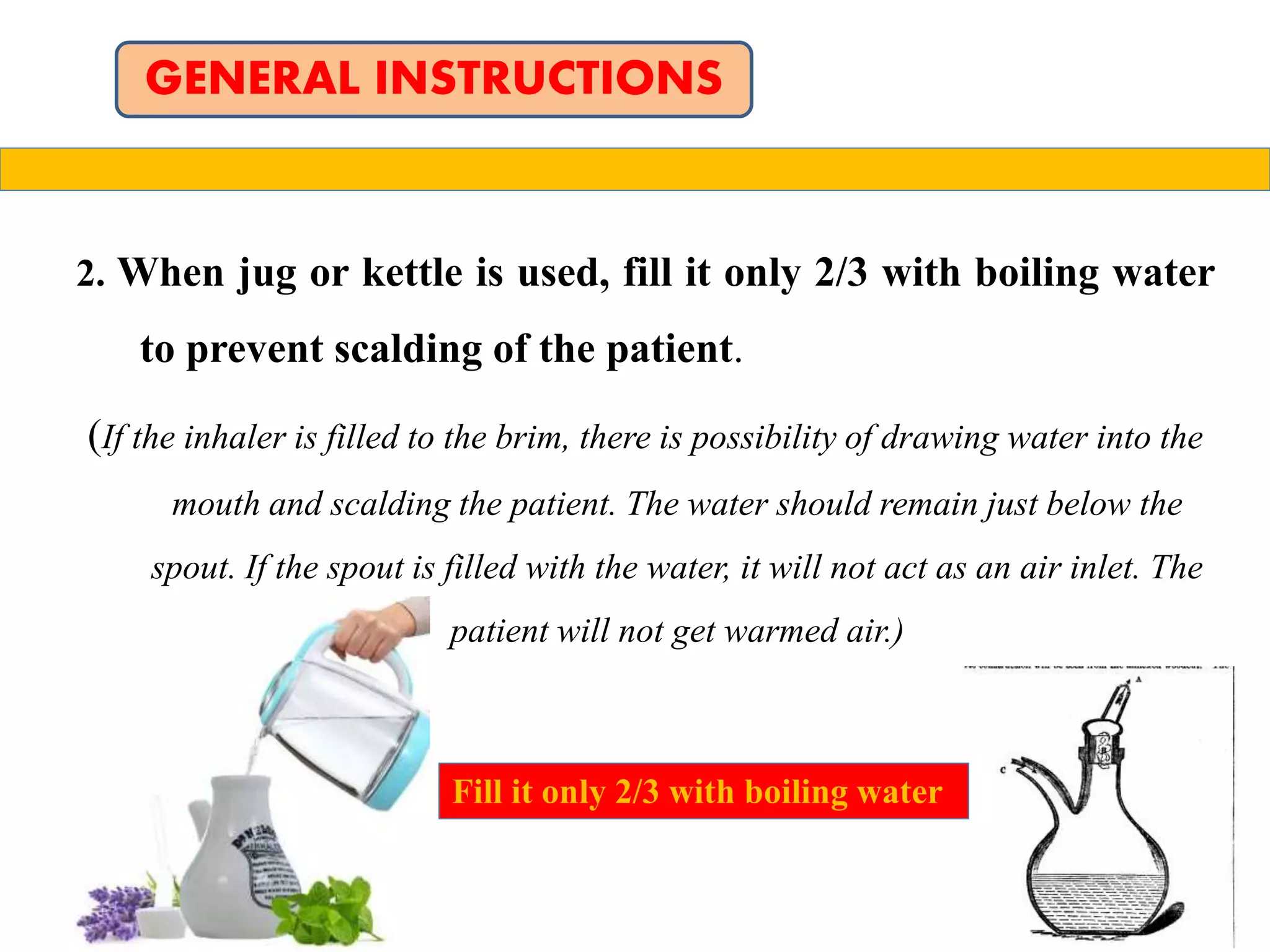
2. When jug or kettle is used, fill it only 2/3 with boiling water
to prevent scalding of the patient.
(If the inhaler is filled to the brim, there is possibility of drawing water into the
mouth and scalding the patient. The water should remain just below the
spout. If the spout is filled with the water, it will not act as an air inlet. The
patient will not get warmed air.)
GENERAL INSTRUCTIONS
Fill it only 2/3 with boiling water
3. Always remember the danger of fire.
(If a stove is used with a kettle to generate steam continuously, as in the case of
steam tent, the blankets used may fall on the stove and catch fire).
4. Have the water in the jug method at a moderate temperature.
{The temperature is maintained between 120 to 1600F (54.4 to 76.70 C). If the
water is cold, it will not generate steam. If the water is too hot, it may cause
scalding of the patient}
5. Keep the patient warm and prevent draught before, during and
after the inhalation.
(During the treatment, the blood vessels of the skin and mucus membranes are dilated and
the patient is easily chilled when exposed to draught. This predisposes him to a more
severe and prolonged attack of inflammation and congestion. Therefore the patient
should not go into a cold atmosphere for several hours after the treatment. The
windows and doors are closed and the fan is put off during the treatment to prevent
draught. Ask the patient to empty the bladder to ensure that the patient will remain on
the bed for several hours after inhalation).
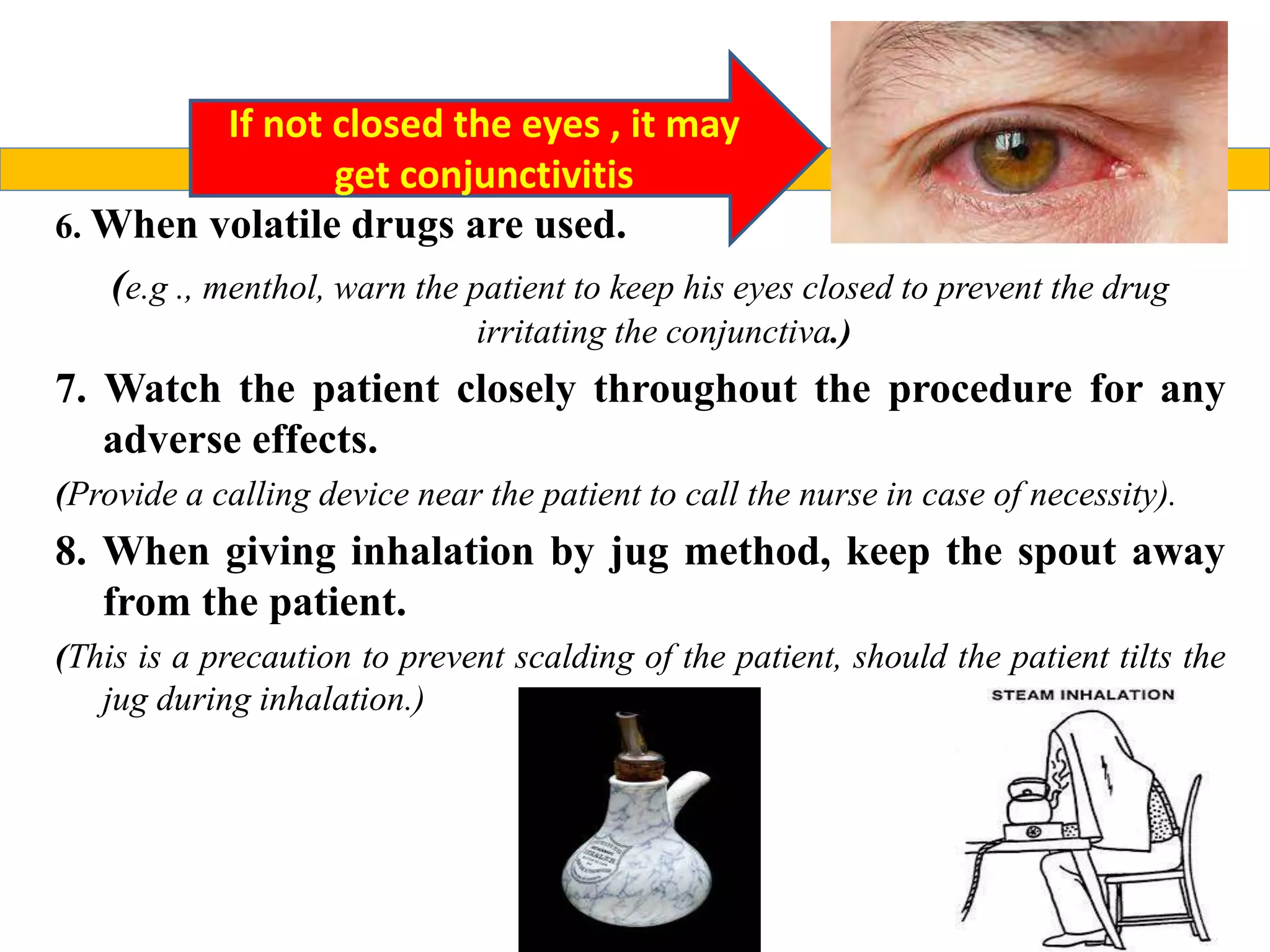
6. When volatile drugs are used.
(e.g ., menthol, warn the patient to keep his eyes closed to prevent the drug
irritating the conjunctiva.)
7. Watch the patient closely throughout the procedure for any
adverse effects.
(Provide a calling device near the patient to call the nurse in case of necessity).
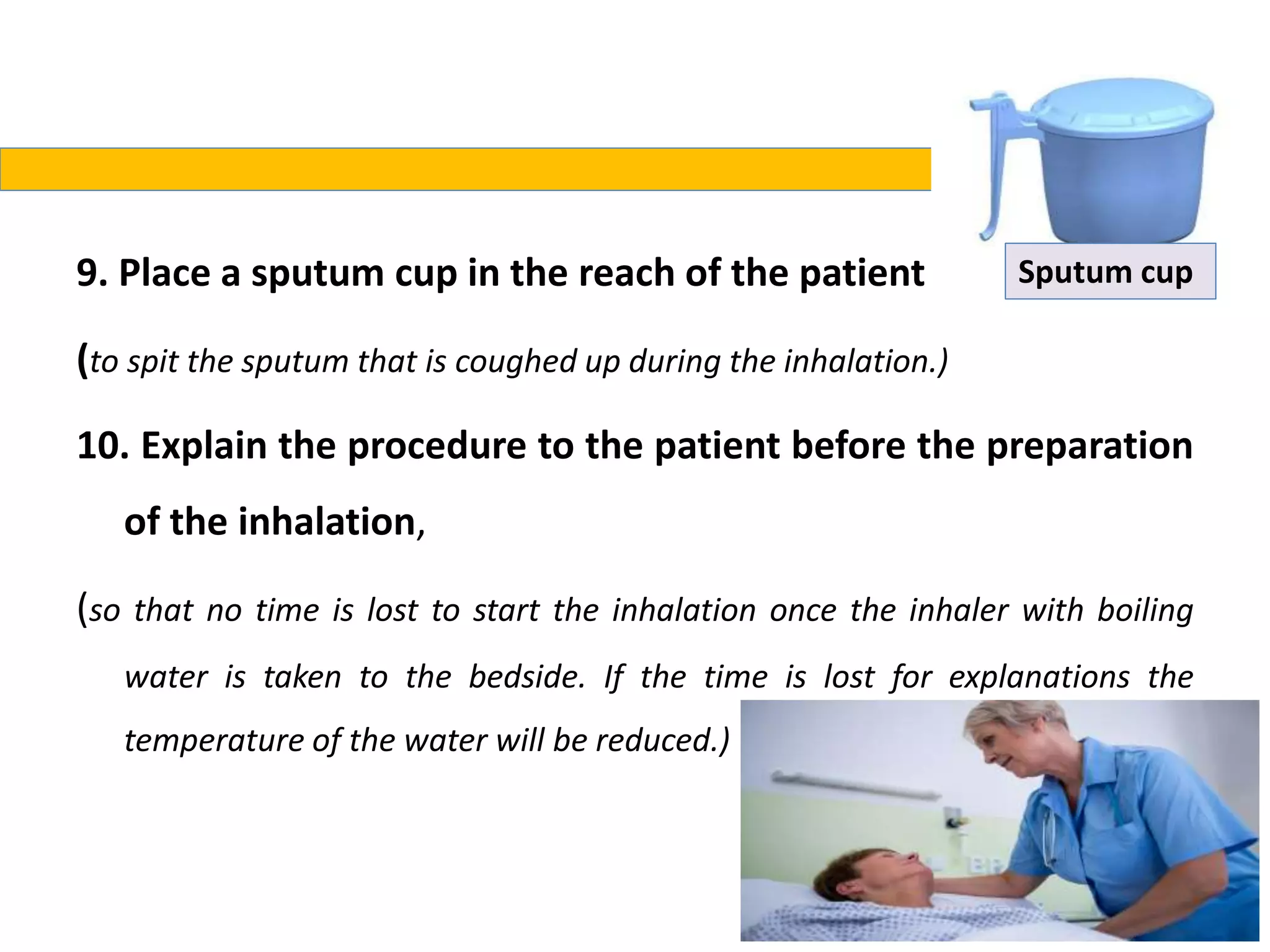
8. When giving inhalation by jug method, keep the spout away
from the patient.
(This is a precaution to prevent scalding of the patient, should the patient tilts the
jug during inhalation.)
If not closed the eyes , it may
get conjunctivitis
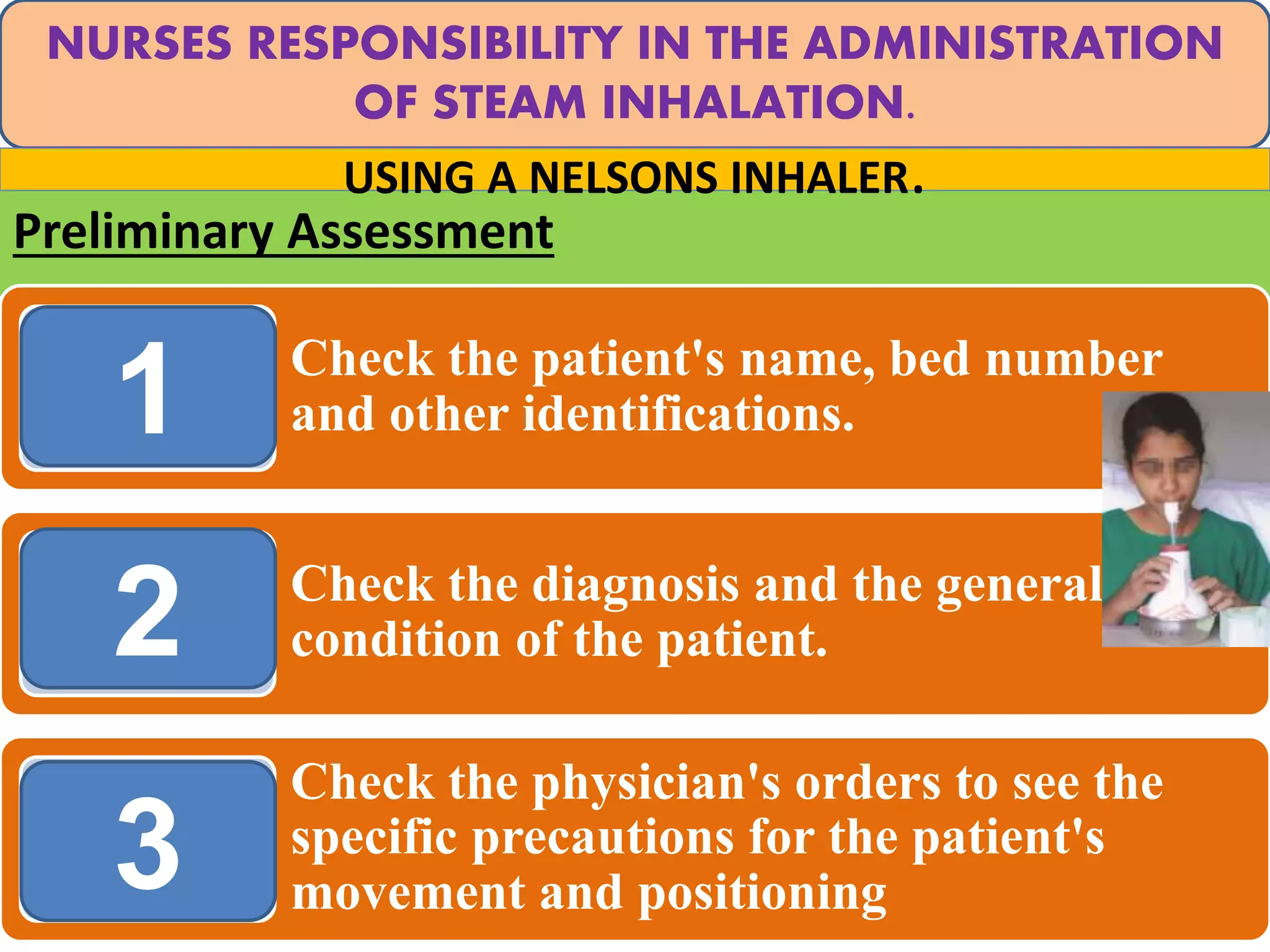
9. Place a sputum cup in the reach of the patient
(to spit the sputum that is coughed up during the inhalation.)
10. Explain the procedure to the patient before the preparation
of the inhalation,
(so that no time is lost to start the inhalation once the inhaler with boiling
water is taken to the bedside. If the time is lost for explanations the
temperature of the water will be reduced.)
Sputum cup
Preliminary Assessment
NURSES RESPONSIBILITY IN THE ADMINISTRATION
OF STEAM INHALATION.
USING A NELSONS INHALER.
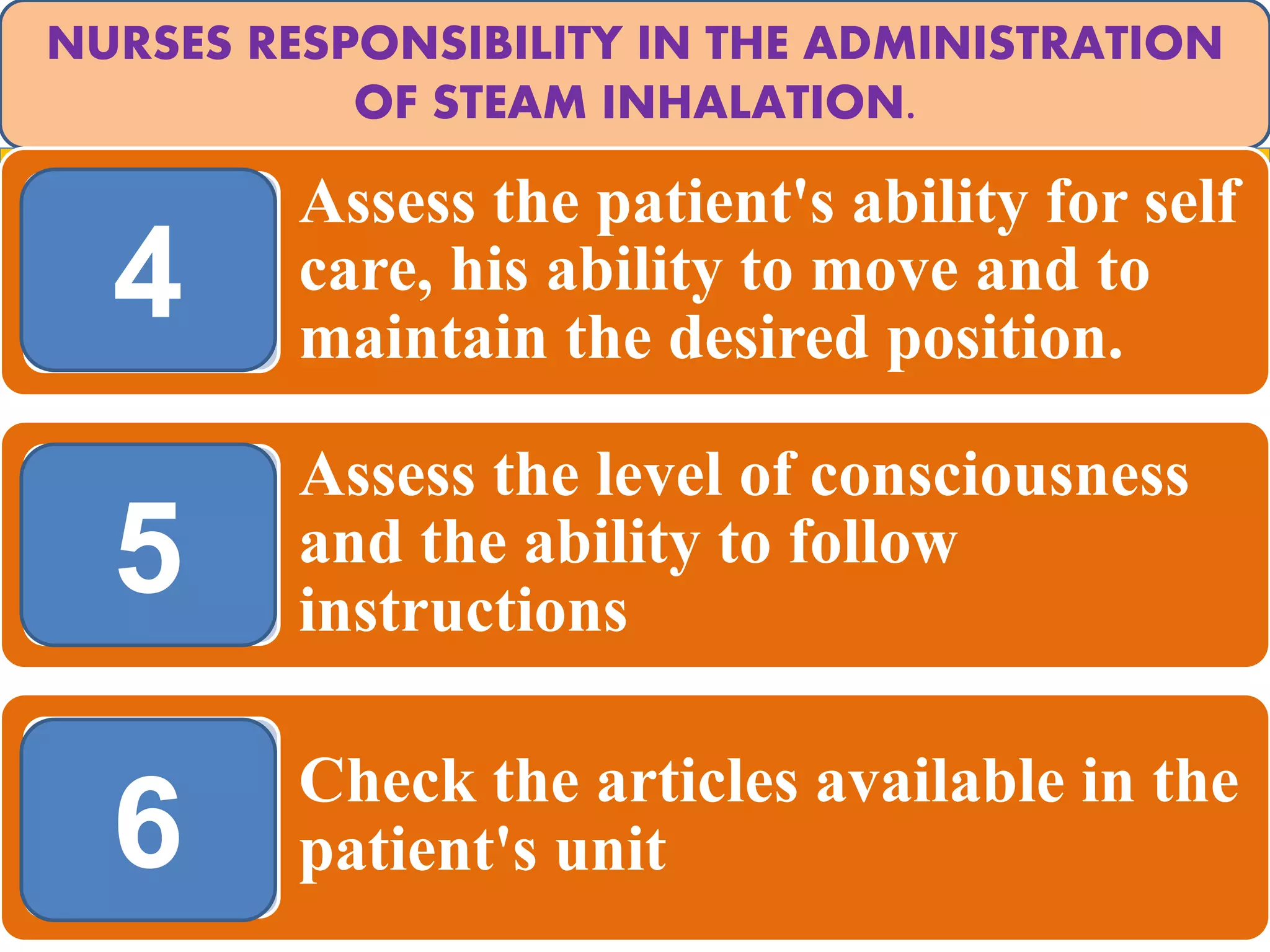
Check the patient's name, bed number
and other identifications.
Check the diagnosis and the general
condition of the patient.
Check the physician's orders to see the
specific precautions for the patient's
movement and positioning
1
2
3
NURSES RESPONSIBILITY IN THE ADMINISTRATION
OF STEAM INHALATION.
Assess the patient's ability for self
care, his ability to move and to
maintain the desired position.
Assess the level of consciousness
and the ability to follow
instructions
Check the articles available in the
patient's unit
4
5
6
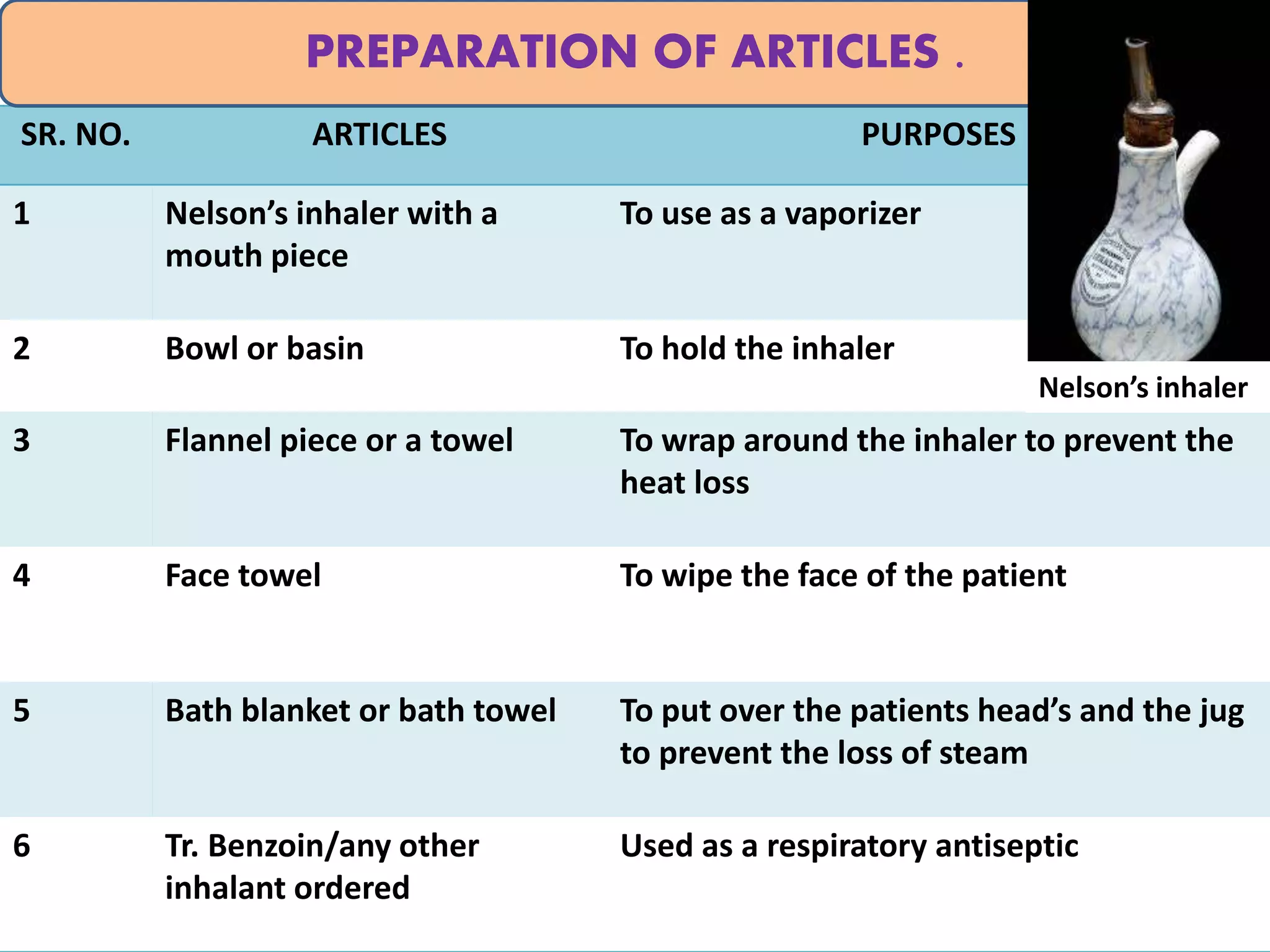
SR. NO. ARTICLES PURPOSES
1 Nelson’s inhaler with a
mouth piece
To use as a vaporizer
2 Bowl or basin To hold the inhaler
3 Flannel piece or a towel To wrap around the inhaler to prevent the
heat loss
4 Face towel To wipe the face of the patient
5 Bath blanket or bath towel To put over the patients head’s and the jug
to prevent the loss of steam
6 Tr. Benzoin/any other
inhalant ordered
Used as a respiratory antiseptic
PREPARATION OF ARTICLES .
Nelson’s inhaler
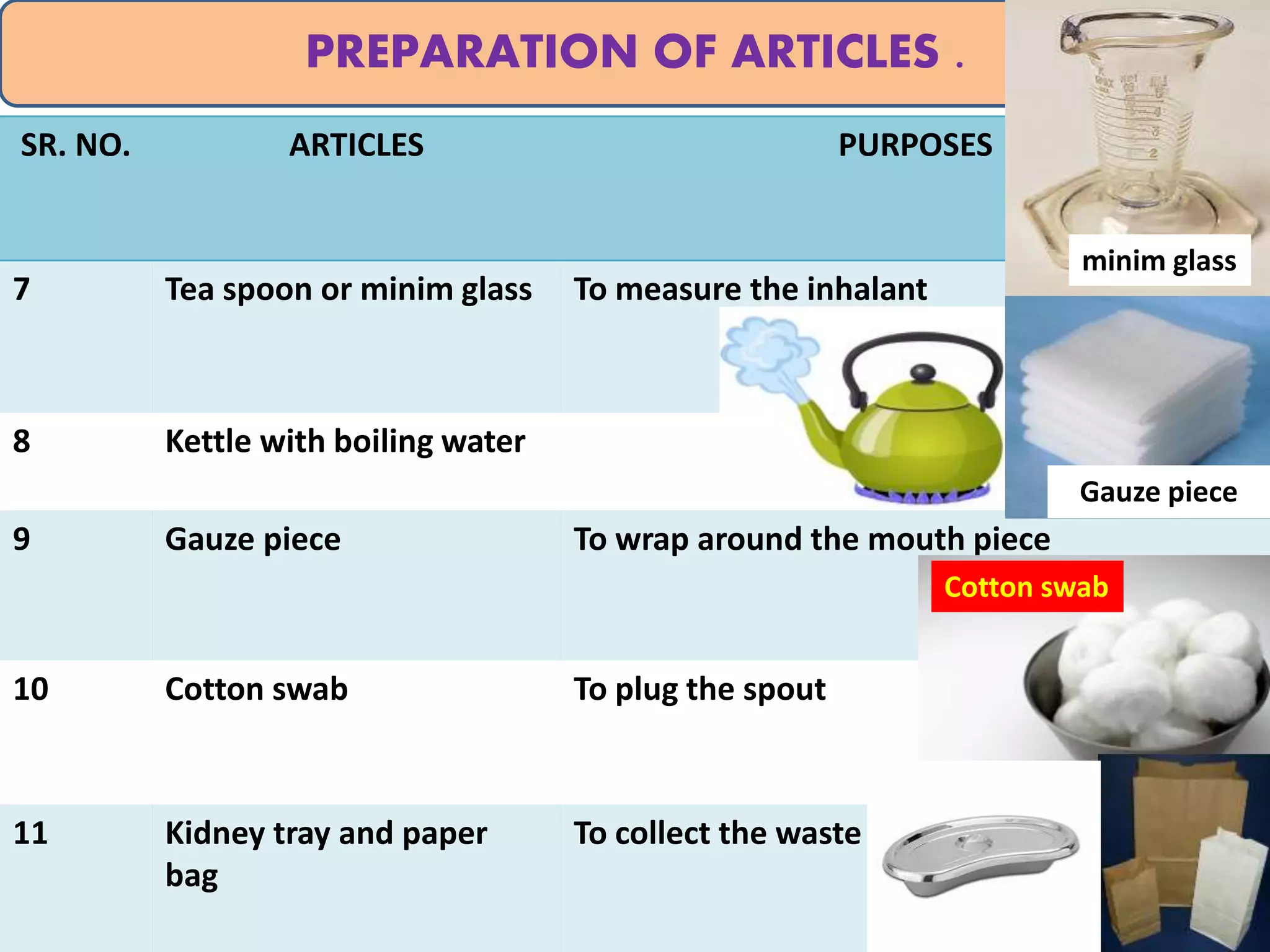
SR. NO. ARTICLES PURPOSES
7 Tea spoon or minim glass To measure the inhalant
8 Kettle with boiling water
9 Gauze piece To wrap around the mouth piece
10 Cotton swab To plug the spout
11 Kidney tray and paper
bag
To collect the waste
PREPARATION OF ARTICLES .
minim glass
Gauze piece
Cotton swab
1. Explain the procedure to the
patient to win his confidence
and co-operation. (Explain the
sequence of the procedure and tell him
how he can take the inhalation.)
2. Make the patient to understand
that he has to remain in the bed
one to two hours more after the
inhalation
Preparation of the Patient and the
Environment
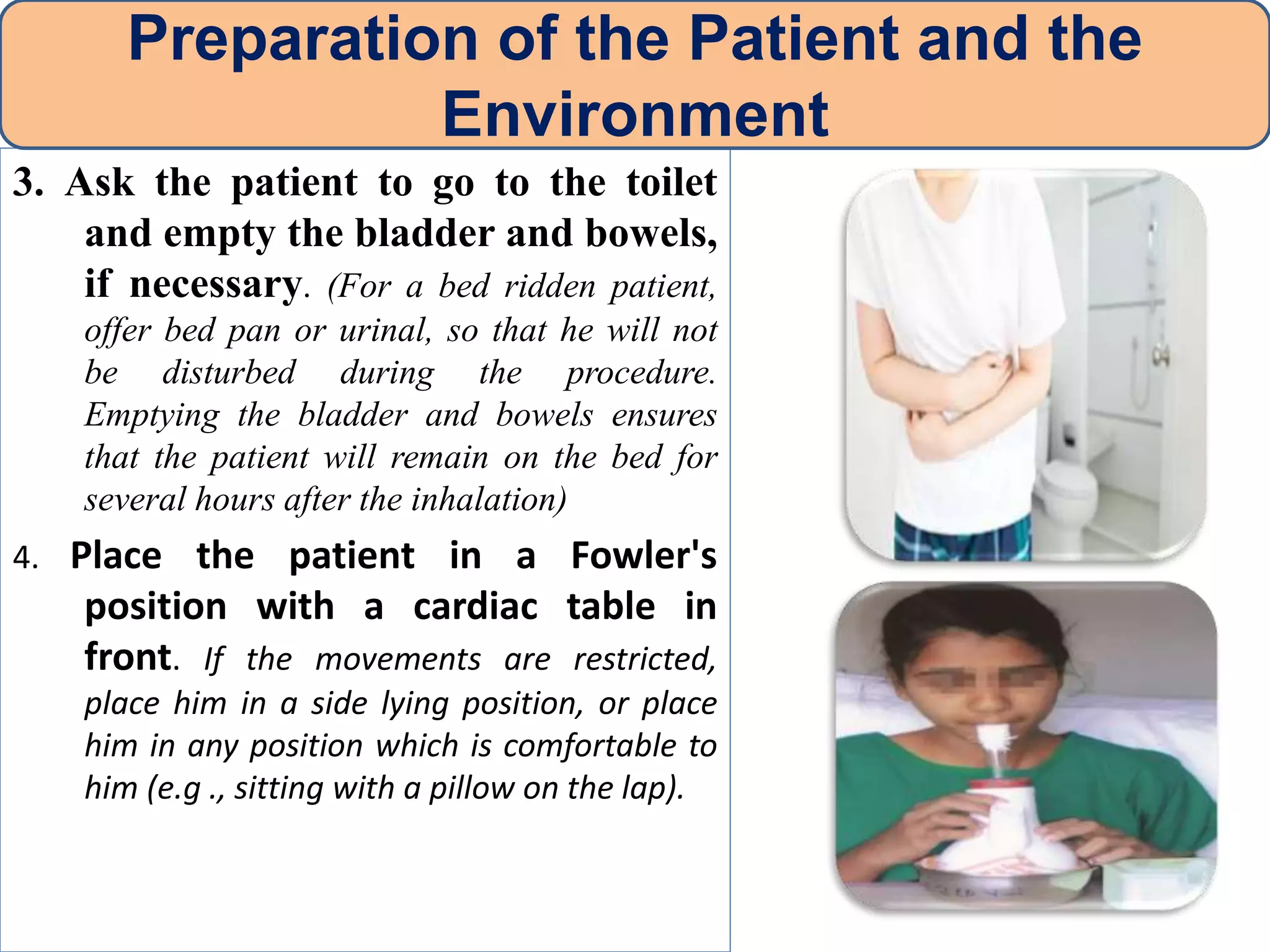
3. Ask the patient to go to the toilet
and empty the bladder and bowels,
if necessary. (For a bed ridden patient,
offer bed pan or urinal, so that he will not
be disturbed during the procedure.
Emptying the bladder and bowels ensures
that the patient will remain on the bed for
several hours after the inhalation)
4. Place the patient in a Fowler's
position with a cardiac table in
front. If the movements are restricted,
place him in a side lying position, or place
him in any position which is comfortable to
him (e.g ., sitting with a pillow on the lap).
Preparation of the Patient and the
Environment
5. Close the doors and windows and put
off the fan to prevent draught.
6. Place the sputum cup in a convenient
place within the easy reach of the
patient.
7. Provide a face towel to the patient to
wipe the sweating from the face
during the inhalation.
Preparation of the Patient and the
Environment
Procedure
PROCEDURE RATIONAL
1. Measure the capacity of the inhaler with cold
water. Measure the capacity when it is filled
half to two thirds full.
To determine the amount of
inhalant
2. Warm the inhaler by pouring a little hot
water into the jug and emptying it
To maintain the temperature of
the water, constant for a longer
period.
PROCEDURE RATIONAL
3. Pour the required amount of inhalant into
the inhaler and fill the jug 2/3 with hot water.
The water should remain just below the spout.
If the inhaler is filled to the brim,
there is possibility of drawing
water into the mouth and cause
scalds. If the spout is filled with
water, it will not act as an air inlet.
The patient will not get warm air
4. Place the mouth piece and close the jug
tightly. See that the mouth piece is in the
opposite direction to the spout
This arrangement keeps the spout
away from the patient when
inhalation is taken in.
5. Cover the mouth piece with a gauze piece
and plug the spout with a cotton ball.
Covering the mouth piece with a
gauze piece will prevent burns of
the lips. Cotton ball in the spout will
prevent escape of steam
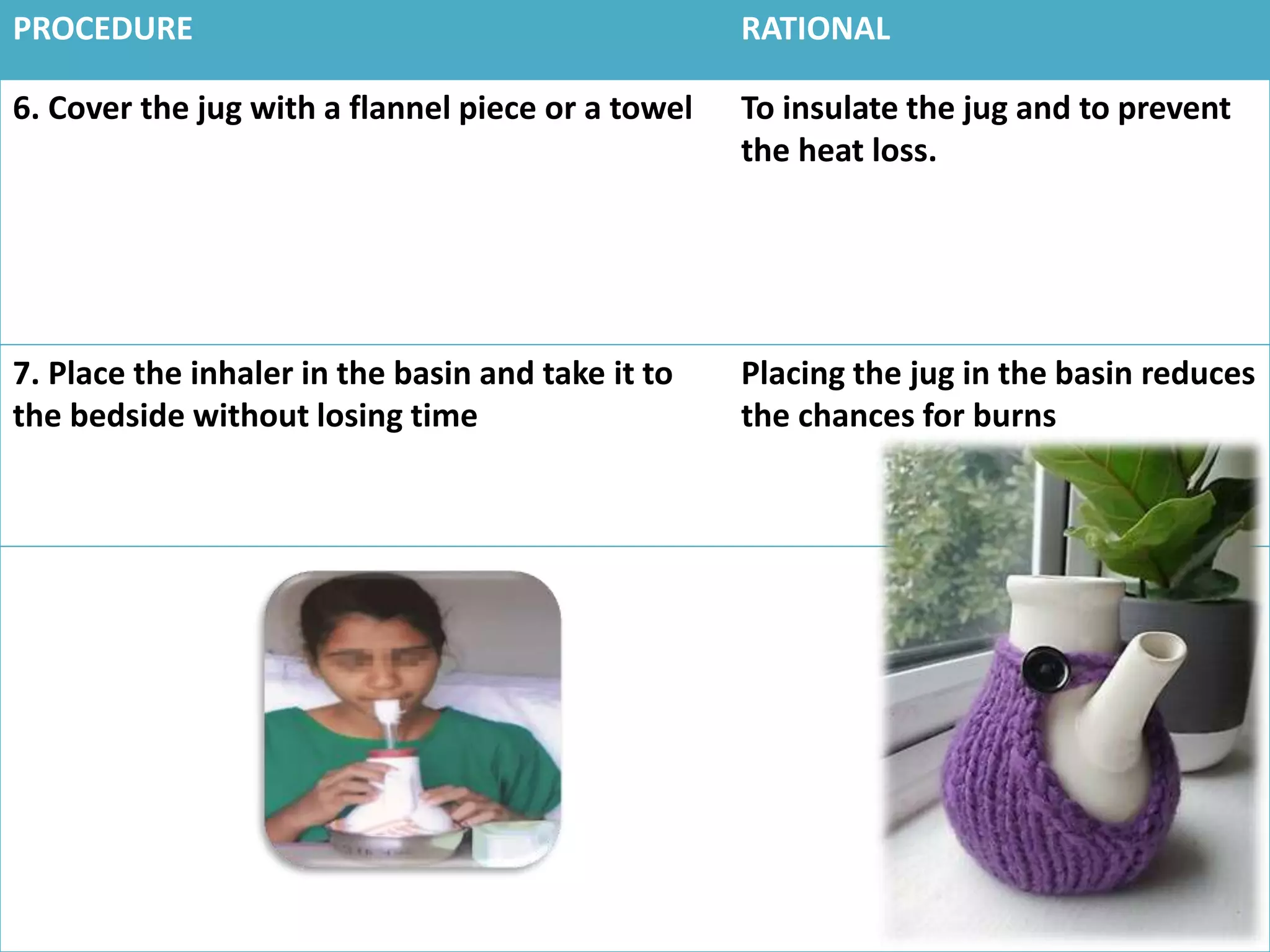
PROCEDURE RATIONAL
6. Cover the jug with a flannel piece or a towel To insulate the jug and to prevent
the heat loss.
7. Place the inhaler in the basin and take it to
the bedside without losing time
Placing the jug in the basin reduces
the chances for burns
PROCEDURE RATIONAL
8. Place the apparatus conveniently in front of
the patient with the spout opposite to the
patient. Remove the cotton plug and discard it
into the paper bag.
Keeping the spout opposite to the
patient reduces the chances of
burns. Removing the cotton plug
helps to keep up the patency of
the spout for the air.
9. Instruct the patient to place the lips on the
mouth piece and breath in the vapour. After
removing the lips from the mouth piece, breath
out the air. Alternately, he should breath in the
steam through the nostrils.
Directing the steam through the
nostrils relieves the congestion of
the mucus membranes of the
nostrils.
PROCEDURE RATIONAL
10. Cover the patient's head and jug
with a bath blanket or a bath towel.
To help to collect the steam
around the face of the
patient, thereby the
concentration of the steam
will be increased
1. Continue the treatment for 15 to 20 minutes, or as
long as the patient gets the vapours.
2. Remove the inhaler from the patient after the
stated time. Wipe off the perspiration from the
face.
After Care of Patient and
the Articles
3. Remove the back rest and the cardiac table. Adjust
the position of the patient in bed. Make him
comfortable. Tidy up the bed.
4. Instruct him to remain in bed for 1 to 2 hours to
prevent draught.
After Care of Patient and
the Articles
5. Take the articles to the utility room.
Empty the inhaler, clean it inside with spirit to remove Tr.
benzoin.
Then wash it with warm soapy water.
Rinse with clean water.
Remove the gauze covering the mouth piece and clean the
mouth piece thoroughly.
Boil it to prevent cross infection.
All the other articles are cleaned with warm soapy water
and then with clean water.
Dry and replace them in their proper places.
Wash hands.
After Care of Patient and
the Articles
6. Record the procedure on the nurse's record with
date and time. Record the patient's response to the
procedure.
7. Return to the patient to assess his comfort and to
observe any untoward reactions in him. Offer hot
drinks if needed.
After Care of Patient and
the Articles
THANK YOU

Steam inhalation

  • 1.
  • 2.
     Steam inhalationis one of the most widely used home remedies to soothe & open the nasal passages and get relief from the symptoms of cold or sinus infections Meaning Inhalation means the inhaling of medicines or anaesthetics in the form of a gas or vapour.
  • 3.
     To relieveinflammation of the mucous membrane in acute cold & in sinusitis. It produces symptomatic relief.  To soften thick, tenacious mucous & relief coughing from many causes Purposes
  • 4.
     To aidin the absorption of oxygen.  To provide warm and moist air following the operation. Eg. Tracheostomy.  To provide antiseptic effect on the upper respiratory tract. Purposes Tracheostomy.
  • 5.
    Methods of steaminhalation JUG METHOD STEAM TENT ELECTRIC STEAMER
  • 6.
    1. Always rememberthe danger involved of scalding the patient either with the steam or with the water coming out of the inhaler. (This is particularly important when the patient is very young, very old, acutely ill or in a state of confusion. In these cases, the spout of the inhaler must be placed in such a way that the patient can not touch it or put his face too near). GENERAL INSTRUCTIONS Avoid scalding
  • 7.
    2. When jugor kettle is used, fill it only 2/3 with boiling water to prevent scalding of the patient. (If the inhaler is filled to the brim, there is possibility of drawing water into the mouth and scalding the patient. The water should remain just below the spout. If the spout is filled with the water, it will not act as an air inlet. The patient will not get warmed air.) GENERAL INSTRUCTIONS Fill it only 2/3 with boiling water
  • 8.
    3. Always rememberthe danger of fire. (If a stove is used with a kettle to generate steam continuously, as in the case of steam tent, the blankets used may fall on the stove and catch fire). 4. Have the water in the jug method at a moderate temperature. {The temperature is maintained between 120 to 1600F (54.4 to 76.70 C). If the water is cold, it will not generate steam. If the water is too hot, it may cause scalding of the patient}
  • 9.
    5. Keep thepatient warm and prevent draught before, during and after the inhalation. (During the treatment, the blood vessels of the skin and mucus membranes are dilated and the patient is easily chilled when exposed to draught. This predisposes him to a more severe and prolonged attack of inflammation and congestion. Therefore the patient should not go into a cold atmosphere for several hours after the treatment. The windows and doors are closed and the fan is put off during the treatment to prevent draught. Ask the patient to empty the bladder to ensure that the patient will remain on the bed for several hours after inhalation).
  • 10.
    6. When volatiledrugs are used. (e.g ., menthol, warn the patient to keep his eyes closed to prevent the drug irritating the conjunctiva.) 7. Watch the patient closely throughout the procedure for any adverse effects. (Provide a calling device near the patient to call the nurse in case of necessity). 8. When giving inhalation by jug method, keep the spout away from the patient. (This is a precaution to prevent scalding of the patient, should the patient tilts the jug during inhalation.) If not closed the eyes , it may get conjunctivitis
  • 11.
    9. Place asputum cup in the reach of the patient (to spit the sputum that is coughed up during the inhalation.) 10. Explain the procedure to the patient before the preparation of the inhalation, (so that no time is lost to start the inhalation once the inhaler with boiling water is taken to the bedside. If the time is lost for explanations the temperature of the water will be reduced.) Sputum cup
  • 12.
    Preliminary Assessment NURSES RESPONSIBILITYIN THE ADMINISTRATION OF STEAM INHALATION. USING A NELSONS INHALER. Check the patient's name, bed number and other identifications. Check the diagnosis and the general condition of the patient. Check the physician's orders to see the specific precautions for the patient's movement and positioning 1 2 3
  • 13.
    NURSES RESPONSIBILITY INTHE ADMINISTRATION OF STEAM INHALATION. Assess the patient's ability for self care, his ability to move and to maintain the desired position. Assess the level of consciousness and the ability to follow instructions Check the articles available in the patient's unit 4 5 6
  • 14.
    SR. NO. ARTICLESPURPOSES 1 Nelson’s inhaler with a mouth piece To use as a vaporizer 2 Bowl or basin To hold the inhaler 3 Flannel piece or a towel To wrap around the inhaler to prevent the heat loss 4 Face towel To wipe the face of the patient 5 Bath blanket or bath towel To put over the patients head’s and the jug to prevent the loss of steam 6 Tr. Benzoin/any other inhalant ordered Used as a respiratory antiseptic PREPARATION OF ARTICLES . Nelson’s inhaler
  • 15.
    SR. NO. ARTICLESPURPOSES 7 Tea spoon or minim glass To measure the inhalant 8 Kettle with boiling water 9 Gauze piece To wrap around the mouth piece 10 Cotton swab To plug the spout 11 Kidney tray and paper bag To collect the waste PREPARATION OF ARTICLES . minim glass Gauze piece Cotton swab
  • 16.
    1. Explain theprocedure to the patient to win his confidence and co-operation. (Explain the sequence of the procedure and tell him how he can take the inhalation.) 2. Make the patient to understand that he has to remain in the bed one to two hours more after the inhalation Preparation of the Patient and the Environment
  • 17.
    3. Ask thepatient to go to the toilet and empty the bladder and bowels, if necessary. (For a bed ridden patient, offer bed pan or urinal, so that he will not be disturbed during the procedure. Emptying the bladder and bowels ensures that the patient will remain on the bed for several hours after the inhalation) 4. Place the patient in a Fowler's position with a cardiac table in front. If the movements are restricted, place him in a side lying position, or place him in any position which is comfortable to him (e.g ., sitting with a pillow on the lap). Preparation of the Patient and the Environment
  • 18.
    5. Close thedoors and windows and put off the fan to prevent draught. 6. Place the sputum cup in a convenient place within the easy reach of the patient. 7. Provide a face towel to the patient to wipe the sweating from the face during the inhalation. Preparation of the Patient and the Environment
  • 19.
    Procedure PROCEDURE RATIONAL 1. Measurethe capacity of the inhaler with cold water. Measure the capacity when it is filled half to two thirds full. To determine the amount of inhalant 2. Warm the inhaler by pouring a little hot water into the jug and emptying it To maintain the temperature of the water, constant for a longer period.
  • 20.
    PROCEDURE RATIONAL 3. Pourthe required amount of inhalant into the inhaler and fill the jug 2/3 with hot water. The water should remain just below the spout. If the inhaler is filled to the brim, there is possibility of drawing water into the mouth and cause scalds. If the spout is filled with water, it will not act as an air inlet. The patient will not get warm air 4. Place the mouth piece and close the jug tightly. See that the mouth piece is in the opposite direction to the spout This arrangement keeps the spout away from the patient when inhalation is taken in. 5. Cover the mouth piece with a gauze piece and plug the spout with a cotton ball. Covering the mouth piece with a gauze piece will prevent burns of the lips. Cotton ball in the spout will prevent escape of steam
  • 21.
    PROCEDURE RATIONAL 6. Coverthe jug with a flannel piece or a towel To insulate the jug and to prevent the heat loss. 7. Place the inhaler in the basin and take it to the bedside without losing time Placing the jug in the basin reduces the chances for burns
  • 22.
    PROCEDURE RATIONAL 8. Placethe apparatus conveniently in front of the patient with the spout opposite to the patient. Remove the cotton plug and discard it into the paper bag. Keeping the spout opposite to the patient reduces the chances of burns. Removing the cotton plug helps to keep up the patency of the spout for the air. 9. Instruct the patient to place the lips on the mouth piece and breath in the vapour. After removing the lips from the mouth piece, breath out the air. Alternately, he should breath in the steam through the nostrils. Directing the steam through the nostrils relieves the congestion of the mucus membranes of the nostrils.
  • 23.
    PROCEDURE RATIONAL 10. Coverthe patient's head and jug with a bath blanket or a bath towel. To help to collect the steam around the face of the patient, thereby the concentration of the steam will be increased
  • 24.
    1. Continue thetreatment for 15 to 20 minutes, or as long as the patient gets the vapours. 2. Remove the inhaler from the patient after the stated time. Wipe off the perspiration from the face. After Care of Patient and the Articles
  • 25.
    3. Remove theback rest and the cardiac table. Adjust the position of the patient in bed. Make him comfortable. Tidy up the bed. 4. Instruct him to remain in bed for 1 to 2 hours to prevent draught. After Care of Patient and the Articles
  • 26.
    5. Take thearticles to the utility room. Empty the inhaler, clean it inside with spirit to remove Tr. benzoin. Then wash it with warm soapy water. Rinse with clean water. Remove the gauze covering the mouth piece and clean the mouth piece thoroughly. Boil it to prevent cross infection. All the other articles are cleaned with warm soapy water and then with clean water. Dry and replace them in their proper places. Wash hands. After Care of Patient and the Articles
  • 27.
    6. Record theprocedure on the nurse's record with date and time. Record the patient's response to the procedure. 7. Return to the patient to assess his comfort and to observe any untoward reactions in him. Offer hot drinks if needed. After Care of Patient and the Articles
  • 30.