Anemia management in CKD
Salwa Ibrahim, MD FRCP (Edin)
Cairo University
4th CKD course, 15-17 May 2016
Agenda
• Mechanism of anemia
• Hemoglobin Target
• KDIGO guidelines
Introduction
• Anemia was first linked to CKD over 170 years ago by Richard
Bright
• Caused primarily by erythropoietin deficiency secondary to
renal mass loss
• EPO level is inappropriately low relative to the degree of
anemia
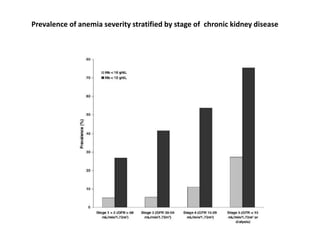
Prevalence of anemia severity stratified by stage of chronic kidney disease
Erythropoeisis
• Erythropoeitin (EPO) is a glycoprotein hormone secreted
(90%) from endothelial cells in proximity to renal tubules
• EPO stimulates stem cells in the bone marrow to  RBC
production
• Iron essential in latter phase as Hb incorporated into
reticulocytes and released into circulation as RBCs
– 2/3rds of iron in the body is in Hb
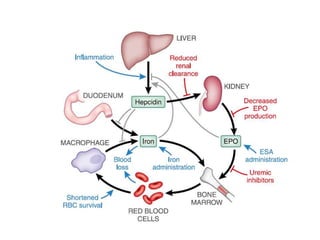
Mechanism of anemia in CKD
• EPO deficiency
• Iron deficiency
• Uremia induced inhibition
• Shortened RBCs survival
• Nutritional deficiency (folate, B12)
Iron deficiency
• CKD patients have increased iron losses, estimated at 1-3 g per year
in hemodialysis patients
• Causes include:
1. Chronic bleeding from uremia-associated platelet dysfunction
2. Frequent phlebotomy
3. Blood trapping in dialysis apparatus
4. Impaired dietary iron absorption (anorexia, use of phosphate binders, PPI
and H2 blockers)
Functional iron deficiency
• Impaired iron release from body stores (reticuloendothelial
cell iron blockade)
• Hepcidin excess accounts for impaired dietary iron absorption
and reticuloendothelial cell iron blockade
• Hepcidin produced by the liver binds and induces degradation
of iron exporter (ferroportin) on duodenal enterocytes,
reticuloendothelial macrophages, and hepatocytes to inhibit
iron entry into plasma
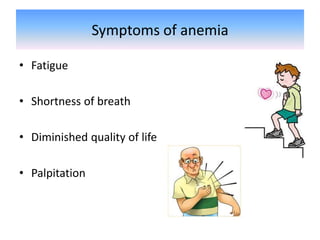
Symptoms of anemia
• Fatigue
• Shortness of breath
• Diminished quality of life
• Palpitation
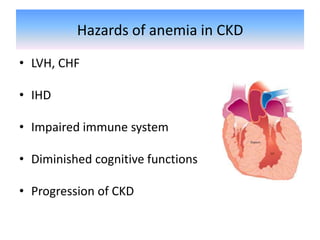
Hazards of anemia in CKD
• LVH, CHF
• IHD
• Impaired immune system
• Diminished cognitive functions
• Progression of CKD
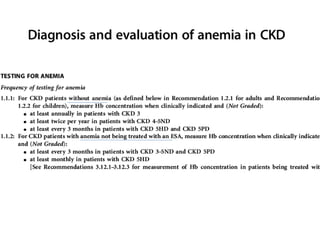
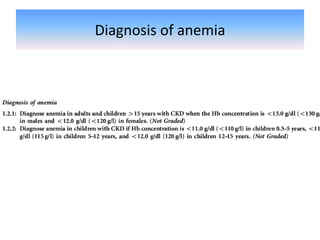
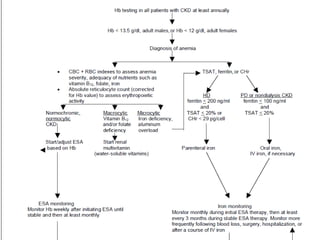
Diagnosis of anemia
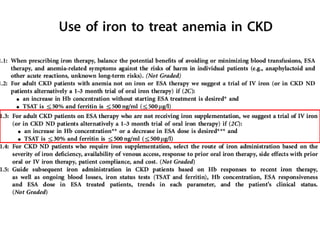
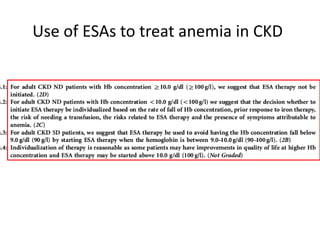
Use of ESAs to treat anemia in CKD
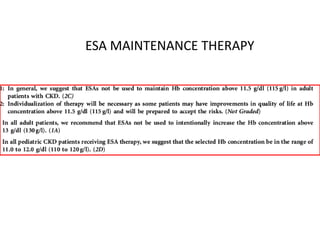
ESA MAINTENANCE THERAPY
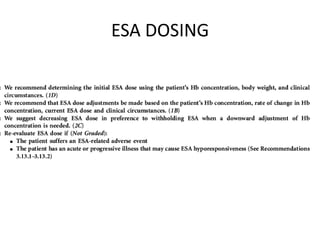
ESA DOSING
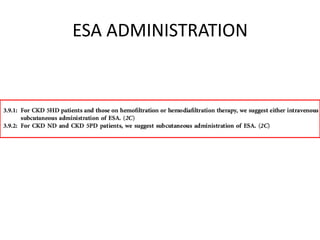
ESA ADMINISTRATION
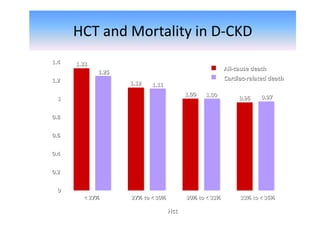
HCT and Mortality in D-CKD
1.33
1.12
1.00
0.96
1.25
1.11
1.00 0.97
0
0.2
0.4
0.6
0.8
1
1.2
1.4
< 27% 27% to < 30% 30% to < 33% 33% to < 36%
Hct
All-cause death
Cardiac-related death
Largest Studies on Target Hgb in D-CKD
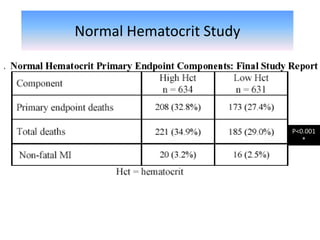
1. Normal Hematocrit Study ≈ 1233 pts (1265)
• Besareb et al NEJM 1998
Normal Hematocrit Study
P<0.001
*
Largest Studies on Target Hgb ND-CKD
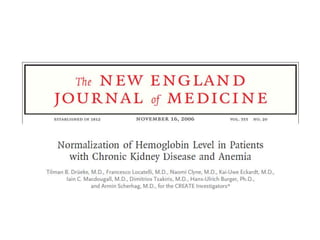
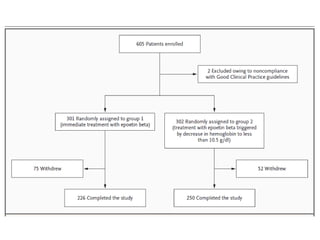
1. The CREATE = 603 pts
– Drueke et al NEJM 2006
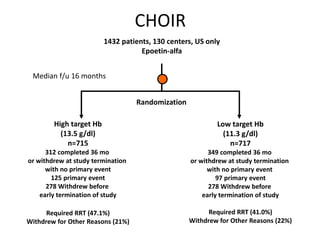
2. The CHOIR study = 1432 pts
– Singh et al NEJM 2006
CHOIR
1432 patients, 130 centers, US only
Epoetin-alfa
Randomization
High target Hb
(13.5 g/dl)
n=715
312 completed 36 mo
or withdrew at study termination
with no primary event
125 primary event
278 Withdrew before
early termination of study
Required RRT (47.1%)
Withdrew for Other Reasons (21%)
Low target Hb
(11.3 g/dl)
n=717
349 completed 36 mo
or withdrew at study termination
with no primary event
97 primary event
278 Withdrew before
early termination of study
Required RRT (41.0%)
Withdrew for Other Reasons (22%)
Median f/u 16 months
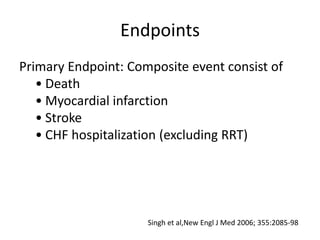
Endpoints
Primary Endpoint: Composite event consist of
• Death
• Myocardial infarction
• Stroke
• CHF hospitalization (excluding RRT)
Singh et al,New Engl J Med 2006; 355:2085-98
Summary (CHOIR)
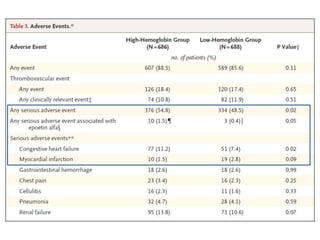
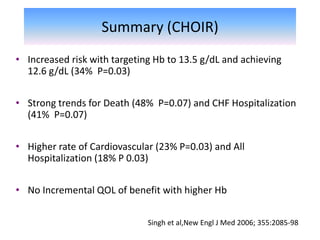
• Increased risk with targeting Hb to 13.5 g/dL and achieving
12.6 g/dL (34% P=0.03)
• Strong trends for Death (48% P=0.07) and CHF Hospitalization
(41% P=0.07)
• Higher rate of Cardiovascular (23% P=0.03) and All
Hospitalization (18% P 0.03)
• No Incremental QOL of benefit with higher Hb
Singh et al,New Engl J Med 2006; 355:2085-98
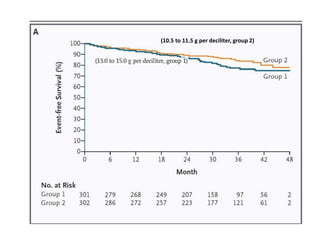
(10.5 to 11.5 g per deciliter, group 2)
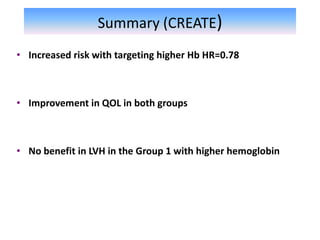
Summary (CREATE)
• Increased risk with targeting higher Hb HR=0.78
• Improvement in QOL in both groups
• No benefit in LVH in the Group 1 with higher hemoglobin
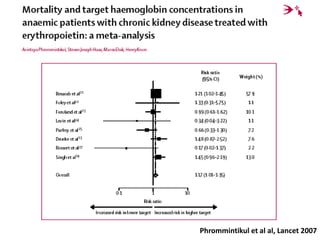
TREAT Study 2009
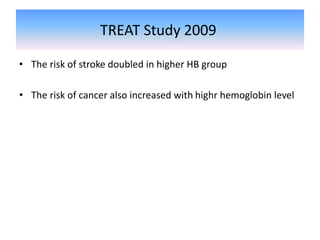
• The risk of stroke doubled in higher HB group
• The risk of cancer also increased with highr hemoglobin level
Phrommintikul et al al, Lancet 2007
ESA available in Egypt
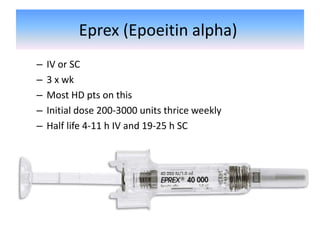
Eprex (Epoeitin alpha)
– IV or SC
– 3 x wk
– Most HD pts on this
– Initial dose 200-3000 units thrice weekly
– Half life 4-11 h IV and 19-25 h SC
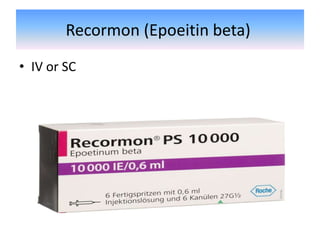
Recormon (Epoeitin beta)
• IV or SC
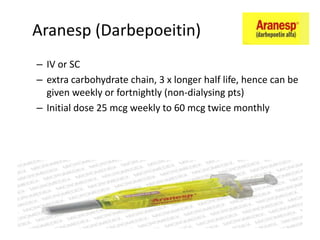
Aranesp (Darbepoeitin)
– IV or SC
– extra carbohydrate chain, 3 x longer half life, hence can be
given weekly or fortnightly (non-dialysing pts)
– Initial dose 25 mcg weekly to 60 mcg twice monthly
• Methoxy polyethylene glycol-epoetin beta is the active
ingredient of a drug marketed by Roche under the brand
name Mircera
• Mircera is a long-acting erythropoietin receptor activator
(CERA) indicated for the treatment of patients with anemia
associated with CKD usually given once monthly (150 mcg)
• The drug stimulates erythropoiesis by interacting with the
erythropoietin receptor on progenitor cells in the bone
marrow
• It has a different receptor binding activity to other ESAs and
its reduced affinity for the erythropoietin receptor allows
continuous stimulation
• It has an in vivo half-life of around 135 hours as compared to
darbapoietin alfa which has a half life of around 21 hours, the
half life of which is three times that of the naturally occurring
erythropoietin in the body
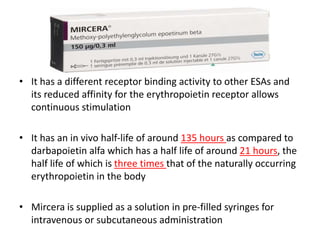
• Mircera is supplied as a solution in pre-filled syringes for
intravenous or subcutaneous administration
Causes of EPO not working
• Iron deficiency ** most common **
• B12 & Folate deficiency
• Inflammation
• ACE inhibitors
• Hyperparathyroidism – bone marrow fibrosis
• Aluminium toxicity
• Inadequate dialysis
• Malignancies, including multiple myeloma
New class of ESA
• Hematinide ( synthetic peptide)
• HIF stabilizer (oral agent) used to stabilize HIF to
increase the transcription of EPO
Anemia management in ckd

Anemia management in ckd

  • 1.
    Anemia management inCKD Salwa Ibrahim, MD FRCP (Edin) Cairo University 4th CKD course, 15-17 May 2016
  • 2.
    Agenda • Mechanism ofanemia • Hemoglobin Target • KDIGO guidelines
  • 3.
    Introduction • Anemia wasfirst linked to CKD over 170 years ago by Richard Bright • Caused primarily by erythropoietin deficiency secondary to renal mass loss • EPO level is inappropriately low relative to the degree of anemia
  • 4.
    Prevalence of anemiaseverity stratified by stage of chronic kidney disease
  • 5.
    Erythropoeisis • Erythropoeitin (EPO)is a glycoprotein hormone secreted (90%) from endothelial cells in proximity to renal tubules • EPO stimulates stem cells in the bone marrow to  RBC production • Iron essential in latter phase as Hb incorporated into reticulocytes and released into circulation as RBCs – 2/3rds of iron in the body is in Hb
  • 6.
    Mechanism of anemiain CKD • EPO deficiency • Iron deficiency • Uremia induced inhibition • Shortened RBCs survival • Nutritional deficiency (folate, B12)
  • 7.
    Iron deficiency • CKDpatients have increased iron losses, estimated at 1-3 g per year in hemodialysis patients • Causes include: 1. Chronic bleeding from uremia-associated platelet dysfunction 2. Frequent phlebotomy 3. Blood trapping in dialysis apparatus 4. Impaired dietary iron absorption (anorexia, use of phosphate binders, PPI and H2 blockers)
  • 8.
    Functional iron deficiency •Impaired iron release from body stores (reticuloendothelial cell iron blockade) • Hepcidin excess accounts for impaired dietary iron absorption and reticuloendothelial cell iron blockade • Hepcidin produced by the liver binds and induces degradation of iron exporter (ferroportin) on duodenal enterocytes, reticuloendothelial macrophages, and hepatocytes to inhibit iron entry into plasma
  • 10.
    Symptoms of anemia •Fatigue • Shortness of breath • Diminished quality of life • Palpitation
  • 11.
    Hazards of anemiain CKD • LVH, CHF • IHD • Impaired immune system • Diminished cognitive functions • Progression of CKD
  • 14.
  • 17.
    Use of ESAsto treat anemia in CKD
  • 18.
  • 19.
  • 20.
  • 22.
    HCT and Mortalityin D-CKD 1.33 1.12 1.00 0.96 1.25 1.11 1.00 0.97 0 0.2 0.4 0.6 0.8 1 1.2 1.4 < 27% 27% to < 30% 30% to < 33% 33% to < 36% Hct All-cause death Cardiac-related death
  • 25.
    Largest Studies onTarget Hgb in D-CKD 1. Normal Hematocrit Study ≈ 1233 pts (1265) • Besareb et al NEJM 1998
  • 26.
  • 27.
    Largest Studies onTarget Hgb ND-CKD 1. The CREATE = 603 pts – Drueke et al NEJM 2006 2. The CHOIR study = 1432 pts – Singh et al NEJM 2006
  • 29.
    CHOIR 1432 patients, 130centers, US only Epoetin-alfa Randomization High target Hb (13.5 g/dl) n=715 312 completed 36 mo or withdrew at study termination with no primary event 125 primary event 278 Withdrew before early termination of study Required RRT (47.1%) Withdrew for Other Reasons (21%) Low target Hb (11.3 g/dl) n=717 349 completed 36 mo or withdrew at study termination with no primary event 97 primary event 278 Withdrew before early termination of study Required RRT (41.0%) Withdrew for Other Reasons (22%) Median f/u 16 months
  • 30.
    Endpoints Primary Endpoint: Compositeevent consist of • Death • Myocardial infarction • Stroke • CHF hospitalization (excluding RRT) Singh et al,New Engl J Med 2006; 355:2085-98
  • 32.
    Summary (CHOIR) • Increasedrisk with targeting Hb to 13.5 g/dL and achieving 12.6 g/dL (34% P=0.03) • Strong trends for Death (48% P=0.07) and CHF Hospitalization (41% P=0.07) • Higher rate of Cardiovascular (23% P=0.03) and All Hospitalization (18% P 0.03) • No Incremental QOL of benefit with higher Hb Singh et al,New Engl J Med 2006; 355:2085-98
  • 35.
    (10.5 to 11.5g per deciliter, group 2)
  • 36.
    Summary (CREATE) • Increasedrisk with targeting higher Hb HR=0.78 • Improvement in QOL in both groups • No benefit in LVH in the Group 1 with higher hemoglobin
  • 37.
    TREAT Study 2009 •The risk of stroke doubled in higher HB group • The risk of cancer also increased with highr hemoglobin level
  • 38.
    Phrommintikul et alal, Lancet 2007
  • 42.
  • 43.
    Eprex (Epoeitin alpha) –IV or SC – 3 x wk – Most HD pts on this – Initial dose 200-3000 units thrice weekly – Half life 4-11 h IV and 19-25 h SC
  • 44.
  • 45.
    Aranesp (Darbepoeitin) – IVor SC – extra carbohydrate chain, 3 x longer half life, hence can be given weekly or fortnightly (non-dialysing pts) – Initial dose 25 mcg weekly to 60 mcg twice monthly
  • 46.
    • Methoxy polyethyleneglycol-epoetin beta is the active ingredient of a drug marketed by Roche under the brand name Mircera • Mircera is a long-acting erythropoietin receptor activator (CERA) indicated for the treatment of patients with anemia associated with CKD usually given once monthly (150 mcg) • The drug stimulates erythropoiesis by interacting with the erythropoietin receptor on progenitor cells in the bone marrow
  • 47.
    • It hasa different receptor binding activity to other ESAs and its reduced affinity for the erythropoietin receptor allows continuous stimulation • It has an in vivo half-life of around 135 hours as compared to darbapoietin alfa which has a half life of around 21 hours, the half life of which is three times that of the naturally occurring erythropoietin in the body • Mircera is supplied as a solution in pre-filled syringes for intravenous or subcutaneous administration
  • 48.
    Causes of EPOnot working • Iron deficiency ** most common ** • B12 & Folate deficiency • Inflammation • ACE inhibitors • Hyperparathyroidism – bone marrow fibrosis • Aluminium toxicity • Inadequate dialysis • Malignancies, including multiple myeloma
  • 49.
    New class ofESA • Hematinide ( synthetic peptide) • HIF stabilizer (oral agent) used to stabilize HIF to increase the transcription of EPO