General University Teaching Hospital of Slemani-Department of Medicine Renal Anemia Guidelines
Management of Anemia in Chronic Kidney
Disease Patients
Rebeen Saeed MMedSci Nephrology (Uo-Sheffield-UK)
Board Candidate of Internal Medicine
General University Teaching Hospital of Slemani-Department
of Medicine
General University Teaching Hospital of Slemani-Department of Medicine Renal Anemia Guidelines
Historical background
• Richard Bright (1836): first observed that anemia
was a complication of renal failure.
• Robert Christison: further described renal
anemia.
• Miyake (1977): purified and identified
erythropoietin.
• Eschbach (Dec 2, 1985): first human use of EPO
General University Teaching Hospital of Slemani-Department of Medicine Renal Anemia Guidelines
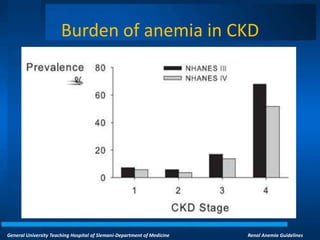
Burden of anemia in CKD
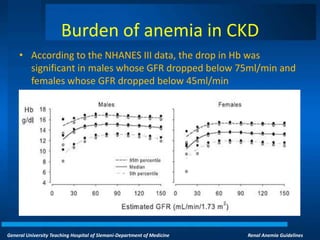
• According to the NHANES III data, the drop in Hb was
significant in males whose GFR dropped below 75ml/min and
females whose GFR dropped below 45ml/min
General University Teaching Hospital of Slemani-Department of Medicine Renal Anemia Guidelines
Burden of anemia in CKD
General University Teaching Hospital of Slemani-Department of Medicine Renal Anemia Guidelines
Effects of anemia(mortality)
• Generation of hypoxia due to anemia is poorly
tolerated in patients with preexisting cardiac and
vascular diseases. Compensatory mechanisms
leads to development of LVH.
• Observational studies do show an increase in
mortality in patients with CKD but not direct
casualty.
• Interventional studies (DOPPS) show that for an
increase of 1g/dL of Hb results in 4% decline in
mortality.
• Also, Medicare data show that CKD=100% and
CKD+Anemia=270% in 2-yr mortality risk.
General University Teaching Hospital of Slemani-Department of Medicine Renal Anemia Guidelines
EFFECTS of anemia on CV health
• CV disease related mortality is 15 times more in
patients with CKD.
• 50% of deaths in patients with CKD are due to CV
disease.
• LVH is the most common abnormality seen in
patients with CKD and there is a strong
correlation between anemia and LVH.
• Tissue hypoxia due to anemia is the principal
stimuli triggering the compensatory changes that
stresses the CV system
General University Teaching Hospital of Slemani-Department of Medicine Renal Anemia Guidelines
Other effects of anemia in CKD
• Acceleration of progression of kidney disease
by oxygen deprivation.
• Increased risk of bacteremia (11% increased
risk for every 1g/dl fall in Hb)
• Detrimental effects on brain and cognitive
functions.
General University Teaching Hospital of Slemani-Department of Medicine Renal Anemia Guidelines
Renal Anemia Guidelines
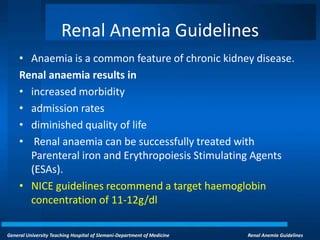
• Anaemia is a common feature of chronic kidney disease.
Renal anaemia results in
• increased morbidity
• admission rates
• diminished quality of life
• Renal anaemia can be successfully treated with
Parenteral iron and Erythropoiesis Stimulating Agents
(ESAs).
• NICE guidelines recommend a target haemoglobin
concentration of 11-12g/dl
General University Teaching Hospital of Slemani-Department of Medicine Renal Anemia Guidelines
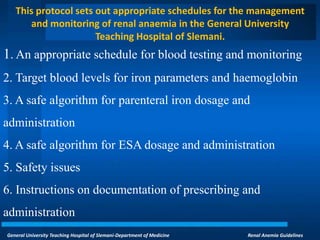
This protocol sets out appropriate schedules for the management
and monitoring of renal anaemia in the General University
Teaching Hospital of Slemani.
1. An appropriate schedule for blood testing and monitoring
2. Target blood levels for iron parameters and haemoglobin
3. A safe algorithm for parenteral iron dosage and
administration
4. A safe algorithm for ESA dosage and administration
5. Safety issues
6. Instructions on documentation of prescribing and
administration
General University Teaching Hospital of Slemani-Department of Medicine Renal Anemia Guidelines
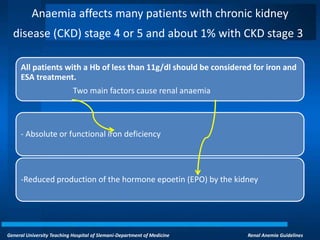
Anaemia affects many patients with chronic kidney
disease (CKD) stage 4 or 5 and about 1% with CKD stage 3
All patients with a Hb of less than 11g/dl should be considered for iron and
ESA treatment.
Two main factors cause renal anaemia
- Absolute or functional iron deficiency
-Reduced production of the hormone epoetin (EPO) by the kidney
General University Teaching Hospital of Slemani-Department of Medicine Renal Anemia Guidelines
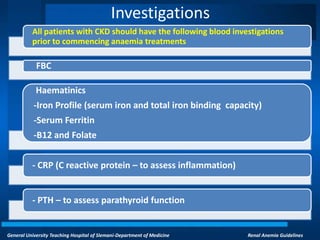
Investigations
All patients with CKD should have the following blood investigations
prior to commencing anaemia treatments
FBC
Haematinics
-Iron Profile (serum iron and total iron binding capacity)
-Serum Ferritin
-B12 and Folate
- CRP (C reactive protein – to assess inflammation)
- PTH – to assess parathyroid function
General University Teaching Hospital of Slemani-Department of Medicine Renal Anemia Guidelines
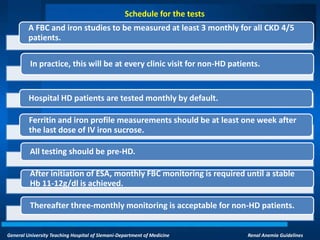
A FBC and iron studies to be measured at least 3 monthly for all CKD 4/5
patients.
In practice, this will be at every clinic visit for non-HD patients.
Hospital HD patients are tested monthly by default.
Ferritin and iron profile measurements should be at least one week after
the last dose of IV iron sucrose.
All testing should be pre-HD.
After initiation of ESA, monthly FBC monitoring is required until a stable
Hb 11-12g/dl is achieved.
Thereafter three-monthly monitoring is acceptable for non-HD patients.
Schedule for the tests
General University Teaching Hospital of Slemani-Department of Medicine Renal Anemia Guidelines
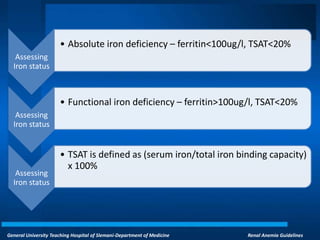
Assessing
Iron status
• Absolute iron deficiency – ferritin<100ug/l, TSAT<20%
Assessing
Iron status
• Functional iron deficiency – ferritin>100ug/l, TSAT<20%
Assessing
Iron status
• TSAT is defined as (serum iron/total iron binding capacity)
x 100%
General University Teaching Hospital of Slemani-Department of Medicine Renal Anemia Guidelines
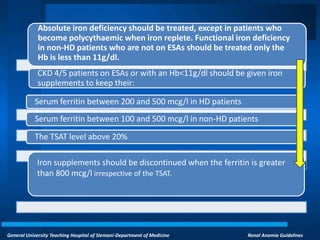
Absolute iron deficiency should be treated, except in patients who
become polycythaemic when iron replete. Functional iron deficiency
in non-HD patients who are not on ESAs should be treated only the
Hb is less than 11g/dl.
CKD 4/5 patients on ESAs or with an Hb<11g/dl should be given iron
supplements to keep their:
Serum ferritin between 200 and 500 mcg/l in HD patients
Serum ferritin between 100 and 500 mcg/l in non-HD patients
The TSAT level above 20%
Iron supplements should be discontinued when the ferritin is greater
than 800 mcg/l irrespective of the TSAT.
General University Teaching Hospital of Slemani-Department of Medicine Renal Anemia Guidelines
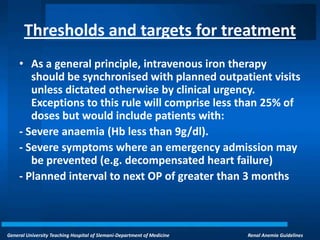
Thresholds and targets for treatment
• As a general principle, intravenous iron therapy
should be synchronised with planned outpatient visits
unless dictated otherwise by clinical urgency.
Exceptions to this rule will comprise less than 25% of
doses but would include patients with:
- Severe anaemia (Hb less than 9g/dl).
- Severe symptoms where an emergency admission may
be prevented (e.g. decompensated heart failure)
- Planned interval to next OP of greater than 3 months
General University Teaching Hospital of Slemani-Department of Medicine Renal Anemia Guidelines
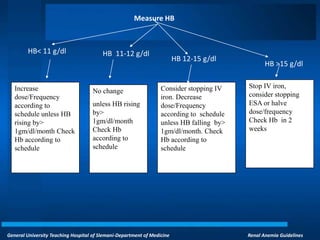
Measure HB
HB< 11 g/dl HB 11-12 g/dl
HB 12-15 g/dl
HB >15 g/dl
Increase
dose/Frequency
according to
schedule unless HB
rising by>
1gm/dl/month Check
Hb according to
schedule
No change
unless HB rising
by>
1gm/dl/month
Check Hb
according to
schedule
Consider stopping IV
iron. Decrease
dose/Frequency
according to schedule
unless HB falling by>
1gm/dl/month. Check
Hb according to
schedule
Stop IV iron,
consider stopping
ESA or halve
dose/frequency
Check Hb in 2
weeks
General University Teaching Hospital of Slemani-Department of Medicine Renal Anemia Guidelines
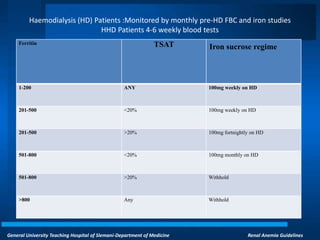
Haemodialysis (HD) Patients :Monitored by monthly pre-HD FBC and iron studies
HHD Patients 4-6 weekly blood tests
Iron sucrose regimeTSATFerritin
100mg weekly on HDANY1-200
100mg weekly on HD<20%201-500
100mg fortnightly on HD>20%201-500
100mg monthly on HD<20%501-800
Withhold>20%501-800
WithholdAny>800
General University Teaching Hospital of Slemani-Department of Medicine Renal Anemia Guidelines
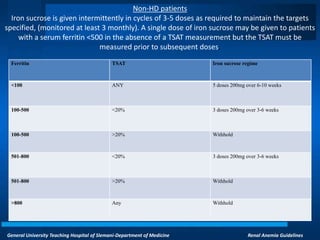
Non-HD patients
Iron sucrose is given intermittently in cycles of 3-5 doses as required to maintain the targets
specified, (monitored at least 3 monthly). A single dose of iron sucrose may be given to patients
with a serum ferritin <500 in the absence of a TSAT measurement but the TSAT must be
measured prior to subsequent doses.
Iron sucrose regimeTSATFerritin
5 doses 200mg over 6-10 weeksANY<100
3 doses 200mg over 3-6 weeks<20%100-500
Withhold>20%100-500
3 doses 200mg over 3-6 weeks<20%501-800
Withhold>20%501-800
WithholdAny>800
General University Teaching Hospital of Slemani-Department of Medicine Renal Anemia Guidelines
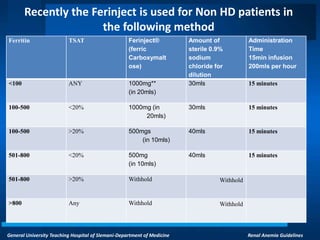
Recently the Ferinject is used for Non HD patients in
the following method
Administration
Time
15min infusion
200mls per hour
Amount of
sterile 0.9%
sodium
chloride for
dilution
Ferinject®
(ferric
Carboxymalt
ose)
TSATFerritin
15 minutes30mls1000mg**
(in 20mls)
ANY<100
15 minutes30mls1000mg (in
20mls)
<20%100-500
15 minutes40mls500mgs
(in 10mls)
>20%100-500
15 minutes40mls500mg
(in 10mls)
<20%501-800
WithholdWithhold>20%501-800
WithholdWithholdAny>800
General University Teaching Hospital of Slemani-Department of Medicine Renal Anemia Guidelines
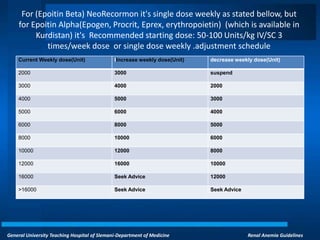
For (Epoitin Beta) NeoRecormon it's single dose weekly as stated bellow, but
for Epoitin Alpha(Epogen, Procrit, Eprex, erythropoietin) (which is available in
Kurdistan) it's Recommended starting dose: 50-100 Units/kg IV/SC 3
times/week dose or single dose weekly .adjustment schedule
decrease weekly dose(Unit)IIncrease weekly dose(Unit)Current Weekly dose(Unit)
suspend30002000
200040003000
300050004000
400060005000
500080006000
6000100008000
80001200010000
100001600012000
12000Seek Advice16000
Seek AdviceSeek Advice>16000
General University Teaching Hospital of Slemani-Department of Medicine Renal Anemia Guidelines
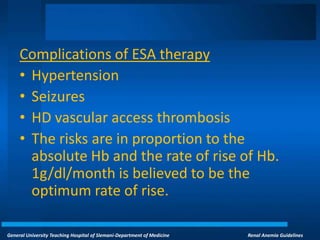
Complications of ESA therapy
• Hypertension
• Seizures
• HD vascular access thrombosis
• The risks are in proportion to the
absolute Hb and the rate of rise of Hb.
1g/dl/month is believed to be the
optimum rate of rise.
General University Teaching Hospital of Slemani-Department of Medicine Renal Anemia Guidelines
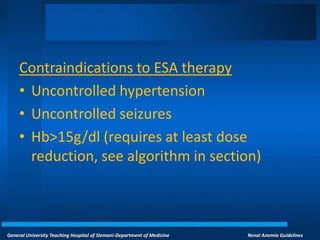
Contraindications to ESA therapy
• Uncontrolled hypertension
• Uncontrolled seizures
• Hb>15g/dl (requires at least dose
reduction, see algorithm in section)
General University Teaching Hospital of Slemani-Department of Medicine Renal Anemia Guidelines
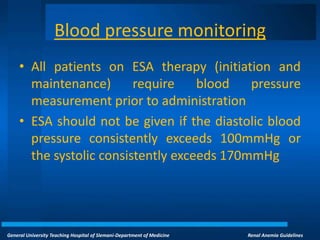
Blood pressure monitoring
• All patients on ESA therapy (initiation and
maintenance) require blood pressure
measurement prior to administration
• ESA should not be given if the diastolic blood
pressure consistently exceeds 100mmHg or
the systolic consistently exceeds 170mmHg
General University Teaching Hospital of Slemani-Department of Medicine Renal Anemia Guidelines
Failure to respond to ESA therapy
• ESA resistance (defined here as Hb<11g/dl
after correction of functional iron deficiency
and 8 weeks therapy with maximum dose of
Epirex and (NeoRecormon) should be brought
to the attention of the relevant consultant
nephrologist
• haematinic deficiency, chronic
inflammation/infection, hyperparathyroidism,
under-dialysis, haemolysis, aluminium toxicity
and Pure Red Cell Aplasia
General University Teaching Hospital of Slemani-Department of Medicine Renal Anemia Guidelines
Professor Meguid El Nahas, PhD, FRCP
Professor of Nephrology University of
Sheffield
Director of Global Kidney Academy
Dr. William McKane PhD, FRCP
Consultant Nephrologist and
Director of postgraduate
education at Sheffield Kidney
Institute in Northern General
Hospital, UK
I consulted Those two Experts in
Sheffield Kidney Institute for writing
this Guideline
General University Teaching Hospital of Slemani-Department of Medicine Renal Anemia Guidelines
References
1. CG114 Anaemia management in chronic kidney disease. NICE guideline,
February 2011 http://guidance.nice.org.uk/CG114
2. Epoetin beta (a recombinant human erythropoietin) medicines. The
electronic Medicines Compendium (eMC) March 2010
http://www.medicines.org.uk/EMC/medicine/1717
3. Summary of Product Characteristics, Ferinject®, last updated 11/08/2009
4. ESA Risks, Benefits Highlighted by TREAT Study in Pre-Dialysis Patients.
NAAC Review Published: November 19, 2009
http://www.anemia.org/professionals/reviews/content.php?contentid=00
0468&sectionid=00014
5- Sheffield Kidney Institute Local renal guidelines for management of anemia
in CKD
6-KDOQI guidelines 2013
7-Nice guidelines
•
General University Teaching Hospital of Slemani-Department of Medicine Renal Anemia Guidelines
Thank You
Any Questions and
Comments?

Renal anemia guidelines

  • 1.
    General University TeachingHospital of Slemani-Department of Medicine Renal Anemia Guidelines Management of Anemia in Chronic Kidney Disease Patients Rebeen Saeed MMedSci Nephrology (Uo-Sheffield-UK) Board Candidate of Internal Medicine General University Teaching Hospital of Slemani-Department of Medicine
  • 2.
    General University TeachingHospital of Slemani-Department of Medicine Renal Anemia Guidelines Historical background • Richard Bright (1836): first observed that anemia was a complication of renal failure. • Robert Christison: further described renal anemia. • Miyake (1977): purified and identified erythropoietin. • Eschbach (Dec 2, 1985): first human use of EPO
  • 3.
    General University TeachingHospital of Slemani-Department of Medicine Renal Anemia Guidelines Burden of anemia in CKD • According to the NHANES III data, the drop in Hb was significant in males whose GFR dropped below 75ml/min and females whose GFR dropped below 45ml/min
  • 4.
    General University TeachingHospital of Slemani-Department of Medicine Renal Anemia Guidelines Burden of anemia in CKD
  • 5.
    General University TeachingHospital of Slemani-Department of Medicine Renal Anemia Guidelines Effects of anemia(mortality) • Generation of hypoxia due to anemia is poorly tolerated in patients with preexisting cardiac and vascular diseases. Compensatory mechanisms leads to development of LVH. • Observational studies do show an increase in mortality in patients with CKD but not direct casualty. • Interventional studies (DOPPS) show that for an increase of 1g/dL of Hb results in 4% decline in mortality. • Also, Medicare data show that CKD=100% and CKD+Anemia=270% in 2-yr mortality risk.
  • 6.
    General University TeachingHospital of Slemani-Department of Medicine Renal Anemia Guidelines EFFECTS of anemia on CV health • CV disease related mortality is 15 times more in patients with CKD. • 50% of deaths in patients with CKD are due to CV disease. • LVH is the most common abnormality seen in patients with CKD and there is a strong correlation between anemia and LVH. • Tissue hypoxia due to anemia is the principal stimuli triggering the compensatory changes that stresses the CV system
  • 7.
    General University TeachingHospital of Slemani-Department of Medicine Renal Anemia Guidelines Other effects of anemia in CKD • Acceleration of progression of kidney disease by oxygen deprivation. • Increased risk of bacteremia (11% increased risk for every 1g/dl fall in Hb) • Detrimental effects on brain and cognitive functions.
  • 8.
    General University TeachingHospital of Slemani-Department of Medicine Renal Anemia Guidelines Renal Anemia Guidelines • Anaemia is a common feature of chronic kidney disease. Renal anaemia results in • increased morbidity • admission rates • diminished quality of life • Renal anaemia can be successfully treated with Parenteral iron and Erythropoiesis Stimulating Agents (ESAs). • NICE guidelines recommend a target haemoglobin concentration of 11-12g/dl
  • 9.
    General University TeachingHospital of Slemani-Department of Medicine Renal Anemia Guidelines This protocol sets out appropriate schedules for the management and monitoring of renal anaemia in the General University Teaching Hospital of Slemani. 1. An appropriate schedule for blood testing and monitoring 2. Target blood levels for iron parameters and haemoglobin 3. A safe algorithm for parenteral iron dosage and administration 4. A safe algorithm for ESA dosage and administration 5. Safety issues 6. Instructions on documentation of prescribing and administration
  • 10.
    General University TeachingHospital of Slemani-Department of Medicine Renal Anemia Guidelines Anaemia affects many patients with chronic kidney disease (CKD) stage 4 or 5 and about 1% with CKD stage 3 All patients with a Hb of less than 11g/dl should be considered for iron and ESA treatment. Two main factors cause renal anaemia - Absolute or functional iron deficiency -Reduced production of the hormone epoetin (EPO) by the kidney
  • 11.
    General University TeachingHospital of Slemani-Department of Medicine Renal Anemia Guidelines Investigations All patients with CKD should have the following blood investigations prior to commencing anaemia treatments FBC Haematinics -Iron Profile (serum iron and total iron binding capacity) -Serum Ferritin -B12 and Folate - CRP (C reactive protein – to assess inflammation) - PTH – to assess parathyroid function
  • 12.
    General University TeachingHospital of Slemani-Department of Medicine Renal Anemia Guidelines A FBC and iron studies to be measured at least 3 monthly for all CKD 4/5 patients. In practice, this will be at every clinic visit for non-HD patients. Hospital HD patients are tested monthly by default. Ferritin and iron profile measurements should be at least one week after the last dose of IV iron sucrose. All testing should be pre-HD. After initiation of ESA, monthly FBC monitoring is required until a stable Hb 11-12g/dl is achieved. Thereafter three-monthly monitoring is acceptable for non-HD patients. Schedule for the tests
  • 13.
    General University TeachingHospital of Slemani-Department of Medicine Renal Anemia Guidelines Assessing Iron status • Absolute iron deficiency – ferritin<100ug/l, TSAT<20% Assessing Iron status • Functional iron deficiency – ferritin>100ug/l, TSAT<20% Assessing Iron status • TSAT is defined as (serum iron/total iron binding capacity) x 100%
  • 14.
    General University TeachingHospital of Slemani-Department of Medicine Renal Anemia Guidelines Absolute iron deficiency should be treated, except in patients who become polycythaemic when iron replete. Functional iron deficiency in non-HD patients who are not on ESAs should be treated only the Hb is less than 11g/dl. CKD 4/5 patients on ESAs or with an Hb<11g/dl should be given iron supplements to keep their: Serum ferritin between 200 and 500 mcg/l in HD patients Serum ferritin between 100 and 500 mcg/l in non-HD patients The TSAT level above 20% Iron supplements should be discontinued when the ferritin is greater than 800 mcg/l irrespective of the TSAT.
  • 15.
    General University TeachingHospital of Slemani-Department of Medicine Renal Anemia Guidelines Thresholds and targets for treatment • As a general principle, intravenous iron therapy should be synchronised with planned outpatient visits unless dictated otherwise by clinical urgency. Exceptions to this rule will comprise less than 25% of doses but would include patients with: - Severe anaemia (Hb less than 9g/dl). - Severe symptoms where an emergency admission may be prevented (e.g. decompensated heart failure) - Planned interval to next OP of greater than 3 months
  • 16.
    General University TeachingHospital of Slemani-Department of Medicine Renal Anemia Guidelines Measure HB HB< 11 g/dl HB 11-12 g/dl HB 12-15 g/dl HB >15 g/dl Increase dose/Frequency according to schedule unless HB rising by> 1gm/dl/month Check Hb according to schedule No change unless HB rising by> 1gm/dl/month Check Hb according to schedule Consider stopping IV iron. Decrease dose/Frequency according to schedule unless HB falling by> 1gm/dl/month. Check Hb according to schedule Stop IV iron, consider stopping ESA or halve dose/frequency Check Hb in 2 weeks
  • 17.
    General University TeachingHospital of Slemani-Department of Medicine Renal Anemia Guidelines Haemodialysis (HD) Patients :Monitored by monthly pre-HD FBC and iron studies HHD Patients 4-6 weekly blood tests Iron sucrose regimeTSATFerritin 100mg weekly on HDANY1-200 100mg weekly on HD<20%201-500 100mg fortnightly on HD>20%201-500 100mg monthly on HD<20%501-800 Withhold>20%501-800 WithholdAny>800
  • 18.
    General University TeachingHospital of Slemani-Department of Medicine Renal Anemia Guidelines Non-HD patients Iron sucrose is given intermittently in cycles of 3-5 doses as required to maintain the targets specified, (monitored at least 3 monthly). A single dose of iron sucrose may be given to patients with a serum ferritin <500 in the absence of a TSAT measurement but the TSAT must be measured prior to subsequent doses. Iron sucrose regimeTSATFerritin 5 doses 200mg over 6-10 weeksANY<100 3 doses 200mg over 3-6 weeks<20%100-500 Withhold>20%100-500 3 doses 200mg over 3-6 weeks<20%501-800 Withhold>20%501-800 WithholdAny>800
  • 19.
    General University TeachingHospital of Slemani-Department of Medicine Renal Anemia Guidelines Recently the Ferinject is used for Non HD patients in the following method Administration Time 15min infusion 200mls per hour Amount of sterile 0.9% sodium chloride for dilution Ferinject® (ferric Carboxymalt ose) TSATFerritin 15 minutes30mls1000mg** (in 20mls) ANY<100 15 minutes30mls1000mg (in 20mls) <20%100-500 15 minutes40mls500mgs (in 10mls) >20%100-500 15 minutes40mls500mg (in 10mls) <20%501-800 WithholdWithhold>20%501-800 WithholdWithholdAny>800
  • 20.
    General University TeachingHospital of Slemani-Department of Medicine Renal Anemia Guidelines For (Epoitin Beta) NeoRecormon it's single dose weekly as stated bellow, but for Epoitin Alpha(Epogen, Procrit, Eprex, erythropoietin) (which is available in Kurdistan) it's Recommended starting dose: 50-100 Units/kg IV/SC 3 times/week dose or single dose weekly .adjustment schedule decrease weekly dose(Unit)IIncrease weekly dose(Unit)Current Weekly dose(Unit) suspend30002000 200040003000 300050004000 400060005000 500080006000 6000100008000 80001200010000 100001600012000 12000Seek Advice16000 Seek AdviceSeek Advice>16000
  • 21.
    General University TeachingHospital of Slemani-Department of Medicine Renal Anemia Guidelines Complications of ESA therapy • Hypertension • Seizures • HD vascular access thrombosis • The risks are in proportion to the absolute Hb and the rate of rise of Hb. 1g/dl/month is believed to be the optimum rate of rise.
  • 22.
    General University TeachingHospital of Slemani-Department of Medicine Renal Anemia Guidelines Contraindications to ESA therapy • Uncontrolled hypertension • Uncontrolled seizures • Hb>15g/dl (requires at least dose reduction, see algorithm in section)
  • 23.
    General University TeachingHospital of Slemani-Department of Medicine Renal Anemia Guidelines Blood pressure monitoring • All patients on ESA therapy (initiation and maintenance) require blood pressure measurement prior to administration • ESA should not be given if the diastolic blood pressure consistently exceeds 100mmHg or the systolic consistently exceeds 170mmHg
  • 24.
    General University TeachingHospital of Slemani-Department of Medicine Renal Anemia Guidelines Failure to respond to ESA therapy • ESA resistance (defined here as Hb<11g/dl after correction of functional iron deficiency and 8 weeks therapy with maximum dose of Epirex and (NeoRecormon) should be brought to the attention of the relevant consultant nephrologist • haematinic deficiency, chronic inflammation/infection, hyperparathyroidism, under-dialysis, haemolysis, aluminium toxicity and Pure Red Cell Aplasia
  • 25.
    General University TeachingHospital of Slemani-Department of Medicine Renal Anemia Guidelines Professor Meguid El Nahas, PhD, FRCP Professor of Nephrology University of Sheffield Director of Global Kidney Academy Dr. William McKane PhD, FRCP Consultant Nephrologist and Director of postgraduate education at Sheffield Kidney Institute in Northern General Hospital, UK I consulted Those two Experts in Sheffield Kidney Institute for writing this Guideline
  • 26.
    General University TeachingHospital of Slemani-Department of Medicine Renal Anemia Guidelines References 1. CG114 Anaemia management in chronic kidney disease. NICE guideline, February 2011 http://guidance.nice.org.uk/CG114 2. Epoetin beta (a recombinant human erythropoietin) medicines. The electronic Medicines Compendium (eMC) March 2010 http://www.medicines.org.uk/EMC/medicine/1717 3. Summary of Product Characteristics, Ferinject®, last updated 11/08/2009 4. ESA Risks, Benefits Highlighted by TREAT Study in Pre-Dialysis Patients. NAAC Review Published: November 19, 2009 http://www.anemia.org/professionals/reviews/content.php?contentid=00 0468&sectionid=00014 5- Sheffield Kidney Institute Local renal guidelines for management of anemia in CKD 6-KDOQI guidelines 2013 7-Nice guidelines •
  • 27.
    General University TeachingHospital of Slemani-Department of Medicine Renal Anemia Guidelines Thank You Any Questions and Comments?