NURSING
CARE PLAN
CARDIOVASCULAR SYSTEM
NURSING ASSESSMENT
• Ask patient to describe anginal attacks.
– When do attacks tend to occur? After a meal? After engaging in certain activities? After
physical activities in general? After visits of family/others?
– Where is the pain located? Does it radiate?
– Was the onset of pain sudden? Gradual?
– How long did it last seconds? Minutes? Hours?
– Was the pain steady and unwavering in quality?
– Is the discomfort accompanied by other symptoms? Sweating? Light-headedness? Nausea?
Palpitations? Shortness of breath?
– How is the pain relieved? How long does it take for pain relief?
• Obtain a baseline 12-lead ECG.
• Assess patient's and family's knowledge of disease.
• Identify patient's and family's level of anxiety and use of appropriate coping
mechanisms.
• Gather information about the patient's cardiac risk factors. Use the patient's age,
total cholesterol level, HDL level, systolic BP, and smoking status to determine the
patient's 10-year risk for development of CHD according to the Framingham risk
scoring method (Third Report of the National Cholesterol Education Program
• Evaluate patient's medical history for such conditions as diabetes, heart failure,
previous MI, or obstructive lung disease that may influence choice of drug
therapy.
• Identify factors that may contribute to noncompliance with prescribed drug
therapy.
• Review renal and hepatic studies and complete blood count.
• Discuss with patient current activity levels. (Effectiveness of antianginal drug
therapy is evaluated by patient's ability to attain higher activity levels.)
• Discuss patient's beliefs about modification of risk factors and willingness to
change.
Nursing Diagnoses
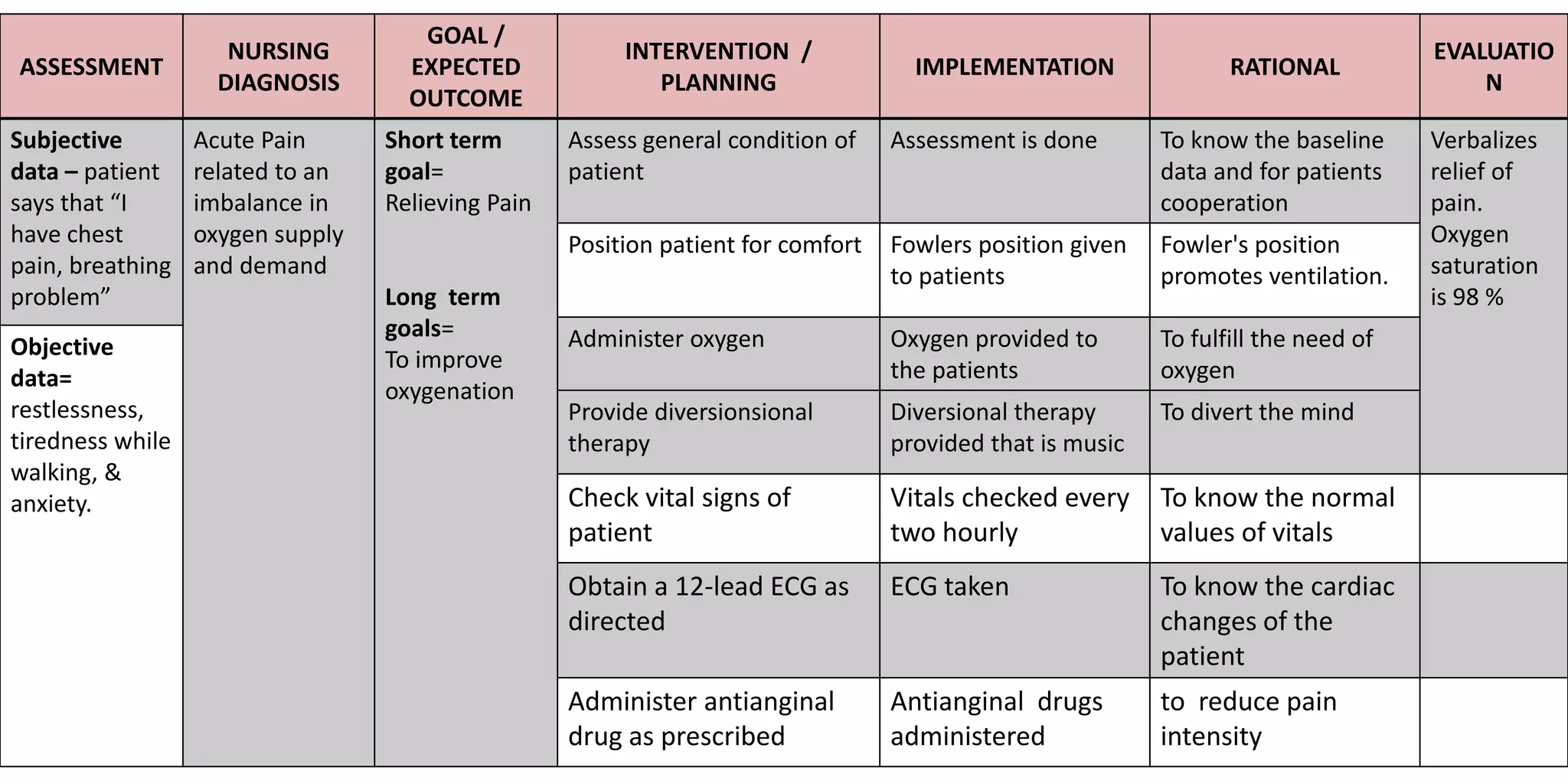
1. Acute Pain related to an imbalance in oxygen supply and demand
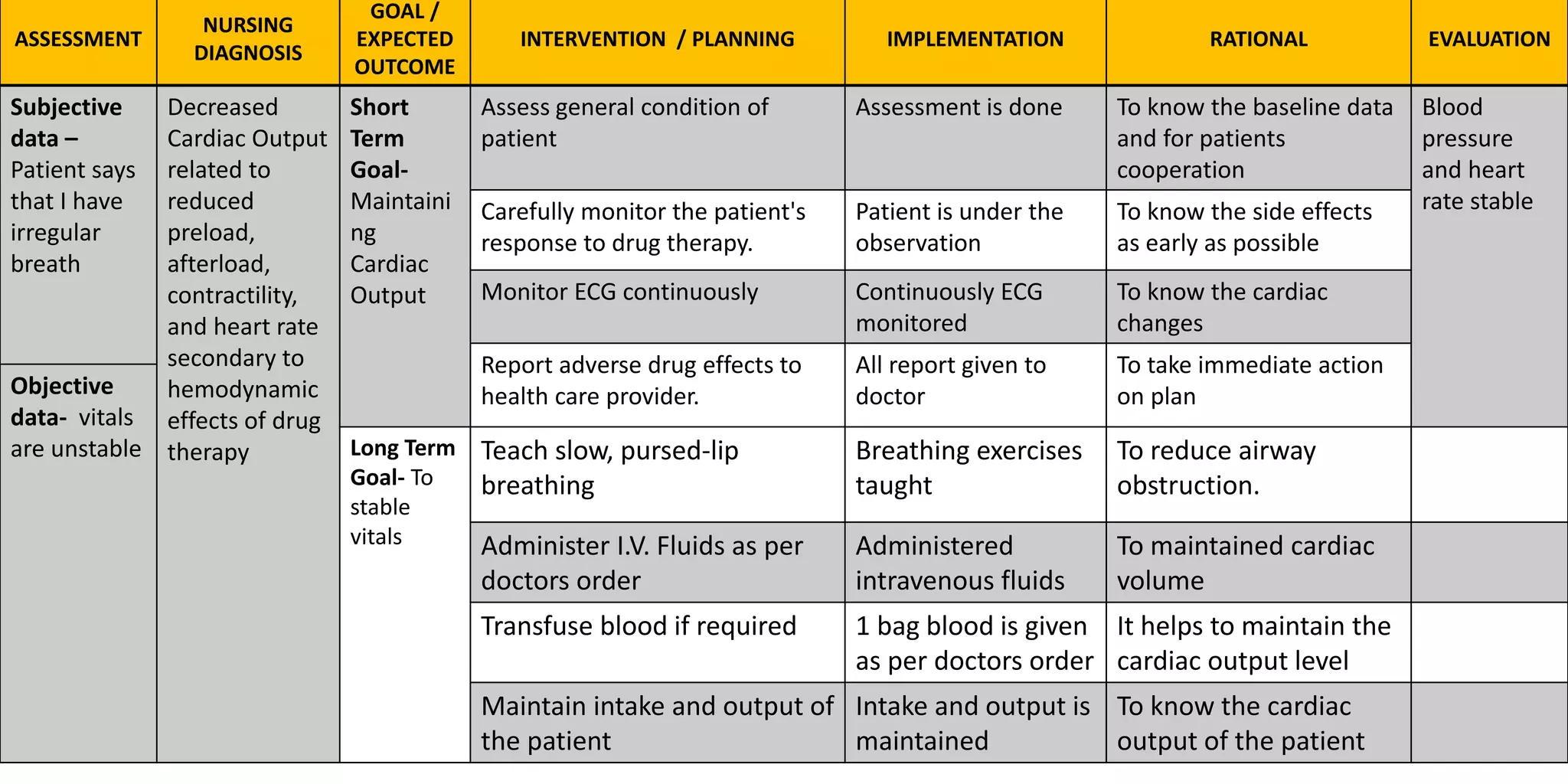
2. Decreased Cardiac Output related to reduced preload, afterload,
contractility, and heart rate secondary to hemodynamic effects of drug
therapy
3. Anxiety related to chest pain, uncertain prognosis, and threatening
environment.
Conti..
4. Acute Pain related to oxygen supply and demand imbalance
5. Anxiety related to chest pain, fear of death, threatening environment
6. Activity Intolerance related to insufficient oxygenation to perform
activities of daily living, deconditioning effects of bed rest
7. Risk for Injury (bleeding) related to dissolution of protective
Nursing Diagnosis
• Impaired Gas Exchange related to pulmonary congestion due to elevated
left ventricular pressures
• Ineffective Tissue Perfusion (renal, cerebral, cardiopulmonary, GI, and
peripheral) related to decreased blood flow
ASSESSMENT
NURSING
DIAGNOSIS
GOAL /
EXPECTED
OUTCOME
INTERVENTION /
PLANNING
IMPLEMENTATION RATIONAL
EVALUATIO
N
Subjective
data – patient
says that “I
have chest
pain, breathing
problem”
Acute Pain
related to an
imbalance in
oxygen supply
and demand
Short term
goal=
Relieving Pain
Long term
goals=
To improve
oxygenation
Assess general condition of
patient
Assessment is done To know the baseline
data and for patients
cooperation
Verbalizes
relief of
pain.
Oxygen
saturation
is 98 %
Position patient for comfort Fowlers position given
to patients
Fowler's position
promotes ventilation.
Administer oxygen Oxygen provided to
the patients
To fulfill the need of
oxygen
Objective
data=
restlessness,
tiredness while
walking, &
anxiety.
Provide diversionsional
therapy
Diversional therapy
provided that is music
To divert the mind
Check vital signs of
patient
Vitals checked every
two hourly
To know the normal
values of vitals
Obtain a 12-lead ECG as
directed
ECG taken To know the cardiac
changes of the
patient
Administer antianginal
drug as prescribed
Antianginal drugs
administered
to reduce pain
intensity
ASSESSMENT
NURSING
DIAGNOSIS
GOAL /
EXPECTED
OUTCOME
INTERVENTION / PLANNING IMPLEMENTATION RATIONAL EVALUATION
Subjective
data –
Patient says
that I have
irregular
breath
Decreased
Cardiac Output
related to
reduced
preload,
afterload,
contractility,
and heart rate
secondary to
hemodynamic
effects of drug
therapy
Short
Term
Goal-
Maintaini
ng
Cardiac
Output
Assess general condition of
patient
Assessment is done To know the baseline data
and for patients
cooperation
Blood
pressure
and heart
rate stable
Carefully monitor the patient's
response to drug therapy.
Patient is under the
observation
To know the side effects
as early as possible
Monitor ECG continuously Continuously ECG
monitored
To know the cardiac
changes
Report adverse drug effects to
health care provider.
All report given to
doctor
To take immediate action
on plan
Objective
data- vitals
are unstable Long Term
Goal- To
stable
vitals
Teach slow, pursed-lip
breathing
Breathing exercises
taught
To reduce airway
obstruction.
Administer I.V. Fluids as per
doctors order
Administered
intravenous fluids
To maintained cardiac
volume
Transfuse blood if required 1 bag blood is given
as per doctors order
It helps to maintain the
cardiac output level
Maintain intake and output of
the patient
Intake and output is
maintained
To know the cardiac
output of the patient
ASSESSMENT
NURSING
DIAGNOSIS
GOAL /
EXPECTED
OUTCOME
INTERVENTION / PLANNING IMPLEMENTATION RATIONAL EVALUATION
Subjective
data -
Anxiety related
to chest pain,
uncertain
prognosis, and
threatening
environment.
Short term
goal – to
reduce
anxiety
level
Assess general
condition of patient
Assessment is done To know the baseline
data and for patients
cooperation
Pain is
reducing as
per
verbalizatio
n of patient
and patient
knows
importance
to reduce
anxiety
Allow patient to ask
the questions
Patient is asking
questions regarding
disease condition
It helps to relieve the
anxiety
Encourage patient to
verbalize fear and
concern.
Patients asking their
doubts to staff and dr.
It helps to reduce
fear.
Objective
data -
Check vital signs
regularly
Vitals are stable To know the changes
in patient condition
Long term
goal – to
reduce pain
Administer medication Administered
antianxinal
medication.
It helps to relieve
from anxiety.
Explain patient about
importance to reduce
anxiety.
Educate the patient
about anxiety
To aware about its
importance
Nursing care plans cardiac complaints

Nursing care plans cardiac complaints

  • 1.
  • 2.
    NURSING ASSESSMENT • Askpatient to describe anginal attacks. – When do attacks tend to occur? After a meal? After engaging in certain activities? After physical activities in general? After visits of family/others? – Where is the pain located? Does it radiate? – Was the onset of pain sudden? Gradual? – How long did it last seconds? Minutes? Hours? – Was the pain steady and unwavering in quality? – Is the discomfort accompanied by other symptoms? Sweating? Light-headedness? Nausea? Palpitations? Shortness of breath? – How is the pain relieved? How long does it take for pain relief?
  • 3.
    • Obtain abaseline 12-lead ECG. • Assess patient's and family's knowledge of disease. • Identify patient's and family's level of anxiety and use of appropriate coping mechanisms. • Gather information about the patient's cardiac risk factors. Use the patient's age, total cholesterol level, HDL level, systolic BP, and smoking status to determine the patient's 10-year risk for development of CHD according to the Framingham risk scoring method (Third Report of the National Cholesterol Education Program
  • 4.
    • Evaluate patient'smedical history for such conditions as diabetes, heart failure, previous MI, or obstructive lung disease that may influence choice of drug therapy. • Identify factors that may contribute to noncompliance with prescribed drug therapy. • Review renal and hepatic studies and complete blood count. • Discuss with patient current activity levels. (Effectiveness of antianginal drug therapy is evaluated by patient's ability to attain higher activity levels.) • Discuss patient's beliefs about modification of risk factors and willingness to change.
  • 5.
    Nursing Diagnoses 1. AcutePain related to an imbalance in oxygen supply and demand 2. Decreased Cardiac Output related to reduced preload, afterload, contractility, and heart rate secondary to hemodynamic effects of drug therapy 3. Anxiety related to chest pain, uncertain prognosis, and threatening environment.
  • 6.
    Conti.. 4. Acute Painrelated to oxygen supply and demand imbalance 5. Anxiety related to chest pain, fear of death, threatening environment 6. Activity Intolerance related to insufficient oxygenation to perform activities of daily living, deconditioning effects of bed rest 7. Risk for Injury (bleeding) related to dissolution of protective
  • 7.
    Nursing Diagnosis • ImpairedGas Exchange related to pulmonary congestion due to elevated left ventricular pressures • Ineffective Tissue Perfusion (renal, cerebral, cardiopulmonary, GI, and peripheral) related to decreased blood flow
  • 8.
    ASSESSMENT NURSING DIAGNOSIS GOAL / EXPECTED OUTCOME INTERVENTION / PLANNING IMPLEMENTATIONRATIONAL EVALUATIO N Subjective data – patient says that “I have chest pain, breathing problem” Acute Pain related to an imbalance in oxygen supply and demand Short term goal= Relieving Pain Long term goals= To improve oxygenation Assess general condition of patient Assessment is done To know the baseline data and for patients cooperation Verbalizes relief of pain. Oxygen saturation is 98 % Position patient for comfort Fowlers position given to patients Fowler's position promotes ventilation. Administer oxygen Oxygen provided to the patients To fulfill the need of oxygen Objective data= restlessness, tiredness while walking, & anxiety. Provide diversionsional therapy Diversional therapy provided that is music To divert the mind Check vital signs of patient Vitals checked every two hourly To know the normal values of vitals Obtain a 12-lead ECG as directed ECG taken To know the cardiac changes of the patient Administer antianginal drug as prescribed Antianginal drugs administered to reduce pain intensity
  • 9.
    ASSESSMENT NURSING DIAGNOSIS GOAL / EXPECTED OUTCOME INTERVENTION /PLANNING IMPLEMENTATION RATIONAL EVALUATION Subjective data – Patient says that I have irregular breath Decreased Cardiac Output related to reduced preload, afterload, contractility, and heart rate secondary to hemodynamic effects of drug therapy Short Term Goal- Maintaini ng Cardiac Output Assess general condition of patient Assessment is done To know the baseline data and for patients cooperation Blood pressure and heart rate stable Carefully monitor the patient's response to drug therapy. Patient is under the observation To know the side effects as early as possible Monitor ECG continuously Continuously ECG monitored To know the cardiac changes Report adverse drug effects to health care provider. All report given to doctor To take immediate action on plan Objective data- vitals are unstable Long Term Goal- To stable vitals Teach slow, pursed-lip breathing Breathing exercises taught To reduce airway obstruction. Administer I.V. Fluids as per doctors order Administered intravenous fluids To maintained cardiac volume Transfuse blood if required 1 bag blood is given as per doctors order It helps to maintain the cardiac output level Maintain intake and output of the patient Intake and output is maintained To know the cardiac output of the patient
  • 10.
    ASSESSMENT NURSING DIAGNOSIS GOAL / EXPECTED OUTCOME INTERVENTION /PLANNING IMPLEMENTATION RATIONAL EVALUATION Subjective data - Anxiety related to chest pain, uncertain prognosis, and threatening environment. Short term goal – to reduce anxiety level Assess general condition of patient Assessment is done To know the baseline data and for patients cooperation Pain is reducing as per verbalizatio n of patient and patient knows importance to reduce anxiety Allow patient to ask the questions Patient is asking questions regarding disease condition It helps to relieve the anxiety Encourage patient to verbalize fear and concern. Patients asking their doubts to staff and dr. It helps to reduce fear. Objective data - Check vital signs regularly Vitals are stable To know the changes in patient condition Long term goal – to reduce pain Administer medication Administered antianxinal medication. It helps to relieve from anxiety. Explain patient about importance to reduce anxiety. Educate the patient about anxiety To aware about its importance