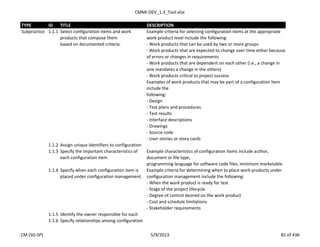
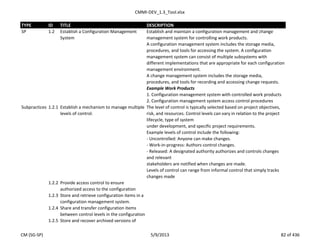
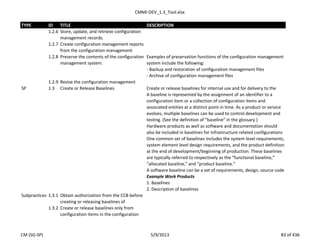
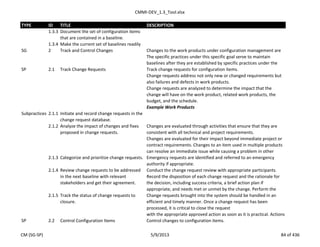
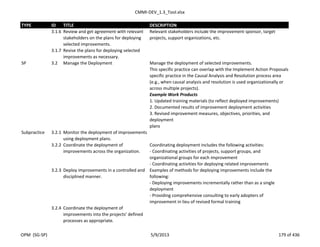
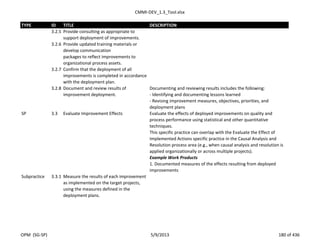
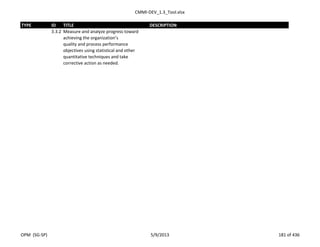
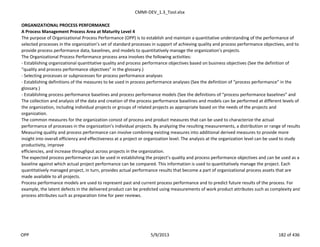
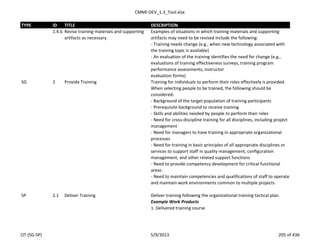
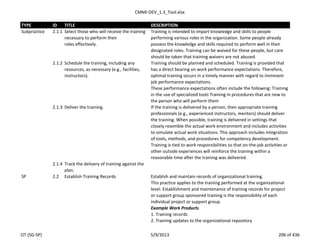
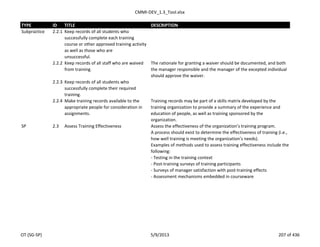
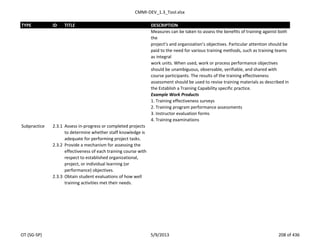
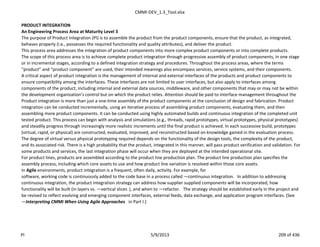
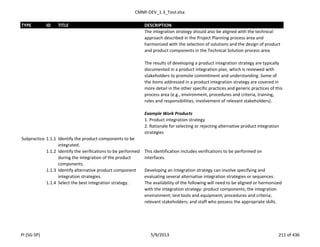
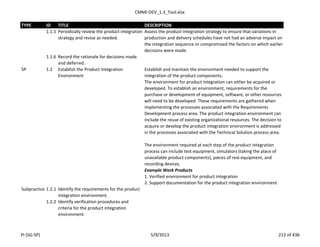
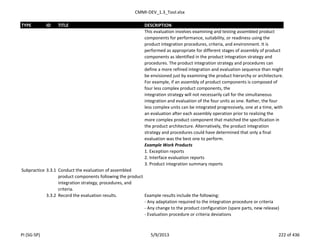
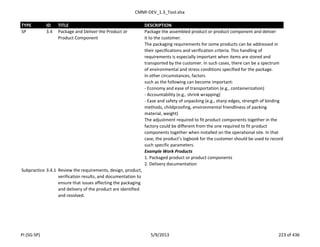
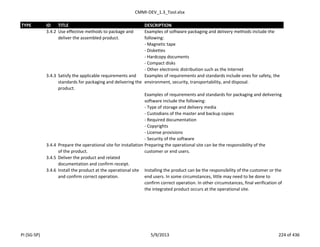
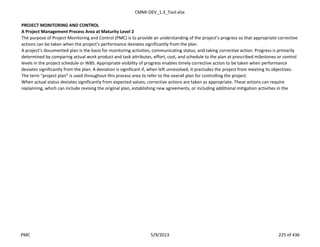
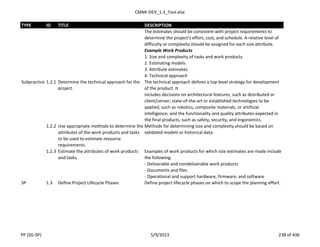
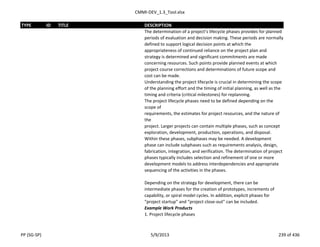
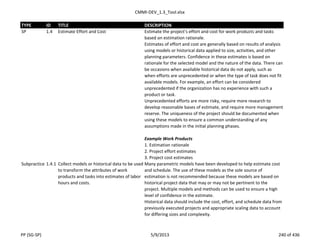
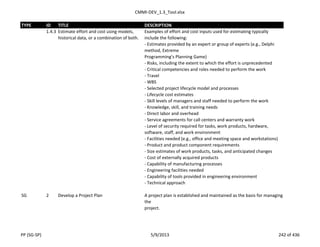
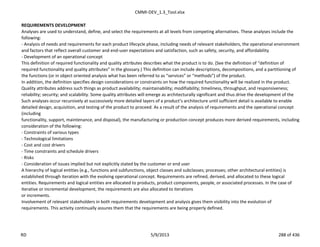
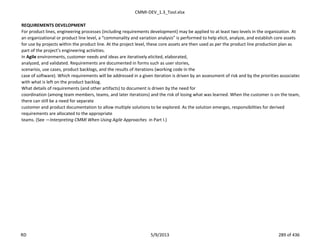
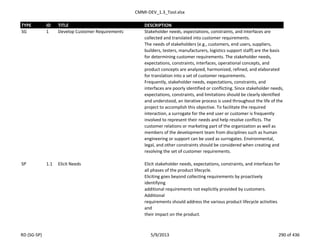
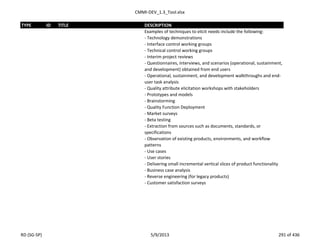
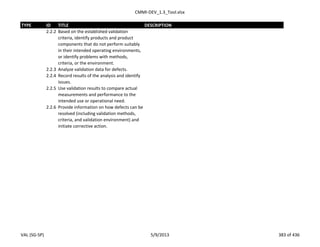
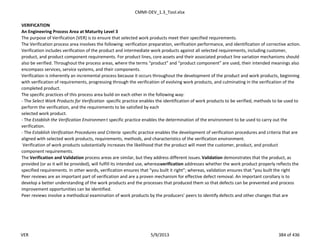
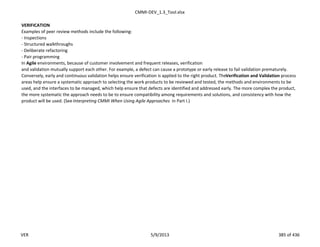
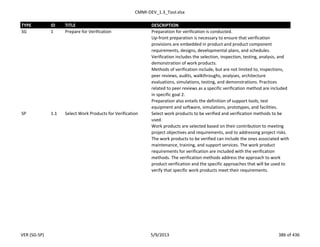
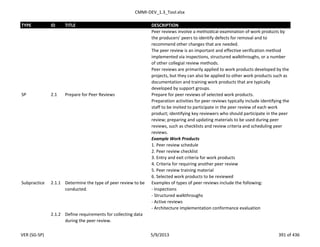
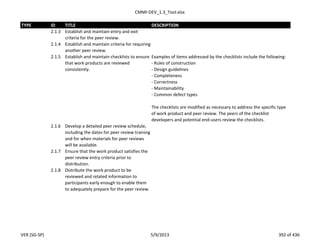
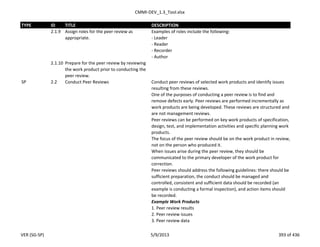
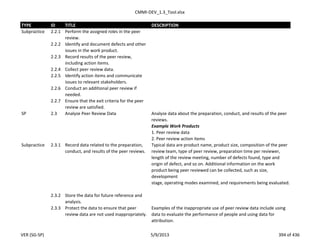
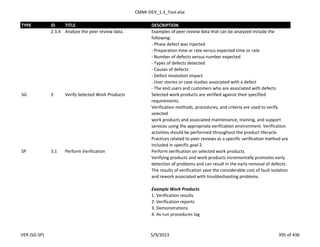
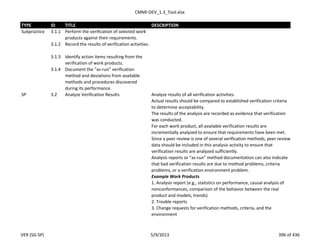
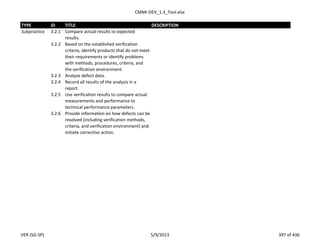
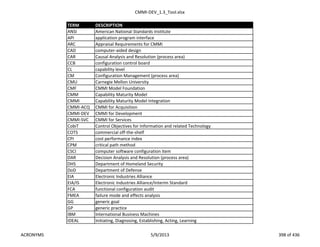
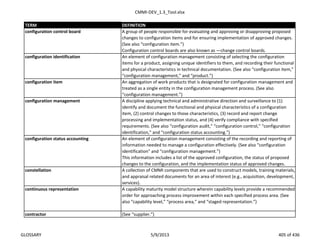
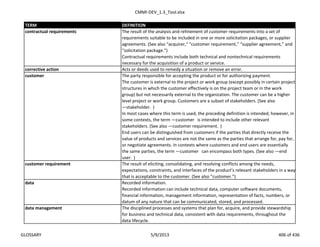
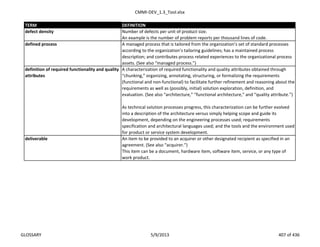
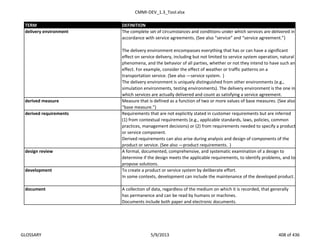
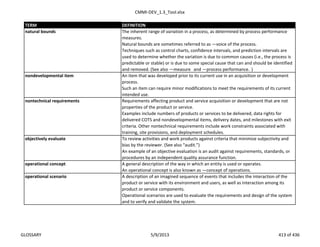
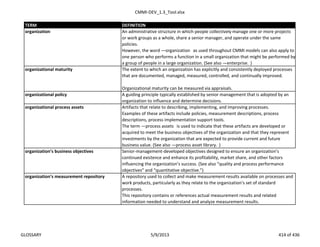
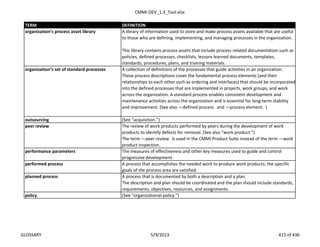
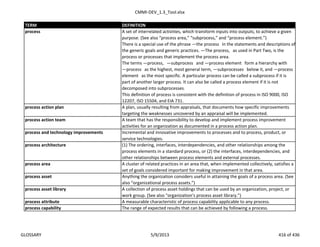
CMMI-DEV_1.3_Tool.xlsx
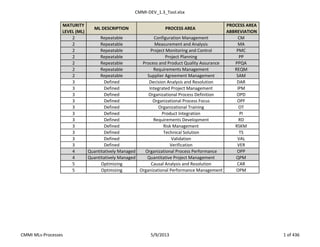
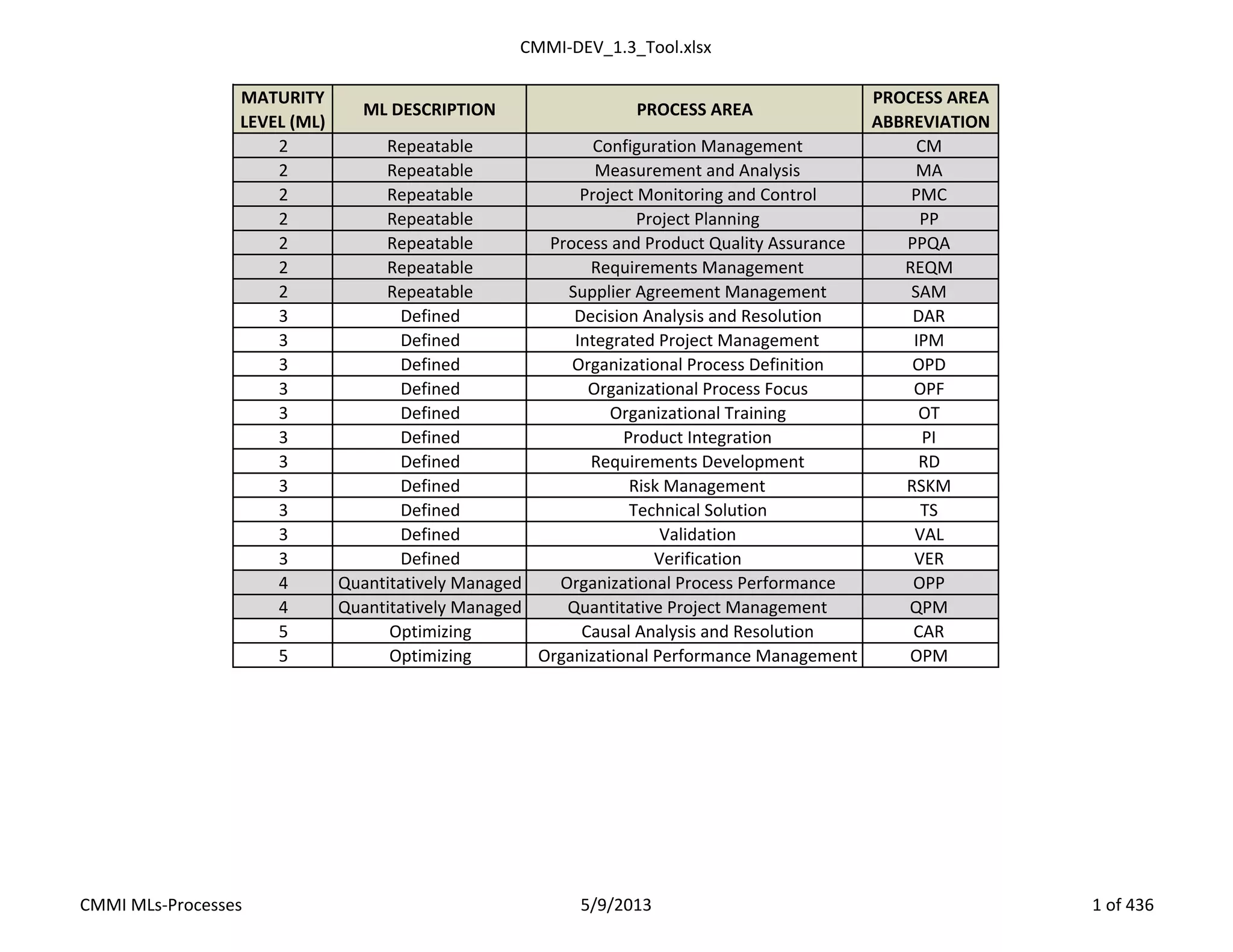
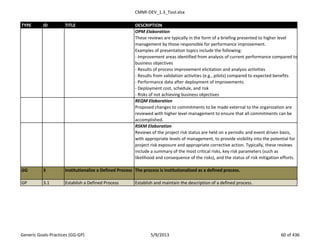
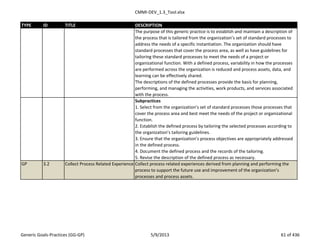
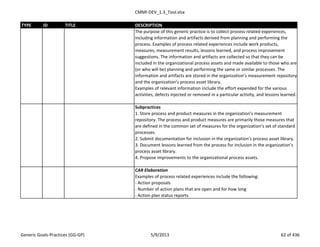
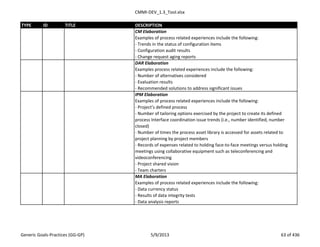
MATURITY
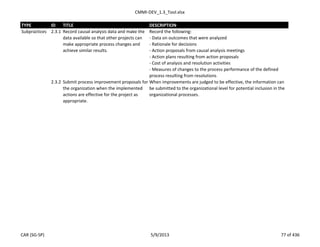
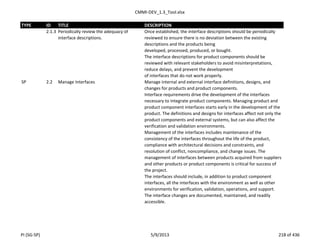
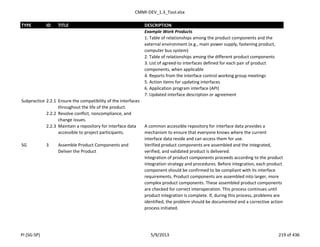
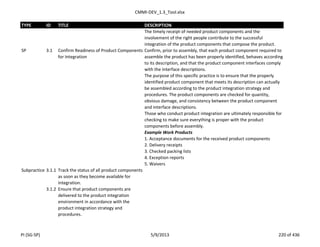
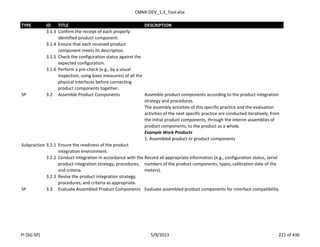
LEVEL (ML)
ML DESCRIPTION PROCESS AREA
PROCESS AREA
ABBREVIATION
2 Repeatable Configuration Management CM
2 Repeatable Measurement and Analysis MA
2 Repeatable Project Monitoring and Control PMC
2 Repeatable Project Planning PP
2 Repeatable Process and Product Quality Assurance PPQA
2 Repeatable Requirements Management REQM
2 Repeatable Supplier Agreement Management SAM
3 Defined Decision Analysis and Resolution DAR
3 Defined Integrated Project Management IPM
3 Defined Organizational Process Definition OPD
3 Defined Organizational Process Focus OPF
3 Defined Organizational Training OT
3 Defined Product Integration PI
3 Defined Requirements Development RD
3 Defined Risk Management RSKM
3 Defined Technical Solution TS
3 Defined Validation VAL
3 Defined Verification VER
4 Quantitatively Managed Organizational Process Performance OPP
4 Quantitatively Managed Quantitative Project Management QPM
5 Optimizing Causal Analysis and Resolution CAR
5 Optimizing Organizational Performance Management OPM
CMMI MLs-Processes 5/9/2013 1 of 436
CMMI-DEV_1.3_Tool.xlsx
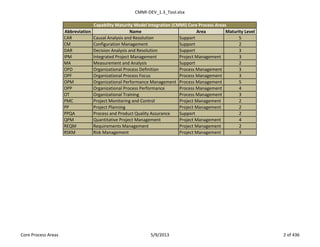
Abbreviation Name Area Maturity Level
CAR Causal Analysis and Resolution Support 5
CM Configuration Management Support 2
DAR Decision Analysis and Resolution Support 3
IPM Integrated Project Management Project Management 3
MA Measurement and Analysis Support 2
OPD Organizational Process Definition Process Management 3
OPF Organizational Process Focus Process Management 3
OPM Organizational Performance Management Process Management 5
OPP Organizational Process Performance Process Management 4
OT Organizational Training Process Management 3
PMC Project Monitoring and Control Project Management 2
PP Project Planning Project Management 2
PPQA Process and Product Quality Assurance Support 2
QPM Quantitative Project Management Project Management 4
REQM Requirements Management Project Management 2
RSKM Risk Management Project Management 3
Capability Maturity Model Integration (CMMI) Core Process Areas
Core Process Areas 5/9/2013 2 of 436
CMMI-DEV_1.3_Tool.xlsx
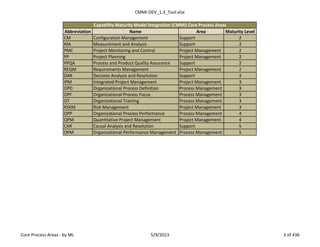
Abbreviation Name Area Maturity Level
CM Configuration Management Support 2
MA Measurement and Analysis Support 2
PMC Project Monitoring and Control Project Management 2
PP Project Planning Project Management 2
PPQA Process and Product Quality Assurance Support 2
REQM Requirements Management Project Management 2
DAR Decision Analysis and Resolution Support 3
IPM Integrated Project Management Project Management 3
OPD Organizational Process Definition Process Management 3
OPF Organizational Process Focus Process Management 3
OT Organizational Training Process Management 3
RSKM Risk Management Project Management 3
OPP Organizational Process Performance Process Management 4
QPM Quantitative Project Management Project Management 4
CAR Causal Analysis and Resolution Support 5
OPM Organizational Performance Management Process Management 5
Capability Maturity Model Integration (CMMI) Core Process Areas
Core Process Areas - by ML 5/9/2013 3 of 436
CMMI-DEV_1.3_Tool.xlsx
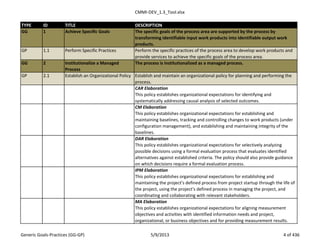
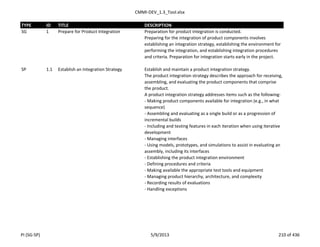
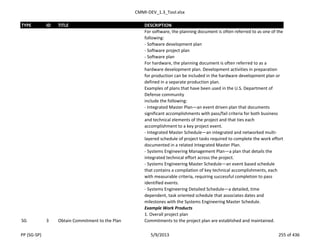
TYPE ID TITLE DESCRIPTION
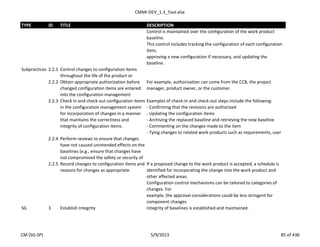
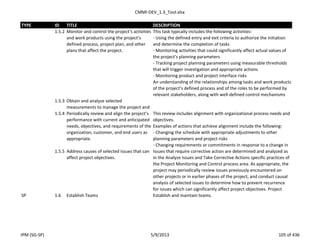
GG 1 Achieve Specific Goals The specific goals of the process area are supported by the process by
transforming identifiable input work products into identifiable output work
products.
GP 1.1 Perform Specific Practices Perform the specific practices of the process area to develop work products and
provide services to achieve the specific goals of the process area.
GG 2 Institutionalize a Managed
Process
The process is institutionalized as a managed process.
GP 2.1 Establish an Organizational Policy Establish and maintain an organizational policy for planning and performing the
process.
CAR Elaboration
This policy establishes organizational expectations for identifying and
systematically addressing causal analysis of selected outcomes.
CM Elaboration
This policy establishes organizational expectations for establishing and
maintaining baselines, tracking and controlling changes to work products (under
configuration management), and establishing and maintaining integrity of the
baselines.
DAR Elaboration
This policy establishes organizational expectations for selectively analyzing
possible decisions using a formal evaluation process that evaluates identified
alternatives against established criteria. The policy should also provide guidance
on which decisions require a formal evaluation process.
IPM Elaboration
This policy establishes organizational expectations for establishing and
maintaining the project’s defined process from project startup through the life of
the project, using the project’s defined process in managing the project, and
coordinating and collaborating with relevant stakeholders.
MA Elaboration
This policy establishes organizational expectations for aligning measurement
objectives and activities with identified information needs and project,
organizational, or business objectives and for providing measurement results.
Generic Goals-Practices (GG-GP) 5/9/2013 4 of 436
CMMI-DEV_1.3_Tool.xlsx
TYPE ID TITLE DESCRIPTION
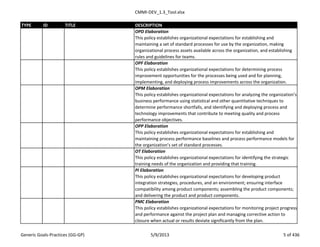
OPD Elaboration
This policy establishes organizational expectations for establishing and
maintaining a set of standard processes for use by the organization, making
organizational process assets available across the organization, and establishing
rules and guidelines for teams.
OPF Elaboration
This policy establishes organizational expectations for determining process
improvement opportunities for the processes being used and for planning,
implementing, and deploying process improvements across the organization.
OPM Elaboration
This policy establishes organizational expectations for analyzing the organization’s
business performance using statistical and other quantitative techniques to
determine performance shortfalls, and identifying and deploying process and
technology improvements that contribute to meeting quality and process
performance objectives.
OPP Elaboration
This policy establishes organizational expectations for establishing and
maintaining process performance baselines and process performance models for
the organization’s set of standard processes.
OT Elaboration
This policy establishes organizational expectations for identifying the strategic
training needs of the organization and providing that training.
PI Elaboration
This policy establishes organizational expectations for developing product
integration strategies, procedures, and an environment; ensuring interface
compatibility among product components; assembling the product components;
and delivering the product and product components.
PMC Elaboration
This policy establishes organizational expectations for monitoring project progress
and performance against the project plan and managing corrective action to
closure when actual or results deviate significantly from the plan.
Generic Goals-Practices (GG-GP) 5/9/2013 5 of 436
CMMI-DEV_1.3_Tool.xlsx
TYPE ID TITLE DESCRIPTION
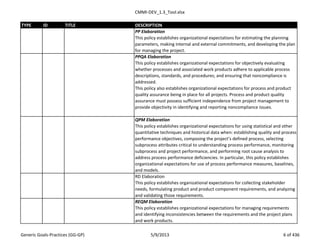
PP Elaboration
This policy establishes organizational expectations for estimating the planning
parameters, making internal and external commitments, and developing the plan
for managing the project.
PPQA Elaboration
This policy establishes organizational expectations for objectively evaluating
whether processes and associated work products adhere to applicable process
descriptions, standards, and procedures; and ensuring that noncompliance is
addressed.
This policy also establishes organizational expectations for process and product
quality assurance being in place for all projects. Process and product quality
assurance must possess sufficient independence from project management to
provide objectivity in identifying and reporting noncompliance issues.
QPM Elaboration
This policy establishes organizational expectations for using statistical and other
quantitative techniques and historical data when: establishing quality and process
performance objectives, composing the project’s defined process, selecting
subprocess attributes critical to understanding process performance, monitoring
subprocess and project performance, and performing root cause analysis to
address process performance deficiencies. In particular, this policy establishes
organizational expectations for use of process performance measures, baselines,
and models.
RD Elaboration
This policy establishes organizational expectations for collecting stakeholder
needs, formulating product and product component requirements, and analyzing
and validating those requirements.
REQM Elaboration
This policy establishes organizational expectations for managing requirements
and identifying inconsistencies between the requirements and the project plans
and work products.
Generic Goals-Practices (GG-GP) 5/9/2013 6 of 436
CMMI-DEV_1.3_Tool.xlsx
TYPE ID TITLE DESCRIPTION
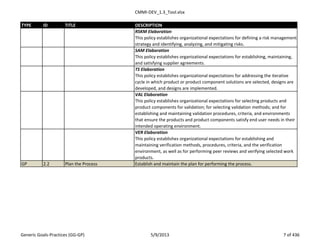
RSKM Elaboration
This policy establishes organizational expectations for defining a risk management
strategy and identifying, analyzing, and mitigating risks.
SAM Elaboration
This policy establishes organizational expectations for establishing, maintaining,
and satisfying supplier agreements.
TS Elaboration
This policy establishes organizational expectations for addressing the iterative
cycle in which product or product component solutions are selected, designs are
developed, and designs are implemented.
VAL Elaboration
This policy establishes organizational expectations for selecting products and
product components for validation; for selecting validation methods; and for
establishing and maintaining validation procedures, criteria, and environments
that ensure the products and product components satisfy end user needs in their
intended operating environment.
VER Elaboration
This policy establishes organizational expectations for establishing and
maintaining verification methods, procedures, criteria, and the verification
environment, as well as for performing peer reviews and verifying selected work
products.
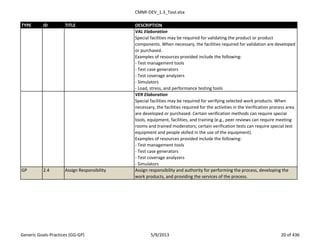
GP 2.2 Plan the Process Establish and maintain the plan for performing the process.
Generic Goals-Practices (GG-GP) 5/9/2013 7 of 436
CMMI-DEV_1.3_Tool.xlsx
TYPE ID TITLE DESCRIPTION
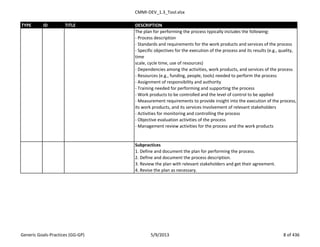
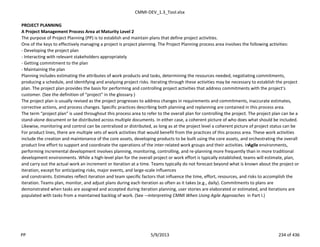
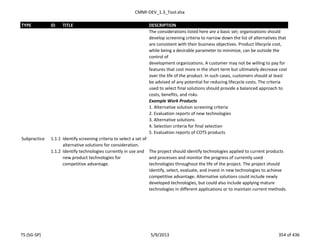
The plan for performing the process typically includes the following:
- Process description
- Standards and requirements for the work products and services of the process
- Specific objectives for the execution of the process and its results (e.g., quality,
time
scale, cycle time, use of resources)
- Dependencies among the activities, work products, and services of the process
- Resources (e.g., funding, people, tools) needed to perform the process
- Assignment of responsibility and authority
- Training needed for performing and supporting the process
- Work products to be controlled and the level of control to be applied
- Measurement requirements to provide insight into the execution of the process,
its work products, and its services Involvement of relevant stakeholders
- Activities for monitoring and controlling the process
- Objective evaluation activities of the process
- Management review activities for the process and the work products
Subpractices
1. Define and document the plan for performing the process.
2. Define and document the process description.
3. Review the plan with relevant stakeholders and get their agreement.
4. Revise the plan as necessary.
Generic Goals-Practices (GG-GP) 5/9/2013 8 of 436
CMMI-DEV_1.3_Tool.xlsx
TYPE ID TITLE DESCRIPTION
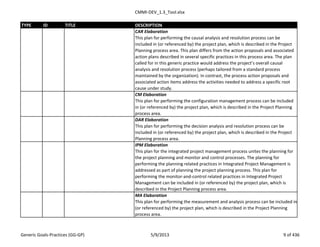
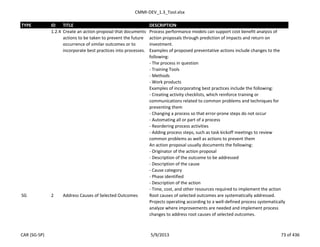
CAR Elaboration
This plan for performing the causal analysis and resolution process can be
included in (or referenced by) the project plan, which is described in the Project
Planning process area. This plan differs from the action proposals and associated
action plans described in several specific practices in this process area. The plan
called for in this generic practice would address the project’s overall causal
analysis and resolution process (perhaps tailored from a standard process
maintained by the organization). In contrast, the process action proposals and
associated action items address the activities needed to address a specific root
cause under study.
CM Elaboration
This plan for performing the configuration management process can be included
in (or referenced by) the project plan, which is described in the Project Planning
process area.
DAR Elaboration
This plan for performing the decision analysis and resolution process can be
included in (or referenced by) the project plan, which is described in the Project
Planning process area.
IPM Elaboration
This plan for the integrated project management process unites the planning for
the project planning and monitor and control processes. The planning for
performing the planning related practices in Integrated Project Management is
addressed as part of planning the project planning process. This plan for
performing the monitor-and-control related practices in Integrated Project
Management can be included in (or referenced by) the project plan, which is
described in the Project Planning process area.
MA Elaboration
This plan for performing the measurement and analysis process can be included in
(or referenced by) the project plan, which is described in the Project Planning
process area.
Generic Goals-Practices (GG-GP) 5/9/2013 9 of 436
CMMI-DEV_1.3_Tool.xlsx
TYPE ID TITLE DESCRIPTION
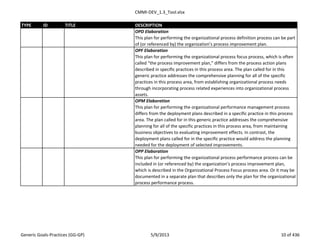
OPD Elaboration
This plan for performing the organizational process definition process can be part
of (or referenced by) the organization’s process improvement plan.
OPF Elaboration
This plan for performing the organizational process focus process, which is often
called “the process improvement plan,” differs from the process action plans
described in specific practices in this process area. The plan called for in this
generic practice addresses the comprehensive planning for all of the specific
practices in this process area, from establishing organizational process needs
through incorporating process related experiences into organizational process
assets.
OPM Elaboration
This plan for performing the organizational performance management process
differs from the deployment plans described in a specific practice in this process
area. The plan called for in this generic practice addresses the comprehensive
planning for all of the specific practices in this process area, from maintaining
business objectives to evaluating improvement effects. In contrast, the
deployment plans called for in the specific practice would address the planning
needed for the deployment of selected improvements.
OPP Elaboration
This plan for performing the organizational process performance process can be
included in (or referenced by) the organization’s process improvement plan,
which is described in the Organizational Process Focus process area. Or it may be
documented in a separate plan that describes only the plan for the organizational
process performance process.
Generic Goals-Practices (GG-GP) 5/9/2013 10 of 436
CMMI-DEV_1.3_Tool.xlsx
TYPE ID TITLE DESCRIPTION
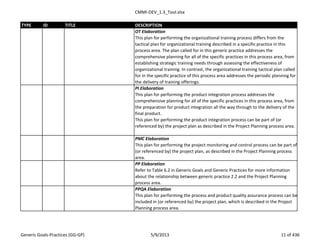
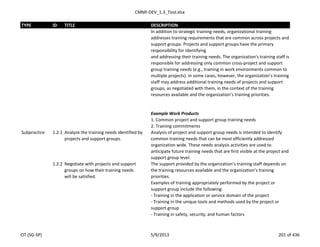
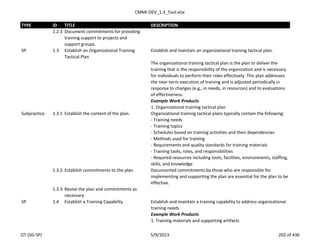
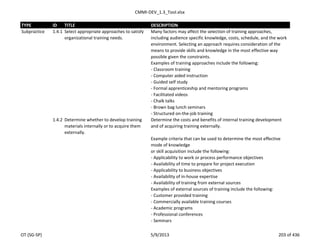
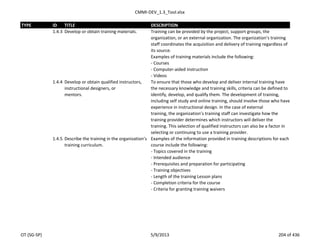
OT Elaboration
This plan for performing the organizational training process differs from the
tactical plan for organizational training described in a specific practice in this
process area. The plan called for in this generic practice addresses the
comprehensive planning for all of the specific practices in this process area, from
establishing strategic training needs through assessing the effectiveness of
organizational training. In contrast, the organizational training tactical plan called
for in the specific practice of this process area addresses the periodic planning for
the delivery of training offerings.
PI Elaboration
This plan for performing the product integration process addresses the
comprehensive planning for all of the specific practices in this process area, from
the preparation for product integration all the way through to the delivery of the
final product.
This plan for performing the product integration process can be part of (or
referenced by) the project plan as described in the Project Planning process area.
PMC Elaboration
This plan for performing the project monitoring and control process can be part of
(or referenced by) the project plan, as described in the Project Planning process
area.
PP Elaboration
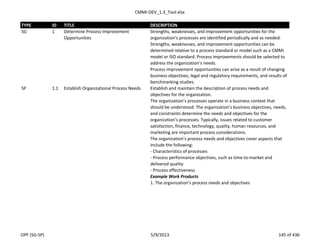
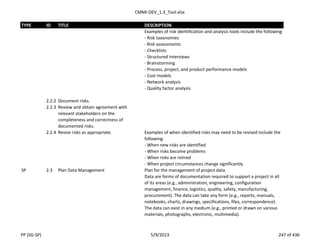
Refer to Table 6.2 in Generic Goals and Generic Practices for more information
about the relationship between generic practice 2.2 and the Project Planning
process area.
PPQA Elaboration
This plan for performing the process and product quality assurance process can be
included in (or referenced by) the project plan, which is described in the Project
Planning process area.
Generic Goals-Practices (GG-GP) 5/9/2013 11 of 436
CMMI-DEV_1.3_Tool.xlsx
TYPE ID TITLE DESCRIPTION
QPM Elaboration
This plan for performing the quantitative project management process can be
included in (or referenced by) the project plan, which is described in the Project
Planning process area.
RD Elaboration
This plan for performing the requirements development process can be part of (or
referenced by) the project plan as described in the Project Planning process area.
REQM Elaboration
This plan for performing the requirements management process can be part of (or
referenced by) the project plan as described in the Project Planning process area.
RSKM Elaboration
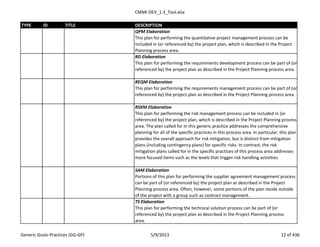
This plan for performing the risk management process can be included in (or
referenced by) the project plan, which is described in the Project Planning process
area. The plan called for in this generic practice addresses the comprehensive
planning for all of the specific practices in this process area. In particular, this plan
provides the overall approach for risk mitigation, but is distinct from mitigation
plans (including contingency plans) for specific risks. In contrast, the risk
mitigation plans called for in the specific practices of this process area addresses
more focused items such as the levels that trigger risk handling activities.
SAM Elaboration
Portions of this plan for performing the supplier agreement management process
can be part of (or referenced by) the project plan as described in the Project
Planning process area. Often, however, some portions of the plan reside outside
of the project with a group such as contract management.
TS Elaboration
This plan for performing the technical solution process can be part of (or
referenced by) the project plan as described in the Project Planning process
area.
Generic Goals-Practices (GG-GP) 5/9/2013 12 of 436
CMMI-DEV_1.3_Tool.xlsx
TYPE ID TITLE DESCRIPTION
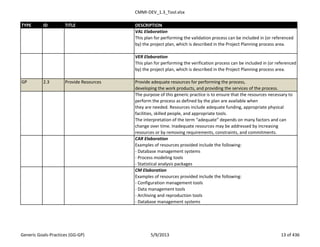
VAL Elaboration
This plan for performing the validation process can be included in (or referenced
by) the project plan, which is described in the Project Planning process area.
VER Elaboration
This plan for performing the verification process can be included in (or referenced
by) the project plan, which is described in the Project Planning process area.
GP 2.3 Provide Resources Provide adequate resources for performing the process,
developing the work products, and providing the services of the process.
The purpose of this generic practice is to ensure that the resources necessary to
perform the process as defined by the plan are available when
they are needed. Resources include adequate funding, appropriate physical
facilities, skilled people, and appropriate tools.
The interpretation of the term “adequate” depends on many factors and can
change over time. Inadequate resources may be addressed by increasing
resources or by removing requirements, constraints, and commitments.
CAR Elaboration
Examples of resources provided include the following:
- Database management systems
- Process modeling tools
- Statistical analysis packages
CM Elaboration
Examples of resources provided include the following:
- Configuration management tools
- Data management tools
- Archiving and reproduction tools
- Database management systems
Generic Goals-Practices (GG-GP) 5/9/2013 13 of 436
CMMI-DEV_1.3_Tool.xlsx
TYPE ID TITLE DESCRIPTION
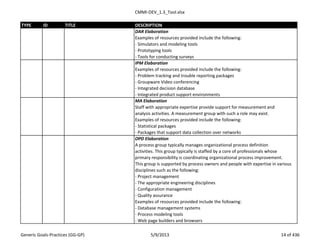
DAR Elaboration
Examples of resources provided include the following:
- Simulators and modeling tools
- Prototyping tools
- Tools for conducting surveys
IPM Elaboration
Examples of resources provided include the following:
- Problem tracking and trouble reporting packages
- Groupware Video conferencing
- Integrated decision database
- Integrated product support environments
MA Elaboration
Staff with appropriate expertise provide support for measurement and
analysis activities. A measurement group with such a role may exist.
Examples of resources provided include the following:
- Statistical packages
- Packages that support data collection over networks
OPD Elaboration
A process group typically manages organizational process definition
activities. This group typically is staffed by a core of professionals whose
primary responsibility is coordinating organizational process improvement.
This group is supported by process owners and people with expertise in various
disciplines such as the following:
- Project management
- The appropriate engineering disciplines
- Configuration management
- Quality assurance
Examples of resources provided include the following:
- Database management systems
- Process modeling tools
- Web page builders and browsers
Generic Goals-Practices (GG-GP) 5/9/2013 14 of 436
CMMI-DEV_1.3_Tool.xlsx
TYPE ID TITLE DESCRIPTION
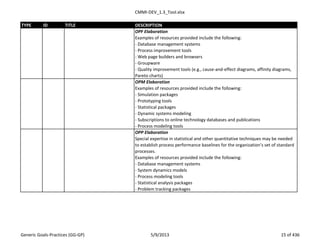
OPF Elaboration
Examples of resources provided include the following:
- Database management systems
- Process improvement tools
- Web page builders and browsers
- Groupware
- Quality improvement tools (e.g., cause-and-effect diagrams, affinity diagrams,
Pareto charts)
OPM Elaboration
Examples of resources provided include the following:
- Simulation packages
- Prototyping tools
- Statistical packages
- Dynamic systems modeling
- Subscriptions to online technology databases and publications
- Process modeling tools
OPP Elaboration
Special expertise in statistical and other quantitative techniques may be needed
to establish process performance baselines for the organization’s set of standard
processes.
Examples of resources provided include the following:
- Database management systems
- System dynamics models
- Process modeling tools
- Statistical analysis packages
- Problem tracking packages
Generic Goals-Practices (GG-GP) 5/9/2013 15 of 436
CMMI-DEV_1.3_Tool.xlsx
TYPE ID TITLE DESCRIPTION
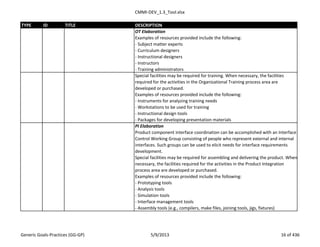
OT Elaboration
Examples of resources provided include the following:
- Subject matter experts
- Curriculum designers
- Instructional designers
- Instructors
- Training administrators
Special facilities may be required for training. When necessary, the facilities
required for the activities in the Organizational Training process area are
developed or purchased.
Examples of resources provided include the following:
- Instruments for analyzing training needs
- Workstations to be used for training
- Instructional design tools
- Packages for developing presentation materials
PI Elaboration
Product component interface coordination can be accomplished with an Interface
Control Working Group consisting of people who represent external and internal
interfaces. Such groups can be used to elicit needs for interface requirements
development.
Special facilities may be required for assembling and delivering the product. When
necessary, the facilities required for the activities in the Product Integration
process area are developed or purchased.
Examples of resources provided include the following:
- Prototyping tools
- Analysis tools
- Simulation tools
- Interface management tools
- Assembly tools (e.g., compilers, make files, joining tools, jigs, fixtures)
Generic Goals-Practices (GG-GP) 5/9/2013 16 of 436
CMMI-DEV_1.3_Tool.xlsx
TYPE ID TITLE DESCRIPTION
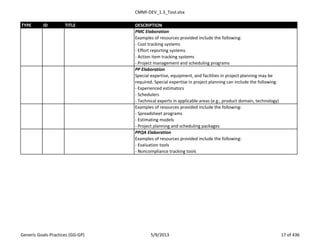
PMC Elaboration
Examples of resources provided include the following:
- Cost tracking systems
- Effort reporting systems
- Action item tracking systems
- Project management and scheduling programs
PP Elaboration
Special expertise, equipment, and facilities in project planning may be
required. Special expertise in project planning can include the following:
- Experienced estimators
- Schedulers
- Technical experts in applicable areas (e.g., product domain, technology)
Examples of resources provided include the following:
- Spreadsheet programs
- Estimating models
- Project planning and scheduling packages
PPQA Elaboration
Examples of resources provided include the following:
- Evaluation tools
- Noncompliance tracking tools
Generic Goals-Practices (GG-GP) 5/9/2013 17 of 436
CMMI-DEV_1.3_Tool.xlsx
TYPE ID TITLE DESCRIPTION
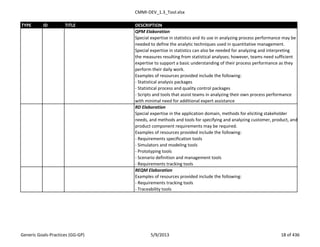
QPM Elaboration
Special expertise in statistics and its use in analyzing process performance may be
needed to define the analytic techniques used in quantitative management.
Special expertise in statistics can also be needed for analyzing and interpreting
the measures resulting from statistical analyses; however, teams need sufficient
expertise to support a basic understanding of their process performance as they
perform their daily work.
Examples of resources provided include the following:
- Statistical analysis packages
- Statistical process and quality control packages
- Scripts and tools that assist teams in analyzing their own process performance
with minimal need for additional expert assistance
RD Elaboration
Special expertise in the application domain, methods for eliciting stakeholder
needs, and methods and tools for specifying and analyzing customer, product, and
product component requirements may be required.
Examples of resources provided include the following:
- Requirements specification tools
- Simulators and modeling tools
- Prototyping tools
- Scenario definition and management tools
- Requirements tracking tools
REQM Elaboration
Examples of resources provided include the following:
- Requirements tracking tools
- Traceability tools
Generic Goals-Practices (GG-GP) 5/9/2013 18 of 436
CMMI-DEV_1.3_Tool.xlsx
TYPE ID TITLE DESCRIPTION
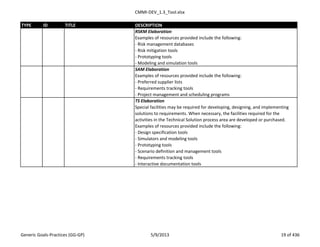
RSKM Elaboration
Examples of resources provided include the following:
- Risk management databases
- Risk mitigation tools
- Prototyping tools
- Modeling and simulation tools
SAM Elaboration
Examples of resources provided include the following:
- Preferred supplier lists
- Requirements tracking tools
- Project management and scheduling programs
TS Elaboration
Special facilities may be required for developing, designing, and implementing
solutions to requirements. When necessary, the facilities required for the
activities in the Technical Solution process area are developed or purchased.
Examples of resources provided include the following:
- Design specification tools
- Simulators and modeling tools
- Prototyping tools
- Scenario definition and management tools
- Requirements tracking tools
- Interactive documentation tools
Generic Goals-Practices (GG-GP) 5/9/2013 19 of 436
CMMI-DEV_1.3_Tool.xlsx
TYPE ID TITLE DESCRIPTION
VAL Elaboration
Special facilities may be required for validating the product or product
components. When necessary, the facilities required for validation are developed
or purchased.
Examples of resources provided include the following:
- Test management tools
- Test case generators
- Test coverage analyzers
- Simulators
- Load, stress, and performance testing tools
VER Elaboration
Special facilities may be required for verifying selected work products. When
necessary, the facilities required for the activities in the Verification process area
are developed or purchased. Certain verification methods can require special
tools, equipment, facilities, and training (e.g., peer reviews can require meeting
rooms and trained moderators; certain verification tests can require special test
equipment and people skilled in the use of the equipment).
Examples of resources provided include the following:
- Test management tools
- Test case generators
- Test coverage analyzers
- Simulators
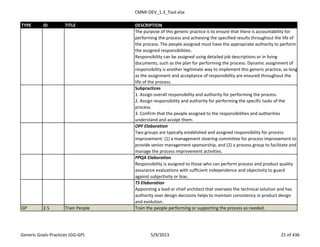
GP 2.4 Assign Responsibility Assign responsibility and authority for performing the process, developing the
work products, and providing the services of the process.
Generic Goals-Practices (GG-GP) 5/9/2013 20 of 436
CMMI-DEV_1.3_Tool.xlsx
TYPE ID TITLE DESCRIPTION
The purpose of this generic practice is to ensure that there is accountability for
performing the process and achieving the specified results throughout the life of
the process. The people assigned must have the appropriate authority to perform
the assigned responsibilities.
Responsibility can be assigned using detailed job descriptions or in living
documents, such as the plan for performing the process. Dynamic assignment of
responsibility is another legitimate way to implement this generic practice, as long
as the assignment and acceptance of responsibility are ensured throughout the
life of the process.
Subpractices
1. Assign overall responsibility and authority for performing the process.
2. Assign responsibility and authority for performing the specific tasks of the
process.
3. Confirm that the people assigned to the responsibilities and authorities
understand and accept them.
OPF Elaboration
Two groups are typically established and assigned responsibility for process
improvement: (1) a management steering committee for process improvement to
provide senior management sponsorship, and (2) a process group to facilitate and
manage the process improvement activities.
PPQA Elaboration
Responsibility is assigned to those who can perform process and product quality
assurance evaluations with sufficient independence and objectivity to guard
against subjectivity or bias.
TS Elaboration
Appointing a lead or chief architect that oversees the technical solution and has
authority over design decisions helps to maintain consistency in product design
and evolution.
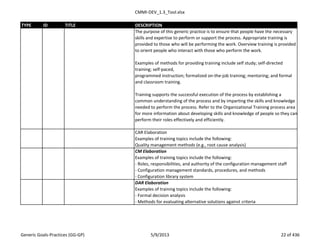
GP 2.5 Train People Train the people performing or supporting the process as needed.
Generic Goals-Practices (GG-GP) 5/9/2013 21 of 436
CMMI-DEV_1.3_Tool.xlsx
TYPE ID TITLE DESCRIPTION
The purpose of this generic practice is to ensure that people have the necessary
skills and expertise to perform or support the process. Appropriate training is
provided to those who will be performing the work. Overview training is provided
to orient people who interact with those who perform the work.
Examples of methods for providing training include self study; self-directed
training; self-paced,
programmed instruction; formalized on-the-job training; mentoring; and formal
and classroom training.
Training supports the successful execution of the process by establishing a
common understanding of the process and by imparting the skills and knowledge
needed to perform the process. Refer to the Organizational Training process area
for more information about developing skills and knowledge of people so they can
perform their roles effectively and efficiently.
CAR Elaboration
Examples of training topics include the following:
Quality management methods (e.g., root cause analysis)
CM Elaboration
Examples of training topics include the following:
- Roles, responsibilities, and authority of the configuration management staff
- Configuration management standards, procedures, and methods
- Configuration library system
DAR Elaboration
Examples of training topics include the following:
- Formal decision analysis
- Methods for evaluating alternative solutions against criteria
Generic Goals-Practices (GG-GP) 5/9/2013 22 of 436
CMMI-DEV_1.3_Tool.xlsx
TYPE ID TITLE DESCRIPTION
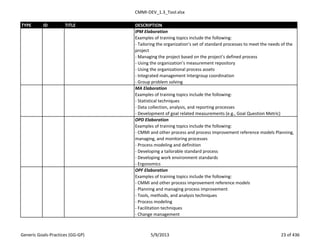
IPM Elaboration
Examples of training topics include the following:
- Tailoring the organization’s set of standard processes to meet the needs of the
project
- Managing the project based on the project’s defined process
- Using the organization’s measurement repository
- Using the organizational process assets
- Integrated management Intergroup coordination
- Group problem solving
MA Elaboration
Examples of training topics include the following:
- Statistical techniques
- Data collection, analysis, and reporting processes
- Development of goal related measurements (e.g., Goal Question Metric)
OPD Elaboration
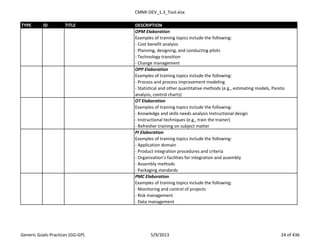
Examples of training topics include the following:
- CMMI and other process and process improvement reference models Planning,
managing, and monitoring processes
- Process modeling and definition
- Developing a tailorable standard process
- Developing work environment standards
- Ergonomics
OPF Elaboration
Examples of training topics include the following:
- CMMI and other process improvement reference models
- Planning and managing process improvement
- Tools, methods, and analysis techniques
- Process modeling
- Facilitation techniques
- Change management
Generic Goals-Practices (GG-GP) 5/9/2013 23 of 436
CMMI-DEV_1.3_Tool.xlsx
TYPE ID TITLE DESCRIPTION
OPM Elaboration
Examples of training topics include the following:
- Cost benefit analysis
- Planning, designing, and conducting pilots
- Technology transition
- Change management
OPP Elaboration
Examples of training topics include the following:
- Process and process improvement modeling
- Statistical and other quantitative methods (e.g., estimating models, Pareto
analysis, control charts)
OT Elaboration
Examples of training topics include the following:
- Knowledge and skills needs analysis Instructional design
- Instructional techniques (e.g., train the trainer)
- Refresher training on subject matter
PI Elaboration
Examples of training topics include the following:
- Application domain
- Product integration procedures and criteria
- Organization’s facilities for integration and assembly
- Assembly methods
- Packaging standards
PMC Elaboration
Examples of training topics include the following:
- Monitoring and control of projects
- Risk management
- Data management
Generic Goals-Practices (GG-GP) 5/9/2013 24 of 436
CMMI-DEV_1.3_Tool.xlsx
TYPE ID TITLE DESCRIPTION
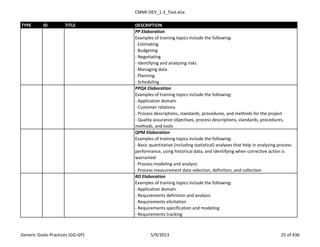
PP Elaboration
Examples of training topics include the following:
- Estimating
- Budgeting
- Negotiating
- Identifying and analyzing risks
- Managing data
- Planning
- Scheduling
PPQA Elaboration
Examples of training topics include the following:
- Application domain
- Customer relations
- Process descriptions, standards, procedures, and methods for the project
- Quality assurance objectives, process descriptions, standards, procedures,
methods, and tools
QPM Elaboration
Examples of training topics include the following:
- Basic quantitative (including statistical) analyses that help in analyzing process
performance, using historical data, and identifying when corrective action is
warranted
- Process modeling and analysis
- Process measurement data selection, definition, and collection
RD Elaboration
Examples of training topics include the following:
- Application domain
- Requirements definition and analysis
- Requirements elicitation
- Requirements specification and modeling
- Requirements tracking
Generic Goals-Practices (GG-GP) 5/9/2013 25 of 436
CMMI-DEV_1.3_Tool.xlsx
TYPE ID TITLE DESCRIPTION
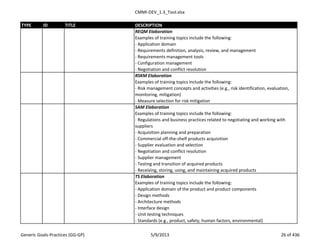
REQM Elaboration
Examples of training topics include the following:
- Application domain
- Requirements definition, analysis, review, and management
- Requirements management tools
- Configuration management
- Negotiation and conflict resolution
RSKM Elaboration
Examples of training topics include the following:
- Risk management concepts and activities (e.g., risk identification, evaluation,
monitoring, mitigation)
- Measure selection for risk mitigation
SAM Elaboration
Examples of training topics include the following:
- Regulations and business practices related to negotiating and working with
suppliers
- Acquisition planning and preparation
- Commercial off-the-shelf products acquisition
- Supplier evaluation and selection
- Negotiation and conflict resolution
- Supplier management
- Testing and transition of acquired products
- Receiving, storing, using, and maintaining acquired products
TS Elaboration
Examples of training topics include the following:
- Application domain of the product and product components
- Design methods
- Architecture methods
- Interface design
- Unit testing techniques
- Standards (e.g., product, safety, human factors, environmental)
Generic Goals-Practices (GG-GP) 5/9/2013 26 of 436
CMMI-DEV_1.3_Tool.xlsx
TYPE ID TITLE DESCRIPTION
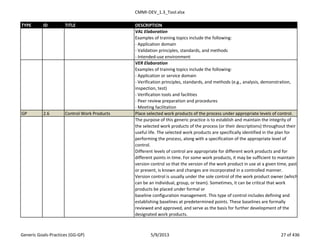
VAL Elaboration
Examples of training topics include the following:
- Application domain
- Validation principles, standards, and methods
- Intended-use environment
VER Elaboration
Examples of training topics include the following:
- Application or service domain
- Verification principles, standards, and methods (e.g., analysis, demonstration,
inspection, test)
- Verification tools and facilities
- Peer review preparation and procedures
- Meeting facilitation
GP 2.6 Control Work Products Place selected work products of the process under appropriate levels of control.
The purpose of this generic practice is to establish and maintain the integrity of
the selected work products of the process (or their descriptions) throughout their
useful life. The selected work products are specifically identified in the plan for
performing the process, along with a specification of the appropriate level of
control.
Different levels of control are appropriate for different work products and for
different points in time. For some work products, it may be sufficient to maintain
version control so that the version of the work product in use at a given time, past
or present, is known and changes are incorporated in a controlled manner.
Version control is usually under the sole control of the work product owner (which
can be an individual, group, or team). Sometimes, it can be critical that work
products be placed under formal or
baseline configuration management. This type of control includes defining and
establishing baselines at predetermined points. These baselines are formally
reviewed and approved, and serve as the basis for further development of the
designated work products.
Generic Goals-Practices (GG-GP) 5/9/2013 27 of 436
CMMI-DEV_1.3_Tool.xlsx
TYPE ID TITLE DESCRIPTION
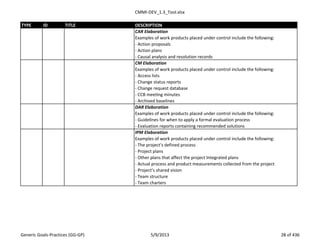
CAR Elaboration
Examples of work products placed under control include the following:
- Action proposals
- Action plans
- Causal analysis and resolution records
CM Elaboration
Examples of work products placed under control include the following:
- Access lists
- Change status reports
- Change request database
- CCB meeting minutes
- Archived baselines
DAR Elaboration
Examples of work products placed under control include the following:
- Guidelines for when to apply a formal evaluation process
- Evaluation reports containing recommended solutions
IPM Elaboration
Examples of work products placed under control include the following:
- The project’s defined process
- Project plans
- Other plans that affect the project Integrated plans
- Actual process and product measurements collected from the project
- Project’s shared vision
- Team structure
- Team charters
Generic Goals-Practices (GG-GP) 5/9/2013 28 of 436
CMMI-DEV_1.3_Tool.xlsx
TYPE ID TITLE DESCRIPTION
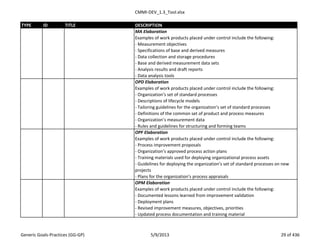
MA Elaboration
Examples of work products placed under control include the following:
- Measurement objectives
- Specifications of base and derived measures
- Data collection and storage procedures
- Base and derived measurement data sets
- Analysis results and draft reports
- Data analysis tools
OPD Elaboration
Examples of work products placed under control include the following:
- Organization’s set of standard processes
- Descriptions of lifecycle models
- Tailoring guidelines for the organization’s set of standard processes
- Definitions of the common set of product and process measures
- Organization’s measurement data
- Rules and guidelines for structuring and forming teams
OPF Elaboration
Examples of work products placed under control include the following:
- Process improvement proposals
- Organization’s approved process action plans
- Training materials used for deploying organizational process assets
- Guidelines for deploying the organization’s set of standard processes on new
projects
- Plans for the organization’s process appraisals
OPM Elaboration
Examples of work products placed under control include the following:
- Documented lessons learned from improvement validation
- Deployment plans
- Revised improvement measures, objectives, priorities
- Updated process documentation and training material
Generic Goals-Practices (GG-GP) 5/9/2013 29 of 436
CMMI-DEV_1.3_Tool.xlsx
TYPE ID TITLE DESCRIPTION
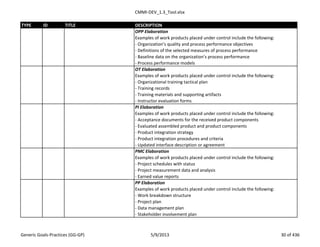
OPP Elaboration
Examples of work products placed under control include the following:
- Organization’s quality and process performance objectives
- Definitions of the selected measures of process performance
- Baseline data on the organization’s process performance
- Process performance models
OT Elaboration
Examples of work products placed under control include the following:
- Organizational training tactical plan
- Training records
- Training materials and supporting artifacts
- Instructor evaluation forms
PI Elaboration
Examples of work products placed under control include the following:
- Acceptance documents for the received product components
- Evaluated assembled product and product components
- Product integration strategy
- Product integration procedures and criteria
- Updated interface description or agreement
PMC Elaboration
Examples of work products placed under control include the following:
- Project schedules with status
- Project measurement data and analysis
- Earned value reports
PP Elaboration
Examples of work products placed under control include the following:
- Work breakdown structure
- Project plan
- Data management plan
- Stakeholder involvement plan
Generic Goals-Practices (GG-GP) 5/9/2013 30 of 436
CMMI-DEV_1.3_Tool.xlsx
TYPE ID TITLE DESCRIPTION
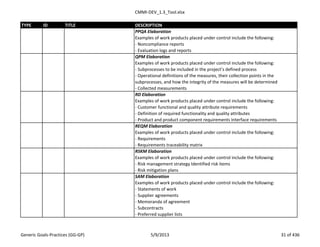
PPQA Elaboration
Examples of work products placed under control include the following:
- Noncompliance reports
- Evaluation logs and reports
QPM Elaboration
Examples of work products placed under control include the following:
- Subprocesses to be included in the project’s defined process
- Operational definitions of the measures, their collection points in the
subprocesses, and how the integrity of the measures will be determined
- Collected measurements
RD Elaboration
Examples of work products placed under control include the following:
- Customer functional and quality attribute requirements
- Definition of required functionality and quality attributes
- Product and product component requirements Interface requirements
REQM Elaboration
Examples of work products placed under control include the following:
- Requirements
- Requirements traceability matrix
RSKM Elaboration
Examples of work products placed under control include the following:
- Risk management strategy Identified risk items
- Risk mitigation plans
SAM Elaboration
Examples of work products placed under control include the following:
- Statements of work
- Supplier agreements
- Memoranda of agreement
- Subcontracts
- Preferred supplier lists
Generic Goals-Practices (GG-GP) 5/9/2013 31 of 436
CMMI-DEV_1.3_Tool.xlsx
TYPE ID TITLE DESCRIPTION
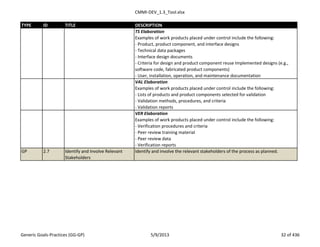
TS Elaboration
Examples of work products placed under control include the following:
- Product, product component, and interface designs
- Technical data packages
- Interface design documents
- Criteria for design and product component reuse Implemented designs (e.g.,
software code, fabricated product components)
- User, installation, operation, and maintenance documentation
VAL Elaboration
Examples of work products placed under control include the following:
- Lists of products and product components selected for validation
- Validation methods, procedures, and criteria
- Validation reports
VER Elaboration
Examples of work products placed under control include the following:
- Verification procedures and criteria
- Peer review training material
- Peer review data
- Verification reports
GP 2.7 Identify and Involve Relevant
Stakeholders
Identify and involve the relevant stakeholders of the process as planned.
Generic Goals-Practices (GG-GP) 5/9/2013 32 of 436
CMMI-DEV_1.3_Tool.xlsx
TYPE ID TITLE DESCRIPTION
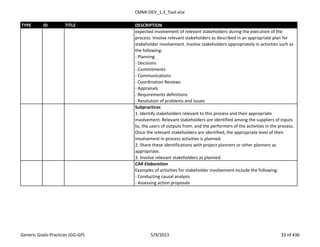
expected involvement of relevant stakeholders during the execution of the
process. Involve relevant stakeholders as described in an appropriate plan for
stakeholder involvement. Involve stakeholders appropriately in activities such as
the following:
- Planning
- Decisions
- Commitments
- Communications
- Coordination Reviews
- Appraisals
- Requirements definitions
- Resolution of problems and issues
Subpractices
1. Identify stakeholders relevant to this process and their appropriate
involvement. Relevant stakeholders are identified among the suppliers of inputs
to, the users of outputs from, and the performers of the activities in the process.
Once the relevant stakeholders are identified, the appropriate level of their
involvement in process activities is planned.
2. Share these identifications with project planners or other planners as
appropriate.
3. Involve relevant stakeholders as planned.
CAR Elaboration
Examples of activities for stakeholder involvement include the following:
- Conducting causal analysis
- Assessing action proposals
Generic Goals-Practices (GG-GP) 5/9/2013 33 of 436
CMMI-DEV_1.3_Tool.xlsx
TYPE ID TITLE DESCRIPTION
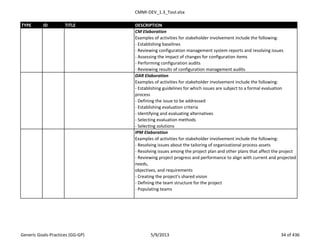
CM Elaboration
Examples of activities for stakeholder involvement include the following:
- Establishing baselines
- Reviewing configuration management system reports and resolving issues
- Assessing the impact of changes for configuration items
- Performing configuration audits
- Reviewing results of configuration management audits
DAR Elaboration
Examples of activities for stakeholder involvement include the following:
- Establishing guidelines for which issues are subject to a formal evaluation
process
- Defining the issue to be addressed
- Establishing evaluation criteria
- Identifying and evaluating alternatives
- Selecting evaluation methods
- Selecting solutions
IPM Elaboration
Examples of activities for stakeholder involvement include the following:
- Resolving issues about the tailoring of organizational process assets
- Resolving issues among the project plan and other plans that affect the project
- Reviewing project progress and performance to align with current and projected
needs,
objectives, and requirements
- Creating the project’s shared vision
- Defining the team structure for the project
- Populating teams
Generic Goals-Practices (GG-GP) 5/9/2013 34 of 436
CMMI-DEV_1.3_Tool.xlsx
TYPE ID TITLE DESCRIPTION
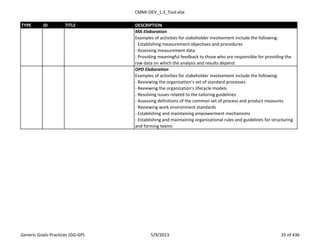
MA Elaboration
Examples of activities for stakeholder involvement include the following:
- Establishing measurement objectives and procedures
- Assessing measurement data
- Providing meaningful feedback to those who are responsible for providing the
raw data on which the analysis and results depend
OPD Elaboration
Examples of activities for stakeholder involvement include the following:
- Reviewing the organization’s set of standard processes
- Reviewing the organization’s lifecycle models
- Resolving issues related to the tailoring guidelines
- Assessing definitions of the common set of process and product measures
- Reviewing work environment standards
- Establishing and maintaining empowerment mechanisms
- Establishing and maintaining organizational rules and guidelines for structuring
and forming teams
Generic Goals-Practices (GG-GP) 5/9/2013 35 of 436
CMMI-DEV_1.3_Tool.xlsx
TYPE ID TITLE DESCRIPTION
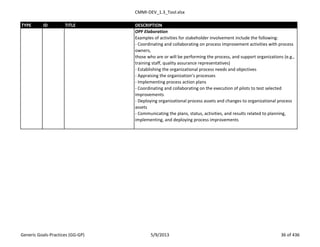
OPF Elaboration
Examples of activities for stakeholder involvement include the following:
- Coordinating and collaborating on process improvement activities with process
owners,
those who are or will be performing the process, and support organizations (e.g.,
training staff, quality assurance representatives)
- Establishing the organizational process needs and objectives
- Appraising the organization’s processes
- Implementing process action plans
- Coordinating and collaborating on the execution of pilots to test selected
improvements
- Deploying organizational process assets and changes to organizational process
assets
- Communicating the plans, status, activities, and results related to planning,
implementing, and deploying process improvements
Generic Goals-Practices (GG-GP) 5/9/2013 36 of 436
CMMI-DEV_1.3_Tool.xlsx
TYPE ID TITLE DESCRIPTION
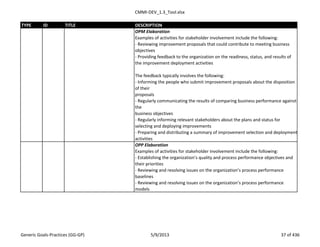
OPM Elaboration
Examples of activities for stakeholder involvement include the following:
- Reviewing improvement proposals that could contribute to meeting business
objectives
- Providing feedback to the organization on the readiness, status, and results of
the improvement deployment activities
The feedback typically involves the following:
- Informing the people who submit improvement proposals about the disposition
of their
proposals
- Regularly communicating the results of comparing business performance against
the
business objectives
- Regularly informing relevant stakeholders about the plans and status for
selecting and deploying improvements
- Preparing and distributing a summary of improvement selection and deployment
activities
OPP Elaboration
Examples of activities for stakeholder involvement include the following:
- Establishing the organization’s quality and process performance objectives and
their priorities
- Reviewing and resolving issues on the organization’s process performance
baselines
- Reviewing and resolving issues on the organization’s process performance
models
Generic Goals-Practices (GG-GP) 5/9/2013 37 of 436
CMMI-DEV_1.3_Tool.xlsx
TYPE ID TITLE DESCRIPTION
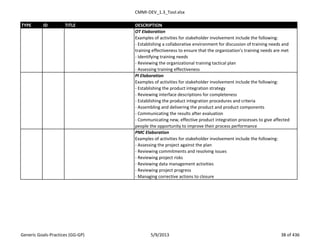
OT Elaboration
Examples of activities for stakeholder involvement include the following:
- Establishing a collaborative environment for discussion of training needs and
training effectiveness to ensure that the organization’s training needs are met
- Identifying training needs
- Reviewing the organizational training tactical plan
- Assessing training effectiveness
PI Elaboration
Examples of activities for stakeholder involvement include the following:
- Establishing the product integration strategy
- Reviewing interface descriptions for completeness
- Establishing the product integration procedures and criteria
- Assembling and delivering the product and product components
- Communicating the results after evaluation
- Communicating new, effective product integration processes to give affected
people the opportunity to improve their process performance
PMC Elaboration
Examples of activities for stakeholder involvement include the following:
- Assessing the project against the plan
- Reviewing commitments and resolving issues
- Reviewing project risks
- Reviewing data management activities
- Reviewing project progress
- Managing corrective actions to closure
Generic Goals-Practices (GG-GP) 5/9/2013 38 of 436
CMMI-DEV_1.3_Tool.xlsx
TYPE ID TITLE DESCRIPTION
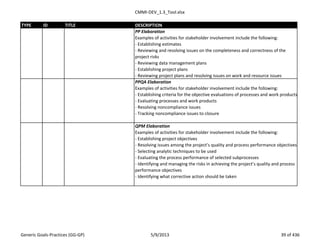
PP Elaboration
Examples of activities for stakeholder involvement include the following:
- Establishing estimates
- Reviewing and resolving issues on the completeness and correctness of the
project risks
- Reviewing data management plans
- Establishing project plans
- Reviewing project plans and resolving issues on work and resource issues
PPQA Elaboration
Examples of activities for stakeholder involvement include the following:
- Establishing criteria for the objective evaluations of processes and work products
- Evaluating processes and work products
- Resolving noncompliance issues
- Tracking noncompliance issues to closure
QPM Elaboration
Examples of activities for stakeholder involvement include the following:
- Establishing project objectives
- Resolving issues among the project’s quality and process performance objectives
- Selecting analytic techniques to be used
- Evaluating the process performance of selected subprocesses
- Identifying and managing the risks in achieving the project’s quality and process
performance objectives
- Identifying what corrective action should be taken
Generic Goals-Practices (GG-GP) 5/9/2013 39 of 436
CMMI-DEV_1.3_Tool.xlsx
TYPE ID TITLE DESCRIPTION
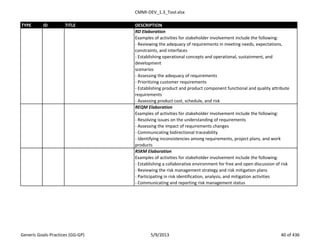
RD Elaboration
Examples of activities for stakeholder involvement include the following:
- Reviewing the adequacy of requirements in meeting needs, expectations,
constraints, and interfaces
- Establishing operational concepts and operational, sustainment, and
development
scenarios
- Assessing the adequacy of requirements
- Prioritizing customer requirements
- Establishing product and product component functional and quality attribute
requirements
- Assessing product cost, schedule, and risk
REQM Elaboration
Examples of activities for stakeholder involvement include the following:
- Resolving issues on the understanding of requirements
- Assessing the impact of requirements changes
- Communicating bidirectional traceability
- Identifying inconsistencies among requirements, project plans, and work
products
RSKM Elaboration
Examples of activities for stakeholder involvement include the following:
- Establishing a collaborative environment for free and open discussion of risk
- Reviewing the risk management strategy and risk mitigation plans
- Participating in risk identification, analysis, and mitigation activities
- Communicating and reporting risk management status
Generic Goals-Practices (GG-GP) 5/9/2013 40 of 436
CMMI-DEV_1.3_Tool.xlsx
TYPE ID TITLE DESCRIPTION
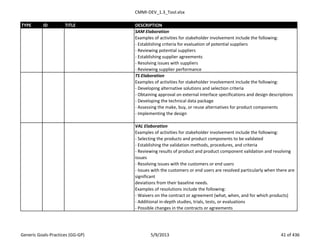
SAM Elaboration
Examples of activities for stakeholder involvement include the following:
- Establishing criteria for evaluation of potential suppliers
- Reviewing potential suppliers
- Establishing supplier agreements
- Resolving issues with suppliers
- Reviewing supplier performance
TS Elaboration
Examples of activities for stakeholder involvement include the following:
- Developing alternative solutions and selection criteria
- Obtaining approval on external interface specifications and design descriptions
- Developing the technical data package
- Assessing the make, buy, or reuse alternatives for product components
- Implementing the design
VAL Elaboration
Examples of activities for stakeholder involvement include the following:
- Selecting the products and product components to be validated
- Establishing the validation methods, procedures, and criteria
- Reviewing results of product and product component validation and resolving
issues
- Resolving issues with the customers or end users
- Issues with the customers or end users are resolved particularly when there are
significant
deviations from their baseline needs.
Examples of resolutions include the following:
- Waivers on the contract or agreement (what, when, and for which products)
- Additional in-depth studies, trials, tests, or evaluations
- Possible changes in the contracts or agreements
Generic Goals-Practices (GG-GP) 5/9/2013 41 of 436
CMMI-DEV_1.3_Tool.xlsx
TYPE ID TITLE DESCRIPTION
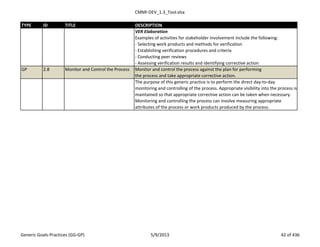
VER Elaboration
Examples of activities for stakeholder involvement include the following:
- Selecting work products and methods for verification
- Establishing verification procedures and criteria
- Conducting peer reviews
- Assessing verification results and identifying corrective action
GP 2.8 Monitor and Control the Process Monitor and control the process against the plan for performing
the process and take appropriate corrective action.
The purpose of this generic practice is to perform the direct day-to-day
monitoring and controlling of the process. Appropriate visibility into the process is
maintained so that appropriate corrective action can be taken when necessary.
Monitoring and controlling the process can involve measuring appropriate
attributes of the process or work products produced by the process.
Generic Goals-Practices (GG-GP) 5/9/2013 42 of 436
CMMI-DEV_1.3_Tool.xlsx
TYPE ID TITLE DESCRIPTION
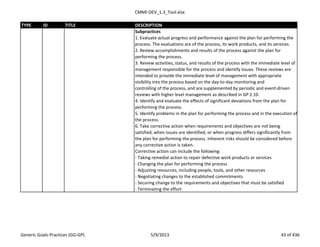
Subpractices
1. Evaluate actual progress and performance against the plan for performing the
process. The evaluations are of the process, its work products, and its services.
2. Review accomplishments and results of the process against the plan for
performing the process.
3. Review activities, status, and results of the process with the immediate level of
management responsible for the process and identify issues. These reviews are
intended to provide the immediate level of management with appropriate
visibility into the process based on the day-to-day monitoring and
controlling of the process, and are supplemented by periodic and event-driven
reviews with higher level management as described in GP 2.10.
4. Identify and evaluate the effects of significant deviations from the plan for
performing the process.
5. Identify problems in the plan for performing the process and in the execution of
the process.
6. Take corrective action when requirements and objectives are not being
satisfied, when issues are identified, or when progress differs significantly from
the plan for performing the process. Inherent risks should be considered before
any corrective action is taken.
Corrective action can include the following:
- Taking remedial action to repair defective work products or services
- Changing the plan for performing the process
- Adjusting resources, including people, tools, and other resources
- Negotiating changes to the established commitments
- Securing change to the requirements and objectives that must be satisfied
- Terminating the effort
Generic Goals-Practices (GG-GP) 5/9/2013 43 of 436
CMMI-DEV_1.3_Tool.xlsx
TYPE ID TITLE DESCRIPTION
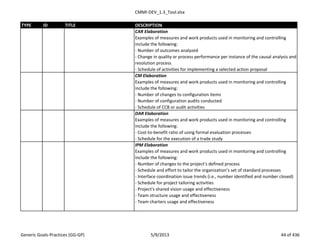
CAR Elaboration
Examples of measures and work products used in monitoring and controlling
include the following:
- Number of outcomes analyzed
- Change in quality or process performance per instance of the causal analysis and
resolution process
- Schedule of activities for implementing a selected action proposal
CM Elaboration
Examples of measures and work products used in monitoring and controlling
include the following:
- Number of changes to configuration items
- Number of configuration audits conducted
- Schedule of CCB or audit activities
DAR Elaboration
Examples of measures and work products used in monitoring and controlling
include the following:
- Cost-to-benefit ratio of using formal evaluation processes
- Schedule for the execution of a trade study
IPM Elaboration
Examples of measures and work products used in monitoring and controlling
include the following:
- Number of changes to the project’s defined process
- Schedule and effort to tailor the organization’s set of standard processes
- Interface coordination issue trends (i.e., number identified and number closed)
- Schedule for project tailoring activities
- Project's shared vision usage and effectiveness
- Team structure usage and effectiveness
- Team charters usage and effectiveness
Generic Goals-Practices (GG-GP) 5/9/2013 44 of 436
CMMI-DEV_1.3_Tool.xlsx
TYPE ID TITLE DESCRIPTION
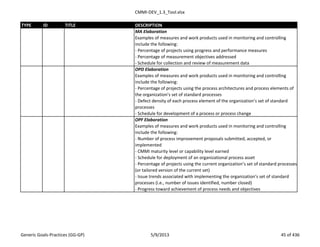
MA Elaboration
Examples of measures and work products used in monitoring and controlling
include the following:
- Percentage of projects using progress and performance measures
- Percentage of measurement objectives addressed
- Schedule for collection and review of measurement data
OPD Elaboration
Examples of measures and work products used in monitoring and controlling
include the following:
- Percentage of projects using the process architectures and process elements of
the organization’s set of standard processes
- Defect density of each process element of the organization’s set of standard
processes
- Schedule for development of a process or process change
OPF Elaboration
Examples of measures and work products used in monitoring and controlling
include the following:
- Number of process improvement proposals submitted, accepted, or
implemented
- CMMI maturity level or capability level earned
- Schedule for deployment of an organizational process asset
- Percentage of projects using the current organization’s set of standard processes
(or tailored version of the current set)
- Issue trends associated with implementing the organization’s set of standard
processes (i.e., number of issues identified, number closed)
- Progress toward achievement of process needs and objectives
Generic Goals-Practices (GG-GP) 5/9/2013 45 of 436
CMMI-DEV_1.3_Tool.xlsx
TYPE ID TITLE DESCRIPTION
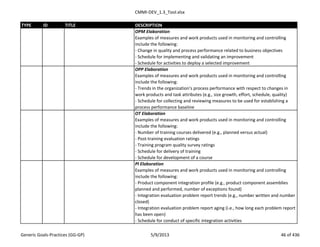
OPM Elaboration
Examples of measures and work products used in monitoring and controlling
include the following:
- Change in quality and process performance related to business objectives
- Schedule for implementing and validating an improvement
- Schedule for activities to deploy a selected improvement
OPP Elaboration
Examples of measures and work products used in monitoring and controlling
include the following:
- Trends in the organization’s process performance with respect to changes in
work products and task attributes (e.g., size growth, effort, schedule, quality)
- Schedule for collecting and reviewing measures to be used for establishing a
process performance baseline
OT Elaboration
Examples of measures and work products used in monitoring and controlling
include the following:
- Number of training courses delivered (e.g., planned versus actual)
- Post-training evaluation ratings
- Training program quality survey ratings
- Schedule for delivery of training
- Schedule for development of a course
PI Elaboration
Examples of measures and work products used in monitoring and controlling
include the following:
- Product component integration profile (e.g., product component assemblies
planned and performed, number of exceptions found)
- Integration evaluation problem report trends (e.g., number written and number
closed)
- Integration evaluation problem report aging (i.e., how long each problem report
has been open)
- Schedule for conduct of specific integration activities
Generic Goals-Practices (GG-GP) 5/9/2013 46 of 436
CMMI-DEV_1.3_Tool.xlsx
TYPE ID TITLE DESCRIPTION
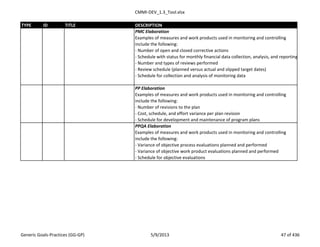
PMC Elaboration
Examples of measures and work products used in monitoring and controlling
include the following:
- Number of open and closed corrective actions
- Schedule with status for monthly financial data collection, analysis, and reporting
- Number and types of reviews performed
- Review schedule (planned versus actual and slipped target dates)
- Schedule for collection and analysis of monitoring data
PP Elaboration
Examples of measures and work products used in monitoring and controlling
include the following:
- Number of revisions to the plan
- Cost, schedule, and effort variance per plan revision
- Schedule for development and maintenance of program plans
PPQA Elaboration
Examples of measures and work products used in monitoring and controlling
include the following:
- Variance of objective process evaluations planned and performed
- Variance of objective work product evaluations planned and performed
- Schedule for objective evaluations
Generic Goals-Practices (GG-GP) 5/9/2013 47 of 436
CMMI-DEV_1.3_Tool.xlsx
TYPE ID TITLE DESCRIPTION
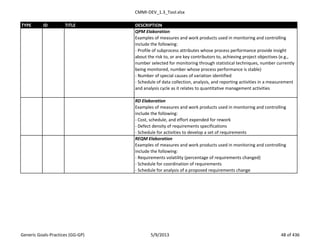
QPM Elaboration
Examples of measures and work products used in monitoring and controlling
include the following:
- Profile of subprocess attributes whose process performance provide insight
about the risk to, or are key contributors to, achieving project objectives (e.g.,
number selected for monitoring through statistical techniques, number currently
being monitored, number whose process performance is stable)
- Number of special causes of variation identified
- Schedule of data collection, analysis, and reporting activities in a measurement
and analysis cycle as it relates to quantitative management activities
RD Elaboration
Examples of measures and work products used in monitoring and controlling
include the following:
- Cost, schedule, and effort expended for rework
- Defect density of requirements specifications
- Schedule for activities to develop a set of requirements
REQM Elaboration
Examples of measures and work products used in monitoring and controlling
include the following:
- Requirements volatility (percentage of requirements changed)
- Schedule for coordination of requirements
- Schedule for analysis of a proposed requirements change
Generic Goals-Practices (GG-GP) 5/9/2013 48 of 436
CMMI-DEV_1.3_Tool.xlsx
TYPE ID TITLE DESCRIPTION
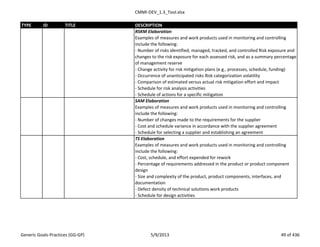
RSKM Elaboration
Examples of measures and work products used in monitoring and controlling
include the following:
- Number of risks identified, managed, tracked, and controlled Risk exposure and
changes to the risk exposure for each assessed risk, and as a summary percentage
of management reserve
- Change activity for risk mitigation plans (e.g., processes, schedule, funding)
- Occurrence of unanticipated risks Risk categorization volatility
- Comparison of estimated versus actual risk mitigation effort and impact
- Schedule for risk analysis activities
- Schedule of actions for a specific mitigation
SAM Elaboration
Examples of measures and work products used in monitoring and controlling
include the following:
- Number of changes made to the requirements for the supplier
- Cost and schedule variance in accordance with the supplier agreement
- Schedule for selecting a supplier and establishing an agreement
TS Elaboration
Examples of measures and work products used in monitoring and controlling
include the following:
- Cost, schedule, and effort expended for rework
- Percentage of requirements addressed in the product or product component
design
- Size and complexity of the product, product components, interfaces, and
documentation
- Defect density of technical solutions work products
- Schedule for design activities
Generic Goals-Practices (GG-GP) 5/9/2013 49 of 436
CMMI-DEV_1.3_Tool.xlsx
TYPE ID TITLE DESCRIPTION
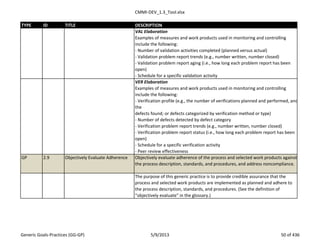
VAL Elaboration
Examples of measures and work products used in monitoring and controlling
include the following:
- Number of validation activities completed (planned versus actual)
- Validation problem report trends (e.g., number written, number closed)
- Validation problem report aging (i.e., how long each problem report has been
open)
- Schedule for a specific validation activity
VER Elaboration
Examples of measures and work products used in monitoring and controlling
include the following:
- Verification profile (e.g., the number of verifications planned and performed, and
the
defects found; or defects categorized by verification method or type)
- Number of defects detected by defect category
- Verification problem report trends (e.g., number written, number closed)
- Verification problem report status (i.e., how long each problem report has been
open)
- Schedule for a specific verification activity
- Peer review effectiveness
GP 2.9 Objectively Evaluate Adherence Objectively evaluate adherence of the process and selected work products against
the process description, standards, and procedures, and address noncompliance.
The purpose of this generic practice is to provide credible assurance that the
process and selected work products are implemented as planned and adhere to
the process description, standards, and procedures. (See the definition of
“objectively evaluate” in the glossary.)
Generic Goals-Practices (GG-GP) 5/9/2013 50 of 436
CMMI-DEV_1.3_Tool.xlsx
TYPE ID TITLE DESCRIPTION
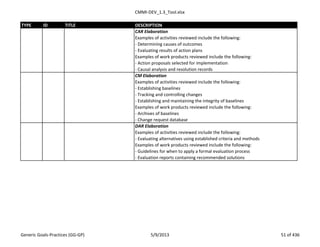
CAR Elaboration
Examples of activities reviewed include the following:
- Determining causes of outcomes
- Evaluating results of action plans
Examples of work products reviewed include the following:
- Action proposals selected for implementation
- Causal analysis and resolution records
CM Elaboration
Examples of activities reviewed include the following:
- Establishing baselines
- Tracking and controlling changes
- Establishing and maintaining the integrity of baselines
Examples of work products reviewed include the following:
- Archives of baselines
- Change request database
DAR Elaboration
Examples of activities reviewed include the following:
- Evaluating alternatives using established criteria and methods
Examples of work products reviewed include the following:
- Guidelines for when to apply a formal evaluation process
- Evaluation reports containing recommended solutions
Generic Goals-Practices (GG-GP) 5/9/2013 51 of 436
CMMI-DEV_1.3_Tool.xlsx
TYPE ID TITLE DESCRIPTION
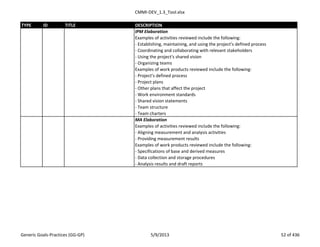
IPM Elaboration
Examples of activities reviewed include the following:
- Establishing, maintaining, and using the project’s defined process
- Coordinating and collaborating with relevant stakeholders
- Using the project's shared vision
- Organizing teams
Examples of work products reviewed include the following:
- Project’s defined process
- Project plans
- Other plans that affect the project
- Work environment standards
- Shared vision statements
- Team structure
- Team charters
MA Elaboration
Examples of activities reviewed include the following:
- Aligning measurement and analysis activities
- Providing measurement results
Examples of work products reviewed include the following:
- Specifications of base and derived measures
- Data collection and storage procedures
- Analysis results and draft reports
Generic Goals-Practices (GG-GP) 5/9/2013 52 of 436
CMMI-DEV_1.3_Tool.xlsx
TYPE ID TITLE DESCRIPTION
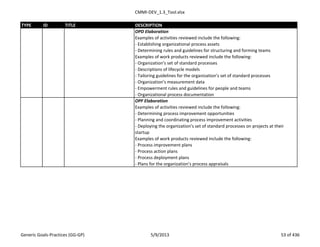
OPD Elaboration
Examples of activities reviewed include the following:
- Establishing organizational process assets
- Determining rules and guidelines for structuring and forming teams
Examples of work products reviewed include the following:
- Organization’s set of standard processes
- Descriptions of lifecycle models
- Tailoring guidelines for the organization’s set of standard processes
- Organization’s measurement data
- Empowerment rules and guidelines for people and teams
- Organizational process documentation
OPF Elaboration
Examples of activities reviewed include the following:
- Determining process improvement opportunities
- Planning and coordinating process improvement activities
- Deploying the organization’s set of standard processes on projects at their
startup
Examples of work products reviewed include the following:
- Process improvement plans
- Process action plans
- Process deployment plans
- Plans for the organization’s process appraisals
Generic Goals-Practices (GG-GP) 5/9/2013 53 of 436
CMMI-DEV_1.3_Tool.xlsx
TYPE ID TITLE DESCRIPTION
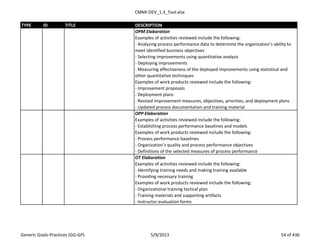
OPM Elaboration
Examples of activities reviewed include the following:
- Analyzing process performance data to determine the organization’s ability to
meet identified business objectives
- Selecting improvements using quantitative analysis
- Deploying improvements
- Measuring effectiveness of the deployed improvements using statistical and
other quantitative techniques
Examples of work products reviewed include the following:
- Improvement proposals
- Deployment plans
- Revised improvement measures, objectives, priorities, and deployment plans
- Updated process documentation and training material
OPP Elaboration
Examples of activities reviewed include the following:
- Establishing process performance baselines and models
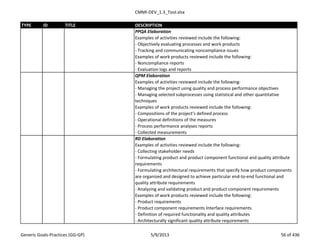
Examples of work products reviewed include the following:
- Process performance baselines
- Organization’s quality and process performance objectives
- Definitions of the selected measures of process performance
OT Elaboration
Examples of activities reviewed include the following:
- Identifying training needs and making training available
- Providing necessary training
Examples of work products reviewed include the following:
- Organizational training tactical plan
- Training materials and supporting artifacts
- Instructor evaluation forms
Generic Goals-Practices (GG-GP) 5/9/2013 54 of 436
CMMI-DEV_1.3_Tool.xlsx
TYPE ID TITLE DESCRIPTION
PI Elaboration
Examples of activities reviewed include the following:
- Establishing and maintaining a product integration strategy
- Ensuring interface compatibility
- Assembling product components and delivering the product
Examples of work products reviewed include the following:
- Product integration strategy
- Product integration procedures and criteria
- Acceptance documents for the received product components
- Assembled product and product components
PMC Elaboration
Examples of activities reviewed include the following:
- Monitoring project progress and performance against the project plan
- Managing corrective actions to closure
Examples of work products reviewed include the following:
- Records of project progress and performance
- Project review results
PP Elaboration
Examples of activities reviewed include the following:
- Establishing estimates
- Developing the project plan
- Obtaining commitments to the project plan
Examples of work products reviewed include the following:
- WBS
- Project plan
- Data management plan
- Stakeholder involvement plan
Generic Goals-Practices (GG-GP) 5/9/2013 55 of 436
CMMI-DEV_1.3_Tool.xlsx
TYPE ID TITLE DESCRIPTION
PPQA Elaboration
Examples of activities reviewed include the following:
- Objectively evaluating processes and work products
- Tracking and communicating noncompliance issues
Examples of work products reviewed include the following:
- Noncompliance reports
- Evaluation logs and reports
QPM Elaboration
Examples of activities reviewed include the following:
- Managing the project using quality and process performance objectives
- Managing selected subprocesses using statistical and other quantitative
techniques
Examples of work products reviewed include the following:
- Compositions of the project’s defined process
- Operational definitions of the measures
- Process performance analyses reports
- Collected measurements
RD Elaboration
Examples of activities reviewed include the following:
- Collecting stakeholder needs
- Formulating product and product component functional and quality attribute
requirements
- Formulating architectural requirements that specify how product components
are organized and designed to achieve particular end-to-end functional and
quality attribute requirements
- Analyzing and validating product and product component requirements
Examples of work products reviewed include the following:
- Product requirements
- Product component requirements Interface requirements
- Definition of required functionality and quality attributes
- Architecturally significant quality attribute requirements
Generic Goals-Practices (GG-GP) 5/9/2013 56 of 436
CMMI-DEV_1.3_Tool.xlsx
TYPE ID TITLE DESCRIPTION
REQM Elaboration
Examples of activities reviewed include the following:
- Managing requirements
- Ensuring alignment among project plans, work products, and requirements
Examples of work products reviewed include the following:
- Requirements
- Requirements traceability matrix
RSKM Elaboration
Examples of activities reviewed include the following:
- Establishing and maintaining a risk management strategy Identifying and
analyzing risks
- Mitigating risks
Examples of work products reviewed include the following:
- Risk management strategy
- Risk mitigation plans
SAM Elaboration
Examples of activities reviewed include the following:
- Establishing and maintaining supplier agreements
- Satisfying supplier agreements
Examples of work products reviewed include the following:
- Plan for supplier agreement management
- Supplier agreements
Generic Goals-Practices (GG-GP) 5/9/2013 57 of 436
CMMI-DEV_1.3_Tool.xlsx
TYPE ID TITLE DESCRIPTION
TS Elaboration
Examples of activities reviewed include the following:
- Selecting product component solutions
- Developing product and product component designs Implementing product
component designs
Examples of work products reviewed include the following:
- Technical data packages
- Product, product component, and interface designs
- Implemented designs (e.g., software code, fabricated product components)
- User, installation, operation, and maintenance documentation
VAL Elaboration
Examples of activities reviewed include the following:
- Selecting the products and product components to be validated
- Establishing and maintaining validation methods, procedures, and criteria
- Validating products or product components
Examples of work products reviewed include the following:
- Validation methods
- Validation procedures
- Validation criteria
VER Elaboration
Examples of activities reviewed include the following:
- Selecting work products for verification
- Establishing and maintaining verification procedures and criteria
- Performing peer reviews
- Verifying selected work products
Examples of work products reviewed include the following:
- Verification procedures and criteria
- Peer review checklists
- Verification reports
GP 2.10 Review Status with Higher Level
Management
Review the activities, status, and results of the process with higher level
management and resolve issues.
Generic Goals-Practices (GG-GP) 5/9/2013 58 of 436
CMMI-DEV_1.3_Tool.xlsx
TYPE ID TITLE DESCRIPTION
The purpose of this generic practice is to provide higher level management with
the appropriate visibility into the process. Higher level management includes
those levels of management in the organization above the immediate level of
management responsible for the process. In particular, higher level management
can include senior management. These reviews are for managers who provide the
policy and overall guidance for the process and not for those who perform the
direct day-to-day monitoring and controlling of the process. Different managers
have different needs for information about the process. These reviews help
ensure that informed decisions on the planning and performing of the process can
be made. Therefore, these reviews are expected to be both periodic and event
driven.
OPF Elaboration
These reviews are typically in the form of a briefing presented to the
management steering committee by the process group and the process action
teams.
Examples of presentation topics include the following:
- Status of improvements being developed by process action teams
- Results of pilots
- Results of deployments
- Schedule status for achieving significant milestones (e.g., readiness for an
appraisal, progress toward achieving a targeted organizational maturity level or
capability level profile)
Generic Goals-Practices (GG-GP) 5/9/2013 59 of 436
CMMI-DEV_1.3_Tool.xlsx
TYPE ID TITLE DESCRIPTION
OPM Elaboration
These reviews are typically in the form of a briefing presented to higher level
management by those responsible for performance improvement.
Examples of presentation topics include the following:
- Improvement areas identified from analysis of current performance compared to
business objectives
- Results of process improvement elicitation and analysis activities
- Results from validation activities (e.g., pilots) compared to expected benefits
- Performance data after deployment of improvements
- Deployment cost, schedule, and risk
- Risks of not achieving business objectives
REQM Elaboration
Proposed changes to commitments to be made external to the organization are
reviewed with higher level management to ensure that all commitments can be
accomplished.
RSKM Elaboration
Reviews of the project risk status are held on a periodic and event driven basis,
with appropriate levels of management, to provide visibility into the potential for
project risk exposure and appropriate corrective action. Typically, these reviews
include a summary of the most critical risks, key risk parameters (such as
likelihood and consequence of the risks), and the status of risk mitigation efforts.
GG 3 Institutionalize a Defined Process The process is institutionalized as a defined process.
GP 3.1 Establish a Defined Process Establish and maintain the description of a defined process.
Generic Goals-Practices (GG-GP) 5/9/2013 60 of 436
CMMI-DEV_1.3_Tool.xlsx
TYPE ID TITLE DESCRIPTION
The purpose of this generic practice is to establish and maintain a description of
the process that is tailored from the organization’s set of standard processes to
address the needs of a specific instantiation. The organization should have
standard processes that cover the process area, as well as have guidelines for
tailoring these standard processes to meet the needs of a project or
organizational function. With a defined process, variability in how the processes
are performed across the organization is reduced and process assets, data, and
learning can be effectively shared.
The descriptions of the defined processes provide the basis for planning,
performing, and managing the activities, work products, and services associated
with the process.
Subpractices
1. Select from the organization’s set of standard processes those processes that
cover the process area and best meet the needs of the project or organizational
function.
2. Establish the defined process by tailoring the selected processes according to
the organization’s tailoring guidelines.
3. Ensure that the organization’s process objectives are appropriately addressed
in the defined process.
4. Document the defined process and the records of the tailoring.
5. Revise the description of the defined process as necessary.
GP 3.2 Collect Process Related Experience Collect process related experiences derived from planning and performing the
process to support the future use and improvement of the organization’s
processes and process assets.
Generic Goals-Practices (GG-GP) 5/9/2013 61 of 436
CMMI-DEV_1.3_Tool.xlsx
TYPE ID TITLE DESCRIPTION
The purpose of this generic practice is to collect process related experiences,
including information and artifacts derived from planning and performing the
process. Examples of process related experiences include work products,
measures, measurement results, lessons learned, and process improvement
suggestions. The information and artifacts are collected so that they can be
included in the organizational process assets and made available to those who are
(or who will be) planning and performing the same or similar processes. The
information and artifacts are stored in the organization’s measurement repository
and the organization’s process asset library.
Examples of relevant information include the effort expended for the various
activities, defects injected or removed in a particular activity, and lessons learned.
Subpractices
1. Store process and product measures in the organization’s measurement
repository. The process and product measures are primarily those measures that
are defined in the common set of measures for the organization’s set of standard
processes.
2. Submit documentation for inclusion in the organization’s process asset library.
3. Document lessons learned from the process for inclusion in the organization’s
process asset library.
4. Propose improvements to the organizational process assets.
CAR Elaboration
Examples of process related experiences include the following:
- Action proposals
- Number of action plans that are open and for how long
- Action plan status reports
Generic Goals-Practices (GG-GP) 5/9/2013 62 of 436
CMMI-DEV_1.3_Tool.xlsx
TYPE ID TITLE DESCRIPTION
CM Elaboration
Examples of process related experiences include the following:
- Trends in the status of configuration items
- Configuration audit results
- Change request aging reports
DAR Elaboration
Examples process related experiences include the following:
- Number of alternatives considered
- Evaluation results
- Recommended solutions to address significant issues
IPM Elaboration
Examples of process related experiences include the following:
- Project’s defined process
- Number of tailoring options exercised by the project to create its defined
process Interface coordination issue trends (i.e., number identified, number
closed)
- Number of times the process asset library is accessed for assets related to
project planning by project members
- Records of expenses related to holding face-to-face meetings versus holding
meetings using collaborative equipment such as teleconferencing and
videoconferencing
- Project shared vision
- Team charters
MA Elaboration
Examples of process related experiences include the following:
- Data currency status
- Results of data integrity tests
- Data analysis reports
Generic Goals-Practices (GG-GP) 5/9/2013 63 of 436
CMMI-DEV_1.3_Tool.xlsx
TYPE ID TITLE DESCRIPTION
OPD Elaboration
Examples of process related experiences include the following:
- Submission of lessons learned to the organization's process asset library
- Submission of measurement data to the organization's measurement repository
- Status of the change requests submitted to modify the organization's standard
process
- Record of non-standard tailoring requests
OPF Elaboration
Examples of process related experiences include the following:
- Criteria used to prioritize candidate process improvements
- Appraisal findings that address strengths and weaknesses of the organization's
processes
- Status of improvement activities against the schedule
- Records of tailoring the organization’s set of standard processes and
implementing them on identified projects
OPM Elaboration
Examples of process related experiences include the following:
- Lessons learned captured from analysis of process performance data compared
to business objectives
- Documented measures of the costs and benefits resulting from implementing
and deploying improvements
- Report of a comparison of similar development processes to identify the
potential for improving efficiency
OPP Elaboration
Examples of process related experiences include the following:
- Process performance baselines
- Percentage of measurement data that is rejected because of inconsistencies
with the process performance measurement definitions
Generic Goals-Practices (GG-GP) 5/9/2013 64 of 436
CMMI-DEV_1.3_Tool.xlsx
TYPE ID TITLE DESCRIPTION
OT Elaboration
Examples of process related experiences include the following:
- Results of training effectiveness surveys
- Training program performance assessment results
- Course evaluations
- Training requirements from an advisory group
PI Elaboration
Examples of process related experiences include the following:
- Records of the receipt of product components, exception reports, confirmation
of configuration status, and results of readiness checking
- Percentage of total development effort spent in product integration (actual to
date plus estimate to complete)
- Defects found in the product and test environment during product integration
- Problem reports resulting from product integration
PMC Elaboration
Examples of process related experiences include the following:
- Records of significant deviations
- Criteria for what constitutes a deviation
- Corrective action results
PP Elaboration
Examples of process related experiences include the following:
- Project data library structure
- Project attribute estimates
- Risk impacts and probability of occurrence
PPQA Elaboration
Examples of process related experiences include the following:
- Evaluation logs
- Quality trends
- Noncompliance reports
- Status reports of corrective actions
- Cost of quality reports for the project
Generic Goals-Practices (GG-GP) 5/9/2013 65 of 436
CMMI-DEV_1.3_Tool.xlsx
TYPE ID TITLE DESCRIPTION
QPM Elaboration
Examples of process related experiences include the following:
- Records of quantitative management data from the project, including results
from the periodic review of the process performance of the subprocesses selected
for management against established interim objectives of the project
- Suggested improvements to process performance models
RD Elaboration
Examples of process related experiences include the following:
- List of the requirements for a product that are found to be ambiguous
- Number of requirements introduced at each phase of the project lifecycle
- Lessons learned from the requirements allocation process
REQM Elaboration
Examples of process related experiences include the following:
- Requirements traceability matrix
- Number of unfunded requirements changes after baselining
- Lessons learned in resolving ambiguous requirements
RSKM Elaboration
Examples of process related experiences include the following:
- Risk parameters
- Risk categories
- Risk status reports
SAM Elaboration
Examples of process related experiences include the following:
- Results of supplier reviews
- Trade studies used to select suppliers
- Revision history of supplier agreements
- Supplier performance reports
Generic Goals-Practices (GG-GP) 5/9/2013 66 of 436
CMMI-DEV_1.3_Tool.xlsx
TYPE ID TITLE DESCRIPTION
TS Elaboration
Examples of process related experiences include the following:
- Results of the make, buy, or reuse analysis
- Design defect density
- Results of applying new methods and tools
VAL Elaboration
Examples of process related experiences include the following:
- Product component prototype
- Percentage of time the validation environment is available
- Number of product defects found through validation per development phase
- Validation analysis report
VER Elaboration
Examples of process related experiences include the following:
- Peer review records that include conduct time and average preparation time
- Number of product defects found through verification per development phase
- Verification and analysis report
Generic Goals-Practices (GG-GP) 5/9/2013 67 of 436
CMMI-DEV_1.3_Tool.xlsx
CAUSAL ANALYSIS AND RESOLUTION
A Support Process Area at Maturity Level 5
The purpose of Causal Analysis and Resolution (CAR) is to identify causes of selected outcomes and take action to improve process performan
Causal analysis and resolution improves quality and productivity by preventing the introduction of defects or problems and by identifying and
appropriately incorporating the causes of superior process performance. The Causal Analysis and Resolution process area involves the
following activities:
- Identifying and analyzing causes of selected outcomes. The selected outcomes can represent defects and problems that can be prevented
from happening in the future or successes that can be implemented in projects or the organization.
- Taking actions to complete the following:
-- Remove causes and prevent the recurrence of those types of defects and problems in the future
-- Proactively analyze data to identify potential problems and prevent them from occurring
-- Incorporate the causes of successes into the process to improve future process performance
CAR 5/9/2013 68 of 436
CMMI-DEV_1.3_Tool.xlsx
ce
CAR 5/9/2013 69 of 436
CMMI-DEV_1.3_Tool.xlsx
TYPE ID TITLE DESCRIPTION
SG 1 Determine Causes of Selected Outcomes Root causes of selected outcomes are systematically determined.
SP 1.1 Select Outcome for Analysis Select outcomes for analysis. This activity could be triggered by an
event (reactive) or could be planned periodically, such as at the
beginning of a new phase or task (proactive).
Example Work Products
1. Data to be used in the initial analysis
2. Initial analysis results data
3. Outcomes selected for further analysis
Subpractices 1.1.1 Gather relevant data. Examples of relevant data include the following:
- Defects reported by customers or end users
- Defects found in peer reviews or testing
- Productivity measures that are higher than expected
- Project management problem reports requiring corrective action
- Process capability problems
- Earned value measurements by process (e.g., cost performance
index)
- Resource throughput, utilization, or response time measurements
- Service fulfillment or service satisfaction problems
1.1.2 Determine which outcomes to analyze
further. When determining which
outcomes to analyze further, consider
their source, impact, frequency of
occurrence, similarity, the cost of analysis,
the time and resources needed, safety
considerations, etc.
Examples of methods for selecting outcomes include the following:
- Pareto analysis
- Histograms
- Box and whisker plots for attributes
- Failure mode and effects analysis (FMEA)
- Process capability analysis
1.1.3 Formally define the scope of the analysis,
including a clear definition of the
improvement needed or expected,
stakeholders affected, target affected, etc.
CAR (SG-SP) 5/9/2013 70 of 436
CMMI-DEV_1.3_Tool.xlsx
TYPE ID TITLE DESCRIPTION
SP 1.2 Analyze Cause Perform causal analysis of selected outcomes and propose actions to
address them.
The purpose of this analysis is to define actions that will address
selected outcomes by analyzing relevant outcome data and producing
action proposals for implementation.
Example Work Products
1. Root cause analysis results
2. Action proposal
Subpractices 1.2.1 Conduct causal analysis with those who
are responsible for performing
the task.
Causal analysis is performed, typically in meetings, with those who
understand the selected outcome under study. Those who have the
best understanding of the selected outcome are typically those who
are responsible for performing the task. The analysis is most effective
when applied to real time data, as close as possible to the event which
triggered the outcome.
Examples of when to perform causal analysis include the following:
- When a stable subprocess does not meet its specified quality and
process performance objectives, or when a subprocess needs to be
stabilized
- During the task, if and when problems warrant a causal analysis
meeting
- When a work product exhibits an unexpected deviation from its
requirements
- When more defects than anticipated escape from earlier phases to
the current phase
- When process performance exceeds expectations
- At the start of a new phase or task
CAR (SG-SP) 5/9/2013 71 of 436
CMMI-DEV_1.3_Tool.xlsx
TYPE ID TITLE DESCRIPTION
1.2.2 Analyze selected outcomes to determine
their root causes.
Analysis of process performance baselines and models can aid in the
identification of potential root causes.
Depending on the type and number of outcomes, it can be beneficial
to look at the outcomes in several ways to ensure all potential root
causes are investigated.
Consider looking at individual outcomes as well as grouping the
outcomes.
Examples of methods to determine root causes include the following:
- Cause-and-effect (fishbone) diagrams
- Check sheets
1.2.3 Combine selected outcomes into groups
based on their root causes.
In some cases, outcomes can be influenced by multiple root causes.
Examples of cause groups or categories include the following:
- Inadequate training and skills
- Breakdown of communication
- Not accounting for all details of a task
- Making mistakes in manual procedures (e.g., keyboard entry)
- Process deficiency
Where appropriate, look for trends or symptoms in or across
groupings.
CAR (SG-SP) 5/9/2013 72 of 436
CMMI-DEV_1.3_Tool.xlsx
TYPE ID TITLE DESCRIPTION
1.2.4 Create an action proposal that documents
actions to be taken to prevent the future
occurrence of similar outcomes or to
incorporate best practices into processes.
Process performance models can support cost benefit analysis of
action proposals through prediction of impacts and return on
investment.
Examples of proposed preventative actions include changes to the
following:
- The process in question
- Training Tools
- Methods
- Work products
Examples of incorporating best practices include the following:
- Creating activity checklists, which reinforce training or
communications related to common problems and techniques for
preventing them
- Changing a process so that error-prone steps do not occur
- Automating all or part of a process
- Reordering process activities
- Adding process steps, such as task kickoff meetings to review
common problems as well as actions to prevent them
An action proposal usually documents the following:
- Originator of the action proposal
- Description of the outcome to be addressed
- Description of the cause
- Cause category
- Phase identified
- Description of the action
- Time, cost, and other resources required to implement the action
SG 2 Address Causes of Selected Outcomes Root causes of selected outcomes are systematically addressed.
Projects operating according to a well-defined process systematically
analyze where improvements are needed and implement process
changes to address root causes of selected outcomes.
CAR (SG-SP) 5/9/2013 73 of 436
CMMI-DEV_1.3_Tool.xlsx
TYPE ID TITLE DESCRIPTION
SP 2.1 Implement Action Proposals Implement selected action proposals developed in causal analysis.
Action proposals describe tasks necessary to address root causes of
analyzed outcomes to prevent or reduce the occurrence or recurrence
of negative outcomes, or incorporate realized successes. Action plans
are developed and implemented for selected action proposals. Only
changes that prove to be of value should be considered for broad
implementation.
Example Work Products
1. Action proposals selected for implementation
2. Action plans
Subpractices 2.1.1 Analyze action proposals and determine
their priorities.
Criteria for prioritizing action proposals include the following:
- Implications of not addressing the outcome
- Cost to implement process improvements to address the outcome
- Expected impact on quality
Process performance models can be used to help identify interactions
among multiple action proposals.
2.1.2 Select action proposals to be
implemented.
Refer to the Decision Analysis and Resolution process area for more
information about analyzing possible decisions using a formal
evaluation process that evaluates identified alternatives against
established criteria.
2.1.3 Create action plans for implementing the
selected action proposals.
Examples of information provided in an action plan include the
following:
- Person responsible for implementation
- Detailed description of the improvement
- Description of the affected areas
- People who are to be kept informed of status
- Schedule
- Cost expended
- Next date that status will be reviewed
- Rationale for key decisions
- Description of implementation actions
CAR (SG-SP) 5/9/2013 74 of 436
CMMI-DEV_1.3_Tool.xlsx
TYPE ID TITLE DESCRIPTION
2.1.4 Implement action plans. To implement action plans, the following tasks should be performed:
- Make assignments.
- Coordinate the people doing the work.
- Review the results.
- Track action items to closure.
Experiments may be conducted for particularly complex changes.
Examples of experiments include the following:
- Using a temporarily modified process
- Using a new tool
Actions may be assigned to members of the causal analysis team,
members of the project team, or other members of the organization.
2.1.5 Look for similar causes that may exist in
other processes and work products and
take action as appropriate.
SP 2.2 Evaluate the Effect of Implemented
Actions
Evaluate the effect of implemented actions on process performance.
Once the changed process is deployed across the project, the effect of
changes is evaluated to verify that the process change has improved
process performance.
Example Work Products
1. Analysis of process performance and change in process
performance
CAR (SG-SP) 5/9/2013 75 of 436
CMMI-DEV_1.3_Tool.xlsx
TYPE ID TITLE DESCRIPTION
Subpractices 2.2.1 Measure and analyze the change in
process performance of the project’s
affected processes or subprocesses.
This subpractice determines whether the selected change has
positively influenced process performance and by how much.
An example of a change in the process performance of the project’s
defined design process would be a change in the predicted ability of
the design to meet the quality and process performance objectives.
Another example would be a change in the defect density of the
design documentation, as statistically measured through peer reviews
before and after the improvement has been made. On a statistical
process control chart, this change in process performance would be
represented by an improvement in the mean, a
reduction in variation, or both.
Statistical and other quantitative techniques (e.g., hypothesis testing)
can be used to compare the before and after baselines to assess the
statistical significance of the change.
2.2.2 Determine the impact of the change on
achieving the project’s quality and process
performance objectives.
This subpractice determines whether the selected change has
positively influenced the ability of the project to meet its quality and
process performance objectives by understanding how changes in the
process performance data have affected the objectives. Process
performance models can aid in the evaluation through prediction of
impacts and return on investment.
2.2.3 Determine and document appropriate
actions if the process or subprocess
improvements did not result in expected
project benefits.
SP 2.3 Record Causal Analysis Data Record causal analysis and resolution data for use across projects and
the organization.
Example Work Products
1. Causal analysis and resolution records
2. Organizational improvement proposals
CAR (SG-SP) 5/9/2013 76 of 436
CMMI-DEV_1.3_Tool.xlsx
TYPE ID TITLE DESCRIPTION
Subpractices 2.3.1 Record causal analysis data and make the
data available so that other projects can
make appropriate process changes and
achieve similar results.
Record the following:
- Data on outcomes that were analyzed
- Rationale for decisions
- Action proposals from causal analysis meetings
- Action plans resulting from action proposals
- Cost of analysis and resolution activities
- Measures of changes to the process performance of the defined
process resulting from resolutions
2.3.2 Submit process improvement proposals for
the organization when the implemented
actions are effective for the project as
appropriate.
When improvements are judged to be effective, the information can
be submitted to the organizational level for potential inclusion in the
organizational processes.
CAR (SG-SP) 5/9/2013 77 of 436
CMMI-DEV_1.3_Tool.xlsx
CONFIGURATION MANAGEMENT
A Support Process Area at Maturity Level 2
The purpose of Configuration Management (CM) is to establish and maintain the integrity of work products using configuration identification,
configuration control, configuration status accounting, and configuration audits.
The Configuration Management process area involves the following activities:
- Identifying the configuration of selected work products that compose baselines at given points in time
- Controlling changes to configuration items
- Building or providing specifications to build work products from the configuration management system
- Maintaining the integrity of baselines
- Providing accurate status and current configuration data to developers, end users, and customers
The work products placed under configuration management include the products that are delivered to the customer, designated internal
work products, acquired products, tools, and other items used in creating and describing these work products. (See the definition of
“configuration management” in the glossary.)
Examples of work products that can be placed under configuration management include the following:
- Hardware and equipment
- Drawings
- Product specifications
- Tool configurations
- Code and libraries
- Compilers
- Test tools and test scripts
- Installation logs
- Product data files
- Product technical publications
- Plans
- User stories
- Iteration backlogs
- Process descriptions
- Requirements
- Architecture documentation and design data
- Product line plans, processes, and core assets
CM 5/9/2013 78 of 436
CMMI-DEV_1.3_Tool.xlsx
CONFIGURATION MANAGEMENT
Acquired products may need to be placed under configuration management by both the supplier and the project. Provisions for conducting
configuration
management should be established in supplier agreements. Methods to ensure that data are complete and consistent should be established
and maintained. Refer to the Supplier Agreement Management process area for more information about establishing supplier agreements.
Configuration management of work products can be performed at several levels of granularity. Configuration items can be decomposed into
configuration components and configuration units. Only the term “configuration item” is used in this process area. Therefore, in these
practices, “configuration item” may be interpreted as “configuration component” or “configuration unit” as appropriate. (See the definition
of “configuration item” in the glossary.)
Baselines provide a stable basis for the continuing evolution of configuration items. An example of a baseline is an approved description of a
product that includes internally consistent versions of requirements, requirement traceability matrices, design, discipline specific items, and
end-user documentation.
Baselines are added to the configuration management system as they are developed. Changes to baselines and the release of work products
built from the configuration management system are systematically controlled and monitored via the configuration control, change
management, and configuration auditing functions of configuration management.
This process area applies not only to configuration management on projects but also to configuration management of organizational work
products such as standards, procedures, reuse libraries, and other shared supporting assets. Configuration management is focused on the
rigorous control of the managerial and technical aspects of work products, including the delivered product or service.
This process area covers the practices for performing the configuration management function and is applicable to all work products that are
placed under configuration management.
For product lines, configuration management involves additional considerations due to the sharing of core assets across the products in the
product line and across multiple versions of core assets and products. (See the definition of “product line” in the glossary.)
In Agile environments, configuration management (CM) is important because of the need to support frequent change, frequent builds
(typically daily), multiple baselines, and multiple CM supported workspaces (e.g., for individuals, teams, and even for pair-programming).
Agile teams may get bogged down if the organization doesn’t:
1) automate CM (e.g., build scripts, status accounting, integrity checking) and
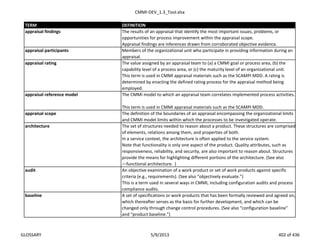
2) implement CM as a single set of standard services.
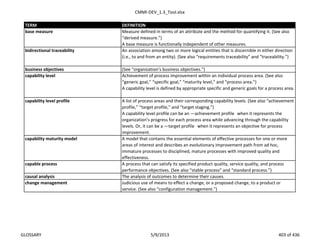
At its start, an Agile team should identify the individual who will be responsible to ensure CM is implemented correctly. At the start of each
iteration, CM support needs are re-confirmed. CM is carefully integrated into the rhythms of each team with a focus on minimizing team
distraction to get the job done. (See ―Interpreting CMMI When Using Agile Approaches‖ in Part I.)
CM 5/9/2013 79 of 436
CMMI-DEV_1.3_Tool.xlsx
TYPE ID TITLE DESCRIPTION
SG 1 Establish Baselines Baselines of identified work products are established.
Specific practices to establish baselines are covered by this specific
goal. The specific practices under the Track and Control Changes
specific goal serve to maintain the baselines. The specific practices of
SP 1.1 Identify Configuration Items Identify configuration items, components, and related work
products to be placed under configuration management.
Configuration identification is the selection and specification of the
following:
- Products delivered to the customer
- Designated internal work products
- Acquired products
- Tools and other capital assets of the project’s work environment
Configuration items can include hardware, equipment, and tangible
assets
as well as software and documentation. Documentation can include
requirements specifications and interface documents. Other
documents that serve to identify the configuration of the product or
service, such as test results, may also be included.
A “configuration item” is an entity designated for configuration
management, which may consist of multiple related work products
Example Work Products
1. Identified configuration items
CM (SG-SP) 5/9/2013 80 of 436
CMMI-DEV_1.3_Tool.xlsx
TYPE ID TITLE DESCRIPTION
Subpractice 1.1.1 Select configuration items and work
products that compose them
based on documented criteria.
Example criteria for selecting configuration items at the appropriate
work product level include the following:
- Work products that can be used by two or more groups
- Work products that are expected to change over time either because
of errors or changes in requirements
- Work products that are dependent on each other (i.e., a change in
one mandates a change in the others)
- Work products critical to project success
Examples of work products that may be part of a configuration item
include the
following:
- Design
- Test plans and procedures
- Test results
- Interface descriptions
- Drawings
- Source code
- User stories or story cards
1.1.2 Assign unique identifiers to configuration
1.1.3 Specify the important characteristics of
each configuration item.
Example characteristics of configuration items include author,
document or file type,
programming language for software code files, minimum marketable
1.1.4 Specify when each configuration item is
placed under configuration management.
Example criteria for determining when to place work products under
configuration management include the following:
- When the work product is ready for test
- Stage of the project lifecycle
- Degree of control desired on the work product
- Cost and schedule limitations
- Stakeholder requirements
1.1.5 Identify the owner responsible for each
1.1.6 Specify relationships among configuration
CM (SG-SP) 5/9/2013 81 of 436
CMMI-DEV_1.3_Tool.xlsx
TYPE ID TITLE DESCRIPTION
SP 1.2 Establish a Configuration Management
System
Establish and maintain a configuration management and change
management system for controlling work products.
A configuration management system includes the storage media,
procedures, and tools for accessing the system. A configuration
management system can consist of multiple subsystems with
different implementations that are appropriate for each configuration
management environment.
A change management system includes the storage media,
procedures, and tools for recording and accessing change requests.
Example Work Products
1. Configuration management system with controlled work products
2. Configuration management system access control procedures
Subpractices 1.2.1 Establish a mechanism to manage multiple
levels of control.
The level of control is typically selected based on project objectives,
risk, and resources. Control levels can vary in relation to the project
lifecycle, type of system
under development, and specific project requirements.
Example levels of control include the following:
- Uncontrolled: Anyone can make changes.
- Work-in-progress: Authors control changes.
- Released: A designated authority authorizes and controls changes
and relevant
stakeholders are notified when changes are made.
Levels of control can range from informal control that simply tracks
changes made
1.2.2 Provide access control to ensure
authorized access to the configuration
1.2.3 Store and retrieve configuration items in a
configuration management system.
1.2.4 Share and transfer configuration items
between control levels in the configuration
1.2.5 Store and recover archived versions of
CM (SG-SP) 5/9/2013 82 of 436
CMMI-DEV_1.3_Tool.xlsx
TYPE ID TITLE DESCRIPTION
1.2.6 Store, update, and retrieve configuration
management records.
1.2.7 Create configuration management reports
from the configuration management
1.2.8 Preserve the contents of the configuration
management system.
Examples of preservation functions of the configuration management
system include the following:
- Backup and restoration of configuration management files
- Archive of configuration management files
1.2.9 Revise the configuration management
SP 1.3 Create or Release Baselines Create or release baselines for internal use and for delivery to the
A baseline is represented by the assignment of an identifier to a
configuration item or a collection of configuration items and
associated entities at a distinct point in time. As a product or service
evolves, multiple baselines can be used to control development and
testing. (See the definition of “baseline” in the glossary.)
Hardware products as well as software and documentation should
also be included in baselines for infrastructure related configurations
One common set of baselines includes the system level requirements,
system element level design requirements, and the product definition
at the end of development/beginning of production. These baselines
are typically referred to respectively as the “functional baseline,”
“allocated baseline,” and “product baseline.”
A software baseline can be a set of requirements, design, source code
Example Work Products
1. Baselines
2. Description of baselines
Subpractices 1.3.1 Obtain authorization from the CCB before
creating or releasing baselines of
1.3.2 Create or release baselines only from
configuration items in the configuration
CM (SG-SP) 5/9/2013 83 of 436
CMMI-DEV_1.3_Tool.xlsx
TYPE ID TITLE DESCRIPTION
1.3.3 Document the set of configuration items
that are contained in a baseline.
1.3.4 Make the current set of baselines readily
SG 2 Track and Control Changes Changes to the work products under configuration management are
The specific practices under this specific goal serve to maintain
baselines after they are established by specific practices under the
SP 2.1 Track Change Requests Track change requests for configuration items.
Change requests address not only new or changed requirements but
also failures and defects in work products.
Change requests are analyzed to determine the impact that the
change will have on the work product, related work products, the
budget, and the schedule.
Example Work Products
Subpractices 2.1.1 Initiate and record change requests in the
change request database.
2.1.2 Analyze the impact of changes and fixes
proposed in change requests.
Changes are evaluated through activities that ensure that they are
consistent with all technical and project requirements.
Changes are evaluated for their impact beyond immediate project or
contract requirements. Changes to an item used in multiple products
can resolve an immediate issue while causing a problem in other
2.1.3 Categorize and prioritize change requests. Emergency requests are identified and referred to an emergency
authority if appropriate.
2.1.4 Review change requests to be addressed
in the next baseline with relevant
stakeholders and get their agreement.
Conduct the change request review with appropriate participants.
Record the disposition of each change request and the rationale for
the decision, including success criteria, a brief action plan if
appropriate, and needs met or unmet by the change. Perform the
2.1.5 Track the status of change requests to
closure.
Change requests brought into the system should be handled in an
efficient and timely manner. Once a change request has been
processed, it is critical to close the request
with the appropriate approved action as soon as it is practical. Actions
SP 2.2 Control Configuration Items Control changes to configuration items.
CM (SG-SP) 5/9/2013 84 of 436
CMMI-DEV_1.3_Tool.xlsx
TYPE ID TITLE DESCRIPTION
Control is maintained over the configuration of the work product
baseline.
This control includes tracking the configuration of each configuration
item,
approving a new configuration if necessary, and updating the
baseline.
Subpractices 2.2.1 Control changes to configuration items
throughout the life of the product or
2.2.2 Obtain appropriate authorization before
changed configuration items are entered
into the configuration management
For example, authorization can come from the CCB, the project
manager, product owner, or the customer.
2.2.3 Check in and check out configuration items
in the configuration management system
for incorporation of changes in a manner
that maintains the correctness and
integrity of configuration items.
Examples of check-in and check-out steps include the following:
- Confirming that the revisions are authorized
- Updating the configuration items
- Archiving the replaced baseline and retrieving the new baseline
- Commenting on the changes made to the item
- Tying changes to related work products such as requirements, user
2.2.4 Perform reviews to ensure that changes
have not caused unintended effects on the
baselines (e.g., ensure that changes have
not compromised the safety or security of
2.2.5 Record changes to configuration items and
reasons for changes as appropriate.
If a proposed change to the work product is accepted, a schedule is
identified for incorporating the change into the work product and
other affected areas.
Configuration control mechanisms can be tailored to categories of
changes. For
example, the approval considerations could be less stringent for
component changes
SG 3 Establish Integrity Integrity of baselines is established and maintained.
CM (SG-SP) 5/9/2013 85 of 436
CMMI-DEV_1.3_Tool.xlsx
TYPE ID TITLE DESCRIPTION
The integrity of baselines, established by processes associated with
the Establish Baselines specific goal, and maintained by processes
associated with the Track and Control Changes specific goal, is
SP 3.1 Establish Configuration Management Establish and maintain records describing configuration items.
Example Work Products
1. Revision history of configuration items
2. Change log
3. Change request records
4. Status of configuration items
5. Differences between baselines
Subpractices 3.1.1 Record configuration management actions
in sufficient detail so the content and
status of each configuration item is known
3.1.2 Ensure that relevant stakeholders have
access to and knowledge of the
configuration status of configuration
items.
Examples of activities for communicating configuration status include
the following:
- Providing access permissions to authorized end users
- Making baseline copies readily available to authorized end users
- Automatically alerting relevant stakeholders when items are
3.1.3 Specify the latest version of baselines.
3.1.4 Identify the version of configuration items
that constitute a particular baseline.
3.1.5 Describe differences between successive
3.1.6 Revise the status and history (i.e., changes,
other actions) of each
configuration item as necessary.
SP 3.2 Perform Configuration Audits Perform configuration audits to maintain the integrity of configuration
CM (SG-SP) 5/9/2013 86 of 436
CMMI-DEV_1.3_Tool.xlsx
TYPE ID TITLE DESCRIPTION
Configuration audits confirm that the resulting baselines and
documentation
conform to a specified standard or requirement. Configuration item
related
records can exist in multiple databases or configuration management
systems. In such instances, configuration audits should extend to
Examples of audit types include the following:
- Functional configuration audits (FCAs): Audits conducted to verify
that the development of a configuration item has been completed
satisfactorily, that the item has achieved the functional and quality
attribute characteristics specified in the functional or allocated
baseline, and that its operational and support documents are
complete and satisfactory.
- Physical configuration audits (PCAs): Audits conducted to verify that
a configuration item, as built, conforms to the technical
Example Work Products
1. Configuration audit results
2. Action items
Subpractices 3.2.1 Assess the integrity of baselines.
3.2.2 Confirm that configuration management
records correctly identify configuration
3.2.3 Review the structure and integrity of items
in the configuration management system.
3.2.4 Confirm the completeness, correctness,
and consistency of items in the
configuration management system.
Completeness, correctness, and consistency of the configuration
management
system’s content are based on requirements as stated in the plan and
3.2.5 Confirm compliance with applicable
configuration management standards and
3.2.6 Track action items from the audit to
CM (SG-SP) 5/9/2013 87 of 436
CMMI-DEV_1.3_Tool.xlsx
DECISION ANALYSIS AND RESOLUTION
A Support Process Area at Maturity Level 3
The purpose of Decision Analysis and Resolution (DAR) is to analyze possible decisions using a formal evaluation process that evaluates
identified alternatives against established criteria.
The Decision Analysis and Resolution process area involves establishing guidelines to determine which issues should be subject to a formal
evaluation process and applying formal evaluation processes to these issues.
A formal evaluation process is a structured approach to evaluating alternative solutions against established criteria to determine a
recommended solution.
A formal evaluation process involves the following actions:
- Establishing the criteria for evaluating alternatives
- Identifying alternative solutions
- Selecting methods for evaluating alternatives
- Evaluating alternative solutions using established criteria and methods
- Selecting recommended solutions from alternatives based on evaluation criteria
Rather than using the phrase “alternative solutions to address issues” each time, in this process area, one of two shorter phrases are used:
“alternative solutions” or “alternatives.”
A formal evaluation process reduces the subjective nature of a decision and provides a higher probability of selecting a solution that meets
multiple demands of relevant stakeholders. While the primary application of this process area is to technical concerns, formal evaluation
processes can be applied to many nontechnical issues, particularly when a project is being planned. Issues that have multiple alternative
solutions and evaluation criteria lend themselves to a formal evaluation process.
Trade studies of equipment or software are typical examples of formal evaluation processes.
During planning, specific issues requiring a formal evaluation process are identified. Typical issues include selection among architectural or
design alternatives, use of reusable or commercial off-the-shelf (COTS) components, supplier selection, engineering support environments or
associated tools, test environments, delivery alternatives, and logistics and production. A formal evaluation process can also be used to
address a make-or-buy decision, the development of manufacturing processes, the selection of distribution locations, and other decisions.
Guidelines are created for deciding when to use formal evaluation processes to address unplanned issues. Guidelines often suggest using
formal evaluation processes when issues are associated with medium-to-high-impact risks or when issues affect the ability to achieve project
DAR 5/9/2013 88 of 436
CMMI-DEV_1.3_Tool.xlsx
DECISION ANALYSIS AND RESOLUTION
Defining an issue well helps to define the scope of alternatives to be considered. The right scope (i.e., not too broad, not too narrow) will aid
in making an appropriate decision for resolving the defined issue.
Formal evaluation processes can vary in formality, type of criteria, and methods employed. Less formal decisions can be analyzed in a few
hours, use few criteria (e.g., effectiveness, cost to implement), and result in a one- or two-page report. More formal decisions can require
separate plans, months of effort, meetings to develop and approve criteria, simulations, prototypes, piloting, and extensive documentation.
Both numeric and non-numeric criteria can be used in a formal evaluation process. Numeric criteria use weights to reflect the relative
importance of criteria. Non-numeric criteria use a subjective ranking scale (e.g., high, medium, low). More formal decisions can require a full
A formal evaluation process identifies and evaluates alternative solutions. The eventual selection of a solution can involve iterative activities
of identification and evaluation. Portions of identified alternatives can be combined, emerging technologies can change alternatives, and the
business situation of suppliers can change during the evaluation period.
A recommended alternative is accompanied by documentation of selected methods, criteria, alternatives, and rationale for the
recommendation. The documentation is distributed to relevant stakeholders; it provides a record of the formal evaluation process and
rationale, which are useful to other projects that encounter a similar issue.
While some of the decisions made throughout the life of the project involve the use of a formal evaluation process, others do not. As
mentioned earlier, guidelines should be established to determine which issues should be subject to a formal evaluation process.
DAR 5/9/2013 89 of 436
CMMI-DEV_1.3_Tool.xlsx
TYPE ID TITLE DESCRIPTION
SG 1 Evaluate Alternatives Decisions are based on an evaluation of alternatives using established
Issues requiring a formal evaluation process can be identified at any
time.
The objective should be to identify issues as early as possible to
SP 1.1 Establish Guidelines for Decision Analysis Establish and maintain guidelines to determine which issues are
process. The choice between the trivial and the truly important is
unclear without explicit guidance. Whether a decision is significant or
not is dependent on the project and circumstances and is determined
Typical guidelines for determining when to require a formal evaluation
process include the
following:
- A decision is directly related to issues that are medium-to-high-
impact risk.
- A decision is related to changing work products under configuration
management.
- A decision would cause schedule delays over a certain percentage or
amount of time.
- A decision affects the ability of the project to achieve its objectives.
Examples of activities for which you may use a formal evaluation
process include the following:
- Making decisions involving the procurement of material when 20
percent of the material
parts constitute 80 percent of the total material costs
- Making design-implementation decisions when technical
performance failure can cause a catastrophic failure (e.g., safety-of-
flight item)
- Making decisions with the potential to significantly reduce design
Example Work Products
1. Guidelines for when to apply a formal evaluation process
Subpractices 1.1.1 Establish guidelines for when to use a
formal evaluation process.
DAR (SG-SP) 5/9/2013 90 of 436
CMMI-DEV_1.3_Tool.xlsx
TYPE ID TITLE DESCRIPTION
1.1.2 Incorporate the use of guidelines into the
defined process as
SP 1.2 Establish Evaluation Criteria Establish and maintain criteria for evaluating alternatives and the
Criteria are ranked so that the highest ranked criteria exert the most
influence on the evaluation. This process area is referenced by many
other process areas in the model,
and many contexts in which a formal evaluation process can be used.
Therefore, in some situations you may find that criteria have already
been
defined as part of another process. This specific practice does not
suggest that a second development of criteria be conducted. A well-
defined statement of the issue to be addressed and the decision to be
made focuses the analysis to be performed. Such a statement also
Example Work Products
1. Documented evaluation criteria
2. Rankings of criteria importance
Subpractices 1.2.1 Define the criteria for evaluating
alternative solutions.
Criteria should be traceable to requirements, scenarios, business case
assumptions, business objectives, or other documented sources.
Types of criteria to consider include the following:
- Technology limitations
- Environmental impact
- Risks
- Business value
- Impact on priorities
- Total ownership and lifecycle costs
1.2.2 Define the range and scale for ranking the
evaluation criteria.
Scales of relative importance for evaluation criteria can be established
with non-numeric values or with formulas that relate the evaluation
1.2.3 Rank the criteria. The criteria are ranked according to the defined range and scale to
reflect the needs, objectives, and priorities of the relevant
1.2.4 Assess the criteria and their relative
1.2.5 Evolve the evaluation criteria to improve
DAR (SG-SP) 5/9/2013 91 of 436
CMMI-DEV_1.3_Tool.xlsx
TYPE ID TITLE DESCRIPTION
1.2.6 Document the rationale for the selection
and rejection of evaluation criteria.
Documentation of selection criteria and rationale may be needed to
justify solutions or for future reference and use.
SP 1.3 Identify Alternative Solutions Identify alternative solutions to address issues.
A wider range of alternatives can surface by soliciting as many
stakeholders as practical for input. Input from stakeholders with
diverse skills and backgrounds can help teams identify and address
assumptions, constraints, and biases. Brainstorming sessions can
stimulate innovative alternatives through rapid interaction and
feedback.
Sufficient candidate solutions may not be furnished for analysis. As
the analysis proceeds, other alternatives should be added to the list of
Example Work Products
1. Identified alternatives
Subpractices 1.3.1 Perform a literature search. A literature search can uncover what others have done both inside
and outside the organization. Such a search can provide a deeper
understanding of the problem, alternatives to consider, barriers to
1.3.2 Identify alternatives for consideration in
addition to the alternatives that may be
provided with the issue.
criteria identify priorities of relevant stakeholders and the importance
of technical, logistical, or other challenges.
Combining key attributes of existing alternatives can generate
additional and sometimes stronger alternatives.
Solicit alternatives from relevant stakeholders. Brainstorming
sessions, interviews, and working groups can be used effectively to
SP 1.4 Select Evaluation Methods Select evaluation methods.
DAR (SG-SP) 5/9/2013 92 of 436
CMMI-DEV_1.3_Tool.xlsx
TYPE ID TITLE DESCRIPTION
Methods for evaluating alternative solutions against established
criteria can range from simulations to the use of probabilistic models
and decision
theory. These methods should be carefully selected. The level of detail
of a method should be commensurate with cost, schedule,
performance, and
risk impacts.
While many problems may require only one evaluation method, some
problems may require multiple methods. For example, simulations
Example Work Products
1. Selected evaluation methods
Subpractices 1.4.1 Select methods based on the purpose for
analyzing a decision and on the availability
of the information used to support the
For example, the methods used for evaluating a solution when
requirements are weakly defined may be different from the methods
used when the requirements are well defined.
Typical evaluation methods include the following:
- Testing Modeling and simulation
- Engineering studies
- Manufacturing studies
- Cost studies
- Business opportunity studies
- Surveys
- Extrapolations based on field experience and prototypes
- End-user review and comment
- Judgment provided by an expert or group of experts (e.g., Delphi
1.4.2 Select evaluation methods based on their
ability to focus on the issues at hand
without being overly influenced by side
Results of simulations can be skewed by random activities in the
solution that are not directly related to the issues at hand.
1.4.3 Determine the measures needed to
support the evaluation method.
Consider the impact on cost, schedule, performance, and risks.
SP 1.5 Evaluate Alternative Solutions Evaluate alternative solutions using established criteria and methods.
DAR (SG-SP) 5/9/2013 93 of 436
CMMI-DEV_1.3_Tool.xlsx
TYPE ID TITLE DESCRIPTION
Evaluating alternative solutions involves analysis, discussion, and
review. Iterative cycles of analysis are sometimes necessary.
Supporting analyses, experimentation, prototyping, piloting, or
simulations maybe needed to substantiate scoring and conclusions.
Often, the relative importance of criteria is imprecise and the total
effect on a solution is not apparent until after the analysis is
Example Work Products
1. Evaluation results
Subpractices 1.5.1 Evaluate proposed alternative solutions
using the established
1.5.2 Evaluate assumptions related to the
evaluation criteria and the
evidence that supports the assumptions.
1.5.3 Evaluate whether uncertainty in the values
for alternative solutions
affects the evaluation and address these
uncertainties as appropriate.
For instance, if the score varies between two values, is the difference
significant enough to make a difference in the final solution set? Does
the variation in score represent a high-impact risk? To address these
concerns, simulations may be run, further studies may be performed,
1.5.4 Perform simulations, modeling,
prototypes, and pilots as necessary to
exercise the evaluation criteria, methods,
and alternative solutions.
Untested criteria, their relative importance, and supporting data or
functions can cause the validity of solutions to be questioned. Criteria
and their relative priorities and scales can be tested with trial runs
against a set of alternatives. These trial runs of a select set of criteria
allow for the evaluation of the cumulative impact of criteria on a
1.5.5 Consider new alternative solutions,
criteria, or methods if proposed
alternatives do not test well; repeat
1.5.6 Document the results of the evaluation. Document the rationale for the addition of new alternatives or
methods and changes to criteria, as well as the results of interim
SP 1.6 Select Solutions Select solutions from alternatives based on evaluation criteria.
DAR (SG-SP) 5/9/2013 94 of 436
CMMI-DEV_1.3_Tool.xlsx
TYPE ID TITLE DESCRIPTION
Selecting solutions involves weighing results from the evaluation of
alternatives. Risks associated with the implementation of solutions
should be assessed.
Example Work Products
Subpractices 1.6.1 Assess the risks associated with
implementing the recommended solution.
Decisions must often be made with incomplete information. There
can be substantial risk associated with the decision because of having
incomplete information.
When decisions must be made according to a specific schedule, time
and resources may not be available for gathering complete
1.6.2 Document and communicate to relevant
stakeholders the results and rationale for
It is important to record both why a solution is selected and why
another solution was rejected.
DAR (SG-SP) 5/9/2013 95 of 436
CMMI-DEV_1.3_Tool.xlsx
INTEGRATED PROJECT MANAGEMENT
A Project Management Process Area at Maturity Level 3
The purpose of Integrated Project Management (IPM) is to establish and manage the project and the involvement of relevant stakeholders
according to an integrated and defined process that is tailored from the organization’s set of standard processes.
Integrated Project Management involves the following activities:
- Establishing the project’s defined process at project startup by tailoring the organization’s set of standard processes
- Managing the project using the project’s defined process
- Establishing the work environment for the project based on the organization’s work environment standards
- Establishing teams that are tasked to accomplish project objectives
- Using and contributing to organizational process assets
- Enabling relevant stakeholders’ concerns to be identified, considered, and, when appropriate, addressed during the project
Ensuring that relevant stakeholders (1) perform their tasks in a coordinated and timely manner; (2) address project requirements, plans,
objectives, problems, and risks; (3) fulfill their commitments; and
(4) identify, track, and resolve coordination issues
The integrated and defined process that is tailored from the organization’s set of standard processes is called the project’s defined process.
(See the definition of “project” in the glossary.)
Managing the project’s effort, cost, schedule, staffing, risks, and other factors is tied to the tasks of the project’s defined process. The
implementation and management of the project’s defined process are typically described in the project plan. Certain activities may be
covered in other plans that affect the project, such as the quality assurance plan, risk management strategy, and the configuration
management plan. Since the defined process for each project is tailored from the organization’s set of standard processes, variability among
projects is typically reduced and projects can easily share process assets, data, and lessons learned.
This process area also addresses the coordination of all activities associated with the project such as the following:
- Development activities (e.g., requirements development, design, verification)
- Service activities (e.g., delivery, help desk, operations, customer contact)
- Acquisition activities (e.g., solicitation, agreement monitoring, transition to operations)
- Support activities (e.g., configuration management, documentation, marketing, training)
IPM 5/9/2013 96 of 436
CMMI-DEV_1.3_Tool.xlsx
INTEGRATED PROJECT MANAGEMENT
The working interfaces and interactions among relevant stakeholders
internal and external to the project are planned and managed to ensure the
quality and integrity of the overall endeavor. Relevant stakeholders
participate as appropriate in defining the project’s defined process and the project plan. Reviews and exchanges are regularly conducted with
relevant stakeholders to ensure that coordination issues receive appropriate attention and everyone involved with the project is
appropriately aware of status, plans, and activities. (See the definition of “relevant stakeholder” in the glossary.) In defining the project’s
defined process, formal interfaces are created as necessary to ensure that appropriate coordination and collaboration occurs.
This process area applies in any organizational structure, including projects that are structured as line organizations, matrix organizations, or
teams. The terminology should be appropriately interpreted for the organizational structure in place.
IPM 5/9/2013 97 of 436
CMMI-DEV_1.3_Tool.xlsx
TYPE ID TITLE DESCRIPTION
SG 1 Use the Project’s Defined Process The project is conducted using a defined process tailored from the
The project’s defined process includes those processes from the
organization’s set of standard processes that address all processes
necessary to acquire, develop, maintain, or deliver the product.
The product related lifecycle processes, such as manufacturing and
SP 1.1 Establish the Project’s Defined Process Establish and maintain the project’s defined process from project
The project’s defined process consists of defined processes that form
an integrated, coherent lifecycle for the project. The project’s defined
process should satisfy the project’s contractual
requirements, operational needs, opportunities, and constraints. It is
designed to provide a best fit for project needs.
A project’s defined process is based on the following factors:
- Stakeholder requirements
- Commitments Organizational process needs and objectives
- The organization’s set of standard processes and tailoring guidelines
- The operational environment
Establishing the project’s defined process at project startup helps to
ensure that project staff and relevant stakeholders implement a set of
activities needed to efficiently establish an initial set of requirements
and plans for the project. As the project progresses, the description of
the project’s
defined process is elaborated and revised to better meet project
requirements and the organization’s process needs and objectives.
Also, as
the organization’s set of standard processes changes, the project’s
IPM (SG-SP) 5/9/2013 98 of 436
CMMI-DEV_1.3_Tool.xlsx
TYPE ID TITLE DESCRIPTION
Subpractices 1.1.1 Select a lifecycle model from the ones
available in organizational process assets.
Examples of project characteristics that could affect the selection of
lifecycle models include the following:
- Size or complexity of the project
- Project strategy
- Experience and familiarity of staff with implementing the process
- Constraints such as cycle time and acceptable defect levels
- Availability of customers to answer questions and provide feedback
1.1.2 Select standard processes from the
organization’s set of standard processes
1.1.3 Tailor the organization’s set of standard
processes and other organizational process
assets according to tailoring guidelines to
produce the project’s defined process.
Sometimes the available lifecycle models and standard processes are
inadequate to
meet project needs. In such circumstances, the project should seek
approval to deviate from what is required by the organization.
Waivers are provided for this purpose.
1.1.4 Use other artifacts from the organization’s
process asset library as appropriate.
Other artifacts can include the following:
- Lessons learned documents
- Templates
- Example documents
- Estimating models
IPM (SG-SP) 5/9/2013 99 of 436
CMMI-DEV_1.3_Tool.xlsx
TYPE ID TITLE DESCRIPTION
1.1.5 Document the project’s defined process. The project’s defined process covers all of the activities for the project
and its interfaces to relevant stakeholders. Examples of project
activities include the following:
- Project planning
- Project monitoring
- Supplier management
- Quality assurance
- Risk management
- Decision analysis and resolution
- Requirements development
- Requirements management
- Configuration management
- Product development and support
- Code review
1.1.6 Conduct peer reviews of the project’s
1.1.7 Revise the project’s defined process as
SP 1.2 Use Organizational Process Assets for
Planning Project Activities
When available, use results of previous planning and execution
activities as predictors of the relative scope and risk of the effort
being estimated.
Example Work Products
1. Project estimates
Subpractices 1.2.1 Use the tasks and work products of the
project’s defined process as a basis for
estimating and planning project activities.
An understanding of the relationships among tasks and work products
of the project’s defined process, and of the roles to be performed by
relevant stakeholders, is a basis for developing a realistic plan.
1.2.2 Use the organization’s measurement
repository in estimating the project’s
planning parameters.
This estimate typically includes the following:
- Appropriate historical data from this project or similar projects
- Similarities and differences between the current project and those
projects whose
historical data will be used
- Validated historical data
- Reasoning, assumptions, and rationale used to select the historical
IPM (SG-SP) 5/9/2013 100 of 436
CMMI-DEV_1.3_Tool.xlsx
TYPE ID TITLE DESCRIPTION
Examples of parameters that are considered for similarities and
differences include the following:
- Work product and task attributes
- Application domain
- Experience of the people
- Design and development approaches
Examples of data contained in the organization’s measurement
repository include the following:
- Size of work products or other work product attributes
- Effort Cost
- Schedule
- Staffing
- Response time
- Service capacity
- Supplier performance
SP 1.3 Establish the Project’s Work Environment Establish and maintain the project’s work environment based on the
organization’s work environment standards.
An appropriate work environment for a project comprises an
infrastructure of facilities, tools, and equipment that people need to
perform their jobs effectively in support of business and project
objectives. The work environment and its components are maintained
at a level of work environment performance and reliability indicated
The project’s work environment might encompass environments for
product integration, verification, and validation or they might be
separate environments.
Example Work Products
1. Equipment and tools for the project
2. Installation, operation, and maintenance manuals for the project
work
environment 3. User surveys and results
IPM (SG-SP) 5/9/2013 101 of 436
CMMI-DEV_1.3_Tool.xlsx
TYPE ID TITLE DESCRIPTION
Subpractices 1.3.1 Plan, design, and install a work
environment for the project.
The critical aspects of the project work environment are, like any
other product,
requirements driven. Functionality and quality attributes of the work
It may be necessary to make tradeoffs among quality attributes,
costs, and risks. The following are examples of each:
- Quality attribute considerations can include timely communication,
safety, security, and maintainability.
- Costs can include capital outlays, training, a support structure;
disassembly and disposal of existing environments; and the operation
and maintenance of the
Examples of equipment and tools include the following:
- Office software
- Decision support software
- Project management tools
- Test and evaluation equipment
- Requirements management tools and design tools
- Configuration management tools
- Evaluation tools
- Integration tools
- Automated test tools
1.3.2 Provide ongoing maintenance and
operational support for the project’s work
environment.
Maintenance and support of the work environment can be
accomplished either with capabilities found inside the organization or
hired from outside the organization.
Examples of maintenance and support approaches include the
following:
- Hiring people to perform maintenance and support
- Training people to perform maintenance and support
1.3.3 Maintain the qualification of components
of the project’s work
environment.
Components include software, databases, hardware, tools, test
equipment, and
appropriate documentation. Qualification of software includes
IPM (SG-SP) 5/9/2013 102 of 436
CMMI-DEV_1.3_Tool.xlsx
TYPE ID TITLE DESCRIPTION
1.3.4 Periodically review how well the work
environment is meeting project needs and
supporting collaboration, and take action
Examples of actions that might be taken include the following:
- Adding new tools
- Acquiring additional networks, equipment, training, and support
SP 1.4 Integrate Plans Integrate the project plan and other plans that affect the project to
This specific practice extends the specific practices for establishing
and maintaining a project plan to address additional planning
activities such as incorporating the project’s defined process,
coordinating with relevant stakeholders, using organizational process
assets, incorporating plans for peer reviews, and establishing
objective entry and exit criteria for tasks. The development of the
project plan should account for current and projected needs,
objectives, and requirements of the organization,
Subpractices 1.4.1 Integrate other plans that affect the
project with the project plan.
Other plans that affect the project plan can include the following:
- Quality assurance plans
- Risk management strategy
- Verification and validation plans
- Transition to operations and support plans
- Configuration management plans
- Documentation plans
- Staff training plans
- Facilities and logistics plans
1.4.2 Incorporate into the project plan the
definitions of measures and
measurement activities for managing the
Examples of measures that would be incorporated include the
following:
- Organization’s common set of measures
1.4.3 Identify and analyze product and project
interface risks.
Examples of product and project interface risks include the following:
- Incomplete interface descriptions
- Unavailability of tools, suppliers, or test equipment
- Unavailability of COTS components
- Inadequate or ineffective team interfaces
IPM (SG-SP) 5/9/2013 103 of 436
CMMI-DEV_1.3_Tool.xlsx
TYPE ID TITLE DESCRIPTION
1.4.4 Schedule tasks in a sequence that accounts
for critical development
and delivery factors and project risks.
Examples of factors considered in scheduling include the following:
- Size and complexity of tasks
- Needs of the customer and end users
- Availability of critical resources
- Availability of key staff
- Integration and test issues
1.4.5 Incorporate plans for performing peer
reviews on work products of the project’s
1.4.6 Incorporate the training needed to
perform the project’s defined process in
This task typically includes negotiating with the organizational training
group on the support they will provide.
1.4.7 Establish objective entry and exit criteria
to authorize the initiation and completion
of tasks described in the work breakdown
1.4.8 Ensure that the project plan is
appropriately compatible with the plans of
Typically the plan and changes to the plan will be reviewed for
compatibility.
1.4.9 Identify how conflicts will be resolved that
arise among relevant stakeholders.
SP 1.5 Manage the Project Using Integrated Plans Manage the project using the project plan, other plans that affect the
project, and the project’s defined process.
Example Work Products
1. Work products created by performing the project’s defined process
2. Collected measures (i.e., actuals) and status records or reports
3. Revised requirements, plans, and commitments
4. Integrated plans
Subpractices 1.5.1 Implement the project’s defined process
using the organization’s
process asset library.
This task typically includes the following activities:
- Incorporating artifacts from the organization’s process asset library
into the project as appropriate
IPM (SG-SP) 5/9/2013 104 of 436
CMMI-DEV_1.3_Tool.xlsx
TYPE ID TITLE DESCRIPTION
1.5.2 Monitor and control the project’s activities
and work products using the project’s
defined process, project plan, and other
plans that affect the project.
This task typically includes the following activities:
- Using the defined entry and exit criteria to authorize the initiation
and determine the completion of tasks
- Monitoring activities that could significantly affect actual values of
the project’s planning parameters
- Tracking project planning parameters using measurable thresholds
that will trigger investigation and appropriate actions
- Monitoring product and project interface risks
An understanding of the relationships among tasks and work products
of the project’s defined process and of the roles to be performed by
relevant stakeholders, along with well-defined control mechanisms
1.5.3 Obtain and analyze selected
measurements to manage the project and
1.5.4 Periodically review and align the project’s
performance with current and anticipated
needs, objectives, and requirements of the
organization, customer, and end users as
appropriate.
This review includes alignment with organizational process needs and
objectives.
Examples of actions that achieve alignment include the following:
- Changing the schedule with appropriate adjustments to other
planning parameters and project risks
- Changing requirements or commitments in response to a change in
1.5.5 Address causes of selected issues that can
affect project objectives.
Issues that require corrective action are determined and analyzed as
in the Analyze Issues and Take Corrective Actions specific practices of
the Project Monitoring and Control process area. As appropriate, the
project may periodically review issues previously encountered on
other projects or in earlier phases of the project, and conduct causal
analysis of selected issues to determine how to prevent recurrence
for issues which can significantly affect project objectives. Project
SP 1.6 Establish Teams Establish and maintain teams.
IPM (SG-SP) 5/9/2013 105 of 436
CMMI-DEV_1.3_Tool.xlsx
TYPE ID TITLE DESCRIPTION
The project is managed using teams that reflect the organizational
rules
and guidelines for team structuring, formation, and operation. (See
the definition of “team” in the glossary.)
The project’s shared vision is established prior to establishing the
One of the best ways to ensure coordination and collaboration with
relevant stakeholders is to include them on the team. In a customer
environment that requires coordination among multiple
product or service development organizations, it is important to
establish a team with representation from all parties that affect
overall success. Such
representation helps to ensure effective collaboration across these
organizations, including the timely resolution of coordination issues.
Example Work Products
1. Documented shared vision
2. List of members assigned to each team
Subpractices 1.6.1 Establish and maintain the project’s shared
vision.
When creating a shared vision, it is critical to understand the
interfaces between the project and stakeholders external to the
project. The vision should be shared among relevant stakeholders to
1.6.2 Establish and maintain the team structure. The project WBS, cost, schedule, project risks, resources, interfaces,
the project’s defined process, and organizational guidelines are
evaluated to establish an appropriate team structure, including team
1.6.3 Establish and maintain each team. Establishing and maintaining teams encompasses choosing team
leaders and team members and establishing team charters for each
team. It also involves providing resources required to accomplish
1.6.4 Periodically evaluate the team structure
and composition.
Teams should be monitored to detect misalignment of work across
different teams, mismanaged interfaces, and mismatches of tasks to
team members. Take corrective action when team or project
SP 1.7 Contribute to Organizational Process Contribute process related experiences to organizational process
IPM (SG-SP) 5/9/2013 106 of 436
CMMI-DEV_1.3_Tool.xlsx
TYPE ID TITLE DESCRIPTION
This specific practice addresses contributing information from
processes in the project’s defined process to organizational process
assets.
Example Work Products
1. Proposed improvements to organizational process assets
2. Actual process and product measures collected from the project
3. Documentation (e.g., exemplary process descriptions, plans,
training modules, checklists, lessons learned)
Subpractices 1.7.1 Propose improvements to the
1.7.2 Store process and product measures in the
organization’s
measurement repository.
These process and product measures typically include the following:
- Planning data
- Replanning data
Examples of data recorded by the project include the following:
- Task descriptions
- Assumptions
- Estimates
- Revised estimates
- Definitions of recorded data and measures
- Measures
- Context information that relates the measures to the activities
performed and work products produced
- Associated information needed to reconstruct the estimates, assess
1.7.3 Submit documentation for possible
inclusion in the organization’s process
asset library.
Examples of documentation include the following:
- Exemplary process descriptions
- Training modules
- Exemplary plans
- Checklists and templates
- Project repository shells
- Tool configurations
IPM (SG-SP) 5/9/2013 107 of 436
CMMI-DEV_1.3_Tool.xlsx
TYPE ID TITLE DESCRIPTION
1.7.4 Document lessons learned from the
project for inclusion in the
organization’s process asset library.
1.7.5 Provide process artifacts associated with
tailoring and implementing the
organization’s set of standard processes in
SG 2 Coordinate and Collaborate with Relevant
Stakeholders
Coordination and collaboration between the project and relevant
stakeholders
SP 2.1 Manage Stakeholder Involvement Manage the involvement of relevant stakeholders in the project.
Stakeholder involvement is managed according to the project’s
integrated plan and defined process.
Example Work Products
1. Agendas and schedules for collaborative activities
2. Recommendations for resolving relevant stakeholder issues
3. Documented issues (e.g., issues with stakeholder requirements,
Subpractices 2.1.1 Coordinate with relevant stakeholders
who should participate in project activities.
The relevant stakeholders should already be identified in the project
plan.
2.1.2 Ensure work products that are produced to
satisfy commitments meet the
requirements of the recipients.
The work products produced to satisfy commitments can be services.
This task typically includes the following:
- Reviewing, demonstrating, or testing, as appropriate, each work
product produced by relevant stakeholders
- Reviewing, demonstrating, or testing, as appropriate, each work
product produced by the project for other projects with
2.1.3 Develop recommendations and coordinate
actions to resolve misunderstandings and
SP 2.2 Manage Dependencies Participate with relevant stakeholders to identify, negotiate, and track
Example Work Products
1. Defects, issues, and action items resulting from reviews with
relevant stakeholders
2. Critical dependencies
3. Commitments to address critical dependencies
IPM (SG-SP) 5/9/2013 108 of 436
CMMI-DEV_1.3_Tool.xlsx
TYPE ID TITLE DESCRIPTION
Subpractices 2.2.1 Conduct reviews with relevant
2.2.2 Identify each critical dependency.
2.2.3 Establish need dates and plan dates for
each critical dependency
based on the project schedule.
2.2.4 Review and get agreement on
commitments to address each critical
dependency with those who are
2.2.5 Document critical dependencies and
commitments.
Documentation of commitments typically includes the following:
- Describing the commitment
- Identifying who made the commitment
- Identifying who is responsible for satisfying the commitment
- Specifying when the commitment will be satisfied
- Specifying the criteria for determining if the commitment has been
2.2.6 Track the critical dependencies and
commitments and take corrective action
as appropriate.
Tracking critical dependencies typically includes the following:
- Evaluating the effects of late and early completion for impacts on
future activities and milestones
- Resolving actual and potential problems with responsible parties
whenever possible
SP 2.3 Resolve Coordination Issues Resolve issues with relevant stakeholders.
Examples of coordination issues include the following:
- Product and product component requirements and design defects
- Late critical dependencies and commitments
- Product level problems
- Unavailability of critical resources or staff
Example Work Products
1. Relevant stakeholder coordination issues
2. Status of relevant stakeholder coordination issues
Subpractices 2.3.1 Identify and document issues.
2.3.2 Communicate issues to relevant
2.3.3 Resolve issues with relevant stakeholders.
IPM (SG-SP) 5/9/2013 109 of 436
CMMI-DEV_1.3_Tool.xlsx
TYPE ID TITLE DESCRIPTION
2.3.4 Escalate to appropriate managers the
issues not resolvable with relevant
2.3.5 Track issues to closure.
2.3.6 Communicate with relevant stakeholders
on the status and resolution of issues.
IPM (SG-SP) 5/9/2013 110 of 436
CMMI-DEV_1.3_Tool.xlsx
MEASUREMENT AND ANALYSIS
A Support Process Area at Maturity Level 2
The purpose of Measurement and Analysis (MA) is to develop and sustain
a measurement capability used to support management information needs.
The Measurement and Analysis process area involves the following activities:
- Specifying objectives of measurement and analysis so that they are aligned with identified information needs and project, organizational, or
business objectives
- Specifying measures, analysis techniques, and mechanisms for data collection, data storage, reporting, and feedback
- Implementing the analysis techniques and mechanisms for data collection, data reporting, and feedback
- Providing objective results that can be used in making informed decisions and taking appropriate corrective action
The integration of measurement and analysis activities into the processes of the project supports the following:
- Objective planning and estimating
- Tracking actual progress and performance against established plans and objectives
- Identifying and resolving process related issues
- Providing a basis for incorporating measurement into additional processes in the future
The staff required to implement a measurement capability may or may not be employed in a separate organization-wide program.
Measurement capability may be integrated into individual projects or other organizational functions (e.g., quality assurance).
The initial focus for measurement activities is at the project level. However, a measurement capability can prove useful for addressing
organization- and enterprise-wide information needs. To support this capability, measurement activities should support information needs at
multiple levels, including the business, organizational unit, and project to minimize re-work as the organization matures.
Projects can store project specific data and results in a project specific repository, but when data are to be used widely or are to be analyzed
in support of determining data trends or benchmarks, data may reside in the organization’s measurement repository.
Measurement and analysis of product components provided by suppliers is essential for effective management of the quality and costs of the
project. It is possible, with careful management of supplier agreements, to provide insight into data that support supplier performance
analysis.
Measurement objectives are derived from information needs that come from project, organizational, or business objectives. In this process
MA 5/9/2013 111 of 436
CMMI-DEV_1.3_Tool.xlsx
Example Project,
Organizational, or
Business Objectives
Information Need Measurement
Objective
Measurement
Information
Categories
Example Base
Measures
Example Derived
Measures
Shorten time to
delivery
Be first to market the
product
What is the estimated
delivery time?
Provide insight into
schedule fluctuations
and progress
Schedule and
progress
Estimate and actual
start and end dates
by task
Milestone
performance
Percentage of project
on time
Schedule estimation
accuracy
Size and effort Estimated and actual
effort and size
Productivity
Effort and cost Estimated and actual
cost
Cost performance
Cost variance
Requirements count Requirements
volatility
Size estimation
accuracy
Function point count Estimated vs. actual
function points
Lines of code count Amount of new,
modified, and reused
code
Table MA.1: Example Measurement Relationships
Increase market
share by reducing
costs of products and
services
How accurate are the
size and cost
estimates?
Provide insight into
actual size and costs
compared to plan
Deliver specified
functionality
Has scope or
project size
grown?
Provide insight
into actual size
compared to plan,
identify unplanned
growth
Size and
stability
Table MA.1 5/9/2013 112 of 436
CMMI-DEV_1.3_Tool.xlsx
Example Project,
Organizational, or
Business Objectives
Information Need Measurement
Objective
Measurement
Information
Categories
Example Base
Measures
Example Derived
Measures
Table MA.1: Example Measurement Relationships
Where are
defects being
inserted and
detected prior
to delivery?
Evaluate the
effectiveness of
defect detection
throughout the
product lifecycle
Quality Number of defects
inserted and detected
by lifecycle
phase
Product size
Defect containment
by lifecycle phase
Defect density
What is the cost of
rework?
Determine the
cost of correcting
defects
Cost Number of defects
inserted and detected
by lifecycle
phase
Effort hours to
correct defects
Labor rates
Rework costs
Reduce information
system
vulnerabilities
What is the
magnitude of
open system
vulnerabilities?
Evaluate the
effectiveness of
mitigating system
vulnerabilities
Information
Assurance
Number of system
vulnerabilities
identified and
number of system
vulnerabilities
mitigated
Percentage of system
vulnerabilities
mitigated
Reduce defects in
products delivered
to the customer by
10% without
affecting cost
Table MA.1 5/9/2013 113 of 436
CMMI-DEV_1.3_Tool.xlsx
TYPE ID TITLE DESCRIPTION
SG 1 Align Measurement and Analysis Activities Measurement objectives and activities are aligned with identified
information needs and objectives.
The specific practices under this specific goal can be addressed
concurrently or in any order.
When establishing measurement objectives, experts often think
ahead about necessary criteria for specifying measures and analysis
procedures. They also think concurrently about the constraints
imposed by data collection and storage procedures.
Often it is important to specify the essential analyses to be conducted
before attending to details of measurement specification, data
collection, or storage.
SP 1.1 Establish Measurement Objectives Establish and maintain measurement objectives derived from
identified information needs and objectives.
Measurement objectives document the purposes for which
measurement
and analysis are done and specify the kinds of actions that can be
taken based on results of data analyses. Measurement objectives can
also identify the change in behavior desired as a result of
implementing a measurement and analysis activity.
Measurement objectives may be constrained by existing processes,
available resources, or other measurement considerations. Judgments
may need to be made about whether the value of the result is
commensurate with resources devoted to doing the work.
Modifications to identified information needs and objectives can, in
turn, be indicated as a consequence of the process and results of
measurement and analysis.
MA (SG-SP) 5/9/2013 114 of 436
CMMI-DEV_1.3_Tool.xlsx
TYPE ID TITLE DESCRIPTION
Sources of information needs and objectives can include the
following:
- Project plans
- Project performance monitoring
- Interviews with managers and others who have information needs
- Established management objectives
- Strategic plans
- Business plans
- Formal requirements or contractual obligations
- Recurring or other troublesome management or technical problems
- Experiences of other projects or organizational entities
- External industry benchmarks
- Process improvement plans
Example measurement objectives include the following:
- Provide insight into schedule fluctuations and progress
- Provide insight into actual size compared to plan
- Identify unplanned growth
- Evaluate the effectiveness of defect detection throughout the
product development lifecycle
- Determine the cost of correcting defects
- Provide insight into actual costs compared to plan
- Evaluate supplier progress against the plan
- Evaluate the effectiveness of mitigating information system
vulnerabilities
Example Work Products
1. Measurement objectives
Subpractices 1.1.1 Document information needs and
objectives.
MA (SG-SP) 5/9/2013 115 of 436
CMMI-DEV_1.3_Tool.xlsx
TYPE ID TITLE DESCRIPTION
1.1.2 Document information needs and
objectives.
It can be neither possible nor desirable to subject all initially identified
information needs to measurement and analysis. Priorities may also
need to be set within the limits of available resources.
1.1.3 Document, review, and update
measurement objectives.
Carefully consider the purposes and intended uses of measurement
and analysis.
The measurement objectives are documented, reviewed by
management and other relevant stakeholders, and updated as
necessary. Doing so enables traceability to subsequent measurement
and analysis activities, and helps to ensure that analyses will properly
address identified information needs and objectives.
It is important that users of measurement and analysis results be
involved in setting
measurement objectives and deciding on plans of action. It may also
be appropriate to involve those who provide the measurement data.
1.1.4 Provide feedback for refining and clarifying
information needs and
objectives as necessary.
Identified information needs and objectives can be refined and
clarified as a result of
setting measurement objectives. Initial descriptions of information
needs may be
ambiguous. Conflicts can arise between existing needs and objectives.
Precise targets on an already existing measure may be unrealistic.
1.1.5 Maintain traceability of measurement
objectives to identified information needs
and objectives.
There should always be a good answer to the question, ―Why are we
measuring this?
Of course, measurement objectives can also change to reflect
evolving information
needs and objectives.
SP 1.2 Specify Measures Specify measures to address measurement objectives.
MA (SG-SP) 5/9/2013 116 of 436
CMMI-DEV_1.3_Tool.xlsx
TYPE ID TITLE DESCRIPTION
Measurement objectives are refined into precise, quantifiable
measures. Measurement of project and organizational work can
typically be traced to
one or more measurement information categories. These categories
include
the following: schedule and progress, effort and cost, size and
stability, and quality. Measures can be either base or derived. Data for
base measures are obtained by direct measurement. Data for derived
measures come from other data, typically by combining two or more
base measures.
Examples of commonly used base measures include the following:
- Estimates and actual measures of work product size (e.g., number of
pages)
- Estimates and actual measures of effort and cost (e.g., number of
person hours)
- Quality measures (e.g., number of defects by severity)
- Information security measures (e.g., number of system
vulnerabilities identified)
- Customer satisfaction survey scores
MA (SG-SP) 5/9/2013 117 of 436
CMMI-DEV_1.3_Tool.xlsx
TYPE ID TITLE DESCRIPTION
Examples of commonly used derived measures include the following:
- Earned value
- Schedule performance index
- Defect density
- Peer review coverage
- Test or verification coverage
- Reliability measures (e.g., mean time to failure)
- Quality measures (e.g., number of defects by severity/total number
of defects)
- Information security measures (e.g., percentage of system
vulnerabilities mitigated)
- Customer satisfaction trends
Derived measures typically are expressed as ratios, composite indices,
or other aggregate summary measures. They are often more
quantitatively reliable and meaningfully interpretable than the base
measures used to generate them.
There are direct relationships among information needs,
measurement objectives, measurement categories, base measures,
and derived measures. This direct relationship is depicted using some
common examples in Table MA.1.
Example Work Products
1. Specifications of base and derived measures
Subpractices 1.2.1 Identify candidate measures based on
documented measurement objectives.
Measurement objectives are refined into measures. Identified
candidate measures are categorized and specified by name and unit
of measure.
1.2.2 Maintain traceability of measures to
measurement objectives.
Interdependencies among candidate measures are identified to
enable later data validation and candidate analyses in support of
measurement objectives.
MA (SG-SP) 5/9/2013 118 of 436
CMMI-DEV_1.3_Tool.xlsx
TYPE ID TITLE DESCRIPTION
1.2.3 Identify existing measures that already
address measurement
objectives.
Specifications for measures may already exist, perhaps established for
other purposes earlier or elsewhere in the organization.
1.2.4 Specify operational definitions for
measures.
Operational definitions are stated in precise and unambiguous terms.
They address two important criteria:
- Communication: What has been measured, how was it measured,
what are the units of measure, and what has been included or
excluded?
- Repeatability: Can the measurement be repeated, given the same
definition, to get the same results?
1.2.5 Prioritize, review, and update measures. Proposed specifications of measures are reviewed for their
appropriateness with
potential end users and other relevant stakeholders. Priorities are set
or changed, and specifications of measures are updated as necessary.
SP 1.3 Specify Data Collection and Storage
Procedures
Specify Data Collection and Storage Procedures
Explicit specification of collection methods helps to ensure that the
right
data are collected properly. This specification can also help further
clarify
information needs and measurement objectives. Proper attention to
storage and retrieval procedures helps to ensure that
data are available and accessible for future use.
Example Work Products
1. Data collection and storage procedures
2. Data collection tools
Subpractices 1.3.1 Identify existing sources of data that are
generated from current work products,
processes, or transactions.
Existing sources of data may have been identified when specifying the
measures. Appropriate collection mechanisms may exist whether or
not pertinent data have already been collected.
MA (SG-SP) 5/9/2013 119 of 436
CMMI-DEV_1.3_Tool.xlsx
TYPE ID TITLE DESCRIPTION
1.3.2 Identify measures for which data are
needed but are not currently
available.
1.3.3 Specify how to collect and store the data
for each required measure.
Explicit specifications are made of what, how, where, and when data
will be collected and stored to ensure its validity and to support later
use for analysis and
documentation purposes.
Questions to be considered typically include the following:
- Have the frequency of collection and the points in the process where
measurements will be made been determined?
- Has the timeline that is required to move measurement results from
points of collection to repositories, other databases, or end users
been established?
- Who is responsible for obtaining data?
- Who is responsible for data storage, retrieval, and security?
- Have necessary supporting tools been developed or acquired?
1.3.4 Create data collection mechanisms and
process guidance.
Data collection and storage mechanisms are well integrated with
other normal work
processes. Data collection mechanisms can include manual or
automated forms and
templates. Clear, concise guidance on correct procedures is available
to those who are responsible for doing the work. Training is provided
as needed to clarify processes required for the collection of complete
and accurate data and to minimize the burden on those who provide
and record data.
1.3.5 Support automatic collection of data as
appropriate and feasible.
Examples of such automated support include the following:
- Time stamped activity logs
- Static or dynamic analyses of artifacts
MA (SG-SP) 5/9/2013 120 of 436
CMMI-DEV_1.3_Tool.xlsx
TYPE ID TITLE DESCRIPTION
1.3.6 Prioritize, review, and update data
collection and storage procedures.
Proposed procedures are reviewed for their appropriateness and
feasibility with those who are responsible for providing, collecting,
and storing data. They also may have useful insights about how to
improve existing processes or may be able to suggest other useful
measures or analyses.
1.3.7 Update measures and measurement
objectives as necessary.
SP 1.4 Specify Analysis Procedures Specify how measurement data are analyzed and communicated.
Specifying analysis procedures in advance ensures that appropriate
analyses will be conducted and reported to address documented
measurement objectives (and thereby the information needs and
objectives on which they are based). This approach also provides a
check that necessary data will, in fact, be collected. Analysis
procedures should account for the quality (e.g., age, reliability) of all
data that enter into an analysis (whether from the project,
organization’s measurement repository, or other source). The quality
of data should be considered to help select the appropriate analysis
procedure and evaluate the results of the analysis.
Example Work Products
1. Analysis specifications and procedures
2. Data analysis tools
Subpractices 1.4.1 Specify and prioritize the analyses to be
conducted and the reports to be prepared.
Early on, pay attention to the analyses to be conducted and to the
manner in which results will be reported. These analyses and reports
should meet the following criteria:
- The analyses explicitly address the documented measurement
objectives.
- Presentation of results is clearly understandable by the audiences to
whom the results are addressed.
Priorities may have to be set for available resources.
MA (SG-SP) 5/9/2013 121 of 436
CMMI-DEV_1.3_Tool.xlsx
TYPE ID TITLE DESCRIPTION
1.4.2 Select appropriate data analysis methods
and tools.
Issues to be considered typically include the following:
- Choice of visual display and other presentation techniques (e.g., pie
charts, bar charts, histograms, radar charts, line graphs, scatter plots,
tables)
- Choice of appropriate descriptive statistics (e.g., arithmetic mean,
median, mode)
- Decisions about statistical sampling criteria when it is impossible or
unnecessary to examine every data element
- Decisions about how to handle analysis in the presence of missing
data elements
- Selection of appropriate analysis tools
Descriptive statistics are typically used in data analysis to do the
following:
- Examine distributions of specified measures (e.g., central tendency,
extent of variation, data points exhibiting unusual variation)
- Examine interrelationships among specified measures (e.g.,
comparisons of defects by phase of the product’s lifecycle,
comparisons of defects by product component)
- Display changes over time
1.4.3 Specify administrative procedures for
analyzing data and communicating results.
Issues to be considered typically include the following:
- Identifying the persons and groups responsible for analyzing the data
and presenting the results
- Determining the timeline to analyze the data and present the results
- Determining the venues for communicating the results (e.g.,
progress reports, transmittal memos, written reports, staff meetings)
MA (SG-SP) 5/9/2013 122 of 436
CMMI-DEV_1.3_Tool.xlsx
TYPE ID TITLE DESCRIPTION
1.4.4 Review and update the proposed content
and format of specified
analyses and reports.
All of the proposed content and format are subject to review and
revision, including
analytic methods and tools, administrative procedures, and priorities.
Relevant
stakeholders consulted should include end users, sponsors, data
analysts, and data
providers.
1.4.5 Update measures and measurement
objectives as necessary.
Just as measurement needs drive data analysis, clarification of
analysis criteria can affect measurement. Specifications for some
measures may be refined further based on specifications established
for data analysis procedures. Other measures may prove unnecessary
or a need for additional measures may be recognized.
Specifying how measures will be analyzed and reported can also
suggest the need for
refining measurement objectives themselves.
1.4.6 Specify criteria for evaluating the utility of
analysis results and for
evaluating the conduct of measurement
and analysis activities.
Criteria for evaluating the utility of the analysis might address the
extent to which the following apply:
- The results are provided in a timely manner, understandable, and
used for decision making.
- The work does not cost more to perform than is justified by the
benefits it provides.
MA (SG-SP) 5/9/2013 123 of 436
CMMI-DEV_1.3_Tool.xlsx
TYPE ID TITLE DESCRIPTION
Criteria for evaluating the conduct of the measurement and analysis
might include the extent to which the following apply:
- The amount of missing data or the number of flagged inconsistencies
is beyond specified thresholds.
- There is selection bias in sampling (e.g., only satisfied end users are
surveyed to evaluate end-user satisfaction, only unsuccessful projects
are evaluated to determine overall productivity).
- Measurement data are repeatable (e.g., statistically reliable).
- Statistical assumptions have been satisfied (e.g., about the
distribution of data, about appropriate measurement scales).
SG 2 Provide Measurement Results Measurement results, which address identified information needs and
objectives, are provided.
The primary reason for conducting measurement and analysis is to
address identified information needs derived from project,
organizational, and business objectives. Measurement results based
on objective evidence can help to monitor progress and performance,
fulfill obligations documented in a supplier agreement, make informed
management and technical decisions, and enable corrective actions to
be taken.
SP 2.1 Obtain Measurement Data Obtain specified measurement data.
The data necessary for analysis are obtained and checked for
completeness and integrity.
Example Work Products
1. Base and derived measurement data sets
2. Results of data integrity tests
Subpractices 2.1.1 Obtain data for base measures. Data are collected as necessary for previously used and newly
specified base
measures. Existing data are gathered from project records or
elsewhere in the
organization.
2.1.2 Generate data for derived measures. Values are newly calculated for all derived measures.
MA (SG-SP) 5/9/2013 124 of 436
CMMI-DEV_1.3_Tool.xlsx
TYPE ID TITLE DESCRIPTION
2.1.3 Perform data integrity checks as close to
the source of data as possible.
All measurements are subject to error in specifying or recording data.
It is always better to identify these errors and sources of missing data
early in the measurement
and analysis cycle.
Checks can include scans for missing data, out-of-bounds data values,
and unusual
patterns and correlation across measures. It is particularly important
to do the following:
- Test and correct for inconsistency of classifications made by human
judgment (i.e., to determine how frequently people make differing
classification decisions based on the same information, otherwise
known as ―inter-coder reliability‖).
- Empirically examine the relationships among measures that are used
to calculate
additional derived measures. Doing so can ensure that important
distinctions are not
overlooked and that derived measures convey their intended
meanings (otherwise
known as ―criterion validity‖).
SP 2.2 Analyze Measurement Data Analyze and interpret measurement data.
Measurement data are analyzed as planned, additional analyses are
conducted as necessary, results are reviewed with relevant
stakeholders, and necessary revisions for future analyses are noted.
Example Work Products
1. Analysis results and draft reports
Subpractices 2.2.1 Conduct initial analyses, interpret results,
and draw preliminary conclusions.
The results of data analyses are rarely self evident. Criteria for
interpreting results and drawing conclusions should be stated
explicitly.
MA (SG-SP) 5/9/2013 125 of 436
CMMI-DEV_1.3_Tool.xlsx
TYPE ID TITLE DESCRIPTION
2.2.2 Conduct additional measurement and
analysis as necessary and prepare results
for presentation.
Results of planned analyses can suggest (or require) additional,
unanticipated analyses. In addition, these analyses can identify needs
to refine existing measures, to calculate additional derived measures,
or even to collect data for additional base measures to properly
complete the planned analysis. Similarly, preparing initial results for
presentation can identify the need for additional, unanticipated
analyses.
2.2.3 Review initial results with relevant
stakeholders.
It may be appropriate to review initial interpretations of results and
the way in which these results are presented before disseminating
and communicating them widely.
Reviewing the initial results before their release can prevent needless
misunderstandings and lead to improvements in the data analysis and
presentation.
Relevant stakeholders with whom reviews may be conducted include
intended end users, sponsors, data analysts, and data providers.
2.2.4 Refine criteria for future analyses. Lessons that can improve future efforts are often learned from
conducting data analyses and preparing results. Similarly, ways to
improve measurement specifications and data collection procedures
can become apparent as can ideas for refining identified information
needs and objectives.
SP 2.3 Store Data and Results Manage and store measurement data, measurement specifications,
and analysis results.
Storing measurement related information enables its timely and cost
effective use as historical data and results. The information also is
needed to provide sufficient context for interpretation of data,
measurement criteria, and analysis results.
MA (SG-SP) 5/9/2013 126 of 436
CMMI-DEV_1.3_Tool.xlsx
TYPE ID TITLE DESCRIPTION
Information stored typically includes the following:
- Measurement plans
- Specifications of measures
- Sets of data that were collected
- Analysis reports and presentations
- Retention period for data stored
Stored information contains or refers to other information needed to
understand and interpret the measures and to assess them for
reasonableness and applicability (e.g., measurement specifications
used on different projects when comparing across projects).
Typically, data sets for derived measures can be recalculated and
need not be stored. However, it may be appropriate to store
summaries based on derived measures (e.g., charts, tables of results,
report text).
Interim analysis results need not be stored separately if they can be
efficiently reconstructed.
Projects can choose to store project specific data and results in a
project specific repository. When data are shared across projects, the
data can reside in the organization’s measurement repository.
Example Work Products
1. Stored data inventory
Subpractices 2.3.1 Review data to ensure their completeness,
integrity, accuracy, and currency.
2.3.2 Store data according to data storage
procedures.
2.3.3 Make stored contents available for use
only to appropriate groups and staff
members.
MA (SG-SP) 5/9/2013 127 of 436
CMMI-DEV_1.3_Tool.xlsx
TYPE ID TITLE DESCRIPTION
2.3.4 Prevent stored information from being
used inappropriately.
Examples of ways to prevent the inappropriate use of data and
related information include controlling access to data and educating
people on the appropriate use of data.
Examples of the inappropriate use of data include the following:
- Disclosure of information provided in confidence
- Faulty interpretations based on incomplete, out-of-context, or
otherwise misleading information
- Measures used to improperly evaluate the performance of people or
to rank projects
- Impugning the integrity of individuals
SP 2.4 Communicate Results Communicate results of measurement and analysis activities to all
relevant stakeholders.
The results of the measurement and analysis process are
communicated to
relevant stakeholders in a timely and usable fashion to support
decision
making and assist in taking corrective action.
Relevant stakeholders include intended end users, sponsors, data
analysts, and data providers.
Example Work Products
1. Delivered reports and related analysis results
2. Contextual information or guidance to help interpret analysis
results
Subpractices 2.4.1 Keep relevant stakeholders informed of
measurement results in a timely manner.
To the extent possible and as part of the normal way they do
business, users of
measurement results are kept personally involved in setting
objectives and deciding on plans of action for measurement and
analysis. Users are regularly kept informed of progress and interim
results.
MA (SG-SP) 5/9/2013 128 of 436
CMMI-DEV_1.3_Tool.xlsx
TYPE ID TITLE DESCRIPTION
2.4.2 Assist relevant stakeholders in
understanding results.
Results are communicated in a clear and concise manner appropriate
to relevant
stakeholders. Results are understandable, easily interpretable, and
clearly tied to
identified information needs and objectives.
The data analyzed are often not self evident to practitioners who are
not measurement
experts. The communication of results should be clear about the
following:
- How and why base and derived measures were specified
- How data were obtained
- How to interpret results based on the data analysis methods used
- How results address information needs
Examples of actions taken to help others to understand results include
the following:
- Discussing the results with relevant stakeholders
- Providing background and explanation in a document
- Briefing users on results
- Providing training on the appropriate use and understanding of
measurement results
MA (SG-SP) 5/9/2013 129 of 436
CMMI-DEV_1.3_Tool.xlsx
ORGANIZATIONAL PROCESS DEFINITION
A Process Management Process Area at Maturity Level 3
The purpose of Organizational Process Definition (OPD) is to establish and maintain a usable set of organizational process assets, work
environment standards, and rules and guidelines for teams.
Organizational process assets enable consistent process execution across the organization and provide a basis for cumulative, long-term
benefits to the organization. (See the definition of “organizational process assets” in the glossary.)
The organization’s process asset library supports organizational learning and process improvement by allowing the sharing of best practices
and lessons learned across the organization. (See the definition of “organizational process assets” in the glossary.)
The organization’s set of standard processes also describes standard interactions with suppliers. Supplier interactions are characterized by
the following typical items: deliverables expected from suppliers, acceptance criteria applicable to those deliverables, standards (e.g.,
architecture and technology standards), and standard milestone and progress reviews.
The organization’s “set of standard processes” is tailored by projects to create their defined processes. Other organizational process assets
are used to support tailoring and implementing defined processes. Work environment standards are used to guide the creation of project
work environments. Rules and guidelines for teams are used to aid in their structuring, formation, and operation.
A “standard process” is composed of other processes (i.e., subprocesses) or process elements. A “process element” is the fundamental (i.e.,
atomic) unit of process definition that describes activities and tasks to consistently perform work. The process architecture provides rules for
connecting the process elements of a standard process. The organization’s set of standard processes can include multiple process
architectures.
Organizational process assets can be organized in many ways, depending on the implementation of the Organizational Process Definition
process area. Examples include the following:
- Descriptions of lifecycle models can be part of the organization’s set of standard processes or they can be documented separately.
- The organization’s set of standard processes can be stored in the organization’s process asset library or it can be stored separately.
- A single repository can contain both measurements and process related documentation, or they can be stored separately.
OPD 5/9/2013 130 of 436
CMMI-DEV_1.3_Tool.xlsx
TYPE ID TITLE DESCRIPTION
SG 1 Establish Organizational Process Assets A set of organizational process assets is established and maintained.
SP 1.1 Establish Standard Processes Establish and maintain the organization’s set of standard processes.
they can be related hierarchically. For example, an enterprise can
have a
set of standard processes that is tailored by individual organizations
(e.g., a division, a site) in the enterprise to establish their set of
standard processes. The set of standard processes can also be tailored
for each of the organization’s business areas, product lines, or
standard services. Thus the organization’s set of standard processes
can refer to the standard processes established at the organization
level and standard processes that may be established at lower levels,
although some organizations may have only one level of standard
processes. (See the definitions of “standard process” and
“organization’s set of standard processes” in the glossary.)
Multiple standard processes may be needed to address the needs of
different application domains, lifecycle models, methodologies, and
tools.
The organization’s set of standard processes contains process
elements (e.g., a work product size estimating element) that may be
interconnected according to one or more process architectures that
describe relationships
among process elements. The organization’s set of standard
processes typically includes technical, management, administrative,
support, and organizational processes.
The organization’s set of standard processes should collectively cover
all
processes needed by the organization and projects, including those
processes addressed by the process areas at maturity level 2.
OPD (SG-SP) 5/9/2013 131 of 436
CMMI-DEV_1.3_Tool.xlsx
TYPE ID TITLE DESCRIPTION
Example Work Products
1. Organization’s set of standard processes
Subpractices 1.1.1 Decompose each standard process into
constituent process elements
to the detail needed to understand and
describe the process.
Each process element covers a closely related set of activities. The
descriptions of process elements may be templates to be filled in,
fragments to be completed,
abstractions to be refined, or complete descriptions to be tailored or
used unmodified. These elements are described in such detail that the
process, when fully defined, can be consistently performed by
appropriately trained and skilled people.
Examples of process elements include the following:
- Template for generating work product size estimates
- Description of work product design methodology
- Tailorable peer review methodology
- Template for conducting management reviews
- Templates or task flows embedded in workflow tools
- Description of methods for prequalifying suppliers as preferred
suppliers
1.1.2 Specify the critical attributes of each
process element.
Examples of critical attributes include the following:
- Process roles
- Applicable standards
- Applicable procedures, methods, tools, and resources
- Process performance objectives
- Entry criteria
- Inputs
- Verification points (e.g., peer reviews)
- Outputs
- Interfaces
- Exit criteria
- Product and process measures
OPD (SG-SP) 5/9/2013 132 of 436
CMMI-DEV_1.3_Tool.xlsx
TYPE ID TITLE DESCRIPTION
1.1.3 Specify relationships among process
elements.
Examples of relationships include the following:
- Order of the process elements
- Interfaces among process elements
- Interfaces with external processes
- Interdependencies among process elements
The rules for describing relationships among process elements are
referred to as the "process architecture."‖ The process architecture
covers essential requirements and guidelines. Detailed specifications
of these relationships are covered in descriptions of defined processes
that are tailored from the organization’s set of standard processes.
1.1.4 Ensure that the organization’s set of
standard processes adheres to applicable
policies, standards, and models.
Adherence to applicable process standards and models is typically
demonstrated by developing a mapping from the organization’s set of
standard processes to relevant process standards and models. This
mapping is a useful input to future appraisals.
1.1.5 Ensure that the organization’s set of
standard processes satisfies process needs
and objectives of the organization.
1.1.6 Ensure that there is appropriate
integration among processes that are
included in the organization’s set of
standard processes.
1.1.7 Document the organization’s set of
standard processes.
1.1.8 Conduct peer reviews on the
organization’s set of standard processes.
OPD (SG-SP) 5/9/2013 133 of 436
CMMI-DEV_1.3_Tool.xlsx
TYPE ID TITLE DESCRIPTION
1.1.9 Revise the organization’s set of standard
processes as necessary.
Examples of when the organization's set of standard processes may
need to be
revised include the following:
- When improvements to the process are identified
- When causal analysis and resolution data indicate that a process
change is needed
- When process improvement proposals are selected for deployment
across the
organization
- When the organization’s process needs and objectives are updated
SP 1.2 Establish Lifecycle Model Descriptions Establish and maintain descriptions of lifecycle models approved for
use in the organization.
Lifecycle models can be developed for a variety of customers or in a
variety of situations, since one lifecycle model may not be appropriate
for all situations. Lifecycle models are often used to define phases of
the project.
Also, the organization can define different lifecycle models for each
type of
product and service it delivers.
Example Work Products
1. Descriptions of lifecycle models
Subpractices 1.2.1 Select lifecycle models based on the needs
of projects and the organization.
Examples of project lifecycle models include the following:
- Waterfall or Serial
- Spiral
- Evolutionary
- Incremental
- Iterative
1.2.2 Document descriptions of lifecycle models. Lifecycle models can be documented as part of the organization’s
standard process descriptions or they can be documented separately.
OPD (SG-SP) 5/9/2013 134 of 436
CMMI-DEV_1.3_Tool.xlsx
TYPE ID TITLE DESCRIPTION
1.2.3 Conduct peer reviews on lifecycle models.
1.2.4 Revise the descriptions of lifecycle models
as necessary.
SP 1.3 Establish Tailoring Criteria and Guidelines Establish and maintain tailoring criteria and guidelines for the
organization’s set of standard processes.
Tailoring criteria and guidelines describe the following:
- How the organization’s set of standard processes and organizational
process assets are used to create defined processes
- Requirements that must be satisfied by defined processes (e.g., the
subset of organizational process assets that are essential for any
defined process)
- Options that can be exercised and criteria for selecting among
options
- Procedures that must be followed in performing and documenting
process tailoring
Examples of reasons for tailoring include the following:
- Adapting the process to a new product line or work environment
- Elaborating the process description so that the resulting defined
process can be
performed
- Customizing the process for an application or class of similar
applications
OPD (SG-SP) 5/9/2013 135 of 436
CMMI-DEV_1.3_Tool.xlsx
TYPE ID TITLE DESCRIPTION
Flexibility in tailoring and defining processes is balanced with ensuring
appropriate consistency of processes across the organization.
Flexibility is
needed to address contextual variables such as the domain; the
nature of
the customer; cost, schedule, and quality tradeoffs; the technical
difficulty of
the work; and the experience of the people implementing the
process. Consistency across the organization is needed so that
organizational standards, objectives, and strategies are appropriately
addressed, and process data and lessons learned can be shared.
Tailoring is a critical activity that allows controlled changes to
processes due to the specific needs of a project or a part of the
organization.
Processes and process elements that are directly related to critical
business objectives should usually be defined as mandatory, but
processes and process elements that are less critical or only indirectly
affect business objectives may allow for more tailoring.
The amount of tailoring could also depend on the project’s lifecycle
model,
the use of suppliers, and other factors. Tailoring criteria and guidelines
can allow for using a standard process “as
is,” with no tailoring.
Example Work Products
1. Tailoring guidelines for the organization’s set of standard processes
OPD (SG-SP) 5/9/2013 136 of 436
CMMI-DEV_1.3_Tool.xlsx
TYPE ID TITLE DESCRIPTION
Subpractices 1.3.1 Specify selection criteria and procedures
for tailoring the organization’s set of
standard processes.
Examples of criteria and procedures include the following:
- Criteria for selecting lifecycle models from the ones approved by the
organization
- Criteria for selecting process elements from the organization’s set of
standard
processes
- Procedures for tailoring selected lifecycle models and process
elements to
accommodate process characteristics and needs
- Procedures for adapting the organization’s common measures to
address information needs
Examples of tailoring include the following:
- Modifying a lifecycle model
- Combining elements of different lifecycle models
- Modifying process elements
- Replacing process elements
- Reordering process elements
1.3.2 Specify the standards used for
documenting defined processes.
1.3.3 Specify the procedures used for submitting
and obtaining approval of
waivers from the organization’s set of
standard processes.
1.3.4 Document tailoring guidelines for the
organization’s set of standard processes.
1.3.5 Conduct peer reviews on the tailoring
guidelines.
1.3.6 Revise tailoring guidelines as necessary.
SP 1.4 Establish the Organization’s Measurement
Repository
Establish and maintain the organization’s measurement repository.
OPD (SG-SP) 5/9/2013 137 of 436
CMMI-DEV_1.3_Tool.xlsx
TYPE ID TITLE DESCRIPTION
The repository contains both product and process measures that are
related to the organization’s set of standard processes. It also
contains or refers to information needed to understand and interpret
measures and to assess them for reasonableness and applicability. For
example, the definitions of measures are used to compare similar
measures from different processes.
Example Work Products
1. Definition of the common set of product and process measures for
the organization’s set of standard processes
2. Design of the organization’s measurement repository
3. Organization’s measurement repository (i.e., the repository
structure, support environment)
4. Organization’s measurement data
Subpractices 1.4.1 Determine the organization’s needs for
storing, retrieving, and analyzing
measurements.
1.4.2 Define a common set of process and
product measures for the organization’s
set of standard processes.
Measures in the common set are selected for their ability to provide
visibility into processes critical to achieving business objectives and to
focus on process elements significantly impacting cost, schedule, and
performance within a project and across the organization. The
common set of measures can vary for different standard processes.
Measures defined include the ones related to agreement
management, some of which may need to be collected from suppliers.
Operational definitions for measures specify procedures for collecting
valid data and the point in the process where data will be collected.
OPD (SG-SP) 5/9/2013 138 of 436
CMMI-DEV_1.3_Tool.xlsx
TYPE ID TITLE DESCRIPTION
Examples of classes of commonly used measures include the
following:
- Estimates of work product size (e.g., pages)
- Estimates of effort and cost (e.g., person hours)
- Actual measures of size, effort, and cost
- Test coverage
- Reliability measures (e.g., mean time to failure)
- Quality measures (e.g., number of defects found, severity of defects)
- Peer review coverage
1.4.3 Design and implement the measurement
repository.
Functions of the measurement repository include the following:
- Supporting effective comparison and interpretation of measurement
data among projects
- Providing sufficient context to allow a new project to quickly identify
and access
data in the repository for similar projects
- Enabling projects to improve the accuracy of their estimates by using
their own and other projects’ historical data
- Aiding in the understanding of process performance
- Supporting potential statistical management of processes or
subprocesses, as needed
1.4.4 Specify procedures for storing, updating,
and retrieving measures.
1.4.5 Conduct peer reviews on definitions of the
common set of measures and procedures
for storing, updating, and retrieving
measures.
1.4.6 Enter specified measures into the
repository.
OPD (SG-SP) 5/9/2013 139 of 436
CMMI-DEV_1.3_Tool.xlsx
TYPE ID TITLE DESCRIPTION
1.4.7 Make the contents of the measurement
repository available for use by the
organization and projects as appropriate.
1.4.8 Revise the measurement repository, the
common set of measures, and procedures
as the organization’s needs change.
Examples of when the common set of measures may need to be
revised include the following:
- New processes are added
- Processes are revised and new measures are needed
- Finer granularity of data is required
- Greater visibility into the process is required
- Measures are retired
SP 1.5 Establish the Organization’s Process Asset
Library
Establish and maintain the organization’s process asset library.
Examples of items to be stored in the organization’s process asset
library include the following:
- Organizational policies
- Process descriptions
- Procedures (e.g., estimating procedure)
- Development plans
- Acquisition plans
- Quality assurance plans
- Training materials
- Process aids (e.g., checklists)
- Lessons learned reports
Example Work Products
1. Design of the organization’s process asset library
2. The organization’s process asset library
3. Selected items to be included in the organization’s process asset
library
4. The catalog of items in the organization’s process asset library
OPD (SG-SP) 5/9/2013 140 of 436
CMMI-DEV_1.3_Tool.xlsx
TYPE ID TITLE DESCRIPTION
Subpractices 1.5.1 Design and implement the organization’s
process asset library, including the library
structure and support environment.
1.5.2 Specify criteria for including items in the
library.
Items are selected based primarily on their relationship to the
organization’s set of standard processes.
1.5.3 Specify procedures for storing, updating,
and retrieving items.
1.5.4 Enter selected items into the library and
catalog them for easy reference and
retrieval.
1.5.5 Make items available for use by projects.
1.5.6 Periodically review the use of each item.
1.5.7 Revise the organization’s process asset
library as necessary.
Examples of when the library may need to be revised include the
following:
- New items are added
- Items are retired
- Current versions of items are changed
SP 1.6 Establish Work Environment Standards Establish and maintain work environment standards.
Work environment standards allow the organization and projects to
benefit from common tools, training, and maintenance, as well as cost
savings from volume purchases. Work environment standards address
the needs of all stakeholders and consider productivity, cost,
availability, security, and workplace health, safety, and ergonomic
factors. Work environment
standards can include guidelines for tailoring and the use of waivers
that
allow adaptation of the project’s work environment to meet needs.
OPD (SG-SP) 5/9/2013 141 of 436
CMMI-DEV_1.3_Tool.xlsx
TYPE ID TITLE DESCRIPTION
Examples of work environment standards include the following:
- Procedures for the operation, safety, and security of the work
environment
- Standard workstation hardware and software
- Standard application software and tailoring guidelines for it
- Standard production and calibration equipment
- Process for requesting and approving tailoring or waivers
Example Work Products
1. Work environment standards
Subpractices 1.6.1 Evaluate commercially available work
environment standards appropriate for the
organization.
1.6.2 Adopt existing work environment
standards and develop new ones to fill
gaps based on the organization’s process
needs and objectives.
SP 1.7 Establish Rules and Guidelines for Teams Establish and maintain organizational rules and guidelines for the
structure, formation, and operation of teams.
Operating rules and guidelines for teams define and control how
teams are created and how they interact to accomplish objectives.
Team members should understand the standards for work and
participate according to those standards. When establishing rules and
guidelines for teams, ensure they comply with all local and national
regulations or laws that can affect the use of teams.
Structuring teams involves defining the number of teams, the type of
each team, and how each team relates to the others in the structure.
Forming teams involves chartering each team, assigning team
members and team leaders, and providing resources to each team to
accomplish work.
OPD (SG-SP) 5/9/2013 142 of 436
CMMI-DEV_1.3_Tool.xlsx
TYPE ID TITLE DESCRIPTION
Example Work Products
1. Rules and guidelines for structuring and forming teams
2. Operating rules for teams
Subpractices 1.7.1 Establish and maintain empowerment
mechanisms to enable timely decision
making.
In a successful teaming environment, clear channels of responsibility
and authority are established by documenting and deploying
organizational guidelines that clearly define the empowerment of
teams.
1.7.2 Establish and maintain rules and guidelines
for structuring and forming
teams.
Organizational process assets can help the project to structure and
implement teams. Such assets can include the following:
- Team structure guidelines
- Team formation guidelines
- Team authority and responsibility guidelines
- Guidelines for establishing lines of communication, authority, and
escalation
- Team leader selection criteria
1.7.3 Define the expectations, rules, and
guidelines that guide how teams work
collectively.
These rules and guidelines establish organizational practices for
consistency across teams and can include the following:
- How interfaces among teams are established and maintained
- How assignments are accepted and transferred
- How resources and inputs are accessed
- How work gets done
- Who checks, reviews, and approves work
- How work is approved
- How work is delivered and communicated
- Who reports to whom
- What the reporting requirements (e.g., cost, schedule, performance
status), measures, and methods are
- Which progress reporting measures and methods are used
OPD (SG-SP) 5/9/2013 143 of 436
CMMI-DEV_1.3_Tool.xlsx
ORGANIZATIONAL PROCESS FOCUS
A Process Management Process Area at Maturity Level 3
The purpose of Organizational Process Focus (OPF) is to plan, implement, and deploy organizational process improvements based on a
thorough understanding of current strengths and weaknesses of the organization’s processes and process assets.
The organization’s processes include all processes used by the organization and its projects. Candidate improvements to the organization’s
processes and process assets are obtained from various sources, including the measurement of processes, lessons learned in implementing
processes, results of process appraisals, results of product and service evaluation activities, results of customer satisfaction evaluations,
results of benchmarking against other organizations’ processes, and recommendations from other improvement initiatives in the
organization.
Process improvement occurs in the context of the organization’s needs and is used to address the organization’s objectives. The organization
encourages participation in process improvement activities by those who perform the process. The responsibility for facilitating and
managing the organization’s process improvement activities, including coordinating the participation of others, is typically assigned to a
process group. The organization provides the long-term commitment and resources required to sponsor this group and to ensure the
Careful planning is required to ensure that process improvement efforts across the organization are adequately managed and implemented.
Results of the organization’s process improvement planning are documented in a process improvement plan.
The “organization’s process improvement plan” addresses appraisal planning, process action planning, pilot planning, and deployment
planning. Appraisal plans describe the appraisal timeline and schedule, the scope of the appraisal, resources required to perform the
appraisal, the reference model against which the appraisal will be performed, and logistics for the appraisal.
Process action plans usually result from appraisals and document how improvements targeting weaknesses uncovered by an appraisal will be
implemented. Sometimes the improvement described in the process action plan should be tested on a small group before deploying it across
the organization. In these cases, a pilot plan is generated.
When the improvement is to be deployed, a deployment plan is created. This plan describes when and how the improvement will be
deployed across the organization.
Organizational process assets are used to describe, implement, and improve the organization’s processes. (See the definition of
“organizational process assets” in the glossary.)
OPF 5/9/2013 144 of 436
CMMI-DEV_1.3_Tool.xlsx
TYPE ID TITLE DESCRIPTION
SG 1 Determine Process Improvement
Opportunities
Strengths, weaknesses, and improvement opportunities for the
organization’s processes are identified periodically and as needed.
Strengths, weaknesses, and improvement opportunities can be
determined relative to a process standard or model such as a CMMI
model or ISO standard. Process improvements should be selected to
address the organization’s needs.
Process improvement opportunities can arise as a result of changing
business objectives, legal and regulatory requirements, and results of
benchmarking studies.
SP 1.1 Establish Organizational Process Needs Establish and maintain the description of process needs and
objectives for the organization.
The organization’s processes operate in a business context that
should be understood. The organization’s business objectives, needs,
and constraints determine the needs and objectives for the
organization’s processes. Typically, issues related to customer
satisfaction, finance, technology, quality, human resources, and
marketing are important process considerations.
The organization’s process needs and objectives cover aspects that
include the following:
- Characteristics of processes
- Process performance objectives, such as time-to-market and
delivered quality
- Process effectiveness
Example Work Products
1. The organization’s process needs and objectives
OPF (SG-SP) 5/9/2013 145 of 436
CMMI-DEV_1.3_Tool.xlsx
TYPE ID TITLE DESCRIPTION
Subpractice 1.1 Identify policies, standards, and business
objectives that are applicable to the
organization’s processes.
Examples of standards include the following:
- ISO/IEC 12207:2008 Systems and Software Engineering – Software
Life Cycle
Processes [ISO 2008a]
- ISO/IEC 15288:2008 Systems and Software Engineering – System Life
Cycle
Processes [ISO 2008b]
- ISO/IEC 27001:2005 Information technology – Security techniques –
Information Security Management Systems – Requirements [ISO/IEC
2005]
- ISO/IEC 14764:2006 Software Engineering – Software Life Cycle
Processes – Maintenance [ISO 2006b]
- ISO/IEC 20000 Information Technology – Service Management [ISO
2005b]
- Assurance Focus for CMMI [DHS 2009]
- NDIA Engineering for System Assurance Guidebook [NDIA 2008]
- Resiliency Management Model [SEI 2010c]
1.1.2 Examine relevant process standards and
models for best practices.
1.1.3 Determine the organization’s process
performance objectives.
Process performance objectives can be expressed in quantitative or
qualitative terms.
Refer to the Measurement and Analysis process area for more
information about establishing measurement objectives.
Refer to the Organizational Process Performance process area for
more information about establishing quality and process performance
objectives.
OPF (SG-SP) 5/9/2013 146 of 436
CMMI-DEV_1.3_Tool.xlsx
TYPE ID TITLE DESCRIPTION
Examples of process performance objectives include the following:
- Achieve a customer satisfaction rating of a certain value
- Ensure product reliability is at least a certain percentage
- Reduce defect insertion rate by a certain percentage
- Achieve a certain cycle time for a given activity
- Improve productivity by a given percentage
- Simplify the requirements approval workflow
- Improve quality of products delivered to customer
1.1.4 Define essential characteristics of the
organization’s processes.
Essential characteristics of the organization’s processes are
determined based on the
following:
- Processes currently being used in the organization
- Standards imposed by the organization
- Standards commonly imposed by customers of the organization
Examples of process characteristics include the following:
- Level of detail
- Process notation
- Granularity
1.1.5 Document the organization’s process
needs and objectives.
1.1.6 Revise the organization’s process needs
and objectives as needed.
SP 1.2 Appraise the Organization’s Processes Appraise the organization’s processes periodically and as needed to
maintain an understanding of their strengths and weaknesses.
Process appraisals can be performed for the following reasons:
- To identify processes to be improved
- To confirm progress and make the benefits of process improvement
visible
- To satisfy the needs of a customer-supplier relationship
- To motivate and facilitate buy-in
OPF (SG-SP) 5/9/2013 147 of 436
CMMI-DEV_1.3_Tool.xlsx
TYPE ID TITLE DESCRIPTION
The buy-in gained during a process appraisal can be eroded
significantly if it is not followed by an appraisal based action plan.
Example Work Products
1. Plans for the organization’s process appraisals
2. Appraisal findings that address strengths and weaknesses of the
organization’s processes
3. Improvement recommendations for the organization’s processes
Subpractices 1.2.1 Obtain sponsorship of the process
appraisal from senior management.
Senior management sponsorship includes the commitment to have
the organization’s
managers and staff participate in the process appraisal and to provide
resources and
funding to analyze and communicate findings of the appraisal.
1.2.2 Define the scope of the process appraisal. Process appraisals can be performed on the entire organization or can
be performed on a smaller part of an organization such as a single
project or business area.
The scope of the process appraisal addresses the following:
- Definition of the organization (e.g., sites, business areas) to be
covered by the appraisal
- Identification of the project and support functions that will represent
the organization in
the appraisal
- Processes to be appraised
OPF (SG-SP) 5/9/2013 148 of 436
CMMI-DEV_1.3_Tool.xlsx
TYPE ID TITLE DESCRIPTION
1.2.3 Determine the method and criteria to be
used for the process
appraisal.
Process appraisals can occur in many forms. They should address the
needs and objectives of the organization, which can change over time.
For example, the appraisal
can be based on a process model, such as a CMMI model, or on a
national or
international standard, such as ISO 9001 [ISO 2008c]. Appraisals can
also be based
on a benchmark comparison with other organizations in which
practices that can
contribute to improved organizational performance are identified. The
characteristics of
the appraisal method may vary, including time and effort, makeup of
the appraisal
team, and the method and depth of investigation.
1.2.4 Plan, schedule, and prepare for the process
appraisal.
1.2.5 Conduct the process appraisal.
1.2.6 Document and deliver the appraisal’s
activities and findings.
SP 1.3 Identify the Organization’s Process
Improvements
Identify improvements to the organization’s processes and
process assets.
Example Work Products
1. Analysis of candidate process improvements
2. Identification of improvements for the organization’s processes
OPF (SG-SP) 5/9/2013 149 of 436
CMMI-DEV_1.3_Tool.xlsx
TYPE ID TITLE DESCRIPTION
Subpractice 1.3.1 Determine candidate process
improvements.
Candidate process improvements are typically determined by doing
the following:
- Measuring processes and analyzing measurement results
- Reviewing processes for effectiveness and suitability
- Assessing customer satisfaction
- Reviewing lessons learned from tailoring the organization’s set of
standard processes
- Reviewing lessons learned from implementing processes
- Reviewing process improvement proposals submitted by the
organization’s managers,
staff, and other relevant stakeholders
- Soliciting inputs on process improvements from senior management
and other leaders
in the organization
- Examining results of process appraisals and other process related
reviews
- Reviewing results of other organizational improvement initiatives
1.3.2 Prioritize candidate process
improvements.
Criteria for prioritization are as follows:
- Consider the estimated cost and effort to implement the process
improvements.
- Evaluate the expected improvement against the organization’s
improvement objectives and priorities.
- Determine the potential barriers to the process improvements and
develop strategies for overcoming these barriers.
OPF (SG-SP) 5/9/2013 150 of 436
CMMI-DEV_1.3_Tool.xlsx
TYPE ID TITLE DESCRIPTION
Examples of techniques to help determine and prioritize possible
improvements to be
implemented include the following:
- A cost benefit analysis that compares the estimated cost and effort
to implement the process improvements and their associated benefits
- A gap analysis that compares current conditions in the organization
with optimal conditions
- Force field analysis of potential improvements to identify potential
barriers and
strategies for overcoming those barriers
- Cause-and-effect analyses to provide information on the potential
effects of different
improvements that can then be compared
1.3.3 Identify and document the process
improvements to be implemented.
1.3.4 Revise the list of planned process
improvements to keep it current.
SG 2 Plan and Implement Process Actions Process actions that address improvements to the organization’s
processes and process assets are planned and implemented.
The successful implementation of improvements requires
participation in process action planning and implementation by
process owners, those who
perform the process, and support organizations.
SP 2.1 Establish Process Action Plans Establish and maintain process action plans to address improvements
to the organization’s processes and process assets.
OPF (SG-SP) 5/9/2013 151 of 436
CMMI-DEV_1.3_Tool.xlsx
TYPE ID TITLE DESCRIPTION
Establishing and maintaining process action plans typically involves
the following roles:
- Management steering committees that set strategies and oversee
process improvement activities
- Process groups that facilitate and manage process improvement
activities
- Process action teams that define and implement process actions
- Process owners that manage deployment
- Practitioners that perform the process
Stakeholder involvement helps to obtain buy-in on process
improvements and increases the likelihood of effective deployment.
Process action plans are detailed implementation plans. These plans
differ from the organization’s process improvement plan by targeting
improvements that were defined to address weaknesses and that
were usually uncovered by appraisals.
Example Work Products
1. The organization’s approved process action plans
Subpractice 2.1.1 Identify strategies, approaches, and
actions to address identified
process improvements.
New, unproven, and major changes are piloted before they are
incorporated into
normal use.
2.1.2 Establish process action teams to
implement actions.
The teams and people performing the process improvement actions
are called ―process action teams.‖ Process action teams typically
include process owners and those who perform the process.
OPF (SG-SP) 5/9/2013 152 of 436
CMMI-DEV_1.3_Tool.xlsx
TYPE ID TITLE DESCRIPTION
2.1.3 Document process action plans. Process action plans typically cover the following:
- Process improvement infrastructure
- Process improvement objectives
- Process improvements to be addressed
- Procedures for planning and tracking process actions
- Strategies for piloting and implementing process actions
- Responsibility and authority for implementing process actions
- Resources, schedules, and assignments for implementing process
actions
- Methods for determining the effectiveness of process actions
- Risks associated with process action plans
2.1.4 Review and negotiate process action plans
with relevant stakeholders.
2.1.5 Revise process action plans as necessary.
SP 2.2 Implement Process Action Plans Implement process action plans.
Example Work Products
1. Commitments among process action teams
2. Status and results of implementing process action plans
3. Plans for pilots
Subpractice 2.2.1 Make process action plans readily available
to relevant stakeholders.
2.2.2 Negotiate and document commitments
among process action teams and revise
their process action plans as necessary.
2.2.3 Track progress and commitments against
process action plans.
2.2.4 Conduct joint reviews with process action
teams and relevant
stakeholders to monitor the progress and
results of process actions.
OPF (SG-SP) 5/9/2013 153 of 436
CMMI-DEV_1.3_Tool.xlsx
TYPE ID TITLE DESCRIPTION
2.2.5 Plan pilots needed to test selected process
improvements.
2.2.6 Review the activities and work products of
process action teams.
2.2.7 Identify, document, and track to closure
issues encountered when implementing
process action plans.
2.2.8 Ensure that results of implementing
process action plans satisfy the
organization’s process improvement
objectives.
SG 3 Deploy Organizational Process Assets and
Incorporate Experiences
Organizational process assets are deployed across the organization
and process related experiences are incorporated into organizational
process assets.
The specific practices under this specific goal describe ongoing
activities. New opportunities to benefit from organizational process
assets and changes to them can arise throughout the life of each
project. Deployment of standard processes and other organizational
process assets should be continually supported in the organization,
particularly for new projects at startup.
SP 3.1 Deploy Organizational Process Assets Deploy organizational process assets across the organization.
Deploying organizational process assets or changes to them should be
performed in an orderly manner. Some organizational process assets
or changes to them may not be appropriate for use in some parts of
the organization (e.g., because of stakeholder requirements or the
current lifecycle phase being implemented). It is therefore important
that those who are or will be executing the process, as well as other
organization functions (e.g., training, quality assurance), be involved
in deployment as necessary.
OPF (SG-SP) 5/9/2013 154 of 436
CMMI-DEV_1.3_Tool.xlsx
TYPE ID TITLE DESCRIPTION
Example Work Products
1. Plans for deploying organizational process assets and changes to
them across the organization
2. Training materials for deploying organizational process assets and
changes to them
3. Documentation of changes to organizational process assets
4. Support materials for deploying organizational process assets and
changes to them
Subpractice 3.1.1 Deploy organizational process assets
across the organization.
Typical activities performed as a part of the deployment of process
assets include the following:
- Identifying organizational process assets that should be adopted by
those who perform
the process
- Determining how organizational process assets are made available
(e.g., via a
website)
- Identifying how changes to organizational process assets are
communicated
- Identifying resources (e.g., methods, tools) needed to support the
use of organizational process assets
- Planning the deployment
- Assisting those who use organizational process assets
- Ensuring that training is available for those who use organizational
process assets
3.1.2 Document changes to organizational
process assets.
Documenting changes to organizational process assets serves two
main purposes:
- To enable the communication of changes
- To understand the relationship of changes in the organizational
process assets to changes in process performance and results
OPF (SG-SP) 5/9/2013 155 of 436
CMMI-DEV_1.3_Tool.xlsx
TYPE ID TITLE DESCRIPTION
3.1.3 Deploy changes that were made to
organizational process assets across the
organization.
Typical activities performed as a part of deploying changes include the
following:
- Determining which changes are appropriate for those who perform
the process
- Planning the deployment
- Arranging for the support needed for the successful transition of
changes
3.1.4 Provide guidance and consultation on the
use of organizational
process assets.
SP 3.2 Deploy Standard Processes Deploy the organization’s set of standard processes to projects at
their startup and deploy changes to them as appropriate throughout
the life of each project.
It is important that new projects use proven and effective processes
to perform critical early activities (e.g., project planning, receiving
requirements, obtaining resources).
Projects should also periodically update their defined processes to
incorporate the latest changes made to the organization’s set of
standard processes when it will benefit them. This periodic update
helps to ensure that all project activities derive the full benefit of what
other projects have learned.
Example Work Products
1. The organization’s list of projects and the status of process
deployment on each (i.e., existing and planned projects)
2. Guidelines for deploying the organization’s set of standard
processes on new projects
3. Records of tailoring and implementing the organization’s set of
standard processes
Subpractice 3.2.1 Identify projects in the organization that
are starting up.
OPF (SG-SP) 5/9/2013 156 of 436
CMMI-DEV_1.3_Tool.xlsx
TYPE ID TITLE DESCRIPTION
3.2.2 Identify active projects that would benefit
from implementing the organization’s
current set of standard processes.
3.2.3 Establish plans to implement the
organization’s current set of standard
processes on the identified projects.
3.2.4 Assist projects in tailoring the
organization’s set of standard processes to
meet their needs.
3.2.5 Maintain records of tailoring and
implementing processes on the identified
projects.
3.2.6 Ensure that the defined processes
resulting from process tailoring are
incorporated into plans for process
compliance audits.
Process compliance audits are objective evaluations of project
activities against the project’s defined process.
3.2.7 As the organization’s set of standard
processes is updated, identify which
projects should implement the changes.
SP 3.3 Monitor the Implementation Monitor the implementation of the organization’s set of standard
processes and use of process assets on all projects.
By monitoring implementation, the organization ensures that the
organization’s set of standard processes and other process assets are
appropriately deployed to all projects. Monitoring implementation
also helps the organization to develop an understanding of the
organizational process assets being used and where they are used in
the organization. Monitoring also helps to establish a broader context
for interpreting and using process and product measures, lessons
learned, and improvement information obtained from projects.
OPF (SG-SP) 5/9/2013 157 of 436
CMMI-DEV_1.3_Tool.xlsx
TYPE ID TITLE DESCRIPTION
Example Work Products
1. Results of monitoring process implementation on projects
2. Status and results of process compliance audits
3. Results of reviewing selected process artifacts created as part of
process tailoring and implementation
Subpractice 3.3.1 Monitor the projects’ use of organizational
process assets and changes to them.
3.3.2 Review selected process artifacts created
during the life of each project.
Reviewing selected process artifacts created during the life of a
project ensures that all projects are making appropriate use of the
organization’s set of standard processes.
3.3.3 Review results of process compliance
audits to determine how well the
organization’s set of standard processes
has been deployed.
3.3.4 Identify, document, and track to closure
issues related to implementing the
organization’s set of standard processes.
SP 3.4 Incorporate Experiences into
Organizational Process Assets
Incorporate process related experiences derived from planning and
performing the process into organizational process assets.
Example Work Products
1. Process improvement proposals
2. Process lessons learned
3. Measurements of organizational process assets
4. Improvement recommendations for organizational process assets
5. Records of the organization’s process improvement activities
6. Information on organizational process assets and improvements to
them
OPF (SG-SP) 5/9/2013 158 of 436
CMMI-DEV_1.3_Tool.xlsx
TYPE ID TITLE DESCRIPTION
Subpractice 3.4.1 Conduct periodic reviews of the
effectiveness and suitability of the
organization’s set of standard processes
and related organizational process assets
relative to the process needs and
objectives derived from the organization’s
business objectives.
3.4.2 Obtain feedback about the use of
organizational process assets.
3.4.3 Derive lessons learned from defining,
piloting, implementing, and deploying
organizational process assets.
3.4.4 Make lessons learned available to people
in the organization as appropriate.
Actions may be necessary to ensure that lessons learned are used
appropriately.
Examples of the inappropriate use of lessons learned include the
following:
- Evaluating the performance of people
- Judging process performance or results
Examples of ways to prevent the inappropriate use of lessons learned
include the
following:
- Controlling access to lessons learned
- Educating people about the appropriate use of lessons learned
3.4.5 Analyze measurement data obtained from
the use of the organization’s
common set of measures.
OPF (SG-SP) 5/9/2013 159 of 436
CMMI-DEV_1.3_Tool.xlsx
TYPE ID TITLE DESCRIPTION
3.4.6 Appraise processes, methods, and tools in
use in the organization and
develop recommendations for improving
organizational process assets.
This appraisal typically includes the following:
- Determining which processes, methods, and tools are of potential
use to other parts of the organization
- Appraising the quality and effectiveness of organizational process
assets Identifying candidate improvements to organizational process
assets
- Determining compliance with the organization’s set of standard
processes and tailoring guidelines
3.4.7 Make the best of the organization’s
processes, methods, and tools available to
people in the organization as appropriate.
3.4.8 Manage process improvement proposals. Process improvement proposals can address both process and
technology improvements.
The activities for managing process improvement proposals typically
include the
following:
- Soliciting process improvement proposals
- Collecting process improvement proposals
- Reviewing process improvement proposals
- Selecting the process improvement proposals to be implemented
- Tracking the implementation of process improvement proposals
Process improvement proposals are documented as process change
requests or problem reports as appropriate.
Some process improvement proposals can be incorporated into the
organization’s process action plans.
3.4.9 Establish and maintain records of the
organization’s process improvement
activities.
OPF (SG-SP) 5/9/2013 160 of 436
CMMI-DEV_1.3_Tool.xlsx
ORGANIZATIONAL PERFORMANCE MANAGEMENT
A Process Management Process Area at Maturity Level 5
The purpose of Organizational Performance Management (OPM) is to
proactively manage the organization’s performance to meet its business objectives.
The Organizational Performance Management process area enables the organization to manage organizational performance by iteratively
analyzing aggregated project data, identifying gaps in performance against the business objectives, and selecting and deploying
improvements to close the
gaps. In this process area, the term “improvement” includes all incremental and innovative process and technology improvements, including
those improvements made to project work environments. “Improvement” refers to all ideas that would change the organization’s processes,
Business objectives that this process area might address include the following:
- Improved product quality (e.g., functionality, quality attributes)
- Increased productivity
- Increased process efficiency and effectiveness Increased consistency in meeting budget and schedule
- Decreased cycle time
- Greater customer and end-user satisfaction
- Shorter development or production time to change functionality, add new features, or adapt to new technologies
- Improved performance of a supply chain involving multiple suppliers Improved use of resources across the organization
The organization analyzes product and process performance data from the projects to determine if it is capable of meeting the quality and
process performance objectives. Process performance baselines and process performance models, developed using Organizational Process
Performance processes, are used as part of the analysis. Causal Analysis and Resolution processes can also be used to identify potential areas
of improvement or specific improvement proposals.
The organization identifies and proactively solicits incremental and innovative improvements from within the organization and from external
sources such as academia, competitive intelligence, and successful improvements implemented elsewhere.
Realization of the improvements and their effects on the quality and process performance objectives depends on being able to effectively
identify, evaluate, implement, and deploy improvements to the organization’s processes and technologies.
Realization of the improvements and beneficial effects also depends on engaging the workforce in identifying and evaluating possible
improvements and maintaining a focus on long-term planning that includes the identification of innovations.
Improvement proposals are evaluated and validated for their effectiveness in the target environment. Based on this evaluation,
improvements are prioritized and selected for deployment to new and ongoing projects. Deployment is managed in accordance with the
deployment plan and performance data are analyzed using statistical and other quantitative techniques to determine the effects of the
improvement on quality and process performance objectives.
OPM 5/9/2013 161 of 436
CMMI-DEV_1.3_Tool.xlsx
ORGANIZATIONAL PERFORMANCE MANAGEMENT
This improvement cycle continually optimizes organizational processes based on quality and process performance objectives. Business
objectives are periodically reviewed to ensure they are current and quality and process performance objectives are updated as appropriate.
The Organizational Process Focus process area includes no assumptions about the quantitative basis for identifying improvements, nor their
expected results. This process area extends the Organizational Process Focus practices by focusing on process improvement based on a
quantitative understanding of the organization’s set of standard processes and technologies and their expected quality and process
The specific practices of this process area apply to organizations whose projects are quantitatively managed. Use of the specific practices of
this process area can add value in other situations, but the results may not provide the same degree of impact to the organization’s quality
and process performance objectives.
OPM 5/9/2013 162 of 436
CMMI-DEV_1.3_Tool.xlsx
TYPE ID TITLE DESCRIPTION
SG 1 Manage Business Performance The organization’s business performance is managed using statistical
and other quantitative techniques to understand process
performance shortfalls, and to identify areas for process
improvement.
Managing business performance requires the following:
- Maintaining the organization’s business objectives
- Understanding the organization’s ability to meet the business
objectives
- Continually improving processes related to achieving the business
objectives
The organization uses defined process performance baselines to
determine if the current and projected organizational business
objectives are being met. Shortfalls in process performance are
identified and analyzed to determine potential areas for process
improvement.
As the organization improves its process performance or as business
strategies change, new business objectives are identified and
associated quality and process performance objectives are derived.
Specific goal 2 addresses eliciting and analyzing improvement
suggestions that address shortfalls in achieving quality and process
performance objectives.
SP 1.1 Maintain Business Objectives Maintain business objectives based on an understanding of business
strategies and actual performance results.
Organizational performance data, characterized by process
performance baselines, are used to evaluate whether business
objectives are realistic and aligned with business strategies. After
business objectives have been revised and prioritized by senior
management, quality and process performance objectives may need
to be created or maintained and re-communicated.
OPM (SG-SP) 5/9/2013 163 of 436
CMMI-DEV_1.3_Tool.xlsx
TYPE ID TITLE DESCRIPTION
Example Work Products
1. Revised business objectives
2. Revised quality and process performance objectives
3. Senior management approval of revised business objectives and
quality and process performance objectives
4. Communication of all revised objectives
5. Updated process performance measures
Subpractice 1.1.1 Evaluate business objectives periodically to
ensure they are aligned with business
strategies.
Senior management is responsible for understanding the
marketplace, establishing business strategies, and establishing
business objectives.
Because business strategies and organizational performance evolve,
business objectives should be reviewed periodically to determine
whether they should be updated. For example, a business objective
might be retired when process performance data show that the
business objective is being met consistently over time or when the
associated business strategy has changed.
1.1.2 Compare business objectives with actual
process performance results to ensure
they are realistic.
Business objectives can set the bar too high to motivate real
improvement. Using process performance baselines helps balance
desires and reality.
If process performance baselines are unavailable, sampling techniques
can be used to develop a quantitative basis for comparison in a short
period of time.
1.1.3 Prioritize business objectives based on
documented criteria, such as the ability to
win new business, retain existing clients, or
accomplish other key business strategies.
OPM (SG-SP) 5/9/2013 164 of 436
CMMI-DEV_1.3_Tool.xlsx
TYPE ID TITLE DESCRIPTION
1.1.4 Maintain quality and process performance
objectives to address changes in business
objectives.
Business objectives and quality and process performance objectives
will typically evolve over time. As existing objectives are achieved,
they will be monitored to ensure they continue to be met, while new
business objectives and associated quality and process performance
objectives are identified and managed.
1.1.5 Revise process performance measures to
align with quality and process performance
objectives.
SP 1.2 Analyze Process Performance Data Analyze process performance data to determine the organization’s
ability to meet identified business objectives.
The data that result from applying the process performance
measures, which are defined using Organizational Process
Performance processes, are analyzed to create process performance
baselines that help in understanding the current capability of the
organization. Comparing process performance baselines to quality
and process performance objectives helps the organization to
determine its ability to meet business objectives. This data typically
are collected from project level process performance data to enable
organizational analysis.
Example Work Products
1. Analysis of current capability vs. business objectives
2. Process performance shortfalls
3. Risks associated with meeting business objectives
Subpractice 1.2.1 Periodically compare quality and process
performance objectives to current process
performance baselines to evaluate the
ability of the organization to meet its
business objectives.
For example, if cycle time is a critical business need, many different
cycle time measures may be collected by the organization. Overall
cycle time performance data should be compared to the business
objectives to understand if expected performance will satisfy business
objectives.
1.2.2 Identify shortfalls where the actual process
performance is not satisfying the business
objectives.
OPM (SG-SP) 5/9/2013 165 of 436
CMMI-DEV_1.3_Tool.xlsx
TYPE ID TITLE DESCRIPTION
1.2.3 Identify and analyze risks associated with
not meeting business objectives.
1.2.4 Report results of the process performance
and risk analyses to
organizational leadership.
SP 1.3 Identify Potential Areas for Improvement Identify potential areas for improvement that could contribute to
meeting business objectives.
Potential areas for improvement are identified through a proactive
analysis
to determine areas that could address process performance shortfalls.
Causal Analysis and Resolution processes can be used to diagnose and
resolve root causes. The output from this activity is used to evaluate
and prioritize potential
improvements, and can result in either incremental or innovative
improvement suggestions as described in specific goal 2.
Example Work Products
1. Potential areas for improvement
Subpractice 1.3.1 Identify potential improvement areas
based on the analysis of process
performance shortfalls.
Performance shortfalls include not meeting productivity, cycle time,
or customer
satisfaction objectives. Examples of areas to consider for
improvement include product
technology, process technology, staffing and staff development, team
structures, supplier selection and management, and other
organizational infrastructures.
1.3.2 Document the rationale for the potential
improvement areas, including references
to applicable business objectives and
process performance data.
OPM (SG-SP) 5/9/2013 166 of 436
CMMI-DEV_1.3_Tool.xlsx
TYPE ID TITLE DESCRIPTION
1.3.3 Document anticipated costs and benefits
associated with addressing
potential improvement areas.
1.3.4 Communicate the set of potential
improvement areas for further evaluation,
prioritization, and use.
SG 2 Select Improvements Improvements are proactively identified, evaluated using statistical
and other
quantitative techniques, and selected for deployment based on their
contribution to meeting quality and process performance objectives.
Improvements to be deployed across the organization are selected
from
improvement suggestions which have been evaluated for
effectiveness in
the target deployment environment. These improvement suggestions
are
elicited and submitted from across the organization to address the
improvement areas identified in specific goal 1.
Evaluations of improvement suggestions are based on the following:
- A quantitative understanding of the organization’s current quality
and process performance
- Satisfaction of the organization’s quality and process performance
objectives
- Estimated costs and impacts of developing and deploying the
improvements, resources, and funding available for deployment
- Estimated benefits in quality and process performance resulting
from
deploying the improvements
SP 2.1 Elicit Suggested Improvements Elicit and categorize suggested improvements.
OPM (SG-SP) 5/9/2013 167 of 436
CMMI-DEV_1.3_Tool.xlsx
TYPE ID TITLE DESCRIPTION
This practice focuses on eliciting suggested improvements and
includes
categorizing suggested improvements as incremental or innovative.
Incremental improvements generally originate with those who do the
work
(i.e., users of the process or technology). Incremental improvements
can be simple and inexpensive to implement and deploy. Incremental
improvement suggestions are analyzed, but, if selected, may not need
rigorous validation or piloting. Innovative improvements such as new
or redesigned processes are more transformational than incremental
improvements.
Innovative improvements often arise out of a systematic search for
solutions to particular performance issues or opportunities to improve
performance. They are identified by those who are trained and
experienced with the maturation of particular technologies or whose
job it is to track or directly contribute to increased performance.
Innovations can be found externally by actively monitoring
innovations used in other organizations or documented in the
research literature. Innovations can also be found by looking internally
(e.g., by examining project lessons learned). Innovations are inspired
by the need to achieve quality and process performance objectives,
the need to improve performance baselines, or the external business
environment.
Examples of incremental improvements include the following:
- Adding an item to a peer review checklist.
- Combining the technical review and management review for
suppliers into a single review.
- Introducing an incident workaround.
- Substituting a new component.
Making minor updates to a tool.
OPM (SG-SP) 5/9/2013 168 of 436
CMMI-DEV_1.3_Tool.xlsx
TYPE ID TITLE DESCRIPTION
Examples of innovative improvements typically include additions or
major updates to the following:
- Computer and related hardware products
- Transformational support tools
- New or redesigned workflows
- Processes or lifecycle models Interface standards
- Reusable components
- Management techniques and methodologies
- Quality improvement techniques and methodologies
- Development techniques and methodologies
Some suggested improvements may be received in the form of a
proposal
(e.g., an organizational improvement proposal arising from a causal
analysis and resolution activity). These suggested improvements will
have
been analyzed and documented prior to input to Organizational
Performance Management processes. When suggested
improvements are received as proposals, the proposals are reviewed
for completeness and are evaluated as part of the selection process
for implementation.
Improvement searches can involve looking outside the organization,
deriving innovations from projects using Causal Analysis and
Resolution processes, using competitive business intelligence, or
analyzing existing
organizational performance.
Example Work Products
1. Suggested incremental improvements 2. Suggested innovative
improvements
OPM (SG-SP) 5/9/2013 169 of 436
CMMI-DEV_1.3_Tool.xlsx
TYPE ID TITLE DESCRIPTION
Subpractice 2.1.1 Elicit suggested improvements. These suggestions document potential improvements to processes
and technologies. Managers and staff in the organization as well as
customers, end users, and suppliers can submit suggestions. The
organization can also search the academic and technology
communities for suggested improvements. Some suggested
improvements may have been implemented at the project level
before being proposed for the organization.
Examples of sources for improvements include the following:
- Findings and recommendations from process appraisals
- The organization’s quality and process performance objectives
- Analysis of data about customer and end-user problems as well as
customer and end-user satisfaction
- Results of process and product benchmarking efforts
- Measured effectiveness of process activities
- Measured effectiveness of project work environments
- Examples of improvements that were successfully adopted
elsewhere
- Feedback on previous improvements
- Spontaneous ideas from managers and staff
- Improvement proposals from Causal Analysis and Resolution
processes resulting from implemented actions with proven
effectiveness
- Analysis of technical performance measures
- Analysis of data on defect causes
- Analysis of project and organizational performance compared to
quality and productivity objectives
2.1.2 Identify suggested improvements as
incremental or innovative.
OPM (SG-SP) 5/9/2013 170 of 436
CMMI-DEV_1.3_Tool.xlsx
TYPE ID TITLE DESCRIPTION
2.1.3 Investigate innovative improvements that
may improve the organization's processes
and technologies.
Investigating innovative improvements typically involves the
following:
- Maintaining awareness of leading relevant technical work and
technology trends
- Searching for commercially available innovative improvements
- Collecting proposals for innovative improvements from the projects
and the
organization
- Reviewing processes and technologies used externally and
comparing them to the processes and technologies used in the
organization
- Identifying areas where innovative improvements have been used
successfully, and reviewing data and documentation of experience
using these improvements
- Identifying improvements that integrate new technology into
products and project work environments
SP 2.2 Analyze Suggested Improvements Analyze suggested improvements for their possible impact on
achieving the organization’s quality and process performance
objectives.
Suggested improvements are incremental and innovative
improvements that are analyzed and possibly selected for validation,
implementation, and deployment throughout the organization.
Example Work Products
1. Suggested improvement proposals
2. Selected improvements to be validated
Subpractice 2.2.1 Analyze the costs and benefits of
suggested improvements.
Process performance models provide insight into the effect of process
changes on process capability and performance.
Improvement suggestions that have a large cost-to-benefit ratio or
that would not improve the organization’s processes may be rejected.
OPM (SG-SP) 5/9/2013 171 of 436
CMMI-DEV_1.3_Tool.xlsx
TYPE ID TITLE DESCRIPTION
Criteria for evaluating costs and benefits include the following:
- Contribution toward meeting the organization’s quality and process
performance objectives
- Effect on mitigating identified project and organizational risks
- Ability to respond quickly to changes in project requirements,
market situations, and the business environment
- Effect on related processes and associated assets
- Cost of defining and collecting data that support the measurement
and analysis of the process and technology improvement
- Expected life span of the improvement
2.2.2 Identify potential barriers and risks to
deploying each suggested improvement.
Examples of barriers to deploying improvements include the
following:
- Turf guarding and parochial perspectives
- Unclear or weak business rationale
- Lack of short-term benefits and visible successes
- Unclear picture of what is expected from everyone
- Too many changes at the same time
- Lack of involvement and support from relevant stakeholders
Examples of risk factors that affect the deployment of improvements
include the following:
- Compatibility of the improvement with existing processes, values,
and skills of potential end users
- Complexity of the improvement
- Difficulty implementing the improvement
- Ability to demonstrate the value of the improvement before
widespread deployment
- Justification for large, up-front investments in areas such as tools
and training
- Inability to overcome ―technology drag‖ where the current
implementation is used successfully by a large and mature installed
base of end users
OPM (SG-SP) 5/9/2013 172 of 436
CMMI-DEV_1.3_Tool.xlsx
TYPE ID TITLE DESCRIPTION
2.2.3 Estimate the cost, effort, and schedule
required for implementing, verifying, and
deploying each suggested improvement.
2.2.4 Select suggested improvements for
validation and possible implementation
and deployment based on the evaluations.
2.2.5 Document the evaluation results of each
selected improvement suggestion in an
improvement proposal.
The proposal should include a problem statement, a plan (including
cost and schedule, risk handling, method for evaluating effectiveness
in the target environment) for implementing the improvement, and
quantitative success criteria for evaluating actual results of the
deployment.
2.2.6 Determine the detailed changes needed to
implement the improvement and
document them in the improvement
proposal.
2.2.7 Determine the validation method that will
be used before broad-scale deployment of
the change and document it in the
improvement proposal.
Determining the validation method includes defining the quantitative
success criteria that will be used to evaluate results of the validation.
Since innovations, by definition, represent a major change with high
impact, most innovative improvements will be piloted. Other
validation methods, including modeling and simulation can be used as
appropriate.
2.2.8 Document results of the selection process. Results of the selection process usually include the following:
- The disposition of each suggested improvement
- The rationale for the disposition of each suggested improvement
SP 2.3 Validate Improvements Validate selected improvements.
Selected improvements are validated in accordance with their
improvement
proposals.
OPM (SG-SP) 5/9/2013 173 of 436
CMMI-DEV_1.3_Tool.xlsx
TYPE ID TITLE DESCRIPTION
Examples of validation methods include the following:
- Discussions with stakeholders, perhaps in the context of a formal
review
- Prototype demonstrations
- Pilots of suggested improvements
- Modeling and simulation
Pilots can be conducted to evaluate significant changes involving
untried,
high-risk, or innovative improvements before they are broadly
deployed. Not
all improvements need the rigor of a pilot. Criteria for selecting
improvements for piloting are defined and used. Factors such as risk,
transformational nature of change, or number of functional areas
affected
will determine the need for a pilot of the improvement.
Red-lined or rough-draft process documentation can be made
available for use in piloting.
Example Work Products
1. Validation plans
2. Validation evaluation reports
3. Documented lessons learned from validation
Subpractice 2.3.1 Plan the validation. Quantitative success criteria documented in the improvement
proposal can be useful when planning validation.
Validation plans for selected improvements to be piloted should
include target projects, project characteristics, a schedule for
reporting results, and measurement activities.
2.3.2 Review and get relevant stakeholder
agreement on validation plans.
2.3.3 Consult with and assist those who perform
the validation.
OPM (SG-SP) 5/9/2013 174 of 436
CMMI-DEV_1.3_Tool.xlsx
TYPE ID TITLE DESCRIPTION
2.3.4 Create a trial implementation, in
accordance with the validation plan, for
selected improvements to be piloted.
2.3.5 Perform each validation in an environment
that is similar to the
environment present in a broad scale
deployment.
2.3.6 Track validation against validation plans.
2.3.7 Review and document the results of
validation.
Validation results are evaluated using the quantitative criteria defined
in the
improvement proposal.
Reviewing and documenting results of pilots typically involves the
following activities:
- Reviewing pilot results with stakeholders
- Deciding whether to terminate the pilot, rework implementation of
the improvement, replan and continue the pilot, or proceed with
deployment
- Updating the disposition of improvement proposals associated with
the pilot
- Identifying and documenting new improvement proposals as
appropriate
- Identifying and documenting lessons learned and problems
encountered during the pilot including feedback to the improvement
team and changes to the improvement
SP 2.4 Select and Implement Improvements for
Deployment
Select and implement improvements for deployment throughout the
organization based on an evaluation of costs, benefits, and other
factors.
OPM (SG-SP) 5/9/2013 175 of 436
CMMI-DEV_1.3_Tool.xlsx
TYPE ID TITLE DESCRIPTION
Selection of suggested improvements for deployment is based on cost-
to-benefit ratios with regard to quality and process performance
objectives, available resources, and the results of improvement
proposal evaluation
and validation activities.
Example Work Products
1. Improvements selected for deployment
2. Updated process documentation and training
Subpractice 2.4.1 Prioritize improvements for deployment. The priority of an improvement is based on an evaluation of its
estimated cost-to-benefit ratio with regard to the quality and process
performance objectives as compared to the performance baselines.
Return on investment can be used as a basis
of comparison.
2.4.2 Select improvements to be deployed. Selection of improvements to be deployed is based on their priorities,
available
resources, and results of improvement proposal evaluation and
validation activities.
2.4.3 Determine how to deploy each
improvement.
Examples of where the improvements may be deployed include the
following:
- Project specific or common work environments
- Product families
- Organization’s projects
- Organizational groups
2.4.4 Document results of the selection process. Results of the selection process usually include the following:
- The selection criteria for suggested improvements
- The characteristics of the target projects
- The disposition of each improvement proposal
- The rationale for the disposition of each improvement proposal
OPM (SG-SP) 5/9/2013 176 of 436
CMMI-DEV_1.3_Tool.xlsx
TYPE ID TITLE DESCRIPTION
2.4.5 Review any changes needed to implement
the improvements.
Examples of changes needed to deploy an improvement include the
following:
- Process descriptions, standards, and procedures
- Work environments
- Education and training
- Skills
- Existing commitments
- Existing activities
- Continuing support to end users
- Organizational culture and characteristics
2.4.6 Update the organizational process assets. Updating the organizational process assets typically includes
reviewing them, gaining approval for them, and communicating them.
SG 3 Deploy Improvements Measurable improvements to the organization’s processes and
technologies are deployed and evaluated using statistical and other
quantitative techniques.
Once improvements are selected for deployment, a plan for
deployment is created and executed. The deployment of
improvements is managed and
the effects of the improvements are measured and evaluated as to
how well
they contribute to meeting quality and process performance
objectives.
SP 3.1 Plan the Deployment Establish and maintain plans for deploying selected improvements.
The plans for deploying selected improvements can be included in the
plan for organizational performance management, in improvement
proposals, or in separate deployment documents.
This specific practice complements the Deploy Organizational Process
Assets specific practice in the Organizational Process Focus process
area and adds the use of quantitative data to guide the deployment
and to determine the value of improvements.
OPM (SG-SP) 5/9/2013 177 of 436
CMMI-DEV_1.3_Tool.xlsx
TYPE ID TITLE DESCRIPTION
Example Work Products
1. Deployment plans for selected improvements
Subpractice 3.1.1 Determine how each improvement should
be adjusted for deployment.
Improvements identified in a limited context (e.g., for a single
improvement proposal) might need to be modified for a selected
portion of the organization.
3.1.2 Identify strategies that address the
potential barriers to deploying each
improvement that were defined in the
improvement proposals.
3.1.3 Identify the target project population for
deployment of the
improvement.
Not all projects are good candidates for all improvements. For
example, improvements may be targeted to software only projects,
COTS integration projects, or operations and support projects.
3.1.4 Establish measures and objectives for
determining the value of each
improvement with respect to the
organization’s quality and process
performance objectives.
Measures can be based on the quantitative success criteria
documented in the improvement proposal or derived from
organizational objectives.
Examples of measures for determining the value of an improvement
include the
following:
Measured improvement in the project’s or organization’s process
performance
- Time to recover the cost of the improvement
- Number and types of project and organizational risks mitigated by
the process or technology improvement
- Average time required to respond to changes in project
requirements, market
situations, and the business environment
3.1.5 Document the plans for deploying selected
improvements.
The deployment plans should include relevant stakeholders, risk
strategies, target projects, measures of success, and schedule.
OPM (SG-SP) 5/9/2013 178 of 436
CMMI-DEV_1.3_Tool.xlsx
TYPE ID TITLE DESCRIPTION
3.1.6 Review and get agreement with relevant
stakeholders on the plans for deploying
selected improvements.
Relevant stakeholders include the improvement sponsor, target
projects, support organizations, etc.
3.1.7 Revise the plans for deploying selected
improvements as necessary.
SP 3.2 Manage the Deployment Manage the deployment of selected improvements.
This specific practice can overlap with the Implement Action Proposals
specific practice in the Causal Analysis and Resolution process area
(e.g., when causal analysis and resolution is used organizationally or
across multiple projects).
Example Work Products
1. Updated training materials (to reflect deployed improvements)
2. Documented results of improvement deployment activities
3. Revised improvement measures, objectives, priorities, and
deployment
plans
Subpractice 3.2.1 Monitor the deployment of improvements
using deployment plans.
3.2.2 Coordinate the deployment of
improvements across the organization.
Coordinating deployment includes the following activities:
- Coordinating activities of projects, support groups, and
organizational groups for each improvement
- Coordinating activities for deploying related improvements
3.2.3 Deploy improvements in a controlled and
disciplined manner.
Examples of methods for deploying improvements include the
following:
- Deploying improvements incrementally rather than as a single
deployment
- Providing comprehensive consulting to early adopters of
improvement in lieu of revised formal training
3.2.4 Coordinate the deployment of
improvements into the projects’ defined
processes as appropriate.
OPM (SG-SP) 5/9/2013 179 of 436
CMMI-DEV_1.3_Tool.xlsx
TYPE ID TITLE DESCRIPTION
3.2.5 Provide consulting as appropriate to
support deployment of improvements.
3.2.6 Provide updated training materials or
develop communication
packages to reflect improvements to
organizational process assets.
3.2.7 Confirm that the deployment of all
improvements is completed in accordance
with the deployment plan.
3.2.8 Document and review results of
improvement deployment.
Documenting and reviewing results includes the following:
- Identifying and documenting lessons learned
- Revising improvement measures, objectives, priorities, and
deployment plans
SP 3.3 Evaluate Improvement Effects Evaluate the effects of deployed improvements on quality and
process performance using statistical and other quantitative
techniques.
This specific practice can overlap with the Evaluate the Effect of
Implemented Actions specific practice in the Causal Analysis and
Resolution process area (e.g., when causal analysis and resolution is
applied organizationally or across multiple projects).
Example Work Products
1. Documented measures of the effects resulting from deployed
improvements
Subpractice 3.3.1 Measure the results of each improvement
as implemented on the target projects,
using the measures defined in the
deployment plans.
OPM (SG-SP) 5/9/2013 180 of 436
CMMI-DEV_1.3_Tool.xlsx
TYPE ID TITLE DESCRIPTION
3.3.2 Measure and analyze progress toward
achieving the organization’s
quality and process performance
objectives using statistical and other
quantitative techniques and take
corrective action as needed.
OPM (SG-SP) 5/9/2013 181 of 436
CMMI-DEV_1.3_Tool.xlsx
ORGANIZATIONAL PROCESS PERFORMANCE
A Process Management Process Area at Maturity Level 4
The purpose of Organizational Process Performance (OPP) is to establish and maintain a quantitative understanding of the performance of
selected processes in the organization’s set of standard processes in support of achieving quality and process performance objectives, and to
provide process performance data, baselines, and models to quantitatively manage the organization’s projects.
The Organizational Process Performance process area involves the following activities:
- Establishing organizational quantitative quality and process performance objectives based on business objectives (See the definition of
“quality and process performance objectives” in the glossary.)
- Selecting processes or subprocesses for process performance analyses
- Establishing definitions of the measures to be used in process performance analyses (See the definition of “process performance” in the
glossary.)
- Establishing process performance baselines and process performance models (See the definitions of “process performance baselines” and
The collection and analysis of the data and creation of the process performance baselines and models can be performed at different levels of
the organization, including individual projects or groups of related projects as appropriate based on the needs of the projects and
organization.
The common measures for the organization consist of process and product measures that can be used to characterize the actual
performance of processes in the organization’s individual projects. By analyzing the resulting measurements, a distribution or range of results
Measuring quality and process performance can involve combining existing measures into additional derived measures to provide more
insight into overall efficiency and effectiveness at a project or organization level. The analysis at the organization level can be used to study
productivity, improve
efficiencies, and increase throughput across projects in the organization.
The expected process performance can be used in establishing the project’s quality and process performance objectives and can be used as a
baseline against which actual project performance can be compared. This information is used to quantitatively manage the project. Each
quantitatively managed project, in turn, provides actual performance results that become a part of organizational process assets that are
made available to all projects.
Process performance models are used to represent past and current process performance and to predict future results of the process. For
example, the latent defects in the delivered product can be predicted using measurements of work product attributes such as complexity and
process attributes such as preparation time for peer reviews.
OPP 5/9/2013 182 of 436
CMMI-DEV_1.3_Tool.xlsx
ORGANIZATIONAL PROCESS PERFORMANCE
When the organization has sufficient measures, data, and analytical techniques for critical process, product, and service characteristics, it is
able to do the following:
- Determine whether processes are behaving consistently or have stable trends (i.e., are predictable)
- Identify processes in which performance is within natural bounds that are consistent across projects and could potentially be aggregated
- Identify processes that show unusual (e.g., sporadic, unpredictable) behavior
- Identify aspects of processes that can be improved in the organization’s set of standard processes
- Identify the implementation of a process that performs best
This process area interfaces with and supports the implementation of other high maturity process areas. The assets established and
maintained as part of implementing this process area (e.g., the measures to be used to characterize subprocess behavior, process
performance baselines, process
performance models) are inputs to the quantitative project management, causal analysis and resolution, and organizational performance
management processes in support of the analyses described there. Quantitative project management processes provide the quality and
OPP 5/9/2013 183 of 436
CMMI-DEV_1.3_Tool.xlsx
TYPE ID TITLE DESCRIPTION
SG 1 Establish Performance Baselines and
Models
Baselines and models, which characterize the expected process
performance of the organization’s set of standard processes, are
established and maintained.
Prior to establishing process performance baselines and models, it is
necessary to determine the quality and process performance
objectives for those processes (the Establish Quality and Process
Performance Objectives specific practice), which processes are
suitable to be measured (the Select Processes specific practice), and
which measures are useful for determining process performance (the
Establish Process Performance Measures specific practice).
The first three practices of this goal are interrelated and often need to
be performed concurrently and iteratively to select quality and
process performance objectives, processes, and measures. Often, the
selection of one quality and process performance objective, process,
or measure will constrain the selection of the others. For example,
selecting a quality and process performance objective relating to
defects delivered to the customer will almost certainly require
selecting the verification processes and defect related measures.
The intent of this goal is to provide projects with the process
performance baselines and models they need to perform quantitative
project management. Many times these baselines and models are
collected or created by the organization, but there are circumstances
in which a project may need to create the baselines and models for
themselves. These circumstances include projects that are not
covered by the organization’s baselines and models. For these cases
the project follows the practices in this goal to create its baselines and
models.
OPP (SG-SP) 5/9/2013 184 of 436
CMMI-DEV_1.3_Tool.xlsx
TYPE ID TITLE DESCRIPTION
SP 1.1 Establish Quality and Process Performance
Objectives
Establish and maintain the organization’s quantitative objectives for
quality and process performance, which are traceable to business
objectives.
The organization’s quality and process performance objectives can be
established for different levels in the organizational structure (e.g.,
business area, product line, function, project) as well as at different
levels in the process hierarchy. When establishing quality and process
performance
objectives, consider the following:
- Traceability to the organization’s business objectives
- Past performance of the selected processes or subprocesses in
context
(e.g., on projects)
- Multiple attributes of process performance (e.g., product quality,
productivity, cycle time, response time)
- Inherent variability or natural bounds of the selected processes or
subprocesses
The organization’s quality and process performance objectives
provide
focus and direction to the process performance analysis and
quantitative project management activities. However, it should be
noted that achieving
quality and process performance objectives that are significantly
different
from current process capability requires use of techniques found in
Causal
Analysis and Resolution and Organizational Performance
Management.
Example Work Products
1. Organization’s quality and process performance objectives
OPP (SG-SP) 5/9/2013 185 of 436
CMMI-DEV_1.3_Tool.xlsx
TYPE ID TITLE DESCRIPTION
Subpractice 1.1.1 Review the organization’s business
objectives related to quality and
process performance.
Examples of business objectives include the following:
- Deliver products within budget and on time
- Improve product quality by a specified percent in a specified
timeframe
- Improve productivity by a specified percent in a specified timeframe
- Maintain customer satisfaction ratings
- Improve time-to-market for new product or service releases by a
specified percent in a specified timeframe
- Reduce deferred product functionality by a specified percent in a
specified timeframe
- Reduce the rate of product recalls by a specified percent in a
specified timeframe
- Reduce customer total cost of ownership by a specified percent in a
specified timeframe
- Decrease the cost of maintaining legacy products by a specified
percent in a specified timeframe
1.1.2 Define the organization’s quantitative
objectives for quality and process
performance.
Quality and process performance objectives can be established for
process or subprocess measurements (e.g., effort, cycle time, defect
removal effectiveness) as well as for product measurements (e.g.,
reliability, defect density) and service
measurements (e.g., capacity, response times) as appropriate.
OPP (SG-SP) 5/9/2013 186 of 436
CMMI-DEV_1.3_Tool.xlsx
TYPE ID TITLE DESCRIPTION
Examples of quality and process performance objectives include the
following:
- Achieve a specified defect escape rate, productivity, duration,
capacity, or cost target
- Improve the defect escape rate, productivity, duration, capacity, or
cost performance by a specified percent of the process performance
baseline in a specified timeframe
- Improve service level agreement performance by a specified percent
of the process performance baseline in a specified timeframe
1.1.3 Define the priorities of the organization’s
objectives for quality and process
performance.
1.1.4 Review, negotiate, and obtain
commitment to the organization’s quality
and process performance objectives and
their priorities from relevant stakeholders.
1.1.5 Revise the organization’s quantitative
objectives for quality and process
performance as necessary.
Examples of when the organization’s quantitative objectives for
quality and process performance may need to be revised include the
following:
- When the organization’s business objectives change
- When the organization’s set of standard processes change
- When actual quality and process performance differ significantly
from objectives
SP 1.2 Select Processes Select processes or subprocesses in the organization’s set of standard
processes to be included in the organization’s process performance
analyses and maintain traceability to business objectives.
OPP (SG-SP) 5/9/2013 187 of 436
CMMI-DEV_1.3_Tool.xlsx
TYPE ID TITLE DESCRIPTION
The organization’s set of standard processes consists of a set of
standard processes that, in turn, are composed of subprocesses.
Typically, it is not possible, useful, or economically justifiable to apply
statistical management techniques to all processes or subprocesses of
the
organization’s set of standard processes. Selection of processes or
subprocesses is based on the quality and process performance
objectives of the organization, which are derived from business
objectives as described in the previous specific practice.
Example Work Products
1. List of processes or subprocesses identified for process
performance
analyses with rationale for their selection including traceability to
business objectives
OPP (SG-SP) 5/9/2013 188 of 436
CMMI-DEV_1.3_Tool.xlsx
TYPE ID TITLE DESCRIPTION
Subpractice 1.2.1 Establish the criteria to use when selecting
subprocesses.
Examples of criteria that can be used for the selection of a process or
subprocess for the organization’s process performance analysis
include the following:
- The process or subprocess is strongly related to key business
objectives.
- The process or subprocess has demonstrated stability in the past.
- Valid historical data are currently available that is relevant to the
process or subprocess.
- The process or subprocess will generate data with sufficient
frequency to allow for statistical management.
- The process or subprocess is an important contributor to quality and
process performance.
- The process or subprocess is an important predictor of quality and
process performance.
- The process or subprocess is a factor important to understanding the
risk associated with achieving the quality and process performance
objectives.
- The quality of the measures and measurements associated with the
process or subprocess (e.g., measurement system error) is adequate.
- Multiple measurable attributes that characterize process or
subprocess behavior are available.
1.2.2 Select the subprocesses and document the
rationale for their selection.
Example approaches to identifying and evaluating subprocess
alternatives as part of a selection include the following:
- Causal analysis
- Sensitivity analysis
OPP (SG-SP) 5/9/2013 189 of 436
CMMI-DEV_1.3_Tool.xlsx
TYPE ID TITLE DESCRIPTION
1.2.3 Establish and maintain traceability
between the selected subprocesses,
quality and process performance
objectives, and business objectives.
Examples of ways in which traceability can be expressed include the
following:
- Mapping of subprocesses to quality and process performance
objectives
- Mapping of subprocesses to business objectives
- Objective flow-down (e.g., Big Y to Vital X, Hoshin planning)
- Balanced scorecard
- Quality Function Deployment (QFD)
- Goal Question Metric
- Documentation for a process performance model
1.2.4 Revise the selection as necessary. It may be necessary to revise the selection in the following situations:
- The predictions made by process performance models result in too
much variation to make them useful.
- The objectives for quality and process performance change.
- The organization’s set of standard processes change.
- The underlying quality and process performance changes.
SP 1.3 Establish Process Performance Measures Establish and maintain definitions of measures to be included in the
organization’s process performance analyses.
Example Work Products
1. Definitions of selected measures of process performance with
rationale
for their selection including traceability to selected processes or
subprocesses
Subpractice 1.3.1 Select measures that reflect appropriate
attributes of the selected processes or
subprocesses to provide insight into the
organization’s quality and process
performance.
It is often helpful to define multiple measures for a process or
subprocess to understand the impact of changes to the process and
avoid sub-optimization. Also, it is often helpful to establish measures
for both product and process attributes for the selected process and
subprocess, as well as its inputs, outputs, and resources (including
people and the skill they bring) consumed.
OPP (SG-SP) 5/9/2013 190 of 436
CMMI-DEV_1.3_Tool.xlsx
TYPE ID TITLE DESCRIPTION
The Goal Question Metric paradigm is an approach that can be used
to select measures that provide insight into the organization’s quality
and process performance objectives. It is often useful to analyze how
these quality and process performance objectives can be achieved
based on an understanding of process performance provided by the
selected measures.
Examples of criteria used to select measures include the following:
- Relationship of measures to the organization’s quality and process
performance objectives
- Coverage that measures provide over the life of the product or
service
- Visibility that measures provide into process performance
- Availability of measures
- Frequency at which observations of the measure can be collected
- Extent to which measures are controllable by changes to the process
or subprocess
- Extent to which measures represent the end users’ view of effective
process performance
1.3.2 Establish operational definitions for the
selected measures.
1.3.3 Incorporate selected measures into the
organization’s set of common measures.
1.3.4 Revise the set of measures as necessary. Measures are periodically evaluated for their continued usefulness
and ability to indicate process effectiveness.
SP 1.4 Analyze Process Performance and Establish
Process Performance
Baselines
Analyze the performance of the selected processes, and establish
and maintain the process performance baselines.
OPP (SG-SP) 5/9/2013 191 of 436
CMMI-DEV_1.3_Tool.xlsx
TYPE ID TITLE DESCRIPTION
The selected measures are analyzed to characterize the performance
of the
selected processes or subprocesses achieved on projects. This
characterization is used to establish and maintain process
performance
baselines (See the definition of “process performance baseline” in the
glossary.) These baselines are used to determine the expected results
of the process or subprocess when used on a project under a given set
of circumstances.
Process performance baselines are compared to the organization’s
quality
and process performance objectives to determine if the quality and
process
performance objectives are being achieved.
The process performance baselines are a measurement of
performance for the organization’s set of standard processes at
various levels of detail. The processes that the process performance
baselines can address include the following:
- Sequence of connected processes
- Processes that cover the entire life of the project
- Processes for developing individual work products
There can be several process performance baselines to characterize
performance for subgroups of the organization.
OPP (SG-SP) 5/9/2013 192 of 436
CMMI-DEV_1.3_Tool.xlsx
TYPE ID TITLE DESCRIPTION
Examples of criteria used to categorize subgroups include the
following:
- Product line
- Line of business
- Application domain
- Complexity
- Team size
- Work product size
- Process elements from the organization’s set of standard processes
Tailoring the organization’s set of standard processes can significantly
affect the comparability of data for inclusion in process performance
baselines. Effects of tailoring should be considered in establishing
baselines. Depending on the tailoring allowed, separate performance
baselines may exist for each type of tailoring.
Example Work Products
1. Analysis of process performance data
2. Baseline data on the organization’s process performance
Subpractice 1.4.1 Collect the selected measurements for the
selected processes and subprocesses.
The process or subprocess in use when the measurement was taken is
recorded to enable its use later.
1.4.2 Analyze the collected measures to
establish a distribution or range of results
that characterize the expected
performance of selected processes or
subprocesses when used on a project.
This analysis should include the stability of the related process or
subprocess, and the impacts of associated factors and context.
Related factors include inputs to the process and other attributes that
can affect the results obtained. The context includes the business
context (e.g., domain) and significant tailoring of the organization’s
set of standard processes.
The measurements from stable subprocesses in projects should be
used when possible; other data may not be reliable.
OPP (SG-SP) 5/9/2013 193 of 436
CMMI-DEV_1.3_Tool.xlsx
TYPE ID TITLE DESCRIPTION
1.4.3 Establish and maintain the process
performance baselines from collected
measurements and analyses.
Process performance baselines are derived by analyzing collected
measures to establish a distribution or range of results that
characterize the expected performance for selected processes or
subprocesses when used on a project in the organization.
1.4.4 Review and get agreement with relevant
stakeholders about the process
performance baselines.
1.4.5 Make the process performance
information available across the
organization in the measurement
repository.
The organization’s process performance baselines are used by
projects to estimate the natural bounds for process performance.
1.4.6 Compare the process performance
baselines to associated quality and process
performance objectives to determine if
those quality and
process performance objectives are being
achieved.
These comparisons should use statistical techniques beyond a simple
comparison of the mean to gauge the extent of quality and process
performance objective achievement. If the quality and process
performance objectives are not being achieved, corrective actions
should be considered.
1.4.7 Revise the process performance baselines
as necessary.
Examples of when the organization’s process performance baselines
may need to be revised include the following:
- When processes change
- When the organization’s results change
- When the organization’s needs change
- When suppliers’ processes change
- When suppliers change
SP 1.5 Establish Process Performance Models Establish and maintain process performance models for the
organization’s set of standard processes.
OPP (SG-SP) 5/9/2013 194 of 436
CMMI-DEV_1.3_Tool.xlsx
TYPE ID TITLE DESCRIPTION
High maturity organizations generally establish and maintain a set of
process performance models at various levels of detail that cover a
range of
activities that are common across the organization and address the
organization’s quality and process performance objectives. (See the
definition of “process performance model” in the glossary.) Under
some
circumstances, projects may need to create their own process
performance
models.
Process performance models are used to estimate or predict the value
of a
process performance measure from the values of other process,
product,
and service measurements. These process performance models
typically
use process and product measurements collected throughout the life
of the
project to estimate progress toward achieving quality and process
performance objectives that cannot be measured until later in the
project’s life.
OPP (SG-SP) 5/9/2013 195 of 436
CMMI-DEV_1.3_Tool.xlsx
TYPE ID TITLE DESCRIPTION
Process performance models are used as follows:
- The organization uses them for estimating, analyzing, and predicting
the process performance associated with processes in and changes to
the organization’s set of standard processes.
- The organization uses them to assess the (potential) return on
investment for process improvement activities.
- Projects use them for estimating, analyzing, and predicting the
process
performance of their defined processes.
- Projects use them for selecting processes or subprocesses for use.
- Projects use them for estimating progress toward achieving the
project’s quality and process performance objectives.
These measures and models are defined to provide insight into and to
provide the ability to predict critical process and product
characteristics that are relevant to the organization’s quality and
process performance objectives.
Examples of process performance models include the following:
- System dynamics models
- Regression models
- Complexity models
- Discrete event simulation models
- Monte Carlo simulation models
Example Work Products
1. Process performance models
Subpractice 1.5.1 Establish process performance models
based on the organization’s set of standard
processes and process performance
baselines.
OPP (SG-SP) 5/9/2013 196 of 436
CMMI-DEV_1.3_Tool.xlsx
TYPE ID TITLE DESCRIPTION
1.5.2 Calibrate process performance models
based on the past results and current
needs.
1.5.3 Review process performance models and
get agreement with relevant
stakeholders.
1.5.4 Support the projects’ use of process
performance models.
1.5.5 Revise process performance models as
necessary.
Examples of when process performance models may need to be
revised include the following:
- When processes change
- When the organization’s results change
- When the organization’s quality and process performance objectives
change
OPP (SG-SP) 5/9/2013 197 of 436
CMMI-DEV_1.3_Tool.xlsx
ORGANIZATIONAL TRAINING
A Process Management Process Area at Maturity Level 3
The purpose of Organizational Training (OT) is to develop skills and knowledge of people so they can perform their roles effectively and
Organizational Training addresses training provided to support the organization’s strategic business objectives and to meet the tactical
training needs that are common across projects and support groups. Training needs identified by individual projects and support groups to
meet their specific needs are handled at the project and support group level and are outside the scope of the Organizational Training process
An organizational training program involves the following activities:
- Identifying the training needed by the organization
- Obtaining and providing training to address those needs
- Establishing and maintaining a training capability
- Establishing and maintaining training records
- Assessing training effectiveness
Effective training requires the assessment of needs, planning, instructional design, and appropriate training media (e.g., workbooks,
computer software), as well as a repository of training process data. As an organizational process, the main components of training include a
managed training development program, documented plans, staff with an appropriate mastery of disciplines and other areas of knowledge,
and mechanisms for measuring the effectiveness of the training program.
Identifying process training needs is based primarily on the skills required to perform the organization’s set of standard processes.
Certain skills can be effectively and efficiently imparted through vehicles other than classroom training experiences (e.g., informal
mentoring). Other skills require more formalized training vehicles, such as in a classroom, by web-based training, through guided self study,
or via a formalized on-the-job training program. The formal or informal training vehicles employed for each situation should be based on an
assessment of the need for training and the performance gap to be addressed. The term “training” used throughout this process area is used
broadly to include all of these learning options.
Success in training is indicated by the availability of opportunities to acquire the skills and knowledge needed to perform new and ongoing
enterprise activities.
Skills and knowledge can be technical, organizational, or contextual. Technical skills pertain to the ability to use equipment, tools, materials,
data, and processes required by a project or process. Organizational skills pertain to behavior within and according to the staff members’
organization structure, role and responsibilities, and general operating principles and methods. Contextual skills are the self-management,
communication, and interpersonal abilities needed to successfully perform work in the organizational and social context of the project and
OT 5/9/2013 198 of 436
CMMI-DEV_1.3_Tool.xlsx
TYPE ID TITLE DESCRIPTION
SG 1 Establish an Organizational Training
Capability
A training capability, which supports the roles in the organization, is
established and maintained.
The organization identifies training required to develop the skills and
knowledge necessary to perform enterprise activities. Once the needs
are identified, a training program addressing those needs is
developed.
SP 1.1 Establish Strategic Training Needs Establish and maintain strategic training needs of the organization.
Strategic training needs address long-term objectives to build a
capability by filling significant knowledge gaps, introducing new
technologies, or implementing major changes in behavior. Strategic
planning typically looks two to five years into the future.
Examples of sources of strategic training needs include the following:
- The organization’s standard processes
- The organization’s strategic business plan
- The organization’s process improvement plan
- Enterprise level initiatives
- Skill assessments
- Risk analyses
- Acquisition and supplier management
Example Work Products
1. Training needs
2. Assessment analysis
Subpractice 1.1.1 Analyze the organization’s strategic
business objectives and process
improvement plan to identify potential
training needs.
OT (SG-SP) 5/9/2013 199 of 436
CMMI-DEV_1.3_Tool.xlsx
TYPE ID TITLE DESCRIPTION
1.1.2 Document the strategic training needs of
the organization.
Examples of categories of training needs include the following:
- Process analysis and documentation
- Engineering (e.g., requirements analysis, design, testing,
configuration management, quality assurance)
- Selection and management of suppliers
- Team building
- Management (e.g., estimating, tracking, risk management)
- Leadership
- Disaster recovery and continuity of operations
- Communication and negotiation skills
1.1.3 Determine the roles and skills needed to
perform the organization’s set of standard
processes.
1.1.4 Document the training needed to perform
roles in the organization’s set of standard
processes.
1.1.5 Document the training needed to maintain
the safe, secure, and
continued operation of the business.
1.1.6 Revise the organization’s strategic needs
and required training as
necessary.
SP 1.2 Determine Which Training Needs Are the
Responsibility of the Organization
Determine which training needs are the responsibility of the
organization and which are left to the individual project or support
group.
OT (SG-SP) 5/9/2013 200 of 436
CMMI-DEV_1.3_Tool.xlsx
TYPE ID TITLE DESCRIPTION
In addition to strategic training needs, organizational training
addresses training requirements that are common across projects and
support groups. Projects and support groups have the primary
responsibility for identifying
and addressing their training needs. The organization’s training staff is
responsible for addressing only common cross-project and support
group training needs (e.g., training in work environments common to
multiple projects). In some cases, however, the organization’s training
staff may address additional training needs of projects and support
groups, as negotiated with them, in the context of the training
resources available and the organization’s training priorities.
Example Work Products
1. Common project and support group training needs
2. Training commitments
Subpractice 1.2.1 Analyze the training needs identified by
projects and support groups.
Analysis of project and support group needs is intended to identify
common training needs that can be most efficiently addressed
organization wide. These needs analysis activities are used to
anticipate future training needs that are first visible at the project and
support group level.
1.2.2 Negotiate with projects and support
groups on how their training needs
will be satisfied.
The support provided by the organization’s training staff depends on
the training resources available and the organization’s training
priorities.
Examples of training appropriately performed by the project or
support group include the following:
- Training in the application or service domain of the project
- Training in the unique tools and methods used by the project or
support group
- Training in safety, security, and human factors
OT (SG-SP) 5/9/2013 201 of 436
CMMI-DEV_1.3_Tool.xlsx
TYPE ID TITLE DESCRIPTION
1.2.3 Document commitments for providing
training support to projects and
support groups.
SP 1.3 Establish an Organizational Training
Tactical Plan
Establish and maintain an organizational training tactical plan.
The organizational training tactical plan is the plan to deliver the
training that is the responsibility of the organization and is necessary
for individuals to perform their roles effectively. This plan addresses
the near-term execution of training and is adjusted periodically in
response to changes (e.g., in needs, in resources) and to evaluations
of effectiveness.
Example Work Products
1. Organizational training tactical plan
Subpractice 1.3.1 Establish the content of the plan. Organizational training tactical plans typically contain the following:
- Training needs
- Training topics
- Schedules based on training activities and their dependencies
- Methods used for training
- Requirements and quality standards for training materials
- Training tasks, roles, and responsibilities
- Required resources including tools, facilities, environments, staffing,
skills, and knowledge
1.3.2 Establish commitments to the plan. Documented commitments by those who are responsible for
implementing and supporting the plan are essential for the plan to be
effective.
1.3.3 Revise the plan and commitments as
necessary.
SP 1.4 Establish a Training Capability Establish and maintain a training capability to address organizational
training needs.
Example Work Products
1. Training materials and supporting artifacts
OT (SG-SP) 5/9/2013 202 of 436
CMMI-DEV_1.3_Tool.xlsx
TYPE ID TITLE DESCRIPTION
Subpractice 1.4.1 Select appropriate approaches to satisfy
organizational training needs.
Many factors may affect the selection of training approaches,
including audience specific knowledge, costs, schedule, and the work
environment. Selecting an approach requires consideration of the
means to provide skills and knowledge in the most effective way
possible given the constraints.
Examples of training approaches include the following:
- Classroom training
- Computer aided instruction
- Guided self study
- Formal apprenticeship and mentoring programs
- Facilitated videos
- Chalk talks
- Brown bag lunch seminars
- Structured on-the-job training
1.4.2 Determine whether to develop training
materials internally or to acquire them
externally.
Determine the costs and benefits of internal training development
and of acquiring training externally.
Example criteria that can be used to determine the most effective
mode of knowledge
or skill acquisition include the following:
- Applicability to work or process performance objectives
- Availability of time to prepare for project execution
- Applicability to business objectives
- Availability of in-house expertise
- Availability of training from external sources
Examples of external sources of training include the following:
- Customer provided training
- Commercially available training courses
- Academic programs
- Professional conferences
- Seminars
OT (SG-SP) 5/9/2013 203 of 436
CMMI-DEV_1.3_Tool.xlsx
TYPE ID TITLE DESCRIPTION
1.4.3 Develop or obtain training materials. Training can be provided by the project, support groups, the
organization, or an external organization. The organization’s training
staff coordinates the acquisition and delivery of training regardless of
its source.
Examples of training materials include the following:
- Courses
- Computer-aided instruction
- Videos
1.4.4 Develop or obtain qualified instructors,
instructional designers, or
mentors.
To ensure that those who develop and deliver internal training have
the necessary knowledge and training skills, criteria can be defined to
identify, develop, and qualify them. The development of training,
including self study and online training, should involve those who have
experience in instructional design. In the case of external
training, the organization’s training staff can investigate how the
training provider determines which instructors will deliver the
training. This selection of qualified instructors can also be a factor in
selecting or continuing to use a training provider.
1.4.5 Describe the training in the organization’s
training curriculum.
Examples of the information provided in training descriptions for each
course include the following:
- Topics covered in the training
- Intended audience
- Prerequisites and preparation for participating
- Training objectives
- Length of the training Lesson plans
- Completion criteria for the course
- Criteria for granting training waivers
OT (SG-SP) 5/9/2013 204 of 436
CMMI-DEV_1.3_Tool.xlsx
TYPE ID TITLE DESCRIPTION
1.4.6 Revise training materials and supporting
artifacts as necessary.
Examples of situations in which training materials and supporting
artifacts may need to be revised include the following:
- Training needs change (e.g., when new technology associated with
the training topic is available)
- An evaluation of the training identifies the need for change (e.g.,
evaluations of training effectiveness surveys, training program
performance assessments, instructor
evaluation forms)
SG 2 Provide Training Training for individuals to perform their roles effectively is provided.
When selecting people to be trained, the following should be
considered:
- Background of the target population of training participants
- Prerequisite background to receive training
- Skills and abilities needed by people to perform their roles
- Need for cross-discipline training for all disciplines, including project
management
- Need for managers to have training in appropriate organizational
processes
- Need for training in basic principles of all appropriate disciplines or
services to support staff in quality management, configuration
management, and other related support functions
- Need to provide competency development for critical functional
areas
- Need to maintain competencies and qualifications of staff to operate
and maintain work environments common to multiple projects
SP 2.1 Deliver Training Deliver training following the organizational training tactical plan.
Example Work Products
1. Delivered training course
OT (SG-SP) 5/9/2013 205 of 436
CMMI-DEV_1.3_Tool.xlsx
TYPE ID TITLE DESCRIPTION
Subpractice 2.1.1 Select those who will receive the training
necessary to perform their
roles effectively.
Training is intended to impart knowledge and skills to people
performing various roles in the organization. Some people already
possess the knowledge and skills required to perform well in their
designated roles. Training can be waived for these people, but care
should be taken that training waivers are not abused.
2.1.2 Schedule the training, including any
resources, as necessary (e.g., facilities,
instructors).
Training should be planned and scheduled. Training is provided that
has a direct bearing on work performance expectations. Therefore,
optimal training occurs in a timely manner with regard to imminent
job performance expectations.
These performance expectations often include the following: Training
in the use of specialized tools Training in procedures that are new to
the person who will perform them
2.1.3 Deliver the training. If the training is delivered by a person, then appropriate training
professionals (e.g., experienced instructors, mentors) should deliver
the training. When possible, training is delivered in settings that
closely resemble the actual work environment and includes activities
to simulate actual work situations. This approach includes integration
of tools, methods, and procedures for competency development.
Training is tied to work responsibilities so that on-the-job activities or
other outside experiences will reinforce the training within a
reasonable time after the training was delivered.
2.1.4 Track the delivery of training against the
plan.
SP 2.2 Establish Training Records Establish and maintain records of organizational training.
This practice applies to the training performed at the organizational
level. Establishment and maintenance of training records for project
or support group sponsored training is the responsibility of each
individual project or support group.
Example Work Products
1. Training records
2. Training updates to the organizational repository
OT (SG-SP) 5/9/2013 206 of 436
CMMI-DEV_1.3_Tool.xlsx
TYPE ID TITLE DESCRIPTION
Subpractice 2.2.1 Keep records of all students who
successfully complete each training
course or other approved training activity
as well as those who are
unsuccessful.
2.2.2 Keep records of all staff who are waived
from training.
The rationale for granting a waiver should be documented, and both
the manager responsible and the manager of the excepted individual
should approve the waiver.
2.2.3 Keep records of all students who
successfully complete their required
training.
2.2.4 Make training records available to the
appropriate people for consideration in
assignments.
Training records may be part of a skills matrix developed by the
training organization to provide a summary of the experience and
education of people, as well as training sponsored by the
organization.
SP 2.3 Assess Training Effectiveness Assess the effectiveness of the organization’s training program.
A process should exist to determine the effectiveness of training (i.e.,
how well training is meeting the organization’s needs).
Examples of methods used to assess training effectiveness include the
following:
- Testing in the training context
- Post-training surveys of training participants
- Surveys of manager satisfaction with post-training effects
- Assessment mechanisms embedded in courseware
OT (SG-SP) 5/9/2013 207 of 436
CMMI-DEV_1.3_Tool.xlsx
TYPE ID TITLE DESCRIPTION
Measures can be taken to assess the benefits of training against both
the
project’s and organization’s objectives. Particular attention should be
paid to the need for various training methods, such as training teams
as integral
work units. When used, work or process performance objectives
should be unambiguous, observable, verifiable, and shared with
course participants. The results of the training effectiveness
assessment should be used to revise training materials as described in
the Establish a Training Capability specific practice.
Example Work Products
1. Training effectiveness surveys
2. Training program performance assessments
3. Instructor evaluation forms
4. Training examinations
Subpractice 2.3.1 Assess in-progress or completed projects
to determine whether staff knowledge is
adequate for performing project tasks.
2.3.2 Provide a mechanism for assessing the
effectiveness of each training course with
respect to established organizational,
project, or individual learning (or
performance) objectives.
2.3.3 Obtain student evaluations of how well
training activities met their needs.
OT (SG-SP) 5/9/2013 208 of 436
CMMI-DEV_1.3_Tool.xlsx
PRODUCT INTEGRATION
An Engineering Process Area at Maturity Level 3
The purpose of Product Integration (PI) is to assemble the product from the product components, ensure that the product, as integrated,
behaves properly (i.e., possesses the required functionality and quality attributes), and deliver the product.
This process area addresses the integration of product components into more complex product components or into complete products.
The scope of this process area is to achieve complete product integration through progressive assembly of product components, in one stage
or in incremental stages, according to a defined integration strategy and procedures. Throughout the process areas, where the terms
“product” and “product component” are used, their intended meanings also encompass services, service systems, and their components.
A critical aspect of product integration is the management of internal and external interfaces of the products and product components to
ensure compatibility among the interfaces. These interfaces are not limited to user interfaces, but also apply to interfaces among
components of the product, including internal and external data sources, middleware, and other components that may or may not be within
the development organization’s control but on which the product relies. Attention should be paid to interface management throughout the
Product integration is more than just a one-time assembly of the product components at the conclusion of design and fabrication. Product
integration can be conducted incrementally, using an iterative process of assembling product components, evaluating them, and then
assembling more product components. It can be conducted using highly automated builds and continuous integration of the completed unit
tested product. This process can begin with analysis and simulations (e.g., threads, rapid prototypes, virtual prototypes, physical prototypes)
and steadily progress through increasingly more realistic increments until the final product is achieved. In each successive build, prototypes
(virtual, rapid, or physical) are constructed, evaluated, improved, and reconstructed based on knowledge gained in the evaluation process.
The degree of virtual versus physical prototyping required depends on the functionality of the design tools, the complexity of the product,
and its associated risk. There is a high probability that the product, integrated in this manner, will pass product verification and validation. For
some products and services, the last integration phase will occur when they are deployed at the intended operational site.
For product lines, products are assembled according to the product line production plan. The product line production plan specifies the
assembly process, including which core assets to use and how product line variation is resolved within those core assets.
In Agile environments, product integration is a frequent, often daily, activity. For example, for
software, working code is continuously added to the code base in a process called ―continuous integration.‖ In addition to addressing
continuous integration, the product integration strategy can address how supplier supplied components will be incorporated, how
functionality will be built (in layers vs. ―vertical slices‖), and when to ―refactor.‖ The strategy should be established early in the project and
be revised to reflect evolving and emerging component interfaces, external feeds, data exchange, and application program interfaces. (See
―Interpreting CMMI When Using Agile Approaches‖ in Part I.)
PI 5/9/2013 209 of 436
CMMI-DEV_1.3_Tool.xlsx
TYPE ID TITLE DESCRIPTION
SG 1 Prepare for Product Integration Preparation for product integration is conducted.
Preparing for the integration of product components involves
establishing an integration strategy, establishing the environment for
performing the integration, and establishing integration procedures
and criteria. Preparation for integration starts early in the project.
SP 1.1 Establish an Integration Strategy Establish and maintain a product integration strategy.
The product integration strategy describes the approach for receiving,
assembling, and evaluating the product components that comprise
the product.
A product integration strategy addresses items such as the following:
- Making product components available for integration (e.g., in what
sequence)
- Assembling and evaluating as a single build or as a progression of
incremental builds
- Including and testing features in each iteration when using iterative
development
- Managing interfaces
- Using models, prototypes, and simulations to assist in evaluating an
assembly, including its interfaces
- Establishing the product integration environment
- Defining procedures and criteria
- Making available the appropriate test tools and equipment
- Managing product hierarchy, architecture, and complexity
- Recording results of evaluations
- Handling exceptions
PI (SG-SP) 5/9/2013 210 of 436
CMMI-DEV_1.3_Tool.xlsx
TYPE ID TITLE DESCRIPTION
The integration strategy should also be aligned with the technical
approach described in the Project Planning process area and
harmonized with the selection of solutions and the design of product
and product components in the Technical Solution process area.
The results of developing a product integration strategy are typically
documented in a product integration plan, which is reviewed with
stakeholders to promote commitment and understanding. Some of
the items addressed in a product integration strategy are covered in
more detail in the other specific practices and generic practices of this
process area (e.g., environment, procedures and criteria, training,
roles and responsibilities, involvement of relevant stakeholders).
Example Work Products
1. Product integration strategy
2. Rationale for selecting or rejecting alternative product integration
strategies
Subpractice 1.1.1 Identify the product components to be
integrated.
1.1.2 Identify the verifications to be performed
during the integration of the product
components.
This identification includes verifications to be performed on
interfaces.
1.1.3 Identify alternative product component
integration strategies.
Developing an integration strategy can involve specifying and
evaluating several alternative integration strategies or sequences.
1.1.4 Select the best integration strategy. The availability of the following will need to be aligned or harmonized
with the integration strategy: product components; the integration
environment; test tools and equipment; procedures and criteria;
relevant stakeholders; and staff who possess the appropriate skills.
PI (SG-SP) 5/9/2013 211 of 436
CMMI-DEV_1.3_Tool.xlsx
TYPE ID TITLE DESCRIPTION
1.1.5 Periodically review the product integration
strategy and revise as needed.
Assess the product integration strategy to ensure that variations in
production and delivery schedules have not had an adverse impact on
the integration sequence or compromised the factors on which earlier
decisions were made.
1.1.6 Record the rationale for decisions made
and deferred.
SP 1.2 Establish the Product Integration
Environment
Establish and maintain the environment needed to support the
integration of the product components.
The environment for product integration can either be acquired or
developed. To establish an environment, requirements for the
purchase or development of equipment, software, or other resources
will need to be developed. These requirements are gathered when
implementing the processes associated with the Requirements
Development process area. The product integration environment can
include the reuse of existing organizational resources. The decision to
acquire or develop the product integration environment is addressed
in the processes associated with the Technical Solution process area.
The environment required at each step of the product integration
process can include test equipment, simulators (taking the place of
unavailable product components), pieces of real equipment, and
recording devices.
Example Work Products
1. Verified environment for product integration
2. Support documentation for the product integration environment
Subpractice 1.2.1 Identify the requirements for the product
integration environment.
1.2.2 Identify verification procedures and
criteria for the product integration
environment.
PI (SG-SP) 5/9/2013 212 of 436
CMMI-DEV_1.3_Tool.xlsx
TYPE ID TITLE DESCRIPTION
1.2.3 Decide whether to make or buy the
needed product integration environment.
1.2.4 Develop an integration environment if a
suitable environment cannot be acquired.
For unprecedented, complex projects, the product integration
environment can be a major development. As such, it would involve
project planning, requirements development, technical solutions,
verification, validation, and risk management.
1.2.5 Maintain the product integration
environment throughout the project.
1.2.6 Dispose of those portions of the
environment that are no longer useful.
SP 1.3 Establish Product Integration Procedures
and Criteria
Establish and maintain procedures and criteria for integration of
the product components.
Procedures for the integration of the product components can include
such things as the number of incremental iterations to be performed
and details of the expected tests and other evaluations to be carried
out at each stage. Criteria can indicate the readiness of a product
component for integration or its acceptability.
PI (SG-SP) 5/9/2013 213 of 436
CMMI-DEV_1.3_Tool.xlsx
TYPE ID TITLE DESCRIPTION
Procedures and criteria for product integration address the following:
- Level of testing for build components
- Verification of interfaces
- Thresholds of performance deviation
- Derived requirements for the assembly and its external interfaces
- Allowable substitutions of components
- Testing environment parameters
- Limits on cost of testing
- Quality/cost tradeoffs for integration operations
- Probability of proper functioning
- Delivery rate and its variation
- Lead time from order to delivery
- Staff member availability
- Availability of the integration facility/line/environment
Criteria can be defined for how the product components are to be
verified and the behaviors (functionality and quality attributes) they
are expected to
have. Criteria can be defined for how the assembled product
components and final integrated product are to be validated and
delivered.
Criteria can also constrain the degree of simulation permitted for a
product component to pass a test, or can constrain the environment
to be used for the integration test. Pertinent parts of the schedule and
criteria for assembly should be shared with suppliers of work products
to reduce the occurrence of delays and component failure.
Example Work Products
1. Product integration procedures
2. Product integration criteria
PI (SG-SP) 5/9/2013 214 of 436
CMMI-DEV_1.3_Tool.xlsx
TYPE ID TITLE DESCRIPTION
Subpractice 1.3.1 Establish and maintain product integration
procedures for the product components.
1.3.2 Establish and maintain criteria for product
component integration and evaluation.
1.3.3 Establish and maintain criteria for
validation and delivery of the integrated
product.
SG 2 Ensure Interface Compatibility The product component interfaces, both internal and external, are
compatible.
Many product integration problems arise from unknown or
uncontrolled aspects of both internal and external interfaces.
Effective management of product component interface requirements,
specifications, and designs helps ensure that implemented interfaces
will be complete and compatible.
SP 2.1 Review Interface Descriptions for
Completeness
Review interface descriptions for coverage and completeness.
The interfaces should include, in addition to product component
interfaces, all the interfaces with the product integration
environment.
Example Work Products
1. Categories of interfaces
2. List of interfaces per category
3. Mapping of the interfaces to the product components and the
product integration environment
PI (SG-SP) 5/9/2013 215 of 436
CMMI-DEV_1.3_Tool.xlsx
TYPE ID TITLE DESCRIPTION
Subpractice 2.1.1 Review interface data for completeness
and ensure complete coverage of all
interfaces.
Consider all the product components and prepare a relationship table.
Interfaces are usually classified in three main classes: environmental,
physical, and functional. Typical categories for these classes include
the following: mechanical, fluid, sound, electrical, climatic,
electromagnetic, thermal, message, and the human-machine or
human interface.
PI (SG-SP) 5/9/2013 216 of 436
CMMI-DEV_1.3_Tool.xlsx
TYPE ID TITLE DESCRIPTION
Examples of interfaces (e.g., for mechanical or electronic components)
that can be classified within these three classes include the following:
- Mechanical interfaces (e.g., weight and size, center of gravity,
clearance of parts in operation, space required for maintenance, fixed
links, mobile links, shocks and vibrations received from the bearing
structure)
- Noise interfaces (e.g., noise transmitted by the structure, noise
transmitted in the air, acoustics)
- Climatic interfaces (e.g., temperature, humidity, pressure, salinity)
- Thermal interfaces (e.g., heat dissipation, transmission of heat to the
bearing structure, air conditioning characteristics)
- Fluid interfaces (e.g., fresh water inlet/outlet, seawater inlet/outlet
for a naval/coastal product, air conditioning, compressed air, nitrogen,
fuel, lubricating oil, exhaust gas outlet)
- Electrical interfaces (e.g., power supply consumption by network
with transients and peak values; nonsensitive control signal for power
supply and communications; sensitive signal [e.g., analog links];
disturbing signal [e.g., microwave]; grounding signal to comply with
the TEMPEST standard)
- Electromagnetic interfaces (e.g., magnetic field, radio and radar
links, optical band link wave guides, coaxial and optical fibers)
- Human-machine interface (e.g., audio or voice synthesis, audio or
voice recognition, display [analog dial, liquid crystal display, indicators'
light emitting diodes], manual controls [pedal, joystick, track ball,
keyboard, push buttons, touch screen])
- Message interfaces (e.g., origination, destination, stimulus,
2.1.2 Ensure that product components and
interfaces are marked to ensure
easy and correct connection to the joining
product component.
PI (SG-SP) 5/9/2013 217 of 436
CMMI-DEV_1.3_Tool.xlsx
TYPE ID TITLE DESCRIPTION
2.1.3 Periodically review the adequacy of
interface descriptions.
Once established, the interface descriptions should be periodically
reviewed to ensure there is no deviation between the existing
descriptions and the products being
developed, processed, produced, or bought.
The interface descriptions for product components should be
reviewed with relevant stakeholders to avoid misinterpretations,
reduce delays, and prevent the development
of interfaces that do not work properly.
SP 2.2 Manage Interfaces Manage internal and external interface definitions, designs, and
changes for products and product components.
Interface requirements drive the development of the interfaces
necessary to integrate product components. Managing product and
product component interfaces starts early in the development of the
product. The definitions and designs for interfaces affect not only the
product components and external systems, but can also affect the
verification and validation environments.
Management of the interfaces includes maintenance of the
consistency of the interfaces throughout the life of the product,
compliance with architectural decisions and constraints, and
resolution of conflict, noncompliance, and change issues. The
management of interfaces between products acquired from suppliers
and other products or product components is critical for success of
the project.
The interfaces should include, in addition to product component
interfaces, all the interfaces with the environment as well as other
environments for verification, validation, operations, and support.
The interface changes are documented, maintained, and readily
accessible.
PI (SG-SP) 5/9/2013 218 of 436
CMMI-DEV_1.3_Tool.xlsx
TYPE ID TITLE DESCRIPTION
Example Work Products
1. Table of relationships among the product components and the
external environment (e.g., main power supply, fastening product,
computer bus system)
2. Table of relationships among the different product components
3. List of agreed-to interfaces defined for each pair of product
components, when applicable
4. Reports from the interface control working group meetings
5. Action items for updating interfaces
6. Application program interface (API)
7. Updated interface description or agreement
Subpractice 2.2.1 Ensure the compatibility of the interfaces
throughout the life of the product.
2.2.2 Resolve conflict, noncompliance, and
change issues.
2.2.3 Maintain a repository for interface data
accessible to project participants.
A common accessible repository for interface data provides a
mechanism to ensure that everyone knows where the current
interface data reside and can access them for use.
SG 3 Assemble Product Components and
Deliver the Product
Verified product components are assembled and the integrated,
verified, and validated product is delivered.
Integration of product components proceeds according to the product
integration strategy and procedures. Before integration, each product
component should be confirmed to be compliant with its interface
requirements. Product components are assembled into larger, more
complex product components. These assembled product components
are checked for correct interoperation. This process continues until
product integration is complete. If, during this process, problems are
identified, the problem should be documented and a corrective action
process initiated.
PI (SG-SP) 5/9/2013 219 of 436
CMMI-DEV_1.3_Tool.xlsx
TYPE ID TITLE DESCRIPTION
The timely receipt of needed product components and the
involvement of the right people contribute to the successful
integration of the product components that compose the product.
SP 3.1 Confirm Readiness of Product Components
for Integration
Confirm, prior to assembly, that each product component required to
assemble the product has been properly identified, behaves according
to its description, and that the product component interfaces comply
with the interface descriptions.
The purpose of this specific practice is to ensure that the properly
identified product component that meets its description can actually
be assembled according to the product integration strategy and
procedures. The product components are checked for quantity,
obvious damage, and consistency between the product component
and interface descriptions.
Those who conduct product integration are ultimately responsible for
checking to make sure everything is proper with the product
components before assembly.
Example Work Products
1. Acceptance documents for the received product components
2. Delivery receipts
3. Checked packing lists
4. Exception reports
5. Waivers
Subpractice 3.1.1 Track the status of all product components
as soon as they become available for
integration.
3.1.2 Ensure that product components are
delivered to the product integration
environment in accordance with the
product integration strategy and
procedures.
PI (SG-SP) 5/9/2013 220 of 436
CMMI-DEV_1.3_Tool.xlsx
TYPE ID TITLE DESCRIPTION
3.1.3 Confirm the receipt of each properly
identified product component.
3.1.4 Ensure that each received product
component meets its description.
3.1.5 Check the configuration status against the
expected configuration.
3.1.6 Perform a pre-check (e.g., by a visual
inspection, using basic measures) of all the
physical interfaces before connecting
product components together.
SP 3.2 Assemble Product Components Assemble product components according to the product integration
strategy and procedures.
The assembly activities of this specific practice and the evaluation
activities of the next specific practice are conducted iteratively, from
the initial product components, through the interim assemblies of
product components, to the product as a whole.
Example Work Products
1. Assembled product or product components
Subpractice 3.2.1 Ensure the readiness of the product
integration environment.
3.2.2 Conduct integration in accordance with the
product integration strategy, procedures,
and criteria.
Record all appropriate information (e.g., configuration status, serial
numbers of the product components, types, calibration date of the
meters).
3.2.3 Revise the product integration strategy,
procedures, and criteria as appropriate.
SP 3.3 Evaluate Assembled Product Components Evaluate assembled product components for interface compatibility.
PI (SG-SP) 5/9/2013 221 of 436
CMMI-DEV_1.3_Tool.xlsx
TYPE ID TITLE DESCRIPTION
This evaluation involves examining and testing assembled product
components for performance, suitability, or readiness using the
product integration procedures, criteria, and environment. It is
performed as appropriate for different stages of assembly of product
components as identified in the product integration strategy and
procedures. The product integration strategy and procedures can
define a more refined integration and evaluation sequence than might
be envisioned just by examining the product hierarchy or architecture.
For example, if an assembly of product components is composed of
four less complex product components, the
integration strategy will not necessarily call for the simultaneous
integration and evaluation of the four units as one. Rather, the four
less complex units can be integrated progressively, one at a time, with
an evaluation after each assembly operation prior to realizing the
more complex product component that matched the specification in
the product architecture. Alternatively, the product integration
strategy and procedures could have determined that only a final
evaluation was the best one to perform.
Example Work Products
1. Exception reports
2. Interface evaluation reports
3. Product integration summary reports
Subpractice 3.3.1 Conduct the evaluation of assembled
product components following the product
integration strategy, procedures, and
criteria.
3.3.2 Record the evaluation results. Example results include the following:
- Any adaptation required to the integration procedure or criteria
- Any change to the product configuration (spare parts, new release)
- Evaluation procedure or criteria deviations
PI (SG-SP) 5/9/2013 222 of 436
CMMI-DEV_1.3_Tool.xlsx
TYPE ID TITLE DESCRIPTION
SP 3.4 Package and Deliver the Product or
Product Component
Package the assembled product or product component and deliver
it to the customer.
The packaging requirements for some products can be addressed in
their specifications and verification criteria. This handling of
requirements is especially important when items are stored and
transported by the customer. In such cases, there can be a spectrum
of environmental and stress conditions specified for the package.
In other circumstances, factors
such as the following can become important:
- Economy and ease of transportation (e.g., containerization)
- Accountability (e.g., shrink wrapping)
- Ease and safety of unpacking (e.g., sharp edges, strength of binding
methods, childproofing, environmental friendliness of packing
material, weight)
The adjustment required to fit product components together in the
factory could be different from the one required to fit product
components together when installed on the operational site. In that
case, the product’s logbook for the customer should be used to record
such specific parameters.
Example Work Products
1. Packaged product or product components
2. Delivery documentation
Subpractice 3.4.1 Review the requirements, design, product,
verification results, and documentation to
ensure that issues affecting the packaging
and delivery of the product are identified
and resolved.
PI (SG-SP) 5/9/2013 223 of 436
CMMI-DEV_1.3_Tool.xlsx
TYPE ID TITLE DESCRIPTION
3.4.2 Use effective methods to package and
deliver the assembled product.
Examples of software packaging and delivery methods include the
following:
- Magnetic tape
- Diskettes
- Hardcopy documents
- Compact disks
- Other electronic distribution such as the Internet
3.4.3 Satisfy the applicable requirements and
standards for packaging and delivering the
product.
Examples of requirements and standards include ones for safety, the
environment, security, transportability, and disposal.
Examples of requirements and standards for packaging and delivering
software include the following:
- Type of storage and delivery media
- Custodians of the master and backup copies
- Required documentation
- Copyrights
- License provisions
- Security of the software
3.4.4 Prepare the operational site for installation
of the product.
Preparing the operational site can be the responsibility of the
customer or end users.
3.4.5 Deliver the product and related
documentation and confirm receipt.
3.4.6 Install the product at the operational site
and confirm correct operation.
Installing the product can be the responsibility of the customer or the
end users. In some circumstances, little may need to be done to
confirm correct operation. In other circumstances, final verification of
the integrated product occurs at the operational site.
PI (SG-SP) 5/9/2013 224 of 436
CMMI-DEV_1.3_Tool.xlsx
PROJECT MONITORING AND CONTROL
A Project Management Process Area at Maturity Level 2
The purpose of Project Monitoring and Control (PMC) is to provide an understanding of the project’s progress so that appropriate corrective
actions can be taken when the project’s performance deviates significantly from the plan.
A project’s documented plan is the basis for monitoring activities, communicating status, and taking corrective action. Progress is primarily
determined by comparing actual work product and task attributes, effort, cost, and schedule to the plan at prescribed milestones or control
levels in the project schedule or WBS. Appropriate visibility of progress enables timely corrective action to be taken when performance
deviates significantly from the plan. A deviation is significant if, when left unresolved, it precludes the project from meeting its objectives.
The term “project plan” is used throughout this process area to refer to the overall plan for controlling the project.
When actual status deviates significantly from expected values, corrective actions are taken as appropriate. These actions can require
replanning, which can include revising the original plan, establishing new agreements, or including additional mitigation activities in the
PMC 5/9/2013 225 of 436
CMMI-DEV_1.3_Tool.xlsx
TYPE ID TITLE DESCRIPTION
SG 1 Monitor the Project Against the Plan Actual project progress and performance are monitored against the
project plan.
SP 1.1 Monitor Project Planning Parameters Monitor actual values of project planning parameters against the
project plan.
Project planning parameters constitute typical indicators of project
progress and performance and include attributes of work products
and tasks, costs, effort, and schedule. Attributes of the work products
and tasks include size, complexity, service level, availability, weight,
form, fit, and function. The frequency of monitoring parameters
should be considered.
Monitoring typically involves measuring actual values of project
planning parameters, comparing actual values to estimates in the
plan, and identifying significant deviations. Recording actual values of
project planning parameters includes recording associated contextual
information to help understand measures. An analysis of the impact
that significant deviations have on determining the corrective actions
to take is handled in specific goal 2 and its specific practices in this
process area.
Example Work Products
1. Records of project performance
2. Records of significant deviations
3. Cost performance reports
Subpractice 1.1.1 Monitor progress against the schedule. Progress monitoring typically includes the following:
- Periodically measuring the actual completion of activities and
milestones
- Comparing actual completion of activities and milestones against the
project plan schedule
- Identifying significant deviations from the project plan schedule
estimates
PMC (SG-SP) 5/9/2013 226 of 436
CMMI-DEV_1.3_Tool.xlsx
TYPE ID TITLE DESCRIPTION
1.1.2 Monitor the project’s costs and expended
effort.
Effort and cost monitoring typically includes the following:
- Periodically measuring the actual effort and costs expended and staff
assigned
- Comparing actual effort, costs, staffing, and training to the project
plan budget and estimates
- Identifying significant deviations from the project plan budget and
estimates
1.1.3 Monitor the attributes of work products
and tasks.
Monitoring the attributes of work products and tasks typically
includes the following:
- Periodically measuring the actual attributes of work products and
tasks, such as size, complexity, or service levels (and changes to these
attributes)
- Comparing the actual attributes of work products and tasks (and
changes to these attributes) to the project plan estimates
- Identifying significant deviations from the project plan estimates
1.1.4 Monitor resources provided and used. Examples of resources include the following:
- Physical facilities
- Computers, peripherals, and software
- Networks
- Security environment
- Project staff
- Processes
1.1.5 Monitor the knowledge and skills of
project staff.
Monitoring the knowledge and skills of project staff typically includes
the following:
- Periodically measuring the acquisition of knowledge and skills by
project staff
- Comparing the actual training obtained to that documented in the
project plan
- Identifying significant deviations from the project plan estimates
1.1.6 Document significant deviations in project
planning parameters.
PMC (SG-SP) 5/9/2013 227 of 436
CMMI-DEV_1.3_Tool.xlsx
TYPE ID TITLE DESCRIPTION
SP 1.2 Monitor Commitments Monitor commitments against those identified in the project plan.
Example Work Products
1. Records of commitment reviews
Subpractice 1.2.1 Regularly review commitments (both
external and internal).
1.2.2 Identify commitments that have not been
satisfied or are at significant
risk of not being satisfied.
1.2.3 Document the results of commitment
reviews.
SP 1.3 Monitor Project Risks Monitor risks against those identified in the project plan.
Example Work Products
1. Records of project risk monitoring
Subpractice 1.3.1 Periodically review the documentation of
risks in the context of the project’s current
status and circumstances.
1.3.2 Revise the documentation of risks as
additional information becomes
available.
As projects progress (especially projects of long duration or
continuous operation), new risks arise. It is important to identify and
analyze these new risks. For example, software, equipment, and tools
in use can become obsolete; or key staff can gradually lose skills in
areas of particular long-term importance to the project and
organization.
1.3.3 Communicate the risk status to relevant
stakeholders.
Examples of risk status include the following:
- A change in the probability that the risk occurs
- A change in risk priority
SP 1.4 Monitor Data Management Monitor the management of project data against the project plan.
PMC (SG-SP) 5/9/2013 228 of 436
CMMI-DEV_1.3_Tool.xlsx
TYPE ID TITLE DESCRIPTION
Data management activities should be monitored to ensure that data
management requirements are being satisfied. Depending on the
results of
monitoring and changes in project requirements, situation, or status,
it may be necessary to re-plan the project’s data management
activities.
Example Work Products
1. Records of data management
Subpractice 1.4.1 Periodically review data management
activities against their
description in the project plan.
1.4.2 Identify and document significant issues
and their impacts.
An example of a significant issue is when stakeholders do not have the
access to project data they need to fulfill their roles as relevant
stakeholders.
1.4.3 Document results of data management
activity reviews.
SP 1.5 Monitor Stakeholder Involvement Monitor stakeholder involvement against the project plan.
Stakeholder involvement should be monitored to ensure that
appropriate
interactions occur. Depending on the results of monitoring and
changes in
project requirements, situation, or status, it may be necessary to re-
plan
stakeholder involvement.
In Agile environments, the sustained involvement of customer and
potential end users in the project’s product development activities
can be crucial to project success; thus, customer and end-user
involvement in project activities should be monitored. (See
―Interpreting CMMI When Using Agile Approaches in Part I.)
PMC (SG-SP) 5/9/2013 229 of 436
CMMI-DEV_1.3_Tool.xlsx
TYPE ID TITLE DESCRIPTION
Example Work Products
1. Records of stakeholder involvement
Subpractice 1.5.1 Periodically review the status of
stakeholder involvement.
1.5.2 Identify and document significant issues
and their impacts.
1.5.3 Document the results of stakeholder
involvement status reviews.
SP 1.6 Conduct Progress Reviews Periodically review the project’s progress, performance, and issues.
A “project’s progress” is the project’s status as viewed at a particular
time when the project activities performed so far and their results and
impacts are reviewed with relevant stakeholders (especially project
representatives and project management) to determine whether
there are significant issues or performance shortfalls to be addressed.
Progress reviews are project reviews to keep relevant stakeholders
informed. These project reviews can be informal and may not be
specified explicitly in project plans.
Example Work Products
1. Documented project review results
Subpractice 1.6.1 Regularly communicate status on assigned
activities and work products to relevant
stakeholders.
Managers, staff, customers, end users, suppliers, and other relevant
stakeholders are included in reviews as appropriate.
1.6.2 Review the results of collecting and
analyzing measures for controlling the
project.
The measurements reviewed can include measures of customer
satisfaction.
1.6.3 Identify and document significant issues
and deviations from the plan.
1.6.4 Document change requests and problems
identified in work products and processes.
PMC (SG-SP) 5/9/2013 230 of 436
CMMI-DEV_1.3_Tool.xlsx
TYPE ID TITLE DESCRIPTION
1.6.5 Document the results of reviews.
1.6.6 Track change requests and problem
reports to closure.
SP 1.7 Conduct Milestone Reviews Review the project’s accomplishments and results at selected project
milestones.
Milestones are pre-planned events or points in time at which a
thorough review of status is conducted to understand how well
stakeholder requirements are being met. (If the project includes a
developmental milestone, then the review is conducted to ensure
that the assumptions and requirements associated with that
milestone are being met.) Milestones can be associated with the
overall project or a particular service type or instance. Milestones can
thus be event based or calendar based.
Milestone reviews are planned during project planning and are
typically formal reviews.
Progress reviews and milestone reviews need not be held separately.
A single review can address the intent of both. For example, a single
pre-planned review can evaluate progress, issues, and performance
up through a planned time period (or milestone) against the plan’s
expectations.
Depending on the project, “project startup” and “project close-out”
could be phases covered by milestone reviews.
Example Work Products
1. Documented milestone review results
Subpractice 1.7.1 Conduct milestone reviews with relevant
stakeholders at meaningful points in the
project’s schedule, such as the completion
of selected phases.
Managers, staff, customers, end users, suppliers, and other relevant
stakeholders are included in milestone reviews as appropriate.
1.7.2 Review commitments, the plan, status,
and risks of the project.
PMC (SG-SP) 5/9/2013 231 of 436
CMMI-DEV_1.3_Tool.xlsx
TYPE ID TITLE DESCRIPTION
1.7.3 Identify and document significant issues
and their impacts.
1.7.4 Document results of the review, action
items, and decisions.
1.7.5 Track action items to closure.
SG 2 Manage Corrective Action to Closure Corrective actions are managed to closure when the project’s
performance or results deviate significantly from the plan.
SP 2.1 Analyze Issues Collect and analyze issues and determine corrective actions to
address them.
Example Work Products
1. List of issues requiring corrective actions
Subpractice 2.1.1 Gather issues for analysis. Issues are collected from reviews and the execution of other
processes.
Examples of issues to be gathered include the following:
- Issues discovered when performing technical reviews, verification,
and validation
- Significant deviations in project planning parameters from estimates
in the project plan
- Commitments (either internal or external) that have not been
satisfied
- Significant changes in risk status
- Data access, collection, privacy, or security issues
- Stakeholder representation or involvement issues
- Product, tool, or environment transition assumptions (or other
customer or supplier commitments) that have not been achieved
2.1.2 Analyze issues to determine the need for
corrective action.
Corrective action is required when the issue, if left unresolved, may
prevent the project from meeting its objectives.
SP 2.2 Take Corrective Action Take corrective action on identified issues.
Example Work Products
1. Corrective action plans
PMC (SG-SP) 5/9/2013 232 of 436
CMMI-DEV_1.3_Tool.xlsx
TYPE ID TITLE DESCRIPTION
Subpractice 2.2.1 Determine and document the appropriate
actions needed to address identified
issues.
Examples of potential actions include the following:
- Modifying the statement of work
- Modifying requirements
- Revising estimates and plans
- Renegotiating commitments
- Adding resources
- Changing processes
- Revising project risks
2.2.2 Review and get agreement with relevant
stakeholders on the actions to be taken.
2.2.3 Negotiate changes to internal and external
commitments.
SP 2.3 Manage Corrective Actions Manage corrective actions to closure.
Example Work Products
1. Corrective action results
Subpractice 2.3.1 Monitor corrective actions for their
completion.
2.3.2 Analyze results of corrective actions to
determine the effectiveness of the
corrective actions.
2.3.3 Determine and document appropriate
actions to correct deviations from planned
results from performing corrective actions.
Lessons learned as a result of taking corrective action can be inputs to
planning and risk management processes.
PMC (SG-SP) 5/9/2013 233 of 436
CMMI-DEV_1.3_Tool.xlsx
PROJECT PLANNING
A Project Management Process Area at Maturity Level 2
The purpose of Project Planning (PP) is to establish and maintain plans that define project activities.
One of the keys to effectively managing a project is project planning. The Project Planning process area involves the following activities:
- Developing the project plan
- Interacting with relevant stakeholders appropriately
- Getting commitment to the plan
- Maintaining the plan
Planning includes estimating the attributes of work products and tasks, determining the resources needed, negotiating commitments,
producing a schedule, and identifying and analyzing project risks. Iterating through these activities may be necessary to establish the project
plan. The project plan provides the basis for performing and controlling project activities that address commitments with the project’s
customer. (See the definition of “project” in the glossary.)
The project plan is usually revised as the project progresses to address changes in requirements and commitments, inaccurate estimates,
corrective actions, and process changes. Specific practices describing both planning and replanning are contained in this process area.
The term “project plan” is used throughout this process area to refer to the overall plan for controlling the project. The project plan can be a
stand-alone document or be distributed across multiple documents. In either case, a coherent picture of who does what should be included.
Likewise, monitoring and control can be centralized or distributed, as long as at the project level a coherent picture of project status can be
For product lines, there are multiple sets of work activities that would benefit from the practices of this process area. These work activities
include the creation and maintenance of the core assets, developing products to be built using the core assets, and orchestrating the overall
product line effort to support and coordinate the operations of the inter-related work groups and their activities. InAgile environments,
performing incremental development involves planning, monitoring, controlling, and re-planning more frequently than in more traditional
development environments. While a high-level plan for the overall project or work effort is typically established, teams will estimate, plan,
and carry out the actual work an increment or iteration at a time. Teams typically do not forecast beyond what is known about the project or
iteration, except for anticipating risks, major events, and large-scale influences
and constraints. Estimates reflect iteration and team specific factors that influence the time, effort, resources, and risks to accomplish the
iteration. Teams plan, monitor, and adjust plans during each iteration as often as it takes (e.g., daily). Commitments to plans are
demonstrated when tasks are assigned and accepted during iteration planning, user stories are elaborated or estimated, and iterations are
populated with tasks from a maintained backlog of work. (See ―Interpreting CMMI When Using Agile Approaches in Part I.)
PP 5/9/2013 234 of 436
CMMI-DEV_1.3_Tool.xlsx
TYPE ID TITLE DESCRIPTION
SG 1 Establish Estimates Establish Estimates of project planning parameters are established
and maintained.
Project planning parameters include all information needed by the
project to perform necessary planning, organizing, staffing, directing,
coordinating, reporting, and budgeting.
Estimates of planning parameters should have a sound basis to instill
confidence that plans based on these estimates are capable of
supporting project objectives.
Factors to consider when estimating these parameters include project
requirements, including product requirements, requirements imposed
by the organization, requirements imposed by the customer, and
other requirements that affect the project.
Documentation of the estimating rationale and supporting data is
needed for stakeholder review and commitment to the plan and for
maintenance of the plan as the project progresses.
SP 1.1 Estimate the Scope of the Project Establish a top-level work breakdown structure (WBS) to estimate the
scope of the project.
The WBS evolves with the project. A top-level WBS can serve to
structure initial estimating. The development of a WBS divides the
overall project into an interconnected set of manageable
components.
Typically, the WBS is a product, work product, or task oriented
structure that provides a scheme for identifying and organizing the
logical units of work to be managed, which are called “work
packages.” The WBS provides a reference and organizational
mechanism for assigning effort, schedule, and responsibility and is
used as the underlying framework to plan, organize, and control the
work done on the project.
PP (SG-SP) 5/9/2013 235 of 436
CMMI-DEV_1.3_Tool.xlsx
TYPE ID TITLE DESCRIPTION
Some projects use the term “contract WBS” to refer to the portion of
the
WBS placed under contract (possibly the entire WBS). Not all projects
have
a contract WBS (e.g., internally funded development).
Example Work Products
1. Task descriptions
2. Work package descriptions
3. WBS
Subpractice 1.1.1 Develop a WBS. The WBS provides a scheme for organizing the project’s work. The
WBS should permit
the identification of the following items:
- Risks and their mitigation tasks
- Tasks for deliverables and supporting activities
- Tasks for skill and knowledge acquisition
- Tasks for the development of needed support plans, such as
configuration
management, quality assurance, and verification plans
- Tasks for the integration and management of nondevelopmental
items
1.1.2 Define the work packages in sufficient
detail so that estimates of project tasks,
responsibilities, and schedule can be
specified.
The top-level WBS is intended to help gauge the project work effort
for tasks and
organizational roles and responsibilities. The amount of detail in the
WBS at this level helps in developing realistic schedules, thereby
minimizing the need for management reserve.
1.1.3 Identify products and product components
to be externally acquired.
1.1.4 Identify work products to be reused.
SP 1.2 Establish Estimates of Work Product and
Task Attributes
Establish and maintain estimates of work product and task attributes.
PP (SG-SP) 5/9/2013 236 of 436
CMMI-DEV_1.3_Tool.xlsx
TYPE ID TITLE DESCRIPTION
Size is the primary input to many models used to estimate effort, cost,
and schedule. Models can also be based on other attributes such as
service level, connectivity, complexity, availability, and structure.
Examples of attributes to estimate include the following:
- Number and complexity of requirements
- Number and complexity of interfaces
- Volume of data
- Number of functions
- Function points
- Source lines of code
- Number of classes and objects
- Number of database tables
- Number of fields in data tables
- Architecture elements
- Experience of project participants
- Amount of code to be reused versus created
- Team velocity and complexity
- Number of pages
- Number of inputs and outputs
- Number of technical risk items
- Number of database tables
- Number of fields in data tables
- Architecture elements
- Experience of project participants
- Amount of code to be reused versus created
- Number of logic gates for integrated circuits
- Number of parts (e.g., printed circuit boards, components,
mechanical parts)
- Physical constraints (e.g., weight, volume)
PP (SG-SP) 5/9/2013 237 of 436
CMMI-DEV_1.3_Tool.xlsx
TYPE ID TITLE DESCRIPTION
The estimates should be consistent with project requirements to
determine the project’s effort, cost, and schedule. A relative level of
difficulty or complexity should be assigned for each size attribute.
Example Work Products
1. Size and complexity of tasks and work products
2. Estimating models
3. Attribute estimates
4. Technical approach
Subpractice 1.2.1 Determine the technical approach for the
project.
The technical approach defines a top-level strategy for development
of the product. It
includes decisions on architectural features, such as distributed or
client/server; state-of-the-art or established technologies to be
applied, such as robotics, composite materials, or artificial
intelligence; and the functionality and quality attributes expected in
the final products, such as safety, security, and ergonomics.
1.2.2 Use appropriate methods to determine the
attributes of the work products and tasks
to be used to estimate resource
requirements.
Methods for determining size and complexity should be based on
validated models or historical data.
1.2.3 Estimate the attributes of work products
and tasks.
Examples of work products for which size estimates are made include
the following:
- Deliverable and nondeliverable work products
- Documents and files
- Operational and support hardware, firmware, and software
SP 1.3 Define Project Lifecycle Phases Define project lifecycle phases on which to scope the planning effort.
PP (SG-SP) 5/9/2013 238 of 436
CMMI-DEV_1.3_Tool.xlsx
TYPE ID TITLE DESCRIPTION
The determination of a project’s lifecycle phases provides for planned
periods of evaluation and decision making. These periods are normally
defined to support logical decision points at which the
appropriateness of continued reliance on the project plan and
strategy is determined and significant commitments are made
concerning resources. Such points provide planned events at which
project course corrections and determinations of future scope and
cost can be made.
Understanding the project lifecycle is crucial in determining the scope
of the planning effort and the timing of initial planning, as well as the
timing and criteria (critical milestones) for replanning.
The project lifecycle phases need to be defined depending on the
scope of
requirements, the estimates for project resources, and the nature of
the
project. Larger projects can contain multiple phases, such as concept
exploration, development, production, operations, and disposal.
Within these phases, subphases may be needed. A development
phase can include subphases such as requirements analysis, design,
fabrication, integration, and verification. The determination of project
phases typically includes selection and refinement of one or more
development models to address interdependencies and appropriate
sequencing of the activities in the phases.
Depending on the strategy for development, there can be
intermediate phases for the creation of prototypes, increments of
capability, or spiral model cycles. In addition, explicit phases for
“project startup” and “project close-out” can be included.
Example Work Products
1. Project lifecycle phases
PP (SG-SP) 5/9/2013 239 of 436
CMMI-DEV_1.3_Tool.xlsx
TYPE ID TITLE DESCRIPTION
SP 1.4 Estimate Effort and Cost Estimate the project’s effort and cost for work products and tasks
based on estimation rationale.
Estimates of effort and cost are generally based on results of analysis
using models or historical data applied to size, activities, and other
planning parameters. Confidence in these estimates is based on
rationale for the selected model and the nature of the data. There can
be occasions when available historical data do not apply, such as
when efforts are unprecedented or when the type of task does not fit
available models. For example, an effort can be considered
unprecedented if the organization has no experience with such a
product or task.
Unprecedented efforts are more risky, require more research to
develop reasonable bases of estimate, and require more management
reserve. The uniqueness of the project should be documented when
using these models to ensure a common understanding of any
assumptions made in the initial planning phases.
Example Work Products
1. Estimation rationale
2. Project effort estimates
3. Project cost estimates
Subpractice 1.4.1 Collect models or historical data to be used
to transform the attributes of work
products and tasks into estimates of labor
hours and costs.
Many parametric models have been developed to help estimate cost
and schedule. The use of these models as the sole source of
estimation is not recommended because these models are based on
historical project data that may or may not be pertinent to the
project. Multiple models and methods can be used to ensure a high
level of confidence in the estimate.
Historical data should include the cost, effort, and schedule data from
previously executed projects and appropriate scaling data to account
for differing sizes and complexity.
PP (SG-SP) 5/9/2013 240 of 436
CMMI-DEV_1.3_Tool.xlsx
TYPE ID TITLE DESCRIPTION
1.4.2 Include supporting infrastructure needs
when estimating effort and cost.
The supporting infrastructure includes resources needed from a
development and sustainment perspective for the product.
Consider the infrastructure resource needs in the development
environment, the test
environment, the production environment, the operational
environment, or any appropriate combination of these environments
when estimating effort and cost.
Examples of infrastructure resources include the following:
- Critical computer resources (e.g., memory, disk and network
capacity, peripherals, communication channels, the capacities of these
resources)
- Engineering environments and tools (e.g., tools for prototyping,
testing, integration, assembly, computer-aided design [CAD],
simulation)
- Facilities, machinery, and equipment (e.g., test benches, recording
devices)
PP (SG-SP) 5/9/2013 241 of 436
CMMI-DEV_1.3_Tool.xlsx
TYPE ID TITLE DESCRIPTION
1.4.3 Estimate effort and cost using models,
historical data, or a combination of both.
Examples of effort and cost inputs used for estimating typically
include the following:
- Estimates provided by an expert or group of experts (e.g., Delphi
method, Extreme
Programming’s Planning Game)
- Risks, including the extent to which the effort is unprecedented
- Critical competencies and roles needed to perform the work
- Travel
- WBS
- Selected project lifecycle model and processes
- Lifecycle cost estimates
- Skill levels of managers and staff needed to perform the work
- Knowledge, skill, and training needs
- Direct labor and overhead
- Service agreements for call centers and warranty work
- Level of security required for tasks, work products, hardware,
software, staff, and work environment
- Facilities needed (e.g., office and meeting space and workstations)
- Product and product component requirements
- Size estimates of work products, tasks, and anticipated changes
- Cost of externally acquired products
- Capability of manufacturing processes
- Engineering facilities needed
- Capability of tools provided in engineering environment
- Technical approach
SG 2 Develop a Project Plan A project plan is established and maintained as the basis for managing
the
project.
PP (SG-SP) 5/9/2013 242 of 436
CMMI-DEV_1.3_Tool.xlsx
TYPE ID TITLE DESCRIPTION
A project plan is a formal, approved document used to manage and
control
the execution of the project. It is based on project requirements and
established estimates.
The project plan should consider all phases of the project lifecycle.
Project planning should ensure that all plans affecting the project are
consistent with the overall project plan.
SP 2.1 Establish the Budget and Schedule Establish and maintain the project’s budget and schedule.
The project’s budget and schedule are based on developed estimates
and ensure that budget allocation, task complexity, and task
dependencies are appropriately addressed.
Event driven, resource-limited schedules have proven to be effective
in dealing with project risk. Identifying accomplishments to be
demonstrated before initiation of an event provides some flexibility in
the timing of the event, a common understanding of what is
expected, a better vision of the state of the project, and a more
accurate status of the project’s tasks.
Example Work Products
1. Project schedules
2. Schedule dependencies
3. Project budget
Subpractice 2.1.1 Identify major milestones. Milestones are pre-planned events or points in time at which a
thorough review of status is conducted to understand how well
stakeholder requirements are being met. (If the project includes a
developmental milestone, then the review is conducted to ensure
that the assumptions and requirements associated with that
milestone are being met.) Milestones can be associated with the
overall project or a particular service type or instance. Milestones can
thus be event based or calendar based. If calendar based, once
agreed, milestone dates are often difficult to change.
PP (SG-SP) 5/9/2013 243 of 436
CMMI-DEV_1.3_Tool.xlsx
TYPE ID TITLE DESCRIPTION
2.1.2 Identify schedule assumptions. When schedules are initially developed, it is common to make
assumptions about the duration of certain activities. These
assumptions are frequently made on items for which little if any
estimation data are available. Identifying these assumptions provides
insight into the level of confidence (i.e., uncertainties) in the overall
schedule.
2.1.3 Identify constraints. Factors that limit the flexibility of management options should be
identified as early as possible. The examination of the attributes of
work products and tasks often bring these issues to the surface. Such
attributes can include task duration, resources, inputs, and outputs.
2.1.4 Identify task dependencies. Frequently, the tasks for a project or service can be accomplished in
some ordered sequence that minimizes the duration. This sequencing
involves the identification of predecessor and successor tasks to
determine optimal ordering.
Examples of tools and inputs that can help determine optimal
ordering of task activities include the following:
- Critical Path Method (CPM)
- Program Evaluation and Review Technique (PERT)
- Resource limited scheduling
- Customer priorities
- Marketable features
- End-user value
PP (SG-SP) 5/9/2013 244 of 436
CMMI-DEV_1.3_Tool.xlsx
TYPE ID TITLE DESCRIPTION
2.1.5 Establish and maintain the budget and
schedule.
Establishing and maintaining the project’s budget and schedule
typically includes the
following:
- Defining the committed or expected availability of resources and
facilities
- Determining the time phasing of activities
- Determining a breakout of subordinate schedules
- Defining dependencies among activities (predecessor or successor
relationships)
- Defining schedule activities and milestones to support project
monitoring and control
- Identifying milestones, releases, or increments for the delivery of
products to the customer
- Defining activities of appropriate duration
- Defining milestones of appropriate time separation
- Defining a management reserve based on the confidence level in
meeting the schedule and budget
- Using appropriate historical data to verify the schedule
- Defining incremental funding requirements
- Documenting project assumptions and rationale
2.1.6 Establish corrective action criteria. Criteria are established for determining what constitutes a significant
deviation from the project plan. A basis for gauging issues and
problems is necessary to determine when corrective action should be
taken. Corrective actions can lead to replanning, which may include
revising the original plan, establishing new agreements, or including
mitigation activities in the current plan. The project plan defines when
(e.g., under what circumstances, with what frequency) the criteria will
be applied and by whom.
SP 2.2 Identify Project Risks Identify and analyze project risks.
PP (SG-SP) 5/9/2013 245 of 436
CMMI-DEV_1.3_Tool.xlsx
TYPE ID TITLE DESCRIPTION
Risks are identified or discovered and analyzed to support project
planning.
This specific practice should be extended to all plans that affect the
project to ensure that appropriate interfacing is taking place among
all relevant stakeholders on identified risks.
Project planning risk identification and analysis typically include the
following:
- Identifying risks
- Analyzing risks to determine the impact, probability of occurrence,
and time frame in which problems are likely to occur
- Prioritizing risks
Example Work Products
1. Identified risks
2. Risk impacts and probability of occurrence
3. Risk priorities
Subpractice 2.2.1 Identify risks. The identification of risks involves the identification of potential
issues, hazards,
threats, vulnerabilities, and so on that could negatively affect work
efforts and plans. Risks should be identified and described
understandably before they can be analyzed and managed properly.
When identifying risks, it is a good idea to use a standard method for
defining risks. Risk identification and analysis tools can be used to help
identify possible problems.
PP (SG-SP) 5/9/2013 246 of 436
CMMI-DEV_1.3_Tool.xlsx
TYPE ID TITLE DESCRIPTION
Examples of risk identification and analysis tools include the following:
- Risk taxonomies
- Risk assessments
- Checklists
- Structured interviews
- Brainstorming
- Process, project, and product performance models
- Cost models
- Network analysis
- Quality factor analysis
2.2.2 Document risks.
2.2.3 Review and obtain agreement with
relevant stakeholders on the
completeness and correctness of
documented risks.
2.2.4 Revise risks as appropriate. Examples of when identified risks may need to be revised include the
following:
- When new risks are identified
- When risks become problems
- When risks are retired
- When project circumstances change significantly
SP 2.3 Plan Data Management Plan for the management of project data.
Data are forms of documentation required to support a project in all
of its areas (e.g., administration, engineering, configuration
management, finance, logistics, quality, safety, manufacturing,
procurement). The data can take any form (e.g., reports, manuals,
notebooks, charts, drawings, specifications, files, correspondence).
The data can exist in any medium (e.g., printed or drawn on various
materials, photographs, electronic, multimedia).
PP (SG-SP) 5/9/2013 247 of 436
CMMI-DEV_1.3_Tool.xlsx
TYPE ID TITLE DESCRIPTION
Data can be deliverable (e.g., items identified by a project’s contract
data
requirements) or data can be nondeliverable (e.g., informal data,
trade
studies, analyses, internal meeting minutes, internal design review
documentation, lessons learned, action items). Distribution can take
many forms, including electronic transmission.
Data requirements for the project should be established for both data
items to be created and their content and form, based on a common
or standard set of data requirements. Uniform content and format
requirements for data items facilitate understanding of data content
and help with consistent management of data resources.
The reason for collecting each document should be clear. This task
includes the analysis and verification of project deliverables and
nondeliverables, data requirements, and customer supplied data.
Often, data are collected with no clear understanding of how they will
be used.
Data are costly and should be collected only when needed.
Example Work Products
1. Data management plan
2. Master list of managed data
3. Data content and format description
4. Lists of data requirements for acquirers and suppliers
5. Privacy requirements
6. Security requirements
7. Security procedures
8. Mechanisms for data retrieval, reproduction, and distribution
9. Schedule for the collection of project data
10. List of project data to be collected
PP (SG-SP) 5/9/2013 248 of 436
CMMI-DEV_1.3_Tool.xlsx
TYPE ID TITLE DESCRIPTION
Subpractice 2.3.1 Establish requirements and procedures to
ensure privacy and the security of data.
Not everyone will have the need or clearance necessary to access
project data. Procedures should be established to identify who has
access to which data as well as when they have access to which data.
2.3.2 Establish a mechanism to archive data and
to access archived data.
Accessed information should be in an understandable form (e.g.,
electronic or computer output from a database) or represented as
originally generated.
2.3.3 Determine the project data to be
identified, collected, and distributed.
2.3.4 Determine the requirements for providing
access to and distribution of data to
relevant stakeholders.
A review of other elements of the project plan can help to determine
who requires access to or receipt of project data as well as which data
are involved.
2.3.5 Decide which project data and plans
require version control or other levels of
configuration control and establish
mechanisms to ensure project data are
controlled.
SP 2.4 Plan the Project’s Resources Plan for resources to perform the project.
Defining project resources (e.g., labor, equipment, materials,
methods) and quantities needed to perform project activities builds
on initial estimates and provides additional information that can be
applied to expand the WBS used to manage the project.
The top-level WBS developed earlier as an estimation mechanism is
typically expanded by decomposing these top levels into work
packages that represent single work units that can be separately
assigned, performed, and tracked. This subdivision is done to
distribute management responsibility and provide better
management control.
PP (SG-SP) 5/9/2013 249 of 436
CMMI-DEV_1.3_Tool.xlsx
TYPE ID TITLE DESCRIPTION
Each work package in the WBS should be assigned a unique identifier
(e.g., number) to permit tracking. A WBS can be based on
requirements, activities, work products, services, or a combination of
these items. A dictionary that describes the work for each work
package in the WBS should accompany the work breakdown
structure.
Example Work Products
1. Work packages
2. WBS task dictionary
3. Staffing requirements based on project size and scope
4. Critical facilities and equipment list
5. Process and workflow definitions and diagrams
6. Project administration requirements list
7. Status reports
Subpractice 2.4.1 Determine process requirements. The processes used to manage a project are identified, defined, and
coordinated with all relevant stakeholders to ensure efficient
operations during project execution.
2.4.2 Determine communication requirements. These requirements address the kinds of mechanisms to be used for
communicating with customers, end users, project staff, and other
relevant stakeholders.
2.4.3 Determine staffing requirements. The staffing of a project depends on the decomposition of project
requirements into
tasks, roles, and responsibilities for accomplishing project
requirements as laid out in the work packages of the WBS.
Staffing requirements should consider the knowledge and skills
required for each
identified position as defined in the Plan Needed Knowledge and Skills
specific
practice.
PP (SG-SP) 5/9/2013 250 of 436
CMMI-DEV_1.3_Tool.xlsx
TYPE ID TITLE DESCRIPTION
2.4.4 Determine facility, equipment, and
component requirements.
Most projects are unique in some way and require a set of unique
assets to accomplish project objectives. The determination and
acquisition of these assets in a timely manner are crucial to project
success.
It is best to identify lead-time items early to determine how they will
be addressed.
Even when required assets are not unique, compiling a list of all
facilities, equipment, and parts (e.g., number of computers for the
staff working on the project, software
applications, office space) provides insight into aspects of the scope of
an effort that
are often overlooked.
2.4.5 Determine other continuing resource
requirements.
Beyond determining processes, reporting templates, staffing,
facilities, and equipment,
there may be a continuing need for other types of resources to
effectively carry out
project activities, including the following:
- Consumables (e.g., electricity, office supplies)
- Access to intellectual property
- Access to transportation (for people and equipment)
The requirements for such resources are derived from the
requirements found in (existing and future) agreements (e.g.,
customer agreements, service agreements,
supplier agreements), the project’s strategic approach, and the need
to manage and maintain the project’s operations for a period of time.
SP 2.5 Plan Needed Knowledge and Skills Plan for knowledge and skills needed to perform the project.
PP (SG-SP) 5/9/2013 251 of 436
CMMI-DEV_1.3_Tool.xlsx
TYPE ID TITLE DESCRIPTION
Knowledge delivery to projects involves training project staff and
acquiring
knowledge from outside sources.
Staffing requirements are dependent on the knowledge and skills
available to support the execution of the project.
Example Work Products
1. Inventory of skill needs
2. Staffing and new hire plans
3. Databases (e.g., skills, training)
4. Training plans
Subpractice 2.5.1 Identify the knowledge and skills needed
to perform the project.
2.5.2 Assess the knowledge and skills available.
2.5.3 Select mechanisms for providing needed
knowledge and skills.
Example mechanisms include the following:
- In-house training (both organizational and project)
- External training
- Staffing and new hires
- External skill acquisition
The choice of in-house training or outsourced training for needed
knowledge and skills is determined by the availability of training
expertise, the project’s schedule, and business objectives.
2.5.4 Incorporate selected mechanisms into the
project plan.
SP 2.6 Plan Stakeholder Involvement Plan the involvement of identified stakeholders.
PP (SG-SP) 5/9/2013 252 of 436
CMMI-DEV_1.3_Tool.xlsx
TYPE ID TITLE DESCRIPTION
Stakeholders are identified from all phases of the project lifecycle by
identifying the people and functions that should be represented in the
project and describing their relevance and the degree of interaction
for project activities. A two-dimensional matrix with stakeholders
along one axis and project activities along the other axis is a
convenient format for accomplishing this identification. Relevance of
the stakeholder to the activity in a particular project phase and the
amount of interaction expected would be shown at the intersection of
the project phase activity axis and the stakeholder axis.
For inputs of stakeholders to be useful, careful selection of relevant
stakeholders is necessary. For each major activity, identify
stakeholders who are affected by the activity and those who have
expertise that is needed to conduct the activity. This list of relevant
stakeholders will probably change as the project moves through
phases of the project lifecycle. It is important, however, to ensure that
relevant stakeholders in the latter phases of the lifecycle have early
input to requirements and design decisions that affect them.
Examples of the type of material that should be included in a plan for
stakeholder interaction include the following:
- List of all relevant stakeholders
- Rationale for stakeholder involvement
- Relationships among stakeholders
- Resources (e.g., training, materials, time, funding) needed to ensure
stakeholder
interaction
- Schedule for the phasing of stakeholder interaction
- Roles and responsibilities of relevant stakeholders with respect to
the project, by project lifecycle phase
- Relative importance of the stakeholder to the success of the project,
by project lifecycle phase
PP (SG-SP) 5/9/2013 253 of 436
CMMI-DEV_1.3_Tool.xlsx
TYPE ID TITLE DESCRIPTION
Implementing this specific practice relies on shared or exchanged
information with the previous Plan Needed Knowledge and Skills
specific practice.
Example Work Products
1. Stakeholder involvement plan
SP 2.7 Establish the Project Plan Establish and maintain the overall project plan.
A documented plan that addresses all relevant planning items is
necessary
to achieve the mutual understanding and commitment of individuals,
groups, and organizations that execute or support the plans.
The plan generated for the project defines all aspects of the effort,
tying together the following in a logical manner:
- Project lifecycle considerations
- Project tasks
- Budgets and schedules
- Milestones
- Data management
- Risk identification
- Resource and skill requirements
- Stakeholder identification and interaction
- Infrastructure considerations
Infrastructure considerations include responsibility and authority
relationships for project staff, management, and support
organizations. Lifecycle considerations can include coverage of later
phases of the product or service life (that might be beyond the life of
the project), especially transition to another phase or party (e.g.,
transition to manufacturing, training, operations, a service provider).
PP (SG-SP) 5/9/2013 254 of 436
CMMI-DEV_1.3_Tool.xlsx
TYPE ID TITLE DESCRIPTION
For software, the planning document is often referred to as one of the
following:
- Software development plan
- Software project plan
- Software plan
For hardware, the planning document is often referred to as a
hardware development plan. Development activities in preparation
for production can be included in the hardware development plan or
defined in a separate production plan.
Examples of plans that have been used in the U.S. Department of
Defense community
include the following:
- Integrated Master Plan—an event driven plan that documents
significant accomplishments with pass/fail criteria for both business
and technical elements of the project and that ties each
accomplishment to a key project event.
- Integrated Master Schedule—an integrated and networked multi-
layered schedule of project tasks required to complete the work effort
documented in a related Integrated Master Plan.
- Systems Engineering Management Plan—a plan that details the
integrated technical effort across the project.
- Systems Engineering Master Schedule—an event based schedule
that contains a compilation of key technical accomplishments, each
with measurable criteria, requiring successful completion to pass
identified events.
- Systems Engineering Detailed Schedule—a detailed, time
dependent, task oriented schedule that associates dates and
milestones with the Systems Engineering Master Schedule.
Example Work Products
1. Overall project plan
SG 3 Obtain Commitment to the Plan Commitments to the project plan are established and maintained.
PP (SG-SP) 5/9/2013 255 of 436
CMMI-DEV_1.3_Tool.xlsx
TYPE ID TITLE DESCRIPTION
To be effective, plans require commitment by those who are
responsible for implementing and supporting the plan.
SP 3.1 Review Plans That Affect the Project Review all plans that affect the project to understand project
commitments.
Plans developed in other process areas typically contain information
similar
to that called for in the overall project plan. These plans can provide
additional detailed guidance and should be compatible with and
support the overall project plan to indicate who has the authority,
responsibility, accountability, and control. All plans that affect the
project should be reviewed to ensure they contain a common
understanding of the scope, objectives, roles, and relationships that
are required for the project to be successful. Many of these plans are
described by the Plan the Process generic practice.
Example Work Products
1. Record of the reviews of plans that affect the project
SP 3.2 Reconcile Work and Resource Levels Adjust the project plan to reconcile available and estimated resources.
To establish a project that is feasible, obtain commitment from
relevant stakeholders and reconcile differences between estimates
and available resources. Reconciliation is typically accomplished by
modifying or deferring requirements, negotiating more resources,
finding ways to increase productivity, outsourcing, adjusting the staff
skill mix, or revising all plans that affect the project or its schedules.
PP (SG-SP) 5/9/2013 256 of 436
CMMI-DEV_1.3_Tool.xlsx
TYPE ID TITLE DESCRIPTION
Example Work Products
1. Revised methods and corresponding estimating parameters (e.g.,
better tools, the use of off-the-shelf components)
2. Renegotiated budgets
3. Revised schedules
4. Revised requirements list
5. Renegotiated stakeholder agreements
SP 3.3 Obtain Plan Commitment Obtain commitment from relevant stakeholders responsible for
performing and supporting plan execution.
Obtaining commitment involves interaction among all relevant
stakeholders, both internal and external to the project. The individual
or group making a commitment should have confidence that the work
can be performed within cost, schedule, and performance constraints.
Often, a provisional commitment is adequate to allow the effort to
begin and to permit research to be performed to increase confidence
to the appropriate level needed to obtain a full commitment.
Example Work Products
1. Documented requests for commitments
2. Documented commitments
Subpractice 3.3.1 Identify needed support and negotiate
commitments with relevant stakeholders.
The WBS can be used as a checklist for ensuring that commitments
are obtained for all tasks.
The plan for stakeholder interaction should identify all parties from
whom commitment should be obtained.
3.3.2 Document all organizational commitments,
both full and provisional, ensuring the
appropriate level of signatories.
Commitments should be documented to ensure a consistent mutual
understanding and for project tracking and maintenance. Provisional
commitments should be accompanied by a description of risks
associated with the relationship.
3.3.3 Review internal commitments with senior
management as appropriate.
PP (SG-SP) 5/9/2013 257 of 436
CMMI-DEV_1.3_Tool.xlsx
TYPE ID TITLE DESCRIPTION
3.3.4 Review external commitments with senior
management as appropriate.
Management can have the necessary insight and authority to reduce
risks associated with external commitments.
3.3.5 Identify commitments regarding interfaces
between project elements and other
projects and organizational units so that
these commitments can be monitored.
Well-defined interface specifications form the basis for commitments.
PP (SG-SP) 5/9/2013 258 of 436
CMMI-DEV_1.3_Tool.xlsx
PROCESS AND PRODUCT QUALITY ASSURANCE
A Support Process Area at Maturity Level 2
The purpose of Process and Product Quality Assurance (PPQA) is to provide staff and management with objective insight into processes and
associated work products.
The Process and Product Quality Assurance process area involves the following activities:
- Objectively evaluating performed processes and work products against applicable process descriptions, standards, and procedures
- Identifying and documenting noncompliance issues
- Providing feedback to project staff and managers on the results of quality assurance activities
- Ensuring that noncompliance issues are addressed
The Process and Product Quality Assurance process area supports the delivery of high-quality products by providing project staff and
managers at all levels with appropriate visibility into, and feedback on, processes and associated work products throughout the life of the
project.
The practices in the Process and Product Quality Assurance process area ensure that planned processes are implemented, while the practices
in the Verification process area ensure that specified requirements are satisfied. These two process areas can on occasion address the same
work product but from different perspectives. Projects should take advantage of the overlap to minimize duplication of effort while taking
Objectivity in process and product quality assurance evaluations is critical
to the success of the project. (See the definition of “objectively evaluate” in
the glossary.) Objectivity is achieved by both independence and the use of criteria. A combination of methods providing evaluations against
criteria by those who do not produce the work product is often used. Less formal methods can be used to provide broad day-to-day
coverage. More formal methods can be used periodically to assure objectivity.
Examples of ways to perform objective evaluations include the following:
- Formal audits by organizationally separate quality assurance organizations
- Peer reviews, which can be performed at various levels of formality
- In-depth review of work at the place it is performed (i.e., desk audits)
- Distributed review and comment of work products
- Process checks built into the processes such as a fail-safe for processes when they are done incorrectly (e.g., Poka-Yoke)
Traditionally, a quality assurance group that is independent of the project provides objectivity. However, another approach may be
appropriate in some organizations to implement the process and product quality assurance role without that kind of independence.
For example, in an organization with an open, quality oriented culture, the process and product quality assurance role can be performed,
partially or completely, by peers and the quality assurance function can be embedded in the process. For small organizations, this embedded
approach might be the most feasible approach.
PPQA 5/9/2013 259 of 436
CMMI-DEV_1.3_Tool.xlsx
PROCESS AND PRODUCT QUALITY ASSURANCE
If quality assurance is embedded in the process, several issues should be addressed to ensure objectivity. Everyone performing quality
assurance activities should be trained in quality assurance. Those who perform quality assurance activities for a work product should be
separate from those who
are directly involved in developing or maintaining the work product. An independent reporting channel to the appropriate level of
organizational management should be available so that noncompliance issues can be escalated as necessary.
For example, when implementing peer reviews as an objective evaluation method, the following issues should be addressed:
- Members are trained and roles are assigned for people attending the peer reviews.
- A member of the peer review who did not produce this work product is assigned to perform the quality assurance role.
- Checklists based on process descriptions, standards, and procedures are available to support the quality assurance activity.
- Noncompliance issues are recorded as part of the peer review report and are tracked and escalated outside the project when necessary.
Quality assurance should begin in the early phases of a project to establish plans, processes, standards, and procedures that will add value to
the project and satisfy the requirements of the project and organizational policies. Those who perform quality assurance activities participate
in establishing plans, processes, standards, and procedures to ensure that they fit project needs and that they will be usable for performing
quality assurance evaluations. In addition, processes and associated work
products to be evaluated during the project are designated. This designation can be based on sampling or on objective criteria that are
consistent with organizational policies, project requirements, and project needs.
When noncompliance issues are identified, they are first addressed in the project and resolved there if possible. Noncompliance issues that
cannot be resolved in the project are escalated to an appropriate level of management for resolution. This process area applies to evaluations
of project activities and work products, and to organizational (e.g., process group, organizational training) activities and work products. For
organizational activities and work products, the term “project” should be appropriately interpreted.
In Agile environments, teams tend to focus on immediate needs of the iteration rather than on longer term and broader organizational
needs. To ensure that objective evaluations are perceived to have value and are efficient, discuss the following early: (1) how objective
evaluations are to be done, (2) which processes and work products will be evaluated, (3) how results of evaluations will be integrated into the
team’s rhythms (e.g., as part of daily meetings, checklists, peer reviews, tools, continuous integration, retrospectives). (See ―Interpreting
CMMI When Using Agile Approaches in Part I.)
PPQA 5/9/2013 260 of 436
CMMI-DEV_1.3_Tool.xlsx
TYPE ID TITLE DESCRIPTION
SG 1 Objectively Evaluate Processes and Work
Products
Adherence of the performed process and associated work products to
applicable process descriptions, standards, and procedures is
objectively evaluated.
SP 1.1 Objectively Evaluate Processes Objectively evaluate selected performed processes against applicable
process descriptions, standards, and procedures.
Objectivity in quality assurance evaluations is critical to the success of
the project. A description of the quality assurance reporting chain and
how it ensures objectivity should be defined.
Example Work Products
1. Evaluation reports
2. Noncompliance reports
3. Corrective actions
Subpractice 1.1.1 Promote an environment (created as part
of project management) that encourages
staff participation in identifying and
reporting quality issues.
1.1.2 Establish and maintain clearly stated
criteria for evaluations.
The intent of this subpractice is to provide criteria, based on business
needs, such as the following:
- What will be evaluated
- When or how often a process will be evaluated
- How the evaluation will be conducted
- Who must be involved in the evaluation
1.1.3 Use the stated criteria to evaluate selected
performed processes for
adherence to process descriptions,
standards, and procedures.
1.1.4 Identify each noncompliance found during
the evaluation.
1.1.5 Identify lessons learned that could
improve processes.
PPQA (SG-SP) 5/9/2013 261 of 436
CMMI-DEV_1.3_Tool.xlsx
TYPE ID TITLE DESCRIPTION
SP 1.2 Objectively Evaluate Work Products Objectively evaluate selected work products against applicable
process descriptions, standards, and procedures.
Example Work Products
1. Evaluation reports
2. Noncompliance reports
3. Corrective actions
Subpractice 1.2.1 Select work products to be evaluated
based on documented sampling criteria if
sampling is used.
Work products can include services produced by a process whether
the recipient of the service is internal or external to the project or
organization.
1.2.2 Establish and maintain clearly stated
criteria for the evaluation of selected work
products.
The intent of this subpractice is to provide criteria, based on business
needs, such as the following:
- What will be evaluated during the evaluation of a work product
- When or how often a work product will be evaluated
- How the evaluation will be conducted
- Who must be involved in the evaluation
1.2.3 Use the stated criteria during evaluations
of selected work products.
1.2.4 Evaluate selected work products at
selected times.
Examples of when work products can be evaluated against process
descriptions,
standards, or procedures include the following:
- Before delivery to the customer
- During delivery to the customer
- Incrementally, when it is appropriate
- During unit testing
- During integration
- When demonstrating an increment
1.2.5 Identify each case of noncompliance found
during evaluations.
1.2.6 Identify lessons learned that could
improve processes.
PPQA (SG-SP) 5/9/2013 262 of 436
CMMI-DEV_1.3_Tool.xlsx
TYPE ID TITLE DESCRIPTION
SG 2 Provide Objective Insight Noncompliance issues are objectively tracked and communicated, and
resolution is ensured.
SP 2.1 Communicate and Resolve Noncompliance
Issues
Communicate quality issues and ensure the resolution of
noncompliance issues with the staff and managers.
Noncompliance issues are problems identified in evaluations that
reflect a
lack of adherence to applicable standards, process descriptions, or
procedures. The status of noncompliance issues provides an indication
of quality trends. Quality issues include noncompliance issues and
trend analysis results.
When noncompliance issues cannot be resolved in the project, use
established escalation mechanisms to ensure that the appropriate
level of management can resolve the issue. Track noncompliance
issues to resolution.
Example Work Products
1. Corrective action reports
2. Evaluation reports
3. Quality trends
Subpractice 2.1.1 Resolve each noncompliance with the
appropriate members of the staff
if possible.
2.1.2 Document noncompliance issues when
they cannot be resolved in the
project.
Examples of ways to resolve noncompliance in the project include the
following:
- Fixing the noncompliance
- Changing the process descriptions, standards, or procedures that
were violated
- Obtaining a waiver to cover the noncompliance
PPQA (SG-SP) 5/9/2013 263 of 436
CMMI-DEV_1.3_Tool.xlsx
TYPE ID TITLE DESCRIPTION
2.1.3 Escalate noncompliance issues that cannot
be resolved in the project to the
appropriate level of management
designated to receive and act on
noncompliance issues.
2.1.4 Analyze noncompliance issues to see if
there are quality trends that
can be identified and addressed.
2.1.5 Ensure that relevant stakeholders are
aware of results of evaluations
and quality trends in a timely manner.
2.1.6 Periodically review open noncompliance
issues and trends with the manager
designated to receive and act on
noncompliance issues.
2.1.7 Track noncompliance issues to resolution.
SP 2.2 Establish Records Establish and maintain records of quality assurance activities.
Example Work Products
1. Evaluation logs
2. Quality assurance reports
3. Status reports of corrective actions
4. Reports of quality trends
Subpractice 2.2.1 Record process and product quality
assurance activities in sufficient
detail so that status and results are known.
2.2.2 Revise the status and history of quality
assurance activities as
necessary.
PPQA (SG-SP) 5/9/2013 264 of 436
CMMI-DEV_1.3_Tool.xlsx
QUANTITATIVE PROJECT MANAGEMENT
A Project Management Process Area at Maturity Level 4
The purpose of Quantitative Project Management (QPM) is to quantitatively manage the project to achieve the project’s established quality
and process performance objectives.
The Quantitative Project Management process area involves the following activities:
- Establishing and maintaining the project’s quality and process performance objectives
- Composing a defined process for the project to help to achieve the project's quality and process performance objectives
- Selecting subprocesses and attributes critical to understanding performance and that help to achieve the project’s quality and process
performance objectives
- Selecting measures and analytic techniques to be used in quantitative management
- Monitoring the performance of selected subprocesses using statistical and other quantitative techniques
- Managing the project using statistical and other quantitative techniques to determine whether or not the project’s objectives for quality
and process performance are being satisfied
- Performing root cause analysis of selected issues to address deficiencies in achieving the project’s quality and process performance
Organizational process assets used to achieve high maturity, including quality and process performance objectives, selected processes,
measures, baselines, and models, are established using organizational process performance processes and used in quantitative project
management processes. The project can use organizational process performance processes to define additional objectives, measures,
baselines, and models as needed to effectively analyze and manage performance. The measures, measurements, and other data resulting
from quantitative project management processes are incorporated into the organizational process assets. In this way, the organization and
its projects derive benefit from assets improved through use.
The project’s defined process is a set of interrelated subprocesses that form an integrated and coherent process for the project. The
Integrated Project Management practices describe establishing the project’s defined process by selecting and tailoring processes from the
organization’s set of standard processes. (See the definition of “defined process” in the glossary.)
Quantitative Project Management practices, unlike Integrated Project Management practices, help you to develop a quantitative
understanding of the expected performance of processes or subprocesses. This understanding is used as a basis for establishing the project’s
defined process by evaluating alternative processes or subprocesses for the project and selecting the ones that will best achieve the quality
and process performance objectives.
Establishing effective relationships with suppliers is also important to the successful implementation of this process area. Establishing
effective relationships can involve establishing quality and process performance objectives for suppliers, determining the measures and
analytic techniques to be used to gain insight into supplier progress and performance, and monitoring progress toward achieving those
QPM 5/9/2013 265 of 436
CMMI-DEV_1.3_Tool.xlsx
QUANTITATIVE PROJECT MANAGEMENT
An essential element of quantitative management is having confidence in predictions (i.e., the ability to accurately predict the extent to
which the project can fulfill its quality and process performance objectives). Subprocesses to be managed through the use of statistical and
other quantitative techniques are chosen based on the needs for predictable process performance.
Another essential element of quantitative management is understanding the nature and extent of the variation experienced in process
performance and recognizing when the project’s actual performance may not be adequate to achieve the project’s quality and process
Thus, quantitative management includes statistical thinking and the correct use of a variety of statistical techniques. (See the definition of
“quantitative management” in the glossary.)
Statistical and other quantitative techniques are used to develop an understanding of the actual performance or to predict the performance
of processes. Such techniques can be applied at multiple levels, from a focus on individual subprocesses to analyses that span lifecycle
phases, projects, and support functions. Non-statistical techniques provide a less rigorous but still useful set of approaches that together with
statistical techniques help the project to understand whether or not quality and process performance objectives are being satisfied and to
identify any needed corrective actions.
This process area applies to managing a project. Applying these concepts to managing other groups and functions can help to link different
aspects of performance in the organization to provide a basis for balancing and reconciling competing priorities to address a broader set of
business objectives.
Examples of other groups and functions that could benefit from using this process area
include the following:
- Quality assurance or quality control functions
- Process definition and improvement
- Internal research and development functions
- Risk identification and management functions
- Technology scouting functions
- Market research
- Customer satisfaction assessment
- Problem tracking and reporting
QPM 5/9/2013 266 of 436
CMMI-DEV_1.3_Tool.xlsx
TYPE ID TITLE DESCRIPTION
SG 1 Prepare for Quantitative Management Preparation for quantitative management is conducted.
Preparation activities include establishing quantitative objectives for
the project, composing a defined process for the project that can help
to achieve those objectives, selecting subprocesses and attributes
critical to understanding performance and achieving the objectives,
and selecting measures and analytic techniques that support
quantitative management.
These activities may need to be repeated when needs and priorities
change, when there is an improved understanding of process
performance, or as part of risk mitigation or corrective action.
SP 1.1 Establish the Project’s Objectives Establish and maintain the project’s quality and process performance
objectives.
When establishing the project’s quality and process performance
objectives, think about the processes that will be included in the
project’s defined process and what the historical data indicate
regarding their process performance. These considerations, along
with others such as technical capability, will help in establishing
realistic objectives for the project.
The project’s objectives for quality and process performance are
established and negotiated at an appropriate level of detail (e.g., for
individual product components, subprocesses, project teams) to
permit an overall evaluation of the objectives and risks at the project
level. As the project progresses, project objectives can be updated as
the project’s actual performance becomes known and more
predictable, and to reflect changing needs and priorities of relevant
stakeholders.
Example Work Products
1. The project’s quality and process performance objectives
2. Assessment of the risk of not achieving the project’s objectives
QPM (SG-SP) 5/9/2013 267 of 436
CMMI-DEV_1.3_Tool.xlsx
TYPE ID TITLE DESCRIPTION
Subpractice 1.1.1 Review the organization's objectives for
quality and process performance.
This review ensures that project members understand the broader
business context in which the project operates. The project’s
objectives for quality and process performance are developed in the
context of these overarching organizational objectives.
1.1.2 Identify the quality and process
performance needs and priorities of the
customer, suppliers, end users, and other
relevant stakeholders.
Typically, the identification of relevant stakeholders’ needs will begin
early (e.g., during development of the statement of work). Needs are
further elicited, analyzed, refined, prioritized, and balanced during
requirements development.
Examples of quality and process performance attributes for which
needs and priorities might be identified include the following:
- Duration
- Predictability
- Reliability
- Maintainability
- Usability
- Timeliness
- Functionality
- Accuracy
1.1.3 Define and document measurable quality
and process performance
objectives for the project.
Defining and documenting objectives for the project involve the
following:
- Incorporating appropriate organizational quality and process
performance objectives
- Writing objectives that reflect the quality and process performance
needs and priorities of the customer, end users, and other relevant
stakeholders
- Determining how each objective will be achieved
- Reviewing the objectives to ensure they are sufficiently specific,
measurable,
attainable, relevant, and time-bound
QPM (SG-SP) 5/9/2013 268 of 436
CMMI-DEV_1.3_Tool.xlsx
TYPE ID TITLE DESCRIPTION
Examples of measurable quality attributes include the following:
- Mean time between failures
- Number and severity of defects in the released product
- Critical resource utilization Number and severity of customer
complaints concerning the provided service
Examples of measurable process performance attributes include the
following:
- Cycle time
- Percentage of rework time
- Percentage of defects removed by product verification activities
(perhaps by type of
verification, such as peer reviews and testing)
- Defect escape rates
- Number and severity of defects found (or incidents reported) in first
year following product delivery (or start of service)
Examples of project quality and process performance objectives
include:
- Maintain change request backlog size below a target value.
- Improve velocity in an Agile environment to a target value by a
target date.
- Reduce idle time by x% by a target date.
- Maintain schedule slippage below a specified percent.
- Reduce the total lifecycle cost by a specified percent by a target
date.
- Reduce defects in products delivered to the customer by 10%
without affecting cost.
QPM (SG-SP) 5/9/2013 269 of 436
CMMI-DEV_1.3_Tool.xlsx
TYPE ID TITLE DESCRIPTION
1.1.4 Derive interim objectives to monitor
progress toward achieving the project’s
objectives.
Interim objectives can be established for attributes of selected
lifecycle phases,
milestones, work products, and subprocesses.
Since process performance models characterize relationships among
product and process attributes, these models can be used to help
derive interim objectives that guide the project toward achieving its
objectives.
1.1.5 Determine the risk of not achieving the
project’s quality and process
performance objectives.
The risk is a function of the established objectives, the product
architecture, the
project’s defined process, availability of needed knowledge and skills,
etc. Process performance baselines and models can be used to
evaluate the likelihood of achieving a set of objectives and provide
guidance in negotiating objectives and commitments.
The assessment of risk can involve various project stakeholders and
can be conducted
as part of the conflict resolution described in the next subpractice.
1.1.6 Resolve conflicts among the project’s
quality and process performance
objectives (e.g., if one objective cannot be
achieved without compromising another).
Process performance models can help to identify conflicts and help to
ensure that the resolution of conflicts does not introduce new
conflicts or risks.
Resolving conflicts involves the following activities:
- Setting relative priorities for objectives
- Considering alternative objectives in light of long-term business
strategies as well as short-term needs
- Involving the customer, end users, senior management, project
management, and
other relevant stakeholders in tradeoff decisions
- Revising objectives as necessary to reflect results of conflict
resolution
QPM (SG-SP) 5/9/2013 270 of 436
CMMI-DEV_1.3_Tool.xlsx
TYPE ID TITLE DESCRIPTION
1.1.7 Establish traceability to the project’s
quality and process performance
objectives from their sources.
Examples of sources of objectives include the following:
- Requirements
- The organization’s quality and process performance objectives
- The customer’s quality and process performance objectives
- Business objectives
- Discussions with customers and potential customers
- Market surveys
- Product Architecture
An example of a method to identify and trace these needs and
priorities is Quality
Function Deployment (QFD) .
1.1.8 Define and negotiate quality and process
performance objectives for suppliers.
1.1.9 Revise the project’s quality and process
performance objectives as
necessary.
SP 1.2 Compose the Defined Process Using statistical and other quantitative techniques, compose a
defined process that enables the project to achieve its quality and
process performance objectives.
Composing the project’s defined process goes beyond the process
selection and tailoring described in the Integrated Project
Management process area. It involves identifying alternatives to one
or more processes or subprocesses, performing quantitative analysis
of performance and selecting the alternatives that are best able to
help the project to achieve its quality and process performance
objectives.
Example Work Products
1. Criteria used to evaluate alternatives for the project
2. Alternative subprocesses
3. Subprocesses to be included in the project’s defined process
4. Assessment of risk of not achieving the project’s objectives
QPM (SG-SP) 5/9/2013 271 of 436
CMMI-DEV_1.3_Tool.xlsx
TYPE ID TITLE DESCRIPTION
Subpractice 1.2.1 Establish the criteria to use in evaluating
process alternatives for the project.
Criteria can be based on the following:
- Quality and process performance objectives
- Availability of process performance data and the relevance of the
data to evaluating an alternative
- Familiarity with an alternative or with alternatives similar in
composition
- Existence of process performance models that can be used in
evaluating an alternative
- Product line standards
- Project lifecycle models
- Stakeholder requirements
- Laws and regulations
1.2.2 Identify alternative processes and
subprocesses for the project.
Identifying alternatives can include one or more of the following:
- Analyzing organizational process performance baselines to identify
candidate subprocesses that would help achieve the project’s quality
and process performance
objectives
- Identifying subprocesses from the organization’s set of standard
processes as well as tailored processes in the process asset library
that can help to achieve the objectives
- Identifying processes from external sources (e.g., such as other
organizations, professional conferences, academic research)
- Adjusting the level or depth of intensity with which a subprocess is
applied (as described in further detail in a subpractice that follows)
QPM (SG-SP) 5/9/2013 272 of 436
CMMI-DEV_1.3_Tool.xlsx
TYPE ID TITLE DESCRIPTION
Adjusting the level or depth of intensity with which the subprocesses
are applied can involve the following choices:
- Number and type of peer reviews to be held and when
- Amount of effort or calendar time devoted to particular tasks
- Number and selection of people involved
- Skill level requirements for performing specific tasks
- Selective application of specialized construction or verification
techniques
- Reuse decisions and associated risk mitigation strategies
- The product and process attributes to be measured
- Sampling rate for management data
1.2.3 Analyze the interaction of alternative
subprocesses to understand relationships
among the subprocesses, including their
attributes.
An analysis of the interaction will provide insight into the relative
strengths and weaknesses of particular alternatives. This analysis can
be supported by a calibration of the organization’s process
performance models with process performance data (e.g., as
characterized in process performance baselines).
Additional modeling may be needed if existing process performance
models cannot address significant relationships among the alternative
subprocesses under consideration and there is high risk of not
achieving objectives.
1.2.4 Evaluate alternative subprocesses against
the criteria.
Use historical data, process performance baselines, and process
performance models as appropriate to assist in evaluating alternatives
against the criteria. These evaluations can include use of a sensitivity
analysis particularly in high risk situations.
1.2.5 Select the alternative subprocesses that
best meet the criteria.
It may be necessary to iterate through the activities described in the
previous subpractices several times before confidence is achieved
that the best available alternatives have been identified.
1.2.6 Evaluate the risk of not achieving the
project’s quality and process performance
objectives.
An analysis of risk associated with the selected alternative defined
process can lead to identifying new alternatives to be evaluated, as
well as areas requiring more management attention.
QPM (SG-SP) 5/9/2013 273 of 436
CMMI-DEV_1.3_Tool.xlsx
TYPE ID TITLE DESCRIPTION
SP 1.3 Select Subprocesses and Attributes Select subprocesses and attributes critical to evaluating performance
and that help to achieve the project’s quality and process
performance objectives.
Some subprocesses are critical because their performance
significantly influences or contributes to achieving the project’s
objectives. These subprocesses may be good candidates for
monitoring and control using statistical and other quantitative
techniques as described in the first specific practice of the second
specific goal.
Also, some attributes of these subprocesses can serve as leading
indicators of the process performance to expect of subprocesses that
are further downstream and can be used to assess the risk of not
achieving the project’s objectives (e.g., by using process performance
models).
Subprocesses and attributes that play such critical roles may have
already been identified as part of the analyses described in the
previous specific practice.
For small projects, and other circumstances in which subprocess data
may not be generated frequently enough in the project to support a
sufficiently sensitive statistical inference, it may still be possible to
understand performance by examining process performance across
similar iterations, teams, or projects.
Example Work Products
1. Criteria used to select subprocesses that are key contributors to
achieving the project’s objectives
2. Selected subprocesses
3. Attributes of selected subprocesses that help in predicting future
project performance
QPM (SG-SP) 5/9/2013 274 of 436
CMMI-DEV_1.3_Tool.xlsx
TYPE ID TITLE DESCRIPTION
Subpractice 1.3.1 Analyze how subprocesses, their
attributes, other factors, and project
performance results relate to each other.
A root cause analysis, sensitivity analysis, or process performance
model can help to identify the subprocesses and attributes that most
contribute to achieving particular
performance results (and variation in performance results) or that are
useful indicators of future achievement of performance results.
1.3.2 Identify criteria to be used in selecting
subprocesses that are key
contributors to achieving the project’s
quality and process performance
objectives.
Examples of criteria used to select subprocesses include the following:
- There is a strong correlation with performance results that are
addressed in the project’s objectives.
- Stable performance of the subprocess is important.
- Poor subprocess performance is associated with major risks to the
project.
- One or more attributes of the subprocess serve as key inputs to
process performance
models used in the project.
- The subprocess will be executed frequently enough to provide
sufficient data for analysis.
1.3.3 Select subprocesses using the identified
criteria.
Historical data, process performance models, and process
performance baselines can help in evaluating candidate subprocesses
against selection criteria.
1.3.4 Identify product and process attributes to
be monitored.
These attributes may have been identified as part of performing the
previous subpractices. Attributes that provide insight into current or
future subprocess performance are candidates for monitoring,
whether or not the associated subprocesses are under the control of
the project. Also, some of these same attributes may serve other
roles, (e.g., to help in monitoring project progress and performance as
described in Project Monitoring and Control [PMC]).
QPM (SG-SP) 5/9/2013 275 of 436
CMMI-DEV_1.3_Tool.xlsx
TYPE ID TITLE DESCRIPTION
Examples of product and process attributes include the following:
- Effort consumed to perform the subprocess
- The rate at which the subprocess is performed
- Cycle time for process elements that make up the subprocess
- Resource or materials consumed as input to the subprocess
- Skill level of the staff member performing the subprocess
- Quality of the work environment used to perform the subprocess
- Volume of outputs of the subprocess (e.g., intermediate work
products)
- Quality attributes of outputs of the subprocess (e.g., reliability,
testability)
SP 1.4 Select Measures and Analytic Techniques Select measures and analytic techniques to be used in quantitative
management.
Example Work Products
1. Definitions of measures and analytic techniques to be used in
quantitative management
2. Traceability of measures back to the project’s quality and process
performance objectives
3. Quality and process performance objectives for selected
subprocesses
and their attributes
4. Process performance baselines and models for use by the project
Subpractice 1.4.1 Identify common measures from the
organizational process assets that
support quantitative management.
Product lines or other stratification criteria can categorize common
measures.
1.4.2 Identify additional measures that may be
needed to cover critical product and
process attributes of the selected
subprocesses.
In some cases, measures can be research oriented. Such measures
should be explicitly identified.
QPM (SG-SP) 5/9/2013 276 of 436
CMMI-DEV_1.3_Tool.xlsx
TYPE ID TITLE DESCRIPTION
1.4.3 Identify the measures to be used in
managing subprocesses.
When selecting measures, keep the following considerations in mind:
- Measures that aggregate data from multiple sources (e.g., different
processes, input sources, environments) or over time (e.g., at a phase
level) can mask underlying problems, making problem identification
and resolution difficult.
- For short-term projects, it may be necessary to aggregate data
across similar instances of a process to enable analysis of its process
performance while continuing to use the unaggregated data in
support of individual projects.
- Selection should not be limited to progress or performance
measures only. Analysis measures‖(e.g., inspection preparation rates,
staff member skill levels, path coverage in testing) may provide better
insight into process performance.
1.4.4 Specify the operational definitions of
measures, their collection points
in subprocesses, and how the integrity of
measures will be determined.
1.4.5 Analyze the relationship of identified
measures to the project quality
and process performance objectives and
derive subprocess quality and
process performance objectives that state
targets (e.g., thresholds, ranges) to be met
for each measured attribute of each
selected
subprocess.
Examples of derived subprocess quality and process performance
objectives include the following:
- Maintain a code review rate between 75 to 100 lines of code per
hour
- Keep requirements gathering sessions to under three hours
- Keep test rate over a specified number of test cases per day
- Maintain rework levels below a specified percent
- Maintain productivity in generating use cases per day
- Keep design complexity (fan-out rate) below a specified threshold
QPM (SG-SP) 5/9/2013 277 of 436
CMMI-DEV_1.3_Tool.xlsx
TYPE ID TITLE DESCRIPTION
1.4.6 Identify the statistical and other
quantitative techniques to be used in
quantitative management.
In quantitative management, the process performance of selected
subprocesses is analyzed using statistical and other quantitative
techniques that help to characterize
subprocess variation, identify when statistically unexpected behavior
occurs, recognize when variation is excessive, and investigate why.
Examples of statistical techniques that can be used in the analysis of
process performance include statistical process control charts,
regression analysis, analysis of variance, and time series analysis.
The project can benefit from analyzing the performance of
subprocesses not selected
for their impact on project performance. Statistical and other
quantitative techniques can be identified to address these
subprocesses as well.
Statistical and other quantitative techniques sometimes involve the
use of graphical displays that help visualize associations among the
data and results of analyses. Such graphical displays can help visualize
process performance and variation over time (i.e., trends), identify
problems or opportunities, and evaluate the effects of particular
factors.
Examples of graphical displays include the following:
- Scatterplots
- Histograms
- Box and whiskers plots
- Run charts
- Ishikawa diagrams
Examples of other techniques used to analyze process performance
include the
following:
- Tally sheets
- Classification schemas (e.g., Orthogonal Defect Classification)
QPM (SG-SP) 5/9/2013 278 of 436
CMMI-DEV_1.3_Tool.xlsx
TYPE ID TITLE DESCRIPTION
1.4.7 Determine what process performance
baselines and models may be needed to
support identified analyses.
In some situations, the set of baselines and models provided as
described in
Organizational Process Performance may be inadequate to support
quantitative project management. This situation can happen when
the objectives, processes,
stakeholders, skill levels, or environment for the project are different
from other
projects for which baselines and models were established.
As the project progresses, data from the project can serve as a more
representative
data set for establishing missing or a project specific set of process
performance
baselines and models.
Hypothesis testing comparing project data to prior historical data can
confirm the need
to establish additional baselines and models specific to the project.
1.4.8 Instrument the organizational or project
support environment to support collection,
derivation, and analysis of measures.
This instrumentation is based on the following:
- Description of the organization’s set of standard processes
- Description of the project’s defined process
- Capabilities of the organizational or project support environment
1.4.9 Revise measures and statistical analysis
techniques as necessary.
SG 2 Quantitatively Manage the Project The project is quantitatively managed.
QPM (SG-SP) 5/9/2013 279 of 436
CMMI-DEV_1.3_Tool.xlsx
TYPE ID TITLE DESCRIPTION
Quantitatively managing the project involves the use of statistical and
other
quantitative techniques to do the following: - Monitor the selected
subprocesses using statistical and other quantitative techniques
- Determine whether or not the project’s quality and process
performance
objectives are being satisfied
- Perform root cause analysis of selected issues to address deficiencies
SP 2.1 Monitor the Performance of Selected
Subprocesses
statistical and other quantitative techniques. The intent of this specific
practice is to use statistical and other quantitative
techniques to analyze variation in subprocess performance and to
determine actions necessary to achieve each subprocess’ s quality and
process performance objectives.
Example Work Products
1. Natural bounds of process performance for each selected
subprocess attribute
2. The actions needed to address deficiencies in the process stability
or
capability of each selected subprocess
Subpractice 2.1.1 Collect data, as defined by the selected
measures, on the
subprocesses as they execute.
QPM (SG-SP) 5/9/2013 280 of 436
CMMI-DEV_1.3_Tool.xlsx
TYPE ID TITLE DESCRIPTION
2.1.2 Monitor the variation and stability of the
selected subprocesses and address
deficiencies.
This analysis involves evaluating measurements in relation to the
natural bounds calculated for each selected measure and identifying
outliers or other signals of potential non-random behavior,
determining their causes and preventing or mitigating the effects of
their recurrence (i.e., addressing special causes of variation).
During such analysis, be sensitive to the sufficiency of the data and to
shifts in process performance that can affect the ability to achieve or
maintain process stability.
Analytic techniques for identifying outliers or signals include statistical
process control charts, prediction intervals, and analysis of variance.
Some of these techniques involve
graphical displays. Other deficiencies in process performance to
consider include when variation is too large to have confidence that
the subprocess is stable, or too great to assess its capability (next
subpractice) of achieving the objectives established for each selected
attribute.
2.1.3 Monitor the capability and performance of
the selected subprocesses and address
deficiencies.
The intent of this subpractice is to identify what actions to take to
help the subprocess achieve its quality and process performance
objectives. Be sure that the subprocess performance is stable relative
to the selected measures (previous subpractice) before comparing its
capability to its quality and process performance objectives.
QPM (SG-SP) 5/9/2013 281 of 436
CMMI-DEV_1.3_Tool.xlsx
TYPE ID TITLE DESCRIPTION
Examples of actions that can be taken when the performance of a
selected
subprocess fails to satisfy its objectives include the following:
- Improving the implementation of the existing subprocess to reduce
its variation or improve its performance (i.e., addressing common
causes of variation)
- Identifying and implementing an alternative subprocess through
identifying and adopting new process elements, subprocesses, and
technologies that may help better align with objectives
- Identifying risks and risk mitigation strategies for each deficiency in
subprocess
capability
- Renegotiating or re-deriving objectives for each selected attribute of
a subprocess so
that they can be met by the subprocess
Some actions can involve the use of root cause analysis, which is
further described in
SP 2.3.
SP 2.2 Manage Project Performance Manage the project using statistical and other quantitative techniques
to determine whether or not the project’s objectives for
quality and process performance will be satisfied.
This specific practice is project focused and uses multiple inputs to
predict if the project's quality and process performance objectives will
be satisfied. Based on this prediction, risks associated with not
meeting the project’s quality and process performance objectives are
identified and managed, and actions to address deficiencies are
defined as appropriate.
Key inputs to this analysis include the individual subprocess stability
and capability data derived from the previous specific practice, as well
as performance data from monitoring other subprocesses, risks, and
suppliers’ progress.
QPM (SG-SP) 5/9/2013 282 of 436
CMMI-DEV_1.3_Tool.xlsx
TYPE ID TITLE DESCRIPTION
Example Work Products
1. Predictions of results to be achieved relative to the project’s quality
and process performance objectives
2. Graphical displays and data tabulations for other subprocesses,
which support quantitative management
3. Assessment of risks of not achieving the project’s quality and
process performance objectives
4. Actions needed to address deficiencies in achieving project
objectives
Subpractice 2.2.1 Periodically review the performance of
subprocesses.
Stability and capability data from monitoring selected subprocesses,
as described in SP2.1, are a key input into understanding the project’s
overall ability to meet quality and process performance objectives.
In addition, subprocesses not selected for their impact on project
objectives can still create problems or risks for the project and thus
some level of monitoring for these subprocesses may be desired as
well. Analytic techniques involving the use of
graphical displays can also prove to be useful to understanding
subprocess
performance.
2.2.2 Monitor and analyze suppliers’ progress
toward achieving their quality and process
performance objectives.
2.2.3 Periodically review and analyze actual
results achieved against established
interim objectives.
2.2.4 Use process performance models
calibrated with project data to
assess progress toward achieving the
project’s quality and process performance
objectives.
Process performance models are used to assess progress toward
achieving objectives that cannot be measured until a future phase in
the project lifecycle. Objectives can either be interim objectives or
overall objectives.
QPM (SG-SP) 5/9/2013 283 of 436
CMMI-DEV_1.3_Tool.xlsx
TYPE ID TITLE DESCRIPTION
An example is the use of process performance models to predict the
latent defects in work products in future phases or in the delivered
product.
Calibration of process performance models is based on the results
obtained from
performing the activities described in the previous subpractices and
specific practices.
2.2.5 Identify and manage risks associated with
achieving the project’s quality and process
performance objectives.
Example sources of risks include the following:
- Subprocesses having inadequate performance or capability
- Suppliers not achieving their quality and process performance
objectives
- Lack of visibility into supplier capability Inaccuracies in the process
performance models used for predicting performance
- Deficiencies in predicted process performance (estimated progress)
- Other identified risks associated with identified deficiencies
2.2.6 Determine and implement actions needed
to address deficiencies in
achieving the project’s quality and process
performance objectives.
The intent of this subpractice is to identify and implement the right
set of actions,
resources, and schedule to place the project back on a path toward
achieving its
objectives.
Examples of actions that can be taken to address deficiencies in
achieving the
project’s objectives include the following:
- Changing quality and process performance objectives so that they
are within the expected range of the project’s defined process
- Improving the implementation of the project’s defined process
- Adopting new subprocesses and technologies that have the
potential for satisfying objectives and managing associated risks
- Identifying the risk and risk mitigation strategies for deficiencies
- Terminating the project
QPM (SG-SP) 5/9/2013 284 of 436
CMMI-DEV_1.3_Tool.xlsx
TYPE ID TITLE DESCRIPTION
Some actions can involve the use of root cause analysis, which is
addressed in the next specific practice.
When corrective actions result in changes to attributes or measures
related to adjustable factors in a process performance model, the
model can be used to predict
the effects of the actions. When undertaking critical corrective actions
in high risk situations, a process performance model can be created to
predict the effects of the change.
SP 2.3 Perform Root Cause Analysis Perform root cause analysis of selected issues to address deficiencies
in achieving the project’s quality and process performance objectives.
Issues to address include deficiencies in subprocess stability and
capability,
and deficiencies in project performance relative to its objectives. Root
cause analysis of selected issues is best performed shortly after the
problem is first identified, while the event is still recent enough to be
carefully investigated.
The formality of and effort required for a root cause analysis can vary
greatly and can be determined by such factors as the stakeholders
who are involved; the risk or opportunity that is present; the
complexity of the
situation; the frequency with which the situation could recur; the
availability
of data, baselines, and models that can be used in the analysis; and
how
much time has passed since the events triggering the deficiency.
In the case of a subprocess that exhibits too much variation, is
performed rarely, and involves different stakeholders, it could take
weeks or months to identify root causes.
QPM (SG-SP) 5/9/2013 285 of 436
CMMI-DEV_1.3_Tool.xlsx
TYPE ID TITLE DESCRIPTION
Likewise, the actions to take can range significantly in terms of effort
and time needed to determine, plan, and implement them.
It is often difficult to know how much time is needed unless an initial
analysis of the deficiencies is undertaken.
Example Work Products
1. Subprocess and project performance measurements and analyses
(including statistical analyses) recorded in the organization’s
measurement repository
2. Graphical displays of data used to understand subprocess and
project performance and performance trends
3. Identified root causes and potential actions to take
Subpractice 2.3.1 Perform root cause analysis, as
appropriate, to diagnose process
performance deficiencies.
Process performance baselines and models are used in diagnosing
deficiencies; identifying possible solutions; predicting future project
and process performance; and evaluating potential actions as
appropriate.
The use of process performance models in predicting future project
and process performance is described in a subpractice of the previous
specific practice.
2.3.2 Identify and analyze potential actions.
2.3.3 Implement selected actions.
2.3.4 Assess the impact of the actions on
subprocess performance.
This assessment of impact can include an evaluation of the statistical
significance of the impacts resulting from the actions taken to
improve process performance.
QPM (SG-SP) 5/9/2013 286 of 436
CMMI-DEV_1.3_Tool.xlsx
REQUIREMENTS DEVELOPMENT
An Engineering Process Area at Maturity Level 3
The purpose of Requirements Development (RD) is to elicit, analyze, and establish customer, product, and product component requirements.
This process area describes three types of requirements: customer requirements, product requirements, and product component
requirements. Taken together, these requirements address the needs of relevant stakeholders, including needs pertinent to various product
lifecycle phases (e.g., acceptance testing criteria) and product attributes (e.g., responsiveness, safety, reliability, maintainability).
Requirements also address constraints caused by the selection of design solutions (e.g., integration of commercial off-the-shelf products, use
for design. The development of requirements includes the following activities:
- Elicitation, analysis, validation, and communication of customer needs, expectations, and constraints to obtain prioritized customer
requirements that constitute an understanding of what will satisfy stakeholders
- Collection and coordination of stakeholder needs
- Development of the lifecycle requirements of the product
- Establishment of the customer functional and quality attribute requirements
- Establishment of initial product and product component requirements consistent with customer requirements
This process area addresses all customer requirements rather than only product level requirements because the customer can also provide
specific design requirements.
Customer requirements are further refined into product and product component requirements. In addition to customer requirements,
product and product component requirements are derived from the selected design solutions. Throughout the process areas, where the
terms “product” and “product component” are used, their intended meanings also encompass services, service systems, and their
Requirements are identified and refined throughout the phases of the product lifecycle. Design decisions, subsequent corrective actions, and
feedback during each phase of the product’s lifecycle are analyzed for impact on derived and allocated requirements.
The Requirements Development process area includes three specific goals. The Develop Customer Requirements specific goal addresses
defining a set of customer requirements to use in the development of product requirements. The Develop Product Requirements specific
goal addresses
defining a set of product or product component requirements to use in the design of products and product components. The Analyze and
Validate Requirements specific goal addresses the analysis of customer, product, and product component requirements to define, derive, and
understand the
requirements. The specific practices of the third specific goal are intended to assist the specific practices in the first two specific goals. The
RD 5/9/2013 287 of 436
CMMI-DEV_1.3_Tool.xlsx
REQUIREMENTS DEVELOPMENT
Analyses are used to understand, define, and select the requirements at all levels from competing alternatives. These analyses include the
following:
- Analysis of needs and requirements for each product lifecycle phase, including needs of relevant stakeholders, the operational environment,
and factors that reflect overall customer and end-user expectations and satisfaction, such as safety, security, and affordability
- Development of an operational concept
This definition of required functionality and quality attributes describes what the product is to do. (See the definition of “definition of
required functionality and quality attributes” in the glossary.) This definition can include descriptions, decompositions, and a partitioning of
the functions (or in object oriented analysis what has been referred to as “services” or “methods”) of the product.
In addition, the definition specifies design considerations or constraints on how the required functionality will be realized in the product.
Quality attributes address such things as product availability; maintainability; modifiability; timeliness, throughput, and responsiveness;
reliability; security; and scalability. Some quality attributes will emerge as architecturally significant and thus drive the development of the
Such analyses occur recursively at successively more detailed layers of a product’s architecture until sufficient detail is available to enable
detailed design, acquisition, and testing of the product to proceed. As a result of the analysis of requirements and the operational concept
(including
functionality, support, maintenance, and disposal), the manufacturing or production concept produces more derived requirements, including
consideration of the following:
- Constraints of various types
- Technological limitations
- Cost and cost drivers
- Time constraints and schedule drivers
- Risks
- Consideration of issues implied but not explicitly stated by the customer or end user
A hierarchy of logical entities (e.g., functions and subfunctions, object classes and subclasses; processes; other architectural entities) is
established through iteration with the evolving operational concept. Requirements are refined, derived, and allocated to these logical
entities. Requirements and logical entities are allocated to products, product components, people, or associated processes. In the case of
iterative or incremental development, the requirements are also allocated to iterations
or increments.
Involvement of relevant stakeholders in both requirements development and analysis gives them visibility into the evolution of
requirements. This activity continually assures them that the requirements are being properly defined.
RD 5/9/2013 288 of 436
CMMI-DEV_1.3_Tool.xlsx
REQUIREMENTS DEVELOPMENT
For product lines, engineering processes (including requirements development) may be applied to at least two levels in the organization. At
an organizational or product line level, a “commonality and variation analysis” is performed to help elicit, analyze, and establish core assets
for use by projects within the product line. At the project level, these core assets are then used as per the product line production plan as
part of the project’s engineering activities.
In Agile environments, customer needs and ideas are iteratively elicited, elaborated,
analyzed, and validated. Requirements are documented in forms such as user stories,
scenarios, use cases, product backlogs, and the results of iterations (working code in the
case of software). Which requirements will be addressed in a given iteration is driven by an assessment of risk and by the priorities associated
with what is left on the product backlog.
What details of requirements (and other artifacts) to document is driven by the need for
coordination (among team members, teams, and later iterations) and the risk of losing what was learned. When the customer is on the team,
there can still be a need for separate
customer and product documentation to allow multiple solutions to be explored. As the solution emerges, responsibilities for derived
requirements are allocated to the appropriate
teams. (See ―Interpreting CMMI When Using Agile Approaches in Part I.)
RD 5/9/2013 289 of 436
CMMI-DEV_1.3_Tool.xlsx
TYPE ID TITLE DESCRIPTION
SG 1 Develop Customer Requirements Stakeholder needs, expectations, constraints, and interfaces are
collected and translated into customer requirements.
The needs of stakeholders (e.g., customers, end users, suppliers,
builders, testers, manufacturers, logistics support staff) are the basis
for determining customer requirements. The stakeholder needs,
expectations, constraints, interfaces, operational concepts, and
product concepts are analyzed, harmonized, refined, and elaborated
for translation into a set of customer requirements.
Frequently, stakeholder needs, expectations, constraints, and
interfaces are poorly identified or conflicting. Since stakeholder needs,
expectations, constraints, and limitations should be clearly identified
and understood, an iterative process is used throughout the life of the
project to accomplish this objective. To facilitate the required
interaction, a surrogate for the end user or customer is frequently
involved to represent their needs and help resolve conflicts. The
customer relations or marketing part of the organization as well as
members of the development team from disciplines such as human
engineering or support can be used as surrogates. Environmental,
legal, and other constraints should be considered when creating and
resolving the set of customer requirements.
SP 1.1 Elicit Needs Elicit stakeholder needs, expectations, constraints, and interfaces for
all phases of the product lifecycle.
Eliciting goes beyond collecting requirements by proactively
identifying
additional requirements not explicitly provided by customers.
Additional
requirements should address the various product lifecycle activities
and
their impact on the product.
RD (SG-SP) 5/9/2013 290 of 436
CMMI-DEV_1.3_Tool.xlsx
TYPE ID TITLE DESCRIPTION
Examples of techniques to elicit needs include the following:
- Technology demonstrations
- Interface control working groups
- Technical control working groups
- Interim project reviews
- Questionnaires, interviews, and scenarios (operational, sustainment,
and development) obtained from end users
- Operational, sustainment, and development walkthroughs and end-
user task analysis
- Quality attribute elicitation workshops with stakeholders
- Prototypes and models
- Brainstorming
- Quality Function Deployment
- Market surveys
- Beta testing
- Extraction from sources such as documents, standards, or
specifications
- Observation of existing products, environments, and workflow
patterns
- Use cases
- User stories
- Delivering small incremental vertical slices of product functionality
- Business case analysis
- Reverse engineering (for legacy products)
- Customer satisfaction surveys
RD (SG-SP) 5/9/2013 291 of 436
CMMI-DEV_1.3_Tool.xlsx
TYPE ID TITLE DESCRIPTION
Examples of sources of requirements that may not be identified by
the customer include the following:
- Business policies
- Standards
- Previous architectural design decisions and principles
- Business environmental requirements (e.g., laboratories, testing and
other facilities, information technology infrastructure)
- Technology
- Legacy products or product components (reuse product
components)
- Regulatory statutes
Example Work Products
1. Results of requirements elicitation activities
Subpractice 1.1 Engage relevant stakeholders using
methods for eliciting needs, expectations,
constraints, and external interfaces.
SP 1.2 Transform Stakeholder Needs into
Customer Requirements
Transform stakeholder needs, expectations, constraints, and
interfaces into prioritized customer requirements.
RD (SG-SP) 5/9/2013 292 of 436
CMMI-DEV_1.3_Tool.xlsx
TYPE ID TITLE DESCRIPTION
The various inputs from the relevant stakeholders should be
consolidated,
missing information should be obtained, and conflicts should be
resolved as
customer requirements are developed and prioritized. The customer
requirements can include needs, expectations, and constraints with
regard
to verification and validation.
In some situations, the customer provides a set of requirements to
the project, or the requirements exist as an output of a previous
project's activities. In these situations, the customer requirements
could conflict with the relevant stakeholders' needs, expectations,
constraints, and interfaces and will need to be transformed into the
recognized set of customer requirements after appropriate resolution
of conflicts.
Relevant stakeholders representing all phases of the product's
lifecycle
should include business as well as technical functions. In this way,
concepts for all product related lifecycle processes are considered
concurrently with the concepts for the products. Customer
requirements result from informed decisions on the business as well
as technical effects of their requirements.
Example Work Products
1. Prioritized customer requirements
2. Customer constraints on the conduct of verification
3. Customer constraints on the conduct of validation
Subpractice 1.2.1 Translate stakeholder needs, expectations,
constraints, and interfaces into
documented customer requirements.
RD (SG-SP) 5/9/2013 293 of 436
CMMI-DEV_1.3_Tool.xlsx
TYPE ID TITLE DESCRIPTION
1.2.2 Establish and maintain a prioritization of
customer functional and quality attribute
requirements.
Having prioritized customer requirements helps to determine project,
iteration, or increment scope. This prioritization ensures that
functional and quality attribute requirements critical to the customer
and other stakeholders are addressed quickly.
1.2.3 Define constraints for verification and
validation.
SG 2 Develop Product Requirements Customer requirements are refined and elaborated to develop
product and product component requirements.
Customer requirements are analyzed in conjunction with the
development of the operational concept to derive more detailed and
precise sets of requirements called “product and product component
requirements.” Product and product component requirements
address the needs associated with each product lifecycle phase.
Derived requirements arise from constraints; consideration of issues
implied but not explicitly stated in the customer requirements
baseline; factors introduced by the selected architecture, product
lifecycle, and design; and the developer’s unique business
considerations. The requirements are reexamined with each
successive, lower level set of requirements and architecture, and the
preferred product concept is refined.
RD (SG-SP) 5/9/2013 294 of 436
CMMI-DEV_1.3_Tool.xlsx
TYPE ID TITLE DESCRIPTION
The requirements are allocated to product functions and product
components including objects, people, and processes. In the case of
iterative or incremental development, the requirements are also
allocated to iterations or increments based on customer priorities,
technology issues, and project objectives. The traceability of
requirements to functions, objects, tests, issues, or other entities is
documented. The allocated requirements and functions (or other
logical entities) are the basis for the synthesis of the technical
solution; however, as the architecture is defined or emerges, it serves
as the ultimate basis for directing the allocation of requirements to
the solution. As internal components are developed, additional
interfaces are defined and interface requirements are established.
SP 2.1 Establish Product and Product Component
Requirements
Establish and maintain product and product component
requirements, which are based on the customer requirements.
The customer functional and quality attribute requirements can be
expressed in the customer’s terms and can be nontechnical
descriptions. The product requirements are the expression of these
requirements in technical terms that can be used for design decisions.
An example of this translation is found in the first House of Quality
Function Deployment, which maps customer desires into technical
parameters. For instance, “solid sounding door” may be mapped to
size, weight, fit, dampening, and resonant frequencies.
Product and product component requirements address the
satisfaction of customer, business, and project objectives and
associated attributes, such as effectiveness and affordability.
Derived requirements also address the needs of other lifecycle phases
(e.g., production, operations, disposal) to the extent compatible with
business objectives.
RD (SG-SP) 5/9/2013 295 of 436
CMMI-DEV_1.3_Tool.xlsx
TYPE ID TITLE DESCRIPTION
The modification of requirements due to approved requirement
changes is covered by the “maintain” aspect of this specific practice;
whereas, the administration of requirement changes is covered by the
Requirements Management process area.
Example Work Products
1. Derived requirements
2. Product requirements
3. Product component requirements
4. Architectural requirements, which specify or constrain the
relationships among product components
Subpractice 2.1.1 Develop requirements in technical terms
necessary for product and product
component design.
2.1.2 Derive requirements that result from
design decisions.
Selection of a technology brings with it additional requirements. For
instance, use of electronics requires additional technology specific
requirements such as electromagnetic interference limits.
Architectural decisions, such as selection of architecture patterns,
introduce additional derived requirements for product components.
For example, the Layers Pattern will constrain dependencies between
certain product components.
2.1.3 Develop architectural requirements
capturing critical quality attributes and
quality attribute measures necessary for
establishing the product architecture and
design.
Examples of quality attribute measures include the following:
- Respond within 1 second
- System is available 99% of the time
- Implement a change with no more than one staff week of effort
2.1.4 Establish and maintain relationships
between requirements for consideration
during change management and
requirements allocation.
Relationships between requirements can aid in evaluating the impact
of changes.
SP 2.2 Allocate Product Component
Requirements
Allocate the requirements for each product component.
RD (SG-SP) 5/9/2013 296 of 436
CMMI-DEV_1.3_Tool.xlsx
TYPE ID TITLE DESCRIPTION
The product architecture provides the basis for allocating product
requirements to product components. The requirements for product
components of the defined solution include allocation of product
performance; design constraints; and fit, form, and function to meet
requirements and facilitate production. In cases where a higher level
requirement specifies a quality attribute that will be the responsibility
of
more than one product component, the quality attribute can
sometimes be
partitioned for unique allocation to each product component as a
derived
requirement, however, other times the shared requirement should
instead
be allocated directly to the architecture. For example, allocation of
shared
requirements to the architecture would describe how a performance
requirement (e.g., on responsiveness) is budgeted among
components so
as to account in an end-to-end manner for realization of the
requirement.
This concept of shared requirements can extend to other
architecturally significant quality attributes (e.g., security, reliability).
Example Work Products
1. Requirement allocation sheets
2. Provisional requirement allocations
3. Design constraints
4. Derived requirements
5. Relationships among derived requirements
Subpractice 2.2.1 Allocate requirements to functions.
RD (SG-SP) 5/9/2013 297 of 436
CMMI-DEV_1.3_Tool.xlsx
TYPE ID TITLE DESCRIPTION
2.2.2 Allocate requirements to product
components and the architecture.
2.2.3 Allocate design constraints to product
components and the architecture.
2.2.4 Allocate requirements to delivery
increments.
2.2.5 Document relationships among allocated
requirements.
Relationships include dependencies in which a change in one
requirement can affect other requirements.
SP 2.3 Identify Interface Requirements Identify interface requirements.
Interfaces between functions (or between objects or other logical
entities)
are identified. Interfaces can drive the development of alternative
solutions
described in the Technical Solution process area.
Interface requirements between products or product components
identified in the product architecture are defined. They are controlled
as part of product and product component integration and are an
integral part of the architecture definition.
Example Work Products
1. Interface requirements
Subpractice 2.3.1 Identify interfaces both external to the
product and internal to the product (e.g.,
between functional partitions or objects).
As the design progresses, the product architecture will be altered by
technical solution processes, creating new interfaces between
product components and components external to the product.
Interfaces with product related lifecycle processes should also be
identified.
Examples of these interfaces include interfaces with test equipment,
transportation systems, support systems, and manufacturing facilities.
RD (SG-SP) 5/9/2013 298 of 436
CMMI-DEV_1.3_Tool.xlsx
TYPE ID TITLE DESCRIPTION
2.3.2 Develop the requirements for the
identified interfaces.
Requirements for interfaces are defined in terms such as origination,
destination,
stimulus, data characteristics for software, and electrical and
mechanical
characteristics for hardware.
SG 3 Analyze and Validate Requirements The requirements are analyzed and validated.
The specific practices of the Analyze and Validate Requirements
specific
goal support the development of the requirements in both the
Develop
Customer Requirements specific goal and the Develop Product
Requirements specific goal. The specific practices associated with this
specific goal cover analyzing and validating the requirements with
respect to the end user’s intended environment.
Analyses are performed to determine what impact the intended
operational environment will have on the ability to satisfy the
stakeholders’ needs, expectations, constraints, and interfaces.
Considerations, such as feasibility, mission needs, cost constraints,
potential market size, and acquisition strategy, should all be taken
into account, depending on the product context. Architecturally
significant quality attributes are identified based on mission and
business drivers. A definition of required functionality and quality
attributes is also established. All specified usage modes for the
product are considered.
RD (SG-SP) 5/9/2013 299 of 436
CMMI-DEV_1.3_Tool.xlsx
TYPE ID TITLE DESCRIPTION
The objectives of the analyses are to determine candidate
requirements for product concepts that will satisfy stakeholder needs,
expectations, and constraints and then to translate these concepts
into requirements. In parallel with this activity, the parameters that
will be used to evaluate the effectiveness of the product are
determined based on customer input and the preliminary product
concept.
Requirements are validated to increase the probability that the
resulting product will perform as intended in the use environment.
SP 3.1 Establish Operational Concepts and
Scenarios
Establish and maintain operational concepts and associated scenarios.
A scenario is typically a sequence of events that may occur in the
development, use, or sustainment of the product, which is used to
make explicit some of the functional or quality attribute needs of the
stakeholders. In contrast, an operational concept for a product usually
depends on both the design solution and the scenario. For example,
the operational concept for a satellite based communications product
is quite different from one based on landlines. Since the alternative
solutions have not usually been defined when preparing the initial
operational concepts, conceptual solutions are developed for use
when analyzing the requirements. The operational concepts are
refined as solution decisions are made and lower level detailed
requirements are developed.
RD (SG-SP) 5/9/2013 300 of 436
CMMI-DEV_1.3_Tool.xlsx
TYPE ID TITLE DESCRIPTION
Just as a design decision for a product can become a requirement for a
product component, the operational concept can become the
scenarios (requirements) for product components. Operational
concepts and scenarios are evolved to facilitate the selection of
product component solutions that, when implemented, will satisfy the
intended use of the product or facilitate its development and
sustainment. Operational concepts and scenarios document the
interaction of the product components with the environment, end
users, and other product components, regardless of engineering
discipline. They should be documented for all modes and states within
operations, product development, deployment, delivery, support
(including maintenance and sustainment), training, and disposal.
Scenarios can be developed to address operational, sustainment,
development, or other event sequences.
Example Work Products
1. Operational concept
2. Product or product component development, installation,
operational, maintenance, and support concepts
3. Disposal concepts
4. Use cases
5. Timeline scenarios
6. New requirements
Subpractice 3.1.1 Develop operational concepts and
scenarios that include operations,
installation, development, maintenance,
support, and disposal as appropriate.
Identify and develop scenarios, consistent with the level of detail in
the stakeholder needs, expectations, and constraints in which the
proposed product or product component is expected to operate.
Augment scenarios with quality attribute considerations for the
functions (or other logical entities) described in the scenario.
RD (SG-SP) 5/9/2013 301 of 436
CMMI-DEV_1.3_Tool.xlsx
TYPE ID TITLE DESCRIPTION
3.1.2 Define the environment in which the
product or product component will
operate, including boundaries and
constraints.
3.1.3 Review operational concepts and scenarios
to refine and discover requirements.
Operational concept and scenario development is an iterative
process. The reviews should be held periodically to ensure that they
agree with the requirements. The review can be in the form of a
walkthrough.
3.1.4 Develop a detailed operational concept, as
products and product components are
selected, that defines the interaction of
the product, the end user, and the
environment, and that satisfies the
operational, maintenance, support, and
disposal needs.
SP 3.2 Establish a Definition of Required
Functionality and Quality Attributes
Establish and maintain a definition of required functionality and
quality attributes.
One approach to defining required functionality and quality attributes
is to analyze scenarios using what some have called a “functional
analysis” to describe what the product is intended to do. This
functional description can include actions, sequence, inputs, outputs,
or other information that communicates the manner in which the
product will be used. The resulting description of functions, logical
groupings of functions, and their association with requirements is
referred to as a functional architecture. (See the definitions of
“functional analysis” and “functional architecture” in the glossary.)
RD (SG-SP) 5/9/2013 302 of 436
CMMI-DEV_1.3_Tool.xlsx
TYPE ID TITLE DESCRIPTION
Such approaches have evolved in recent years through the
introduction of architecture description languages, methods, and
tools to more fully address and characterize the quality attributes,
allowing a richer (e.g., multi-dimensional) specification of constraints
on how the defined functionality will be realized in the product, and
facilitating additional analyses of the requirements and technical
solutions. Some quality attributes will emerge as architecturally
significant and thus drive the development of the product
architecture. These quality attributes often reflect cross-cutting
concerns that may not be allocatable to lower level elements of a
solution. A clear understanding of the quality attributes and their
importance based on mission or business needs is an essential input
to the design process.
Example Work Products
1. Definition of required functionality and quality attributes
2. Functional architecture
3. Activity diagrams and use cases
4. Object oriented analysis with services or methods identified
5. Architecturally significant quality attribute requirements
Subpractice 3.2.1 Determine key mission and business
drivers.
3.2.2 Identify desirable functionality and quality
attributes.
Functionality and quality attributes can be identified and defined
through an analysis of various scenarios with relevant stakeholders as
described in the previous specific practice.
3.2.3 Determine architecturally significant
quality attributes based on key mission
and business drivers.
3.2.4 Analyze and quantify functionality required
by end users.
This analysis can involve considering the sequencing of time critical
functions.
RD (SG-SP) 5/9/2013 303 of 436
CMMI-DEV_1.3_Tool.xlsx
TYPE ID TITLE DESCRIPTION
3.2.5 Analyze requirements to identify logical or
functional partitions (e.g., subfunctions).
3.2.6 Partition requirements into groups, based
on established criteria (e.g., similar
functionality, similar quality attribute
requirements, coupling), to facilitate and
focus the requirements analysis.
3.2.7 Allocate customer requirements to
functional partitions, objects, people, or
support elements to support the synthesis
of solutions.
3.2.8 Allocate requirements to functions and
subfunctions (or other logical entities).
SP 3.3 Analyze Requirements Analyze requirements to ensure that they are necessary and
sufficient.
In light of the operational concept and scenarios, the requirements for
one level of the product hierarchy are analyzed to determine whether
they are necessary and sufficient to meet the objectives of higher
levels of the product hierarchy. The analyzed requirements then
provide the basis for more detailed and precise requirements for
lower levels of the product hierarchy.
As requirements are defined, their relationship to higher level
requirements and the higher level definition of required functionality
and quality attributes should be understood. Also, the key
requirements used to track progress are determined. For instance, the
weight of a product or size of a software product can be monitored
through development based on its risk or its criticality to the
customer.
RD (SG-SP) 5/9/2013 304 of 436
CMMI-DEV_1.3_Tool.xlsx
TYPE ID TITLE DESCRIPTION
Example Work Products
1. Requirements defects reports
2. Proposed requirements changes to resolve defects
3. Key requirements
4. Technical performance measures
Subpractice 3.3.1 Analyze stakeholder needs, expectations,
constraints, and external interfaces to
organize them into related subjects and
remove conflicts.
3.3.2 Analyze requirements to determine
whether they satisfy the objectives of
higher level requirements.
3.3.3 Analyze requirements to ensure that they
are complete, feasible, realizable, and
verifiable.
While design determines the feasibility of a particular solution, this
subpractice addresses knowing which requirements affect feasibility.
3.3.4 Identify key requirements that have a
strong influence on cost, schedule,
performance, or risk.
3.3.5 Identify technical performance measures
that will be tracked during the
development effort.
3.3.6 Analyze operational concepts and
scenarios to refine the customer needs,
constraints, and interfaces and to discover
new requirements.
This analysis can result in more detailed operational concepts and
scenarios as well as supporting the derivation of new requirements.
SP 3.4 Analyze Requirements to Achieve Balance Analyze requirements to balance stakeholder needs and constraints.
Stakeholder needs and constraints can address such things as cost,
schedule, product or project performance, functionality, priorities,
reusable components, maintainability, or risk.
Example Work Products
1. Assessment of risks related to requirements
RD (SG-SP) 5/9/2013 305 of 436
CMMI-DEV_1.3_Tool.xlsx
TYPE ID TITLE DESCRIPTION
Subpractice 3.4.1 Use proven models, simulations, and
prototyping to analyze the balance of
stakeholder needs and constraints.
Results of the analyses can be used to reduce the cost of the product
and the risk in developing the product.
3.4.2 Perform a risk assessment on the
requirements and definition of required
functionality and quality attributes.
3.4.3 Examine product lifecycle concepts for
impacts of requirements on risks.
3.4.4 Assess the impact of the architecturally
significant quality attribute requirements
on the product and product development
costs and risks.
When the impact of requirements on costs and risks seems to
outweigh the perceived benefit, relevant stakeholders should be
consulted to determine what changes may be needed.
As an example, a really tight response time requirement or a high
availability requirement could prove expensive to implement. Perhaps
the requirement could be relaxed once the impacts (e.g., on cost) are
understood.
SP 3.5 Validate Requirements Validate requirements to ensure the resulting product will perform as
intended in the end user's environment.
Requirements validation is performed early in the development effort
with end users to gain confidence that the requirements are capable
of guiding a development that results in successful final validation.
This activity should be integrated with risk management activities.
Mature organizations will typically perform requirements validation in
a more sophisticated way using multiple techniques and will broaden
the basis of the validation to include other stakeholder needs and
expectations.
Examples of techniques used for requirements validation include the
following:
- Analysis
- Simulations
- Prototyping
- Demonstrations
RD (SG-SP) 5/9/2013 306 of 436
CMMI-DEV_1.3_Tool.xlsx
TYPE ID TITLE DESCRIPTION
Example Work Products
1. Record of analysis methods and results
Subpractice 3.5.1 Analyze the requirements to determine
the risk that the resulting product will not
perform appropriately in its intended use
environment.
3.5.2 Explore the adequacy and completeness of
requirements by
developing product representations (e.g.,
prototypes, simulations, models, scenarios,
storyboards) and by obtaining feedback
about them
from relevant stakeholders.
3.5.3 Assess the design as it matures in the
context of the requirements validation
environment to identify validation issues
and expose
unstated needs and customer
requirements.
RD (SG-SP) 5/9/2013 307 of 436
CMMI-DEV_1.3_Tool.xlsx
REQUIREMENTS MANAGEMENT
A Project Management Process Area at Maturity Level 2
The purpose of Requirements Management (REQM) is to manage requirements of the project’s products and product components and to
ensure alignment between those requirements and the project’s plans and work products.
Requirements management processes manage all requirements received or generated by the project, including both technical and
nontechnical requirements as well as requirements levied on the project by the organization.
In particular, if the Requirements Development process area is implemented, its processes will generate product and product component
requirements that will also be managed by the requirements management processes.
Throughout the process areas, where the terms “product” and “product component” are used, their intended meanings also encompass
services, service systems, and their components.
When the Requirements Management, Requirements Development, and Technical Solution process areas are all implemented, their
associated processes can be closely tied and be performed concurrently.
The project takes appropriate steps to ensure that the set of approved requirements is managed to support the planning and execution
needs of the project. When a project receives requirements from an approved requirements provider, these requirements are reviewed with
the requirements provider to resolve issues and prevent misunderstanding before requirements are incorporated into project plans. Once
the requirements provider and the requirements receiver reach an agreement, commitment to the requirements is obtained from project
participants. The project manages changes to requirements as they evolve and identifies inconsistencies that occur among plans, work
Part of managing requirements is documenting requirements changes and their rationale and maintaining bidirectional traceability between
source requirements, all product and product component requirements, and other specified work products. (See the definition of
“bidirectional traceability” in the glossary.)
All projects have requirements. In the case of maintenance activities, changes are based on changes to the existing requirements, design, or
implementation. In projects that deliver increments of product capability, the changes can also be due to evolving customer needs,
technology maturation and obsolescence, and standards evolution. In both cases, the requirements changes, if any, might be documented in
change requests from the customer or end users, or they might take the form of new requirements received from the requirements
development process. Regardless of their source or form, activities that are driven by changes to requirements are managed accordingly.
RM 5/9/2013 308 of 436
CMMI-DEV_1.3_Tool.xlsx
REQUIREMENTS MANAGEMENT
In Agile environments, requirements are communicated and tracked through mechanisms
such as product backlogs, story cards, and screen mock-ups. Commitments to requirements
are either made collectively by the team or an empowered team leader. Work assignments
are regularly (e.g., daily, weekly) adjusted based on progress made and as an improved
understanding of the requirements and solution emerge. Traceability and consistency across
requirements and work products is addressed through the mechanisms already mentioned
as well as during start-of-iteration or end-of-iteration activities such as ―retrospectives‖ and
―demo days.‖ (See Interpreting CMMI When Using Agile Approaches in Part I.)
RM 5/9/2013 309 of 436
CMMI-DEV_1.3_Tool.xlsx
TYPE ID TITLE DESCRIPTION
SG 1 Manage Requirements Requirements are managed and inconsistencies with project plans
and work
products are identified.
The project maintains a current and approved set of requirements
over the life of the project by doing the following:
- Managing all changes to requirements
- Maintaining relationships among requirements, project plans, and
work
products
- Ensuring alignment among requirements, project plans, and work
products
- Taking corrective action
SP 1.1 Understand Requirements Develop an understanding with the requirements providers on the
meaning of the requirements.
As the project matures and requirements are derived, all activities or
disciplines will receive requirements. To avoid requirements creep,
criteria
are established to designate appropriate channels or official sources
from
which to receive requirements. Those who receive requirements
conduct analyses of them with the provider to ensure that a
compatible, shared understanding is reached on the meaning of
requirements. The result of these analyses and dialogs is a set of
approved requirements.
Example Work Products
1. Lists of criteria for distinguishing appropriate requirements
providers
2. Criteria for evaluation and acceptance of requirements
3. Results of analyses against criteria
4. A set of approved requirements
RM (SG-SP) 5/9/2013 310 of 436
CMMI-DEV_1.3_Tool.xlsx
TYPE ID TITLE DESCRIPTION
Subpractice 1.1.1 Establish criteria for distinguishing
appropriate requirements providers.
1.1.2 Establish objective criteria for the
evaluation and acceptance of
requirements.
Lack of evaluation and acceptance criteria often results in inadequate
verification,
costly rework, or customer rejection.
Examples of evaluation and acceptance criteria include the following:
- Clearly and properly stated
- Complete
- Consistent with one another
- Uniquely identified
- Consistent with architectural approach and quality attribute
priorities
- Appropriate to implement
- Verifiable (i.e., testable)
- Traceable
- Achievable
- Tied to business value
- Identified as a priority for the customer
1.1.3 Analyze requirements to ensure that
established criteria are met.
1.1.4 Reach an understanding of requirements
with requirements providers so that
project participants can commit to them.
SP 1.2 Obtain Commitment to Requirements Obtain commitment to requirements from project participants.
RM (SG-SP) 5/9/2013 311 of 436
CMMI-DEV_1.3_Tool.xlsx
TYPE ID TITLE DESCRIPTION
The previous specific practice dealt with reaching an understanding
with requirements providers. This specific practice deals with
agreements and commitments among those who carry out activities
necessary to implement requirements. Requirements evolve
throughout the project. As requirements evolve, this specific practice
ensures that project participants commit to the current and approved
requirements and the resulting changes in project plans, activities,
and work products.
Example Work Products
1. Requirements impact assessments
2. Documented commitments to requirements and requirements
changes
Subpractice 1.2.1 Assess the impact of requirements on
existing commitments.
The impact on the project participants should be evaluated when the
requirements change or at the start of a new requirement.
1.2.2 Negotiate and record commitments. Changes to existing commitments should be negotiated before
project participants
commit to a new requirement or requirement change.
SP 1.3 Manage Requirements Changes Manage changes to requirements as they evolve during the project.
Requirements change for a variety of reasons. As needs change and as
work proceeds, changes may have to be made to existing
requirements. It is essential to manage these additions and changes
efficiently and effectively. To effectively analyze the impact of
changes, it is necessary that the source of each requirement is known
and the rationale for the change is documented. The project may
want to track appropriate measures of requirements volatility to
judge whether new or revised approach to change control is
necessary.
RM (SG-SP) 5/9/2013 312 of 436
CMMI-DEV_1.3_Tool.xlsx
TYPE ID TITLE DESCRIPTION
Example Work Products
1. Requirements change requests
2. Requirements change impact reports
3. Requirements status
4. Requirements database
Subpractice 1.3.1 Document all requirements and
requirements changes that are given to or
generated by the project.
1.3.2 Maintain a requirements change history,
including the rationale for changes.
Maintaining the change history helps to track requirements volatility.
1.3.3 Evaluate the impact of requirement
changes from the standpoint of relevant
stakeholders.
Requirements changes that affect the product architecture can affect
many stakeholders.
1.3.4 Make requirements and change data
available to the project.
SP 1.4 Maintain Bidirectional Traceability of
Requirements
Maintain bidirectional traceability among requirements and work
products.
The intent of this specific practice is to maintain the bidirectional
traceability of requirements. (See the definition of “bidirectional
traceability” in the glossary.) When requirements are managed well,
traceability can be established from a source requirement to its lower
level requirements and from those lower level requirements back to
their source requirements. Such bidirectional traceability helps to
determine whether all source requirements have been completely
addressed and whether all lower level requirements can be traced to
a valid source.
RM (SG-SP) 5/9/2013 313 of 436
CMMI-DEV_1.3_Tool.xlsx
TYPE ID TITLE DESCRIPTION
Requirements traceability also covers relationships to other entities
such as intermediate and final work products, changes in design
documentation,
and test plans. Traceability can cover horizontal relationships, such as
across interfaces, as well as vertical relationships. Traceability is
particularly needed when assessing the impact of requirements
changes on project activities and work products.
Examples of what aspects of traceability to consider include the
following:
- Scope of traceability: The boundaries within which traceability is
needed
- Definition of traceability: The elements that need logical
relationships
- Type of traceability: When horizontal and vertical traceability is
needed
Such bidirectional traceability is not always automated. It can be done
manually using spreadsheets, databases, and other common tools.
Example Work Products
1. Requirements traceability matrix
2. Requirements tracking system
Subpractice 1.4.1 Maintain requirements traceability to
ensure that the source of lower level (i.e.,
derived) requirements is documented.
1.4.2 Maintain requirements traceability from a
requirement to its derived
requirements and allocation to work
products.
Work products for which traceability may be maintained include the
architecture, product components, development iterations (or
increments), functions, interfaces, objects, people, processes, and
other work products.
1.4.3 Generate a requirements traceability
matrix.
RM (SG-SP) 5/9/2013 314 of 436
CMMI-DEV_1.3_Tool.xlsx
TYPE ID TITLE DESCRIPTION
SP 1.5 Ensure Alignment Between Project Work
and Requirements
Ensure that project plans and work products remain aligned with
requirements.
This specific practice finds inconsistencies between requirements and
project plans and work products and initiates corrective actions to
resolve
them.
Example Work Products
1. Documentation of inconsistencies between requirements and
project
plans and work products, including sources and conditions
2. Corrective actions
Subpractice 1.5.1 Review project plans, activities, and work
products for consistency with
requirements and changes made to them.
1.5.2 Identify the source of the inconsistency (if
any).
1.5.3 Identify any changes that should be made
to plans and work products resulting from
changes to the requirements baseline.
1.5.4 Initiate any necessary corrective actions.
RM (SG-SP) 5/9/2013 315 of 436
CMMI-DEV_1.3_Tool.xlsx
RISK MANAGEMENT
A Project Management Process Area at Maturity Level 3
The purpose of Risk Management (RSKM) is to identify potential problems before they occur so that risk handling activities can be planned
and invoked as needed across the life of the product or project to mitigate adverse impacts on achieving objectives.
Risk management is a continuous, forward-looking process that is an important part of project management. Risk management should
address issues that could endanger achievement of critical objectives. A continuous risk management approach effectively anticipates and
mitigates risks that
can have a critical impact on a project.
Effective risk management includes early and aggressive risk identification through collaboration and the involvement of relevant
stakeholders as described in the stakeholder involvement plan addressed in the Project Planning process area. Strong leadership among all
relevant stakeholders is needed to establish an environment for free and open disclosure and
Risk management should consider both internal and external, as well as both technical and non-technical, sources of cost, schedule,
performance, and other risks. Early and aggressive detection of risk is important because it is typically easier, less costly, and less disruptive
to make changes and
correct work efforts during the earlier, rather than the later, phases of the project.
For example, decisions related to product architecture are often made early before their impacts can be fully understood, and thus the risk
Industry standards can help when determining how to prevent or mitigate specific risks commonly found in a particular industry. Certain risks
can be proactively managed or mitigated by reviewing industry best practices and lessons learned.
Risk management can be divided into the following parts:
- Defining a risk management strategy
- Identifying and analyzing risks
- Handling identified risks, including the implementation of risk mitigation plans as needed
As represented in the Project Planning and Project Monitoring and Control process areas, organizations initially may focus on risk
identification for awareness and react to the realization of these risks as they occur. TheRisk Management process area describes an
evolution of these specific
Although the primary emphasis of theRisk Management process area is on the project, these concepts can also be applied to manage
organizational risks.
In Agile environments, some risk management activities are inherently embedded in the Agile method used. For example, some technical
risks can be addressed by encouraging experimentation (early "failures") or by executing a "spike" outside of the routine iteration.
However, the Risk Management process area encourages a more systematic approach to managing risks, both technical and non-technical.
Such an approach can be integrated into Agile’s typical iteration and meeting rhythms; more specifically, during iteration planning, task
estimating, and acceptance of tasks. (See Interpreting CMMI When Using Agile Approaches in Part I.)
RSKM 5/9/2013 316 of 436
CMMI-DEV_1.3_Tool.xlsx
TYPE ID TITLE DESCRIPTION
SG 1 Prepare for Risk Management Preparation for risk management is conducted.
Prepare for risk management by establishing and maintaining a
strategy for identifying, analyzing, and mitigating risks. Typically, this
strategy is documented in a risk management plan. The risk
management strategy addresses specific actions and the
management approach used to apply and control the risk
management program. The strategy typically includes identifying
sources of risk, the scheme used to categorize risks, and parameters
used to evaluate, bound, and control risks for effective handling.
SP 1.1 Determine Risk Sources and Categories Determine risk sources and categories.
Identifying risk sources provides a basis for systematically examining
changing situations over time to uncover circumstances that affect
the ability of the project to meet its objectives. Risk sources are both
internal and external to the project. As the project progresses,
additional sources of risk can be identified. Establishing categories for
risks provides a mechanism for collecting and organizing risks as well
as ensuring appropriate scrutiny and management attention to risks
that can have serious consequences on meeting project objectives.
Example Work Products
1. Risk source lists (external and internal) 2. Risk categories list
Subpractice 1.1.1 Determine risk sources. Risk sources are fundamental drivers that cause risks in a project or
organization.
There are many sources of risks, both internal and external to a
project. Risk sources identify where risks can originate.
RSKM (SG-SP) 5/9/2013 317 of 436
CMMI-DEV_1.3_Tool.xlsx
TYPE ID TITLE DESCRIPTION
Typical internal and external risk sources include the following:
- Uncertain requirements
- Unprecedented efforts (i.e., estimates unavailable)
- Infeasible design
- Competing quality attribute requirements that affect solution
selection and design
- Unavailable technology
- Unrealistic schedule estimates or allocation
- Inadequate staffing and skills
- Cost or funding issues
- Uncertain or inadequate subcontractor capability
- Uncertain or inadequate supplier capability
- Inadequate communication with actual or potential customers or
with their representatives
- Disruptions to the continuity of operations
- Regulatory constraints (e.g. security, safety, environment)
Many of these sources of risk are accepted without adequately
planning for them. Early identification of both internal and external
sources of risk can lead to early identification of risks. Risk mitigation
plans can then be implemented early in the project to preclude
occurrence of risks or reduce consequences of their occurrence.
1.1.2 Determine risk categories. Risk categories are "bins" used for collecting and organizing risks.
Identifying risk categories aids the future consolidation of activities in
risk mitigation plans.
RSKM (SG-SP) 5/9/2013 318 of 436
CMMI-DEV_1.3_Tool.xlsx
TYPE ID TITLE DESCRIPTION
The following factors can be considered when determining risk
categories:
- Phases of the project’s lifecycle model (e.g., requirements, design,
manufacturing, test and evaluation, delivery, disposal)
- Types of processes used
- Types of products used
- Project management risks (e.g., contract risks, budget risks, schedule
risks, resource risks)
- Technical performance risks (e.g., quality attribute related risks,
supportability risks)
A risk taxonomy can be used to provide a framework for determining
risk sources and categories.
SP 1.2 Define Risk Parameters Define parameters used to analyze and categorize risks and to control
the risk management effort.
Parameters for evaluating, categorizing, and prioritizing risks include
the
following:
- Risk likelihood (i.e., probability of risk occurrence)
- Risk consequence (i.e., impact and severity of risk occurrence)
- Thresholds to trigger management activities
RSKM (SG-SP) 5/9/2013 319 of 436
CMMI-DEV_1.3_Tool.xlsx
TYPE ID TITLE DESCRIPTION
Risk parameters are used to provide common and consistent criteria
for
comparing risks to be managed. Without these parameters, it is
difficult to
gauge the severity of an unwanted change caused by a risk and to
prioritize
the actions required for risk mitigation planning.
Projects should document the parameters used to analyze and
categorize risks so that they are available for reference throughout
the life of the project because circumstances change over time. Using
these parameters, risks can easily be re-categorized and analyzed
when changes occur.
Risk parameters are used to provide common and consistent criteria
for
comparing risks to be managed. Without these parameters, it is
difficult to
gauge the severity of an unwanted change caused by a risk and to
prioritize
the actions required for risk mitigation planning. Projects should
document the parameters used to analyze and categorize risks so that
they are available for reference throughout the life of the project
because circumstances change over time. Using these parameters,
risks can easily be re-categorized and analyzed when changes occur.
Example Work Products
1. Risk evaluation, categorization, and prioritization criteria
2. Risk management requirements (e.g., control and approval levels,
reassessment intervals)
RSKM (SG-SP) 5/9/2013 320 of 436
CMMI-DEV_1.3_Tool.xlsx
TYPE ID TITLE DESCRIPTION
Subpractice 1.2.1 Define consistent criteria for evaluating
and quantifying risk likelihood and severity
levels.
Consistently used criteria (e.g., bounds on likelihood, severity levels)
allow impacts of different risks to be commonly understood, to
receive the appropriate level of scrutiny, and to obtain the
management attention warranted. In managing dissimilar risks (e.g.,
staff safety versus environmental pollution), it is important to ensure
consistency in the end result. (For example, a high-impact risk of
environmental pollution is as important as a high-impact risk to staff
safety.) One way of providing a common basis for comparing
dissimilar risks is assigning dollar values to risks (e.g., through a
process of risk monetization).
1.2.2 Define thresholds for each risk category. For each risk category, thresholds can be established to determine
acceptability or
unacceptability of risks, prioritization of risks, or triggers for
management action.
Examples of thresholds include the following:
- Project-wide thresholds could be established to involve senior
management when product costs exceed 10 percent of the target
cost or when cost performance indices (CPIs) fall below 0.95.
- Schedule thresholds could be established to involve senior
management when schedule performance indices (SPIs) fall below
0.95.
- Performance thresholds could be established to involve senior
management when specified key items (e.g., processor utilization,
average response times) exceed 125 percent of the intended design.
RSKM (SG-SP) 5/9/2013 321 of 436
CMMI-DEV_1.3_Tool.xlsx
TYPE ID TITLE DESCRIPTION
1.2.3 Define bounds on the extent to which
thresholds are applied against or within a
category.
There are few limits to which risks can be assessed in either a
quantitative or
qualitative fashion. Definition of bounds (or boundary conditions) can
be used to help define the extent of the risk management effort and
avoid excessive resource expenditures. Bounds can include the
exclusion of a risk source from a category. These bounds can also
exclude conditions that occur below a given frequency.
SP 1.3 Establish a Risk Management Strategy Establish and maintain the strategy to be used for risk management.
A comprehensive risk management strategy addresses items such as
the following:
- The scope of the risk management effort
- Methods and tools to be used for risk identification, risk analysis, risk
mitigation, risk monitoring, and communication
- Project specific sources of risks
- How risks are to be organized, categorized, compared, and
consolidated
- Parameters used for taking action on identified risks, including
likelihood, consequence, and thresholds
- Risk mitigation techniques to be used, such as prototyping, piloting,
simulation, alternative designs, or evolutionary development
- The definition of risk measures used to monitor the status of risks
- Time intervals for risk monitoring or reassessment
The risk management strategy should be guided by a common vision
of
success that describes desired future project outcomes in terms of the
product delivered, its cost, and its fitness for the task. The risk
management strategy is often documented in a risk management
plan for the organization or project. This strategy is reviewed with
relevant stakeholders to promote commitment and understanding.
RSKM (SG-SP) 5/9/2013 322 of 436
CMMI-DEV_1.3_Tool.xlsx
TYPE ID TITLE DESCRIPTION
A risk management strategy should be developed early in the project,
so
that relevant risks are identified and managed proactively. Early
identification and assessment of critical risks allows the project to
formulate risk handling approaches and adjust project definition and
allocation of resources based on critical risks.
Example Work Products
1. Project risk management strategy
SG 2 Identify and Analyze Risks Risks are identified and analyzed to determine their relative
importance.
The degree of risk affects the resources assigned to handle the risk
and the timing of when appropriate management attention is
required.
Risk analysis entails identifying risks from identified internal and
external sources and evaluating each identified risk to determine its
likelihood and consequences. Risk categorization, based on an
evaluation against established risk categories and criteria developed
for the risk management strategy, provides information needed for
risk handling. Related risks can be grouped to enable efficient
handling and effective use of risk management resources.
SP 2.1 Identify Risks Identify and document risks.
Identifying potential issues, hazards, threats, and vulnerabilities that
could
negatively affect work efforts or plans is the basis for sound and
successful
risk management. Risks should be identified and described
understandably before they can be analyzed and managed properly.
Risks are documented
in a concise statement that includes the context, conditions, and
consequences of risk occurrence.
RSKM (SG-SP) 5/9/2013 323 of 436
CMMI-DEV_1.3_Tool.xlsx
TYPE ID TITLE DESCRIPTION
Risk identification should be an organized, thorough approach to seek
out
probable or realistic risks in achieving objectives. To be effective, risk
identification should not attempt to address every possible event.
Using categories and parameters developed in the risk management
strategy and
identified sources of risk can provide the discipline and streamlining
appropriate for risk identification. Identified risks form a baseline for
initiating risk management activities. Risks should be reviewed
periodically
to reexamine possible sources of risk and changing conditions to
uncover
sources and risks previously overlooked or nonexistent when the risk
management strategy was last updated.
Risk identification focuses on the identification of risks, not the
placement of blame. The results of risk identification activities should
never be used by management to evaluate the performance of
individuals.
Many methods are used for identifying risks. Typical identification
methods include the following:
- Examine each element of the project work breakdown structure.
- Conduct a risk assessment using a risk taxonomy.
- Interview subject matter experts.
- Review risk management efforts from similar products.
- Examine lessons learned documents or databases.
- Examine design specifications and agreement requirements.
Example Work Products
1. List of identified risks, including the context, conditions, and
consequences of risk occurrence
RSKM (SG-SP) 5/9/2013 324 of 436
CMMI-DEV_1.3_Tool.xlsx
TYPE ID TITLE DESCRIPTION
Subpractice 2.1.1 Identify the risks associated with cost,
schedule, and performance.
Risks associated with cost, schedule, performance, and other business
objectives should be examined to understand their effect on project
objectives. Risk candidates can be discovered that are outside the
scope of project objectives but vital to customer
interests. For example, risks in development costs, product acquisition
costs, cost of spare (or replacement) products, and product
disposition (or disposal) costs have design implications.
The customer may not have considered the full cost of supporting a
fielded product or
using a delivered service. The customer should be informed of such
risks, but actively managing those risks may not be necessary.
Mechanisms for making such decisions should be examined at project
and organization levels and put in place if deemed appropriate,
especially for risks that affect the project’s ability to verify and
validate the product.
In addition to the cost risks identified above, other cost risks can
include the ones associated with funding levels, funding estimates,
and distributed budgets.
Schedule risks can include risks associated with planned activities, key
events, and milestones.
RSKM (SG-SP) 5/9/2013 325 of 436
CMMI-DEV_1.3_Tool.xlsx
TYPE ID TITLE DESCRIPTION
Performance risks can include risks associated with the following:
- Requirements Analysis and design
- Application of new technology
- Physical size
- Shape
- Weight
- Manufacturing and fabrication
- Product behavior and operation with respect to functionality or
quality attributes
- Verification
- Validation
- Performance maintenance attributes
Performance maintenance attributes are those characteristics that
enable an in-use product or service to provide required performance,
such as maintaining safety and security performance.
There are risks that do not fall into cost, schedule, or performance
categories, but can be associated with other aspects of the
organization’s operation.
Examples of these other risks include risks related to the following:
- Strikes
- Diminishing sources of supply
- Technology cycle time
- Competition
2.1.2 Review environmental elements that can
affect the project.
Risks to a project that frequently are missed include risks supposedly
outside the scope of the project (i.e., the project does not control
whether they occur but can mitigate their impact). These risks can
include weather or natural disasters, political changes, and
telecommunications failures.
RSKM (SG-SP) 5/9/2013 326 of 436
CMMI-DEV_1.3_Tool.xlsx
TYPE ID TITLE DESCRIPTION
2.1.3 Review all elements of the work
breakdown structure as part of identifying
risks to help ensure that all aspects of the
work effort have been considered.
2.1.4 Review all elements of the project plan as
part of identifying risks to
help ensure that all aspects of the project
have been considered.
2.1.5 Document the context, conditions, and
potential consequences of each risk.
Risk statements are typically documented in a standard format that
contains the risk context, conditions, and consequences of
occurrence. The risk context provides additional information about
the risk such as the relative time frame of the risk, the circumstances
or conditions surrounding the risk that has brought about the concern,
and any doubt or uncertainty.
2.1.6 Identify the relevant stakeholders
associated with each risk.
SP 2.2 Evaluate, Categorize, and Prioritize Risks Evaluate and categorize each identified risk using defined risk
categories and parameters, and determine its relative priority.
RSKM (SG-SP) 5/9/2013 327 of 436
CMMI-DEV_1.3_Tool.xlsx
TYPE ID TITLE DESCRIPTION
The evaluation of risks is needed to assign a relative importance to
each
identified risk and is used in determining when appropriate
management
attention is required. Often it is useful to aggregate risks based on
their
interrelationships and develop options at an aggregate level. When an
aggregate risk is formed by a roll up of lower level risks, care should
be
taken to ensure that important lower level risks are not ignored.
Collectively, the activities of risk evaluation, categorization, and
prioritization are sometimes called a “risk assessment” or “risk
analysis.”
Example Work Products
1. List of risks and their assigned priority
Subpractice 2.2.1 Evaluate identified risks using defined risk
parameters.
Each risk is evaluated and assigned values according to defined risk
parameters, which can include likelihood, consequence (i.e., severity,
impact), and thresholds. The assigned risk parameter values can be
integrated to produce additional measures, such as risk exposure (i.e.,
the combination of likelihood and consequence), which can be used to
prioritize risks for handling. Often, a scale with three to five values is
used to evaluate both likelihood and
consequence.
Likelihood, for example, can be categorized as remote, unlikely, likely,
highly likely, or nearly certain.
RSKM (SG-SP) 5/9/2013 328 of 436
CMMI-DEV_1.3_Tool.xlsx
TYPE ID TITLE DESCRIPTION
Example categories for consequence include the following:
- Low
- Medium
- High
- Negligible
- Marginal
- Significant
- Critical
- Catastrophic
Probability values are frequently used to quantify likelihood.
Consequences are generally related to cost, schedule, environmental
impact, or human measures (e.g., labor hours lost, severity of injury).
Risk evaluation is often a difficult and time consuming task. Specific
expertise or group techniques may be needed to assess risks and gain
confidence in the prioritization. In addition, priorities can require
reevaluation as time progresses. To provide a basis for comparing the
impact of the realization of identified risks, consequences of the risks
can be monetized.
2.2.2 Categorize and group risks according to
defined risk categories.
Risks are categorized into defined risk categories, providing a means
to review them according to their source, taxonomy, or project
component. Related or equivalent risks can be grouped for efficient
handling. The cause-and-effect relationships between related risks are
documented.
2.2.3 Prioritize risks for mitigation. A relative priority is determined for each risk based on assigned risk
parameters. Clear criteria should be used to determine risk priority.
Risk prioritization helps to determine the most effective areas to
which resources for risks mitigation can be applied with the greatest
positive impact on the project.
SG 3 Mitigate Risks Risks are handled and mitigated as appropriate to reduce adverse
impacts on achieving objectives.
RSKM (SG-SP) 5/9/2013 329 of 436
CMMI-DEV_1.3_Tool.xlsx
TYPE ID TITLE DESCRIPTION
The steps in handling risks include developing risk handling options,
monitoring risks, and performing risk handling activities when defined
thresholds are exceeded. Risk mitigation plans are developed and
implemented for selected risks to proactively reduce the potential
impact of risk occurrence. Risk mitigation planning can also include
contingency plans to deal with the impact of selected risks that can
occur despite attempts to mitigate them. Risk parameters used to
trigger risk handling activities are defined by the risk management
strategy.
SP 3.1 Develop Risk Mitigation Plans Develop a risk mitigation plan in accordance with the risk
management strategy.
A critical component of risk mitigation planning is developing
alternative courses of action, workarounds, and fallback positions, and
a recommended course of action for each critical risk. The risk
mitigation plan for a given risk includes techniques and methods used
to avoid, reduce, and control the probability of risk occurrence; the
extent of damage incurred should the risk occur (sometimes called a
“contingency plan”); or both. Risks are monitored and when they
exceed established thresholds, risk mitigation plans are deployed to
return the affected effort to an acceptable risk level. If the risk cannot
be mitigated, a contingency plan can be invoked. Both risk mitigation
and contingency plans often are generated only for selected risks for
which consequences of the risks are high or unacceptable. Other risks
may be accepted and simply monitored.
RSKM (SG-SP) 5/9/2013 330 of 436
CMMI-DEV_1.3_Tool.xlsx
TYPE ID TITLE DESCRIPTION
Options for handling risks typically include alternatives such as the
following:
- Risk avoidance: changing or lowering requirements while still
meeting end user needs
- Risk control: taking active steps to minimize risks
- Risk transfer: reallocating requirements to lower risks
- Risk monitoring: watching and periodically reevaluating the risk for
changes in assigned risk parameters
- Risk acceptance: acknowledging risk but not taking action
Often, especially for high-impact risks, more than one approach to
handling
a risk should be generated.
For example, in the case of an event that disrupts the continuity of
operations, approaches to risk management can include establishing
the following:
- Resource reserves to respond to disruptive events
- Lists of available backup equipment
- Backups to key staff
- Plans for testing emergency response systems
- Posted procedures for emergencies
- Disseminated lists of key contacts and information resources for
emergencies
In many cases, risks are accepted or watched. Risk acceptance is
usually
done when the risk is judged too low for formal mitigation or when
there appears to be no viable way to reduce the risk. If a risk is
accepted, the rationale for this decision should be documented. Risks
are watched when there is an objectively defined, verifiable, and
documented threshold (e.g., for cost, schedule, performance, risk
exposure) that will trigger risk mitigation planning or invoke a
contingency plan.
RSKM (SG-SP) 5/9/2013 331 of 436
CMMI-DEV_1.3_Tool.xlsx
TYPE ID TITLE DESCRIPTION
Adequate consideration should be given early to technology
demonstrations, models, simulations, pilots, and prototypes as part of
risk mitigation planning.
Example Work Products
1. Documented handling options for each identified risk
2. Risk mitigation plans
3. Contingency plans
4. List of those who are responsible for tracking and addressing each
risk
Subpractice 3.1.1 Determine the levels and thresholds that
define when a risk becomes
unacceptable and triggers the execution of
a risk mitigation plan or contingency plan.
Risk level (derived using a risk model) is a measure combining the
uncertainty of reaching an objective with the consequences of failing
to reach the objective.
Risk levels and thresholds that bound planned or acceptable cost,
schedule, or performance should be clearly understood and defined to
provide a means with which risk can be understood. Proper
categorization of risk is essential for ensuring an appropriate priority
based on severity and the associated management response. There
can be multiple thresholds employed to initiate varying levels of
management response. Typically, thresholds for the execution of risk
mitigation plans are set to engage before the execution of
contingency plans.
3.1.2 Identify the person or group responsible
for addressing each risk.
3.1.3 Determine the costs and benefits of
implementing the risk mitigation plan for
each risk.
Risk mitigation activities should be examined for benefits they provide
versus resources they will expend. Just like any other design activity,
alternative plans may need to be developed and costs and benefits of
each alternative assessed. The most appropriate plan is selected for
implementation.
RSKM (SG-SP) 5/9/2013 332 of 436
CMMI-DEV_1.3_Tool.xlsx
TYPE ID TITLE DESCRIPTION
3.1.4 Develop an overall risk mitigation plan for
the project to orchestrate the
implementation of individual risk
mitigation and contingency plans.
Develop an overall risk mitigation plan for the project to orchestrate
the implementation of individual risk mitigation and contingency
plans.
3.1.5 Develop contingency plans for selected
critical risks in the event their impacts are
realized.
Risk mitigation plans are developed and implemented as needed to
proactively reduce risks before they become problems. Despite best
efforts, some risks can be unavoidable and will become problems that
affect the project. Contingency plans can be developed for critical
risks to describe actions a project can take to deal with the occurrence
of this impact. The intent is to define a proactive plan for handling the
risk. Either the risk is reduced (mitigation) or addressed (contingency).
In either event, the risk is managed.
Some risk management literature may consider contingency plans a
synonym or subset of risk mitigation plans. These plans also can be
addressed together as risk handling or risk action plans.
SP 3.2 Implement Risk Mitigation Plans Monitor the status of each risk periodically and implement the risk
mitigation plan as appropriate.
To effectively control and manage risks during the work effort, follow
a proactive program to regularly monitor risks and the status and
results of risk handling actions. The risk management strategy defines
the intervals at which risk status should be revisited. This activity can
result in the discovery of new risks or new risk handling options that
can require replanning and reassessment. In either event,
acceptability thresholds associated with the risk should be compared
to the risk status to determine the need for implementing a risk
mitigation plan.
RSKM (SG-SP) 5/9/2013 333 of 436
CMMI-DEV_1.3_Tool.xlsx
TYPE ID TITLE DESCRIPTION
Example Work Products
1. Updated lists of risk status
2. Updated assessments of risk likelihood, consequence, and
thresholds
3. Updated list of risk handling options
4. Updated list of actions taken to handle risks
5. Risk mitigation plans of risk handling options
Subpractice 3.2.1 Monitor risk status. After a risk mitigation plan is initiated, the risk is still monitored.
Thresholds are assessed to check for the potential execution of a
contingency plan.
A mechanism for monitoring should be employed.
3.2.2 Provide a method for tracking open risk
handling action items to closure.
3.2.3 Invoke selected risk handling options when
monitored risks exceed defined thresholds.
Often, risk handling is only performed for risks judged to be high and
medium. The risk handling strategy for a given risk can include
techniques and methods to avoid, reduce, and control the likelihood
of the risk or the extent of damage incurred should the risk occur, or
both. In this context, risk handling includes both risk mitigation plans
and contingency plans.
Risk handling techniques are developed to avoid, reduce, and control
adverse impact to project objectives and to bring about acceptable
outcomes in light of probable impacts. Actions generated to handle a
risk require proper resource loading and scheduling in plans and
baseline schedules. This replanning should closely consider the effects
on adjacent or dependent work initiatives or activities.
3.2.4 Establish a schedule or period of
performance for each risk handling activity
that includes a start date and anticipated
completion date.
RSKM (SG-SP) 5/9/2013 334 of 436
CMMI-DEV_1.3_Tool.xlsx
TYPE ID TITLE DESCRIPTION
3.2.5 Provide a continued commitment of
resources for each plan to allow the
successful execution of risk handling
activities.
3.2.6 Collect performance measures on risk
handling activities.
RSKM (SG-SP) 5/9/2013 335 of 436
CMMI-DEV_1.3_Tool.xlsx
SUPPLIER AGREEMENT MANAGEMENT
A Project Management Process Area at Maturity Level 2
The purpose of Supplier Agreement Management (SAM) is to manage the acquisition of products and services from suppliers.
The scope of this process area addresses the acquisition of products, services, and product and service components that can be delivered to
the project’s customer or included in a product or service system. This process area’s practices can also be used for other purposes that
benefit the project (e.g., purchasing consumables). This process area does not apply in all contexts in which commercial off-
the-shelf (COTS) components are acquired but does apply in cases where there are modifications to COTS components, government off-the-
shelf components, or freeware, that are of significant value to the project or that represent significant project risk.
Throughout the process areas, where the terms “product” and “product component” are used, their intended meanings also encompass
services, service systems, and their components.
The Supplier Agreement Management process area involves the following activities:
- Determining the type of acquisition
- Selecting suppliers
- Establishing and maintaining agreements with suppliers
- Executing supplier agreements
- Accepting delivery of acquired products
- Ensuring successful transition of acquired products
This process area primarily addresses the acquisition of products and product components that are delivered to the project’s customer.
Examples of products and product components that can be acquired by the project include the following:
- Subsystems (e.g., navigational system on an airplane)
- Software
- Hardware
- Documentation (e.g., installation, operator’s, and user’s manuals)
- Parts and materials (e.g., gauges, switches, wheels, steel, raw materials)
To minimize risks to the project, this process area can also address the acquisition of significant products and product components not
delivered to the project’s customer but used to develop and maintain the product or service (for example, development tools and test
environments).
The Technical Solution process area provides practices for determining the products and product components that can be acquired from
suppliers.
This process area does not directly address arrangements in which the supplier is integrated into the project team and uses the same
processes and reports to the same management as the project team members (e.g., integrated teams). Typically, these situations are
handled by other processes or functions (e.g., project management processes, processes or functions external to the project) though some of
SAM 5/9/2013 336 of 436
CMMI-DEV_1.3_Tool.xlsx
SUPPLIER AGREEMENT MANAGEMENT
This process area typically is not implemented to address arrangements in which the project’s customer is also a supplier. These situations
are usually handled by either informal agreements with the customer or by specification of the customer furnished items in the overall
agreement that the project has with the customer. In the latter case, some of the specific practices of this process area can be useful in
managing the agreement, although others may not, due to the fundamentally different relationship that exists with a customer as opposed
to an ordinary supplier. See the CMMI-ACQ model for more information about other types of agreements.
Suppliers can take many forms depending on business needs, including in-house suppliers (i.e., suppliers that are in the same organization
but are external to the project), fabrication departments, suppliers of reuse libraries, and commercial suppliers. (See the definition of
“supplier” in the glossary.)
A supplier agreement is established to manage the relationship between the organization and the supplier. A supplier agreement is any
written agreement between the organization (representing the project) and the supplier. This agreement can be a contract, license, service
level agreement, or memorandum of agreement. The acquired product is delivered to the project from the supplier according to the supplier
agreement. (See the definition of “supplier agreement” in the glossary.)
SAM 5/9/2013 337 of 436
CMMI-DEV_1.3_Tool.xlsx
TYPE ID TITLE DESCRIPTION
SG 1 Establish Supplier Agreements Agreements with the suppliers are established and maintained.
SP 1.1 Determine Acquisition Type Determine the type of acquisition for each product or product
component to be acquired.
Many different types of acquisitions can be used to acquire products
and
product components that can be used by the project.
Examples of types of acquisitions include the following:
- Purchasing modified COTS products of significant value to the project
- Obtaining products through a supplier agreement
- Obtaining products from an in-house supplier
- Obtaining products from the customer
- Obtaining products from a preferred supplier
- Combining some of the above (e.g., contracting for a modification to
a COTS product, having another part of the business enterprise co-
develop products with an external supplier)
If acquiring modified COTS products of significant value to the project
or
that represent significant project risk, care in evaluating and selecting
these
products and the supplier can be critical to the project. Aspects to
consider
in the selection decision include proprietary issues and the availability
of the products.
Example Work Products
1. List of the acquisition types that will be used for all products and
product components to be acquired
SP 1.2 Select Suppliers Select suppliers based on an evaluation of their ability to meet the
specified requirements and established criteria.
Criteria should be established to address factors that are important to
the project.
SAM (SG-SP) 5/9/2013 338 of 436
CMMI-DEV_1.3_Tool.xlsx
TYPE ID TITLE DESCRIPTION
Examples of factors that can be important to the project include the
following:
- Geographical location of the supplier
- Supplier’s performance records on similar work
- Engineering capabilities
- Staff and facilities available to perform the work
- Prior experience in similar situations
- Customer satisfaction with similar products delivered by the supplier
Example Work Products
1. Market studies
2. List of candidate suppliers
3. Preferred supplier list
4. Trade study or other record of evaluation criteria, advantages and
disadvantages of candidate suppliers, and rationale for selection of
suppliers
5. Solicitation materials and requirements
Subpractice 1.2.1 Establish and document criteria for
evaluating potential suppliers.
1.2.2 Identify potential suppliers and distribute
solicitation material and requirements to
them.
A proactive manner of performing this activity is to conduct market
research to identify potential sources of candidate products to be
acquired, including candidates from suppliers of custom made
products and suppliers of COTS products.
1.2.3 Evaluate proposals according to evaluation
criteria.
1.2.4 Evaluate risks associated with each
proposed supplier.
SAM (SG-SP) 5/9/2013 339 of 436
CMMI-DEV_1.3_Tool.xlsx
TYPE ID TITLE DESCRIPTION
1.2.5 Evaluate proposed suppliers’ abilities to
perform the work.
Examples of methods used to evaluate the proposed supplier’s
abilities to perform the work include the following:
- Evaluation of prior experience in similar applications
- Evaluation of customer satisfaction with similar products provided
- Evaluation of prior performance on similar work
- Evaluation of management capabilities
- Capability evaluations
- Evaluation of staff available to perform the work
- Evaluation of available facilities and resources
- Evaluation of the project’s ability to work with the proposed supplier
- Evaluation of the impact of candidate COTS products on the project’s
plan and
commitments
When modified COTS products are being evaluated, consider the
following:
Cost of the modified COTS products
Cost and effort to incorporate the modified COTS products into the
project Security requirements Benefits and impacts that can result
from future product releases
Future releases of the modified COTS product can provide additional
features that support planned or anticipated enhancements for the
project, but can result in the supplier discontinuing support of its
current release.
1.2.6 Select the supplier.
SP 1.3 Establish Supplier Agreements Establish and maintain supplier agreements.
SAM (SG-SP) 5/9/2013 340 of 436
CMMI-DEV_1.3_Tool.xlsx
TYPE ID TITLE DESCRIPTION
A supplier agreement is any written agreement between the
organization
(representing the project) and the supplier. This agreement can be a
contract, license, service level agreement, or memorandum of
agreement.
The content of the supplier agreement should specify the
arrangement for selecting supplier processes and work products to be
monitored, analyzed,
and evaluated, if the arrangement is appropriate to the acquisition or
product being acquired. The supplier agreement should also specify
the reviews, monitoring, evaluations, and acceptance testing to be
performed.
Supplier processes that are critical to the success of the project (e.g.,
due to complexity, due to importance) should be monitored. Supplier
agreements between independent legal entities are typically
reviewed by legal or contract advisors prior to approval.
Example Work Products
1. Statements of work
2. Contracts
3. Memoranda of agreement
4. Licensing agreement
Subpractice 1.3.1 Revise the requirements (e.g., product
requirements, service level requirements)
to be fulfilled by the supplier to reflect
negotiations with the supplier when
necessary.
1.3.2 Document what the project will provide to
the supplier.
Include the following:
- Project furnished facilities
- Documentation
- Services
SAM (SG-SP) 5/9/2013 341 of 436
CMMI-DEV_1.3_Tool.xlsx
TYPE ID TITLE DESCRIPTION
1.3.3 Document the supplier agreement. The supplier agreement should include a statement of work, a
specification, terms and conditions, a list of deliverables, a schedule, a
budget, and a defined acceptance process.
This subpractice typically includes the following tasks:
- Identifying the type and depth of project oversight of the supplier,
procedures, and evaluation criteria to be used in monitoring supplier
performance including selection of processes to be monitored and
work products to be evaluated
- Establishing the statement of work, specification, terms and
conditions, list of
deliverables, schedule, budget, and acceptance process
- Identifying who from the project and supplier are responsible and
authorized to make changes to the supplier agreement
- Identifying how requirements changes and changes to the supplier
agreement are to be determined, communicated, and addressed
- Identifying standards and procedures that will be followed
Identifying critical dependencies between the project and the supplier
- Identifying the types of reviews that will be conducted with the
supplier
- Identifying the supplier’s responsibilities for ongoing maintenance
and support of the acquired products
- Identifying warranty, ownership, and rights of use for the acquired
products
- Identifying acceptance criteria
SAM (SG-SP) 5/9/2013 342 of 436
CMMI-DEV_1.3_Tool.xlsx
TYPE ID TITLE DESCRIPTION
In some cases, selection of modified COTS products can require a
supplier agreement in addition to the agreements in the product’s
license. Examples of what could be covered in an agreement with a
COTS supplier include the following:
- Discounts for large quantity purchases
- Coverage of relevant stakeholders under the licensing agreement,
including project
suppliers, team members, and the project’s customer
- Plans for future enhancements
- On-site support, such as responses to queries and problem reports
- Additional capabilities that are not in the product
- Maintenance support, including support after the product is
withdrawn from general availability
1.3.4 Periodically review the supplier agreement
to ensure it accurately reflects the
project’s relationship with the supplier and
current risks and market conditions.
1.3.5 Ensure that all parties to the supplier
agreement understand and agree
to all requirements before implementing
the agreement or any changes.
1.3.6 Revise the supplier agreement as
necessary to reflect changes to the
supplier’s processes or work products.
1.3.7 Revise the project’s plans and
commitments, including changes to the
project’s processes or work products, as
necessary to reflect the supplier
agreement.
SAM (SG-SP) 5/9/2013 343 of 436
CMMI-DEV_1.3_Tool.xlsx
TYPE ID TITLE DESCRIPTION
SG 2 Satisfy Supplier Agreements Agreements with suppliers are satisfied by both the project and the
supplier.
SP 2.1 Execute the Supplier Agreement Perform activities with the supplier as specified in the supplier
agreement.
Example Work Products
1. Supplier progress reports and performance measures
2. Supplier review materials and reports
3. Action items tracked to closure
4. Product and documentation deliveries
Subpractice 2.1.1 Monitor supplier progress and
performance (e.g., schedule, effort, cost,
technical performance) as defined in the
supplier agreement.
2.1.2 Select, monitor, and analyze processes
used by the supplier as defined in the
supplier agreement.
Supplier processes that are critical to the success of the project (e.g.,
due to complexity, due to importance) should be monitored. The
selection of processes to monitor should consider the impact of the
selection on the supplier.
2.1.3 Select and evaluate work products from
the supplier as defined in the supplier
agreement.
The work products selected for evaluation should include critical
products, product components, and work products that provide
insight into quality issues as early as possible. In situations of low risk,
it may not be necessary to select any work products for evaluation.
2.1.4 Conduct reviews with the supplier as
specified in the supplier agreement.
Reviews cover both formal and informal reviews and include the
following steps:
- Preparing for the review
- Ensuring that relevant stakeholders participate
- Conducting the review
- Identifying, documenting, and tracking all action items to closure
- Preparing and distributing to the relevant stakeholders a summary
report of the review
SAM (SG-SP) 5/9/2013 344 of 436
CMMI-DEV_1.3_Tool.xlsx
TYPE ID TITLE DESCRIPTION
2.1.5 Conduct technical reviews with the
supplier as defined in the supplier
agreement.
Technical reviews typically include the following:
- Providing the supplier with visibility into the needs and desires of the
project’s customers and end users as appropriate
- Reviewing the supplier’s technical activities and verifying that the
supplier’s interpretation and implementation of the requirements are
consistent with the project’s interpretation
- Ensuring that technical commitments are being met and that
technical issues are communicated and resolved in a timely manner
- Obtaining technical information about the supplier’s products
- Providing appropriate technical information and support to the
supplier
2.1.6 Conduct management reviews with the
supplier as defined in the supplier
agreement.
Management reviews typically include the following:
- Reviewing critical dependencies
- Reviewing project risks involving the supplier
- Reviewing schedule and budget
- Reviewing the supplier’s compliance with legal and regulatory
requirements
Technical and management reviews can be coordinated and held
jointly.
2.1.7 Use the results of reviews to improve the
supplier’s performance and to establish
and nurture long-term relationships with
preferred suppliers.
2.1.8 Monitor risks involving the supplier and
take corrective action as necessary.
SP 2.2 Accept the Acquired Product Ensure that the supplier agreement is satisfied before accepting the
acquired product.
Acceptance reviews, tests, and configuration audits should be
completed before accepting the product as defined in the supplier
agreement.
SAM (SG-SP) 5/9/2013 345 of 436
CMMI-DEV_1.3_Tool.xlsx
TYPE ID TITLE DESCRIPTION
Example Work Products
1. Acceptance procedures
2. Acceptance reviews or test results
3. Discrepancy reports or corrective action plans
Subpractice 2.2.1 Define the acceptance procedures.
2.2.2 Review and obtain agreement from
relevant stakeholders on the acceptance
procedures before the acceptance review
or test.
2.2.3 Verify that the acquired products satisfy
their requirements.
2.2.4 Confirm that the nontechnical
commitments associated with the
acquired work product are satisfied.
This confirmation can include confirming that the appropriate license,
warranty,
ownership, use, and support or maintenance agreements are in place
and that all supporting materials are received.
2.2.5 Document the results of the acceptance
review or test.
2.2.6 Establish an action plan and obtain
supplier agreement to take action to
correct acquired work products that do not
pass their acceptance review or test.
2.2.7 Identify, document, and track action items
to closure.
SP 2.3 Ensure Transition of Products Ensure the transition of products acquired from the supplier.
Before the acquired product is transferred to the project, customer, or
end user, appropriate preparation and evaluation should occur to
ensure a smooth transition.
Example Work Products
1. Transition plans
2. Training reports
3. Support and maintenance reports
SAM (SG-SP) 5/9/2013 346 of 436
CMMI-DEV_1.3_Tool.xlsx
TYPE ID TITLE DESCRIPTION
Subpractice 2.3.1 Ensure that facilities exist to receive, store,
integrate, and maintain the acquired
products as appropriate.
2.3.2 Ensure that appropriate training is
provided for those who are involved in
receiving, storing, integrating, and
maintaining acquired products.
2.3.3 Ensure that acquired products are stored,
distributed, and integrated according to
the terms and conditions specified in the
supplier agreement or license.
SAM (SG-SP) 5/9/2013 347 of 436
CMMI-DEV_1.3_Tool.xlsx
TECHNICAL SOLUTION
An Engineering Process Area at Maturity Level 3
The purpose of Technical Solution (TS) is to select, design, and implement solutions to requirements. Solutions, designs, and implementations
encompass products, product components, and product related lifecycle processes either singly or in combination as appropriate.
The Technical Solution process area is applicable at any level of the product architecture and to every product, product component, and
product related lifecycle process. Throughout the process areas, where the terms “product” and “product component” are used, their
intended meanings also encompass services, service systems, and their components.
This process area focuses on the following:
- Evaluating and selecting solutions (sometimes referred to as “design approaches,” “design concepts,” or “preliminary designs”) that
potentially satisfy an appropriate set of allocated functional and quality
attribute requirements
- Developing detailed designs for the selected solutions (detailed in the context of containing all the information needed to manufacture,
code, or otherwise implement the design as a product or product component)
- Implementing the designs as a product or product component
Typically, these activities interactively support each other. Some level of design, at times fairly detailed, can be needed to select solutions.
Prototypes or pilots can be used as a means of gaining sufficient knowledge to develop a technical data package or a complete set of
requirements. Quality attribute models, simulations, prototypes or pilots can be used to provide additional information about the properties
of the potential design solutions to aid in the selection of solutions. Simulations can be particularly useful for projects developing systems-of-
Technical Solution specific practices apply not only to the product and product components but also to product related lifecycle processes.
The product related lifecycle processes are developed in concert with the product or product component. Such development can include
selecting and adapting existing processes (including standard processes) for use as well as developing new processes.
Processes associated with the Technical Solution process area receive the product and product component requirements from the
requirements management processes. The requirements management processes place the requirements, which originate in requirements
development processes, under appropriate configuration management and maintain their traceability to previous requirements.
For a maintenance or sustainment project, the requirements in need of maintenance actions or redesign can be driven by user needs,
technology maturation and obsolescence, or latent defects in the product components. New requirements can arise from changes in the
operating environment. Such requirements can be uncovered during verification of the product(s) where its actual performance can be
compared against its specified performance and unacceptable degradation can be identified. Processes associated with the Technical
Solution process area should be used to perform the maintenance or sustainment design efforts.
TS 5/9/2013 348 of 436
CMMI-DEV_1.3_Tool.xlsx
TECHNICAL SOLUTION
For product lines, these practices apply to both core asset development (i.e., building for reuse) and product development (i.e., building with
reuse). Core asset development additionally requires product line variation management (the selection and implementation of product line
variation mechanisms) and product line production planning (the development of processes and other work products that define how
products will be built to make best use of these core assets).
In Agile environments, the focus is on early solution exploration. By making the selection and tradeoff decisions more explicit, the Technical
Solution process area helps improve the quality of those decisions, both individually and over time. Solutions can be defined in terms of
functions, feature sets, releases, or any other components that facilitate product development. When someone other than the team will be
working on the product in the future, release information, maintenance logs, and other data are typically included with the installed product.
To support future product updates, rationale (for trade-offs, interfaces, and purchased parts) is captured so that why the product exists can
be better understood. If
there is low risk in the selected solution, the need to formally capture decisions is significantly reduced. (SeeInterpreting CMMI When Using
TS 5/9/2013 349 of 436
CMMI-DEV_1.3_Tool.xlsx
TYPE ID TITLE DESCRIPTION
SG 1 Select Product Component Solutions Product or product component solutions are selected from alternative
solutions.
Alternative solutions and their relative merits are considered in
advance of selecting a solution. Key requirements, design issues, and
constraints are established for use in alternative solution analysis.
Architectural choices and patterns that support achievement of
quality attribute requirements are considered. Also, the use of
commercial off-the-shelf (COTS) product components are considered
relative to cost, schedule, performance, and risk. COTS alternatives
can be used with or without modification. Sometimes such items can
require modifications to aspects such as interfaces or a customization
of some of the features to correct a mismatch with functional or
quality attribute requirements, or with architectural designs.
One indicator of a good design process is that the design was chosen
after comparing and evaluating it against alternative solutions.
Decisions about architecture, custom development versus off the
shelf, and product component modularization are typical of the design
choices that are addressed. Some of these decisions can require the
use of a formal evaluation process.
Sometimes the search for solutions examines alternative instances of
the same requirements with no allocations needed for lower level
product components. Such is the case at the bottom of the product
architecture. There are also cases where one or more of the solutions
are fixed (e.g., a specific solution is directed or available product
components, such as COTS, are investigated for use).
TS (SG-SP) 5/9/2013 350 of 436
CMMI-DEV_1.3_Tool.xlsx
TYPE ID TITLE DESCRIPTION
In the general case, solutions are defined as a set. That is, when
defining
the next layer of product components, the solution for each of the
product components in the set is established. The alternative
solutions are not only
different ways of addressing the same requirements, but they also
reflect a
different allocation of requirements among the product components
comprising the solution set. The objective is to optimize the set as a
whole and not the individual pieces. There will be significant
interaction with processes associated with the Requirements
Development process area to
support the provisional allocations to product components until a
solution set is selected and final allocations are established.
Product related lifecycle processes are among the product component
solutions that are selected from alternative solutions. Examples of
these product related lifecycle processes are the manufacturing,
delivery, and support processes.
SP 1.1 Develop Alternative Solutions and
Selection Criteria
Develop alternative solutions and selection criteria.
Alternative solutions should be identified and analyzed to enable the
selection of a balanced solution across the life of the product in terms
of cost, schedule, performance, and risk. These solutions are based on
proposed product architectures that address critical product quality
attribute requirements and span a design space of feasible solutions.
Specific
practices associated with the Develop the Design specific goal provide
more information on developing potential product architectures that
can be incorporated into alternative solutions for the product.
TS (SG-SP) 5/9/2013 351 of 436
CMMI-DEV_1.3_Tool.xlsx
TYPE ID TITLE DESCRIPTION
Alternative solutions frequently encompass alternative requirement
allocations to different product components. These alternative
solutions can also include the use of COTS solutions in the product
architecture. Processes associated with the Requirements
Development process area would then be employed to provide a
more complete and robust provisional allocation of requirements to
the alternative solutions.
TS (SG-SP) 5/9/2013 352 of 436
CMMI-DEV_1.3_Tool.xlsx
TYPE ID TITLE DESCRIPTION
Alternative solutions span the acceptable range of cost, schedule, and
performance. The product component requirements are received and
used along with design issues, constraints, and criteria to develop the
alternative solutions. Selection criteria would typically address costs
(e.g., time,
people, money), benefits (e.g., product performance, capability,
effectiveness), and risks (e.g., technical, cost, schedule).
Considerations for alternative solutions and selection criteria include
the following:
- Cost of development, manufacturing, procurement, maintenance,
and
support
- Achievement of key quality attribute requirements, such as product
timeliness, safety, reliability, and maintainability
- Complexity of the product component and product related lifecycle
processes
- Robustness to product operating and use conditions, operating
modes, environments, and variations in product related lifecycle
processes
- Product expansion and growth Technology limitations
- Sensitivity to construction methods and materials
- Risk
- Evolution of requirements and technology
- Disposal
- Capabilities and limitations of end users and operators
- Characteristics of COTS products
TS (SG-SP) 5/9/2013 353 of 436
CMMI-DEV_1.3_Tool.xlsx
TYPE ID TITLE DESCRIPTION
The considerations listed here are a basic set; organizations should
develop screening criteria to narrow down the list of alternatives that
are consistent with their business objectives. Product lifecycle cost,
while being a desirable parameter to minimize, can be outside the
control of
development organizations. A customer may not be willing to pay for
features that cost more in the short term but ultimately decrease cost
over the life of the product. In such cases, customers should at least
be advised of any potential for reducing lifecycle costs. The criteria
used to select final solutions should provide a balanced approach to
costs, benefits, and risks.
Example Work Products
1. Alternative solution screening criteria
2. Evaluation reports of new technologies
3. Alternative solutions
4. Selection criteria for final selection
5. Evaluation reports of COTS products
Subpractice 1.1.1 Identify screening criteria to select a set of
alternative solutions for consideration.
1.1.2 Identify technologies currently in use and
new product technologies for
competitive advantage.
The project should identify technologies applied to current products
and processes and monitor the progress of currently used
technologies throughout the life of the project. The project should
identify, select, evaluate, and invest in new technologies to achieve
competitive advantage. Alternative solutions could include newly
developed technologies, but could also include applying mature
technologies in different applications or to maintain current methods.
TS (SG-SP) 5/9/2013 354 of 436
CMMI-DEV_1.3_Tool.xlsx
TYPE ID TITLE DESCRIPTION
1.1.3 Identify candidate COTS products that
satisfy the requirements.
The supplier of the COTS product will need to meet requirements that
include the
following:
- Product functionality and quality attributes
- Terms and conditions of warranties for the products
- Expectations (e.g., for review activities), constraints, or checkpoints
to help mitigate suppliers' responsibilities for ongoing maintenance
and support of the products
1.1.4 Identify re-usable solution components or
applicable architecture patterns.
For product lines, the organization’s core assets can be used as a basis
for a solution.
1.1.5 Generate alternative solutions.
1.1.6 Obtain a complete requirements allocation
for each alternative.
1.1.7 Develop the criteria for selecting the best
alternative solution.
Criteria should be included that address design issues for the life of
the product, such as provisions for more easily inserting new
technologies or the ability to better exploit commercial products.
Examples include criteria related to open design or open architecture
concepts for the alternatives being evaluated.
SP 1.2 Select Product Component Solutions Select the product component solutions based on selection criteria.
Selecting product components that best satisfy the criteria establishes
the
requirement allocations to product components. Lower level
requirements
are generated from the selected alternative and used to develop
product component designs. Interfaces among product components
are described. Physical interface descriptions are included in the
documentation for interfaces to items and activities external to the
product.
TS (SG-SP) 5/9/2013 355 of 436
CMMI-DEV_1.3_Tool.xlsx
TYPE ID TITLE DESCRIPTION
The description of the solutions and the rationale for selection are
documented. The documentation evolves throughout development as
solutions and detailed designs are developed and those designs are
implemented. Maintaining a record of rationale is critical to
downstream decision making. Such records keep downstream
stakeholders from redoing work and provide insights to apply
technology as it becomes available in applicable circumstances.
Example Work Products
1. Product component selection decisions and rationale
2. Documented relationships between requirements and product
components
3. Documented solutions, evaluations, and rationale
Subpractice 1.2.1 Evaluate each alternative solution/set of
solutions against the selection criteria
established in the context of the
operational concepts and scenarios.
Develop timeline scenarios for product operation and user interaction
for each alternative solution.
1.2.2 Based on the evaluation of alternatives,
assess the adequacy of the selection
criteria and update these criteria as
necessary.
1.2.3 Identify and resolve issues with the
alternative solutions and requirements.
1.2.4 Select the best set of alternative solutions
that satisfy the established selection
criteria.
1.2.5 Establish the functional and quality
attribute requirements associated with the
selected set of alternatives as the set of
allocated requirements to those product
components.
TS (SG-SP) 5/9/2013 356 of 436
CMMI-DEV_1.3_Tool.xlsx
TYPE ID TITLE DESCRIPTION
1.2.6 Identify the product component solutions
that will be reused or acquired.
1.2.7 Establish and maintain the documentation
of the solutions, evaluations, and rationale.
SG 2 Develop the Design Product or product component designs are developed.
Product or product component designs should provide the
appropriate content not only for implementation, but also for other
phases of the product lifecycle such as modification, reprocurement,
maintenance, sustainment, and installation. The design
documentation provides a reference to support mutual understanding
of the design by relevant stakeholders and supports future changes to
the design both during development and in subsequent phases of the
product lifecycle. A complete design description is documented in a
technical data package that includes a full range of features and
parameters including form, fit, function, interface, manufacturing
process characteristics, and other parameters. Established
organizational or project design standards (e.g., checklists, templates,
object frameworks) form the basis for achieving a high degree of
definition and completeness in design documentation.
SP 2.1 Design the Product or Product Component Develop a design for the product or product component.
Product design consists of two broad phases that can overlap in
execution: preliminary and detailed design. Preliminary design
establishes product capabilities and the product architecture,
including architectural styles and patterns, product partitions, product
component identifications, system states and modes, major
intercomponent interfaces, and external product interfaces. Detailed
design fully defines the structure and capabilities of the product
components.
TS (SG-SP) 5/9/2013 357 of 436
CMMI-DEV_1.3_Tool.xlsx
TYPE ID TITLE DESCRIPTION
Architecture definition is driven from a set of architectural
requirements developed during the requirements development
processes. These requirements identify the quality attributes that are
critical to the success of the product. The architecture defines
structural elements and coordination mechanisms that either directly
satisfy requirements or support the achievement of the requirements
as the details of the product design are established. Architectures can
include standards and design rules governing development of product
components and their interfaces as well as guidance to aid product
developers. Specific practices in the Select Product Component
Solutions specific goal contain more information about using product
architectures as a basis for alternative solutions.
Architects postulate and develop a model of the product, making
judgments about allocation of functional and quality attribute
requirements to product components including hardware and
software. Multiple architectures, supporting alternative solutions, can
be developed and analyzed to determine the advantages and
disadvantages in the context of the architectural requirements.
Operational concepts and operational, sustainment, and development
scenarios are used to generate use cases and quality attribute related
scenarios that are used to refine the architecture. They are also used
as a means to evaluate the suitability of the architecture for its
intended purpose during architecture evaluations, which are
conducted periodically throughout product design.
TS (SG-SP) 5/9/2013 358 of 436
CMMI-DEV_1.3_Tool.xlsx
TYPE ID TITLE DESCRIPTION
Examples of architecture definition tasks include the following:
- Establishing the structural relations of partitions and rules regarding
interfaces between elements within partitions, and between
partitions
- Selecting architectural patterns that support the functional and
quality attribute requirements, and instantiating or composing those
patterns to create the product architecture
- Identifying major internal interfaces and all external interfaces
- Identifying product components and interfaces between them
- Formally defining component behavior and interaction using an
architecture description language
- Defining coordination mechanisms (e.g., for software, hardware)
- Establishing infrastructure capabilities and services
- Developing product component templates or classes and
frameworks
- Establishing design rules and authority for making decisions
- Defining a process/thread model
- Defining physical deployment of software to hardware Identifying
major reuse approaches and sources
During detailed design, the product architecture details are finalized,
product components are completely defined, and interfaces are fully
characterized. Product component designs can be optimized for
certain quality attributes. Designers can evaluate the use of legacy or
COTS products for the product components. As the design matures,
the requirements assigned to lower level product components are
tracked to ensure that those requirements are satisfied.
TS (SG-SP) 5/9/2013 359 of 436
CMMI-DEV_1.3_Tool.xlsx
TYPE ID TITLE DESCRIPTION
For software engineering, detailed design is focused on software
product component development. The internal structure of product
components is defined, data schemas are generated, algorithms are
developed, and heuristics are established to provide product
component capabilities that satisfy allocated requirements.
For hardware engineering, detailed design is focused on product
development of electronic, mechanical, electro-optical, and other
hardware products and their components. Electrical schematics and
interconnection diagrams are developed, mechanical and optical
assembly models are generated, and fabrication and assembly
processes are developed.
Example Work Products
1. Product architecture
2. Product component design
Subpractice 2.1.1 Establish and maintain criteria against
which the design can be evaluated.
Examples of quality attributes, in addition to expected product
performance, for which
design criteria can be established, include the following:
- Modular
- Clear
- Simple
- Maintainable
- Verifiable
- Portable
- Reliable
- Accurate
- Secure
- Scalable
- Usable
TS (SG-SP) 5/9/2013 360 of 436
CMMI-DEV_1.3_Tool.xlsx
TYPE ID TITLE DESCRIPTION
2.1.2 Identify, develop, or acquire the design
methods appropriate for the product.
Effective design methods can embody a wide range of activities, tools,
and descriptive techniques. Whether a given method is effective or
not depends on the situation. Two companies may have effective
design methods for products in which they specialize, but these
methods may not be effective in cooperative ventures. Highly
sophisticated methods are not necessarily effective in the hands of
designers who have not been trained in the use of the methods.
Whether a method is effective also depends on how much assistance
it provides the designer, and the cost effectiveness of that assistance.
For example, a multiyear prototyping effort may not be appropriate
for a simple product component but might be the right thing to do for
an unprecedented, expensive, and complex product development.
Rapid prototyping techniques, however, can be highly effective for
many product components. Methods that use tools to ensure that a
design will encompass all the necessary attributes needed to
implement the product component design can be effective. For
example, a design tool that ―knows‖ the capabilities of the
manufacturing processes can allow the variability of the
manufacturing process to be accounted for in the design tolerances.
Examples of techniques and methods that facilitate effective design
include the following:
- Prototypes
- Structural models
- Object oriented design
- Essential systems analysis
- Entity relationship models
- Design reuse
- Design patterns
TS (SG-SP) 5/9/2013 361 of 436
CMMI-DEV_1.3_Tool.xlsx
TYPE ID TITLE DESCRIPTION
2.1.3 Ensure that the design adheres to
applicable design standards and
criteria.
Examples of design standards include the following (some or all of
these standards
may be design criteria, particularly in circumstances where the
standards have not been established):
- Operator interface standards
- Test scenarios
- Safety standards
- Design constraints (e.g., electromagnetic compatibility, signal
integrity, environmental)
- Production constraints
- Design tolerances
- Parts standards (e.g., production scrap, waste)
2.1.4 Ensure that the design adheres to
allocated requirements.
Identified COTS product components should be taken into account.
For example,
putting existing product components into the product architecture
might modify the
requirements and the requirements allocation.
2.1.5 Document the design.
SP 2.2 Establish a Technical Data Package Establish and maintain a technical data package.
A technical data package provides the developer with a
comprehensive description of the product or product component as it
is developed. Such a package also provides procurement flexibility in a
variety of circumstances such as performance based contracting or
build-to-print. (See the definition of “technical data package” in the
glossary.)
TS (SG-SP) 5/9/2013 362 of 436
CMMI-DEV_1.3_Tool.xlsx
TYPE ID TITLE DESCRIPTION
The design is recorded in a technical data package that is created
during preliminary design to document the architecture definition.
This technical data package is maintained throughout the life of the
product to record essential details of the product design. The
technical data package provides the description of a product or
product component (including product related lifecycle processes if
not handled as separate product components) that supports an
acquisition strategy, or the implementation, production, engineering,
and logistics support phases of the product lifecycle. The description
includes the definition of the required design configuration and
procedures to ensure adequacy of product or product component
performance. It includes all applicable technical data such as
drawings, associated lists, specifications, design descriptions, design
databases, standards, quality attribute requirements, quality
assurance provisions, and packaging details. The technical data
package includes a description of the selected alternative solution
that was chosen for implementation.
TS (SG-SP) 5/9/2013 363 of 436
CMMI-DEV_1.3_Tool.xlsx
TYPE ID TITLE DESCRIPTION
Because design descriptions can involve a large amount of data and
can be crucial to successful product component development, it is
advisable to establish criteria for organizing the data and for selecting
the data content. It is particularly useful to use the product
architecture as a means of organizing this data and abstracting views
that are clear and relevant to an issue or feature of interest. These
views include the following:
- Customers
- Requirements
- The environment
- Functional
- Logical
- Security
- Data
- States/modes
- Construction
- Management
These views are documented in the technical data package.
Example Work Products
1. Technical data package
Subpractice 2.2.1 Determine the number of levels of design
and the appropriate level of
documentation for each design level.
Determining the number of levels of product components (e.g.,
subsystem, hardware configuration item, circuit board, computer
software configuration item [CSCI], computer software product
component, computer software unit) that require documentation and
requirements traceability is important to manage documentation
costs and to support integration and verification plans.
2.2.2 Determine the views to be used to
document the architecture.
Views are selected to document the structures inherent in the
product and to address particular stakeholder concerns.
TS (SG-SP) 5/9/2013 364 of 436
CMMI-DEV_1.3_Tool.xlsx
TYPE ID TITLE DESCRIPTION
2.2.3 Base detailed design descriptions on the
allocated product component
requirements, architecture, and higher
level designs.
2.2.4 Document the design in the technical data
package.
2.2.5 Document the key (i.e., significant effect
on cost, schedule, or technical
performance) decisions made or defined,
including their rationale.
2.2.6 Revise the technical data package as
necessary.
SP 2.3 Design Interfaces Using Criteria Design product component interfaces using established criteria.
Interface designs include the following:
- Origination
- Destination
- Stimulus and data characteristics for software, including sequencing
constraints or protocols
- Resources consumed processing a particular stimulus
- Exception or error handling behavior for stimuli that are erroneous
or out of specified limits
- Electrical, mechanical, and functional characteristics for hardware
- Services lines of communication
The criteria for interfaces frequently reflect critical parameters that
should be defined, or at least investigated, to ascertain their
applicability. These parameters are often peculiar to a given type of
product (e.g., software, mechanical, electrical, service) and are often
associated with safety,
security, durability, and mission critical characteristics.
TS (SG-SP) 5/9/2013 365 of 436
CMMI-DEV_1.3_Tool.xlsx
TYPE ID TITLE DESCRIPTION
Example Work Products
1. Interface design specifications
2. Interface control documents
3. Interface specification criteria
4. Rationale for selected interface design
Subpractice 2.3.1 Define interface criteria. These criteria can be a part of the organizational process assets.
2.3.2 Identify interfaces associated with other
product components.
2.3.3 Identify interfaces associated with external
items.
2.3.4 Identify interfaces between product
components and the product related
lifecycle processes.
For example, such interfaces could include the ones between a
product component to be fabricated and the jigs and fixtures used to
enable that fabrication during the
manufacturing process.
2.3.5 Apply the criteria to the interface design
alternatives.
2.3.6 Document the selected interface designs
and the rationale for the selection.
SP 2.4 Perform Make, Buy, or Reuse Analyses Evaluate whether the product components should be developed,
purchased, or reused based on established criteria.
The determination of what products or product components will be
acquired
is frequently referred to as a “make-or-buy analysis.” It is based on an
analysis of the needs of the project. This make-or-buy analysis begins
early in the project during the first iteration of design; continues
during the design process; and is completed with the decision to
develop, acquire, or reuse the product.
TS (SG-SP) 5/9/2013 366 of 436
CMMI-DEV_1.3_Tool.xlsx
TYPE ID TITLE DESCRIPTION
Factors affecting the make-or-buy decision include the following:
- Functions the products will provide and how these functions will fit
into the project
- Available project resources and skills
- Costs of acquiring versus developing internally
- Critical delivery and integration dates
- Strategic business alliances, including high-level business
requirements
- Market research of available products, including COTS products
- Functionality and quality of available products
- Skills and capabilities of potential suppliers
- Impact on core competencies
- Licenses, warranties, responsibilities, and limitations associated with
products being acquired
- Product availability
- Proprietary issues
- Risk reduction
- Match between needs and product line core assets
The make-or-buy decision can be conducted using a formal evaluation
approach.
As technology evolves, so does the rationale for choosing to develop
or purchase a product component. While complex development
efforts can
favor purchasing an off-the-shelf product component, advances in
productivity and tools can provide an opposing rationale. Off-the-shelf
products can have incomplete or inaccurate documentation and may
or
may not be supported in the future.
TS (SG-SP) 5/9/2013 367 of 436
CMMI-DEV_1.3_Tool.xlsx
TYPE ID TITLE DESCRIPTION
Once the decision is made to purchase an off-the-shelf product
component,
how to implement that decision depends on the type of item being
acquired.
There are times when “off the shelf” refers to an existing item that is
not
readily available because it must first be customized to meet
particular
purchaser specified requirements for performance and other product
characteristics as part of its procurement (e.g., aircraft engines). To
manage such procurements, a supplier agreement is established that
includes these requirements and the acceptance criteria to be met. In
other cases, the off-the-shelf product is literally off the shelf (word
processing software, for example) and there is no agreement with the
supplier that needs to be managed.
Example Work Products
1. Criteria for design and product component reuse
2. Make-or-buy analyses
3. Guidelines for choosing COTS product components
Subpractice 2.4.1 Develop criteria for the reuse of product
component designs.
2.4.2 Analyze designs to determine if product
components should be developed, reused,
or purchased.
2.4.3 Analyze implications for maintenance
when considering purchased or
nondevelopmental (e.g., COTS,
government off the shelf, reuse) items.
Examples of implications for maintenance include the following:
- Compatibility with future releases of COTS products
- Configuration management of supplier changes
- Defects in the nondevelopmental item and their resolution
- Unplanned obsolescence
SG 3 Implement the Product Design Product components, and associated support documentation, are
implemented from their designs.
TS (SG-SP) 5/9/2013 368 of 436
CMMI-DEV_1.3_Tool.xlsx
TYPE ID TITLE DESCRIPTION
Product components are implemented from the designs established
by the specific practices in the Develop the Design specific goal. The
implementation usually includes unit testing of the product
components before sending them to product integration and
development of end-user documentation.
SP 3.1 Implement the Design Implement the designs of the product components.
Once the design has been completed, it is implemented as a product
component. The characteristics of that implementation depend on
the type of product component. Design implementation at the top
level of the product hierarchy involves the specification of each of the
product components at the next level of the product hierarchy. This
activity includes the allocation, refinement, and verification of each
product component. It also involves the coordination between the
various product component development efforts.
Example characteristics of this implementation are as follows:
- Software is coded.
- Data are documented.
- Services are documented.
- Electrical and mechanical parts are fabricated.
- Product-unique manufacturing processes are put into operation.
- Processes are documented.
- Facilities are constructed.
- Materials are produced (e.g., a product-unique material could be
petroleum, oil, a
lubricant, a new alloy).
Example Work Products
1. Implemented design
TS (SG-SP) 5/9/2013 369 of 436
CMMI-DEV_1.3_Tool.xlsx
TYPE ID TITLE DESCRIPTION
Subpractice 3.1.1 Use effective methods to implement the
product components.
Examples of software coding methods include the following:
- Structured programming
- Object oriented programming
- Aspect oriented programming
- Automatic code generation
- Software code reuse
- Use of applicable design patterns
Examples of hardware implementation methods include the following:
- Gate level synthesis
- Circuit board layout (place and route)
- Computer aided design drawing
- Post layout simulation
- Fabrication methods
3.1.2 Adhere to applicable standards and
criteria.
Examples of implementation standards include the following:
- Language standards (e.g., standards for software programming
languages, hardware description languages)
- Drawing requirements
- Standard parts lists
- Manufactured parts
- Structure and hierarchy of software product components
- Process and quality standards
Examples of criteria include the following:
- Modularity
- Clarity
- Simplicity
- Reliability
- Safety
- Maintainability
3.1.3 Conduct peer reviews of the selected
product components.
TS (SG-SP) 5/9/2013 370 of 436
CMMI-DEV_1.3_Tool.xlsx
TYPE ID TITLE DESCRIPTION
3.1.4 Perform unit testing of the product
component as appropriate.
Note that unit testing is not limited to software. Unit testing involves
the testing of individual hardware or software units or groups of
related items prior to integration of those items.
Examples of unit testing methods (manual or automated) include the
following:
- Statement coverage testing
- Branch coverage testing
- Predicate coverage testing
- Path coverage testing
- Boundary value testing
- Special value testing
Examples of unit testing methods include the following:
- Functional testing
- Radiation inspection testing
- Environmental testing
3.1.5 Revise the product component as
necessary.
An example of when the product component may need to be revised
is when problems
surface during implementation that could not be foreseen during
design.
SP 3.2 Develop Product Support Documentation Develop and maintain the end-use documentation.
This specific practice develops and maintains the documentation that
will be
used to install, operate, and maintain the product.
Example Work Products
1. End-user training materials
2. User's manual
3. Operator's manual
4. Maintenance manual
5. Online help
TS (SG-SP) 5/9/2013 371 of 436
CMMI-DEV_1.3_Tool.xlsx
TYPE ID TITLE DESCRIPTION
Subpractice 3.2.1 Review the requirements, design, product,
and test results to ensure
that issues affecting the installation,
operation, and maintenance
documentation are identified and
resolved.
3.2.2 Use effective methods to develop the
installation, operation, and maintenance
documentation.
3.2.3 Adhere to the applicable documentation
standards.
Examples of documentation standards include the following:
- Compatibility with designated word processors
- Acceptable fonts
- Numbering of pages, sections, and paragraphs
- Consistency with a designated style manual
- Use of abbreviations
- Security classification markings
- Internationalization requirements
3.2.4 Develop preliminary versions of the
installation, operation, and maintenance
documentation in early phases of the
project lifecycle for review by the relevant
stakeholders.
3.2.5 Conduct peer reviews of the installation,
operation, and maintenance
documentation.
TS (SG-SP) 5/9/2013 372 of 436
CMMI-DEV_1.3_Tool.xlsx
TYPE ID TITLE DESCRIPTION
3.2.6 Revise the installation, operation, and
maintenance documentation as
necessary.
Examples of when documentation may need to be revised include
when the following
events occur:
- Requirements changes are made
- Design changes are made
- Product changes are made
- Documentation errors are identified
- Workaround fixes are identified
TS (SG-SP) 5/9/2013 373 of 436
CMMI-DEV_1.3_Tool.xlsx
VALIDATION
An Engineering Process Area at Maturity Level 3
The purpose of Validation (VAL) is to demonstrate that a product or product component fulfills its intended use when placed in its intended
environment.
Validation activities can be applied to all aspects of the product in any of its intended environments, such as operation, training,
manufacturing, maintenance, and support services. The methods employed to accomplish validation can be applied to work products as well
as to the product and product components. (Throughout the process areas, where the terms “product” and “product component” are used,
their intended meanings also encompass services, service systems, and their components.) The work products (e.g., requirements, designs,
prototypes) should be selected on the basis of which are the best predictors of how well the product and product component will satisfy end
user needs and thus validation is performed early (concept/exploration phases) and incrementally throughout the product lifecycle (including
The validation environment should represent the intended environment for the product and product components as well as represent the
intended environment suitable for validation activities with work products.
Validation demonstrates that the product, as provided, will fulfill its intended use; whereas, verification addresses whether the work product
properly reflects the specified requirements. In other words, verification ensures that “you built it right”; whereas, validation ensures that
“you built the right thing.” Validation activities use approaches similar to verification (e.g., test, analysis, inspection, demonstration,
simulation). Often, the end users and other relevant stakeholders are involved in the validation activities. Both validation and verification
activities often run concurrently and can use portions of the same environment.
Whenever possible, validation should be accomplished using the product or product component operating in its intended environment. The
entire environment can be used or only part of it. However, validation issues can be discovered early in the life of the project using work
products by involving relevant stakeholders. Validation activities for services can be applied to work products such as proposals, service
catalogs, statements of work, and service records.
When validation issues are identified, they are referred to processes associated with the Requirements Development , Technical Solution, or
Project Monitoring and Control process areas for resolution.
The specific practices of this process area build on each other in the following way:
- The Select Products for Validation specific practice enables the identification of the product or product component to be validated and
methods to be used to perform the validation.
- The Establish the Validation Environment specific practice enables the determination of the environment to be used to carry out the
validation.
- The Establish Validation Procedures and Criteria specific practice enables the development of validation procedures and criteria that are
aligned with the characteristics of selected products, customer constraints on validation, methods, and the validation environment.
VAL 5/9/2013 374 of 436
CMMI-DEV_1.3_Tool.xlsx
TYPE ID TITLE DESCRIPTION
SG 1 Prepare for Validation Preparation for validation is conducted.
Preparation activities include selecting products and product
components for validation and establishing and maintaining the
validation environment,
procedures, and criteria. Items selected for validation can include only
the
product or it can include appropriate levels of product components
used to
build the product. Any product or product component can be subject
to
validation, including replacement, maintenance, and training
products, to
name a few.
The environment required to validate the product or product
component is prepared. The environment can be purchased or can be
specified, designed, and built. Environments used for product
integration and verification can be considered in collaboration with
the validation environment to reduce cost and improve efficiency or
productivity.
SP 1.1 Select Products for Validation Select products and product components to be validated and
validation methods to be used.
Products and product components are selected for validation based
on their relationship to end user needs. For each product component,
the scope of
the validation (e.g., operational behavior, maintenance, training, user
interface) should be determined.
VAL (SG-SP) 5/9/2013 375 of 436
CMMI-DEV_1.3_Tool.xlsx
TYPE ID TITLE DESCRIPTION
Examples of products and product components that can be validated
include the following:
- Product and product component requirements and designs
- Product and product components (e.g., system, hardware units,
software, service
documentation)
- User interfaces
- User manuals
- Training materials
- Process documentation
- Access protocols
- Data interchange reporting formats
The requirements and constraints for performing validation are
collected.
Then, validation methods are selected based on their ability to
demonstrate
that end user needs are satisfied. The validation methods not only
define
the approach to product validation, but also drive the needs for the
facilities,
equipment, and environments. The validation approach and needs
can
result in the generation of lower level product component
requirements that
are handled by the requirements development processes. Derived
requirements, such as interface requirements to test sets and test
equipment, can be generated. These requirements are also passed to
the
requirements development processes to ensure that the product or
product components can be validated in an environment that
supports the methods.
VAL (SG-SP) 5/9/2013 376 of 436
CMMI-DEV_1.3_Tool.xlsx
TYPE ID TITLE DESCRIPTION
Validation methods should be selected early in the life of the project
so they are clearly understood and agreed to by relevant
stakeholders.
Validation methods address the development, maintenance, support,
and training for the product or product component as appropriate.
Examples of validation methods include the following:
- Discussions with end users, perhaps in the context of a formal review
Prototype demonstrations
- Functional demonstrations (e.g., system, hardware units, software,
service documentation, user interfaces)
- Pilots of training materials
- Tests of products and product components by end users and other
relevant stakeholders
- Incremental delivery of working and potentially acceptable product
- Analyses of product and product components (e.g., simulations,
modeling, user analyses)
Hardware validation activities include modeling to validate form, fit,
and function of mechanical designs; thermal modeling; maintainability
and reliability analysis; timeline demonstrations; and electrical design
simulations of electronic or mechanical product components.
Example Work Products
1. Lists of products and product components selected for validation
2. Validation methods for each product or product component
3. Requirements for performing validation for each product or product
component
4. Validation constraints for each product or product component
VAL (SG-SP) 5/9/2013 377 of 436
CMMI-DEV_1.3_Tool.xlsx
TYPE ID TITLE DESCRIPTION
Subpractice 1.1.1 Identify the key principles, features, and
phases for product or product component
validation throughout the life of the
project.
1.1.2 Determine which categories of end user
needs (operational, maintenance, training,
or support) are to be validated.
The product or product component should be maintainable and
supportable in its intended operational environment. This specific
practice also addresses the actual maintenance, training, and support
services that can be delivered with the product.
An example of evaluation of maintenance concepts in the operational
environment is a demonstration that maintenance tools are operating
with the actual product.
1.1.3 Select the product and product
components to be validated.
1.1.4 Select the evaluation methods for product
or product component validation.
1.1.5 Review the validation selection,
constraints, and methods with relevant
stakeholders.
SP 1.2 Establish the Validation Environment Establish and maintain the environment needed to support validation.
The requirements for the validation environment are driven by the
product or product components selected, by the type of the work
products (e.g., design, prototype, final version), and by the methods
of validation. These selections can yield requirements for the
purchase or development of equipment, software, or other resources.
These requirements are provided to the requirements development
processes for development. The validation environment can include
the reuse of existing resources. In this case, arrangements for the use
of these resources should be made.
VAL (SG-SP) 5/9/2013 378 of 436
CMMI-DEV_1.3_Tool.xlsx
TYPE ID TITLE DESCRIPTION
Example types of elements in a validation environment include the
following:
- Test tools interfaced with the product being validated (e.g., scope,
electronic devices, probes)
- Temporary embedded test software
- Recording tools for dump or further analysis and replay
- Simulated subsystems or components (e.g., software, electronics,
mechanics)
- Simulated interfaced systems (e.g., a dummy warship for testing a
naval radar)
- Real interfaced systems (e.g., aircraft for testing a radar with
trajectory tracking
facilities)
- Facilities and customer supplied products
- Skilled people to operate or use all the preceding elements
- Dedicated computing or network test environment (e.g., pseudo-
operational
telecommunications network test bed or facility with actual trunks,
switches, and
systems established for realistic integration and validation trials)
Early selection of products or product components to be validated,
work
products to be used in validation, and validation methods is needed to
ensure that the validation environment will be available when
necessary. The validation environment should be carefully controlled
to provide for replication, results analysis, and revalidation of problem
areas.
Example Work Products
1. Validation environment
VAL (SG-SP) 5/9/2013 379 of 436
CMMI-DEV_1.3_Tool.xlsx
TYPE ID TITLE DESCRIPTION
Subpractice 1.2.1 Identify requirements for the validation
environment.
1.2.2 Identify customer supplied products.
1.2.3 Identify test equipment and tools.
1.2.4 Identify validation resources that are
available for reuse and modification.
1.2.5 Plan the availability of resources in detail.
SP 1.3 Establish Validation Procedures and
Criteria
Establish and maintain procedures and criteria for validation.
Validation procedures and criteria are defined to ensure the product
or
product component will fulfill its intended use when placed in its
intended environment. Test cases and procedures for acceptance
testing can be
used for validation procedures.
The validation procedures and criteria include test and evaluation of
maintenance, training, and support services.
Examples of sources for validation criteria include the following:
- Product and product component requirements
- Standards
- Customer acceptance criteria
- Environmental performance
- Thresholds of performance deviation
Example Work Products
1. Validation procedures
2. Validation criteria
3. Test and evaluation procedures for maintenance, training, and
support
VAL (SG-SP) 5/9/2013 380 of 436
CMMI-DEV_1.3_Tool.xlsx
TYPE ID TITLE DESCRIPTION
Subpractice 1.3.1 Review the product requirements to
ensure that issues affecting validation of
the product or product component are
identified and resolved.
1.3.2 Document the environment, operational
scenario, procedures, inputs, outputs, and
criteria for the validation of the selected
product or product component.
1.3.3 Assess the design as it matures in the
context of the validation environment to
identify validation issues.
SG 2 Validate Product or Product Components The product or product components are validated to ensure they are
suitable
for use in their intended operating environment.
The validation methods, procedures, and criteria are used to validate
the
selected products and product components and any associated
maintenance, training, and support services using the appropriate
validation
environment. Validation activities are performed throughout the
product lifecycle.
SP 2.1 Perform Validation Perform validation on selected products and product components.
To be acceptable to stakeholders, a product or product component
should perform as expected in its intended operational environment.
Validation activities are performed and the resulting data are
collected according to established methods, procedures, and criteria.
The as-run validation procedures should be documented and the
deviations occurring during the execution should be noted as
appropriate.
VAL (SG-SP) 5/9/2013 381 of 436
CMMI-DEV_1.3_Tool.xlsx
TYPE ID TITLE DESCRIPTION
Example Work Products
1. Validation reports
2. Validation results
3. Validation cross reference matrix
4. As-run procedures log
5. Operational demonstrations
SP 2.2 Analyze Validation Results Analyze results of validation activities.
The data resulting from validation tests, inspections, demonstrations,
or evaluations are analyzed against defined validation criteria.
Analysis reports indicate whether needs were met. In the case of
deficiencies, these reports document the degree of success or failure
and categorize probable causes of failure. The collected test,
inspection, or review results are compared with established
evaluation criteria to determine whether to proceed or to address
requirements or design issues in the requirements development or
technical solution processes.
Analysis reports or as-run validation documentation can also indicate
that bad test results are due to a validation procedure problem or a
validation environment problem.
Example Work Products
1. Validation deficiency reports
2. Validation issues
3. Procedure change request
Subpractice 2.2.1 Compare actual results to expected
results.
VAL (SG-SP) 5/9/2013 382 of 436
CMMI-DEV_1.3_Tool.xlsx
TYPE ID TITLE DESCRIPTION
2.2.2 Based on the established validation
criteria, identify products and product
components that do not perform suitably
in their intended operating environments,
or identify problems with methods,
criteria, or the environment.
2.2.3 Analyze validation data for defects.
2.2.4 Record results of the analysis and identify
issues.
2.2.5 Use validation results to compare actual
measurements and performance to the
intended use or operational need.
2.2.6 Provide information on how defects can be
resolved (including validation methods,
criteria, and validation environment) and
initiate corrective action.
VAL (SG-SP) 5/9/2013 383 of 436
CMMI-DEV_1.3_Tool.xlsx
VERIFICATION
An Engineering Process Area at Maturity Level 3
The purpose of Verification (VER) is to ensure that selected work products meet their specified requirements.
The Verification process area involves the following: verification preparation, verification performance, and identification of corrective action.
Verification includes verification of the product and intermediate work products against all selected requirements, including customer,
product, and product component requirements. For product lines, core assets and their associated product line variation mechanisms should
also be verified. Throughout the process areas, where the terms “product” and “product component” are used, their intended meanings also
encompass services, service systems, and their components.
Verification is inherently an incremental process because it occurs throughout the development of the product and work products, beginning
with verification of requirements, progressing through the verification of evolving work products, and culminating in the verification of the
completed product.
The specific practices of this process area build on each other in the following way:
- The Select Work Products for Verification specific practice enables the identification of work products to be verified, methods to be used to
perform the verification, and the requirements to be satisfied by each
selected work product.
- The Establish the Verification Environmen t specific practice enables the determination of the environment to be used to carry out the
verification.
- The Establish Verification Procedures and Criteria specific practice enables the development of verification procedures and criteria that are
aligned with selected work products, requirements, methods, and characteristics of the verification environment.
Verification of work products substantially increases the likelihood that the product will meet the customer, product, and product
component requirements.
The Verification and Validation process areas are similar, but they address different issues.Validation demonstrates that the product, as
provided (or as it will be provided), will fulfill its intended use, whereasverification addresses whether the work product properly reflects the
specified requirements. In other words, verification ensures that “you built it right”; whereas, validation ensures that “you built the right
Peer reviews are an important part of verification and are a proven mechanism for effective defect removal. An important corollary is to
develop a better understanding of the work products and the processes that produced them so that defects can be prevented and process
improvement opportunities can be identified.
Peer reviews involve a methodical examination of work products by the producers’ peers to identify defects and other changes that are
VER 5/9/2013 384 of 436
CMMI-DEV_1.3_Tool.xlsx
VERIFICATION
Examples of peer review methods include the following:
- Inspections
- Structured walkthroughs
- Deliberate refactoring
- Pair programming
In Agile environments, because of customer involvement and frequent releases, verification
and validation mutually support each other. For example, a defect can cause a prototype or early release to fail validation prematurely.
Conversely, early and continuous validation helps ensure verification is applied to the right product. TheVerification and Validation process
areas help ensure a systematic approach to selecting the work products to be reviewed and tested, the methods and environments to be
used, and the interfaces to be managed, which help ensure that defects are identified and addressed early. The more complex the product,
the more systematic the approach needs to be to ensure compatibility among requirements and solutions, and consistency with how the
product will be used. (See Interpreting CMMI When Using Agile Approaches in Part I.)
VER 5/9/2013 385 of 436
CMMI-DEV_1.3_Tool.xlsx
TYPE ID TITLE DESCRIPTION
SG 1 Prepare for Verification Preparation for verification is conducted.
Up-front preparation is necessary to ensure that verification
provisions are embedded in product and product component
requirements, designs, developmental plans, and schedules.
Verification includes the selection, inspection, testing, analysis, and
demonstration of work products.
Methods of verification include, but are not limited to, inspections,
peer reviews, audits, walkthroughs, analyses, architecture
evaluations, simulations, testing, and demonstrations. Practices
related to peer reviews as a specific verification method are included
in specific goal 2.
Preparation also entails the definition of support tools, test
equipment and software, simulations, prototypes, and facilities.
SP 1.1 Select Work Products for Verification Select work products to be verified and verification methods to be
used.
Work products are selected based on their contribution to meeting
project objectives and requirements, and to addressing project risks.
The work products to be verified can include the ones associated with
maintenance, training, and support services. The work product
requirements for verification are included with the verification
methods. The verification methods address the approach to work
product verification and the specific approaches that will be used to
verify that specific work products meet their requirements.
VER (SG-SP) 5/9/2013 386 of 436
CMMI-DEV_1.3_Tool.xlsx
TYPE ID TITLE DESCRIPTION
Examples of verification methods include the following:
- Software architecture evaluation and implementation conformance
evaluation
- Path coverage testing
- Load, stress, and performance testing
- Decision table based testing
- Functional decomposition based testing
- Test case reuse
- Acceptance testing
- Continuous integration (i.e.,Agile approach that identifies
integration issues early)
Verification for systems engineering typically includes prototyping,
modeling, and simulation to verify adequacy of system design (and
allocation).
Verification for hardware engineering typically requires a parametric
approach that considers various environmental conditions (e.g.,
pressure, temperature, vibration, humidity), various input ranges
(e.g., input power could be rated at 20V to 32V for a planned nominal
of 28V), variations induced from part to part tolerance issues, and
many other variables. Hardware verification normally tests most
variables separately except when problematic interactions are
suspected.
VER (SG-SP) 5/9/2013 387 of 436
CMMI-DEV_1.3_Tool.xlsx
TYPE ID TITLE DESCRIPTION
Selection of verification methods typically begins with the definition of
product and product component requirements to ensure that the
requirements are verifiable. Re-verification should be addressed by
verification methods to ensure that rework performed on work
products
does not cause unintended defects. Suppliers should be involved in
this
selection to ensure that the project's methods are appropriate for the
supplier's environment.
Example Work Products
1. Lists of work products selected for verification
2. Verification methods for each selected work product
Subpractice 1.1.1 Identify work products for verification.
1.1.2 Identify requirements to be satisfied by
each selected work product.
1.1.3 Identify verification methods available for
use.
1.1.4 Define verification methods to be used for
each selected work product.
1.1.5 Submit for integration with the project
plan the identification of work products to
be verified, the requirements to be
satisfied, and the methods to be used.
SP 1.2 Establish the Verification Environment Establish and maintain the environment needed to support
verification.
VER (SG-SP) 5/9/2013 388 of 436
CMMI-DEV_1.3_Tool.xlsx
TYPE ID TITLE DESCRIPTION
An environment should be established to enable verification to take
place.
The verification environment can be acquired, developed, reused,
modified,
or obtained using a combination of these activities, depending on the
needs of the project. The type of environment required depends on
the work products selected for verification and the verification
methods used. A peer review can require little more than a package of
materials, reviewers, and a room. A product test can require
simulators, emulators, scenario generators, data reduction tools,
environmental controls, and interfaces with other systems.
Example Work Products
1. Verification environment
Subpractice 1.2.1 Identify verification environment
requirements.
1.2.2 Identify verification resources that are
available for reuse or modification.
1.2.3 Identify verification equipment and tools.
1.2.4 Acquire verification support equipment
and an environment (e.g., test
equipment, software).
SP 1.3 Establish Verification Procedures and
Criteria
Establish and maintain verification procedures and criteria for the
selected work products.
Verification criteria are defined to ensure that work products meet
their
requirements.
VER (SG-SP) 5/9/2013 389 of 436
CMMI-DEV_1.3_Tool.xlsx
TYPE ID TITLE DESCRIPTION
Examples of sources for verification criteria include the following:
- Product and product component requirements
- Standards
- Organizational policies
- Test type
- Test parameters
- Parameters for tradeoff between quality and cost of testing
- Type of work products
- Suppliers
- Proposals and agreements
- Customers reviewing work products collaboratively with developers
Example Work Products
1. Verification procedures
2. Verification criteria
Subpractice 1.3.1 Generate a set of comprehensive,
integrated verification procedures for work
products and commercial off-the-shelf
products, as necessary.
1.3.2 Develop and refine verification criteria as
necessary.
1.3.3 Identify the expected results, tolerances
allowed, and other criteria for satisfying
the requirements.
1.3.4 Identify equipment and environmental
components needed to support
verification.
SG 2 Perform Peer Reviews Peer reviews are performed on selected work products.
VER (SG-SP) 5/9/2013 390 of 436
CMMI-DEV_1.3_Tool.xlsx
TYPE ID TITLE DESCRIPTION
Peer reviews involve a methodical examination of work products by
the producers’ peers to identify defects for removal and to
recommend other changes that are needed.
The peer review is an important and effective verification method
implemented via inspections, structured walkthroughs, or a number
of other collegial review methods.
Peer reviews are primarily applied to work products developed by the
projects, but they can also be applied to other work products such as
documentation and training work products that are typically
developed by support groups.
SP 2.1 Prepare for Peer Reviews Prepare for peer reviews of selected work products.
Preparation activities for peer reviews typically include identifying the
staff to be invited to participate in the peer review of each work
product; identifying key reviewers who should participate in the peer
review; preparing and updating materials to be used during peer
reviews, such as checklists and review criteria and scheduling peer
reviews.
Example Work Products
1. Peer review schedule
2. Peer review checklist
3. Entry and exit criteria for work products
4. Criteria for requiring another peer review
5. Peer review training material
6. Selected work products to be reviewed
Subpractice 2.1.1 Determine the type of peer review to be
conducted.
Examples of types of peer reviews include the following:
- Inspections
- Structured walkthroughs
- Active reviews
- Architecture implementation conformance evaluation
2.1.2 Define requirements for collecting data
during the peer review.
VER (SG-SP) 5/9/2013 391 of 436
CMMI-DEV_1.3_Tool.xlsx
TYPE ID TITLE DESCRIPTION
2.1.3 Establish and maintain entry and exit
criteria for the peer review.
2.1.4 Establish and maintain criteria for requiring
another peer review.
2.1.5 Establish and maintain checklists to ensure
that work products are reviewed
consistently.
Examples of items addressed by the checklists include the following:
- Rules of construction
- Design guidelines
- Completeness
- Correctness
- Maintainability
- Common defect types
The checklists are modified as necessary to address the specific type
of work product and peer review. The peers of the checklist
developers and potential end-users review the checklists.
2.1.6 Develop a detailed peer review schedule,
including the dates for peer review training
and for when materials for peer reviews
will be available.
2.1.7 Ensure that the work product satisfies the
peer review entry criteria prior to
distribution.
2.1.8 Distribute the work product to be
reviewed and related information to
participants early enough to enable them
to adequately prepare for the peer review.
VER (SG-SP) 5/9/2013 392 of 436
CMMI-DEV_1.3_Tool.xlsx
TYPE ID TITLE DESCRIPTION
2.1.9 Assign roles for the peer review as
appropriate.
Examples of roles include the following:
- Leader
- Reader
- Recorder
- Author
2.1.10 Prepare for the peer review by reviewing
the work product prior to conducting the
peer review.
SP 2.2 Conduct Peer Reviews Conduct peer reviews of selected work products and identify issues
resulting from these reviews.
One of the purposes of conducting a peer review is to find and
remove defects early. Peer reviews are performed incrementally as
work products are being developed. These reviews are structured and
are not management reviews.
Peer reviews can be performed on key work products of specification,
design, test, and implementation activities and specific planning work
products.
The focus of the peer review should be on the work product in review,
not on the person who produced it.
When issues arise during the peer review, they should be
communicated to the primary developer of the work product for
correction.
Peer reviews should address the following guidelines: there should be
sufficient preparation, the conduct should be managed and
controlled, consistent and sufficient data should be recorded (an
example is conducting a formal inspection), and action items should
be recorded.
Example Work Products
1. Peer review results
2. Peer review issues
3. Peer review data
VER (SG-SP) 5/9/2013 393 of 436
CMMI-DEV_1.3_Tool.xlsx
TYPE ID TITLE DESCRIPTION
Subpractice 2.2.1 Perform the assigned roles in the peer
review.
2.2.2 Identify and document defects and other
issues in the work product.
2.2.3 Record results of the peer review,
including action items.
2.2.4 Collect peer review data.
2.2.5 Identify action items and communicate
issues to relevant stakeholders.
2.2.6 Conduct an additional peer review if
needed.
2.2.7 Ensure that the exit criteria for the peer
review are satisfied.
SP 2.3 Analyze Peer Review Data Analyze data about the preparation, conduct, and results of the peer
reviews.
Example Work Products
1. Peer review data
2. Peer review action items
Subpractice 2.3.1 Record data related to the preparation,
conduct, and results of the peer reviews.
Typical data are product name, product size, composition of the peer
review team, type of peer review, preparation time per reviewer,
length of the review meeting, number of defects found, type and
origin of defect, and so on. Additional information on the work
product being peer reviewed can be collected, such as size,
development
stage, operating modes examined, and requirements being evaluated.
2.3.2 Store the data for future reference and
analysis.
2.3.3 Protect the data to ensure that peer
review data are not used inappropriately.
Examples of the inappropriate use of peer review data include using
data to evaluate the performance of people and using data for
attribution.
VER (SG-SP) 5/9/2013 394 of 436
CMMI-DEV_1.3_Tool.xlsx
TYPE ID TITLE DESCRIPTION
2.3.4 Analyze the peer review data. Examples of peer review data that can be analyzed include the
following:
- Phase defect was injected
- Preparation time or rate versus expected time or rate
- Number of defects versus number expected
- Types of defects detected
- Causes of defects
- Defect resolution impact
- User stories or case studies associated with a defect
- The end users and customers who are associated with defects
SG 3 Verify Selected Work Products Selected work products are verified against their specified
requirements.
Verification methods, procedures, and criteria are used to verify
selected
work products and associated maintenance, training, and support
services using the appropriate verification environment. Verification
activities should be performed throughout the product lifecycle.
Practices related to peer reviews as a specific verification method are
included in specific goal 2.
SP 3.1 Perform Verification Perform verification on selected work products.
Verifying products and work products incrementally promotes early
detection of problems and can result in the early removal of defects.
The results of verification save the considerable cost of fault isolation
and rework associated with troubleshooting problems.
Example Work Products
1. Verification results
2. Verification reports
3. Demonstrations
4. As-run procedures log
VER (SG-SP) 5/9/2013 395 of 436
CMMI-DEV_1.3_Tool.xlsx
TYPE ID TITLE DESCRIPTION
Subpractice 3.1.1 Perform the verification of selected work
products against their requirements.
3.1.2 Record the results of verification activities.
3.1.3 Identify action items resulting from the
verification of work products.
3.1.4 Document the “as-run” verification
method and deviations from available
methods and procedures discovered
during its performance.
SP 3.2 Analyze Verification Results Analyze results of all verification activities.
Actual results should be compared to established verification criteria
to determine acceptability.
The results of the analysis are recorded as evidence that verification
was conducted.
For each work product, all available verification results are
incrementally analyzed to ensure that requirements have been met.
Since a peer review is one of several verification methods, peer review
data should be included in this analysis activity to ensure that
verification results are analyzed sufficiently.
Analysis reports or “as-run” method documentation can also indicate
that bad verification results are due to method problems, criteria
problems, or a verification environment problem.
Example Work Products
1. Analysis report (e.g., statistics on performance, causal analysis of
nonconformances, comparison of the behavior between the real
product and models, trends)
2. Trouble reports
3. Change requests for verification methods, criteria, and the
environment
VER (SG-SP) 5/9/2013 396 of 436
CMMI-DEV_1.3_Tool.xlsx
TYPE ID TITLE DESCRIPTION
Subpractice 3.2.1 Compare actual results to expected
results.
3.2.2 Based on the established verification
criteria, identify products that do not meet
their requirements or identify problems
with methods, procedures, criteria, and
the verification environment.
3.2.3 Analyze defect data.
3.2.4 Record all results of the analysis in a
report.
3.2.5 Use verification results to compare actual
measurements and performance to
technical performance parameters.
3.2.6 Provide information on how defects can be
resolved (including verification methods,
criteria, and verification environment) and
initiate corrective action.
VER (SG-SP) 5/9/2013 397 of 436
CMMI-DEV_1.3_Tool.xlsx
TERM DESCRIPTION
ANSI American National Standards Institute
API application program interface
ARC Appraisal Requirements for CMMI
CAD computer-aided design
CAR Causal Analysis and Resolution (process area)
CCB configuration control board
CL capability level
CM Configuration Management (process area)
CMU Carnegie Mellon University
CMF CMMI Model Foundation
CMM Capability Maturity Model
CMMI Capability Maturity Model Integration
CMMI-ACQ CMMI for Acquisition
CMMI-DEV CMMI for Development
CMMI-SVC CMMI for Services
CobiT Control Objectives for Information and related Technology
COTS commercial off-the-shelf
CPI cost performance index
CPM critical path method
CSCI computer software configuration item
DAR Decision Analysis and Resolution (process area)
DHS Department of Homeland Security
DoD Department of Defense
EIA Electronic Industries Alliance
EIA/IS Electronic Industries Alliance/Interim Standard
FCA functional configuration audit
FMEA failure mode and effects analysis
GG generic goal
GP generic practice
IBM International Business Machines
IDEAL Initiating, Diagnosing, Establishing, Acting, Learning
ACRONYMS 5/9/2013 398 of 436
CMMI-DEV_1.3_Tool.xlsx
TERM DESCRIPTION
IEEE Institute of Electrical and Electronics Engineers
INCOSE International Council on Systems Engineering
IPD-CMM Integrated Product Development Capability Maturity Model
IPM Integrated Project Management (process area)
ISO International Organization for Standardization
ISO/IEC International Organization for Standardization and International
Electrotechnical Commission
ITIL Information Technology Infrastructure Library
MA Measurement and Analysis (process area)
MDD Method Definition Document
ML maturity level
NDIA National Defense Industrial Association
OID Organizational Innovation and Deployment (former process area)
OPD Organizational Process Definition (process area)
OPF Organizational Process Focus (process area)
OPM Organizational Performance Management (process area)
OPP Organizational Process Performance (process area)
OT Organizational Training (process area)
P-CMM People Capability Maturity Model
PCA physical configuration audit
PERT Program Evaluation and Review Technique
PI Product Integration (process area)
PMC Project Monitoring and Control (process area)
PP Project Planning (process area)
PPQA Process and Product Quality Assurance (process area)
QFD Quality Function Deployment
QPM Quantitative Project Management (process area)
RD Requirements Development (process area)
REQM Requirements Management (process area)
RSKM Risk Management (process area)
SA-CMM Software Acquisition Capability Maturity Model
ACRONYMS 5/9/2013 399 of 436
CMMI-DEV_1.3_Tool.xlsx
TERM DESCRIPTION
SAM Supplier Agreement Management (process area)
SCAMPI Standard CMMI Appraisal Method for Process Improvement
SECAM Systems Engineering Capability Assessment Model
SECM Systems Engineering Capability Model
SEI Software Engineering Institute
SG specific goal
SP specific practice
SPI schedule performance index
SSD Service System Development (process area in CMMI-SVC)
SSE-CMM Systems Security Engineering Capability Maturity Model
SW-CMM Capability Maturity Model for Software or Software Capability Maturity Model
TS Technical Solution (process area)
VAL Validation (process area)
VER Verification (process area)
WBS work breakdown structure
ACRONYMS 5/9/2013 400 of 436
CMMI-DEV_1.3_Tool.xlsx
TERM DEFINITION
acceptance criteria The criteria that a deliverable must satisfy to be accepted by a user, customer, or other
authorized entity. (See also “deliverable.”)
acceptance testing Formal testing conducted to enable a user, customer, or other authorized entity to
determine whether to accept a deliverable. (See also “unit testing.”)
achievement profile A list of process areas and their corresponding capability levels that represent the
organization’s progress for each process area while advancing through the capability
levels. (See also “capability level profile,” “target profile,” and “target staging.”)
acquirer The stakeholder that acquires or procures a product or service from a supplier. (See also
“stakeholder.”)
acquisition The process of obtaining products or services through supplier agreements. (See also
“supplier agreement.”)
acquisition strategy The specific approach to acquiring products and services that is based on considerations
of supply sources, acquisition methods, requirements specification types, agreement
types, and related acquisition risks.
A clearly marked model component that contains information of interest to particular
users.
In a CMMI model, all additions bearing the same name can be optionally selected as a
group for use. In CMMI for Services, the Service System Development (SSD) process
area is an addition.
Requirement that results from levying all or part of a higher level requirement on a
lower level architectural element or design component.
More generally, requirements can be allocated to other logical or physical components
including people, consumables, delivery increments, or the architecture as a whole,
depending on what best enables the product or service to achieve the requirements.
An examination of one or more processes by a trained team of professionals using an
appraisal reference model as the basis for determining, at a minimum, strengths and
weaknesses.
This term has a special meaning in the CMMI Product Suite besides its common
standard English meaning.
addition
appraisal
allocated requirement
GLOSSARY 5/9/2013 401 of 436
CMMI-DEV_1.3_Tool.xlsx
TERM DEFINITION
The results of an appraisal that identify the most important issues, problems, or
opportunities for process improvement within the appraisal scope.
Appraisal findings are inferences drawn from corroborated objective evidence.
appraisal participants Members of the organizational unit who participate in providing information during an
appraisal.
The value assigned by an appraisal team to (a) a CMMI goal or process area, (b) the
capability level of a process area, or (c) the maturity level of an organizational unit.
This term is used in CMMI appraisal materials such as the SCAMPI MDD. A rating is
determined by enacting the defined rating process for the appraisal method being
employed.
The CMMI model to which an appraisal team correlates implemented process activities.
This term is used in CMMI appraisal materials such as the SCAMPI MDD.
appraisal scope The definition of the boundaries of an appraisal encompassing the organizational limits
and CMMI model limits within which the processes to be investigated operate.
The set of structures needed to reason about a product. These structures are comprised
of elements, relations among them, and properties of both.
In a service context, the architecture is often applied to the service system.
Note that functionality is only one aspect of the product. Quality attributes, such as
responsiveness, reliability, and security, are also important to reason about. Structures
provide the means for highlighting different portions of the architecture. (See also
―functional architecture.‖)
An objective examination of a work product or set of work products against specific
criteria (e.g., requirements). (See also “objectively evaluate.”)
This is a term used in several ways in CMMI, including configuration audits and process
compliance audits.
baseline A set of specifications or work products that has been formally reviewed and agreed on,
which thereafter serves as the basis for further development, and which can be
changed only through change control procedures. (See also “configuration baseline”
and “product baseline.”)
architecture
appraisal reference model
appraisal rating
appraisal findings
audit
GLOSSARY 5/9/2013 402 of 436
CMMI-DEV_1.3_Tool.xlsx
TERM DEFINITION
Measure defined in terms of an attribute and the method for quantifying it. (See also
“derived measure.”)
A base measure is functionally independent of other measures.
bidirectional traceability An association among two or more logical entities that is discernible in either direction
(i.e., to and from an entity). (See also “requirements traceability” and “traceability.”)
business objectives (See “organization’s business objectives.”)
Achievement of process improvement within an individual process area. (See also
“generic goal,” “specific goal,” “maturity level,” and “process area.”)
A capability level is defined by appropriate specific and generic goals for a process area.
A list of process areas and their corresponding capability levels. (See also “achievement
profile,” “target profile,” and “target staging.”)
A capability level profile can be an ―achievement profile‖ when it represents the
organization’s progress for each process area while advancing through the capability
levels. Or, it can be a ―target profile‖ when it represents an objective for process
improvement.
capability maturity model A model that contains the essential elements of effective processes for one or more
areas of interest and describes an evolutionary improvement path from ad hoc,
immature processes to disciplined, mature processes with improved quality and
effectiveness.
capable process A process that can satisfy its specified product quality, service quality, and process
performance objectives. (See also “stable process” and “standard process.”)
causal analysis The analysis of outcomes to determine their causes.
change management Judicious use of means to effect a change, or a proposed change, to a product or
service. (See also “configuration management.”)
capability level profile
capability level
base measure
GLOSSARY 5/9/2013 403 of 436
CMMI-DEV_1.3_Tool.xlsx
TERM DEFINITION
The basic structure that organizes CMMI components, including elements of current
CMMI models as well as rules and methods for generating models, appraisal methods
(including associated artifacts), and training materials. (See also “CMMI model” and
“CMMI Product Suite.”)
The framework enables new areas of interest to be added to CMMI so that they will
integrate with the existing ones.
CMMI model A model generated from the CMMI Framework. (See also “CMMI Framework” and
“CMMI Product Suite.”)
Any of the main architectural elements that compose a CMMI model.
Some of the main elements of a CMMI model include specific practices, generic
practices, specific goals, generic goals, process areas, capability levels, and maturity
levels.
The complete set of products developed around the CMMI concept. (See also “CMMI
Framework” and “CMMI model.”)
These products include the framework itself, models, appraisal methods, appraisal
materials, and training materials.
commercial off-the-shelf Items that can be purchased from a commercial supplier.
common cause of variation The variation of a process that exists because of normal and expected interactions
among components of a process. (See also “special cause of variation.”)
configuration audit An audit conducted to verify that a configuration item or a collection of configuration
items that make up a baseline conforms to a specified standard or requirement. (See
also “audit” and “configuration item.”)
The configuration information formally designated at a specific time during a product’s
or product component’s life. (See also “product lifecycle.”)
Configuration baselines plus approved changes from those baselines constitute the
current configuration information.
configuration control An element of configuration management consisting of the evaluation, coordination,
approval or disapproval, and implementation of changes to configuration items after
formal establishment of their configuration identification. (See also “configuration
identification,” “configuration item,” and “configuration management.”)
CMMI model component
CMMI Framework
configuration baseline
CMMI Product Suite
GLOSSARY 5/9/2013 404 of 436
CMMI-DEV_1.3_Tool.xlsx
TERM DEFINITION
A group of people responsible for evaluating and approving or disapproving proposed
changes to configuration items and for ensuring implementation of approved changes.
(See also “configuration item.”)
Configuration control boards are also known as ―change control boards.‖
configuration identification An element of configuration management consisting of selecting the configuration
items for a product, assigning unique identifiers to them, and recording their functional
and physical characteristics in technical documentation. (See also “configuration item,”
“configuration management,” and “product.”)
configuration item An aggregation of work products that is designated for configuration management and
treated as a single entity in the configuration management process. (See also
“configuration management.”)
configuration management A discipline applying technical and administrative direction and surveillance to (1)
identify and document the functional and physical characteristics of a configuration
item, (2) control changes to those characteristics, (3) record and report change
processing and implementation status, and (4) verify compliance with specified
requirements. (See also “configuration audit,” “configuration control,” “configuration
identification,” and “configuration status accounting.”)
An element of configuration management consisting of the recording and reporting of
information needed to manage a configuration effectively. (See also “configuration
identification” and “configuration management.”)
This information includes a list of the approved configuration, the status of proposed
changes to the configuration, and the implementation status of approved changes.
constellation A collection of CMMI components that are used to construct models, training materials,
and appraisal related documents for an area of interest (e.g., acquisition, development,
services).
continuous representation A capability maturity model structure wherein capability levels provide a recommended
order for approaching process improvement within each specified process area. (See
also “capability level,” “process area,” and “staged representation.”)
contractor (See “supplier.”)
configuration status accounting
configuration control board
GLOSSARY 5/9/2013 405 of 436
CMMI-DEV_1.3_Tool.xlsx
TERM DEFINITION
The result of the analysis and refinement of customer requirements into a set of
requirements suitable to be included in one or more solicitation packages, or supplier
agreements. (See also “acquirer,” “customer requirement,” “supplier agreement,” and
“solicitation package.”)
Contractual requirements include both technical and nontechnical requirements
necessary for the acquisition of a product or service.
corrective action Acts or deeds used to remedy a situation or remove an error.
The party responsible for accepting the product or for authorizing payment.
The customer is external to the project or work group (except possibly in certain project
structures in which the customer effectively is on the project team or in the work
group) but not necessarily external to the organization. The customer can be a higher
level project or work group. Customers are a subset of stakeholders. (See also
―stakeholder.‖)
In most cases where this term is used, the preceding definition is intended; however, in
some contexts, the term ―customer‖ is intended to include other relevant
stakeholders. (See also ―customer requirement.‖)
End users can be distinguished from customers if the parties that directly receive the
value of products and services are not the same as the parties that arrange for, pay for,
or negotiate agreements. In contexts where customers and end users are essentially
the same parties, the term ―customer‖ can encompass both types. (See also ―end
user.‖)
customer requirement The result of eliciting, consolidating, and resolving conflicts among the needs,
expectations, constraints, and interfaces of the product’s relevant stakeholders in a way
that is acceptable to the customer. (See also “customer.”)
Recorded information.
Recorded information can include technical data, computer software documents,
financial information, management information, representation of facts, numbers, or
datum of any nature that can be communicated, stored, and processed.
data management The disciplined processes and systems that plan for, acquire, and provide stewardship
for business and technical data, consistent with data requirements, throughout the
data lifecycle.
customer
contractual requirements
data
GLOSSARY 5/9/2013 406 of 436
CMMI-DEV_1.3_Tool.xlsx
TERM DEFINITION
Number of defects per unit of product size.
An example is the number of problem reports per thousand lines of code.
defined process A managed process that is tailored from the organization’s set of standard processes
according to the organization’s tailoring guidelines; has a maintained process
description; and contributes process related experiences to the organizational process
assets. (See also “managed process.”)
A characterization of required functionality and quality attributes obtained through
“chunking,” organizing, annotating, structuring, or formalizing the requirements
(functional and non-functional) to facilitate further refinement and reasoning about the
requirements as well as (possibly, initial) solution exploration, definition, and
evaluation. (See also “architecture,” “functional architecture,” and “quality attribute.”)
As technical solution processes progress, this characterization can be further evolved
into a description of the architecture versus simply helping scope and guide its
development, depending on the engineering processes used; requirements
specification and architectural languages used; and the tools and the environment used
for product or service system development.
An item to be provided to an acquirer or other designated recipient as specified in an
agreement. (See also “acquirer.”)
This item can be a document, hardware item, software item, service, or any type of
work product.
definition of required functionality and quality
attributes
deliverable
defect density
GLOSSARY 5/9/2013 407 of 436
CMMI-DEV_1.3_Tool.xlsx
TERM DEFINITION
The complete set of circumstances and conditions under which services are delivered in
accordance with service agreements. (See also “service” and “service agreement.”)
The delivery environment encompasses everything that has or can have a significant
effect on service delivery, including but not limited to service system operation, natural
phenomena, and the behavior of all parties, whether or not they intend to have such an
effect. For example, consider the effect of weather or traffic patterns on a
transportation service. (See also ―service system.‖)
The delivery environment is uniquely distinguished from other environments (e.g.,
simulation environments, testing environments). The delivery environment is the one in
which services are actually delivered and count as satisfying a service agreement.
derived measure Measure that is defined as a function of two or more values of base measures. (See also
“base measure.”)
Requirements that are not explicitly stated in customer requirements but are inferred
(1) from contextual requirements (e.g., applicable standards, laws, policies, common
practices, management decisions) or (2) from requirements needed to specify a product
or service component.
Derived requirements can also arise during analysis and design of components of the
product or service. (See also ―product requirements.‖)
design review A formal, documented, comprehensive, and systematic examination of a design to
determine if the design meets the applicable requirements, to identify problems, and to
propose solutions.
To create a product or service system by deliberate effort.
In some contexts, development can include the maintenance of the developed product.
A collection of data, regardless of the medium on which it is recorded, that generally
has permanence and can be read by humans or machines.
Documents include both paper and electronic documents.
derived requirements
delivery environment
document
development
GLOSSARY 5/9/2013 408 of 436
CMMI-DEV_1.3_Tool.xlsx
TERM DEFINITION
A party that ultimately uses a delivered product or that receives the benefit of a
delivered service. (See also “customer.”)
End users may or may not also be customers (who can establish and accept agreements
or authorize payments).
In contexts where a single service agreement covers multiple service deliveries, any
party that initiates a service request can be considered an end user. (See also ―service
agreement‖ and ―service request.‖)
The full composition of a company. (See also “organization.”)
A company can consist of many organizations in many locations with different
customers.
entry criteria States of being that must be present before an effort can begin successfully.
A target staging, created using the continuous representation that is defined so that the
results of using the target staging can be compared to maturity levels of the staged
representation. (See also “capability level profile,” “maturity level,” “target profile,” and
“target staging.”)
Such staging permits benchmarking of progress among organizations, enterprises,
projects, and work groups, regardless of the CMMI representation used. The
organization can implement components of CMMI models beyond the ones reported as
part of equivalent staging. Equivalent staging relates how the organization compares to
other organizations in terms of maturity levels.
Create, document, use, and revise work products as necessary to ensure they remain
useful.
The phrase ―establish and maintain‖ plays a special role in communicating a deeper
principle in CMMI: work products that have a central or key role in work group, project,
and organizational performance should be given attention to ensure they are used and
useful in that role.
This phrase has particular significance in CMMI because it often appears in goal and
practice statements (though in the former as "established and maintained") and should
be taken as shorthand for applying the principle to whatever work product is the object
of the phrase.
establish and maintain
equivalent staging
enterprise
end user
GLOSSARY 5/9/2013 409 of 436
CMMI-DEV_1.3_Tool.xlsx
TERM DEFINITION
example work product An informative model component that provides sample outputs from a specific
practice.
executive (See “senior manager.”)
exit criteria States of being that must be present before an effort can end successfully.
CMMI components that describe the activities that are important in achieving a
required CMMI component.
Model users can implement the expected components explicitly or implement
equivalent practices to these components. Specific and generic practices are expected
model components.
findings (See “appraisal findings.”)
formal evaluation process A structured approach to evaluating alternative solutions against established criteria to
determine a recommended solution to address an issue.
framework (See “CMMI Framework.”)
functional analysis Examination of a defined function to identify all the subfunctions necessary to
accomplish that function; identification of functional relationships and interfaces
(internal and external) and capturing these relationships and interfaces in a functional
architecture; and flow down of upper level requirements and assignment of these
requirements to lower level subfunctions. (See also “functional architecture.”)
functional architecture The hierarchical arrangement of functions, their internal and external (external to the
aggregation itself) functional interfaces and external physical interfaces, their
respective requirements, and their design constraints. (See also “architecture,”
“functional analysis,” and “definition of required functionality and quality attributes.”)
generic goal A required model component that describes characteristics that must be present to
institutionalize processes that implement a process area. (See also
“institutionalization.”)
expected CMMI components
GLOSSARY 5/9/2013 410 of 436
CMMI-DEV_1.3_Tool.xlsx
TERM DEFINITION
An expected model component that is considered important in achieving the associated
generic goal.
The generic practices associated with a generic goal describe the activities that are
expected to result in achievement of the generic goal and contribute to the
institutionalization of the processes associated with a process area.
generic practice elaboration An informative model component that appears after a generic practice to provide
guidance on how the generic practice could be applied uniquely to a process area. (This
model component is not present in all CMMI models.)
The application of a systematic, disciplined, and quantifiable approach to transforming a
set of requirements that represent the collection of stakeholder needs, expectations,
and constraints, using documented techniques and technology to design, implement,
and maintain a tangible product. (See also “software engineering” and “systems
engineering.”)
In CMMI, hardware engineering represents all technical fields (e.g., electrical,
mechanical) that transform requirements and ideas into tangible products.
The person or persons who provide the policy and overall guidance for the process but
do not provide the direct day-to-day monitoring and controlling of the process. (See
also “senior manager.”)
Such persons belong to a level of management in the organization above the immediate
level responsible for the process and can be (but are not necessarily) senior managers.
A process that is not performed or is performed only partially; one or more of the
specific goals of the process area are not satisfied.
An incomplete process is also known as capability level 0.
CMMI components that help model users understand the required and expected
components of a model.
These components can be examples, detailed explanations, or other helpful
information. Subpractices, notes, references, goal titles, practice titles, sources,
example work products, and generic practice elaborations are informative model
components.
informative CMMI components
higher level management
incomplete process
hardware engineering
generic practice
GLOSSARY 5/9/2013 411 of 436
CMMI-DEV_1.3_Tool.xlsx
TERM DEFINITION
institutionalization The ingrained way of doing business that an organization follows routinely as part of its
corporate culture.
interface control In configuration management, the process of (1) identifying all functional and physical
characteristics relevant to the interfacing of two or more configuration items provided
by one or more organizations and (2) ensuring that proposed changes to these
characteristics are evaluated and approved prior to implementation. (See also
“configuration item” and “configuration management.”)
lifecycle model A partitioning of the life of a product, service, project, work group, or set of work
activities into phases.
managed process A performed process that is planned and executed in accordance with policy; employs
skilled people having adequate resources to produce controlled outputs; involves
relevant stakeholders; is monitored, controlled, and reviewed; and is evaluated for
adherence to its process description. (See also “performed process.”)
A person who provides technical and administrative direction and control to those who
perform tasks or activities within the manager’s area of responsibility.
This term has a special meaning in the CMMI Product Suite besides its common
standard English meaning. The traditional functions of a manager include planning,
organizing, directing, and controlling work within an area of responsibility.
maturity level Degree of process improvement across a predefined set of process areas in which all
goals in the set are attained. (See also “capability level” and “process area.”)
Variable to which a value is assigned as a result of measurement. (See also “base
measure,” “derived measure,” and “measurement.”)
The definition of this term in CMMI is consistent with the definition of this term in ISO
15939.
measurement A set of operations to determine the value of a measure. (See also “measure.”)
measurement result A value determined by performing a measurement. (See also “measurement.”)
Binding document of understanding or agreement between two or more parties.
A memorandum of agreement is also known as a ―memorandum of understanding.‖
memorandum of agreement
measure (noun)
manager
GLOSSARY 5/9/2013 412 of 436
CMMI-DEV_1.3_Tool.xlsx
TERM DEFINITION
The inherent range of variation in a process, as determined by process performance
measures.
Natural bounds are sometimes referred to as ―voice of the process.‖
Techniques such as control charts, confidence intervals, and prediction intervals are
used to determine whether the variation is due to common causes (i.e., the process is
predictable or stable) or is due to some special cause that can and should be identified
and removed. (See also ―measure‖ and ―process performance.‖)
An item that was developed prior to its current use in an acquisition or development
process.
Such an item can require minor modifications to meet the requirements of its current
intended use.
Requirements affecting product and service acquisition or development that are not
properties of the product or service.
Examples include numbers of products or services to be delivered, data rights for
delivered COTS and nondevelopmental items, delivery dates, and milestones with exit
criteria. Other nontechnical requirements include work constraints associated with
training, site provisions, and deployment schedules.
To review activities and work products against criteria that minimize subjectivity and
bias by the reviewer. (See also “audit.”)
An example of an objective evaluation is an audit against requirements, standards, or
procedures by an independent quality assurance function.
A general description of the way in which an entity is used or operates.
An operational concept is also known as ―concept of operations.‖
A description of an imagined sequence of events that includes the interaction of the
product or service with its environment and users, as well as interaction among its
product or service components.
Operational scenarios are used to evaluate the requirements and design of the system
and to verify and validate the system.
objectively evaluate
nontechnical requirements
nondevelopmental item
natural bounds
operational scenario
operational concept
GLOSSARY 5/9/2013 413 of 436
CMMI-DEV_1.3_Tool.xlsx
TERM DEFINITION
An administrative structure in which people collectively manage one or more projects
or work groups as a whole, share a senior manager, and operate under the same
policies.
However, the word ―organization‖ as used throughout CMMI models can also apply to
one person who performs a function in a small organization that might be performed by
a group of people in a large organization. (See also ―enterprise.‖)
The extent to which an organization has explicitly and consistently deployed processes
that are documented, managed, measured, controlled, and continually improved.
Organizational maturity can be measured via appraisals.
organizational policy A guiding principle typically established by senior management that is adopted by an
organization to influence and determine decisions.
Artifacts that relate to describing, implementing, and improving processes.
Examples of these artifacts include policies, measurement descriptions, process
descriptions, process implementation support tools.
The term ―process assets‖ is used to indicate that these artifacts are developed or
acquired to meet the business objectives of the organization and that they represent
investments by the organization that are expected to provide current and future
business value. (See also ―process asset library.‖)
organization’s business objectives Senior-management-developed objectives designed to ensure an organization’s
continued existence and enhance its profitability, market share, and other factors
influencing the organization’s success. (See also “quality and process performance
objectives” and “quantitative objective.”)
A repository used to collect and make measurement results available on processes and
work products, particularly as they relate to the organization’s set of standard
processes.
This repository contains or references actual measurement results and related
information needed to understand and analyze measurement results.
organization’s measurement repository
organizational process assets
organizational maturity
organization
GLOSSARY 5/9/2013 414 of 436
CMMI-DEV_1.3_Tool.xlsx
TERM DEFINITION
A library of information used to store and make process assets available that are useful
to those who are defining, implementing, and managing processes in the organization.
This library contains process assets that include process related documentation such as
policies, defined processes, checklists, lessons learned documents, templates,
standards, procedures, plans, and training materials.
A collection of definitions of the processes that guide activities in an organization.
These process descriptions cover the fundamental process elements (and their
relationships to each other such as ordering and interfaces) that should be incorporated
into the defined processes that are implemented in projects, work groups, and work
across the organization. A standard process enables consistent development and
maintenance activities across the organization and is essential for long-term stability
and improvement. (See also ―defined process‖ and ―process element.‖)
outsourcing (See “acquisition.”)
The review of work products performed by peers during the development of work
products to identify defects for removal. (See also “work product.”)
The term ―peer review‖ is used in the CMMI Product Suite instead of the term ―work
product inspection.‖
performance parameters The measures of effectiveness and other key measures used to guide and control
progressive development.
performed process A process that accomplishes the needed work to produce work products; the specific
goals of the process area are satisfied.
A process that is documented by both a description and a plan.
The description and plan should be coordinated and the plan should include standards,
requirements, objectives, resources, and assignments.
policy (See “organizational policy.”)
organization’s process asset library
planned process
peer review
organization’s set of standard processes
GLOSSARY 5/9/2013 415 of 436
CMMI-DEV_1.3_Tool.xlsx
TERM DEFINITION
A set of interrelated activities, which transform inputs into outputs, to achieve a given
purpose. (See also “process area,” “subprocess,” and “process element.”)
There is a special use of the phrase ―the process‖ in the statements and descriptions of
the generic goals and generic practices. ―The process,‖ as used in Part Two, is the
process or processes that implement the process area.
The terms ―process,‖ ―subprocess‖ and ―process element‖ form a hierarchy with
―process‖ as the highest, most general term, ―subprocesses‖ below it, and ―process
element‖ as the most specific. A particular process can be called a subprocess if it is
part of another larger process. It can also be called a process element if it is not
decomposed into subprocesses.
This definition of process is consistent with the definition of process in ISO 9000, ISO
12207, ISO 15504, and EIA 731.
process action plan A plan, usually resulting from appraisals, that documents how specific improvements
targeting the weaknesses uncovered by an appraisal will be implemented.
process action team A team that has the responsibility to develop and implement process improvement
activities for an organization as documented in a process action plan.
process and technology improvements Incremental and innovative improvements to processes and to process, product, or
service technologies.
process architecture (1) The ordering, interfaces, interdependencies, and other relationships among the
process elements in a standard process, or (2) the interfaces, interdependencies, and
other relationships between process elements and external processes.
process area A cluster of related practices in an area that, when implemented collectively, satisfies a
set of goals considered important for making improvement in that area.
process asset Anything the organization considers useful in attaining the goals of a process area. (See
also “organizational process assets.”)
process asset library A collection of process asset holdings that can be used by an organization, project, or
work group. (See also “organization’s process asset library.”)
process attribute A measurable characteristic of process capability applicable to any process.
process capability The range of expected results that can be achieved by following a process.
process
GLOSSARY 5/9/2013 416 of 436
CMMI-DEV_1.3_Tool.xlsx
TERM DEFINITION
The act of defining and describing a process.
The result of process definition is a process description. (See also ―process
description.‖)
A documented expression of a set of activities performed to achieve a given purpose.
A process description provides an operational definition of the major components of a
process. The description specifies, in a complete, precise, and verifiable manner, the
requirements, design, behavior, or other characteristics of a process. It also can include
procedures for determining whether these provisions have been satisfied. Process
descriptions can be found at the activity, project, work group, or organizational level.
The fundamental unit of a process.
A process can be defined in terms of subprocesses or process elements. A subprocess is
a process element when it is not further decomposed into subprocesses or process
elements. (See also ―process‖ and ―subprocess.‖)
Each process element covers a closely related set of activities (e.g., estimating element,
peer review element). Process elements can be portrayed using templates to be
completed, abstractions to be refined, or descriptions to be modified or used. A process
element can be an activity or task.
The terms ―process,‖ ―subprocess,‖ and ―process element‖ form a hierarchy with
―process‖ as the highest, most general term, ―subprocesses‖ below it, and ―process
element‖ as the most specific.
process group A collection of specialists who facilitate the definition, maintenance, and improvement
of processes used by the organization.
process improvement A program of activities designed to improve the process performance and maturity of
the organization’s processes, and the results of such a program.
process improvement objectives A set of target characteristics established to guide the effort to improve an existing
process in a specific, measurable way either in terms of resultant product or service
characteristics (e.g., quality, product performance, conformance to standards) or in the
way in which the process is executed (e.g., elimination of redundant process steps,
combination of process steps, improvement of cycle time). (See also “organization’s
business objectives” and “quantitative objective.”)
process description
process definition
process element
GLOSSARY 5/9/2013 417 of 436
CMMI-DEV_1.3_Tool.xlsx
TERM DEFINITION
process improvement plan A plan for achieving organizational process improvement objectives based on a
thorough understanding of current strengths and weaknesses of the organization’s
processes and process assets.
process measurement A set of operations used to determine values of measures of a process and its resulting
products or services for the purpose of characterizing and understanding the process.
(See also “measurement.”)
The person (or team) responsible for defining and maintaining a process.
At the organizational level, the process owner is the person (or team) responsible for
the description of a standard process; at the project or work group level, the process
owner is the person (or team) responsible for the description of the defined process. A
process can therefore have multiple owners at different levels of responsibility. (See
also "defined process" and "standard process.")
A measure of results achieved by following a process. (See also “measure.”)
Process performance is characterized by both process measures (e.g., effort, cycle time,
defect removal efficiency) and product or service measures (e.g., reliability, defect
density, response time).
A documented characterization of process performance, which can include central
tendency and variation. (See also “process performance.”)
A process performance baseline can be used as a benchmark for comparing actual
process performance against expected process performance.
A description of relationships among the measurable attributes of one or more
processes or work products that is developed from historical process performance data
and is used to predict future performance. (See also “measure.”)
One or more of the measureable attributes represent controllable inputs tied to a
subprocess to enable performance of ―what-if‖ analyses for planning, dynamic re-
planning, and problem resolution. Process performance models include statistical,
probabilistic and simulation based models that predict interim or final results by
connecting past performance with future outcomes. They model the variation of the
factors, and provide insight into the expected range and variation of predicted results. A
process performance model can be a collection of models that (when combined) meet
the criteria of a process performance model.
process performance model
process performance baseline
process performance
process owner
GLOSSARY 5/9/2013 418 of 436
CMMI-DEV_1.3_Tool.xlsx
TERM DEFINITION
Making, altering, or adapting a process description for a particular end.
For example, a project or work group tailors its defined process from the organization’s
set of standard processes to meet objectives, constraints, and the environment of the
project or work group. (See also ―defined process,‖ ―organization’s set of standard
processes,‖ and ―process description.‖)
A work product that is intended for delivery to a customer or end user.
This term has a special meaning in the CMMI Product Suite besides its common
standard English meaning. The form of a product can vary in different contexts. (See
also ―customer,‖ ―product component,‖ ―service,‖ and ―work product.‖)
The initial approved technical data package defining a configuration item during the
production, operation, maintenance, and logistic support of its lifecycle. (See also
“configuration item,” “configuration management,” and “technical data package.”)
This term is related to configuration management.
A work product that is a lower level component of the product. (See also “product” and
“work product.”)
Product components are integrated to produce the product. There can be multiple
levels of product components.
Throughout the process areas, where the terms ―product‖ and ―product component‖
are used, their intended meanings also encompass services, service systems, and their
components.
product component requirements A complete specification of a product or service component, including fit, form,
function, performance, and any other requirement.
The period of time, consisting of phases, that begins when a product or service is
conceived and ends when the product or service is no longer available for use.
Since an organization can be producing multiple products or services for multiple
customers, one description of a product lifecycle may not be adequate. Therefore, the
organization can define a set of approved product lifecycle models. These models are
typically found in published literature and are likely to be tailored for use in an
organization.
A product lifecycle could consist of the following phases: (1) concept and vision, (2)
feasibility, (3) design/development, (4) production, and (5) phase out.
process tailoring
product lifecycle
product component
product baseline
product
GLOSSARY 5/9/2013 419 of 436
CMMI-DEV_1.3_Tool.xlsx
TERM DEFINITION
A group of products sharing a common, managed set of features that satisfy specific
needs of a selected market or mission and that are developed from a common set of
core assets in a prescribed way. (See also “service line.”)
The development or acquisition of products for the product line is based on exploiting
commonality and bounding variation (i.e., restricting unnecessary product variation)
across the group of products. The managed set of core assets (e.g., requirements,
architectures, components, tools, testing artifacts, operating procedures, software)
includes prescriptive guidance for their use in product development. Product line
operations involve interlocking execution of the broad activities of core asset
development, product development, and management.
Many people use ―product line‖ just to mean the set of products produced by a
particular business unit, whether they are built with shared assets or not. We call that
collection a "portfolio," and reserve "product line" to have the technical meaning given
here.
product related lifecycle processes Processes associated with a product or service throughout one or more phases of its life
(e.g., from conception through disposal), such as manufacturing and support processes.
A refinement of customer requirements into the developers’ language, making implicit
requirements into explicit derived requirements. (See also “derived requirements” and
“product component requirements.”)
The developer uses product requirements to guide the design and building of the
product or service.
product suite (See “CMMI Product Suite.”)
A managed set of interrelated activities and resources, including people, that delivers
one or more products or services to a customer or end user.
A project has an intended beginning (i.e., project startup) and end. Projects typically
operate according to a plan. Such a plan is frequently documented and specifies what is
to be delivered or implemented, the resources and funds to be used, the work to be
done, and a schedule for doing the work. A project can be composed of projects. (See
also ―project startup.‖)
In some contexts, the term ―program‖ is used to refer to a project.
product requirements
product line
project
GLOSSARY 5/9/2013 420 of 436
CMMI-DEV_1.3_Tool.xlsx
TERM DEFINITION
A plan that provides the basis for performing and controlling
the project’s activities, which addresses the commitments to
the project’s customer.
Project planning includes estimating the attributes of work products and tasks,
determining the resources needed, negotiating commitments, producing a schedule,
and identifying and analyzing project risks.
Iterating through these activities may be necessary to establish the project plan.
project progress and performance What a project achieves with respect to implementing project plans, including effort,
cost, schedule, and technical performance. (See also “technical performance.”)
project startup When a set of interrelated resources for a project are directed to develop or deliver one
or more products or services for a customer or end user. (See also “project.”)
A preliminary type, form, or instance of a product, service, product component, or
service component that serves as a model for later stages or for the final, complete
version of the product or service. This model of the product or service (e.g., physical,
electronic, digital, analytical) can be used for the following (and other) purposes:
- Assessing the feasibility of a new or unfamiliar technology
- Assessing or mitigating technical risk
- Validating requirements
- Demonstrating critical features
- Qualifying a product or service
- Qualifying a process
- Characterizing performance or features of the product or service
- Elucidating physical principles
quality The degree to which a set of inherent characteristics fulfills requirements.
quality and process performance objectives Quantitative objectives and requirements for product quality, service quality, and
process performance. Quantitative process performance objectives include quality;
however, to emphasize the importance of quality in the CMMI Product Suite, the
phrase "quality and process performance objectives" is used. "Process performance
objectives" are referenced in maturity level 3; the term "quality and process
performance objectives" implies the use of quantitative data and is only used in
maturity levels 4 and 5.
prototype
project plan
GLOSSARY 5/9/2013 421 of 436
CMMI-DEV_1.3_Tool.xlsx
TERM DEFINITION
quality assurance A planned and systematic means for assuring management that the defined standards,
practices, procedures, and methods of the process are applied.
A property of a product or service by which its quality will be judged by relevant
stakeholders. Quality attributes are characterizable by some appropriate measure.
Quality attributes are non-functional, such as timeliness, throughput, responsiveness,
security, modifiability, reliability, and usability. They have a significant influence on the
architecture.
quality control The operational techniques and activities that are used to fulfill requirements for
quality. (See also “quality assurance.”)
Managing a project or work group using statistical and other quantitative techniques to
build an understanding of the performance or predicted performance of processes in
comparison to the project’s or work group’s quality and process performance
objectives, and identifying corrective action that may need to be taken. (See also
“statistical techniques.”)
Statistical techniques used in quantitative management include analysis, creation, or
use of process performance models; analysis, creation, or use of process performance
baselines; use of control charts; analysis of variance, regression analysis; and use of
confidence intervals or prediction intervals, sensitivity analysis, simulations, and tests of
hypotheses.
quantitative objective Desired target value expressed using quantitative measures. (See also “measure,”
“process improvement objectives,” and “quality and process performance objectives.”)
quantitatively managed (See “quantitative management.”)
reference model A model that is used as a benchmark for measuring an attribute.
relevant stakeholder A stakeholder that is identified for involvement in specified activities and is included in a
plan. (See also “stakeholder.”)
The organization, use, and presentation of a CMM’s components.
Overall, two types of approaches to presenting best practices are evident: the staged
representation and the continuous representation.
representation
quantitative management
quality attribute
GLOSSARY 5/9/2013 422 of 436
CMMI-DEV_1.3_Tool.xlsx
TERM DEFINITION
CMMI components that are essential to achieving process improvement in a given
process area.
Specific goals and generic goals are required model components. Goal satisfaction is
used in appraisals as the basis for deciding whether a process area has been satisfied.
requirement (1) A condition or capability needed by a user to solve a problem or achieve an
objective.
(2) A condition or capability that must be met or possessed by a product, service,
product component, or service component to satisfy a supplier agreement, standard,
specification, or other formally imposed documents.
(3) A documented representation of a condition or capability as in (1) or (2). (See also
“supplier agreement.”)
requirements analysis The determination of product or service specific functional and quality attribute
characteristics based on analyses of customer needs, expectations, and constraints;
operational concept; projected utilization environments for people, products, services,
and processes; and measures of effectiveness. (See also “operational concept.”)
requirements elicitation Using systematic techniques such as prototypes and structured surveys to proactively
identify and document customer and end-user needs.
requirements management The management of all requirements received by or generated by the project or work
group, including both technical and nontechnical requirements as well as those
requirements levied on the project or work group by the organization. (See also
“nontechnical requirements.”)
requirements traceability A discernible association between requirements and related requirements,
implementations, and verifications. (See also “bidirectional traceability” and
“traceability.”)
return on investment The ratio of revenue from output (product or service) to production costs, which
determines whether an organization benefits from performing an action to produce
something.
risk analysis The evaluation, classification, and prioritization of risks.
required CMMI components
GLOSSARY 5/9/2013 423 of 436
CMMI-DEV_1.3_Tool.xlsx
TERM DEFINITION
risk identification An organized, thorough approach used to seek out probable or realistic risks in
achieving objectives.
An organized, analytic process used to identify what might cause harm or loss (identify
risks); to assess and quantify the identified risks; and to develop and, if needed,
implement an appropriate approach to prevent or handle causes of risk that could
result in significant harm or loss.
Typically, risk management is performed for the activities of a project, a work group, an
organization, or other organizational units that are developing or delivering products or
services.
A management role at a high enough level in an organization that the primary focus of
the person filling the role is the long-term vitality of the organization rather than short-
term concerns and pressures. (See also “higher level management.”)
A senior manager has authority to direct the allocation or reallocation of resources in
support of organizational process improvement effectiveness.
A senior manager can be any manager who satisfies this description, including the head
of the organization. Synonyms for senior manager include "executive" and "top-level
manager." However, to ensure consistency and usability, these synonyms are not used
in CMMI models.
A product that is intangible and non-storable. (See also “product,” “customer,” and
“work product.”)
Services are delivered through the use of service systems that have been designed to
satisfy service requirements. (See also ―service system.‖)
Many service providers deliver combinations of services and goods. A single service
system can deliver both types of products. For example, a training organization can
deliver training materials along with its training services.
Services may be delivered through combinations of manual and automated processes.
service
senior manager
risk management
GLOSSARY 5/9/2013 424 of 436
CMMI-DEV_1.3_Tool.xlsx
TERM DEFINITION
A binding, written record of a promised exchange of value between a service provider
and a customer. (See also “customer.”)
Service agreements can be fully negotiable, partially negotiable, or non-negotiable, and
they can be drafted either by the service provider, the customer, or both, depending on
the situation.
A "promised exchange of value" means a joint recognition and acceptance of what each
party will provide to the other to satisfy the agreement. Typically, the customer
provides payment in return for delivered services, but other arrangements are possible.
A "written" record need not be contained in a single document or other artifact.
Alternatively, it may be extremely brief for some types of services (e.g., a receipt that
identifies a service, its price, its recipient).
A list or repository of standardized service definitions.
Service catalogs can include varying degrees of detail about available service levels,
quality, prices, negotiable/tailorable items, and terms and conditions.
A service catalog need not be contained in a single document or other artifact, and can
be a combination of items that provide equivalent information (such as web pages
linked to a database.) Alternatively, for some services an effective catalog can be a
simple printed menu of available services and their prices.
Service catalog information can be partitioned into distinct subsets to support different
types of stakeholders (e.g., customers, end users, provider staff, suppliers).
An indication of an actual or potential interference with a service.
Service incidents can occur in any service domain because customer and end-user
complaints are types of incidents and even the simplest of services can generate
complaints.
The word "incident" can be used in place of "service incident" for brevity when the
context makes the meaning clear.
service level A defined magnitude, degree, or quality of service delivery performance. (See also
“service” and “service level measure.”)
service catalog
service agreement
service incident
GLOSSARY 5/9/2013 425 of 436
CMMI-DEV_1.3_Tool.xlsx
TERM DEFINITION
A service agreement that specifies delivered services; service measures; levels of
acceptable and unacceptable services; and expected responsibilities, liabilities, and
actions of both the provider and customer in anticipated situations. (See also
“measure,” “service,” and “service agreement.”)
A service level agreement is a kind of service agreement that documents the details
indicated in the definition.
The use of the term "service agreement" always includes "service level agreement" as a
subcategory and the former may be used in place of the latter for brevity. However,
"service level agreement" is the preferred term when it is desired to emphasize
situations in which distinct levels of acceptable services exist, or other details of a
service level agreement are likely to be important to the discussion.
service level measure A measure of service delivery performance associated with a service level. (See also
“measure” and “service level.”)
service line A consolidated and standardized set of services and service levels that satisfy specific
needs of a selected market or mission area. (See also “product line” and “service
level.”)
A communication from a customer or end user that one or more specific instances of
service delivery are desired. (See also “service agreement.”)
These requests are made within the context of a service agreement.
In cases where services are to be delivered continuously or periodically, some service
requests may be explicitly identified in the service agreement itself.
In other cases, service requests that fall within the scope of a previously established
service agreement are generated over time by customers or end users as their needs
develop.
service request
service level agreement
GLOSSARY 5/9/2013 426 of 436
CMMI-DEV_1.3_Tool.xlsx
TERM DEFINITION
The complete set of requirements that affect service delivery and service system
development. (See also “service system.”)
Service requirements include both technical and nontechnical requirements. Technical
requirements are properties of the service to be delivered and the service system
needed to enable delivery. Nontechnical requirements may include additional
conditions, provisions, commitments, and terms identified by agreements, and
regulations, as well as needed capabilities and conditions derived from business
objectives.
An integrated and interdependent combination of component resources that satisfies
service requirements. (See also “service system component” and “service
requirements.”)
A service system encompasses everything required for service delivery, including work
products, processes, facilities, tools, consumables, and human resources.
Note that a service system includes the people necessary to perform the service
system’s processes. In contexts where end users perform some processes for service
delivery to be accomplished, those end users are also part of the service system (at
least for the duration of those interactions).
A complex service system may be divisible into multiple distinct delivery and support
systems or subsystems. While these divisions and distinctions may be significant to the
service provider organization, they may not be as meaningful to other stakeholders.
service system
service requirements
GLOSSARY 5/9/2013 427 of 436
CMMI-DEV_1.3_Tool.xlsx
TERM DEFINITION
A resource required for a service system to successfully deliver services.
Some components can remain owned by a customer, end user, or third party before
service delivery begins and after service delivery ends. (See also "customer" and "end
user.")
Some components can be transient resources that are part of the service system for a
limited time (e.g., items that are under repair in a maintenance shop).
Components can include processes and people.
The word "component" can be used in place of "service system component" for brevity
when the context makes the meaning clear.
The word ―infrastructure‖ can be used to refer collectively to service system
components that are tangible and essentially permanent. Depending on the context
and type of service, infrastructure can include human resources.
A service system component that ceases to be available or becomes permanently
changed by its use during the delivery of a service.
Fuel, office supplies, and disposable containers are examples of commonly used
consumables. Particular types of services can have their own specialized consumables
(e.g., a health care service may require medications or blood supplies).
People are not consumables, but their labor time is a consumable.
shared vision A common understanding of guiding principles, including mission, objectives, expected
behavior, values, and final outcomes, which are developed and used by a project or
work group.
software engineering (1) The application of a systematic, disciplined, quantifiable approach to the
development, operation, and maintenance of software.
(2) The study of approaches as in (1). (See also “hardware engineering,” and “systems
engineering.”)
solicitation The process of preparing a package to be used in selecting a supplier. (See also
“solicitation package.”)
solicitation package A collection of formal documents that includes a description of the desired form of
response from a potential supplier, the relevant statement of work for the supplier, and
required provisions in the supplier agreement.
service system component
service system consumable
GLOSSARY 5/9/2013 428 of 436
CMMI-DEV_1.3_Tool.xlsx
TERM DEFINITION
special cause of variation A cause of a defect that is specific to some transient circumstance and is not an
inherent part of a process. (See also “common cause of variation.”)
specific goal A required model component that describes the unique characteristics that must be
present to satisfy the process area. (See also “capability level,” “generic goal,”
“organization’s business objectives,” and “process area.”)
An expected model component that is considered important in achieving the associated
specific goal. (See also “process area” and “specific goal.”)
The specific practices describe the activities expected to result in achievement of the
specific goals of a process area.
stable process The state in which special causes of process variation have been removed and
prevented from recurring so that only common causes of process variation of the
process remain. (See also “capable process,” “common cause of variation,” “special
cause of variation,” and “standard process.”)
staged representation A model structure wherein attaining the goals of a set of process areas establishes a
maturity level; each level builds a foundation for subsequent levels. (See also “maturity
level” and “process area.”)
A group or individual that is affected by or is in some way accountable for the outcome
of an undertaking. (See also “customer” and “relevant stakeholder.”)
Stakeholders may include project or work group members, suppliers, customers, end
users, and others.
Formal requirements developed and used to prescribe consistent approaches to
acquisition, development, or service.
Examples of standards include ISO/IEC standards, IEEE standards, and organizational
standards.
An operational definition of the basic process that guides the establishment of a
common process in an organization.
A standard process describes the fundamental process elements that are expected to
be incorporated into any defined process. It also describes relationships (e.g., ordering,
interfaces) among these process elements. (See also ―defined process.‖)
statement of work A description of work to be performed.
standard process
standard (noun)
stakeholder
specific practice
GLOSSARY 5/9/2013 429 of 436
CMMI-DEV_1.3_Tool.xlsx
TERM DEFINITION
Analytic techniques that enable accomplishing an activity by quantifying parameters of
the task (e.g., inputs, size, effort, and performance). (See also “statistical techniques”
and “quantitative management.”)
This term is used in the high maturity process areas where the use of statistical and
other quantitative techniques to improve understanding of project, work, and
organizational processes is described.
Examples of non-statistical quantitative techniques include trend analysis, run charts,
Pareto analysis, bar charts, radar charts, and data averaging.
The reason for using the compound term "statistical and other quantitative techniques"
in CMMI is to acknowledge that while statistical techniques are expected, other
quantitative techniques can also be used effectively.
statistical process control Statistically based analysis of a process and measures of process performance, which
identify common and special causes of variation in process performance and maintain
process performance within limits. (See also “common cause of variation,” “special
cause of variation,” and “statistical techniques.”)
Techniques adapted from the field of mathematical statistics used for activities such as
characterizing process performance, understanding process variation, and predicting
outcomes.
Examples of statistical techniques include sampling techniques, analysis of variance, chi-
squared tests, and process control charts.
An informative model component that provides guidance for interpreting and
implementing specific or generic practices.
Subpractices may be worded as if prescriptive, but they are actually meant only to
provide ideas that can be useful for process improvement.
statistical and other quantitative techniques
subpractice
statistical techniques
GLOSSARY 5/9/2013 430 of 436
CMMI-DEV_1.3_Tool.xlsx
TERM DEFINITION
A process that is part of a larger process. (See also “process,” “process description,” and
“process element.”)
A subprocess may or may not be further decomposed into more granular subprocesses
or process elements. The terms "process,"‖ "subprocess," and "process element" form
a hierarchy with "process" as the highest, most general term, "subprocesses" below it,
and "process element" as the most specific. A subprocess can also be called a process
element if it is not decomposed into further subprocesses.
supplier (1) An entity delivering products or performing services being acquired.
(2) An individual, partnership, company, corporation, association, or other entity having
an agreement with an acquirer for the design, development, manufacture,
maintenance, modification, or supply of items under the terms of an agreement. (See
also “acquirer.”)
A documented agreement between the acquirer and supplier. (See also “supplier.”)
Supplier agreements are also known as contracts, licenses, and memoranda of
agreement.
sustainment The processes used to ensure that a product or service remains operational.
system of systems A set or arrangement of systems that results when independent and useful systems are
integrated into a large system that delivers unique capabilities.
The interdisciplinary approach governing the total technical and managerial effort
required to transform a set of customer needs, expectations, and constraints into a
solution and to support that solution throughout its life. (See also “hardware
engineering” and “software engineering.”)
This approach includes the definition of technical performance measures, the
integration of engineering specialties toward the establishment of an architecture, and
the definition of supporting lifecycle processes that balance cost, schedule, and
performance objectives.
systems engineering
supplier agreement
subprocess
GLOSSARY 5/9/2013 431 of 436
CMMI-DEV_1.3_Tool.xlsx
TERM DEFINITION
The act of making, altering, or adapting something for a particular end.
For example, a project or work group establishes its defined process by tailoring from
the organization’s set of standard processes to meet its objectives, constraints, and
environment. Likewise, a service provider tailors standard services for a particular
service agreement.
Organizational guidelines that enable projects, work groups, and organizational
functions to appropriately adapt standard processes for their use.
The organization’s set of standard processes is described at a general level that may not
be directly usable to perform a process.
Tailoring guidelines aid those who establish the defined processes for project or work
groups. Tailoring guidelines cover (1) selecting a standard process, (2) selecting an
approved lifecycle model, and (3) tailoring the selected standard process and lifecycle
model to fit project or work group needs. Tailoring guidelines describe what can and
cannot be modified and identify process components that are candidates for
modification.
A list of process areas and their corresponding capability levels that represent an
objective for process improvement. (See also “achievement profile” and “capability
level profile.”)
Target profiles are only available when using the continuous representation.
A sequence of target profiles that describes the path of process improvement to be
followed by the organization. (See also “achievement profile,” “capability level profile,”
and “target profile.”)
Target staging is only available when using the continuous representation.
tailoring
target staging
target profile
tailoring guidelines
GLOSSARY 5/9/2013 432 of 436
CMMI-DEV_1.3_Tool.xlsx
TERM DEFINITION
A group of people with complementary skills and expertise who work together to
accomplish specified objectives. A team establishes and maintains a process that
identifies roles, responsibilities, and interfaces; is sufficiently precise to enable the team
to measure, manage, and improve their work performance; and enables the team to
make and defend their commitments. Collectively, team members provide skills and
advocacy appropriate to all aspects of their work (e.g., for the different phases of a
work product’s life) and are responsible for accomplishing the specified objectives.
Not every project or work group member must belong to a team (e.g., a person staffed
to accomplish a task that is largely self-contained). Thus, a large project or work group
can consist of many teams as well as project staff not belonging to any team. A smaller
project or work group can consist of only a single team (or a single individual).
team
GLOSSARY 5/9/2013 433 of 436
CMMI-DEV_1.3_Tool.xlsx
TERM DEFINITION
A collection of items that can include the following if such information is appropriate to
the type of product and product component (e.g., material and manufacturing
requirements may not be useful for product components associated with software
services or processes):
-Product architecture description
- Allocated requirements
- Product component descriptions
- Product related lifecycle process descriptions if not described as separate product
components
- Key product characteristics
- Required physical characteristics and constraints
- Interface requirements
- Materials requirements (bills of material and material characteristics)
- Fabrication and manufacturing requirements (for both the original equipment
manufacturer and field support)
- Verification criteria used to ensure requirements have been achieved
- Conditions of use (environments) and operating/usage scenarios, modes and states
for operations, support, training, manufacturing, disposal, and verifications throughout
the life of the product
- Rationale for decisions and characteristics (e.g., requirements, requirement
allocations, design choices)
Characteristic of a process, product, or service, generally defined by a functional or
technical requirement.
Examples of technical performance types include estimating accuracy, end-user
functions, security functions, response time, component accuracy, maximum weight,
minimum throughput, allowable range.
technical performance measure Precisely defined technical measure of a requirement, capability, or some combination
of requirements and capabilities. (See also “measure.”)
technical requirements Properties (i.e., attributes) of products or services to be acquired or developed.
technical data package
technical performance
GLOSSARY 5/9/2013 434 of 436
CMMI-DEV_1.3_Tool.xlsx
TERM DEFINITION
traceability A discernible association among two or more logical entities such as requirements,
system elements, verifications, or tasks. (See also “bidirectional traceability” and
“requirements traceability.”)
trade study An evaluation of alternatives, based on criteria and systematic analysis, to select the
best alternative for attaining determined objectives.
Formal and informal learning options.
These learning options can include classroom training, informal mentoring, web-based
training, guided self study, and formalized on-the-job training programs.
The learning options selected for each situation are based on an assessment of the
need for training and the performance gap to be addressed.
unit testing Testing of individual hardware or software units or groups of related units. (See also
“acceptance testing.”)
Confirmation that the product or service, as provided (or as it will be provided), will
fulfill its intended use.
In other words, validation ensures that "you built the right thing." (See also
"verification.")
Confirmation that work products properly reflect the requirements specified for them.
In other words, verification ensures that "you built it right." (See also "validation.")
The establishment and maintenance of baselines and the identification of changes to
baselines that make it possible to return to the previous baseline.
In some contexts, an individual work product may have its own baseline and a level of
control less than formal configuration control may be sufficient.
work breakdown structure (WBS) An arrangement of work elements and their relationship to each other and to the end
product or service.
version control
verification
validation
training
GLOSSARY 5/9/2013 435 of 436
CMMI-DEV_1.3_Tool.xlsx
TERM DEFINITION
A managed set of people and other assigned resources that delivers one or more
products or services to a customer or end user. (See also “project.”)
A work group can be any organizational entity with a defined purpose, whether or not
that entity appears on an organization chart. Work groups can appear at any level of an
organization, can contain other work groups, and can span organizational boundaries.
A work group together with its work can be considered the same as a project if it has an
intentionally limited lifetime.
work plan A plan of activities and related resource allocations for a work group.
Work planning includes estimating the attributes of work products and tasks,
determining the resources needed, negotiating commitments, producing a schedule,
and identifying and analyzing risks. Iterating through these activities can be necessary
to establish the work plan.
A useful result of a process.
This result can include files, documents, products, parts of a product, services, process
descriptions, specifications, and invoices. A key distinction between a work product and
a product component is that a work product is not necessarily part of the end product.
(See also "product" and "product component.")
In CMMI models, the definition of "work product" includes services, however, the
phrase "work products and services" is sometimes used to emphasize the inclusion of
services in the discussion.
work product and task attributes Characteristics of products, services, and tasks used to help in estimating work. These
characteristics include items such as size, complexity, weight, form, fit, and function.
They are typically used as one input to deriving other resource estimates (e.g., effort,
cost, schedule).
work startup When a set of interrelated resources for a work group is directed to develop or deliver
one or more products or services for a customer or end user. (See also “work group.”)
work product
work group
GLOSSARY 5/9/2013 436 of 436

CMMI-DEV 1.3 Tool (checklist)

  • 1.
    CMMI-DEV_1.3_Tool.xlsx MATURITY LEVEL (ML) ML DESCRIPTIONPROCESS AREA PROCESS AREA ABBREVIATION 2 Repeatable Configuration Management CM 2 Repeatable Measurement and Analysis MA 2 Repeatable Project Monitoring and Control PMC 2 Repeatable Project Planning PP 2 Repeatable Process and Product Quality Assurance PPQA 2 Repeatable Requirements Management REQM 2 Repeatable Supplier Agreement Management SAM 3 Defined Decision Analysis and Resolution DAR 3 Defined Integrated Project Management IPM 3 Defined Organizational Process Definition OPD 3 Defined Organizational Process Focus OPF 3 Defined Organizational Training OT 3 Defined Product Integration PI 3 Defined Requirements Development RD 3 Defined Risk Management RSKM 3 Defined Technical Solution TS 3 Defined Validation VAL 3 Defined Verification VER 4 Quantitatively Managed Organizational Process Performance OPP 4 Quantitatively Managed Quantitative Project Management QPM 5 Optimizing Causal Analysis and Resolution CAR 5 Optimizing Organizational Performance Management OPM CMMI MLs-Processes 5/9/2013 1 of 436
  • 2.
    CMMI-DEV_1.3_Tool.xlsx Abbreviation Name AreaMaturity Level CAR Causal Analysis and Resolution Support 5 CM Configuration Management Support 2 DAR Decision Analysis and Resolution Support 3 IPM Integrated Project Management Project Management 3 MA Measurement and Analysis Support 2 OPD Organizational Process Definition Process Management 3 OPF Organizational Process Focus Process Management 3 OPM Organizational Performance Management Process Management 5 OPP Organizational Process Performance Process Management 4 OT Organizational Training Process Management 3 PMC Project Monitoring and Control Project Management 2 PP Project Planning Project Management 2 PPQA Process and Product Quality Assurance Support 2 QPM Quantitative Project Management Project Management 4 REQM Requirements Management Project Management 2 RSKM Risk Management Project Management 3 Capability Maturity Model Integration (CMMI) Core Process Areas Core Process Areas 5/9/2013 2 of 436
  • 3.
    CMMI-DEV_1.3_Tool.xlsx Abbreviation Name AreaMaturity Level CM Configuration Management Support 2 MA Measurement and Analysis Support 2 PMC Project Monitoring and Control Project Management 2 PP Project Planning Project Management 2 PPQA Process and Product Quality Assurance Support 2 REQM Requirements Management Project Management 2 DAR Decision Analysis and Resolution Support 3 IPM Integrated Project Management Project Management 3 OPD Organizational Process Definition Process Management 3 OPF Organizational Process Focus Process Management 3 OT Organizational Training Process Management 3 RSKM Risk Management Project Management 3 OPP Organizational Process Performance Process Management 4 QPM Quantitative Project Management Project Management 4 CAR Causal Analysis and Resolution Support 5 OPM Organizational Performance Management Process Management 5 Capability Maturity Model Integration (CMMI) Core Process Areas Core Process Areas - by ML 5/9/2013 3 of 436
  • 4.
    CMMI-DEV_1.3_Tool.xlsx TYPE ID TITLEDESCRIPTION GG 1 Achieve Specific Goals The specific goals of the process area are supported by the process by transforming identifiable input work products into identifiable output work products. GP 1.1 Perform Specific Practices Perform the specific practices of the process area to develop work products and provide services to achieve the specific goals of the process area. GG 2 Institutionalize a Managed Process The process is institutionalized as a managed process. GP 2.1 Establish an Organizational Policy Establish and maintain an organizational policy for planning and performing the process. CAR Elaboration This policy establishes organizational expectations for identifying and systematically addressing causal analysis of selected outcomes. CM Elaboration This policy establishes organizational expectations for establishing and maintaining baselines, tracking and controlling changes to work products (under configuration management), and establishing and maintaining integrity of the baselines. DAR Elaboration This policy establishes organizational expectations for selectively analyzing possible decisions using a formal evaluation process that evaluates identified alternatives against established criteria. The policy should also provide guidance on which decisions require a formal evaluation process. IPM Elaboration This policy establishes organizational expectations for establishing and maintaining the project’s defined process from project startup through the life of the project, using the project’s defined process in managing the project, and coordinating and collaborating with relevant stakeholders. MA Elaboration This policy establishes organizational expectations for aligning measurement objectives and activities with identified information needs and project, organizational, or business objectives and for providing measurement results. Generic Goals-Practices (GG-GP) 5/9/2013 4 of 436
  • 5.
    CMMI-DEV_1.3_Tool.xlsx TYPE ID TITLEDESCRIPTION OPD Elaboration This policy establishes organizational expectations for establishing and maintaining a set of standard processes for use by the organization, making organizational process assets available across the organization, and establishing rules and guidelines for teams. OPF Elaboration This policy establishes organizational expectations for determining process improvement opportunities for the processes being used and for planning, implementing, and deploying process improvements across the organization. OPM Elaboration This policy establishes organizational expectations for analyzing the organization’s business performance using statistical and other quantitative techniques to determine performance shortfalls, and identifying and deploying process and technology improvements that contribute to meeting quality and process performance objectives. OPP Elaboration This policy establishes organizational expectations for establishing and maintaining process performance baselines and process performance models for the organization’s set of standard processes. OT Elaboration This policy establishes organizational expectations for identifying the strategic training needs of the organization and providing that training. PI Elaboration This policy establishes organizational expectations for developing product integration strategies, procedures, and an environment; ensuring interface compatibility among product components; assembling the product components; and delivering the product and product components. PMC Elaboration This policy establishes organizational expectations for monitoring project progress and performance against the project plan and managing corrective action to closure when actual or results deviate significantly from the plan. Generic Goals-Practices (GG-GP) 5/9/2013 5 of 436
  • 6.
    CMMI-DEV_1.3_Tool.xlsx TYPE ID TITLEDESCRIPTION PP Elaboration This policy establishes organizational expectations for estimating the planning parameters, making internal and external commitments, and developing the plan for managing the project. PPQA Elaboration This policy establishes organizational expectations for objectively evaluating whether processes and associated work products adhere to applicable process descriptions, standards, and procedures; and ensuring that noncompliance is addressed. This policy also establishes organizational expectations for process and product quality assurance being in place for all projects. Process and product quality assurance must possess sufficient independence from project management to provide objectivity in identifying and reporting noncompliance issues. QPM Elaboration This policy establishes organizational expectations for using statistical and other quantitative techniques and historical data when: establishing quality and process performance objectives, composing the project’s defined process, selecting subprocess attributes critical to understanding process performance, monitoring subprocess and project performance, and performing root cause analysis to address process performance deficiencies. In particular, this policy establishes organizational expectations for use of process performance measures, baselines, and models. RD Elaboration This policy establishes organizational expectations for collecting stakeholder needs, formulating product and product component requirements, and analyzing and validating those requirements. REQM Elaboration This policy establishes organizational expectations for managing requirements and identifying inconsistencies between the requirements and the project plans and work products. Generic Goals-Practices (GG-GP) 5/9/2013 6 of 436
  • 7.
    CMMI-DEV_1.3_Tool.xlsx TYPE ID TITLEDESCRIPTION RSKM Elaboration This policy establishes organizational expectations for defining a risk management strategy and identifying, analyzing, and mitigating risks. SAM Elaboration This policy establishes organizational expectations for establishing, maintaining, and satisfying supplier agreements. TS Elaboration This policy establishes organizational expectations for addressing the iterative cycle in which product or product component solutions are selected, designs are developed, and designs are implemented. VAL Elaboration This policy establishes organizational expectations for selecting products and product components for validation; for selecting validation methods; and for establishing and maintaining validation procedures, criteria, and environments that ensure the products and product components satisfy end user needs in their intended operating environment. VER Elaboration This policy establishes organizational expectations for establishing and maintaining verification methods, procedures, criteria, and the verification environment, as well as for performing peer reviews and verifying selected work products. GP 2.2 Plan the Process Establish and maintain the plan for performing the process. Generic Goals-Practices (GG-GP) 5/9/2013 7 of 436
  • 8.
    CMMI-DEV_1.3_Tool.xlsx TYPE ID TITLEDESCRIPTION The plan for performing the process typically includes the following: - Process description - Standards and requirements for the work products and services of the process - Specific objectives for the execution of the process and its results (e.g., quality, time scale, cycle time, use of resources) - Dependencies among the activities, work products, and services of the process - Resources (e.g., funding, people, tools) needed to perform the process - Assignment of responsibility and authority - Training needed for performing and supporting the process - Work products to be controlled and the level of control to be applied - Measurement requirements to provide insight into the execution of the process, its work products, and its services Involvement of relevant stakeholders - Activities for monitoring and controlling the process - Objective evaluation activities of the process - Management review activities for the process and the work products Subpractices 1. Define and document the plan for performing the process. 2. Define and document the process description. 3. Review the plan with relevant stakeholders and get their agreement. 4. Revise the plan as necessary. Generic Goals-Practices (GG-GP) 5/9/2013 8 of 436
  • 9.
    CMMI-DEV_1.3_Tool.xlsx TYPE ID TITLEDESCRIPTION CAR Elaboration This plan for performing the causal analysis and resolution process can be included in (or referenced by) the project plan, which is described in the Project Planning process area. This plan differs from the action proposals and associated action plans described in several specific practices in this process area. The plan called for in this generic practice would address the project’s overall causal analysis and resolution process (perhaps tailored from a standard process maintained by the organization). In contrast, the process action proposals and associated action items address the activities needed to address a specific root cause under study. CM Elaboration This plan for performing the configuration management process can be included in (or referenced by) the project plan, which is described in the Project Planning process area. DAR Elaboration This plan for performing the decision analysis and resolution process can be included in (or referenced by) the project plan, which is described in the Project Planning process area. IPM Elaboration This plan for the integrated project management process unites the planning for the project planning and monitor and control processes. The planning for performing the planning related practices in Integrated Project Management is addressed as part of planning the project planning process. This plan for performing the monitor-and-control related practices in Integrated Project Management can be included in (or referenced by) the project plan, which is described in the Project Planning process area. MA Elaboration This plan for performing the measurement and analysis process can be included in (or referenced by) the project plan, which is described in the Project Planning process area. Generic Goals-Practices (GG-GP) 5/9/2013 9 of 436
  • 10.
    CMMI-DEV_1.3_Tool.xlsx TYPE ID TITLEDESCRIPTION OPD Elaboration This plan for performing the organizational process definition process can be part of (or referenced by) the organization’s process improvement plan. OPF Elaboration This plan for performing the organizational process focus process, which is often called “the process improvement plan,” differs from the process action plans described in specific practices in this process area. The plan called for in this generic practice addresses the comprehensive planning for all of the specific practices in this process area, from establishing organizational process needs through incorporating process related experiences into organizational process assets. OPM Elaboration This plan for performing the organizational performance management process differs from the deployment plans described in a specific practice in this process area. The plan called for in this generic practice addresses the comprehensive planning for all of the specific practices in this process area, from maintaining business objectives to evaluating improvement effects. In contrast, the deployment plans called for in the specific practice would address the planning needed for the deployment of selected improvements. OPP Elaboration This plan for performing the organizational process performance process can be included in (or referenced by) the organization’s process improvement plan, which is described in the Organizational Process Focus process area. Or it may be documented in a separate plan that describes only the plan for the organizational process performance process. Generic Goals-Practices (GG-GP) 5/9/2013 10 of 436
  • 11.
    CMMI-DEV_1.3_Tool.xlsx TYPE ID TITLEDESCRIPTION OT Elaboration This plan for performing the organizational training process differs from the tactical plan for organizational training described in a specific practice in this process area. The plan called for in this generic practice addresses the comprehensive planning for all of the specific practices in this process area, from establishing strategic training needs through assessing the effectiveness of organizational training. In contrast, the organizational training tactical plan called for in the specific practice of this process area addresses the periodic planning for the delivery of training offerings. PI Elaboration This plan for performing the product integration process addresses the comprehensive planning for all of the specific practices in this process area, from the preparation for product integration all the way through to the delivery of the final product. This plan for performing the product integration process can be part of (or referenced by) the project plan as described in the Project Planning process area. PMC Elaboration This plan for performing the project monitoring and control process can be part of (or referenced by) the project plan, as described in the Project Planning process area. PP Elaboration Refer to Table 6.2 in Generic Goals and Generic Practices for more information about the relationship between generic practice 2.2 and the Project Planning process area. PPQA Elaboration This plan for performing the process and product quality assurance process can be included in (or referenced by) the project plan, which is described in the Project Planning process area. Generic Goals-Practices (GG-GP) 5/9/2013 11 of 436
  • 12.
    CMMI-DEV_1.3_Tool.xlsx TYPE ID TITLEDESCRIPTION QPM Elaboration This plan for performing the quantitative project management process can be included in (or referenced by) the project plan, which is described in the Project Planning process area. RD Elaboration This plan for performing the requirements development process can be part of (or referenced by) the project plan as described in the Project Planning process area. REQM Elaboration This plan for performing the requirements management process can be part of (or referenced by) the project plan as described in the Project Planning process area. RSKM Elaboration This plan for performing the risk management process can be included in (or referenced by) the project plan, which is described in the Project Planning process area. The plan called for in this generic practice addresses the comprehensive planning for all of the specific practices in this process area. In particular, this plan provides the overall approach for risk mitigation, but is distinct from mitigation plans (including contingency plans) for specific risks. In contrast, the risk mitigation plans called for in the specific practices of this process area addresses more focused items such as the levels that trigger risk handling activities. SAM Elaboration Portions of this plan for performing the supplier agreement management process can be part of (or referenced by) the project plan as described in the Project Planning process area. Often, however, some portions of the plan reside outside of the project with a group such as contract management. TS Elaboration This plan for performing the technical solution process can be part of (or referenced by) the project plan as described in the Project Planning process area. Generic Goals-Practices (GG-GP) 5/9/2013 12 of 436
  • 13.
    CMMI-DEV_1.3_Tool.xlsx TYPE ID TITLEDESCRIPTION VAL Elaboration This plan for performing the validation process can be included in (or referenced by) the project plan, which is described in the Project Planning process area. VER Elaboration This plan for performing the verification process can be included in (or referenced by) the project plan, which is described in the Project Planning process area. GP 2.3 Provide Resources Provide adequate resources for performing the process, developing the work products, and providing the services of the process. The purpose of this generic practice is to ensure that the resources necessary to perform the process as defined by the plan are available when they are needed. Resources include adequate funding, appropriate physical facilities, skilled people, and appropriate tools. The interpretation of the term “adequate” depends on many factors and can change over time. Inadequate resources may be addressed by increasing resources or by removing requirements, constraints, and commitments. CAR Elaboration Examples of resources provided include the following: - Database management systems - Process modeling tools - Statistical analysis packages CM Elaboration Examples of resources provided include the following: - Configuration management tools - Data management tools - Archiving and reproduction tools - Database management systems Generic Goals-Practices (GG-GP) 5/9/2013 13 of 436
  • 14.
    CMMI-DEV_1.3_Tool.xlsx TYPE ID TITLEDESCRIPTION DAR Elaboration Examples of resources provided include the following: - Simulators and modeling tools - Prototyping tools - Tools for conducting surveys IPM Elaboration Examples of resources provided include the following: - Problem tracking and trouble reporting packages - Groupware Video conferencing - Integrated decision database - Integrated product support environments MA Elaboration Staff with appropriate expertise provide support for measurement and analysis activities. A measurement group with such a role may exist. Examples of resources provided include the following: - Statistical packages - Packages that support data collection over networks OPD Elaboration A process group typically manages organizational process definition activities. This group typically is staffed by a core of professionals whose primary responsibility is coordinating organizational process improvement. This group is supported by process owners and people with expertise in various disciplines such as the following: - Project management - The appropriate engineering disciplines - Configuration management - Quality assurance Examples of resources provided include the following: - Database management systems - Process modeling tools - Web page builders and browsers Generic Goals-Practices (GG-GP) 5/9/2013 14 of 436
  • 15.
    CMMI-DEV_1.3_Tool.xlsx TYPE ID TITLEDESCRIPTION OPF Elaboration Examples of resources provided include the following: - Database management systems - Process improvement tools - Web page builders and browsers - Groupware - Quality improvement tools (e.g., cause-and-effect diagrams, affinity diagrams, Pareto charts) OPM Elaboration Examples of resources provided include the following: - Simulation packages - Prototyping tools - Statistical packages - Dynamic systems modeling - Subscriptions to online technology databases and publications - Process modeling tools OPP Elaboration Special expertise in statistical and other quantitative techniques may be needed to establish process performance baselines for the organization’s set of standard processes. Examples of resources provided include the following: - Database management systems - System dynamics models - Process modeling tools - Statistical analysis packages - Problem tracking packages Generic Goals-Practices (GG-GP) 5/9/2013 15 of 436
  • 16.
    CMMI-DEV_1.3_Tool.xlsx TYPE ID TITLEDESCRIPTION OT Elaboration Examples of resources provided include the following: - Subject matter experts - Curriculum designers - Instructional designers - Instructors - Training administrators Special facilities may be required for training. When necessary, the facilities required for the activities in the Organizational Training process area are developed or purchased. Examples of resources provided include the following: - Instruments for analyzing training needs - Workstations to be used for training - Instructional design tools - Packages for developing presentation materials PI Elaboration Product component interface coordination can be accomplished with an Interface Control Working Group consisting of people who represent external and internal interfaces. Such groups can be used to elicit needs for interface requirements development. Special facilities may be required for assembling and delivering the product. When necessary, the facilities required for the activities in the Product Integration process area are developed or purchased. Examples of resources provided include the following: - Prototyping tools - Analysis tools - Simulation tools - Interface management tools - Assembly tools (e.g., compilers, make files, joining tools, jigs, fixtures) Generic Goals-Practices (GG-GP) 5/9/2013 16 of 436
  • 17.
    CMMI-DEV_1.3_Tool.xlsx TYPE ID TITLEDESCRIPTION PMC Elaboration Examples of resources provided include the following: - Cost tracking systems - Effort reporting systems - Action item tracking systems - Project management and scheduling programs PP Elaboration Special expertise, equipment, and facilities in project planning may be required. Special expertise in project planning can include the following: - Experienced estimators - Schedulers - Technical experts in applicable areas (e.g., product domain, technology) Examples of resources provided include the following: - Spreadsheet programs - Estimating models - Project planning and scheduling packages PPQA Elaboration Examples of resources provided include the following: - Evaluation tools - Noncompliance tracking tools Generic Goals-Practices (GG-GP) 5/9/2013 17 of 436
  • 18.
    CMMI-DEV_1.3_Tool.xlsx TYPE ID TITLEDESCRIPTION QPM Elaboration Special expertise in statistics and its use in analyzing process performance may be needed to define the analytic techniques used in quantitative management. Special expertise in statistics can also be needed for analyzing and interpreting the measures resulting from statistical analyses; however, teams need sufficient expertise to support a basic understanding of their process performance as they perform their daily work. Examples of resources provided include the following: - Statistical analysis packages - Statistical process and quality control packages - Scripts and tools that assist teams in analyzing their own process performance with minimal need for additional expert assistance RD Elaboration Special expertise in the application domain, methods for eliciting stakeholder needs, and methods and tools for specifying and analyzing customer, product, and product component requirements may be required. Examples of resources provided include the following: - Requirements specification tools - Simulators and modeling tools - Prototyping tools - Scenario definition and management tools - Requirements tracking tools REQM Elaboration Examples of resources provided include the following: - Requirements tracking tools - Traceability tools Generic Goals-Practices (GG-GP) 5/9/2013 18 of 436
  • 19.
    CMMI-DEV_1.3_Tool.xlsx TYPE ID TITLEDESCRIPTION RSKM Elaboration Examples of resources provided include the following: - Risk management databases - Risk mitigation tools - Prototyping tools - Modeling and simulation tools SAM Elaboration Examples of resources provided include the following: - Preferred supplier lists - Requirements tracking tools - Project management and scheduling programs TS Elaboration Special facilities may be required for developing, designing, and implementing solutions to requirements. When necessary, the facilities required for the activities in the Technical Solution process area are developed or purchased. Examples of resources provided include the following: - Design specification tools - Simulators and modeling tools - Prototyping tools - Scenario definition and management tools - Requirements tracking tools - Interactive documentation tools Generic Goals-Practices (GG-GP) 5/9/2013 19 of 436
  • 20.
    CMMI-DEV_1.3_Tool.xlsx TYPE ID TITLEDESCRIPTION VAL Elaboration Special facilities may be required for validating the product or product components. When necessary, the facilities required for validation are developed or purchased. Examples of resources provided include the following: - Test management tools - Test case generators - Test coverage analyzers - Simulators - Load, stress, and performance testing tools VER Elaboration Special facilities may be required for verifying selected work products. When necessary, the facilities required for the activities in the Verification process area are developed or purchased. Certain verification methods can require special tools, equipment, facilities, and training (e.g., peer reviews can require meeting rooms and trained moderators; certain verification tests can require special test equipment and people skilled in the use of the equipment). Examples of resources provided include the following: - Test management tools - Test case generators - Test coverage analyzers - Simulators GP 2.4 Assign Responsibility Assign responsibility and authority for performing the process, developing the work products, and providing the services of the process. Generic Goals-Practices (GG-GP) 5/9/2013 20 of 436
  • 21.
    CMMI-DEV_1.3_Tool.xlsx TYPE ID TITLEDESCRIPTION The purpose of this generic practice is to ensure that there is accountability for performing the process and achieving the specified results throughout the life of the process. The people assigned must have the appropriate authority to perform the assigned responsibilities. Responsibility can be assigned using detailed job descriptions or in living documents, such as the plan for performing the process. Dynamic assignment of responsibility is another legitimate way to implement this generic practice, as long as the assignment and acceptance of responsibility are ensured throughout the life of the process. Subpractices 1. Assign overall responsibility and authority for performing the process. 2. Assign responsibility and authority for performing the specific tasks of the process. 3. Confirm that the people assigned to the responsibilities and authorities understand and accept them. OPF Elaboration Two groups are typically established and assigned responsibility for process improvement: (1) a management steering committee for process improvement to provide senior management sponsorship, and (2) a process group to facilitate and manage the process improvement activities. PPQA Elaboration Responsibility is assigned to those who can perform process and product quality assurance evaluations with sufficient independence and objectivity to guard against subjectivity or bias. TS Elaboration Appointing a lead or chief architect that oversees the technical solution and has authority over design decisions helps to maintain consistency in product design and evolution. GP 2.5 Train People Train the people performing or supporting the process as needed. Generic Goals-Practices (GG-GP) 5/9/2013 21 of 436
  • 22.
    CMMI-DEV_1.3_Tool.xlsx TYPE ID TITLEDESCRIPTION The purpose of this generic practice is to ensure that people have the necessary skills and expertise to perform or support the process. Appropriate training is provided to those who will be performing the work. Overview training is provided to orient people who interact with those who perform the work. Examples of methods for providing training include self study; self-directed training; self-paced, programmed instruction; formalized on-the-job training; mentoring; and formal and classroom training. Training supports the successful execution of the process by establishing a common understanding of the process and by imparting the skills and knowledge needed to perform the process. Refer to the Organizational Training process area for more information about developing skills and knowledge of people so they can perform their roles effectively and efficiently. CAR Elaboration Examples of training topics include the following: Quality management methods (e.g., root cause analysis) CM Elaboration Examples of training topics include the following: - Roles, responsibilities, and authority of the configuration management staff - Configuration management standards, procedures, and methods - Configuration library system DAR Elaboration Examples of training topics include the following: - Formal decision analysis - Methods for evaluating alternative solutions against criteria Generic Goals-Practices (GG-GP) 5/9/2013 22 of 436
  • 23.
    CMMI-DEV_1.3_Tool.xlsx TYPE ID TITLEDESCRIPTION IPM Elaboration Examples of training topics include the following: - Tailoring the organization’s set of standard processes to meet the needs of the project - Managing the project based on the project’s defined process - Using the organization’s measurement repository - Using the organizational process assets - Integrated management Intergroup coordination - Group problem solving MA Elaboration Examples of training topics include the following: - Statistical techniques - Data collection, analysis, and reporting processes - Development of goal related measurements (e.g., Goal Question Metric) OPD Elaboration Examples of training topics include the following: - CMMI and other process and process improvement reference models Planning, managing, and monitoring processes - Process modeling and definition - Developing a tailorable standard process - Developing work environment standards - Ergonomics OPF Elaboration Examples of training topics include the following: - CMMI and other process improvement reference models - Planning and managing process improvement - Tools, methods, and analysis techniques - Process modeling - Facilitation techniques - Change management Generic Goals-Practices (GG-GP) 5/9/2013 23 of 436
  • 24.
    CMMI-DEV_1.3_Tool.xlsx TYPE ID TITLEDESCRIPTION OPM Elaboration Examples of training topics include the following: - Cost benefit analysis - Planning, designing, and conducting pilots - Technology transition - Change management OPP Elaboration Examples of training topics include the following: - Process and process improvement modeling - Statistical and other quantitative methods (e.g., estimating models, Pareto analysis, control charts) OT Elaboration Examples of training topics include the following: - Knowledge and skills needs analysis Instructional design - Instructional techniques (e.g., train the trainer) - Refresher training on subject matter PI Elaboration Examples of training topics include the following: - Application domain - Product integration procedures and criteria - Organization’s facilities for integration and assembly - Assembly methods - Packaging standards PMC Elaboration Examples of training topics include the following: - Monitoring and control of projects - Risk management - Data management Generic Goals-Practices (GG-GP) 5/9/2013 24 of 436
  • 25.
    CMMI-DEV_1.3_Tool.xlsx TYPE ID TITLEDESCRIPTION PP Elaboration Examples of training topics include the following: - Estimating - Budgeting - Negotiating - Identifying and analyzing risks - Managing data - Planning - Scheduling PPQA Elaboration Examples of training topics include the following: - Application domain - Customer relations - Process descriptions, standards, procedures, and methods for the project - Quality assurance objectives, process descriptions, standards, procedures, methods, and tools QPM Elaboration Examples of training topics include the following: - Basic quantitative (including statistical) analyses that help in analyzing process performance, using historical data, and identifying when corrective action is warranted - Process modeling and analysis - Process measurement data selection, definition, and collection RD Elaboration Examples of training topics include the following: - Application domain - Requirements definition and analysis - Requirements elicitation - Requirements specification and modeling - Requirements tracking Generic Goals-Practices (GG-GP) 5/9/2013 25 of 436
  • 26.
    CMMI-DEV_1.3_Tool.xlsx TYPE ID TITLEDESCRIPTION REQM Elaboration Examples of training topics include the following: - Application domain - Requirements definition, analysis, review, and management - Requirements management tools - Configuration management - Negotiation and conflict resolution RSKM Elaboration Examples of training topics include the following: - Risk management concepts and activities (e.g., risk identification, evaluation, monitoring, mitigation) - Measure selection for risk mitigation SAM Elaboration Examples of training topics include the following: - Regulations and business practices related to negotiating and working with suppliers - Acquisition planning and preparation - Commercial off-the-shelf products acquisition - Supplier evaluation and selection - Negotiation and conflict resolution - Supplier management - Testing and transition of acquired products - Receiving, storing, using, and maintaining acquired products TS Elaboration Examples of training topics include the following: - Application domain of the product and product components - Design methods - Architecture methods - Interface design - Unit testing techniques - Standards (e.g., product, safety, human factors, environmental) Generic Goals-Practices (GG-GP) 5/9/2013 26 of 436
  • 27.
    CMMI-DEV_1.3_Tool.xlsx TYPE ID TITLEDESCRIPTION VAL Elaboration Examples of training topics include the following: - Application domain - Validation principles, standards, and methods - Intended-use environment VER Elaboration Examples of training topics include the following: - Application or service domain - Verification principles, standards, and methods (e.g., analysis, demonstration, inspection, test) - Verification tools and facilities - Peer review preparation and procedures - Meeting facilitation GP 2.6 Control Work Products Place selected work products of the process under appropriate levels of control. The purpose of this generic practice is to establish and maintain the integrity of the selected work products of the process (or their descriptions) throughout their useful life. The selected work products are specifically identified in the plan for performing the process, along with a specification of the appropriate level of control. Different levels of control are appropriate for different work products and for different points in time. For some work products, it may be sufficient to maintain version control so that the version of the work product in use at a given time, past or present, is known and changes are incorporated in a controlled manner. Version control is usually under the sole control of the work product owner (which can be an individual, group, or team). Sometimes, it can be critical that work products be placed under formal or baseline configuration management. This type of control includes defining and establishing baselines at predetermined points. These baselines are formally reviewed and approved, and serve as the basis for further development of the designated work products. Generic Goals-Practices (GG-GP) 5/9/2013 27 of 436
  • 28.
    CMMI-DEV_1.3_Tool.xlsx TYPE ID TITLEDESCRIPTION CAR Elaboration Examples of work products placed under control include the following: - Action proposals - Action plans - Causal analysis and resolution records CM Elaboration Examples of work products placed under control include the following: - Access lists - Change status reports - Change request database - CCB meeting minutes - Archived baselines DAR Elaboration Examples of work products placed under control include the following: - Guidelines for when to apply a formal evaluation process - Evaluation reports containing recommended solutions IPM Elaboration Examples of work products placed under control include the following: - The project’s defined process - Project plans - Other plans that affect the project Integrated plans - Actual process and product measurements collected from the project - Project’s shared vision - Team structure - Team charters Generic Goals-Practices (GG-GP) 5/9/2013 28 of 436
  • 29.
    CMMI-DEV_1.3_Tool.xlsx TYPE ID TITLEDESCRIPTION MA Elaboration Examples of work products placed under control include the following: - Measurement objectives - Specifications of base and derived measures - Data collection and storage procedures - Base and derived measurement data sets - Analysis results and draft reports - Data analysis tools OPD Elaboration Examples of work products placed under control include the following: - Organization’s set of standard processes - Descriptions of lifecycle models - Tailoring guidelines for the organization’s set of standard processes - Definitions of the common set of product and process measures - Organization’s measurement data - Rules and guidelines for structuring and forming teams OPF Elaboration Examples of work products placed under control include the following: - Process improvement proposals - Organization’s approved process action plans - Training materials used for deploying organizational process assets - Guidelines for deploying the organization’s set of standard processes on new projects - Plans for the organization’s process appraisals OPM Elaboration Examples of work products placed under control include the following: - Documented lessons learned from improvement validation - Deployment plans - Revised improvement measures, objectives, priorities - Updated process documentation and training material Generic Goals-Practices (GG-GP) 5/9/2013 29 of 436
  • 30.
    CMMI-DEV_1.3_Tool.xlsx TYPE ID TITLEDESCRIPTION OPP Elaboration Examples of work products placed under control include the following: - Organization’s quality and process performance objectives - Definitions of the selected measures of process performance - Baseline data on the organization’s process performance - Process performance models OT Elaboration Examples of work products placed under control include the following: - Organizational training tactical plan - Training records - Training materials and supporting artifacts - Instructor evaluation forms PI Elaboration Examples of work products placed under control include the following: - Acceptance documents for the received product components - Evaluated assembled product and product components - Product integration strategy - Product integration procedures and criteria - Updated interface description or agreement PMC Elaboration Examples of work products placed under control include the following: - Project schedules with status - Project measurement data and analysis - Earned value reports PP Elaboration Examples of work products placed under control include the following: - Work breakdown structure - Project plan - Data management plan - Stakeholder involvement plan Generic Goals-Practices (GG-GP) 5/9/2013 30 of 436
  • 31.
    CMMI-DEV_1.3_Tool.xlsx TYPE ID TITLEDESCRIPTION PPQA Elaboration Examples of work products placed under control include the following: - Noncompliance reports - Evaluation logs and reports QPM Elaboration Examples of work products placed under control include the following: - Subprocesses to be included in the project’s defined process - Operational definitions of the measures, their collection points in the subprocesses, and how the integrity of the measures will be determined - Collected measurements RD Elaboration Examples of work products placed under control include the following: - Customer functional and quality attribute requirements - Definition of required functionality and quality attributes - Product and product component requirements Interface requirements REQM Elaboration Examples of work products placed under control include the following: - Requirements - Requirements traceability matrix RSKM Elaboration Examples of work products placed under control include the following: - Risk management strategy Identified risk items - Risk mitigation plans SAM Elaboration Examples of work products placed under control include the following: - Statements of work - Supplier agreements - Memoranda of agreement - Subcontracts - Preferred supplier lists Generic Goals-Practices (GG-GP) 5/9/2013 31 of 436
  • 32.
    CMMI-DEV_1.3_Tool.xlsx TYPE ID TITLEDESCRIPTION TS Elaboration Examples of work products placed under control include the following: - Product, product component, and interface designs - Technical data packages - Interface design documents - Criteria for design and product component reuse Implemented designs (e.g., software code, fabricated product components) - User, installation, operation, and maintenance documentation VAL Elaboration Examples of work products placed under control include the following: - Lists of products and product components selected for validation - Validation methods, procedures, and criteria - Validation reports VER Elaboration Examples of work products placed under control include the following: - Verification procedures and criteria - Peer review training material - Peer review data - Verification reports GP 2.7 Identify and Involve Relevant Stakeholders Identify and involve the relevant stakeholders of the process as planned. Generic Goals-Practices (GG-GP) 5/9/2013 32 of 436
  • 33.
    CMMI-DEV_1.3_Tool.xlsx TYPE ID TITLEDESCRIPTION expected involvement of relevant stakeholders during the execution of the process. Involve relevant stakeholders as described in an appropriate plan for stakeholder involvement. Involve stakeholders appropriately in activities such as the following: - Planning - Decisions - Commitments - Communications - Coordination Reviews - Appraisals - Requirements definitions - Resolution of problems and issues Subpractices 1. Identify stakeholders relevant to this process and their appropriate involvement. Relevant stakeholders are identified among the suppliers of inputs to, the users of outputs from, and the performers of the activities in the process. Once the relevant stakeholders are identified, the appropriate level of their involvement in process activities is planned. 2. Share these identifications with project planners or other planners as appropriate. 3. Involve relevant stakeholders as planned. CAR Elaboration Examples of activities for stakeholder involvement include the following: - Conducting causal analysis - Assessing action proposals Generic Goals-Practices (GG-GP) 5/9/2013 33 of 436
  • 34.
    CMMI-DEV_1.3_Tool.xlsx TYPE ID TITLEDESCRIPTION CM Elaboration Examples of activities for stakeholder involvement include the following: - Establishing baselines - Reviewing configuration management system reports and resolving issues - Assessing the impact of changes for configuration items - Performing configuration audits - Reviewing results of configuration management audits DAR Elaboration Examples of activities for stakeholder involvement include the following: - Establishing guidelines for which issues are subject to a formal evaluation process - Defining the issue to be addressed - Establishing evaluation criteria - Identifying and evaluating alternatives - Selecting evaluation methods - Selecting solutions IPM Elaboration Examples of activities for stakeholder involvement include the following: - Resolving issues about the tailoring of organizational process assets - Resolving issues among the project plan and other plans that affect the project - Reviewing project progress and performance to align with current and projected needs, objectives, and requirements - Creating the project’s shared vision - Defining the team structure for the project - Populating teams Generic Goals-Practices (GG-GP) 5/9/2013 34 of 436
  • 35.
    CMMI-DEV_1.3_Tool.xlsx TYPE ID TITLEDESCRIPTION MA Elaboration Examples of activities for stakeholder involvement include the following: - Establishing measurement objectives and procedures - Assessing measurement data - Providing meaningful feedback to those who are responsible for providing the raw data on which the analysis and results depend OPD Elaboration Examples of activities for stakeholder involvement include the following: - Reviewing the organization’s set of standard processes - Reviewing the organization’s lifecycle models - Resolving issues related to the tailoring guidelines - Assessing definitions of the common set of process and product measures - Reviewing work environment standards - Establishing and maintaining empowerment mechanisms - Establishing and maintaining organizational rules and guidelines for structuring and forming teams Generic Goals-Practices (GG-GP) 5/9/2013 35 of 436
  • 36.
    CMMI-DEV_1.3_Tool.xlsx TYPE ID TITLEDESCRIPTION OPF Elaboration Examples of activities for stakeholder involvement include the following: - Coordinating and collaborating on process improvement activities with process owners, those who are or will be performing the process, and support organizations (e.g., training staff, quality assurance representatives) - Establishing the organizational process needs and objectives - Appraising the organization’s processes - Implementing process action plans - Coordinating and collaborating on the execution of pilots to test selected improvements - Deploying organizational process assets and changes to organizational process assets - Communicating the plans, status, activities, and results related to planning, implementing, and deploying process improvements Generic Goals-Practices (GG-GP) 5/9/2013 36 of 436
  • 37.
    CMMI-DEV_1.3_Tool.xlsx TYPE ID TITLEDESCRIPTION OPM Elaboration Examples of activities for stakeholder involvement include the following: - Reviewing improvement proposals that could contribute to meeting business objectives - Providing feedback to the organization on the readiness, status, and results of the improvement deployment activities The feedback typically involves the following: - Informing the people who submit improvement proposals about the disposition of their proposals - Regularly communicating the results of comparing business performance against the business objectives - Regularly informing relevant stakeholders about the plans and status for selecting and deploying improvements - Preparing and distributing a summary of improvement selection and deployment activities OPP Elaboration Examples of activities for stakeholder involvement include the following: - Establishing the organization’s quality and process performance objectives and their priorities - Reviewing and resolving issues on the organization’s process performance baselines - Reviewing and resolving issues on the organization’s process performance models Generic Goals-Practices (GG-GP) 5/9/2013 37 of 436
  • 38.
    CMMI-DEV_1.3_Tool.xlsx TYPE ID TITLEDESCRIPTION OT Elaboration Examples of activities for stakeholder involvement include the following: - Establishing a collaborative environment for discussion of training needs and training effectiveness to ensure that the organization’s training needs are met - Identifying training needs - Reviewing the organizational training tactical plan - Assessing training effectiveness PI Elaboration Examples of activities for stakeholder involvement include the following: - Establishing the product integration strategy - Reviewing interface descriptions for completeness - Establishing the product integration procedures and criteria - Assembling and delivering the product and product components - Communicating the results after evaluation - Communicating new, effective product integration processes to give affected people the opportunity to improve their process performance PMC Elaboration Examples of activities for stakeholder involvement include the following: - Assessing the project against the plan - Reviewing commitments and resolving issues - Reviewing project risks - Reviewing data management activities - Reviewing project progress - Managing corrective actions to closure Generic Goals-Practices (GG-GP) 5/9/2013 38 of 436
  • 39.
    CMMI-DEV_1.3_Tool.xlsx TYPE ID TITLEDESCRIPTION PP Elaboration Examples of activities for stakeholder involvement include the following: - Establishing estimates - Reviewing and resolving issues on the completeness and correctness of the project risks - Reviewing data management plans - Establishing project plans - Reviewing project plans and resolving issues on work and resource issues PPQA Elaboration Examples of activities for stakeholder involvement include the following: - Establishing criteria for the objective evaluations of processes and work products - Evaluating processes and work products - Resolving noncompliance issues - Tracking noncompliance issues to closure QPM Elaboration Examples of activities for stakeholder involvement include the following: - Establishing project objectives - Resolving issues among the project’s quality and process performance objectives - Selecting analytic techniques to be used - Evaluating the process performance of selected subprocesses - Identifying and managing the risks in achieving the project’s quality and process performance objectives - Identifying what corrective action should be taken Generic Goals-Practices (GG-GP) 5/9/2013 39 of 436
  • 40.
    CMMI-DEV_1.3_Tool.xlsx TYPE ID TITLEDESCRIPTION RD Elaboration Examples of activities for stakeholder involvement include the following: - Reviewing the adequacy of requirements in meeting needs, expectations, constraints, and interfaces - Establishing operational concepts and operational, sustainment, and development scenarios - Assessing the adequacy of requirements - Prioritizing customer requirements - Establishing product and product component functional and quality attribute requirements - Assessing product cost, schedule, and risk REQM Elaboration Examples of activities for stakeholder involvement include the following: - Resolving issues on the understanding of requirements - Assessing the impact of requirements changes - Communicating bidirectional traceability - Identifying inconsistencies among requirements, project plans, and work products RSKM Elaboration Examples of activities for stakeholder involvement include the following: - Establishing a collaborative environment for free and open discussion of risk - Reviewing the risk management strategy and risk mitigation plans - Participating in risk identification, analysis, and mitigation activities - Communicating and reporting risk management status Generic Goals-Practices (GG-GP) 5/9/2013 40 of 436
  • 41.
    CMMI-DEV_1.3_Tool.xlsx TYPE ID TITLEDESCRIPTION SAM Elaboration Examples of activities for stakeholder involvement include the following: - Establishing criteria for evaluation of potential suppliers - Reviewing potential suppliers - Establishing supplier agreements - Resolving issues with suppliers - Reviewing supplier performance TS Elaboration Examples of activities for stakeholder involvement include the following: - Developing alternative solutions and selection criteria - Obtaining approval on external interface specifications and design descriptions - Developing the technical data package - Assessing the make, buy, or reuse alternatives for product components - Implementing the design VAL Elaboration Examples of activities for stakeholder involvement include the following: - Selecting the products and product components to be validated - Establishing the validation methods, procedures, and criteria - Reviewing results of product and product component validation and resolving issues - Resolving issues with the customers or end users - Issues with the customers or end users are resolved particularly when there are significant deviations from their baseline needs. Examples of resolutions include the following: - Waivers on the contract or agreement (what, when, and for which products) - Additional in-depth studies, trials, tests, or evaluations - Possible changes in the contracts or agreements Generic Goals-Practices (GG-GP) 5/9/2013 41 of 436
  • 42.
    CMMI-DEV_1.3_Tool.xlsx TYPE ID TITLEDESCRIPTION VER Elaboration Examples of activities for stakeholder involvement include the following: - Selecting work products and methods for verification - Establishing verification procedures and criteria - Conducting peer reviews - Assessing verification results and identifying corrective action GP 2.8 Monitor and Control the Process Monitor and control the process against the plan for performing the process and take appropriate corrective action. The purpose of this generic practice is to perform the direct day-to-day monitoring and controlling of the process. Appropriate visibility into the process is maintained so that appropriate corrective action can be taken when necessary. Monitoring and controlling the process can involve measuring appropriate attributes of the process or work products produced by the process. Generic Goals-Practices (GG-GP) 5/9/2013 42 of 436
  • 43.
    CMMI-DEV_1.3_Tool.xlsx TYPE ID TITLEDESCRIPTION Subpractices 1. Evaluate actual progress and performance against the plan for performing the process. The evaluations are of the process, its work products, and its services. 2. Review accomplishments and results of the process against the plan for performing the process. 3. Review activities, status, and results of the process with the immediate level of management responsible for the process and identify issues. These reviews are intended to provide the immediate level of management with appropriate visibility into the process based on the day-to-day monitoring and controlling of the process, and are supplemented by periodic and event-driven reviews with higher level management as described in GP 2.10. 4. Identify and evaluate the effects of significant deviations from the plan for performing the process. 5. Identify problems in the plan for performing the process and in the execution of the process. 6. Take corrective action when requirements and objectives are not being satisfied, when issues are identified, or when progress differs significantly from the plan for performing the process. Inherent risks should be considered before any corrective action is taken. Corrective action can include the following: - Taking remedial action to repair defective work products or services - Changing the plan for performing the process - Adjusting resources, including people, tools, and other resources - Negotiating changes to the established commitments - Securing change to the requirements and objectives that must be satisfied - Terminating the effort Generic Goals-Practices (GG-GP) 5/9/2013 43 of 436
  • 44.
    CMMI-DEV_1.3_Tool.xlsx TYPE ID TITLEDESCRIPTION CAR Elaboration Examples of measures and work products used in monitoring and controlling include the following: - Number of outcomes analyzed - Change in quality or process performance per instance of the causal analysis and resolution process - Schedule of activities for implementing a selected action proposal CM Elaboration Examples of measures and work products used in monitoring and controlling include the following: - Number of changes to configuration items - Number of configuration audits conducted - Schedule of CCB or audit activities DAR Elaboration Examples of measures and work products used in monitoring and controlling include the following: - Cost-to-benefit ratio of using formal evaluation processes - Schedule for the execution of a trade study IPM Elaboration Examples of measures and work products used in monitoring and controlling include the following: - Number of changes to the project’s defined process - Schedule and effort to tailor the organization’s set of standard processes - Interface coordination issue trends (i.e., number identified and number closed) - Schedule for project tailoring activities - Project's shared vision usage and effectiveness - Team structure usage and effectiveness - Team charters usage and effectiveness Generic Goals-Practices (GG-GP) 5/9/2013 44 of 436
  • 45.
    CMMI-DEV_1.3_Tool.xlsx TYPE ID TITLEDESCRIPTION MA Elaboration Examples of measures and work products used in monitoring and controlling include the following: - Percentage of projects using progress and performance measures - Percentage of measurement objectives addressed - Schedule for collection and review of measurement data OPD Elaboration Examples of measures and work products used in monitoring and controlling include the following: - Percentage of projects using the process architectures and process elements of the organization’s set of standard processes - Defect density of each process element of the organization’s set of standard processes - Schedule for development of a process or process change OPF Elaboration Examples of measures and work products used in monitoring and controlling include the following: - Number of process improvement proposals submitted, accepted, or implemented - CMMI maturity level or capability level earned - Schedule for deployment of an organizational process asset - Percentage of projects using the current organization’s set of standard processes (or tailored version of the current set) - Issue trends associated with implementing the organization’s set of standard processes (i.e., number of issues identified, number closed) - Progress toward achievement of process needs and objectives Generic Goals-Practices (GG-GP) 5/9/2013 45 of 436
  • 46.
    CMMI-DEV_1.3_Tool.xlsx TYPE ID TITLEDESCRIPTION OPM Elaboration Examples of measures and work products used in monitoring and controlling include the following: - Change in quality and process performance related to business objectives - Schedule for implementing and validating an improvement - Schedule for activities to deploy a selected improvement OPP Elaboration Examples of measures and work products used in monitoring and controlling include the following: - Trends in the organization’s process performance with respect to changes in work products and task attributes (e.g., size growth, effort, schedule, quality) - Schedule for collecting and reviewing measures to be used for establishing a process performance baseline OT Elaboration Examples of measures and work products used in monitoring and controlling include the following: - Number of training courses delivered (e.g., planned versus actual) - Post-training evaluation ratings - Training program quality survey ratings - Schedule for delivery of training - Schedule for development of a course PI Elaboration Examples of measures and work products used in monitoring and controlling include the following: - Product component integration profile (e.g., product component assemblies planned and performed, number of exceptions found) - Integration evaluation problem report trends (e.g., number written and number closed) - Integration evaluation problem report aging (i.e., how long each problem report has been open) - Schedule for conduct of specific integration activities Generic Goals-Practices (GG-GP) 5/9/2013 46 of 436
  • 47.
    CMMI-DEV_1.3_Tool.xlsx TYPE ID TITLEDESCRIPTION PMC Elaboration Examples of measures and work products used in monitoring and controlling include the following: - Number of open and closed corrective actions - Schedule with status for monthly financial data collection, analysis, and reporting - Number and types of reviews performed - Review schedule (planned versus actual and slipped target dates) - Schedule for collection and analysis of monitoring data PP Elaboration Examples of measures and work products used in monitoring and controlling include the following: - Number of revisions to the plan - Cost, schedule, and effort variance per plan revision - Schedule for development and maintenance of program plans PPQA Elaboration Examples of measures and work products used in monitoring and controlling include the following: - Variance of objective process evaluations planned and performed - Variance of objective work product evaluations planned and performed - Schedule for objective evaluations Generic Goals-Practices (GG-GP) 5/9/2013 47 of 436
  • 48.
    CMMI-DEV_1.3_Tool.xlsx TYPE ID TITLEDESCRIPTION QPM Elaboration Examples of measures and work products used in monitoring and controlling include the following: - Profile of subprocess attributes whose process performance provide insight about the risk to, or are key contributors to, achieving project objectives (e.g., number selected for monitoring through statistical techniques, number currently being monitored, number whose process performance is stable) - Number of special causes of variation identified - Schedule of data collection, analysis, and reporting activities in a measurement and analysis cycle as it relates to quantitative management activities RD Elaboration Examples of measures and work products used in monitoring and controlling include the following: - Cost, schedule, and effort expended for rework - Defect density of requirements specifications - Schedule for activities to develop a set of requirements REQM Elaboration Examples of measures and work products used in monitoring and controlling include the following: - Requirements volatility (percentage of requirements changed) - Schedule for coordination of requirements - Schedule for analysis of a proposed requirements change Generic Goals-Practices (GG-GP) 5/9/2013 48 of 436
  • 49.
    CMMI-DEV_1.3_Tool.xlsx TYPE ID TITLEDESCRIPTION RSKM Elaboration Examples of measures and work products used in monitoring and controlling include the following: - Number of risks identified, managed, tracked, and controlled Risk exposure and changes to the risk exposure for each assessed risk, and as a summary percentage of management reserve - Change activity for risk mitigation plans (e.g., processes, schedule, funding) - Occurrence of unanticipated risks Risk categorization volatility - Comparison of estimated versus actual risk mitigation effort and impact - Schedule for risk analysis activities - Schedule of actions for a specific mitigation SAM Elaboration Examples of measures and work products used in monitoring and controlling include the following: - Number of changes made to the requirements for the supplier - Cost and schedule variance in accordance with the supplier agreement - Schedule for selecting a supplier and establishing an agreement TS Elaboration Examples of measures and work products used in monitoring and controlling include the following: - Cost, schedule, and effort expended for rework - Percentage of requirements addressed in the product or product component design - Size and complexity of the product, product components, interfaces, and documentation - Defect density of technical solutions work products - Schedule for design activities Generic Goals-Practices (GG-GP) 5/9/2013 49 of 436
  • 50.
    CMMI-DEV_1.3_Tool.xlsx TYPE ID TITLEDESCRIPTION VAL Elaboration Examples of measures and work products used in monitoring and controlling include the following: - Number of validation activities completed (planned versus actual) - Validation problem report trends (e.g., number written, number closed) - Validation problem report aging (i.e., how long each problem report has been open) - Schedule for a specific validation activity VER Elaboration Examples of measures and work products used in monitoring and controlling include the following: - Verification profile (e.g., the number of verifications planned and performed, and the defects found; or defects categorized by verification method or type) - Number of defects detected by defect category - Verification problem report trends (e.g., number written, number closed) - Verification problem report status (i.e., how long each problem report has been open) - Schedule for a specific verification activity - Peer review effectiveness GP 2.9 Objectively Evaluate Adherence Objectively evaluate adherence of the process and selected work products against the process description, standards, and procedures, and address noncompliance. The purpose of this generic practice is to provide credible assurance that the process and selected work products are implemented as planned and adhere to the process description, standards, and procedures. (See the definition of “objectively evaluate” in the glossary.) Generic Goals-Practices (GG-GP) 5/9/2013 50 of 436
  • 51.
    CMMI-DEV_1.3_Tool.xlsx TYPE ID TITLEDESCRIPTION CAR Elaboration Examples of activities reviewed include the following: - Determining causes of outcomes - Evaluating results of action plans Examples of work products reviewed include the following: - Action proposals selected for implementation - Causal analysis and resolution records CM Elaboration Examples of activities reviewed include the following: - Establishing baselines - Tracking and controlling changes - Establishing and maintaining the integrity of baselines Examples of work products reviewed include the following: - Archives of baselines - Change request database DAR Elaboration Examples of activities reviewed include the following: - Evaluating alternatives using established criteria and methods Examples of work products reviewed include the following: - Guidelines for when to apply a formal evaluation process - Evaluation reports containing recommended solutions Generic Goals-Practices (GG-GP) 5/9/2013 51 of 436
  • 52.
    CMMI-DEV_1.3_Tool.xlsx TYPE ID TITLEDESCRIPTION IPM Elaboration Examples of activities reviewed include the following: - Establishing, maintaining, and using the project’s defined process - Coordinating and collaborating with relevant stakeholders - Using the project's shared vision - Organizing teams Examples of work products reviewed include the following: - Project’s defined process - Project plans - Other plans that affect the project - Work environment standards - Shared vision statements - Team structure - Team charters MA Elaboration Examples of activities reviewed include the following: - Aligning measurement and analysis activities - Providing measurement results Examples of work products reviewed include the following: - Specifications of base and derived measures - Data collection and storage procedures - Analysis results and draft reports Generic Goals-Practices (GG-GP) 5/9/2013 52 of 436
  • 53.
    CMMI-DEV_1.3_Tool.xlsx TYPE ID TITLEDESCRIPTION OPD Elaboration Examples of activities reviewed include the following: - Establishing organizational process assets - Determining rules and guidelines for structuring and forming teams Examples of work products reviewed include the following: - Organization’s set of standard processes - Descriptions of lifecycle models - Tailoring guidelines for the organization’s set of standard processes - Organization’s measurement data - Empowerment rules and guidelines for people and teams - Organizational process documentation OPF Elaboration Examples of activities reviewed include the following: - Determining process improvement opportunities - Planning and coordinating process improvement activities - Deploying the organization’s set of standard processes on projects at their startup Examples of work products reviewed include the following: - Process improvement plans - Process action plans - Process deployment plans - Plans for the organization’s process appraisals Generic Goals-Practices (GG-GP) 5/9/2013 53 of 436
  • 54.
    CMMI-DEV_1.3_Tool.xlsx TYPE ID TITLEDESCRIPTION OPM Elaboration Examples of activities reviewed include the following: - Analyzing process performance data to determine the organization’s ability to meet identified business objectives - Selecting improvements using quantitative analysis - Deploying improvements - Measuring effectiveness of the deployed improvements using statistical and other quantitative techniques Examples of work products reviewed include the following: - Improvement proposals - Deployment plans - Revised improvement measures, objectives, priorities, and deployment plans - Updated process documentation and training material OPP Elaboration Examples of activities reviewed include the following: - Establishing process performance baselines and models Examples of work products reviewed include the following: - Process performance baselines - Organization’s quality and process performance objectives - Definitions of the selected measures of process performance OT Elaboration Examples of activities reviewed include the following: - Identifying training needs and making training available - Providing necessary training Examples of work products reviewed include the following: - Organizational training tactical plan - Training materials and supporting artifacts - Instructor evaluation forms Generic Goals-Practices (GG-GP) 5/9/2013 54 of 436
  • 55.
    CMMI-DEV_1.3_Tool.xlsx TYPE ID TITLEDESCRIPTION PI Elaboration Examples of activities reviewed include the following: - Establishing and maintaining a product integration strategy - Ensuring interface compatibility - Assembling product components and delivering the product Examples of work products reviewed include the following: - Product integration strategy - Product integration procedures and criteria - Acceptance documents for the received product components - Assembled product and product components PMC Elaboration Examples of activities reviewed include the following: - Monitoring project progress and performance against the project plan - Managing corrective actions to closure Examples of work products reviewed include the following: - Records of project progress and performance - Project review results PP Elaboration Examples of activities reviewed include the following: - Establishing estimates - Developing the project plan - Obtaining commitments to the project plan Examples of work products reviewed include the following: - WBS - Project plan - Data management plan - Stakeholder involvement plan Generic Goals-Practices (GG-GP) 5/9/2013 55 of 436
  • 56.
    CMMI-DEV_1.3_Tool.xlsx TYPE ID TITLEDESCRIPTION PPQA Elaboration Examples of activities reviewed include the following: - Objectively evaluating processes and work products - Tracking and communicating noncompliance issues Examples of work products reviewed include the following: - Noncompliance reports - Evaluation logs and reports QPM Elaboration Examples of activities reviewed include the following: - Managing the project using quality and process performance objectives - Managing selected subprocesses using statistical and other quantitative techniques Examples of work products reviewed include the following: - Compositions of the project’s defined process - Operational definitions of the measures - Process performance analyses reports - Collected measurements RD Elaboration Examples of activities reviewed include the following: - Collecting stakeholder needs - Formulating product and product component functional and quality attribute requirements - Formulating architectural requirements that specify how product components are organized and designed to achieve particular end-to-end functional and quality attribute requirements - Analyzing and validating product and product component requirements Examples of work products reviewed include the following: - Product requirements - Product component requirements Interface requirements - Definition of required functionality and quality attributes - Architecturally significant quality attribute requirements Generic Goals-Practices (GG-GP) 5/9/2013 56 of 436
  • 57.
    CMMI-DEV_1.3_Tool.xlsx TYPE ID TITLEDESCRIPTION REQM Elaboration Examples of activities reviewed include the following: - Managing requirements - Ensuring alignment among project plans, work products, and requirements Examples of work products reviewed include the following: - Requirements - Requirements traceability matrix RSKM Elaboration Examples of activities reviewed include the following: - Establishing and maintaining a risk management strategy Identifying and analyzing risks - Mitigating risks Examples of work products reviewed include the following: - Risk management strategy - Risk mitigation plans SAM Elaboration Examples of activities reviewed include the following: - Establishing and maintaining supplier agreements - Satisfying supplier agreements Examples of work products reviewed include the following: - Plan for supplier agreement management - Supplier agreements Generic Goals-Practices (GG-GP) 5/9/2013 57 of 436
  • 58.
    CMMI-DEV_1.3_Tool.xlsx TYPE ID TITLEDESCRIPTION TS Elaboration Examples of activities reviewed include the following: - Selecting product component solutions - Developing product and product component designs Implementing product component designs Examples of work products reviewed include the following: - Technical data packages - Product, product component, and interface designs - Implemented designs (e.g., software code, fabricated product components) - User, installation, operation, and maintenance documentation VAL Elaboration Examples of activities reviewed include the following: - Selecting the products and product components to be validated - Establishing and maintaining validation methods, procedures, and criteria - Validating products or product components Examples of work products reviewed include the following: - Validation methods - Validation procedures - Validation criteria VER Elaboration Examples of activities reviewed include the following: - Selecting work products for verification - Establishing and maintaining verification procedures and criteria - Performing peer reviews - Verifying selected work products Examples of work products reviewed include the following: - Verification procedures and criteria - Peer review checklists - Verification reports GP 2.10 Review Status with Higher Level Management Review the activities, status, and results of the process with higher level management and resolve issues. Generic Goals-Practices (GG-GP) 5/9/2013 58 of 436
  • 59.
    CMMI-DEV_1.3_Tool.xlsx TYPE ID TITLEDESCRIPTION The purpose of this generic practice is to provide higher level management with the appropriate visibility into the process. Higher level management includes those levels of management in the organization above the immediate level of management responsible for the process. In particular, higher level management can include senior management. These reviews are for managers who provide the policy and overall guidance for the process and not for those who perform the direct day-to-day monitoring and controlling of the process. Different managers have different needs for information about the process. These reviews help ensure that informed decisions on the planning and performing of the process can be made. Therefore, these reviews are expected to be both periodic and event driven. OPF Elaboration These reviews are typically in the form of a briefing presented to the management steering committee by the process group and the process action teams. Examples of presentation topics include the following: - Status of improvements being developed by process action teams - Results of pilots - Results of deployments - Schedule status for achieving significant milestones (e.g., readiness for an appraisal, progress toward achieving a targeted organizational maturity level or capability level profile) Generic Goals-Practices (GG-GP) 5/9/2013 59 of 436
  • 60.
    CMMI-DEV_1.3_Tool.xlsx TYPE ID TITLEDESCRIPTION OPM Elaboration These reviews are typically in the form of a briefing presented to higher level management by those responsible for performance improvement. Examples of presentation topics include the following: - Improvement areas identified from analysis of current performance compared to business objectives - Results of process improvement elicitation and analysis activities - Results from validation activities (e.g., pilots) compared to expected benefits - Performance data after deployment of improvements - Deployment cost, schedule, and risk - Risks of not achieving business objectives REQM Elaboration Proposed changes to commitments to be made external to the organization are reviewed with higher level management to ensure that all commitments can be accomplished. RSKM Elaboration Reviews of the project risk status are held on a periodic and event driven basis, with appropriate levels of management, to provide visibility into the potential for project risk exposure and appropriate corrective action. Typically, these reviews include a summary of the most critical risks, key risk parameters (such as likelihood and consequence of the risks), and the status of risk mitigation efforts. GG 3 Institutionalize a Defined Process The process is institutionalized as a defined process. GP 3.1 Establish a Defined Process Establish and maintain the description of a defined process. Generic Goals-Practices (GG-GP) 5/9/2013 60 of 436
  • 61.
    CMMI-DEV_1.3_Tool.xlsx TYPE ID TITLEDESCRIPTION The purpose of this generic practice is to establish and maintain a description of the process that is tailored from the organization’s set of standard processes to address the needs of a specific instantiation. The organization should have standard processes that cover the process area, as well as have guidelines for tailoring these standard processes to meet the needs of a project or organizational function. With a defined process, variability in how the processes are performed across the organization is reduced and process assets, data, and learning can be effectively shared. The descriptions of the defined processes provide the basis for planning, performing, and managing the activities, work products, and services associated with the process. Subpractices 1. Select from the organization’s set of standard processes those processes that cover the process area and best meet the needs of the project or organizational function. 2. Establish the defined process by tailoring the selected processes according to the organization’s tailoring guidelines. 3. Ensure that the organization’s process objectives are appropriately addressed in the defined process. 4. Document the defined process and the records of the tailoring. 5. Revise the description of the defined process as necessary. GP 3.2 Collect Process Related Experience Collect process related experiences derived from planning and performing the process to support the future use and improvement of the organization’s processes and process assets. Generic Goals-Practices (GG-GP) 5/9/2013 61 of 436
  • 62.
    CMMI-DEV_1.3_Tool.xlsx TYPE ID TITLEDESCRIPTION The purpose of this generic practice is to collect process related experiences, including information and artifacts derived from planning and performing the process. Examples of process related experiences include work products, measures, measurement results, lessons learned, and process improvement suggestions. The information and artifacts are collected so that they can be included in the organizational process assets and made available to those who are (or who will be) planning and performing the same or similar processes. The information and artifacts are stored in the organization’s measurement repository and the organization’s process asset library. Examples of relevant information include the effort expended for the various activities, defects injected or removed in a particular activity, and lessons learned. Subpractices 1. Store process and product measures in the organization’s measurement repository. The process and product measures are primarily those measures that are defined in the common set of measures for the organization’s set of standard processes. 2. Submit documentation for inclusion in the organization’s process asset library. 3. Document lessons learned from the process for inclusion in the organization’s process asset library. 4. Propose improvements to the organizational process assets. CAR Elaboration Examples of process related experiences include the following: - Action proposals - Number of action plans that are open and for how long - Action plan status reports Generic Goals-Practices (GG-GP) 5/9/2013 62 of 436
  • 63.
    CMMI-DEV_1.3_Tool.xlsx TYPE ID TITLEDESCRIPTION CM Elaboration Examples of process related experiences include the following: - Trends in the status of configuration items - Configuration audit results - Change request aging reports DAR Elaboration Examples process related experiences include the following: - Number of alternatives considered - Evaluation results - Recommended solutions to address significant issues IPM Elaboration Examples of process related experiences include the following: - Project’s defined process - Number of tailoring options exercised by the project to create its defined process Interface coordination issue trends (i.e., number identified, number closed) - Number of times the process asset library is accessed for assets related to project planning by project members - Records of expenses related to holding face-to-face meetings versus holding meetings using collaborative equipment such as teleconferencing and videoconferencing - Project shared vision - Team charters MA Elaboration Examples of process related experiences include the following: - Data currency status - Results of data integrity tests - Data analysis reports Generic Goals-Practices (GG-GP) 5/9/2013 63 of 436
  • 64.
    CMMI-DEV_1.3_Tool.xlsx TYPE ID TITLEDESCRIPTION OPD Elaboration Examples of process related experiences include the following: - Submission of lessons learned to the organization's process asset library - Submission of measurement data to the organization's measurement repository - Status of the change requests submitted to modify the organization's standard process - Record of non-standard tailoring requests OPF Elaboration Examples of process related experiences include the following: - Criteria used to prioritize candidate process improvements - Appraisal findings that address strengths and weaknesses of the organization's processes - Status of improvement activities against the schedule - Records of tailoring the organization’s set of standard processes and implementing them on identified projects OPM Elaboration Examples of process related experiences include the following: - Lessons learned captured from analysis of process performance data compared to business objectives - Documented measures of the costs and benefits resulting from implementing and deploying improvements - Report of a comparison of similar development processes to identify the potential for improving efficiency OPP Elaboration Examples of process related experiences include the following: - Process performance baselines - Percentage of measurement data that is rejected because of inconsistencies with the process performance measurement definitions Generic Goals-Practices (GG-GP) 5/9/2013 64 of 436
  • 65.
    CMMI-DEV_1.3_Tool.xlsx TYPE ID TITLEDESCRIPTION OT Elaboration Examples of process related experiences include the following: - Results of training effectiveness surveys - Training program performance assessment results - Course evaluations - Training requirements from an advisory group PI Elaboration Examples of process related experiences include the following: - Records of the receipt of product components, exception reports, confirmation of configuration status, and results of readiness checking - Percentage of total development effort spent in product integration (actual to date plus estimate to complete) - Defects found in the product and test environment during product integration - Problem reports resulting from product integration PMC Elaboration Examples of process related experiences include the following: - Records of significant deviations - Criteria for what constitutes a deviation - Corrective action results PP Elaboration Examples of process related experiences include the following: - Project data library structure - Project attribute estimates - Risk impacts and probability of occurrence PPQA Elaboration Examples of process related experiences include the following: - Evaluation logs - Quality trends - Noncompliance reports - Status reports of corrective actions - Cost of quality reports for the project Generic Goals-Practices (GG-GP) 5/9/2013 65 of 436
  • 66.
    CMMI-DEV_1.3_Tool.xlsx TYPE ID TITLEDESCRIPTION QPM Elaboration Examples of process related experiences include the following: - Records of quantitative management data from the project, including results from the periodic review of the process performance of the subprocesses selected for management against established interim objectives of the project - Suggested improvements to process performance models RD Elaboration Examples of process related experiences include the following: - List of the requirements for a product that are found to be ambiguous - Number of requirements introduced at each phase of the project lifecycle - Lessons learned from the requirements allocation process REQM Elaboration Examples of process related experiences include the following: - Requirements traceability matrix - Number of unfunded requirements changes after baselining - Lessons learned in resolving ambiguous requirements RSKM Elaboration Examples of process related experiences include the following: - Risk parameters - Risk categories - Risk status reports SAM Elaboration Examples of process related experiences include the following: - Results of supplier reviews - Trade studies used to select suppliers - Revision history of supplier agreements - Supplier performance reports Generic Goals-Practices (GG-GP) 5/9/2013 66 of 436
  • 67.
    CMMI-DEV_1.3_Tool.xlsx TYPE ID TITLEDESCRIPTION TS Elaboration Examples of process related experiences include the following: - Results of the make, buy, or reuse analysis - Design defect density - Results of applying new methods and tools VAL Elaboration Examples of process related experiences include the following: - Product component prototype - Percentage of time the validation environment is available - Number of product defects found through validation per development phase - Validation analysis report VER Elaboration Examples of process related experiences include the following: - Peer review records that include conduct time and average preparation time - Number of product defects found through verification per development phase - Verification and analysis report Generic Goals-Practices (GG-GP) 5/9/2013 67 of 436
  • 68.
    CMMI-DEV_1.3_Tool.xlsx CAUSAL ANALYSIS ANDRESOLUTION A Support Process Area at Maturity Level 5 The purpose of Causal Analysis and Resolution (CAR) is to identify causes of selected outcomes and take action to improve process performan Causal analysis and resolution improves quality and productivity by preventing the introduction of defects or problems and by identifying and appropriately incorporating the causes of superior process performance. The Causal Analysis and Resolution process area involves the following activities: - Identifying and analyzing causes of selected outcomes. The selected outcomes can represent defects and problems that can be prevented from happening in the future or successes that can be implemented in projects or the organization. - Taking actions to complete the following: -- Remove causes and prevent the recurrence of those types of defects and problems in the future -- Proactively analyze data to identify potential problems and prevent them from occurring -- Incorporate the causes of successes into the process to improve future process performance CAR 5/9/2013 68 of 436
  • 69.
  • 70.
    CMMI-DEV_1.3_Tool.xlsx TYPE ID TITLEDESCRIPTION SG 1 Determine Causes of Selected Outcomes Root causes of selected outcomes are systematically determined. SP 1.1 Select Outcome for Analysis Select outcomes for analysis. This activity could be triggered by an event (reactive) or could be planned periodically, such as at the beginning of a new phase or task (proactive). Example Work Products 1. Data to be used in the initial analysis 2. Initial analysis results data 3. Outcomes selected for further analysis Subpractices 1.1.1 Gather relevant data. Examples of relevant data include the following: - Defects reported by customers or end users - Defects found in peer reviews or testing - Productivity measures that are higher than expected - Project management problem reports requiring corrective action - Process capability problems - Earned value measurements by process (e.g., cost performance index) - Resource throughput, utilization, or response time measurements - Service fulfillment or service satisfaction problems 1.1.2 Determine which outcomes to analyze further. When determining which outcomes to analyze further, consider their source, impact, frequency of occurrence, similarity, the cost of analysis, the time and resources needed, safety considerations, etc. Examples of methods for selecting outcomes include the following: - Pareto analysis - Histograms - Box and whisker plots for attributes - Failure mode and effects analysis (FMEA) - Process capability analysis 1.1.3 Formally define the scope of the analysis, including a clear definition of the improvement needed or expected, stakeholders affected, target affected, etc. CAR (SG-SP) 5/9/2013 70 of 436
  • 71.
    CMMI-DEV_1.3_Tool.xlsx TYPE ID TITLEDESCRIPTION SP 1.2 Analyze Cause Perform causal analysis of selected outcomes and propose actions to address them. The purpose of this analysis is to define actions that will address selected outcomes by analyzing relevant outcome data and producing action proposals for implementation. Example Work Products 1. Root cause analysis results 2. Action proposal Subpractices 1.2.1 Conduct causal analysis with those who are responsible for performing the task. Causal analysis is performed, typically in meetings, with those who understand the selected outcome under study. Those who have the best understanding of the selected outcome are typically those who are responsible for performing the task. The analysis is most effective when applied to real time data, as close as possible to the event which triggered the outcome. Examples of when to perform causal analysis include the following: - When a stable subprocess does not meet its specified quality and process performance objectives, or when a subprocess needs to be stabilized - During the task, if and when problems warrant a causal analysis meeting - When a work product exhibits an unexpected deviation from its requirements - When more defects than anticipated escape from earlier phases to the current phase - When process performance exceeds expectations - At the start of a new phase or task CAR (SG-SP) 5/9/2013 71 of 436
  • 72.
    CMMI-DEV_1.3_Tool.xlsx TYPE ID TITLEDESCRIPTION 1.2.2 Analyze selected outcomes to determine their root causes. Analysis of process performance baselines and models can aid in the identification of potential root causes. Depending on the type and number of outcomes, it can be beneficial to look at the outcomes in several ways to ensure all potential root causes are investigated. Consider looking at individual outcomes as well as grouping the outcomes. Examples of methods to determine root causes include the following: - Cause-and-effect (fishbone) diagrams - Check sheets 1.2.3 Combine selected outcomes into groups based on their root causes. In some cases, outcomes can be influenced by multiple root causes. Examples of cause groups or categories include the following: - Inadequate training and skills - Breakdown of communication - Not accounting for all details of a task - Making mistakes in manual procedures (e.g., keyboard entry) - Process deficiency Where appropriate, look for trends or symptoms in or across groupings. CAR (SG-SP) 5/9/2013 72 of 436
  • 73.
    CMMI-DEV_1.3_Tool.xlsx TYPE ID TITLEDESCRIPTION 1.2.4 Create an action proposal that documents actions to be taken to prevent the future occurrence of similar outcomes or to incorporate best practices into processes. Process performance models can support cost benefit analysis of action proposals through prediction of impacts and return on investment. Examples of proposed preventative actions include changes to the following: - The process in question - Training Tools - Methods - Work products Examples of incorporating best practices include the following: - Creating activity checklists, which reinforce training or communications related to common problems and techniques for preventing them - Changing a process so that error-prone steps do not occur - Automating all or part of a process - Reordering process activities - Adding process steps, such as task kickoff meetings to review common problems as well as actions to prevent them An action proposal usually documents the following: - Originator of the action proposal - Description of the outcome to be addressed - Description of the cause - Cause category - Phase identified - Description of the action - Time, cost, and other resources required to implement the action SG 2 Address Causes of Selected Outcomes Root causes of selected outcomes are systematically addressed. Projects operating according to a well-defined process systematically analyze where improvements are needed and implement process changes to address root causes of selected outcomes. CAR (SG-SP) 5/9/2013 73 of 436
  • 74.
    CMMI-DEV_1.3_Tool.xlsx TYPE ID TITLEDESCRIPTION SP 2.1 Implement Action Proposals Implement selected action proposals developed in causal analysis. Action proposals describe tasks necessary to address root causes of analyzed outcomes to prevent or reduce the occurrence or recurrence of negative outcomes, or incorporate realized successes. Action plans are developed and implemented for selected action proposals. Only changes that prove to be of value should be considered for broad implementation. Example Work Products 1. Action proposals selected for implementation 2. Action plans Subpractices 2.1.1 Analyze action proposals and determine their priorities. Criteria for prioritizing action proposals include the following: - Implications of not addressing the outcome - Cost to implement process improvements to address the outcome - Expected impact on quality Process performance models can be used to help identify interactions among multiple action proposals. 2.1.2 Select action proposals to be implemented. Refer to the Decision Analysis and Resolution process area for more information about analyzing possible decisions using a formal evaluation process that evaluates identified alternatives against established criteria. 2.1.3 Create action plans for implementing the selected action proposals. Examples of information provided in an action plan include the following: - Person responsible for implementation - Detailed description of the improvement - Description of the affected areas - People who are to be kept informed of status - Schedule - Cost expended - Next date that status will be reviewed - Rationale for key decisions - Description of implementation actions CAR (SG-SP) 5/9/2013 74 of 436
  • 75.
    CMMI-DEV_1.3_Tool.xlsx TYPE ID TITLEDESCRIPTION 2.1.4 Implement action plans. To implement action plans, the following tasks should be performed: - Make assignments. - Coordinate the people doing the work. - Review the results. - Track action items to closure. Experiments may be conducted for particularly complex changes. Examples of experiments include the following: - Using a temporarily modified process - Using a new tool Actions may be assigned to members of the causal analysis team, members of the project team, or other members of the organization. 2.1.5 Look for similar causes that may exist in other processes and work products and take action as appropriate. SP 2.2 Evaluate the Effect of Implemented Actions Evaluate the effect of implemented actions on process performance. Once the changed process is deployed across the project, the effect of changes is evaluated to verify that the process change has improved process performance. Example Work Products 1. Analysis of process performance and change in process performance CAR (SG-SP) 5/9/2013 75 of 436
  • 76.
    CMMI-DEV_1.3_Tool.xlsx TYPE ID TITLEDESCRIPTION Subpractices 2.2.1 Measure and analyze the change in process performance of the project’s affected processes or subprocesses. This subpractice determines whether the selected change has positively influenced process performance and by how much. An example of a change in the process performance of the project’s defined design process would be a change in the predicted ability of the design to meet the quality and process performance objectives. Another example would be a change in the defect density of the design documentation, as statistically measured through peer reviews before and after the improvement has been made. On a statistical process control chart, this change in process performance would be represented by an improvement in the mean, a reduction in variation, or both. Statistical and other quantitative techniques (e.g., hypothesis testing) can be used to compare the before and after baselines to assess the statistical significance of the change. 2.2.2 Determine the impact of the change on achieving the project’s quality and process performance objectives. This subpractice determines whether the selected change has positively influenced the ability of the project to meet its quality and process performance objectives by understanding how changes in the process performance data have affected the objectives. Process performance models can aid in the evaluation through prediction of impacts and return on investment. 2.2.3 Determine and document appropriate actions if the process or subprocess improvements did not result in expected project benefits. SP 2.3 Record Causal Analysis Data Record causal analysis and resolution data for use across projects and the organization. Example Work Products 1. Causal analysis and resolution records 2. Organizational improvement proposals CAR (SG-SP) 5/9/2013 76 of 436
  • 77.
    CMMI-DEV_1.3_Tool.xlsx TYPE ID TITLEDESCRIPTION Subpractices 2.3.1 Record causal analysis data and make the data available so that other projects can make appropriate process changes and achieve similar results. Record the following: - Data on outcomes that were analyzed - Rationale for decisions - Action proposals from causal analysis meetings - Action plans resulting from action proposals - Cost of analysis and resolution activities - Measures of changes to the process performance of the defined process resulting from resolutions 2.3.2 Submit process improvement proposals for the organization when the implemented actions are effective for the project as appropriate. When improvements are judged to be effective, the information can be submitted to the organizational level for potential inclusion in the organizational processes. CAR (SG-SP) 5/9/2013 77 of 436
  • 78.
    CMMI-DEV_1.3_Tool.xlsx CONFIGURATION MANAGEMENT A SupportProcess Area at Maturity Level 2 The purpose of Configuration Management (CM) is to establish and maintain the integrity of work products using configuration identification, configuration control, configuration status accounting, and configuration audits. The Configuration Management process area involves the following activities: - Identifying the configuration of selected work products that compose baselines at given points in time - Controlling changes to configuration items - Building or providing specifications to build work products from the configuration management system - Maintaining the integrity of baselines - Providing accurate status and current configuration data to developers, end users, and customers The work products placed under configuration management include the products that are delivered to the customer, designated internal work products, acquired products, tools, and other items used in creating and describing these work products. (See the definition of “configuration management” in the glossary.) Examples of work products that can be placed under configuration management include the following: - Hardware and equipment - Drawings - Product specifications - Tool configurations - Code and libraries - Compilers - Test tools and test scripts - Installation logs - Product data files - Product technical publications - Plans - User stories - Iteration backlogs - Process descriptions - Requirements - Architecture documentation and design data - Product line plans, processes, and core assets CM 5/9/2013 78 of 436
  • 79.
    CMMI-DEV_1.3_Tool.xlsx CONFIGURATION MANAGEMENT Acquired productsmay need to be placed under configuration management by both the supplier and the project. Provisions for conducting configuration management should be established in supplier agreements. Methods to ensure that data are complete and consistent should be established and maintained. Refer to the Supplier Agreement Management process area for more information about establishing supplier agreements. Configuration management of work products can be performed at several levels of granularity. Configuration items can be decomposed into configuration components and configuration units. Only the term “configuration item” is used in this process area. Therefore, in these practices, “configuration item” may be interpreted as “configuration component” or “configuration unit” as appropriate. (See the definition of “configuration item” in the glossary.) Baselines provide a stable basis for the continuing evolution of configuration items. An example of a baseline is an approved description of a product that includes internally consistent versions of requirements, requirement traceability matrices, design, discipline specific items, and end-user documentation. Baselines are added to the configuration management system as they are developed. Changes to baselines and the release of work products built from the configuration management system are systematically controlled and monitored via the configuration control, change management, and configuration auditing functions of configuration management. This process area applies not only to configuration management on projects but also to configuration management of organizational work products such as standards, procedures, reuse libraries, and other shared supporting assets. Configuration management is focused on the rigorous control of the managerial and technical aspects of work products, including the delivered product or service. This process area covers the practices for performing the configuration management function and is applicable to all work products that are placed under configuration management. For product lines, configuration management involves additional considerations due to the sharing of core assets across the products in the product line and across multiple versions of core assets and products. (See the definition of “product line” in the glossary.) In Agile environments, configuration management (CM) is important because of the need to support frequent change, frequent builds (typically daily), multiple baselines, and multiple CM supported workspaces (e.g., for individuals, teams, and even for pair-programming). Agile teams may get bogged down if the organization doesn’t: 1) automate CM (e.g., build scripts, status accounting, integrity checking) and 2) implement CM as a single set of standard services. At its start, an Agile team should identify the individual who will be responsible to ensure CM is implemented correctly. At the start of each iteration, CM support needs are re-confirmed. CM is carefully integrated into the rhythms of each team with a focus on minimizing team distraction to get the job done. (See ―Interpreting CMMI When Using Agile Approaches‖ in Part I.) CM 5/9/2013 79 of 436
  • 80.
    CMMI-DEV_1.3_Tool.xlsx TYPE ID TITLEDESCRIPTION SG 1 Establish Baselines Baselines of identified work products are established. Specific practices to establish baselines are covered by this specific goal. The specific practices under the Track and Control Changes specific goal serve to maintain the baselines. The specific practices of SP 1.1 Identify Configuration Items Identify configuration items, components, and related work products to be placed under configuration management. Configuration identification is the selection and specification of the following: - Products delivered to the customer - Designated internal work products - Acquired products - Tools and other capital assets of the project’s work environment Configuration items can include hardware, equipment, and tangible assets as well as software and documentation. Documentation can include requirements specifications and interface documents. Other documents that serve to identify the configuration of the product or service, such as test results, may also be included. A “configuration item” is an entity designated for configuration management, which may consist of multiple related work products Example Work Products 1. Identified configuration items CM (SG-SP) 5/9/2013 80 of 436
  • 81.
    CMMI-DEV_1.3_Tool.xlsx TYPE ID TITLEDESCRIPTION Subpractice 1.1.1 Select configuration items and work products that compose them based on documented criteria. Example criteria for selecting configuration items at the appropriate work product level include the following: - Work products that can be used by two or more groups - Work products that are expected to change over time either because of errors or changes in requirements - Work products that are dependent on each other (i.e., a change in one mandates a change in the others) - Work products critical to project success Examples of work products that may be part of a configuration item include the following: - Design - Test plans and procedures - Test results - Interface descriptions - Drawings - Source code - User stories or story cards 1.1.2 Assign unique identifiers to configuration 1.1.3 Specify the important characteristics of each configuration item. Example characteristics of configuration items include author, document or file type, programming language for software code files, minimum marketable 1.1.4 Specify when each configuration item is placed under configuration management. Example criteria for determining when to place work products under configuration management include the following: - When the work product is ready for test - Stage of the project lifecycle - Degree of control desired on the work product - Cost and schedule limitations - Stakeholder requirements 1.1.5 Identify the owner responsible for each 1.1.6 Specify relationships among configuration CM (SG-SP) 5/9/2013 81 of 436
  • 82.
    CMMI-DEV_1.3_Tool.xlsx TYPE ID TITLEDESCRIPTION SP 1.2 Establish a Configuration Management System Establish and maintain a configuration management and change management system for controlling work products. A configuration management system includes the storage media, procedures, and tools for accessing the system. A configuration management system can consist of multiple subsystems with different implementations that are appropriate for each configuration management environment. A change management system includes the storage media, procedures, and tools for recording and accessing change requests. Example Work Products 1. Configuration management system with controlled work products 2. Configuration management system access control procedures Subpractices 1.2.1 Establish a mechanism to manage multiple levels of control. The level of control is typically selected based on project objectives, risk, and resources. Control levels can vary in relation to the project lifecycle, type of system under development, and specific project requirements. Example levels of control include the following: - Uncontrolled: Anyone can make changes. - Work-in-progress: Authors control changes. - Released: A designated authority authorizes and controls changes and relevant stakeholders are notified when changes are made. Levels of control can range from informal control that simply tracks changes made 1.2.2 Provide access control to ensure authorized access to the configuration 1.2.3 Store and retrieve configuration items in a configuration management system. 1.2.4 Share and transfer configuration items between control levels in the configuration 1.2.5 Store and recover archived versions of CM (SG-SP) 5/9/2013 82 of 436
  • 83.
    CMMI-DEV_1.3_Tool.xlsx TYPE ID TITLEDESCRIPTION 1.2.6 Store, update, and retrieve configuration management records. 1.2.7 Create configuration management reports from the configuration management 1.2.8 Preserve the contents of the configuration management system. Examples of preservation functions of the configuration management system include the following: - Backup and restoration of configuration management files - Archive of configuration management files 1.2.9 Revise the configuration management SP 1.3 Create or Release Baselines Create or release baselines for internal use and for delivery to the A baseline is represented by the assignment of an identifier to a configuration item or a collection of configuration items and associated entities at a distinct point in time. As a product or service evolves, multiple baselines can be used to control development and testing. (See the definition of “baseline” in the glossary.) Hardware products as well as software and documentation should also be included in baselines for infrastructure related configurations One common set of baselines includes the system level requirements, system element level design requirements, and the product definition at the end of development/beginning of production. These baselines are typically referred to respectively as the “functional baseline,” “allocated baseline,” and “product baseline.” A software baseline can be a set of requirements, design, source code Example Work Products 1. Baselines 2. Description of baselines Subpractices 1.3.1 Obtain authorization from the CCB before creating or releasing baselines of 1.3.2 Create or release baselines only from configuration items in the configuration CM (SG-SP) 5/9/2013 83 of 436
  • 84.
    CMMI-DEV_1.3_Tool.xlsx TYPE ID TITLEDESCRIPTION 1.3.3 Document the set of configuration items that are contained in a baseline. 1.3.4 Make the current set of baselines readily SG 2 Track and Control Changes Changes to the work products under configuration management are The specific practices under this specific goal serve to maintain baselines after they are established by specific practices under the SP 2.1 Track Change Requests Track change requests for configuration items. Change requests address not only new or changed requirements but also failures and defects in work products. Change requests are analyzed to determine the impact that the change will have on the work product, related work products, the budget, and the schedule. Example Work Products Subpractices 2.1.1 Initiate and record change requests in the change request database. 2.1.2 Analyze the impact of changes and fixes proposed in change requests. Changes are evaluated through activities that ensure that they are consistent with all technical and project requirements. Changes are evaluated for their impact beyond immediate project or contract requirements. Changes to an item used in multiple products can resolve an immediate issue while causing a problem in other 2.1.3 Categorize and prioritize change requests. Emergency requests are identified and referred to an emergency authority if appropriate. 2.1.4 Review change requests to be addressed in the next baseline with relevant stakeholders and get their agreement. Conduct the change request review with appropriate participants. Record the disposition of each change request and the rationale for the decision, including success criteria, a brief action plan if appropriate, and needs met or unmet by the change. Perform the 2.1.5 Track the status of change requests to closure. Change requests brought into the system should be handled in an efficient and timely manner. Once a change request has been processed, it is critical to close the request with the appropriate approved action as soon as it is practical. Actions SP 2.2 Control Configuration Items Control changes to configuration items. CM (SG-SP) 5/9/2013 84 of 436
  • 85.
    CMMI-DEV_1.3_Tool.xlsx TYPE ID TITLEDESCRIPTION Control is maintained over the configuration of the work product baseline. This control includes tracking the configuration of each configuration item, approving a new configuration if necessary, and updating the baseline. Subpractices 2.2.1 Control changes to configuration items throughout the life of the product or 2.2.2 Obtain appropriate authorization before changed configuration items are entered into the configuration management For example, authorization can come from the CCB, the project manager, product owner, or the customer. 2.2.3 Check in and check out configuration items in the configuration management system for incorporation of changes in a manner that maintains the correctness and integrity of configuration items. Examples of check-in and check-out steps include the following: - Confirming that the revisions are authorized - Updating the configuration items - Archiving the replaced baseline and retrieving the new baseline - Commenting on the changes made to the item - Tying changes to related work products such as requirements, user 2.2.4 Perform reviews to ensure that changes have not caused unintended effects on the baselines (e.g., ensure that changes have not compromised the safety or security of 2.2.5 Record changes to configuration items and reasons for changes as appropriate. If a proposed change to the work product is accepted, a schedule is identified for incorporating the change into the work product and other affected areas. Configuration control mechanisms can be tailored to categories of changes. For example, the approval considerations could be less stringent for component changes SG 3 Establish Integrity Integrity of baselines is established and maintained. CM (SG-SP) 5/9/2013 85 of 436
  • 86.
    CMMI-DEV_1.3_Tool.xlsx TYPE ID TITLEDESCRIPTION The integrity of baselines, established by processes associated with the Establish Baselines specific goal, and maintained by processes associated with the Track and Control Changes specific goal, is SP 3.1 Establish Configuration Management Establish and maintain records describing configuration items. Example Work Products 1. Revision history of configuration items 2. Change log 3. Change request records 4. Status of configuration items 5. Differences between baselines Subpractices 3.1.1 Record configuration management actions in sufficient detail so the content and status of each configuration item is known 3.1.2 Ensure that relevant stakeholders have access to and knowledge of the configuration status of configuration items. Examples of activities for communicating configuration status include the following: - Providing access permissions to authorized end users - Making baseline copies readily available to authorized end users - Automatically alerting relevant stakeholders when items are 3.1.3 Specify the latest version of baselines. 3.1.4 Identify the version of configuration items that constitute a particular baseline. 3.1.5 Describe differences between successive 3.1.6 Revise the status and history (i.e., changes, other actions) of each configuration item as necessary. SP 3.2 Perform Configuration Audits Perform configuration audits to maintain the integrity of configuration CM (SG-SP) 5/9/2013 86 of 436
  • 87.
    CMMI-DEV_1.3_Tool.xlsx TYPE ID TITLEDESCRIPTION Configuration audits confirm that the resulting baselines and documentation conform to a specified standard or requirement. Configuration item related records can exist in multiple databases or configuration management systems. In such instances, configuration audits should extend to Examples of audit types include the following: - Functional configuration audits (FCAs): Audits conducted to verify that the development of a configuration item has been completed satisfactorily, that the item has achieved the functional and quality attribute characteristics specified in the functional or allocated baseline, and that its operational and support documents are complete and satisfactory. - Physical configuration audits (PCAs): Audits conducted to verify that a configuration item, as built, conforms to the technical Example Work Products 1. Configuration audit results 2. Action items Subpractices 3.2.1 Assess the integrity of baselines. 3.2.2 Confirm that configuration management records correctly identify configuration 3.2.3 Review the structure and integrity of items in the configuration management system. 3.2.4 Confirm the completeness, correctness, and consistency of items in the configuration management system. Completeness, correctness, and consistency of the configuration management system’s content are based on requirements as stated in the plan and 3.2.5 Confirm compliance with applicable configuration management standards and 3.2.6 Track action items from the audit to CM (SG-SP) 5/9/2013 87 of 436
  • 88.
    CMMI-DEV_1.3_Tool.xlsx DECISION ANALYSIS ANDRESOLUTION A Support Process Area at Maturity Level 3 The purpose of Decision Analysis and Resolution (DAR) is to analyze possible decisions using a formal evaluation process that evaluates identified alternatives against established criteria. The Decision Analysis and Resolution process area involves establishing guidelines to determine which issues should be subject to a formal evaluation process and applying formal evaluation processes to these issues. A formal evaluation process is a structured approach to evaluating alternative solutions against established criteria to determine a recommended solution. A formal evaluation process involves the following actions: - Establishing the criteria for evaluating alternatives - Identifying alternative solutions - Selecting methods for evaluating alternatives - Evaluating alternative solutions using established criteria and methods - Selecting recommended solutions from alternatives based on evaluation criteria Rather than using the phrase “alternative solutions to address issues” each time, in this process area, one of two shorter phrases are used: “alternative solutions” or “alternatives.” A formal evaluation process reduces the subjective nature of a decision and provides a higher probability of selecting a solution that meets multiple demands of relevant stakeholders. While the primary application of this process area is to technical concerns, formal evaluation processes can be applied to many nontechnical issues, particularly when a project is being planned. Issues that have multiple alternative solutions and evaluation criteria lend themselves to a formal evaluation process. Trade studies of equipment or software are typical examples of formal evaluation processes. During planning, specific issues requiring a formal evaluation process are identified. Typical issues include selection among architectural or design alternatives, use of reusable or commercial off-the-shelf (COTS) components, supplier selection, engineering support environments or associated tools, test environments, delivery alternatives, and logistics and production. A formal evaluation process can also be used to address a make-or-buy decision, the development of manufacturing processes, the selection of distribution locations, and other decisions. Guidelines are created for deciding when to use formal evaluation processes to address unplanned issues. Guidelines often suggest using formal evaluation processes when issues are associated with medium-to-high-impact risks or when issues affect the ability to achieve project DAR 5/9/2013 88 of 436
  • 89.
    CMMI-DEV_1.3_Tool.xlsx DECISION ANALYSIS ANDRESOLUTION Defining an issue well helps to define the scope of alternatives to be considered. The right scope (i.e., not too broad, not too narrow) will aid in making an appropriate decision for resolving the defined issue. Formal evaluation processes can vary in formality, type of criteria, and methods employed. Less formal decisions can be analyzed in a few hours, use few criteria (e.g., effectiveness, cost to implement), and result in a one- or two-page report. More formal decisions can require separate plans, months of effort, meetings to develop and approve criteria, simulations, prototypes, piloting, and extensive documentation. Both numeric and non-numeric criteria can be used in a formal evaluation process. Numeric criteria use weights to reflect the relative importance of criteria. Non-numeric criteria use a subjective ranking scale (e.g., high, medium, low). More formal decisions can require a full A formal evaluation process identifies and evaluates alternative solutions. The eventual selection of a solution can involve iterative activities of identification and evaluation. Portions of identified alternatives can be combined, emerging technologies can change alternatives, and the business situation of suppliers can change during the evaluation period. A recommended alternative is accompanied by documentation of selected methods, criteria, alternatives, and rationale for the recommendation. The documentation is distributed to relevant stakeholders; it provides a record of the formal evaluation process and rationale, which are useful to other projects that encounter a similar issue. While some of the decisions made throughout the life of the project involve the use of a formal evaluation process, others do not. As mentioned earlier, guidelines should be established to determine which issues should be subject to a formal evaluation process. DAR 5/9/2013 89 of 436
  • 90.
    CMMI-DEV_1.3_Tool.xlsx TYPE ID TITLEDESCRIPTION SG 1 Evaluate Alternatives Decisions are based on an evaluation of alternatives using established Issues requiring a formal evaluation process can be identified at any time. The objective should be to identify issues as early as possible to SP 1.1 Establish Guidelines for Decision Analysis Establish and maintain guidelines to determine which issues are process. The choice between the trivial and the truly important is unclear without explicit guidance. Whether a decision is significant or not is dependent on the project and circumstances and is determined Typical guidelines for determining when to require a formal evaluation process include the following: - A decision is directly related to issues that are medium-to-high- impact risk. - A decision is related to changing work products under configuration management. - A decision would cause schedule delays over a certain percentage or amount of time. - A decision affects the ability of the project to achieve its objectives. Examples of activities for which you may use a formal evaluation process include the following: - Making decisions involving the procurement of material when 20 percent of the material parts constitute 80 percent of the total material costs - Making design-implementation decisions when technical performance failure can cause a catastrophic failure (e.g., safety-of- flight item) - Making decisions with the potential to significantly reduce design Example Work Products 1. Guidelines for when to apply a formal evaluation process Subpractices 1.1.1 Establish guidelines for when to use a formal evaluation process. DAR (SG-SP) 5/9/2013 90 of 436
  • 91.
    CMMI-DEV_1.3_Tool.xlsx TYPE ID TITLEDESCRIPTION 1.1.2 Incorporate the use of guidelines into the defined process as SP 1.2 Establish Evaluation Criteria Establish and maintain criteria for evaluating alternatives and the Criteria are ranked so that the highest ranked criteria exert the most influence on the evaluation. This process area is referenced by many other process areas in the model, and many contexts in which a formal evaluation process can be used. Therefore, in some situations you may find that criteria have already been defined as part of another process. This specific practice does not suggest that a second development of criteria be conducted. A well- defined statement of the issue to be addressed and the decision to be made focuses the analysis to be performed. Such a statement also Example Work Products 1. Documented evaluation criteria 2. Rankings of criteria importance Subpractices 1.2.1 Define the criteria for evaluating alternative solutions. Criteria should be traceable to requirements, scenarios, business case assumptions, business objectives, or other documented sources. Types of criteria to consider include the following: - Technology limitations - Environmental impact - Risks - Business value - Impact on priorities - Total ownership and lifecycle costs 1.2.2 Define the range and scale for ranking the evaluation criteria. Scales of relative importance for evaluation criteria can be established with non-numeric values or with formulas that relate the evaluation 1.2.3 Rank the criteria. The criteria are ranked according to the defined range and scale to reflect the needs, objectives, and priorities of the relevant 1.2.4 Assess the criteria and their relative 1.2.5 Evolve the evaluation criteria to improve DAR (SG-SP) 5/9/2013 91 of 436
  • 92.
    CMMI-DEV_1.3_Tool.xlsx TYPE ID TITLEDESCRIPTION 1.2.6 Document the rationale for the selection and rejection of evaluation criteria. Documentation of selection criteria and rationale may be needed to justify solutions or for future reference and use. SP 1.3 Identify Alternative Solutions Identify alternative solutions to address issues. A wider range of alternatives can surface by soliciting as many stakeholders as practical for input. Input from stakeholders with diverse skills and backgrounds can help teams identify and address assumptions, constraints, and biases. Brainstorming sessions can stimulate innovative alternatives through rapid interaction and feedback. Sufficient candidate solutions may not be furnished for analysis. As the analysis proceeds, other alternatives should be added to the list of Example Work Products 1. Identified alternatives Subpractices 1.3.1 Perform a literature search. A literature search can uncover what others have done both inside and outside the organization. Such a search can provide a deeper understanding of the problem, alternatives to consider, barriers to 1.3.2 Identify alternatives for consideration in addition to the alternatives that may be provided with the issue. criteria identify priorities of relevant stakeholders and the importance of technical, logistical, or other challenges. Combining key attributes of existing alternatives can generate additional and sometimes stronger alternatives. Solicit alternatives from relevant stakeholders. Brainstorming sessions, interviews, and working groups can be used effectively to SP 1.4 Select Evaluation Methods Select evaluation methods. DAR (SG-SP) 5/9/2013 92 of 436
  • 93.
    CMMI-DEV_1.3_Tool.xlsx TYPE ID TITLEDESCRIPTION Methods for evaluating alternative solutions against established criteria can range from simulations to the use of probabilistic models and decision theory. These methods should be carefully selected. The level of detail of a method should be commensurate with cost, schedule, performance, and risk impacts. While many problems may require only one evaluation method, some problems may require multiple methods. For example, simulations Example Work Products 1. Selected evaluation methods Subpractices 1.4.1 Select methods based on the purpose for analyzing a decision and on the availability of the information used to support the For example, the methods used for evaluating a solution when requirements are weakly defined may be different from the methods used when the requirements are well defined. Typical evaluation methods include the following: - Testing Modeling and simulation - Engineering studies - Manufacturing studies - Cost studies - Business opportunity studies - Surveys - Extrapolations based on field experience and prototypes - End-user review and comment - Judgment provided by an expert or group of experts (e.g., Delphi 1.4.2 Select evaluation methods based on their ability to focus on the issues at hand without being overly influenced by side Results of simulations can be skewed by random activities in the solution that are not directly related to the issues at hand. 1.4.3 Determine the measures needed to support the evaluation method. Consider the impact on cost, schedule, performance, and risks. SP 1.5 Evaluate Alternative Solutions Evaluate alternative solutions using established criteria and methods. DAR (SG-SP) 5/9/2013 93 of 436
  • 94.
    CMMI-DEV_1.3_Tool.xlsx TYPE ID TITLEDESCRIPTION Evaluating alternative solutions involves analysis, discussion, and review. Iterative cycles of analysis are sometimes necessary. Supporting analyses, experimentation, prototyping, piloting, or simulations maybe needed to substantiate scoring and conclusions. Often, the relative importance of criteria is imprecise and the total effect on a solution is not apparent until after the analysis is Example Work Products 1. Evaluation results Subpractices 1.5.1 Evaluate proposed alternative solutions using the established 1.5.2 Evaluate assumptions related to the evaluation criteria and the evidence that supports the assumptions. 1.5.3 Evaluate whether uncertainty in the values for alternative solutions affects the evaluation and address these uncertainties as appropriate. For instance, if the score varies between two values, is the difference significant enough to make a difference in the final solution set? Does the variation in score represent a high-impact risk? To address these concerns, simulations may be run, further studies may be performed, 1.5.4 Perform simulations, modeling, prototypes, and pilots as necessary to exercise the evaluation criteria, methods, and alternative solutions. Untested criteria, their relative importance, and supporting data or functions can cause the validity of solutions to be questioned. Criteria and their relative priorities and scales can be tested with trial runs against a set of alternatives. These trial runs of a select set of criteria allow for the evaluation of the cumulative impact of criteria on a 1.5.5 Consider new alternative solutions, criteria, or methods if proposed alternatives do not test well; repeat 1.5.6 Document the results of the evaluation. Document the rationale for the addition of new alternatives or methods and changes to criteria, as well as the results of interim SP 1.6 Select Solutions Select solutions from alternatives based on evaluation criteria. DAR (SG-SP) 5/9/2013 94 of 436
  • 95.
    CMMI-DEV_1.3_Tool.xlsx TYPE ID TITLEDESCRIPTION Selecting solutions involves weighing results from the evaluation of alternatives. Risks associated with the implementation of solutions should be assessed. Example Work Products Subpractices 1.6.1 Assess the risks associated with implementing the recommended solution. Decisions must often be made with incomplete information. There can be substantial risk associated with the decision because of having incomplete information. When decisions must be made according to a specific schedule, time and resources may not be available for gathering complete 1.6.2 Document and communicate to relevant stakeholders the results and rationale for It is important to record both why a solution is selected and why another solution was rejected. DAR (SG-SP) 5/9/2013 95 of 436
  • 96.
    CMMI-DEV_1.3_Tool.xlsx INTEGRATED PROJECT MANAGEMENT AProject Management Process Area at Maturity Level 3 The purpose of Integrated Project Management (IPM) is to establish and manage the project and the involvement of relevant stakeholders according to an integrated and defined process that is tailored from the organization’s set of standard processes. Integrated Project Management involves the following activities: - Establishing the project’s defined process at project startup by tailoring the organization’s set of standard processes - Managing the project using the project’s defined process - Establishing the work environment for the project based on the organization’s work environment standards - Establishing teams that are tasked to accomplish project objectives - Using and contributing to organizational process assets - Enabling relevant stakeholders’ concerns to be identified, considered, and, when appropriate, addressed during the project Ensuring that relevant stakeholders (1) perform their tasks in a coordinated and timely manner; (2) address project requirements, plans, objectives, problems, and risks; (3) fulfill their commitments; and (4) identify, track, and resolve coordination issues The integrated and defined process that is tailored from the organization’s set of standard processes is called the project’s defined process. (See the definition of “project” in the glossary.) Managing the project’s effort, cost, schedule, staffing, risks, and other factors is tied to the tasks of the project’s defined process. The implementation and management of the project’s defined process are typically described in the project plan. Certain activities may be covered in other plans that affect the project, such as the quality assurance plan, risk management strategy, and the configuration management plan. Since the defined process for each project is tailored from the organization’s set of standard processes, variability among projects is typically reduced and projects can easily share process assets, data, and lessons learned. This process area also addresses the coordination of all activities associated with the project such as the following: - Development activities (e.g., requirements development, design, verification) - Service activities (e.g., delivery, help desk, operations, customer contact) - Acquisition activities (e.g., solicitation, agreement monitoring, transition to operations) - Support activities (e.g., configuration management, documentation, marketing, training) IPM 5/9/2013 96 of 436
  • 97.
    CMMI-DEV_1.3_Tool.xlsx INTEGRATED PROJECT MANAGEMENT Theworking interfaces and interactions among relevant stakeholders internal and external to the project are planned and managed to ensure the quality and integrity of the overall endeavor. Relevant stakeholders participate as appropriate in defining the project’s defined process and the project plan. Reviews and exchanges are regularly conducted with relevant stakeholders to ensure that coordination issues receive appropriate attention and everyone involved with the project is appropriately aware of status, plans, and activities. (See the definition of “relevant stakeholder” in the glossary.) In defining the project’s defined process, formal interfaces are created as necessary to ensure that appropriate coordination and collaboration occurs. This process area applies in any organizational structure, including projects that are structured as line organizations, matrix organizations, or teams. The terminology should be appropriately interpreted for the organizational structure in place. IPM 5/9/2013 97 of 436
  • 98.
    CMMI-DEV_1.3_Tool.xlsx TYPE ID TITLEDESCRIPTION SG 1 Use the Project’s Defined Process The project is conducted using a defined process tailored from the The project’s defined process includes those processes from the organization’s set of standard processes that address all processes necessary to acquire, develop, maintain, or deliver the product. The product related lifecycle processes, such as manufacturing and SP 1.1 Establish the Project’s Defined Process Establish and maintain the project’s defined process from project The project’s defined process consists of defined processes that form an integrated, coherent lifecycle for the project. The project’s defined process should satisfy the project’s contractual requirements, operational needs, opportunities, and constraints. It is designed to provide a best fit for project needs. A project’s defined process is based on the following factors: - Stakeholder requirements - Commitments Organizational process needs and objectives - The organization’s set of standard processes and tailoring guidelines - The operational environment Establishing the project’s defined process at project startup helps to ensure that project staff and relevant stakeholders implement a set of activities needed to efficiently establish an initial set of requirements and plans for the project. As the project progresses, the description of the project’s defined process is elaborated and revised to better meet project requirements and the organization’s process needs and objectives. Also, as the organization’s set of standard processes changes, the project’s IPM (SG-SP) 5/9/2013 98 of 436
  • 99.
    CMMI-DEV_1.3_Tool.xlsx TYPE ID TITLEDESCRIPTION Subpractices 1.1.1 Select a lifecycle model from the ones available in organizational process assets. Examples of project characteristics that could affect the selection of lifecycle models include the following: - Size or complexity of the project - Project strategy - Experience and familiarity of staff with implementing the process - Constraints such as cycle time and acceptable defect levels - Availability of customers to answer questions and provide feedback 1.1.2 Select standard processes from the organization’s set of standard processes 1.1.3 Tailor the organization’s set of standard processes and other organizational process assets according to tailoring guidelines to produce the project’s defined process. Sometimes the available lifecycle models and standard processes are inadequate to meet project needs. In such circumstances, the project should seek approval to deviate from what is required by the organization. Waivers are provided for this purpose. 1.1.4 Use other artifacts from the organization’s process asset library as appropriate. Other artifacts can include the following: - Lessons learned documents - Templates - Example documents - Estimating models IPM (SG-SP) 5/9/2013 99 of 436
  • 100.
    CMMI-DEV_1.3_Tool.xlsx TYPE ID TITLEDESCRIPTION 1.1.5 Document the project’s defined process. The project’s defined process covers all of the activities for the project and its interfaces to relevant stakeholders. Examples of project activities include the following: - Project planning - Project monitoring - Supplier management - Quality assurance - Risk management - Decision analysis and resolution - Requirements development - Requirements management - Configuration management - Product development and support - Code review 1.1.6 Conduct peer reviews of the project’s 1.1.7 Revise the project’s defined process as SP 1.2 Use Organizational Process Assets for Planning Project Activities When available, use results of previous planning and execution activities as predictors of the relative scope and risk of the effort being estimated. Example Work Products 1. Project estimates Subpractices 1.2.1 Use the tasks and work products of the project’s defined process as a basis for estimating and planning project activities. An understanding of the relationships among tasks and work products of the project’s defined process, and of the roles to be performed by relevant stakeholders, is a basis for developing a realistic plan. 1.2.2 Use the organization’s measurement repository in estimating the project’s planning parameters. This estimate typically includes the following: - Appropriate historical data from this project or similar projects - Similarities and differences between the current project and those projects whose historical data will be used - Validated historical data - Reasoning, assumptions, and rationale used to select the historical IPM (SG-SP) 5/9/2013 100 of 436
  • 101.
    CMMI-DEV_1.3_Tool.xlsx TYPE ID TITLEDESCRIPTION Examples of parameters that are considered for similarities and differences include the following: - Work product and task attributes - Application domain - Experience of the people - Design and development approaches Examples of data contained in the organization’s measurement repository include the following: - Size of work products or other work product attributes - Effort Cost - Schedule - Staffing - Response time - Service capacity - Supplier performance SP 1.3 Establish the Project’s Work Environment Establish and maintain the project’s work environment based on the organization’s work environment standards. An appropriate work environment for a project comprises an infrastructure of facilities, tools, and equipment that people need to perform their jobs effectively in support of business and project objectives. The work environment and its components are maintained at a level of work environment performance and reliability indicated The project’s work environment might encompass environments for product integration, verification, and validation or they might be separate environments. Example Work Products 1. Equipment and tools for the project 2. Installation, operation, and maintenance manuals for the project work environment 3. User surveys and results IPM (SG-SP) 5/9/2013 101 of 436
  • 102.
    CMMI-DEV_1.3_Tool.xlsx TYPE ID TITLEDESCRIPTION Subpractices 1.3.1 Plan, design, and install a work environment for the project. The critical aspects of the project work environment are, like any other product, requirements driven. Functionality and quality attributes of the work It may be necessary to make tradeoffs among quality attributes, costs, and risks. The following are examples of each: - Quality attribute considerations can include timely communication, safety, security, and maintainability. - Costs can include capital outlays, training, a support structure; disassembly and disposal of existing environments; and the operation and maintenance of the Examples of equipment and tools include the following: - Office software - Decision support software - Project management tools - Test and evaluation equipment - Requirements management tools and design tools - Configuration management tools - Evaluation tools - Integration tools - Automated test tools 1.3.2 Provide ongoing maintenance and operational support for the project’s work environment. Maintenance and support of the work environment can be accomplished either with capabilities found inside the organization or hired from outside the organization. Examples of maintenance and support approaches include the following: - Hiring people to perform maintenance and support - Training people to perform maintenance and support 1.3.3 Maintain the qualification of components of the project’s work environment. Components include software, databases, hardware, tools, test equipment, and appropriate documentation. Qualification of software includes IPM (SG-SP) 5/9/2013 102 of 436
  • 103.
    CMMI-DEV_1.3_Tool.xlsx TYPE ID TITLEDESCRIPTION 1.3.4 Periodically review how well the work environment is meeting project needs and supporting collaboration, and take action Examples of actions that might be taken include the following: - Adding new tools - Acquiring additional networks, equipment, training, and support SP 1.4 Integrate Plans Integrate the project plan and other plans that affect the project to This specific practice extends the specific practices for establishing and maintaining a project plan to address additional planning activities such as incorporating the project’s defined process, coordinating with relevant stakeholders, using organizational process assets, incorporating plans for peer reviews, and establishing objective entry and exit criteria for tasks. The development of the project plan should account for current and projected needs, objectives, and requirements of the organization, Subpractices 1.4.1 Integrate other plans that affect the project with the project plan. Other plans that affect the project plan can include the following: - Quality assurance plans - Risk management strategy - Verification and validation plans - Transition to operations and support plans - Configuration management plans - Documentation plans - Staff training plans - Facilities and logistics plans 1.4.2 Incorporate into the project plan the definitions of measures and measurement activities for managing the Examples of measures that would be incorporated include the following: - Organization’s common set of measures 1.4.3 Identify and analyze product and project interface risks. Examples of product and project interface risks include the following: - Incomplete interface descriptions - Unavailability of tools, suppliers, or test equipment - Unavailability of COTS components - Inadequate or ineffective team interfaces IPM (SG-SP) 5/9/2013 103 of 436
  • 104.
    CMMI-DEV_1.3_Tool.xlsx TYPE ID TITLEDESCRIPTION 1.4.4 Schedule tasks in a sequence that accounts for critical development and delivery factors and project risks. Examples of factors considered in scheduling include the following: - Size and complexity of tasks - Needs of the customer and end users - Availability of critical resources - Availability of key staff - Integration and test issues 1.4.5 Incorporate plans for performing peer reviews on work products of the project’s 1.4.6 Incorporate the training needed to perform the project’s defined process in This task typically includes negotiating with the organizational training group on the support they will provide. 1.4.7 Establish objective entry and exit criteria to authorize the initiation and completion of tasks described in the work breakdown 1.4.8 Ensure that the project plan is appropriately compatible with the plans of Typically the plan and changes to the plan will be reviewed for compatibility. 1.4.9 Identify how conflicts will be resolved that arise among relevant stakeholders. SP 1.5 Manage the Project Using Integrated Plans Manage the project using the project plan, other plans that affect the project, and the project’s defined process. Example Work Products 1. Work products created by performing the project’s defined process 2. Collected measures (i.e., actuals) and status records or reports 3. Revised requirements, plans, and commitments 4. Integrated plans Subpractices 1.5.1 Implement the project’s defined process using the organization’s process asset library. This task typically includes the following activities: - Incorporating artifacts from the organization’s process asset library into the project as appropriate IPM (SG-SP) 5/9/2013 104 of 436
  • 105.
    CMMI-DEV_1.3_Tool.xlsx TYPE ID TITLEDESCRIPTION 1.5.2 Monitor and control the project’s activities and work products using the project’s defined process, project plan, and other plans that affect the project. This task typically includes the following activities: - Using the defined entry and exit criteria to authorize the initiation and determine the completion of tasks - Monitoring activities that could significantly affect actual values of the project’s planning parameters - Tracking project planning parameters using measurable thresholds that will trigger investigation and appropriate actions - Monitoring product and project interface risks An understanding of the relationships among tasks and work products of the project’s defined process and of the roles to be performed by relevant stakeholders, along with well-defined control mechanisms 1.5.3 Obtain and analyze selected measurements to manage the project and 1.5.4 Periodically review and align the project’s performance with current and anticipated needs, objectives, and requirements of the organization, customer, and end users as appropriate. This review includes alignment with organizational process needs and objectives. Examples of actions that achieve alignment include the following: - Changing the schedule with appropriate adjustments to other planning parameters and project risks - Changing requirements or commitments in response to a change in 1.5.5 Address causes of selected issues that can affect project objectives. Issues that require corrective action are determined and analyzed as in the Analyze Issues and Take Corrective Actions specific practices of the Project Monitoring and Control process area. As appropriate, the project may periodically review issues previously encountered on other projects or in earlier phases of the project, and conduct causal analysis of selected issues to determine how to prevent recurrence for issues which can significantly affect project objectives. Project SP 1.6 Establish Teams Establish and maintain teams. IPM (SG-SP) 5/9/2013 105 of 436
  • 106.
    CMMI-DEV_1.3_Tool.xlsx TYPE ID TITLEDESCRIPTION The project is managed using teams that reflect the organizational rules and guidelines for team structuring, formation, and operation. (See the definition of “team” in the glossary.) The project’s shared vision is established prior to establishing the One of the best ways to ensure coordination and collaboration with relevant stakeholders is to include them on the team. In a customer environment that requires coordination among multiple product or service development organizations, it is important to establish a team with representation from all parties that affect overall success. Such representation helps to ensure effective collaboration across these organizations, including the timely resolution of coordination issues. Example Work Products 1. Documented shared vision 2. List of members assigned to each team Subpractices 1.6.1 Establish and maintain the project’s shared vision. When creating a shared vision, it is critical to understand the interfaces between the project and stakeholders external to the project. The vision should be shared among relevant stakeholders to 1.6.2 Establish and maintain the team structure. The project WBS, cost, schedule, project risks, resources, interfaces, the project’s defined process, and organizational guidelines are evaluated to establish an appropriate team structure, including team 1.6.3 Establish and maintain each team. Establishing and maintaining teams encompasses choosing team leaders and team members and establishing team charters for each team. It also involves providing resources required to accomplish 1.6.4 Periodically evaluate the team structure and composition. Teams should be monitored to detect misalignment of work across different teams, mismanaged interfaces, and mismatches of tasks to team members. Take corrective action when team or project SP 1.7 Contribute to Organizational Process Contribute process related experiences to organizational process IPM (SG-SP) 5/9/2013 106 of 436
  • 107.
    CMMI-DEV_1.3_Tool.xlsx TYPE ID TITLEDESCRIPTION This specific practice addresses contributing information from processes in the project’s defined process to organizational process assets. Example Work Products 1. Proposed improvements to organizational process assets 2. Actual process and product measures collected from the project 3. Documentation (e.g., exemplary process descriptions, plans, training modules, checklists, lessons learned) Subpractices 1.7.1 Propose improvements to the 1.7.2 Store process and product measures in the organization’s measurement repository. These process and product measures typically include the following: - Planning data - Replanning data Examples of data recorded by the project include the following: - Task descriptions - Assumptions - Estimates - Revised estimates - Definitions of recorded data and measures - Measures - Context information that relates the measures to the activities performed and work products produced - Associated information needed to reconstruct the estimates, assess 1.7.3 Submit documentation for possible inclusion in the organization’s process asset library. Examples of documentation include the following: - Exemplary process descriptions - Training modules - Exemplary plans - Checklists and templates - Project repository shells - Tool configurations IPM (SG-SP) 5/9/2013 107 of 436
  • 108.
    CMMI-DEV_1.3_Tool.xlsx TYPE ID TITLEDESCRIPTION 1.7.4 Document lessons learned from the project for inclusion in the organization’s process asset library. 1.7.5 Provide process artifacts associated with tailoring and implementing the organization’s set of standard processes in SG 2 Coordinate and Collaborate with Relevant Stakeholders Coordination and collaboration between the project and relevant stakeholders SP 2.1 Manage Stakeholder Involvement Manage the involvement of relevant stakeholders in the project. Stakeholder involvement is managed according to the project’s integrated plan and defined process. Example Work Products 1. Agendas and schedules for collaborative activities 2. Recommendations for resolving relevant stakeholder issues 3. Documented issues (e.g., issues with stakeholder requirements, Subpractices 2.1.1 Coordinate with relevant stakeholders who should participate in project activities. The relevant stakeholders should already be identified in the project plan. 2.1.2 Ensure work products that are produced to satisfy commitments meet the requirements of the recipients. The work products produced to satisfy commitments can be services. This task typically includes the following: - Reviewing, demonstrating, or testing, as appropriate, each work product produced by relevant stakeholders - Reviewing, demonstrating, or testing, as appropriate, each work product produced by the project for other projects with 2.1.3 Develop recommendations and coordinate actions to resolve misunderstandings and SP 2.2 Manage Dependencies Participate with relevant stakeholders to identify, negotiate, and track Example Work Products 1. Defects, issues, and action items resulting from reviews with relevant stakeholders 2. Critical dependencies 3. Commitments to address critical dependencies IPM (SG-SP) 5/9/2013 108 of 436
  • 109.
    CMMI-DEV_1.3_Tool.xlsx TYPE ID TITLEDESCRIPTION Subpractices 2.2.1 Conduct reviews with relevant 2.2.2 Identify each critical dependency. 2.2.3 Establish need dates and plan dates for each critical dependency based on the project schedule. 2.2.4 Review and get agreement on commitments to address each critical dependency with those who are 2.2.5 Document critical dependencies and commitments. Documentation of commitments typically includes the following: - Describing the commitment - Identifying who made the commitment - Identifying who is responsible for satisfying the commitment - Specifying when the commitment will be satisfied - Specifying the criteria for determining if the commitment has been 2.2.6 Track the critical dependencies and commitments and take corrective action as appropriate. Tracking critical dependencies typically includes the following: - Evaluating the effects of late and early completion for impacts on future activities and milestones - Resolving actual and potential problems with responsible parties whenever possible SP 2.3 Resolve Coordination Issues Resolve issues with relevant stakeholders. Examples of coordination issues include the following: - Product and product component requirements and design defects - Late critical dependencies and commitments - Product level problems - Unavailability of critical resources or staff Example Work Products 1. Relevant stakeholder coordination issues 2. Status of relevant stakeholder coordination issues Subpractices 2.3.1 Identify and document issues. 2.3.2 Communicate issues to relevant 2.3.3 Resolve issues with relevant stakeholders. IPM (SG-SP) 5/9/2013 109 of 436
  • 110.
    CMMI-DEV_1.3_Tool.xlsx TYPE ID TITLEDESCRIPTION 2.3.4 Escalate to appropriate managers the issues not resolvable with relevant 2.3.5 Track issues to closure. 2.3.6 Communicate with relevant stakeholders on the status and resolution of issues. IPM (SG-SP) 5/9/2013 110 of 436
  • 111.
    CMMI-DEV_1.3_Tool.xlsx MEASUREMENT AND ANALYSIS ASupport Process Area at Maturity Level 2 The purpose of Measurement and Analysis (MA) is to develop and sustain a measurement capability used to support management information needs. The Measurement and Analysis process area involves the following activities: - Specifying objectives of measurement and analysis so that they are aligned with identified information needs and project, organizational, or business objectives - Specifying measures, analysis techniques, and mechanisms for data collection, data storage, reporting, and feedback - Implementing the analysis techniques and mechanisms for data collection, data reporting, and feedback - Providing objective results that can be used in making informed decisions and taking appropriate corrective action The integration of measurement and analysis activities into the processes of the project supports the following: - Objective planning and estimating - Tracking actual progress and performance against established plans and objectives - Identifying and resolving process related issues - Providing a basis for incorporating measurement into additional processes in the future The staff required to implement a measurement capability may or may not be employed in a separate organization-wide program. Measurement capability may be integrated into individual projects or other organizational functions (e.g., quality assurance). The initial focus for measurement activities is at the project level. However, a measurement capability can prove useful for addressing organization- and enterprise-wide information needs. To support this capability, measurement activities should support information needs at multiple levels, including the business, organizational unit, and project to minimize re-work as the organization matures. Projects can store project specific data and results in a project specific repository, but when data are to be used widely or are to be analyzed in support of determining data trends or benchmarks, data may reside in the organization’s measurement repository. Measurement and analysis of product components provided by suppliers is essential for effective management of the quality and costs of the project. It is possible, with careful management of supplier agreements, to provide insight into data that support supplier performance analysis. Measurement objectives are derived from information needs that come from project, organizational, or business objectives. In this process MA 5/9/2013 111 of 436
  • 112.
    CMMI-DEV_1.3_Tool.xlsx Example Project, Organizational, or BusinessObjectives Information Need Measurement Objective Measurement Information Categories Example Base Measures Example Derived Measures Shorten time to delivery Be first to market the product What is the estimated delivery time? Provide insight into schedule fluctuations and progress Schedule and progress Estimate and actual start and end dates by task Milestone performance Percentage of project on time Schedule estimation accuracy Size and effort Estimated and actual effort and size Productivity Effort and cost Estimated and actual cost Cost performance Cost variance Requirements count Requirements volatility Size estimation accuracy Function point count Estimated vs. actual function points Lines of code count Amount of new, modified, and reused code Table MA.1: Example Measurement Relationships Increase market share by reducing costs of products and services How accurate are the size and cost estimates? Provide insight into actual size and costs compared to plan Deliver specified functionality Has scope or project size grown? Provide insight into actual size compared to plan, identify unplanned growth Size and stability Table MA.1 5/9/2013 112 of 436
  • 113.
    CMMI-DEV_1.3_Tool.xlsx Example Project, Organizational, or BusinessObjectives Information Need Measurement Objective Measurement Information Categories Example Base Measures Example Derived Measures Table MA.1: Example Measurement Relationships Where are defects being inserted and detected prior to delivery? Evaluate the effectiveness of defect detection throughout the product lifecycle Quality Number of defects inserted and detected by lifecycle phase Product size Defect containment by lifecycle phase Defect density What is the cost of rework? Determine the cost of correcting defects Cost Number of defects inserted and detected by lifecycle phase Effort hours to correct defects Labor rates Rework costs Reduce information system vulnerabilities What is the magnitude of open system vulnerabilities? Evaluate the effectiveness of mitigating system vulnerabilities Information Assurance Number of system vulnerabilities identified and number of system vulnerabilities mitigated Percentage of system vulnerabilities mitigated Reduce defects in products delivered to the customer by 10% without affecting cost Table MA.1 5/9/2013 113 of 436
  • 114.
    CMMI-DEV_1.3_Tool.xlsx TYPE ID TITLEDESCRIPTION SG 1 Align Measurement and Analysis Activities Measurement objectives and activities are aligned with identified information needs and objectives. The specific practices under this specific goal can be addressed concurrently or in any order. When establishing measurement objectives, experts often think ahead about necessary criteria for specifying measures and analysis procedures. They also think concurrently about the constraints imposed by data collection and storage procedures. Often it is important to specify the essential analyses to be conducted before attending to details of measurement specification, data collection, or storage. SP 1.1 Establish Measurement Objectives Establish and maintain measurement objectives derived from identified information needs and objectives. Measurement objectives document the purposes for which measurement and analysis are done and specify the kinds of actions that can be taken based on results of data analyses. Measurement objectives can also identify the change in behavior desired as a result of implementing a measurement and analysis activity. Measurement objectives may be constrained by existing processes, available resources, or other measurement considerations. Judgments may need to be made about whether the value of the result is commensurate with resources devoted to doing the work. Modifications to identified information needs and objectives can, in turn, be indicated as a consequence of the process and results of measurement and analysis. MA (SG-SP) 5/9/2013 114 of 436
  • 115.
    CMMI-DEV_1.3_Tool.xlsx TYPE ID TITLEDESCRIPTION Sources of information needs and objectives can include the following: - Project plans - Project performance monitoring - Interviews with managers and others who have information needs - Established management objectives - Strategic plans - Business plans - Formal requirements or contractual obligations - Recurring or other troublesome management or technical problems - Experiences of other projects or organizational entities - External industry benchmarks - Process improvement plans Example measurement objectives include the following: - Provide insight into schedule fluctuations and progress - Provide insight into actual size compared to plan - Identify unplanned growth - Evaluate the effectiveness of defect detection throughout the product development lifecycle - Determine the cost of correcting defects - Provide insight into actual costs compared to plan - Evaluate supplier progress against the plan - Evaluate the effectiveness of mitigating information system vulnerabilities Example Work Products 1. Measurement objectives Subpractices 1.1.1 Document information needs and objectives. MA (SG-SP) 5/9/2013 115 of 436
  • 116.
    CMMI-DEV_1.3_Tool.xlsx TYPE ID TITLEDESCRIPTION 1.1.2 Document information needs and objectives. It can be neither possible nor desirable to subject all initially identified information needs to measurement and analysis. Priorities may also need to be set within the limits of available resources. 1.1.3 Document, review, and update measurement objectives. Carefully consider the purposes and intended uses of measurement and analysis. The measurement objectives are documented, reviewed by management and other relevant stakeholders, and updated as necessary. Doing so enables traceability to subsequent measurement and analysis activities, and helps to ensure that analyses will properly address identified information needs and objectives. It is important that users of measurement and analysis results be involved in setting measurement objectives and deciding on plans of action. It may also be appropriate to involve those who provide the measurement data. 1.1.4 Provide feedback for refining and clarifying information needs and objectives as necessary. Identified information needs and objectives can be refined and clarified as a result of setting measurement objectives. Initial descriptions of information needs may be ambiguous. Conflicts can arise between existing needs and objectives. Precise targets on an already existing measure may be unrealistic. 1.1.5 Maintain traceability of measurement objectives to identified information needs and objectives. There should always be a good answer to the question, ―Why are we measuring this? Of course, measurement objectives can also change to reflect evolving information needs and objectives. SP 1.2 Specify Measures Specify measures to address measurement objectives. MA (SG-SP) 5/9/2013 116 of 436
  • 117.
    CMMI-DEV_1.3_Tool.xlsx TYPE ID TITLEDESCRIPTION Measurement objectives are refined into precise, quantifiable measures. Measurement of project and organizational work can typically be traced to one or more measurement information categories. These categories include the following: schedule and progress, effort and cost, size and stability, and quality. Measures can be either base or derived. Data for base measures are obtained by direct measurement. Data for derived measures come from other data, typically by combining two or more base measures. Examples of commonly used base measures include the following: - Estimates and actual measures of work product size (e.g., number of pages) - Estimates and actual measures of effort and cost (e.g., number of person hours) - Quality measures (e.g., number of defects by severity) - Information security measures (e.g., number of system vulnerabilities identified) - Customer satisfaction survey scores MA (SG-SP) 5/9/2013 117 of 436
  • 118.
    CMMI-DEV_1.3_Tool.xlsx TYPE ID TITLEDESCRIPTION Examples of commonly used derived measures include the following: - Earned value - Schedule performance index - Defect density - Peer review coverage - Test or verification coverage - Reliability measures (e.g., mean time to failure) - Quality measures (e.g., number of defects by severity/total number of defects) - Information security measures (e.g., percentage of system vulnerabilities mitigated) - Customer satisfaction trends Derived measures typically are expressed as ratios, composite indices, or other aggregate summary measures. They are often more quantitatively reliable and meaningfully interpretable than the base measures used to generate them. There are direct relationships among information needs, measurement objectives, measurement categories, base measures, and derived measures. This direct relationship is depicted using some common examples in Table MA.1. Example Work Products 1. Specifications of base and derived measures Subpractices 1.2.1 Identify candidate measures based on documented measurement objectives. Measurement objectives are refined into measures. Identified candidate measures are categorized and specified by name and unit of measure. 1.2.2 Maintain traceability of measures to measurement objectives. Interdependencies among candidate measures are identified to enable later data validation and candidate analyses in support of measurement objectives. MA (SG-SP) 5/9/2013 118 of 436
  • 119.
    CMMI-DEV_1.3_Tool.xlsx TYPE ID TITLEDESCRIPTION 1.2.3 Identify existing measures that already address measurement objectives. Specifications for measures may already exist, perhaps established for other purposes earlier or elsewhere in the organization. 1.2.4 Specify operational definitions for measures. Operational definitions are stated in precise and unambiguous terms. They address two important criteria: - Communication: What has been measured, how was it measured, what are the units of measure, and what has been included or excluded? - Repeatability: Can the measurement be repeated, given the same definition, to get the same results? 1.2.5 Prioritize, review, and update measures. Proposed specifications of measures are reviewed for their appropriateness with potential end users and other relevant stakeholders. Priorities are set or changed, and specifications of measures are updated as necessary. SP 1.3 Specify Data Collection and Storage Procedures Specify Data Collection and Storage Procedures Explicit specification of collection methods helps to ensure that the right data are collected properly. This specification can also help further clarify information needs and measurement objectives. Proper attention to storage and retrieval procedures helps to ensure that data are available and accessible for future use. Example Work Products 1. Data collection and storage procedures 2. Data collection tools Subpractices 1.3.1 Identify existing sources of data that are generated from current work products, processes, or transactions. Existing sources of data may have been identified when specifying the measures. Appropriate collection mechanisms may exist whether or not pertinent data have already been collected. MA (SG-SP) 5/9/2013 119 of 436
  • 120.
    CMMI-DEV_1.3_Tool.xlsx TYPE ID TITLEDESCRIPTION 1.3.2 Identify measures for which data are needed but are not currently available. 1.3.3 Specify how to collect and store the data for each required measure. Explicit specifications are made of what, how, where, and when data will be collected and stored to ensure its validity and to support later use for analysis and documentation purposes. Questions to be considered typically include the following: - Have the frequency of collection and the points in the process where measurements will be made been determined? - Has the timeline that is required to move measurement results from points of collection to repositories, other databases, or end users been established? - Who is responsible for obtaining data? - Who is responsible for data storage, retrieval, and security? - Have necessary supporting tools been developed or acquired? 1.3.4 Create data collection mechanisms and process guidance. Data collection and storage mechanisms are well integrated with other normal work processes. Data collection mechanisms can include manual or automated forms and templates. Clear, concise guidance on correct procedures is available to those who are responsible for doing the work. Training is provided as needed to clarify processes required for the collection of complete and accurate data and to minimize the burden on those who provide and record data. 1.3.5 Support automatic collection of data as appropriate and feasible. Examples of such automated support include the following: - Time stamped activity logs - Static or dynamic analyses of artifacts MA (SG-SP) 5/9/2013 120 of 436
  • 121.
    CMMI-DEV_1.3_Tool.xlsx TYPE ID TITLEDESCRIPTION 1.3.6 Prioritize, review, and update data collection and storage procedures. Proposed procedures are reviewed for their appropriateness and feasibility with those who are responsible for providing, collecting, and storing data. They also may have useful insights about how to improve existing processes or may be able to suggest other useful measures or analyses. 1.3.7 Update measures and measurement objectives as necessary. SP 1.4 Specify Analysis Procedures Specify how measurement data are analyzed and communicated. Specifying analysis procedures in advance ensures that appropriate analyses will be conducted and reported to address documented measurement objectives (and thereby the information needs and objectives on which they are based). This approach also provides a check that necessary data will, in fact, be collected. Analysis procedures should account for the quality (e.g., age, reliability) of all data that enter into an analysis (whether from the project, organization’s measurement repository, or other source). The quality of data should be considered to help select the appropriate analysis procedure and evaluate the results of the analysis. Example Work Products 1. Analysis specifications and procedures 2. Data analysis tools Subpractices 1.4.1 Specify and prioritize the analyses to be conducted and the reports to be prepared. Early on, pay attention to the analyses to be conducted and to the manner in which results will be reported. These analyses and reports should meet the following criteria: - The analyses explicitly address the documented measurement objectives. - Presentation of results is clearly understandable by the audiences to whom the results are addressed. Priorities may have to be set for available resources. MA (SG-SP) 5/9/2013 121 of 436
  • 122.
    CMMI-DEV_1.3_Tool.xlsx TYPE ID TITLEDESCRIPTION 1.4.2 Select appropriate data analysis methods and tools. Issues to be considered typically include the following: - Choice of visual display and other presentation techniques (e.g., pie charts, bar charts, histograms, radar charts, line graphs, scatter plots, tables) - Choice of appropriate descriptive statistics (e.g., arithmetic mean, median, mode) - Decisions about statistical sampling criteria when it is impossible or unnecessary to examine every data element - Decisions about how to handle analysis in the presence of missing data elements - Selection of appropriate analysis tools Descriptive statistics are typically used in data analysis to do the following: - Examine distributions of specified measures (e.g., central tendency, extent of variation, data points exhibiting unusual variation) - Examine interrelationships among specified measures (e.g., comparisons of defects by phase of the product’s lifecycle, comparisons of defects by product component) - Display changes over time 1.4.3 Specify administrative procedures for analyzing data and communicating results. Issues to be considered typically include the following: - Identifying the persons and groups responsible for analyzing the data and presenting the results - Determining the timeline to analyze the data and present the results - Determining the venues for communicating the results (e.g., progress reports, transmittal memos, written reports, staff meetings) MA (SG-SP) 5/9/2013 122 of 436
  • 123.
    CMMI-DEV_1.3_Tool.xlsx TYPE ID TITLEDESCRIPTION 1.4.4 Review and update the proposed content and format of specified analyses and reports. All of the proposed content and format are subject to review and revision, including analytic methods and tools, administrative procedures, and priorities. Relevant stakeholders consulted should include end users, sponsors, data analysts, and data providers. 1.4.5 Update measures and measurement objectives as necessary. Just as measurement needs drive data analysis, clarification of analysis criteria can affect measurement. Specifications for some measures may be refined further based on specifications established for data analysis procedures. Other measures may prove unnecessary or a need for additional measures may be recognized. Specifying how measures will be analyzed and reported can also suggest the need for refining measurement objectives themselves. 1.4.6 Specify criteria for evaluating the utility of analysis results and for evaluating the conduct of measurement and analysis activities. Criteria for evaluating the utility of the analysis might address the extent to which the following apply: - The results are provided in a timely manner, understandable, and used for decision making. - The work does not cost more to perform than is justified by the benefits it provides. MA (SG-SP) 5/9/2013 123 of 436
  • 124.
    CMMI-DEV_1.3_Tool.xlsx TYPE ID TITLEDESCRIPTION Criteria for evaluating the conduct of the measurement and analysis might include the extent to which the following apply: - The amount of missing data or the number of flagged inconsistencies is beyond specified thresholds. - There is selection bias in sampling (e.g., only satisfied end users are surveyed to evaluate end-user satisfaction, only unsuccessful projects are evaluated to determine overall productivity). - Measurement data are repeatable (e.g., statistically reliable). - Statistical assumptions have been satisfied (e.g., about the distribution of data, about appropriate measurement scales). SG 2 Provide Measurement Results Measurement results, which address identified information needs and objectives, are provided. The primary reason for conducting measurement and analysis is to address identified information needs derived from project, organizational, and business objectives. Measurement results based on objective evidence can help to monitor progress and performance, fulfill obligations documented in a supplier agreement, make informed management and technical decisions, and enable corrective actions to be taken. SP 2.1 Obtain Measurement Data Obtain specified measurement data. The data necessary for analysis are obtained and checked for completeness and integrity. Example Work Products 1. Base and derived measurement data sets 2. Results of data integrity tests Subpractices 2.1.1 Obtain data for base measures. Data are collected as necessary for previously used and newly specified base measures. Existing data are gathered from project records or elsewhere in the organization. 2.1.2 Generate data for derived measures. Values are newly calculated for all derived measures. MA (SG-SP) 5/9/2013 124 of 436
  • 125.
    CMMI-DEV_1.3_Tool.xlsx TYPE ID TITLEDESCRIPTION 2.1.3 Perform data integrity checks as close to the source of data as possible. All measurements are subject to error in specifying or recording data. It is always better to identify these errors and sources of missing data early in the measurement and analysis cycle. Checks can include scans for missing data, out-of-bounds data values, and unusual patterns and correlation across measures. It is particularly important to do the following: - Test and correct for inconsistency of classifications made by human judgment (i.e., to determine how frequently people make differing classification decisions based on the same information, otherwise known as ―inter-coder reliability‖). - Empirically examine the relationships among measures that are used to calculate additional derived measures. Doing so can ensure that important distinctions are not overlooked and that derived measures convey their intended meanings (otherwise known as ―criterion validity‖). SP 2.2 Analyze Measurement Data Analyze and interpret measurement data. Measurement data are analyzed as planned, additional analyses are conducted as necessary, results are reviewed with relevant stakeholders, and necessary revisions for future analyses are noted. Example Work Products 1. Analysis results and draft reports Subpractices 2.2.1 Conduct initial analyses, interpret results, and draw preliminary conclusions. The results of data analyses are rarely self evident. Criteria for interpreting results and drawing conclusions should be stated explicitly. MA (SG-SP) 5/9/2013 125 of 436
  • 126.
    CMMI-DEV_1.3_Tool.xlsx TYPE ID TITLEDESCRIPTION 2.2.2 Conduct additional measurement and analysis as necessary and prepare results for presentation. Results of planned analyses can suggest (or require) additional, unanticipated analyses. In addition, these analyses can identify needs to refine existing measures, to calculate additional derived measures, or even to collect data for additional base measures to properly complete the planned analysis. Similarly, preparing initial results for presentation can identify the need for additional, unanticipated analyses. 2.2.3 Review initial results with relevant stakeholders. It may be appropriate to review initial interpretations of results and the way in which these results are presented before disseminating and communicating them widely. Reviewing the initial results before their release can prevent needless misunderstandings and lead to improvements in the data analysis and presentation. Relevant stakeholders with whom reviews may be conducted include intended end users, sponsors, data analysts, and data providers. 2.2.4 Refine criteria for future analyses. Lessons that can improve future efforts are often learned from conducting data analyses and preparing results. Similarly, ways to improve measurement specifications and data collection procedures can become apparent as can ideas for refining identified information needs and objectives. SP 2.3 Store Data and Results Manage and store measurement data, measurement specifications, and analysis results. Storing measurement related information enables its timely and cost effective use as historical data and results. The information also is needed to provide sufficient context for interpretation of data, measurement criteria, and analysis results. MA (SG-SP) 5/9/2013 126 of 436
  • 127.
    CMMI-DEV_1.3_Tool.xlsx TYPE ID TITLEDESCRIPTION Information stored typically includes the following: - Measurement plans - Specifications of measures - Sets of data that were collected - Analysis reports and presentations - Retention period for data stored Stored information contains or refers to other information needed to understand and interpret the measures and to assess them for reasonableness and applicability (e.g., measurement specifications used on different projects when comparing across projects). Typically, data sets for derived measures can be recalculated and need not be stored. However, it may be appropriate to store summaries based on derived measures (e.g., charts, tables of results, report text). Interim analysis results need not be stored separately if they can be efficiently reconstructed. Projects can choose to store project specific data and results in a project specific repository. When data are shared across projects, the data can reside in the organization’s measurement repository. Example Work Products 1. Stored data inventory Subpractices 2.3.1 Review data to ensure their completeness, integrity, accuracy, and currency. 2.3.2 Store data according to data storage procedures. 2.3.3 Make stored contents available for use only to appropriate groups and staff members. MA (SG-SP) 5/9/2013 127 of 436
  • 128.
    CMMI-DEV_1.3_Tool.xlsx TYPE ID TITLEDESCRIPTION 2.3.4 Prevent stored information from being used inappropriately. Examples of ways to prevent the inappropriate use of data and related information include controlling access to data and educating people on the appropriate use of data. Examples of the inappropriate use of data include the following: - Disclosure of information provided in confidence - Faulty interpretations based on incomplete, out-of-context, or otherwise misleading information - Measures used to improperly evaluate the performance of people or to rank projects - Impugning the integrity of individuals SP 2.4 Communicate Results Communicate results of measurement and analysis activities to all relevant stakeholders. The results of the measurement and analysis process are communicated to relevant stakeholders in a timely and usable fashion to support decision making and assist in taking corrective action. Relevant stakeholders include intended end users, sponsors, data analysts, and data providers. Example Work Products 1. Delivered reports and related analysis results 2. Contextual information or guidance to help interpret analysis results Subpractices 2.4.1 Keep relevant stakeholders informed of measurement results in a timely manner. To the extent possible and as part of the normal way they do business, users of measurement results are kept personally involved in setting objectives and deciding on plans of action for measurement and analysis. Users are regularly kept informed of progress and interim results. MA (SG-SP) 5/9/2013 128 of 436
  • 129.
    CMMI-DEV_1.3_Tool.xlsx TYPE ID TITLEDESCRIPTION 2.4.2 Assist relevant stakeholders in understanding results. Results are communicated in a clear and concise manner appropriate to relevant stakeholders. Results are understandable, easily interpretable, and clearly tied to identified information needs and objectives. The data analyzed are often not self evident to practitioners who are not measurement experts. The communication of results should be clear about the following: - How and why base and derived measures were specified - How data were obtained - How to interpret results based on the data analysis methods used - How results address information needs Examples of actions taken to help others to understand results include the following: - Discussing the results with relevant stakeholders - Providing background and explanation in a document - Briefing users on results - Providing training on the appropriate use and understanding of measurement results MA (SG-SP) 5/9/2013 129 of 436
  • 130.
    CMMI-DEV_1.3_Tool.xlsx ORGANIZATIONAL PROCESS DEFINITION AProcess Management Process Area at Maturity Level 3 The purpose of Organizational Process Definition (OPD) is to establish and maintain a usable set of organizational process assets, work environment standards, and rules and guidelines for teams. Organizational process assets enable consistent process execution across the organization and provide a basis for cumulative, long-term benefits to the organization. (See the definition of “organizational process assets” in the glossary.) The organization’s process asset library supports organizational learning and process improvement by allowing the sharing of best practices and lessons learned across the organization. (See the definition of “organizational process assets” in the glossary.) The organization’s set of standard processes also describes standard interactions with suppliers. Supplier interactions are characterized by the following typical items: deliverables expected from suppliers, acceptance criteria applicable to those deliverables, standards (e.g., architecture and technology standards), and standard milestone and progress reviews. The organization’s “set of standard processes” is tailored by projects to create their defined processes. Other organizational process assets are used to support tailoring and implementing defined processes. Work environment standards are used to guide the creation of project work environments. Rules and guidelines for teams are used to aid in their structuring, formation, and operation. A “standard process” is composed of other processes (i.e., subprocesses) or process elements. A “process element” is the fundamental (i.e., atomic) unit of process definition that describes activities and tasks to consistently perform work. The process architecture provides rules for connecting the process elements of a standard process. The organization’s set of standard processes can include multiple process architectures. Organizational process assets can be organized in many ways, depending on the implementation of the Organizational Process Definition process area. Examples include the following: - Descriptions of lifecycle models can be part of the organization’s set of standard processes or they can be documented separately. - The organization’s set of standard processes can be stored in the organization’s process asset library or it can be stored separately. - A single repository can contain both measurements and process related documentation, or they can be stored separately. OPD 5/9/2013 130 of 436
  • 131.
    CMMI-DEV_1.3_Tool.xlsx TYPE ID TITLEDESCRIPTION SG 1 Establish Organizational Process Assets A set of organizational process assets is established and maintained. SP 1.1 Establish Standard Processes Establish and maintain the organization’s set of standard processes. they can be related hierarchically. For example, an enterprise can have a set of standard processes that is tailored by individual organizations (e.g., a division, a site) in the enterprise to establish their set of standard processes. The set of standard processes can also be tailored for each of the organization’s business areas, product lines, or standard services. Thus the organization’s set of standard processes can refer to the standard processes established at the organization level and standard processes that may be established at lower levels, although some organizations may have only one level of standard processes. (See the definitions of “standard process” and “organization’s set of standard processes” in the glossary.) Multiple standard processes may be needed to address the needs of different application domains, lifecycle models, methodologies, and tools. The organization’s set of standard processes contains process elements (e.g., a work product size estimating element) that may be interconnected according to one or more process architectures that describe relationships among process elements. The organization’s set of standard processes typically includes technical, management, administrative, support, and organizational processes. The organization’s set of standard processes should collectively cover all processes needed by the organization and projects, including those processes addressed by the process areas at maturity level 2. OPD (SG-SP) 5/9/2013 131 of 436
  • 132.
    CMMI-DEV_1.3_Tool.xlsx TYPE ID TITLEDESCRIPTION Example Work Products 1. Organization’s set of standard processes Subpractices 1.1.1 Decompose each standard process into constituent process elements to the detail needed to understand and describe the process. Each process element covers a closely related set of activities. The descriptions of process elements may be templates to be filled in, fragments to be completed, abstractions to be refined, or complete descriptions to be tailored or used unmodified. These elements are described in such detail that the process, when fully defined, can be consistently performed by appropriately trained and skilled people. Examples of process elements include the following: - Template for generating work product size estimates - Description of work product design methodology - Tailorable peer review methodology - Template for conducting management reviews - Templates or task flows embedded in workflow tools - Description of methods for prequalifying suppliers as preferred suppliers 1.1.2 Specify the critical attributes of each process element. Examples of critical attributes include the following: - Process roles - Applicable standards - Applicable procedures, methods, tools, and resources - Process performance objectives - Entry criteria - Inputs - Verification points (e.g., peer reviews) - Outputs - Interfaces - Exit criteria - Product and process measures OPD (SG-SP) 5/9/2013 132 of 436
  • 133.
    CMMI-DEV_1.3_Tool.xlsx TYPE ID TITLEDESCRIPTION 1.1.3 Specify relationships among process elements. Examples of relationships include the following: - Order of the process elements - Interfaces among process elements - Interfaces with external processes - Interdependencies among process elements The rules for describing relationships among process elements are referred to as the "process architecture."‖ The process architecture covers essential requirements and guidelines. Detailed specifications of these relationships are covered in descriptions of defined processes that are tailored from the organization’s set of standard processes. 1.1.4 Ensure that the organization’s set of standard processes adheres to applicable policies, standards, and models. Adherence to applicable process standards and models is typically demonstrated by developing a mapping from the organization’s set of standard processes to relevant process standards and models. This mapping is a useful input to future appraisals. 1.1.5 Ensure that the organization’s set of standard processes satisfies process needs and objectives of the organization. 1.1.6 Ensure that there is appropriate integration among processes that are included in the organization’s set of standard processes. 1.1.7 Document the organization’s set of standard processes. 1.1.8 Conduct peer reviews on the organization’s set of standard processes. OPD (SG-SP) 5/9/2013 133 of 436
  • 134.
    CMMI-DEV_1.3_Tool.xlsx TYPE ID TITLEDESCRIPTION 1.1.9 Revise the organization’s set of standard processes as necessary. Examples of when the organization's set of standard processes may need to be revised include the following: - When improvements to the process are identified - When causal analysis and resolution data indicate that a process change is needed - When process improvement proposals are selected for deployment across the organization - When the organization’s process needs and objectives are updated SP 1.2 Establish Lifecycle Model Descriptions Establish and maintain descriptions of lifecycle models approved for use in the organization. Lifecycle models can be developed for a variety of customers or in a variety of situations, since one lifecycle model may not be appropriate for all situations. Lifecycle models are often used to define phases of the project. Also, the organization can define different lifecycle models for each type of product and service it delivers. Example Work Products 1. Descriptions of lifecycle models Subpractices 1.2.1 Select lifecycle models based on the needs of projects and the organization. Examples of project lifecycle models include the following: - Waterfall or Serial - Spiral - Evolutionary - Incremental - Iterative 1.2.2 Document descriptions of lifecycle models. Lifecycle models can be documented as part of the organization’s standard process descriptions or they can be documented separately. OPD (SG-SP) 5/9/2013 134 of 436
  • 135.
    CMMI-DEV_1.3_Tool.xlsx TYPE ID TITLEDESCRIPTION 1.2.3 Conduct peer reviews on lifecycle models. 1.2.4 Revise the descriptions of lifecycle models as necessary. SP 1.3 Establish Tailoring Criteria and Guidelines Establish and maintain tailoring criteria and guidelines for the organization’s set of standard processes. Tailoring criteria and guidelines describe the following: - How the organization’s set of standard processes and organizational process assets are used to create defined processes - Requirements that must be satisfied by defined processes (e.g., the subset of organizational process assets that are essential for any defined process) - Options that can be exercised and criteria for selecting among options - Procedures that must be followed in performing and documenting process tailoring Examples of reasons for tailoring include the following: - Adapting the process to a new product line or work environment - Elaborating the process description so that the resulting defined process can be performed - Customizing the process for an application or class of similar applications OPD (SG-SP) 5/9/2013 135 of 436
  • 136.
    CMMI-DEV_1.3_Tool.xlsx TYPE ID TITLEDESCRIPTION Flexibility in tailoring and defining processes is balanced with ensuring appropriate consistency of processes across the organization. Flexibility is needed to address contextual variables such as the domain; the nature of the customer; cost, schedule, and quality tradeoffs; the technical difficulty of the work; and the experience of the people implementing the process. Consistency across the organization is needed so that organizational standards, objectives, and strategies are appropriately addressed, and process data and lessons learned can be shared. Tailoring is a critical activity that allows controlled changes to processes due to the specific needs of a project or a part of the organization. Processes and process elements that are directly related to critical business objectives should usually be defined as mandatory, but processes and process elements that are less critical or only indirectly affect business objectives may allow for more tailoring. The amount of tailoring could also depend on the project’s lifecycle model, the use of suppliers, and other factors. Tailoring criteria and guidelines can allow for using a standard process “as is,” with no tailoring. Example Work Products 1. Tailoring guidelines for the organization’s set of standard processes OPD (SG-SP) 5/9/2013 136 of 436
  • 137.
    CMMI-DEV_1.3_Tool.xlsx TYPE ID TITLEDESCRIPTION Subpractices 1.3.1 Specify selection criteria and procedures for tailoring the organization’s set of standard processes. Examples of criteria and procedures include the following: - Criteria for selecting lifecycle models from the ones approved by the organization - Criteria for selecting process elements from the organization’s set of standard processes - Procedures for tailoring selected lifecycle models and process elements to accommodate process characteristics and needs - Procedures for adapting the organization’s common measures to address information needs Examples of tailoring include the following: - Modifying a lifecycle model - Combining elements of different lifecycle models - Modifying process elements - Replacing process elements - Reordering process elements 1.3.2 Specify the standards used for documenting defined processes. 1.3.3 Specify the procedures used for submitting and obtaining approval of waivers from the organization’s set of standard processes. 1.3.4 Document tailoring guidelines for the organization’s set of standard processes. 1.3.5 Conduct peer reviews on the tailoring guidelines. 1.3.6 Revise tailoring guidelines as necessary. SP 1.4 Establish the Organization’s Measurement Repository Establish and maintain the organization’s measurement repository. OPD (SG-SP) 5/9/2013 137 of 436
  • 138.
    CMMI-DEV_1.3_Tool.xlsx TYPE ID TITLEDESCRIPTION The repository contains both product and process measures that are related to the organization’s set of standard processes. It also contains or refers to information needed to understand and interpret measures and to assess them for reasonableness and applicability. For example, the definitions of measures are used to compare similar measures from different processes. Example Work Products 1. Definition of the common set of product and process measures for the organization’s set of standard processes 2. Design of the organization’s measurement repository 3. Organization’s measurement repository (i.e., the repository structure, support environment) 4. Organization’s measurement data Subpractices 1.4.1 Determine the organization’s needs for storing, retrieving, and analyzing measurements. 1.4.2 Define a common set of process and product measures for the organization’s set of standard processes. Measures in the common set are selected for their ability to provide visibility into processes critical to achieving business objectives and to focus on process elements significantly impacting cost, schedule, and performance within a project and across the organization. The common set of measures can vary for different standard processes. Measures defined include the ones related to agreement management, some of which may need to be collected from suppliers. Operational definitions for measures specify procedures for collecting valid data and the point in the process where data will be collected. OPD (SG-SP) 5/9/2013 138 of 436
  • 139.
    CMMI-DEV_1.3_Tool.xlsx TYPE ID TITLEDESCRIPTION Examples of classes of commonly used measures include the following: - Estimates of work product size (e.g., pages) - Estimates of effort and cost (e.g., person hours) - Actual measures of size, effort, and cost - Test coverage - Reliability measures (e.g., mean time to failure) - Quality measures (e.g., number of defects found, severity of defects) - Peer review coverage 1.4.3 Design and implement the measurement repository. Functions of the measurement repository include the following: - Supporting effective comparison and interpretation of measurement data among projects - Providing sufficient context to allow a new project to quickly identify and access data in the repository for similar projects - Enabling projects to improve the accuracy of their estimates by using their own and other projects’ historical data - Aiding in the understanding of process performance - Supporting potential statistical management of processes or subprocesses, as needed 1.4.4 Specify procedures for storing, updating, and retrieving measures. 1.4.5 Conduct peer reviews on definitions of the common set of measures and procedures for storing, updating, and retrieving measures. 1.4.6 Enter specified measures into the repository. OPD (SG-SP) 5/9/2013 139 of 436
  • 140.
    CMMI-DEV_1.3_Tool.xlsx TYPE ID TITLEDESCRIPTION 1.4.7 Make the contents of the measurement repository available for use by the organization and projects as appropriate. 1.4.8 Revise the measurement repository, the common set of measures, and procedures as the organization’s needs change. Examples of when the common set of measures may need to be revised include the following: - New processes are added - Processes are revised and new measures are needed - Finer granularity of data is required - Greater visibility into the process is required - Measures are retired SP 1.5 Establish the Organization’s Process Asset Library Establish and maintain the organization’s process asset library. Examples of items to be stored in the organization’s process asset library include the following: - Organizational policies - Process descriptions - Procedures (e.g., estimating procedure) - Development plans - Acquisition plans - Quality assurance plans - Training materials - Process aids (e.g., checklists) - Lessons learned reports Example Work Products 1. Design of the organization’s process asset library 2. The organization’s process asset library 3. Selected items to be included in the organization’s process asset library 4. The catalog of items in the organization’s process asset library OPD (SG-SP) 5/9/2013 140 of 436
  • 141.
    CMMI-DEV_1.3_Tool.xlsx TYPE ID TITLEDESCRIPTION Subpractices 1.5.1 Design and implement the organization’s process asset library, including the library structure and support environment. 1.5.2 Specify criteria for including items in the library. Items are selected based primarily on their relationship to the organization’s set of standard processes. 1.5.3 Specify procedures for storing, updating, and retrieving items. 1.5.4 Enter selected items into the library and catalog them for easy reference and retrieval. 1.5.5 Make items available for use by projects. 1.5.6 Periodically review the use of each item. 1.5.7 Revise the organization’s process asset library as necessary. Examples of when the library may need to be revised include the following: - New items are added - Items are retired - Current versions of items are changed SP 1.6 Establish Work Environment Standards Establish and maintain work environment standards. Work environment standards allow the organization and projects to benefit from common tools, training, and maintenance, as well as cost savings from volume purchases. Work environment standards address the needs of all stakeholders and consider productivity, cost, availability, security, and workplace health, safety, and ergonomic factors. Work environment standards can include guidelines for tailoring and the use of waivers that allow adaptation of the project’s work environment to meet needs. OPD (SG-SP) 5/9/2013 141 of 436
  • 142.
    CMMI-DEV_1.3_Tool.xlsx TYPE ID TITLEDESCRIPTION Examples of work environment standards include the following: - Procedures for the operation, safety, and security of the work environment - Standard workstation hardware and software - Standard application software and tailoring guidelines for it - Standard production and calibration equipment - Process for requesting and approving tailoring or waivers Example Work Products 1. Work environment standards Subpractices 1.6.1 Evaluate commercially available work environment standards appropriate for the organization. 1.6.2 Adopt existing work environment standards and develop new ones to fill gaps based on the organization’s process needs and objectives. SP 1.7 Establish Rules and Guidelines for Teams Establish and maintain organizational rules and guidelines for the structure, formation, and operation of teams. Operating rules and guidelines for teams define and control how teams are created and how they interact to accomplish objectives. Team members should understand the standards for work and participate according to those standards. When establishing rules and guidelines for teams, ensure they comply with all local and national regulations or laws that can affect the use of teams. Structuring teams involves defining the number of teams, the type of each team, and how each team relates to the others in the structure. Forming teams involves chartering each team, assigning team members and team leaders, and providing resources to each team to accomplish work. OPD (SG-SP) 5/9/2013 142 of 436
  • 143.
    CMMI-DEV_1.3_Tool.xlsx TYPE ID TITLEDESCRIPTION Example Work Products 1. Rules and guidelines for structuring and forming teams 2. Operating rules for teams Subpractices 1.7.1 Establish and maintain empowerment mechanisms to enable timely decision making. In a successful teaming environment, clear channels of responsibility and authority are established by documenting and deploying organizational guidelines that clearly define the empowerment of teams. 1.7.2 Establish and maintain rules and guidelines for structuring and forming teams. Organizational process assets can help the project to structure and implement teams. Such assets can include the following: - Team structure guidelines - Team formation guidelines - Team authority and responsibility guidelines - Guidelines for establishing lines of communication, authority, and escalation - Team leader selection criteria 1.7.3 Define the expectations, rules, and guidelines that guide how teams work collectively. These rules and guidelines establish organizational practices for consistency across teams and can include the following: - How interfaces among teams are established and maintained - How assignments are accepted and transferred - How resources and inputs are accessed - How work gets done - Who checks, reviews, and approves work - How work is approved - How work is delivered and communicated - Who reports to whom - What the reporting requirements (e.g., cost, schedule, performance status), measures, and methods are - Which progress reporting measures and methods are used OPD (SG-SP) 5/9/2013 143 of 436
  • 144.
    CMMI-DEV_1.3_Tool.xlsx ORGANIZATIONAL PROCESS FOCUS AProcess Management Process Area at Maturity Level 3 The purpose of Organizational Process Focus (OPF) is to plan, implement, and deploy organizational process improvements based on a thorough understanding of current strengths and weaknesses of the organization’s processes and process assets. The organization’s processes include all processes used by the organization and its projects. Candidate improvements to the organization’s processes and process assets are obtained from various sources, including the measurement of processes, lessons learned in implementing processes, results of process appraisals, results of product and service evaluation activities, results of customer satisfaction evaluations, results of benchmarking against other organizations’ processes, and recommendations from other improvement initiatives in the organization. Process improvement occurs in the context of the organization’s needs and is used to address the organization’s objectives. The organization encourages participation in process improvement activities by those who perform the process. The responsibility for facilitating and managing the organization’s process improvement activities, including coordinating the participation of others, is typically assigned to a process group. The organization provides the long-term commitment and resources required to sponsor this group and to ensure the Careful planning is required to ensure that process improvement efforts across the organization are adequately managed and implemented. Results of the organization’s process improvement planning are documented in a process improvement plan. The “organization’s process improvement plan” addresses appraisal planning, process action planning, pilot planning, and deployment planning. Appraisal plans describe the appraisal timeline and schedule, the scope of the appraisal, resources required to perform the appraisal, the reference model against which the appraisal will be performed, and logistics for the appraisal. Process action plans usually result from appraisals and document how improvements targeting weaknesses uncovered by an appraisal will be implemented. Sometimes the improvement described in the process action plan should be tested on a small group before deploying it across the organization. In these cases, a pilot plan is generated. When the improvement is to be deployed, a deployment plan is created. This plan describes when and how the improvement will be deployed across the organization. Organizational process assets are used to describe, implement, and improve the organization’s processes. (See the definition of “organizational process assets” in the glossary.) OPF 5/9/2013 144 of 436
  • 145.
    CMMI-DEV_1.3_Tool.xlsx TYPE ID TITLEDESCRIPTION SG 1 Determine Process Improvement Opportunities Strengths, weaknesses, and improvement opportunities for the organization’s processes are identified periodically and as needed. Strengths, weaknesses, and improvement opportunities can be determined relative to a process standard or model such as a CMMI model or ISO standard. Process improvements should be selected to address the organization’s needs. Process improvement opportunities can arise as a result of changing business objectives, legal and regulatory requirements, and results of benchmarking studies. SP 1.1 Establish Organizational Process Needs Establish and maintain the description of process needs and objectives for the organization. The organization’s processes operate in a business context that should be understood. The organization’s business objectives, needs, and constraints determine the needs and objectives for the organization’s processes. Typically, issues related to customer satisfaction, finance, technology, quality, human resources, and marketing are important process considerations. The organization’s process needs and objectives cover aspects that include the following: - Characteristics of processes - Process performance objectives, such as time-to-market and delivered quality - Process effectiveness Example Work Products 1. The organization’s process needs and objectives OPF (SG-SP) 5/9/2013 145 of 436
  • 146.
    CMMI-DEV_1.3_Tool.xlsx TYPE ID TITLEDESCRIPTION Subpractice 1.1 Identify policies, standards, and business objectives that are applicable to the organization’s processes. Examples of standards include the following: - ISO/IEC 12207:2008 Systems and Software Engineering – Software Life Cycle Processes [ISO 2008a] - ISO/IEC 15288:2008 Systems and Software Engineering – System Life Cycle Processes [ISO 2008b] - ISO/IEC 27001:2005 Information technology – Security techniques – Information Security Management Systems – Requirements [ISO/IEC 2005] - ISO/IEC 14764:2006 Software Engineering – Software Life Cycle Processes – Maintenance [ISO 2006b] - ISO/IEC 20000 Information Technology – Service Management [ISO 2005b] - Assurance Focus for CMMI [DHS 2009] - NDIA Engineering for System Assurance Guidebook [NDIA 2008] - Resiliency Management Model [SEI 2010c] 1.1.2 Examine relevant process standards and models for best practices. 1.1.3 Determine the organization’s process performance objectives. Process performance objectives can be expressed in quantitative or qualitative terms. Refer to the Measurement and Analysis process area for more information about establishing measurement objectives. Refer to the Organizational Process Performance process area for more information about establishing quality and process performance objectives. OPF (SG-SP) 5/9/2013 146 of 436
  • 147.
    CMMI-DEV_1.3_Tool.xlsx TYPE ID TITLEDESCRIPTION Examples of process performance objectives include the following: - Achieve a customer satisfaction rating of a certain value - Ensure product reliability is at least a certain percentage - Reduce defect insertion rate by a certain percentage - Achieve a certain cycle time for a given activity - Improve productivity by a given percentage - Simplify the requirements approval workflow - Improve quality of products delivered to customer 1.1.4 Define essential characteristics of the organization’s processes. Essential characteristics of the organization’s processes are determined based on the following: - Processes currently being used in the organization - Standards imposed by the organization - Standards commonly imposed by customers of the organization Examples of process characteristics include the following: - Level of detail - Process notation - Granularity 1.1.5 Document the organization’s process needs and objectives. 1.1.6 Revise the organization’s process needs and objectives as needed. SP 1.2 Appraise the Organization’s Processes Appraise the organization’s processes periodically and as needed to maintain an understanding of their strengths and weaknesses. Process appraisals can be performed for the following reasons: - To identify processes to be improved - To confirm progress and make the benefits of process improvement visible - To satisfy the needs of a customer-supplier relationship - To motivate and facilitate buy-in OPF (SG-SP) 5/9/2013 147 of 436
  • 148.
    CMMI-DEV_1.3_Tool.xlsx TYPE ID TITLEDESCRIPTION The buy-in gained during a process appraisal can be eroded significantly if it is not followed by an appraisal based action plan. Example Work Products 1. Plans for the organization’s process appraisals 2. Appraisal findings that address strengths and weaknesses of the organization’s processes 3. Improvement recommendations for the organization’s processes Subpractices 1.2.1 Obtain sponsorship of the process appraisal from senior management. Senior management sponsorship includes the commitment to have the organization’s managers and staff participate in the process appraisal and to provide resources and funding to analyze and communicate findings of the appraisal. 1.2.2 Define the scope of the process appraisal. Process appraisals can be performed on the entire organization or can be performed on a smaller part of an organization such as a single project or business area. The scope of the process appraisal addresses the following: - Definition of the organization (e.g., sites, business areas) to be covered by the appraisal - Identification of the project and support functions that will represent the organization in the appraisal - Processes to be appraised OPF (SG-SP) 5/9/2013 148 of 436
  • 149.
    CMMI-DEV_1.3_Tool.xlsx TYPE ID TITLEDESCRIPTION 1.2.3 Determine the method and criteria to be used for the process appraisal. Process appraisals can occur in many forms. They should address the needs and objectives of the organization, which can change over time. For example, the appraisal can be based on a process model, such as a CMMI model, or on a national or international standard, such as ISO 9001 [ISO 2008c]. Appraisals can also be based on a benchmark comparison with other organizations in which practices that can contribute to improved organizational performance are identified. The characteristics of the appraisal method may vary, including time and effort, makeup of the appraisal team, and the method and depth of investigation. 1.2.4 Plan, schedule, and prepare for the process appraisal. 1.2.5 Conduct the process appraisal. 1.2.6 Document and deliver the appraisal’s activities and findings. SP 1.3 Identify the Organization’s Process Improvements Identify improvements to the organization’s processes and process assets. Example Work Products 1. Analysis of candidate process improvements 2. Identification of improvements for the organization’s processes OPF (SG-SP) 5/9/2013 149 of 436
  • 150.
    CMMI-DEV_1.3_Tool.xlsx TYPE ID TITLEDESCRIPTION Subpractice 1.3.1 Determine candidate process improvements. Candidate process improvements are typically determined by doing the following: - Measuring processes and analyzing measurement results - Reviewing processes for effectiveness and suitability - Assessing customer satisfaction - Reviewing lessons learned from tailoring the organization’s set of standard processes - Reviewing lessons learned from implementing processes - Reviewing process improvement proposals submitted by the organization’s managers, staff, and other relevant stakeholders - Soliciting inputs on process improvements from senior management and other leaders in the organization - Examining results of process appraisals and other process related reviews - Reviewing results of other organizational improvement initiatives 1.3.2 Prioritize candidate process improvements. Criteria for prioritization are as follows: - Consider the estimated cost and effort to implement the process improvements. - Evaluate the expected improvement against the organization’s improvement objectives and priorities. - Determine the potential barriers to the process improvements and develop strategies for overcoming these barriers. OPF (SG-SP) 5/9/2013 150 of 436
  • 151.
    CMMI-DEV_1.3_Tool.xlsx TYPE ID TITLEDESCRIPTION Examples of techniques to help determine and prioritize possible improvements to be implemented include the following: - A cost benefit analysis that compares the estimated cost and effort to implement the process improvements and their associated benefits - A gap analysis that compares current conditions in the organization with optimal conditions - Force field analysis of potential improvements to identify potential barriers and strategies for overcoming those barriers - Cause-and-effect analyses to provide information on the potential effects of different improvements that can then be compared 1.3.3 Identify and document the process improvements to be implemented. 1.3.4 Revise the list of planned process improvements to keep it current. SG 2 Plan and Implement Process Actions Process actions that address improvements to the organization’s processes and process assets are planned and implemented. The successful implementation of improvements requires participation in process action planning and implementation by process owners, those who perform the process, and support organizations. SP 2.1 Establish Process Action Plans Establish and maintain process action plans to address improvements to the organization’s processes and process assets. OPF (SG-SP) 5/9/2013 151 of 436
  • 152.
    CMMI-DEV_1.3_Tool.xlsx TYPE ID TITLEDESCRIPTION Establishing and maintaining process action plans typically involves the following roles: - Management steering committees that set strategies and oversee process improvement activities - Process groups that facilitate and manage process improvement activities - Process action teams that define and implement process actions - Process owners that manage deployment - Practitioners that perform the process Stakeholder involvement helps to obtain buy-in on process improvements and increases the likelihood of effective deployment. Process action plans are detailed implementation plans. These plans differ from the organization’s process improvement plan by targeting improvements that were defined to address weaknesses and that were usually uncovered by appraisals. Example Work Products 1. The organization’s approved process action plans Subpractice 2.1.1 Identify strategies, approaches, and actions to address identified process improvements. New, unproven, and major changes are piloted before they are incorporated into normal use. 2.1.2 Establish process action teams to implement actions. The teams and people performing the process improvement actions are called ―process action teams.‖ Process action teams typically include process owners and those who perform the process. OPF (SG-SP) 5/9/2013 152 of 436
  • 153.
    CMMI-DEV_1.3_Tool.xlsx TYPE ID TITLEDESCRIPTION 2.1.3 Document process action plans. Process action plans typically cover the following: - Process improvement infrastructure - Process improvement objectives - Process improvements to be addressed - Procedures for planning and tracking process actions - Strategies for piloting and implementing process actions - Responsibility and authority for implementing process actions - Resources, schedules, and assignments for implementing process actions - Methods for determining the effectiveness of process actions - Risks associated with process action plans 2.1.4 Review and negotiate process action plans with relevant stakeholders. 2.1.5 Revise process action plans as necessary. SP 2.2 Implement Process Action Plans Implement process action plans. Example Work Products 1. Commitments among process action teams 2. Status and results of implementing process action plans 3. Plans for pilots Subpractice 2.2.1 Make process action plans readily available to relevant stakeholders. 2.2.2 Negotiate and document commitments among process action teams and revise their process action plans as necessary. 2.2.3 Track progress and commitments against process action plans. 2.2.4 Conduct joint reviews with process action teams and relevant stakeholders to monitor the progress and results of process actions. OPF (SG-SP) 5/9/2013 153 of 436
  • 154.
    CMMI-DEV_1.3_Tool.xlsx TYPE ID TITLEDESCRIPTION 2.2.5 Plan pilots needed to test selected process improvements. 2.2.6 Review the activities and work products of process action teams. 2.2.7 Identify, document, and track to closure issues encountered when implementing process action plans. 2.2.8 Ensure that results of implementing process action plans satisfy the organization’s process improvement objectives. SG 3 Deploy Organizational Process Assets and Incorporate Experiences Organizational process assets are deployed across the organization and process related experiences are incorporated into organizational process assets. The specific practices under this specific goal describe ongoing activities. New opportunities to benefit from organizational process assets and changes to them can arise throughout the life of each project. Deployment of standard processes and other organizational process assets should be continually supported in the organization, particularly for new projects at startup. SP 3.1 Deploy Organizational Process Assets Deploy organizational process assets across the organization. Deploying organizational process assets or changes to them should be performed in an orderly manner. Some organizational process assets or changes to them may not be appropriate for use in some parts of the organization (e.g., because of stakeholder requirements or the current lifecycle phase being implemented). It is therefore important that those who are or will be executing the process, as well as other organization functions (e.g., training, quality assurance), be involved in deployment as necessary. OPF (SG-SP) 5/9/2013 154 of 436
  • 155.
    CMMI-DEV_1.3_Tool.xlsx TYPE ID TITLEDESCRIPTION Example Work Products 1. Plans for deploying organizational process assets and changes to them across the organization 2. Training materials for deploying organizational process assets and changes to them 3. Documentation of changes to organizational process assets 4. Support materials for deploying organizational process assets and changes to them Subpractice 3.1.1 Deploy organizational process assets across the organization. Typical activities performed as a part of the deployment of process assets include the following: - Identifying organizational process assets that should be adopted by those who perform the process - Determining how organizational process assets are made available (e.g., via a website) - Identifying how changes to organizational process assets are communicated - Identifying resources (e.g., methods, tools) needed to support the use of organizational process assets - Planning the deployment - Assisting those who use organizational process assets - Ensuring that training is available for those who use organizational process assets 3.1.2 Document changes to organizational process assets. Documenting changes to organizational process assets serves two main purposes: - To enable the communication of changes - To understand the relationship of changes in the organizational process assets to changes in process performance and results OPF (SG-SP) 5/9/2013 155 of 436
  • 156.
    CMMI-DEV_1.3_Tool.xlsx TYPE ID TITLEDESCRIPTION 3.1.3 Deploy changes that were made to organizational process assets across the organization. Typical activities performed as a part of deploying changes include the following: - Determining which changes are appropriate for those who perform the process - Planning the deployment - Arranging for the support needed for the successful transition of changes 3.1.4 Provide guidance and consultation on the use of organizational process assets. SP 3.2 Deploy Standard Processes Deploy the organization’s set of standard processes to projects at their startup and deploy changes to them as appropriate throughout the life of each project. It is important that new projects use proven and effective processes to perform critical early activities (e.g., project planning, receiving requirements, obtaining resources). Projects should also periodically update their defined processes to incorporate the latest changes made to the organization’s set of standard processes when it will benefit them. This periodic update helps to ensure that all project activities derive the full benefit of what other projects have learned. Example Work Products 1. The organization’s list of projects and the status of process deployment on each (i.e., existing and planned projects) 2. Guidelines for deploying the organization’s set of standard processes on new projects 3. Records of tailoring and implementing the organization’s set of standard processes Subpractice 3.2.1 Identify projects in the organization that are starting up. OPF (SG-SP) 5/9/2013 156 of 436
  • 157.
    CMMI-DEV_1.3_Tool.xlsx TYPE ID TITLEDESCRIPTION 3.2.2 Identify active projects that would benefit from implementing the organization’s current set of standard processes. 3.2.3 Establish plans to implement the organization’s current set of standard processes on the identified projects. 3.2.4 Assist projects in tailoring the organization’s set of standard processes to meet their needs. 3.2.5 Maintain records of tailoring and implementing processes on the identified projects. 3.2.6 Ensure that the defined processes resulting from process tailoring are incorporated into plans for process compliance audits. Process compliance audits are objective evaluations of project activities against the project’s defined process. 3.2.7 As the organization’s set of standard processes is updated, identify which projects should implement the changes. SP 3.3 Monitor the Implementation Monitor the implementation of the organization’s set of standard processes and use of process assets on all projects. By monitoring implementation, the organization ensures that the organization’s set of standard processes and other process assets are appropriately deployed to all projects. Monitoring implementation also helps the organization to develop an understanding of the organizational process assets being used and where they are used in the organization. Monitoring also helps to establish a broader context for interpreting and using process and product measures, lessons learned, and improvement information obtained from projects. OPF (SG-SP) 5/9/2013 157 of 436
  • 158.
    CMMI-DEV_1.3_Tool.xlsx TYPE ID TITLEDESCRIPTION Example Work Products 1. Results of monitoring process implementation on projects 2. Status and results of process compliance audits 3. Results of reviewing selected process artifacts created as part of process tailoring and implementation Subpractice 3.3.1 Monitor the projects’ use of organizational process assets and changes to them. 3.3.2 Review selected process artifacts created during the life of each project. Reviewing selected process artifacts created during the life of a project ensures that all projects are making appropriate use of the organization’s set of standard processes. 3.3.3 Review results of process compliance audits to determine how well the organization’s set of standard processes has been deployed. 3.3.4 Identify, document, and track to closure issues related to implementing the organization’s set of standard processes. SP 3.4 Incorporate Experiences into Organizational Process Assets Incorporate process related experiences derived from planning and performing the process into organizational process assets. Example Work Products 1. Process improvement proposals 2. Process lessons learned 3. Measurements of organizational process assets 4. Improvement recommendations for organizational process assets 5. Records of the organization’s process improvement activities 6. Information on organizational process assets and improvements to them OPF (SG-SP) 5/9/2013 158 of 436
  • 159.
    CMMI-DEV_1.3_Tool.xlsx TYPE ID TITLEDESCRIPTION Subpractice 3.4.1 Conduct periodic reviews of the effectiveness and suitability of the organization’s set of standard processes and related organizational process assets relative to the process needs and objectives derived from the organization’s business objectives. 3.4.2 Obtain feedback about the use of organizational process assets. 3.4.3 Derive lessons learned from defining, piloting, implementing, and deploying organizational process assets. 3.4.4 Make lessons learned available to people in the organization as appropriate. Actions may be necessary to ensure that lessons learned are used appropriately. Examples of the inappropriate use of lessons learned include the following: - Evaluating the performance of people - Judging process performance or results Examples of ways to prevent the inappropriate use of lessons learned include the following: - Controlling access to lessons learned - Educating people about the appropriate use of lessons learned 3.4.5 Analyze measurement data obtained from the use of the organization’s common set of measures. OPF (SG-SP) 5/9/2013 159 of 436
  • 160.
    CMMI-DEV_1.3_Tool.xlsx TYPE ID TITLEDESCRIPTION 3.4.6 Appraise processes, methods, and tools in use in the organization and develop recommendations for improving organizational process assets. This appraisal typically includes the following: - Determining which processes, methods, and tools are of potential use to other parts of the organization - Appraising the quality and effectiveness of organizational process assets Identifying candidate improvements to organizational process assets - Determining compliance with the organization’s set of standard processes and tailoring guidelines 3.4.7 Make the best of the organization’s processes, methods, and tools available to people in the organization as appropriate. 3.4.8 Manage process improvement proposals. Process improvement proposals can address both process and technology improvements. The activities for managing process improvement proposals typically include the following: - Soliciting process improvement proposals - Collecting process improvement proposals - Reviewing process improvement proposals - Selecting the process improvement proposals to be implemented - Tracking the implementation of process improvement proposals Process improvement proposals are documented as process change requests or problem reports as appropriate. Some process improvement proposals can be incorporated into the organization’s process action plans. 3.4.9 Establish and maintain records of the organization’s process improvement activities. OPF (SG-SP) 5/9/2013 160 of 436
  • 161.
    CMMI-DEV_1.3_Tool.xlsx ORGANIZATIONAL PERFORMANCE MANAGEMENT AProcess Management Process Area at Maturity Level 5 The purpose of Organizational Performance Management (OPM) is to proactively manage the organization’s performance to meet its business objectives. The Organizational Performance Management process area enables the organization to manage organizational performance by iteratively analyzing aggregated project data, identifying gaps in performance against the business objectives, and selecting and deploying improvements to close the gaps. In this process area, the term “improvement” includes all incremental and innovative process and technology improvements, including those improvements made to project work environments. “Improvement” refers to all ideas that would change the organization’s processes, Business objectives that this process area might address include the following: - Improved product quality (e.g., functionality, quality attributes) - Increased productivity - Increased process efficiency and effectiveness Increased consistency in meeting budget and schedule - Decreased cycle time - Greater customer and end-user satisfaction - Shorter development or production time to change functionality, add new features, or adapt to new technologies - Improved performance of a supply chain involving multiple suppliers Improved use of resources across the organization The organization analyzes product and process performance data from the projects to determine if it is capable of meeting the quality and process performance objectives. Process performance baselines and process performance models, developed using Organizational Process Performance processes, are used as part of the analysis. Causal Analysis and Resolution processes can also be used to identify potential areas of improvement or specific improvement proposals. The organization identifies and proactively solicits incremental and innovative improvements from within the organization and from external sources such as academia, competitive intelligence, and successful improvements implemented elsewhere. Realization of the improvements and their effects on the quality and process performance objectives depends on being able to effectively identify, evaluate, implement, and deploy improvements to the organization’s processes and technologies. Realization of the improvements and beneficial effects also depends on engaging the workforce in identifying and evaluating possible improvements and maintaining a focus on long-term planning that includes the identification of innovations. Improvement proposals are evaluated and validated for their effectiveness in the target environment. Based on this evaluation, improvements are prioritized and selected for deployment to new and ongoing projects. Deployment is managed in accordance with the deployment plan and performance data are analyzed using statistical and other quantitative techniques to determine the effects of the improvement on quality and process performance objectives. OPM 5/9/2013 161 of 436
  • 162.
    CMMI-DEV_1.3_Tool.xlsx ORGANIZATIONAL PERFORMANCE MANAGEMENT Thisimprovement cycle continually optimizes organizational processes based on quality and process performance objectives. Business objectives are periodically reviewed to ensure they are current and quality and process performance objectives are updated as appropriate. The Organizational Process Focus process area includes no assumptions about the quantitative basis for identifying improvements, nor their expected results. This process area extends the Organizational Process Focus practices by focusing on process improvement based on a quantitative understanding of the organization’s set of standard processes and technologies and their expected quality and process The specific practices of this process area apply to organizations whose projects are quantitatively managed. Use of the specific practices of this process area can add value in other situations, but the results may not provide the same degree of impact to the organization’s quality and process performance objectives. OPM 5/9/2013 162 of 436
  • 163.
    CMMI-DEV_1.3_Tool.xlsx TYPE ID TITLEDESCRIPTION SG 1 Manage Business Performance The organization’s business performance is managed using statistical and other quantitative techniques to understand process performance shortfalls, and to identify areas for process improvement. Managing business performance requires the following: - Maintaining the organization’s business objectives - Understanding the organization’s ability to meet the business objectives - Continually improving processes related to achieving the business objectives The organization uses defined process performance baselines to determine if the current and projected organizational business objectives are being met. Shortfalls in process performance are identified and analyzed to determine potential areas for process improvement. As the organization improves its process performance or as business strategies change, new business objectives are identified and associated quality and process performance objectives are derived. Specific goal 2 addresses eliciting and analyzing improvement suggestions that address shortfalls in achieving quality and process performance objectives. SP 1.1 Maintain Business Objectives Maintain business objectives based on an understanding of business strategies and actual performance results. Organizational performance data, characterized by process performance baselines, are used to evaluate whether business objectives are realistic and aligned with business strategies. After business objectives have been revised and prioritized by senior management, quality and process performance objectives may need to be created or maintained and re-communicated. OPM (SG-SP) 5/9/2013 163 of 436
  • 164.
    CMMI-DEV_1.3_Tool.xlsx TYPE ID TITLEDESCRIPTION Example Work Products 1. Revised business objectives 2. Revised quality and process performance objectives 3. Senior management approval of revised business objectives and quality and process performance objectives 4. Communication of all revised objectives 5. Updated process performance measures Subpractice 1.1.1 Evaluate business objectives periodically to ensure they are aligned with business strategies. Senior management is responsible for understanding the marketplace, establishing business strategies, and establishing business objectives. Because business strategies and organizational performance evolve, business objectives should be reviewed periodically to determine whether they should be updated. For example, a business objective might be retired when process performance data show that the business objective is being met consistently over time or when the associated business strategy has changed. 1.1.2 Compare business objectives with actual process performance results to ensure they are realistic. Business objectives can set the bar too high to motivate real improvement. Using process performance baselines helps balance desires and reality. If process performance baselines are unavailable, sampling techniques can be used to develop a quantitative basis for comparison in a short period of time. 1.1.3 Prioritize business objectives based on documented criteria, such as the ability to win new business, retain existing clients, or accomplish other key business strategies. OPM (SG-SP) 5/9/2013 164 of 436
  • 165.
    CMMI-DEV_1.3_Tool.xlsx TYPE ID TITLEDESCRIPTION 1.1.4 Maintain quality and process performance objectives to address changes in business objectives. Business objectives and quality and process performance objectives will typically evolve over time. As existing objectives are achieved, they will be monitored to ensure they continue to be met, while new business objectives and associated quality and process performance objectives are identified and managed. 1.1.5 Revise process performance measures to align with quality and process performance objectives. SP 1.2 Analyze Process Performance Data Analyze process performance data to determine the organization’s ability to meet identified business objectives. The data that result from applying the process performance measures, which are defined using Organizational Process Performance processes, are analyzed to create process performance baselines that help in understanding the current capability of the organization. Comparing process performance baselines to quality and process performance objectives helps the organization to determine its ability to meet business objectives. This data typically are collected from project level process performance data to enable organizational analysis. Example Work Products 1. Analysis of current capability vs. business objectives 2. Process performance shortfalls 3. Risks associated with meeting business objectives Subpractice 1.2.1 Periodically compare quality and process performance objectives to current process performance baselines to evaluate the ability of the organization to meet its business objectives. For example, if cycle time is a critical business need, many different cycle time measures may be collected by the organization. Overall cycle time performance data should be compared to the business objectives to understand if expected performance will satisfy business objectives. 1.2.2 Identify shortfalls where the actual process performance is not satisfying the business objectives. OPM (SG-SP) 5/9/2013 165 of 436
  • 166.
    CMMI-DEV_1.3_Tool.xlsx TYPE ID TITLEDESCRIPTION 1.2.3 Identify and analyze risks associated with not meeting business objectives. 1.2.4 Report results of the process performance and risk analyses to organizational leadership. SP 1.3 Identify Potential Areas for Improvement Identify potential areas for improvement that could contribute to meeting business objectives. Potential areas for improvement are identified through a proactive analysis to determine areas that could address process performance shortfalls. Causal Analysis and Resolution processes can be used to diagnose and resolve root causes. The output from this activity is used to evaluate and prioritize potential improvements, and can result in either incremental or innovative improvement suggestions as described in specific goal 2. Example Work Products 1. Potential areas for improvement Subpractice 1.3.1 Identify potential improvement areas based on the analysis of process performance shortfalls. Performance shortfalls include not meeting productivity, cycle time, or customer satisfaction objectives. Examples of areas to consider for improvement include product technology, process technology, staffing and staff development, team structures, supplier selection and management, and other organizational infrastructures. 1.3.2 Document the rationale for the potential improvement areas, including references to applicable business objectives and process performance data. OPM (SG-SP) 5/9/2013 166 of 436
  • 167.
    CMMI-DEV_1.3_Tool.xlsx TYPE ID TITLEDESCRIPTION 1.3.3 Document anticipated costs and benefits associated with addressing potential improvement areas. 1.3.4 Communicate the set of potential improvement areas for further evaluation, prioritization, and use. SG 2 Select Improvements Improvements are proactively identified, evaluated using statistical and other quantitative techniques, and selected for deployment based on their contribution to meeting quality and process performance objectives. Improvements to be deployed across the organization are selected from improvement suggestions which have been evaluated for effectiveness in the target deployment environment. These improvement suggestions are elicited and submitted from across the organization to address the improvement areas identified in specific goal 1. Evaluations of improvement suggestions are based on the following: - A quantitative understanding of the organization’s current quality and process performance - Satisfaction of the organization’s quality and process performance objectives - Estimated costs and impacts of developing and deploying the improvements, resources, and funding available for deployment - Estimated benefits in quality and process performance resulting from deploying the improvements SP 2.1 Elicit Suggested Improvements Elicit and categorize suggested improvements. OPM (SG-SP) 5/9/2013 167 of 436
  • 168.
    CMMI-DEV_1.3_Tool.xlsx TYPE ID TITLEDESCRIPTION This practice focuses on eliciting suggested improvements and includes categorizing suggested improvements as incremental or innovative. Incremental improvements generally originate with those who do the work (i.e., users of the process or technology). Incremental improvements can be simple and inexpensive to implement and deploy. Incremental improvement suggestions are analyzed, but, if selected, may not need rigorous validation or piloting. Innovative improvements such as new or redesigned processes are more transformational than incremental improvements. Innovative improvements often arise out of a systematic search for solutions to particular performance issues or opportunities to improve performance. They are identified by those who are trained and experienced with the maturation of particular technologies or whose job it is to track or directly contribute to increased performance. Innovations can be found externally by actively monitoring innovations used in other organizations or documented in the research literature. Innovations can also be found by looking internally (e.g., by examining project lessons learned). Innovations are inspired by the need to achieve quality and process performance objectives, the need to improve performance baselines, or the external business environment. Examples of incremental improvements include the following: - Adding an item to a peer review checklist. - Combining the technical review and management review for suppliers into a single review. - Introducing an incident workaround. - Substituting a new component. Making minor updates to a tool. OPM (SG-SP) 5/9/2013 168 of 436
  • 169.
    CMMI-DEV_1.3_Tool.xlsx TYPE ID TITLEDESCRIPTION Examples of innovative improvements typically include additions or major updates to the following: - Computer and related hardware products - Transformational support tools - New or redesigned workflows - Processes or lifecycle models Interface standards - Reusable components - Management techniques and methodologies - Quality improvement techniques and methodologies - Development techniques and methodologies Some suggested improvements may be received in the form of a proposal (e.g., an organizational improvement proposal arising from a causal analysis and resolution activity). These suggested improvements will have been analyzed and documented prior to input to Organizational Performance Management processes. When suggested improvements are received as proposals, the proposals are reviewed for completeness and are evaluated as part of the selection process for implementation. Improvement searches can involve looking outside the organization, deriving innovations from projects using Causal Analysis and Resolution processes, using competitive business intelligence, or analyzing existing organizational performance. Example Work Products 1. Suggested incremental improvements 2. Suggested innovative improvements OPM (SG-SP) 5/9/2013 169 of 436
  • 170.
    CMMI-DEV_1.3_Tool.xlsx TYPE ID TITLEDESCRIPTION Subpractice 2.1.1 Elicit suggested improvements. These suggestions document potential improvements to processes and technologies. Managers and staff in the organization as well as customers, end users, and suppliers can submit suggestions. The organization can also search the academic and technology communities for suggested improvements. Some suggested improvements may have been implemented at the project level before being proposed for the organization. Examples of sources for improvements include the following: - Findings and recommendations from process appraisals - The organization’s quality and process performance objectives - Analysis of data about customer and end-user problems as well as customer and end-user satisfaction - Results of process and product benchmarking efforts - Measured effectiveness of process activities - Measured effectiveness of project work environments - Examples of improvements that were successfully adopted elsewhere - Feedback on previous improvements - Spontaneous ideas from managers and staff - Improvement proposals from Causal Analysis and Resolution processes resulting from implemented actions with proven effectiveness - Analysis of technical performance measures - Analysis of data on defect causes - Analysis of project and organizational performance compared to quality and productivity objectives 2.1.2 Identify suggested improvements as incremental or innovative. OPM (SG-SP) 5/9/2013 170 of 436
  • 171.
    CMMI-DEV_1.3_Tool.xlsx TYPE ID TITLEDESCRIPTION 2.1.3 Investigate innovative improvements that may improve the organization's processes and technologies. Investigating innovative improvements typically involves the following: - Maintaining awareness of leading relevant technical work and technology trends - Searching for commercially available innovative improvements - Collecting proposals for innovative improvements from the projects and the organization - Reviewing processes and technologies used externally and comparing them to the processes and technologies used in the organization - Identifying areas where innovative improvements have been used successfully, and reviewing data and documentation of experience using these improvements - Identifying improvements that integrate new technology into products and project work environments SP 2.2 Analyze Suggested Improvements Analyze suggested improvements for their possible impact on achieving the organization’s quality and process performance objectives. Suggested improvements are incremental and innovative improvements that are analyzed and possibly selected for validation, implementation, and deployment throughout the organization. Example Work Products 1. Suggested improvement proposals 2. Selected improvements to be validated Subpractice 2.2.1 Analyze the costs and benefits of suggested improvements. Process performance models provide insight into the effect of process changes on process capability and performance. Improvement suggestions that have a large cost-to-benefit ratio or that would not improve the organization’s processes may be rejected. OPM (SG-SP) 5/9/2013 171 of 436
  • 172.
    CMMI-DEV_1.3_Tool.xlsx TYPE ID TITLEDESCRIPTION Criteria for evaluating costs and benefits include the following: - Contribution toward meeting the organization’s quality and process performance objectives - Effect on mitigating identified project and organizational risks - Ability to respond quickly to changes in project requirements, market situations, and the business environment - Effect on related processes and associated assets - Cost of defining and collecting data that support the measurement and analysis of the process and technology improvement - Expected life span of the improvement 2.2.2 Identify potential barriers and risks to deploying each suggested improvement. Examples of barriers to deploying improvements include the following: - Turf guarding and parochial perspectives - Unclear or weak business rationale - Lack of short-term benefits and visible successes - Unclear picture of what is expected from everyone - Too many changes at the same time - Lack of involvement and support from relevant stakeholders Examples of risk factors that affect the deployment of improvements include the following: - Compatibility of the improvement with existing processes, values, and skills of potential end users - Complexity of the improvement - Difficulty implementing the improvement - Ability to demonstrate the value of the improvement before widespread deployment - Justification for large, up-front investments in areas such as tools and training - Inability to overcome ―technology drag‖ where the current implementation is used successfully by a large and mature installed base of end users OPM (SG-SP) 5/9/2013 172 of 436
  • 173.
    CMMI-DEV_1.3_Tool.xlsx TYPE ID TITLEDESCRIPTION 2.2.3 Estimate the cost, effort, and schedule required for implementing, verifying, and deploying each suggested improvement. 2.2.4 Select suggested improvements for validation and possible implementation and deployment based on the evaluations. 2.2.5 Document the evaluation results of each selected improvement suggestion in an improvement proposal. The proposal should include a problem statement, a plan (including cost and schedule, risk handling, method for evaluating effectiveness in the target environment) for implementing the improvement, and quantitative success criteria for evaluating actual results of the deployment. 2.2.6 Determine the detailed changes needed to implement the improvement and document them in the improvement proposal. 2.2.7 Determine the validation method that will be used before broad-scale deployment of the change and document it in the improvement proposal. Determining the validation method includes defining the quantitative success criteria that will be used to evaluate results of the validation. Since innovations, by definition, represent a major change with high impact, most innovative improvements will be piloted. Other validation methods, including modeling and simulation can be used as appropriate. 2.2.8 Document results of the selection process. Results of the selection process usually include the following: - The disposition of each suggested improvement - The rationale for the disposition of each suggested improvement SP 2.3 Validate Improvements Validate selected improvements. Selected improvements are validated in accordance with their improvement proposals. OPM (SG-SP) 5/9/2013 173 of 436
  • 174.
    CMMI-DEV_1.3_Tool.xlsx TYPE ID TITLEDESCRIPTION Examples of validation methods include the following: - Discussions with stakeholders, perhaps in the context of a formal review - Prototype demonstrations - Pilots of suggested improvements - Modeling and simulation Pilots can be conducted to evaluate significant changes involving untried, high-risk, or innovative improvements before they are broadly deployed. Not all improvements need the rigor of a pilot. Criteria for selecting improvements for piloting are defined and used. Factors such as risk, transformational nature of change, or number of functional areas affected will determine the need for a pilot of the improvement. Red-lined or rough-draft process documentation can be made available for use in piloting. Example Work Products 1. Validation plans 2. Validation evaluation reports 3. Documented lessons learned from validation Subpractice 2.3.1 Plan the validation. Quantitative success criteria documented in the improvement proposal can be useful when planning validation. Validation plans for selected improvements to be piloted should include target projects, project characteristics, a schedule for reporting results, and measurement activities. 2.3.2 Review and get relevant stakeholder agreement on validation plans. 2.3.3 Consult with and assist those who perform the validation. OPM (SG-SP) 5/9/2013 174 of 436
  • 175.
    CMMI-DEV_1.3_Tool.xlsx TYPE ID TITLEDESCRIPTION 2.3.4 Create a trial implementation, in accordance with the validation plan, for selected improvements to be piloted. 2.3.5 Perform each validation in an environment that is similar to the environment present in a broad scale deployment. 2.3.6 Track validation against validation plans. 2.3.7 Review and document the results of validation. Validation results are evaluated using the quantitative criteria defined in the improvement proposal. Reviewing and documenting results of pilots typically involves the following activities: - Reviewing pilot results with stakeholders - Deciding whether to terminate the pilot, rework implementation of the improvement, replan and continue the pilot, or proceed with deployment - Updating the disposition of improvement proposals associated with the pilot - Identifying and documenting new improvement proposals as appropriate - Identifying and documenting lessons learned and problems encountered during the pilot including feedback to the improvement team and changes to the improvement SP 2.4 Select and Implement Improvements for Deployment Select and implement improvements for deployment throughout the organization based on an evaluation of costs, benefits, and other factors. OPM (SG-SP) 5/9/2013 175 of 436
  • 176.
    CMMI-DEV_1.3_Tool.xlsx TYPE ID TITLEDESCRIPTION Selection of suggested improvements for deployment is based on cost- to-benefit ratios with regard to quality and process performance objectives, available resources, and the results of improvement proposal evaluation and validation activities. Example Work Products 1. Improvements selected for deployment 2. Updated process documentation and training Subpractice 2.4.1 Prioritize improvements for deployment. The priority of an improvement is based on an evaluation of its estimated cost-to-benefit ratio with regard to the quality and process performance objectives as compared to the performance baselines. Return on investment can be used as a basis of comparison. 2.4.2 Select improvements to be deployed. Selection of improvements to be deployed is based on their priorities, available resources, and results of improvement proposal evaluation and validation activities. 2.4.3 Determine how to deploy each improvement. Examples of where the improvements may be deployed include the following: - Project specific or common work environments - Product families - Organization’s projects - Organizational groups 2.4.4 Document results of the selection process. Results of the selection process usually include the following: - The selection criteria for suggested improvements - The characteristics of the target projects - The disposition of each improvement proposal - The rationale for the disposition of each improvement proposal OPM (SG-SP) 5/9/2013 176 of 436
  • 177.
    CMMI-DEV_1.3_Tool.xlsx TYPE ID TITLEDESCRIPTION 2.4.5 Review any changes needed to implement the improvements. Examples of changes needed to deploy an improvement include the following: - Process descriptions, standards, and procedures - Work environments - Education and training - Skills - Existing commitments - Existing activities - Continuing support to end users - Organizational culture and characteristics 2.4.6 Update the organizational process assets. Updating the organizational process assets typically includes reviewing them, gaining approval for them, and communicating them. SG 3 Deploy Improvements Measurable improvements to the organization’s processes and technologies are deployed and evaluated using statistical and other quantitative techniques. Once improvements are selected for deployment, a plan for deployment is created and executed. The deployment of improvements is managed and the effects of the improvements are measured and evaluated as to how well they contribute to meeting quality and process performance objectives. SP 3.1 Plan the Deployment Establish and maintain plans for deploying selected improvements. The plans for deploying selected improvements can be included in the plan for organizational performance management, in improvement proposals, or in separate deployment documents. This specific practice complements the Deploy Organizational Process Assets specific practice in the Organizational Process Focus process area and adds the use of quantitative data to guide the deployment and to determine the value of improvements. OPM (SG-SP) 5/9/2013 177 of 436
  • 178.
    CMMI-DEV_1.3_Tool.xlsx TYPE ID TITLEDESCRIPTION Example Work Products 1. Deployment plans for selected improvements Subpractice 3.1.1 Determine how each improvement should be adjusted for deployment. Improvements identified in a limited context (e.g., for a single improvement proposal) might need to be modified for a selected portion of the organization. 3.1.2 Identify strategies that address the potential barriers to deploying each improvement that were defined in the improvement proposals. 3.1.3 Identify the target project population for deployment of the improvement. Not all projects are good candidates for all improvements. For example, improvements may be targeted to software only projects, COTS integration projects, or operations and support projects. 3.1.4 Establish measures and objectives for determining the value of each improvement with respect to the organization’s quality and process performance objectives. Measures can be based on the quantitative success criteria documented in the improvement proposal or derived from organizational objectives. Examples of measures for determining the value of an improvement include the following: Measured improvement in the project’s or organization’s process performance - Time to recover the cost of the improvement - Number and types of project and organizational risks mitigated by the process or technology improvement - Average time required to respond to changes in project requirements, market situations, and the business environment 3.1.5 Document the plans for deploying selected improvements. The deployment plans should include relevant stakeholders, risk strategies, target projects, measures of success, and schedule. OPM (SG-SP) 5/9/2013 178 of 436
  • 179.
    CMMI-DEV_1.3_Tool.xlsx TYPE ID TITLEDESCRIPTION 3.1.6 Review and get agreement with relevant stakeholders on the plans for deploying selected improvements. Relevant stakeholders include the improvement sponsor, target projects, support organizations, etc. 3.1.7 Revise the plans for deploying selected improvements as necessary. SP 3.2 Manage the Deployment Manage the deployment of selected improvements. This specific practice can overlap with the Implement Action Proposals specific practice in the Causal Analysis and Resolution process area (e.g., when causal analysis and resolution is used organizationally or across multiple projects). Example Work Products 1. Updated training materials (to reflect deployed improvements) 2. Documented results of improvement deployment activities 3. Revised improvement measures, objectives, priorities, and deployment plans Subpractice 3.2.1 Monitor the deployment of improvements using deployment plans. 3.2.2 Coordinate the deployment of improvements across the organization. Coordinating deployment includes the following activities: - Coordinating activities of projects, support groups, and organizational groups for each improvement - Coordinating activities for deploying related improvements 3.2.3 Deploy improvements in a controlled and disciplined manner. Examples of methods for deploying improvements include the following: - Deploying improvements incrementally rather than as a single deployment - Providing comprehensive consulting to early adopters of improvement in lieu of revised formal training 3.2.4 Coordinate the deployment of improvements into the projects’ defined processes as appropriate. OPM (SG-SP) 5/9/2013 179 of 436
  • 180.
    CMMI-DEV_1.3_Tool.xlsx TYPE ID TITLEDESCRIPTION 3.2.5 Provide consulting as appropriate to support deployment of improvements. 3.2.6 Provide updated training materials or develop communication packages to reflect improvements to organizational process assets. 3.2.7 Confirm that the deployment of all improvements is completed in accordance with the deployment plan. 3.2.8 Document and review results of improvement deployment. Documenting and reviewing results includes the following: - Identifying and documenting lessons learned - Revising improvement measures, objectives, priorities, and deployment plans SP 3.3 Evaluate Improvement Effects Evaluate the effects of deployed improvements on quality and process performance using statistical and other quantitative techniques. This specific practice can overlap with the Evaluate the Effect of Implemented Actions specific practice in the Causal Analysis and Resolution process area (e.g., when causal analysis and resolution is applied organizationally or across multiple projects). Example Work Products 1. Documented measures of the effects resulting from deployed improvements Subpractice 3.3.1 Measure the results of each improvement as implemented on the target projects, using the measures defined in the deployment plans. OPM (SG-SP) 5/9/2013 180 of 436
  • 181.
    CMMI-DEV_1.3_Tool.xlsx TYPE ID TITLEDESCRIPTION 3.3.2 Measure and analyze progress toward achieving the organization’s quality and process performance objectives using statistical and other quantitative techniques and take corrective action as needed. OPM (SG-SP) 5/9/2013 181 of 436
  • 182.
    CMMI-DEV_1.3_Tool.xlsx ORGANIZATIONAL PROCESS PERFORMANCE AProcess Management Process Area at Maturity Level 4 The purpose of Organizational Process Performance (OPP) is to establish and maintain a quantitative understanding of the performance of selected processes in the organization’s set of standard processes in support of achieving quality and process performance objectives, and to provide process performance data, baselines, and models to quantitatively manage the organization’s projects. The Organizational Process Performance process area involves the following activities: - Establishing organizational quantitative quality and process performance objectives based on business objectives (See the definition of “quality and process performance objectives” in the glossary.) - Selecting processes or subprocesses for process performance analyses - Establishing definitions of the measures to be used in process performance analyses (See the definition of “process performance” in the glossary.) - Establishing process performance baselines and process performance models (See the definitions of “process performance baselines” and The collection and analysis of the data and creation of the process performance baselines and models can be performed at different levels of the organization, including individual projects or groups of related projects as appropriate based on the needs of the projects and organization. The common measures for the organization consist of process and product measures that can be used to characterize the actual performance of processes in the organization’s individual projects. By analyzing the resulting measurements, a distribution or range of results Measuring quality and process performance can involve combining existing measures into additional derived measures to provide more insight into overall efficiency and effectiveness at a project or organization level. The analysis at the organization level can be used to study productivity, improve efficiencies, and increase throughput across projects in the organization. The expected process performance can be used in establishing the project’s quality and process performance objectives and can be used as a baseline against which actual project performance can be compared. This information is used to quantitatively manage the project. Each quantitatively managed project, in turn, provides actual performance results that become a part of organizational process assets that are made available to all projects. Process performance models are used to represent past and current process performance and to predict future results of the process. For example, the latent defects in the delivered product can be predicted using measurements of work product attributes such as complexity and process attributes such as preparation time for peer reviews. OPP 5/9/2013 182 of 436
  • 183.
    CMMI-DEV_1.3_Tool.xlsx ORGANIZATIONAL PROCESS PERFORMANCE Whenthe organization has sufficient measures, data, and analytical techniques for critical process, product, and service characteristics, it is able to do the following: - Determine whether processes are behaving consistently or have stable trends (i.e., are predictable) - Identify processes in which performance is within natural bounds that are consistent across projects and could potentially be aggregated - Identify processes that show unusual (e.g., sporadic, unpredictable) behavior - Identify aspects of processes that can be improved in the organization’s set of standard processes - Identify the implementation of a process that performs best This process area interfaces with and supports the implementation of other high maturity process areas. The assets established and maintained as part of implementing this process area (e.g., the measures to be used to characterize subprocess behavior, process performance baselines, process performance models) are inputs to the quantitative project management, causal analysis and resolution, and organizational performance management processes in support of the analyses described there. Quantitative project management processes provide the quality and OPP 5/9/2013 183 of 436
  • 184.
    CMMI-DEV_1.3_Tool.xlsx TYPE ID TITLEDESCRIPTION SG 1 Establish Performance Baselines and Models Baselines and models, which characterize the expected process performance of the organization’s set of standard processes, are established and maintained. Prior to establishing process performance baselines and models, it is necessary to determine the quality and process performance objectives for those processes (the Establish Quality and Process Performance Objectives specific practice), which processes are suitable to be measured (the Select Processes specific practice), and which measures are useful for determining process performance (the Establish Process Performance Measures specific practice). The first three practices of this goal are interrelated and often need to be performed concurrently and iteratively to select quality and process performance objectives, processes, and measures. Often, the selection of one quality and process performance objective, process, or measure will constrain the selection of the others. For example, selecting a quality and process performance objective relating to defects delivered to the customer will almost certainly require selecting the verification processes and defect related measures. The intent of this goal is to provide projects with the process performance baselines and models they need to perform quantitative project management. Many times these baselines and models are collected or created by the organization, but there are circumstances in which a project may need to create the baselines and models for themselves. These circumstances include projects that are not covered by the organization’s baselines and models. For these cases the project follows the practices in this goal to create its baselines and models. OPP (SG-SP) 5/9/2013 184 of 436
  • 185.
    CMMI-DEV_1.3_Tool.xlsx TYPE ID TITLEDESCRIPTION SP 1.1 Establish Quality and Process Performance Objectives Establish and maintain the organization’s quantitative objectives for quality and process performance, which are traceable to business objectives. The organization’s quality and process performance objectives can be established for different levels in the organizational structure (e.g., business area, product line, function, project) as well as at different levels in the process hierarchy. When establishing quality and process performance objectives, consider the following: - Traceability to the organization’s business objectives - Past performance of the selected processes or subprocesses in context (e.g., on projects) - Multiple attributes of process performance (e.g., product quality, productivity, cycle time, response time) - Inherent variability or natural bounds of the selected processes or subprocesses The organization’s quality and process performance objectives provide focus and direction to the process performance analysis and quantitative project management activities. However, it should be noted that achieving quality and process performance objectives that are significantly different from current process capability requires use of techniques found in Causal Analysis and Resolution and Organizational Performance Management. Example Work Products 1. Organization’s quality and process performance objectives OPP (SG-SP) 5/9/2013 185 of 436
  • 186.
    CMMI-DEV_1.3_Tool.xlsx TYPE ID TITLEDESCRIPTION Subpractice 1.1.1 Review the organization’s business objectives related to quality and process performance. Examples of business objectives include the following: - Deliver products within budget and on time - Improve product quality by a specified percent in a specified timeframe - Improve productivity by a specified percent in a specified timeframe - Maintain customer satisfaction ratings - Improve time-to-market for new product or service releases by a specified percent in a specified timeframe - Reduce deferred product functionality by a specified percent in a specified timeframe - Reduce the rate of product recalls by a specified percent in a specified timeframe - Reduce customer total cost of ownership by a specified percent in a specified timeframe - Decrease the cost of maintaining legacy products by a specified percent in a specified timeframe 1.1.2 Define the organization’s quantitative objectives for quality and process performance. Quality and process performance objectives can be established for process or subprocess measurements (e.g., effort, cycle time, defect removal effectiveness) as well as for product measurements (e.g., reliability, defect density) and service measurements (e.g., capacity, response times) as appropriate. OPP (SG-SP) 5/9/2013 186 of 436
  • 187.
    CMMI-DEV_1.3_Tool.xlsx TYPE ID TITLEDESCRIPTION Examples of quality and process performance objectives include the following: - Achieve a specified defect escape rate, productivity, duration, capacity, or cost target - Improve the defect escape rate, productivity, duration, capacity, or cost performance by a specified percent of the process performance baseline in a specified timeframe - Improve service level agreement performance by a specified percent of the process performance baseline in a specified timeframe 1.1.3 Define the priorities of the organization’s objectives for quality and process performance. 1.1.4 Review, negotiate, and obtain commitment to the organization’s quality and process performance objectives and their priorities from relevant stakeholders. 1.1.5 Revise the organization’s quantitative objectives for quality and process performance as necessary. Examples of when the organization’s quantitative objectives for quality and process performance may need to be revised include the following: - When the organization’s business objectives change - When the organization’s set of standard processes change - When actual quality and process performance differ significantly from objectives SP 1.2 Select Processes Select processes or subprocesses in the organization’s set of standard processes to be included in the organization’s process performance analyses and maintain traceability to business objectives. OPP (SG-SP) 5/9/2013 187 of 436
  • 188.
    CMMI-DEV_1.3_Tool.xlsx TYPE ID TITLEDESCRIPTION The organization’s set of standard processes consists of a set of standard processes that, in turn, are composed of subprocesses. Typically, it is not possible, useful, or economically justifiable to apply statistical management techniques to all processes or subprocesses of the organization’s set of standard processes. Selection of processes or subprocesses is based on the quality and process performance objectives of the organization, which are derived from business objectives as described in the previous specific practice. Example Work Products 1. List of processes or subprocesses identified for process performance analyses with rationale for their selection including traceability to business objectives OPP (SG-SP) 5/9/2013 188 of 436
  • 189.
    CMMI-DEV_1.3_Tool.xlsx TYPE ID TITLEDESCRIPTION Subpractice 1.2.1 Establish the criteria to use when selecting subprocesses. Examples of criteria that can be used for the selection of a process or subprocess for the organization’s process performance analysis include the following: - The process or subprocess is strongly related to key business objectives. - The process or subprocess has demonstrated stability in the past. - Valid historical data are currently available that is relevant to the process or subprocess. - The process or subprocess will generate data with sufficient frequency to allow for statistical management. - The process or subprocess is an important contributor to quality and process performance. - The process or subprocess is an important predictor of quality and process performance. - The process or subprocess is a factor important to understanding the risk associated with achieving the quality and process performance objectives. - The quality of the measures and measurements associated with the process or subprocess (e.g., measurement system error) is adequate. - Multiple measurable attributes that characterize process or subprocess behavior are available. 1.2.2 Select the subprocesses and document the rationale for their selection. Example approaches to identifying and evaluating subprocess alternatives as part of a selection include the following: - Causal analysis - Sensitivity analysis OPP (SG-SP) 5/9/2013 189 of 436
  • 190.
    CMMI-DEV_1.3_Tool.xlsx TYPE ID TITLEDESCRIPTION 1.2.3 Establish and maintain traceability between the selected subprocesses, quality and process performance objectives, and business objectives. Examples of ways in which traceability can be expressed include the following: - Mapping of subprocesses to quality and process performance objectives - Mapping of subprocesses to business objectives - Objective flow-down (e.g., Big Y to Vital X, Hoshin planning) - Balanced scorecard - Quality Function Deployment (QFD) - Goal Question Metric - Documentation for a process performance model 1.2.4 Revise the selection as necessary. It may be necessary to revise the selection in the following situations: - The predictions made by process performance models result in too much variation to make them useful. - The objectives for quality and process performance change. - The organization’s set of standard processes change. - The underlying quality and process performance changes. SP 1.3 Establish Process Performance Measures Establish and maintain definitions of measures to be included in the organization’s process performance analyses. Example Work Products 1. Definitions of selected measures of process performance with rationale for their selection including traceability to selected processes or subprocesses Subpractice 1.3.1 Select measures that reflect appropriate attributes of the selected processes or subprocesses to provide insight into the organization’s quality and process performance. It is often helpful to define multiple measures for a process or subprocess to understand the impact of changes to the process and avoid sub-optimization. Also, it is often helpful to establish measures for both product and process attributes for the selected process and subprocess, as well as its inputs, outputs, and resources (including people and the skill they bring) consumed. OPP (SG-SP) 5/9/2013 190 of 436
  • 191.
    CMMI-DEV_1.3_Tool.xlsx TYPE ID TITLEDESCRIPTION The Goal Question Metric paradigm is an approach that can be used to select measures that provide insight into the organization’s quality and process performance objectives. It is often useful to analyze how these quality and process performance objectives can be achieved based on an understanding of process performance provided by the selected measures. Examples of criteria used to select measures include the following: - Relationship of measures to the organization’s quality and process performance objectives - Coverage that measures provide over the life of the product or service - Visibility that measures provide into process performance - Availability of measures - Frequency at which observations of the measure can be collected - Extent to which measures are controllable by changes to the process or subprocess - Extent to which measures represent the end users’ view of effective process performance 1.3.2 Establish operational definitions for the selected measures. 1.3.3 Incorporate selected measures into the organization’s set of common measures. 1.3.4 Revise the set of measures as necessary. Measures are periodically evaluated for their continued usefulness and ability to indicate process effectiveness. SP 1.4 Analyze Process Performance and Establish Process Performance Baselines Analyze the performance of the selected processes, and establish and maintain the process performance baselines. OPP (SG-SP) 5/9/2013 191 of 436
  • 192.
    CMMI-DEV_1.3_Tool.xlsx TYPE ID TITLEDESCRIPTION The selected measures are analyzed to characterize the performance of the selected processes or subprocesses achieved on projects. This characterization is used to establish and maintain process performance baselines (See the definition of “process performance baseline” in the glossary.) These baselines are used to determine the expected results of the process or subprocess when used on a project under a given set of circumstances. Process performance baselines are compared to the organization’s quality and process performance objectives to determine if the quality and process performance objectives are being achieved. The process performance baselines are a measurement of performance for the organization’s set of standard processes at various levels of detail. The processes that the process performance baselines can address include the following: - Sequence of connected processes - Processes that cover the entire life of the project - Processes for developing individual work products There can be several process performance baselines to characterize performance for subgroups of the organization. OPP (SG-SP) 5/9/2013 192 of 436
  • 193.
    CMMI-DEV_1.3_Tool.xlsx TYPE ID TITLEDESCRIPTION Examples of criteria used to categorize subgroups include the following: - Product line - Line of business - Application domain - Complexity - Team size - Work product size - Process elements from the organization’s set of standard processes Tailoring the organization’s set of standard processes can significantly affect the comparability of data for inclusion in process performance baselines. Effects of tailoring should be considered in establishing baselines. Depending on the tailoring allowed, separate performance baselines may exist for each type of tailoring. Example Work Products 1. Analysis of process performance data 2. Baseline data on the organization’s process performance Subpractice 1.4.1 Collect the selected measurements for the selected processes and subprocesses. The process or subprocess in use when the measurement was taken is recorded to enable its use later. 1.4.2 Analyze the collected measures to establish a distribution or range of results that characterize the expected performance of selected processes or subprocesses when used on a project. This analysis should include the stability of the related process or subprocess, and the impacts of associated factors and context. Related factors include inputs to the process and other attributes that can affect the results obtained. The context includes the business context (e.g., domain) and significant tailoring of the organization’s set of standard processes. The measurements from stable subprocesses in projects should be used when possible; other data may not be reliable. OPP (SG-SP) 5/9/2013 193 of 436
  • 194.
    CMMI-DEV_1.3_Tool.xlsx TYPE ID TITLEDESCRIPTION 1.4.3 Establish and maintain the process performance baselines from collected measurements and analyses. Process performance baselines are derived by analyzing collected measures to establish a distribution or range of results that characterize the expected performance for selected processes or subprocesses when used on a project in the organization. 1.4.4 Review and get agreement with relevant stakeholders about the process performance baselines. 1.4.5 Make the process performance information available across the organization in the measurement repository. The organization’s process performance baselines are used by projects to estimate the natural bounds for process performance. 1.4.6 Compare the process performance baselines to associated quality and process performance objectives to determine if those quality and process performance objectives are being achieved. These comparisons should use statistical techniques beyond a simple comparison of the mean to gauge the extent of quality and process performance objective achievement. If the quality and process performance objectives are not being achieved, corrective actions should be considered. 1.4.7 Revise the process performance baselines as necessary. Examples of when the organization’s process performance baselines may need to be revised include the following: - When processes change - When the organization’s results change - When the organization’s needs change - When suppliers’ processes change - When suppliers change SP 1.5 Establish Process Performance Models Establish and maintain process performance models for the organization’s set of standard processes. OPP (SG-SP) 5/9/2013 194 of 436
  • 195.
    CMMI-DEV_1.3_Tool.xlsx TYPE ID TITLEDESCRIPTION High maturity organizations generally establish and maintain a set of process performance models at various levels of detail that cover a range of activities that are common across the organization and address the organization’s quality and process performance objectives. (See the definition of “process performance model” in the glossary.) Under some circumstances, projects may need to create their own process performance models. Process performance models are used to estimate or predict the value of a process performance measure from the values of other process, product, and service measurements. These process performance models typically use process and product measurements collected throughout the life of the project to estimate progress toward achieving quality and process performance objectives that cannot be measured until later in the project’s life. OPP (SG-SP) 5/9/2013 195 of 436
  • 196.
    CMMI-DEV_1.3_Tool.xlsx TYPE ID TITLEDESCRIPTION Process performance models are used as follows: - The organization uses them for estimating, analyzing, and predicting the process performance associated with processes in and changes to the organization’s set of standard processes. - The organization uses them to assess the (potential) return on investment for process improvement activities. - Projects use them for estimating, analyzing, and predicting the process performance of their defined processes. - Projects use them for selecting processes or subprocesses for use. - Projects use them for estimating progress toward achieving the project’s quality and process performance objectives. These measures and models are defined to provide insight into and to provide the ability to predict critical process and product characteristics that are relevant to the organization’s quality and process performance objectives. Examples of process performance models include the following: - System dynamics models - Regression models - Complexity models - Discrete event simulation models - Monte Carlo simulation models Example Work Products 1. Process performance models Subpractice 1.5.1 Establish process performance models based on the organization’s set of standard processes and process performance baselines. OPP (SG-SP) 5/9/2013 196 of 436
  • 197.
    CMMI-DEV_1.3_Tool.xlsx TYPE ID TITLEDESCRIPTION 1.5.2 Calibrate process performance models based on the past results and current needs. 1.5.3 Review process performance models and get agreement with relevant stakeholders. 1.5.4 Support the projects’ use of process performance models. 1.5.5 Revise process performance models as necessary. Examples of when process performance models may need to be revised include the following: - When processes change - When the organization’s results change - When the organization’s quality and process performance objectives change OPP (SG-SP) 5/9/2013 197 of 436
  • 198.
    CMMI-DEV_1.3_Tool.xlsx ORGANIZATIONAL TRAINING A ProcessManagement Process Area at Maturity Level 3 The purpose of Organizational Training (OT) is to develop skills and knowledge of people so they can perform their roles effectively and Organizational Training addresses training provided to support the organization’s strategic business objectives and to meet the tactical training needs that are common across projects and support groups. Training needs identified by individual projects and support groups to meet their specific needs are handled at the project and support group level and are outside the scope of the Organizational Training process An organizational training program involves the following activities: - Identifying the training needed by the organization - Obtaining and providing training to address those needs - Establishing and maintaining a training capability - Establishing and maintaining training records - Assessing training effectiveness Effective training requires the assessment of needs, planning, instructional design, and appropriate training media (e.g., workbooks, computer software), as well as a repository of training process data. As an organizational process, the main components of training include a managed training development program, documented plans, staff with an appropriate mastery of disciplines and other areas of knowledge, and mechanisms for measuring the effectiveness of the training program. Identifying process training needs is based primarily on the skills required to perform the organization’s set of standard processes. Certain skills can be effectively and efficiently imparted through vehicles other than classroom training experiences (e.g., informal mentoring). Other skills require more formalized training vehicles, such as in a classroom, by web-based training, through guided self study, or via a formalized on-the-job training program. The formal or informal training vehicles employed for each situation should be based on an assessment of the need for training and the performance gap to be addressed. The term “training” used throughout this process area is used broadly to include all of these learning options. Success in training is indicated by the availability of opportunities to acquire the skills and knowledge needed to perform new and ongoing enterprise activities. Skills and knowledge can be technical, organizational, or contextual. Technical skills pertain to the ability to use equipment, tools, materials, data, and processes required by a project or process. Organizational skills pertain to behavior within and according to the staff members’ organization structure, role and responsibilities, and general operating principles and methods. Contextual skills are the self-management, communication, and interpersonal abilities needed to successfully perform work in the organizational and social context of the project and OT 5/9/2013 198 of 436
  • 199.
    CMMI-DEV_1.3_Tool.xlsx TYPE ID TITLEDESCRIPTION SG 1 Establish an Organizational Training Capability A training capability, which supports the roles in the organization, is established and maintained. The organization identifies training required to develop the skills and knowledge necessary to perform enterprise activities. Once the needs are identified, a training program addressing those needs is developed. SP 1.1 Establish Strategic Training Needs Establish and maintain strategic training needs of the organization. Strategic training needs address long-term objectives to build a capability by filling significant knowledge gaps, introducing new technologies, or implementing major changes in behavior. Strategic planning typically looks two to five years into the future. Examples of sources of strategic training needs include the following: - The organization’s standard processes - The organization’s strategic business plan - The organization’s process improvement plan - Enterprise level initiatives - Skill assessments - Risk analyses - Acquisition and supplier management Example Work Products 1. Training needs 2. Assessment analysis Subpractice 1.1.1 Analyze the organization’s strategic business objectives and process improvement plan to identify potential training needs. OT (SG-SP) 5/9/2013 199 of 436
  • 200.
    CMMI-DEV_1.3_Tool.xlsx TYPE ID TITLEDESCRIPTION 1.1.2 Document the strategic training needs of the organization. Examples of categories of training needs include the following: - Process analysis and documentation - Engineering (e.g., requirements analysis, design, testing, configuration management, quality assurance) - Selection and management of suppliers - Team building - Management (e.g., estimating, tracking, risk management) - Leadership - Disaster recovery and continuity of operations - Communication and negotiation skills 1.1.3 Determine the roles and skills needed to perform the organization’s set of standard processes. 1.1.4 Document the training needed to perform roles in the organization’s set of standard processes. 1.1.5 Document the training needed to maintain the safe, secure, and continued operation of the business. 1.1.6 Revise the organization’s strategic needs and required training as necessary. SP 1.2 Determine Which Training Needs Are the Responsibility of the Organization Determine which training needs are the responsibility of the organization and which are left to the individual project or support group. OT (SG-SP) 5/9/2013 200 of 436
  • 201.
    CMMI-DEV_1.3_Tool.xlsx TYPE ID TITLEDESCRIPTION In addition to strategic training needs, organizational training addresses training requirements that are common across projects and support groups. Projects and support groups have the primary responsibility for identifying and addressing their training needs. The organization’s training staff is responsible for addressing only common cross-project and support group training needs (e.g., training in work environments common to multiple projects). In some cases, however, the organization’s training staff may address additional training needs of projects and support groups, as negotiated with them, in the context of the training resources available and the organization’s training priorities. Example Work Products 1. Common project and support group training needs 2. Training commitments Subpractice 1.2.1 Analyze the training needs identified by projects and support groups. Analysis of project and support group needs is intended to identify common training needs that can be most efficiently addressed organization wide. These needs analysis activities are used to anticipate future training needs that are first visible at the project and support group level. 1.2.2 Negotiate with projects and support groups on how their training needs will be satisfied. The support provided by the organization’s training staff depends on the training resources available and the organization’s training priorities. Examples of training appropriately performed by the project or support group include the following: - Training in the application or service domain of the project - Training in the unique tools and methods used by the project or support group - Training in safety, security, and human factors OT (SG-SP) 5/9/2013 201 of 436
  • 202.
    CMMI-DEV_1.3_Tool.xlsx TYPE ID TITLEDESCRIPTION 1.2.3 Document commitments for providing training support to projects and support groups. SP 1.3 Establish an Organizational Training Tactical Plan Establish and maintain an organizational training tactical plan. The organizational training tactical plan is the plan to deliver the training that is the responsibility of the organization and is necessary for individuals to perform their roles effectively. This plan addresses the near-term execution of training and is adjusted periodically in response to changes (e.g., in needs, in resources) and to evaluations of effectiveness. Example Work Products 1. Organizational training tactical plan Subpractice 1.3.1 Establish the content of the plan. Organizational training tactical plans typically contain the following: - Training needs - Training topics - Schedules based on training activities and their dependencies - Methods used for training - Requirements and quality standards for training materials - Training tasks, roles, and responsibilities - Required resources including tools, facilities, environments, staffing, skills, and knowledge 1.3.2 Establish commitments to the plan. Documented commitments by those who are responsible for implementing and supporting the plan are essential for the plan to be effective. 1.3.3 Revise the plan and commitments as necessary. SP 1.4 Establish a Training Capability Establish and maintain a training capability to address organizational training needs. Example Work Products 1. Training materials and supporting artifacts OT (SG-SP) 5/9/2013 202 of 436
  • 203.
    CMMI-DEV_1.3_Tool.xlsx TYPE ID TITLEDESCRIPTION Subpractice 1.4.1 Select appropriate approaches to satisfy organizational training needs. Many factors may affect the selection of training approaches, including audience specific knowledge, costs, schedule, and the work environment. Selecting an approach requires consideration of the means to provide skills and knowledge in the most effective way possible given the constraints. Examples of training approaches include the following: - Classroom training - Computer aided instruction - Guided self study - Formal apprenticeship and mentoring programs - Facilitated videos - Chalk talks - Brown bag lunch seminars - Structured on-the-job training 1.4.2 Determine whether to develop training materials internally or to acquire them externally. Determine the costs and benefits of internal training development and of acquiring training externally. Example criteria that can be used to determine the most effective mode of knowledge or skill acquisition include the following: - Applicability to work or process performance objectives - Availability of time to prepare for project execution - Applicability to business objectives - Availability of in-house expertise - Availability of training from external sources Examples of external sources of training include the following: - Customer provided training - Commercially available training courses - Academic programs - Professional conferences - Seminars OT (SG-SP) 5/9/2013 203 of 436
  • 204.
    CMMI-DEV_1.3_Tool.xlsx TYPE ID TITLEDESCRIPTION 1.4.3 Develop or obtain training materials. Training can be provided by the project, support groups, the organization, or an external organization. The organization’s training staff coordinates the acquisition and delivery of training regardless of its source. Examples of training materials include the following: - Courses - Computer-aided instruction - Videos 1.4.4 Develop or obtain qualified instructors, instructional designers, or mentors. To ensure that those who develop and deliver internal training have the necessary knowledge and training skills, criteria can be defined to identify, develop, and qualify them. The development of training, including self study and online training, should involve those who have experience in instructional design. In the case of external training, the organization’s training staff can investigate how the training provider determines which instructors will deliver the training. This selection of qualified instructors can also be a factor in selecting or continuing to use a training provider. 1.4.5 Describe the training in the organization’s training curriculum. Examples of the information provided in training descriptions for each course include the following: - Topics covered in the training - Intended audience - Prerequisites and preparation for participating - Training objectives - Length of the training Lesson plans - Completion criteria for the course - Criteria for granting training waivers OT (SG-SP) 5/9/2013 204 of 436
  • 205.
    CMMI-DEV_1.3_Tool.xlsx TYPE ID TITLEDESCRIPTION 1.4.6 Revise training materials and supporting artifacts as necessary. Examples of situations in which training materials and supporting artifacts may need to be revised include the following: - Training needs change (e.g., when new technology associated with the training topic is available) - An evaluation of the training identifies the need for change (e.g., evaluations of training effectiveness surveys, training program performance assessments, instructor evaluation forms) SG 2 Provide Training Training for individuals to perform their roles effectively is provided. When selecting people to be trained, the following should be considered: - Background of the target population of training participants - Prerequisite background to receive training - Skills and abilities needed by people to perform their roles - Need for cross-discipline training for all disciplines, including project management - Need for managers to have training in appropriate organizational processes - Need for training in basic principles of all appropriate disciplines or services to support staff in quality management, configuration management, and other related support functions - Need to provide competency development for critical functional areas - Need to maintain competencies and qualifications of staff to operate and maintain work environments common to multiple projects SP 2.1 Deliver Training Deliver training following the organizational training tactical plan. Example Work Products 1. Delivered training course OT (SG-SP) 5/9/2013 205 of 436
  • 206.
    CMMI-DEV_1.3_Tool.xlsx TYPE ID TITLEDESCRIPTION Subpractice 2.1.1 Select those who will receive the training necessary to perform their roles effectively. Training is intended to impart knowledge and skills to people performing various roles in the organization. Some people already possess the knowledge and skills required to perform well in their designated roles. Training can be waived for these people, but care should be taken that training waivers are not abused. 2.1.2 Schedule the training, including any resources, as necessary (e.g., facilities, instructors). Training should be planned and scheduled. Training is provided that has a direct bearing on work performance expectations. Therefore, optimal training occurs in a timely manner with regard to imminent job performance expectations. These performance expectations often include the following: Training in the use of specialized tools Training in procedures that are new to the person who will perform them 2.1.3 Deliver the training. If the training is delivered by a person, then appropriate training professionals (e.g., experienced instructors, mentors) should deliver the training. When possible, training is delivered in settings that closely resemble the actual work environment and includes activities to simulate actual work situations. This approach includes integration of tools, methods, and procedures for competency development. Training is tied to work responsibilities so that on-the-job activities or other outside experiences will reinforce the training within a reasonable time after the training was delivered. 2.1.4 Track the delivery of training against the plan. SP 2.2 Establish Training Records Establish and maintain records of organizational training. This practice applies to the training performed at the organizational level. Establishment and maintenance of training records for project or support group sponsored training is the responsibility of each individual project or support group. Example Work Products 1. Training records 2. Training updates to the organizational repository OT (SG-SP) 5/9/2013 206 of 436
  • 207.
    CMMI-DEV_1.3_Tool.xlsx TYPE ID TITLEDESCRIPTION Subpractice 2.2.1 Keep records of all students who successfully complete each training course or other approved training activity as well as those who are unsuccessful. 2.2.2 Keep records of all staff who are waived from training. The rationale for granting a waiver should be documented, and both the manager responsible and the manager of the excepted individual should approve the waiver. 2.2.3 Keep records of all students who successfully complete their required training. 2.2.4 Make training records available to the appropriate people for consideration in assignments. Training records may be part of a skills matrix developed by the training organization to provide a summary of the experience and education of people, as well as training sponsored by the organization. SP 2.3 Assess Training Effectiveness Assess the effectiveness of the organization’s training program. A process should exist to determine the effectiveness of training (i.e., how well training is meeting the organization’s needs). Examples of methods used to assess training effectiveness include the following: - Testing in the training context - Post-training surveys of training participants - Surveys of manager satisfaction with post-training effects - Assessment mechanisms embedded in courseware OT (SG-SP) 5/9/2013 207 of 436
  • 208.
    CMMI-DEV_1.3_Tool.xlsx TYPE ID TITLEDESCRIPTION Measures can be taken to assess the benefits of training against both the project’s and organization’s objectives. Particular attention should be paid to the need for various training methods, such as training teams as integral work units. When used, work or process performance objectives should be unambiguous, observable, verifiable, and shared with course participants. The results of the training effectiveness assessment should be used to revise training materials as described in the Establish a Training Capability specific practice. Example Work Products 1. Training effectiveness surveys 2. Training program performance assessments 3. Instructor evaluation forms 4. Training examinations Subpractice 2.3.1 Assess in-progress or completed projects to determine whether staff knowledge is adequate for performing project tasks. 2.3.2 Provide a mechanism for assessing the effectiveness of each training course with respect to established organizational, project, or individual learning (or performance) objectives. 2.3.3 Obtain student evaluations of how well training activities met their needs. OT (SG-SP) 5/9/2013 208 of 436
  • 209.
    CMMI-DEV_1.3_Tool.xlsx PRODUCT INTEGRATION An EngineeringProcess Area at Maturity Level 3 The purpose of Product Integration (PI) is to assemble the product from the product components, ensure that the product, as integrated, behaves properly (i.e., possesses the required functionality and quality attributes), and deliver the product. This process area addresses the integration of product components into more complex product components or into complete products. The scope of this process area is to achieve complete product integration through progressive assembly of product components, in one stage or in incremental stages, according to a defined integration strategy and procedures. Throughout the process areas, where the terms “product” and “product component” are used, their intended meanings also encompass services, service systems, and their components. A critical aspect of product integration is the management of internal and external interfaces of the products and product components to ensure compatibility among the interfaces. These interfaces are not limited to user interfaces, but also apply to interfaces among components of the product, including internal and external data sources, middleware, and other components that may or may not be within the development organization’s control but on which the product relies. Attention should be paid to interface management throughout the Product integration is more than just a one-time assembly of the product components at the conclusion of design and fabrication. Product integration can be conducted incrementally, using an iterative process of assembling product components, evaluating them, and then assembling more product components. It can be conducted using highly automated builds and continuous integration of the completed unit tested product. This process can begin with analysis and simulations (e.g., threads, rapid prototypes, virtual prototypes, physical prototypes) and steadily progress through increasingly more realistic increments until the final product is achieved. In each successive build, prototypes (virtual, rapid, or physical) are constructed, evaluated, improved, and reconstructed based on knowledge gained in the evaluation process. The degree of virtual versus physical prototyping required depends on the functionality of the design tools, the complexity of the product, and its associated risk. There is a high probability that the product, integrated in this manner, will pass product verification and validation. For some products and services, the last integration phase will occur when they are deployed at the intended operational site. For product lines, products are assembled according to the product line production plan. The product line production plan specifies the assembly process, including which core assets to use and how product line variation is resolved within those core assets. In Agile environments, product integration is a frequent, often daily, activity. For example, for software, working code is continuously added to the code base in a process called ―continuous integration.‖ In addition to addressing continuous integration, the product integration strategy can address how supplier supplied components will be incorporated, how functionality will be built (in layers vs. ―vertical slices‖), and when to ―refactor.‖ The strategy should be established early in the project and be revised to reflect evolving and emerging component interfaces, external feeds, data exchange, and application program interfaces. (See ―Interpreting CMMI When Using Agile Approaches‖ in Part I.) PI 5/9/2013 209 of 436
  • 210.
    CMMI-DEV_1.3_Tool.xlsx TYPE ID TITLEDESCRIPTION SG 1 Prepare for Product Integration Preparation for product integration is conducted. Preparing for the integration of product components involves establishing an integration strategy, establishing the environment for performing the integration, and establishing integration procedures and criteria. Preparation for integration starts early in the project. SP 1.1 Establish an Integration Strategy Establish and maintain a product integration strategy. The product integration strategy describes the approach for receiving, assembling, and evaluating the product components that comprise the product. A product integration strategy addresses items such as the following: - Making product components available for integration (e.g., in what sequence) - Assembling and evaluating as a single build or as a progression of incremental builds - Including and testing features in each iteration when using iterative development - Managing interfaces - Using models, prototypes, and simulations to assist in evaluating an assembly, including its interfaces - Establishing the product integration environment - Defining procedures and criteria - Making available the appropriate test tools and equipment - Managing product hierarchy, architecture, and complexity - Recording results of evaluations - Handling exceptions PI (SG-SP) 5/9/2013 210 of 436
  • 211.
    CMMI-DEV_1.3_Tool.xlsx TYPE ID TITLEDESCRIPTION The integration strategy should also be aligned with the technical approach described in the Project Planning process area and harmonized with the selection of solutions and the design of product and product components in the Technical Solution process area. The results of developing a product integration strategy are typically documented in a product integration plan, which is reviewed with stakeholders to promote commitment and understanding. Some of the items addressed in a product integration strategy are covered in more detail in the other specific practices and generic practices of this process area (e.g., environment, procedures and criteria, training, roles and responsibilities, involvement of relevant stakeholders). Example Work Products 1. Product integration strategy 2. Rationale for selecting or rejecting alternative product integration strategies Subpractice 1.1.1 Identify the product components to be integrated. 1.1.2 Identify the verifications to be performed during the integration of the product components. This identification includes verifications to be performed on interfaces. 1.1.3 Identify alternative product component integration strategies. Developing an integration strategy can involve specifying and evaluating several alternative integration strategies or sequences. 1.1.4 Select the best integration strategy. The availability of the following will need to be aligned or harmonized with the integration strategy: product components; the integration environment; test tools and equipment; procedures and criteria; relevant stakeholders; and staff who possess the appropriate skills. PI (SG-SP) 5/9/2013 211 of 436
  • 212.
    CMMI-DEV_1.3_Tool.xlsx TYPE ID TITLEDESCRIPTION 1.1.5 Periodically review the product integration strategy and revise as needed. Assess the product integration strategy to ensure that variations in production and delivery schedules have not had an adverse impact on the integration sequence or compromised the factors on which earlier decisions were made. 1.1.6 Record the rationale for decisions made and deferred. SP 1.2 Establish the Product Integration Environment Establish and maintain the environment needed to support the integration of the product components. The environment for product integration can either be acquired or developed. To establish an environment, requirements for the purchase or development of equipment, software, or other resources will need to be developed. These requirements are gathered when implementing the processes associated with the Requirements Development process area. The product integration environment can include the reuse of existing organizational resources. The decision to acquire or develop the product integration environment is addressed in the processes associated with the Technical Solution process area. The environment required at each step of the product integration process can include test equipment, simulators (taking the place of unavailable product components), pieces of real equipment, and recording devices. Example Work Products 1. Verified environment for product integration 2. Support documentation for the product integration environment Subpractice 1.2.1 Identify the requirements for the product integration environment. 1.2.2 Identify verification procedures and criteria for the product integration environment. PI (SG-SP) 5/9/2013 212 of 436
  • 213.
    CMMI-DEV_1.3_Tool.xlsx TYPE ID TITLEDESCRIPTION 1.2.3 Decide whether to make or buy the needed product integration environment. 1.2.4 Develop an integration environment if a suitable environment cannot be acquired. For unprecedented, complex projects, the product integration environment can be a major development. As such, it would involve project planning, requirements development, technical solutions, verification, validation, and risk management. 1.2.5 Maintain the product integration environment throughout the project. 1.2.6 Dispose of those portions of the environment that are no longer useful. SP 1.3 Establish Product Integration Procedures and Criteria Establish and maintain procedures and criteria for integration of the product components. Procedures for the integration of the product components can include such things as the number of incremental iterations to be performed and details of the expected tests and other evaluations to be carried out at each stage. Criteria can indicate the readiness of a product component for integration or its acceptability. PI (SG-SP) 5/9/2013 213 of 436
  • 214.
    CMMI-DEV_1.3_Tool.xlsx TYPE ID TITLEDESCRIPTION Procedures and criteria for product integration address the following: - Level of testing for build components - Verification of interfaces - Thresholds of performance deviation - Derived requirements for the assembly and its external interfaces - Allowable substitutions of components - Testing environment parameters - Limits on cost of testing - Quality/cost tradeoffs for integration operations - Probability of proper functioning - Delivery rate and its variation - Lead time from order to delivery - Staff member availability - Availability of the integration facility/line/environment Criteria can be defined for how the product components are to be verified and the behaviors (functionality and quality attributes) they are expected to have. Criteria can be defined for how the assembled product components and final integrated product are to be validated and delivered. Criteria can also constrain the degree of simulation permitted for a product component to pass a test, or can constrain the environment to be used for the integration test. Pertinent parts of the schedule and criteria for assembly should be shared with suppliers of work products to reduce the occurrence of delays and component failure. Example Work Products 1. Product integration procedures 2. Product integration criteria PI (SG-SP) 5/9/2013 214 of 436
  • 215.
    CMMI-DEV_1.3_Tool.xlsx TYPE ID TITLEDESCRIPTION Subpractice 1.3.1 Establish and maintain product integration procedures for the product components. 1.3.2 Establish and maintain criteria for product component integration and evaluation. 1.3.3 Establish and maintain criteria for validation and delivery of the integrated product. SG 2 Ensure Interface Compatibility The product component interfaces, both internal and external, are compatible. Many product integration problems arise from unknown or uncontrolled aspects of both internal and external interfaces. Effective management of product component interface requirements, specifications, and designs helps ensure that implemented interfaces will be complete and compatible. SP 2.1 Review Interface Descriptions for Completeness Review interface descriptions for coverage and completeness. The interfaces should include, in addition to product component interfaces, all the interfaces with the product integration environment. Example Work Products 1. Categories of interfaces 2. List of interfaces per category 3. Mapping of the interfaces to the product components and the product integration environment PI (SG-SP) 5/9/2013 215 of 436
  • 216.
    CMMI-DEV_1.3_Tool.xlsx TYPE ID TITLEDESCRIPTION Subpractice 2.1.1 Review interface data for completeness and ensure complete coverage of all interfaces. Consider all the product components and prepare a relationship table. Interfaces are usually classified in three main classes: environmental, physical, and functional. Typical categories for these classes include the following: mechanical, fluid, sound, electrical, climatic, electromagnetic, thermal, message, and the human-machine or human interface. PI (SG-SP) 5/9/2013 216 of 436
  • 217.
    CMMI-DEV_1.3_Tool.xlsx TYPE ID TITLEDESCRIPTION Examples of interfaces (e.g., for mechanical or electronic components) that can be classified within these three classes include the following: - Mechanical interfaces (e.g., weight and size, center of gravity, clearance of parts in operation, space required for maintenance, fixed links, mobile links, shocks and vibrations received from the bearing structure) - Noise interfaces (e.g., noise transmitted by the structure, noise transmitted in the air, acoustics) - Climatic interfaces (e.g., temperature, humidity, pressure, salinity) - Thermal interfaces (e.g., heat dissipation, transmission of heat to the bearing structure, air conditioning characteristics) - Fluid interfaces (e.g., fresh water inlet/outlet, seawater inlet/outlet for a naval/coastal product, air conditioning, compressed air, nitrogen, fuel, lubricating oil, exhaust gas outlet) - Electrical interfaces (e.g., power supply consumption by network with transients and peak values; nonsensitive control signal for power supply and communications; sensitive signal [e.g., analog links]; disturbing signal [e.g., microwave]; grounding signal to comply with the TEMPEST standard) - Electromagnetic interfaces (e.g., magnetic field, radio and radar links, optical band link wave guides, coaxial and optical fibers) - Human-machine interface (e.g., audio or voice synthesis, audio or voice recognition, display [analog dial, liquid crystal display, indicators' light emitting diodes], manual controls [pedal, joystick, track ball, keyboard, push buttons, touch screen]) - Message interfaces (e.g., origination, destination, stimulus, 2.1.2 Ensure that product components and interfaces are marked to ensure easy and correct connection to the joining product component. PI (SG-SP) 5/9/2013 217 of 436
  • 218.
    CMMI-DEV_1.3_Tool.xlsx TYPE ID TITLEDESCRIPTION 2.1.3 Periodically review the adequacy of interface descriptions. Once established, the interface descriptions should be periodically reviewed to ensure there is no deviation between the existing descriptions and the products being developed, processed, produced, or bought. The interface descriptions for product components should be reviewed with relevant stakeholders to avoid misinterpretations, reduce delays, and prevent the development of interfaces that do not work properly. SP 2.2 Manage Interfaces Manage internal and external interface definitions, designs, and changes for products and product components. Interface requirements drive the development of the interfaces necessary to integrate product components. Managing product and product component interfaces starts early in the development of the product. The definitions and designs for interfaces affect not only the product components and external systems, but can also affect the verification and validation environments. Management of the interfaces includes maintenance of the consistency of the interfaces throughout the life of the product, compliance with architectural decisions and constraints, and resolution of conflict, noncompliance, and change issues. The management of interfaces between products acquired from suppliers and other products or product components is critical for success of the project. The interfaces should include, in addition to product component interfaces, all the interfaces with the environment as well as other environments for verification, validation, operations, and support. The interface changes are documented, maintained, and readily accessible. PI (SG-SP) 5/9/2013 218 of 436
  • 219.
    CMMI-DEV_1.3_Tool.xlsx TYPE ID TITLEDESCRIPTION Example Work Products 1. Table of relationships among the product components and the external environment (e.g., main power supply, fastening product, computer bus system) 2. Table of relationships among the different product components 3. List of agreed-to interfaces defined for each pair of product components, when applicable 4. Reports from the interface control working group meetings 5. Action items for updating interfaces 6. Application program interface (API) 7. Updated interface description or agreement Subpractice 2.2.1 Ensure the compatibility of the interfaces throughout the life of the product. 2.2.2 Resolve conflict, noncompliance, and change issues. 2.2.3 Maintain a repository for interface data accessible to project participants. A common accessible repository for interface data provides a mechanism to ensure that everyone knows where the current interface data reside and can access them for use. SG 3 Assemble Product Components and Deliver the Product Verified product components are assembled and the integrated, verified, and validated product is delivered. Integration of product components proceeds according to the product integration strategy and procedures. Before integration, each product component should be confirmed to be compliant with its interface requirements. Product components are assembled into larger, more complex product components. These assembled product components are checked for correct interoperation. This process continues until product integration is complete. If, during this process, problems are identified, the problem should be documented and a corrective action process initiated. PI (SG-SP) 5/9/2013 219 of 436
  • 220.
    CMMI-DEV_1.3_Tool.xlsx TYPE ID TITLEDESCRIPTION The timely receipt of needed product components and the involvement of the right people contribute to the successful integration of the product components that compose the product. SP 3.1 Confirm Readiness of Product Components for Integration Confirm, prior to assembly, that each product component required to assemble the product has been properly identified, behaves according to its description, and that the product component interfaces comply with the interface descriptions. The purpose of this specific practice is to ensure that the properly identified product component that meets its description can actually be assembled according to the product integration strategy and procedures. The product components are checked for quantity, obvious damage, and consistency between the product component and interface descriptions. Those who conduct product integration are ultimately responsible for checking to make sure everything is proper with the product components before assembly. Example Work Products 1. Acceptance documents for the received product components 2. Delivery receipts 3. Checked packing lists 4. Exception reports 5. Waivers Subpractice 3.1.1 Track the status of all product components as soon as they become available for integration. 3.1.2 Ensure that product components are delivered to the product integration environment in accordance with the product integration strategy and procedures. PI (SG-SP) 5/9/2013 220 of 436
  • 221.
    CMMI-DEV_1.3_Tool.xlsx TYPE ID TITLEDESCRIPTION 3.1.3 Confirm the receipt of each properly identified product component. 3.1.4 Ensure that each received product component meets its description. 3.1.5 Check the configuration status against the expected configuration. 3.1.6 Perform a pre-check (e.g., by a visual inspection, using basic measures) of all the physical interfaces before connecting product components together. SP 3.2 Assemble Product Components Assemble product components according to the product integration strategy and procedures. The assembly activities of this specific practice and the evaluation activities of the next specific practice are conducted iteratively, from the initial product components, through the interim assemblies of product components, to the product as a whole. Example Work Products 1. Assembled product or product components Subpractice 3.2.1 Ensure the readiness of the product integration environment. 3.2.2 Conduct integration in accordance with the product integration strategy, procedures, and criteria. Record all appropriate information (e.g., configuration status, serial numbers of the product components, types, calibration date of the meters). 3.2.3 Revise the product integration strategy, procedures, and criteria as appropriate. SP 3.3 Evaluate Assembled Product Components Evaluate assembled product components for interface compatibility. PI (SG-SP) 5/9/2013 221 of 436
  • 222.
    CMMI-DEV_1.3_Tool.xlsx TYPE ID TITLEDESCRIPTION This evaluation involves examining and testing assembled product components for performance, suitability, or readiness using the product integration procedures, criteria, and environment. It is performed as appropriate for different stages of assembly of product components as identified in the product integration strategy and procedures. The product integration strategy and procedures can define a more refined integration and evaluation sequence than might be envisioned just by examining the product hierarchy or architecture. For example, if an assembly of product components is composed of four less complex product components, the integration strategy will not necessarily call for the simultaneous integration and evaluation of the four units as one. Rather, the four less complex units can be integrated progressively, one at a time, with an evaluation after each assembly operation prior to realizing the more complex product component that matched the specification in the product architecture. Alternatively, the product integration strategy and procedures could have determined that only a final evaluation was the best one to perform. Example Work Products 1. Exception reports 2. Interface evaluation reports 3. Product integration summary reports Subpractice 3.3.1 Conduct the evaluation of assembled product components following the product integration strategy, procedures, and criteria. 3.3.2 Record the evaluation results. Example results include the following: - Any adaptation required to the integration procedure or criteria - Any change to the product configuration (spare parts, new release) - Evaluation procedure or criteria deviations PI (SG-SP) 5/9/2013 222 of 436
  • 223.
    CMMI-DEV_1.3_Tool.xlsx TYPE ID TITLEDESCRIPTION SP 3.4 Package and Deliver the Product or Product Component Package the assembled product or product component and deliver it to the customer. The packaging requirements for some products can be addressed in their specifications and verification criteria. This handling of requirements is especially important when items are stored and transported by the customer. In such cases, there can be a spectrum of environmental and stress conditions specified for the package. In other circumstances, factors such as the following can become important: - Economy and ease of transportation (e.g., containerization) - Accountability (e.g., shrink wrapping) - Ease and safety of unpacking (e.g., sharp edges, strength of binding methods, childproofing, environmental friendliness of packing material, weight) The adjustment required to fit product components together in the factory could be different from the one required to fit product components together when installed on the operational site. In that case, the product’s logbook for the customer should be used to record such specific parameters. Example Work Products 1. Packaged product or product components 2. Delivery documentation Subpractice 3.4.1 Review the requirements, design, product, verification results, and documentation to ensure that issues affecting the packaging and delivery of the product are identified and resolved. PI (SG-SP) 5/9/2013 223 of 436
  • 224.
    CMMI-DEV_1.3_Tool.xlsx TYPE ID TITLEDESCRIPTION 3.4.2 Use effective methods to package and deliver the assembled product. Examples of software packaging and delivery methods include the following: - Magnetic tape - Diskettes - Hardcopy documents - Compact disks - Other electronic distribution such as the Internet 3.4.3 Satisfy the applicable requirements and standards for packaging and delivering the product. Examples of requirements and standards include ones for safety, the environment, security, transportability, and disposal. Examples of requirements and standards for packaging and delivering software include the following: - Type of storage and delivery media - Custodians of the master and backup copies - Required documentation - Copyrights - License provisions - Security of the software 3.4.4 Prepare the operational site for installation of the product. Preparing the operational site can be the responsibility of the customer or end users. 3.4.5 Deliver the product and related documentation and confirm receipt. 3.4.6 Install the product at the operational site and confirm correct operation. Installing the product can be the responsibility of the customer or the end users. In some circumstances, little may need to be done to confirm correct operation. In other circumstances, final verification of the integrated product occurs at the operational site. PI (SG-SP) 5/9/2013 224 of 436
  • 225.
    CMMI-DEV_1.3_Tool.xlsx PROJECT MONITORING ANDCONTROL A Project Management Process Area at Maturity Level 2 The purpose of Project Monitoring and Control (PMC) is to provide an understanding of the project’s progress so that appropriate corrective actions can be taken when the project’s performance deviates significantly from the plan. A project’s documented plan is the basis for monitoring activities, communicating status, and taking corrective action. Progress is primarily determined by comparing actual work product and task attributes, effort, cost, and schedule to the plan at prescribed milestones or control levels in the project schedule or WBS. Appropriate visibility of progress enables timely corrective action to be taken when performance deviates significantly from the plan. A deviation is significant if, when left unresolved, it precludes the project from meeting its objectives. The term “project plan” is used throughout this process area to refer to the overall plan for controlling the project. When actual status deviates significantly from expected values, corrective actions are taken as appropriate. These actions can require replanning, which can include revising the original plan, establishing new agreements, or including additional mitigation activities in the PMC 5/9/2013 225 of 436
  • 226.
    CMMI-DEV_1.3_Tool.xlsx TYPE ID TITLEDESCRIPTION SG 1 Monitor the Project Against the Plan Actual project progress and performance are monitored against the project plan. SP 1.1 Monitor Project Planning Parameters Monitor actual values of project planning parameters against the project plan. Project planning parameters constitute typical indicators of project progress and performance and include attributes of work products and tasks, costs, effort, and schedule. Attributes of the work products and tasks include size, complexity, service level, availability, weight, form, fit, and function. The frequency of monitoring parameters should be considered. Monitoring typically involves measuring actual values of project planning parameters, comparing actual values to estimates in the plan, and identifying significant deviations. Recording actual values of project planning parameters includes recording associated contextual information to help understand measures. An analysis of the impact that significant deviations have on determining the corrective actions to take is handled in specific goal 2 and its specific practices in this process area. Example Work Products 1. Records of project performance 2. Records of significant deviations 3. Cost performance reports Subpractice 1.1.1 Monitor progress against the schedule. Progress monitoring typically includes the following: - Periodically measuring the actual completion of activities and milestones - Comparing actual completion of activities and milestones against the project plan schedule - Identifying significant deviations from the project plan schedule estimates PMC (SG-SP) 5/9/2013 226 of 436
  • 227.
    CMMI-DEV_1.3_Tool.xlsx TYPE ID TITLEDESCRIPTION 1.1.2 Monitor the project’s costs and expended effort. Effort and cost monitoring typically includes the following: - Periodically measuring the actual effort and costs expended and staff assigned - Comparing actual effort, costs, staffing, and training to the project plan budget and estimates - Identifying significant deviations from the project plan budget and estimates 1.1.3 Monitor the attributes of work products and tasks. Monitoring the attributes of work products and tasks typically includes the following: - Periodically measuring the actual attributes of work products and tasks, such as size, complexity, or service levels (and changes to these attributes) - Comparing the actual attributes of work products and tasks (and changes to these attributes) to the project plan estimates - Identifying significant deviations from the project plan estimates 1.1.4 Monitor resources provided and used. Examples of resources include the following: - Physical facilities - Computers, peripherals, and software - Networks - Security environment - Project staff - Processes 1.1.5 Monitor the knowledge and skills of project staff. Monitoring the knowledge and skills of project staff typically includes the following: - Periodically measuring the acquisition of knowledge and skills by project staff - Comparing the actual training obtained to that documented in the project plan - Identifying significant deviations from the project plan estimates 1.1.6 Document significant deviations in project planning parameters. PMC (SG-SP) 5/9/2013 227 of 436
  • 228.
    CMMI-DEV_1.3_Tool.xlsx TYPE ID TITLEDESCRIPTION SP 1.2 Monitor Commitments Monitor commitments against those identified in the project plan. Example Work Products 1. Records of commitment reviews Subpractice 1.2.1 Regularly review commitments (both external and internal). 1.2.2 Identify commitments that have not been satisfied or are at significant risk of not being satisfied. 1.2.3 Document the results of commitment reviews. SP 1.3 Monitor Project Risks Monitor risks against those identified in the project plan. Example Work Products 1. Records of project risk monitoring Subpractice 1.3.1 Periodically review the documentation of risks in the context of the project’s current status and circumstances. 1.3.2 Revise the documentation of risks as additional information becomes available. As projects progress (especially projects of long duration or continuous operation), new risks arise. It is important to identify and analyze these new risks. For example, software, equipment, and tools in use can become obsolete; or key staff can gradually lose skills in areas of particular long-term importance to the project and organization. 1.3.3 Communicate the risk status to relevant stakeholders. Examples of risk status include the following: - A change in the probability that the risk occurs - A change in risk priority SP 1.4 Monitor Data Management Monitor the management of project data against the project plan. PMC (SG-SP) 5/9/2013 228 of 436
  • 229.
    CMMI-DEV_1.3_Tool.xlsx TYPE ID TITLEDESCRIPTION Data management activities should be monitored to ensure that data management requirements are being satisfied. Depending on the results of monitoring and changes in project requirements, situation, or status, it may be necessary to re-plan the project’s data management activities. Example Work Products 1. Records of data management Subpractice 1.4.1 Periodically review data management activities against their description in the project plan. 1.4.2 Identify and document significant issues and their impacts. An example of a significant issue is when stakeholders do not have the access to project data they need to fulfill their roles as relevant stakeholders. 1.4.3 Document results of data management activity reviews. SP 1.5 Monitor Stakeholder Involvement Monitor stakeholder involvement against the project plan. Stakeholder involvement should be monitored to ensure that appropriate interactions occur. Depending on the results of monitoring and changes in project requirements, situation, or status, it may be necessary to re- plan stakeholder involvement. In Agile environments, the sustained involvement of customer and potential end users in the project’s product development activities can be crucial to project success; thus, customer and end-user involvement in project activities should be monitored. (See ―Interpreting CMMI When Using Agile Approaches in Part I.) PMC (SG-SP) 5/9/2013 229 of 436
  • 230.
    CMMI-DEV_1.3_Tool.xlsx TYPE ID TITLEDESCRIPTION Example Work Products 1. Records of stakeholder involvement Subpractice 1.5.1 Periodically review the status of stakeholder involvement. 1.5.2 Identify and document significant issues and their impacts. 1.5.3 Document the results of stakeholder involvement status reviews. SP 1.6 Conduct Progress Reviews Periodically review the project’s progress, performance, and issues. A “project’s progress” is the project’s status as viewed at a particular time when the project activities performed so far and their results and impacts are reviewed with relevant stakeholders (especially project representatives and project management) to determine whether there are significant issues or performance shortfalls to be addressed. Progress reviews are project reviews to keep relevant stakeholders informed. These project reviews can be informal and may not be specified explicitly in project plans. Example Work Products 1. Documented project review results Subpractice 1.6.1 Regularly communicate status on assigned activities and work products to relevant stakeholders. Managers, staff, customers, end users, suppliers, and other relevant stakeholders are included in reviews as appropriate. 1.6.2 Review the results of collecting and analyzing measures for controlling the project. The measurements reviewed can include measures of customer satisfaction. 1.6.3 Identify and document significant issues and deviations from the plan. 1.6.4 Document change requests and problems identified in work products and processes. PMC (SG-SP) 5/9/2013 230 of 436
  • 231.
    CMMI-DEV_1.3_Tool.xlsx TYPE ID TITLEDESCRIPTION 1.6.5 Document the results of reviews. 1.6.6 Track change requests and problem reports to closure. SP 1.7 Conduct Milestone Reviews Review the project’s accomplishments and results at selected project milestones. Milestones are pre-planned events or points in time at which a thorough review of status is conducted to understand how well stakeholder requirements are being met. (If the project includes a developmental milestone, then the review is conducted to ensure that the assumptions and requirements associated with that milestone are being met.) Milestones can be associated with the overall project or a particular service type or instance. Milestones can thus be event based or calendar based. Milestone reviews are planned during project planning and are typically formal reviews. Progress reviews and milestone reviews need not be held separately. A single review can address the intent of both. For example, a single pre-planned review can evaluate progress, issues, and performance up through a planned time period (or milestone) against the plan’s expectations. Depending on the project, “project startup” and “project close-out” could be phases covered by milestone reviews. Example Work Products 1. Documented milestone review results Subpractice 1.7.1 Conduct milestone reviews with relevant stakeholders at meaningful points in the project’s schedule, such as the completion of selected phases. Managers, staff, customers, end users, suppliers, and other relevant stakeholders are included in milestone reviews as appropriate. 1.7.2 Review commitments, the plan, status, and risks of the project. PMC (SG-SP) 5/9/2013 231 of 436
  • 232.
    CMMI-DEV_1.3_Tool.xlsx TYPE ID TITLEDESCRIPTION 1.7.3 Identify and document significant issues and their impacts. 1.7.4 Document results of the review, action items, and decisions. 1.7.5 Track action items to closure. SG 2 Manage Corrective Action to Closure Corrective actions are managed to closure when the project’s performance or results deviate significantly from the plan. SP 2.1 Analyze Issues Collect and analyze issues and determine corrective actions to address them. Example Work Products 1. List of issues requiring corrective actions Subpractice 2.1.1 Gather issues for analysis. Issues are collected from reviews and the execution of other processes. Examples of issues to be gathered include the following: - Issues discovered when performing technical reviews, verification, and validation - Significant deviations in project planning parameters from estimates in the project plan - Commitments (either internal or external) that have not been satisfied - Significant changes in risk status - Data access, collection, privacy, or security issues - Stakeholder representation or involvement issues - Product, tool, or environment transition assumptions (or other customer or supplier commitments) that have not been achieved 2.1.2 Analyze issues to determine the need for corrective action. Corrective action is required when the issue, if left unresolved, may prevent the project from meeting its objectives. SP 2.2 Take Corrective Action Take corrective action on identified issues. Example Work Products 1. Corrective action plans PMC (SG-SP) 5/9/2013 232 of 436
  • 233.
    CMMI-DEV_1.3_Tool.xlsx TYPE ID TITLEDESCRIPTION Subpractice 2.2.1 Determine and document the appropriate actions needed to address identified issues. Examples of potential actions include the following: - Modifying the statement of work - Modifying requirements - Revising estimates and plans - Renegotiating commitments - Adding resources - Changing processes - Revising project risks 2.2.2 Review and get agreement with relevant stakeholders on the actions to be taken. 2.2.3 Negotiate changes to internal and external commitments. SP 2.3 Manage Corrective Actions Manage corrective actions to closure. Example Work Products 1. Corrective action results Subpractice 2.3.1 Monitor corrective actions for their completion. 2.3.2 Analyze results of corrective actions to determine the effectiveness of the corrective actions. 2.3.3 Determine and document appropriate actions to correct deviations from planned results from performing corrective actions. Lessons learned as a result of taking corrective action can be inputs to planning and risk management processes. PMC (SG-SP) 5/9/2013 233 of 436
  • 234.
    CMMI-DEV_1.3_Tool.xlsx PROJECT PLANNING A ProjectManagement Process Area at Maturity Level 2 The purpose of Project Planning (PP) is to establish and maintain plans that define project activities. One of the keys to effectively managing a project is project planning. The Project Planning process area involves the following activities: - Developing the project plan - Interacting with relevant stakeholders appropriately - Getting commitment to the plan - Maintaining the plan Planning includes estimating the attributes of work products and tasks, determining the resources needed, negotiating commitments, producing a schedule, and identifying and analyzing project risks. Iterating through these activities may be necessary to establish the project plan. The project plan provides the basis for performing and controlling project activities that address commitments with the project’s customer. (See the definition of “project” in the glossary.) The project plan is usually revised as the project progresses to address changes in requirements and commitments, inaccurate estimates, corrective actions, and process changes. Specific practices describing both planning and replanning are contained in this process area. The term “project plan” is used throughout this process area to refer to the overall plan for controlling the project. The project plan can be a stand-alone document or be distributed across multiple documents. In either case, a coherent picture of who does what should be included. Likewise, monitoring and control can be centralized or distributed, as long as at the project level a coherent picture of project status can be For product lines, there are multiple sets of work activities that would benefit from the practices of this process area. These work activities include the creation and maintenance of the core assets, developing products to be built using the core assets, and orchestrating the overall product line effort to support and coordinate the operations of the inter-related work groups and their activities. InAgile environments, performing incremental development involves planning, monitoring, controlling, and re-planning more frequently than in more traditional development environments. While a high-level plan for the overall project or work effort is typically established, teams will estimate, plan, and carry out the actual work an increment or iteration at a time. Teams typically do not forecast beyond what is known about the project or iteration, except for anticipating risks, major events, and large-scale influences and constraints. Estimates reflect iteration and team specific factors that influence the time, effort, resources, and risks to accomplish the iteration. Teams plan, monitor, and adjust plans during each iteration as often as it takes (e.g., daily). Commitments to plans are demonstrated when tasks are assigned and accepted during iteration planning, user stories are elaborated or estimated, and iterations are populated with tasks from a maintained backlog of work. (See ―Interpreting CMMI When Using Agile Approaches in Part I.) PP 5/9/2013 234 of 436
  • 235.
    CMMI-DEV_1.3_Tool.xlsx TYPE ID TITLEDESCRIPTION SG 1 Establish Estimates Establish Estimates of project planning parameters are established and maintained. Project planning parameters include all information needed by the project to perform necessary planning, organizing, staffing, directing, coordinating, reporting, and budgeting. Estimates of planning parameters should have a sound basis to instill confidence that plans based on these estimates are capable of supporting project objectives. Factors to consider when estimating these parameters include project requirements, including product requirements, requirements imposed by the organization, requirements imposed by the customer, and other requirements that affect the project. Documentation of the estimating rationale and supporting data is needed for stakeholder review and commitment to the plan and for maintenance of the plan as the project progresses. SP 1.1 Estimate the Scope of the Project Establish a top-level work breakdown structure (WBS) to estimate the scope of the project. The WBS evolves with the project. A top-level WBS can serve to structure initial estimating. The development of a WBS divides the overall project into an interconnected set of manageable components. Typically, the WBS is a product, work product, or task oriented structure that provides a scheme for identifying and organizing the logical units of work to be managed, which are called “work packages.” The WBS provides a reference and organizational mechanism for assigning effort, schedule, and responsibility and is used as the underlying framework to plan, organize, and control the work done on the project. PP (SG-SP) 5/9/2013 235 of 436
  • 236.
    CMMI-DEV_1.3_Tool.xlsx TYPE ID TITLEDESCRIPTION Some projects use the term “contract WBS” to refer to the portion of the WBS placed under contract (possibly the entire WBS). Not all projects have a contract WBS (e.g., internally funded development). Example Work Products 1. Task descriptions 2. Work package descriptions 3. WBS Subpractice 1.1.1 Develop a WBS. The WBS provides a scheme for organizing the project’s work. The WBS should permit the identification of the following items: - Risks and their mitigation tasks - Tasks for deliverables and supporting activities - Tasks for skill and knowledge acquisition - Tasks for the development of needed support plans, such as configuration management, quality assurance, and verification plans - Tasks for the integration and management of nondevelopmental items 1.1.2 Define the work packages in sufficient detail so that estimates of project tasks, responsibilities, and schedule can be specified. The top-level WBS is intended to help gauge the project work effort for tasks and organizational roles and responsibilities. The amount of detail in the WBS at this level helps in developing realistic schedules, thereby minimizing the need for management reserve. 1.1.3 Identify products and product components to be externally acquired. 1.1.4 Identify work products to be reused. SP 1.2 Establish Estimates of Work Product and Task Attributes Establish and maintain estimates of work product and task attributes. PP (SG-SP) 5/9/2013 236 of 436
  • 237.
    CMMI-DEV_1.3_Tool.xlsx TYPE ID TITLEDESCRIPTION Size is the primary input to many models used to estimate effort, cost, and schedule. Models can also be based on other attributes such as service level, connectivity, complexity, availability, and structure. Examples of attributes to estimate include the following: - Number and complexity of requirements - Number and complexity of interfaces - Volume of data - Number of functions - Function points - Source lines of code - Number of classes and objects - Number of database tables - Number of fields in data tables - Architecture elements - Experience of project participants - Amount of code to be reused versus created - Team velocity and complexity - Number of pages - Number of inputs and outputs - Number of technical risk items - Number of database tables - Number of fields in data tables - Architecture elements - Experience of project participants - Amount of code to be reused versus created - Number of logic gates for integrated circuits - Number of parts (e.g., printed circuit boards, components, mechanical parts) - Physical constraints (e.g., weight, volume) PP (SG-SP) 5/9/2013 237 of 436
  • 238.
    CMMI-DEV_1.3_Tool.xlsx TYPE ID TITLEDESCRIPTION The estimates should be consistent with project requirements to determine the project’s effort, cost, and schedule. A relative level of difficulty or complexity should be assigned for each size attribute. Example Work Products 1. Size and complexity of tasks and work products 2. Estimating models 3. Attribute estimates 4. Technical approach Subpractice 1.2.1 Determine the technical approach for the project. The technical approach defines a top-level strategy for development of the product. It includes decisions on architectural features, such as distributed or client/server; state-of-the-art or established technologies to be applied, such as robotics, composite materials, or artificial intelligence; and the functionality and quality attributes expected in the final products, such as safety, security, and ergonomics. 1.2.2 Use appropriate methods to determine the attributes of the work products and tasks to be used to estimate resource requirements. Methods for determining size and complexity should be based on validated models or historical data. 1.2.3 Estimate the attributes of work products and tasks. Examples of work products for which size estimates are made include the following: - Deliverable and nondeliverable work products - Documents and files - Operational and support hardware, firmware, and software SP 1.3 Define Project Lifecycle Phases Define project lifecycle phases on which to scope the planning effort. PP (SG-SP) 5/9/2013 238 of 436
  • 239.
    CMMI-DEV_1.3_Tool.xlsx TYPE ID TITLEDESCRIPTION The determination of a project’s lifecycle phases provides for planned periods of evaluation and decision making. These periods are normally defined to support logical decision points at which the appropriateness of continued reliance on the project plan and strategy is determined and significant commitments are made concerning resources. Such points provide planned events at which project course corrections and determinations of future scope and cost can be made. Understanding the project lifecycle is crucial in determining the scope of the planning effort and the timing of initial planning, as well as the timing and criteria (critical milestones) for replanning. The project lifecycle phases need to be defined depending on the scope of requirements, the estimates for project resources, and the nature of the project. Larger projects can contain multiple phases, such as concept exploration, development, production, operations, and disposal. Within these phases, subphases may be needed. A development phase can include subphases such as requirements analysis, design, fabrication, integration, and verification. The determination of project phases typically includes selection and refinement of one or more development models to address interdependencies and appropriate sequencing of the activities in the phases. Depending on the strategy for development, there can be intermediate phases for the creation of prototypes, increments of capability, or spiral model cycles. In addition, explicit phases for “project startup” and “project close-out” can be included. Example Work Products 1. Project lifecycle phases PP (SG-SP) 5/9/2013 239 of 436
  • 240.
    CMMI-DEV_1.3_Tool.xlsx TYPE ID TITLEDESCRIPTION SP 1.4 Estimate Effort and Cost Estimate the project’s effort and cost for work products and tasks based on estimation rationale. Estimates of effort and cost are generally based on results of analysis using models or historical data applied to size, activities, and other planning parameters. Confidence in these estimates is based on rationale for the selected model and the nature of the data. There can be occasions when available historical data do not apply, such as when efforts are unprecedented or when the type of task does not fit available models. For example, an effort can be considered unprecedented if the organization has no experience with such a product or task. Unprecedented efforts are more risky, require more research to develop reasonable bases of estimate, and require more management reserve. The uniqueness of the project should be documented when using these models to ensure a common understanding of any assumptions made in the initial planning phases. Example Work Products 1. Estimation rationale 2. Project effort estimates 3. Project cost estimates Subpractice 1.4.1 Collect models or historical data to be used to transform the attributes of work products and tasks into estimates of labor hours and costs. Many parametric models have been developed to help estimate cost and schedule. The use of these models as the sole source of estimation is not recommended because these models are based on historical project data that may or may not be pertinent to the project. Multiple models and methods can be used to ensure a high level of confidence in the estimate. Historical data should include the cost, effort, and schedule data from previously executed projects and appropriate scaling data to account for differing sizes and complexity. PP (SG-SP) 5/9/2013 240 of 436
  • 241.
    CMMI-DEV_1.3_Tool.xlsx TYPE ID TITLEDESCRIPTION 1.4.2 Include supporting infrastructure needs when estimating effort and cost. The supporting infrastructure includes resources needed from a development and sustainment perspective for the product. Consider the infrastructure resource needs in the development environment, the test environment, the production environment, the operational environment, or any appropriate combination of these environments when estimating effort and cost. Examples of infrastructure resources include the following: - Critical computer resources (e.g., memory, disk and network capacity, peripherals, communication channels, the capacities of these resources) - Engineering environments and tools (e.g., tools for prototyping, testing, integration, assembly, computer-aided design [CAD], simulation) - Facilities, machinery, and equipment (e.g., test benches, recording devices) PP (SG-SP) 5/9/2013 241 of 436
  • 242.
    CMMI-DEV_1.3_Tool.xlsx TYPE ID TITLEDESCRIPTION 1.4.3 Estimate effort and cost using models, historical data, or a combination of both. Examples of effort and cost inputs used for estimating typically include the following: - Estimates provided by an expert or group of experts (e.g., Delphi method, Extreme Programming’s Planning Game) - Risks, including the extent to which the effort is unprecedented - Critical competencies and roles needed to perform the work - Travel - WBS - Selected project lifecycle model and processes - Lifecycle cost estimates - Skill levels of managers and staff needed to perform the work - Knowledge, skill, and training needs - Direct labor and overhead - Service agreements for call centers and warranty work - Level of security required for tasks, work products, hardware, software, staff, and work environment - Facilities needed (e.g., office and meeting space and workstations) - Product and product component requirements - Size estimates of work products, tasks, and anticipated changes - Cost of externally acquired products - Capability of manufacturing processes - Engineering facilities needed - Capability of tools provided in engineering environment - Technical approach SG 2 Develop a Project Plan A project plan is established and maintained as the basis for managing the project. PP (SG-SP) 5/9/2013 242 of 436
  • 243.
    CMMI-DEV_1.3_Tool.xlsx TYPE ID TITLEDESCRIPTION A project plan is a formal, approved document used to manage and control the execution of the project. It is based on project requirements and established estimates. The project plan should consider all phases of the project lifecycle. Project planning should ensure that all plans affecting the project are consistent with the overall project plan. SP 2.1 Establish the Budget and Schedule Establish and maintain the project’s budget and schedule. The project’s budget and schedule are based on developed estimates and ensure that budget allocation, task complexity, and task dependencies are appropriately addressed. Event driven, resource-limited schedules have proven to be effective in dealing with project risk. Identifying accomplishments to be demonstrated before initiation of an event provides some flexibility in the timing of the event, a common understanding of what is expected, a better vision of the state of the project, and a more accurate status of the project’s tasks. Example Work Products 1. Project schedules 2. Schedule dependencies 3. Project budget Subpractice 2.1.1 Identify major milestones. Milestones are pre-planned events or points in time at which a thorough review of status is conducted to understand how well stakeholder requirements are being met. (If the project includes a developmental milestone, then the review is conducted to ensure that the assumptions and requirements associated with that milestone are being met.) Milestones can be associated with the overall project or a particular service type or instance. Milestones can thus be event based or calendar based. If calendar based, once agreed, milestone dates are often difficult to change. PP (SG-SP) 5/9/2013 243 of 436
  • 244.
    CMMI-DEV_1.3_Tool.xlsx TYPE ID TITLEDESCRIPTION 2.1.2 Identify schedule assumptions. When schedules are initially developed, it is common to make assumptions about the duration of certain activities. These assumptions are frequently made on items for which little if any estimation data are available. Identifying these assumptions provides insight into the level of confidence (i.e., uncertainties) in the overall schedule. 2.1.3 Identify constraints. Factors that limit the flexibility of management options should be identified as early as possible. The examination of the attributes of work products and tasks often bring these issues to the surface. Such attributes can include task duration, resources, inputs, and outputs. 2.1.4 Identify task dependencies. Frequently, the tasks for a project or service can be accomplished in some ordered sequence that minimizes the duration. This sequencing involves the identification of predecessor and successor tasks to determine optimal ordering. Examples of tools and inputs that can help determine optimal ordering of task activities include the following: - Critical Path Method (CPM) - Program Evaluation and Review Technique (PERT) - Resource limited scheduling - Customer priorities - Marketable features - End-user value PP (SG-SP) 5/9/2013 244 of 436
  • 245.
    CMMI-DEV_1.3_Tool.xlsx TYPE ID TITLEDESCRIPTION 2.1.5 Establish and maintain the budget and schedule. Establishing and maintaining the project’s budget and schedule typically includes the following: - Defining the committed or expected availability of resources and facilities - Determining the time phasing of activities - Determining a breakout of subordinate schedules - Defining dependencies among activities (predecessor or successor relationships) - Defining schedule activities and milestones to support project monitoring and control - Identifying milestones, releases, or increments for the delivery of products to the customer - Defining activities of appropriate duration - Defining milestones of appropriate time separation - Defining a management reserve based on the confidence level in meeting the schedule and budget - Using appropriate historical data to verify the schedule - Defining incremental funding requirements - Documenting project assumptions and rationale 2.1.6 Establish corrective action criteria. Criteria are established for determining what constitutes a significant deviation from the project plan. A basis for gauging issues and problems is necessary to determine when corrective action should be taken. Corrective actions can lead to replanning, which may include revising the original plan, establishing new agreements, or including mitigation activities in the current plan. The project plan defines when (e.g., under what circumstances, with what frequency) the criteria will be applied and by whom. SP 2.2 Identify Project Risks Identify and analyze project risks. PP (SG-SP) 5/9/2013 245 of 436
  • 246.
    CMMI-DEV_1.3_Tool.xlsx TYPE ID TITLEDESCRIPTION Risks are identified or discovered and analyzed to support project planning. This specific practice should be extended to all plans that affect the project to ensure that appropriate interfacing is taking place among all relevant stakeholders on identified risks. Project planning risk identification and analysis typically include the following: - Identifying risks - Analyzing risks to determine the impact, probability of occurrence, and time frame in which problems are likely to occur - Prioritizing risks Example Work Products 1. Identified risks 2. Risk impacts and probability of occurrence 3. Risk priorities Subpractice 2.2.1 Identify risks. The identification of risks involves the identification of potential issues, hazards, threats, vulnerabilities, and so on that could negatively affect work efforts and plans. Risks should be identified and described understandably before they can be analyzed and managed properly. When identifying risks, it is a good idea to use a standard method for defining risks. Risk identification and analysis tools can be used to help identify possible problems. PP (SG-SP) 5/9/2013 246 of 436
  • 247.
    CMMI-DEV_1.3_Tool.xlsx TYPE ID TITLEDESCRIPTION Examples of risk identification and analysis tools include the following: - Risk taxonomies - Risk assessments - Checklists - Structured interviews - Brainstorming - Process, project, and product performance models - Cost models - Network analysis - Quality factor analysis 2.2.2 Document risks. 2.2.3 Review and obtain agreement with relevant stakeholders on the completeness and correctness of documented risks. 2.2.4 Revise risks as appropriate. Examples of when identified risks may need to be revised include the following: - When new risks are identified - When risks become problems - When risks are retired - When project circumstances change significantly SP 2.3 Plan Data Management Plan for the management of project data. Data are forms of documentation required to support a project in all of its areas (e.g., administration, engineering, configuration management, finance, logistics, quality, safety, manufacturing, procurement). The data can take any form (e.g., reports, manuals, notebooks, charts, drawings, specifications, files, correspondence). The data can exist in any medium (e.g., printed or drawn on various materials, photographs, electronic, multimedia). PP (SG-SP) 5/9/2013 247 of 436
  • 248.
    CMMI-DEV_1.3_Tool.xlsx TYPE ID TITLEDESCRIPTION Data can be deliverable (e.g., items identified by a project’s contract data requirements) or data can be nondeliverable (e.g., informal data, trade studies, analyses, internal meeting minutes, internal design review documentation, lessons learned, action items). Distribution can take many forms, including electronic transmission. Data requirements for the project should be established for both data items to be created and their content and form, based on a common or standard set of data requirements. Uniform content and format requirements for data items facilitate understanding of data content and help with consistent management of data resources. The reason for collecting each document should be clear. This task includes the analysis and verification of project deliverables and nondeliverables, data requirements, and customer supplied data. Often, data are collected with no clear understanding of how they will be used. Data are costly and should be collected only when needed. Example Work Products 1. Data management plan 2. Master list of managed data 3. Data content and format description 4. Lists of data requirements for acquirers and suppliers 5. Privacy requirements 6. Security requirements 7. Security procedures 8. Mechanisms for data retrieval, reproduction, and distribution 9. Schedule for the collection of project data 10. List of project data to be collected PP (SG-SP) 5/9/2013 248 of 436
  • 249.
    CMMI-DEV_1.3_Tool.xlsx TYPE ID TITLEDESCRIPTION Subpractice 2.3.1 Establish requirements and procedures to ensure privacy and the security of data. Not everyone will have the need or clearance necessary to access project data. Procedures should be established to identify who has access to which data as well as when they have access to which data. 2.3.2 Establish a mechanism to archive data and to access archived data. Accessed information should be in an understandable form (e.g., electronic or computer output from a database) or represented as originally generated. 2.3.3 Determine the project data to be identified, collected, and distributed. 2.3.4 Determine the requirements for providing access to and distribution of data to relevant stakeholders. A review of other elements of the project plan can help to determine who requires access to or receipt of project data as well as which data are involved. 2.3.5 Decide which project data and plans require version control or other levels of configuration control and establish mechanisms to ensure project data are controlled. SP 2.4 Plan the Project’s Resources Plan for resources to perform the project. Defining project resources (e.g., labor, equipment, materials, methods) and quantities needed to perform project activities builds on initial estimates and provides additional information that can be applied to expand the WBS used to manage the project. The top-level WBS developed earlier as an estimation mechanism is typically expanded by decomposing these top levels into work packages that represent single work units that can be separately assigned, performed, and tracked. This subdivision is done to distribute management responsibility and provide better management control. PP (SG-SP) 5/9/2013 249 of 436
  • 250.
    CMMI-DEV_1.3_Tool.xlsx TYPE ID TITLEDESCRIPTION Each work package in the WBS should be assigned a unique identifier (e.g., number) to permit tracking. A WBS can be based on requirements, activities, work products, services, or a combination of these items. A dictionary that describes the work for each work package in the WBS should accompany the work breakdown structure. Example Work Products 1. Work packages 2. WBS task dictionary 3. Staffing requirements based on project size and scope 4. Critical facilities and equipment list 5. Process and workflow definitions and diagrams 6. Project administration requirements list 7. Status reports Subpractice 2.4.1 Determine process requirements. The processes used to manage a project are identified, defined, and coordinated with all relevant stakeholders to ensure efficient operations during project execution. 2.4.2 Determine communication requirements. These requirements address the kinds of mechanisms to be used for communicating with customers, end users, project staff, and other relevant stakeholders. 2.4.3 Determine staffing requirements. The staffing of a project depends on the decomposition of project requirements into tasks, roles, and responsibilities for accomplishing project requirements as laid out in the work packages of the WBS. Staffing requirements should consider the knowledge and skills required for each identified position as defined in the Plan Needed Knowledge and Skills specific practice. PP (SG-SP) 5/9/2013 250 of 436
  • 251.
    CMMI-DEV_1.3_Tool.xlsx TYPE ID TITLEDESCRIPTION 2.4.4 Determine facility, equipment, and component requirements. Most projects are unique in some way and require a set of unique assets to accomplish project objectives. The determination and acquisition of these assets in a timely manner are crucial to project success. It is best to identify lead-time items early to determine how they will be addressed. Even when required assets are not unique, compiling a list of all facilities, equipment, and parts (e.g., number of computers for the staff working on the project, software applications, office space) provides insight into aspects of the scope of an effort that are often overlooked. 2.4.5 Determine other continuing resource requirements. Beyond determining processes, reporting templates, staffing, facilities, and equipment, there may be a continuing need for other types of resources to effectively carry out project activities, including the following: - Consumables (e.g., electricity, office supplies) - Access to intellectual property - Access to transportation (for people and equipment) The requirements for such resources are derived from the requirements found in (existing and future) agreements (e.g., customer agreements, service agreements, supplier agreements), the project’s strategic approach, and the need to manage and maintain the project’s operations for a period of time. SP 2.5 Plan Needed Knowledge and Skills Plan for knowledge and skills needed to perform the project. PP (SG-SP) 5/9/2013 251 of 436
  • 252.
    CMMI-DEV_1.3_Tool.xlsx TYPE ID TITLEDESCRIPTION Knowledge delivery to projects involves training project staff and acquiring knowledge from outside sources. Staffing requirements are dependent on the knowledge and skills available to support the execution of the project. Example Work Products 1. Inventory of skill needs 2. Staffing and new hire plans 3. Databases (e.g., skills, training) 4. Training plans Subpractice 2.5.1 Identify the knowledge and skills needed to perform the project. 2.5.2 Assess the knowledge and skills available. 2.5.3 Select mechanisms for providing needed knowledge and skills. Example mechanisms include the following: - In-house training (both organizational and project) - External training - Staffing and new hires - External skill acquisition The choice of in-house training or outsourced training for needed knowledge and skills is determined by the availability of training expertise, the project’s schedule, and business objectives. 2.5.4 Incorporate selected mechanisms into the project plan. SP 2.6 Plan Stakeholder Involvement Plan the involvement of identified stakeholders. PP (SG-SP) 5/9/2013 252 of 436
  • 253.
    CMMI-DEV_1.3_Tool.xlsx TYPE ID TITLEDESCRIPTION Stakeholders are identified from all phases of the project lifecycle by identifying the people and functions that should be represented in the project and describing their relevance and the degree of interaction for project activities. A two-dimensional matrix with stakeholders along one axis and project activities along the other axis is a convenient format for accomplishing this identification. Relevance of the stakeholder to the activity in a particular project phase and the amount of interaction expected would be shown at the intersection of the project phase activity axis and the stakeholder axis. For inputs of stakeholders to be useful, careful selection of relevant stakeholders is necessary. For each major activity, identify stakeholders who are affected by the activity and those who have expertise that is needed to conduct the activity. This list of relevant stakeholders will probably change as the project moves through phases of the project lifecycle. It is important, however, to ensure that relevant stakeholders in the latter phases of the lifecycle have early input to requirements and design decisions that affect them. Examples of the type of material that should be included in a plan for stakeholder interaction include the following: - List of all relevant stakeholders - Rationale for stakeholder involvement - Relationships among stakeholders - Resources (e.g., training, materials, time, funding) needed to ensure stakeholder interaction - Schedule for the phasing of stakeholder interaction - Roles and responsibilities of relevant stakeholders with respect to the project, by project lifecycle phase - Relative importance of the stakeholder to the success of the project, by project lifecycle phase PP (SG-SP) 5/9/2013 253 of 436
  • 254.
    CMMI-DEV_1.3_Tool.xlsx TYPE ID TITLEDESCRIPTION Implementing this specific practice relies on shared or exchanged information with the previous Plan Needed Knowledge and Skills specific practice. Example Work Products 1. Stakeholder involvement plan SP 2.7 Establish the Project Plan Establish and maintain the overall project plan. A documented plan that addresses all relevant planning items is necessary to achieve the mutual understanding and commitment of individuals, groups, and organizations that execute or support the plans. The plan generated for the project defines all aspects of the effort, tying together the following in a logical manner: - Project lifecycle considerations - Project tasks - Budgets and schedules - Milestones - Data management - Risk identification - Resource and skill requirements - Stakeholder identification and interaction - Infrastructure considerations Infrastructure considerations include responsibility and authority relationships for project staff, management, and support organizations. Lifecycle considerations can include coverage of later phases of the product or service life (that might be beyond the life of the project), especially transition to another phase or party (e.g., transition to manufacturing, training, operations, a service provider). PP (SG-SP) 5/9/2013 254 of 436
  • 255.
    CMMI-DEV_1.3_Tool.xlsx TYPE ID TITLEDESCRIPTION For software, the planning document is often referred to as one of the following: - Software development plan - Software project plan - Software plan For hardware, the planning document is often referred to as a hardware development plan. Development activities in preparation for production can be included in the hardware development plan or defined in a separate production plan. Examples of plans that have been used in the U.S. Department of Defense community include the following: - Integrated Master Plan—an event driven plan that documents significant accomplishments with pass/fail criteria for both business and technical elements of the project and that ties each accomplishment to a key project event. - Integrated Master Schedule—an integrated and networked multi- layered schedule of project tasks required to complete the work effort documented in a related Integrated Master Plan. - Systems Engineering Management Plan—a plan that details the integrated technical effort across the project. - Systems Engineering Master Schedule—an event based schedule that contains a compilation of key technical accomplishments, each with measurable criteria, requiring successful completion to pass identified events. - Systems Engineering Detailed Schedule—a detailed, time dependent, task oriented schedule that associates dates and milestones with the Systems Engineering Master Schedule. Example Work Products 1. Overall project plan SG 3 Obtain Commitment to the Plan Commitments to the project plan are established and maintained. PP (SG-SP) 5/9/2013 255 of 436
  • 256.
    CMMI-DEV_1.3_Tool.xlsx TYPE ID TITLEDESCRIPTION To be effective, plans require commitment by those who are responsible for implementing and supporting the plan. SP 3.1 Review Plans That Affect the Project Review all plans that affect the project to understand project commitments. Plans developed in other process areas typically contain information similar to that called for in the overall project plan. These plans can provide additional detailed guidance and should be compatible with and support the overall project plan to indicate who has the authority, responsibility, accountability, and control. All plans that affect the project should be reviewed to ensure they contain a common understanding of the scope, objectives, roles, and relationships that are required for the project to be successful. Many of these plans are described by the Plan the Process generic practice. Example Work Products 1. Record of the reviews of plans that affect the project SP 3.2 Reconcile Work and Resource Levels Adjust the project plan to reconcile available and estimated resources. To establish a project that is feasible, obtain commitment from relevant stakeholders and reconcile differences between estimates and available resources. Reconciliation is typically accomplished by modifying or deferring requirements, negotiating more resources, finding ways to increase productivity, outsourcing, adjusting the staff skill mix, or revising all plans that affect the project or its schedules. PP (SG-SP) 5/9/2013 256 of 436
  • 257.
    CMMI-DEV_1.3_Tool.xlsx TYPE ID TITLEDESCRIPTION Example Work Products 1. Revised methods and corresponding estimating parameters (e.g., better tools, the use of off-the-shelf components) 2. Renegotiated budgets 3. Revised schedules 4. Revised requirements list 5. Renegotiated stakeholder agreements SP 3.3 Obtain Plan Commitment Obtain commitment from relevant stakeholders responsible for performing and supporting plan execution. Obtaining commitment involves interaction among all relevant stakeholders, both internal and external to the project. The individual or group making a commitment should have confidence that the work can be performed within cost, schedule, and performance constraints. Often, a provisional commitment is adequate to allow the effort to begin and to permit research to be performed to increase confidence to the appropriate level needed to obtain a full commitment. Example Work Products 1. Documented requests for commitments 2. Documented commitments Subpractice 3.3.1 Identify needed support and negotiate commitments with relevant stakeholders. The WBS can be used as a checklist for ensuring that commitments are obtained for all tasks. The plan for stakeholder interaction should identify all parties from whom commitment should be obtained. 3.3.2 Document all organizational commitments, both full and provisional, ensuring the appropriate level of signatories. Commitments should be documented to ensure a consistent mutual understanding and for project tracking and maintenance. Provisional commitments should be accompanied by a description of risks associated with the relationship. 3.3.3 Review internal commitments with senior management as appropriate. PP (SG-SP) 5/9/2013 257 of 436
  • 258.
    CMMI-DEV_1.3_Tool.xlsx TYPE ID TITLEDESCRIPTION 3.3.4 Review external commitments with senior management as appropriate. Management can have the necessary insight and authority to reduce risks associated with external commitments. 3.3.5 Identify commitments regarding interfaces between project elements and other projects and organizational units so that these commitments can be monitored. Well-defined interface specifications form the basis for commitments. PP (SG-SP) 5/9/2013 258 of 436
  • 259.
    CMMI-DEV_1.3_Tool.xlsx PROCESS AND PRODUCTQUALITY ASSURANCE A Support Process Area at Maturity Level 2 The purpose of Process and Product Quality Assurance (PPQA) is to provide staff and management with objective insight into processes and associated work products. The Process and Product Quality Assurance process area involves the following activities: - Objectively evaluating performed processes and work products against applicable process descriptions, standards, and procedures - Identifying and documenting noncompliance issues - Providing feedback to project staff and managers on the results of quality assurance activities - Ensuring that noncompliance issues are addressed The Process and Product Quality Assurance process area supports the delivery of high-quality products by providing project staff and managers at all levels with appropriate visibility into, and feedback on, processes and associated work products throughout the life of the project. The practices in the Process and Product Quality Assurance process area ensure that planned processes are implemented, while the practices in the Verification process area ensure that specified requirements are satisfied. These two process areas can on occasion address the same work product but from different perspectives. Projects should take advantage of the overlap to minimize duplication of effort while taking Objectivity in process and product quality assurance evaluations is critical to the success of the project. (See the definition of “objectively evaluate” in the glossary.) Objectivity is achieved by both independence and the use of criteria. A combination of methods providing evaluations against criteria by those who do not produce the work product is often used. Less formal methods can be used to provide broad day-to-day coverage. More formal methods can be used periodically to assure objectivity. Examples of ways to perform objective evaluations include the following: - Formal audits by organizationally separate quality assurance organizations - Peer reviews, which can be performed at various levels of formality - In-depth review of work at the place it is performed (i.e., desk audits) - Distributed review and comment of work products - Process checks built into the processes such as a fail-safe for processes when they are done incorrectly (e.g., Poka-Yoke) Traditionally, a quality assurance group that is independent of the project provides objectivity. However, another approach may be appropriate in some organizations to implement the process and product quality assurance role without that kind of independence. For example, in an organization with an open, quality oriented culture, the process and product quality assurance role can be performed, partially or completely, by peers and the quality assurance function can be embedded in the process. For small organizations, this embedded approach might be the most feasible approach. PPQA 5/9/2013 259 of 436
  • 260.
    CMMI-DEV_1.3_Tool.xlsx PROCESS AND PRODUCTQUALITY ASSURANCE If quality assurance is embedded in the process, several issues should be addressed to ensure objectivity. Everyone performing quality assurance activities should be trained in quality assurance. Those who perform quality assurance activities for a work product should be separate from those who are directly involved in developing or maintaining the work product. An independent reporting channel to the appropriate level of organizational management should be available so that noncompliance issues can be escalated as necessary. For example, when implementing peer reviews as an objective evaluation method, the following issues should be addressed: - Members are trained and roles are assigned for people attending the peer reviews. - A member of the peer review who did not produce this work product is assigned to perform the quality assurance role. - Checklists based on process descriptions, standards, and procedures are available to support the quality assurance activity. - Noncompliance issues are recorded as part of the peer review report and are tracked and escalated outside the project when necessary. Quality assurance should begin in the early phases of a project to establish plans, processes, standards, and procedures that will add value to the project and satisfy the requirements of the project and organizational policies. Those who perform quality assurance activities participate in establishing plans, processes, standards, and procedures to ensure that they fit project needs and that they will be usable for performing quality assurance evaluations. In addition, processes and associated work products to be evaluated during the project are designated. This designation can be based on sampling or on objective criteria that are consistent with organizational policies, project requirements, and project needs. When noncompliance issues are identified, they are first addressed in the project and resolved there if possible. Noncompliance issues that cannot be resolved in the project are escalated to an appropriate level of management for resolution. This process area applies to evaluations of project activities and work products, and to organizational (e.g., process group, organizational training) activities and work products. For organizational activities and work products, the term “project” should be appropriately interpreted. In Agile environments, teams tend to focus on immediate needs of the iteration rather than on longer term and broader organizational needs. To ensure that objective evaluations are perceived to have value and are efficient, discuss the following early: (1) how objective evaluations are to be done, (2) which processes and work products will be evaluated, (3) how results of evaluations will be integrated into the team’s rhythms (e.g., as part of daily meetings, checklists, peer reviews, tools, continuous integration, retrospectives). (See ―Interpreting CMMI When Using Agile Approaches in Part I.) PPQA 5/9/2013 260 of 436
  • 261.
    CMMI-DEV_1.3_Tool.xlsx TYPE ID TITLEDESCRIPTION SG 1 Objectively Evaluate Processes and Work Products Adherence of the performed process and associated work products to applicable process descriptions, standards, and procedures is objectively evaluated. SP 1.1 Objectively Evaluate Processes Objectively evaluate selected performed processes against applicable process descriptions, standards, and procedures. Objectivity in quality assurance evaluations is critical to the success of the project. A description of the quality assurance reporting chain and how it ensures objectivity should be defined. Example Work Products 1. Evaluation reports 2. Noncompliance reports 3. Corrective actions Subpractice 1.1.1 Promote an environment (created as part of project management) that encourages staff participation in identifying and reporting quality issues. 1.1.2 Establish and maintain clearly stated criteria for evaluations. The intent of this subpractice is to provide criteria, based on business needs, such as the following: - What will be evaluated - When or how often a process will be evaluated - How the evaluation will be conducted - Who must be involved in the evaluation 1.1.3 Use the stated criteria to evaluate selected performed processes for adherence to process descriptions, standards, and procedures. 1.1.4 Identify each noncompliance found during the evaluation. 1.1.5 Identify lessons learned that could improve processes. PPQA (SG-SP) 5/9/2013 261 of 436
  • 262.
    CMMI-DEV_1.3_Tool.xlsx TYPE ID TITLEDESCRIPTION SP 1.2 Objectively Evaluate Work Products Objectively evaluate selected work products against applicable process descriptions, standards, and procedures. Example Work Products 1. Evaluation reports 2. Noncompliance reports 3. Corrective actions Subpractice 1.2.1 Select work products to be evaluated based on documented sampling criteria if sampling is used. Work products can include services produced by a process whether the recipient of the service is internal or external to the project or organization. 1.2.2 Establish and maintain clearly stated criteria for the evaluation of selected work products. The intent of this subpractice is to provide criteria, based on business needs, such as the following: - What will be evaluated during the evaluation of a work product - When or how often a work product will be evaluated - How the evaluation will be conducted - Who must be involved in the evaluation 1.2.3 Use the stated criteria during evaluations of selected work products. 1.2.4 Evaluate selected work products at selected times. Examples of when work products can be evaluated against process descriptions, standards, or procedures include the following: - Before delivery to the customer - During delivery to the customer - Incrementally, when it is appropriate - During unit testing - During integration - When demonstrating an increment 1.2.5 Identify each case of noncompliance found during evaluations. 1.2.6 Identify lessons learned that could improve processes. PPQA (SG-SP) 5/9/2013 262 of 436
  • 263.
    CMMI-DEV_1.3_Tool.xlsx TYPE ID TITLEDESCRIPTION SG 2 Provide Objective Insight Noncompliance issues are objectively tracked and communicated, and resolution is ensured. SP 2.1 Communicate and Resolve Noncompliance Issues Communicate quality issues and ensure the resolution of noncompliance issues with the staff and managers. Noncompliance issues are problems identified in evaluations that reflect a lack of adherence to applicable standards, process descriptions, or procedures. The status of noncompliance issues provides an indication of quality trends. Quality issues include noncompliance issues and trend analysis results. When noncompliance issues cannot be resolved in the project, use established escalation mechanisms to ensure that the appropriate level of management can resolve the issue. Track noncompliance issues to resolution. Example Work Products 1. Corrective action reports 2. Evaluation reports 3. Quality trends Subpractice 2.1.1 Resolve each noncompliance with the appropriate members of the staff if possible. 2.1.2 Document noncompliance issues when they cannot be resolved in the project. Examples of ways to resolve noncompliance in the project include the following: - Fixing the noncompliance - Changing the process descriptions, standards, or procedures that were violated - Obtaining a waiver to cover the noncompliance PPQA (SG-SP) 5/9/2013 263 of 436
  • 264.
    CMMI-DEV_1.3_Tool.xlsx TYPE ID TITLEDESCRIPTION 2.1.3 Escalate noncompliance issues that cannot be resolved in the project to the appropriate level of management designated to receive and act on noncompliance issues. 2.1.4 Analyze noncompliance issues to see if there are quality trends that can be identified and addressed. 2.1.5 Ensure that relevant stakeholders are aware of results of evaluations and quality trends in a timely manner. 2.1.6 Periodically review open noncompliance issues and trends with the manager designated to receive and act on noncompliance issues. 2.1.7 Track noncompliance issues to resolution. SP 2.2 Establish Records Establish and maintain records of quality assurance activities. Example Work Products 1. Evaluation logs 2. Quality assurance reports 3. Status reports of corrective actions 4. Reports of quality trends Subpractice 2.2.1 Record process and product quality assurance activities in sufficient detail so that status and results are known. 2.2.2 Revise the status and history of quality assurance activities as necessary. PPQA (SG-SP) 5/9/2013 264 of 436
  • 265.
    CMMI-DEV_1.3_Tool.xlsx QUANTITATIVE PROJECT MANAGEMENT AProject Management Process Area at Maturity Level 4 The purpose of Quantitative Project Management (QPM) is to quantitatively manage the project to achieve the project’s established quality and process performance objectives. The Quantitative Project Management process area involves the following activities: - Establishing and maintaining the project’s quality and process performance objectives - Composing a defined process for the project to help to achieve the project's quality and process performance objectives - Selecting subprocesses and attributes critical to understanding performance and that help to achieve the project’s quality and process performance objectives - Selecting measures and analytic techniques to be used in quantitative management - Monitoring the performance of selected subprocesses using statistical and other quantitative techniques - Managing the project using statistical and other quantitative techniques to determine whether or not the project’s objectives for quality and process performance are being satisfied - Performing root cause analysis of selected issues to address deficiencies in achieving the project’s quality and process performance Organizational process assets used to achieve high maturity, including quality and process performance objectives, selected processes, measures, baselines, and models, are established using organizational process performance processes and used in quantitative project management processes. The project can use organizational process performance processes to define additional objectives, measures, baselines, and models as needed to effectively analyze and manage performance. The measures, measurements, and other data resulting from quantitative project management processes are incorporated into the organizational process assets. In this way, the organization and its projects derive benefit from assets improved through use. The project’s defined process is a set of interrelated subprocesses that form an integrated and coherent process for the project. The Integrated Project Management practices describe establishing the project’s defined process by selecting and tailoring processes from the organization’s set of standard processes. (See the definition of “defined process” in the glossary.) Quantitative Project Management practices, unlike Integrated Project Management practices, help you to develop a quantitative understanding of the expected performance of processes or subprocesses. This understanding is used as a basis for establishing the project’s defined process by evaluating alternative processes or subprocesses for the project and selecting the ones that will best achieve the quality and process performance objectives. Establishing effective relationships with suppliers is also important to the successful implementation of this process area. Establishing effective relationships can involve establishing quality and process performance objectives for suppliers, determining the measures and analytic techniques to be used to gain insight into supplier progress and performance, and monitoring progress toward achieving those QPM 5/9/2013 265 of 436
  • 266.
    CMMI-DEV_1.3_Tool.xlsx QUANTITATIVE PROJECT MANAGEMENT Anessential element of quantitative management is having confidence in predictions (i.e., the ability to accurately predict the extent to which the project can fulfill its quality and process performance objectives). Subprocesses to be managed through the use of statistical and other quantitative techniques are chosen based on the needs for predictable process performance. Another essential element of quantitative management is understanding the nature and extent of the variation experienced in process performance and recognizing when the project’s actual performance may not be adequate to achieve the project’s quality and process Thus, quantitative management includes statistical thinking and the correct use of a variety of statistical techniques. (See the definition of “quantitative management” in the glossary.) Statistical and other quantitative techniques are used to develop an understanding of the actual performance or to predict the performance of processes. Such techniques can be applied at multiple levels, from a focus on individual subprocesses to analyses that span lifecycle phases, projects, and support functions. Non-statistical techniques provide a less rigorous but still useful set of approaches that together with statistical techniques help the project to understand whether or not quality and process performance objectives are being satisfied and to identify any needed corrective actions. This process area applies to managing a project. Applying these concepts to managing other groups and functions can help to link different aspects of performance in the organization to provide a basis for balancing and reconciling competing priorities to address a broader set of business objectives. Examples of other groups and functions that could benefit from using this process area include the following: - Quality assurance or quality control functions - Process definition and improvement - Internal research and development functions - Risk identification and management functions - Technology scouting functions - Market research - Customer satisfaction assessment - Problem tracking and reporting QPM 5/9/2013 266 of 436
  • 267.
    CMMI-DEV_1.3_Tool.xlsx TYPE ID TITLEDESCRIPTION SG 1 Prepare for Quantitative Management Preparation for quantitative management is conducted. Preparation activities include establishing quantitative objectives for the project, composing a defined process for the project that can help to achieve those objectives, selecting subprocesses and attributes critical to understanding performance and achieving the objectives, and selecting measures and analytic techniques that support quantitative management. These activities may need to be repeated when needs and priorities change, when there is an improved understanding of process performance, or as part of risk mitigation or corrective action. SP 1.1 Establish the Project’s Objectives Establish and maintain the project’s quality and process performance objectives. When establishing the project’s quality and process performance objectives, think about the processes that will be included in the project’s defined process and what the historical data indicate regarding their process performance. These considerations, along with others such as technical capability, will help in establishing realistic objectives for the project. The project’s objectives for quality and process performance are established and negotiated at an appropriate level of detail (e.g., for individual product components, subprocesses, project teams) to permit an overall evaluation of the objectives and risks at the project level. As the project progresses, project objectives can be updated as the project’s actual performance becomes known and more predictable, and to reflect changing needs and priorities of relevant stakeholders. Example Work Products 1. The project’s quality and process performance objectives 2. Assessment of the risk of not achieving the project’s objectives QPM (SG-SP) 5/9/2013 267 of 436
  • 268.
    CMMI-DEV_1.3_Tool.xlsx TYPE ID TITLEDESCRIPTION Subpractice 1.1.1 Review the organization's objectives for quality and process performance. This review ensures that project members understand the broader business context in which the project operates. The project’s objectives for quality and process performance are developed in the context of these overarching organizational objectives. 1.1.2 Identify the quality and process performance needs and priorities of the customer, suppliers, end users, and other relevant stakeholders. Typically, the identification of relevant stakeholders’ needs will begin early (e.g., during development of the statement of work). Needs are further elicited, analyzed, refined, prioritized, and balanced during requirements development. Examples of quality and process performance attributes for which needs and priorities might be identified include the following: - Duration - Predictability - Reliability - Maintainability - Usability - Timeliness - Functionality - Accuracy 1.1.3 Define and document measurable quality and process performance objectives for the project. Defining and documenting objectives for the project involve the following: - Incorporating appropriate organizational quality and process performance objectives - Writing objectives that reflect the quality and process performance needs and priorities of the customer, end users, and other relevant stakeholders - Determining how each objective will be achieved - Reviewing the objectives to ensure they are sufficiently specific, measurable, attainable, relevant, and time-bound QPM (SG-SP) 5/9/2013 268 of 436
  • 269.
    CMMI-DEV_1.3_Tool.xlsx TYPE ID TITLEDESCRIPTION Examples of measurable quality attributes include the following: - Mean time between failures - Number and severity of defects in the released product - Critical resource utilization Number and severity of customer complaints concerning the provided service Examples of measurable process performance attributes include the following: - Cycle time - Percentage of rework time - Percentage of defects removed by product verification activities (perhaps by type of verification, such as peer reviews and testing) - Defect escape rates - Number and severity of defects found (or incidents reported) in first year following product delivery (or start of service) Examples of project quality and process performance objectives include: - Maintain change request backlog size below a target value. - Improve velocity in an Agile environment to a target value by a target date. - Reduce idle time by x% by a target date. - Maintain schedule slippage below a specified percent. - Reduce the total lifecycle cost by a specified percent by a target date. - Reduce defects in products delivered to the customer by 10% without affecting cost. QPM (SG-SP) 5/9/2013 269 of 436
  • 270.
    CMMI-DEV_1.3_Tool.xlsx TYPE ID TITLEDESCRIPTION 1.1.4 Derive interim objectives to monitor progress toward achieving the project’s objectives. Interim objectives can be established for attributes of selected lifecycle phases, milestones, work products, and subprocesses. Since process performance models characterize relationships among product and process attributes, these models can be used to help derive interim objectives that guide the project toward achieving its objectives. 1.1.5 Determine the risk of not achieving the project’s quality and process performance objectives. The risk is a function of the established objectives, the product architecture, the project’s defined process, availability of needed knowledge and skills, etc. Process performance baselines and models can be used to evaluate the likelihood of achieving a set of objectives and provide guidance in negotiating objectives and commitments. The assessment of risk can involve various project stakeholders and can be conducted as part of the conflict resolution described in the next subpractice. 1.1.6 Resolve conflicts among the project’s quality and process performance objectives (e.g., if one objective cannot be achieved without compromising another). Process performance models can help to identify conflicts and help to ensure that the resolution of conflicts does not introduce new conflicts or risks. Resolving conflicts involves the following activities: - Setting relative priorities for objectives - Considering alternative objectives in light of long-term business strategies as well as short-term needs - Involving the customer, end users, senior management, project management, and other relevant stakeholders in tradeoff decisions - Revising objectives as necessary to reflect results of conflict resolution QPM (SG-SP) 5/9/2013 270 of 436
  • 271.
    CMMI-DEV_1.3_Tool.xlsx TYPE ID TITLEDESCRIPTION 1.1.7 Establish traceability to the project’s quality and process performance objectives from their sources. Examples of sources of objectives include the following: - Requirements - The organization’s quality and process performance objectives - The customer’s quality and process performance objectives - Business objectives - Discussions with customers and potential customers - Market surveys - Product Architecture An example of a method to identify and trace these needs and priorities is Quality Function Deployment (QFD) . 1.1.8 Define and negotiate quality and process performance objectives for suppliers. 1.1.9 Revise the project’s quality and process performance objectives as necessary. SP 1.2 Compose the Defined Process Using statistical and other quantitative techniques, compose a defined process that enables the project to achieve its quality and process performance objectives. Composing the project’s defined process goes beyond the process selection and tailoring described in the Integrated Project Management process area. It involves identifying alternatives to one or more processes or subprocesses, performing quantitative analysis of performance and selecting the alternatives that are best able to help the project to achieve its quality and process performance objectives. Example Work Products 1. Criteria used to evaluate alternatives for the project 2. Alternative subprocesses 3. Subprocesses to be included in the project’s defined process 4. Assessment of risk of not achieving the project’s objectives QPM (SG-SP) 5/9/2013 271 of 436
  • 272.
    CMMI-DEV_1.3_Tool.xlsx TYPE ID TITLEDESCRIPTION Subpractice 1.2.1 Establish the criteria to use in evaluating process alternatives for the project. Criteria can be based on the following: - Quality and process performance objectives - Availability of process performance data and the relevance of the data to evaluating an alternative - Familiarity with an alternative or with alternatives similar in composition - Existence of process performance models that can be used in evaluating an alternative - Product line standards - Project lifecycle models - Stakeholder requirements - Laws and regulations 1.2.2 Identify alternative processes and subprocesses for the project. Identifying alternatives can include one or more of the following: - Analyzing organizational process performance baselines to identify candidate subprocesses that would help achieve the project’s quality and process performance objectives - Identifying subprocesses from the organization’s set of standard processes as well as tailored processes in the process asset library that can help to achieve the objectives - Identifying processes from external sources (e.g., such as other organizations, professional conferences, academic research) - Adjusting the level or depth of intensity with which a subprocess is applied (as described in further detail in a subpractice that follows) QPM (SG-SP) 5/9/2013 272 of 436
  • 273.
    CMMI-DEV_1.3_Tool.xlsx TYPE ID TITLEDESCRIPTION Adjusting the level or depth of intensity with which the subprocesses are applied can involve the following choices: - Number and type of peer reviews to be held and when - Amount of effort or calendar time devoted to particular tasks - Number and selection of people involved - Skill level requirements for performing specific tasks - Selective application of specialized construction or verification techniques - Reuse decisions and associated risk mitigation strategies - The product and process attributes to be measured - Sampling rate for management data 1.2.3 Analyze the interaction of alternative subprocesses to understand relationships among the subprocesses, including their attributes. An analysis of the interaction will provide insight into the relative strengths and weaknesses of particular alternatives. This analysis can be supported by a calibration of the organization’s process performance models with process performance data (e.g., as characterized in process performance baselines). Additional modeling may be needed if existing process performance models cannot address significant relationships among the alternative subprocesses under consideration and there is high risk of not achieving objectives. 1.2.4 Evaluate alternative subprocesses against the criteria. Use historical data, process performance baselines, and process performance models as appropriate to assist in evaluating alternatives against the criteria. These evaluations can include use of a sensitivity analysis particularly in high risk situations. 1.2.5 Select the alternative subprocesses that best meet the criteria. It may be necessary to iterate through the activities described in the previous subpractices several times before confidence is achieved that the best available alternatives have been identified. 1.2.6 Evaluate the risk of not achieving the project’s quality and process performance objectives. An analysis of risk associated with the selected alternative defined process can lead to identifying new alternatives to be evaluated, as well as areas requiring more management attention. QPM (SG-SP) 5/9/2013 273 of 436
  • 274.
    CMMI-DEV_1.3_Tool.xlsx TYPE ID TITLEDESCRIPTION SP 1.3 Select Subprocesses and Attributes Select subprocesses and attributes critical to evaluating performance and that help to achieve the project’s quality and process performance objectives. Some subprocesses are critical because their performance significantly influences or contributes to achieving the project’s objectives. These subprocesses may be good candidates for monitoring and control using statistical and other quantitative techniques as described in the first specific practice of the second specific goal. Also, some attributes of these subprocesses can serve as leading indicators of the process performance to expect of subprocesses that are further downstream and can be used to assess the risk of not achieving the project’s objectives (e.g., by using process performance models). Subprocesses and attributes that play such critical roles may have already been identified as part of the analyses described in the previous specific practice. For small projects, and other circumstances in which subprocess data may not be generated frequently enough in the project to support a sufficiently sensitive statistical inference, it may still be possible to understand performance by examining process performance across similar iterations, teams, or projects. Example Work Products 1. Criteria used to select subprocesses that are key contributors to achieving the project’s objectives 2. Selected subprocesses 3. Attributes of selected subprocesses that help in predicting future project performance QPM (SG-SP) 5/9/2013 274 of 436
  • 275.
    CMMI-DEV_1.3_Tool.xlsx TYPE ID TITLEDESCRIPTION Subpractice 1.3.1 Analyze how subprocesses, their attributes, other factors, and project performance results relate to each other. A root cause analysis, sensitivity analysis, or process performance model can help to identify the subprocesses and attributes that most contribute to achieving particular performance results (and variation in performance results) or that are useful indicators of future achievement of performance results. 1.3.2 Identify criteria to be used in selecting subprocesses that are key contributors to achieving the project’s quality and process performance objectives. Examples of criteria used to select subprocesses include the following: - There is a strong correlation with performance results that are addressed in the project’s objectives. - Stable performance of the subprocess is important. - Poor subprocess performance is associated with major risks to the project. - One or more attributes of the subprocess serve as key inputs to process performance models used in the project. - The subprocess will be executed frequently enough to provide sufficient data for analysis. 1.3.3 Select subprocesses using the identified criteria. Historical data, process performance models, and process performance baselines can help in evaluating candidate subprocesses against selection criteria. 1.3.4 Identify product and process attributes to be monitored. These attributes may have been identified as part of performing the previous subpractices. Attributes that provide insight into current or future subprocess performance are candidates for monitoring, whether or not the associated subprocesses are under the control of the project. Also, some of these same attributes may serve other roles, (e.g., to help in monitoring project progress and performance as described in Project Monitoring and Control [PMC]). QPM (SG-SP) 5/9/2013 275 of 436
  • 276.
    CMMI-DEV_1.3_Tool.xlsx TYPE ID TITLEDESCRIPTION Examples of product and process attributes include the following: - Effort consumed to perform the subprocess - The rate at which the subprocess is performed - Cycle time for process elements that make up the subprocess - Resource or materials consumed as input to the subprocess - Skill level of the staff member performing the subprocess - Quality of the work environment used to perform the subprocess - Volume of outputs of the subprocess (e.g., intermediate work products) - Quality attributes of outputs of the subprocess (e.g., reliability, testability) SP 1.4 Select Measures and Analytic Techniques Select measures and analytic techniques to be used in quantitative management. Example Work Products 1. Definitions of measures and analytic techniques to be used in quantitative management 2. Traceability of measures back to the project’s quality and process performance objectives 3. Quality and process performance objectives for selected subprocesses and their attributes 4. Process performance baselines and models for use by the project Subpractice 1.4.1 Identify common measures from the organizational process assets that support quantitative management. Product lines or other stratification criteria can categorize common measures. 1.4.2 Identify additional measures that may be needed to cover critical product and process attributes of the selected subprocesses. In some cases, measures can be research oriented. Such measures should be explicitly identified. QPM (SG-SP) 5/9/2013 276 of 436
  • 277.
    CMMI-DEV_1.3_Tool.xlsx TYPE ID TITLEDESCRIPTION 1.4.3 Identify the measures to be used in managing subprocesses. When selecting measures, keep the following considerations in mind: - Measures that aggregate data from multiple sources (e.g., different processes, input sources, environments) or over time (e.g., at a phase level) can mask underlying problems, making problem identification and resolution difficult. - For short-term projects, it may be necessary to aggregate data across similar instances of a process to enable analysis of its process performance while continuing to use the unaggregated data in support of individual projects. - Selection should not be limited to progress or performance measures only. Analysis measures‖(e.g., inspection preparation rates, staff member skill levels, path coverage in testing) may provide better insight into process performance. 1.4.4 Specify the operational definitions of measures, their collection points in subprocesses, and how the integrity of measures will be determined. 1.4.5 Analyze the relationship of identified measures to the project quality and process performance objectives and derive subprocess quality and process performance objectives that state targets (e.g., thresholds, ranges) to be met for each measured attribute of each selected subprocess. Examples of derived subprocess quality and process performance objectives include the following: - Maintain a code review rate between 75 to 100 lines of code per hour - Keep requirements gathering sessions to under three hours - Keep test rate over a specified number of test cases per day - Maintain rework levels below a specified percent - Maintain productivity in generating use cases per day - Keep design complexity (fan-out rate) below a specified threshold QPM (SG-SP) 5/9/2013 277 of 436
  • 278.
    CMMI-DEV_1.3_Tool.xlsx TYPE ID TITLEDESCRIPTION 1.4.6 Identify the statistical and other quantitative techniques to be used in quantitative management. In quantitative management, the process performance of selected subprocesses is analyzed using statistical and other quantitative techniques that help to characterize subprocess variation, identify when statistically unexpected behavior occurs, recognize when variation is excessive, and investigate why. Examples of statistical techniques that can be used in the analysis of process performance include statistical process control charts, regression analysis, analysis of variance, and time series analysis. The project can benefit from analyzing the performance of subprocesses not selected for their impact on project performance. Statistical and other quantitative techniques can be identified to address these subprocesses as well. Statistical and other quantitative techniques sometimes involve the use of graphical displays that help visualize associations among the data and results of analyses. Such graphical displays can help visualize process performance and variation over time (i.e., trends), identify problems or opportunities, and evaluate the effects of particular factors. Examples of graphical displays include the following: - Scatterplots - Histograms - Box and whiskers plots - Run charts - Ishikawa diagrams Examples of other techniques used to analyze process performance include the following: - Tally sheets - Classification schemas (e.g., Orthogonal Defect Classification) QPM (SG-SP) 5/9/2013 278 of 436
  • 279.
    CMMI-DEV_1.3_Tool.xlsx TYPE ID TITLEDESCRIPTION 1.4.7 Determine what process performance baselines and models may be needed to support identified analyses. In some situations, the set of baselines and models provided as described in Organizational Process Performance may be inadequate to support quantitative project management. This situation can happen when the objectives, processes, stakeholders, skill levels, or environment for the project are different from other projects for which baselines and models were established. As the project progresses, data from the project can serve as a more representative data set for establishing missing or a project specific set of process performance baselines and models. Hypothesis testing comparing project data to prior historical data can confirm the need to establish additional baselines and models specific to the project. 1.4.8 Instrument the organizational or project support environment to support collection, derivation, and analysis of measures. This instrumentation is based on the following: - Description of the organization’s set of standard processes - Description of the project’s defined process - Capabilities of the organizational or project support environment 1.4.9 Revise measures and statistical analysis techniques as necessary. SG 2 Quantitatively Manage the Project The project is quantitatively managed. QPM (SG-SP) 5/9/2013 279 of 436
  • 280.
    CMMI-DEV_1.3_Tool.xlsx TYPE ID TITLEDESCRIPTION Quantitatively managing the project involves the use of statistical and other quantitative techniques to do the following: - Monitor the selected subprocesses using statistical and other quantitative techniques - Determine whether or not the project’s quality and process performance objectives are being satisfied - Perform root cause analysis of selected issues to address deficiencies SP 2.1 Monitor the Performance of Selected Subprocesses statistical and other quantitative techniques. The intent of this specific practice is to use statistical and other quantitative techniques to analyze variation in subprocess performance and to determine actions necessary to achieve each subprocess’ s quality and process performance objectives. Example Work Products 1. Natural bounds of process performance for each selected subprocess attribute 2. The actions needed to address deficiencies in the process stability or capability of each selected subprocess Subpractice 2.1.1 Collect data, as defined by the selected measures, on the subprocesses as they execute. QPM (SG-SP) 5/9/2013 280 of 436
  • 281.
    CMMI-DEV_1.3_Tool.xlsx TYPE ID TITLEDESCRIPTION 2.1.2 Monitor the variation and stability of the selected subprocesses and address deficiencies. This analysis involves evaluating measurements in relation to the natural bounds calculated for each selected measure and identifying outliers or other signals of potential non-random behavior, determining their causes and preventing or mitigating the effects of their recurrence (i.e., addressing special causes of variation). During such analysis, be sensitive to the sufficiency of the data and to shifts in process performance that can affect the ability to achieve or maintain process stability. Analytic techniques for identifying outliers or signals include statistical process control charts, prediction intervals, and analysis of variance. Some of these techniques involve graphical displays. Other deficiencies in process performance to consider include when variation is too large to have confidence that the subprocess is stable, or too great to assess its capability (next subpractice) of achieving the objectives established for each selected attribute. 2.1.3 Monitor the capability and performance of the selected subprocesses and address deficiencies. The intent of this subpractice is to identify what actions to take to help the subprocess achieve its quality and process performance objectives. Be sure that the subprocess performance is stable relative to the selected measures (previous subpractice) before comparing its capability to its quality and process performance objectives. QPM (SG-SP) 5/9/2013 281 of 436
  • 282.
    CMMI-DEV_1.3_Tool.xlsx TYPE ID TITLEDESCRIPTION Examples of actions that can be taken when the performance of a selected subprocess fails to satisfy its objectives include the following: - Improving the implementation of the existing subprocess to reduce its variation or improve its performance (i.e., addressing common causes of variation) - Identifying and implementing an alternative subprocess through identifying and adopting new process elements, subprocesses, and technologies that may help better align with objectives - Identifying risks and risk mitigation strategies for each deficiency in subprocess capability - Renegotiating or re-deriving objectives for each selected attribute of a subprocess so that they can be met by the subprocess Some actions can involve the use of root cause analysis, which is further described in SP 2.3. SP 2.2 Manage Project Performance Manage the project using statistical and other quantitative techniques to determine whether or not the project’s objectives for quality and process performance will be satisfied. This specific practice is project focused and uses multiple inputs to predict if the project's quality and process performance objectives will be satisfied. Based on this prediction, risks associated with not meeting the project’s quality and process performance objectives are identified and managed, and actions to address deficiencies are defined as appropriate. Key inputs to this analysis include the individual subprocess stability and capability data derived from the previous specific practice, as well as performance data from monitoring other subprocesses, risks, and suppliers’ progress. QPM (SG-SP) 5/9/2013 282 of 436
  • 283.
    CMMI-DEV_1.3_Tool.xlsx TYPE ID TITLEDESCRIPTION Example Work Products 1. Predictions of results to be achieved relative to the project’s quality and process performance objectives 2. Graphical displays and data tabulations for other subprocesses, which support quantitative management 3. Assessment of risks of not achieving the project’s quality and process performance objectives 4. Actions needed to address deficiencies in achieving project objectives Subpractice 2.2.1 Periodically review the performance of subprocesses. Stability and capability data from monitoring selected subprocesses, as described in SP2.1, are a key input into understanding the project’s overall ability to meet quality and process performance objectives. In addition, subprocesses not selected for their impact on project objectives can still create problems or risks for the project and thus some level of monitoring for these subprocesses may be desired as well. Analytic techniques involving the use of graphical displays can also prove to be useful to understanding subprocess performance. 2.2.2 Monitor and analyze suppliers’ progress toward achieving their quality and process performance objectives. 2.2.3 Periodically review and analyze actual results achieved against established interim objectives. 2.2.4 Use process performance models calibrated with project data to assess progress toward achieving the project’s quality and process performance objectives. Process performance models are used to assess progress toward achieving objectives that cannot be measured until a future phase in the project lifecycle. Objectives can either be interim objectives or overall objectives. QPM (SG-SP) 5/9/2013 283 of 436
  • 284.
    CMMI-DEV_1.3_Tool.xlsx TYPE ID TITLEDESCRIPTION An example is the use of process performance models to predict the latent defects in work products in future phases or in the delivered product. Calibration of process performance models is based on the results obtained from performing the activities described in the previous subpractices and specific practices. 2.2.5 Identify and manage risks associated with achieving the project’s quality and process performance objectives. Example sources of risks include the following: - Subprocesses having inadequate performance or capability - Suppliers not achieving their quality and process performance objectives - Lack of visibility into supplier capability Inaccuracies in the process performance models used for predicting performance - Deficiencies in predicted process performance (estimated progress) - Other identified risks associated with identified deficiencies 2.2.6 Determine and implement actions needed to address deficiencies in achieving the project’s quality and process performance objectives. The intent of this subpractice is to identify and implement the right set of actions, resources, and schedule to place the project back on a path toward achieving its objectives. Examples of actions that can be taken to address deficiencies in achieving the project’s objectives include the following: - Changing quality and process performance objectives so that they are within the expected range of the project’s defined process - Improving the implementation of the project’s defined process - Adopting new subprocesses and technologies that have the potential for satisfying objectives and managing associated risks - Identifying the risk and risk mitigation strategies for deficiencies - Terminating the project QPM (SG-SP) 5/9/2013 284 of 436
  • 285.
    CMMI-DEV_1.3_Tool.xlsx TYPE ID TITLEDESCRIPTION Some actions can involve the use of root cause analysis, which is addressed in the next specific practice. When corrective actions result in changes to attributes or measures related to adjustable factors in a process performance model, the model can be used to predict the effects of the actions. When undertaking critical corrective actions in high risk situations, a process performance model can be created to predict the effects of the change. SP 2.3 Perform Root Cause Analysis Perform root cause analysis of selected issues to address deficiencies in achieving the project’s quality and process performance objectives. Issues to address include deficiencies in subprocess stability and capability, and deficiencies in project performance relative to its objectives. Root cause analysis of selected issues is best performed shortly after the problem is first identified, while the event is still recent enough to be carefully investigated. The formality of and effort required for a root cause analysis can vary greatly and can be determined by such factors as the stakeholders who are involved; the risk or opportunity that is present; the complexity of the situation; the frequency with which the situation could recur; the availability of data, baselines, and models that can be used in the analysis; and how much time has passed since the events triggering the deficiency. In the case of a subprocess that exhibits too much variation, is performed rarely, and involves different stakeholders, it could take weeks or months to identify root causes. QPM (SG-SP) 5/9/2013 285 of 436
  • 286.
    CMMI-DEV_1.3_Tool.xlsx TYPE ID TITLEDESCRIPTION Likewise, the actions to take can range significantly in terms of effort and time needed to determine, plan, and implement them. It is often difficult to know how much time is needed unless an initial analysis of the deficiencies is undertaken. Example Work Products 1. Subprocess and project performance measurements and analyses (including statistical analyses) recorded in the organization’s measurement repository 2. Graphical displays of data used to understand subprocess and project performance and performance trends 3. Identified root causes and potential actions to take Subpractice 2.3.1 Perform root cause analysis, as appropriate, to diagnose process performance deficiencies. Process performance baselines and models are used in diagnosing deficiencies; identifying possible solutions; predicting future project and process performance; and evaluating potential actions as appropriate. The use of process performance models in predicting future project and process performance is described in a subpractice of the previous specific practice. 2.3.2 Identify and analyze potential actions. 2.3.3 Implement selected actions. 2.3.4 Assess the impact of the actions on subprocess performance. This assessment of impact can include an evaluation of the statistical significance of the impacts resulting from the actions taken to improve process performance. QPM (SG-SP) 5/9/2013 286 of 436
  • 287.
    CMMI-DEV_1.3_Tool.xlsx REQUIREMENTS DEVELOPMENT An EngineeringProcess Area at Maturity Level 3 The purpose of Requirements Development (RD) is to elicit, analyze, and establish customer, product, and product component requirements. This process area describes three types of requirements: customer requirements, product requirements, and product component requirements. Taken together, these requirements address the needs of relevant stakeholders, including needs pertinent to various product lifecycle phases (e.g., acceptance testing criteria) and product attributes (e.g., responsiveness, safety, reliability, maintainability). Requirements also address constraints caused by the selection of design solutions (e.g., integration of commercial off-the-shelf products, use for design. The development of requirements includes the following activities: - Elicitation, analysis, validation, and communication of customer needs, expectations, and constraints to obtain prioritized customer requirements that constitute an understanding of what will satisfy stakeholders - Collection and coordination of stakeholder needs - Development of the lifecycle requirements of the product - Establishment of the customer functional and quality attribute requirements - Establishment of initial product and product component requirements consistent with customer requirements This process area addresses all customer requirements rather than only product level requirements because the customer can also provide specific design requirements. Customer requirements are further refined into product and product component requirements. In addition to customer requirements, product and product component requirements are derived from the selected design solutions. Throughout the process areas, where the terms “product” and “product component” are used, their intended meanings also encompass services, service systems, and their Requirements are identified and refined throughout the phases of the product lifecycle. Design decisions, subsequent corrective actions, and feedback during each phase of the product’s lifecycle are analyzed for impact on derived and allocated requirements. The Requirements Development process area includes three specific goals. The Develop Customer Requirements specific goal addresses defining a set of customer requirements to use in the development of product requirements. The Develop Product Requirements specific goal addresses defining a set of product or product component requirements to use in the design of products and product components. The Analyze and Validate Requirements specific goal addresses the analysis of customer, product, and product component requirements to define, derive, and understand the requirements. The specific practices of the third specific goal are intended to assist the specific practices in the first two specific goals. The RD 5/9/2013 287 of 436
  • 288.
    CMMI-DEV_1.3_Tool.xlsx REQUIREMENTS DEVELOPMENT Analyses areused to understand, define, and select the requirements at all levels from competing alternatives. These analyses include the following: - Analysis of needs and requirements for each product lifecycle phase, including needs of relevant stakeholders, the operational environment, and factors that reflect overall customer and end-user expectations and satisfaction, such as safety, security, and affordability - Development of an operational concept This definition of required functionality and quality attributes describes what the product is to do. (See the definition of “definition of required functionality and quality attributes” in the glossary.) This definition can include descriptions, decompositions, and a partitioning of the functions (or in object oriented analysis what has been referred to as “services” or “methods”) of the product. In addition, the definition specifies design considerations or constraints on how the required functionality will be realized in the product. Quality attributes address such things as product availability; maintainability; modifiability; timeliness, throughput, and responsiveness; reliability; security; and scalability. Some quality attributes will emerge as architecturally significant and thus drive the development of the Such analyses occur recursively at successively more detailed layers of a product’s architecture until sufficient detail is available to enable detailed design, acquisition, and testing of the product to proceed. As a result of the analysis of requirements and the operational concept (including functionality, support, maintenance, and disposal), the manufacturing or production concept produces more derived requirements, including consideration of the following: - Constraints of various types - Technological limitations - Cost and cost drivers - Time constraints and schedule drivers - Risks - Consideration of issues implied but not explicitly stated by the customer or end user A hierarchy of logical entities (e.g., functions and subfunctions, object classes and subclasses; processes; other architectural entities) is established through iteration with the evolving operational concept. Requirements are refined, derived, and allocated to these logical entities. Requirements and logical entities are allocated to products, product components, people, or associated processes. In the case of iterative or incremental development, the requirements are also allocated to iterations or increments. Involvement of relevant stakeholders in both requirements development and analysis gives them visibility into the evolution of requirements. This activity continually assures them that the requirements are being properly defined. RD 5/9/2013 288 of 436
  • 289.
    CMMI-DEV_1.3_Tool.xlsx REQUIREMENTS DEVELOPMENT For productlines, engineering processes (including requirements development) may be applied to at least two levels in the organization. At an organizational or product line level, a “commonality and variation analysis” is performed to help elicit, analyze, and establish core assets for use by projects within the product line. At the project level, these core assets are then used as per the product line production plan as part of the project’s engineering activities. In Agile environments, customer needs and ideas are iteratively elicited, elaborated, analyzed, and validated. Requirements are documented in forms such as user stories, scenarios, use cases, product backlogs, and the results of iterations (working code in the case of software). Which requirements will be addressed in a given iteration is driven by an assessment of risk and by the priorities associated with what is left on the product backlog. What details of requirements (and other artifacts) to document is driven by the need for coordination (among team members, teams, and later iterations) and the risk of losing what was learned. When the customer is on the team, there can still be a need for separate customer and product documentation to allow multiple solutions to be explored. As the solution emerges, responsibilities for derived requirements are allocated to the appropriate teams. (See ―Interpreting CMMI When Using Agile Approaches in Part I.) RD 5/9/2013 289 of 436
  • 290.
    CMMI-DEV_1.3_Tool.xlsx TYPE ID TITLEDESCRIPTION SG 1 Develop Customer Requirements Stakeholder needs, expectations, constraints, and interfaces are collected and translated into customer requirements. The needs of stakeholders (e.g., customers, end users, suppliers, builders, testers, manufacturers, logistics support staff) are the basis for determining customer requirements. The stakeholder needs, expectations, constraints, interfaces, operational concepts, and product concepts are analyzed, harmonized, refined, and elaborated for translation into a set of customer requirements. Frequently, stakeholder needs, expectations, constraints, and interfaces are poorly identified or conflicting. Since stakeholder needs, expectations, constraints, and limitations should be clearly identified and understood, an iterative process is used throughout the life of the project to accomplish this objective. To facilitate the required interaction, a surrogate for the end user or customer is frequently involved to represent their needs and help resolve conflicts. The customer relations or marketing part of the organization as well as members of the development team from disciplines such as human engineering or support can be used as surrogates. Environmental, legal, and other constraints should be considered when creating and resolving the set of customer requirements. SP 1.1 Elicit Needs Elicit stakeholder needs, expectations, constraints, and interfaces for all phases of the product lifecycle. Eliciting goes beyond collecting requirements by proactively identifying additional requirements not explicitly provided by customers. Additional requirements should address the various product lifecycle activities and their impact on the product. RD (SG-SP) 5/9/2013 290 of 436
  • 291.
    CMMI-DEV_1.3_Tool.xlsx TYPE ID TITLEDESCRIPTION Examples of techniques to elicit needs include the following: - Technology demonstrations - Interface control working groups - Technical control working groups - Interim project reviews - Questionnaires, interviews, and scenarios (operational, sustainment, and development) obtained from end users - Operational, sustainment, and development walkthroughs and end- user task analysis - Quality attribute elicitation workshops with stakeholders - Prototypes and models - Brainstorming - Quality Function Deployment - Market surveys - Beta testing - Extraction from sources such as documents, standards, or specifications - Observation of existing products, environments, and workflow patterns - Use cases - User stories - Delivering small incremental vertical slices of product functionality - Business case analysis - Reverse engineering (for legacy products) - Customer satisfaction surveys RD (SG-SP) 5/9/2013 291 of 436
  • 292.
    CMMI-DEV_1.3_Tool.xlsx TYPE ID TITLEDESCRIPTION Examples of sources of requirements that may not be identified by the customer include the following: - Business policies - Standards - Previous architectural design decisions and principles - Business environmental requirements (e.g., laboratories, testing and other facilities, information technology infrastructure) - Technology - Legacy products or product components (reuse product components) - Regulatory statutes Example Work Products 1. Results of requirements elicitation activities Subpractice 1.1 Engage relevant stakeholders using methods for eliciting needs, expectations, constraints, and external interfaces. SP 1.2 Transform Stakeholder Needs into Customer Requirements Transform stakeholder needs, expectations, constraints, and interfaces into prioritized customer requirements. RD (SG-SP) 5/9/2013 292 of 436
  • 293.
    CMMI-DEV_1.3_Tool.xlsx TYPE ID TITLEDESCRIPTION The various inputs from the relevant stakeholders should be consolidated, missing information should be obtained, and conflicts should be resolved as customer requirements are developed and prioritized. The customer requirements can include needs, expectations, and constraints with regard to verification and validation. In some situations, the customer provides a set of requirements to the project, or the requirements exist as an output of a previous project's activities. In these situations, the customer requirements could conflict with the relevant stakeholders' needs, expectations, constraints, and interfaces and will need to be transformed into the recognized set of customer requirements after appropriate resolution of conflicts. Relevant stakeholders representing all phases of the product's lifecycle should include business as well as technical functions. In this way, concepts for all product related lifecycle processes are considered concurrently with the concepts for the products. Customer requirements result from informed decisions on the business as well as technical effects of their requirements. Example Work Products 1. Prioritized customer requirements 2. Customer constraints on the conduct of verification 3. Customer constraints on the conduct of validation Subpractice 1.2.1 Translate stakeholder needs, expectations, constraints, and interfaces into documented customer requirements. RD (SG-SP) 5/9/2013 293 of 436
  • 294.
    CMMI-DEV_1.3_Tool.xlsx TYPE ID TITLEDESCRIPTION 1.2.2 Establish and maintain a prioritization of customer functional and quality attribute requirements. Having prioritized customer requirements helps to determine project, iteration, or increment scope. This prioritization ensures that functional and quality attribute requirements critical to the customer and other stakeholders are addressed quickly. 1.2.3 Define constraints for verification and validation. SG 2 Develop Product Requirements Customer requirements are refined and elaborated to develop product and product component requirements. Customer requirements are analyzed in conjunction with the development of the operational concept to derive more detailed and precise sets of requirements called “product and product component requirements.” Product and product component requirements address the needs associated with each product lifecycle phase. Derived requirements arise from constraints; consideration of issues implied but not explicitly stated in the customer requirements baseline; factors introduced by the selected architecture, product lifecycle, and design; and the developer’s unique business considerations. The requirements are reexamined with each successive, lower level set of requirements and architecture, and the preferred product concept is refined. RD (SG-SP) 5/9/2013 294 of 436
  • 295.
    CMMI-DEV_1.3_Tool.xlsx TYPE ID TITLEDESCRIPTION The requirements are allocated to product functions and product components including objects, people, and processes. In the case of iterative or incremental development, the requirements are also allocated to iterations or increments based on customer priorities, technology issues, and project objectives. The traceability of requirements to functions, objects, tests, issues, or other entities is documented. The allocated requirements and functions (or other logical entities) are the basis for the synthesis of the technical solution; however, as the architecture is defined or emerges, it serves as the ultimate basis for directing the allocation of requirements to the solution. As internal components are developed, additional interfaces are defined and interface requirements are established. SP 2.1 Establish Product and Product Component Requirements Establish and maintain product and product component requirements, which are based on the customer requirements. The customer functional and quality attribute requirements can be expressed in the customer’s terms and can be nontechnical descriptions. The product requirements are the expression of these requirements in technical terms that can be used for design decisions. An example of this translation is found in the first House of Quality Function Deployment, which maps customer desires into technical parameters. For instance, “solid sounding door” may be mapped to size, weight, fit, dampening, and resonant frequencies. Product and product component requirements address the satisfaction of customer, business, and project objectives and associated attributes, such as effectiveness and affordability. Derived requirements also address the needs of other lifecycle phases (e.g., production, operations, disposal) to the extent compatible with business objectives. RD (SG-SP) 5/9/2013 295 of 436
  • 296.
    CMMI-DEV_1.3_Tool.xlsx TYPE ID TITLEDESCRIPTION The modification of requirements due to approved requirement changes is covered by the “maintain” aspect of this specific practice; whereas, the administration of requirement changes is covered by the Requirements Management process area. Example Work Products 1. Derived requirements 2. Product requirements 3. Product component requirements 4. Architectural requirements, which specify or constrain the relationships among product components Subpractice 2.1.1 Develop requirements in technical terms necessary for product and product component design. 2.1.2 Derive requirements that result from design decisions. Selection of a technology brings with it additional requirements. For instance, use of electronics requires additional technology specific requirements such as electromagnetic interference limits. Architectural decisions, such as selection of architecture patterns, introduce additional derived requirements for product components. For example, the Layers Pattern will constrain dependencies between certain product components. 2.1.3 Develop architectural requirements capturing critical quality attributes and quality attribute measures necessary for establishing the product architecture and design. Examples of quality attribute measures include the following: - Respond within 1 second - System is available 99% of the time - Implement a change with no more than one staff week of effort 2.1.4 Establish and maintain relationships between requirements for consideration during change management and requirements allocation. Relationships between requirements can aid in evaluating the impact of changes. SP 2.2 Allocate Product Component Requirements Allocate the requirements for each product component. RD (SG-SP) 5/9/2013 296 of 436
  • 297.
    CMMI-DEV_1.3_Tool.xlsx TYPE ID TITLEDESCRIPTION The product architecture provides the basis for allocating product requirements to product components. The requirements for product components of the defined solution include allocation of product performance; design constraints; and fit, form, and function to meet requirements and facilitate production. In cases where a higher level requirement specifies a quality attribute that will be the responsibility of more than one product component, the quality attribute can sometimes be partitioned for unique allocation to each product component as a derived requirement, however, other times the shared requirement should instead be allocated directly to the architecture. For example, allocation of shared requirements to the architecture would describe how a performance requirement (e.g., on responsiveness) is budgeted among components so as to account in an end-to-end manner for realization of the requirement. This concept of shared requirements can extend to other architecturally significant quality attributes (e.g., security, reliability). Example Work Products 1. Requirement allocation sheets 2. Provisional requirement allocations 3. Design constraints 4. Derived requirements 5. Relationships among derived requirements Subpractice 2.2.1 Allocate requirements to functions. RD (SG-SP) 5/9/2013 297 of 436
  • 298.
    CMMI-DEV_1.3_Tool.xlsx TYPE ID TITLEDESCRIPTION 2.2.2 Allocate requirements to product components and the architecture. 2.2.3 Allocate design constraints to product components and the architecture. 2.2.4 Allocate requirements to delivery increments. 2.2.5 Document relationships among allocated requirements. Relationships include dependencies in which a change in one requirement can affect other requirements. SP 2.3 Identify Interface Requirements Identify interface requirements. Interfaces between functions (or between objects or other logical entities) are identified. Interfaces can drive the development of alternative solutions described in the Technical Solution process area. Interface requirements between products or product components identified in the product architecture are defined. They are controlled as part of product and product component integration and are an integral part of the architecture definition. Example Work Products 1. Interface requirements Subpractice 2.3.1 Identify interfaces both external to the product and internal to the product (e.g., between functional partitions or objects). As the design progresses, the product architecture will be altered by technical solution processes, creating new interfaces between product components and components external to the product. Interfaces with product related lifecycle processes should also be identified. Examples of these interfaces include interfaces with test equipment, transportation systems, support systems, and manufacturing facilities. RD (SG-SP) 5/9/2013 298 of 436
  • 299.
    CMMI-DEV_1.3_Tool.xlsx TYPE ID TITLEDESCRIPTION 2.3.2 Develop the requirements for the identified interfaces. Requirements for interfaces are defined in terms such as origination, destination, stimulus, data characteristics for software, and electrical and mechanical characteristics for hardware. SG 3 Analyze and Validate Requirements The requirements are analyzed and validated. The specific practices of the Analyze and Validate Requirements specific goal support the development of the requirements in both the Develop Customer Requirements specific goal and the Develop Product Requirements specific goal. The specific practices associated with this specific goal cover analyzing and validating the requirements with respect to the end user’s intended environment. Analyses are performed to determine what impact the intended operational environment will have on the ability to satisfy the stakeholders’ needs, expectations, constraints, and interfaces. Considerations, such as feasibility, mission needs, cost constraints, potential market size, and acquisition strategy, should all be taken into account, depending on the product context. Architecturally significant quality attributes are identified based on mission and business drivers. A definition of required functionality and quality attributes is also established. All specified usage modes for the product are considered. RD (SG-SP) 5/9/2013 299 of 436
  • 300.
    CMMI-DEV_1.3_Tool.xlsx TYPE ID TITLEDESCRIPTION The objectives of the analyses are to determine candidate requirements for product concepts that will satisfy stakeholder needs, expectations, and constraints and then to translate these concepts into requirements. In parallel with this activity, the parameters that will be used to evaluate the effectiveness of the product are determined based on customer input and the preliminary product concept. Requirements are validated to increase the probability that the resulting product will perform as intended in the use environment. SP 3.1 Establish Operational Concepts and Scenarios Establish and maintain operational concepts and associated scenarios. A scenario is typically a sequence of events that may occur in the development, use, or sustainment of the product, which is used to make explicit some of the functional or quality attribute needs of the stakeholders. In contrast, an operational concept for a product usually depends on both the design solution and the scenario. For example, the operational concept for a satellite based communications product is quite different from one based on landlines. Since the alternative solutions have not usually been defined when preparing the initial operational concepts, conceptual solutions are developed for use when analyzing the requirements. The operational concepts are refined as solution decisions are made and lower level detailed requirements are developed. RD (SG-SP) 5/9/2013 300 of 436
  • 301.
    CMMI-DEV_1.3_Tool.xlsx TYPE ID TITLEDESCRIPTION Just as a design decision for a product can become a requirement for a product component, the operational concept can become the scenarios (requirements) for product components. Operational concepts and scenarios are evolved to facilitate the selection of product component solutions that, when implemented, will satisfy the intended use of the product or facilitate its development and sustainment. Operational concepts and scenarios document the interaction of the product components with the environment, end users, and other product components, regardless of engineering discipline. They should be documented for all modes and states within operations, product development, deployment, delivery, support (including maintenance and sustainment), training, and disposal. Scenarios can be developed to address operational, sustainment, development, or other event sequences. Example Work Products 1. Operational concept 2. Product or product component development, installation, operational, maintenance, and support concepts 3. Disposal concepts 4. Use cases 5. Timeline scenarios 6. New requirements Subpractice 3.1.1 Develop operational concepts and scenarios that include operations, installation, development, maintenance, support, and disposal as appropriate. Identify and develop scenarios, consistent with the level of detail in the stakeholder needs, expectations, and constraints in which the proposed product or product component is expected to operate. Augment scenarios with quality attribute considerations for the functions (or other logical entities) described in the scenario. RD (SG-SP) 5/9/2013 301 of 436
  • 302.
    CMMI-DEV_1.3_Tool.xlsx TYPE ID TITLEDESCRIPTION 3.1.2 Define the environment in which the product or product component will operate, including boundaries and constraints. 3.1.3 Review operational concepts and scenarios to refine and discover requirements. Operational concept and scenario development is an iterative process. The reviews should be held periodically to ensure that they agree with the requirements. The review can be in the form of a walkthrough. 3.1.4 Develop a detailed operational concept, as products and product components are selected, that defines the interaction of the product, the end user, and the environment, and that satisfies the operational, maintenance, support, and disposal needs. SP 3.2 Establish a Definition of Required Functionality and Quality Attributes Establish and maintain a definition of required functionality and quality attributes. One approach to defining required functionality and quality attributes is to analyze scenarios using what some have called a “functional analysis” to describe what the product is intended to do. This functional description can include actions, sequence, inputs, outputs, or other information that communicates the manner in which the product will be used. The resulting description of functions, logical groupings of functions, and their association with requirements is referred to as a functional architecture. (See the definitions of “functional analysis” and “functional architecture” in the glossary.) RD (SG-SP) 5/9/2013 302 of 436
  • 303.
    CMMI-DEV_1.3_Tool.xlsx TYPE ID TITLEDESCRIPTION Such approaches have evolved in recent years through the introduction of architecture description languages, methods, and tools to more fully address and characterize the quality attributes, allowing a richer (e.g., multi-dimensional) specification of constraints on how the defined functionality will be realized in the product, and facilitating additional analyses of the requirements and technical solutions. Some quality attributes will emerge as architecturally significant and thus drive the development of the product architecture. These quality attributes often reflect cross-cutting concerns that may not be allocatable to lower level elements of a solution. A clear understanding of the quality attributes and their importance based on mission or business needs is an essential input to the design process. Example Work Products 1. Definition of required functionality and quality attributes 2. Functional architecture 3. Activity diagrams and use cases 4. Object oriented analysis with services or methods identified 5. Architecturally significant quality attribute requirements Subpractice 3.2.1 Determine key mission and business drivers. 3.2.2 Identify desirable functionality and quality attributes. Functionality and quality attributes can be identified and defined through an analysis of various scenarios with relevant stakeholders as described in the previous specific practice. 3.2.3 Determine architecturally significant quality attributes based on key mission and business drivers. 3.2.4 Analyze and quantify functionality required by end users. This analysis can involve considering the sequencing of time critical functions. RD (SG-SP) 5/9/2013 303 of 436
  • 304.
    CMMI-DEV_1.3_Tool.xlsx TYPE ID TITLEDESCRIPTION 3.2.5 Analyze requirements to identify logical or functional partitions (e.g., subfunctions). 3.2.6 Partition requirements into groups, based on established criteria (e.g., similar functionality, similar quality attribute requirements, coupling), to facilitate and focus the requirements analysis. 3.2.7 Allocate customer requirements to functional partitions, objects, people, or support elements to support the synthesis of solutions. 3.2.8 Allocate requirements to functions and subfunctions (or other logical entities). SP 3.3 Analyze Requirements Analyze requirements to ensure that they are necessary and sufficient. In light of the operational concept and scenarios, the requirements for one level of the product hierarchy are analyzed to determine whether they are necessary and sufficient to meet the objectives of higher levels of the product hierarchy. The analyzed requirements then provide the basis for more detailed and precise requirements for lower levels of the product hierarchy. As requirements are defined, their relationship to higher level requirements and the higher level definition of required functionality and quality attributes should be understood. Also, the key requirements used to track progress are determined. For instance, the weight of a product or size of a software product can be monitored through development based on its risk or its criticality to the customer. RD (SG-SP) 5/9/2013 304 of 436
  • 305.
    CMMI-DEV_1.3_Tool.xlsx TYPE ID TITLEDESCRIPTION Example Work Products 1. Requirements defects reports 2. Proposed requirements changes to resolve defects 3. Key requirements 4. Technical performance measures Subpractice 3.3.1 Analyze stakeholder needs, expectations, constraints, and external interfaces to organize them into related subjects and remove conflicts. 3.3.2 Analyze requirements to determine whether they satisfy the objectives of higher level requirements. 3.3.3 Analyze requirements to ensure that they are complete, feasible, realizable, and verifiable. While design determines the feasibility of a particular solution, this subpractice addresses knowing which requirements affect feasibility. 3.3.4 Identify key requirements that have a strong influence on cost, schedule, performance, or risk. 3.3.5 Identify technical performance measures that will be tracked during the development effort. 3.3.6 Analyze operational concepts and scenarios to refine the customer needs, constraints, and interfaces and to discover new requirements. This analysis can result in more detailed operational concepts and scenarios as well as supporting the derivation of new requirements. SP 3.4 Analyze Requirements to Achieve Balance Analyze requirements to balance stakeholder needs and constraints. Stakeholder needs and constraints can address such things as cost, schedule, product or project performance, functionality, priorities, reusable components, maintainability, or risk. Example Work Products 1. Assessment of risks related to requirements RD (SG-SP) 5/9/2013 305 of 436
  • 306.
    CMMI-DEV_1.3_Tool.xlsx TYPE ID TITLEDESCRIPTION Subpractice 3.4.1 Use proven models, simulations, and prototyping to analyze the balance of stakeholder needs and constraints. Results of the analyses can be used to reduce the cost of the product and the risk in developing the product. 3.4.2 Perform a risk assessment on the requirements and definition of required functionality and quality attributes. 3.4.3 Examine product lifecycle concepts for impacts of requirements on risks. 3.4.4 Assess the impact of the architecturally significant quality attribute requirements on the product and product development costs and risks. When the impact of requirements on costs and risks seems to outweigh the perceived benefit, relevant stakeholders should be consulted to determine what changes may be needed. As an example, a really tight response time requirement or a high availability requirement could prove expensive to implement. Perhaps the requirement could be relaxed once the impacts (e.g., on cost) are understood. SP 3.5 Validate Requirements Validate requirements to ensure the resulting product will perform as intended in the end user's environment. Requirements validation is performed early in the development effort with end users to gain confidence that the requirements are capable of guiding a development that results in successful final validation. This activity should be integrated with risk management activities. Mature organizations will typically perform requirements validation in a more sophisticated way using multiple techniques and will broaden the basis of the validation to include other stakeholder needs and expectations. Examples of techniques used for requirements validation include the following: - Analysis - Simulations - Prototyping - Demonstrations RD (SG-SP) 5/9/2013 306 of 436
  • 307.
    CMMI-DEV_1.3_Tool.xlsx TYPE ID TITLEDESCRIPTION Example Work Products 1. Record of analysis methods and results Subpractice 3.5.1 Analyze the requirements to determine the risk that the resulting product will not perform appropriately in its intended use environment. 3.5.2 Explore the adequacy and completeness of requirements by developing product representations (e.g., prototypes, simulations, models, scenarios, storyboards) and by obtaining feedback about them from relevant stakeholders. 3.5.3 Assess the design as it matures in the context of the requirements validation environment to identify validation issues and expose unstated needs and customer requirements. RD (SG-SP) 5/9/2013 307 of 436
  • 308.
    CMMI-DEV_1.3_Tool.xlsx REQUIREMENTS MANAGEMENT A ProjectManagement Process Area at Maturity Level 2 The purpose of Requirements Management (REQM) is to manage requirements of the project’s products and product components and to ensure alignment between those requirements and the project’s plans and work products. Requirements management processes manage all requirements received or generated by the project, including both technical and nontechnical requirements as well as requirements levied on the project by the organization. In particular, if the Requirements Development process area is implemented, its processes will generate product and product component requirements that will also be managed by the requirements management processes. Throughout the process areas, where the terms “product” and “product component” are used, their intended meanings also encompass services, service systems, and their components. When the Requirements Management, Requirements Development, and Technical Solution process areas are all implemented, their associated processes can be closely tied and be performed concurrently. The project takes appropriate steps to ensure that the set of approved requirements is managed to support the planning and execution needs of the project. When a project receives requirements from an approved requirements provider, these requirements are reviewed with the requirements provider to resolve issues and prevent misunderstanding before requirements are incorporated into project plans. Once the requirements provider and the requirements receiver reach an agreement, commitment to the requirements is obtained from project participants. The project manages changes to requirements as they evolve and identifies inconsistencies that occur among plans, work Part of managing requirements is documenting requirements changes and their rationale and maintaining bidirectional traceability between source requirements, all product and product component requirements, and other specified work products. (See the definition of “bidirectional traceability” in the glossary.) All projects have requirements. In the case of maintenance activities, changes are based on changes to the existing requirements, design, or implementation. In projects that deliver increments of product capability, the changes can also be due to evolving customer needs, technology maturation and obsolescence, and standards evolution. In both cases, the requirements changes, if any, might be documented in change requests from the customer or end users, or they might take the form of new requirements received from the requirements development process. Regardless of their source or form, activities that are driven by changes to requirements are managed accordingly. RM 5/9/2013 308 of 436
  • 309.
    CMMI-DEV_1.3_Tool.xlsx REQUIREMENTS MANAGEMENT In Agileenvironments, requirements are communicated and tracked through mechanisms such as product backlogs, story cards, and screen mock-ups. Commitments to requirements are either made collectively by the team or an empowered team leader. Work assignments are regularly (e.g., daily, weekly) adjusted based on progress made and as an improved understanding of the requirements and solution emerge. Traceability and consistency across requirements and work products is addressed through the mechanisms already mentioned as well as during start-of-iteration or end-of-iteration activities such as ―retrospectives‖ and ―demo days.‖ (See Interpreting CMMI When Using Agile Approaches in Part I.) RM 5/9/2013 309 of 436
  • 310.
    CMMI-DEV_1.3_Tool.xlsx TYPE ID TITLEDESCRIPTION SG 1 Manage Requirements Requirements are managed and inconsistencies with project plans and work products are identified. The project maintains a current and approved set of requirements over the life of the project by doing the following: - Managing all changes to requirements - Maintaining relationships among requirements, project plans, and work products - Ensuring alignment among requirements, project plans, and work products - Taking corrective action SP 1.1 Understand Requirements Develop an understanding with the requirements providers on the meaning of the requirements. As the project matures and requirements are derived, all activities or disciplines will receive requirements. To avoid requirements creep, criteria are established to designate appropriate channels or official sources from which to receive requirements. Those who receive requirements conduct analyses of them with the provider to ensure that a compatible, shared understanding is reached on the meaning of requirements. The result of these analyses and dialogs is a set of approved requirements. Example Work Products 1. Lists of criteria for distinguishing appropriate requirements providers 2. Criteria for evaluation and acceptance of requirements 3. Results of analyses against criteria 4. A set of approved requirements RM (SG-SP) 5/9/2013 310 of 436
  • 311.
    CMMI-DEV_1.3_Tool.xlsx TYPE ID TITLEDESCRIPTION Subpractice 1.1.1 Establish criteria for distinguishing appropriate requirements providers. 1.1.2 Establish objective criteria for the evaluation and acceptance of requirements. Lack of evaluation and acceptance criteria often results in inadequate verification, costly rework, or customer rejection. Examples of evaluation and acceptance criteria include the following: - Clearly and properly stated - Complete - Consistent with one another - Uniquely identified - Consistent with architectural approach and quality attribute priorities - Appropriate to implement - Verifiable (i.e., testable) - Traceable - Achievable - Tied to business value - Identified as a priority for the customer 1.1.3 Analyze requirements to ensure that established criteria are met. 1.1.4 Reach an understanding of requirements with requirements providers so that project participants can commit to them. SP 1.2 Obtain Commitment to Requirements Obtain commitment to requirements from project participants. RM (SG-SP) 5/9/2013 311 of 436
  • 312.
    CMMI-DEV_1.3_Tool.xlsx TYPE ID TITLEDESCRIPTION The previous specific practice dealt with reaching an understanding with requirements providers. This specific practice deals with agreements and commitments among those who carry out activities necessary to implement requirements. Requirements evolve throughout the project. As requirements evolve, this specific practice ensures that project participants commit to the current and approved requirements and the resulting changes in project plans, activities, and work products. Example Work Products 1. Requirements impact assessments 2. Documented commitments to requirements and requirements changes Subpractice 1.2.1 Assess the impact of requirements on existing commitments. The impact on the project participants should be evaluated when the requirements change or at the start of a new requirement. 1.2.2 Negotiate and record commitments. Changes to existing commitments should be negotiated before project participants commit to a new requirement or requirement change. SP 1.3 Manage Requirements Changes Manage changes to requirements as they evolve during the project. Requirements change for a variety of reasons. As needs change and as work proceeds, changes may have to be made to existing requirements. It is essential to manage these additions and changes efficiently and effectively. To effectively analyze the impact of changes, it is necessary that the source of each requirement is known and the rationale for the change is documented. The project may want to track appropriate measures of requirements volatility to judge whether new or revised approach to change control is necessary. RM (SG-SP) 5/9/2013 312 of 436
  • 313.
    CMMI-DEV_1.3_Tool.xlsx TYPE ID TITLEDESCRIPTION Example Work Products 1. Requirements change requests 2. Requirements change impact reports 3. Requirements status 4. Requirements database Subpractice 1.3.1 Document all requirements and requirements changes that are given to or generated by the project. 1.3.2 Maintain a requirements change history, including the rationale for changes. Maintaining the change history helps to track requirements volatility. 1.3.3 Evaluate the impact of requirement changes from the standpoint of relevant stakeholders. Requirements changes that affect the product architecture can affect many stakeholders. 1.3.4 Make requirements and change data available to the project. SP 1.4 Maintain Bidirectional Traceability of Requirements Maintain bidirectional traceability among requirements and work products. The intent of this specific practice is to maintain the bidirectional traceability of requirements. (See the definition of “bidirectional traceability” in the glossary.) When requirements are managed well, traceability can be established from a source requirement to its lower level requirements and from those lower level requirements back to their source requirements. Such bidirectional traceability helps to determine whether all source requirements have been completely addressed and whether all lower level requirements can be traced to a valid source. RM (SG-SP) 5/9/2013 313 of 436
  • 314.
    CMMI-DEV_1.3_Tool.xlsx TYPE ID TITLEDESCRIPTION Requirements traceability also covers relationships to other entities such as intermediate and final work products, changes in design documentation, and test plans. Traceability can cover horizontal relationships, such as across interfaces, as well as vertical relationships. Traceability is particularly needed when assessing the impact of requirements changes on project activities and work products. Examples of what aspects of traceability to consider include the following: - Scope of traceability: The boundaries within which traceability is needed - Definition of traceability: The elements that need logical relationships - Type of traceability: When horizontal and vertical traceability is needed Such bidirectional traceability is not always automated. It can be done manually using spreadsheets, databases, and other common tools. Example Work Products 1. Requirements traceability matrix 2. Requirements tracking system Subpractice 1.4.1 Maintain requirements traceability to ensure that the source of lower level (i.e., derived) requirements is documented. 1.4.2 Maintain requirements traceability from a requirement to its derived requirements and allocation to work products. Work products for which traceability may be maintained include the architecture, product components, development iterations (or increments), functions, interfaces, objects, people, processes, and other work products. 1.4.3 Generate a requirements traceability matrix. RM (SG-SP) 5/9/2013 314 of 436
  • 315.
    CMMI-DEV_1.3_Tool.xlsx TYPE ID TITLEDESCRIPTION SP 1.5 Ensure Alignment Between Project Work and Requirements Ensure that project plans and work products remain aligned with requirements. This specific practice finds inconsistencies between requirements and project plans and work products and initiates corrective actions to resolve them. Example Work Products 1. Documentation of inconsistencies between requirements and project plans and work products, including sources and conditions 2. Corrective actions Subpractice 1.5.1 Review project plans, activities, and work products for consistency with requirements and changes made to them. 1.5.2 Identify the source of the inconsistency (if any). 1.5.3 Identify any changes that should be made to plans and work products resulting from changes to the requirements baseline. 1.5.4 Initiate any necessary corrective actions. RM (SG-SP) 5/9/2013 315 of 436
  • 316.
    CMMI-DEV_1.3_Tool.xlsx RISK MANAGEMENT A ProjectManagement Process Area at Maturity Level 3 The purpose of Risk Management (RSKM) is to identify potential problems before they occur so that risk handling activities can be planned and invoked as needed across the life of the product or project to mitigate adverse impacts on achieving objectives. Risk management is a continuous, forward-looking process that is an important part of project management. Risk management should address issues that could endanger achievement of critical objectives. A continuous risk management approach effectively anticipates and mitigates risks that can have a critical impact on a project. Effective risk management includes early and aggressive risk identification through collaboration and the involvement of relevant stakeholders as described in the stakeholder involvement plan addressed in the Project Planning process area. Strong leadership among all relevant stakeholders is needed to establish an environment for free and open disclosure and Risk management should consider both internal and external, as well as both technical and non-technical, sources of cost, schedule, performance, and other risks. Early and aggressive detection of risk is important because it is typically easier, less costly, and less disruptive to make changes and correct work efforts during the earlier, rather than the later, phases of the project. For example, decisions related to product architecture are often made early before their impacts can be fully understood, and thus the risk Industry standards can help when determining how to prevent or mitigate specific risks commonly found in a particular industry. Certain risks can be proactively managed or mitigated by reviewing industry best practices and lessons learned. Risk management can be divided into the following parts: - Defining a risk management strategy - Identifying and analyzing risks - Handling identified risks, including the implementation of risk mitigation plans as needed As represented in the Project Planning and Project Monitoring and Control process areas, organizations initially may focus on risk identification for awareness and react to the realization of these risks as they occur. TheRisk Management process area describes an evolution of these specific Although the primary emphasis of theRisk Management process area is on the project, these concepts can also be applied to manage organizational risks. In Agile environments, some risk management activities are inherently embedded in the Agile method used. For example, some technical risks can be addressed by encouraging experimentation (early "failures") or by executing a "spike" outside of the routine iteration. However, the Risk Management process area encourages a more systematic approach to managing risks, both technical and non-technical. Such an approach can be integrated into Agile’s typical iteration and meeting rhythms; more specifically, during iteration planning, task estimating, and acceptance of tasks. (See Interpreting CMMI When Using Agile Approaches in Part I.) RSKM 5/9/2013 316 of 436
  • 317.
    CMMI-DEV_1.3_Tool.xlsx TYPE ID TITLEDESCRIPTION SG 1 Prepare for Risk Management Preparation for risk management is conducted. Prepare for risk management by establishing and maintaining a strategy for identifying, analyzing, and mitigating risks. Typically, this strategy is documented in a risk management plan. The risk management strategy addresses specific actions and the management approach used to apply and control the risk management program. The strategy typically includes identifying sources of risk, the scheme used to categorize risks, and parameters used to evaluate, bound, and control risks for effective handling. SP 1.1 Determine Risk Sources and Categories Determine risk sources and categories. Identifying risk sources provides a basis for systematically examining changing situations over time to uncover circumstances that affect the ability of the project to meet its objectives. Risk sources are both internal and external to the project. As the project progresses, additional sources of risk can be identified. Establishing categories for risks provides a mechanism for collecting and organizing risks as well as ensuring appropriate scrutiny and management attention to risks that can have serious consequences on meeting project objectives. Example Work Products 1. Risk source lists (external and internal) 2. Risk categories list Subpractice 1.1.1 Determine risk sources. Risk sources are fundamental drivers that cause risks in a project or organization. There are many sources of risks, both internal and external to a project. Risk sources identify where risks can originate. RSKM (SG-SP) 5/9/2013 317 of 436
  • 318.
    CMMI-DEV_1.3_Tool.xlsx TYPE ID TITLEDESCRIPTION Typical internal and external risk sources include the following: - Uncertain requirements - Unprecedented efforts (i.e., estimates unavailable) - Infeasible design - Competing quality attribute requirements that affect solution selection and design - Unavailable technology - Unrealistic schedule estimates or allocation - Inadequate staffing and skills - Cost or funding issues - Uncertain or inadequate subcontractor capability - Uncertain or inadequate supplier capability - Inadequate communication with actual or potential customers or with their representatives - Disruptions to the continuity of operations - Regulatory constraints (e.g. security, safety, environment) Many of these sources of risk are accepted without adequately planning for them. Early identification of both internal and external sources of risk can lead to early identification of risks. Risk mitigation plans can then be implemented early in the project to preclude occurrence of risks or reduce consequences of their occurrence. 1.1.2 Determine risk categories. Risk categories are "bins" used for collecting and organizing risks. Identifying risk categories aids the future consolidation of activities in risk mitigation plans. RSKM (SG-SP) 5/9/2013 318 of 436
  • 319.
    CMMI-DEV_1.3_Tool.xlsx TYPE ID TITLEDESCRIPTION The following factors can be considered when determining risk categories: - Phases of the project’s lifecycle model (e.g., requirements, design, manufacturing, test and evaluation, delivery, disposal) - Types of processes used - Types of products used - Project management risks (e.g., contract risks, budget risks, schedule risks, resource risks) - Technical performance risks (e.g., quality attribute related risks, supportability risks) A risk taxonomy can be used to provide a framework for determining risk sources and categories. SP 1.2 Define Risk Parameters Define parameters used to analyze and categorize risks and to control the risk management effort. Parameters for evaluating, categorizing, and prioritizing risks include the following: - Risk likelihood (i.e., probability of risk occurrence) - Risk consequence (i.e., impact and severity of risk occurrence) - Thresholds to trigger management activities RSKM (SG-SP) 5/9/2013 319 of 436
  • 320.
    CMMI-DEV_1.3_Tool.xlsx TYPE ID TITLEDESCRIPTION Risk parameters are used to provide common and consistent criteria for comparing risks to be managed. Without these parameters, it is difficult to gauge the severity of an unwanted change caused by a risk and to prioritize the actions required for risk mitigation planning. Projects should document the parameters used to analyze and categorize risks so that they are available for reference throughout the life of the project because circumstances change over time. Using these parameters, risks can easily be re-categorized and analyzed when changes occur. Risk parameters are used to provide common and consistent criteria for comparing risks to be managed. Without these parameters, it is difficult to gauge the severity of an unwanted change caused by a risk and to prioritize the actions required for risk mitigation planning. Projects should document the parameters used to analyze and categorize risks so that they are available for reference throughout the life of the project because circumstances change over time. Using these parameters, risks can easily be re-categorized and analyzed when changes occur. Example Work Products 1. Risk evaluation, categorization, and prioritization criteria 2. Risk management requirements (e.g., control and approval levels, reassessment intervals) RSKM (SG-SP) 5/9/2013 320 of 436
  • 321.
    CMMI-DEV_1.3_Tool.xlsx TYPE ID TITLEDESCRIPTION Subpractice 1.2.1 Define consistent criteria for evaluating and quantifying risk likelihood and severity levels. Consistently used criteria (e.g., bounds on likelihood, severity levels) allow impacts of different risks to be commonly understood, to receive the appropriate level of scrutiny, and to obtain the management attention warranted. In managing dissimilar risks (e.g., staff safety versus environmental pollution), it is important to ensure consistency in the end result. (For example, a high-impact risk of environmental pollution is as important as a high-impact risk to staff safety.) One way of providing a common basis for comparing dissimilar risks is assigning dollar values to risks (e.g., through a process of risk monetization). 1.2.2 Define thresholds for each risk category. For each risk category, thresholds can be established to determine acceptability or unacceptability of risks, prioritization of risks, or triggers for management action. Examples of thresholds include the following: - Project-wide thresholds could be established to involve senior management when product costs exceed 10 percent of the target cost or when cost performance indices (CPIs) fall below 0.95. - Schedule thresholds could be established to involve senior management when schedule performance indices (SPIs) fall below 0.95. - Performance thresholds could be established to involve senior management when specified key items (e.g., processor utilization, average response times) exceed 125 percent of the intended design. RSKM (SG-SP) 5/9/2013 321 of 436
  • 322.
    CMMI-DEV_1.3_Tool.xlsx TYPE ID TITLEDESCRIPTION 1.2.3 Define bounds on the extent to which thresholds are applied against or within a category. There are few limits to which risks can be assessed in either a quantitative or qualitative fashion. Definition of bounds (or boundary conditions) can be used to help define the extent of the risk management effort and avoid excessive resource expenditures. Bounds can include the exclusion of a risk source from a category. These bounds can also exclude conditions that occur below a given frequency. SP 1.3 Establish a Risk Management Strategy Establish and maintain the strategy to be used for risk management. A comprehensive risk management strategy addresses items such as the following: - The scope of the risk management effort - Methods and tools to be used for risk identification, risk analysis, risk mitigation, risk monitoring, and communication - Project specific sources of risks - How risks are to be organized, categorized, compared, and consolidated - Parameters used for taking action on identified risks, including likelihood, consequence, and thresholds - Risk mitigation techniques to be used, such as prototyping, piloting, simulation, alternative designs, or evolutionary development - The definition of risk measures used to monitor the status of risks - Time intervals for risk monitoring or reassessment The risk management strategy should be guided by a common vision of success that describes desired future project outcomes in terms of the product delivered, its cost, and its fitness for the task. The risk management strategy is often documented in a risk management plan for the organization or project. This strategy is reviewed with relevant stakeholders to promote commitment and understanding. RSKM (SG-SP) 5/9/2013 322 of 436
  • 323.
    CMMI-DEV_1.3_Tool.xlsx TYPE ID TITLEDESCRIPTION A risk management strategy should be developed early in the project, so that relevant risks are identified and managed proactively. Early identification and assessment of critical risks allows the project to formulate risk handling approaches and adjust project definition and allocation of resources based on critical risks. Example Work Products 1. Project risk management strategy SG 2 Identify and Analyze Risks Risks are identified and analyzed to determine their relative importance. The degree of risk affects the resources assigned to handle the risk and the timing of when appropriate management attention is required. Risk analysis entails identifying risks from identified internal and external sources and evaluating each identified risk to determine its likelihood and consequences. Risk categorization, based on an evaluation against established risk categories and criteria developed for the risk management strategy, provides information needed for risk handling. Related risks can be grouped to enable efficient handling and effective use of risk management resources. SP 2.1 Identify Risks Identify and document risks. Identifying potential issues, hazards, threats, and vulnerabilities that could negatively affect work efforts or plans is the basis for sound and successful risk management. Risks should be identified and described understandably before they can be analyzed and managed properly. Risks are documented in a concise statement that includes the context, conditions, and consequences of risk occurrence. RSKM (SG-SP) 5/9/2013 323 of 436
  • 324.
    CMMI-DEV_1.3_Tool.xlsx TYPE ID TITLEDESCRIPTION Risk identification should be an organized, thorough approach to seek out probable or realistic risks in achieving objectives. To be effective, risk identification should not attempt to address every possible event. Using categories and parameters developed in the risk management strategy and identified sources of risk can provide the discipline and streamlining appropriate for risk identification. Identified risks form a baseline for initiating risk management activities. Risks should be reviewed periodically to reexamine possible sources of risk and changing conditions to uncover sources and risks previously overlooked or nonexistent when the risk management strategy was last updated. Risk identification focuses on the identification of risks, not the placement of blame. The results of risk identification activities should never be used by management to evaluate the performance of individuals. Many methods are used for identifying risks. Typical identification methods include the following: - Examine each element of the project work breakdown structure. - Conduct a risk assessment using a risk taxonomy. - Interview subject matter experts. - Review risk management efforts from similar products. - Examine lessons learned documents or databases. - Examine design specifications and agreement requirements. Example Work Products 1. List of identified risks, including the context, conditions, and consequences of risk occurrence RSKM (SG-SP) 5/9/2013 324 of 436
  • 325.
    CMMI-DEV_1.3_Tool.xlsx TYPE ID TITLEDESCRIPTION Subpractice 2.1.1 Identify the risks associated with cost, schedule, and performance. Risks associated with cost, schedule, performance, and other business objectives should be examined to understand their effect on project objectives. Risk candidates can be discovered that are outside the scope of project objectives but vital to customer interests. For example, risks in development costs, product acquisition costs, cost of spare (or replacement) products, and product disposition (or disposal) costs have design implications. The customer may not have considered the full cost of supporting a fielded product or using a delivered service. The customer should be informed of such risks, but actively managing those risks may not be necessary. Mechanisms for making such decisions should be examined at project and organization levels and put in place if deemed appropriate, especially for risks that affect the project’s ability to verify and validate the product. In addition to the cost risks identified above, other cost risks can include the ones associated with funding levels, funding estimates, and distributed budgets. Schedule risks can include risks associated with planned activities, key events, and milestones. RSKM (SG-SP) 5/9/2013 325 of 436
  • 326.
    CMMI-DEV_1.3_Tool.xlsx TYPE ID TITLEDESCRIPTION Performance risks can include risks associated with the following: - Requirements Analysis and design - Application of new technology - Physical size - Shape - Weight - Manufacturing and fabrication - Product behavior and operation with respect to functionality or quality attributes - Verification - Validation - Performance maintenance attributes Performance maintenance attributes are those characteristics that enable an in-use product or service to provide required performance, such as maintaining safety and security performance. There are risks that do not fall into cost, schedule, or performance categories, but can be associated with other aspects of the organization’s operation. Examples of these other risks include risks related to the following: - Strikes - Diminishing sources of supply - Technology cycle time - Competition 2.1.2 Review environmental elements that can affect the project. Risks to a project that frequently are missed include risks supposedly outside the scope of the project (i.e., the project does not control whether they occur but can mitigate their impact). These risks can include weather or natural disasters, political changes, and telecommunications failures. RSKM (SG-SP) 5/9/2013 326 of 436
  • 327.
    CMMI-DEV_1.3_Tool.xlsx TYPE ID TITLEDESCRIPTION 2.1.3 Review all elements of the work breakdown structure as part of identifying risks to help ensure that all aspects of the work effort have been considered. 2.1.4 Review all elements of the project plan as part of identifying risks to help ensure that all aspects of the project have been considered. 2.1.5 Document the context, conditions, and potential consequences of each risk. Risk statements are typically documented in a standard format that contains the risk context, conditions, and consequences of occurrence. The risk context provides additional information about the risk such as the relative time frame of the risk, the circumstances or conditions surrounding the risk that has brought about the concern, and any doubt or uncertainty. 2.1.6 Identify the relevant stakeholders associated with each risk. SP 2.2 Evaluate, Categorize, and Prioritize Risks Evaluate and categorize each identified risk using defined risk categories and parameters, and determine its relative priority. RSKM (SG-SP) 5/9/2013 327 of 436
  • 328.
    CMMI-DEV_1.3_Tool.xlsx TYPE ID TITLEDESCRIPTION The evaluation of risks is needed to assign a relative importance to each identified risk and is used in determining when appropriate management attention is required. Often it is useful to aggregate risks based on their interrelationships and develop options at an aggregate level. When an aggregate risk is formed by a roll up of lower level risks, care should be taken to ensure that important lower level risks are not ignored. Collectively, the activities of risk evaluation, categorization, and prioritization are sometimes called a “risk assessment” or “risk analysis.” Example Work Products 1. List of risks and their assigned priority Subpractice 2.2.1 Evaluate identified risks using defined risk parameters. Each risk is evaluated and assigned values according to defined risk parameters, which can include likelihood, consequence (i.e., severity, impact), and thresholds. The assigned risk parameter values can be integrated to produce additional measures, such as risk exposure (i.e., the combination of likelihood and consequence), which can be used to prioritize risks for handling. Often, a scale with three to five values is used to evaluate both likelihood and consequence. Likelihood, for example, can be categorized as remote, unlikely, likely, highly likely, or nearly certain. RSKM (SG-SP) 5/9/2013 328 of 436
  • 329.
    CMMI-DEV_1.3_Tool.xlsx TYPE ID TITLEDESCRIPTION Example categories for consequence include the following: - Low - Medium - High - Negligible - Marginal - Significant - Critical - Catastrophic Probability values are frequently used to quantify likelihood. Consequences are generally related to cost, schedule, environmental impact, or human measures (e.g., labor hours lost, severity of injury). Risk evaluation is often a difficult and time consuming task. Specific expertise or group techniques may be needed to assess risks and gain confidence in the prioritization. In addition, priorities can require reevaluation as time progresses. To provide a basis for comparing the impact of the realization of identified risks, consequences of the risks can be monetized. 2.2.2 Categorize and group risks according to defined risk categories. Risks are categorized into defined risk categories, providing a means to review them according to their source, taxonomy, or project component. Related or equivalent risks can be grouped for efficient handling. The cause-and-effect relationships between related risks are documented. 2.2.3 Prioritize risks for mitigation. A relative priority is determined for each risk based on assigned risk parameters. Clear criteria should be used to determine risk priority. Risk prioritization helps to determine the most effective areas to which resources for risks mitigation can be applied with the greatest positive impact on the project. SG 3 Mitigate Risks Risks are handled and mitigated as appropriate to reduce adverse impacts on achieving objectives. RSKM (SG-SP) 5/9/2013 329 of 436
  • 330.
    CMMI-DEV_1.3_Tool.xlsx TYPE ID TITLEDESCRIPTION The steps in handling risks include developing risk handling options, monitoring risks, and performing risk handling activities when defined thresholds are exceeded. Risk mitigation plans are developed and implemented for selected risks to proactively reduce the potential impact of risk occurrence. Risk mitigation planning can also include contingency plans to deal with the impact of selected risks that can occur despite attempts to mitigate them. Risk parameters used to trigger risk handling activities are defined by the risk management strategy. SP 3.1 Develop Risk Mitigation Plans Develop a risk mitigation plan in accordance with the risk management strategy. A critical component of risk mitigation planning is developing alternative courses of action, workarounds, and fallback positions, and a recommended course of action for each critical risk. The risk mitigation plan for a given risk includes techniques and methods used to avoid, reduce, and control the probability of risk occurrence; the extent of damage incurred should the risk occur (sometimes called a “contingency plan”); or both. Risks are monitored and when they exceed established thresholds, risk mitigation plans are deployed to return the affected effort to an acceptable risk level. If the risk cannot be mitigated, a contingency plan can be invoked. Both risk mitigation and contingency plans often are generated only for selected risks for which consequences of the risks are high or unacceptable. Other risks may be accepted and simply monitored. RSKM (SG-SP) 5/9/2013 330 of 436
  • 331.
    CMMI-DEV_1.3_Tool.xlsx TYPE ID TITLEDESCRIPTION Options for handling risks typically include alternatives such as the following: - Risk avoidance: changing or lowering requirements while still meeting end user needs - Risk control: taking active steps to minimize risks - Risk transfer: reallocating requirements to lower risks - Risk monitoring: watching and periodically reevaluating the risk for changes in assigned risk parameters - Risk acceptance: acknowledging risk but not taking action Often, especially for high-impact risks, more than one approach to handling a risk should be generated. For example, in the case of an event that disrupts the continuity of operations, approaches to risk management can include establishing the following: - Resource reserves to respond to disruptive events - Lists of available backup equipment - Backups to key staff - Plans for testing emergency response systems - Posted procedures for emergencies - Disseminated lists of key contacts and information resources for emergencies In many cases, risks are accepted or watched. Risk acceptance is usually done when the risk is judged too low for formal mitigation or when there appears to be no viable way to reduce the risk. If a risk is accepted, the rationale for this decision should be documented. Risks are watched when there is an objectively defined, verifiable, and documented threshold (e.g., for cost, schedule, performance, risk exposure) that will trigger risk mitigation planning or invoke a contingency plan. RSKM (SG-SP) 5/9/2013 331 of 436
  • 332.
    CMMI-DEV_1.3_Tool.xlsx TYPE ID TITLEDESCRIPTION Adequate consideration should be given early to technology demonstrations, models, simulations, pilots, and prototypes as part of risk mitigation planning. Example Work Products 1. Documented handling options for each identified risk 2. Risk mitigation plans 3. Contingency plans 4. List of those who are responsible for tracking and addressing each risk Subpractice 3.1.1 Determine the levels and thresholds that define when a risk becomes unacceptable and triggers the execution of a risk mitigation plan or contingency plan. Risk level (derived using a risk model) is a measure combining the uncertainty of reaching an objective with the consequences of failing to reach the objective. Risk levels and thresholds that bound planned or acceptable cost, schedule, or performance should be clearly understood and defined to provide a means with which risk can be understood. Proper categorization of risk is essential for ensuring an appropriate priority based on severity and the associated management response. There can be multiple thresholds employed to initiate varying levels of management response. Typically, thresholds for the execution of risk mitigation plans are set to engage before the execution of contingency plans. 3.1.2 Identify the person or group responsible for addressing each risk. 3.1.3 Determine the costs and benefits of implementing the risk mitigation plan for each risk. Risk mitigation activities should be examined for benefits they provide versus resources they will expend. Just like any other design activity, alternative plans may need to be developed and costs and benefits of each alternative assessed. The most appropriate plan is selected for implementation. RSKM (SG-SP) 5/9/2013 332 of 436
  • 333.
    CMMI-DEV_1.3_Tool.xlsx TYPE ID TITLEDESCRIPTION 3.1.4 Develop an overall risk mitigation plan for the project to orchestrate the implementation of individual risk mitigation and contingency plans. Develop an overall risk mitigation plan for the project to orchestrate the implementation of individual risk mitigation and contingency plans. 3.1.5 Develop contingency plans for selected critical risks in the event their impacts are realized. Risk mitigation plans are developed and implemented as needed to proactively reduce risks before they become problems. Despite best efforts, some risks can be unavoidable and will become problems that affect the project. Contingency plans can be developed for critical risks to describe actions a project can take to deal with the occurrence of this impact. The intent is to define a proactive plan for handling the risk. Either the risk is reduced (mitigation) or addressed (contingency). In either event, the risk is managed. Some risk management literature may consider contingency plans a synonym or subset of risk mitigation plans. These plans also can be addressed together as risk handling or risk action plans. SP 3.2 Implement Risk Mitigation Plans Monitor the status of each risk periodically and implement the risk mitigation plan as appropriate. To effectively control and manage risks during the work effort, follow a proactive program to regularly monitor risks and the status and results of risk handling actions. The risk management strategy defines the intervals at which risk status should be revisited. This activity can result in the discovery of new risks or new risk handling options that can require replanning and reassessment. In either event, acceptability thresholds associated with the risk should be compared to the risk status to determine the need for implementing a risk mitigation plan. RSKM (SG-SP) 5/9/2013 333 of 436
  • 334.
    CMMI-DEV_1.3_Tool.xlsx TYPE ID TITLEDESCRIPTION Example Work Products 1. Updated lists of risk status 2. Updated assessments of risk likelihood, consequence, and thresholds 3. Updated list of risk handling options 4. Updated list of actions taken to handle risks 5. Risk mitigation plans of risk handling options Subpractice 3.2.1 Monitor risk status. After a risk mitigation plan is initiated, the risk is still monitored. Thresholds are assessed to check for the potential execution of a contingency plan. A mechanism for monitoring should be employed. 3.2.2 Provide a method for tracking open risk handling action items to closure. 3.2.3 Invoke selected risk handling options when monitored risks exceed defined thresholds. Often, risk handling is only performed for risks judged to be high and medium. The risk handling strategy for a given risk can include techniques and methods to avoid, reduce, and control the likelihood of the risk or the extent of damage incurred should the risk occur, or both. In this context, risk handling includes both risk mitigation plans and contingency plans. Risk handling techniques are developed to avoid, reduce, and control adverse impact to project objectives and to bring about acceptable outcomes in light of probable impacts. Actions generated to handle a risk require proper resource loading and scheduling in plans and baseline schedules. This replanning should closely consider the effects on adjacent or dependent work initiatives or activities. 3.2.4 Establish a schedule or period of performance for each risk handling activity that includes a start date and anticipated completion date. RSKM (SG-SP) 5/9/2013 334 of 436
  • 335.
    CMMI-DEV_1.3_Tool.xlsx TYPE ID TITLEDESCRIPTION 3.2.5 Provide a continued commitment of resources for each plan to allow the successful execution of risk handling activities. 3.2.6 Collect performance measures on risk handling activities. RSKM (SG-SP) 5/9/2013 335 of 436
  • 336.
    CMMI-DEV_1.3_Tool.xlsx SUPPLIER AGREEMENT MANAGEMENT AProject Management Process Area at Maturity Level 2 The purpose of Supplier Agreement Management (SAM) is to manage the acquisition of products and services from suppliers. The scope of this process area addresses the acquisition of products, services, and product and service components that can be delivered to the project’s customer or included in a product or service system. This process area’s practices can also be used for other purposes that benefit the project (e.g., purchasing consumables). This process area does not apply in all contexts in which commercial off- the-shelf (COTS) components are acquired but does apply in cases where there are modifications to COTS components, government off-the- shelf components, or freeware, that are of significant value to the project or that represent significant project risk. Throughout the process areas, where the terms “product” and “product component” are used, their intended meanings also encompass services, service systems, and their components. The Supplier Agreement Management process area involves the following activities: - Determining the type of acquisition - Selecting suppliers - Establishing and maintaining agreements with suppliers - Executing supplier agreements - Accepting delivery of acquired products - Ensuring successful transition of acquired products This process area primarily addresses the acquisition of products and product components that are delivered to the project’s customer. Examples of products and product components that can be acquired by the project include the following: - Subsystems (e.g., navigational system on an airplane) - Software - Hardware - Documentation (e.g., installation, operator’s, and user’s manuals) - Parts and materials (e.g., gauges, switches, wheels, steel, raw materials) To minimize risks to the project, this process area can also address the acquisition of significant products and product components not delivered to the project’s customer but used to develop and maintain the product or service (for example, development tools and test environments). The Technical Solution process area provides practices for determining the products and product components that can be acquired from suppliers. This process area does not directly address arrangements in which the supplier is integrated into the project team and uses the same processes and reports to the same management as the project team members (e.g., integrated teams). Typically, these situations are handled by other processes or functions (e.g., project management processes, processes or functions external to the project) though some of SAM 5/9/2013 336 of 436
  • 337.
    CMMI-DEV_1.3_Tool.xlsx SUPPLIER AGREEMENT MANAGEMENT Thisprocess area typically is not implemented to address arrangements in which the project’s customer is also a supplier. These situations are usually handled by either informal agreements with the customer or by specification of the customer furnished items in the overall agreement that the project has with the customer. In the latter case, some of the specific practices of this process area can be useful in managing the agreement, although others may not, due to the fundamentally different relationship that exists with a customer as opposed to an ordinary supplier. See the CMMI-ACQ model for more information about other types of agreements. Suppliers can take many forms depending on business needs, including in-house suppliers (i.e., suppliers that are in the same organization but are external to the project), fabrication departments, suppliers of reuse libraries, and commercial suppliers. (See the definition of “supplier” in the glossary.) A supplier agreement is established to manage the relationship between the organization and the supplier. A supplier agreement is any written agreement between the organization (representing the project) and the supplier. This agreement can be a contract, license, service level agreement, or memorandum of agreement. The acquired product is delivered to the project from the supplier according to the supplier agreement. (See the definition of “supplier agreement” in the glossary.) SAM 5/9/2013 337 of 436
  • 338.
    CMMI-DEV_1.3_Tool.xlsx TYPE ID TITLEDESCRIPTION SG 1 Establish Supplier Agreements Agreements with the suppliers are established and maintained. SP 1.1 Determine Acquisition Type Determine the type of acquisition for each product or product component to be acquired. Many different types of acquisitions can be used to acquire products and product components that can be used by the project. Examples of types of acquisitions include the following: - Purchasing modified COTS products of significant value to the project - Obtaining products through a supplier agreement - Obtaining products from an in-house supplier - Obtaining products from the customer - Obtaining products from a preferred supplier - Combining some of the above (e.g., contracting for a modification to a COTS product, having another part of the business enterprise co- develop products with an external supplier) If acquiring modified COTS products of significant value to the project or that represent significant project risk, care in evaluating and selecting these products and the supplier can be critical to the project. Aspects to consider in the selection decision include proprietary issues and the availability of the products. Example Work Products 1. List of the acquisition types that will be used for all products and product components to be acquired SP 1.2 Select Suppliers Select suppliers based on an evaluation of their ability to meet the specified requirements and established criteria. Criteria should be established to address factors that are important to the project. SAM (SG-SP) 5/9/2013 338 of 436
  • 339.
    CMMI-DEV_1.3_Tool.xlsx TYPE ID TITLEDESCRIPTION Examples of factors that can be important to the project include the following: - Geographical location of the supplier - Supplier’s performance records on similar work - Engineering capabilities - Staff and facilities available to perform the work - Prior experience in similar situations - Customer satisfaction with similar products delivered by the supplier Example Work Products 1. Market studies 2. List of candidate suppliers 3. Preferred supplier list 4. Trade study or other record of evaluation criteria, advantages and disadvantages of candidate suppliers, and rationale for selection of suppliers 5. Solicitation materials and requirements Subpractice 1.2.1 Establish and document criteria for evaluating potential suppliers. 1.2.2 Identify potential suppliers and distribute solicitation material and requirements to them. A proactive manner of performing this activity is to conduct market research to identify potential sources of candidate products to be acquired, including candidates from suppliers of custom made products and suppliers of COTS products. 1.2.3 Evaluate proposals according to evaluation criteria. 1.2.4 Evaluate risks associated with each proposed supplier. SAM (SG-SP) 5/9/2013 339 of 436
  • 340.
    CMMI-DEV_1.3_Tool.xlsx TYPE ID TITLEDESCRIPTION 1.2.5 Evaluate proposed suppliers’ abilities to perform the work. Examples of methods used to evaluate the proposed supplier’s abilities to perform the work include the following: - Evaluation of prior experience in similar applications - Evaluation of customer satisfaction with similar products provided - Evaluation of prior performance on similar work - Evaluation of management capabilities - Capability evaluations - Evaluation of staff available to perform the work - Evaluation of available facilities and resources - Evaluation of the project’s ability to work with the proposed supplier - Evaluation of the impact of candidate COTS products on the project’s plan and commitments When modified COTS products are being evaluated, consider the following: Cost of the modified COTS products Cost and effort to incorporate the modified COTS products into the project Security requirements Benefits and impacts that can result from future product releases Future releases of the modified COTS product can provide additional features that support planned or anticipated enhancements for the project, but can result in the supplier discontinuing support of its current release. 1.2.6 Select the supplier. SP 1.3 Establish Supplier Agreements Establish and maintain supplier agreements. SAM (SG-SP) 5/9/2013 340 of 436
  • 341.
    CMMI-DEV_1.3_Tool.xlsx TYPE ID TITLEDESCRIPTION A supplier agreement is any written agreement between the organization (representing the project) and the supplier. This agreement can be a contract, license, service level agreement, or memorandum of agreement. The content of the supplier agreement should specify the arrangement for selecting supplier processes and work products to be monitored, analyzed, and evaluated, if the arrangement is appropriate to the acquisition or product being acquired. The supplier agreement should also specify the reviews, monitoring, evaluations, and acceptance testing to be performed. Supplier processes that are critical to the success of the project (e.g., due to complexity, due to importance) should be monitored. Supplier agreements between independent legal entities are typically reviewed by legal or contract advisors prior to approval. Example Work Products 1. Statements of work 2. Contracts 3. Memoranda of agreement 4. Licensing agreement Subpractice 1.3.1 Revise the requirements (e.g., product requirements, service level requirements) to be fulfilled by the supplier to reflect negotiations with the supplier when necessary. 1.3.2 Document what the project will provide to the supplier. Include the following: - Project furnished facilities - Documentation - Services SAM (SG-SP) 5/9/2013 341 of 436
  • 342.
    CMMI-DEV_1.3_Tool.xlsx TYPE ID TITLEDESCRIPTION 1.3.3 Document the supplier agreement. The supplier agreement should include a statement of work, a specification, terms and conditions, a list of deliverables, a schedule, a budget, and a defined acceptance process. This subpractice typically includes the following tasks: - Identifying the type and depth of project oversight of the supplier, procedures, and evaluation criteria to be used in monitoring supplier performance including selection of processes to be monitored and work products to be evaluated - Establishing the statement of work, specification, terms and conditions, list of deliverables, schedule, budget, and acceptance process - Identifying who from the project and supplier are responsible and authorized to make changes to the supplier agreement - Identifying how requirements changes and changes to the supplier agreement are to be determined, communicated, and addressed - Identifying standards and procedures that will be followed Identifying critical dependencies between the project and the supplier - Identifying the types of reviews that will be conducted with the supplier - Identifying the supplier’s responsibilities for ongoing maintenance and support of the acquired products - Identifying warranty, ownership, and rights of use for the acquired products - Identifying acceptance criteria SAM (SG-SP) 5/9/2013 342 of 436
  • 343.
    CMMI-DEV_1.3_Tool.xlsx TYPE ID TITLEDESCRIPTION In some cases, selection of modified COTS products can require a supplier agreement in addition to the agreements in the product’s license. Examples of what could be covered in an agreement with a COTS supplier include the following: - Discounts for large quantity purchases - Coverage of relevant stakeholders under the licensing agreement, including project suppliers, team members, and the project’s customer - Plans for future enhancements - On-site support, such as responses to queries and problem reports - Additional capabilities that are not in the product - Maintenance support, including support after the product is withdrawn from general availability 1.3.4 Periodically review the supplier agreement to ensure it accurately reflects the project’s relationship with the supplier and current risks and market conditions. 1.3.5 Ensure that all parties to the supplier agreement understand and agree to all requirements before implementing the agreement or any changes. 1.3.6 Revise the supplier agreement as necessary to reflect changes to the supplier’s processes or work products. 1.3.7 Revise the project’s plans and commitments, including changes to the project’s processes or work products, as necessary to reflect the supplier agreement. SAM (SG-SP) 5/9/2013 343 of 436
  • 344.
    CMMI-DEV_1.3_Tool.xlsx TYPE ID TITLEDESCRIPTION SG 2 Satisfy Supplier Agreements Agreements with suppliers are satisfied by both the project and the supplier. SP 2.1 Execute the Supplier Agreement Perform activities with the supplier as specified in the supplier agreement. Example Work Products 1. Supplier progress reports and performance measures 2. Supplier review materials and reports 3. Action items tracked to closure 4. Product and documentation deliveries Subpractice 2.1.1 Monitor supplier progress and performance (e.g., schedule, effort, cost, technical performance) as defined in the supplier agreement. 2.1.2 Select, monitor, and analyze processes used by the supplier as defined in the supplier agreement. Supplier processes that are critical to the success of the project (e.g., due to complexity, due to importance) should be monitored. The selection of processes to monitor should consider the impact of the selection on the supplier. 2.1.3 Select and evaluate work products from the supplier as defined in the supplier agreement. The work products selected for evaluation should include critical products, product components, and work products that provide insight into quality issues as early as possible. In situations of low risk, it may not be necessary to select any work products for evaluation. 2.1.4 Conduct reviews with the supplier as specified in the supplier agreement. Reviews cover both formal and informal reviews and include the following steps: - Preparing for the review - Ensuring that relevant stakeholders participate - Conducting the review - Identifying, documenting, and tracking all action items to closure - Preparing and distributing to the relevant stakeholders a summary report of the review SAM (SG-SP) 5/9/2013 344 of 436
  • 345.
    CMMI-DEV_1.3_Tool.xlsx TYPE ID TITLEDESCRIPTION 2.1.5 Conduct technical reviews with the supplier as defined in the supplier agreement. Technical reviews typically include the following: - Providing the supplier with visibility into the needs and desires of the project’s customers and end users as appropriate - Reviewing the supplier’s technical activities and verifying that the supplier’s interpretation and implementation of the requirements are consistent with the project’s interpretation - Ensuring that technical commitments are being met and that technical issues are communicated and resolved in a timely manner - Obtaining technical information about the supplier’s products - Providing appropriate technical information and support to the supplier 2.1.6 Conduct management reviews with the supplier as defined in the supplier agreement. Management reviews typically include the following: - Reviewing critical dependencies - Reviewing project risks involving the supplier - Reviewing schedule and budget - Reviewing the supplier’s compliance with legal and regulatory requirements Technical and management reviews can be coordinated and held jointly. 2.1.7 Use the results of reviews to improve the supplier’s performance and to establish and nurture long-term relationships with preferred suppliers. 2.1.8 Monitor risks involving the supplier and take corrective action as necessary. SP 2.2 Accept the Acquired Product Ensure that the supplier agreement is satisfied before accepting the acquired product. Acceptance reviews, tests, and configuration audits should be completed before accepting the product as defined in the supplier agreement. SAM (SG-SP) 5/9/2013 345 of 436
  • 346.
    CMMI-DEV_1.3_Tool.xlsx TYPE ID TITLEDESCRIPTION Example Work Products 1. Acceptance procedures 2. Acceptance reviews or test results 3. Discrepancy reports or corrective action plans Subpractice 2.2.1 Define the acceptance procedures. 2.2.2 Review and obtain agreement from relevant stakeholders on the acceptance procedures before the acceptance review or test. 2.2.3 Verify that the acquired products satisfy their requirements. 2.2.4 Confirm that the nontechnical commitments associated with the acquired work product are satisfied. This confirmation can include confirming that the appropriate license, warranty, ownership, use, and support or maintenance agreements are in place and that all supporting materials are received. 2.2.5 Document the results of the acceptance review or test. 2.2.6 Establish an action plan and obtain supplier agreement to take action to correct acquired work products that do not pass their acceptance review or test. 2.2.7 Identify, document, and track action items to closure. SP 2.3 Ensure Transition of Products Ensure the transition of products acquired from the supplier. Before the acquired product is transferred to the project, customer, or end user, appropriate preparation and evaluation should occur to ensure a smooth transition. Example Work Products 1. Transition plans 2. Training reports 3. Support and maintenance reports SAM (SG-SP) 5/9/2013 346 of 436
  • 347.
    CMMI-DEV_1.3_Tool.xlsx TYPE ID TITLEDESCRIPTION Subpractice 2.3.1 Ensure that facilities exist to receive, store, integrate, and maintain the acquired products as appropriate. 2.3.2 Ensure that appropriate training is provided for those who are involved in receiving, storing, integrating, and maintaining acquired products. 2.3.3 Ensure that acquired products are stored, distributed, and integrated according to the terms and conditions specified in the supplier agreement or license. SAM (SG-SP) 5/9/2013 347 of 436
  • 348.
    CMMI-DEV_1.3_Tool.xlsx TECHNICAL SOLUTION An EngineeringProcess Area at Maturity Level 3 The purpose of Technical Solution (TS) is to select, design, and implement solutions to requirements. Solutions, designs, and implementations encompass products, product components, and product related lifecycle processes either singly or in combination as appropriate. The Technical Solution process area is applicable at any level of the product architecture and to every product, product component, and product related lifecycle process. Throughout the process areas, where the terms “product” and “product component” are used, their intended meanings also encompass services, service systems, and their components. This process area focuses on the following: - Evaluating and selecting solutions (sometimes referred to as “design approaches,” “design concepts,” or “preliminary designs”) that potentially satisfy an appropriate set of allocated functional and quality attribute requirements - Developing detailed designs for the selected solutions (detailed in the context of containing all the information needed to manufacture, code, or otherwise implement the design as a product or product component) - Implementing the designs as a product or product component Typically, these activities interactively support each other. Some level of design, at times fairly detailed, can be needed to select solutions. Prototypes or pilots can be used as a means of gaining sufficient knowledge to develop a technical data package or a complete set of requirements. Quality attribute models, simulations, prototypes or pilots can be used to provide additional information about the properties of the potential design solutions to aid in the selection of solutions. Simulations can be particularly useful for projects developing systems-of- Technical Solution specific practices apply not only to the product and product components but also to product related lifecycle processes. The product related lifecycle processes are developed in concert with the product or product component. Such development can include selecting and adapting existing processes (including standard processes) for use as well as developing new processes. Processes associated with the Technical Solution process area receive the product and product component requirements from the requirements management processes. The requirements management processes place the requirements, which originate in requirements development processes, under appropriate configuration management and maintain their traceability to previous requirements. For a maintenance or sustainment project, the requirements in need of maintenance actions or redesign can be driven by user needs, technology maturation and obsolescence, or latent defects in the product components. New requirements can arise from changes in the operating environment. Such requirements can be uncovered during verification of the product(s) where its actual performance can be compared against its specified performance and unacceptable degradation can be identified. Processes associated with the Technical Solution process area should be used to perform the maintenance or sustainment design efforts. TS 5/9/2013 348 of 436
  • 349.
    CMMI-DEV_1.3_Tool.xlsx TECHNICAL SOLUTION For productlines, these practices apply to both core asset development (i.e., building for reuse) and product development (i.e., building with reuse). Core asset development additionally requires product line variation management (the selection and implementation of product line variation mechanisms) and product line production planning (the development of processes and other work products that define how products will be built to make best use of these core assets). In Agile environments, the focus is on early solution exploration. By making the selection and tradeoff decisions more explicit, the Technical Solution process area helps improve the quality of those decisions, both individually and over time. Solutions can be defined in terms of functions, feature sets, releases, or any other components that facilitate product development. When someone other than the team will be working on the product in the future, release information, maintenance logs, and other data are typically included with the installed product. To support future product updates, rationale (for trade-offs, interfaces, and purchased parts) is captured so that why the product exists can be better understood. If there is low risk in the selected solution, the need to formally capture decisions is significantly reduced. (SeeInterpreting CMMI When Using TS 5/9/2013 349 of 436
  • 350.
    CMMI-DEV_1.3_Tool.xlsx TYPE ID TITLEDESCRIPTION SG 1 Select Product Component Solutions Product or product component solutions are selected from alternative solutions. Alternative solutions and their relative merits are considered in advance of selecting a solution. Key requirements, design issues, and constraints are established for use in alternative solution analysis. Architectural choices and patterns that support achievement of quality attribute requirements are considered. Also, the use of commercial off-the-shelf (COTS) product components are considered relative to cost, schedule, performance, and risk. COTS alternatives can be used with or without modification. Sometimes such items can require modifications to aspects such as interfaces or a customization of some of the features to correct a mismatch with functional or quality attribute requirements, or with architectural designs. One indicator of a good design process is that the design was chosen after comparing and evaluating it against alternative solutions. Decisions about architecture, custom development versus off the shelf, and product component modularization are typical of the design choices that are addressed. Some of these decisions can require the use of a formal evaluation process. Sometimes the search for solutions examines alternative instances of the same requirements with no allocations needed for lower level product components. Such is the case at the bottom of the product architecture. There are also cases where one or more of the solutions are fixed (e.g., a specific solution is directed or available product components, such as COTS, are investigated for use). TS (SG-SP) 5/9/2013 350 of 436
  • 351.
    CMMI-DEV_1.3_Tool.xlsx TYPE ID TITLEDESCRIPTION In the general case, solutions are defined as a set. That is, when defining the next layer of product components, the solution for each of the product components in the set is established. The alternative solutions are not only different ways of addressing the same requirements, but they also reflect a different allocation of requirements among the product components comprising the solution set. The objective is to optimize the set as a whole and not the individual pieces. There will be significant interaction with processes associated with the Requirements Development process area to support the provisional allocations to product components until a solution set is selected and final allocations are established. Product related lifecycle processes are among the product component solutions that are selected from alternative solutions. Examples of these product related lifecycle processes are the manufacturing, delivery, and support processes. SP 1.1 Develop Alternative Solutions and Selection Criteria Develop alternative solutions and selection criteria. Alternative solutions should be identified and analyzed to enable the selection of a balanced solution across the life of the product in terms of cost, schedule, performance, and risk. These solutions are based on proposed product architectures that address critical product quality attribute requirements and span a design space of feasible solutions. Specific practices associated with the Develop the Design specific goal provide more information on developing potential product architectures that can be incorporated into alternative solutions for the product. TS (SG-SP) 5/9/2013 351 of 436
  • 352.
    CMMI-DEV_1.3_Tool.xlsx TYPE ID TITLEDESCRIPTION Alternative solutions frequently encompass alternative requirement allocations to different product components. These alternative solutions can also include the use of COTS solutions in the product architecture. Processes associated with the Requirements Development process area would then be employed to provide a more complete and robust provisional allocation of requirements to the alternative solutions. TS (SG-SP) 5/9/2013 352 of 436
  • 353.
    CMMI-DEV_1.3_Tool.xlsx TYPE ID TITLEDESCRIPTION Alternative solutions span the acceptable range of cost, schedule, and performance. The product component requirements are received and used along with design issues, constraints, and criteria to develop the alternative solutions. Selection criteria would typically address costs (e.g., time, people, money), benefits (e.g., product performance, capability, effectiveness), and risks (e.g., technical, cost, schedule). Considerations for alternative solutions and selection criteria include the following: - Cost of development, manufacturing, procurement, maintenance, and support - Achievement of key quality attribute requirements, such as product timeliness, safety, reliability, and maintainability - Complexity of the product component and product related lifecycle processes - Robustness to product operating and use conditions, operating modes, environments, and variations in product related lifecycle processes - Product expansion and growth Technology limitations - Sensitivity to construction methods and materials - Risk - Evolution of requirements and technology - Disposal - Capabilities and limitations of end users and operators - Characteristics of COTS products TS (SG-SP) 5/9/2013 353 of 436
  • 354.
    CMMI-DEV_1.3_Tool.xlsx TYPE ID TITLEDESCRIPTION The considerations listed here are a basic set; organizations should develop screening criteria to narrow down the list of alternatives that are consistent with their business objectives. Product lifecycle cost, while being a desirable parameter to minimize, can be outside the control of development organizations. A customer may not be willing to pay for features that cost more in the short term but ultimately decrease cost over the life of the product. In such cases, customers should at least be advised of any potential for reducing lifecycle costs. The criteria used to select final solutions should provide a balanced approach to costs, benefits, and risks. Example Work Products 1. Alternative solution screening criteria 2. Evaluation reports of new technologies 3. Alternative solutions 4. Selection criteria for final selection 5. Evaluation reports of COTS products Subpractice 1.1.1 Identify screening criteria to select a set of alternative solutions for consideration. 1.1.2 Identify technologies currently in use and new product technologies for competitive advantage. The project should identify technologies applied to current products and processes and monitor the progress of currently used technologies throughout the life of the project. The project should identify, select, evaluate, and invest in new technologies to achieve competitive advantage. Alternative solutions could include newly developed technologies, but could also include applying mature technologies in different applications or to maintain current methods. TS (SG-SP) 5/9/2013 354 of 436
  • 355.
    CMMI-DEV_1.3_Tool.xlsx TYPE ID TITLEDESCRIPTION 1.1.3 Identify candidate COTS products that satisfy the requirements. The supplier of the COTS product will need to meet requirements that include the following: - Product functionality and quality attributes - Terms and conditions of warranties for the products - Expectations (e.g., for review activities), constraints, or checkpoints to help mitigate suppliers' responsibilities for ongoing maintenance and support of the products 1.1.4 Identify re-usable solution components or applicable architecture patterns. For product lines, the organization’s core assets can be used as a basis for a solution. 1.1.5 Generate alternative solutions. 1.1.6 Obtain a complete requirements allocation for each alternative. 1.1.7 Develop the criteria for selecting the best alternative solution. Criteria should be included that address design issues for the life of the product, such as provisions for more easily inserting new technologies or the ability to better exploit commercial products. Examples include criteria related to open design or open architecture concepts for the alternatives being evaluated. SP 1.2 Select Product Component Solutions Select the product component solutions based on selection criteria. Selecting product components that best satisfy the criteria establishes the requirement allocations to product components. Lower level requirements are generated from the selected alternative and used to develop product component designs. Interfaces among product components are described. Physical interface descriptions are included in the documentation for interfaces to items and activities external to the product. TS (SG-SP) 5/9/2013 355 of 436
  • 356.
    CMMI-DEV_1.3_Tool.xlsx TYPE ID TITLEDESCRIPTION The description of the solutions and the rationale for selection are documented. The documentation evolves throughout development as solutions and detailed designs are developed and those designs are implemented. Maintaining a record of rationale is critical to downstream decision making. Such records keep downstream stakeholders from redoing work and provide insights to apply technology as it becomes available in applicable circumstances. Example Work Products 1. Product component selection decisions and rationale 2. Documented relationships between requirements and product components 3. Documented solutions, evaluations, and rationale Subpractice 1.2.1 Evaluate each alternative solution/set of solutions against the selection criteria established in the context of the operational concepts and scenarios. Develop timeline scenarios for product operation and user interaction for each alternative solution. 1.2.2 Based on the evaluation of alternatives, assess the adequacy of the selection criteria and update these criteria as necessary. 1.2.3 Identify and resolve issues with the alternative solutions and requirements. 1.2.4 Select the best set of alternative solutions that satisfy the established selection criteria. 1.2.5 Establish the functional and quality attribute requirements associated with the selected set of alternatives as the set of allocated requirements to those product components. TS (SG-SP) 5/9/2013 356 of 436
  • 357.
    CMMI-DEV_1.3_Tool.xlsx TYPE ID TITLEDESCRIPTION 1.2.6 Identify the product component solutions that will be reused or acquired. 1.2.7 Establish and maintain the documentation of the solutions, evaluations, and rationale. SG 2 Develop the Design Product or product component designs are developed. Product or product component designs should provide the appropriate content not only for implementation, but also for other phases of the product lifecycle such as modification, reprocurement, maintenance, sustainment, and installation. The design documentation provides a reference to support mutual understanding of the design by relevant stakeholders and supports future changes to the design both during development and in subsequent phases of the product lifecycle. A complete design description is documented in a technical data package that includes a full range of features and parameters including form, fit, function, interface, manufacturing process characteristics, and other parameters. Established organizational or project design standards (e.g., checklists, templates, object frameworks) form the basis for achieving a high degree of definition and completeness in design documentation. SP 2.1 Design the Product or Product Component Develop a design for the product or product component. Product design consists of two broad phases that can overlap in execution: preliminary and detailed design. Preliminary design establishes product capabilities and the product architecture, including architectural styles and patterns, product partitions, product component identifications, system states and modes, major intercomponent interfaces, and external product interfaces. Detailed design fully defines the structure and capabilities of the product components. TS (SG-SP) 5/9/2013 357 of 436
  • 358.
    CMMI-DEV_1.3_Tool.xlsx TYPE ID TITLEDESCRIPTION Architecture definition is driven from a set of architectural requirements developed during the requirements development processes. These requirements identify the quality attributes that are critical to the success of the product. The architecture defines structural elements and coordination mechanisms that either directly satisfy requirements or support the achievement of the requirements as the details of the product design are established. Architectures can include standards and design rules governing development of product components and their interfaces as well as guidance to aid product developers. Specific practices in the Select Product Component Solutions specific goal contain more information about using product architectures as a basis for alternative solutions. Architects postulate and develop a model of the product, making judgments about allocation of functional and quality attribute requirements to product components including hardware and software. Multiple architectures, supporting alternative solutions, can be developed and analyzed to determine the advantages and disadvantages in the context of the architectural requirements. Operational concepts and operational, sustainment, and development scenarios are used to generate use cases and quality attribute related scenarios that are used to refine the architecture. They are also used as a means to evaluate the suitability of the architecture for its intended purpose during architecture evaluations, which are conducted periodically throughout product design. TS (SG-SP) 5/9/2013 358 of 436
  • 359.
    CMMI-DEV_1.3_Tool.xlsx TYPE ID TITLEDESCRIPTION Examples of architecture definition tasks include the following: - Establishing the structural relations of partitions and rules regarding interfaces between elements within partitions, and between partitions - Selecting architectural patterns that support the functional and quality attribute requirements, and instantiating or composing those patterns to create the product architecture - Identifying major internal interfaces and all external interfaces - Identifying product components and interfaces between them - Formally defining component behavior and interaction using an architecture description language - Defining coordination mechanisms (e.g., for software, hardware) - Establishing infrastructure capabilities and services - Developing product component templates or classes and frameworks - Establishing design rules and authority for making decisions - Defining a process/thread model - Defining physical deployment of software to hardware Identifying major reuse approaches and sources During detailed design, the product architecture details are finalized, product components are completely defined, and interfaces are fully characterized. Product component designs can be optimized for certain quality attributes. Designers can evaluate the use of legacy or COTS products for the product components. As the design matures, the requirements assigned to lower level product components are tracked to ensure that those requirements are satisfied. TS (SG-SP) 5/9/2013 359 of 436
  • 360.
    CMMI-DEV_1.3_Tool.xlsx TYPE ID TITLEDESCRIPTION For software engineering, detailed design is focused on software product component development. The internal structure of product components is defined, data schemas are generated, algorithms are developed, and heuristics are established to provide product component capabilities that satisfy allocated requirements. For hardware engineering, detailed design is focused on product development of electronic, mechanical, electro-optical, and other hardware products and their components. Electrical schematics and interconnection diagrams are developed, mechanical and optical assembly models are generated, and fabrication and assembly processes are developed. Example Work Products 1. Product architecture 2. Product component design Subpractice 2.1.1 Establish and maintain criteria against which the design can be evaluated. Examples of quality attributes, in addition to expected product performance, for which design criteria can be established, include the following: - Modular - Clear - Simple - Maintainable - Verifiable - Portable - Reliable - Accurate - Secure - Scalable - Usable TS (SG-SP) 5/9/2013 360 of 436
  • 361.
    CMMI-DEV_1.3_Tool.xlsx TYPE ID TITLEDESCRIPTION 2.1.2 Identify, develop, or acquire the design methods appropriate for the product. Effective design methods can embody a wide range of activities, tools, and descriptive techniques. Whether a given method is effective or not depends on the situation. Two companies may have effective design methods for products in which they specialize, but these methods may not be effective in cooperative ventures. Highly sophisticated methods are not necessarily effective in the hands of designers who have not been trained in the use of the methods. Whether a method is effective also depends on how much assistance it provides the designer, and the cost effectiveness of that assistance. For example, a multiyear prototyping effort may not be appropriate for a simple product component but might be the right thing to do for an unprecedented, expensive, and complex product development. Rapid prototyping techniques, however, can be highly effective for many product components. Methods that use tools to ensure that a design will encompass all the necessary attributes needed to implement the product component design can be effective. For example, a design tool that ―knows‖ the capabilities of the manufacturing processes can allow the variability of the manufacturing process to be accounted for in the design tolerances. Examples of techniques and methods that facilitate effective design include the following: - Prototypes - Structural models - Object oriented design - Essential systems analysis - Entity relationship models - Design reuse - Design patterns TS (SG-SP) 5/9/2013 361 of 436
  • 362.
    CMMI-DEV_1.3_Tool.xlsx TYPE ID TITLEDESCRIPTION 2.1.3 Ensure that the design adheres to applicable design standards and criteria. Examples of design standards include the following (some or all of these standards may be design criteria, particularly in circumstances where the standards have not been established): - Operator interface standards - Test scenarios - Safety standards - Design constraints (e.g., electromagnetic compatibility, signal integrity, environmental) - Production constraints - Design tolerances - Parts standards (e.g., production scrap, waste) 2.1.4 Ensure that the design adheres to allocated requirements. Identified COTS product components should be taken into account. For example, putting existing product components into the product architecture might modify the requirements and the requirements allocation. 2.1.5 Document the design. SP 2.2 Establish a Technical Data Package Establish and maintain a technical data package. A technical data package provides the developer with a comprehensive description of the product or product component as it is developed. Such a package also provides procurement flexibility in a variety of circumstances such as performance based contracting or build-to-print. (See the definition of “technical data package” in the glossary.) TS (SG-SP) 5/9/2013 362 of 436
  • 363.
    CMMI-DEV_1.3_Tool.xlsx TYPE ID TITLEDESCRIPTION The design is recorded in a technical data package that is created during preliminary design to document the architecture definition. This technical data package is maintained throughout the life of the product to record essential details of the product design. The technical data package provides the description of a product or product component (including product related lifecycle processes if not handled as separate product components) that supports an acquisition strategy, or the implementation, production, engineering, and logistics support phases of the product lifecycle. The description includes the definition of the required design configuration and procedures to ensure adequacy of product or product component performance. It includes all applicable technical data such as drawings, associated lists, specifications, design descriptions, design databases, standards, quality attribute requirements, quality assurance provisions, and packaging details. The technical data package includes a description of the selected alternative solution that was chosen for implementation. TS (SG-SP) 5/9/2013 363 of 436
  • 364.
    CMMI-DEV_1.3_Tool.xlsx TYPE ID TITLEDESCRIPTION Because design descriptions can involve a large amount of data and can be crucial to successful product component development, it is advisable to establish criteria for organizing the data and for selecting the data content. It is particularly useful to use the product architecture as a means of organizing this data and abstracting views that are clear and relevant to an issue or feature of interest. These views include the following: - Customers - Requirements - The environment - Functional - Logical - Security - Data - States/modes - Construction - Management These views are documented in the technical data package. Example Work Products 1. Technical data package Subpractice 2.2.1 Determine the number of levels of design and the appropriate level of documentation for each design level. Determining the number of levels of product components (e.g., subsystem, hardware configuration item, circuit board, computer software configuration item [CSCI], computer software product component, computer software unit) that require documentation and requirements traceability is important to manage documentation costs and to support integration and verification plans. 2.2.2 Determine the views to be used to document the architecture. Views are selected to document the structures inherent in the product and to address particular stakeholder concerns. TS (SG-SP) 5/9/2013 364 of 436
  • 365.
    CMMI-DEV_1.3_Tool.xlsx TYPE ID TITLEDESCRIPTION 2.2.3 Base detailed design descriptions on the allocated product component requirements, architecture, and higher level designs. 2.2.4 Document the design in the technical data package. 2.2.5 Document the key (i.e., significant effect on cost, schedule, or technical performance) decisions made or defined, including their rationale. 2.2.6 Revise the technical data package as necessary. SP 2.3 Design Interfaces Using Criteria Design product component interfaces using established criteria. Interface designs include the following: - Origination - Destination - Stimulus and data characteristics for software, including sequencing constraints or protocols - Resources consumed processing a particular stimulus - Exception or error handling behavior for stimuli that are erroneous or out of specified limits - Electrical, mechanical, and functional characteristics for hardware - Services lines of communication The criteria for interfaces frequently reflect critical parameters that should be defined, or at least investigated, to ascertain their applicability. These parameters are often peculiar to a given type of product (e.g., software, mechanical, electrical, service) and are often associated with safety, security, durability, and mission critical characteristics. TS (SG-SP) 5/9/2013 365 of 436
  • 366.
    CMMI-DEV_1.3_Tool.xlsx TYPE ID TITLEDESCRIPTION Example Work Products 1. Interface design specifications 2. Interface control documents 3. Interface specification criteria 4. Rationale for selected interface design Subpractice 2.3.1 Define interface criteria. These criteria can be a part of the organizational process assets. 2.3.2 Identify interfaces associated with other product components. 2.3.3 Identify interfaces associated with external items. 2.3.4 Identify interfaces between product components and the product related lifecycle processes. For example, such interfaces could include the ones between a product component to be fabricated and the jigs and fixtures used to enable that fabrication during the manufacturing process. 2.3.5 Apply the criteria to the interface design alternatives. 2.3.6 Document the selected interface designs and the rationale for the selection. SP 2.4 Perform Make, Buy, or Reuse Analyses Evaluate whether the product components should be developed, purchased, or reused based on established criteria. The determination of what products or product components will be acquired is frequently referred to as a “make-or-buy analysis.” It is based on an analysis of the needs of the project. This make-or-buy analysis begins early in the project during the first iteration of design; continues during the design process; and is completed with the decision to develop, acquire, or reuse the product. TS (SG-SP) 5/9/2013 366 of 436
  • 367.
    CMMI-DEV_1.3_Tool.xlsx TYPE ID TITLEDESCRIPTION Factors affecting the make-or-buy decision include the following: - Functions the products will provide and how these functions will fit into the project - Available project resources and skills - Costs of acquiring versus developing internally - Critical delivery and integration dates - Strategic business alliances, including high-level business requirements - Market research of available products, including COTS products - Functionality and quality of available products - Skills and capabilities of potential suppliers - Impact on core competencies - Licenses, warranties, responsibilities, and limitations associated with products being acquired - Product availability - Proprietary issues - Risk reduction - Match between needs and product line core assets The make-or-buy decision can be conducted using a formal evaluation approach. As technology evolves, so does the rationale for choosing to develop or purchase a product component. While complex development efforts can favor purchasing an off-the-shelf product component, advances in productivity and tools can provide an opposing rationale. Off-the-shelf products can have incomplete or inaccurate documentation and may or may not be supported in the future. TS (SG-SP) 5/9/2013 367 of 436
  • 368.
    CMMI-DEV_1.3_Tool.xlsx TYPE ID TITLEDESCRIPTION Once the decision is made to purchase an off-the-shelf product component, how to implement that decision depends on the type of item being acquired. There are times when “off the shelf” refers to an existing item that is not readily available because it must first be customized to meet particular purchaser specified requirements for performance and other product characteristics as part of its procurement (e.g., aircraft engines). To manage such procurements, a supplier agreement is established that includes these requirements and the acceptance criteria to be met. In other cases, the off-the-shelf product is literally off the shelf (word processing software, for example) and there is no agreement with the supplier that needs to be managed. Example Work Products 1. Criteria for design and product component reuse 2. Make-or-buy analyses 3. Guidelines for choosing COTS product components Subpractice 2.4.1 Develop criteria for the reuse of product component designs. 2.4.2 Analyze designs to determine if product components should be developed, reused, or purchased. 2.4.3 Analyze implications for maintenance when considering purchased or nondevelopmental (e.g., COTS, government off the shelf, reuse) items. Examples of implications for maintenance include the following: - Compatibility with future releases of COTS products - Configuration management of supplier changes - Defects in the nondevelopmental item and their resolution - Unplanned obsolescence SG 3 Implement the Product Design Product components, and associated support documentation, are implemented from their designs. TS (SG-SP) 5/9/2013 368 of 436
  • 369.
    CMMI-DEV_1.3_Tool.xlsx TYPE ID TITLEDESCRIPTION Product components are implemented from the designs established by the specific practices in the Develop the Design specific goal. The implementation usually includes unit testing of the product components before sending them to product integration and development of end-user documentation. SP 3.1 Implement the Design Implement the designs of the product components. Once the design has been completed, it is implemented as a product component. The characteristics of that implementation depend on the type of product component. Design implementation at the top level of the product hierarchy involves the specification of each of the product components at the next level of the product hierarchy. This activity includes the allocation, refinement, and verification of each product component. It also involves the coordination between the various product component development efforts. Example characteristics of this implementation are as follows: - Software is coded. - Data are documented. - Services are documented. - Electrical and mechanical parts are fabricated. - Product-unique manufacturing processes are put into operation. - Processes are documented. - Facilities are constructed. - Materials are produced (e.g., a product-unique material could be petroleum, oil, a lubricant, a new alloy). Example Work Products 1. Implemented design TS (SG-SP) 5/9/2013 369 of 436
  • 370.
    CMMI-DEV_1.3_Tool.xlsx TYPE ID TITLEDESCRIPTION Subpractice 3.1.1 Use effective methods to implement the product components. Examples of software coding methods include the following: - Structured programming - Object oriented programming - Aspect oriented programming - Automatic code generation - Software code reuse - Use of applicable design patterns Examples of hardware implementation methods include the following: - Gate level synthesis - Circuit board layout (place and route) - Computer aided design drawing - Post layout simulation - Fabrication methods 3.1.2 Adhere to applicable standards and criteria. Examples of implementation standards include the following: - Language standards (e.g., standards for software programming languages, hardware description languages) - Drawing requirements - Standard parts lists - Manufactured parts - Structure and hierarchy of software product components - Process and quality standards Examples of criteria include the following: - Modularity - Clarity - Simplicity - Reliability - Safety - Maintainability 3.1.3 Conduct peer reviews of the selected product components. TS (SG-SP) 5/9/2013 370 of 436
  • 371.
    CMMI-DEV_1.3_Tool.xlsx TYPE ID TITLEDESCRIPTION 3.1.4 Perform unit testing of the product component as appropriate. Note that unit testing is not limited to software. Unit testing involves the testing of individual hardware or software units or groups of related items prior to integration of those items. Examples of unit testing methods (manual or automated) include the following: - Statement coverage testing - Branch coverage testing - Predicate coverage testing - Path coverage testing - Boundary value testing - Special value testing Examples of unit testing methods include the following: - Functional testing - Radiation inspection testing - Environmental testing 3.1.5 Revise the product component as necessary. An example of when the product component may need to be revised is when problems surface during implementation that could not be foreseen during design. SP 3.2 Develop Product Support Documentation Develop and maintain the end-use documentation. This specific practice develops and maintains the documentation that will be used to install, operate, and maintain the product. Example Work Products 1. End-user training materials 2. User's manual 3. Operator's manual 4. Maintenance manual 5. Online help TS (SG-SP) 5/9/2013 371 of 436
  • 372.
    CMMI-DEV_1.3_Tool.xlsx TYPE ID TITLEDESCRIPTION Subpractice 3.2.1 Review the requirements, design, product, and test results to ensure that issues affecting the installation, operation, and maintenance documentation are identified and resolved. 3.2.2 Use effective methods to develop the installation, operation, and maintenance documentation. 3.2.3 Adhere to the applicable documentation standards. Examples of documentation standards include the following: - Compatibility with designated word processors - Acceptable fonts - Numbering of pages, sections, and paragraphs - Consistency with a designated style manual - Use of abbreviations - Security classification markings - Internationalization requirements 3.2.4 Develop preliminary versions of the installation, operation, and maintenance documentation in early phases of the project lifecycle for review by the relevant stakeholders. 3.2.5 Conduct peer reviews of the installation, operation, and maintenance documentation. TS (SG-SP) 5/9/2013 372 of 436
  • 373.
    CMMI-DEV_1.3_Tool.xlsx TYPE ID TITLEDESCRIPTION 3.2.6 Revise the installation, operation, and maintenance documentation as necessary. Examples of when documentation may need to be revised include when the following events occur: - Requirements changes are made - Design changes are made - Product changes are made - Documentation errors are identified - Workaround fixes are identified TS (SG-SP) 5/9/2013 373 of 436
  • 374.
    CMMI-DEV_1.3_Tool.xlsx VALIDATION An Engineering ProcessArea at Maturity Level 3 The purpose of Validation (VAL) is to demonstrate that a product or product component fulfills its intended use when placed in its intended environment. Validation activities can be applied to all aspects of the product in any of its intended environments, such as operation, training, manufacturing, maintenance, and support services. The methods employed to accomplish validation can be applied to work products as well as to the product and product components. (Throughout the process areas, where the terms “product” and “product component” are used, their intended meanings also encompass services, service systems, and their components.) The work products (e.g., requirements, designs, prototypes) should be selected on the basis of which are the best predictors of how well the product and product component will satisfy end user needs and thus validation is performed early (concept/exploration phases) and incrementally throughout the product lifecycle (including The validation environment should represent the intended environment for the product and product components as well as represent the intended environment suitable for validation activities with work products. Validation demonstrates that the product, as provided, will fulfill its intended use; whereas, verification addresses whether the work product properly reflects the specified requirements. In other words, verification ensures that “you built it right”; whereas, validation ensures that “you built the right thing.” Validation activities use approaches similar to verification (e.g., test, analysis, inspection, demonstration, simulation). Often, the end users and other relevant stakeholders are involved in the validation activities. Both validation and verification activities often run concurrently and can use portions of the same environment. Whenever possible, validation should be accomplished using the product or product component operating in its intended environment. The entire environment can be used or only part of it. However, validation issues can be discovered early in the life of the project using work products by involving relevant stakeholders. Validation activities for services can be applied to work products such as proposals, service catalogs, statements of work, and service records. When validation issues are identified, they are referred to processes associated with the Requirements Development , Technical Solution, or Project Monitoring and Control process areas for resolution. The specific practices of this process area build on each other in the following way: - The Select Products for Validation specific practice enables the identification of the product or product component to be validated and methods to be used to perform the validation. - The Establish the Validation Environment specific practice enables the determination of the environment to be used to carry out the validation. - The Establish Validation Procedures and Criteria specific practice enables the development of validation procedures and criteria that are aligned with the characteristics of selected products, customer constraints on validation, methods, and the validation environment. VAL 5/9/2013 374 of 436
  • 375.
    CMMI-DEV_1.3_Tool.xlsx TYPE ID TITLEDESCRIPTION SG 1 Prepare for Validation Preparation for validation is conducted. Preparation activities include selecting products and product components for validation and establishing and maintaining the validation environment, procedures, and criteria. Items selected for validation can include only the product or it can include appropriate levels of product components used to build the product. Any product or product component can be subject to validation, including replacement, maintenance, and training products, to name a few. The environment required to validate the product or product component is prepared. The environment can be purchased or can be specified, designed, and built. Environments used for product integration and verification can be considered in collaboration with the validation environment to reduce cost and improve efficiency or productivity. SP 1.1 Select Products for Validation Select products and product components to be validated and validation methods to be used. Products and product components are selected for validation based on their relationship to end user needs. For each product component, the scope of the validation (e.g., operational behavior, maintenance, training, user interface) should be determined. VAL (SG-SP) 5/9/2013 375 of 436
  • 376.
    CMMI-DEV_1.3_Tool.xlsx TYPE ID TITLEDESCRIPTION Examples of products and product components that can be validated include the following: - Product and product component requirements and designs - Product and product components (e.g., system, hardware units, software, service documentation) - User interfaces - User manuals - Training materials - Process documentation - Access protocols - Data interchange reporting formats The requirements and constraints for performing validation are collected. Then, validation methods are selected based on their ability to demonstrate that end user needs are satisfied. The validation methods not only define the approach to product validation, but also drive the needs for the facilities, equipment, and environments. The validation approach and needs can result in the generation of lower level product component requirements that are handled by the requirements development processes. Derived requirements, such as interface requirements to test sets and test equipment, can be generated. These requirements are also passed to the requirements development processes to ensure that the product or product components can be validated in an environment that supports the methods. VAL (SG-SP) 5/9/2013 376 of 436
  • 377.
    CMMI-DEV_1.3_Tool.xlsx TYPE ID TITLEDESCRIPTION Validation methods should be selected early in the life of the project so they are clearly understood and agreed to by relevant stakeholders. Validation methods address the development, maintenance, support, and training for the product or product component as appropriate. Examples of validation methods include the following: - Discussions with end users, perhaps in the context of a formal review Prototype demonstrations - Functional demonstrations (e.g., system, hardware units, software, service documentation, user interfaces) - Pilots of training materials - Tests of products and product components by end users and other relevant stakeholders - Incremental delivery of working and potentially acceptable product - Analyses of product and product components (e.g., simulations, modeling, user analyses) Hardware validation activities include modeling to validate form, fit, and function of mechanical designs; thermal modeling; maintainability and reliability analysis; timeline demonstrations; and electrical design simulations of electronic or mechanical product components. Example Work Products 1. Lists of products and product components selected for validation 2. Validation methods for each product or product component 3. Requirements for performing validation for each product or product component 4. Validation constraints for each product or product component VAL (SG-SP) 5/9/2013 377 of 436
  • 378.
    CMMI-DEV_1.3_Tool.xlsx TYPE ID TITLEDESCRIPTION Subpractice 1.1.1 Identify the key principles, features, and phases for product or product component validation throughout the life of the project. 1.1.2 Determine which categories of end user needs (operational, maintenance, training, or support) are to be validated. The product or product component should be maintainable and supportable in its intended operational environment. This specific practice also addresses the actual maintenance, training, and support services that can be delivered with the product. An example of evaluation of maintenance concepts in the operational environment is a demonstration that maintenance tools are operating with the actual product. 1.1.3 Select the product and product components to be validated. 1.1.4 Select the evaluation methods for product or product component validation. 1.1.5 Review the validation selection, constraints, and methods with relevant stakeholders. SP 1.2 Establish the Validation Environment Establish and maintain the environment needed to support validation. The requirements for the validation environment are driven by the product or product components selected, by the type of the work products (e.g., design, prototype, final version), and by the methods of validation. These selections can yield requirements for the purchase or development of equipment, software, or other resources. These requirements are provided to the requirements development processes for development. The validation environment can include the reuse of existing resources. In this case, arrangements for the use of these resources should be made. VAL (SG-SP) 5/9/2013 378 of 436
  • 379.
    CMMI-DEV_1.3_Tool.xlsx TYPE ID TITLEDESCRIPTION Example types of elements in a validation environment include the following: - Test tools interfaced with the product being validated (e.g., scope, electronic devices, probes) - Temporary embedded test software - Recording tools for dump or further analysis and replay - Simulated subsystems or components (e.g., software, electronics, mechanics) - Simulated interfaced systems (e.g., a dummy warship for testing a naval radar) - Real interfaced systems (e.g., aircraft for testing a radar with trajectory tracking facilities) - Facilities and customer supplied products - Skilled people to operate or use all the preceding elements - Dedicated computing or network test environment (e.g., pseudo- operational telecommunications network test bed or facility with actual trunks, switches, and systems established for realistic integration and validation trials) Early selection of products or product components to be validated, work products to be used in validation, and validation methods is needed to ensure that the validation environment will be available when necessary. The validation environment should be carefully controlled to provide for replication, results analysis, and revalidation of problem areas. Example Work Products 1. Validation environment VAL (SG-SP) 5/9/2013 379 of 436
  • 380.
    CMMI-DEV_1.3_Tool.xlsx TYPE ID TITLEDESCRIPTION Subpractice 1.2.1 Identify requirements for the validation environment. 1.2.2 Identify customer supplied products. 1.2.3 Identify test equipment and tools. 1.2.4 Identify validation resources that are available for reuse and modification. 1.2.5 Plan the availability of resources in detail. SP 1.3 Establish Validation Procedures and Criteria Establish and maintain procedures and criteria for validation. Validation procedures and criteria are defined to ensure the product or product component will fulfill its intended use when placed in its intended environment. Test cases and procedures for acceptance testing can be used for validation procedures. The validation procedures and criteria include test and evaluation of maintenance, training, and support services. Examples of sources for validation criteria include the following: - Product and product component requirements - Standards - Customer acceptance criteria - Environmental performance - Thresholds of performance deviation Example Work Products 1. Validation procedures 2. Validation criteria 3. Test and evaluation procedures for maintenance, training, and support VAL (SG-SP) 5/9/2013 380 of 436
  • 381.
    CMMI-DEV_1.3_Tool.xlsx TYPE ID TITLEDESCRIPTION Subpractice 1.3.1 Review the product requirements to ensure that issues affecting validation of the product or product component are identified and resolved. 1.3.2 Document the environment, operational scenario, procedures, inputs, outputs, and criteria for the validation of the selected product or product component. 1.3.3 Assess the design as it matures in the context of the validation environment to identify validation issues. SG 2 Validate Product or Product Components The product or product components are validated to ensure they are suitable for use in their intended operating environment. The validation methods, procedures, and criteria are used to validate the selected products and product components and any associated maintenance, training, and support services using the appropriate validation environment. Validation activities are performed throughout the product lifecycle. SP 2.1 Perform Validation Perform validation on selected products and product components. To be acceptable to stakeholders, a product or product component should perform as expected in its intended operational environment. Validation activities are performed and the resulting data are collected according to established methods, procedures, and criteria. The as-run validation procedures should be documented and the deviations occurring during the execution should be noted as appropriate. VAL (SG-SP) 5/9/2013 381 of 436
  • 382.
    CMMI-DEV_1.3_Tool.xlsx TYPE ID TITLEDESCRIPTION Example Work Products 1. Validation reports 2. Validation results 3. Validation cross reference matrix 4. As-run procedures log 5. Operational demonstrations SP 2.2 Analyze Validation Results Analyze results of validation activities. The data resulting from validation tests, inspections, demonstrations, or evaluations are analyzed against defined validation criteria. Analysis reports indicate whether needs were met. In the case of deficiencies, these reports document the degree of success or failure and categorize probable causes of failure. The collected test, inspection, or review results are compared with established evaluation criteria to determine whether to proceed or to address requirements or design issues in the requirements development or technical solution processes. Analysis reports or as-run validation documentation can also indicate that bad test results are due to a validation procedure problem or a validation environment problem. Example Work Products 1. Validation deficiency reports 2. Validation issues 3. Procedure change request Subpractice 2.2.1 Compare actual results to expected results. VAL (SG-SP) 5/9/2013 382 of 436
  • 383.
    CMMI-DEV_1.3_Tool.xlsx TYPE ID TITLEDESCRIPTION 2.2.2 Based on the established validation criteria, identify products and product components that do not perform suitably in their intended operating environments, or identify problems with methods, criteria, or the environment. 2.2.3 Analyze validation data for defects. 2.2.4 Record results of the analysis and identify issues. 2.2.5 Use validation results to compare actual measurements and performance to the intended use or operational need. 2.2.6 Provide information on how defects can be resolved (including validation methods, criteria, and validation environment) and initiate corrective action. VAL (SG-SP) 5/9/2013 383 of 436
  • 384.
    CMMI-DEV_1.3_Tool.xlsx VERIFICATION An Engineering ProcessArea at Maturity Level 3 The purpose of Verification (VER) is to ensure that selected work products meet their specified requirements. The Verification process area involves the following: verification preparation, verification performance, and identification of corrective action. Verification includes verification of the product and intermediate work products against all selected requirements, including customer, product, and product component requirements. For product lines, core assets and their associated product line variation mechanisms should also be verified. Throughout the process areas, where the terms “product” and “product component” are used, their intended meanings also encompass services, service systems, and their components. Verification is inherently an incremental process because it occurs throughout the development of the product and work products, beginning with verification of requirements, progressing through the verification of evolving work products, and culminating in the verification of the completed product. The specific practices of this process area build on each other in the following way: - The Select Work Products for Verification specific practice enables the identification of work products to be verified, methods to be used to perform the verification, and the requirements to be satisfied by each selected work product. - The Establish the Verification Environmen t specific practice enables the determination of the environment to be used to carry out the verification. - The Establish Verification Procedures and Criteria specific practice enables the development of verification procedures and criteria that are aligned with selected work products, requirements, methods, and characteristics of the verification environment. Verification of work products substantially increases the likelihood that the product will meet the customer, product, and product component requirements. The Verification and Validation process areas are similar, but they address different issues.Validation demonstrates that the product, as provided (or as it will be provided), will fulfill its intended use, whereasverification addresses whether the work product properly reflects the specified requirements. In other words, verification ensures that “you built it right”; whereas, validation ensures that “you built the right Peer reviews are an important part of verification and are a proven mechanism for effective defect removal. An important corollary is to develop a better understanding of the work products and the processes that produced them so that defects can be prevented and process improvement opportunities can be identified. Peer reviews involve a methodical examination of work products by the producers’ peers to identify defects and other changes that are VER 5/9/2013 384 of 436
  • 385.
    CMMI-DEV_1.3_Tool.xlsx VERIFICATION Examples of peerreview methods include the following: - Inspections - Structured walkthroughs - Deliberate refactoring - Pair programming In Agile environments, because of customer involvement and frequent releases, verification and validation mutually support each other. For example, a defect can cause a prototype or early release to fail validation prematurely. Conversely, early and continuous validation helps ensure verification is applied to the right product. TheVerification and Validation process areas help ensure a systematic approach to selecting the work products to be reviewed and tested, the methods and environments to be used, and the interfaces to be managed, which help ensure that defects are identified and addressed early. The more complex the product, the more systematic the approach needs to be to ensure compatibility among requirements and solutions, and consistency with how the product will be used. (See Interpreting CMMI When Using Agile Approaches in Part I.) VER 5/9/2013 385 of 436
  • 386.
    CMMI-DEV_1.3_Tool.xlsx TYPE ID TITLEDESCRIPTION SG 1 Prepare for Verification Preparation for verification is conducted. Up-front preparation is necessary to ensure that verification provisions are embedded in product and product component requirements, designs, developmental plans, and schedules. Verification includes the selection, inspection, testing, analysis, and demonstration of work products. Methods of verification include, but are not limited to, inspections, peer reviews, audits, walkthroughs, analyses, architecture evaluations, simulations, testing, and demonstrations. Practices related to peer reviews as a specific verification method are included in specific goal 2. Preparation also entails the definition of support tools, test equipment and software, simulations, prototypes, and facilities. SP 1.1 Select Work Products for Verification Select work products to be verified and verification methods to be used. Work products are selected based on their contribution to meeting project objectives and requirements, and to addressing project risks. The work products to be verified can include the ones associated with maintenance, training, and support services. The work product requirements for verification are included with the verification methods. The verification methods address the approach to work product verification and the specific approaches that will be used to verify that specific work products meet their requirements. VER (SG-SP) 5/9/2013 386 of 436
  • 387.
    CMMI-DEV_1.3_Tool.xlsx TYPE ID TITLEDESCRIPTION Examples of verification methods include the following: - Software architecture evaluation and implementation conformance evaluation - Path coverage testing - Load, stress, and performance testing - Decision table based testing - Functional decomposition based testing - Test case reuse - Acceptance testing - Continuous integration (i.e.,Agile approach that identifies integration issues early) Verification for systems engineering typically includes prototyping, modeling, and simulation to verify adequacy of system design (and allocation). Verification for hardware engineering typically requires a parametric approach that considers various environmental conditions (e.g., pressure, temperature, vibration, humidity), various input ranges (e.g., input power could be rated at 20V to 32V for a planned nominal of 28V), variations induced from part to part tolerance issues, and many other variables. Hardware verification normally tests most variables separately except when problematic interactions are suspected. VER (SG-SP) 5/9/2013 387 of 436
  • 388.
    CMMI-DEV_1.3_Tool.xlsx TYPE ID TITLEDESCRIPTION Selection of verification methods typically begins with the definition of product and product component requirements to ensure that the requirements are verifiable. Re-verification should be addressed by verification methods to ensure that rework performed on work products does not cause unintended defects. Suppliers should be involved in this selection to ensure that the project's methods are appropriate for the supplier's environment. Example Work Products 1. Lists of work products selected for verification 2. Verification methods for each selected work product Subpractice 1.1.1 Identify work products for verification. 1.1.2 Identify requirements to be satisfied by each selected work product. 1.1.3 Identify verification methods available for use. 1.1.4 Define verification methods to be used for each selected work product. 1.1.5 Submit for integration with the project plan the identification of work products to be verified, the requirements to be satisfied, and the methods to be used. SP 1.2 Establish the Verification Environment Establish and maintain the environment needed to support verification. VER (SG-SP) 5/9/2013 388 of 436
  • 389.
    CMMI-DEV_1.3_Tool.xlsx TYPE ID TITLEDESCRIPTION An environment should be established to enable verification to take place. The verification environment can be acquired, developed, reused, modified, or obtained using a combination of these activities, depending on the needs of the project. The type of environment required depends on the work products selected for verification and the verification methods used. A peer review can require little more than a package of materials, reviewers, and a room. A product test can require simulators, emulators, scenario generators, data reduction tools, environmental controls, and interfaces with other systems. Example Work Products 1. Verification environment Subpractice 1.2.1 Identify verification environment requirements. 1.2.2 Identify verification resources that are available for reuse or modification. 1.2.3 Identify verification equipment and tools. 1.2.4 Acquire verification support equipment and an environment (e.g., test equipment, software). SP 1.3 Establish Verification Procedures and Criteria Establish and maintain verification procedures and criteria for the selected work products. Verification criteria are defined to ensure that work products meet their requirements. VER (SG-SP) 5/9/2013 389 of 436
  • 390.
    CMMI-DEV_1.3_Tool.xlsx TYPE ID TITLEDESCRIPTION Examples of sources for verification criteria include the following: - Product and product component requirements - Standards - Organizational policies - Test type - Test parameters - Parameters for tradeoff between quality and cost of testing - Type of work products - Suppliers - Proposals and agreements - Customers reviewing work products collaboratively with developers Example Work Products 1. Verification procedures 2. Verification criteria Subpractice 1.3.1 Generate a set of comprehensive, integrated verification procedures for work products and commercial off-the-shelf products, as necessary. 1.3.2 Develop and refine verification criteria as necessary. 1.3.3 Identify the expected results, tolerances allowed, and other criteria for satisfying the requirements. 1.3.4 Identify equipment and environmental components needed to support verification. SG 2 Perform Peer Reviews Peer reviews are performed on selected work products. VER (SG-SP) 5/9/2013 390 of 436
  • 391.
    CMMI-DEV_1.3_Tool.xlsx TYPE ID TITLEDESCRIPTION Peer reviews involve a methodical examination of work products by the producers’ peers to identify defects for removal and to recommend other changes that are needed. The peer review is an important and effective verification method implemented via inspections, structured walkthroughs, or a number of other collegial review methods. Peer reviews are primarily applied to work products developed by the projects, but they can also be applied to other work products such as documentation and training work products that are typically developed by support groups. SP 2.1 Prepare for Peer Reviews Prepare for peer reviews of selected work products. Preparation activities for peer reviews typically include identifying the staff to be invited to participate in the peer review of each work product; identifying key reviewers who should participate in the peer review; preparing and updating materials to be used during peer reviews, such as checklists and review criteria and scheduling peer reviews. Example Work Products 1. Peer review schedule 2. Peer review checklist 3. Entry and exit criteria for work products 4. Criteria for requiring another peer review 5. Peer review training material 6. Selected work products to be reviewed Subpractice 2.1.1 Determine the type of peer review to be conducted. Examples of types of peer reviews include the following: - Inspections - Structured walkthroughs - Active reviews - Architecture implementation conformance evaluation 2.1.2 Define requirements for collecting data during the peer review. VER (SG-SP) 5/9/2013 391 of 436
  • 392.
    CMMI-DEV_1.3_Tool.xlsx TYPE ID TITLEDESCRIPTION 2.1.3 Establish and maintain entry and exit criteria for the peer review. 2.1.4 Establish and maintain criteria for requiring another peer review. 2.1.5 Establish and maintain checklists to ensure that work products are reviewed consistently. Examples of items addressed by the checklists include the following: - Rules of construction - Design guidelines - Completeness - Correctness - Maintainability - Common defect types The checklists are modified as necessary to address the specific type of work product and peer review. The peers of the checklist developers and potential end-users review the checklists. 2.1.6 Develop a detailed peer review schedule, including the dates for peer review training and for when materials for peer reviews will be available. 2.1.7 Ensure that the work product satisfies the peer review entry criteria prior to distribution. 2.1.8 Distribute the work product to be reviewed and related information to participants early enough to enable them to adequately prepare for the peer review. VER (SG-SP) 5/9/2013 392 of 436
  • 393.
    CMMI-DEV_1.3_Tool.xlsx TYPE ID TITLEDESCRIPTION 2.1.9 Assign roles for the peer review as appropriate. Examples of roles include the following: - Leader - Reader - Recorder - Author 2.1.10 Prepare for the peer review by reviewing the work product prior to conducting the peer review. SP 2.2 Conduct Peer Reviews Conduct peer reviews of selected work products and identify issues resulting from these reviews. One of the purposes of conducting a peer review is to find and remove defects early. Peer reviews are performed incrementally as work products are being developed. These reviews are structured and are not management reviews. Peer reviews can be performed on key work products of specification, design, test, and implementation activities and specific planning work products. The focus of the peer review should be on the work product in review, not on the person who produced it. When issues arise during the peer review, they should be communicated to the primary developer of the work product for correction. Peer reviews should address the following guidelines: there should be sufficient preparation, the conduct should be managed and controlled, consistent and sufficient data should be recorded (an example is conducting a formal inspection), and action items should be recorded. Example Work Products 1. Peer review results 2. Peer review issues 3. Peer review data VER (SG-SP) 5/9/2013 393 of 436
  • 394.
    CMMI-DEV_1.3_Tool.xlsx TYPE ID TITLEDESCRIPTION Subpractice 2.2.1 Perform the assigned roles in the peer review. 2.2.2 Identify and document defects and other issues in the work product. 2.2.3 Record results of the peer review, including action items. 2.2.4 Collect peer review data. 2.2.5 Identify action items and communicate issues to relevant stakeholders. 2.2.6 Conduct an additional peer review if needed. 2.2.7 Ensure that the exit criteria for the peer review are satisfied. SP 2.3 Analyze Peer Review Data Analyze data about the preparation, conduct, and results of the peer reviews. Example Work Products 1. Peer review data 2. Peer review action items Subpractice 2.3.1 Record data related to the preparation, conduct, and results of the peer reviews. Typical data are product name, product size, composition of the peer review team, type of peer review, preparation time per reviewer, length of the review meeting, number of defects found, type and origin of defect, and so on. Additional information on the work product being peer reviewed can be collected, such as size, development stage, operating modes examined, and requirements being evaluated. 2.3.2 Store the data for future reference and analysis. 2.3.3 Protect the data to ensure that peer review data are not used inappropriately. Examples of the inappropriate use of peer review data include using data to evaluate the performance of people and using data for attribution. VER (SG-SP) 5/9/2013 394 of 436
  • 395.
    CMMI-DEV_1.3_Tool.xlsx TYPE ID TITLEDESCRIPTION 2.3.4 Analyze the peer review data. Examples of peer review data that can be analyzed include the following: - Phase defect was injected - Preparation time or rate versus expected time or rate - Number of defects versus number expected - Types of defects detected - Causes of defects - Defect resolution impact - User stories or case studies associated with a defect - The end users and customers who are associated with defects SG 3 Verify Selected Work Products Selected work products are verified against their specified requirements. Verification methods, procedures, and criteria are used to verify selected work products and associated maintenance, training, and support services using the appropriate verification environment. Verification activities should be performed throughout the product lifecycle. Practices related to peer reviews as a specific verification method are included in specific goal 2. SP 3.1 Perform Verification Perform verification on selected work products. Verifying products and work products incrementally promotes early detection of problems and can result in the early removal of defects. The results of verification save the considerable cost of fault isolation and rework associated with troubleshooting problems. Example Work Products 1. Verification results 2. Verification reports 3. Demonstrations 4. As-run procedures log VER (SG-SP) 5/9/2013 395 of 436
  • 396.
    CMMI-DEV_1.3_Tool.xlsx TYPE ID TITLEDESCRIPTION Subpractice 3.1.1 Perform the verification of selected work products against their requirements. 3.1.2 Record the results of verification activities. 3.1.3 Identify action items resulting from the verification of work products. 3.1.4 Document the “as-run” verification method and deviations from available methods and procedures discovered during its performance. SP 3.2 Analyze Verification Results Analyze results of all verification activities. Actual results should be compared to established verification criteria to determine acceptability. The results of the analysis are recorded as evidence that verification was conducted. For each work product, all available verification results are incrementally analyzed to ensure that requirements have been met. Since a peer review is one of several verification methods, peer review data should be included in this analysis activity to ensure that verification results are analyzed sufficiently. Analysis reports or “as-run” method documentation can also indicate that bad verification results are due to method problems, criteria problems, or a verification environment problem. Example Work Products 1. Analysis report (e.g., statistics on performance, causal analysis of nonconformances, comparison of the behavior between the real product and models, trends) 2. Trouble reports 3. Change requests for verification methods, criteria, and the environment VER (SG-SP) 5/9/2013 396 of 436
  • 397.
    CMMI-DEV_1.3_Tool.xlsx TYPE ID TITLEDESCRIPTION Subpractice 3.2.1 Compare actual results to expected results. 3.2.2 Based on the established verification criteria, identify products that do not meet their requirements or identify problems with methods, procedures, criteria, and the verification environment. 3.2.3 Analyze defect data. 3.2.4 Record all results of the analysis in a report. 3.2.5 Use verification results to compare actual measurements and performance to technical performance parameters. 3.2.6 Provide information on how defects can be resolved (including verification methods, criteria, and verification environment) and initiate corrective action. VER (SG-SP) 5/9/2013 397 of 436
  • 398.
    CMMI-DEV_1.3_Tool.xlsx TERM DESCRIPTION ANSI AmericanNational Standards Institute API application program interface ARC Appraisal Requirements for CMMI CAD computer-aided design CAR Causal Analysis and Resolution (process area) CCB configuration control board CL capability level CM Configuration Management (process area) CMU Carnegie Mellon University CMF CMMI Model Foundation CMM Capability Maturity Model CMMI Capability Maturity Model Integration CMMI-ACQ CMMI for Acquisition CMMI-DEV CMMI for Development CMMI-SVC CMMI for Services CobiT Control Objectives for Information and related Technology COTS commercial off-the-shelf CPI cost performance index CPM critical path method CSCI computer software configuration item DAR Decision Analysis and Resolution (process area) DHS Department of Homeland Security DoD Department of Defense EIA Electronic Industries Alliance EIA/IS Electronic Industries Alliance/Interim Standard FCA functional configuration audit FMEA failure mode and effects analysis GG generic goal GP generic practice IBM International Business Machines IDEAL Initiating, Diagnosing, Establishing, Acting, Learning ACRONYMS 5/9/2013 398 of 436
  • 399.
    CMMI-DEV_1.3_Tool.xlsx TERM DESCRIPTION IEEE Instituteof Electrical and Electronics Engineers INCOSE International Council on Systems Engineering IPD-CMM Integrated Product Development Capability Maturity Model IPM Integrated Project Management (process area) ISO International Organization for Standardization ISO/IEC International Organization for Standardization and International Electrotechnical Commission ITIL Information Technology Infrastructure Library MA Measurement and Analysis (process area) MDD Method Definition Document ML maturity level NDIA National Defense Industrial Association OID Organizational Innovation and Deployment (former process area) OPD Organizational Process Definition (process area) OPF Organizational Process Focus (process area) OPM Organizational Performance Management (process area) OPP Organizational Process Performance (process area) OT Organizational Training (process area) P-CMM People Capability Maturity Model PCA physical configuration audit PERT Program Evaluation and Review Technique PI Product Integration (process area) PMC Project Monitoring and Control (process area) PP Project Planning (process area) PPQA Process and Product Quality Assurance (process area) QFD Quality Function Deployment QPM Quantitative Project Management (process area) RD Requirements Development (process area) REQM Requirements Management (process area) RSKM Risk Management (process area) SA-CMM Software Acquisition Capability Maturity Model ACRONYMS 5/9/2013 399 of 436
  • 400.
    CMMI-DEV_1.3_Tool.xlsx TERM DESCRIPTION SAM SupplierAgreement Management (process area) SCAMPI Standard CMMI Appraisal Method for Process Improvement SECAM Systems Engineering Capability Assessment Model SECM Systems Engineering Capability Model SEI Software Engineering Institute SG specific goal SP specific practice SPI schedule performance index SSD Service System Development (process area in CMMI-SVC) SSE-CMM Systems Security Engineering Capability Maturity Model SW-CMM Capability Maturity Model for Software or Software Capability Maturity Model TS Technical Solution (process area) VAL Validation (process area) VER Verification (process area) WBS work breakdown structure ACRONYMS 5/9/2013 400 of 436
  • 401.
    CMMI-DEV_1.3_Tool.xlsx TERM DEFINITION acceptance criteriaThe criteria that a deliverable must satisfy to be accepted by a user, customer, or other authorized entity. (See also “deliverable.”) acceptance testing Formal testing conducted to enable a user, customer, or other authorized entity to determine whether to accept a deliverable. (See also “unit testing.”) achievement profile A list of process areas and their corresponding capability levels that represent the organization’s progress for each process area while advancing through the capability levels. (See also “capability level profile,” “target profile,” and “target staging.”) acquirer The stakeholder that acquires or procures a product or service from a supplier. (See also “stakeholder.”) acquisition The process of obtaining products or services through supplier agreements. (See also “supplier agreement.”) acquisition strategy The specific approach to acquiring products and services that is based on considerations of supply sources, acquisition methods, requirements specification types, agreement types, and related acquisition risks. A clearly marked model component that contains information of interest to particular users. In a CMMI model, all additions bearing the same name can be optionally selected as a group for use. In CMMI for Services, the Service System Development (SSD) process area is an addition. Requirement that results from levying all or part of a higher level requirement on a lower level architectural element or design component. More generally, requirements can be allocated to other logical or physical components including people, consumables, delivery increments, or the architecture as a whole, depending on what best enables the product or service to achieve the requirements. An examination of one or more processes by a trained team of professionals using an appraisal reference model as the basis for determining, at a minimum, strengths and weaknesses. This term has a special meaning in the CMMI Product Suite besides its common standard English meaning. addition appraisal allocated requirement GLOSSARY 5/9/2013 401 of 436
  • 402.
    CMMI-DEV_1.3_Tool.xlsx TERM DEFINITION The resultsof an appraisal that identify the most important issues, problems, or opportunities for process improvement within the appraisal scope. Appraisal findings are inferences drawn from corroborated objective evidence. appraisal participants Members of the organizational unit who participate in providing information during an appraisal. The value assigned by an appraisal team to (a) a CMMI goal or process area, (b) the capability level of a process area, or (c) the maturity level of an organizational unit. This term is used in CMMI appraisal materials such as the SCAMPI MDD. A rating is determined by enacting the defined rating process for the appraisal method being employed. The CMMI model to which an appraisal team correlates implemented process activities. This term is used in CMMI appraisal materials such as the SCAMPI MDD. appraisal scope The definition of the boundaries of an appraisal encompassing the organizational limits and CMMI model limits within which the processes to be investigated operate. The set of structures needed to reason about a product. These structures are comprised of elements, relations among them, and properties of both. In a service context, the architecture is often applied to the service system. Note that functionality is only one aspect of the product. Quality attributes, such as responsiveness, reliability, and security, are also important to reason about. Structures provide the means for highlighting different portions of the architecture. (See also ―functional architecture.‖) An objective examination of a work product or set of work products against specific criteria (e.g., requirements). (See also “objectively evaluate.”) This is a term used in several ways in CMMI, including configuration audits and process compliance audits. baseline A set of specifications or work products that has been formally reviewed and agreed on, which thereafter serves as the basis for further development, and which can be changed only through change control procedures. (See also “configuration baseline” and “product baseline.”) architecture appraisal reference model appraisal rating appraisal findings audit GLOSSARY 5/9/2013 402 of 436
  • 403.
    CMMI-DEV_1.3_Tool.xlsx TERM DEFINITION Measure definedin terms of an attribute and the method for quantifying it. (See also “derived measure.”) A base measure is functionally independent of other measures. bidirectional traceability An association among two or more logical entities that is discernible in either direction (i.e., to and from an entity). (See also “requirements traceability” and “traceability.”) business objectives (See “organization’s business objectives.”) Achievement of process improvement within an individual process area. (See also “generic goal,” “specific goal,” “maturity level,” and “process area.”) A capability level is defined by appropriate specific and generic goals for a process area. A list of process areas and their corresponding capability levels. (See also “achievement profile,” “target profile,” and “target staging.”) A capability level profile can be an ―achievement profile‖ when it represents the organization’s progress for each process area while advancing through the capability levels. Or, it can be a ―target profile‖ when it represents an objective for process improvement. capability maturity model A model that contains the essential elements of effective processes for one or more areas of interest and describes an evolutionary improvement path from ad hoc, immature processes to disciplined, mature processes with improved quality and effectiveness. capable process A process that can satisfy its specified product quality, service quality, and process performance objectives. (See also “stable process” and “standard process.”) causal analysis The analysis of outcomes to determine their causes. change management Judicious use of means to effect a change, or a proposed change, to a product or service. (See also “configuration management.”) capability level profile capability level base measure GLOSSARY 5/9/2013 403 of 436
  • 404.
    CMMI-DEV_1.3_Tool.xlsx TERM DEFINITION The basicstructure that organizes CMMI components, including elements of current CMMI models as well as rules and methods for generating models, appraisal methods (including associated artifacts), and training materials. (See also “CMMI model” and “CMMI Product Suite.”) The framework enables new areas of interest to be added to CMMI so that they will integrate with the existing ones. CMMI model A model generated from the CMMI Framework. (See also “CMMI Framework” and “CMMI Product Suite.”) Any of the main architectural elements that compose a CMMI model. Some of the main elements of a CMMI model include specific practices, generic practices, specific goals, generic goals, process areas, capability levels, and maturity levels. The complete set of products developed around the CMMI concept. (See also “CMMI Framework” and “CMMI model.”) These products include the framework itself, models, appraisal methods, appraisal materials, and training materials. commercial off-the-shelf Items that can be purchased from a commercial supplier. common cause of variation The variation of a process that exists because of normal and expected interactions among components of a process. (See also “special cause of variation.”) configuration audit An audit conducted to verify that a configuration item or a collection of configuration items that make up a baseline conforms to a specified standard or requirement. (See also “audit” and “configuration item.”) The configuration information formally designated at a specific time during a product’s or product component’s life. (See also “product lifecycle.”) Configuration baselines plus approved changes from those baselines constitute the current configuration information. configuration control An element of configuration management consisting of the evaluation, coordination, approval or disapproval, and implementation of changes to configuration items after formal establishment of their configuration identification. (See also “configuration identification,” “configuration item,” and “configuration management.”) CMMI model component CMMI Framework configuration baseline CMMI Product Suite GLOSSARY 5/9/2013 404 of 436
  • 405.
    CMMI-DEV_1.3_Tool.xlsx TERM DEFINITION A groupof people responsible for evaluating and approving or disapproving proposed changes to configuration items and for ensuring implementation of approved changes. (See also “configuration item.”) Configuration control boards are also known as ―change control boards.‖ configuration identification An element of configuration management consisting of selecting the configuration items for a product, assigning unique identifiers to them, and recording their functional and physical characteristics in technical documentation. (See also “configuration item,” “configuration management,” and “product.”) configuration item An aggregation of work products that is designated for configuration management and treated as a single entity in the configuration management process. (See also “configuration management.”) configuration management A discipline applying technical and administrative direction and surveillance to (1) identify and document the functional and physical characteristics of a configuration item, (2) control changes to those characteristics, (3) record and report change processing and implementation status, and (4) verify compliance with specified requirements. (See also “configuration audit,” “configuration control,” “configuration identification,” and “configuration status accounting.”) An element of configuration management consisting of the recording and reporting of information needed to manage a configuration effectively. (See also “configuration identification” and “configuration management.”) This information includes a list of the approved configuration, the status of proposed changes to the configuration, and the implementation status of approved changes. constellation A collection of CMMI components that are used to construct models, training materials, and appraisal related documents for an area of interest (e.g., acquisition, development, services). continuous representation A capability maturity model structure wherein capability levels provide a recommended order for approaching process improvement within each specified process area. (See also “capability level,” “process area,” and “staged representation.”) contractor (See “supplier.”) configuration status accounting configuration control board GLOSSARY 5/9/2013 405 of 436
  • 406.
    CMMI-DEV_1.3_Tool.xlsx TERM DEFINITION The resultof the analysis and refinement of customer requirements into a set of requirements suitable to be included in one or more solicitation packages, or supplier agreements. (See also “acquirer,” “customer requirement,” “supplier agreement,” and “solicitation package.”) Contractual requirements include both technical and nontechnical requirements necessary for the acquisition of a product or service. corrective action Acts or deeds used to remedy a situation or remove an error. The party responsible for accepting the product or for authorizing payment. The customer is external to the project or work group (except possibly in certain project structures in which the customer effectively is on the project team or in the work group) but not necessarily external to the organization. The customer can be a higher level project or work group. Customers are a subset of stakeholders. (See also ―stakeholder.‖) In most cases where this term is used, the preceding definition is intended; however, in some contexts, the term ―customer‖ is intended to include other relevant stakeholders. (See also ―customer requirement.‖) End users can be distinguished from customers if the parties that directly receive the value of products and services are not the same as the parties that arrange for, pay for, or negotiate agreements. In contexts where customers and end users are essentially the same parties, the term ―customer‖ can encompass both types. (See also ―end user.‖) customer requirement The result of eliciting, consolidating, and resolving conflicts among the needs, expectations, constraints, and interfaces of the product’s relevant stakeholders in a way that is acceptable to the customer. (See also “customer.”) Recorded information. Recorded information can include technical data, computer software documents, financial information, management information, representation of facts, numbers, or datum of any nature that can be communicated, stored, and processed. data management The disciplined processes and systems that plan for, acquire, and provide stewardship for business and technical data, consistent with data requirements, throughout the data lifecycle. customer contractual requirements data GLOSSARY 5/9/2013 406 of 436
  • 407.
    CMMI-DEV_1.3_Tool.xlsx TERM DEFINITION Number ofdefects per unit of product size. An example is the number of problem reports per thousand lines of code. defined process A managed process that is tailored from the organization’s set of standard processes according to the organization’s tailoring guidelines; has a maintained process description; and contributes process related experiences to the organizational process assets. (See also “managed process.”) A characterization of required functionality and quality attributes obtained through “chunking,” organizing, annotating, structuring, or formalizing the requirements (functional and non-functional) to facilitate further refinement and reasoning about the requirements as well as (possibly, initial) solution exploration, definition, and evaluation. (See also “architecture,” “functional architecture,” and “quality attribute.”) As technical solution processes progress, this characterization can be further evolved into a description of the architecture versus simply helping scope and guide its development, depending on the engineering processes used; requirements specification and architectural languages used; and the tools and the environment used for product or service system development. An item to be provided to an acquirer or other designated recipient as specified in an agreement. (See also “acquirer.”) This item can be a document, hardware item, software item, service, or any type of work product. definition of required functionality and quality attributes deliverable defect density GLOSSARY 5/9/2013 407 of 436
  • 408.
    CMMI-DEV_1.3_Tool.xlsx TERM DEFINITION The completeset of circumstances and conditions under which services are delivered in accordance with service agreements. (See also “service” and “service agreement.”) The delivery environment encompasses everything that has or can have a significant effect on service delivery, including but not limited to service system operation, natural phenomena, and the behavior of all parties, whether or not they intend to have such an effect. For example, consider the effect of weather or traffic patterns on a transportation service. (See also ―service system.‖) The delivery environment is uniquely distinguished from other environments (e.g., simulation environments, testing environments). The delivery environment is the one in which services are actually delivered and count as satisfying a service agreement. derived measure Measure that is defined as a function of two or more values of base measures. (See also “base measure.”) Requirements that are not explicitly stated in customer requirements but are inferred (1) from contextual requirements (e.g., applicable standards, laws, policies, common practices, management decisions) or (2) from requirements needed to specify a product or service component. Derived requirements can also arise during analysis and design of components of the product or service. (See also ―product requirements.‖) design review A formal, documented, comprehensive, and systematic examination of a design to determine if the design meets the applicable requirements, to identify problems, and to propose solutions. To create a product or service system by deliberate effort. In some contexts, development can include the maintenance of the developed product. A collection of data, regardless of the medium on which it is recorded, that generally has permanence and can be read by humans or machines. Documents include both paper and electronic documents. derived requirements delivery environment document development GLOSSARY 5/9/2013 408 of 436
  • 409.
    CMMI-DEV_1.3_Tool.xlsx TERM DEFINITION A partythat ultimately uses a delivered product or that receives the benefit of a delivered service. (See also “customer.”) End users may or may not also be customers (who can establish and accept agreements or authorize payments). In contexts where a single service agreement covers multiple service deliveries, any party that initiates a service request can be considered an end user. (See also ―service agreement‖ and ―service request.‖) The full composition of a company. (See also “organization.”) A company can consist of many organizations in many locations with different customers. entry criteria States of being that must be present before an effort can begin successfully. A target staging, created using the continuous representation that is defined so that the results of using the target staging can be compared to maturity levels of the staged representation. (See also “capability level profile,” “maturity level,” “target profile,” and “target staging.”) Such staging permits benchmarking of progress among organizations, enterprises, projects, and work groups, regardless of the CMMI representation used. The organization can implement components of CMMI models beyond the ones reported as part of equivalent staging. Equivalent staging relates how the organization compares to other organizations in terms of maturity levels. Create, document, use, and revise work products as necessary to ensure they remain useful. The phrase ―establish and maintain‖ plays a special role in communicating a deeper principle in CMMI: work products that have a central or key role in work group, project, and organizational performance should be given attention to ensure they are used and useful in that role. This phrase has particular significance in CMMI because it often appears in goal and practice statements (though in the former as "established and maintained") and should be taken as shorthand for applying the principle to whatever work product is the object of the phrase. establish and maintain equivalent staging enterprise end user GLOSSARY 5/9/2013 409 of 436
  • 410.
    CMMI-DEV_1.3_Tool.xlsx TERM DEFINITION example workproduct An informative model component that provides sample outputs from a specific practice. executive (See “senior manager.”) exit criteria States of being that must be present before an effort can end successfully. CMMI components that describe the activities that are important in achieving a required CMMI component. Model users can implement the expected components explicitly or implement equivalent practices to these components. Specific and generic practices are expected model components. findings (See “appraisal findings.”) formal evaluation process A structured approach to evaluating alternative solutions against established criteria to determine a recommended solution to address an issue. framework (See “CMMI Framework.”) functional analysis Examination of a defined function to identify all the subfunctions necessary to accomplish that function; identification of functional relationships and interfaces (internal and external) and capturing these relationships and interfaces in a functional architecture; and flow down of upper level requirements and assignment of these requirements to lower level subfunctions. (See also “functional architecture.”) functional architecture The hierarchical arrangement of functions, their internal and external (external to the aggregation itself) functional interfaces and external physical interfaces, their respective requirements, and their design constraints. (See also “architecture,” “functional analysis,” and “definition of required functionality and quality attributes.”) generic goal A required model component that describes characteristics that must be present to institutionalize processes that implement a process area. (See also “institutionalization.”) expected CMMI components GLOSSARY 5/9/2013 410 of 436
  • 411.
    CMMI-DEV_1.3_Tool.xlsx TERM DEFINITION An expectedmodel component that is considered important in achieving the associated generic goal. The generic practices associated with a generic goal describe the activities that are expected to result in achievement of the generic goal and contribute to the institutionalization of the processes associated with a process area. generic practice elaboration An informative model component that appears after a generic practice to provide guidance on how the generic practice could be applied uniquely to a process area. (This model component is not present in all CMMI models.) The application of a systematic, disciplined, and quantifiable approach to transforming a set of requirements that represent the collection of stakeholder needs, expectations, and constraints, using documented techniques and technology to design, implement, and maintain a tangible product. (See also “software engineering” and “systems engineering.”) In CMMI, hardware engineering represents all technical fields (e.g., electrical, mechanical) that transform requirements and ideas into tangible products. The person or persons who provide the policy and overall guidance for the process but do not provide the direct day-to-day monitoring and controlling of the process. (See also “senior manager.”) Such persons belong to a level of management in the organization above the immediate level responsible for the process and can be (but are not necessarily) senior managers. A process that is not performed or is performed only partially; one or more of the specific goals of the process area are not satisfied. An incomplete process is also known as capability level 0. CMMI components that help model users understand the required and expected components of a model. These components can be examples, detailed explanations, or other helpful information. Subpractices, notes, references, goal titles, practice titles, sources, example work products, and generic practice elaborations are informative model components. informative CMMI components higher level management incomplete process hardware engineering generic practice GLOSSARY 5/9/2013 411 of 436
  • 412.
    CMMI-DEV_1.3_Tool.xlsx TERM DEFINITION institutionalization Theingrained way of doing business that an organization follows routinely as part of its corporate culture. interface control In configuration management, the process of (1) identifying all functional and physical characteristics relevant to the interfacing of two or more configuration items provided by one or more organizations and (2) ensuring that proposed changes to these characteristics are evaluated and approved prior to implementation. (See also “configuration item” and “configuration management.”) lifecycle model A partitioning of the life of a product, service, project, work group, or set of work activities into phases. managed process A performed process that is planned and executed in accordance with policy; employs skilled people having adequate resources to produce controlled outputs; involves relevant stakeholders; is monitored, controlled, and reviewed; and is evaluated for adherence to its process description. (See also “performed process.”) A person who provides technical and administrative direction and control to those who perform tasks or activities within the manager’s area of responsibility. This term has a special meaning in the CMMI Product Suite besides its common standard English meaning. The traditional functions of a manager include planning, organizing, directing, and controlling work within an area of responsibility. maturity level Degree of process improvement across a predefined set of process areas in which all goals in the set are attained. (See also “capability level” and “process area.”) Variable to which a value is assigned as a result of measurement. (See also “base measure,” “derived measure,” and “measurement.”) The definition of this term in CMMI is consistent with the definition of this term in ISO 15939. measurement A set of operations to determine the value of a measure. (See also “measure.”) measurement result A value determined by performing a measurement. (See also “measurement.”) Binding document of understanding or agreement between two or more parties. A memorandum of agreement is also known as a ―memorandum of understanding.‖ memorandum of agreement measure (noun) manager GLOSSARY 5/9/2013 412 of 436
  • 413.
    CMMI-DEV_1.3_Tool.xlsx TERM DEFINITION The inherentrange of variation in a process, as determined by process performance measures. Natural bounds are sometimes referred to as ―voice of the process.‖ Techniques such as control charts, confidence intervals, and prediction intervals are used to determine whether the variation is due to common causes (i.e., the process is predictable or stable) or is due to some special cause that can and should be identified and removed. (See also ―measure‖ and ―process performance.‖) An item that was developed prior to its current use in an acquisition or development process. Such an item can require minor modifications to meet the requirements of its current intended use. Requirements affecting product and service acquisition or development that are not properties of the product or service. Examples include numbers of products or services to be delivered, data rights for delivered COTS and nondevelopmental items, delivery dates, and milestones with exit criteria. Other nontechnical requirements include work constraints associated with training, site provisions, and deployment schedules. To review activities and work products against criteria that minimize subjectivity and bias by the reviewer. (See also “audit.”) An example of an objective evaluation is an audit against requirements, standards, or procedures by an independent quality assurance function. A general description of the way in which an entity is used or operates. An operational concept is also known as ―concept of operations.‖ A description of an imagined sequence of events that includes the interaction of the product or service with its environment and users, as well as interaction among its product or service components. Operational scenarios are used to evaluate the requirements and design of the system and to verify and validate the system. objectively evaluate nontechnical requirements nondevelopmental item natural bounds operational scenario operational concept GLOSSARY 5/9/2013 413 of 436
  • 414.
    CMMI-DEV_1.3_Tool.xlsx TERM DEFINITION An administrativestructure in which people collectively manage one or more projects or work groups as a whole, share a senior manager, and operate under the same policies. However, the word ―organization‖ as used throughout CMMI models can also apply to one person who performs a function in a small organization that might be performed by a group of people in a large organization. (See also ―enterprise.‖) The extent to which an organization has explicitly and consistently deployed processes that are documented, managed, measured, controlled, and continually improved. Organizational maturity can be measured via appraisals. organizational policy A guiding principle typically established by senior management that is adopted by an organization to influence and determine decisions. Artifacts that relate to describing, implementing, and improving processes. Examples of these artifacts include policies, measurement descriptions, process descriptions, process implementation support tools. The term ―process assets‖ is used to indicate that these artifacts are developed or acquired to meet the business objectives of the organization and that they represent investments by the organization that are expected to provide current and future business value. (See also ―process asset library.‖) organization’s business objectives Senior-management-developed objectives designed to ensure an organization’s continued existence and enhance its profitability, market share, and other factors influencing the organization’s success. (See also “quality and process performance objectives” and “quantitative objective.”) A repository used to collect and make measurement results available on processes and work products, particularly as they relate to the organization’s set of standard processes. This repository contains or references actual measurement results and related information needed to understand and analyze measurement results. organization’s measurement repository organizational process assets organizational maturity organization GLOSSARY 5/9/2013 414 of 436
  • 415.
    CMMI-DEV_1.3_Tool.xlsx TERM DEFINITION A libraryof information used to store and make process assets available that are useful to those who are defining, implementing, and managing processes in the organization. This library contains process assets that include process related documentation such as policies, defined processes, checklists, lessons learned documents, templates, standards, procedures, plans, and training materials. A collection of definitions of the processes that guide activities in an organization. These process descriptions cover the fundamental process elements (and their relationships to each other such as ordering and interfaces) that should be incorporated into the defined processes that are implemented in projects, work groups, and work across the organization. A standard process enables consistent development and maintenance activities across the organization and is essential for long-term stability and improvement. (See also ―defined process‖ and ―process element.‖) outsourcing (See “acquisition.”) The review of work products performed by peers during the development of work products to identify defects for removal. (See also “work product.”) The term ―peer review‖ is used in the CMMI Product Suite instead of the term ―work product inspection.‖ performance parameters The measures of effectiveness and other key measures used to guide and control progressive development. performed process A process that accomplishes the needed work to produce work products; the specific goals of the process area are satisfied. A process that is documented by both a description and a plan. The description and plan should be coordinated and the plan should include standards, requirements, objectives, resources, and assignments. policy (See “organizational policy.”) organization’s process asset library planned process peer review organization’s set of standard processes GLOSSARY 5/9/2013 415 of 436
  • 416.
    CMMI-DEV_1.3_Tool.xlsx TERM DEFINITION A setof interrelated activities, which transform inputs into outputs, to achieve a given purpose. (See also “process area,” “subprocess,” and “process element.”) There is a special use of the phrase ―the process‖ in the statements and descriptions of the generic goals and generic practices. ―The process,‖ as used in Part Two, is the process or processes that implement the process area. The terms ―process,‖ ―subprocess‖ and ―process element‖ form a hierarchy with ―process‖ as the highest, most general term, ―subprocesses‖ below it, and ―process element‖ as the most specific. A particular process can be called a subprocess if it is part of another larger process. It can also be called a process element if it is not decomposed into subprocesses. This definition of process is consistent with the definition of process in ISO 9000, ISO 12207, ISO 15504, and EIA 731. process action plan A plan, usually resulting from appraisals, that documents how specific improvements targeting the weaknesses uncovered by an appraisal will be implemented. process action team A team that has the responsibility to develop and implement process improvement activities for an organization as documented in a process action plan. process and technology improvements Incremental and innovative improvements to processes and to process, product, or service technologies. process architecture (1) The ordering, interfaces, interdependencies, and other relationships among the process elements in a standard process, or (2) the interfaces, interdependencies, and other relationships between process elements and external processes. process area A cluster of related practices in an area that, when implemented collectively, satisfies a set of goals considered important for making improvement in that area. process asset Anything the organization considers useful in attaining the goals of a process area. (See also “organizational process assets.”) process asset library A collection of process asset holdings that can be used by an organization, project, or work group. (See also “organization’s process asset library.”) process attribute A measurable characteristic of process capability applicable to any process. process capability The range of expected results that can be achieved by following a process. process GLOSSARY 5/9/2013 416 of 436
  • 417.
    CMMI-DEV_1.3_Tool.xlsx TERM DEFINITION The actof defining and describing a process. The result of process definition is a process description. (See also ―process description.‖) A documented expression of a set of activities performed to achieve a given purpose. A process description provides an operational definition of the major components of a process. The description specifies, in a complete, precise, and verifiable manner, the requirements, design, behavior, or other characteristics of a process. It also can include procedures for determining whether these provisions have been satisfied. Process descriptions can be found at the activity, project, work group, or organizational level. The fundamental unit of a process. A process can be defined in terms of subprocesses or process elements. A subprocess is a process element when it is not further decomposed into subprocesses or process elements. (See also ―process‖ and ―subprocess.‖) Each process element covers a closely related set of activities (e.g., estimating element, peer review element). Process elements can be portrayed using templates to be completed, abstractions to be refined, or descriptions to be modified or used. A process element can be an activity or task. The terms ―process,‖ ―subprocess,‖ and ―process element‖ form a hierarchy with ―process‖ as the highest, most general term, ―subprocesses‖ below it, and ―process element‖ as the most specific. process group A collection of specialists who facilitate the definition, maintenance, and improvement of processes used by the organization. process improvement A program of activities designed to improve the process performance and maturity of the organization’s processes, and the results of such a program. process improvement objectives A set of target characteristics established to guide the effort to improve an existing process in a specific, measurable way either in terms of resultant product or service characteristics (e.g., quality, product performance, conformance to standards) or in the way in which the process is executed (e.g., elimination of redundant process steps, combination of process steps, improvement of cycle time). (See also “organization’s business objectives” and “quantitative objective.”) process description process definition process element GLOSSARY 5/9/2013 417 of 436
  • 418.
    CMMI-DEV_1.3_Tool.xlsx TERM DEFINITION process improvementplan A plan for achieving organizational process improvement objectives based on a thorough understanding of current strengths and weaknesses of the organization’s processes and process assets. process measurement A set of operations used to determine values of measures of a process and its resulting products or services for the purpose of characterizing and understanding the process. (See also “measurement.”) The person (or team) responsible for defining and maintaining a process. At the organizational level, the process owner is the person (or team) responsible for the description of a standard process; at the project or work group level, the process owner is the person (or team) responsible for the description of the defined process. A process can therefore have multiple owners at different levels of responsibility. (See also "defined process" and "standard process.") A measure of results achieved by following a process. (See also “measure.”) Process performance is characterized by both process measures (e.g., effort, cycle time, defect removal efficiency) and product or service measures (e.g., reliability, defect density, response time). A documented characterization of process performance, which can include central tendency and variation. (See also “process performance.”) A process performance baseline can be used as a benchmark for comparing actual process performance against expected process performance. A description of relationships among the measurable attributes of one or more processes or work products that is developed from historical process performance data and is used to predict future performance. (See also “measure.”) One or more of the measureable attributes represent controllable inputs tied to a subprocess to enable performance of ―what-if‖ analyses for planning, dynamic re- planning, and problem resolution. Process performance models include statistical, probabilistic and simulation based models that predict interim or final results by connecting past performance with future outcomes. They model the variation of the factors, and provide insight into the expected range and variation of predicted results. A process performance model can be a collection of models that (when combined) meet the criteria of a process performance model. process performance model process performance baseline process performance process owner GLOSSARY 5/9/2013 418 of 436
  • 419.
    CMMI-DEV_1.3_Tool.xlsx TERM DEFINITION Making, altering,or adapting a process description for a particular end. For example, a project or work group tailors its defined process from the organization’s set of standard processes to meet objectives, constraints, and the environment of the project or work group. (See also ―defined process,‖ ―organization’s set of standard processes,‖ and ―process description.‖) A work product that is intended for delivery to a customer or end user. This term has a special meaning in the CMMI Product Suite besides its common standard English meaning. The form of a product can vary in different contexts. (See also ―customer,‖ ―product component,‖ ―service,‖ and ―work product.‖) The initial approved technical data package defining a configuration item during the production, operation, maintenance, and logistic support of its lifecycle. (See also “configuration item,” “configuration management,” and “technical data package.”) This term is related to configuration management. A work product that is a lower level component of the product. (See also “product” and “work product.”) Product components are integrated to produce the product. There can be multiple levels of product components. Throughout the process areas, where the terms ―product‖ and ―product component‖ are used, their intended meanings also encompass services, service systems, and their components. product component requirements A complete specification of a product or service component, including fit, form, function, performance, and any other requirement. The period of time, consisting of phases, that begins when a product or service is conceived and ends when the product or service is no longer available for use. Since an organization can be producing multiple products or services for multiple customers, one description of a product lifecycle may not be adequate. Therefore, the organization can define a set of approved product lifecycle models. These models are typically found in published literature and are likely to be tailored for use in an organization. A product lifecycle could consist of the following phases: (1) concept and vision, (2) feasibility, (3) design/development, (4) production, and (5) phase out. process tailoring product lifecycle product component product baseline product GLOSSARY 5/9/2013 419 of 436
  • 420.
    CMMI-DEV_1.3_Tool.xlsx TERM DEFINITION A groupof products sharing a common, managed set of features that satisfy specific needs of a selected market or mission and that are developed from a common set of core assets in a prescribed way. (See also “service line.”) The development or acquisition of products for the product line is based on exploiting commonality and bounding variation (i.e., restricting unnecessary product variation) across the group of products. The managed set of core assets (e.g., requirements, architectures, components, tools, testing artifacts, operating procedures, software) includes prescriptive guidance for their use in product development. Product line operations involve interlocking execution of the broad activities of core asset development, product development, and management. Many people use ―product line‖ just to mean the set of products produced by a particular business unit, whether they are built with shared assets or not. We call that collection a "portfolio," and reserve "product line" to have the technical meaning given here. product related lifecycle processes Processes associated with a product or service throughout one or more phases of its life (e.g., from conception through disposal), such as manufacturing and support processes. A refinement of customer requirements into the developers’ language, making implicit requirements into explicit derived requirements. (See also “derived requirements” and “product component requirements.”) The developer uses product requirements to guide the design and building of the product or service. product suite (See “CMMI Product Suite.”) A managed set of interrelated activities and resources, including people, that delivers one or more products or services to a customer or end user. A project has an intended beginning (i.e., project startup) and end. Projects typically operate according to a plan. Such a plan is frequently documented and specifies what is to be delivered or implemented, the resources and funds to be used, the work to be done, and a schedule for doing the work. A project can be composed of projects. (See also ―project startup.‖) In some contexts, the term ―program‖ is used to refer to a project. product requirements product line project GLOSSARY 5/9/2013 420 of 436
  • 421.
    CMMI-DEV_1.3_Tool.xlsx TERM DEFINITION A planthat provides the basis for performing and controlling the project’s activities, which addresses the commitments to the project’s customer. Project planning includes estimating the attributes of work products and tasks, determining the resources needed, negotiating commitments, producing a schedule, and identifying and analyzing project risks. Iterating through these activities may be necessary to establish the project plan. project progress and performance What a project achieves with respect to implementing project plans, including effort, cost, schedule, and technical performance. (See also “technical performance.”) project startup When a set of interrelated resources for a project are directed to develop or deliver one or more products or services for a customer or end user. (See also “project.”) A preliminary type, form, or instance of a product, service, product component, or service component that serves as a model for later stages or for the final, complete version of the product or service. This model of the product or service (e.g., physical, electronic, digital, analytical) can be used for the following (and other) purposes: - Assessing the feasibility of a new or unfamiliar technology - Assessing or mitigating technical risk - Validating requirements - Demonstrating critical features - Qualifying a product or service - Qualifying a process - Characterizing performance or features of the product or service - Elucidating physical principles quality The degree to which a set of inherent characteristics fulfills requirements. quality and process performance objectives Quantitative objectives and requirements for product quality, service quality, and process performance. Quantitative process performance objectives include quality; however, to emphasize the importance of quality in the CMMI Product Suite, the phrase "quality and process performance objectives" is used. "Process performance objectives" are referenced in maturity level 3; the term "quality and process performance objectives" implies the use of quantitative data and is only used in maturity levels 4 and 5. prototype project plan GLOSSARY 5/9/2013 421 of 436
  • 422.
    CMMI-DEV_1.3_Tool.xlsx TERM DEFINITION quality assuranceA planned and systematic means for assuring management that the defined standards, practices, procedures, and methods of the process are applied. A property of a product or service by which its quality will be judged by relevant stakeholders. Quality attributes are characterizable by some appropriate measure. Quality attributes are non-functional, such as timeliness, throughput, responsiveness, security, modifiability, reliability, and usability. They have a significant influence on the architecture. quality control The operational techniques and activities that are used to fulfill requirements for quality. (See also “quality assurance.”) Managing a project or work group using statistical and other quantitative techniques to build an understanding of the performance or predicted performance of processes in comparison to the project’s or work group’s quality and process performance objectives, and identifying corrective action that may need to be taken. (See also “statistical techniques.”) Statistical techniques used in quantitative management include analysis, creation, or use of process performance models; analysis, creation, or use of process performance baselines; use of control charts; analysis of variance, regression analysis; and use of confidence intervals or prediction intervals, sensitivity analysis, simulations, and tests of hypotheses. quantitative objective Desired target value expressed using quantitative measures. (See also “measure,” “process improvement objectives,” and “quality and process performance objectives.”) quantitatively managed (See “quantitative management.”) reference model A model that is used as a benchmark for measuring an attribute. relevant stakeholder A stakeholder that is identified for involvement in specified activities and is included in a plan. (See also “stakeholder.”) The organization, use, and presentation of a CMM’s components. Overall, two types of approaches to presenting best practices are evident: the staged representation and the continuous representation. representation quantitative management quality attribute GLOSSARY 5/9/2013 422 of 436
  • 423.
    CMMI-DEV_1.3_Tool.xlsx TERM DEFINITION CMMI componentsthat are essential to achieving process improvement in a given process area. Specific goals and generic goals are required model components. Goal satisfaction is used in appraisals as the basis for deciding whether a process area has been satisfied. requirement (1) A condition or capability needed by a user to solve a problem or achieve an objective. (2) A condition or capability that must be met or possessed by a product, service, product component, or service component to satisfy a supplier agreement, standard, specification, or other formally imposed documents. (3) A documented representation of a condition or capability as in (1) or (2). (See also “supplier agreement.”) requirements analysis The determination of product or service specific functional and quality attribute characteristics based on analyses of customer needs, expectations, and constraints; operational concept; projected utilization environments for people, products, services, and processes; and measures of effectiveness. (See also “operational concept.”) requirements elicitation Using systematic techniques such as prototypes and structured surveys to proactively identify and document customer and end-user needs. requirements management The management of all requirements received by or generated by the project or work group, including both technical and nontechnical requirements as well as those requirements levied on the project or work group by the organization. (See also “nontechnical requirements.”) requirements traceability A discernible association between requirements and related requirements, implementations, and verifications. (See also “bidirectional traceability” and “traceability.”) return on investment The ratio of revenue from output (product or service) to production costs, which determines whether an organization benefits from performing an action to produce something. risk analysis The evaluation, classification, and prioritization of risks. required CMMI components GLOSSARY 5/9/2013 423 of 436
  • 424.
    CMMI-DEV_1.3_Tool.xlsx TERM DEFINITION risk identificationAn organized, thorough approach used to seek out probable or realistic risks in achieving objectives. An organized, analytic process used to identify what might cause harm or loss (identify risks); to assess and quantify the identified risks; and to develop and, if needed, implement an appropriate approach to prevent or handle causes of risk that could result in significant harm or loss. Typically, risk management is performed for the activities of a project, a work group, an organization, or other organizational units that are developing or delivering products or services. A management role at a high enough level in an organization that the primary focus of the person filling the role is the long-term vitality of the organization rather than short- term concerns and pressures. (See also “higher level management.”) A senior manager has authority to direct the allocation or reallocation of resources in support of organizational process improvement effectiveness. A senior manager can be any manager who satisfies this description, including the head of the organization. Synonyms for senior manager include "executive" and "top-level manager." However, to ensure consistency and usability, these synonyms are not used in CMMI models. A product that is intangible and non-storable. (See also “product,” “customer,” and “work product.”) Services are delivered through the use of service systems that have been designed to satisfy service requirements. (See also ―service system.‖) Many service providers deliver combinations of services and goods. A single service system can deliver both types of products. For example, a training organization can deliver training materials along with its training services. Services may be delivered through combinations of manual and automated processes. service senior manager risk management GLOSSARY 5/9/2013 424 of 436
  • 425.
    CMMI-DEV_1.3_Tool.xlsx TERM DEFINITION A binding,written record of a promised exchange of value between a service provider and a customer. (See also “customer.”) Service agreements can be fully negotiable, partially negotiable, or non-negotiable, and they can be drafted either by the service provider, the customer, or both, depending on the situation. A "promised exchange of value" means a joint recognition and acceptance of what each party will provide to the other to satisfy the agreement. Typically, the customer provides payment in return for delivered services, but other arrangements are possible. A "written" record need not be contained in a single document or other artifact. Alternatively, it may be extremely brief for some types of services (e.g., a receipt that identifies a service, its price, its recipient). A list or repository of standardized service definitions. Service catalogs can include varying degrees of detail about available service levels, quality, prices, negotiable/tailorable items, and terms and conditions. A service catalog need not be contained in a single document or other artifact, and can be a combination of items that provide equivalent information (such as web pages linked to a database.) Alternatively, for some services an effective catalog can be a simple printed menu of available services and their prices. Service catalog information can be partitioned into distinct subsets to support different types of stakeholders (e.g., customers, end users, provider staff, suppliers). An indication of an actual or potential interference with a service. Service incidents can occur in any service domain because customer and end-user complaints are types of incidents and even the simplest of services can generate complaints. The word "incident" can be used in place of "service incident" for brevity when the context makes the meaning clear. service level A defined magnitude, degree, or quality of service delivery performance. (See also “service” and “service level measure.”) service catalog service agreement service incident GLOSSARY 5/9/2013 425 of 436
  • 426.
    CMMI-DEV_1.3_Tool.xlsx TERM DEFINITION A serviceagreement that specifies delivered services; service measures; levels of acceptable and unacceptable services; and expected responsibilities, liabilities, and actions of both the provider and customer in anticipated situations. (See also “measure,” “service,” and “service agreement.”) A service level agreement is a kind of service agreement that documents the details indicated in the definition. The use of the term "service agreement" always includes "service level agreement" as a subcategory and the former may be used in place of the latter for brevity. However, "service level agreement" is the preferred term when it is desired to emphasize situations in which distinct levels of acceptable services exist, or other details of a service level agreement are likely to be important to the discussion. service level measure A measure of service delivery performance associated with a service level. (See also “measure” and “service level.”) service line A consolidated and standardized set of services and service levels that satisfy specific needs of a selected market or mission area. (See also “product line” and “service level.”) A communication from a customer or end user that one or more specific instances of service delivery are desired. (See also “service agreement.”) These requests are made within the context of a service agreement. In cases where services are to be delivered continuously or periodically, some service requests may be explicitly identified in the service agreement itself. In other cases, service requests that fall within the scope of a previously established service agreement are generated over time by customers or end users as their needs develop. service request service level agreement GLOSSARY 5/9/2013 426 of 436
  • 427.
    CMMI-DEV_1.3_Tool.xlsx TERM DEFINITION The completeset of requirements that affect service delivery and service system development. (See also “service system.”) Service requirements include both technical and nontechnical requirements. Technical requirements are properties of the service to be delivered and the service system needed to enable delivery. Nontechnical requirements may include additional conditions, provisions, commitments, and terms identified by agreements, and regulations, as well as needed capabilities and conditions derived from business objectives. An integrated and interdependent combination of component resources that satisfies service requirements. (See also “service system component” and “service requirements.”) A service system encompasses everything required for service delivery, including work products, processes, facilities, tools, consumables, and human resources. Note that a service system includes the people necessary to perform the service system’s processes. In contexts where end users perform some processes for service delivery to be accomplished, those end users are also part of the service system (at least for the duration of those interactions). A complex service system may be divisible into multiple distinct delivery and support systems or subsystems. While these divisions and distinctions may be significant to the service provider organization, they may not be as meaningful to other stakeholders. service system service requirements GLOSSARY 5/9/2013 427 of 436
  • 428.
    CMMI-DEV_1.3_Tool.xlsx TERM DEFINITION A resourcerequired for a service system to successfully deliver services. Some components can remain owned by a customer, end user, or third party before service delivery begins and after service delivery ends. (See also "customer" and "end user.") Some components can be transient resources that are part of the service system for a limited time (e.g., items that are under repair in a maintenance shop). Components can include processes and people. The word "component" can be used in place of "service system component" for brevity when the context makes the meaning clear. The word ―infrastructure‖ can be used to refer collectively to service system components that are tangible and essentially permanent. Depending on the context and type of service, infrastructure can include human resources. A service system component that ceases to be available or becomes permanently changed by its use during the delivery of a service. Fuel, office supplies, and disposable containers are examples of commonly used consumables. Particular types of services can have their own specialized consumables (e.g., a health care service may require medications or blood supplies). People are not consumables, but their labor time is a consumable. shared vision A common understanding of guiding principles, including mission, objectives, expected behavior, values, and final outcomes, which are developed and used by a project or work group. software engineering (1) The application of a systematic, disciplined, quantifiable approach to the development, operation, and maintenance of software. (2) The study of approaches as in (1). (See also “hardware engineering,” and “systems engineering.”) solicitation The process of preparing a package to be used in selecting a supplier. (See also “solicitation package.”) solicitation package A collection of formal documents that includes a description of the desired form of response from a potential supplier, the relevant statement of work for the supplier, and required provisions in the supplier agreement. service system component service system consumable GLOSSARY 5/9/2013 428 of 436
  • 429.
    CMMI-DEV_1.3_Tool.xlsx TERM DEFINITION special causeof variation A cause of a defect that is specific to some transient circumstance and is not an inherent part of a process. (See also “common cause of variation.”) specific goal A required model component that describes the unique characteristics that must be present to satisfy the process area. (See also “capability level,” “generic goal,” “organization’s business objectives,” and “process area.”) An expected model component that is considered important in achieving the associated specific goal. (See also “process area” and “specific goal.”) The specific practices describe the activities expected to result in achievement of the specific goals of a process area. stable process The state in which special causes of process variation have been removed and prevented from recurring so that only common causes of process variation of the process remain. (See also “capable process,” “common cause of variation,” “special cause of variation,” and “standard process.”) staged representation A model structure wherein attaining the goals of a set of process areas establishes a maturity level; each level builds a foundation for subsequent levels. (See also “maturity level” and “process area.”) A group or individual that is affected by or is in some way accountable for the outcome of an undertaking. (See also “customer” and “relevant stakeholder.”) Stakeholders may include project or work group members, suppliers, customers, end users, and others. Formal requirements developed and used to prescribe consistent approaches to acquisition, development, or service. Examples of standards include ISO/IEC standards, IEEE standards, and organizational standards. An operational definition of the basic process that guides the establishment of a common process in an organization. A standard process describes the fundamental process elements that are expected to be incorporated into any defined process. It also describes relationships (e.g., ordering, interfaces) among these process elements. (See also ―defined process.‖) statement of work A description of work to be performed. standard process standard (noun) stakeholder specific practice GLOSSARY 5/9/2013 429 of 436
  • 430.
    CMMI-DEV_1.3_Tool.xlsx TERM DEFINITION Analytic techniquesthat enable accomplishing an activity by quantifying parameters of the task (e.g., inputs, size, effort, and performance). (See also “statistical techniques” and “quantitative management.”) This term is used in the high maturity process areas where the use of statistical and other quantitative techniques to improve understanding of project, work, and organizational processes is described. Examples of non-statistical quantitative techniques include trend analysis, run charts, Pareto analysis, bar charts, radar charts, and data averaging. The reason for using the compound term "statistical and other quantitative techniques" in CMMI is to acknowledge that while statistical techniques are expected, other quantitative techniques can also be used effectively. statistical process control Statistically based analysis of a process and measures of process performance, which identify common and special causes of variation in process performance and maintain process performance within limits. (See also “common cause of variation,” “special cause of variation,” and “statistical techniques.”) Techniques adapted from the field of mathematical statistics used for activities such as characterizing process performance, understanding process variation, and predicting outcomes. Examples of statistical techniques include sampling techniques, analysis of variance, chi- squared tests, and process control charts. An informative model component that provides guidance for interpreting and implementing specific or generic practices. Subpractices may be worded as if prescriptive, but they are actually meant only to provide ideas that can be useful for process improvement. statistical and other quantitative techniques subpractice statistical techniques GLOSSARY 5/9/2013 430 of 436
  • 431.
    CMMI-DEV_1.3_Tool.xlsx TERM DEFINITION A processthat is part of a larger process. (See also “process,” “process description,” and “process element.”) A subprocess may or may not be further decomposed into more granular subprocesses or process elements. The terms "process,"‖ "subprocess," and "process element" form a hierarchy with "process" as the highest, most general term, "subprocesses" below it, and "process element" as the most specific. A subprocess can also be called a process element if it is not decomposed into further subprocesses. supplier (1) An entity delivering products or performing services being acquired. (2) An individual, partnership, company, corporation, association, or other entity having an agreement with an acquirer for the design, development, manufacture, maintenance, modification, or supply of items under the terms of an agreement. (See also “acquirer.”) A documented agreement between the acquirer and supplier. (See also “supplier.”) Supplier agreements are also known as contracts, licenses, and memoranda of agreement. sustainment The processes used to ensure that a product or service remains operational. system of systems A set or arrangement of systems that results when independent and useful systems are integrated into a large system that delivers unique capabilities. The interdisciplinary approach governing the total technical and managerial effort required to transform a set of customer needs, expectations, and constraints into a solution and to support that solution throughout its life. (See also “hardware engineering” and “software engineering.”) This approach includes the definition of technical performance measures, the integration of engineering specialties toward the establishment of an architecture, and the definition of supporting lifecycle processes that balance cost, schedule, and performance objectives. systems engineering supplier agreement subprocess GLOSSARY 5/9/2013 431 of 436
  • 432.
    CMMI-DEV_1.3_Tool.xlsx TERM DEFINITION The actof making, altering, or adapting something for a particular end. For example, a project or work group establishes its defined process by tailoring from the organization’s set of standard processes to meet its objectives, constraints, and environment. Likewise, a service provider tailors standard services for a particular service agreement. Organizational guidelines that enable projects, work groups, and organizational functions to appropriately adapt standard processes for their use. The organization’s set of standard processes is described at a general level that may not be directly usable to perform a process. Tailoring guidelines aid those who establish the defined processes for project or work groups. Tailoring guidelines cover (1) selecting a standard process, (2) selecting an approved lifecycle model, and (3) tailoring the selected standard process and lifecycle model to fit project or work group needs. Tailoring guidelines describe what can and cannot be modified and identify process components that are candidates for modification. A list of process areas and their corresponding capability levels that represent an objective for process improvement. (See also “achievement profile” and “capability level profile.”) Target profiles are only available when using the continuous representation. A sequence of target profiles that describes the path of process improvement to be followed by the organization. (See also “achievement profile,” “capability level profile,” and “target profile.”) Target staging is only available when using the continuous representation. tailoring target staging target profile tailoring guidelines GLOSSARY 5/9/2013 432 of 436
  • 433.
    CMMI-DEV_1.3_Tool.xlsx TERM DEFINITION A groupof people with complementary skills and expertise who work together to accomplish specified objectives. A team establishes and maintains a process that identifies roles, responsibilities, and interfaces; is sufficiently precise to enable the team to measure, manage, and improve their work performance; and enables the team to make and defend their commitments. Collectively, team members provide skills and advocacy appropriate to all aspects of their work (e.g., for the different phases of a work product’s life) and are responsible for accomplishing the specified objectives. Not every project or work group member must belong to a team (e.g., a person staffed to accomplish a task that is largely self-contained). Thus, a large project or work group can consist of many teams as well as project staff not belonging to any team. A smaller project or work group can consist of only a single team (or a single individual). team GLOSSARY 5/9/2013 433 of 436
  • 434.
    CMMI-DEV_1.3_Tool.xlsx TERM DEFINITION A collectionof items that can include the following if such information is appropriate to the type of product and product component (e.g., material and manufacturing requirements may not be useful for product components associated with software services or processes): -Product architecture description - Allocated requirements - Product component descriptions - Product related lifecycle process descriptions if not described as separate product components - Key product characteristics - Required physical characteristics and constraints - Interface requirements - Materials requirements (bills of material and material characteristics) - Fabrication and manufacturing requirements (for both the original equipment manufacturer and field support) - Verification criteria used to ensure requirements have been achieved - Conditions of use (environments) and operating/usage scenarios, modes and states for operations, support, training, manufacturing, disposal, and verifications throughout the life of the product - Rationale for decisions and characteristics (e.g., requirements, requirement allocations, design choices) Characteristic of a process, product, or service, generally defined by a functional or technical requirement. Examples of technical performance types include estimating accuracy, end-user functions, security functions, response time, component accuracy, maximum weight, minimum throughput, allowable range. technical performance measure Precisely defined technical measure of a requirement, capability, or some combination of requirements and capabilities. (See also “measure.”) technical requirements Properties (i.e., attributes) of products or services to be acquired or developed. technical data package technical performance GLOSSARY 5/9/2013 434 of 436
  • 435.
    CMMI-DEV_1.3_Tool.xlsx TERM DEFINITION traceability Adiscernible association among two or more logical entities such as requirements, system elements, verifications, or tasks. (See also “bidirectional traceability” and “requirements traceability.”) trade study An evaluation of alternatives, based on criteria and systematic analysis, to select the best alternative for attaining determined objectives. Formal and informal learning options. These learning options can include classroom training, informal mentoring, web-based training, guided self study, and formalized on-the-job training programs. The learning options selected for each situation are based on an assessment of the need for training and the performance gap to be addressed. unit testing Testing of individual hardware or software units or groups of related units. (See also “acceptance testing.”) Confirmation that the product or service, as provided (or as it will be provided), will fulfill its intended use. In other words, validation ensures that "you built the right thing." (See also "verification.") Confirmation that work products properly reflect the requirements specified for them. In other words, verification ensures that "you built it right." (See also "validation.") The establishment and maintenance of baselines and the identification of changes to baselines that make it possible to return to the previous baseline. In some contexts, an individual work product may have its own baseline and a level of control less than formal configuration control may be sufficient. work breakdown structure (WBS) An arrangement of work elements and their relationship to each other and to the end product or service. version control verification validation training GLOSSARY 5/9/2013 435 of 436
  • 436.
    CMMI-DEV_1.3_Tool.xlsx TERM DEFINITION A managedset of people and other assigned resources that delivers one or more products or services to a customer or end user. (See also “project.”) A work group can be any organizational entity with a defined purpose, whether or not that entity appears on an organization chart. Work groups can appear at any level of an organization, can contain other work groups, and can span organizational boundaries. A work group together with its work can be considered the same as a project if it has an intentionally limited lifetime. work plan A plan of activities and related resource allocations for a work group. Work planning includes estimating the attributes of work products and tasks, determining the resources needed, negotiating commitments, producing a schedule, and identifying and analyzing risks. Iterating through these activities can be necessary to establish the work plan. A useful result of a process. This result can include files, documents, products, parts of a product, services, process descriptions, specifications, and invoices. A key distinction between a work product and a product component is that a work product is not necessarily part of the end product. (See also "product" and "product component.") In CMMI models, the definition of "work product" includes services, however, the phrase "work products and services" is sometimes used to emphasize the inclusion of services in the discussion. work product and task attributes Characteristics of products, services, and tasks used to help in estimating work. These characteristics include items such as size, complexity, weight, form, fit, and function. They are typically used as one input to deriving other resource estimates (e.g., effort, cost, schedule). work startup When a set of interrelated resources for a work group is directed to develop or deliver one or more products or services for a customer or end user. (See also “work group.”) work product work group GLOSSARY 5/9/2013 436 of 436