Design for Reliability
Hilaire Ananda Perera

Define
Measure
Analyze
Improve
Control

ES&S DFSS - Design For Reliability
July 2002

Honeywell Toronto …………. …. 1

USE OR DISCLOSURE OF DATA CONTAINED ON THIS SHEET IS SUBJECT TO THE RESTRICTIONS ON THE TITLE PAGE OF THIS DOCUMENT
Contents
•
•
•
•
•
•
•
•
•
•
•
•
•
•
•
•
•

What is Reliability
Designing for Reliability
Design for Performance and Reliability Concurrently
Reliability Design Tasks
Derating
Accelerated Life Testing (ALT)
Reliability Estimation
Significance of Weibull β values
Gamma Function Assessment
Prediction Models
Stress/Strength Interference & Probabilistic Design
Reliability Estimation with Safety Margin
Mean and Variance for Any Distribution
Binary Synthesis of Classical Equations
Mean and Standard Deviation of an Algebraic Function
Statistical Data from a Tolerance Statement
False Alarm Probability Estimation

ES&S DFSS - Design For Reliability
July 2002

Honeywell Toronto …………. …. 2

USE OR DISCLOSURE OF DATA CONTAINED ON THIS SHEET IS SUBJECT TO THE RESTRICTIONS ON THE TITLE PAGE OF THIS DOCUMENT
Contents
•
•
•
•
•
•

cntd.

Screening Strength Estimation
Adaptive Environmental Stress Screening
How CDE Model Parameters Obtained
Product Assurance Rolled Throughput Yield (RTY)
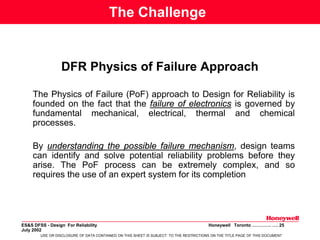
The Challenge: DFR Physics of Failure Approach
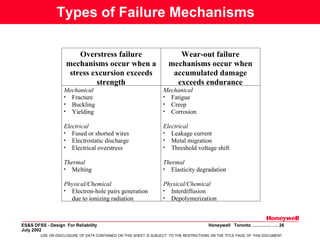
Types of Failure Mechanisms

ES&S DFSS - Design For Reliability
July 2002

Honeywell Toronto …………. …. 3

USE OR DISCLOSURE OF DATA CONTAINED ON THIS SHEET IS SUBJECT TO THE RESTRICTIONS ON THE TITLE PAGE OF THIS DOCUMENT
What is Reliability ?

• Reliability is the likelihood(probability) that a
product will
– perform its intended function
– within specified tolerances
– under stated conditions
– for a given period of time

ES&S DFSS - Design For Reliability
July 2002

Honeywell Toronto …………. …. 4

USE OR DISCLOSURE OF DATA CONTAINED ON THIS SHEET IS SUBJECT TO THE RESTRICTIONS ON THE TITLE PAGE OF THIS DOCUMENT
Designing for Reliability

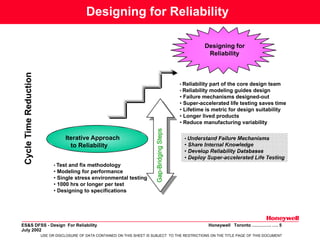
• Reliability part of the core design team
• Reliability modeling guides design

• Failure mechanisms designed-out
• Super-accelerated life testing saves time
• Lifetime is metric for design suitability
• Longer lived products
• Reduce manufacturing variability

Iterative Approach
to Reliability
• Test and fix methodology

• Modeling for performance
• Single stress environmental testing
• 1000 hrs or longer per test
• Designing to specifications

ES&S DFSS - Design For Reliability
July 2002

Gap-Bridging Steps

Cycle Time Reduction

Designing for
Reliability

• Understand Failure Mechanisms

• Share Internal Knowledge
• Develop Reliability Databases
• Deploy Super-accelerated Life Testing

Honeywell Toronto …………. …. 5

USE OR DISCLOSURE OF DATA CONTAINED ON THIS SHEET IS SUBJECT TO THE RESTRICTIONS ON THE TITLE PAGE OF THIS DOCUMENT
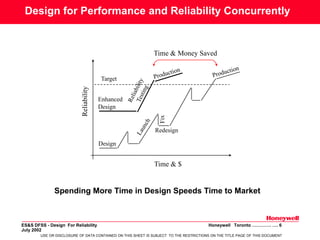
Design for Performance and Reliability Concurrently

Time & Money Saved

Reliability

Target
Enhanced
Design

Redesign
Design

Time & $

Spending More Time in Design Speeds Time to Market

ES&S DFSS - Design For Reliability
July 2002

Honeywell Toronto …………. …. 6

USE OR DISCLOSURE OF DATA CONTAINED ON THIS SHEET IS SUBJECT TO THE RESTRICTIONS ON THE TITLE PAGE OF THIS DOCUMENT
Reliability Design Tasks

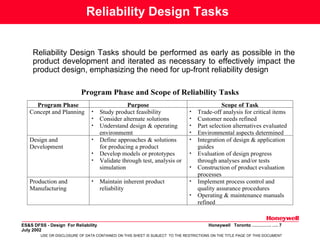
Reliability Design Tasks should be performed as early as possible in the
product development and iterated as necessary to effectively impact the
product design, emphasizing the need for up-front reliability design
Program Phase and Scope of Reliability Tasks
Program Phase
Concept and Planning

•
•
•

Design and
Development

•

•
•

Production and
Manufacturing

•

Purpose
Study product feasibility
Consider alternate solutions
Understand design & operating
environmemt
Define approaches & solutions
for producing a product
Develop models or prototypes
Validate through test, analysis or
simulation
Maintain inherent product
reliability

•
•
•
•
•

•

•

•

•

ES&S DFSS - Design For Reliability
July 2002

Scope of Task
Trade-off analysis for critical items
Customer needs refined
Part selection alternatives evaluated
Environmental aspects determined
Integration of design & application
guides
Evaluation of design progress
through analyses and/or tests
Construction of product evaluation
processes
Implement process control and
quality assurance procedures
Operating & maintenance manuals
refined

Honeywell Toronto …………. …. 7

USE OR DISCLOSURE OF DATA CONTAINED ON THIS SHEET IS SUBJECT TO THE RESTRICTIONS ON THE TITLE PAGE OF THIS DOCUMENT
Derating

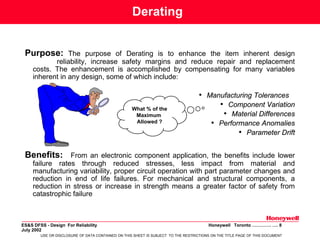
Purpose: The purpose of Derating is to enhance the item inherent design
reliability, increase safety margins and reduce repair and replacement
costs. The enhancement is accomplished by compensating for many variables
inherent in any design, some of which include:

What % of the
Maximum
Allowed ?

• Manufacturing Tolerances
• Component Variation
• Material Differences
• Performance Anomalies
• Parameter Drift

Benefits: From an electronic component application, the benefits include lower
failure rates through reduced stresses, less impact from material and
manufacturing variability, proper circuit operation with part parameter changes and
reduction in end of life failures. For mechanical and structural components, a
reduction in stress or increase in strength means a greater factor of safety from
catastrophic failure

ES&S DFSS - Design For Reliability
July 2002

Honeywell Toronto …………. …. 8

USE OR DISCLOSURE OF DATA CONTAINED ON THIS SHEET IS SUBJECT TO THE RESTRICTIONS ON THE TITLE PAGE OF THIS DOCUMENT
Accelerated Life Testing (ALT)

Accelerated Life Testing involves measuring the performance of the
product at accelerated load or stress conditions, in order to induce
pattern failures quickly. The goal is to accelerate failure mechanisms
and the accumulation damage, reducing the time-to-failure. Proper
ALT requires that:

• The failure mechanisms in the accelerated environment are the same as
those observed under normal operating conditions;

• Acceleration transforms are available to confidently extrapolate from the
test life to the usage life of the product under actual operating conditions;

• The failure probability density functions at normal operating levels and
under accelerated conditions are consistent

ES&S DFSS - Design For Reliability
July 2002

Honeywell Toronto …………. …. 9

USE OR DISCLOSURE OF DATA CONTAINED ON THIS SHEET IS SUBJECT TO THE RESTRICTIONS ON THE TITLE PAGE OF THIS DOCUMENT
Reliability Estimation

Reliability R(T) of a Device with a Mean Time (Hours) To Failure of “MTTF” for a specified
Mission Time of “T” Hours using the Weibull reliability function is:

β


R (T ) = e

 T
 1
−
⋅Γ  1+  
 MTTF  β  

If β = 1; MTTF = 30000 Hrs and T = 2 Hrs
Reliability = 0.99993. This means
99.99% of the missions will be
completed successfully
within 2 Hrs

β is the Weibull Shape Parameter. For an Electronic Device, β = 1 (Exponential Distribution) in
the Useful Life period. Γ represents the Gamma Function. Actual β values to determine
Reliability can be derived using Time To Failure data of End-Units from the operating field

ES&S DFSS - Design For Reliability
July 2002

Honeywell Toronto …………. …. 10

USE OR DISCLOSURE OF DATA CONTAINED ON THIS SHEET IS SUBJECT TO THE RESTRICTIONS ON THE TITLE PAGE OF THIS DOCUMENT
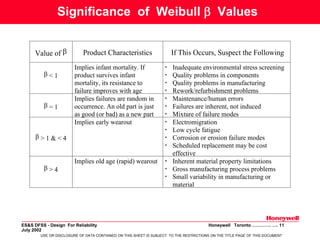
Significance of Weibull β Values
Value of β
β<1

β=1

Product Characteristics
Implies infant mortality. If
product survives infant
mortality, its resistance to
failure improves with age
Implies failures are random in
occurrence. An old part is just
as good (or bad) as a new part
Implies early wearout

If This Occurs, Suspect the Following
•
•
•
•
•
•
•
•
•

β>1&<4

•
•

β>4

Implies old age (rapid) wearout

•
•
•

ES&S DFSS - Design For Reliability
July 2002

Inadequate environmental stress screening
Quality problems in components
Quality problems in manufacturing
Rework/refurbishment problems
Maintenance/human errors
Failures are inherent, not induced
Mixture of failure modes
Electromigration
Low cycle fatigue
Corrosion or erosion failure modes
Scheduled replacement may be cost
effective
Inherent material property limitations
Gross manufacturing process problems
Small variability in manufacturing or
material

Honeywell Toronto …………. …. 11

USE OR DISCLOSURE OF DATA CONTAINED ON THIS SHEET IS SUBJECT TO THE RESTRICTIONS ON THE TITLE PAGE OF THIS DOCUMENT
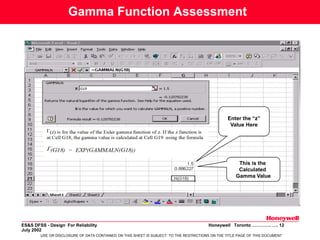
Gamma Function Assessment

Enter the “z”
Value Here

This is the
Calculated
Gamma Value

ES&S DFSS - Design For Reliability
July 2002

Honeywell Toronto …………. …. 12

USE OR DISCLOSURE OF DATA CONTAINED ON THIS SHEET IS SUBJECT TO THE RESTRICTIONS ON THE TITLE PAGE OF THIS DOCUMENT
Prediction Models
– IEEE 1413 Reliability Prediction Process Guide
 Framework for Hardware & Software predictions at all levels

– Telcordia TR-332 (previously known as Bellcore)
– RDF 2000 (French)
– MIL-HDBK-217F, N2
 Piece-part reliability prediction, sum defect rates
 No new technology or high complexity models - obsolete
 Need to find a replacement . . . . .

– RAC PRISM
 Forces holistic consideration of factors influencing Reliability
– Mission & Duty cycle
– All processes
– Devices

ES&S DFSS - Design For Reliability
July 2002

Honeywell Toronto …………. …. 13

USE OR DISCLOSURE OF DATA CONTAINED ON THIS SHEET IS SUBJECT TO THE RESTRICTIONS ON THE TITLE PAGE OF THIS DOCUMENT
Stress/Strength Interference & Probabilistic Design

Reliability prediction using the Stress/Strength Interference and
Probabilistic Design method:
This method assumes that the material properties are time independent
because of their slow change, and the components are not subjected to wear
related failure modes. When components are subjected to reversing mechanical loads that
exhibit a single failure mode, the reliability is designed-in by selecting the probability number
representing the Safety Margin. For the use of this methodology, Binary Synthesis of the
classical equations are needed.

Safety Margin (SM) =

Reliability (R) = 1 -

ES&S DFSS - Design For Reliability
July 2002

µS − µs
σ S 2 + σ s2

1
2Π

∫

SM

−t 2
2

µs = Mean Stress of the Stress function
σs = Standard Deviation of the Stress
µS = Mean Strength of material
σS = Standard Deviation of the material Strength
If SM = 3.5
Reliability = 0.9997

e dt

−∞

Honeywell Toronto …………. …. 14

USE OR DISCLOSURE OF DATA CONTAINED ON THIS SHEET IS SUBJECT TO THE RESTRICTIONS ON THE TITLE PAGE OF THIS DOCUMENT
Reliability Estimation with Safety Margin

To obtain Reliability,
Go Here and Select
Standard Normal
Cumulative Distribution
Enter “SM” Value
to “Z”

Reliability = 0.999767

ES&S DFSS - Design For Reliability
July 2002

Honeywell Toronto …………. …. 15

USE OR DISCLOSURE OF DATA CONTAINED ON THIS SHEET IS SUBJECT TO THE RESTRICTIONS ON THE TITLE PAGE OF THIS DOCUMENT
Mean and Variance for any Distribution

Let f(x) = Probability Density Function of the independent variable x
If f(x) ≥ 0, for all x
+∞

∫

Mean = µ = xf ( x )dx
−∞

Coefficient of Variation (CV)
provides a relative measure of data
dispersion compared to the Mean
CV =

+∞

σ
µ

∫

2
2
Variance = σ = ( x − µ ) f ( x )dx , where σ = Standard Deviation
−∞

When “x = Time”, Lower boundary of the Integral will be 0 instead of -∞
This is the case for Reliability related functions

ES&S DFSS - Design For Reliability
July 2002

Honeywell Toronto …………. …. 16

USE OR DISCLOSURE OF DATA CONTAINED ON THIS SHEET IS SUBJECT TO THE RESTRICTIONS ON THE TITLE PAGE OF THIS DOCUMENT
Binary Synthesis of Classical Equations
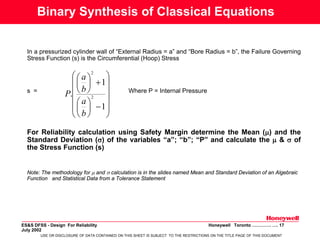
In a pressurized cylinder wall of “External Radius = a” and “Bore Radius = b”, the Failure Governing
Stress Function (s) is the Circumferential (Hoop) Stress

s =

  a 2 
   + 1
b
P.   2 

a
   − 1

b

Where P = Internal Pressure

For Reliability calculation using Safety Margin determine the Mean (µ) and the
Standard Deviation (σ) of the variables “a”; “b”; “P” and calculate the µ & σ of
the Stress Function (s)
Note: The methodology for µ and σ calculation is in the slides named Mean and Standard Deviation of an Algebraic
Function and Statistical Data from a Tolerance Statement

ES&S DFSS - Design For Reliability
July 2002

Honeywell Toronto …………. …. 17

USE OR DISCLOSURE OF DATA CONTAINED ON THIS SHEET IS SUBJECT TO THE RESTRICTIONS ON THE TITLE PAGE OF THIS DOCUMENT
Mean and Standard Deviation of an Algebraic Function
Algebraic
Function
c
c.x
c.x + d
c.x - d
x+y
x–y
* x.y

Mean

Standard Deviation

c
c.µx
c.µx + d
c.µx - d
µx + µy

0
c.σx
c.σx
c.σx

µx - µy

(µ

µx . µy

x
*
y

µx
µy

n

µxn

* x
* x

0.5

(σ
(σ

(0.5. 4.µ

2
x

− 2.σ x

2
x

)

0.5

+σ y

2 0.5

2

+σ y

2 0.5

x
x

.σ y + µ y .σ x + σ x .σ y
2


 1
µ
 y

2

)
)

2

(µ

2

2

  µ x .σ y + µ y .σ x
.

µ y2 +σ y2

( n −1)
n.µ x
.σ x
2

2

2

− 0.5. 4.µ x − 2.σ x
2

x

2

2






2

)

2 0.5
0.5

)

0.5

c, d, n are constants
* These are good approximations when the Coefficient of Variation (CV) is small. i.e. CV < 0.1

ES&S DFSS - Design For Reliability
July 2002

Honeywell Toronto …………. …. 18

USE OR DISCLOSURE OF DATA CONTAINED ON THIS SHEET IS SUBJECT TO THE RESTRICTIONS ON THE TITLE PAGE OF THIS DOCUMENT
Statistical Data from a Tolerance Statement
When the distributional Probability Density Function of a variable is Normal
(or Gaussian) between the limits Low “a” and High “b”

The Mean (µ) is approximately equal to

a+b
2

The Standard Deviation (σ) is approximately equal to

For a 10K Ohms Resistor with
±5% tolerance
µ = 10K Ohms
σ = 167 Ohms

b−a
6

These simplified calculations are based on theoretical derivations and was justified by
E. B. Haugen in University of Arizona, 1974

ES&S DFSS - Design For Reliability
July 2002

Honeywell Toronto …………. …. 19

USE OR DISCLOSURE OF DATA CONTAINED ON THIS SHEET IS SUBJECT TO THE RESTRICTIONS ON THE TITLE PAGE OF THIS DOCUMENT
False Alarm Probability Estimation

Voltage Divider Circuitry for Min_Limit & Max_Limit
Tested Output Voltage = 12V +/- 180mV µ = 12 ; σ = 0.06

Resistor
X

VRef = 15V +/- 180 mV

Resistor
Y

VTest = (Y/(X+Y))* VRef.

µ = 15; σ = 0.06

Grnd

False Alarms can happen
due to Component
Tolerances and Voltage
Deviations

Resistor Tolerance is +/- 10%

Case 1: Min_Limit; X=100K Ohms; Y=302K Ohms µ (VTest) = 11.27 ; σ(VTest) = 0.064
Safety Margin (SM) = 8.343

Probability of Failure = 0.00E+00

Case 2: Max_Limit; X=100K Ohms; Y=541K Ohms µ (VTest) = 12.66 ; σ(VTest) = 0.079
Safety Margin (SM) = 6.679

Probability of Failure = 1.2084E-11

False Alarm Probability = 1.2084E-11
ES&S DFSS - Design For Reliability
July 2002

Honeywell Toronto …………. …. 20

USE OR DISCLOSURE OF DATA CONTAINED ON THIS SHEET IS SUBJECT TO THE RESTRICTIONS ON THE TITLE PAGE OF THIS DOCUMENT
Screening Strength Estimation
The Screening Strength of a given stress screen profile is defined as the
probability that the stress screen will precipitate a latent defect into a
detectable failure, given that a defect is present. Screening provide
assurance on the Outgoing Reliability
Screening Strength for Temperature Cycling (STn) is a function of Temperature Range =T;
Temp. Rate of Change =R; Number of Cycles =n

STn

= 1 − e[−[0.0017⋅(T + 0.6)

0.6

⋅ln(e + R ) ⋅n]]
3

Screening Strength for Random Vibration (SVt) is a function of G = gRMS; Vibration Duration = t

SVt

= 1 − e[−(0.0046⋅G

1.71

⋅t )]

Combined Screen Strength (SS) = 1 - (1-STn).(1-SVt)

When T = 111oC; R = 5oC/Min
n =16 Cyc; G = 2gRMS;
t = 15 Min
SS = 0.98432

The Screening Strength equations were developed by Hughes Aircraft Company, and modified by Rome Air
Development Centre (RADC) based on the data from McDonnel Aircraft Co. and Grumman Aerospace
Corporation

ES&S DFSS - Design For Reliability
July 2002

Honeywell Toronto …………. …. 21

USE OR DISCLOSURE OF DATA CONTAINED ON THIS SHEET IS SUBJECT TO THE RESTRICTIONS ON THE TITLE PAGE OF THIS DOCUMENT
Adaptive Environmental Stress Screening (ESS)
The principle of adaptive screening is to adjust the screens on the basis of
observed screening results, so that the screens are always most costeffective while meeting ESS program goals. Contract terms should be
flexible enough to permit modifications of screening parameters when such
modifications can be shown to be beneficial
The Chance Defective Exponential (CDE) Model is the chosen prediction model for failure rate
distribution analysis, as the constant failure rate portion could be extracted for Acceleration
Factor calculation, the average rate of defect precipitation determined for Best Thermal Cycling
Time and Failure Free Time calculation. CDE equation parameters are obtained using the
SigmaPlot computer program
P/N XXXX100-07 ESS
Period: 01 Jan 99 - 31 Dec 99
0.04
Failure
Rate (fr)
0.03
Fail/Hour

Outgoing Defect Density = 5300 PPM
Yield = 0.9947
4σ < Capability < 5σ
Time To Remove 99.999% Defects = 32 Hrs
Failure Free Time (99.99% Yield) at 90% LCL = 20Hrs

0.02

fr = 0.0031+ 0.0385*exp(-0.3669*t)

0.01

0.00
0

2

4

6

8

10

12

14

16

18

20

22

24

26

28

30

32

34

36

38

40

ESS Time (t) Hours

CONDITION: Cumulative Thermal Energy due to previous runs And/Or NFF
And/Or BIE Failure are also responsible for relevant failure precipitation

ES&S DFSS - Design For Reliability
July 2002

Honeywell Toronto …………. …. 22

USE OR DISCLOSURE OF DATA CONTAINED ON THIS SHEET IS SUBJECT TO THE RESTRICTIONS ON THE TITLE PAGE OF THIS DOCUMENT
How CDE Model Parameters Obtained

Time To
Failure
Data

Failure
Rate
Data

ES&S DFSS - Design For Reliability
July 2002

CDE Model
Parameters

Coefficient of
Variation (CV)
used as a gauge
of the accuracy
of the fitted
curve parameters

Honeywell Toronto …………. …. 23

USE OR DISCLOSURE OF DATA CONTAINED ON THIS SHEET IS SUBJECT TO THE RESTRICTIONS ON THE TITLE PAGE OF THIS DOCUMENT
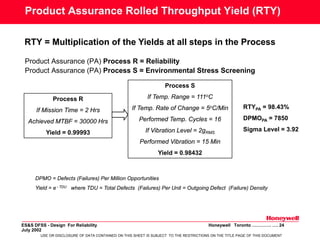
Product Assurance Rolled Throughput Yield (RTY)
RTY = Multiplication of the Yields at all steps in the Process
Product Assurance (PA) Process R = Reliability
Product Assurance (PA) Process S = Environmental Stress Screening
Process S
Process R

If Temp. Range = 111oC

If Mission Time = 2 Hrs

If Temp. Rate of Change = 5oC/Min

RTYPA = 98.43%

Achieved MTBF = 30000 Hrs

Performed Temp. Cycles = 16

DPMOPA = 7850

Yield = 0.99993

If Vibration Level = 2gRMS

Sigma Level = 3.92

Performed Vibration = 15 Min
Yield = 0.98432

DPMO = Defects (Failures) Per Million Opportunities
Yield = e - TDU where TDU = Total Defects (Failures) Per Unit = Outgoing Defect (Failure) Density

ES&S DFSS - Design For Reliability
July 2002

Honeywell Toronto …………. …. 24

USE OR DISCLOSURE OF DATA CONTAINED ON THIS SHEET IS SUBJECT TO THE RESTRICTIONS ON THE TITLE PAGE OF THIS DOCUMENT
The Challenge

DFR Physics of Failure Approach
The Physics of Failure (PoF) approach to Design for Reliability is
founded on the fact that the failure of electronics is governed by
fundamental mechanical, electrical, thermal and chemical
processes.
By understanding the possible failure mechanism, design teams
can identify and solve potential reliability problems before they
arise. The PoF process can be extremely complex, and so
requires the use of an expert system for its completion

ES&S DFSS - Design For Reliability
July 2002

Honeywell Toronto …………. …. 25

USE OR DISCLOSURE OF DATA CONTAINED ON THIS SHEET IS SUBJECT TO THE RESTRICTIONS ON THE TITLE PAGE OF THIS DOCUMENT
Types of Failure Mechanisms
Overstress failure
mechanisms occur when a
stress excursion exceeds
strength

Wear-out failure
mechanisms occur when
accumulated damage
exceeds endurance

Mechanical
•
Fracture
•
Buckling
•
Yielding

Mechanical
•
Fatigue
•
Creep
•
Corrosion

Electrical
•
Fused or shorted wires
•
Electrostatic discharge
•
Electrical overstress

Electrical
•
Leakage current
•
Metal migration
•
Threshold voltage shift

Thermal
•
Melting

Thermal
•
Elasticity degradation

Physical/Chemical
•
Electron-hole pairs generation
due to ionizing radiation

Physical/Chemical
•
Interdiffusion
•
Depolymerization

ES&S DFSS - Design For Reliability
July 2002

Honeywell Toronto …………. …. 26

USE OR DISCLOSURE OF DATA CONTAINED ON THIS SHEET IS SUBJECT TO THE RESTRICTIONS ON THE TITLE PAGE OF THIS DOCUMENT

Design For Reliability

  • 1.
    Design for Reliability HilaireAnanda Perera Define Measure Analyze Improve Control ES&S DFSS - Design For Reliability July 2002 Honeywell Toronto …………. …. 1 USE OR DISCLOSURE OF DATA CONTAINED ON THIS SHEET IS SUBJECT TO THE RESTRICTIONS ON THE TITLE PAGE OF THIS DOCUMENT
  • 2.
    Contents • • • • • • • • • • • • • • • • • What is Reliability Designingfor Reliability Design for Performance and Reliability Concurrently Reliability Design Tasks Derating Accelerated Life Testing (ALT) Reliability Estimation Significance of Weibull β values Gamma Function Assessment Prediction Models Stress/Strength Interference & Probabilistic Design Reliability Estimation with Safety Margin Mean and Variance for Any Distribution Binary Synthesis of Classical Equations Mean and Standard Deviation of an Algebraic Function Statistical Data from a Tolerance Statement False Alarm Probability Estimation ES&S DFSS - Design For Reliability July 2002 Honeywell Toronto …………. …. 2 USE OR DISCLOSURE OF DATA CONTAINED ON THIS SHEET IS SUBJECT TO THE RESTRICTIONS ON THE TITLE PAGE OF THIS DOCUMENT
  • 3.
    Contents • • • • • • cntd. Screening Strength Estimation AdaptiveEnvironmental Stress Screening How CDE Model Parameters Obtained Product Assurance Rolled Throughput Yield (RTY) The Challenge: DFR Physics of Failure Approach Types of Failure Mechanisms ES&S DFSS - Design For Reliability July 2002 Honeywell Toronto …………. …. 3 USE OR DISCLOSURE OF DATA CONTAINED ON THIS SHEET IS SUBJECT TO THE RESTRICTIONS ON THE TITLE PAGE OF THIS DOCUMENT
  • 4.
    What is Reliability? • Reliability is the likelihood(probability) that a product will – perform its intended function – within specified tolerances – under stated conditions – for a given period of time ES&S DFSS - Design For Reliability July 2002 Honeywell Toronto …………. …. 4 USE OR DISCLOSURE OF DATA CONTAINED ON THIS SHEET IS SUBJECT TO THE RESTRICTIONS ON THE TITLE PAGE OF THIS DOCUMENT
  • 5.
    Designing for Reliability •Reliability part of the core design team • Reliability modeling guides design • Failure mechanisms designed-out • Super-accelerated life testing saves time • Lifetime is metric for design suitability • Longer lived products • Reduce manufacturing variability Iterative Approach to Reliability • Test and fix methodology • Modeling for performance • Single stress environmental testing • 1000 hrs or longer per test • Designing to specifications ES&S DFSS - Design For Reliability July 2002 Gap-Bridging Steps Cycle Time Reduction Designing for Reliability • Understand Failure Mechanisms • Share Internal Knowledge • Develop Reliability Databases • Deploy Super-accelerated Life Testing Honeywell Toronto …………. …. 5 USE OR DISCLOSURE OF DATA CONTAINED ON THIS SHEET IS SUBJECT TO THE RESTRICTIONS ON THE TITLE PAGE OF THIS DOCUMENT
  • 6.
    Design for Performanceand Reliability Concurrently Time & Money Saved Reliability Target Enhanced Design Redesign Design Time & $ Spending More Time in Design Speeds Time to Market ES&S DFSS - Design For Reliability July 2002 Honeywell Toronto …………. …. 6 USE OR DISCLOSURE OF DATA CONTAINED ON THIS SHEET IS SUBJECT TO THE RESTRICTIONS ON THE TITLE PAGE OF THIS DOCUMENT
  • 7.
    Reliability Design Tasks ReliabilityDesign Tasks should be performed as early as possible in the product development and iterated as necessary to effectively impact the product design, emphasizing the need for up-front reliability design Program Phase and Scope of Reliability Tasks Program Phase Concept and Planning • • • Design and Development • • • Production and Manufacturing • Purpose Study product feasibility Consider alternate solutions Understand design & operating environmemt Define approaches & solutions for producing a product Develop models or prototypes Validate through test, analysis or simulation Maintain inherent product reliability • • • • • • • • • ES&S DFSS - Design For Reliability July 2002 Scope of Task Trade-off analysis for critical items Customer needs refined Part selection alternatives evaluated Environmental aspects determined Integration of design & application guides Evaluation of design progress through analyses and/or tests Construction of product evaluation processes Implement process control and quality assurance procedures Operating & maintenance manuals refined Honeywell Toronto …………. …. 7 USE OR DISCLOSURE OF DATA CONTAINED ON THIS SHEET IS SUBJECT TO THE RESTRICTIONS ON THE TITLE PAGE OF THIS DOCUMENT
  • 8.
    Derating Purpose: The purposeof Derating is to enhance the item inherent design reliability, increase safety margins and reduce repair and replacement costs. The enhancement is accomplished by compensating for many variables inherent in any design, some of which include: What % of the Maximum Allowed ? • Manufacturing Tolerances • Component Variation • Material Differences • Performance Anomalies • Parameter Drift Benefits: From an electronic component application, the benefits include lower failure rates through reduced stresses, less impact from material and manufacturing variability, proper circuit operation with part parameter changes and reduction in end of life failures. For mechanical and structural components, a reduction in stress or increase in strength means a greater factor of safety from catastrophic failure ES&S DFSS - Design For Reliability July 2002 Honeywell Toronto …………. …. 8 USE OR DISCLOSURE OF DATA CONTAINED ON THIS SHEET IS SUBJECT TO THE RESTRICTIONS ON THE TITLE PAGE OF THIS DOCUMENT
  • 9.
    Accelerated Life Testing(ALT) Accelerated Life Testing involves measuring the performance of the product at accelerated load or stress conditions, in order to induce pattern failures quickly. The goal is to accelerate failure mechanisms and the accumulation damage, reducing the time-to-failure. Proper ALT requires that: • The failure mechanisms in the accelerated environment are the same as those observed under normal operating conditions; • Acceleration transforms are available to confidently extrapolate from the test life to the usage life of the product under actual operating conditions; • The failure probability density functions at normal operating levels and under accelerated conditions are consistent ES&S DFSS - Design For Reliability July 2002 Honeywell Toronto …………. …. 9 USE OR DISCLOSURE OF DATA CONTAINED ON THIS SHEET IS SUBJECT TO THE RESTRICTIONS ON THE TITLE PAGE OF THIS DOCUMENT
  • 10.
    Reliability Estimation Reliability R(T)of a Device with a Mean Time (Hours) To Failure of “MTTF” for a specified Mission Time of “T” Hours using the Weibull reliability function is: β  R (T ) = e  T  1 − ⋅Γ  1+    MTTF  β   If β = 1; MTTF = 30000 Hrs and T = 2 Hrs Reliability = 0.99993. This means 99.99% of the missions will be completed successfully within 2 Hrs β is the Weibull Shape Parameter. For an Electronic Device, β = 1 (Exponential Distribution) in the Useful Life period. Γ represents the Gamma Function. Actual β values to determine Reliability can be derived using Time To Failure data of End-Units from the operating field ES&S DFSS - Design For Reliability July 2002 Honeywell Toronto …………. …. 10 USE OR DISCLOSURE OF DATA CONTAINED ON THIS SHEET IS SUBJECT TO THE RESTRICTIONS ON THE TITLE PAGE OF THIS DOCUMENT
  • 11.
    Significance of Weibullβ Values Value of β β<1 β=1 Product Characteristics Implies infant mortality. If product survives infant mortality, its resistance to failure improves with age Implies failures are random in occurrence. An old part is just as good (or bad) as a new part Implies early wearout If This Occurs, Suspect the Following • • • • • • • • • β>1&<4 • • β>4 Implies old age (rapid) wearout • • • ES&S DFSS - Design For Reliability July 2002 Inadequate environmental stress screening Quality problems in components Quality problems in manufacturing Rework/refurbishment problems Maintenance/human errors Failures are inherent, not induced Mixture of failure modes Electromigration Low cycle fatigue Corrosion or erosion failure modes Scheduled replacement may be cost effective Inherent material property limitations Gross manufacturing process problems Small variability in manufacturing or material Honeywell Toronto …………. …. 11 USE OR DISCLOSURE OF DATA CONTAINED ON THIS SHEET IS SUBJECT TO THE RESTRICTIONS ON THE TITLE PAGE OF THIS DOCUMENT
  • 12.
    Gamma Function Assessment Enterthe “z” Value Here This is the Calculated Gamma Value ES&S DFSS - Design For Reliability July 2002 Honeywell Toronto …………. …. 12 USE OR DISCLOSURE OF DATA CONTAINED ON THIS SHEET IS SUBJECT TO THE RESTRICTIONS ON THE TITLE PAGE OF THIS DOCUMENT
  • 13.
    Prediction Models – IEEE1413 Reliability Prediction Process Guide  Framework for Hardware & Software predictions at all levels – Telcordia TR-332 (previously known as Bellcore) – RDF 2000 (French) – MIL-HDBK-217F, N2  Piece-part reliability prediction, sum defect rates  No new technology or high complexity models - obsolete  Need to find a replacement . . . . . – RAC PRISM  Forces holistic consideration of factors influencing Reliability – Mission & Duty cycle – All processes – Devices ES&S DFSS - Design For Reliability July 2002 Honeywell Toronto …………. …. 13 USE OR DISCLOSURE OF DATA CONTAINED ON THIS SHEET IS SUBJECT TO THE RESTRICTIONS ON THE TITLE PAGE OF THIS DOCUMENT
  • 14.
    Stress/Strength Interference &Probabilistic Design Reliability prediction using the Stress/Strength Interference and Probabilistic Design method: This method assumes that the material properties are time independent because of their slow change, and the components are not subjected to wear related failure modes. When components are subjected to reversing mechanical loads that exhibit a single failure mode, the reliability is designed-in by selecting the probability number representing the Safety Margin. For the use of this methodology, Binary Synthesis of the classical equations are needed. Safety Margin (SM) = Reliability (R) = 1 - ES&S DFSS - Design For Reliability July 2002 µS − µs σ S 2 + σ s2 1 2Π ∫ SM −t 2 2 µs = Mean Stress of the Stress function σs = Standard Deviation of the Stress µS = Mean Strength of material σS = Standard Deviation of the material Strength If SM = 3.5 Reliability = 0.9997 e dt −∞ Honeywell Toronto …………. …. 14 USE OR DISCLOSURE OF DATA CONTAINED ON THIS SHEET IS SUBJECT TO THE RESTRICTIONS ON THE TITLE PAGE OF THIS DOCUMENT
  • 15.
    Reliability Estimation withSafety Margin To obtain Reliability, Go Here and Select Standard Normal Cumulative Distribution Enter “SM” Value to “Z” Reliability = 0.999767 ES&S DFSS - Design For Reliability July 2002 Honeywell Toronto …………. …. 15 USE OR DISCLOSURE OF DATA CONTAINED ON THIS SHEET IS SUBJECT TO THE RESTRICTIONS ON THE TITLE PAGE OF THIS DOCUMENT
  • 16.
    Mean and Variancefor any Distribution Let f(x) = Probability Density Function of the independent variable x If f(x) ≥ 0, for all x +∞ ∫ Mean = µ = xf ( x )dx −∞ Coefficient of Variation (CV) provides a relative measure of data dispersion compared to the Mean CV = +∞ σ µ ∫ 2 2 Variance = σ = ( x − µ ) f ( x )dx , where σ = Standard Deviation −∞ When “x = Time”, Lower boundary of the Integral will be 0 instead of -∞ This is the case for Reliability related functions ES&S DFSS - Design For Reliability July 2002 Honeywell Toronto …………. …. 16 USE OR DISCLOSURE OF DATA CONTAINED ON THIS SHEET IS SUBJECT TO THE RESTRICTIONS ON THE TITLE PAGE OF THIS DOCUMENT
  • 17.
    Binary Synthesis ofClassical Equations In a pressurized cylinder wall of “External Radius = a” and “Bore Radius = b”, the Failure Governing Stress Function (s) is the Circumferential (Hoop) Stress s =   a 2     + 1 b P.   2   a    − 1  b Where P = Internal Pressure For Reliability calculation using Safety Margin determine the Mean (µ) and the Standard Deviation (σ) of the variables “a”; “b”; “P” and calculate the µ & σ of the Stress Function (s) Note: The methodology for µ and σ calculation is in the slides named Mean and Standard Deviation of an Algebraic Function and Statistical Data from a Tolerance Statement ES&S DFSS - Design For Reliability July 2002 Honeywell Toronto …………. …. 17 USE OR DISCLOSURE OF DATA CONTAINED ON THIS SHEET IS SUBJECT TO THE RESTRICTIONS ON THE TITLE PAGE OF THIS DOCUMENT
  • 18.
    Mean and StandardDeviation of an Algebraic Function Algebraic Function c c.x c.x + d c.x - d x+y x–y * x.y Mean Standard Deviation c c.µx c.µx + d c.µx - d µx + µy 0 c.σx c.σx c.σx µx - µy (µ µx . µy x * y µx µy n µxn * x * x 0.5 (σ (σ (0.5. 4.µ 2 x − 2.σ x 2 x ) 0.5 +σ y 2 0.5 2 +σ y 2 0.5 x x .σ y + µ y .σ x + σ x .σ y 2   1 µ  y 2 ) ) 2 (µ 2 2   µ x .σ y + µ y .σ x .  µ y2 +σ y2  ( n −1) n.µ x .σ x 2 2 2 − 0.5. 4.µ x − 2.σ x 2 x 2 2     2 ) 2 0.5 0.5 ) 0.5 c, d, n are constants * These are good approximations when the Coefficient of Variation (CV) is small. i.e. CV < 0.1 ES&S DFSS - Design For Reliability July 2002 Honeywell Toronto …………. …. 18 USE OR DISCLOSURE OF DATA CONTAINED ON THIS SHEET IS SUBJECT TO THE RESTRICTIONS ON THE TITLE PAGE OF THIS DOCUMENT
  • 19.
    Statistical Data froma Tolerance Statement When the distributional Probability Density Function of a variable is Normal (or Gaussian) between the limits Low “a” and High “b” The Mean (µ) is approximately equal to a+b 2 The Standard Deviation (σ) is approximately equal to For a 10K Ohms Resistor with ±5% tolerance µ = 10K Ohms σ = 167 Ohms b−a 6 These simplified calculations are based on theoretical derivations and was justified by E. B. Haugen in University of Arizona, 1974 ES&S DFSS - Design For Reliability July 2002 Honeywell Toronto …………. …. 19 USE OR DISCLOSURE OF DATA CONTAINED ON THIS SHEET IS SUBJECT TO THE RESTRICTIONS ON THE TITLE PAGE OF THIS DOCUMENT
  • 20.
    False Alarm ProbabilityEstimation Voltage Divider Circuitry for Min_Limit & Max_Limit Tested Output Voltage = 12V +/- 180mV µ = 12 ; σ = 0.06 Resistor X VRef = 15V +/- 180 mV Resistor Y VTest = (Y/(X+Y))* VRef. µ = 15; σ = 0.06 Grnd False Alarms can happen due to Component Tolerances and Voltage Deviations Resistor Tolerance is +/- 10% Case 1: Min_Limit; X=100K Ohms; Y=302K Ohms µ (VTest) = 11.27 ; σ(VTest) = 0.064 Safety Margin (SM) = 8.343 Probability of Failure = 0.00E+00 Case 2: Max_Limit; X=100K Ohms; Y=541K Ohms µ (VTest) = 12.66 ; σ(VTest) = 0.079 Safety Margin (SM) = 6.679 Probability of Failure = 1.2084E-11 False Alarm Probability = 1.2084E-11 ES&S DFSS - Design For Reliability July 2002 Honeywell Toronto …………. …. 20 USE OR DISCLOSURE OF DATA CONTAINED ON THIS SHEET IS SUBJECT TO THE RESTRICTIONS ON THE TITLE PAGE OF THIS DOCUMENT
  • 21.
    Screening Strength Estimation TheScreening Strength of a given stress screen profile is defined as the probability that the stress screen will precipitate a latent defect into a detectable failure, given that a defect is present. Screening provide assurance on the Outgoing Reliability Screening Strength for Temperature Cycling (STn) is a function of Temperature Range =T; Temp. Rate of Change =R; Number of Cycles =n STn = 1 − e[−[0.0017⋅(T + 0.6) 0.6 ⋅ln(e + R ) ⋅n]] 3 Screening Strength for Random Vibration (SVt) is a function of G = gRMS; Vibration Duration = t SVt = 1 − e[−(0.0046⋅G 1.71 ⋅t )] Combined Screen Strength (SS) = 1 - (1-STn).(1-SVt) When T = 111oC; R = 5oC/Min n =16 Cyc; G = 2gRMS; t = 15 Min SS = 0.98432 The Screening Strength equations were developed by Hughes Aircraft Company, and modified by Rome Air Development Centre (RADC) based on the data from McDonnel Aircraft Co. and Grumman Aerospace Corporation ES&S DFSS - Design For Reliability July 2002 Honeywell Toronto …………. …. 21 USE OR DISCLOSURE OF DATA CONTAINED ON THIS SHEET IS SUBJECT TO THE RESTRICTIONS ON THE TITLE PAGE OF THIS DOCUMENT
  • 22.
    Adaptive Environmental StressScreening (ESS) The principle of adaptive screening is to adjust the screens on the basis of observed screening results, so that the screens are always most costeffective while meeting ESS program goals. Contract terms should be flexible enough to permit modifications of screening parameters when such modifications can be shown to be beneficial The Chance Defective Exponential (CDE) Model is the chosen prediction model for failure rate distribution analysis, as the constant failure rate portion could be extracted for Acceleration Factor calculation, the average rate of defect precipitation determined for Best Thermal Cycling Time and Failure Free Time calculation. CDE equation parameters are obtained using the SigmaPlot computer program P/N XXXX100-07 ESS Period: 01 Jan 99 - 31 Dec 99 0.04 Failure Rate (fr) 0.03 Fail/Hour Outgoing Defect Density = 5300 PPM Yield = 0.9947 4σ < Capability < 5σ Time To Remove 99.999% Defects = 32 Hrs Failure Free Time (99.99% Yield) at 90% LCL = 20Hrs 0.02 fr = 0.0031+ 0.0385*exp(-0.3669*t) 0.01 0.00 0 2 4 6 8 10 12 14 16 18 20 22 24 26 28 30 32 34 36 38 40 ESS Time (t) Hours CONDITION: Cumulative Thermal Energy due to previous runs And/Or NFF And/Or BIE Failure are also responsible for relevant failure precipitation ES&S DFSS - Design For Reliability July 2002 Honeywell Toronto …………. …. 22 USE OR DISCLOSURE OF DATA CONTAINED ON THIS SHEET IS SUBJECT TO THE RESTRICTIONS ON THE TITLE PAGE OF THIS DOCUMENT
  • 23.
    How CDE ModelParameters Obtained Time To Failure Data Failure Rate Data ES&S DFSS - Design For Reliability July 2002 CDE Model Parameters Coefficient of Variation (CV) used as a gauge of the accuracy of the fitted curve parameters Honeywell Toronto …………. …. 23 USE OR DISCLOSURE OF DATA CONTAINED ON THIS SHEET IS SUBJECT TO THE RESTRICTIONS ON THE TITLE PAGE OF THIS DOCUMENT
  • 24.
    Product Assurance RolledThroughput Yield (RTY) RTY = Multiplication of the Yields at all steps in the Process Product Assurance (PA) Process R = Reliability Product Assurance (PA) Process S = Environmental Stress Screening Process S Process R If Temp. Range = 111oC If Mission Time = 2 Hrs If Temp. Rate of Change = 5oC/Min RTYPA = 98.43% Achieved MTBF = 30000 Hrs Performed Temp. Cycles = 16 DPMOPA = 7850 Yield = 0.99993 If Vibration Level = 2gRMS Sigma Level = 3.92 Performed Vibration = 15 Min Yield = 0.98432 DPMO = Defects (Failures) Per Million Opportunities Yield = e - TDU where TDU = Total Defects (Failures) Per Unit = Outgoing Defect (Failure) Density ES&S DFSS - Design For Reliability July 2002 Honeywell Toronto …………. …. 24 USE OR DISCLOSURE OF DATA CONTAINED ON THIS SHEET IS SUBJECT TO THE RESTRICTIONS ON THE TITLE PAGE OF THIS DOCUMENT
  • 25.
    The Challenge DFR Physicsof Failure Approach The Physics of Failure (PoF) approach to Design for Reliability is founded on the fact that the failure of electronics is governed by fundamental mechanical, electrical, thermal and chemical processes. By understanding the possible failure mechanism, design teams can identify and solve potential reliability problems before they arise. The PoF process can be extremely complex, and so requires the use of an expert system for its completion ES&S DFSS - Design For Reliability July 2002 Honeywell Toronto …………. …. 25 USE OR DISCLOSURE OF DATA CONTAINED ON THIS SHEET IS SUBJECT TO THE RESTRICTIONS ON THE TITLE PAGE OF THIS DOCUMENT
  • 26.
    Types of FailureMechanisms Overstress failure mechanisms occur when a stress excursion exceeds strength Wear-out failure mechanisms occur when accumulated damage exceeds endurance Mechanical • Fracture • Buckling • Yielding Mechanical • Fatigue • Creep • Corrosion Electrical • Fused or shorted wires • Electrostatic discharge • Electrical overstress Electrical • Leakage current • Metal migration • Threshold voltage shift Thermal • Melting Thermal • Elasticity degradation Physical/Chemical • Electron-hole pairs generation due to ionizing radiation Physical/Chemical • Interdiffusion • Depolymerization ES&S DFSS - Design For Reliability July 2002 Honeywell Toronto …………. …. 26 USE OR DISCLOSURE OF DATA CONTAINED ON THIS SHEET IS SUBJECT TO THE RESTRICTIONS ON THE TITLE PAGE OF THIS DOCUMENT