RELIABILITY MANAGEMENT AN INTEGRATED APPROACHWg Cdr Jayesh C S PaiCSDO, AF
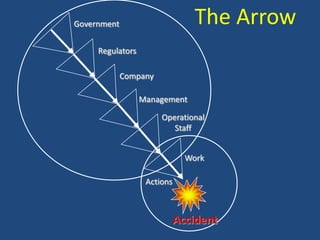
The ArrowGovernmentRegulatorsCompanyManagementOperational StaffWorkActionsAccident
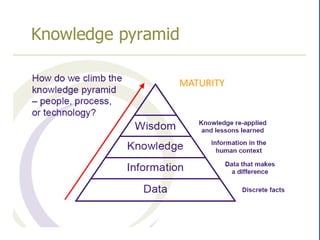
3/10/2010CSDO3MATURITY
Memory and learning3/10/2010CSDO410% of whatweread20% of whatwehear“Conventional Learning”30% of whatwesee50% of whatwesee & hear70% of what we discuss“ActiveLearning”80% of whatweexperience95% of what we teachTo consider pedagogical methodologies other       than “conventional ones”
DEMING Quotes"There is no substitute for knowledge.""The most important things cannot be measured.""The most important things are unknown or unknowable.“"Experience by itself teaches nothing.“"I think that people here expect miracles. American management thinks that they can just copy from Japan—but they don't know what to copy!"
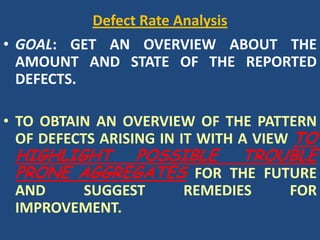
Defect Rate AnalysisGOAL: GET AN OVERVIEW ABOUT THE AMOUNT AND STATE OF THE REPORTED DEFECTS.TO OBTAIN AN OVERVIEW OF THE PATTERN OF DEFECTS ARISING IN IT WITH A VIEW TO HIGHLIGHT POSSIBLE TROUBLE PRONE AGGREGATES FOR THE FUTURE AND SUGGEST REMEDIES FOR IMPROVEMENT.
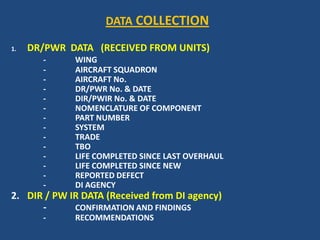
DATA COLLECTION1.	DR/PWR  DATA   (RECEIVED FROM UNITS)-	WING		-	AIRCRAFT SQUADRON		-	AIRCRAFT No.		-	DR/PWR No. & DATE		-	DIR/PWIR No. & DATE		-	NOMENCLATURE OF COMPONENT		-	PART NUMBER		-	SYSTEM		-	TRADE		-	TBO		-	LIFE COMPLETED SINCE LAST OVERHAUL		-	LIFE COMPLETED SINCE NEW		-	REPORTED DEFECT		-	DI AGENCY2.	DIR / PW IR DATA (Received from DI agency)		-	CONFIRMATION AND FINDINGS		-	RECOMMENDATIONS
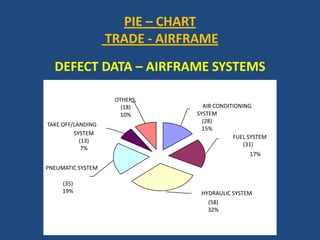
PIE – CHART TRADE - AIRFRAMEDEFECT DATA – AIRFRAME SYSTEMSOTHERS,(18)10%AIR CONDITIONINGSYSTEM(28)15%TAKE OFF/LANDING SYSTEM(13)7%FUEL SYSTEM                 (31)17%PNEUMATIC SYSTEM(35)19%HYDRAULIC SYSTEM(58)32%
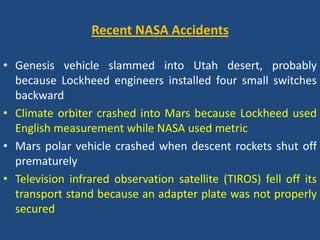
Recent NASA AccidentsGenesis vehicle slammed into Utah desert, probably because Lockheed engineers installed four small switches backwardClimate orbiter crashed into Mars because Lockheed used English measurement while NASA used metricMars polar vehicle crashed when descent rockets shut off prematurelyTelevision infrared observation satellite (TIROS) fell off its transport stand because an adapter plate was not properly secured
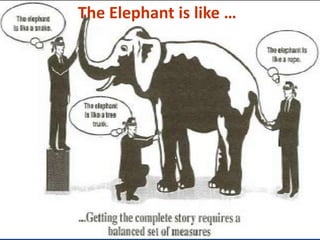
3/10/2010CSDO10The Elephant is like …
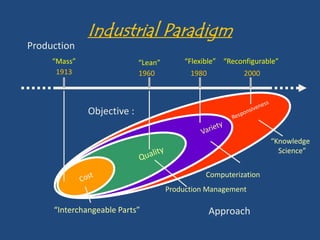
Industrial ParadigmProduction “Mass”“Flexible”“Reconfigurable”“Lean”1913196019802000ResponsivenessObjective :Variety“Knowledge  Science”QualityCostComputerizationProduction Management“Interchangeable Parts”Approach
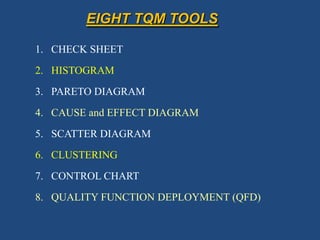
EIGHT TQM TOOLSCHECK SHEETHISTOGRAMPARETO DIAGRAMCAUSE and EFFECT DIAGRAM SCATTER DIAGRAMCLUSTERINGCONTROL CHARTQUALITY FUNCTION DEPLOYMENT (QFD)
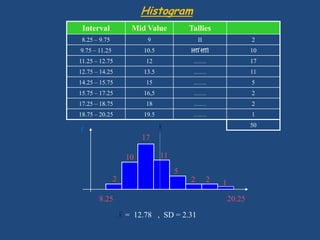
f171110522218.2520.25     =  12.78   ,  SD = 2.31Histogram
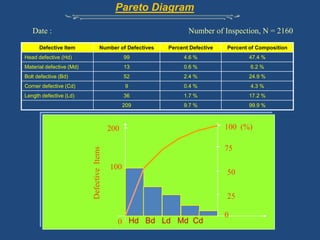
Pareto Diagram Date :				              Number of Inspection, N = 2160100  (%)2007510050Defective  Items250Hd   Bd   Ld   Md  Cd0
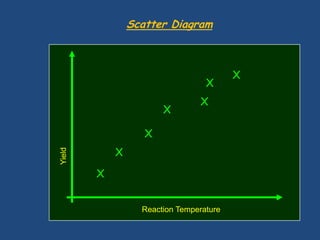
Scatter DiagramXXXXYieldXXXReaction Temperature
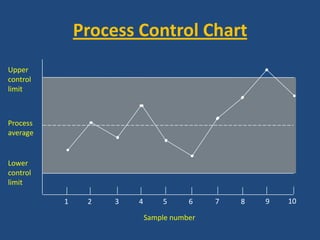
Process Control ChartUppercontrollimitProcessaverageLowercontrollimit10912345678Sample number
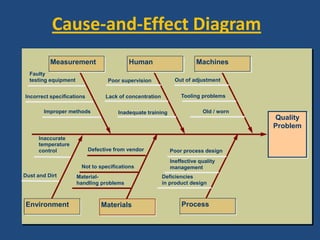
Cause-and-Effect Diagram MachinesMeasurementHumanFaultytesting equipmentOut of adjustmentPoor supervisionTooling problemsIncorrect specificationsLack of concentrationOld / wornImproper methodsInadequate trainingQualityProblemInaccuratetemperature controlDefective from vendorPoor process designIneffective qualitymanagementNot to specificationsDust and DirtDeficienciesin product designMaterial-handling problemsProcessEnvironmentMaterials
Engineers—wake up!Most engineers need to understand they are a dying breed if they plan to maintain  equipment using only the seat of their pants, qualitative data, for making decisions. Engineers must fluently use reliability data so they can reduce costs and avoid failures by using data to make wise decision. Without the  numbers, we engineers will soon be viewed as technical amateurs with declining pay scales and unemployment as the byproduct. Use the data in your maintenance systems to solve technical problems and make improvements!
RELIABILITY vs MAINTENANCE ENGINEERThe task of reliability engineers is to avoid failures which carry a requirement for solving problems with data. The task of maintenance engineers is to quickly restore equipment to operating conditions which requires understanding failure modes and the failure data. Both reliability engineers and maintenance engineers can use a common set of data for an excellent communication tool to solve the vitally few problems in the shortest interval of time using facts from the data to reduce costs.
ReliabilityReliabilityReliability is the ability of a system or component to perform its required functions under stated conditions for a specified period of time [IEEE 90].In other words, it is the likelihood that the system or component will succeed within its identified mission time, with no failures. An aircraft mission is the perfect example to illustrate this concept. When an aircraft takes off for its mission, there is one goal in mind: complete the flight, as intended, safely (with no catastrophic failures).
ReliabilityReliability data requires definition of a failure. Failures can be catastrophic failures or slow degradation—you decide by defining the failures. Units of measure for the data must be in units of the degradation— it can be hours, miles, cycles, and so forth—in short, whatever motivates the failure.
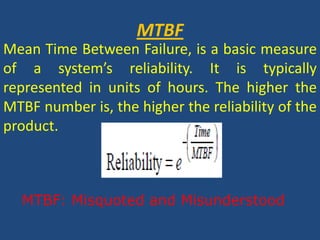
What is a Failure? Reliability is quantified as MTBF (Mean Time Between Failure) for repairable product and MTTF (Mean Time To Failure) for non-repairable product.MTBF is often quoted without providing a definition of failure. This practice is not only misleading but completely useless.MTBF impacts both reliability and availability.
What is a Failure? One could argue there are two basic definitions of a failure:1) The termination of the ability of the product as a whole to perform its required function.2) The termination of the ability of any individual component to perform its required function but not the termination of the ability of the product as a whole to perform.
ExampleIf the inverter of a UPS fails and the UPS switches to static bypass, the failure does not prevent the UPS from performing its required function which is supplying power to the critical load. However, the inverter failure does prevent a component of the UPS from performing its required function of supplying conditioned power.According to definition 1, this is not a failure, but according to definition 2, it is a failure.
What is a Failure? In reality there are more then two definitions of failure, in fact they are infinite.Is customer misapplication considered a failure?Are shipping damages considered failures?Is the expected wear out of a consumable item such as a battery considered a failure if it failed prematurely?If an LED (Light Emitting Diode) on a computer were to fail is it considered a failure even though it hasn’t impacted the operation of the computer?
Definition of FailureFailure itself must also be thoroughly defined at system and module levels. It may be necessary to define more than one type of failure (for example, total system failure or degradation failure) or failures for different operating modes (for example, in flight or on ground) in order to describe all the requirements.
Definition of FailureMTBFs might then be ascribed to the different failure types. MTBFs and failure rates often require clarification as to the meaning of ‘failure’ and ‘time’. The latter may refer to operating time, revenue time, clock time, etc. Types of failure which do not count for the purpose of proving the reliability (for example, maintenance induced or environment outside limits) have also to be defined.
3/10/2010CSDO29
MAINTAINABILITYESSENTIALLY, THE EASE AND SPEED WITH WHICH A FAILED EQUIPMENT CAN BE BROUGHT BACK INTO OPERATING CONDITIONS IS MAINTAINABILITY ALSO CALLED AS MEAN TIME TO REPAIR (MTTR) OF AN ITEM. 3/10/2010CSDO30
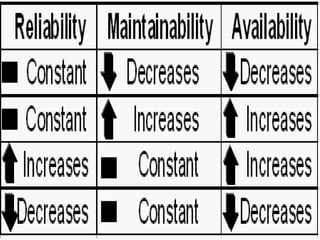
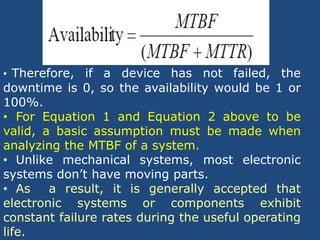
MTTRMean Time to Repair (or Recover), is the expected time to recover a system from a failure. MTTR impacts Availability and not Reliability.The longer the MTTR, the worse off a system is.As the MTBF goes up, Availability goes up. As the MTTR goes up, Availability goes down.
MEAN TIME TO REPAIRDETECTION OF FAULTALLOCATION OF MAINTENANCE TEAMDIAGNOSE FAULT OBTAIN SPARE PARTS (LOGISTIC DELAY)REPAIR TIME(MTTR-THIS IS THE MANUFACTURERS INFORMATION)TEST AND ACCEPT REPAIR CLOSING UP THE SYSTEM AND RETURNING TO NORMAL OPERATION.SKILL OF THE MAINTENANCE ENGINEERS AND THE MAINTENANCE STAFF AVAILABLE AT THE BASES3/10/2010CSDO32
MEAN TIME TO REPAIRIf a Mean Time To Repair (MTTR) or Down Time (MDT) is specified, then the meaning of repair time must be defined in detail.Mean time to repair is often used when it is mean down time which is intended.
MTBFMean Time Between Failure, is a basic measure of a system’s reliability. It is typically represented in units of hours. The higher the MTBF number is, the higher the reliability of the product.MTBF: Misquoted and Misunderstood
MTBFA common misconception about MTBF is that it is equivalent to the expected number of operating hours before a system fails, or the “service life”.It is not uncommon, however, to see an MTBF number on the order of 1 million hours, and it would be unrealistic to think the system could actually operate continuously for over 100 years without a failure.
MTBFThere are 500,000 humans aged 25-year-old in the sample population.Over the course of a year, data is collected on failures (deaths) for this population.The operational life of the population is 500,000 x 1 year = 500,000 people years.Throughout the year, 625 people failed (died).The failure rate is 625 failures / 500,000 people years = 0.125% / year.The MTBF is the inverse of failure rate or 1 / 0.00125 = 800 years.So, even though 25-year-old humans have high MTBF values, their life expectancy (service life) is much shorter and does not correlate.
It’s all about Assumptions!So, what is the MTBF of 25-year-old humans, 80 or 800? It’s both! But, how can the same population end up with two such drastically different MTBF values? If the MTBF of 80 years more accurately reflects the life of the product (humans in this case), is this the better method?
MTBFThe biggest limitation is time. In order to do this, the entire sample population would have to fail, and for many products this is on the order of 10-15 years. In addition, even if it were sensible to wait this duration before calculating the MTBF, problems would be encountered in tracking products. For example, how would a manufacturer know if the products were still in service if they were taken out of service and never reported?Who would want the MTBF value of a product that has been superceded by several generations of technology updates?
AvailabilityAvailability, on the other hand, is the degree to which a system or component is operational and accessible when required for use [IEEE 90].Availability is often looked at because, when a failure does occur, the critical variable now becomes how quickly the system can be recovered.
Therefore, if a device has not failed, the downtime is 0, so the availability would be 1 or 100%.
  For Equation 1 and Equation 2 above to be valid, a basic assumption must be made when analyzing the MTBF of a system.
  Unlike mechanical systems, most electronic systems don’t have moving parts.
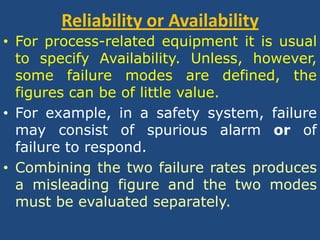
As  a result, it is generally accepted that electronic systems or components exhibit constant failure rates during the useful operating life.Reliability or AvailabilityFor process-related equipment it is usual to specify Availability. Unless, however, some failure modes are defined, the figures can be of little value. For example, in a safety system, failure may consist of spurious alarm or of failure to respond. Combining the two failure rates produces a misleading figure and the two modes must be evaluated separately.
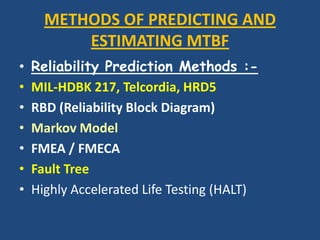
METHODS OF PREDICTING AND ESTIMATING MTBFReliability Prediction Methods :-MIL-HDBK 217, Telcordia, HRD5RBD (Reliability Block Diagram)Markov ModelFMEA / FMECAFault TreeHighly Accelerated Life Testing (HALT)
METHODS OF PREDICTING AND ESTIMATING MTBFReliability Estimation Methods :-Similar Item Prediction MethodField Data Measurement MethodThe FIDES Prediction Model (FIDES Guide 2004 Issue, A Reliability Methodology for Electronic Systems) was designed by the FIDES Group, a consortium of European companies from the aeronautics and defense fields, to apply to all domains using electronics, including the military, commercial industry, and telecommunications.
3/10/2010CSDO44
3/10/2010CSDO45
3/10/2010CSDO46
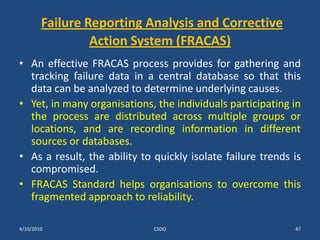
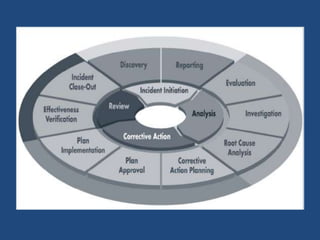
Failure Reporting Analysis and Corrective Action System (FRACAS) An effective FRACAS process provides for gathering and tracking failure data in a central database so that this data can be analyzed to determine underlying causes.Yet, in many organisations, the individuals participating in the process are distributed across multiple groups or locations, and are recording information in different sources or databases. As a result, the ability to quickly isolate failure trends is compromised. FRACAS Standard helps organisations to overcome this fragmented approach to reliability. 3/10/2010CSDO47
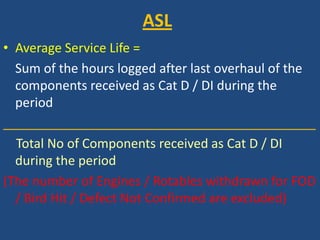
ASLAverage Service Life =	Sum of the hours logged after last overhaul of the components received as Cat D / DI during the period____________________________________________    Total No of Components received as Cat D / DI during the period(The number of Engines / Rotables withdrawn for FOD / Bird Hit / Defect Not Confirmed are excluded)

Reliability

  • 1.
    RELIABILITY MANAGEMENT ANINTEGRATED APPROACHWg Cdr Jayesh C S PaiCSDO, AF
  • 2.
  • 3.
  • 4.
    Memory and learning3/10/2010CSDO410%of whatweread20% of whatwehear“Conventional Learning”30% of whatwesee50% of whatwesee & hear70% of what we discuss“ActiveLearning”80% of whatweexperience95% of what we teachTo consider pedagogical methodologies other than “conventional ones”
  • 5.
    DEMING Quotes"There isno substitute for knowledge.""The most important things cannot be measured.""The most important things are unknown or unknowable.“"Experience by itself teaches nothing.“"I think that people here expect miracles. American management thinks that they can just copy from Japan—but they don't know what to copy!"
  • 6.
    Defect Rate AnalysisGOAL:GET AN OVERVIEW ABOUT THE AMOUNT AND STATE OF THE REPORTED DEFECTS.TO OBTAIN AN OVERVIEW OF THE PATTERN OF DEFECTS ARISING IN IT WITH A VIEW TO HIGHLIGHT POSSIBLE TROUBLE PRONE AGGREGATES FOR THE FUTURE AND SUGGEST REMEDIES FOR IMPROVEMENT.
  • 7.
    DATA COLLECTION1. DR/PWR DATA (RECEIVED FROM UNITS)- WING - AIRCRAFT SQUADRON - AIRCRAFT No. - DR/PWR No. & DATE - DIR/PWIR No. & DATE - NOMENCLATURE OF COMPONENT - PART NUMBER - SYSTEM - TRADE - TBO - LIFE COMPLETED SINCE LAST OVERHAUL - LIFE COMPLETED SINCE NEW - REPORTED DEFECT - DI AGENCY2. DIR / PW IR DATA (Received from DI agency) - CONFIRMATION AND FINDINGS - RECOMMENDATIONS
  • 8.
    PIE – CHARTTRADE - AIRFRAMEDEFECT DATA – AIRFRAME SYSTEMSOTHERS,(18)10%AIR CONDITIONINGSYSTEM(28)15%TAKE OFF/LANDING SYSTEM(13)7%FUEL SYSTEM (31)17%PNEUMATIC SYSTEM(35)19%HYDRAULIC SYSTEM(58)32%
  • 9.
    Recent NASA AccidentsGenesisvehicle slammed into Utah desert, probably because Lockheed engineers installed four small switches backwardClimate orbiter crashed into Mars because Lockheed used English measurement while NASA used metricMars polar vehicle crashed when descent rockets shut off prematurelyTelevision infrared observation satellite (TIROS) fell off its transport stand because an adapter plate was not properly secured
  • 10.
  • 11.
    Industrial ParadigmProduction “Mass”“Flexible”“Reconfigurable”“Lean”1913196019802000ResponsivenessObjective:Variety“Knowledge Science”QualityCostComputerizationProduction Management“Interchangeable Parts”Approach
  • 12.
    EIGHT TQM TOOLSCHECKSHEETHISTOGRAMPARETO DIAGRAMCAUSE and EFFECT DIAGRAM SCATTER DIAGRAMCLUSTERINGCONTROL CHARTQUALITY FUNCTION DEPLOYMENT (QFD)
  • 13.
    f171110522218.2520.25 = 12.78 , SD = 2.31Histogram
  • 14.
    Pareto Diagram Date: Number of Inspection, N = 2160100 (%)2007510050Defective Items250Hd Bd Ld Md Cd0
  • 15.
  • 16.
  • 17.
    Cause-and-Effect Diagram MachinesMeasurementHumanFaultytestingequipmentOut of adjustmentPoor supervisionTooling problemsIncorrect specificationsLack of concentrationOld / wornImproper methodsInadequate trainingQualityProblemInaccuratetemperature controlDefective from vendorPoor process designIneffective qualitymanagementNot to specificationsDust and DirtDeficienciesin product designMaterial-handling problemsProcessEnvironmentMaterials
  • 18.
    Engineers—wake up!Most engineersneed to understand they are a dying breed if they plan to maintain equipment using only the seat of their pants, qualitative data, for making decisions. Engineers must fluently use reliability data so they can reduce costs and avoid failures by using data to make wise decision. Without the numbers, we engineers will soon be viewed as technical amateurs with declining pay scales and unemployment as the byproduct. Use the data in your maintenance systems to solve technical problems and make improvements!
  • 20.
    RELIABILITY vs MAINTENANCEENGINEERThe task of reliability engineers is to avoid failures which carry a requirement for solving problems with data. The task of maintenance engineers is to quickly restore equipment to operating conditions which requires understanding failure modes and the failure data. Both reliability engineers and maintenance engineers can use a common set of data for an excellent communication tool to solve the vitally few problems in the shortest interval of time using facts from the data to reduce costs.
  • 21.
    ReliabilityReliabilityReliability is theability of a system or component to perform its required functions under stated conditions for a specified period of time [IEEE 90].In other words, it is the likelihood that the system or component will succeed within its identified mission time, with no failures. An aircraft mission is the perfect example to illustrate this concept. When an aircraft takes off for its mission, there is one goal in mind: complete the flight, as intended, safely (with no catastrophic failures).
  • 22.
    ReliabilityReliability data requiresdefinition of a failure. Failures can be catastrophic failures or slow degradation—you decide by defining the failures. Units of measure for the data must be in units of the degradation— it can be hours, miles, cycles, and so forth—in short, whatever motivates the failure.
  • 23.
    What is aFailure? Reliability is quantified as MTBF (Mean Time Between Failure) for repairable product and MTTF (Mean Time To Failure) for non-repairable product.MTBF is often quoted without providing a definition of failure. This practice is not only misleading but completely useless.MTBF impacts both reliability and availability.
  • 24.
    What is aFailure? One could argue there are two basic definitions of a failure:1) The termination of the ability of the product as a whole to perform its required function.2) The termination of the ability of any individual component to perform its required function but not the termination of the ability of the product as a whole to perform.
  • 25.
    ExampleIf the inverterof a UPS fails and the UPS switches to static bypass, the failure does not prevent the UPS from performing its required function which is supplying power to the critical load. However, the inverter failure does prevent a component of the UPS from performing its required function of supplying conditioned power.According to definition 1, this is not a failure, but according to definition 2, it is a failure.
  • 26.
    What is aFailure? In reality there are more then two definitions of failure, in fact they are infinite.Is customer misapplication considered a failure?Are shipping damages considered failures?Is the expected wear out of a consumable item such as a battery considered a failure if it failed prematurely?If an LED (Light Emitting Diode) on a computer were to fail is it considered a failure even though it hasn’t impacted the operation of the computer?
  • 27.
    Definition of FailureFailureitself must also be thoroughly defined at system and module levels. It may be necessary to define more than one type of failure (for example, total system failure or degradation failure) or failures for different operating modes (for example, in flight or on ground) in order to describe all the requirements.
  • 28.
    Definition of FailureMTBFsmight then be ascribed to the different failure types. MTBFs and failure rates often require clarification as to the meaning of ‘failure’ and ‘time’. The latter may refer to operating time, revenue time, clock time, etc. Types of failure which do not count for the purpose of proving the reliability (for example, maintenance induced or environment outside limits) have also to be defined.
  • 29.
  • 30.
    MAINTAINABILITYESSENTIALLY, THE EASEAND SPEED WITH WHICH A FAILED EQUIPMENT CAN BE BROUGHT BACK INTO OPERATING CONDITIONS IS MAINTAINABILITY ALSO CALLED AS MEAN TIME TO REPAIR (MTTR) OF AN ITEM. 3/10/2010CSDO30
  • 31.
    MTTRMean Time toRepair (or Recover), is the expected time to recover a system from a failure. MTTR impacts Availability and not Reliability.The longer the MTTR, the worse off a system is.As the MTBF goes up, Availability goes up. As the MTTR goes up, Availability goes down.
  • 32.
    MEAN TIME TOREPAIRDETECTION OF FAULTALLOCATION OF MAINTENANCE TEAMDIAGNOSE FAULT OBTAIN SPARE PARTS (LOGISTIC DELAY)REPAIR TIME(MTTR-THIS IS THE MANUFACTURERS INFORMATION)TEST AND ACCEPT REPAIR CLOSING UP THE SYSTEM AND RETURNING TO NORMAL OPERATION.SKILL OF THE MAINTENANCE ENGINEERS AND THE MAINTENANCE STAFF AVAILABLE AT THE BASES3/10/2010CSDO32
  • 33.
    MEAN TIME TOREPAIRIf a Mean Time To Repair (MTTR) or Down Time (MDT) is specified, then the meaning of repair time must be defined in detail.Mean time to repair is often used when it is mean down time which is intended.
  • 34.
    MTBFMean Time BetweenFailure, is a basic measure of a system’s reliability. It is typically represented in units of hours. The higher the MTBF number is, the higher the reliability of the product.MTBF: Misquoted and Misunderstood
  • 35.
    MTBFA common misconceptionabout MTBF is that it is equivalent to the expected number of operating hours before a system fails, or the “service life”.It is not uncommon, however, to see an MTBF number on the order of 1 million hours, and it would be unrealistic to think the system could actually operate continuously for over 100 years without a failure.
  • 36.
    MTBFThere are 500,000humans aged 25-year-old in the sample population.Over the course of a year, data is collected on failures (deaths) for this population.The operational life of the population is 500,000 x 1 year = 500,000 people years.Throughout the year, 625 people failed (died).The failure rate is 625 failures / 500,000 people years = 0.125% / year.The MTBF is the inverse of failure rate or 1 / 0.00125 = 800 years.So, even though 25-year-old humans have high MTBF values, their life expectancy (service life) is much shorter and does not correlate.
  • 37.
    It’s all aboutAssumptions!So, what is the MTBF of 25-year-old humans, 80 or 800? It’s both! But, how can the same population end up with two such drastically different MTBF values? If the MTBF of 80 years more accurately reflects the life of the product (humans in this case), is this the better method?
  • 38.
    MTBFThe biggest limitationis time. In order to do this, the entire sample population would have to fail, and for many products this is on the order of 10-15 years. In addition, even if it were sensible to wait this duration before calculating the MTBF, problems would be encountered in tracking products. For example, how would a manufacturer know if the products were still in service if they were taken out of service and never reported?Who would want the MTBF value of a product that has been superceded by several generations of technology updates?
  • 39.
    AvailabilityAvailability, on theother hand, is the degree to which a system or component is operational and accessible when required for use [IEEE 90].Availability is often looked at because, when a failure does occur, the critical variable now becomes how quickly the system can be recovered.
  • 40.
    Therefore, if adevice has not failed, the downtime is 0, so the availability would be 1 or 100%.
  • 41.
    ForEquation 1 and Equation 2 above to be valid, a basic assumption must be made when analyzing the MTBF of a system.
  • 42.
    Unlikemechanical systems, most electronic systems don’t have moving parts.
  • 43.
    As aresult, it is generally accepted that electronic systems or components exhibit constant failure rates during the useful operating life.Reliability or AvailabilityFor process-related equipment it is usual to specify Availability. Unless, however, some failure modes are defined, the figures can be of little value. For example, in a safety system, failure may consist of spurious alarm or of failure to respond. Combining the two failure rates produces a misleading figure and the two modes must be evaluated separately.
  • 44.
    METHODS OF PREDICTINGAND ESTIMATING MTBFReliability Prediction Methods :-MIL-HDBK 217, Telcordia, HRD5RBD (Reliability Block Diagram)Markov ModelFMEA / FMECAFault TreeHighly Accelerated Life Testing (HALT)
  • 45.
    METHODS OF PREDICTINGAND ESTIMATING MTBFReliability Estimation Methods :-Similar Item Prediction MethodField Data Measurement MethodThe FIDES Prediction Model (FIDES Guide 2004 Issue, A Reliability Methodology for Electronic Systems) was designed by the FIDES Group, a consortium of European companies from the aeronautics and defense fields, to apply to all domains using electronics, including the military, commercial industry, and telecommunications.
  • 46.
  • 47.
  • 48.
  • 49.
    Failure Reporting Analysisand Corrective Action System (FRACAS) An effective FRACAS process provides for gathering and tracking failure data in a central database so that this data can be analyzed to determine underlying causes.Yet, in many organisations, the individuals participating in the process are distributed across multiple groups or locations, and are recording information in different sources or databases. As a result, the ability to quickly isolate failure trends is compromised. FRACAS Standard helps organisations to overcome this fragmented approach to reliability. 3/10/2010CSDO47
  • 51.
    ASLAverage Service Life= Sum of the hours logged after last overhaul of the components received as Cat D / DI during the period____________________________________________ Total No of Components received as Cat D / DI during the period(The number of Engines / Rotables withdrawn for FOD / Bird Hit / Defect Not Confirmed are excluded)
  • 52.
    DEMING Quotes"There isno substitute for knowledge.""The most important things cannot be measured.""The most important things are unknown or unknowable.“"Experience by itself teaches nothing.“"I think that people here expect miracles. American management thinks that they can just copy from Japan—but they don't know what to copy!"