Predicting Product 
                    Predicting Product
                   Life Using Reliability 
                   Life Using Reliability
                         y
                    Analysis Methods
                               Steven Wachs
                            ©2011 ASQ & Presentation Steven
                          Presented live on Nov 09th ~ 11th, 2012


http://reliabilitycalendar.org/The_Re
liability_Calendar/Short_Courses/Sh
liability Calendar/Short Courses/Sh
ort_Courses.html
ASQ Reliability Division 
                 ASQ Reliability Division
                  Short Course Series
                  Short Course Series
                  One of the monthly webinars 
                  One of the monthly webinars
                    on topics of interest to 
                      reliability engineers.
                    To view recorded webinar (available to ASQ Reliability 
                        Division members only) visit asq.org/reliability
                                             )              /

                     To sign up for the free and available to anyone live 
                    webinars visit reliabilitycalendar.org and select English 
                    Webinars to find links to register for upcoming events


http://reliabilitycalendar.org/The_Re
liability_Calendar/Short_Courses/Sh
liability Calendar/Short Courses/Sh
ort_Courses.html
Predicting Product Life
Using Reliability Analysis
        Methods
         Steven Wachs
      Principal Statistician
     Integral Concepts, Inc.
      www.integral-concepts.com
            248-884-2276
        www.integral-concepts.com   1
        ©2012 Copyright
Agenda

   Reliability Concepts & Reliability Data
   Probability, Statistics, and Distributions
   Assessing & Selecting Models
   Estimating Reliability Statistics
   Systems Reliability
   Reliability Test Planning
   Accelerated Life Testing
   Warranty Analysis

                  www.integral-concepts.com      2
                  ©2012 Copyright
Motivation

Intense Global Competition

Customer Expectations

Customer Loyalty

Product Liability


             www.integral-concepts.com   3
             ©2012 Copyright
Defining Reliability


  Reliability is the probability that a
  material, component, or system will
  perform its intended function under
  defined operating conditions for a
  specified period of time.


              www.integral-concepts.com   4
              ©2012 Copyright
Ambiguity in Definition

 What is the intended function?
 What are the defined operating
  conditions?
 How should time be defined?


We must clearly define these characteristics
 when defining reliability for a specific
 application
               www.integral-concepts.com       5
               ©2012 Copyright
Reliability Data

 Life Data
 Time-To-Failure (TTF) Data
 Time-Between-Failure (TBF) Data
 Survival Data
 Event-time Data
 Degradation Data

              www.integral-concepts.com   6
              ©2012 Copyright
Unique Aspects of Reliability Data

 Presence of Censoring
 Reliability Models based on positive
  random variables (e.g. exponential,
  lognormal, Weibull, gamma)
 Interpolation and extrapolation often
  required


             www.integral-concepts.com    7
             ©2012 Copyright
Repairable vs. Non-repairable

 The focus of this course is non-
  repairable components or systems
  (characterized by time to failure)

 Repairable systems are characterized
  by time between failure


              www.integral-concepts.com   8
              ©2012 Copyright
The Bathtub Curve


            www.integral-concepts.com   9
            ©2012 Copyright
The Reliability Function


R(to ) = P(T > to )

where T =“time”
to failure


                 www.integral-concepts.com   10
                 ©2012 Copyright
Censored Data

  When exact failure times are not known

  Provides useful information for estimation
   of reliability (Do NOT drop from analysis)

  Types of Censoring
   – Right Censoring
   – Left Censoring
   – Interval Censoring

                www.integral-concepts.com       11
                ©2012 Copyright
Types of Censoring
     Left Censoring                         Right Censoring


                      Interval Censoring


                www.integral-concepts.com                     12
                ©2012 Copyright
Other Censoring Ideas

  Competing Risks


 • Impact on Reliability estimates
 • Alternatives (if extreme censoring exists)
   – Use Accelerated Testing Conditions
   – Use Degradation Data


                www.integral-concepts.com       13
                ©2012 Copyright
Agenda

   Reliability Concepts & Reliability Data
   Probability, Statistics, and Distributions
   Assessing & Selecting Models
   Estimating Reliability Statistics
   Systems Reliability
   Reliability Test Planning
   Accelerated Life Testing
   Warranty Analysis

                  www.integral-concepts.com      14
                  ©2012 Copyright
Describing Time to Failure


            www.integral-concepts.com   15
            ©2012 Copyright
Integrating the PDF


                                         B


                                             c fxdx
                                              d
 PX  B  PX  c, d 
             www.integral-concepts.com                   16
             ©2012 Copyright
Reliability
                                  Distribution Plot
             0.0008

             0.0007

             0.0006

             0.0005
   Density


             0.0004

             0.0003

             0.0002

             0.0001                                       R(1500)

             0.0000
                      0                     1500
                                                      X


                          www.integral-concepts.com                 17
                          ©2012 Copyright
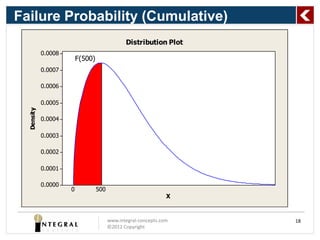
Failure Probability (Cumulative)
                                               Distribution Plot
            0.0008
                         F(500)
            0.0007

            0.0006

            0.0005
  Density


            0.0004

            0.0003

            0.0002

            0.0001

            0.0000
                     0            500
                                                                X


                                        www.integral-concepts.com   18
                                        ©2012 Copyright
The CDF


                                         fxdx
                                         t
              Ft  PX  , t 


          www.integral-concepts.com           19
          ©2012 Copyright
                                             19
CDF/Reliability Relationship


      www.integral-concepts.com   20
      ©2012 Copyright
Hazard Function (Rate)

The propensity to fail in the next instant
 given that it hasn’t failed up to that
 time (“instantaneous failure rate
 function”)

                   ft                       ft
ht             1Ft
                                             Rt

              www.integral-concepts.com              21
              ©2012 Copyright
www.integral-concepts.com   22
©2012 Copyright
Mean Time to Failure (MTTF)

 The Expected Value or the Mean of the Time
  to Failure Random Variable
 The average time to failure (often
  significantly larger than the median time to
  failure)
 The MTTF can be misleading as often as
  much as 70% of the population will fail
  before the MTTF
                                          
    MTTF  ET        0 tftdt  0 Rtdt
               www.integral-concepts.com         23
               ©2012 Copyright
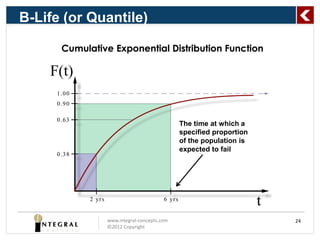
B-Life (or Quantile)


                                         The time at which a
                                         specified proportion
                                         of the population is
                                         expected to fail


             www.integral-concepts.com                          24
             ©2012 Copyright
Advantages of Parametric Models
 May be described concisely with a few
  parameters

 Allows extrapolation (in time)


 Provide “smooth” estimates of failure
  time distributions

               www.integral-concepts.com   25
               ©2012 Copyright
Common Distributions in Reliability

   Weibull
   Exponential
   Lognormal
   Gamma
   Binomial
   Loglogistic
   Etc.


              www.integral-concepts.com   26
              ©2012 Copyright
Exponential Distribution

  The simplest model used in reliability
   analysis (and sometimes misused)

  Described by a single parameter, l  which
   is the hazard rate (inverse of MTTF)

  Key property: the hazard rate is constant
   (the only distribution with this property)

              www.integral-concepts.com         27
              ©2012 Copyright
Exponential Distribution

•   pdf: f(t) = le-lt
•   cdf: F(t) = 1 - e-lt
•   Reliability: R(t) = e-lt
•   Hazard rate: h(t) = l
•   MTTF = 1/l = q
•   Quantile: F-1(p) = (1/l)[-ln(1-p)]

              www.integral-concepts.com   28
              ©2012 Copyright
Exponential Distribution Example

Light bulb lifetime may be described by an
    exponential distribution. The MTTF = 12,000
    hrs.

Find:
A. Hazard Rate
B. Proportion failing by 12,000 hrs
C. Proportion failing by 24,000 hrs


               www.integral-concepts.com      29
               ©2012 Copyright
Exponential Distribution Example

 Solution
 A. l = 1/12,000 = 0.000083 = 83 failures per
    million hrs
                                    12,000
 B. F12, 000  1  e              12,000     1   1
                                                     e     0. 632
                                   24,000
 C. F24, 000  1  e             12,000      1   1
                                                           0. 865
                                                     e2


              www.integral-concepts.com                              30
              ©2012 Copyright
Exponential Distribution Guidelines

 Constant hazard rate implies that the
  probability that a unit will fail in the next
  instant does not depend on the unit’s age

 Reasonable for many electronic
  components that do not wear out

 Usually inappropriate for modeling TTF of
  mechanical components that are subject
  to fatigue, corrosion, or wear
               www.integral-concepts.com          31
               ©2012 Copyright
The Weibull Distribution

 The most common model in reliability analysis

 Described by 2 parameters:
    h = “scale” parameter
    b = “shape” parameter

 Flexible model that can effectively model a
  wide variety of failure distributions


                www.integral-concepts.com       32
                ©2012 Copyright
The Weibull Distribution (some functions)

                                                          1          t   
   pdf:                ft                       t
                                                                   e    

                                                                     
                                                               t
   cdf:                Ft  1  e                            


                                                           
                                                      t
   Reliability:        Rt  e                       


                                                              1
   Hazard rate:        ht                       t
                                                       

                   www.integral-concepts.com                                     33
                   ©2012 Copyright
The Weibull Shape Parameter

Failure Rate


                                           ?


               www.integral-concepts.com       34
               ©2012 Copyright
The Weibull Scale Parameter


                                        ?


            www.integral-concepts.com       35
            ©2012 Copyright
Weibull Characteristics

  h is also referred to as the 63.2nd
  percentile
  To see this: set t = h in F(t)
                                                  
                                           
     Ft  F  1  e                       

                        1 
                 1e
                 1  e  0. 632
                       1

  • The value of b is irrelevant when t =
    h
               www.integral-concepts.com               36
               ©2012 Copyright
Conditional Reliability

 An application of conditional probability
 Needed to estimate reliability when “burn-
  in” is used or to estimate reliability after a
  warranty period.

                                             Rtt 0 
    Rt|t 0                                 Rt 0 
                 www.integral-concepts.com               37
                 ©2012 Copyright
Agenda

   Reliability Concepts & Reliability Data
   Probability, Statistics, and Distributions
   Assessing & Selecting Models
   Estimating Reliability Statistics
   Systems Reliability
   Reliability Test Planning
   Accelerated Life Testing
   Warranty Analysis

                  www.integral-concepts.com      38
                  ©2012 Copyright
Selecting Models

 Given time-to-failure data (failures and
  censored data), which distribution best
  describes the data?
 Graphical Methods (probability
  plotting) and/or Statistical Methods
  may be utilized


             www.integral-concepts.com   39
             ©2012 Copyright
Probability Plots

 Graphical method to assess “fit”
 Fit is determined by how well the plotted
  points align along a straight line
 Plotted variables are “transformed” so that
  y is a linear function of x
   – X axis: Plot observed failure times
   – Y axis: Plot estimated cumulative probabilities
     (p)

                 www.integral-concepts.com             40
                 ©2012 Copyright
Probability Plotting


              www.integral-concepts.com   41
              ©2012 Copyright
Constructing Probability Plots
• X-Axis – Observed/Transformed
  Failure Times

• Y-Axis – Estimated/Transformed
  Cumulative Probabilities

• Transformed quantities for plot
  depend on the distribution

            www.integral-concepts.com   42
            ©2012 Copyright
Constructing Probability Plots


         www.integral-concepts.com   43
         ©2012 Copyright
Linearizing the CDF - Example

 Consider the Weibull distribution.           Recall
  that the Weibull cdf is:
                                                   
                                              t
  Ft  1  e                                 

 • We need to transform F(t) to achieve
   a linear function


               www.integral-concepts.com                44
               ©2012 Copyright
Linearizing the CDF - Example
                                        
                                   t
       1  Ft  e                 

                        t       
         1
       1Ft
                e      


                                        
       ln 1Ft     
             1          t


       ln ln 1Ft 
                1
                                      lnt   ln


       By setting:       y  ln ln 1Ft 
                                      1


                       x  lnt
                       C   ln
       we have:        y  x  C


           www.integral-concepts.com                      45
           ©2012 Copyright
Graphical Estimation


        2.75
                                     b = 2.0/2.75
                                       = 0.73

2.0


                             h

         www.integral-concepts.com                  46
         ©2012 Copyright
Selecting Models
 Multiple Distributions may adequately
  describe the time-to-failure data
 Sensitivity Analysis is recommended
  to assess how reliability predictions
  vary with alternative viable models
 Confidence Intervals on reliability
  estimates do not include model
  uncertainty

             www.integral-concepts.com    47
             ©2012 Copyright
Selecting a Distribution


              www.integral-concepts.com   48
              ©2012 Copyright
Handling Multiple Failure Modes

 Multiple Failure Modes should be
  modeled separately (if data exists)
 Failure rates of the various failure
  modes are typically different
 Overall Reliability may be predicted
  using system reliability concepts
  (series model)


              www.integral-concepts.com   49
              ©2012 Copyright
Handling Multiple Failure Modes
 ReliaSoft Weibull++ 7 - www.ReliaSoft.com
                                                                    Probability - W eibull
                                       99.000
                                                                                                                           Probability-Weibull

                                                                                                                           Data 1
                                                                                                                           Weibull-2P
                                       90.000                                                                              ML E SRM MED FM
                                                                                                                           F=40/S=0
                                                                                                                                 Data Points
                                                                                                                                 Probability Line


                                       50.000
     U n re l i a b i l i ty , F (t)


                                       10.000


                                        5.000


                                                                                                                          Steven Wachs
                                                                                                                          integral Concepts, Inc.
                                                                                                                          10/28/2011
                                                                                                                          1:05:27 PM
                                        1.000
                                            0.010   0.100   1.000           10.000           100.000   1000.000   10000.000
                                                                           Time, ( t)
 b   h    


                                                            www.integral-concepts.com                                                               50
                                                            ©2012 Copyright
Handling Multiple Failure Modes
 ReliaSoft Weibull++ 7 - www.ReliaSoft.com
                                                                            Probability - W eibull
                                       99.000
                                                                                                                                   Probability-Weibull

                                                                                                                                   Data 1
                                                                                                                                   Weibull-CFM
                                       90.000                                                                                      ML E SRM MED FM
                                                                                                                                         CFM 1 Points
                                                                                                                                         CFM 2 Points
                                                                                                                                         CFM 1 L ine
                                                                                                                                         CFM 2 L ine
                                                                                                                                         Probability Line


                                       50.000
     U n re l i a b i l i ty , F (t)


                                       10.000


                                        5.000


                                                                                                                                  Steven Wachs
                                                                                                                                  integral Concepts, Inc.
                                                                                                                                  10/28/2011
                                                                                                                                  1:03:08 PM
                                        1.000
                                            0.010   0.100           1.000           10.000           100.000   1000.000   10000.000
                                                                                   Time, ( t)
 b    h      b   h  


                                                                    www.integral-concepts.com                                                               51
                                                                    ©2012 Copyright
Agenda

   Reliability Concepts & Reliability Data
   Probability, Statistics, and Distributions
   Assessing & Selecting Models
   Estimating Reliability Statistics
   Systems Reliability
   Reliability Test Planning
   Accelerated Life Testing
   Warranty Analysis

                  www.integral-concepts.com      52
                  ©2012 Copyright
Reliability Estimation

 From the time-to-failure distribution we
  can estimate quantities like:
  •   Reliability at various times
  •   Time at which x% are expected to fail
  •   Failure (hazard) rates
  •   Mean time to failure

 Confidence Intervals or Bounds should
  be included to account for estimation
  uncertainty
               www.integral-concepts.com      53
               ©2012 Copyright
Reliability Estimation

 Estimation Methods
  • Maximum Likelihood Estimation (MLE):
    nice statistical properties, handles
    censored data well, biased estimates for
    small sample sizes

  • Rank Regression: Unbiased estimates but
    poorer precision and does not handle
    censored data as well as MLE


              www.integral-concepts.com        54
              ©2012 Copyright
Properties of Estimators


 Bias – The extent to which the estimator
  differs on average from the true value. (An
  unbiased estimator equals the true value
  on average)

 Precision – The amount of variability in the
  estimates.


                www.integral-concepts.com        55
                ©2012 Copyright
Properties of Estimators


     www.integral-concepts.com   56
     ©2012 Copyright
Estimation Methods

   Maximum Likelihood Estimation
    – Generally preferred by statisticians (minimum
      variance) although the estimates tend to be biased

    – ML method finds parameter values which maximize
      the likelihood function (the joint probability of
      observing all of the data).

    – The maximization of the likelihood function usually
      must be done numerically (rather than
      analytically).

                    www.integral-concepts.com               57
                    ©2012 Copyright
MLE Example (Weibull)
 • Given failure time data, we need to
   estimate h, b.
    i1 fx i  fx 1 fx 2 . . . fx n 
         n
L
                                               
L      e
     n  x 1                           xi
                          i               
     i1

 • We maximize likelihood function by
   taking derivatives with respect to
   each parameter

              www.integral-concepts.com            58
              ©2012 Copyright
Effect of Censored Data on the Likelihood Function


  • With no censoring, the likelihood
    function is:

           i1 fx i   fx 1 fx 2 . . . fx n 
               n
      L

   • Censored observations cannot
     use the pdf since the failure
     time is unknown

                   www.integral-concepts.com            59
                   ©2012 Copyright
Effect of Censored Data on the Likelihood Function


  • Suppose we have a right-censored
    observation at time = 1500?

  • What function indicates the probability of
    this occurring?


                 www.integral-concepts.com           60
                 ©2012 Copyright
Effect of Censored Data on the Likelihood Function


  • Suppose we have a right-censored
    observation at time = 1500?

  • What function indicates the probability of
    this occurring?

  • R(1500) gives the probability that a unit fails
    at time 1500 or later.


                  www.integral-concepts.com           61
                  ©2012 Copyright
Effect of Censored Data on the Likelihood Function

                                 Distribution Plot
             0.0008

             0.0007

             0.0006

             0.0005
   Density


             0.0004

             0.0003

             0.0002

             0.0001                                   R(1500)

             0.0000
                      0                   1500
                                                 X


                          www.integral-concepts.com             62
                          ©2012 Copyright
Effect of Censored Data on the Likelihood Function


  • Suppose we have a left-censored
    observation at time = 500?

  • What function indicates the probability of
    this occurring?


                 www.integral-concepts.com           63
                 ©2012 Copyright
Effect of Censored Data on the Likelihood Function


  • Suppose we have a left-censored observation
    at time = 500?

  • What function indicates the probability of
    this occurring?

  • F(500) gives the probability that a unit fails at
    time 500 or earlier.


                  www.integral-concepts.com             64
                  ©2012 Copyright
Effect of Censored Data on the Likelihood Function

                                              Distribution Plot
              0.0008
                           F(500)
              0.0007

              0.0006

              0.0005
    Density


              0.0004

              0.0003

              0.0002

              0.0001

              0.0000
                       0            500
                                                             X


                                     www.integral-concepts.com    65
                                     ©2012 Copyright
Effect of Censored Data on the Likelihood Function


  • Suppose we have an interval censored
    condition where the failure occurred
    between 1000 and 1300.

  • What function indicates the probability of
    this occurring?


                 www.integral-concepts.com           66
                 ©2012 Copyright
Effect of Censored Data on the Likelihood Function


  • Suppose we have an interval censored
    condition where the failure occurred
    between 1000 and 1300.

  • What function indicates the probability of
    this occurring?

  • F(1300)-F(1000) gives the probability that a
    unit fails between 1000 and 1300


                 www.integral-concepts.com           67
                 ©2012 Copyright
Effect of Censored Data on the Likelihood Function

                                   Distribution Plot
             0.0008

             0.0007

             0.0006

             0.0005                      F(1300)-F(1000)
   Density


             0.0004

             0.0003

             0.0002

             0.0001

             0.0000
                      0          1000 1300
                                                      X


                          www.integral-concepts.com        68
                          ©2012 Copyright
Estimation Methods

• Rank Regression
  – Determines best fit line on the probability
    plot by using least squares regression

  – Fitted line is used to estimate parameters


                www.integral-concepts.com         69
                ©2012 Copyright
Failure Probability Plot


              www.integral-concepts.com   70
              ©2012 Copyright
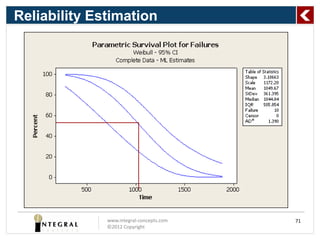
Reliability Estimation


              www.integral-concepts.com   71
              ©2012 Copyright
Estimating with Multiple Failure Modes
     Failure Time   Failure Model               Failure Time   Failure Model
           63           linkage                      791            motor
          116           linkage                      808            motor
          237           linkage                      823            motor
          249           linkage                      841            motor
          297           linkage                      869            motor
          384           linkage                      874           linkage
          386           linkage                      878            motor
          420           linkage                      981            motor
          467           linkage                      991            motor
          485            motor                       999            motor
          522           linkage                     1005            motor
          541           linkage                     1007            motor
          592           linkage                     1046            motor
          595           linkage                     1084            motor
          601           linkage                     1086            motor
          624           linkage                     1190            motor
          655            motor                      1299            motor
          662           linkage                     1481           linkage
          702           linkage                     1502            motor
          721           linkage                     1581            motor


                        www.integral-concepts.com                              72
                        ©2012 Copyright
Linkage Failure Mode
Distribution Analysis: Failure Time

Variable: Failure Time
Failure Mode: fm = linkage

Censoring Information        Count
Uncensored value                20
Right censored value            20

Estimation Method: Maximum Likelihood

Distribution:   Weibull

Parameter Estimates

                         Standard             95.0% Normal CI
Parameter   Estimate        Error               Lower    Upper
Shape        1.34641     0.264909            0.915592 1.97994
Scale        1325.81      240.466             929.169 1891.76

                       www.integral-concepts.com                 73
                       ©2012 Copyright
Motor Failure Mode
Distribution Analysis: Failure Time

Variable: Failure Time
Failure Mode: fm = motor

Censoring Information     Count
Uncensored value             20
Right censored value         20

Estimation Method: Maximum Likelihood

Distribution:   Weibull

Parameter Estimates

                       Standard            95.0% Normal CI
Parameter   Estimate      Error             Lower    Upper
Shape        4.17342   0.634609           3.09784 5.62245
Scale        1154.46    62.7168           1037.86 1284.17
                   www.integral-concepts.com                 74
                   ©2012 Copyright
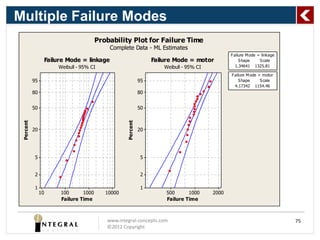
Multiple Failure Modes
                                      Probability Plot for Failure Time
                                          Complete Data - ML Estimates
                                                                                              F ailure M ode = linkage
                 Failure Mode = linkage                         Failure Mode = motor               S hape     S cale
                     Weibull - 95% CI                               Weibull - 95% CI             1.34641 1325.81

                                                                                              F ailure M ode = motor
           95                                              95                                     S hape      S cale
                                                                                                4.17342 1154.46
           80                                              80


           50                                              50
 Percent


           20                                    Percent   20


           5                                                5


           2                                                2

           1                                                1
                10    100      1000      10000                      500      1000      2000
                      Failure Time                                  Failure Time


                                         www.integral-concepts.com                                                       75
                                         ©2012 Copyright
Multiple Failure Modes
                                        Survival Plot for Failure Time
                                           Complete Data - ML Estimates
                                                                                             F ailure M ode = linkage
                 Failure Mode = linkage                           Failure Mode = motor            S hape     S cale
                     Weibull - 95% CI                                   Weibull - 95% CI        1.34641 1325.81

                                                                                             F ailure M ode = motor
           100                                              100                                  S hape      S cale
                                                                                               4.17342 1154.46


           80                                                80


           60                                                60
 Percent


                                                  Percent
           40                                                40


           20                                                20


            0                                                0

                 0    1500      3000      4500                    500        1000     1500
                      Failure Time                                       Failure Time


                                          www.integral-concepts.com                                                     76
                                          ©2012 Copyright
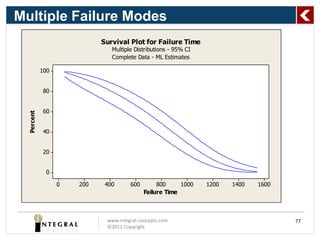
Multiple Failure Modes
                            Survival Plot for Failure Time
                               Multiple Distributions - 95% CI
                               Complete Data - ML Estimates

            100


            80


            60
  Percent


            40


            20


             0

                  0   200    400      600        800     1000    1200   1400   1600
                                            Failure Time


                             www.integral-concepts.com                                77
                             ©2012 Copyright
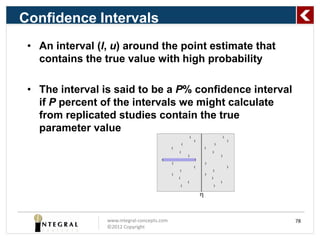
Confidence Intervals
 • An interval (l, u) around the point estimate that
   contains the true value with high probability

 • The interval is said to be a P% confidence interval
   if P percent of the intervals we might calculate
   from replicated studies contain the true
   parameter value


                 www.integral-concepts.com               78
                 ©2012 Copyright
Improving Precision of Estimates

 More Data (Failures) = Better Precision
  (tighter confidence intervals)
 Can make more assumptions (assume
  distribution parameters)
 Reduce confidence level (not a real
  solution)


             www.integral-concepts.com      79
             ©2012 Copyright
Agenda

   Reliability Concepts & Reliability Data
   Probability, Statistics, and Distributions
   Assessing & Selecting Models
   Estimating Reliability Statistics
   Systems Reliability
   Reliability Test Planning
   Accelerated Life Testing
   Warranty Analysis

                  www.integral-concepts.com      80
                  ©2012 Copyright
System Reliability

 A System may be thought of as a collection of
  components or subsystems

 System Reliability Depends on:
  a. Component reliability
  b. Configuration (redundancy)
  c. Time


               www.integral-concepts.com      81
               ©2012 Copyright
A Series System


              i1 R it  R 1 tR 2 tR 3 tR 4 t
                    4
R s t 

 Example: If the component reliabilities are 0.9, 0.9. 0.8, 0.8 at 1 year
 Then the System reliability at 1 year is: 0.9*0.9*0.8*0.8 = 0.52


                        www.integral-concepts.com                           82
                        ©2012 Copyright
Series Model for Multiple Failure Modes


           n
 Rt     R it  R A tR BtR C tR Dt
          i1


                www.integral-concepts.com         83
                ©2012 Copyright
A Parallel System (Redundant Components)


   R s t  1  F s t
           1  F 1 tF 2 tF 3 t
           1  1  R 1 t1  R 2 t1  R 3 t

                     www.integral-concepts.com            84
                     ©2012 Copyright
A Parallel System (Redundant Components)


 Example: If the component reliabilities are 0.9, 0.9. 0.9 at 1 year
 Then the System reliability at 1 year is: 1 - (.1)*(.1)*(.1) = 0.999


                         www.integral-concepts.com                      85
                         ©2012 Copyright
k-out-of-n Parallel Systems
 System consists of n components in which k of
  the n components must function in order for
  the system to function

 For example, if 2 of 4 engines are required to
  fly, then the system will not fail if:
  – All 4 engines operate
  – Any 3 operate
  – Any 2 operate


                 www.integral-concepts.com         86
                 ©2012 Copyright
k-out-of-n Parallel Systems

If all components have the same reliability, R(t):


The probabilities of all possible combinations leading to success are
summed


                       www.integral-concepts.com                        87
                       ©2012 Copyright
k-out-of-n Parallel Systems Example

 Suppose a system consists of 6 identical pumps. For the
 system to function, at least 4 of the 6 pumps must operate. If
 the reliability of each pump at 3 years in service is 0.90, what
 is the system reliability at 3 years?


                      www.integral-concepts.com                     88
                      ©2012 Copyright
Effect of k on System Reliability

 As k increases, system reliability decreases


 If k = 1        Pure Parallel System

 If k = n        Series System


              www.integral-concepts.com          89
              ©2012 Copyright
Effect of k on System Reliability
                         System Reliability vs k (k-out-of-6, R = 0.90)

               1.0


               0.9


               0.8          k        Reliability
 Reliability


                            1         1.0000
                            2         0.9999
               0.7          3         0.9987
                            4         0.9842
                            5         0.8857
               0.6          6         0.5314


               0.5
                     1          2                 3             4   5     6
                                                          k


                                    www.integral-concepts.com                 90
                                    ©2012 Copyright
k-out-of-n Parallel Systems
 When the components in the k-out-of-n
 parallel configuration do not share the same
 reliability function, all possible combinations
 must be computed

 Example follows


               www.integral-concepts.com           91
               ©2012 Copyright
k-out-of-n System Example

Three generators are
configured in parallel. At                    0.90
least two of the
generators must
function in order for the                     0.8    2/3
system to function. At 5                      7
years: R1 = 0.90, R2 =
0.87, R3 = 0.80. What is                      0.80
the System Reliability at
5 years?

                  www.integral-concepts.com          92
                  ©2012 Copyright
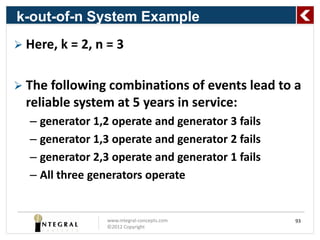
k-out-of-n System Example
 Here, k = 2, n = 3


 The following combinations of events lead to a
  reliable system at 5 years in service:
  – generator 1,2 operate and generator 3 fails
  – generator 1,3 operate and generator 2 fails
  – generator 2,3 operate and generator 1 fails
  – All three generators operate


                 www.integral-concepts.com        93
                 ©2012 Copyright
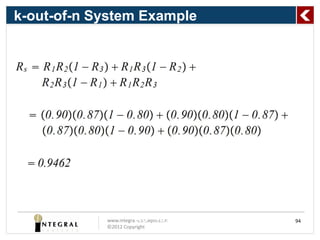
k-out-of-n System Example


                       R1 = 0.90
                       R2 = 0.87
                       R3 = 0.80
            www.integral-concepts.com   94
            ©2012 Copyright
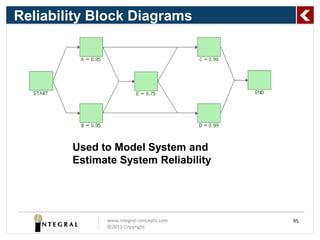
Reliability Block Diagrams


        Used to Model System and
        Estimate System Reliability


              www.integral-concepts.com   95
              ©2012 Copyright
Reliability Allocation Problems

Given a reliability target for the system, how
should subsystem and/or component level
reliability requirements be established so that the
system objective is met?

Typical Goals
   a. Maximize the System Reliability for a given cost
   b. Minimize the Cost for a given System Reliability

   Improve component reliability or add
     redundancies?

                  www.integral-concepts.com              96
                  ©2012 Copyright
Agenda

   Reliability Concepts & Reliability Data
   Probability, Statistics, and Distributions
   Assessing & Selecting Models
   Estimating Reliability Statistics
   Systems Reliability
   Reliability Test Planning
   Accelerated Life Testing
   Warranty Analysis

                  www.integral-concepts.com      97
                  ©2012 Copyright
Reliability Test Planning

 Estimation Test Plans
   Determine sample size needed to
    estimate reliability characteristics with a
    specified precision

   Planning information such as assumed
    distribution parameters, testing time, and
    censoring scheme is required

   Failures during testing are required

               www.integral-concepts.com          98
               ©2012 Copyright
Sample Sizes for Desired
Precision
 We select sample size to achieve the desired
  precision in our estimates

 Larger sample size  Greater precision


 Greater precision  Smaller confidence
  intervals


               www.integral-concepts.com         99
               ©2012 Copyright
Sample Size Calculations

Calculation Depends On:
 Distribution used to model the failure data
 Level of precision desired
 Confidence level
 Presence of censoring
 Length of test (for Type I censoring)
 Failure proportion (for Type II censoring)


                 www.integral-concepts.com      100
                 ©2012 Copyright
Estimation Test Plan
 Type I right-censored data (Single Censoring)

 Estimated parameter: 50th percentile
 Calculated planning estimate = 124.883
 Target Confidence Level = 95%

 Planning distribution: Weibull
 Scale = 150, Shape = 2


                                                 Actual
 Censoring                     Sample        Confidence
      Time   Precision           Size             Level
       100      62.435              8           96.2010


                 www.integral-concepts.com                101
                 ©2012 Copyright
Reliability Test Planning

 Demonstration Test Plans
   Determine sample size (or testing time)
    needed to demonstrate reliability
    characteristics (e.g. lower bound on
    reliability)

   Planning information such as assumed
    distribution and parameter is required

   Failures during testing are not required

              www.integral-concepts.com        102
              ©2012 Copyright
Reliability Demonstration


 Evaluates the following hypothesis
  H0: The reliability is less than or equal to a
           specified value

  H1: The reliability is greater than a specified
     value


                  www.integral-concepts.com         103
                  ©2012 Copyright
Types of Test Plans

  Zero-Failure Test Plans
    – Test demonstrates reliability if zero failures
      are observed during test
    – Useful for highly reliable items

  M-Failure Test Plans
    – Test demonstrates reliability if no more
      than m failures occur
    – Permit verification of test design
      assumptions
                 www.integral-concepts.com             104
                 ©2012 Copyright
Planning Information

 Assumptions needed:
  – Distribution
  – Shape Parameter (for Weibull)
  – Scale Parameter (for other distributions such
    as lognormal, loglogistic, logistic, extreme
    value)
  – Assumptions based on expert opinions, prior
    studies, similar products
  – Sensitivity analysis is recommended

                www.integral-concepts.com           105
                ©2012 Copyright
Computing Test Time or Sample Size

 We specify either the sample size or the
  testing time allocated for each unit (the
  other quantity is computed)

 Demonstration Test Plan consists of:
  – The maximum number of failures allowed
  – The sample size
  – The testing time for each unit

               www.integral-concepts.com      106
               ©2012 Copyright
Example: Demonstration Test Plan

 Reliability Goal:     1st percentile > 80,000 mi

 TTF estimated by Weibull w/ b = 2.5


 Can test for 120,000 miles


 How many units are needed for zero-failure
  and 1-failure test plans?
                www.integral-concepts.com            107
                ©2012 Copyright
Example: Demonstration Test Plan

Demonstration Test Plans

Reliability Test Plan
Distribution: Weibull, Shape = 2.5
Percentile Goal = 80000,Target Confidence Level = 95%

                                        Actual
Failure   Testing   Sample          Confidence
   Test      Time     Size               Level
      0    120000      108             94.9768


                    www.integral-concepts.com           108
                    ©2012 Copyright
Example: Demonstration Test Plan

Demonstration Test Plans

Reliability Test Plan
Distribution: Weibull, Shape = 2.5
Percentile Goal = 80000,Target Confidence Level = 95%

                                        Actual
Failure   Testing   Sample          Confidence
   Test      Time     Size               Level
      1    120000      172             95.0241


                    www.integral-concepts.com           109
                    ©2012 Copyright
Example: Demonstration Test Plan

  Suppose we can only test 50 units?
Reliability Test Plan
Distribution: Weibull, Shape = 2.5
Percentile Goal = 80000,Actual Confidence Level = 95%


Failure   Sample   Testing
  Test     Size        Time
      0       50    163392


                    www.integral-concepts.com           110
                    ©2012 Copyright
Probability of Passing (POP)
                  Likelihood of Passing for Weibull Model
                     Maximum Failures = 0, Target Alpha = 0.05
                  Time = 120000, N = 108, Actual alpha = 0.0502316

            100


            80


            60
  Percent


            40


            20


             0

                  2              4             6               8     10
                                 Ratio of Improvement


                         www.integral-concepts.com                        111
                         ©2012 Copyright
Probability of Passing (POP)
                  Likelihood of Passing for Weibull Model
                     Maximum Failures = 1, Target Alpha = 0.05
                  Time = 120000, N = 172, Actual alpha = 0.0497587

            100


            80


            60
  Percent


            40


            20


             0

                  2              4             6               8     10
                                 Ratio of Improvement


                        www.integral-concepts.com                         112
                        ©2012 Copyright
Demonstration Test Plan (1st Percentile)
Reliability Test Plan
Distribution: Weibull, Shape = 2.5
Percentile Goal = 80000, Target Confidence Level = 95%


                                    Actual
Failure   Testing   Sample      Confidence
   Test      Time     Size           Level
      0    120000      108         94.9768
      1    120000      172         95.0241
      2    120000      228         94.9669
      3    120000      281         94.9567


                      www.integral-concepts.com          113
                      ©2012 Copyright
Demonstration Test Plans
                                                                       Test Units vs Test Time
                                     772.775
                                                                                                                                    0   Failures
                                                                                                                                    1   Failures
                                                                                                                                    2   Failures
                                                                                                                                    3   Failures


                                     639.853


                                     506.932
  N u m b e r o f T e s t U n i ts


                                     374.010


                                     241.088


                                                                                                                             Steven Wachs
                                                                                                                             integral Concepts, Inc.
                                                                                                                             10/28/2011
                                                                                                                             2:25:16 PM
                                     108.167
                                        80000.000   88000.000       96000.000               104000.000   112000.000   120000.000
                                                                                Test Time


                                                                www.integral-concepts.com                                                              114
                                                                ©2012 Copyright
Agenda

   Reliability Concepts & Reliability Data
   Probability, Statistics, and Distributions
   Assessing & Selecting Models
   Estimating Reliability Statistics
   Systems Reliability
   Reliability Test Planning
   Accelerated Life Testing
   Warranty Analysis

                  www.integral-concepts.com      115
                  ©2012 Copyright
Introduction to ALT
 Purpose:To estimate reliability on a
 timely basis

 Inducefailures sooner by testing at
 accelerated stress conditions

 Extrapolateresults obtained at
 accelerated conditions to use conditions
 (using acceleration models)

 Focus
      on one or a small number of failure
 modes
                www.integral-concepts.com   116
                ©2012 Copyright
ALT Models (2 parts)


             www.integral-concepts.com   117
             ©2012 Copyright
Life is a Function of Time and Stress


             www.integral-concepts.com   118
             ©2012 Copyright
Life-Stress Relationship
  ReliaSoft AL TA 7 - www.ReliaSoft.com
                                                        Lif e vs Stress
              100000.000
                                                                                                      Life

                                                                                                      Data 1
                                                                                                      Ey ring
                                                                                                      Weibull
                                                                                                      323
                                                                                                      F=30 | S=0
                                                                                                            Eta L ine
                                                                                                            1%
                                                                                                            99%
                                                                                                      393
                                                                                                            Stress Lev el Points
                                                                                                            Eta Point
                                                                                                            Imposed Pdf
                                                                                                      408
                                                                                                            Stress Lev el Points
                                                                                                            Eta Point
                                                                                                            Imposed Pdf
                                                                                                      423
                                                                                                            Stress Lev el Points
                                                                                                            Eta Point
                                                                                                            Imposed Pdf
     L i fe


               10000.000


                                                                                                     Steven Wachs
                                                                                                     integral Concepts, Inc.
                                                                                                     7/7/2011
                                                                                                     3:07:17 PM
                1000.000
                      300.000             328.000          356.000        384.000   412.000   440.000
                                                         Temperature
  Beta=4.2918; A=-11.0878; B=1454.0864


                                             www.integral-concepts.com                                                             119
                                             ©2012 Copyright
Accelerated Stress Testing

 Combination of Statistical Modeling and
  understanding of Physics of Failure
 Care must be taken in designing tests to
  yield useful information
 ALT models should be refined based on
  correlation to actual results obtained at
  normal use conditions


               www.integral-concepts.com      120
               ©2012 Copyright
Accelerated Life Testing - Topics
 Purpose and Key Concepts

 Accelerated Life Test Models

 One, Two, and Multiple Stress Models

 ALT Test Planning

 Accelerated Degradation Models

 Pitfalls, Guidelines, and Examples
                www.integral-concepts.com   121
                ©2012 Copyright
Introduction to ALT
 Purpose: To estimate reliability on a timely
  basis

 Induce failures sooner by testing at accelerated
  conditions

 Extrapolate results obtained at accelerated
  conditions to use conditions (using acceleration
  models)

 Focus on one or a small number of failure
  modes
                www.integral-concepts.com        122
                ©2012 Copyright
Types of Accelerated Testing
 Accelerated Life Testing
   – Units tested until failure
   – Accelerating factor(s) are used to shorten the
     time to failure

 Accelerated Degradation Testing
   – Accelerating factor(s) are used to promote
     degradation
   – Amount of degradation observed during test
   – Degradation data used to predict actual time
     to failure at stressed conditions
                 www.integral-concepts.com            123
                 ©2012 Copyright
Accelerating Methods

1.    Increase Usage Rate
     – Increase usage rate from normal usage rate
     – ex. Car door hinges have median lifetime of
       44,000 cycles (15 years at 8 cycles per day)
     – Increasing rate to 5000 cycles per day will
       reduce median lifetime to 9 days.
     – Assumes TTF is independent of usage rate
     – Need to avoid unintended “stress” (e.g.
       temp) caused by higher usage rate

                   www.integral-concepts.com          124
                   ©2012 Copyright
Accelerating Methods
2. Test Under Stress Conditions
  •   Test at higher levels of one or multiple stress
      factors
  •   Common stress factors
      – temperature
      – thermal cycling
      – voltage
      – pressure
      – mechanical load
      – humidity


                www.integral-concepts.com               125
                ©2012 Copyright
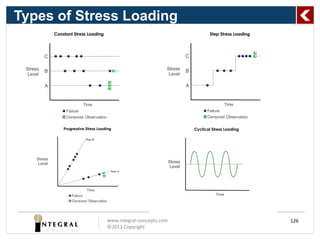
Types of Stress Loading


             www.integral-concepts.com   126
             ©2012 Copyright
Accelerated Life Test Models
         ALT Models have 2 parts
1. Stochastic Part
     •   failure time distribution at each level of
         stress
     •   Use distribution fitting to fit appropriate
         models (Weibull, lognormal, etc.) at each
         level of stress

2.   Structural Part
     •   Life-stress relationship
     •   Use regression models to relate the stress
         variable to the Time To Failure Distribution
                   www.integral-concepts.com            127
                   ©2012 Copyright
ALT Models have 2 parts


           www.integral-concepts.com   128
           ©2012 Copyright
Acceleration Models

 Acceleration models relate accelerating
  factors (e.g. temp, voltage) to the TTF
  distribution.

 Model depends on acceleration method
  (usage or stress) and the type of stress

 Physical models are based on physical or
  chemical theory that describes the failure
  causing process
              www.integral-concepts.com        129
              ©2012 Copyright
Life-Stress Models
   Increased stress promotes earlier failures and
    life is predicted as a function of time and stress

   Common stress factors include:
    – Temperature, Load, Pressure, Voltage, Current,
      Thermal cycling, etc.

   The models assume stress levels are positive.
    For temperature, use absolute temperature
    (Kelvin) instead of Celsius or Farenheit


                   www.integral-concepts.com             130
                   ©2012 Copyright
Acceleration Factor

 Quantifies the degree to which a given
  stress accelerates failure times

  AF = Life at Use Condition / Life at Stress Condition

 Acceleration factor increases with stress


                   www.integral-concepts.com              131
                   ©2012 Copyright
Acceleration Factor
  ReliaSoft ALTA 7 - www.ReliaSoft.com
                                                                   Acc el erati on Factor vs Stres s
                            10.000
                                                                                                                            Acceleration Factor

                                                                                                                            Data 1
                                                                                                                            Arrhenius
                                                                                                                            Weibull
                                                                                                                            323
                                                                                                                            F= | S=
                                                                                                                               30     0
                                                                                                                                  AF Line
                                         8.000
     A c c e le r a t io n F a c t o r


                                         6.000


                                         4.000


                                         2.000


                                                                                                                            Steven Wachs
                                                                                                                            integral Concepts, Inc.
                                                                                                                            8/17/2011
                                                                                                                            9:47:29 PM
                                         0.000
                                             300.000   340.000         380.000                420.000   460.000   500.000
                                                                                 Temp erat u re
  Beta=4.2916; B=1861.6187; C=58.9848


                                                                 www.integral-concepts.com                                                            132
                                                                 ©2012 Copyright
Arrhenius Model (Temp Acceleration)

  Commonly used for products which fail as
   a result of material degradation at
   elevated temperatures

  Based on a kinetic model that describes
   the effect of temperature on the rate of a
   simple chemical reaction.


               www.integral-concepts.com        133
               ©2012 Copyright
Arrhenius Relationship


   Rate = rate of a chemical reaction (rate is inversely
            proportional to life)
   tempK = absolute temperature in the Kelvin scale
           = temp in deg C + 273.15
   kB = Boltzmann’s constant = 8.6171x10-5= 1/11605
         electron volts per deg C
   Ea = activation energy in electron volts
   g = a constant
   (Ea and g are product or material characteristics)
                     www.integral-concepts.com             134
                     ©2012 Copyright
www.integral-concepts.com   135
©2012 Copyright
Arrhenius Model (ALTA Formulation)


 Rate = rate of a chemical reaction (rate is inversely
         proportional to life)
 T = absolute temperature in Kelvin
 kB = Boltzmann’s constant = 8.6171x10-5= 1/11605
       electron volts per deg C
 Ea = activation energy in electron volts
 C = a constant


                    www.integral-concepts.com            136
                    ©2012 Copyright
Arrhenius Model (ALTA Formulation)


  Let:


  Then:


             www.integral-concepts.com   137
             ©2012 Copyright
Arrhenius-Weibull Model

The Weibull PDF


 Scale Parameter


          b, B, and C are estimated from the data (MLE)
          (the PDF is a function of time and temperature)

                         www.integral-concepts.com          138
                         ©2012 Copyright
www.integral-concepts.com   139
©2012 Copyright
Inverse Power Law Model

 Supports a variety of stress variables such as
  voltage, temperature, load, etc.

 Assumes that the product life is proportional
  to the inverse power of the stress induced


                www.integral-concepts.com          140
                ©2012 Copyright
Inverse Power Law Relationship


   where:
   T(V) = TTF at a given voltage
   V = Voltage
   A = constant (product characteristic)
   a = constant (product characteristic)
   (Voltage is the acceleration variable here)

                    www.integral-concepts.com    141
                    ©2012 Copyright
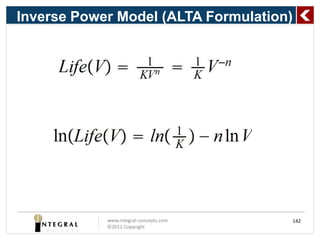
Inverse Power Model (ALTA Formulation)


Taking logs of both sides, we have:


If failure time and stress are on log scales, this is a linear relationship


                             www.integral-concepts.com                        142
                             ©2012 Copyright
Other Models

  Some 2-stress and multiple stress models
  will be mentioned later

  Many specific models have been developed
  (for certain materials, failure modes, and
  applications) although most may be
  modeled with general formulations.


              www.integral-concepts.com        143
              ©2012 Copyright
Guidelines for ALT Models
   Acceleration Factor(s) should be chosen to
    accelerate failure modes
   The amount of extrapolation between test stresses
    and use condition should be minimized
   Different failure modes may be accelerated at
    different rates (best to focus on one or two modes)
   The available data will generally provide little
    power to detect model lack of fit. An
    understanding of the physics is important.


                   www.integral-concepts.com           144
                   ©2012 Copyright
Guidelines for ALT Models
   Sensitivity analysis should be performed to assess
    the impact of changing model assumptions
   ALT should be planned and conducted by teams
    including personnel knowledgeable about the
    product, its use environment, the
    physical/chemical/mechanical aspects of the
    failure mode, and the statistical aspects of the
    design and analysis of reliability tests
   ALT results should be correlated with longer term
    tests or field data


                   www.integral-concepts.com             145
                   ©2012 Copyright
Strategy for Analyzing ALT Data
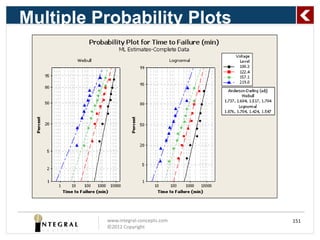
1.   Examine the data graphically
2.   Generate multiple probability plots
3.   Fit an overall model
4.   Perform residual analysis
5.   Assess reasonableness of the model
6.   Utilize model for predictions (with
     uncertainly quantified)


              www.integral-concepts.com    146
              ©2012 Copyright
Example – Analyzing ALT Data
 ALT of mylar-polyurethane insulation used
  in high performance electromagnets*
 Insulation has a characteristic dielectric
  strength which may degrade over time
 When applied voltage exceeds dielectric
  strength a short circuit will occur
 Accelerating variable is voltage

*From Meeker & Escobar (1998)

                    www.integral-concepts.com   147
                    ©2012 Copyright
Example – Analyzing ALT Data
Time to Failure (Minutes) of Mylar-Polyurethane Insulation

                  Voltage Stress (kV/mm)
              219.0     157.1      122.4              100.3

               15.0          49.0            188.0    606.0
               16.0          99.0            297.0   1012.0
               36.0         154.5            405.0   2520.0
               50.0         180.0            744.0   2610.0
               55.0         291.0           1218.0   3988.0
               95.0         447.0           1340.0   4100.0
              122.0         510.0           1715.0   5025.0
              129.0         600.0           3382.0   6842.0
              625.0        1656.0
              700.0        1721.0

                      www.integral-concepts.com               148
                      ©2012 Copyright
Example – Analyzing ALT Data
• TTF data collected at four stress (voltage)
  levels

• Normal operating voltage level is 50 kV/mm

• Fit appropriate model

• Find 95% confidence interval for the B10 life


                www.integral-concepts.com         149
                ©2012 Copyright
Graphical Analysis


         www.integral-concepts.com   150
         ©2012 Copyright
Multiple Probability Plots


          www.integral-concepts.com   151
          ©2012 Copyright
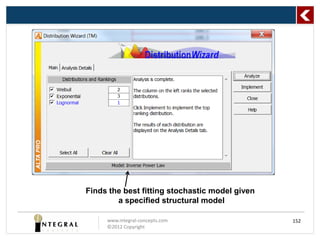
Finds the best fitting stochastic model given
        a specified structural model

     www.integral-concepts.com                  152
     ©2012 Copyright
Fitting the Model


                                 Model:        Inverse Power Law
Std. = scale parameter for       Distribution: Lognormal
Lognormal distribution           Analysis:     MLE
                                 Std: 1.049793128
The location parameter
is a function of Voltage         K: 1.149419255E-012
per the IPL model                n: 4.289109625
                                 LK Value:     -271.4247009
                                 Fail  Susp: 36  0
                           www.integral-concepts.com               153
                           ©2012 Copyright
ReliaSoft AL TA 7 - www.ReliaSoft.com
                                                  Probabi l i ty - Lognormal
                99.000
                                                                                                        Probability

                                                                                                        Data 1
                                                                                                        Inverse Power Law
                                                                                                        Lognormal
                                                                                                        100.3
                                                                                                        F= | S=
                                                                                                           8      0
                                                                                                              Stress Level Points
                                                                                                              Stress Level Line
                                                                                                        122.4
                                                                                                        F= | S=
                                                                                                           8      0
                                                                                                              Stress Level Points
                                                                                                              Stress Level Line
                                                                                                        157.1
                                                                                                        F= | S=
                                                                                                           10      0
                                                                                                              Stress Level Points
                                                                                                              Stress Level Line
                                                                                                        219
                                                                                                        F= | S=
                                                                                                           10      0
   U n r e lia b ilit y


                                                                                                              Stress Level Points
                                                                                                              Stress Level Line
                                                                                                        50
                50.000                                                                                        Use Level Line


                10.000


                          5.000


                                                                                                        Steven Wachs
                                                                                                        integral Concepts, Inc.
                                                                                                        8/19/2011
                                                                                                        3:15:43 PM
                          1.000
                              10.000    100.000            1000.000            10000.000   100000.000
                                                             Time
Std=1.0498; K=1.1494E-12; n=4.2891


                                           www.integral-concepts.com                                                                154
                                           ©2012 Copyright
ReliaSoft AL TA 7 - www.ReliaSoft.com
                                                    Us e Level Probabi l i ty Lognormal
                99.000
                                                                                                               Use Level
                                                                                                               CB@90% 2-Sided

                                                                                                               Data 1
                                                                                                               Inverse Power Law
                                                                                                               Lognormal
                                                                                                               50
                                                                                                               F= | S=
                                                                                                                  36      0
                                                                                                                     Data Points
                                                                                                                     Use Level Line
                                                                                                                     Top CB-II
                                                                                                                     Bottom CB-II
   U n r e lia b ilit y


                50.000


                10.000


                          5.000


                                                                                                               Steven Wachs
                                                                                                               integral Concepts, Inc.
                                                                                                               8/19/2011
                                                                                                               3:22:01 PM
                          1.000
                             1000.000   10000.000               100000.000            1000000.000   1.000E+7
                                                                    Time
Std=1.0498; K=1.1494E-12; n=4.2891


                                               www.integral-concepts.com                                                                 155
                                               ©2012 Copyright
ReliaSoft AL TA 7 - www.ReliaSoft.com
                                                      R el i abi l i ty vs Ti me
               1.000
                                                                                                             Reliability
                                                                                                             CB@90% 2-Sided [R]

                                                                                                             Data 1
                                                                                                             Inverse Power Law
                                                                                                             Lognormal
                                                                                                             50
                                                                                                             F= | S=
                                                                                                                36      0
               0.800                                                                                               Data Points
                                                                                                                   Reliability Line
                                                                                                                   Top CB-II
                                                                                                                   Bottom CB-II


               0.600
   R e lia b ilit y


               0.400


               0.200


                                                                                                             Steven Wachs
                                                                                                             integral Concepts, Inc.
                                                                                                             8/19/2011
                                                                                                             3:25:11 PM
               0.000
                       0.000       60000.000     120000.000           180000.000   240000.000   300000.000
                                                               Time
Std=1.0498; K=1.1494E-12; n=4.2891


                                               www.integral-concepts.com                                                               156
                                               ©2012 Copyright
ReliaSoft AL TA 7 - www.ReliaSoft.com
                                                      Unrel i abi l i ty vs Ti me
                   1.000
                                                                                                              Unreliability

                                                                                                              Data 1
                                                                                                              Inverse Power Law
                                                                                                              Lognormal
                                                                                                              50
                                                                                                              F= | S=
                                                                                                                 36     0
                                                                                                                    Data Points
                   0.800                                                                                            Unreliability Line


                   0.600
   U n r e lia b ilit y


                   0.400


                   0.200


                                                                                                              Steven Wachs
                                                                                                              integral Concepts, Inc.
                                                                                                              8/19/2011
                                                                                                              3:19:32 PM
                   0.000
                           0.000   60000.000      120000.000           180000.000   240000.000   300000.000
                                                                Time
Std=1.0498; K=1.1494E-12; n=4.2891


                                               www.integral-concepts.com                                                                 157
                                               ©2012 Copyright
ReliaSoft AL TA 7 - www.ReliaSoft.com
                                                               Fai l ure R ate vs Ti me
               5.000E-5
                                                                                                                       Failure Rate

                                                                                                                       Data 1
                                                                                                                       Inverse Power Law
                                                                                                                       Lognormal
                                                                                                                       50
                                                                                                                       F= | S=
                                                                                                                          36      0
                                                                                                                             Failure Rate Line
               4.000E-5


               3.000E-5
   F a ilu r e R a t e


               2.000E-5


               1.000E-5


                                                                                                                       Steven Wachs
                                                                                                                       integral Concepts, Inc.
                                                                                                                       8/19/2011
                                                                                                                       3:52:01 PM
                         0.000
                                 0.000   100000.000         200000.000          300000.000   400000.000   500000.000
                                                                         Time
Std=1.0498; K=1.1494E-12; n=4.2891


                                                      www.integral-concepts.com                                                                  158
                                                      ©2012 Copyright
ReliaSoft AL TA 7 - www.ReliaSoft.com
                                                  Li fe vs Stres s
    100000.000
                                                                                Life

                                                                                Data 1
                                                                                Inverse Power Law
                                                                                Lognormal
                                                                                50
                                                                                F= | S=
                                                                                   36      0
                                                                                      Median Line
                                                                                100.3
                                                                                      Stress Level Points
       10000.000                                                                      Median Point
                                                                                      Imposed Pdf
                                                                                122.4
                                                                                      Stress Level Points
                                                                                      Median Point
                                                                                      Imposed Pdf
                                                                                157.1
                                                                                      Stress Level Points
                                                                                      Median Point
                                                                                      Imposed Pdf
                                                                                219
                                                                                      Stress Level Points
   L ife


           1000.000                                                                   Median Point
                                                                                      Imposed Pdf


            100.000


                                                                                Steven Wachs
                                                                                integral Concepts, Inc.
                                                                                8/19/2011
                                                                                4:15:19 PM
              10.000
                    10.000                            100.000        1000.000
                                                      V olt ag e
Std=1.0498; K=1.1494E-12; n=4.2891


                                        www.integral-concepts.com                                           159
                                        ©2012 Copyright
ReliaSoft AL TA 7 - www.ReliaSoft.com
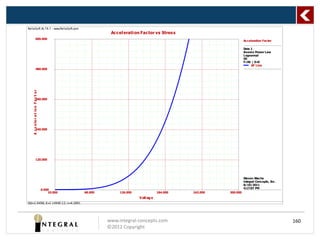
                                                              Acc el erati on Factor vs Stres s
                      600.000
                                                                                                                       Acceleration Factor

                                                                                                                       Data 1
                                                                                                                       Inverse Power Law
                                                                                                                       Lognormal
                                                                                                                       50
                                                                                                                       F= | S=
                                                                                                                          36     0
                                                                                                                             AF Line
                      480.000
   A c c e le r a t io n F a c t o r


                      360.000


                      240.000


                      120.000


                                                                                                                       Steven Wachs
                                                                                                                       integral Concepts, Inc.
                                                                                                                       8/19/2011
                                                                                                                       4:17:07 PM
                                       0.000
                                           10.000   68.000        126.000                184.000   242.000   300.000
                                                                            V olt ag e
Std=1.0498; K=1.1494E-12; n=4.2891


                                                             www.integral-concepts.com                                                           160
                                                             ©2012 Copyright
ReliaSoft AL TA 7 - www.ReliaSoft.com
                                                 Standardi z ed R es i dual s
               99.000
                                                                                                 Standard Residuals

                                                                                                 Data 1
                                                                                                 Inverse Power Law
                                                                                                 Lognormal
                                                                                                       Residual Line
                                                                                                 100.3
                                                                                                 F= | S=
                                                                                                    8     0
                                                                                                       Residuals
                                                                                                 122.4
                                                                                                 F= | S=
                                                                                                    8     0
                                                                                                       Residuals
                                                                                                 157.1
                                                                                                 F= | S=
                                                                                                    10     0
                                                                                                       Residuals
                                                                                                 219
                                                                                                 F= | S=
                                                                                                    10     0
                                                                                                       Residuals
   P r o b a b ilit y


               50.000


               10.000


                        5.000


                                                                                                 Steven Wachs
                                                                                                 integral Concepts, Inc.
                                                                                                 8/19/2011
                                                                                                 4:18:09 PM
                        1.000
                            -10.000     -6.000    -2.000                2.000   6.000   10.000
                                                           Resid u al
Std=1.0498; K=1.1494E-12; n=4.2891


                                                 www.integral-concepts.com                                                 161
                                                 ©2012 Copyright
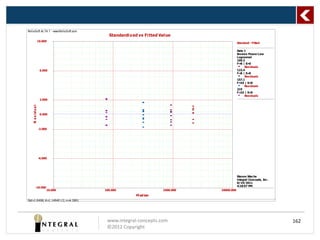
ReliaSoft AL TA 7 - www.ReliaSoft.com
                                          Standardi z ed vs Fi tted Val ue
                    10.000
                                                                                             Standard - Fitted

                                                                                             Data 1
                                                                                             Inverse Power Law
                                                                                             Lognormal
                                                                                             100.3
                                                                                             F= | S=
                                                                                                8     0
                                                                                                   Residuals
                     6.000                                                                   122.4
                                                                                             F= | S=
                                                                                                8     0
                                                                                                   Residuals
                                                                                             157.1
                                                                                             F= | S=
                                                                                                10     0
                                                                                                   Residuals
                                                                                             219
                                                                                             F= | S=
                                                                                                10     0
                                                                                                   Residuals
                     2.000
   R e s id u a l


                     0.000


                    -2.000


                    -6.000


                                                                                             Steven Wachs
                                                                                             integral Concepts, Inc.
                                                                                             8/19/2011
                                                                                             4:18:57 PM
            -10.000
                         10.000         100.000                       1000.000   10000.000
                                                        M ed ian
Std=1.0498; K=1.1494E-12; n=4.2891


                                         www.integral-concepts.com                                                     162
                                         ©2012 Copyright
www.integral-concepts.com   163
©2012 Copyright
www.integral-concepts.com   164
©2012 Copyright
Other Models
   Temperature-Humidity (T-H) Model
   Temperature-Non Thermal Model
   Generalized Eyring Model (handles interactions)
   Proportional Hazards (multiple stresses)
   General Log-Linear Models (multiple stresses)
   Norris-Landzberg (temp cycling)
   Peck Model (corrosion on aluminum)
   Black’s Model (electromigration)
   Reciprocal Exponential (corrosion)
   Mechanical Stress Model (stress migration)
                   www.integral-concepts.com          165
                   ©2012 Copyright
Time-Varying Stress Tests


           www.integral-concepts.com   166
           ©2012 Copyright
Step Stress
   May be appealing when the ultimate stress level
    that will induce failures is unknown (keep
    increasing stress until failure)

   An Issue: precision in estimates for time-varying
    stresses is much worse than for constant stress
    tests (of same length and sample size)

   Precision is improved by utilizing multiple stress
    profiles (rather than testing all units with a
    single time-varying stress profile)

                  www.integral-concepts.com              167
                  ©2012 Copyright
Thermal Cycling Stress
 While can be described as time-varying it’s
  also possible to model this as a constant
  stress by describing the cyclic stress using
  one or more stress factors
  – Change in temperature
  – Maximum temperature
  – Ramp rates
  – Time at maximum temperature
  – Etc.

              www.integral-concepts.com          168
              ©2012 Copyright
Time Varying Stresses

  If the normal use condition involves time-
   varying stresses, it is reasonable to impose
   time-varying stresses during the testing
  Use condition may also be characterized by
   time-varying stress


              www.integral-concepts.com           169
              ©2012 Copyright
Modeling Time Varying Stresses

  Cumulative Damage Model


  Model considers the cumulative effect (on
  life) of stresses applied at different levels
  for specified periods of time


              www.integral-concepts.com           170
              ©2012 Copyright
Accelerated Degradation Analysis
   When testing to failure is not feasible (even at
    stressed conditions) but degradation leading to
    failure is measureable
    –   Component wear (times, brake pads)
    –   Crack Propagation
    –   Leak rate testing
    –   Air Flow loss
 Observed degradation over time is used to
  predict eventual failure times
 May be done when testing under normal
  conditions or accelerated conditions
                   www.integral-concepts.com           171
                   ©2012 Copyright
Accelerated Degradation Analysis
   Failure is defined as a specified level of degradation

   For each unit, degradation is measured over time

   A degradation model (function of time) is fit for
    each unit and that unit’s failure time is predicted by
    extrapolating to the defined failure degradation
    level

   The predicted failure times are utilized in
    developing the ALT model in the usual way

                   www.integral-concepts.com             172
                   ©2012 Copyright
Accelerated Degradation Analysis
ReliaSoft ALTA 7 - www.ReliaSoft.com
                                                        Degradati on vs Ti me
                           120.000
                                                                                                      Exponential Fit

                                                                                                      A1
                                                                                                           Data Points
                                                                                                           Degradation

                                                                                                      A2
                                                                                                           Data Points
                           104.000                                                                         Degradation

                                                                                                      A3
                                                                                                           Data Points
                                                                                                           Degradation

                                                                                                      A4
                                                                                                           Data Points
                                                                                                           Degradation
                            88.000                                                                    A5
                                                                                                           Data Points
    D e g r a d a t io n


                                                                                                           Degradation

                                                                                                      B1
                                                                                                           Data Points
                                                                                                           Degradation

                                                                                                      B2
                            72.000                                                                         Data Points
                                                                                                           Degradation

                                                                                                      B3
                                                                                                           Data Points
                                                                                                           Degradation

                                                                                                      B4
                                                                                                           Data Points
                            56.000                                                                         Degradation

                                                                                                      B5
                                                                                                           Data Points
                                                                                                           Degradation

                                                                                                      C1
                                                                                                           Data Points
                                                                                                           Degradation
                            40.000
                                 0.000   5.000       10.000                15.000   20.000   25.000
                                                              Time, (t )


                                                   Critical Degradation (Failure)
                                                 www.integral-concepts.com                                               173
                                                 ©2012 Copyright
Accelerated Degradation Analysis

  Assumes that repeat measurements may
  be taken over time (non-destructive
  testing)

  If measurements are destructive, another
  approach is possible


              www.integral-concepts.com       174
              ©2012 Copyright
Degradation Models

                                                ALTA provides a
                                                distribution wizard to
                                                help select the best
                                                fitting model (based
                                                on minimizing mean
                                                square error)

                                                The same model type
                                                is used for all units
                                                although the
                                                parameters are
                                                unique


    y = performance (degradation metric)
    x = time
    a, b, c = model parameters (obtained from the data)


                www.integral-concepts.com                                175
                ©2012 Copyright
ReliaSoft ALTA 7 - www.ReliaSoft.com


                           120.000
                                                            Degradati on vs Ti me                                                      Extrapolated TTF
                                                                                                              Exponential Fit

                                                                                                              A1
                                                                                                                   Data Points
                                                                                                                   Degradation
                                                                                                                                 F/S    TTF         Temp   Unit ID
                                                                                                              A2

                           104.000
                                                                                                                   Data Points
                                                                                                                   Degradation   F      29.19936699 323    A1
                                                                                                              A3
                                                                                                                   Data Points   F      24.19106074 323    A2
                                                                                                                   Degradation

                                                                                                              A4                 F      21.5253096 323     A3
                                                                                                                   Data Points

                            88.000
                                                                                                                   Degradation
                                                                                                                                 F      19.99555003 323    A4
                                                                                                              A5
                                                                                                                   Data Points
                                                                                                                                 F      20.12667806 323    A5
    D e g r a d a t io n


                                                                                                                   Degradation

                                                                                                              B1
                                                                                                                   Data Points
                                                                                                                                 F      25.67779573 373    B1
                                                                                                                   Degradation

                                                                                                              B2
                                                                                                                                 F      21.84304209 373    B2
                            72.000                                                                                 Data Points
                                                                                                                   Degradation   F      20.41643434 373    B3
                                                                                                              B3
                                                                                                                   Data Points
                                                                                                                   Degradation
                                                                                                                                 F      17.58327056 373    B4
                                                                                                              B4
                                                                                                                   Data Points
                                                                                                                                 F      17.50269546 373    B5
                                                                                                                   Degradation
                            56.000
                                                                                                              B5
                                                                                                                                 F      28.81203487 383    C1
                                                                                                                   Data Points
                                                                                                                   Degradation   F      16.02505667 383    C2
                                                                                                              C1
                                                                                                                   Data Points
                                                                                                                   Degradation
                                                                                                                                 F      15.07735101 383    C3
                            40.000
                                 0.000      5.000        10.000                15.000      20.000    25.000
                                                                                                                                 F      10.70443956 383    C4
                                                                  Time, (t )
                                                                                                                                 F      12.58102201 383    C5

                                         Model Parameters
  Unit ID                                  Temperature      Parameter a   Parameter b
  A1                                       323              -0.02359402568                          99.57923112
  A2                                       323              -0.02964751683                          102.4349421
  A3                                       323              -0.03250228489                          100.649557
  A4                                       323              -0.03618158626                          103.0787979
  A5                                       323              -0.03358825385                          98.30186281
  B1                                       373              -0.02571570596                          96.77083426
  B2                                       373              -0.03102417044                          98.46343551
  B3                                       373              -0.03249511417                          97.07242701
  B4                                       373              -0.03834724581                          98.12998759
  B5                                       373              -0.03566518644                          93.34104183


                                                                                        www.integral-concepts.com                                                176
                                                                                        ©2012 Copyright
Potential Pitfalls of ALTs
1.   Accelerated conditions induce new failure
     modes (or inhibit failure modes)
2.   Oversimplification of relationship
     between life and the accelerating variable
3.   Failure to quantify uncertainty in
     estimated quantities
4.   Masked failure modes
5.   Using ALT results to compare alternatives
                www.integral-concepts.com         177
                ©2012 Copyright
ALT Induces New Failure Modes
 Accelerated conditions induce new failure
  modes that are not possible at operating
  conditions (or inhibit an operating
  condition failure mode)
 Risk of attributing failure from new failure
  mode to the failure mode of interest
 Failures due to new mode might result in
  too much censoring for failure mode of
  interest
                www.integral-concepts.com        178
                ©2012 Copyright
Oversimplification of TTF/Accel. Variable Relationship

     Ignoring significant explanatory variables in the
      ALT can give misleading results

     ALT conditions should represent actual
      conditions encountered except for the
      accelerating variable(s)

     If multiple accelerating variables are varied
      simultaneously, an adequate physical model that
      describes the relationship among these variables
      and TTF is required.

                     www.integral-concepts.com            179
                     ©2012 Copyright
Failure to Quantify Uncertainty
   Point estimates do not convey the amount of
    uncertainty in the estimate – use of confidence
    intervals is recommended.

   Statistical confidence intervals do NOT account
    for model uncertainty.

   Uncertainty due to model assumptions can be
    assessed using sensitivity analysis (e.g. what
    would the results be under a different model?)

                   www.integral-concepts.com          180
                   ©2012 Copyright
Masked Failure Modes


         www.integral-concepts.com   181
         ©2012 Copyright
Using ALT Results to Compare Alternatives

  Simply comparing alternatives at
   accelerated conditions may give
   misleading results (especially when
   different failure modes are present)

  Comparisons should be made at use
   conditions after extrapolation using an
   appropriate structural model

                www.integral-concepts.com    182
                ©2012 Copyright
ALT Planning
 What stress factor(s) should be utilized?

 What are the stress levels to be tested at?

 How many units should be put on test?

 How should units be allocated to stress levels?

 How will failure be measured?

 What constraints are there (testing time, # of
  units)?

                www.integral-concepts.com          183
                ©2012 Copyright
General Guidelines for Planning ALTs

 Use 3 or 4 levels of the accelerating variable

 Select the highest level of the accelerating
  variable to be as high as reasonably possible

 Select the lowest level of the accelerating
  variable to be as low as possible while still
  obtaining at least 4 failures at this level

 Allocate more test units to the lower levels
  of accelerating variables
                www.integral-concepts.com          184
                ©2012 Copyright
Agenda

   Reliability Concepts & Reliability Data
   Probability, Statistics, and Distributions
   Assessing & Selecting Models
   Estimating Reliability Statistics
   Systems Reliability
   Reliability Test Planning
   Accelerated Life Testing
   Warranty Analysis

                  www.integral-concepts.com      185
                  ©2012 Copyright
Introduction to Warranty Analysis
   Overview of Predictive Warranty Analysis

   Modeling Time-To-Failure

   Predicting Future Failures

   Developing a Warranty Forecast

   Accounting for Model Uncertainty

   Identifying and Handling Non-Homogenous Groups
    (Model Revisions / Design Levels)

                    www.integral-concepts.com        186
                    ©2012 Copyright
Purpose of Warranty Analysis
 Forecast the number of units that will fail
  during the warranty period (and after)
 Forecast / budget / accrue warranty expense

 Forecast service part requirements

 Identify emerging product issues / field
  concerns
 Manage customer expectations /
  relationships
                  www.integral-concepts.com     187
                  ©2012 Copyright
Sources of Warranty Data

 Customer Return Data
  – Direct from Customers
  – Via Dealer or Retailer


 Laboratory Testing
  – Reliability Testing
  – Accelerated Life Testing
  – Degradation Testing / Analysis


                www.integral-concepts.com   188
                ©2012 Copyright
Data Quality / Completeness

 Accuracy
 Consistency
 Assumptions for Censored Data
 Availability of Data for Failures after Warranty
  Period


                www.integral-concepts.com        189
                ©2012 Copyright
Data Setup
 Warranty Systems May Provide Data in Various
  Formats
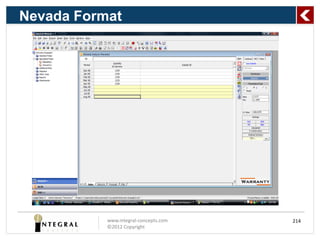
  – Nevada Table Format
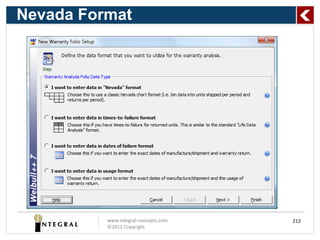
  – Time to Failure Format
  – Dates of Failure Format
  – Usage Format

 Data must typically be formatted into standard
  format for reliability estimation


                www.integral-concepts.com     190
                ©2012 Copyright
Example: Nevada Format


                                          Returns
    Shipped      Jan-09          Feb-09   Mar-09     Apr-09     May-09
Dec-08    1200             3            7        6        13         10
Jan-09    1250                          5        3        10         14
Feb-09    1300                                   2          5          9
Mar-09    1225                                              4          7
Apr-09    1350                                                         6


                 www.integral-concepts.com                          191
                 ©2012 Copyright
Summarizing Failures

                                           Returns
      Shipped       Jan-09        Feb-09   Mar-09     Apr-09     May-09
  Dec-08    1200             3           7        6        13         10
  Jan-09    1250                         5        3        10         14
  Feb-09    1300                                  2          5          9
  Mar-09    1225                                             4          7
  Apr-09    1350                                                        6


      Failures at 1 month in service:
      3 + 5 + 2 + 4 + 6 = 20


                   www.integral-concepts.com                                192
                   ©2012 Copyright
Summarizing Failures


                                             Returns
       Shipped         Jan-09       Feb-09   Mar-09     Apr-09     May-09
   Dec-08    1200               3          7        6        13         10
   Jan-09    1250                          5        3        10         14
   Feb-09    1300                                   2          5          9
   Mar-09    1225                                              4          7
   Apr-09    1350                                                         6


       Failures at 2 months in service:
       7 + 3 + 5 + 7 = 22


                    www.integral-concepts.com                                 193
                    ©2012 Copyright
Censored Data

                                          Returns
       Shipped      Jan-09       Feb-09   Mar-09     Apr-09     May-09
   Dec-08    1200            3          7        6        13         10    1161
   Jan-09    1250                       5        3        10         14
   Feb-09    1300                                2          5          9
   Mar-09    1225                                           4          7
   Apr-09    1350                                                      6


   Censored at 5 months:
   1200 – (3 + 7 + 6 + 13 + 10) = 1161


                    www.integral-concepts.com                                     194
                    ©2012 Copyright
Summarized Data
     Num In State              F/S        End Time
     20                        F          1
     1344                      S          1
     22                        F          2
     1214                      S          2
     25                        F          3
     1284                      S          3
     27                        F          4
     1218                      S          4
     10                        F          5
     1161                      S          5
              www.integral-concepts.com              195
              ©2012 Copyright
Life Data Analysis

 Distribution Fitting


 Parametric Estimation


 Utilize Standard Reliability Analysis Methods


                www.integral-concepts.com         196
                ©2012 Copyright
Common Distributions in Reliability

   Weibull
   Exponential
   Lognormal
   Gamma
   Loglogistic
   Etc.


              www.integral-concepts.com   197
              ©2012 Copyright
Weibull Distribution
b = 2.22
h  


     www.integral-concepts.com   198
     ©2012 Copyright
Returns Prediction


 Apply concept of conditional probability
   – Units that fail in a future period have not
     failed in a prior period
   – Knowledge that units have not failed should
     be utilized


 We multiply conditional failure probability
  by the number of units at risk

                 www.integral-concepts.com         199
                 ©2012 Copyright
Conditional Failure Probability


Probability of failure at time t given that
 the unit has not yet failed at time t0


               www.integral-concepts.com      200
               ©2012 Copyright
Returns Prediction
                                                                       Returns
                                  Shipped        Jan-09       Feb-09   Mar-09     Apr-09     May-09
 To Forecast June             Dec-08    1200              3          7        6        13         10
                              Jan-09    1250                         5        3        10         14
   2009 Returns               Feb-09    1300                                  2          5          9
                              Mar-09    1225                                             4          7
                              Apr-09    1350                                                        6


 For Dec. 2008
 Shipments


Units at Risk from
Dec. 2008 = 1161            1161 * 0.0201 = 23 Returns

                     www.integral-concepts.com                                                  201
                     ©2012 Copyright
Returns Prediction
                                                                       Returns
To Forecast June                Shipped        Jan-09       Feb-09     Mar-09     Apr-09     May-09
                            Dec-08    1200              3            7        6        13         10
  2009 Returns              Jan-09    1250                           5        3        10         14
                            Feb-09    1300                                    2          5          9
                            Mar-09    1225                                               4          7
                            Apr-09    1350                                                          6


 For Jan. 2009
 Shipments


Units at Risk from             1218 * 0.0158 = 19 Returns
Jan. 2009 = 1218
                   www.integral-concepts.com                                                    202
                   ©2012 Copyright
Returns Prediction

 The procedure is repeated for all shipment
  periods

 Then forecasts can be performed for
  subsequent forecast periods

 Estimated units at risk reflect actual
  failures and forecasted failures in earlier
  forecast periods

                www.integral-concepts.com       203
                ©2012 Copyright
Returns Prediction

                            Forecasted Returns
Ship Month Jun 09       Jul 09   Aug 09    Sep 09   Oct 09
  Dec 08     23           28        32        37      40
  Jan 09     19           24        29        33      38
  Feb 09     15           20        25        30      35
  Mar 09     9            14        19        24      28
  Apr 09     6            10        15        21      26
   Total     73           96       121       144     167


                www.integral-concepts.com                204
                ©2012 Copyright
Returns Prediction
Confidence Bounds
              Forecasted Returns (Upper 95% Conf. Bound)
         Ship Month   Jun 09     Jul 09       Aug 09   Sep 09   Oct 09
           Dec 08       32        41            49       58       66
           Jan 09       19        24            29       33       38
           Feb 09       15        20            25       30       35
           Mar 09        9        14            19       24       28
           Apr 09        6        10            15       21       26
            Total       73        96           121      144      167

                       Forecasted Returns (Lower 95% Conf. Bound)
         Ship Month   Jun 09    Jul 09   Aug 09    Sep 09    Oct 09
           Dec 08       17       19         21       23        25
           Jan 09       15       17         20       22        24
           Feb 09       12       15         18       21        23
           Mar 09        8       11         14       17        19
           Apr 09        4        9         12       16        19
            Total       55       71         86       98       109


        Using Bounds on Failure Probability Estimates


                         www.integral-concepts.com                       205
                         ©2012 Copyright
Example (Using Weibull++)

 Data Setup
 Reliability Analysis and Warranty Forecast
 Warranty Length
 Non-Homogeneous Warranty Data
 Monitoring Warranty Returns (SPC)


               www.integral-concepts.com       206
               ©2012 Copyright
Usage Format
   Should be used when Failures are Based on
    Product Usage (e.g. Mileage for Tire Wear)

   Reporting Failures at Time in Service would be
    misleading due to variation in customer usage rate

   Failures are reported at actual use

   Use for Censored Data is Estimated
    – Constant Rate
    – Probability Distribution


                    www.integral-concepts.com            207
                    ©2012 Copyright
Sales Based on Date


 www.integral-concepts.com   208
 ©2012 Copyright
Returns at Actual Usage

                                                      Censored Data Based on
                                                      Constant Usage Rate


                          www.integral-concepts.com                            209
                          ©2012 Copyright
Returns at Actual Usage


                                            Censored Data Based on
                                            Probability Distribution


                    www.integral-concepts.com                          210
                    ©2012 Copyright
Future Sales


www.integral-concepts.com   211
©2012 Copyright
Nevada Format


          www.integral-concepts.com   212
          ©2012 Copyright
Nevada Format


          www.integral-concepts.com   213
          ©2012 Copyright
Nevada Format


           www.integral-concepts.com   214
           ©2012 Copyright
www.integral-concepts.com   215
©2012 Copyright
Reliability Records (Failures are Exact Failures)


www.integral-concepts.com                          216
©2012 Copyright
Selecting Distribution(s)

   www.integral-concepts.com   217
   ©2012 Copyright
Parameter Estimation & Probability Plotting


                    www.integral-concepts.com   218
                    ©2012 Copyright
Reliability
Statistics


              www.integral-concepts.com   219
              ©2012 Copyright
Setting up a Warranty Forecast


    www.integral-concepts.com    220
    ©2012 Copyright
Generating a Warranty Forecast


 www.integral-concepts.com       221
 ©2012 Copyright
Warranty Forecast Results
  www.integral-concepts.com   222
  ©2012 Copyright
Warranty Forecast Results

  www.integral-concepts.com   223
  ©2012 Copyright
Warranty Forecast Results
  www.integral-concepts.com   224
  ©2012 Copyright
www.integral-concepts.com   225
©2012 Copyright
Warranty Forecast Results


www.integral-concepts.com       226
©2012 Copyright
www.integral-concepts.com   227
©2012 Copyright
Warranty Period

 Specification of Warranty Period
  determines the age at which units drop out
  of risk pool

 Examples:   36 months in service, 36,000
  miles, 1 year

 Must be accounted for when estimating
  warranty costs

               www.integral-concepts.com       228
               ©2012 Copyright
Forecast with Warranty Length


   www.integral-concepts.com    229
   ©2012 Copyright
Non-Homogeneous Warranty Data


 Accounting for Multiple “Subsets”
  – Production Periods with known differences in
    Reliability performance (quality spills)
  – Design Changes
  – Manufacturing Process Changes
  – Unknown Causes


                www.integral-concepts.com          230
                ©2012 Copyright
Accounting for Multiple “Subsets”

 Best Handled by Modeling Subsets
  Separately and Developing Forecast by
  Subset (based on units at risk from each
  subset)

 Subset Forecasts are combined to product
  an overall Forecast


               www.integral-concepts.com     231
               ©2012 Copyright
Multiple Subsets (Production/Sales)


    www.integral-concepts.com         232
    ©2012 Copyright
www.integral-concepts.com   233
©2012 Copyright
Date:       11/23/2010
User:       Steven Wachs
Company: Integral Concepts Inc.
Subset ID: A
Distribution:          Lognormal-2P

Analysis: MLE
CB Method:             FM
Ranking: MED
Mean        9.814101365       Subset A Model
Std         0.2842096391
LK Value -32896.16664
Fail  Susp 3167  45142

Num In State          F/S          End Time   Subset ID
1                     F            5236       A
1                     F            5435       A
1                     F            5547       A
1                     F            5604       A
1                     F            5661       A
1                     F            5678       A
1                     F            5845       A
1                     F            6125       A
1                     F            6152       A
10659                 S            6246       A
               www.integral-concepts.com                  234
               ©2012 Copyright
Subset ID:          B
Distribution:       Lognormal-2P
Analysis: MLE
CB Method:          FM
Ranking: MED
Mean       9.681629366          Subset B Model
Std        0.3473241293
LK Value -3984.173579
Fail  Susp         395  41414

Num In State      F/S          End Time Subset ID
10945             S            41       B
10911             S            1315     B
11209             S            2465     B
1203              S            3739     B
7146              S            5013     B
1                 F            5045     B
1                 F            5199     B
1                 F            5200     B
1                 F            5471     B
1                 F            5725     B
1                 F            5729     B
                www.integral-concepts.com           235
                ©2012 Copyright
Probability Plots by Subset


        www.integral-concepts.com   236
        ©2012 Copyright
ReliaSoft Weibull++ 7 - www.ReliaSoft.com
                                                                                                     Unrelia bility vs Time Plot
                                               1.000
                                                                                                                                                           Unreliability

                                                                                                                                                           2003-2005
                                                                                                                                                           Weibull-3P
                                                                                                                                                           ML E SRM MED FM
                                                                                                                                                           F=239/S=2608
                                                                                                                                                                 Data Points
                                                                                                                                                                 Unreliability L ine
                                               0.800
                                                                                                                                                           others
                                                                                                                                                           Weibull-2P
                                                                                                                                                           ML E SRM MED FM
                                                                                                                                                           F=110/S=5451
                                                                                                                                                                 Data Points
   U n re l i a b i l i ty , F (t)= 1 -R (t)


                                                                                                                                                                 Unreliability L ine

                                               0.600               Failure Probability Curves by Subset                                                    1996-2000
                                                                                                                                                           Weibull-3P
                                                                                                                                                           ML E SRM MED FM
                                                                                                                                                           F=35/S=2757
                                                                                                                                                                 Unreliability L ine


                                               0.400


                                               0.200


                                                                                                            x 19
                                                                                                     x 30
                                                                                              x 43                                                         Steven Wachs
                                                                                      x 46                         x 13   x5                               integral Concepts, Inc.
                                                                               x 36                  x6     x 10
                                                                        x 38          x 13    x9                                                           3/11/2012
                                                           x8
                                                            10   x 19
                                                                 x 11   x 12   x 21
                                               0.000                                                                                                       9:02:24 PM
                                                   0.000                  4.000                        8.000                    12.000   16.000   20.000
                                                                                                                   Time, ( t)
1996-2000: b   h     g 
2003-2005: b   h    g   
others: b   h  


                                                                                             www.integral-concepts.com
                                                                                             ©2012 Copyright
Forecast (Both Subsets)


  www.integral-concepts.com   238
  ©2012 Copyright
Agenda

   Reliability Concepts & Reliability Data
   Probability, Statistics, and Distributions
   Assessing & Selecting Models
   Estimating Reliability Statistics
   Systems Reliability
   Reliability Test Planning
   Accelerated Life Testing
   Warranty Analysis

                  www.integral-concepts.com      239
                  ©2012 Copyright
Predicting Product Life
Using Reliability Analysis
        Methods
         Steven Wachs
      Principal Statistician
     Integral Concepts, Inc.
      www.integral-concepts.com
            248-884-2276
        www.integral-concepts.com   240
        ©2012 Copyright

Predicting product life using reliability analysis methods

  • 1.
    Predicting Product  Predicting Product Life Using Reliability  Life Using Reliability y Analysis Methods Steven Wachs ©2011 ASQ & Presentation Steven Presented live on Nov 09th ~ 11th, 2012 http://reliabilitycalendar.org/The_Re liability_Calendar/Short_Courses/Sh liability Calendar/Short Courses/Sh ort_Courses.html
  • 2.
    ASQ Reliability Division  ASQ Reliability Division Short Course Series Short Course Series One of the monthly webinars  One of the monthly webinars on topics of interest to  reliability engineers. To view recorded webinar (available to ASQ Reliability  Division members only) visit asq.org/reliability ) / To sign up for the free and available to anyone live  webinars visit reliabilitycalendar.org and select English  Webinars to find links to register for upcoming events http://reliabilitycalendar.org/The_Re liability_Calendar/Short_Courses/Sh liability Calendar/Short Courses/Sh ort_Courses.html
  • 3.
    Predicting Product Life UsingReliability Analysis Methods Steven Wachs Principal Statistician Integral Concepts, Inc. www.integral-concepts.com 248-884-2276 www.integral-concepts.com 1 ©2012 Copyright
  • 4.
    Agenda  Reliability Concepts & Reliability Data  Probability, Statistics, and Distributions  Assessing & Selecting Models  Estimating Reliability Statistics  Systems Reliability  Reliability Test Planning  Accelerated Life Testing  Warranty Analysis www.integral-concepts.com 2 ©2012 Copyright
  • 5.
    Motivation Intense Global Competition CustomerExpectations Customer Loyalty Product Liability www.integral-concepts.com 3 ©2012 Copyright
  • 6.
    Defining Reliability Reliability is the probability that a material, component, or system will perform its intended function under defined operating conditions for a specified period of time. www.integral-concepts.com 4 ©2012 Copyright
  • 7.
    Ambiguity in Definition What is the intended function?  What are the defined operating conditions?  How should time be defined? We must clearly define these characteristics when defining reliability for a specific application www.integral-concepts.com 5 ©2012 Copyright
  • 8.
    Reliability Data  LifeData  Time-To-Failure (TTF) Data  Time-Between-Failure (TBF) Data  Survival Data  Event-time Data  Degradation Data www.integral-concepts.com 6 ©2012 Copyright
  • 9.
    Unique Aspects ofReliability Data  Presence of Censoring  Reliability Models based on positive random variables (e.g. exponential, lognormal, Weibull, gamma)  Interpolation and extrapolation often required www.integral-concepts.com 7 ©2012 Copyright
  • 10.
    Repairable vs. Non-repairable The focus of this course is non- repairable components or systems (characterized by time to failure)  Repairable systems are characterized by time between failure www.integral-concepts.com 8 ©2012 Copyright
  • 11.
    The Bathtub Curve www.integral-concepts.com 9 ©2012 Copyright
  • 12.
    The Reliability Function R(to) = P(T > to ) where T =“time” to failure www.integral-concepts.com 10 ©2012 Copyright
  • 13.
    Censored Data When exact failure times are not known  Provides useful information for estimation of reliability (Do NOT drop from analysis)  Types of Censoring – Right Censoring – Left Censoring – Interval Censoring www.integral-concepts.com 11 ©2012 Copyright
  • 14.
    Types of Censoring Left Censoring Right Censoring Interval Censoring www.integral-concepts.com 12 ©2012 Copyright
  • 15.
    Other Censoring Ideas  Competing Risks • Impact on Reliability estimates • Alternatives (if extreme censoring exists) – Use Accelerated Testing Conditions – Use Degradation Data www.integral-concepts.com 13 ©2012 Copyright
  • 16.
    Agenda  Reliability Concepts & Reliability Data  Probability, Statistics, and Distributions  Assessing & Selecting Models  Estimating Reliability Statistics  Systems Reliability  Reliability Test Planning  Accelerated Life Testing  Warranty Analysis www.integral-concepts.com 14 ©2012 Copyright
  • 17.
    Describing Time toFailure www.integral-concepts.com 15 ©2012 Copyright
  • 18.
    Integrating the PDF B c fxdx d PX  B  PX  c, d  www.integral-concepts.com 16 ©2012 Copyright
  • 19.
    Reliability Distribution Plot 0.0008 0.0007 0.0006 0.0005 Density 0.0004 0.0003 0.0002 0.0001 R(1500) 0.0000 0 1500 X www.integral-concepts.com 17 ©2012 Copyright
  • 20.
    Failure Probability (Cumulative) Distribution Plot 0.0008 F(500) 0.0007 0.0006 0.0005 Density 0.0004 0.0003 0.0002 0.0001 0.0000 0 500 X www.integral-concepts.com 18 ©2012 Copyright
  • 21.
    The CDF  fxdx t Ft  PX  , t  www.integral-concepts.com 19 ©2012 Copyright 19
  • 22.
    CDF/Reliability Relationship www.integral-concepts.com 20 ©2012 Copyright
  • 23.
    Hazard Function (Rate) Thepropensity to fail in the next instant given that it hasn’t failed up to that time (“instantaneous failure rate function”) ft ft ht  1Ft  Rt www.integral-concepts.com 21 ©2012 Copyright
  • 24.
    www.integral-concepts.com 22 ©2012 Copyright
  • 25.
    Mean Time toFailure (MTTF)  The Expected Value or the Mean of the Time to Failure Random Variable  The average time to failure (often significantly larger than the median time to failure)  The MTTF can be misleading as often as much as 70% of the population will fail before the MTTF   MTTF  ET  0 tftdt  0 Rtdt www.integral-concepts.com 23 ©2012 Copyright
  • 26.
    B-Life (or Quantile) The time at which a specified proportion of the population is expected to fail www.integral-concepts.com 24 ©2012 Copyright
  • 27.
    Advantages of ParametricModels  May be described concisely with a few parameters  Allows extrapolation (in time)  Provide “smooth” estimates of failure time distributions www.integral-concepts.com 25 ©2012 Copyright
  • 28.
    Common Distributions inReliability  Weibull  Exponential  Lognormal  Gamma  Binomial  Loglogistic  Etc. www.integral-concepts.com 26 ©2012 Copyright
  • 29.
    Exponential Distribution The simplest model used in reliability analysis (and sometimes misused)  Described by a single parameter, l which is the hazard rate (inverse of MTTF)  Key property: the hazard rate is constant (the only distribution with this property) www.integral-concepts.com 27 ©2012 Copyright
  • 30.
    Exponential Distribution • pdf: f(t) = le-lt • cdf: F(t) = 1 - e-lt • Reliability: R(t) = e-lt • Hazard rate: h(t) = l • MTTF = 1/l = q • Quantile: F-1(p) = (1/l)[-ln(1-p)] www.integral-concepts.com 28 ©2012 Copyright
  • 31.
    Exponential Distribution Example Lightbulb lifetime may be described by an exponential distribution. The MTTF = 12,000 hrs. Find: A. Hazard Rate B. Proportion failing by 12,000 hrs C. Proportion failing by 24,000 hrs www.integral-concepts.com 29 ©2012 Copyright
  • 32.
    Exponential Distribution Example Solution A. l = 1/12,000 = 0.000083 = 83 failures per million hrs 12,000 B. F12, 000  1  e 12,000  1 1 e  0. 632 24,000 C. F24, 000  1  e 12,000  1 1  0. 865 e2 www.integral-concepts.com 30 ©2012 Copyright
  • 33.
    Exponential Distribution Guidelines Constant hazard rate implies that the probability that a unit will fail in the next instant does not depend on the unit’s age  Reasonable for many electronic components that do not wear out  Usually inappropriate for modeling TTF of mechanical components that are subject to fatigue, corrosion, or wear www.integral-concepts.com 31 ©2012 Copyright
  • 34.
    The Weibull Distribution The most common model in reliability analysis  Described by 2 parameters: h = “scale” parameter b = “shape” parameter  Flexible model that can effectively model a wide variety of failure distributions www.integral-concepts.com 32 ©2012 Copyright
  • 35.
    The Weibull Distribution(some functions)  1  t   pdf: ft     t  e    t  cdf: Ft  1  e    t  Reliability: Rt  e   1  Hazard rate: ht     t  www.integral-concepts.com 33 ©2012 Copyright
  • 36.
    The Weibull ShapeParameter Failure Rate ? www.integral-concepts.com 34 ©2012 Copyright
  • 37.
    The Weibull ScaleParameter ? www.integral-concepts.com 35 ©2012 Copyright
  • 38.
    Weibull Characteristics h is also referred to as the 63.2nd percentile  To see this: set t = h in F(t)    Ft  F  1  e  1   1e  1  e  0. 632 1 • The value of b is irrelevant when t = h www.integral-concepts.com 36 ©2012 Copyright
  • 39.
    Conditional Reliability  Anapplication of conditional probability  Needed to estimate reliability when “burn- in” is used or to estimate reliability after a warranty period. Rtt 0  Rt|t 0   Rt 0  www.integral-concepts.com 37 ©2012 Copyright
  • 40.
    Agenda  Reliability Concepts & Reliability Data  Probability, Statistics, and Distributions  Assessing & Selecting Models  Estimating Reliability Statistics  Systems Reliability  Reliability Test Planning  Accelerated Life Testing  Warranty Analysis www.integral-concepts.com 38 ©2012 Copyright
  • 41.
    Selecting Models  Giventime-to-failure data (failures and censored data), which distribution best describes the data?  Graphical Methods (probability plotting) and/or Statistical Methods may be utilized www.integral-concepts.com 39 ©2012 Copyright
  • 42.
    Probability Plots  Graphicalmethod to assess “fit”  Fit is determined by how well the plotted points align along a straight line  Plotted variables are “transformed” so that y is a linear function of x – X axis: Plot observed failure times – Y axis: Plot estimated cumulative probabilities (p) www.integral-concepts.com 40 ©2012 Copyright
  • 43.
    Probability Plotting www.integral-concepts.com 41 ©2012 Copyright
  • 44.
    Constructing Probability Plots •X-Axis – Observed/Transformed Failure Times • Y-Axis – Estimated/Transformed Cumulative Probabilities • Transformed quantities for plot depend on the distribution www.integral-concepts.com 42 ©2012 Copyright
  • 45.
    Constructing Probability Plots www.integral-concepts.com 43 ©2012 Copyright
  • 46.
    Linearizing the CDF- Example  Consider the Weibull distribution. Recall that the Weibull cdf is:   t Ft  1  e  • We need to transform F(t) to achieve a linear function www.integral-concepts.com 44 ©2012 Copyright
  • 47.
    Linearizing the CDF- Example   t 1  Ft  e  t  1 1Ft e   ln 1Ft      1 t ln ln 1Ft  1   lnt   ln By setting: y  ln ln 1Ft  1 x  lnt C   ln we have: y  x  C www.integral-concepts.com 45 ©2012 Copyright
  • 48.
    Graphical Estimation 2.75 b = 2.0/2.75 = 0.73 2.0 h www.integral-concepts.com 46 ©2012 Copyright
  • 49.
    Selecting Models  MultipleDistributions may adequately describe the time-to-failure data  Sensitivity Analysis is recommended to assess how reliability predictions vary with alternative viable models  Confidence Intervals on reliability estimates do not include model uncertainty www.integral-concepts.com 47 ©2012 Copyright
  • 50.
    Selecting a Distribution www.integral-concepts.com 48 ©2012 Copyright
  • 51.
    Handling Multiple FailureModes  Multiple Failure Modes should be modeled separately (if data exists)  Failure rates of the various failure modes are typically different  Overall Reliability may be predicted using system reliability concepts (series model) www.integral-concepts.com 49 ©2012 Copyright
  • 52.
    Handling Multiple FailureModes ReliaSoft Weibull++ 7 - www.ReliaSoft.com Probability - W eibull 99.000 Probability-Weibull Data 1 Weibull-2P 90.000 ML E SRM MED FM F=40/S=0 Data Points Probability Line 50.000 U n re l i a b i l i ty , F (t) 10.000 5.000 Steven Wachs integral Concepts, Inc. 10/28/2011 1:05:27 PM 1.000 0.010 0.100 1.000 10.000 100.000 1000.000 10000.000 Time, ( t) b   h     www.integral-concepts.com 50 ©2012 Copyright
  • 53.
    Handling Multiple FailureModes ReliaSoft Weibull++ 7 - www.ReliaSoft.com Probability - W eibull 99.000 Probability-Weibull Data 1 Weibull-CFM 90.000 ML E SRM MED FM CFM 1 Points CFM 2 Points CFM 1 L ine CFM 2 L ine Probability Line 50.000 U n re l i a b i l i ty , F (t) 10.000 5.000 Steven Wachs integral Concepts, Inc. 10/28/2011 1:03:08 PM 1.000 0.010 0.100 1.000 10.000 100.000 1000.000 10000.000 Time, ( t) b    h      b   h   www.integral-concepts.com 51 ©2012 Copyright
  • 54.
    Agenda  Reliability Concepts & Reliability Data  Probability, Statistics, and Distributions  Assessing & Selecting Models  Estimating Reliability Statistics  Systems Reliability  Reliability Test Planning  Accelerated Life Testing  Warranty Analysis www.integral-concepts.com 52 ©2012 Copyright
  • 55.
    Reliability Estimation  Fromthe time-to-failure distribution we can estimate quantities like: • Reliability at various times • Time at which x% are expected to fail • Failure (hazard) rates • Mean time to failure  Confidence Intervals or Bounds should be included to account for estimation uncertainty www.integral-concepts.com 53 ©2012 Copyright
  • 56.
    Reliability Estimation  EstimationMethods • Maximum Likelihood Estimation (MLE): nice statistical properties, handles censored data well, biased estimates for small sample sizes • Rank Regression: Unbiased estimates but poorer precision and does not handle censored data as well as MLE www.integral-concepts.com 54 ©2012 Copyright
  • 57.
    Properties of Estimators Bias – The extent to which the estimator differs on average from the true value. (An unbiased estimator equals the true value on average)  Precision – The amount of variability in the estimates. www.integral-concepts.com 55 ©2012 Copyright
  • 58.
    Properties of Estimators www.integral-concepts.com 56 ©2012 Copyright
  • 59.
    Estimation Methods  Maximum Likelihood Estimation – Generally preferred by statisticians (minimum variance) although the estimates tend to be biased – ML method finds parameter values which maximize the likelihood function (the joint probability of observing all of the data). – The maximization of the likelihood function usually must be done numerically (rather than analytically). www.integral-concepts.com 57 ©2012 Copyright
  • 60.
    MLE Example (Weibull) • Given failure time data, we need to estimate h, b. i1 fx i  fx 1 fx 2 . . . fx n  n L  L      e n  x 1  xi i  i1 • We maximize likelihood function by taking derivatives with respect to each parameter www.integral-concepts.com 58 ©2012 Copyright
  • 61.
    Effect of CensoredData on the Likelihood Function • With no censoring, the likelihood function is: i1 fx i   fx 1 fx 2 . . . fx n  n L • Censored observations cannot use the pdf since the failure time is unknown www.integral-concepts.com 59 ©2012 Copyright
  • 62.
    Effect of CensoredData on the Likelihood Function • Suppose we have a right-censored observation at time = 1500? • What function indicates the probability of this occurring? www.integral-concepts.com 60 ©2012 Copyright
  • 63.
    Effect of CensoredData on the Likelihood Function • Suppose we have a right-censored observation at time = 1500? • What function indicates the probability of this occurring? • R(1500) gives the probability that a unit fails at time 1500 or later. www.integral-concepts.com 61 ©2012 Copyright
  • 64.
    Effect of CensoredData on the Likelihood Function Distribution Plot 0.0008 0.0007 0.0006 0.0005 Density 0.0004 0.0003 0.0002 0.0001 R(1500) 0.0000 0 1500 X www.integral-concepts.com 62 ©2012 Copyright
  • 65.
    Effect of CensoredData on the Likelihood Function • Suppose we have a left-censored observation at time = 500? • What function indicates the probability of this occurring? www.integral-concepts.com 63 ©2012 Copyright
  • 66.
    Effect of CensoredData on the Likelihood Function • Suppose we have a left-censored observation at time = 500? • What function indicates the probability of this occurring? • F(500) gives the probability that a unit fails at time 500 or earlier. www.integral-concepts.com 64 ©2012 Copyright
  • 67.
    Effect of CensoredData on the Likelihood Function Distribution Plot 0.0008 F(500) 0.0007 0.0006 0.0005 Density 0.0004 0.0003 0.0002 0.0001 0.0000 0 500 X www.integral-concepts.com 65 ©2012 Copyright
  • 68.
    Effect of CensoredData on the Likelihood Function • Suppose we have an interval censored condition where the failure occurred between 1000 and 1300. • What function indicates the probability of this occurring? www.integral-concepts.com 66 ©2012 Copyright
  • 69.
    Effect of CensoredData on the Likelihood Function • Suppose we have an interval censored condition where the failure occurred between 1000 and 1300. • What function indicates the probability of this occurring? • F(1300)-F(1000) gives the probability that a unit fails between 1000 and 1300 www.integral-concepts.com 67 ©2012 Copyright
  • 70.
    Effect of CensoredData on the Likelihood Function Distribution Plot 0.0008 0.0007 0.0006 0.0005 F(1300)-F(1000) Density 0.0004 0.0003 0.0002 0.0001 0.0000 0 1000 1300 X www.integral-concepts.com 68 ©2012 Copyright
  • 71.
    Estimation Methods • RankRegression – Determines best fit line on the probability plot by using least squares regression – Fitted line is used to estimate parameters www.integral-concepts.com 69 ©2012 Copyright
  • 72.
    Failure Probability Plot www.integral-concepts.com 70 ©2012 Copyright
  • 73.
    Reliability Estimation www.integral-concepts.com 71 ©2012 Copyright
  • 74.
    Estimating with MultipleFailure Modes Failure Time Failure Model Failure Time Failure Model 63 linkage 791 motor 116 linkage 808 motor 237 linkage 823 motor 249 linkage 841 motor 297 linkage 869 motor 384 linkage 874 linkage 386 linkage 878 motor 420 linkage 981 motor 467 linkage 991 motor 485 motor 999 motor 522 linkage 1005 motor 541 linkage 1007 motor 592 linkage 1046 motor 595 linkage 1084 motor 601 linkage 1086 motor 624 linkage 1190 motor 655 motor 1299 motor 662 linkage 1481 linkage 702 linkage 1502 motor 721 linkage 1581 motor www.integral-concepts.com 72 ©2012 Copyright
  • 75.
    Linkage Failure Mode DistributionAnalysis: Failure Time Variable: Failure Time Failure Mode: fm = linkage Censoring Information Count Uncensored value 20 Right censored value 20 Estimation Method: Maximum Likelihood Distribution: Weibull Parameter Estimates Standard 95.0% Normal CI Parameter Estimate Error Lower Upper Shape 1.34641 0.264909 0.915592 1.97994 Scale 1325.81 240.466 929.169 1891.76 www.integral-concepts.com 73 ©2012 Copyright
  • 76.
    Motor Failure Mode DistributionAnalysis: Failure Time Variable: Failure Time Failure Mode: fm = motor Censoring Information Count Uncensored value 20 Right censored value 20 Estimation Method: Maximum Likelihood Distribution: Weibull Parameter Estimates Standard 95.0% Normal CI Parameter Estimate Error Lower Upper Shape 4.17342 0.634609 3.09784 5.62245 Scale 1154.46 62.7168 1037.86 1284.17 www.integral-concepts.com 74 ©2012 Copyright
  • 77.
    Multiple Failure Modes Probability Plot for Failure Time Complete Data - ML Estimates F ailure M ode = linkage Failure Mode = linkage Failure Mode = motor S hape S cale Weibull - 95% CI Weibull - 95% CI 1.34641 1325.81 F ailure M ode = motor 95 95 S hape S cale 4.17342 1154.46 80 80 50 50 Percent 20 Percent 20 5 5 2 2 1 1 10 100 1000 10000 500 1000 2000 Failure Time Failure Time www.integral-concepts.com 75 ©2012 Copyright
  • 78.
    Multiple Failure Modes Survival Plot for Failure Time Complete Data - ML Estimates F ailure M ode = linkage Failure Mode = linkage Failure Mode = motor S hape S cale Weibull - 95% CI Weibull - 95% CI 1.34641 1325.81 F ailure M ode = motor 100 100 S hape S cale 4.17342 1154.46 80 80 60 60 Percent Percent 40 40 20 20 0 0 0 1500 3000 4500 500 1000 1500 Failure Time Failure Time www.integral-concepts.com 76 ©2012 Copyright
  • 79.
    Multiple Failure Modes Survival Plot for Failure Time Multiple Distributions - 95% CI Complete Data - ML Estimates 100 80 60 Percent 40 20 0 0 200 400 600 800 1000 1200 1400 1600 Failure Time www.integral-concepts.com 77 ©2012 Copyright
  • 80.
    Confidence Intervals •An interval (l, u) around the point estimate that contains the true value with high probability • The interval is said to be a P% confidence interval if P percent of the intervals we might calculate from replicated studies contain the true parameter value www.integral-concepts.com 78 ©2012 Copyright
  • 81.
    Improving Precision ofEstimates  More Data (Failures) = Better Precision (tighter confidence intervals)  Can make more assumptions (assume distribution parameters)  Reduce confidence level (not a real solution) www.integral-concepts.com 79 ©2012 Copyright
  • 82.
    Agenda  Reliability Concepts & Reliability Data  Probability, Statistics, and Distributions  Assessing & Selecting Models  Estimating Reliability Statistics  Systems Reliability  Reliability Test Planning  Accelerated Life Testing  Warranty Analysis www.integral-concepts.com 80 ©2012 Copyright
  • 83.
    System Reliability  ASystem may be thought of as a collection of components or subsystems  System Reliability Depends on: a. Component reliability b. Configuration (redundancy) c. Time www.integral-concepts.com 81 ©2012 Copyright
  • 84.
    A Series System i1 R it  R 1 tR 2 tR 3 tR 4 t 4 R s t  Example: If the component reliabilities are 0.9, 0.9. 0.8, 0.8 at 1 year Then the System reliability at 1 year is: 0.9*0.9*0.8*0.8 = 0.52 www.integral-concepts.com 82 ©2012 Copyright
  • 85.
    Series Model forMultiple Failure Modes n Rt   R it  R A tR BtR C tR Dt i1 www.integral-concepts.com 83 ©2012 Copyright
  • 86.
    A Parallel System(Redundant Components) R s t  1  F s t  1  F 1 tF 2 tF 3 t  1  1  R 1 t1  R 2 t1  R 3 t www.integral-concepts.com 84 ©2012 Copyright
  • 87.
    A Parallel System(Redundant Components) Example: If the component reliabilities are 0.9, 0.9. 0.9 at 1 year Then the System reliability at 1 year is: 1 - (.1)*(.1)*(.1) = 0.999 www.integral-concepts.com 85 ©2012 Copyright
  • 88.
    k-out-of-n Parallel Systems System consists of n components in which k of the n components must function in order for the system to function  For example, if 2 of 4 engines are required to fly, then the system will not fail if: – All 4 engines operate – Any 3 operate – Any 2 operate www.integral-concepts.com 86 ©2012 Copyright
  • 89.
    k-out-of-n Parallel Systems Ifall components have the same reliability, R(t): The probabilities of all possible combinations leading to success are summed www.integral-concepts.com 87 ©2012 Copyright
  • 90.
    k-out-of-n Parallel SystemsExample Suppose a system consists of 6 identical pumps. For the system to function, at least 4 of the 6 pumps must operate. If the reliability of each pump at 3 years in service is 0.90, what is the system reliability at 3 years? www.integral-concepts.com 88 ©2012 Copyright
  • 91.
    Effect of kon System Reliability  As k increases, system reliability decreases  If k = 1 Pure Parallel System  If k = n Series System www.integral-concepts.com 89 ©2012 Copyright
  • 92.
    Effect of kon System Reliability System Reliability vs k (k-out-of-6, R = 0.90) 1.0 0.9 0.8 k Reliability Reliability 1 1.0000 2 0.9999 0.7 3 0.9987 4 0.9842 5 0.8857 0.6 6 0.5314 0.5 1 2 3 4 5 6 k www.integral-concepts.com 90 ©2012 Copyright
  • 93.
    k-out-of-n Parallel Systems When the components in the k-out-of-n parallel configuration do not share the same reliability function, all possible combinations must be computed  Example follows www.integral-concepts.com 91 ©2012 Copyright
  • 94.
    k-out-of-n System Example Threegenerators are configured in parallel. At 0.90 least two of the generators must function in order for the 0.8 2/3 system to function. At 5 7 years: R1 = 0.90, R2 = 0.87, R3 = 0.80. What is 0.80 the System Reliability at 5 years? www.integral-concepts.com 92 ©2012 Copyright
  • 95.
    k-out-of-n System Example Here, k = 2, n = 3  The following combinations of events lead to a reliable system at 5 years in service: – generator 1,2 operate and generator 3 fails – generator 1,3 operate and generator 2 fails – generator 2,3 operate and generator 1 fails – All three generators operate www.integral-concepts.com 93 ©2012 Copyright
  • 96.
    k-out-of-n System Example R1 = 0.90 R2 = 0.87 R3 = 0.80 www.integral-concepts.com 94 ©2012 Copyright
  • 97.
    Reliability Block Diagrams Used to Model System and Estimate System Reliability www.integral-concepts.com 95 ©2012 Copyright
  • 98.
    Reliability Allocation Problems Givena reliability target for the system, how should subsystem and/or component level reliability requirements be established so that the system objective is met? Typical Goals a. Maximize the System Reliability for a given cost b. Minimize the Cost for a given System Reliability Improve component reliability or add redundancies? www.integral-concepts.com 96 ©2012 Copyright
  • 99.
    Agenda  Reliability Concepts & Reliability Data  Probability, Statistics, and Distributions  Assessing & Selecting Models  Estimating Reliability Statistics  Systems Reliability  Reliability Test Planning  Accelerated Life Testing  Warranty Analysis www.integral-concepts.com 97 ©2012 Copyright
  • 100.
    Reliability Test Planning Estimation Test Plans  Determine sample size needed to estimate reliability characteristics with a specified precision  Planning information such as assumed distribution parameters, testing time, and censoring scheme is required  Failures during testing are required www.integral-concepts.com 98 ©2012 Copyright
  • 101.
    Sample Sizes forDesired Precision  We select sample size to achieve the desired precision in our estimates  Larger sample size  Greater precision  Greater precision  Smaller confidence intervals www.integral-concepts.com 99 ©2012 Copyright
  • 102.
    Sample Size Calculations CalculationDepends On:  Distribution used to model the failure data  Level of precision desired  Confidence level  Presence of censoring  Length of test (for Type I censoring)  Failure proportion (for Type II censoring) www.integral-concepts.com 100 ©2012 Copyright
  • 103.
    Estimation Test Plan Type I right-censored data (Single Censoring) Estimated parameter: 50th percentile Calculated planning estimate = 124.883 Target Confidence Level = 95% Planning distribution: Weibull Scale = 150, Shape = 2 Actual Censoring Sample Confidence Time Precision Size Level 100 62.435 8 96.2010 www.integral-concepts.com 101 ©2012 Copyright
  • 104.
    Reliability Test Planning Demonstration Test Plans  Determine sample size (or testing time) needed to demonstrate reliability characteristics (e.g. lower bound on reliability)  Planning information such as assumed distribution and parameter is required  Failures during testing are not required www.integral-concepts.com 102 ©2012 Copyright
  • 105.
    Reliability Demonstration  Evaluatesthe following hypothesis H0: The reliability is less than or equal to a specified value H1: The reliability is greater than a specified value www.integral-concepts.com 103 ©2012 Copyright
  • 106.
    Types of TestPlans  Zero-Failure Test Plans – Test demonstrates reliability if zero failures are observed during test – Useful for highly reliable items  M-Failure Test Plans – Test demonstrates reliability if no more than m failures occur – Permit verification of test design assumptions www.integral-concepts.com 104 ©2012 Copyright
  • 107.
    Planning Information  Assumptionsneeded: – Distribution – Shape Parameter (for Weibull) – Scale Parameter (for other distributions such as lognormal, loglogistic, logistic, extreme value) – Assumptions based on expert opinions, prior studies, similar products – Sensitivity analysis is recommended www.integral-concepts.com 105 ©2012 Copyright
  • 108.
    Computing Test Timeor Sample Size  We specify either the sample size or the testing time allocated for each unit (the other quantity is computed)  Demonstration Test Plan consists of: – The maximum number of failures allowed – The sample size – The testing time for each unit www.integral-concepts.com 106 ©2012 Copyright
  • 109.
    Example: Demonstration TestPlan  Reliability Goal: 1st percentile > 80,000 mi  TTF estimated by Weibull w/ b = 2.5  Can test for 120,000 miles  How many units are needed for zero-failure and 1-failure test plans? www.integral-concepts.com 107 ©2012 Copyright
  • 110.
    Example: Demonstration TestPlan Demonstration Test Plans Reliability Test Plan Distribution: Weibull, Shape = 2.5 Percentile Goal = 80000,Target Confidence Level = 95% Actual Failure Testing Sample Confidence Test Time Size Level 0 120000 108 94.9768 www.integral-concepts.com 108 ©2012 Copyright
  • 111.
    Example: Demonstration TestPlan Demonstration Test Plans Reliability Test Plan Distribution: Weibull, Shape = 2.5 Percentile Goal = 80000,Target Confidence Level = 95% Actual Failure Testing Sample Confidence Test Time Size Level 1 120000 172 95.0241 www.integral-concepts.com 109 ©2012 Copyright
  • 112.
    Example: Demonstration TestPlan  Suppose we can only test 50 units? Reliability Test Plan Distribution: Weibull, Shape = 2.5 Percentile Goal = 80000,Actual Confidence Level = 95% Failure Sample Testing Test Size Time 0 50 163392 www.integral-concepts.com 110 ©2012 Copyright
  • 113.
    Probability of Passing(POP) Likelihood of Passing for Weibull Model Maximum Failures = 0, Target Alpha = 0.05 Time = 120000, N = 108, Actual alpha = 0.0502316 100 80 60 Percent 40 20 0 2 4 6 8 10 Ratio of Improvement www.integral-concepts.com 111 ©2012 Copyright
  • 114.
    Probability of Passing(POP) Likelihood of Passing for Weibull Model Maximum Failures = 1, Target Alpha = 0.05 Time = 120000, N = 172, Actual alpha = 0.0497587 100 80 60 Percent 40 20 0 2 4 6 8 10 Ratio of Improvement www.integral-concepts.com 112 ©2012 Copyright
  • 115.
    Demonstration Test Plan(1st Percentile) Reliability Test Plan Distribution: Weibull, Shape = 2.5 Percentile Goal = 80000, Target Confidence Level = 95% Actual Failure Testing Sample Confidence Test Time Size Level 0 120000 108 94.9768 1 120000 172 95.0241 2 120000 228 94.9669 3 120000 281 94.9567 www.integral-concepts.com 113 ©2012 Copyright
  • 116.
    Demonstration Test Plans Test Units vs Test Time 772.775 0 Failures 1 Failures 2 Failures 3 Failures 639.853 506.932 N u m b e r o f T e s t U n i ts 374.010 241.088 Steven Wachs integral Concepts, Inc. 10/28/2011 2:25:16 PM 108.167 80000.000 88000.000 96000.000 104000.000 112000.000 120000.000 Test Time www.integral-concepts.com 114 ©2012 Copyright
  • 117.
    Agenda  Reliability Concepts & Reliability Data  Probability, Statistics, and Distributions  Assessing & Selecting Models  Estimating Reliability Statistics  Systems Reliability  Reliability Test Planning  Accelerated Life Testing  Warranty Analysis www.integral-concepts.com 115 ©2012 Copyright
  • 118.
    Introduction to ALT Purpose:To estimate reliability on a timely basis  Inducefailures sooner by testing at accelerated stress conditions  Extrapolateresults obtained at accelerated conditions to use conditions (using acceleration models)  Focus on one or a small number of failure modes www.integral-concepts.com 116 ©2012 Copyright
  • 119.
    ALT Models (2parts) www.integral-concepts.com 117 ©2012 Copyright
  • 120.
    Life is aFunction of Time and Stress www.integral-concepts.com 118 ©2012 Copyright
  • 121.
    Life-Stress Relationship ReliaSoft AL TA 7 - www.ReliaSoft.com Lif e vs Stress 100000.000 Life Data 1 Ey ring Weibull 323 F=30 | S=0 Eta L ine 1% 99% 393 Stress Lev el Points Eta Point Imposed Pdf 408 Stress Lev el Points Eta Point Imposed Pdf 423 Stress Lev el Points Eta Point Imposed Pdf L i fe 10000.000 Steven Wachs integral Concepts, Inc. 7/7/2011 3:07:17 PM 1000.000 300.000 328.000 356.000 384.000 412.000 440.000 Temperature Beta=4.2918; A=-11.0878; B=1454.0864 www.integral-concepts.com 119 ©2012 Copyright
  • 122.
    Accelerated Stress Testing Combination of Statistical Modeling and understanding of Physics of Failure  Care must be taken in designing tests to yield useful information  ALT models should be refined based on correlation to actual results obtained at normal use conditions www.integral-concepts.com 120 ©2012 Copyright
  • 123.
    Accelerated Life Testing- Topics  Purpose and Key Concepts  Accelerated Life Test Models  One, Two, and Multiple Stress Models  ALT Test Planning  Accelerated Degradation Models  Pitfalls, Guidelines, and Examples www.integral-concepts.com 121 ©2012 Copyright
  • 124.
    Introduction to ALT Purpose: To estimate reliability on a timely basis  Induce failures sooner by testing at accelerated conditions  Extrapolate results obtained at accelerated conditions to use conditions (using acceleration models)  Focus on one or a small number of failure modes www.integral-concepts.com 122 ©2012 Copyright
  • 125.
    Types of AcceleratedTesting  Accelerated Life Testing – Units tested until failure – Accelerating factor(s) are used to shorten the time to failure  Accelerated Degradation Testing – Accelerating factor(s) are used to promote degradation – Amount of degradation observed during test – Degradation data used to predict actual time to failure at stressed conditions www.integral-concepts.com 123 ©2012 Copyright
  • 126.
    Accelerating Methods 1. Increase Usage Rate – Increase usage rate from normal usage rate – ex. Car door hinges have median lifetime of 44,000 cycles (15 years at 8 cycles per day) – Increasing rate to 5000 cycles per day will reduce median lifetime to 9 days. – Assumes TTF is independent of usage rate – Need to avoid unintended “stress” (e.g. temp) caused by higher usage rate www.integral-concepts.com 124 ©2012 Copyright
  • 127.
    Accelerating Methods 2. TestUnder Stress Conditions • Test at higher levels of one or multiple stress factors • Common stress factors – temperature – thermal cycling – voltage – pressure – mechanical load – humidity www.integral-concepts.com 125 ©2012 Copyright
  • 128.
    Types of StressLoading www.integral-concepts.com 126 ©2012 Copyright
  • 129.
    Accelerated Life TestModels ALT Models have 2 parts 1. Stochastic Part • failure time distribution at each level of stress • Use distribution fitting to fit appropriate models (Weibull, lognormal, etc.) at each level of stress 2. Structural Part • Life-stress relationship • Use regression models to relate the stress variable to the Time To Failure Distribution www.integral-concepts.com 127 ©2012 Copyright
  • 130.
    ALT Models have2 parts www.integral-concepts.com 128 ©2012 Copyright
  • 131.
    Acceleration Models  Accelerationmodels relate accelerating factors (e.g. temp, voltage) to the TTF distribution.  Model depends on acceleration method (usage or stress) and the type of stress  Physical models are based on physical or chemical theory that describes the failure causing process www.integral-concepts.com 129 ©2012 Copyright
  • 132.
    Life-Stress Models  Increased stress promotes earlier failures and life is predicted as a function of time and stress  Common stress factors include: – Temperature, Load, Pressure, Voltage, Current, Thermal cycling, etc.  The models assume stress levels are positive. For temperature, use absolute temperature (Kelvin) instead of Celsius or Farenheit www.integral-concepts.com 130 ©2012 Copyright
  • 133.
    Acceleration Factor  Quantifiesthe degree to which a given stress accelerates failure times AF = Life at Use Condition / Life at Stress Condition  Acceleration factor increases with stress www.integral-concepts.com 131 ©2012 Copyright
  • 134.
    Acceleration Factor ReliaSoft ALTA 7 - www.ReliaSoft.com Acc el erati on Factor vs Stres s 10.000 Acceleration Factor Data 1 Arrhenius Weibull 323 F= | S= 30 0 AF Line 8.000 A c c e le r a t io n F a c t o r 6.000 4.000 2.000 Steven Wachs integral Concepts, Inc. 8/17/2011 9:47:29 PM 0.000 300.000 340.000 380.000 420.000 460.000 500.000 Temp erat u re Beta=4.2916; B=1861.6187; C=58.9848 www.integral-concepts.com 132 ©2012 Copyright
  • 135.
    Arrhenius Model (TempAcceleration)  Commonly used for products which fail as a result of material degradation at elevated temperatures  Based on a kinetic model that describes the effect of temperature on the rate of a simple chemical reaction. www.integral-concepts.com 133 ©2012 Copyright
  • 136.
    Arrhenius Relationship Rate = rate of a chemical reaction (rate is inversely proportional to life) tempK = absolute temperature in the Kelvin scale = temp in deg C + 273.15 kB = Boltzmann’s constant = 8.6171x10-5= 1/11605 electron volts per deg C Ea = activation energy in electron volts g = a constant (Ea and g are product or material characteristics) www.integral-concepts.com 134 ©2012 Copyright
  • 137.
    www.integral-concepts.com 135 ©2012 Copyright
  • 138.
    Arrhenius Model (ALTAFormulation) Rate = rate of a chemical reaction (rate is inversely proportional to life) T = absolute temperature in Kelvin kB = Boltzmann’s constant = 8.6171x10-5= 1/11605 electron volts per deg C Ea = activation energy in electron volts C = a constant www.integral-concepts.com 136 ©2012 Copyright
  • 139.
    Arrhenius Model (ALTAFormulation) Let: Then: www.integral-concepts.com 137 ©2012 Copyright
  • 140.
    Arrhenius-Weibull Model The WeibullPDF Scale Parameter b, B, and C are estimated from the data (MLE) (the PDF is a function of time and temperature) www.integral-concepts.com 138 ©2012 Copyright
  • 141.
    www.integral-concepts.com 139 ©2012 Copyright
  • 142.
    Inverse Power LawModel  Supports a variety of stress variables such as voltage, temperature, load, etc.  Assumes that the product life is proportional to the inverse power of the stress induced www.integral-concepts.com 140 ©2012 Copyright
  • 143.
    Inverse Power LawRelationship where: T(V) = TTF at a given voltage V = Voltage A = constant (product characteristic) a = constant (product characteristic) (Voltage is the acceleration variable here) www.integral-concepts.com 141 ©2012 Copyright
  • 144.
    Inverse Power Model(ALTA Formulation) Taking logs of both sides, we have: If failure time and stress are on log scales, this is a linear relationship www.integral-concepts.com 142 ©2012 Copyright
  • 145.
    Other Models Some 2-stress and multiple stress models will be mentioned later  Many specific models have been developed (for certain materials, failure modes, and applications) although most may be modeled with general formulations. www.integral-concepts.com 143 ©2012 Copyright
  • 146.
    Guidelines for ALTModels  Acceleration Factor(s) should be chosen to accelerate failure modes  The amount of extrapolation between test stresses and use condition should be minimized  Different failure modes may be accelerated at different rates (best to focus on one or two modes)  The available data will generally provide little power to detect model lack of fit. An understanding of the physics is important. www.integral-concepts.com 144 ©2012 Copyright
  • 147.
    Guidelines for ALTModels  Sensitivity analysis should be performed to assess the impact of changing model assumptions  ALT should be planned and conducted by teams including personnel knowledgeable about the product, its use environment, the physical/chemical/mechanical aspects of the failure mode, and the statistical aspects of the design and analysis of reliability tests  ALT results should be correlated with longer term tests or field data www.integral-concepts.com 145 ©2012 Copyright
  • 148.
    Strategy for AnalyzingALT Data 1. Examine the data graphically 2. Generate multiple probability plots 3. Fit an overall model 4. Perform residual analysis 5. Assess reasonableness of the model 6. Utilize model for predictions (with uncertainly quantified) www.integral-concepts.com 146 ©2012 Copyright
  • 149.
    Example – AnalyzingALT Data  ALT of mylar-polyurethane insulation used in high performance electromagnets*  Insulation has a characteristic dielectric strength which may degrade over time  When applied voltage exceeds dielectric strength a short circuit will occur  Accelerating variable is voltage *From Meeker & Escobar (1998) www.integral-concepts.com 147 ©2012 Copyright
  • 150.
    Example – AnalyzingALT Data Time to Failure (Minutes) of Mylar-Polyurethane Insulation Voltage Stress (kV/mm) 219.0 157.1 122.4 100.3 15.0 49.0 188.0 606.0 16.0 99.0 297.0 1012.0 36.0 154.5 405.0 2520.0 50.0 180.0 744.0 2610.0 55.0 291.0 1218.0 3988.0 95.0 447.0 1340.0 4100.0 122.0 510.0 1715.0 5025.0 129.0 600.0 3382.0 6842.0 625.0 1656.0 700.0 1721.0 www.integral-concepts.com 148 ©2012 Copyright
  • 151.
    Example – AnalyzingALT Data • TTF data collected at four stress (voltage) levels • Normal operating voltage level is 50 kV/mm • Fit appropriate model • Find 95% confidence interval for the B10 life www.integral-concepts.com 149 ©2012 Copyright
  • 152.
    Graphical Analysis www.integral-concepts.com 150 ©2012 Copyright
  • 153.
    Multiple Probability Plots www.integral-concepts.com 151 ©2012 Copyright
  • 154.
    Finds the bestfitting stochastic model given a specified structural model www.integral-concepts.com 152 ©2012 Copyright
  • 155.
    Fitting the Model Model: Inverse Power Law Std. = scale parameter for Distribution: Lognormal Lognormal distribution Analysis: MLE Std: 1.049793128 The location parameter is a function of Voltage K: 1.149419255E-012 per the IPL model n: 4.289109625 LK Value: -271.4247009 Fail Susp: 36 0 www.integral-concepts.com 153 ©2012 Copyright
  • 156.
    ReliaSoft AL TA7 - www.ReliaSoft.com Probabi l i ty - Lognormal 99.000 Probability Data 1 Inverse Power Law Lognormal 100.3 F= | S= 8 0 Stress Level Points Stress Level Line 122.4 F= | S= 8 0 Stress Level Points Stress Level Line 157.1 F= | S= 10 0 Stress Level Points Stress Level Line 219 F= | S= 10 0 U n r e lia b ilit y Stress Level Points Stress Level Line 50 50.000 Use Level Line 10.000 5.000 Steven Wachs integral Concepts, Inc. 8/19/2011 3:15:43 PM 1.000 10.000 100.000 1000.000 10000.000 100000.000 Time Std=1.0498; K=1.1494E-12; n=4.2891 www.integral-concepts.com 154 ©2012 Copyright
  • 157.
    ReliaSoft AL TA7 - www.ReliaSoft.com Us e Level Probabi l i ty Lognormal 99.000 Use Level CB@90% 2-Sided Data 1 Inverse Power Law Lognormal 50 F= | S= 36 0 Data Points Use Level Line Top CB-II Bottom CB-II U n r e lia b ilit y 50.000 10.000 5.000 Steven Wachs integral Concepts, Inc. 8/19/2011 3:22:01 PM 1.000 1000.000 10000.000 100000.000 1000000.000 1.000E+7 Time Std=1.0498; K=1.1494E-12; n=4.2891 www.integral-concepts.com 155 ©2012 Copyright
  • 158.
    ReliaSoft AL TA7 - www.ReliaSoft.com R el i abi l i ty vs Ti me 1.000 Reliability CB@90% 2-Sided [R] Data 1 Inverse Power Law Lognormal 50 F= | S= 36 0 0.800 Data Points Reliability Line Top CB-II Bottom CB-II 0.600 R e lia b ilit y 0.400 0.200 Steven Wachs integral Concepts, Inc. 8/19/2011 3:25:11 PM 0.000 0.000 60000.000 120000.000 180000.000 240000.000 300000.000 Time Std=1.0498; K=1.1494E-12; n=4.2891 www.integral-concepts.com 156 ©2012 Copyright
  • 159.
    ReliaSoft AL TA7 - www.ReliaSoft.com Unrel i abi l i ty vs Ti me 1.000 Unreliability Data 1 Inverse Power Law Lognormal 50 F= | S= 36 0 Data Points 0.800 Unreliability Line 0.600 U n r e lia b ilit y 0.400 0.200 Steven Wachs integral Concepts, Inc. 8/19/2011 3:19:32 PM 0.000 0.000 60000.000 120000.000 180000.000 240000.000 300000.000 Time Std=1.0498; K=1.1494E-12; n=4.2891 www.integral-concepts.com 157 ©2012 Copyright
  • 160.
    ReliaSoft AL TA7 - www.ReliaSoft.com Fai l ure R ate vs Ti me 5.000E-5 Failure Rate Data 1 Inverse Power Law Lognormal 50 F= | S= 36 0 Failure Rate Line 4.000E-5 3.000E-5 F a ilu r e R a t e 2.000E-5 1.000E-5 Steven Wachs integral Concepts, Inc. 8/19/2011 3:52:01 PM 0.000 0.000 100000.000 200000.000 300000.000 400000.000 500000.000 Time Std=1.0498; K=1.1494E-12; n=4.2891 www.integral-concepts.com 158 ©2012 Copyright
  • 161.
    ReliaSoft AL TA7 - www.ReliaSoft.com Li fe vs Stres s 100000.000 Life Data 1 Inverse Power Law Lognormal 50 F= | S= 36 0 Median Line 100.3 Stress Level Points 10000.000 Median Point Imposed Pdf 122.4 Stress Level Points Median Point Imposed Pdf 157.1 Stress Level Points Median Point Imposed Pdf 219 Stress Level Points L ife 1000.000 Median Point Imposed Pdf 100.000 Steven Wachs integral Concepts, Inc. 8/19/2011 4:15:19 PM 10.000 10.000 100.000 1000.000 V olt ag e Std=1.0498; K=1.1494E-12; n=4.2891 www.integral-concepts.com 159 ©2012 Copyright
  • 162.
    ReliaSoft AL TA7 - www.ReliaSoft.com Acc el erati on Factor vs Stres s 600.000 Acceleration Factor Data 1 Inverse Power Law Lognormal 50 F= | S= 36 0 AF Line 480.000 A c c e le r a t io n F a c t o r 360.000 240.000 120.000 Steven Wachs integral Concepts, Inc. 8/19/2011 4:17:07 PM 0.000 10.000 68.000 126.000 184.000 242.000 300.000 V olt ag e Std=1.0498; K=1.1494E-12; n=4.2891 www.integral-concepts.com 160 ©2012 Copyright
  • 163.
    ReliaSoft AL TA7 - www.ReliaSoft.com Standardi z ed R es i dual s 99.000 Standard Residuals Data 1 Inverse Power Law Lognormal Residual Line 100.3 F= | S= 8 0 Residuals 122.4 F= | S= 8 0 Residuals 157.1 F= | S= 10 0 Residuals 219 F= | S= 10 0 Residuals P r o b a b ilit y 50.000 10.000 5.000 Steven Wachs integral Concepts, Inc. 8/19/2011 4:18:09 PM 1.000 -10.000 -6.000 -2.000 2.000 6.000 10.000 Resid u al Std=1.0498; K=1.1494E-12; n=4.2891 www.integral-concepts.com 161 ©2012 Copyright
  • 164.
    ReliaSoft AL TA7 - www.ReliaSoft.com Standardi z ed vs Fi tted Val ue 10.000 Standard - Fitted Data 1 Inverse Power Law Lognormal 100.3 F= | S= 8 0 Residuals 6.000 122.4 F= | S= 8 0 Residuals 157.1 F= | S= 10 0 Residuals 219 F= | S= 10 0 Residuals 2.000 R e s id u a l 0.000 -2.000 -6.000 Steven Wachs integral Concepts, Inc. 8/19/2011 4:18:57 PM -10.000 10.000 100.000 1000.000 10000.000 M ed ian Std=1.0498; K=1.1494E-12; n=4.2891 www.integral-concepts.com 162 ©2012 Copyright
  • 165.
    www.integral-concepts.com 163 ©2012 Copyright
  • 166.
    www.integral-concepts.com 164 ©2012 Copyright
  • 167.
    Other Models  Temperature-Humidity (T-H) Model  Temperature-Non Thermal Model  Generalized Eyring Model (handles interactions)  Proportional Hazards (multiple stresses)  General Log-Linear Models (multiple stresses)  Norris-Landzberg (temp cycling)  Peck Model (corrosion on aluminum)  Black’s Model (electromigration)  Reciprocal Exponential (corrosion)  Mechanical Stress Model (stress migration) www.integral-concepts.com 165 ©2012 Copyright
  • 168.
    Time-Varying Stress Tests www.integral-concepts.com 166 ©2012 Copyright
  • 169.
    Step Stress  May be appealing when the ultimate stress level that will induce failures is unknown (keep increasing stress until failure)  An Issue: precision in estimates for time-varying stresses is much worse than for constant stress tests (of same length and sample size)  Precision is improved by utilizing multiple stress profiles (rather than testing all units with a single time-varying stress profile) www.integral-concepts.com 167 ©2012 Copyright
  • 170.
    Thermal Cycling Stress While can be described as time-varying it’s also possible to model this as a constant stress by describing the cyclic stress using one or more stress factors – Change in temperature – Maximum temperature – Ramp rates – Time at maximum temperature – Etc. www.integral-concepts.com 168 ©2012 Copyright
  • 171.
    Time Varying Stresses  If the normal use condition involves time- varying stresses, it is reasonable to impose time-varying stresses during the testing  Use condition may also be characterized by time-varying stress www.integral-concepts.com 169 ©2012 Copyright
  • 172.
    Modeling Time VaryingStresses  Cumulative Damage Model  Model considers the cumulative effect (on life) of stresses applied at different levels for specified periods of time www.integral-concepts.com 170 ©2012 Copyright
  • 173.
    Accelerated Degradation Analysis  When testing to failure is not feasible (even at stressed conditions) but degradation leading to failure is measureable – Component wear (times, brake pads) – Crack Propagation – Leak rate testing – Air Flow loss  Observed degradation over time is used to predict eventual failure times  May be done when testing under normal conditions or accelerated conditions www.integral-concepts.com 171 ©2012 Copyright
  • 174.
    Accelerated Degradation Analysis  Failure is defined as a specified level of degradation  For each unit, degradation is measured over time  A degradation model (function of time) is fit for each unit and that unit’s failure time is predicted by extrapolating to the defined failure degradation level  The predicted failure times are utilized in developing the ALT model in the usual way www.integral-concepts.com 172 ©2012 Copyright
  • 175.
    Accelerated Degradation Analysis ReliaSoftALTA 7 - www.ReliaSoft.com Degradati on vs Ti me 120.000 Exponential Fit A1 Data Points Degradation A2 Data Points 104.000 Degradation A3 Data Points Degradation A4 Data Points Degradation 88.000 A5 Data Points D e g r a d a t io n Degradation B1 Data Points Degradation B2 72.000 Data Points Degradation B3 Data Points Degradation B4 Data Points 56.000 Degradation B5 Data Points Degradation C1 Data Points Degradation 40.000 0.000 5.000 10.000 15.000 20.000 25.000 Time, (t ) Critical Degradation (Failure) www.integral-concepts.com 173 ©2012 Copyright
  • 176.
    Accelerated Degradation Analysis  Assumes that repeat measurements may be taken over time (non-destructive testing)  If measurements are destructive, another approach is possible www.integral-concepts.com 174 ©2012 Copyright
  • 177.
    Degradation Models ALTA provides a distribution wizard to help select the best fitting model (based on minimizing mean square error) The same model type is used for all units although the parameters are unique y = performance (degradation metric) x = time a, b, c = model parameters (obtained from the data) www.integral-concepts.com 175 ©2012 Copyright
  • 178.
    ReliaSoft ALTA 7- www.ReliaSoft.com 120.000 Degradati on vs Ti me Extrapolated TTF Exponential Fit A1 Data Points Degradation F/S TTF Temp Unit ID A2 104.000 Data Points Degradation F 29.19936699 323 A1 A3 Data Points F 24.19106074 323 A2 Degradation A4 F 21.5253096 323 A3 Data Points 88.000 Degradation F 19.99555003 323 A4 A5 Data Points F 20.12667806 323 A5 D e g r a d a t io n Degradation B1 Data Points F 25.67779573 373 B1 Degradation B2 F 21.84304209 373 B2 72.000 Data Points Degradation F 20.41643434 373 B3 B3 Data Points Degradation F 17.58327056 373 B4 B4 Data Points F 17.50269546 373 B5 Degradation 56.000 B5 F 28.81203487 383 C1 Data Points Degradation F 16.02505667 383 C2 C1 Data Points Degradation F 15.07735101 383 C3 40.000 0.000 5.000 10.000 15.000 20.000 25.000 F 10.70443956 383 C4 Time, (t ) F 12.58102201 383 C5 Model Parameters Unit ID Temperature Parameter a Parameter b A1 323 -0.02359402568 99.57923112 A2 323 -0.02964751683 102.4349421 A3 323 -0.03250228489 100.649557 A4 323 -0.03618158626 103.0787979 A5 323 -0.03358825385 98.30186281 B1 373 -0.02571570596 96.77083426 B2 373 -0.03102417044 98.46343551 B3 373 -0.03249511417 97.07242701 B4 373 -0.03834724581 98.12998759 B5 373 -0.03566518644 93.34104183 www.integral-concepts.com 176 ©2012 Copyright
  • 179.
    Potential Pitfalls ofALTs 1. Accelerated conditions induce new failure modes (or inhibit failure modes) 2. Oversimplification of relationship between life and the accelerating variable 3. Failure to quantify uncertainty in estimated quantities 4. Masked failure modes 5. Using ALT results to compare alternatives www.integral-concepts.com 177 ©2012 Copyright
  • 180.
    ALT Induces NewFailure Modes  Accelerated conditions induce new failure modes that are not possible at operating conditions (or inhibit an operating condition failure mode)  Risk of attributing failure from new failure mode to the failure mode of interest  Failures due to new mode might result in too much censoring for failure mode of interest www.integral-concepts.com 178 ©2012 Copyright
  • 181.
    Oversimplification of TTF/Accel.Variable Relationship  Ignoring significant explanatory variables in the ALT can give misleading results  ALT conditions should represent actual conditions encountered except for the accelerating variable(s)  If multiple accelerating variables are varied simultaneously, an adequate physical model that describes the relationship among these variables and TTF is required. www.integral-concepts.com 179 ©2012 Copyright
  • 182.
    Failure to QuantifyUncertainty  Point estimates do not convey the amount of uncertainty in the estimate – use of confidence intervals is recommended.  Statistical confidence intervals do NOT account for model uncertainty.  Uncertainty due to model assumptions can be assessed using sensitivity analysis (e.g. what would the results be under a different model?) www.integral-concepts.com 180 ©2012 Copyright
  • 183.
    Masked Failure Modes www.integral-concepts.com 181 ©2012 Copyright
  • 184.
    Using ALT Resultsto Compare Alternatives  Simply comparing alternatives at accelerated conditions may give misleading results (especially when different failure modes are present)  Comparisons should be made at use conditions after extrapolation using an appropriate structural model www.integral-concepts.com 182 ©2012 Copyright
  • 185.
    ALT Planning  Whatstress factor(s) should be utilized?  What are the stress levels to be tested at?  How many units should be put on test?  How should units be allocated to stress levels?  How will failure be measured?  What constraints are there (testing time, # of units)? www.integral-concepts.com 183 ©2012 Copyright
  • 186.
    General Guidelines forPlanning ALTs  Use 3 or 4 levels of the accelerating variable  Select the highest level of the accelerating variable to be as high as reasonably possible  Select the lowest level of the accelerating variable to be as low as possible while still obtaining at least 4 failures at this level  Allocate more test units to the lower levels of accelerating variables www.integral-concepts.com 184 ©2012 Copyright
  • 187.
    Agenda  Reliability Concepts & Reliability Data  Probability, Statistics, and Distributions  Assessing & Selecting Models  Estimating Reliability Statistics  Systems Reliability  Reliability Test Planning  Accelerated Life Testing  Warranty Analysis www.integral-concepts.com 185 ©2012 Copyright
  • 188.
    Introduction to WarrantyAnalysis  Overview of Predictive Warranty Analysis  Modeling Time-To-Failure  Predicting Future Failures  Developing a Warranty Forecast  Accounting for Model Uncertainty  Identifying and Handling Non-Homogenous Groups (Model Revisions / Design Levels) www.integral-concepts.com 186 ©2012 Copyright
  • 189.
    Purpose of WarrantyAnalysis  Forecast the number of units that will fail during the warranty period (and after)  Forecast / budget / accrue warranty expense  Forecast service part requirements  Identify emerging product issues / field concerns  Manage customer expectations / relationships www.integral-concepts.com 187 ©2012 Copyright
  • 190.
    Sources of WarrantyData  Customer Return Data – Direct from Customers – Via Dealer or Retailer  Laboratory Testing – Reliability Testing – Accelerated Life Testing – Degradation Testing / Analysis www.integral-concepts.com 188 ©2012 Copyright
  • 191.
    Data Quality /Completeness  Accuracy  Consistency  Assumptions for Censored Data  Availability of Data for Failures after Warranty Period www.integral-concepts.com 189 ©2012 Copyright
  • 192.
    Data Setup  WarrantySystems May Provide Data in Various Formats – Nevada Table Format – Time to Failure Format – Dates of Failure Format – Usage Format  Data must typically be formatted into standard format for reliability estimation www.integral-concepts.com 190 ©2012 Copyright
  • 193.
    Example: Nevada Format Returns Shipped Jan-09 Feb-09 Mar-09 Apr-09 May-09 Dec-08 1200 3 7 6 13 10 Jan-09 1250 5 3 10 14 Feb-09 1300 2 5 9 Mar-09 1225 4 7 Apr-09 1350 6 www.integral-concepts.com 191 ©2012 Copyright
  • 194.
    Summarizing Failures Returns Shipped Jan-09 Feb-09 Mar-09 Apr-09 May-09 Dec-08 1200 3 7 6 13 10 Jan-09 1250 5 3 10 14 Feb-09 1300 2 5 9 Mar-09 1225 4 7 Apr-09 1350 6 Failures at 1 month in service: 3 + 5 + 2 + 4 + 6 = 20 www.integral-concepts.com 192 ©2012 Copyright
  • 195.
    Summarizing Failures Returns Shipped Jan-09 Feb-09 Mar-09 Apr-09 May-09 Dec-08 1200 3 7 6 13 10 Jan-09 1250 5 3 10 14 Feb-09 1300 2 5 9 Mar-09 1225 4 7 Apr-09 1350 6 Failures at 2 months in service: 7 + 3 + 5 + 7 = 22 www.integral-concepts.com 193 ©2012 Copyright
  • 196.
    Censored Data Returns Shipped Jan-09 Feb-09 Mar-09 Apr-09 May-09 Dec-08 1200 3 7 6 13 10 1161 Jan-09 1250 5 3 10 14 Feb-09 1300 2 5 9 Mar-09 1225 4 7 Apr-09 1350 6 Censored at 5 months: 1200 – (3 + 7 + 6 + 13 + 10) = 1161 www.integral-concepts.com 194 ©2012 Copyright
  • 197.
    Summarized Data Num In State F/S End Time 20 F 1 1344 S 1 22 F 2 1214 S 2 25 F 3 1284 S 3 27 F 4 1218 S 4 10 F 5 1161 S 5 www.integral-concepts.com 195 ©2012 Copyright
  • 198.
    Life Data Analysis Distribution Fitting  Parametric Estimation  Utilize Standard Reliability Analysis Methods www.integral-concepts.com 196 ©2012 Copyright
  • 199.
    Common Distributions inReliability  Weibull  Exponential  Lognormal  Gamma  Loglogistic  Etc. www.integral-concepts.com 197 ©2012 Copyright
  • 200.
    Weibull Distribution b =2.22 h   www.integral-concepts.com 198 ©2012 Copyright
  • 201.
    Returns Prediction  Applyconcept of conditional probability – Units that fail in a future period have not failed in a prior period – Knowledge that units have not failed should be utilized  We multiply conditional failure probability by the number of units at risk www.integral-concepts.com 199 ©2012 Copyright
  • 202.
    Conditional Failure Probability Probabilityof failure at time t given that the unit has not yet failed at time t0 www.integral-concepts.com 200 ©2012 Copyright
  • 203.
    Returns Prediction Returns Shipped Jan-09 Feb-09 Mar-09 Apr-09 May-09 To Forecast June Dec-08 1200 3 7 6 13 10 Jan-09 1250 5 3 10 14 2009 Returns Feb-09 1300 2 5 9 Mar-09 1225 4 7 Apr-09 1350 6 For Dec. 2008 Shipments Units at Risk from Dec. 2008 = 1161 1161 * 0.0201 = 23 Returns www.integral-concepts.com 201 ©2012 Copyright
  • 204.
    Returns Prediction Returns To Forecast June Shipped Jan-09 Feb-09 Mar-09 Apr-09 May-09 Dec-08 1200 3 7 6 13 10 2009 Returns Jan-09 1250 5 3 10 14 Feb-09 1300 2 5 9 Mar-09 1225 4 7 Apr-09 1350 6 For Jan. 2009 Shipments Units at Risk from 1218 * 0.0158 = 19 Returns Jan. 2009 = 1218 www.integral-concepts.com 202 ©2012 Copyright
  • 205.
    Returns Prediction  Theprocedure is repeated for all shipment periods  Then forecasts can be performed for subsequent forecast periods  Estimated units at risk reflect actual failures and forecasted failures in earlier forecast periods www.integral-concepts.com 203 ©2012 Copyright
  • 206.
    Returns Prediction Forecasted Returns Ship Month Jun 09 Jul 09 Aug 09 Sep 09 Oct 09 Dec 08 23 28 32 37 40 Jan 09 19 24 29 33 38 Feb 09 15 20 25 30 35 Mar 09 9 14 19 24 28 Apr 09 6 10 15 21 26 Total 73 96 121 144 167 www.integral-concepts.com 204 ©2012 Copyright
  • 207.
    Returns Prediction Confidence Bounds Forecasted Returns (Upper 95% Conf. Bound) Ship Month Jun 09 Jul 09 Aug 09 Sep 09 Oct 09 Dec 08 32 41 49 58 66 Jan 09 19 24 29 33 38 Feb 09 15 20 25 30 35 Mar 09 9 14 19 24 28 Apr 09 6 10 15 21 26 Total 73 96 121 144 167 Forecasted Returns (Lower 95% Conf. Bound) Ship Month Jun 09 Jul 09 Aug 09 Sep 09 Oct 09 Dec 08 17 19 21 23 25 Jan 09 15 17 20 22 24 Feb 09 12 15 18 21 23 Mar 09 8 11 14 17 19 Apr 09 4 9 12 16 19 Total 55 71 86 98 109 Using Bounds on Failure Probability Estimates www.integral-concepts.com 205 ©2012 Copyright
  • 208.
    Example (Using Weibull++) Data Setup  Reliability Analysis and Warranty Forecast  Warranty Length  Non-Homogeneous Warranty Data  Monitoring Warranty Returns (SPC) www.integral-concepts.com 206 ©2012 Copyright
  • 209.
    Usage Format  Should be used when Failures are Based on Product Usage (e.g. Mileage for Tire Wear)  Reporting Failures at Time in Service would be misleading due to variation in customer usage rate  Failures are reported at actual use  Use for Censored Data is Estimated – Constant Rate – Probability Distribution www.integral-concepts.com 207 ©2012 Copyright
  • 210.
    Sales Based onDate www.integral-concepts.com 208 ©2012 Copyright
  • 211.
    Returns at ActualUsage Censored Data Based on Constant Usage Rate www.integral-concepts.com 209 ©2012 Copyright
  • 212.
    Returns at ActualUsage Censored Data Based on Probability Distribution www.integral-concepts.com 210 ©2012 Copyright
  • 213.
  • 214.
    Nevada Format www.integral-concepts.com 212 ©2012 Copyright
  • 215.
    Nevada Format www.integral-concepts.com 213 ©2012 Copyright
  • 216.
    Nevada Format www.integral-concepts.com 214 ©2012 Copyright
  • 217.
    www.integral-concepts.com 215 ©2012 Copyright
  • 218.
    Reliability Records (Failuresare Exact Failures) www.integral-concepts.com 216 ©2012 Copyright
  • 219.
    Selecting Distribution(s) www.integral-concepts.com 217 ©2012 Copyright
  • 220.
    Parameter Estimation &Probability Plotting www.integral-concepts.com 218 ©2012 Copyright
  • 221.
    Reliability Statistics www.integral-concepts.com 219 ©2012 Copyright
  • 222.
    Setting up aWarranty Forecast www.integral-concepts.com 220 ©2012 Copyright
  • 223.
    Generating a WarrantyForecast www.integral-concepts.com 221 ©2012 Copyright
  • 224.
    Warranty Forecast Results www.integral-concepts.com 222 ©2012 Copyright
  • 225.
    Warranty Forecast Results www.integral-concepts.com 223 ©2012 Copyright
  • 226.
    Warranty Forecast Results www.integral-concepts.com 224 ©2012 Copyright
  • 227.
    www.integral-concepts.com 225 ©2012 Copyright
  • 228.
  • 229.
    www.integral-concepts.com 227 ©2012 Copyright
  • 230.
    Warranty Period  Specificationof Warranty Period determines the age at which units drop out of risk pool  Examples: 36 months in service, 36,000 miles, 1 year  Must be accounted for when estimating warranty costs www.integral-concepts.com 228 ©2012 Copyright
  • 231.
    Forecast with WarrantyLength www.integral-concepts.com 229 ©2012 Copyright
  • 232.
    Non-Homogeneous Warranty Data Accounting for Multiple “Subsets” – Production Periods with known differences in Reliability performance (quality spills) – Design Changes – Manufacturing Process Changes – Unknown Causes www.integral-concepts.com 230 ©2012 Copyright
  • 233.
    Accounting for Multiple“Subsets”  Best Handled by Modeling Subsets Separately and Developing Forecast by Subset (based on units at risk from each subset)  Subset Forecasts are combined to product an overall Forecast www.integral-concepts.com 231 ©2012 Copyright
  • 234.
    Multiple Subsets (Production/Sales) www.integral-concepts.com 232 ©2012 Copyright
  • 235.
    www.integral-concepts.com 233 ©2012 Copyright
  • 236.
    Date: 11/23/2010 User: Steven Wachs Company: Integral Concepts Inc. Subset ID: A Distribution: Lognormal-2P Analysis: MLE CB Method: FM Ranking: MED Mean 9.814101365 Subset A Model Std 0.2842096391 LK Value -32896.16664 Fail Susp 3167 45142 Num In State F/S End Time Subset ID 1 F 5236 A 1 F 5435 A 1 F 5547 A 1 F 5604 A 1 F 5661 A 1 F 5678 A 1 F 5845 A 1 F 6125 A 1 F 6152 A 10659 S 6246 A www.integral-concepts.com 234 ©2012 Copyright
  • 237.
    Subset ID: B Distribution: Lognormal-2P Analysis: MLE CB Method: FM Ranking: MED Mean 9.681629366 Subset B Model Std 0.3473241293 LK Value -3984.173579 Fail Susp 395 41414 Num In State F/S End Time Subset ID 10945 S 41 B 10911 S 1315 B 11209 S 2465 B 1203 S 3739 B 7146 S 5013 B 1 F 5045 B 1 F 5199 B 1 F 5200 B 1 F 5471 B 1 F 5725 B 1 F 5729 B www.integral-concepts.com 235 ©2012 Copyright
  • 238.
    Probability Plots bySubset www.integral-concepts.com 236 ©2012 Copyright
  • 239.
    ReliaSoft Weibull++ 7- www.ReliaSoft.com Unrelia bility vs Time Plot 1.000 Unreliability 2003-2005 Weibull-3P ML E SRM MED FM F=239/S=2608 Data Points Unreliability L ine 0.800 others Weibull-2P ML E SRM MED FM F=110/S=5451 Data Points U n re l i a b i l i ty , F (t)= 1 -R (t) Unreliability L ine 0.600 Failure Probability Curves by Subset 1996-2000 Weibull-3P ML E SRM MED FM F=35/S=2757 Unreliability L ine 0.400 0.200 x 19 x 30 x 43 Steven Wachs x 46 x 13 x5 integral Concepts, Inc. x 36 x6 x 10 x 38 x 13 x9 3/11/2012 x8 10 x 19 x 11 x 12 x 21 0.000 9:02:24 PM 0.000 4.000 8.000 12.000 16.000 20.000 Time, ( t) 1996-2000: b   h     g  2003-2005: b   h    g    others: b   h   www.integral-concepts.com ©2012 Copyright
  • 240.
    Forecast (Both Subsets) www.integral-concepts.com 238 ©2012 Copyright
  • 241.
    Agenda  Reliability Concepts & Reliability Data  Probability, Statistics, and Distributions  Assessing & Selecting Models  Estimating Reliability Statistics  Systems Reliability  Reliability Test Planning  Accelerated Life Testing  Warranty Analysis www.integral-concepts.com 239 ©2012 Copyright
  • 242.
    Predicting Product Life UsingReliability Analysis Methods Steven Wachs Principal Statistician Integral Concepts, Inc. www.integral-concepts.com 248-884-2276 www.integral-concepts.com 240 ©2012 Copyright