Weibull Analysis
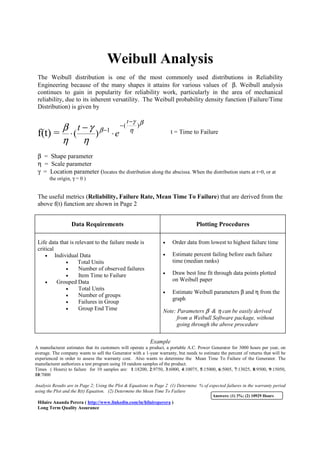
 The Weibull distribution is one of the most commonly used distributions in Reliability
 Engineering because of the many shapes it attains for various values of β. Weibull analysis
 continues to gain in popularity for reliability work, particularly in the area of mechanical
 reliability, due to its inherent versatility. The Weibull probability density function (Failure/Time
 Distribution) is given by

                                               t −γ β
       β t − γ β −1 − (                          η
                                                   )
 f(t) = ⋅ (   ) ⋅e                                                    t = Time to Failure
       η    η
 β = Shape parameter
 η = Scale parameter
 γ = Location parameter (locates the distribution along the abscissa. When the distribution starts at t=0, or at
       the origin, γ = 0 )


 The useful metrics (Reliability, Failure Rate, Mean Time To Failure) that are derived from the
 above f(t) function are shown in Page 2


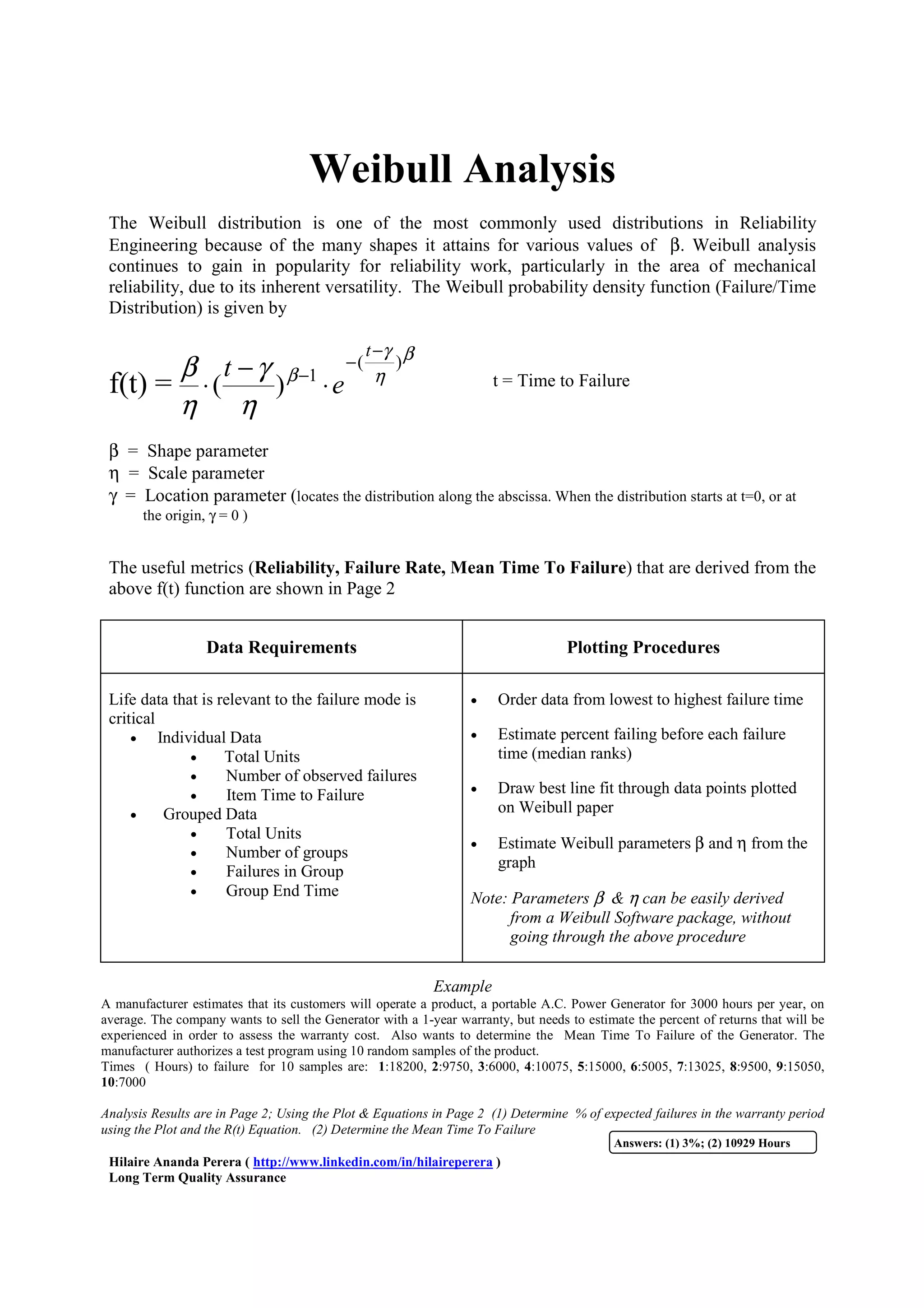
                  Data Requirements                                                Plotting Procedures

 Life data that is relevant to the failure mode is                •    Order data from lowest to highest failure time
 critical
     •    Individual Data                                         •    Estimate percent failing before each failure
               •    Total Units                                        time (median ranks)
               •    Number of observed failures
                                                                  •    Draw best line fit through data points plotted
               •     Item Time to Failure
     •     Grouped Data                                                on Weibull paper
               •    Total Units
                                                                  •    Estimate Weibull parameters β and η from the
               •    Number of groups
                                                                       graph
               •     Failures in Group
               •    Group End Time                                Note: Parameters β & η can be easily derived
                                                                        from a Weibull Software package, without
                                                                        going through the above procedure

                                                           Example
A manufacturer estimates that its customers will operate a product, a portable A.C. Power Generator for 3000 hours per year, on
average. The company wants to sell the Generator with a 1-year warranty, but needs to estimate the percent of returns that will be
experienced in order to assess the warranty cost. Also wants to determine the Mean Time To Failure of the Generator. The
manufacturer authorizes a test program using 10 random samples of the product.
Times ( Hours) to failure for 10 samples are: 1:18200, 2:9750, 3:6000, 4:10075, 5:15000, 6:5005, 7:13025, 8:9500, 9:15050,
10:7000

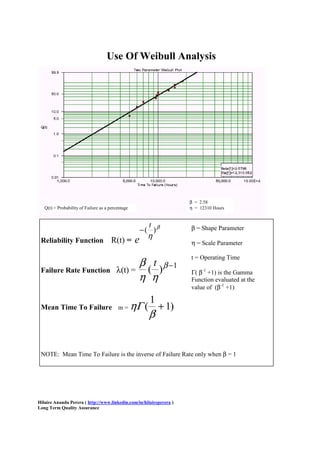
Analysis Results are in Page 2; Using the Plot & Equations in Page 2 (1) Determine % of expected failures in the warranty period
using the Plot and the R(t) Equation. (2) Determine the Mean Time To Failure
                                                                                            Answers: (1) 3%; (2) 10929 Hours
 Hilaire Ananda Perera ( http://www.linkedin.com/in/hilaireperera )
 Long Term Quality Assurance
Use Of Weibull Analysis


                                                                     β = 2.58
   Q(t) = Probability of Failure as a percentage                     η = 12310 Hours


                                                         t
                                                       −( ) β        β = Shape Parameter
                                                         η
 Reliability Function                  R(t) =      e                 η = Scale Parameter


                                               β t β −1
                                                                     t = Operating Time

 Failure Rate Function                   λ(t) = ( )                  Γ( β -1 +1) is the Gamma
                                               η η                   Function evaluated at the
                                                                     value of (β -1 +1)

                                                          1
 Mean Time To Failure m = ηΓ (                                + 1)
                                                         β


 NOTE: Mean Time To Failure is the inverse of Failure Rate only when β = 1


Hilaire Ananda Perera ( http://www.linkedin.com/in/hilaireperera )
Long Term Quality Assurance
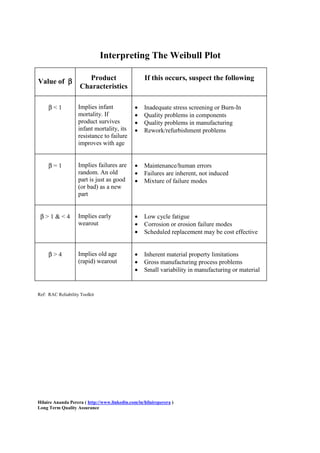
Interpreting The Weibull Plot

Value of β            Product                      If this occurs, suspect the following
                    Characteristics

     β<1            Implies infant             •   Inadequate stress screening or Burn-In
                    mortality. If              •   Quality problems in components
                    product survives           •   Quality problems in manufacturing
                    infant mortality, its      •   Rework/refurbishment problems
                    resistance to failure
                    improves with age


     β=1            Implies failures are       •   Maintenance/human errors
                    random. An old             •   Failures are inherent, not induced
                    part is just as good       •   Mixture of failure modes
                    (or bad) as a new
                    part


 β>1&<4             Implies early              •   Low cycle fatigue
                    wearout                    •   Corrosion or erosion failure modes
                                               •   Scheduled replacement may be cost effective


     β>4            Implies old age            •   Inherent material property limitations
                    (rapid) wearout            •   Gross manufacturing process problems
                                               •   Small variability in manufacturing or material


Ref: RAC Reliability Toolkit


Hilaire Ananda Perera ( http://www.linkedin.com/in/hilaireperera )
Long Term Quality Assurance

Weibull analysis

  • 1.
    Weibull Analysis TheWeibull distribution is one of the most commonly used distributions in Reliability Engineering because of the many shapes it attains for various values of β. Weibull analysis continues to gain in popularity for reliability work, particularly in the area of mechanical reliability, due to its inherent versatility. The Weibull probability density function (Failure/Time Distribution) is given by t −γ β β t − γ β −1 − ( η ) f(t) = ⋅ ( ) ⋅e t = Time to Failure η η β = Shape parameter η = Scale parameter γ = Location parameter (locates the distribution along the abscissa. When the distribution starts at t=0, or at the origin, γ = 0 ) The useful metrics (Reliability, Failure Rate, Mean Time To Failure) that are derived from the above f(t) function are shown in Page 2 Data Requirements Plotting Procedures Life data that is relevant to the failure mode is • Order data from lowest to highest failure time critical • Individual Data • Estimate percent failing before each failure • Total Units time (median ranks) • Number of observed failures • Draw best line fit through data points plotted • Item Time to Failure • Grouped Data on Weibull paper • Total Units • Estimate Weibull parameters β and η from the • Number of groups graph • Failures in Group • Group End Time Note: Parameters β & η can be easily derived from a Weibull Software package, without going through the above procedure Example A manufacturer estimates that its customers will operate a product, a portable A.C. Power Generator for 3000 hours per year, on average. The company wants to sell the Generator with a 1-year warranty, but needs to estimate the percent of returns that will be experienced in order to assess the warranty cost. Also wants to determine the Mean Time To Failure of the Generator. The manufacturer authorizes a test program using 10 random samples of the product. Times ( Hours) to failure for 10 samples are: 1:18200, 2:9750, 3:6000, 4:10075, 5:15000, 6:5005, 7:13025, 8:9500, 9:15050, 10:7000 Analysis Results are in Page 2; Using the Plot & Equations in Page 2 (1) Determine % of expected failures in the warranty period using the Plot and the R(t) Equation. (2) Determine the Mean Time To Failure Answers: (1) 3%; (2) 10929 Hours Hilaire Ananda Perera ( http://www.linkedin.com/in/hilaireperera ) Long Term Quality Assurance
  • 2.
    Use Of WeibullAnalysis β = 2.58 Q(t) = Probability of Failure as a percentage η = 12310 Hours t −( ) β β = Shape Parameter η Reliability Function R(t) = e η = Scale Parameter β t β −1 t = Operating Time Failure Rate Function λ(t) = ( ) Γ( β -1 +1) is the Gamma η η Function evaluated at the value of (β -1 +1) 1 Mean Time To Failure m = ηΓ ( + 1) β NOTE: Mean Time To Failure is the inverse of Failure Rate only when β = 1 Hilaire Ananda Perera ( http://www.linkedin.com/in/hilaireperera ) Long Term Quality Assurance
  • 3.
    Interpreting The WeibullPlot Value of β Product If this occurs, suspect the following Characteristics β<1 Implies infant • Inadequate stress screening or Burn-In mortality. If • Quality problems in components product survives • Quality problems in manufacturing infant mortality, its • Rework/refurbishment problems resistance to failure improves with age β=1 Implies failures are • Maintenance/human errors random. An old • Failures are inherent, not induced part is just as good • Mixture of failure modes (or bad) as a new part β>1&<4 Implies early • Low cycle fatigue wearout • Corrosion or erosion failure modes • Scheduled replacement may be cost effective β>4 Implies old age • Inherent material property limitations (rapid) wearout • Gross manufacturing process problems • Small variability in manufacturing or material Ref: RAC Reliability Toolkit Hilaire Ananda Perera ( http://www.linkedin.com/in/hilaireperera ) Long Term Quality Assurance