Quality ControlQuality Control
Chapter 11- ReliabilityChapter 11- Reliability
PowerPoint presentation to accompanyPowerPoint presentation to accompany
BesterfieldBesterfield
Quality Control, 8eQuality Control, 8e
PowerPoints created by RosidaPowerPoints created by Rosida
CoowarCoowar
Besterfield: Quality Control, 8th
ed.. © 2009 Pearson Education, Upper Saddle River, NJ 07458.
All rights reserved
OutlineOutline
 Fundamental Aspects
 Additional Statistical Aspects
 Life and Reliability Testing Plans
 Availability and Maintainability
Besterfield: Quality Control, 8th
ed.. © 2009 Pearson Education, Upper Saddle River, NJ 07458.
All rights reserved
When you have completed this chapter you should
be able to:
 Know the definition of reliability and the
factors associated with it.
 Know the various techniques to obtain reliability.
 Understand the probability distributions, failure
curves, and reliability curves as a factor of time.
Learning ObjectivesLearning Objectives
Besterfield: Quality Control, 8th
ed.. © 2009 Pearson Education, Upper Saddle River, NJ 07458.
All rights reserved
When you have completed this chapter you
should be able to:
 Calculate the failure rate under different
conditions.
 Construct the life history curve and describe its
three phases.
 Calculate the normal, exponential, and Weibull
failure rate.
Learning Objectives cont’d.Learning Objectives cont’d.
Besterfield: Quality Control, 8th
ed.. © 2009 Pearson Education, Upper Saddle River, NJ 07458.
All rights reserved
When you have completed this chapter you
should be able to:
 Construct the OC Curve
 Determine life and reliability test curves
 Calculate the normal, exponential, and Weibull failure rate
 Understand the different types of test design
 Understand the concepts of availability and maintainability
Learning Objectives cont’d.Learning Objectives cont’d.
Besterfield: Quality Control, 8th
ed.. © 2009 Pearson Education, Upper Saddle River, NJ 07458.
All rights reserved
 Generally defined as the ability of a product to
perform as expected over time.
 Formally defined as the probability that a
product, piece of equipment, or system will
perform its intended function for a stated period
of time under specified operating conditions.
ReliabilityReliability
Besterfield: Quality Control, 8th
ed.. © 2009 Pearson Education, Upper Saddle River, NJ 07458.
All rights reserved
 Means quality over the long run.
 A product that “works” for a long period
of time is a reliable one.
 Since all units of a product will fail at
different times, reliability is a probability.
ReliabilityReliability
Besterfield: Quality Control, 8th
ed.. © 2009 Pearson Education, Upper Saddle River, NJ 07458.
All rights reserved
There are four factors associated with Reliability:
1. Numerical Value.
The numerical value is the probability that
the product will function satisfactorily
during a particular time.
ReliabilityReliability
Besterfield: Quality Control, 8th
ed.. © 2009 Pearson Education, Upper Saddle River, NJ 07458.
All rights reserved
There are four factors associated with Reliability:
2. Intended Function.
Product are designed for particular
applications and are expected to be able to
perform those applications.
ReliabilityReliability
Besterfield: Quality Control, 8th
ed.. © 2009 Pearson Education, Upper Saddle River, NJ 07458.
All rights reserved
There are four factors associated with Reliability:
3. Life.
 How long the product is expected to last.
Product life is specified as a function of
usage, time, or both.
ReliabilityReliability
Besterfield: Quality Control, 8th
ed.. © 2009 Pearson Education, Upper Saddle River, NJ 07458.
All rights reserved
There are four factors associated with Reliability:
4. Environmental Conditions
Indoors.
Outdoors.
Storage.
Transportation.
ReliabilityReliability
Besterfield: Quality Control, 8th
ed.. © 2009 Pearson Education, Upper Saddle River, NJ 07458.
All rights reserved
Emphasis:
1.The Consumer Protection Act of 1972.
2.Products are more complicated.
3.Automation.
Achieving ReliabilityAchieving Reliability
Besterfield: Quality Control, 8th
ed.. © 2009 Pearson Education, Upper Saddle River, NJ 07458.
All rights reserved
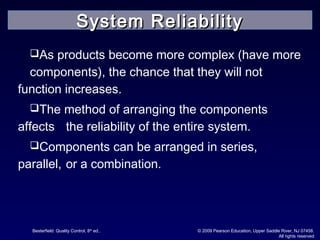
As products become more complex (have more
components), the chance that they will not
function increases.
The method of arranging the components
affects the reliability of the entire system.
Components can be arranged in series,
parallel, or a combination.
System ReliabilitySystem Reliability
Besterfield: Quality Control, 8th
ed.. © 2009 Pearson Education, Upper Saddle River, NJ 07458.
All rights reserved
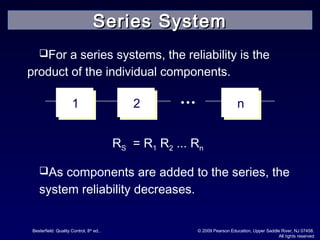
RS = R1 R2 ... Rn
1 2 n
For a series systems, the reliability is the
product of the individual components.
As components are added to the series, the
system reliability decreases.
Series SystemSeries System
Besterfield: Quality Control, 8th
ed.. © 2009 Pearson Education, Upper Saddle River, NJ 07458.
All rights reserved
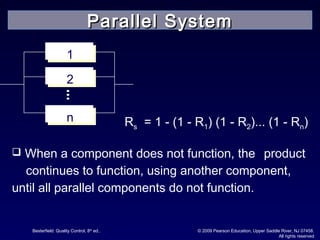
Rs = 1 - (1 - R1) (1 - R2)... (1 - Rn)
1
2
n
 When a component does not function, the product
continues to function, using another component,
until all parallel components do not function.
Parallel SystemParallel System
Besterfield: Quality Control, 8th
ed.. © 2009 Pearson Education, Upper Saddle River, NJ 07458.
All rights reserved
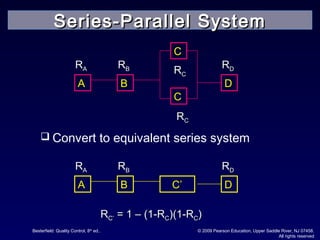
 Convert to equivalent series system
AA BB
CC
CC
DD
RRAA RRBB
RRCC
RRDD
RRCC
AA BB C’C’ DD
RRAA RRBB RRDD
RRC’C’ = 1 – (1-R= 1 – (1-RCC)(1-R)(1-RCC))
Series-Parallel SystemSeries-Parallel System
Besterfield: Quality Control, 8th
ed.. © 2009 Pearson Education, Upper Saddle River, NJ 07458.
All rights reserved
 The most important aspect of reliability is the
design.
 It should be as simple as possible.
 The fewer the number of components, the
greater the reliability.
 Another way of achieving reliability is to have a
backup or redundant component (parallel
component).
DesignDesign
Besterfield: Quality Control, 8th
ed.. © 2009 Pearson Education, Upper Saddle River, NJ 07458.
All rights reserved
 Reliability can be achieved by overdesign.
 The use of large factors of safety can increase the
reliability of a product.
 When an unreliable product can lead to a fatality
or substantial financial loss, a fail-safe type of
device should be used.
 The maintenance of the system is an important
factor in reliability.
DesignDesign
Besterfield: Quality Control, 8th
ed.. © 2009 Pearson Education, Upper Saddle River, NJ 07458.
All rights reserved
 The second most important aspect of
reliability is the production process.
 Emphasis should be placed on those
components which are least reliable.
 Production personnel.
ProductionProduction
Besterfield: Quality Control, 8th
ed.. © 2009 Pearson Education, Upper Saddle River, NJ 07458.
All rights reserved
 The third most important aspect of reliability is
the transportation.
 Packaging
 Shipment
 Performance of the product by the customer is
the final evaluation.
 Good packaging techniques and shipment
evaluation are essential.
TransportationTransportation
Besterfield: Quality Control, 8th
ed.. © 2009 Pearson Education, Upper Saddle River, NJ 07458.
All rights reserved
Distributions Applicable to Reliability:
 Exponential distribution.
 Normal distribution.
 Weibull distribution.
Reliability Curves:Reliability Curves:
 The curves as a function of time.The curves as a function of time.
Additional Statistical AspectsAdditional Statistical Aspects
Besterfield: Quality Control, 8th
ed.. © 2009 Pearson Education, Upper Saddle River, NJ 07458.
All rights reserved
Reliability Curves:
 The reliability curves for the exponential,
normal and Weibull distributions as a function
of time are given in Figure 11-2(b) .
Additional Statistical AspectsAdditional Statistical Aspects
Besterfield: Quality Control, 8th
ed.. © 2009 Pearson Education, Upper Saddle River, NJ 07458.
All rights reserved
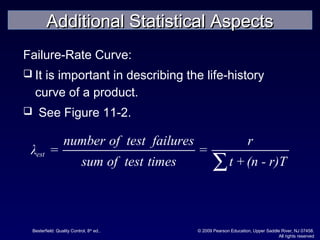
Failure-Rate Curve:
 It is important in describing the life-history
curve of a product.
 See Figure 11-2.
est
number of test failures r
λ = =
sum of test times t +(n - r)T∑
Additional Statistical AspectsAdditional Statistical Aspects
Besterfield: Quality Control, 8th
ed.. © 2009 Pearson Education, Upper Saddle River, NJ 07458.
All rights reserved
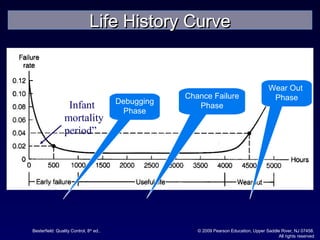
 The curve, sometimes referred to as the
“bathtub” curve, is a comparison of failure rate
with time.
 It has three distinct phases:
 The debugging phase.
 The chance failure phase.
 The wear-out phase.
Life History CurveLife History Curve
Besterfield: Quality Control, 8th
ed.. © 2009 Pearson Education, Upper Saddle River, NJ 07458.
All rights reserved
“Infant
mortality
period”
Debugging
Phase
Chance Failure
Phase
Wear Out
Phase
Life History CurveLife History Curve
Besterfield: Quality Control, 8th
ed.. © 2009 Pearson Education, Upper Saddle River, NJ 07458.
All rights reserved
1. The debugging phase:
It is characterized by marginal and short-life
parts that cause a rapid decrease in the
failure rate.
It may be part of the testing activity prior to
shipment for some products.
The Weibull distribution ß<1 is used to
describe the occurrence of failures.
Life History CurveLife History Curve
Besterfield: Quality Control, 8th
ed.. © 2009 Pearson Education, Upper Saddle River, NJ 07458.
All rights reserved
2. The chance failure phase:
Failures occur in a random manner due to the
constant failure rate. The Exponential and the
Weibull distributions β= 1 are best suited to
describe this phase.
3. The wear-out phase:
Is depicted by a sharp raise in failure rates. The
Normal distribution and the Weibull distribution ß
>1 are used to describe this phase.
Life History CurveLife History Curve
Besterfield: Quality Control, 8th
ed.. © 2009 Pearson Education, Upper Saddle River, NJ 07458.
All rights reserved
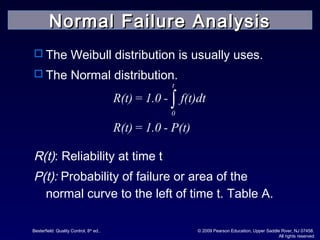
 The Weibull distribution is usually uses.
 The Normal distribution.
R(t): Reliability at time t
P(t): Probability of failure or area of the
normal curve to the left of time t. Table A.
t
0
R(t)= 1.0 - f(t)dt
R(t)= 1.0 - P(t)
∫
Normal Failure AnalysisNormal Failure Analysis
Besterfield: Quality Control, 8th
ed.. © 2009 Pearson Education, Upper Saddle River, NJ 07458.
All rights reserved
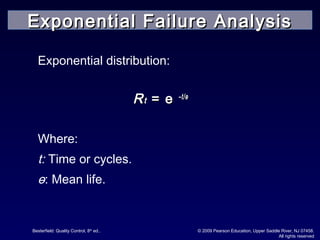
Exponential distribution:
RRtt == ee –t/–t/өө
Where:
t: Time or cycles.
ө: Mean life.
Exponential Failure AnalysisExponential Failure Analysis
Besterfield: Quality Control, 8th
ed.. © 2009 Pearson Education, Upper Saddle River, NJ 07458.
All rights reserved
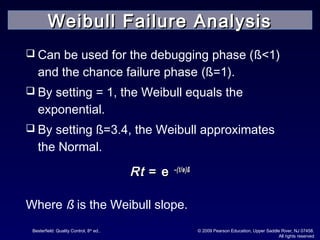
 Can be used for the debugging phase (ß<1)
and the chance failure phase (ß=1).
 By setting = 1, the Weibull equals the
exponential.
 By setting ß=3.4, the Weibull approximates
the Normal.
RtRt == ee –(t/–(t/өө)ß)ß
Where ß is the Weibull slope.
Weibull Failure AnalysisWeibull Failure Analysis
Besterfield: Quality Control, 8th
ed.. © 2009 Pearson Education, Upper Saddle River, NJ 07458.
All rights reserved
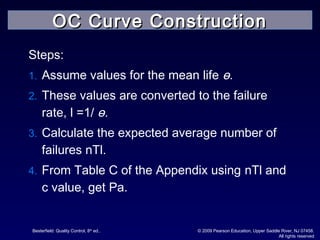
Steps:
1. Assume values for the mean life ө.
2. These values are converted to the failure
rate, l =1/ ө.
3. Calculate the expected average number of
failures nTl.
4. From Table C of the Appendix using nTl and
c value, get Pa.
OC Curve ConstructionOC Curve Construction
Besterfield: Quality Control, 8th
ed.. © 2009 Pearson Education, Upper Saddle River, NJ 07458.
All rights reserved
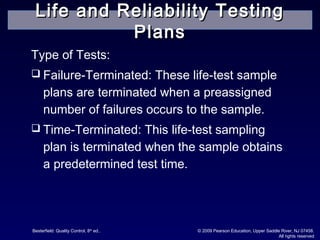
Type of Tests:
 Failure-Terminated: These life-test sample
plans are terminated when a preassigned
number of failures occurs to the sample.
 Time-Terminated: This life-test sampling
plan is terminated when the sample obtains
a predetermined test time.
Life and Reliability TestingLife and Reliability Testing
PlansPlans
Besterfield: Quality Control, 8th
ed.. © 2009 Pearson Education, Upper Saddle River, NJ 07458.
All rights reserved
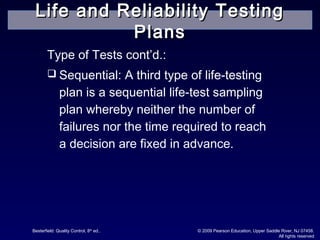
Type of Tests cont’d.:
 Sequential: A third type of life-testing
plan is a sequential life-test sampling
plan whereby neither the number of
failures nor the time required to reach
a decision are fixed in advance.
Life and Reliability TestingLife and Reliability Testing
PlansPlans
Besterfield: Quality Control, 8th
ed.. © 2009 Pearson Education, Upper Saddle River, NJ 07458.
All rights reserved
Tests are based on one or more of the
following characteristics:
 Mean life: the average life of the product.
 Failure rate: the percentage of failures per
unit time or number of cycles.
Life and Reliability TestingLife and Reliability Testing
PlansPlans
Besterfield: Quality Control, 8th
ed.. © 2009 Pearson Education, Upper Saddle River, NJ 07458.
All rights reserved
Test are based on one or more of the following
characteristics cont’d.:
 Hazard rate: the instantaneous failure rate at
a specified time.
 Reliable life: the life beyond which some
specified portion of the items in the lot will
survive.
Life and Reliability TestingLife and Reliability Testing
PlansPlans
Besterfield: Quality Control, 8th
ed.. © 2009 Pearson Education, Upper Saddle River, NJ 07458.
All rights reserved
 Quality Control Reliability Handbook H108
gives sampling procedures and tables for life
and reliability testing.
 Sampling plans in the handbook are based on
the exponential distribution.
 Provides for the three different types of test:
failure-terminated, time-terminated, and
sequential.
Handbook H108Handbook H108
Besterfield: Quality Control, 8th
ed.. © 2009 Pearson Education, Upper Saddle River, NJ 07458.
All rights reserved
 The handbook is over 70 pages long.
 The time-terminated plan:
1. Stipulated producer’s risk, consumer’s
risk, and sample size.
2. Stipulated producer’s risk, rejection
number, and sample size.
3. Stipulated producer’s risk, consumer’s
risk, and test time.
Handbook H108Handbook H108
Besterfield: Quality Control, 8th
ed.. © 2009 Pearson Education, Upper Saddle River, NJ 07458.
All rights reserved
 Define customer performance requirements.
 Determine important economic factors and
relationship with reliability requirements.
 Define the environment and conditions of
product use.
Reliability ManagementReliability Management
Besterfield: Quality Control, 8th
ed.. © 2009 Pearson Education, Upper Saddle River, NJ 07458.
All rights reserved
 Select components, designs, and
vendors that meet reliability and cost
criteria.
 Determine reliability requirements for
machines and equipments.
 Analyze field reliability for
improvement.
Reliability ManagementReliability Management
Besterfield: Quality Control, 8th
ed.. © 2009 Pearson Education, Upper Saddle River, NJ 07458.
All rights reserved
For long-lasting products and services such as
refrigerators, electric power lines, and front-line
services, the time-related factors of availability,
reliability, and maintainability are interrelated.
Availability and MaintainabilityAvailability and Maintainability
Besterfield: Quality Control, 8th
ed.. © 2009 Pearson Education, Upper Saddle River, NJ 07458.
All rights reserved
 It is a time-related factor that measures the
ability of a product or service to perform its
designated function.
 The product or service is available when it
is in the operational state, which includes
active and standby use.
AvailabilityAvailability
Besterfield: Quality Control, 8th
ed.. © 2009 Pearson Education, Upper Saddle River, NJ 07458.
All rights reserved
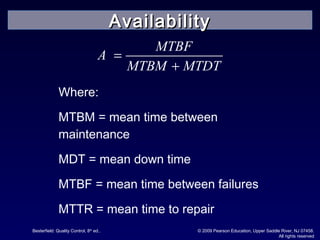
MTBF
A
MTBM MTDT
=
+
Where:
MTBM = mean time between
maintenance
MDT = mean down time
MTBF = mean time between failures
MTTR = mean time to repair
AvailabilityAvailability
Besterfield: Quality Control, 8th
ed.. © 2009 Pearson Education, Upper Saddle River, NJ 07458.
All rights reserved
Maintainability is the probability that a system or
product can be retained in, or one that has
failed can be restored to, operating condition in
a specified amount of time.
MaintainabilityMaintainability
Besterfield: Quality Control, 8th
ed.. © 2009 Pearson Education, Upper Saddle River, NJ 07458.
All rights reserved
 Maintainability is the totality of design
factors that allows maintenance to be
accomplished easily.
 Preventive maintenance reduces the risk
of failure.
 Corrective maintenance is the response to
failures.
MaintainabilityMaintainability

Reliabilty

  • 1.
    Quality ControlQuality Control Chapter11- ReliabilityChapter 11- Reliability PowerPoint presentation to accompanyPowerPoint presentation to accompany BesterfieldBesterfield Quality Control, 8eQuality Control, 8e PowerPoints created by RosidaPowerPoints created by Rosida CoowarCoowar
  • 2.
    Besterfield: Quality Control,8th ed.. © 2009 Pearson Education, Upper Saddle River, NJ 07458. All rights reserved OutlineOutline  Fundamental Aspects  Additional Statistical Aspects  Life and Reliability Testing Plans  Availability and Maintainability
  • 3.
    Besterfield: Quality Control,8th ed.. © 2009 Pearson Education, Upper Saddle River, NJ 07458. All rights reserved When you have completed this chapter you should be able to:  Know the definition of reliability and the factors associated with it.  Know the various techniques to obtain reliability.  Understand the probability distributions, failure curves, and reliability curves as a factor of time. Learning ObjectivesLearning Objectives
  • 4.
    Besterfield: Quality Control,8th ed.. © 2009 Pearson Education, Upper Saddle River, NJ 07458. All rights reserved When you have completed this chapter you should be able to:  Calculate the failure rate under different conditions.  Construct the life history curve and describe its three phases.  Calculate the normal, exponential, and Weibull failure rate. Learning Objectives cont’d.Learning Objectives cont’d.
  • 5.
    Besterfield: Quality Control,8th ed.. © 2009 Pearson Education, Upper Saddle River, NJ 07458. All rights reserved When you have completed this chapter you should be able to:  Construct the OC Curve  Determine life and reliability test curves  Calculate the normal, exponential, and Weibull failure rate  Understand the different types of test design  Understand the concepts of availability and maintainability Learning Objectives cont’d.Learning Objectives cont’d.
  • 6.
    Besterfield: Quality Control,8th ed.. © 2009 Pearson Education, Upper Saddle River, NJ 07458. All rights reserved  Generally defined as the ability of a product to perform as expected over time.  Formally defined as the probability that a product, piece of equipment, or system will perform its intended function for a stated period of time under specified operating conditions. ReliabilityReliability
  • 7.
    Besterfield: Quality Control,8th ed.. © 2009 Pearson Education, Upper Saddle River, NJ 07458. All rights reserved  Means quality over the long run.  A product that “works” for a long period of time is a reliable one.  Since all units of a product will fail at different times, reliability is a probability. ReliabilityReliability
  • 8.
    Besterfield: Quality Control,8th ed.. © 2009 Pearson Education, Upper Saddle River, NJ 07458. All rights reserved There are four factors associated with Reliability: 1. Numerical Value. The numerical value is the probability that the product will function satisfactorily during a particular time. ReliabilityReliability
  • 9.
    Besterfield: Quality Control,8th ed.. © 2009 Pearson Education, Upper Saddle River, NJ 07458. All rights reserved There are four factors associated with Reliability: 2. Intended Function. Product are designed for particular applications and are expected to be able to perform those applications. ReliabilityReliability
  • 10.
    Besterfield: Quality Control,8th ed.. © 2009 Pearson Education, Upper Saddle River, NJ 07458. All rights reserved There are four factors associated with Reliability: 3. Life.  How long the product is expected to last. Product life is specified as a function of usage, time, or both. ReliabilityReliability
  • 11.
    Besterfield: Quality Control,8th ed.. © 2009 Pearson Education, Upper Saddle River, NJ 07458. All rights reserved There are four factors associated with Reliability: 4. Environmental Conditions Indoors. Outdoors. Storage. Transportation. ReliabilityReliability
  • 12.
    Besterfield: Quality Control,8th ed.. © 2009 Pearson Education, Upper Saddle River, NJ 07458. All rights reserved Emphasis: 1.The Consumer Protection Act of 1972. 2.Products are more complicated. 3.Automation. Achieving ReliabilityAchieving Reliability
  • 13.
    Besterfield: Quality Control,8th ed.. © 2009 Pearson Education, Upper Saddle River, NJ 07458. All rights reserved As products become more complex (have more components), the chance that they will not function increases. The method of arranging the components affects the reliability of the entire system. Components can be arranged in series, parallel, or a combination. System ReliabilitySystem Reliability
  • 14.
    Besterfield: Quality Control,8th ed.. © 2009 Pearson Education, Upper Saddle River, NJ 07458. All rights reserved RS = R1 R2 ... Rn 1 2 n For a series systems, the reliability is the product of the individual components. As components are added to the series, the system reliability decreases. Series SystemSeries System
  • 15.
    Besterfield: Quality Control,8th ed.. © 2009 Pearson Education, Upper Saddle River, NJ 07458. All rights reserved Rs = 1 - (1 - R1) (1 - R2)... (1 - Rn) 1 2 n  When a component does not function, the product continues to function, using another component, until all parallel components do not function. Parallel SystemParallel System
  • 16.
    Besterfield: Quality Control,8th ed.. © 2009 Pearson Education, Upper Saddle River, NJ 07458. All rights reserved  Convert to equivalent series system AA BB CC CC DD RRAA RRBB RRCC RRDD RRCC AA BB C’C’ DD RRAA RRBB RRDD RRC’C’ = 1 – (1-R= 1 – (1-RCC)(1-R)(1-RCC)) Series-Parallel SystemSeries-Parallel System
  • 17.
    Besterfield: Quality Control,8th ed.. © 2009 Pearson Education, Upper Saddle River, NJ 07458. All rights reserved  The most important aspect of reliability is the design.  It should be as simple as possible.  The fewer the number of components, the greater the reliability.  Another way of achieving reliability is to have a backup or redundant component (parallel component). DesignDesign
  • 18.
    Besterfield: Quality Control,8th ed.. © 2009 Pearson Education, Upper Saddle River, NJ 07458. All rights reserved  Reliability can be achieved by overdesign.  The use of large factors of safety can increase the reliability of a product.  When an unreliable product can lead to a fatality or substantial financial loss, a fail-safe type of device should be used.  The maintenance of the system is an important factor in reliability. DesignDesign
  • 19.
    Besterfield: Quality Control,8th ed.. © 2009 Pearson Education, Upper Saddle River, NJ 07458. All rights reserved  The second most important aspect of reliability is the production process.  Emphasis should be placed on those components which are least reliable.  Production personnel. ProductionProduction
  • 20.
    Besterfield: Quality Control,8th ed.. © 2009 Pearson Education, Upper Saddle River, NJ 07458. All rights reserved  The third most important aspect of reliability is the transportation.  Packaging  Shipment  Performance of the product by the customer is the final evaluation.  Good packaging techniques and shipment evaluation are essential. TransportationTransportation
  • 21.
    Besterfield: Quality Control,8th ed.. © 2009 Pearson Education, Upper Saddle River, NJ 07458. All rights reserved Distributions Applicable to Reliability:  Exponential distribution.  Normal distribution.  Weibull distribution. Reliability Curves:Reliability Curves:  The curves as a function of time.The curves as a function of time. Additional Statistical AspectsAdditional Statistical Aspects
  • 22.
    Besterfield: Quality Control,8th ed.. © 2009 Pearson Education, Upper Saddle River, NJ 07458. All rights reserved Reliability Curves:  The reliability curves for the exponential, normal and Weibull distributions as a function of time are given in Figure 11-2(b) . Additional Statistical AspectsAdditional Statistical Aspects
  • 23.
    Besterfield: Quality Control,8th ed.. © 2009 Pearson Education, Upper Saddle River, NJ 07458. All rights reserved Failure-Rate Curve:  It is important in describing the life-history curve of a product.  See Figure 11-2. est number of test failures r λ = = sum of test times t +(n - r)T∑ Additional Statistical AspectsAdditional Statistical Aspects
  • 24.
    Besterfield: Quality Control,8th ed.. © 2009 Pearson Education, Upper Saddle River, NJ 07458. All rights reserved  The curve, sometimes referred to as the “bathtub” curve, is a comparison of failure rate with time.  It has three distinct phases:  The debugging phase.  The chance failure phase.  The wear-out phase. Life History CurveLife History Curve
  • 25.
    Besterfield: Quality Control,8th ed.. © 2009 Pearson Education, Upper Saddle River, NJ 07458. All rights reserved “Infant mortality period” Debugging Phase Chance Failure Phase Wear Out Phase Life History CurveLife History Curve
  • 26.
    Besterfield: Quality Control,8th ed.. © 2009 Pearson Education, Upper Saddle River, NJ 07458. All rights reserved 1. The debugging phase: It is characterized by marginal and short-life parts that cause a rapid decrease in the failure rate. It may be part of the testing activity prior to shipment for some products. The Weibull distribution ß<1 is used to describe the occurrence of failures. Life History CurveLife History Curve
  • 27.
    Besterfield: Quality Control,8th ed.. © 2009 Pearson Education, Upper Saddle River, NJ 07458. All rights reserved 2. The chance failure phase: Failures occur in a random manner due to the constant failure rate. The Exponential and the Weibull distributions β= 1 are best suited to describe this phase. 3. The wear-out phase: Is depicted by a sharp raise in failure rates. The Normal distribution and the Weibull distribution ß >1 are used to describe this phase. Life History CurveLife History Curve
  • 28.
    Besterfield: Quality Control,8th ed.. © 2009 Pearson Education, Upper Saddle River, NJ 07458. All rights reserved  The Weibull distribution is usually uses.  The Normal distribution. R(t): Reliability at time t P(t): Probability of failure or area of the normal curve to the left of time t. Table A. t 0 R(t)= 1.0 - f(t)dt R(t)= 1.0 - P(t) ∫ Normal Failure AnalysisNormal Failure Analysis
  • 29.
    Besterfield: Quality Control,8th ed.. © 2009 Pearson Education, Upper Saddle River, NJ 07458. All rights reserved Exponential distribution: RRtt == ee –t/–t/өө Where: t: Time or cycles. ө: Mean life. Exponential Failure AnalysisExponential Failure Analysis
  • 30.
    Besterfield: Quality Control,8th ed.. © 2009 Pearson Education, Upper Saddle River, NJ 07458. All rights reserved  Can be used for the debugging phase (ß<1) and the chance failure phase (ß=1).  By setting = 1, the Weibull equals the exponential.  By setting ß=3.4, the Weibull approximates the Normal. RtRt == ee –(t/–(t/өө)ß)ß Where ß is the Weibull slope. Weibull Failure AnalysisWeibull Failure Analysis
  • 31.
    Besterfield: Quality Control,8th ed.. © 2009 Pearson Education, Upper Saddle River, NJ 07458. All rights reserved Steps: 1. Assume values for the mean life ө. 2. These values are converted to the failure rate, l =1/ ө. 3. Calculate the expected average number of failures nTl. 4. From Table C of the Appendix using nTl and c value, get Pa. OC Curve ConstructionOC Curve Construction
  • 32.
    Besterfield: Quality Control,8th ed.. © 2009 Pearson Education, Upper Saddle River, NJ 07458. All rights reserved Type of Tests:  Failure-Terminated: These life-test sample plans are terminated when a preassigned number of failures occurs to the sample.  Time-Terminated: This life-test sampling plan is terminated when the sample obtains a predetermined test time. Life and Reliability TestingLife and Reliability Testing PlansPlans
  • 33.
    Besterfield: Quality Control,8th ed.. © 2009 Pearson Education, Upper Saddle River, NJ 07458. All rights reserved Type of Tests cont’d.:  Sequential: A third type of life-testing plan is a sequential life-test sampling plan whereby neither the number of failures nor the time required to reach a decision are fixed in advance. Life and Reliability TestingLife and Reliability Testing PlansPlans
  • 34.
    Besterfield: Quality Control,8th ed.. © 2009 Pearson Education, Upper Saddle River, NJ 07458. All rights reserved Tests are based on one or more of the following characteristics:  Mean life: the average life of the product.  Failure rate: the percentage of failures per unit time or number of cycles. Life and Reliability TestingLife and Reliability Testing PlansPlans
  • 35.
    Besterfield: Quality Control,8th ed.. © 2009 Pearson Education, Upper Saddle River, NJ 07458. All rights reserved Test are based on one or more of the following characteristics cont’d.:  Hazard rate: the instantaneous failure rate at a specified time.  Reliable life: the life beyond which some specified portion of the items in the lot will survive. Life and Reliability TestingLife and Reliability Testing PlansPlans
  • 36.
    Besterfield: Quality Control,8th ed.. © 2009 Pearson Education, Upper Saddle River, NJ 07458. All rights reserved  Quality Control Reliability Handbook H108 gives sampling procedures and tables for life and reliability testing.  Sampling plans in the handbook are based on the exponential distribution.  Provides for the three different types of test: failure-terminated, time-terminated, and sequential. Handbook H108Handbook H108
  • 37.
    Besterfield: Quality Control,8th ed.. © 2009 Pearson Education, Upper Saddle River, NJ 07458. All rights reserved  The handbook is over 70 pages long.  The time-terminated plan: 1. Stipulated producer’s risk, consumer’s risk, and sample size. 2. Stipulated producer’s risk, rejection number, and sample size. 3. Stipulated producer’s risk, consumer’s risk, and test time. Handbook H108Handbook H108
  • 38.
    Besterfield: Quality Control,8th ed.. © 2009 Pearson Education, Upper Saddle River, NJ 07458. All rights reserved  Define customer performance requirements.  Determine important economic factors and relationship with reliability requirements.  Define the environment and conditions of product use. Reliability ManagementReliability Management
  • 39.
    Besterfield: Quality Control,8th ed.. © 2009 Pearson Education, Upper Saddle River, NJ 07458. All rights reserved  Select components, designs, and vendors that meet reliability and cost criteria.  Determine reliability requirements for machines and equipments.  Analyze field reliability for improvement. Reliability ManagementReliability Management
  • 40.
    Besterfield: Quality Control,8th ed.. © 2009 Pearson Education, Upper Saddle River, NJ 07458. All rights reserved For long-lasting products and services such as refrigerators, electric power lines, and front-line services, the time-related factors of availability, reliability, and maintainability are interrelated. Availability and MaintainabilityAvailability and Maintainability
  • 41.
    Besterfield: Quality Control,8th ed.. © 2009 Pearson Education, Upper Saddle River, NJ 07458. All rights reserved  It is a time-related factor that measures the ability of a product or service to perform its designated function.  The product or service is available when it is in the operational state, which includes active and standby use. AvailabilityAvailability
  • 42.
    Besterfield: Quality Control,8th ed.. © 2009 Pearson Education, Upper Saddle River, NJ 07458. All rights reserved MTBF A MTBM MTDT = + Where: MTBM = mean time between maintenance MDT = mean down time MTBF = mean time between failures MTTR = mean time to repair AvailabilityAvailability
  • 43.
    Besterfield: Quality Control,8th ed.. © 2009 Pearson Education, Upper Saddle River, NJ 07458. All rights reserved Maintainability is the probability that a system or product can be retained in, or one that has failed can be restored to, operating condition in a specified amount of time. MaintainabilityMaintainability
  • 44.
    Besterfield: Quality Control,8th ed.. © 2009 Pearson Education, Upper Saddle River, NJ 07458. All rights reserved  Maintainability is the totality of design factors that allows maintenance to be accomplished easily.  Preventive maintenance reduces the risk of failure.  Corrective maintenance is the response to failures. MaintainabilityMaintainability

Editor's Notes

  • #2 &amp;lt;number&amp;gt;
  • #3 &amp;lt;number&amp;gt;