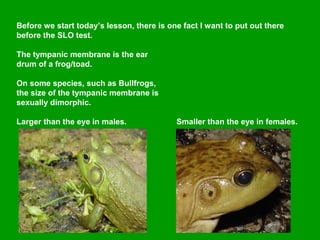
Before we start today’s lesson, there is one fact I want to put out there
before the SLO test.
The tympanic membrane is the ear
drum of a frog/toad.
On some species, such as Bullfrogs,
the size of the tympanic membrane is
sexually dimorphic.
Larger than the eye in males. Smaller than the eye in females.
Amphibian DefenseAmphibian Defense
ToxinsToxins
ToxinsToxins – most amphibians are distasteful to– most amphibians are distasteful to
their predators.their predators.
ToxinsToxins – most amphibians are distasteful to– most amphibians are distasteful to
their predators.their predators.
Many species have very poisonousMany species have very poisonous
chemicals that can be released from theirchemicals that can be released from their
skin glands.skin glands.
ToxinsToxins – most amphibians are distasteful to– most amphibians are distasteful to
their predators.their predators.
Many species have very poisonousMany species have very poisonous
chemicals that can be released from theirchemicals that can be released from their
skin glands.skin glands.
Amphibians are poisonous, not venomous.Amphibians are poisonous, not venomous.
ToxinsToxins – most amphibians are distasteful to– most amphibians are distasteful to
their predators.their predators.
Many species have very poisonousMany species have very poisonous
chemicals that can be released from theirchemicals that can be released from their
skin glands.skin glands.
Amphibians are poisonous, not venomous.Amphibians are poisonous, not venomous.
You must know the following 3 examples ofYou must know the following 3 examples of
toxins produced by amphibians.toxins produced by amphibians.
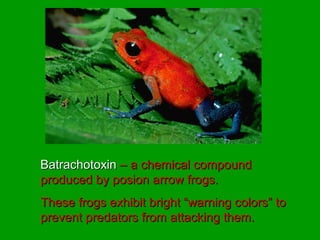
BatrachotoxinBatrachotoxin – a chemical compound– a chemical compound
produced by posion arrow frogs.produced by posion arrow frogs.
BatrachotoxinBatrachotoxin – a chemical compound– a chemical compound
produced by posion arrow frogs.produced by posion arrow frogs.
These frogs exhibit bright “warning colors” toThese frogs exhibit bright “warning colors” to
prevent predators from attacking them.prevent predators from attacking them.
Toads produce a chemical calledToads produce a chemical called bufoteninbufotenin. This. This
chemical causes increased heart rate and potentiallychemical causes increased heart rate and potentially
heart failure.heart failure.
Toads produce a chemical calledToads produce a chemical called bufoteninbufotenin. This. This
chemical causes increased heart rate and potentiallychemical causes increased heart rate and potentially
heart failure.heart failure.
Bufotenin is released from bean-shaped glands calledBufotenin is released from bean-shaped glands called
parotoid glandsparotoid glands located behind toads’ eyes.located behind toads’ eyes.
A family of salamanders called newts produce a veryA family of salamanders called newts produce a very
toxic chemical calledtoxic chemical called salamandrinsalamandrin in their skin glands.in their skin glands.
A family of salamanders called newts produce a veryA family of salamanders called newts produce a very
toxic chemical calledtoxic chemical called salamandrinsalamandrin in their skin glands.in their skin glands.
SalamandrinSalamandrin is lethal in very small doses.is lethal in very small doses.
Red-spotted Newt (eft). Efts Red-spotted Newt (adult). This
are subadult newts. is an Ohio native.
MimicryMimicry is a means of defense utilized byis a means of defense utilized by
amphibians as well as many other animals.amphibians as well as many other animals.
MimicryMimicry is a means of defense utilized byis a means of defense utilized by
amphibians as well as many other animals.amphibians as well as many other animals.
Mimicry is a strategy in which a nonpoisonousMimicry is a strategy in which a nonpoisonous
animal that has evolved to look like a similaranimal that has evolved to look like a similar
poisonous species.poisonous species.
MimicryMimicry is a means of defense utilized byis a means of defense utilized by
amphibians as well as many other animals.amphibians as well as many other animals.
Mimicry is a strategy in which a nonpoisonousMimicry is a strategy in which a nonpoisonous
animal that has evolved to look like a similaranimal that has evolved to look like a similar
poisonous species.poisonous species.
This mud salamander mimics the toxic red eft. It is native toThis mud salamander mimics the toxic red eft. It is native to
eastern Ohio.eastern Ohio.
Aposomatic colorsAposomatic colors
Aposomatic colorsAposomatic colors are the “warning colors” that toxicare the “warning colors” that toxic
animals exhibit to inform predators that they areanimals exhibit to inform predators that they are
dangerous.dangerous.
Aposomatic colorsAposomatic colors are the “warning colors” that toxicare the “warning colors” that toxic
animals exhibit to inform predators that they areanimals exhibit to inform predators that they are
dangerous.dangerous.
Aposomatic colors areAposomatic colors are
generally bright shadesgenerally bright shades
that stand out againstthat stand out against
the background.the background.
Aposomatic colors are the “warning colors” that toxicAposomatic colors are the “warning colors” that toxic
animals exhibit to inform predators that they areanimals exhibit to inform predators that they are
dangerous.dangerous.
Aposomatic colors areAposomatic colors are
generally bright shadesgenerally bright shades
that stand out againstthat stand out against
the background.the background.
Examples:Examples: redred
Aposomatic colors are the “warning colors” that toxicAposomatic colors are the “warning colors” that toxic
animals exhibit to inform predators that they areanimals exhibit to inform predators that they are
dangerous.dangerous.
Aposomatic colors areAposomatic colors are
generally bright shadesgenerally bright shades
that stand out againstthat stand out against
the background.the background.
Examples:Examples: yellowyellow
Aposomatic colors are the “warning colors” that toxicAposomatic colors are the “warning colors” that toxic
animals exhibit to inform predators that they areanimals exhibit to inform predators that they are
dangerous.dangerous.
Aposomatic colors areAposomatic colors are
generally bright shadesgenerally bright shades
that stand out againstthat stand out against
the background.the background.
Examples:Examples: blueblue
Aposomatic colors are the “warning colors” that toxicAposomatic colors are the “warning colors” that toxic
animals exhibit to inform predators that they areanimals exhibit to inform predators that they are
dangerous.dangerous.
Aposomatic colors areAposomatic colors are
generally bright shadesgenerally bright shades
that stand out againstthat stand out against
the background.the background.
Examples:Examples: yellow onyellow on
blackblack
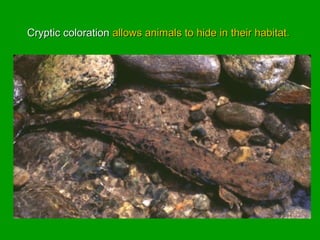
Cryptic colorationCryptic coloration
Cryptic colorationCryptic coloration allows animals to hide in their habitat.allows animals to hide in their habitat.
Counter shadingCounter shading
Counter shadingCounter shading is a type of cryptic coloration. Frogs thatis a type of cryptic coloration. Frogs that
set at the surface on algae mats are often green dorsally.set at the surface on algae mats are often green dorsally.
Counter shadingCounter shading is a type of cryptic coloration. Frogs thatis a type of cryptic coloration. Frogs that
set at the surface on algae mats are often green dorsally.set at the surface on algae mats are often green dorsally.
The same frog’s body is white on the underside.The same frog’s body is white on the underside.
Counter shadingCounter shading is a type of cryptic coloration. Frogs thatis a type of cryptic coloration. Frogs that
set at the surface on algae mats are often green dorsally.set at the surface on algae mats are often green dorsally.
The same frog’s body is white on the underside. WhenThe same frog’s body is white on the underside. When
it swims into open water, predators looking up at its bellyit swims into open water, predators looking up at its belly
from below will not be able to see it against the brightfrom below will not be able to see it against the bright
light of the sky.light of the sky.
A few amphibiansA few amphibians
have sufficientlyhave sufficiently
sharp teeth thatsharp teeth that
they willthey will bitebite as aas a
means of defense.means of defense.
Other means of defense……Other means of defense……
1.1. HidingHiding ––
Other means of defense……Other means of defense……
1.1. HidingHiding – most small salamanders simply stay– most small salamanders simply stay
hidden beneath logs or rocks.hidden beneath logs or rocks.
Other means of defense……Other means of defense……
1.1. Hiding – most small salamanders simply stayHiding – most small salamanders simply stay
hidden beneath logs or rocks.hidden beneath logs or rocks.
2.2. EscapeEscape ––
Other means of defense……Other means of defense……
1.1. Hiding – most small salamanders simply stayHiding – most small salamanders simply stay
hidden beneath logs or rocks.hidden beneath logs or rocks.
2.2. EscapeEscape – many amphibians, especially frogs simply– many amphibians, especially frogs simply
leap away from danger.leap away from danger.
Other means of defense……Other means of defense……
1.1. Hiding – most small salamanders simply stayHiding – most small salamanders simply stay
hidden beneath logs or rocks.hidden beneath logs or rocks.
2.2. Escape – many amphibians, especially frogs simplyEscape – many amphibians, especially frogs simply
leap away from danger.leap away from danger.
3.3. UrinationUrination
Other means of defense……Other means of defense……
1.1. Hiding – most small salamanders simply stayHiding – most small salamanders simply stay
hidden beneath logs or rocks.hidden beneath logs or rocks.
2.2. Escape – many amphibians, especially frogs simplyEscape – many amphibians, especially frogs simply
leap away from danger.leap away from danger.
3.3. UrinationUrination – some amphibians, most notably toads,– some amphibians, most notably toads,
empty their bladder when they are in the graspempty their bladder when they are in the grasp
of a predator.of a predator.
Other means of defense……Other means of defense……
1.1. Hiding – most small salamanders simply stayHiding – most small salamanders simply stay
hidden beneath logs or rocks.hidden beneath logs or rocks.
2.2. Escape – many amphibians, especially frogs simplyEscape – many amphibians, especially frogs simply
leap away from danger.leap away from danger.
3.3. Urination – some amphibians, most notably toads,Urination – some amphibians, most notably toads,
empty their bladder when they are in the graspempty their bladder when they are in the grasp
of a predator.of a predator.
4.4. Distress callDistress call
Other means of defense……Other means of defense……
1.1. Hiding – most small salamanders simply stayHiding – most small salamanders simply stay
hidden beneath logs or rocks.hidden beneath logs or rocks.
2.2. Escape – many amphibians, especially frogs simplyEscape – many amphibians, especially frogs simply
leap away from danger.leap away from danger.
3.3. UrinationUrination – some amphibians, most notably toads,– some amphibians, most notably toads,
empty their bladder when they are in the graspempty their bladder when they are in the grasp
of a predator.of a predator.
4.4. Distress callDistress call – when captured by or escaping from a– when captured by or escaping from a
predator, most frogs/toads emit a distict call that ispredator, most frogs/toads emit a distict call that is
recognized by their own species as a warning.recognized by their own species as a warning.

Amphibian Defense Notes

  • 1.
    Before we starttoday’s lesson, there is one fact I want to put out there before the SLO test. The tympanic membrane is the ear drum of a frog/toad. On some species, such as Bullfrogs, the size of the tympanic membrane is sexually dimorphic. Larger than the eye in males. Smaller than the eye in females.
  • 2.
  • 3.
  • 4.
    ToxinsToxins – mostamphibians are distasteful to– most amphibians are distasteful to their predators.their predators.
  • 5.
    ToxinsToxins – mostamphibians are distasteful to– most amphibians are distasteful to their predators.their predators. Many species have very poisonousMany species have very poisonous chemicals that can be released from theirchemicals that can be released from their skin glands.skin glands.
  • 6.
    ToxinsToxins – mostamphibians are distasteful to– most amphibians are distasteful to their predators.their predators. Many species have very poisonousMany species have very poisonous chemicals that can be released from theirchemicals that can be released from their skin glands.skin glands. Amphibians are poisonous, not venomous.Amphibians are poisonous, not venomous.
  • 7.
    ToxinsToxins – mostamphibians are distasteful to– most amphibians are distasteful to their predators.their predators. Many species have very poisonousMany species have very poisonous chemicals that can be released from theirchemicals that can be released from their skin glands.skin glands. Amphibians are poisonous, not venomous.Amphibians are poisonous, not venomous. You must know the following 3 examples ofYou must know the following 3 examples of toxins produced by amphibians.toxins produced by amphibians.
  • 8.
    BatrachotoxinBatrachotoxin – achemical compound– a chemical compound produced by posion arrow frogs.produced by posion arrow frogs.
  • 9.
    BatrachotoxinBatrachotoxin – achemical compound– a chemical compound produced by posion arrow frogs.produced by posion arrow frogs. These frogs exhibit bright “warning colors” toThese frogs exhibit bright “warning colors” to prevent predators from attacking them.prevent predators from attacking them.
  • 10.
    Toads produce achemical calledToads produce a chemical called bufoteninbufotenin. This. This chemical causes increased heart rate and potentiallychemical causes increased heart rate and potentially heart failure.heart failure.
  • 11.
    Toads produce achemical calledToads produce a chemical called bufoteninbufotenin. This. This chemical causes increased heart rate and potentiallychemical causes increased heart rate and potentially heart failure.heart failure. Bufotenin is released from bean-shaped glands calledBufotenin is released from bean-shaped glands called parotoid glandsparotoid glands located behind toads’ eyes.located behind toads’ eyes.
  • 12.
    A family ofsalamanders called newts produce a veryA family of salamanders called newts produce a very toxic chemical calledtoxic chemical called salamandrinsalamandrin in their skin glands.in their skin glands.
  • 13.
    A family ofsalamanders called newts produce a veryA family of salamanders called newts produce a very toxic chemical calledtoxic chemical called salamandrinsalamandrin in their skin glands.in their skin glands. SalamandrinSalamandrin is lethal in very small doses.is lethal in very small doses. Red-spotted Newt (eft). Efts Red-spotted Newt (adult). This are subadult newts. is an Ohio native.
  • 14.
    MimicryMimicry is ameans of defense utilized byis a means of defense utilized by amphibians as well as many other animals.amphibians as well as many other animals.
  • 15.
    MimicryMimicry is ameans of defense utilized byis a means of defense utilized by amphibians as well as many other animals.amphibians as well as many other animals. Mimicry is a strategy in which a nonpoisonousMimicry is a strategy in which a nonpoisonous animal that has evolved to look like a similaranimal that has evolved to look like a similar poisonous species.poisonous species.
  • 16.
    MimicryMimicry is ameans of defense utilized byis a means of defense utilized by amphibians as well as many other animals.amphibians as well as many other animals. Mimicry is a strategy in which a nonpoisonousMimicry is a strategy in which a nonpoisonous animal that has evolved to look like a similaranimal that has evolved to look like a similar poisonous species.poisonous species. This mud salamander mimics the toxic red eft. It is native toThis mud salamander mimics the toxic red eft. It is native to eastern Ohio.eastern Ohio.
  • 17.
  • 18.
    Aposomatic colorsAposomatic colorsare the “warning colors” that toxicare the “warning colors” that toxic animals exhibit to inform predators that they areanimals exhibit to inform predators that they are dangerous.dangerous.
  • 19.
    Aposomatic colorsAposomatic colorsare the “warning colors” that toxicare the “warning colors” that toxic animals exhibit to inform predators that they areanimals exhibit to inform predators that they are dangerous.dangerous. Aposomatic colors areAposomatic colors are generally bright shadesgenerally bright shades that stand out againstthat stand out against the background.the background.
  • 20.
    Aposomatic colors arethe “warning colors” that toxicAposomatic colors are the “warning colors” that toxic animals exhibit to inform predators that they areanimals exhibit to inform predators that they are dangerous.dangerous. Aposomatic colors areAposomatic colors are generally bright shadesgenerally bright shades that stand out againstthat stand out against the background.the background. Examples:Examples: redred
  • 21.
    Aposomatic colors arethe “warning colors” that toxicAposomatic colors are the “warning colors” that toxic animals exhibit to inform predators that they areanimals exhibit to inform predators that they are dangerous.dangerous. Aposomatic colors areAposomatic colors are generally bright shadesgenerally bright shades that stand out againstthat stand out against the background.the background. Examples:Examples: yellowyellow
  • 22.
    Aposomatic colors arethe “warning colors” that toxicAposomatic colors are the “warning colors” that toxic animals exhibit to inform predators that they areanimals exhibit to inform predators that they are dangerous.dangerous. Aposomatic colors areAposomatic colors are generally bright shadesgenerally bright shades that stand out againstthat stand out against the background.the background. Examples:Examples: blueblue
  • 23.
    Aposomatic colors arethe “warning colors” that toxicAposomatic colors are the “warning colors” that toxic animals exhibit to inform predators that they areanimals exhibit to inform predators that they are dangerous.dangerous. Aposomatic colors areAposomatic colors are generally bright shadesgenerally bright shades that stand out againstthat stand out against the background.the background. Examples:Examples: yellow onyellow on blackblack
  • 24.
  • 25.
    Cryptic colorationCryptic colorationallows animals to hide in their habitat.allows animals to hide in their habitat.
  • 26.
    Cryptic colorationCryptic colorationallows animals to hide in their habitat.allows animals to hide in their habitat.
  • 27.
    Cryptic colorationCryptic colorationallows animals to hide in their habitat.allows animals to hide in their habitat.
  • 28.
    Cryptic colorationCryptic colorationallows animals to hide in their habitat.allows animals to hide in their habitat.
  • 29.
    Cryptic colorationCryptic colorationallows animals to hide in their habitat.allows animals to hide in their habitat.
  • 30.
  • 31.
    Counter shadingCounter shadingis a type of cryptic coloration. Frogs thatis a type of cryptic coloration. Frogs that set at the surface on algae mats are often green dorsally.set at the surface on algae mats are often green dorsally.
  • 32.
    Counter shadingCounter shadingis a type of cryptic coloration. Frogs thatis a type of cryptic coloration. Frogs that set at the surface on algae mats are often green dorsally.set at the surface on algae mats are often green dorsally. The same frog’s body is white on the underside.The same frog’s body is white on the underside.
  • 33.
    Counter shadingCounter shadingis a type of cryptic coloration. Frogs thatis a type of cryptic coloration. Frogs that set at the surface on algae mats are often green dorsally.set at the surface on algae mats are often green dorsally. The same frog’s body is white on the underside. WhenThe same frog’s body is white on the underside. When it swims into open water, predators looking up at its bellyit swims into open water, predators looking up at its belly from below will not be able to see it against the brightfrom below will not be able to see it against the bright light of the sky.light of the sky.
  • 34.
    A few amphibiansAfew amphibians have sufficientlyhave sufficiently sharp teeth thatsharp teeth that they willthey will bitebite as aas a means of defense.means of defense.
  • 35.
    Other means ofdefense……Other means of defense……
  • 36.
    Other means ofdefense……Other means of defense…… 1.1. HidingHiding ––
  • 37.
    Other means ofdefense……Other means of defense…… 1.1. HidingHiding – most small salamanders simply stay– most small salamanders simply stay hidden beneath logs or rocks.hidden beneath logs or rocks.
  • 38.
    Other means ofdefense……Other means of defense…… 1.1. Hiding – most small salamanders simply stayHiding – most small salamanders simply stay hidden beneath logs or rocks.hidden beneath logs or rocks. 2.2. EscapeEscape ––
  • 39.
    Other means ofdefense……Other means of defense…… 1.1. Hiding – most small salamanders simply stayHiding – most small salamanders simply stay hidden beneath logs or rocks.hidden beneath logs or rocks. 2.2. EscapeEscape – many amphibians, especially frogs simply– many amphibians, especially frogs simply leap away from danger.leap away from danger.
  • 40.
    Other means ofdefense……Other means of defense…… 1.1. Hiding – most small salamanders simply stayHiding – most small salamanders simply stay hidden beneath logs or rocks.hidden beneath logs or rocks. 2.2. Escape – many amphibians, especially frogs simplyEscape – many amphibians, especially frogs simply leap away from danger.leap away from danger. 3.3. UrinationUrination
  • 41.
    Other means ofdefense……Other means of defense…… 1.1. Hiding – most small salamanders simply stayHiding – most small salamanders simply stay hidden beneath logs or rocks.hidden beneath logs or rocks. 2.2. Escape – many amphibians, especially frogs simplyEscape – many amphibians, especially frogs simply leap away from danger.leap away from danger. 3.3. UrinationUrination – some amphibians, most notably toads,– some amphibians, most notably toads, empty their bladder when they are in the graspempty their bladder when they are in the grasp of a predator.of a predator.
  • 42.
    Other means ofdefense……Other means of defense…… 1.1. Hiding – most small salamanders simply stayHiding – most small salamanders simply stay hidden beneath logs or rocks.hidden beneath logs or rocks. 2.2. Escape – many amphibians, especially frogs simplyEscape – many amphibians, especially frogs simply leap away from danger.leap away from danger. 3.3. Urination – some amphibians, most notably toads,Urination – some amphibians, most notably toads, empty their bladder when they are in the graspempty their bladder when they are in the grasp of a predator.of a predator. 4.4. Distress callDistress call
  • 43.
    Other means ofdefense……Other means of defense…… 1.1. Hiding – most small salamanders simply stayHiding – most small salamanders simply stay hidden beneath logs or rocks.hidden beneath logs or rocks. 2.2. Escape – many amphibians, especially frogs simplyEscape – many amphibians, especially frogs simply leap away from danger.leap away from danger. 3.3. UrinationUrination – some amphibians, most notably toads,– some amphibians, most notably toads, empty their bladder when they are in the graspempty their bladder when they are in the grasp of a predator.of a predator. 4.4. Distress callDistress call – when captured by or escaping from a– when captured by or escaping from a predator, most frogs/toads emit a distict call that ispredator, most frogs/toads emit a distict call that is recognized by their own species as a warning.recognized by their own species as a warning.