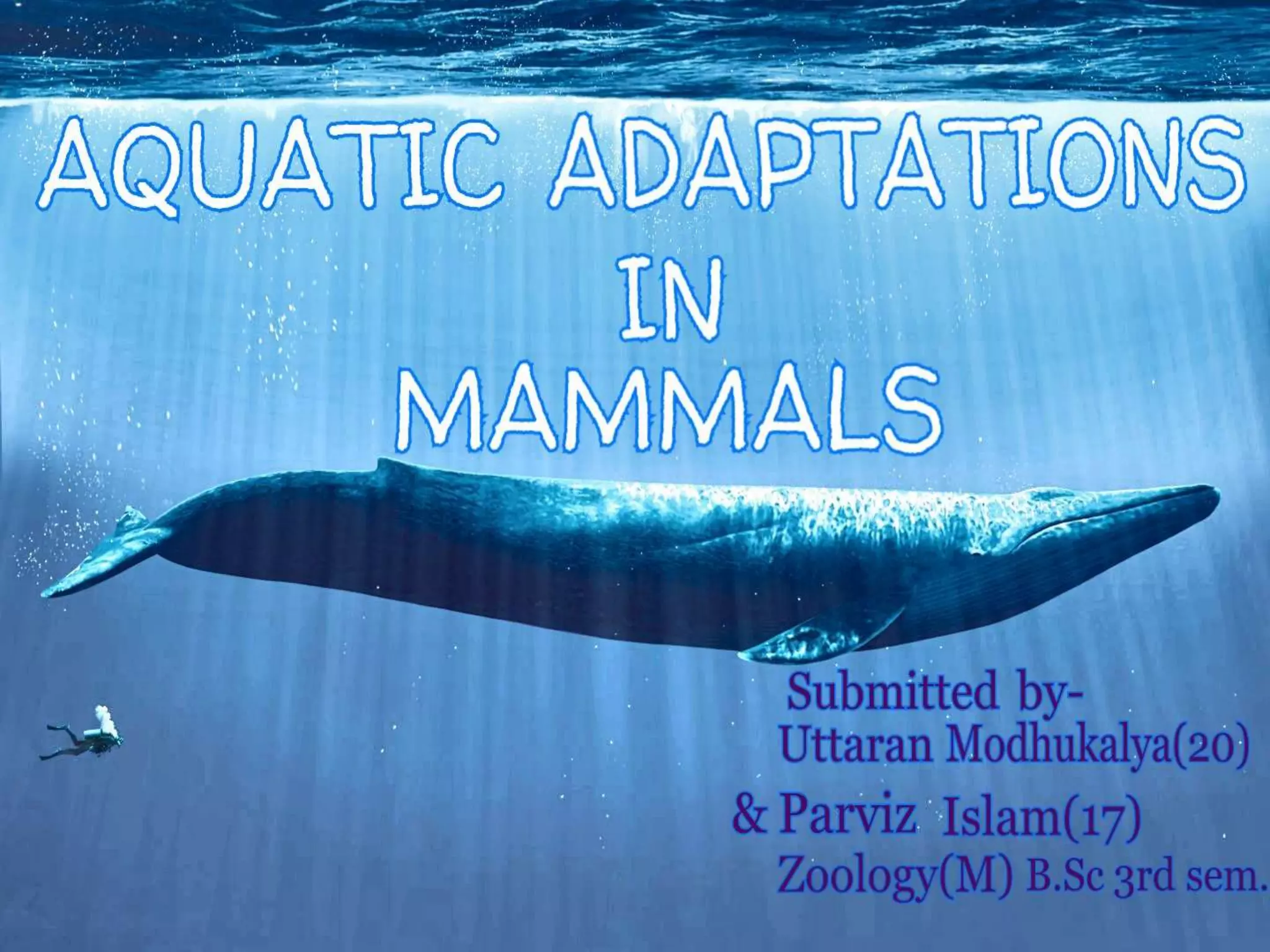
AQUATIC ADAPTATION OF
MAMMAL
ACKNOWLEDGEMENT
We are very much pleased to submit our seminar
topic on AQUATIC ADAPTATION OF MAMMAL for
B.Sc. 3rd semester. We sincerely thanks to our
honorable principal Dr. Prasanna Kr. Dutta to give
us opportunity for preparing the seminar topic and
our Professors Dr.Gayatri Agni Bora(HOD) and
Dr.Bikramaditya Bakalial of Zoology department of
our college for guiding properly the same.
We are also thankful to our other respected
teachers of the department and our friends and
parents for supporting us and help to make the
seminar on the above topic.
CONTENT
 INTRODUCTION
 ADAPTATION OF AQUATIC
MAMMALS
 MODIFICATION OF ORIGINAL
STRUCTURE
 LOSS OF STRUCTURE
 DEVELOPMENT OF NEW
STRUCTURE
 TYPES OF AQUATIC MAMMALS
 CONCLUSION
 REFERENCE
INTRODUCTION
ADAPTATION OF AQUATIC
MAMMALS
MODIFICATION OF ORIGINAL
STRUCTURE-
 A. Body shape – The body shape of
aquatic mammal become stream lined
with elongated head and indistinct neck
and tapering posterior region.
 B. Body size and weight – Aquatic
mammals develop a layer body size
which help to reduce heat loss and due
to buoyancy increased weight does not
produce any problem.
MODIFICATION OF ORIGINAL
STRUCTURE-
 C.Origin of flipper-
Forelimbs are modified
into skin covered
unjointed flipper .
 D. Upper valvular nostrils
– The nose opening is
move to the dorsal side of
the head that help animal
to breath air without
exposing its body. Valve
support the nasal
opening.
MODIFICATION OF ORIGINAL
STRUCTURE-
 E. Mammary gland – In
lactation the mammary
duct dilates and acts as
storage of milk which is
pumped directly into
the mouth of the young.
 F. Oblique diaphragm –
It makes thoracic cavity
larger that provide
more space for lungs.
MODIFICATION OF ORIGINAL
STRUCTURE-
 G. Large lungs – It allow the
animal to stay for a longer
period of time under water.
 H.Endoskeleton–
Modification of skull bone,
cervical vertebrae ribs can
be seen bones are light,
spongy and fill with oil.
 I.Teeth– Various modification
of teeth in different orders
can be observed, mobility of
jaws reduced.
Loss of structure-
 D. Lacrimal gland
and all kind of skin
gland are absent.
 E. Skin is devoid of
muscle and nerve.
 F. Pelvis portion
become rudimentary.
Development of new
structure-
 E. Foam – Thy have foam like
substance made up of fat
mucus and gas in the middle
ear which improve their hearing
under water.
 F. Melon – It is a receptor
organ present in front of nostril
which detect pressure change
in water.
 G. Harderian gland – This
gland secrete a fatty substance
which protect the eye under
water.
Development of new
structure-
 C. Blubber – A thick
subcutaneous layer of fat
called blubber act as a
thermo regulator and
maintain internal body
temperature. During deep
diving it absorb hydrostatic
pressure.
 D. Baleen – In some whale
the upper jaw develop rows
of numerous triangular horny
plate called baleen, serve as
effective sieve to capture
plankton.
Development of new
structure-
 A. Tail fluke – Aquatic
mammal develop large,
lateral or horizontal
expansion of skin in their
tail these called tail fluke
which are not supported
by fin rays or bones.
 B. Dorsal fin – They
develop an adipose dorsal
fin which serve as rather
or keel during swimming.
Loss of structure-
 A. Hair form body
surface degenerates
making the skin smooth
and less resistance
while moving in water
 B. Pinnae are also
absent.
 C. Nictitating
membrane of eye
absent.
Types of aquatic mammals-
 A. Amphibious mammals –
These numerous live in
land but go to water for food
and shelter. So they show
partial adaptation. e.g,
Hippopotamus, walrus etc.
 B. Completely aquatic
mammals – These
mammals never come to
land and are perfectly at
home in water. e.g, Blue
whale,dolphin.
CONCLUSION-
Presentation on aquatic mammals

Presentation on aquatic mammals

  • 1.
  • 2.
    ACKNOWLEDGEMENT We are verymuch pleased to submit our seminar topic on AQUATIC ADAPTATION OF MAMMAL for B.Sc. 3rd semester. We sincerely thanks to our honorable principal Dr. Prasanna Kr. Dutta to give us opportunity for preparing the seminar topic and our Professors Dr.Gayatri Agni Bora(HOD) and Dr.Bikramaditya Bakalial of Zoology department of our college for guiding properly the same. We are also thankful to our other respected teachers of the department and our friends and parents for supporting us and help to make the seminar on the above topic.
  • 3.
    CONTENT  INTRODUCTION  ADAPTATIONOF AQUATIC MAMMALS  MODIFICATION OF ORIGINAL STRUCTURE  LOSS OF STRUCTURE  DEVELOPMENT OF NEW STRUCTURE  TYPES OF AQUATIC MAMMALS  CONCLUSION  REFERENCE
  • 4.
  • 5.
  • 6.
    MODIFICATION OF ORIGINAL STRUCTURE- A. Body shape – The body shape of aquatic mammal become stream lined with elongated head and indistinct neck and tapering posterior region.  B. Body size and weight – Aquatic mammals develop a layer body size which help to reduce heat loss and due to buoyancy increased weight does not produce any problem.
  • 7.
    MODIFICATION OF ORIGINAL STRUCTURE- C.Origin of flipper- Forelimbs are modified into skin covered unjointed flipper .  D. Upper valvular nostrils – The nose opening is move to the dorsal side of the head that help animal to breath air without exposing its body. Valve support the nasal opening.
  • 8.
    MODIFICATION OF ORIGINAL STRUCTURE- E. Mammary gland – In lactation the mammary duct dilates and acts as storage of milk which is pumped directly into the mouth of the young.  F. Oblique diaphragm – It makes thoracic cavity larger that provide more space for lungs.
  • 9.
    MODIFICATION OF ORIGINAL STRUCTURE- G. Large lungs – It allow the animal to stay for a longer period of time under water.  H.Endoskeleton– Modification of skull bone, cervical vertebrae ribs can be seen bones are light, spongy and fill with oil.  I.Teeth– Various modification of teeth in different orders can be observed, mobility of jaws reduced.
  • 10.
    Loss of structure- D. Lacrimal gland and all kind of skin gland are absent.  E. Skin is devoid of muscle and nerve.  F. Pelvis portion become rudimentary.
  • 11.
    Development of new structure- E. Foam – Thy have foam like substance made up of fat mucus and gas in the middle ear which improve their hearing under water.  F. Melon – It is a receptor organ present in front of nostril which detect pressure change in water.  G. Harderian gland – This gland secrete a fatty substance which protect the eye under water.
  • 12.
    Development of new structure- C. Blubber – A thick subcutaneous layer of fat called blubber act as a thermo regulator and maintain internal body temperature. During deep diving it absorb hydrostatic pressure.  D. Baleen – In some whale the upper jaw develop rows of numerous triangular horny plate called baleen, serve as effective sieve to capture plankton.
  • 13.
    Development of new structure- A. Tail fluke – Aquatic mammal develop large, lateral or horizontal expansion of skin in their tail these called tail fluke which are not supported by fin rays or bones.  B. Dorsal fin – They develop an adipose dorsal fin which serve as rather or keel during swimming.
  • 14.
    Loss of structure- A. Hair form body surface degenerates making the skin smooth and less resistance while moving in water  B. Pinnae are also absent.  C. Nictitating membrane of eye absent.
  • 15.
    Types of aquaticmammals-  A. Amphibious mammals – These numerous live in land but go to water for food and shelter. So they show partial adaptation. e.g, Hippopotamus, walrus etc.  B. Completely aquatic mammals – These mammals never come to land and are perfectly at home in water. e.g, Blue whale,dolphin.
  • 16.