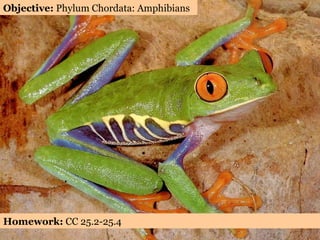
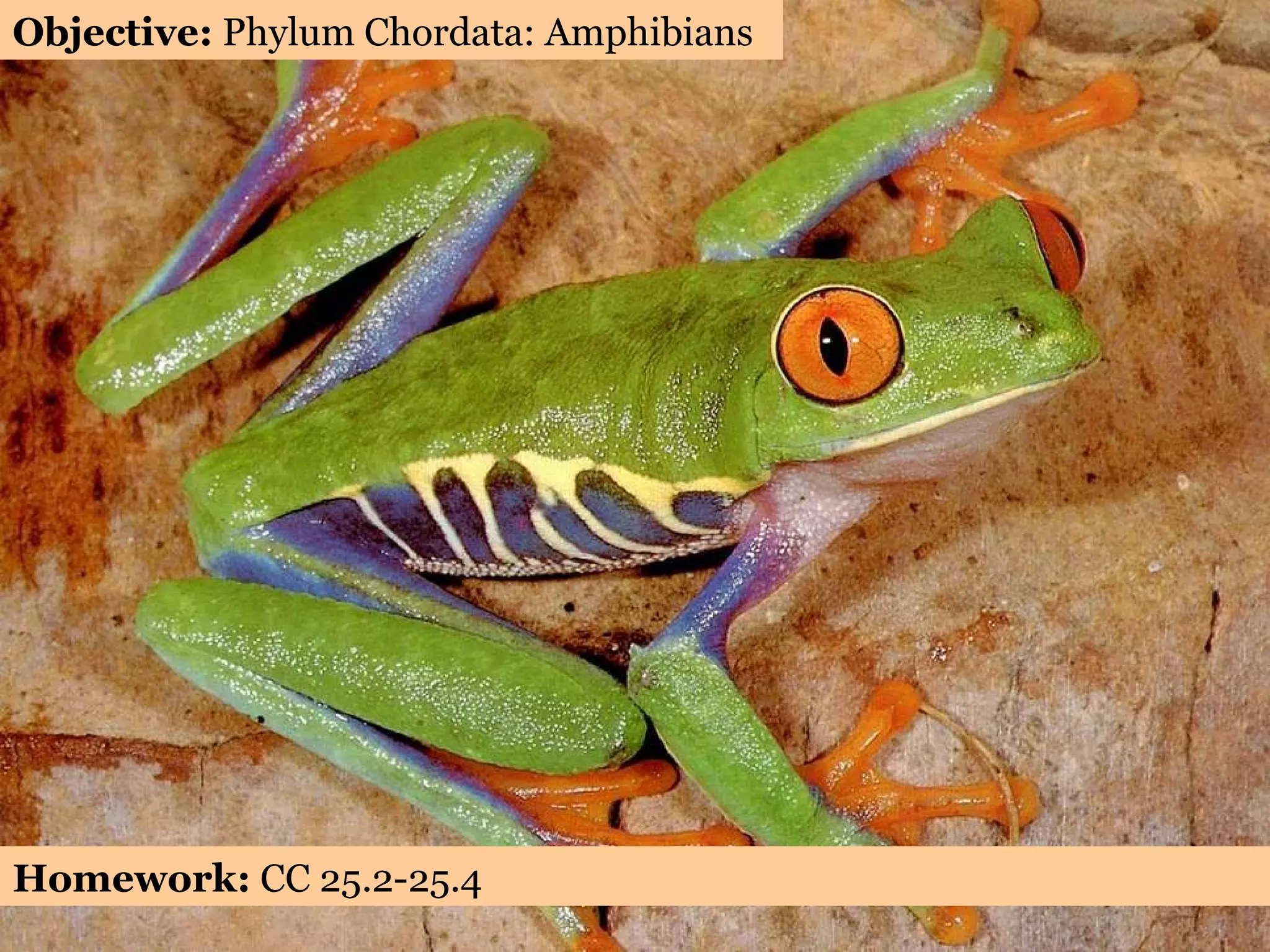
Objective:  Phylum Chordata: Amphibians Homework:  CC 25.2-25.4
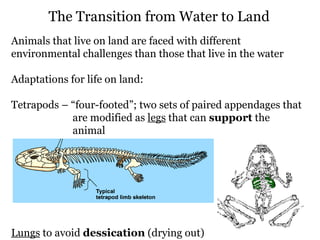
Animals that live on land are faced with different environmental challenges than those that live in the water Adaptations for life on land: Tetrapods – “four-footed”; two sets of paired appendages that  are modified as  legs  that can  support  the  animal Lungs  to avoid  dessication  (drying out)‏ The Transition from Water to Land
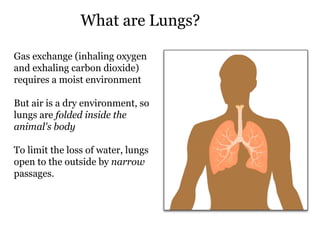
What are Lungs? Gas exchange (inhaling oxygen and exhaling carbon dioxide) requires a moist environment But air is a dry environment, so lungs are  folded inside the animal's body To limit the loss of water, lungs open to the outside by  narrow  passages.
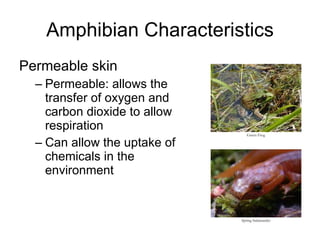
Amphibian Characteristics Permeable skin Permeable: allows the transfer of oxygen and carbon dioxide to allow respiration Can allow the uptake of chemicals in the environment Green Frog Spring Salamander
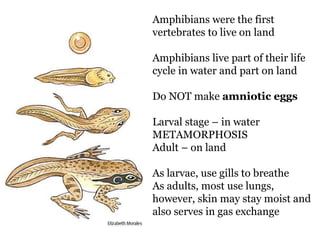
Amphibians were the first vertebrates to live on land Amphibians live part of their life cycle in water and part on land Do NOT make  amniotic eggs Larval stage – in water METAMORPHOSIS Adult – on land As larvae, use gills to breathe As adults, most use lungs, however, skin may stay moist and also serves in gas exchange
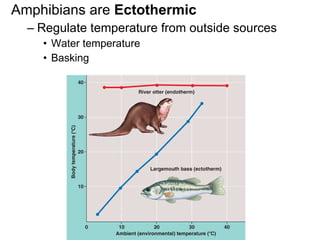
Amphibians are  Ectothermic Regulate temperature from outside sources Water temperature Basking
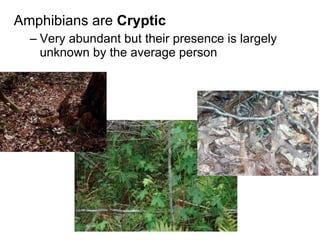
Amphibians are  Cryptic Very abundant but their presence is largely unknown by the average person
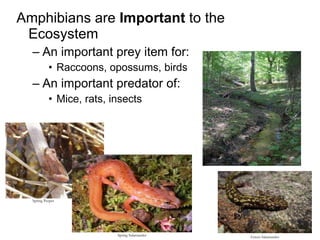
Amphibians are  Important  to the Ecosystem An important prey item for: Raccoons, opossums, birds An important predator of: Mice, rats, insects Spring Peeper Spring Salamander Green Salamander
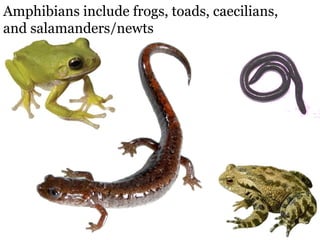
Amphibians include frogs, toads, caecilians, and salamanders/newts
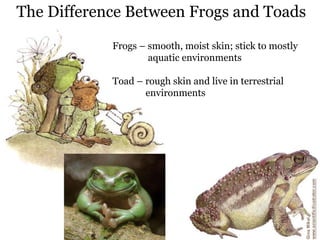
The Difference Between Frogs and Toads Frogs – smooth, moist skin; stick to mostly  aquatic environments Toad – rough skin and live in terrestrial  environments
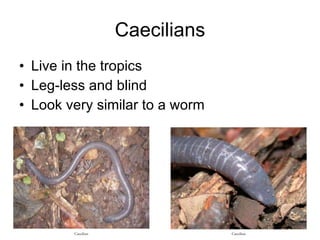
Caecilians Live in the tropics Leg-less and blind Look very similar to a worm Caecilian Caecilian
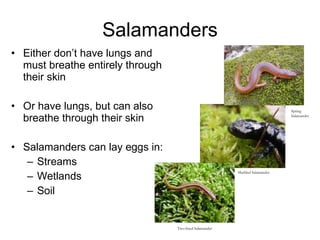
Salamanders Either don’t have lungs and must breathe entirely through their skin Or have lungs, but can also breathe through their skin Salamanders can lay eggs in: Streams Wetlands Soil Marbled Salamander Two-lined Salamander Spring Salamander
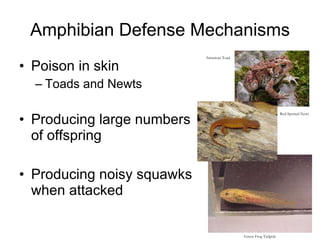
Amphibian Defense Mechanisms Poison in skin Toads and Newts Producing large numbers of offspring Producing noisy squawks when attacked American Toad Red-Spotted Newt Green Frog Tadpole
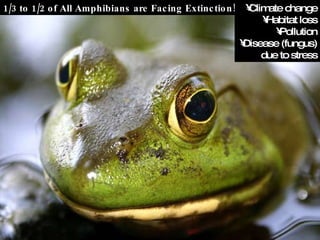
1/3 to 1/2 of All Amphibians are Facing Extinction! Climate change Habitat loss Pollution Disease (fungus)‏ due to stress

Phylum Chordata - Class Amphibia

  • 1.
    Objective: PhylumChordata: Amphibians Homework: CC 25.2-25.4
  • 2.
    Animals that liveon land are faced with different environmental challenges than those that live in the water Adaptations for life on land: Tetrapods – “four-footed”; two sets of paired appendages that are modified as legs that can support the animal Lungs to avoid dessication (drying out)‏ The Transition from Water to Land
  • 3.
    What are Lungs?Gas exchange (inhaling oxygen and exhaling carbon dioxide) requires a moist environment But air is a dry environment, so lungs are folded inside the animal's body To limit the loss of water, lungs open to the outside by narrow passages.
  • 4.
    Amphibian Characteristics Permeableskin Permeable: allows the transfer of oxygen and carbon dioxide to allow respiration Can allow the uptake of chemicals in the environment Green Frog Spring Salamander
  • 5.
    Amphibians were thefirst vertebrates to live on land Amphibians live part of their life cycle in water and part on land Do NOT make amniotic eggs Larval stage – in water METAMORPHOSIS Adult – on land As larvae, use gills to breathe As adults, most use lungs, however, skin may stay moist and also serves in gas exchange
  • 6.
    Amphibians are Ectothermic Regulate temperature from outside sources Water temperature Basking
  • 7.
    Amphibians are Cryptic Very abundant but their presence is largely unknown by the average person
  • 8.
    Amphibians are Important to the Ecosystem An important prey item for: Raccoons, opossums, birds An important predator of: Mice, rats, insects Spring Peeper Spring Salamander Green Salamander
  • 9.
    Amphibians include frogs,toads, caecilians, and salamanders/newts
  • 10.
    The Difference BetweenFrogs and Toads Frogs – smooth, moist skin; stick to mostly aquatic environments Toad – rough skin and live in terrestrial environments
  • 11.
    Caecilians Live inthe tropics Leg-less and blind Look very similar to a worm Caecilian Caecilian
  • 12.
    Salamanders Either don’thave lungs and must breathe entirely through their skin Or have lungs, but can also breathe through their skin Salamanders can lay eggs in: Streams Wetlands Soil Marbled Salamander Two-lined Salamander Spring Salamander
  • 13.
    Amphibian Defense MechanismsPoison in skin Toads and Newts Producing large numbers of offspring Producing noisy squawks when attacked American Toad Red-Spotted Newt Green Frog Tadpole
  • 14.
    1/3 to 1/2of All Amphibians are Facing Extinction! Climate change Habitat loss Pollution Disease (fungus)‏ due to stress

Editor's Notes

  • #5 Green Frog (Photo by J.D. Willson), Spring Salamander (Photo by K. Cecala)‏
  • #8 Timber Rattlesnake (Canebrake) (Photo by J.D. Willson), Eastern Diamondback Rattlesnake (Photo by M.E. Dorcas), Timber Rattlesnake (Canebrake) (Photo by Wayne VanDevender)‏
  • #9 Spring Peeper(photo by J.D. Willson), Spring Salamander (Photo by K. Cecala), Ringneck Snake (Photo by J.D. Willson), Green Salamander (Photo by J.D. Willson), Stream photo by Kristen Cecala
  • #12 Photos by Shannon Pittman, and J.D. Willson Caecilian
  • #13 Spring Salamander (Photo by Pierson Hill), Marbled Salamander (Photo by K. Cecala), Two-Lined Salamander (Photo by Pierson Hill)‏
  • #14 Photos by J. D. Willson American Toad, Red-Spotted newt, Green Frog Tadpole