Chordata:
Urochordata and
Cephalochordata
Michelle Sit and Paul Riviere
What is a Chordata
• Chordata are fishes, amphibians, reptiles,
birds, mammals, tunicates (Urochordata), and
lancelets (Cephalochordata)
Michelle Sit
Intro to chordates
- 4 defining characteristics of chordata:
- Notochord
- Flexible rod that is between digestive track and
nervous system.
- Hollow nerve cord (later becomes CNS)
- Have a tail: some lose tail after development
- Pharyngeal slits or clefts
- Grooves in the pharynx that develop into gills or a
filter to capture food with
Urochordata
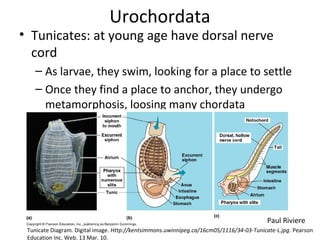
• Tunicates: at young age have dorsal nerve
cord
– As larvae, they swim, looking for a place to settle
– Once they find a place to anchor, they undergo
metamorphosis, loosing many chordata
characteristics (nervous system, muscles, etc.)
Tunicate Diagram. Digital image. Http://kentsimmons.uwinnipeg.ca/16cm05/1116/34-03-Tunicate-L.jpg. Pearson
Education Inc. Web. 13 Mar. 10.
Paul Riviere
Cephalochordata
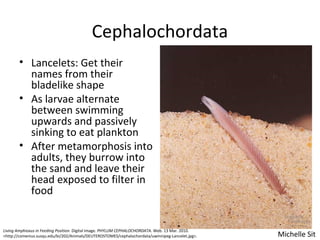
• Lancelets: Get their
names from their
bladelike shape
• As larvae alternate
between swimming
upwards and passively
sinking to eat plankton
• After metamorphosis into
adults, they burrow into
the sand and leave their
head exposed to filter in
food
Michelle Sit
Living Amphioxus in Feeding Position. Digital image. PHYLUM CEPHALOCHORDATA. Web. 13 Mar. 2010.
<http://comenius.susqu.edu/bi/202/Animals/DEUTEROSTOMES/cephalochordata/uwinnipeg-Lancelet.jpg>.
Sample Animals
Urochordata
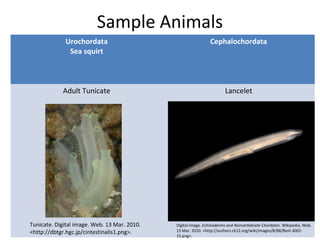
Sea squirt
Cephalochordata
Adult Tunicate Lancelet
Tunicate. Digital image. Web. 13 Mar. 2010.
<http://dbtgr.hgc.jp/cintestinalis1.png>.
Digital image. Echinoderms and Nonvertebrate Chordates. Wikipedia. Web.
13 Mar. 2010. <http://authors.ck12.org/wiki/images/8/88/BioII-3002-
15.png>.
Body cavity
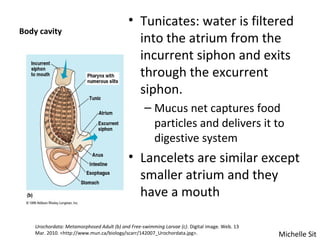
• Tunicates: water is filtered
into the atrium from the
incurrent siphon and exits
through the excurrent
siphon.
– Mucus net captures food
particles and delivers it to
digestive system
• Lancelets are similar except
smaller atrium and they
have a mouth
Michelle Sit
Urochordata: Metamorphosed Adult (b) and Free-swimming Larvae (c). Digital image. Web. 13
Mar. 2010. <http://www.mun.ca/biology/scarr/142007_Urochordata.jpg>.
Body symmetry
• Both have Bilateral symmetry
Paul Riviere
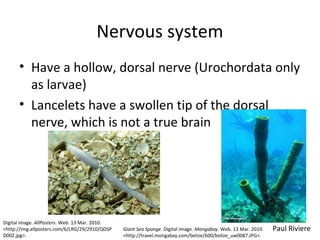
Nervous system
• Have a hollow, dorsal nerve (Urochordata only
as larvae)
• Lancelets have a swollen tip of the dorsal
nerve, which is not a true brain
Paul RiviereGiant Sea Sponge. Digital image. Mongabay. Web. 13 Mar. 2010.
<http://travel.mongabay.com/belize/600/belize_uw0087.JPG>.
Digital image. AllPosters. Web. 13 Mar. 2010.
<http://img.allposters.com/6/LRG/29/2910/QDSP
D00Z.jpg>.
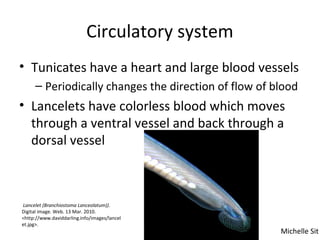
Circulatory system
• Tunicates have a heart and large blood vessels
– Periodically changes the direction of flow of blood
• Lancelets have colorless blood which moves
through a ventral vessel and back through a
dorsal vessel
Michelle Sit
Lancelet (Branchiostoma Lanceolatum)).
Digital image. Web. 13 Mar. 2010.
<http://www.daviddarling.info/images/lancel
et.jpg>.
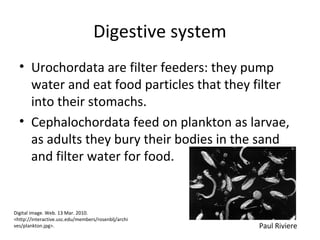
Digestive system
• Urochordata are filter feeders: they pump
water and eat food particles that they filter
into their stomachs.
• Cephalochordata feed on plankton as larvae,
as adults they bury their bodies in the sand
and filter water for food.
Paul Riviere
Digital image. Web. 13 Mar. 2010.
<http://interactive.usc.edu/members/rosenblj/archi
ves/plankton.jpg>.
Excretory system
• Lancelets pump water out through the
atriopore, separately from waste
• Urochordata pump out water and waste with
an excurrent siphon
– Both have a separate mouth and anus
Paul Riviere
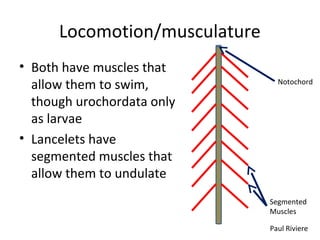
Locomotion/musculature
• Both have muscles that
allow them to swim,
though urochordata only
as larvae
• Lancelets have
segmented muscles that
allow them to undulate
Segmented
Muscles
Notochord
Paul Riviere
Skeletal type
• Notochord is a defining trait of these two
phylums
– It is a soft, flexible rod that is located between the
digestive and nervous systems.
– Allows these animals to swim
Primitive skeletal system, and notochord forms in
almost all more advanced species at some point in
development.
Paul Riviere
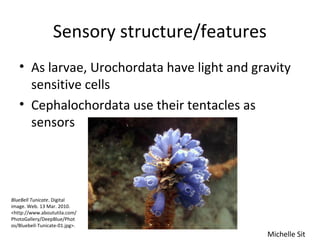
Sensory structure/features
• As larvae, Urochordata have light and gravity
sensitive cells
• Cephalochordata use their tentacles as
sensors
Michelle Sit
BlueBell Tunicate. Digital
image. Web. 13 Mar. 2010.
<http://www.aboututila.com/
PhotoGallery/DeepBlue/Phot
os/Bluebell-Tunicate-01.jpg>.
Reproduction
• Urochordata
– Both male and female (Hermaphroditic)
– Can reproduce sexually or asexually (budding)
• Celphalochordata
– Either male or female
– Reproduces sexually
Michelle Sit
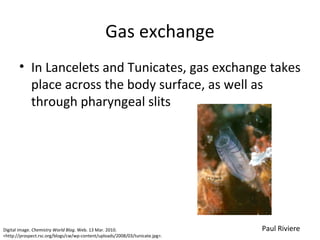
Gas exchange
• In Lancelets and Tunicates, gas exchange takes
place across the body surface, as well as
through pharyngeal slits
Paul RiviereDigital image. Chemistry World Blog. Web. 13 Mar. 2010.
<http://prospect.rsc.org/blogs/cw/wp-content/uploads/2008/03/tunicate.jpg>.
Other
• Tunicates can make cellulose
• Slits that allow water that enters mouth to
leave body without entering digestive track.
– Later evolve into gills for some vertebraes.
– For tetropods, become parts of ears, neck, and
head: pharyngeal clefts
Paul Riviere
QUIZ
• 1. Celphalochordata use what as sensory
features?
a) Tentacles
b) Tail
c) Mouth
d) Pharyngeal slits
a. Tentacles
Quiz
• 2. Cephalochordata are also known as
a) Sea sponges
b) Tunicates
c) Lancelets
d) Craniates
c. Lancelets
Quiz
• 3. Which of the following are not
characteristics of Chordata?
a) Tail
b) Notochord
c) Atrium
d) Hollow Nerve Cord
e) Pharyngeal cleft
C. Atrium
Quiz
• 4. What is the defining characteristic of these
two phylums?
a) Tail
b) Hollow Nerve Cord
c) Pharyngeal Cleft
d) Notochord
d. Notochord
Thanks!!

Chordata uro and ceph

  • 1.
  • 2.
    What is aChordata • Chordata are fishes, amphibians, reptiles, birds, mammals, tunicates (Urochordata), and lancelets (Cephalochordata) Michelle Sit
  • 3.
    Intro to chordates -4 defining characteristics of chordata: - Notochord - Flexible rod that is between digestive track and nervous system. - Hollow nerve cord (later becomes CNS) - Have a tail: some lose tail after development - Pharyngeal slits or clefts - Grooves in the pharynx that develop into gills or a filter to capture food with
  • 4.
    Urochordata • Tunicates: atyoung age have dorsal nerve cord – As larvae, they swim, looking for a place to settle – Once they find a place to anchor, they undergo metamorphosis, loosing many chordata characteristics (nervous system, muscles, etc.) Tunicate Diagram. Digital image. Http://kentsimmons.uwinnipeg.ca/16cm05/1116/34-03-Tunicate-L.jpg. Pearson Education Inc. Web. 13 Mar. 10. Paul Riviere
  • 5.
    Cephalochordata • Lancelets: Gettheir names from their bladelike shape • As larvae alternate between swimming upwards and passively sinking to eat plankton • After metamorphosis into adults, they burrow into the sand and leave their head exposed to filter in food Michelle Sit Living Amphioxus in Feeding Position. Digital image. PHYLUM CEPHALOCHORDATA. Web. 13 Mar. 2010. <http://comenius.susqu.edu/bi/202/Animals/DEUTEROSTOMES/cephalochordata/uwinnipeg-Lancelet.jpg>.
  • 6.
    Sample Animals Urochordata Sea squirt Cephalochordata AdultTunicate Lancelet Tunicate. Digital image. Web. 13 Mar. 2010. <http://dbtgr.hgc.jp/cintestinalis1.png>. Digital image. Echinoderms and Nonvertebrate Chordates. Wikipedia. Web. 13 Mar. 2010. <http://authors.ck12.org/wiki/images/8/88/BioII-3002- 15.png>.
  • 7.
    Body cavity • Tunicates:water is filtered into the atrium from the incurrent siphon and exits through the excurrent siphon. – Mucus net captures food particles and delivers it to digestive system • Lancelets are similar except smaller atrium and they have a mouth Michelle Sit Urochordata: Metamorphosed Adult (b) and Free-swimming Larvae (c). Digital image. Web. 13 Mar. 2010. <http://www.mun.ca/biology/scarr/142007_Urochordata.jpg>.
  • 8.
    Body symmetry • Bothhave Bilateral symmetry Paul Riviere
  • 9.
    Nervous system • Havea hollow, dorsal nerve (Urochordata only as larvae) • Lancelets have a swollen tip of the dorsal nerve, which is not a true brain Paul RiviereGiant Sea Sponge. Digital image. Mongabay. Web. 13 Mar. 2010. <http://travel.mongabay.com/belize/600/belize_uw0087.JPG>. Digital image. AllPosters. Web. 13 Mar. 2010. <http://img.allposters.com/6/LRG/29/2910/QDSP D00Z.jpg>.
  • 10.
    Circulatory system • Tunicateshave a heart and large blood vessels – Periodically changes the direction of flow of blood • Lancelets have colorless blood which moves through a ventral vessel and back through a dorsal vessel Michelle Sit Lancelet (Branchiostoma Lanceolatum)). Digital image. Web. 13 Mar. 2010. <http://www.daviddarling.info/images/lancel et.jpg>.
  • 11.
    Digestive system • Urochordataare filter feeders: they pump water and eat food particles that they filter into their stomachs. • Cephalochordata feed on plankton as larvae, as adults they bury their bodies in the sand and filter water for food. Paul Riviere Digital image. Web. 13 Mar. 2010. <http://interactive.usc.edu/members/rosenblj/archi ves/plankton.jpg>.
  • 12.
    Excretory system • Lanceletspump water out through the atriopore, separately from waste • Urochordata pump out water and waste with an excurrent siphon – Both have a separate mouth and anus Paul Riviere
  • 13.
    Locomotion/musculature • Both havemuscles that allow them to swim, though urochordata only as larvae • Lancelets have segmented muscles that allow them to undulate Segmented Muscles Notochord Paul Riviere
  • 14.
    Skeletal type • Notochordis a defining trait of these two phylums – It is a soft, flexible rod that is located between the digestive and nervous systems. – Allows these animals to swim Primitive skeletal system, and notochord forms in almost all more advanced species at some point in development. Paul Riviere
  • 15.
    Sensory structure/features • Aslarvae, Urochordata have light and gravity sensitive cells • Cephalochordata use their tentacles as sensors Michelle Sit BlueBell Tunicate. Digital image. Web. 13 Mar. 2010. <http://www.aboututila.com/ PhotoGallery/DeepBlue/Phot os/Bluebell-Tunicate-01.jpg>.
  • 16.
    Reproduction • Urochordata – Bothmale and female (Hermaphroditic) – Can reproduce sexually or asexually (budding) • Celphalochordata – Either male or female – Reproduces sexually Michelle Sit
  • 17.
    Gas exchange • InLancelets and Tunicates, gas exchange takes place across the body surface, as well as through pharyngeal slits Paul RiviereDigital image. Chemistry World Blog. Web. 13 Mar. 2010. <http://prospect.rsc.org/blogs/cw/wp-content/uploads/2008/03/tunicate.jpg>.
  • 18.
    Other • Tunicates canmake cellulose • Slits that allow water that enters mouth to leave body without entering digestive track. – Later evolve into gills for some vertebraes. – For tetropods, become parts of ears, neck, and head: pharyngeal clefts Paul Riviere
  • 19.
    QUIZ • 1. Celphalochordatause what as sensory features? a) Tentacles b) Tail c) Mouth d) Pharyngeal slits
  • 20.
  • 21.
    Quiz • 2. Cephalochordataare also known as a) Sea sponges b) Tunicates c) Lancelets d) Craniates
  • 22.
  • 23.
    Quiz • 3. Whichof the following are not characteristics of Chordata? a) Tail b) Notochord c) Atrium d) Hollow Nerve Cord e) Pharyngeal cleft
  • 24.
  • 25.
    Quiz • 4. Whatis the defining characteristic of these two phylums? a) Tail b) Hollow Nerve Cord c) Pharyngeal Cleft d) Notochord
  • 26.
  • 27.