

Protective Adaptations
of Animals to their Environment
Adaptation
is the ability of an animal to adjust to its environment.
Animals have many different defense mechanisms
that can protect them against predators or gain them
an evening meal.
Prey an animal or animals caught, killed, and eaten by another animal as food.
Predator a carnivorous animal that hunts, kills, and eats other animals in order
to survive, or any other organism that behaves in a similar manner
Different Types of Protection/ Defense
Mechanism
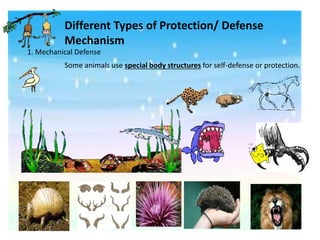
1. Mechanical Defense
Some animals use special body structures for self-defense or protection.
2. Chemical Defense
Chemical defense relates to secretion of chemicals as a means
to avoid the enemy or kill it , some make themselves taste bad
others, some smell really bad, These chemicals either befuddle
the enemy or stun it or repel it.
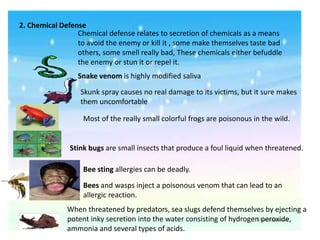
Skunk spray causes no real damage to its victims, but it sure makes
them uncomfortable
Snake venom is highly modified saliva
When threatened by predators, sea slugs defend themselves by ejecting a
potent inky secretion into the water consisting of hydrogen peroxide,
ammonia and several types of acids.
Most of the really small colorful frogs are poisonous in the wild.
Stink bugs are small insects that produce a foul liquid when threatened.
Bee sting allergies can be deadly.
Bees and wasps inject a poisonous venom that can lead to an
allergic reaction.
3. Behavioral Defense
Acts of aggression by animals toward one another can be caused by reasons
ranging from the protection of their young to territory disputes.
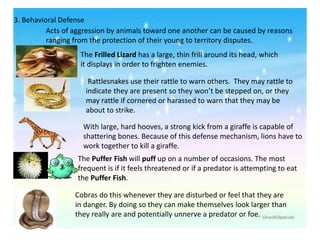
The Frilled Lizard has a large, thin frill around its head, which
it displays in order to frighten enemies.
With large, hard hooves, a strong kick from a giraffe is capable of
shattering bones. Because of this defense mechanism, lions have to
work together to kill a giraffe.
Cobras do this whenever they are disturbed or feel that they are
in danger. By doing so they can make themselves look larger than
they really are and potentially unnerve a predator or foe.
Rattlesnakes use their rattle to warn others. They may rattle to
indicate they are present so they won’t be stepped on, or they
may rattle if cornered or harassed to warn that they may be
about to strike.
The Puffer Fish will puff up on a number of occasions. The most
frequent is if it feels threatened or if a predator is attempting to eat
the Puffer Fish.
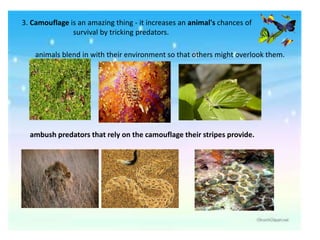
ambush predators that rely on the camouflage their stripes provide.
3. Camouflage is an amazing thing - it increases an animal's chances of
survival by tricking predators.
animals blend in with their environment so that others might overlook them.
Mimicry- similarity of appearance in nature: the resemblance of a plant
or animal to another species or to a feature of its natural
surroundings, developed as protection from predators.
The Arts of Deception

Animal defenssive adaptation

  • 1.
    Protective Adaptations of Animalsto their Environment Adaptation is the ability of an animal to adjust to its environment. Animals have many different defense mechanisms that can protect them against predators or gain them an evening meal. Prey an animal or animals caught, killed, and eaten by another animal as food. Predator a carnivorous animal that hunts, kills, and eats other animals in order to survive, or any other organism that behaves in a similar manner
  • 2.
    Different Types ofProtection/ Defense Mechanism 1. Mechanical Defense Some animals use special body structures for self-defense or protection.
  • 3.
    2. Chemical Defense Chemicaldefense relates to secretion of chemicals as a means to avoid the enemy or kill it , some make themselves taste bad others, some smell really bad, These chemicals either befuddle the enemy or stun it or repel it. Skunk spray causes no real damage to its victims, but it sure makes them uncomfortable Snake venom is highly modified saliva When threatened by predators, sea slugs defend themselves by ejecting a potent inky secretion into the water consisting of hydrogen peroxide, ammonia and several types of acids. Most of the really small colorful frogs are poisonous in the wild. Stink bugs are small insects that produce a foul liquid when threatened. Bee sting allergies can be deadly. Bees and wasps inject a poisonous venom that can lead to an allergic reaction.
  • 5.
    3. Behavioral Defense Actsof aggression by animals toward one another can be caused by reasons ranging from the protection of their young to territory disputes. The Frilled Lizard has a large, thin frill around its head, which it displays in order to frighten enemies. With large, hard hooves, a strong kick from a giraffe is capable of shattering bones. Because of this defense mechanism, lions have to work together to kill a giraffe. Cobras do this whenever they are disturbed or feel that they are in danger. By doing so they can make themselves look larger than they really are and potentially unnerve a predator or foe. Rattlesnakes use their rattle to warn others. They may rattle to indicate they are present so they won’t be stepped on, or they may rattle if cornered or harassed to warn that they may be about to strike. The Puffer Fish will puff up on a number of occasions. The most frequent is if it feels threatened or if a predator is attempting to eat the Puffer Fish.
  • 6.
    ambush predators thatrely on the camouflage their stripes provide. 3. Camouflage is an amazing thing - it increases an animal's chances of survival by tricking predators. animals blend in with their environment so that others might overlook them.
  • 8.
    Mimicry- similarity ofappearance in nature: the resemblance of a plant or animal to another species or to a feature of its natural surroundings, developed as protection from predators. The Arts of Deception