Anti-predator adaptations are specialized traits or behaviors that help animals defend against predators, such as camouflage, mimicry, or defensive structures. These adaptations enhance survival chances by avoiding detection, deterring attacks, or protecting against predator threats.
ANTI-PREDATOR ADAPTATIONSIN ANIMALS
• An adaptation is a characteristic of a species (e.g., Behavioral, physical)
that enables it to survive in its natural environment.
• Adaptations develop and change over time through the process of
evolution.
• It is a characteristic of an organism that develops through time, which
improves its chance of survival & reproduction.
Adaptation
3.
ANTI-PREDATOR ADAPTATIONS
Prey animalshave evolved characteristics to escape predators that
are called anti-predator adaptations.
Anti-predator adaptations include ways to prevent being sensed
by predators, as well as to prevent being captured, attacked and
eaten.
Anti-predator adaptations include ways to prevent being sensed
by predators, as well as to prevent being captured, attacked and
eaten.
4.
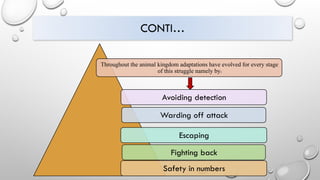
CONTI…
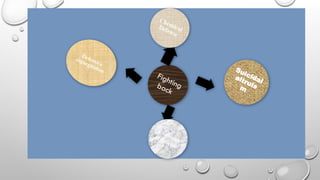
Throughout the animalkingdom adaptations have evolved for every stage
of this struggle namely by:
Avoiding detection
Warding off attack
Escaping
Fighting back
Safety in numbers
5.
CONTI…
• Finally,some species are able to escape even when
caught by sacrificing certain body parts: crabs can shed a
claw, while lizards can shed their tails, often distracting
predators long enough to permit the prey to escape.
6.
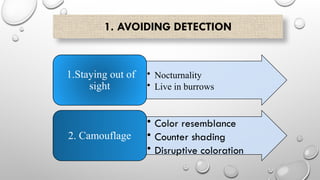
1. AVOIDING DETECTION
•Nocturnality
• Live in burrows
1.Staying out of
sight
• Color resemblance
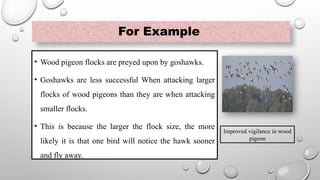
• Counter shading
• Disruptive coloration
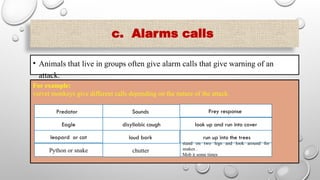
2. Camouflage
7.
a. Staying OutOf Sight
Animals may avoid becoming prey by living out of sight
of predators, whether in caves, burrows, or by being
nocturnal.
8.
a. Nocturnality
•Nocturnality isan animal behavior characterized by
activity during the night and sleeping during the day.
•This is a behavioral form of detection avoidance called
crypsis used by animals to either avoid predation or to
enhance prey hunting.
9.
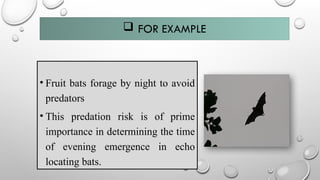
FOR EXAMPLE
•Fruit bats forage by night to avoid
predators
• This predation risk is of prime
importance in determining the time
of evening emergence in echo
locating bats.
10.
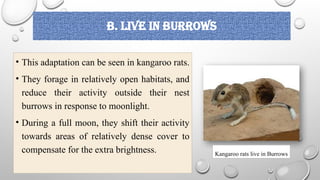
b. LIVE INBURROWS
• This adaptation can be seen in kangaroo rats.
• They forage in relatively open habitats, and
reduce their activity outside their nest
burrows in response to moonlight.
• During a full moon, they shift their activity
towards areas of relatively dense cover to
compensate for the extra brightness. Kangaroo rats live in Burrows
11.
2. CAMOUFLAGE
• Camouflageis an adaptation in which a species evolves to resemble
its background.
• It is the technique used by many animals of resembling and blending
in with their surroundings.
• Prey animals use camouflage to remain undetected by their
predators.
• predators use camouflage to sneak up, unseen, by their prey.
12.
a. COLOR RESEMBLANCE
•An animal’s color resembles its natural environment.
• This helps the animal to not be seen while still in plain view
• Some animals such as the Snowshoe Hare adapt
seasonally.
• They come winter, their color changes to white,
which helps them blend in with the snow.
• In the spring, their color changes back to brown
to blend in with the surrounding environment.
For example
Snowshoe color in
winter
Snowshoe color in
spring
13.
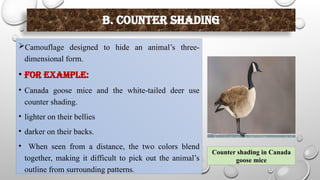
b. COUNTER SHADING
Camouflagedesigned to hide an animal’s three-
dimensional form.
• For example:
• Canada goose mice and the white-tailed deer use
counter shading.
• lighter on their bellies
• darker on their backs.
• When seen from a distance, the two colors blend
together, making it difficult to pick out the animal’s
outline from surrounding patterns.
Counter shading in Canada
goose mice
14.
c. DISRUPTIVE COLORATION
Markings
disguisethe
animal among
its surroundings
It leads the eye
away from its
shape and into
the background.
Animals that have
patterns of spots,
stripes or uneven
patches use this
method of
camouflage.
15.
FOR EXAMPLE
• Zebrasuse disruptive coloration.
• It lives in herds. Lions like to pick out one member of
the herd that looks weak.
• When the lion attacks the zebras start running in all
directions.
• With all those stripes mixing together, it’s easy for
the lion to lose the zebra it picked out of the herd.
Zebras: a disruptively camouflaged
predator
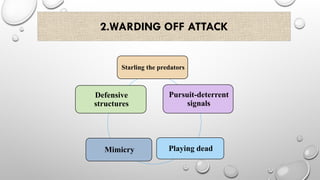
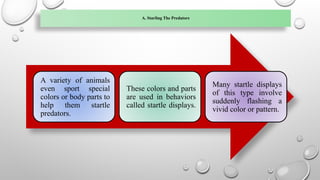
A. Starling ThePredators
A variety of animals
even sport special
colors or body parts to
help them startle
predators.
These colors and parts
are used in behaviors
called startle displays.
Many startle displays
of this type involve
suddenly flashing a
vivid color or pattern.
18.
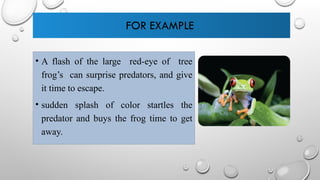
FOR EXAMPLE
• Aflash of the large red-eye of tree
frog’s can surprise predators, and give
it time to escape.
• sudden splash of color startles the
predator and buys the frog time to get
away.
19.
B. PURSUIT-DETERRENT SIGNALS
•When encountering predators prey animals often expose themselves by loud
vocalization, by repeated movements or by revealing conspicuous colors.
• Warning calls given by birds such as the Eurasian jay are similarly honest signals,
benefiting both predator and prey:
• The predator is informed that it has been detected and might as well save time and
energy by giving up the chase, while the prey is protected from attack.
For example
20.
C. PLAYING DEAD
•A number of animals including mammals, insects and reptiles exhibit a type of
adaptive behavior known as playing dead or tonic immobility.
• When faced with a threatening situation, an animal may appear lifeless and may
even emit odors that resemble the smell of decaying flesh.
• Also known as thanatosis, playing dead is often used as a defense mechanism, a
trick to catch prey, or a means to sexually reproduce.
21.
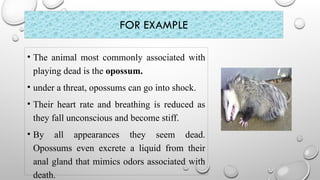
FOR EXAMPLE
• Theanimal most commonly associated with
playing dead is the opossum.
• under a threat, opossums can go into shock.
• Their heart rate and breathing is reduced as
they fall unconscious and become stiff.
• By all appearances they seem dead.
Opossums even excrete a liquid from their
anal gland that mimics odors associated with
death.
22.
D. MIMICRY
• Mimicryoccurs when an organism (the mimic) simulates signal
properties of another organism (the model) to confuse a third organism.
• His results in the mimic gaining protection, food, and mating
advantages.
23.
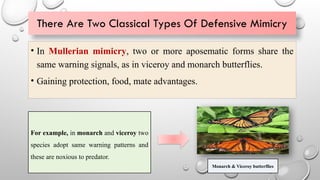
There Are TwoClassical Types Of Defensive Mimicry
• In Mullerian mimicry, two or more aposematic forms share the
same warning signals, as in viceroy and monarch butterflies.
• Gaining protection, food, mate advantages.
For example, in monarch and viceroy two
species adopt same warning patterns and
these are noxious to predator.
Monarch & Viceroy butterflies
24.
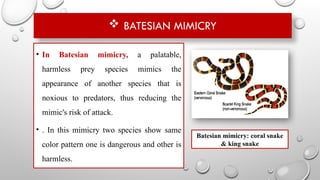
BATESIAN MIMICRY
•In Batesian mimicry, a palatable,
harmless prey species mimics the
appearance of another species that is
noxious to predators, thus reducing the
mimic's risk of attack.
• . In this mimicry two species show same
color pattern one is dangerous and other is
harmless.
Batesian mimicry: coral snake
& king snake
25.
E. DEFENSIVE STRUCTURES
•When an animal is under attack, it will defend itself
with all the weapons it has arms, legs, wings, hooves,
teeth, claws, antlers, etc.
• Some animals have further adapted to defending
themselves and have developed other forms of defense.
26.
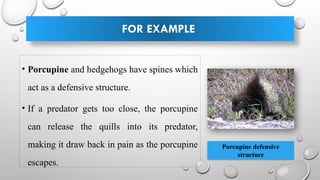
FOR EXAMPLE
• Porcupineand hedgehogs have spines which
act as a defensive structure.
• If a predator gets too close, the porcupine
can release the quills into its predator,
making it draw back in pain as the porcupine
escapes.
Porcupine defensive
structure
A. FLIGHT
• Ifpredator attacks on the prey then the normal reaction of prey is
to flee by an available means such as flying, gliding, running and
burrowing.
• . Escape paths are often erratic, making it difficult for the predator
to predict which way the prey will go next
29.
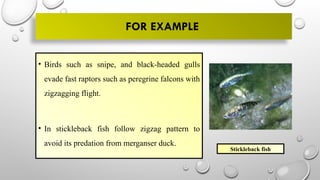
FOR EXAMPLE
• Birdssuch as snipe, and black-headed gulls
evade fast raptors such as peregrine falcons with
zigzagging flight.
• In stickleback fish follow zigzag pattern to
avoid its predation from merganser duck.
Stickleback fish
30.
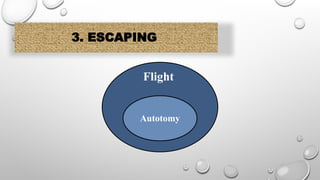
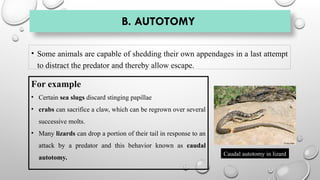
B. AUTOTOMY
• Someanimals are capable of shedding their own appendages in a last attempt
to distract the predator and thereby allow escape.
For example
• Certain sea slugs discard stinging papillae
• crabs can sacrifice a claw, which can be regrown over several
successive molts.
• Many lizards can drop a portion of their tail in response to an
attack by a predator and this behavior known as caudal
autotomy.
Caudal autotomy in lizard
A. CHEMICAL DEFENSE
•Some animals and insects use chemical defense.
• When attacked, some may spit, spray, or squirt chemicals which can cause pain or
discomfort to the predator.
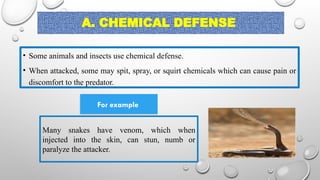
Many snakes have venom, which when
injected into the skin, can stun, numb or
paralyze the attacker.
For example
33.
CONTI…
• Skunks usean odor to protect themselves.
• They produce a strong liquid called musk. Musk is made and stored in glands near the tail.
• When another animal comes too close, the skunk raises its tail and sprays musk from its
glands.
• While the intruder is reeling from the powerful odor, the skunk runs away.
34.
B. COMMUNAL DEFENSE
•In communal defense, prey groups actively defend themselves by grouping together and
sometimes by attacking or mobbing a predator rather than allowing themselves to be passive
victims of predation.
• Mobbing is the harassing of a predator by many prey animals.
• Mobbing is usually done to protect the young in social colonies.
35.
For Example
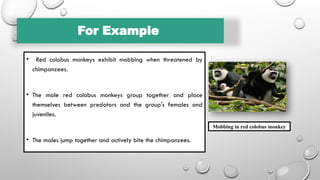
• Redcolobus monkeys exhibit mobbing when threatened by
chimpanzees.
• The male red colobus monkeys group together and place
themselves between predators and the group's females and
juveniles.
• The males jump together and actively bite the chimpanzees.
Mobbing in red colobus monkey
36.
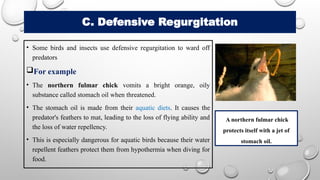
C. Defensive Regurgitation
•Some birds and insects use defensive regurgitation to ward off
predators
For example
• The northern fulmar chick vomits a bright orange, oily
substance called stomach oil when threatened.
• The stomach oil is made from their aquatic diets. It causes the
predator's feathers to mat, leading to the loss of flying ability and
the loss of water repellency.
• This is especially dangerous for aquatic birds because their water
repellent feathers protect them from hypothermia when diving for
food.
A northern fulmar chick
protects itself with a jet of
stomach oil.
37.
D. Suicidal Altruism
Colonydefense is a necessary
but dangerous task for some
animals.
As an extreme form of colony defense is
self-sacrificial behaviors that is evolved
by kin selection in various social insects.
Most self-sacrificial defensive
mechanisms occur in response to an
acute threat to the colony.
38.
For Example
• InMalaysian exploding ant when a worker ant's leg is grasped it suicidally expels the contents
of its hypertrophied submandibular glands expelling corrosive irritant compounds and
adhesives onto the predator.
• These prevent predation and serve as a signal to other enemy ants to stop predation of the rest
of the colony.
39.
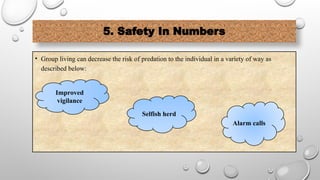
5. Safety InNumbers
• Group living can decrease the risk of predation to the individual in a variety of way as
described below:
Improved
vigilance
Selfish herd
Alarm calls
40.
A. Improved Vigilance
•In the improved vigilance effect groups are able to detect predator’s sooner than
solitary individuals.
• As the number of predator increase chances of predator is decrease.
• If the prey is alerted early in an attack they have an improved chance of escape.
41.
For Example
• Woodpigeon flocks are preyed upon by goshawks.
• Goshawks are less successful When attacking larger
flocks of wood pigeons than they are when attacking
smaller flocks.
• This is because the larger the flock size, the more
likely it is that one bird will notice the hawk sooner
and fly away.
Improved vigilance in wood
pigeon
42.
b. Selfish Herd
•The selfish herd theory was proposed by W.D. Hamilton to explain why animals seek
central positions in a group.
• The theory's central idea is to reduce the individual's domain of danger. A domain of danger
is the area within the group in which the individual is more likely to be attacked by a
predator.
• The center of the group has the lowest domain of danger, so animals are predicted to strive
constantly to gain this position.
43.
c. Alarms calls
•Animals that live in groups often give alarm calls that give warning of an
attack.
For example:
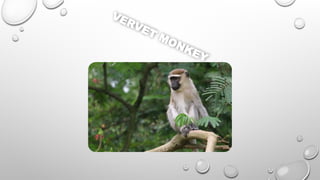
vervet monkeys give different calls depending on the nature of the attack.
Predator Sounds Prey response
Eagle disyllabic cough look up and run into cover
leopard or cat loud bark run up into the trees
Python or snake chutter
stand on two legs and look around for
snakes .
Mob it some times
REFERENCES
• Daly, M.,P. R. Behrends, M. Wilson and L. Jacobs. 1992. Behavioral modulation of predation
risk: moonlight avoidance and crepuscular compensation in a nocturnal desert rodent,
dipodomys merriami. Anim. Behav., 44: 1-9
• Rosalind, K., D. Humphreys and D. Graeme. 2018. A review of thanatosis (death feigning)
as an anti-predator behavior. Behavioral ecology and sociobiology, 72: 1-16.
• Scott, r. S., E. Ehrhardt and T. Eisner. 1993. Defensive regurgitation by a noctuid moth larva
(litoprosopus futilis). A journal of entomology, 100: 209-221.
46.
CONTI…
• Endler, J.A. 1981. An overview of the relationships between mimicry and crypsis. Biological journal of the
linnean society, 16: 25-31.
• Holmgren, h., M. Enquist. 1999. Dynamics of mimicry evolution. Biological journal of the linnean society,
66: 145-158.
• Ritland, d. B. 1995. Comparative unpalatability of mimetic viceroy butterflies (limenitis archippus) from
four south-eastern united states populations. Oecologia, 103: 327-336.
• Leblanc, a. R. H., M. J. Macdougall, Y. Haridy, D. Scott and R. R. Reisz. 2018. Caudal autotomy as anti-
predatory behaviour in palaeozoic reptiles. Scientific reports, 8: 963-965.
47.
Conti…
• Warham, j.1977. The incidence, functions and ecological significance of petrel stomach oils.
New zealand ecological society, 24: 84-93.
• Pulliam, h. R. 1973. On the advantages of flocking. J. Theor. Biol., 38: 419-22.
• Hamilton, w. 1971. Geometry for the selfish herd. Journal of theoretical biology, 31: 295-311.
• Stanford, b. And B. Craig. 1995. The influence of chimpanzee predation on group size and anti-
predator behavior in red colobus monkeys. Anim. Behav., 49: 577-587.

 Most read